#precalculus
1 messages · Page 280 of 1
 vestal zenith
vestal zenith
vestal zenith
I can show you how to do it on wordmat
 viscid thistle
ok
vestal zenith
so this is what I get
first you make a table like the one in the picture
and then you choose the wordmat tab > regression > exponential regression
and you get the following equation
viscid thistle
huh
Hm
Do you know how to do it on a graphing calculator?
I have to find the a and b values though
vestal zenith
yes you can see the a and b values in the equation
viscid thistle
I need a graph though
 obsidian monolithBOT
kyoto
viscid thistle
ok
vestal zenith
you can plug the equation in your graphing calculator
but I can see in your case the form is:
$y=a \cdot b^x$
obsidian monolithBOT
kyoto
vestal zenith
so what's the value of a and b here? @viscid thistle
viscid thistle
I don't even know so confusing
vestal zenith
look at the picture I sent
viscid thistle
Can you show me it on paper @vestal zenith over text is hard
Ye
Idk how you got those numbers though
in the progress
vestal zenith
it's a bit hard to explain when you're not used to wordmat
and i'm wondering why your teacher haven't taught you how to do regression yet
i'm not familiar with desmos but I found a video about it here: https://www.youtube.com/watch?v=zcZaI-xfiFE
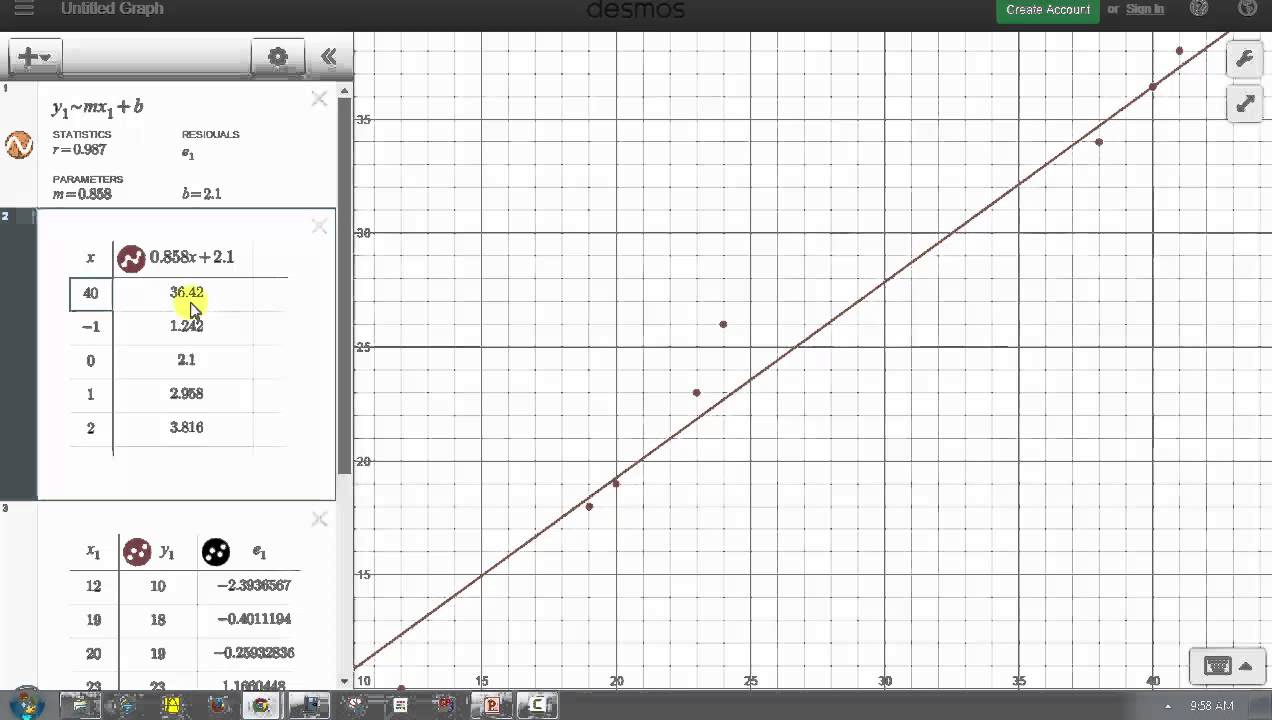
This video explains how to perform linear regression using the online graphing tool Desmos.
http://mathispower4u.com
viscid thistle
ok ty
 thin jewel
anyone help me with velocity problem?
 vague hearth
 rare zephyr
is there such thing as the inverse of a factorial
like how division is the inverse of multiply
 prime yoke
can someone simply explain the reasoning behind why floor(-x) and -floor(x) are different
 undone pawn
 supple hazel
 late pewter
which part are you stuck on
 mystic umbra
@thorn agate
late pewter
have you learned about derivatives?
if not have you learned anything about exponential growth
late pewter
rate of growth
thats just a derivative
sapphire grows overtime at a declining rate
thats also a derivative
late pewter
 thorn agate
?
thorn agate
?
also this is a precalculus channel btw
 hexed granite
I need 7, or 8
 lunar axle
can someone plz help
 proud raven
do you have any notes?
@lunar axle
this is usually what youll use for C -> P
obviously youll need to simplify
 clever pecan
r means radius
viscid thistle
yes.
 crude pilot
yeah
 astral knoll
yes, as it has changed cot into 1/cot which is wrong.
viscid thistle
Would the quadratic function be A(x) = 6^2 + 12x + c?
not even sure
@astral knoll
astral knoll
Area=width * length, so new area is (6+x)(12+2x), now multiply and u will get the result in the form asked.
viscid thistle
for a question like this
are we supposed to assume that the right triangles evenly share the height of the pole
so like each side thats adjacent to the pole is 15 ft
or am i getting that wrong
bruh
crude pilot
divide it by 2 then factor
 trail niche
viscid thistle
are we supposed to assume that the right triangles evenly share the height of th...
trail niche
viscid thistle
are we supposed to assume that the right triangles evenly share the height of th...
Probs not
Since they got different angles
Try treating the whole system as one big triangle by adding the two angles
You know the height of the base
And the angle of one side
Crap actually nvm then u can’t use trig
 steel tulip
What have you tried so far?
 worldly radish
well im just wondering what am i supposed to do with A, B, and C
 potent imp
plug in -2 into the equation
worldly radish
-1 if x<0
-1 if x is greater/equal to 0
soo the 1st part is true but the 2nd part isnt
potent imp
yeah
 astral mantle
what part of this are you confused about?
if x=3 then h(3) = 6
otherwise, just substitute x into the other equation
potent imp
also note that the other equation simplifies to x+3 if x is not 3
 quartz oxide
help pls
viscid thistle
@quartz oxide do u still need help?
viscid thistle
ok, do you remember solving quadratic equations during Algebra II?
quartz oxide
yea kinda
viscid thistle
okay great, so simplify this let's just refer to this as $3x^2 - 7x + 2 = 0$
obsidian monolithBOT
Jitter
viscid thistle
do you know how to put the equation into factored form?
quartz oxide
would it be (3x-1)(x-2)=0
obsidian monolithBOT
Jitter
viscid thistle
we can set each equation equal to zero, getting the equations $3sin(x)-1=0$ and $sin(x)-2=0$
obsidian monolithBOT
Jitter
quartz oxide
so is that the solutions for [0,2pi]?
viscid thistle
Well, you can simplify it and find an exact value by solving for $sin(x)$. first equation would be $sin(x)=1/3$ and the second $sin(x)=2$
obsidian monolithBOT
Jitter
 thorn lily
I need to solve for x (the original problem is circled). Below the problem is my work so far, but I’m stuck on how to get the x’s on one side of the equation. My teacher wants us to provide the exact solution and an approximate solution.
thorn lily
Ok, what did I do incorrectly? And how do I move the x to one side?
 shrewd root
u have to expand the brackets when it first appears
then move all x term to one side by addition/subtraction
then factor out the x
thorn lily
sorry, how do I expand the parentheses?
shrewd root
(x-1)log2: x log2-log2
shrewd root
yes!
thorn lily
Thank you!
shrewd root
but not done yet
thorn lily
Yeah. Where do I go from here?
shrewd root
shrewd root
then factor out the x
step 3^
thorn lily
By factor it out do you mean divide?
shrewd root
2x + 4, factor out 2 becomes 2(x+4)
thorn lily
Ah ok
shrewd root
factor means take out common factor
shrewd root
looks good
astral knoll
viscid thistle
<@!526810042905788438> Would it be (x+6) and (2x+12)
yes
 sinful gull
What do you mean..
 onyx gazelle
Never mind I figured out my own question
sinful gull
Alright then

 trail sun
@iron pendant
 agile owl
how would i answer this?
 sick steppe
polynomial of degree n will have nth differences be constant @agile owl
agile owl
im not sure what that means
sick steppe
Lines (degree 1 polynomials) have constant 1st difference
quadratics (degree 2) have 2nd differences constant
etc
agile owl
oh ok then that's degree 4 cuz its x^4?
sick steppe
yes
agile owl
that makes sense thank u
the word differences messes me up
then this would be 3rd differences cuz its degree 3?
sick steppe
yes
worldly radish
agile owl
how would i find what number it is?
sick steppe
d = an! @agile owl
agile owl
d=4(3!) ???
sick steppe
yes
 elfin arrow
Can anyone help me solve this question? "A balloon drops 2 balls with a time of 3s between the drops, after 10 seconds the first ball reaches the ground, how high is the balloon? (tag me if u can help me out)
 serene river
anyone?
 ember socket
Hello
I am Solving a exponential function. I’m at 4^2x+9=12
So after subtracting nine on both sides I end up with 4^2x=3
What would be the next step ?
 main narwhal
you would take log, base 4, on both sides
ember socket
So log each side ?
main narwhal
yup
ember socket
Ok thanks a lot I was stumped on that and was unsure on what to do
Logs are so confusing
main narwhal
the rules may take some getting used to
but it is fine more exercises or examples will treat it as 2nd nature
ember socket
Indeed I’m still getting used to them after a week of practice
main narwhal
perfectly normal take some breaks in between overwork will prevent you to have the "aha" moment
main narwhal
Do you know what is sec x equal to?
 cobalt swallow
@oak skiff you need to use this arcsinu + arccosu = pi/2
shrewd root
infinite, question is not well defined
viscid thistle
hm
wouldnt that be ambiguous case
then you use law of sines to figure out the sides and angles*
you can determine whether it’s obtuse or acute right after
 misty imp
misty imp
misty imp
it says i have to pay for steps :c
viscid thistle
hm
misty imp
it gives answer but idk rly how to do it myself
viscid thistle
lets see, uk how they give you steps but its incomplete
you could open it on another tab and put that part where it was incomplete
then it shows you the steps on how to complete it
@misty imp
I had that trouble back then too
lol
viscid thistle
ic
 smoky pagoda
x + 3y = 12 and 3xy is as big as it can be. First thing to note is both numbers have to be positive : if only one is negative so will the product, but if both are negative the sum cannot be 12. Next to try and find y you might want to consider all multiples of 3 smaller than 12 and compare against a necessary x value. Compare these products and take the maximum (this is assuming the question wants integer answers)
 drowsy karma
Okay thanks
 scarlet oak
@misty imp check out the laws of logarithms. For this problem in particular pay attention to the product rule and quotient rule
 vapid mica
 brazen tundra
i found the angle measure using inverse tan but what do i do after to find the weight?
shrewd root
i think u have to resolve the force/tension in the diagonal cable to balance out the horizontal force and vertical mass
agile owl
how do i find the answer do i plug in the coordinates?
vestal zenith
you can plot the function in your graph calculator and check it
viscid thistle
vestal zenith
you can plot the function in your graph calculator and check it
Huh?
That's not even close to the method they probably want them to approach this
@agile owl consider how can you express that a number is negative first
sick steppe
f(x) < 0 means f is negative
sick steppe
yes
viscid thistle
agile owl
what? like -1?
I was trying you to go "to express a number to be negative, x<0". Then you'd go f(x)<0
agile owl
-infty?
 oak skiff
anyone free to vc to help me with 2 problems?
 bitter sandal
hey, how do i find the root of a non-factorable cubic equation?
the equation is: P(x) = 5x³+21x - 2
 uncut mulch
the presence of 14x and 7x separated like that is very suss
are you sure its not supposed to be 14x**^2**?
because that would have nice roots
bitter sandal
nopee its 14x + 7x
bitter sandal
prolly, but its still solvable right?
obsidian monolithBOT


 Requested by ramonov#0921
uncut mulch
Requested by ramonov#0921
uncut mulch
,w solve 5x³ + 14x + 7x - 2 = 0
obsidian monolithBOT
 Requested by ramonov#0921
bitter sandal
obsidian monolith
Requested by ramonov#0921
bitter sandal
obsidian monolith
this is what i got when i assumed 14x as 14x²
uncut mulch
solveable yes, but very ugly
bitter sandal
i think i'd go with 14x²
uncut mulch
use cubic formula and/or depressed cubic
bitter sandal
yeah it looks ugly
bitter sandal
uncut mulch
use cubic formula and/or depressed cubic
will cardano's method work?
uncut mulch
fancy name related to what i stated
 pale python
when finding non-permissible values of a rational expression, only the numbers on the denonminator is what you're working with, right?
Yes
uncut mulch
for rational expressions, the numerator would be defined everywhere so yes you only need to consider the denominator when determining non-permissible values
pale python
Alright, thanks!
bitter sandal
how do I find the polynomial equation using the quotient and remainder?
uncut mulch
its better if you post the whole question
bitter sandal
okay, uh, "Write a polynomial division that has a quotient of x+5 and a remainder of -2"
uncut mulch
consider the quotient-remainder form:
P(x) = (x-a)Q(x) + R(x)
bitter sandal
ahh that one! thank you
scarlet oak
Hey all, is there a reason to use cardans method to solve cubic equations? Im using the "a0/an" method that I've seen which is easier. If it's worth the time, I'll learn the cardan method
cobalt swallow
well use whatever can be used to solve, there is no set method. Studying Cardano's method is useful nonetheless, because sometimes the usual techniques don't work , it is a method to find the real roots of general cubic equation so sometimes does come handy, it is kinda like the quadratic formula method.
scarlet oak
Does cardano's method always work?
Also, do cubic equations come up in calc 1 or 2?
I was having trouble finding a video to explain cardano's method; most of them are in hindi, and I've yet to learn how to speak it
cobalt swallow

The Cardano's formula (named after Girolamo Cardano 1501-1576), which is similar to the perfect-square method to quadratic equations, is a standard way to find a real root of a cubic equation like ...
I think this is enough, just write cardano's method , and a load of stuff is on internet in english
@scarlet oak
scarlet oak
Thanks! I'll definitely check it out. @cobalt swallow
 tribal vapor
given a recursive sequence definition
lets say you want to find like the 4th term
is there a way to find just that one term, without having to start from the first term and progressing until you reach the 4th?
 fringe quartz
ye there is a way
fringe quartz
well
should be obvious that
every term is you just adding +3
to the number
so you want 4th term. just multiply the 3 by 3
add 9 to 15
you get 24
tribal vapor
yeah
tribal vapor
yeah i just verified it with some python
do you know what the recursive definition for this sequence would be?
 gaunt mason
Hmmm, there might be many.
If you assume the form of
a_n + A a_n+1 + B a_n-2 = 0
Inputting exact figures, give you 2 equation of 2 variables, A and B.
@tribal vapor
gaunt mason
It's a classical recursive formula with 3 terms
You can have more or less terms, but this is like the most common one.
You can have for example
a_n + A* a_n-1 = 0
 inner iron
Solve the trigonometric equation for all values −3π≤x≤3π. 2sin1/3x-sqroot3=0
 desert axle
hi I'm in elementary school how do I start learning calculus now I want to make my paretns proud
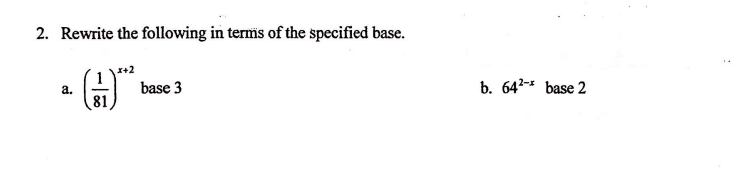 uncut mulch
expressing something in base $\red{a}$ would mean to express it in the form ${\red{a}}^b$
obsidian monolithBOT
ℝamonov
 amber laurel
so for b for example its 2^64^2-x?
 past meadow
no
clever pecan
@past meadow why so?
past meadow
Because 2^64^2-x doesnt equal 64^(2-x)
And its also probably not even what they meant to write
clever pecan
I'm assuming you let 64^(2 - x) = 2^a, and solve for a in terms of x
for problem (b)
same for problem (a)
but just 3^a
 quick kelp
suppose the graph of y=ax^2+bx+c has its highest point at (1,7) and it's y-intercept is -3. Then what is a, b, and c?
viscid thistle
@quick kelp are you still stuck?
viscid thistle
Consider what happens at the y-intercept
ie what's the x value that characterises it
viscid thistle
Ok yeah ig you could think it that way
If you are in the form y=ax²+bx+c yes, as when the function hits the y-intercept, x is 0, so you'd notice that y=a(0)²+b(0)+c simplifies to y=c
quick kelp
ohh
viscid thistle
Then what's our c?
quick kelp
the y-interceptt
viscid thistle
I mean what's the value of the constant c
quick kelp
y?
viscid thistle
You are given the y-intercept, aren't you?
quick kelp
yes
viscid thistle
If you know the y-intercept, and we just established that c represents the y-intercept, what's our c
quick kelp
ohh!
viscid thistle
What can you do with the info: "highest point at (1,7)"
viscid thistle
Yes
And you get an eqn
Our goal is to make a system of 2 eqn's to solve for a and b
What's the other equation you can have
quick kelp
hm..
viscid thistle
Think about highest point
quick kelp
(h,k)
viscid thistle
Think about what does that mean
quick kelp
vertex?
viscid thistle
Do you know how to get the vertex if you have for example y=x²+x+1
This is just an example
quick kelp
do you use an equation form?
viscid thistle
I want to see if you are able to do it numerically
viscid thistle
quick kelp
do you use an equation form?
Wdym by eqn form
Uh i really have to go, i'll be back in some time
viscid thistle
Ok gl
 fiery wave
@quick kelp if it can help, recall that the x coordinate of a vertex (in the form ax^2 + bx + c) is -b/2a
viscid thistle
Yes.
quick kelp
quick kelp
1=-b/2a?
how would this vertex equation be relevant if i may ask>?
fiery wave
Because now you have 2 equations
The one you got by plugging (1,7) into the rule
And the one you just got
You can find a and b that way
quick kelp
hm...
let me think this through
i'm so sorry I don't know how to continue
so I got 2 equations which is 1=-b/2a and
y=ax^2+bx-3
quick kelp
7=a(1)^2+b(1)-3?
quick kelp
Ohhh
okok im solving it rn
what I did
I got the value of a from 7=a+b-3
which yield to a=-b+10
then plugged the the value of that a to 1=-b/2a
and got a b=20
and used that value of b again to 1=-b+10
so i got a=-10 b=10 c=-3
b=20*
fiery wave
Looks good @quick kelp
quick kelp
Oh my god
thank you so much
thank you to both of u! Really appreciate the help!
And the time you gave for a stranger :))
 iron pendant
https://notevensweating.shx.gg/sbwmhP i got this problem wrong but i dont understand why, can someone explain and help me find what i did wrong?

 harsh smelt
@iron pendant are you familiar with unit circle?
uncut mulch
describe what you did
lunar axle
can someone plz confirm if this is right for me??
 blissful ridge
Looks correct
 lapis bone
 fossil crownBOT
From
Rule 4
If your question has not been answered for a minimum of 15 minutes, you may use the Helpers tag once. Please do not try to bump your question using this ping unnecessarily. Do not abuse this ping. Do not individually ping users with the Helpers tag without their express permission.
 stuck lark
we can do some algebra then recognize a derivative
 bleak torrent
I have no clue what that means
stuck lark
$\frac{1-2\cos(x)}{\pi-3x}=\frac23\frac{\cos(x)-\frac12}{x-\frac\pi3}$
obsidian monolithBOT
RokabeJintarou
stuck lark
you're welcome
cobalt swallow
it is not that the answer is wrong but the way you did it, firstly you seem to have used the fact lim x-> 0 sinx/ x =1, nothing wrong with that , but your second step is wrong, in the way that it does not lead to third step the way you did it , to get to the third , you don't do multplication in sin, rather you do it outside sin, and that you will multiply by (m+n)(m-n)/4 , both above and below ( I repeat outside of sin) , then you will get the third step as you have
@bleak torrent
and after that you use lim x-> 0 sinx/ x =1 , so the third step expression will directly be as k^2 will cancelled when you use that fact , so -2 (m+n)(m-n) /4 =
-(m+n)(m-n)/2 the answer you got ,
 prisma glacier
Hey! I'd like to simplify sqrt(16+sqrt(31))-sqrt(16-sqrt(31)) into sqrt(2) but I don't know how to proceed! Does someone have an idea? Thanks!
uncut mulch
you could try assigning a variable to your original expression,
square it in an attempt to simplify some of the square roots and see what happens
 bold knoll
hi hi. quick question.
i came across this identity in my book, is there a name for it?
$a_0=0, {\sum_{i=1}^{n}{(a_i -a_{i-1})}} = a_n$
obsidian monolithBOT
Biggs
 odd shell
Hi, I'm a little confused on how to do this type of question:
The point (1, -2) is on the graph of f(x). Describe the following transformations on f(x), and determine the resulting point:
g(x)=2f(x)+3
sick steppe
@odd shell do you have the transformations from f that make g?
odd shell
@sick steppe yeah that is why i am confused
this is the only information that is given to me
sick steppe
ok so what does the 2 do? and what does the +3 do?
odd shell
well so the 2 would be a vertical strech? and the three a vertical translation up?
sick steppe
yep
vertical stretch by a factor of 2, vertical translation 3 up
Now determining the resulting point means you want to know g(1)
but g(1) = 2f(1) + 3, but f(1)=-2
odd shell
so then would it be g(1)=2(-2)+3
sick steppe
yes
sick steppe
yes
bleak torrent
 bold meadow
0/0 so L'Hopital's rule
uncut mulch
consider 1 = sin(pi/2)
and the limit definition of the derivative
 fathom phoenix
hello can anyone help
bold meadow
a. 1st derivative
obsidian monolithBOT
Shen
fathom phoenix
ok thanks
bold meadow
ax^2+bx+c
c determines the height, changing this doesn't change the maximum height?
viscid thistle
it doesn't change where the maximum height is
$x = \frac{-b}{2a}$ is where the maximum is
obsidian monolithBOT
Shen
viscid thistle
according to a quadratic in the form $ax^2 + bx + c$
obsidian monolithBOT
Shen
viscid thistle
changing $c$ changes the max value, it just doesn't change where it is (along the x-axis)
obsidian monolithBOT
Shen
viscid thistle
If you want to solve for maximum height, you need to do:
$a(\frac{-b}{2a})^2 + b\frac{-b}{2a} + c$
obsidian monolithBOT
Shen
viscid thistle
where you plug in $\frac{-b}{2a}$ for $x$
obsidian monolithBOT
Shen
 blissful gale
help
 sour plinth
use the arithmetic series formula $\frac{n}{2}(2a+(n-1)d)$
obsidian monolithBOT
187
blissful gale
how do i do the sum 165 part
sour plinth
let it equal to 165
then you know the values of a and d
a=5 and d=2
so solve for n
obsidian monolithBOT
187
blissful gale
bro how
 bright grail
im stuck on this question
i tried finding the inverse but i got stuck trying to isolate
 signal pivot
So the input of ln can't be negetive or zero i.e it has to > 0
\begin{align*}
e^{x^2-x}> 1\
\therefore \hspace{6pt} x^2-x>0\
\end{align*}
So that gives either x=0 or x=1
obsidian monolithBOT
S k
bright grail
how did you go from e^x^2-x > 0 to the second one
removing the e
and how did it go from > 1 to > 0 @signal pivot
i dont understand how to jump to that step
sick steppe
e^0=1 @bright grail
 woeful fable
Is there a reason why during addition identities and subtractions for trig functions, when you break up the inner values, it has to be from the lower value to the greater value?
sick steppe
@woeful fable specific example if possible?
woeful fable
cos(2pi/12+3pi/12) != cos(3pi/12+2pi/12)
woeful fable
I did the angle formula
and they don't equal the same unless I have an algebraic error
woeful fable
I did cos(pi/4+pi/6)
Which sums just
cos(pi/4)cos(pi/6) - sin(pi/4)sin(pi/6)
sick steppe
yeah
woeful fable
That's equal to (sqrt2/2)(1/2) - (sqrt2/2)(sqrt3/2)
then that's sqrt2/4 - sqrt6/4)
which is sqrt 2 - sqrt 6 / 4
sick steppe
brackets
woeful fable
wdym
sick steppe
(sqrt2-sqrt6)/4
woeful fable
I just distributed and simplified
yes
yea
And that's not equal to what it's supposed to be
if I did cos(pi/6+pi/4)
The top one is my result
the correct answer is the bottom one
sick steppe
You either added or removed a negative somewhere then
woeful fable
cos(pi/4) = sqrt2/2
cos(pi/6) = 1/2
sin(pi/4) = sqrt2/2
sin(pi/6) = sqrt3/2
angle addition formula for cos(x+y) is cos(x)cos(y)-sin(x)sin(y)
idk where im screwing up
obsidian monolithBOT
Result:
0.86602540378444
,calc sin(pi/6)
obsidian monolithBOT
Result:
0.5
0/0 so L'Hopital's
mystic umbra
@bold meadow I am trying to work this out on my own but I am not understanding the step by step for e
bold meadow
well after using L'Hopitals' you can see that it just becomes:
$\lim_{x \to a} \frac{\sec^2{x}}{-\sin{x}} = - \csc{a}. \sec^2{a}$
obsidian monolithBOT
usernamephobic
mystic umbra
@bold meadow in my book it says f'/g'
so I need the derivitive of (tanx-tana) as step 1 to find f'
derivitive wrt x
but there is an a there
blissful ridge
Divide numerator and denominator by (x-a) and you'll notice that each term becomes the definition of derivative at x=a
mystic umbra
ok that matches the book
probably harder for me because I forgot the definition of a derivitive
isn't that just the definition of the limit of the tangent line?
slope of the tangent line
blissful ridge
$f'(a)=\lim_{x \to a} \frac{f(x)-f(a)}{x-a}$
obsidian monolithBOT
My Army is Frozen
mystic umbra
ok thx
 autumn marsh
Need help solving f(x) = 0
uncut mulch
the solutions aren't pretty
cobalt swallow
there is 2 solutions only , that can be seen for -2e^(-x) = x-4 by "hand " drawing the graph
but yes finding them won't be easy
using W lambert is a good way to solve it
autumn marsh
Can you show me how?
cobalt swallow
it gives solutions W( ...)+ .. something, they are expressed in terms of the Lambert's function , but we need numerical values I don't think you need it, considering you asked it in precalculus
I don't know how to do it properly as well
Only looked it up when Ramonov told about it, really interesting.
many find approximate solutions through iteration
maybe using Newton's method
autumn marsh
Hmm... I’ll try using Newton’s method
mystic umbra
blackpenredpen on youtube does the W-lambert functions method
bright grail
can someone explain this? how did they get this
 viscid thistle
bright grail
can someone explain this? how did they get this
viscid thistle
bright grail
can someone explain this? how did they get this
they used the lengths of the line segments
viscid thistle
viscid thistle
not my question, but how did they get this
desmos proves this, but how would you get this without the use of a graphing calc?
 green kernel
viscid thistle
desmos proves this, but how would you get this without the use of a graphing cal...
green kernel
viscid thistle
desmos proves this, but how would you get this without the use of a graphing cal...
divide the red inequality by sin theta, then take reciprocals (which flips the inequality signs)
viscid thistle
Have you tried anything so far? @winged cloak
 winged cloak
@viscid thistle Nvm i did it it was dumb 🤦♀️ i just couldn't see it
 worn violet
Can someone help me with: Graph the function f(x) = cos (x) and g(x)= 1/2 cps (2x-pi) ?
viscid thistle
What do you know about the graph of y=cos(x)
worn violet
Suppose you need to find the height of a tall building. Standing 20 meters from the base of the building, you aim a laser pointer at the closest part of the top of the building. You measure that the laser pointer is 4◦ tilted from pointing straight up. The laser pointer is held 2 meters above the ground. How tall is the building?
 wispy aurora
Draw a diagram
worn violet
and
 echo wagon
Show your diagram
wispy aurora
^
echo wagon
If your diagram is right, it's just a trig question
worn violet
can u help me with the diagram im confused
worn violet
not much im generally confused about this
wispy aurora
ok, my recommendation is imagining it in your head. Imagine a building, and you walk 20 meters away from it. Now draw one line as the building, and the other line as the path you took 20 meters away from it
wispy aurora
Got it so far? Now I recommend drawing a line from the point where you currently are to a point 2 meters above it. That is to simulate the laser pointer
worn violet
ok
wispy aurora
Now draw a line connecting the laser pointer to the building
echo wagon
And show your drawing, even if it's not done and you need help to continue
viscid thistle
i think you were the one i was helping who i asked for the diagram but you didn't post it
echo wagon
Maybe their phone is too old to take pictures and they're embarrassed to tell us
Don't be, only the mods here are elitist. The rest of us are nice.
worn violet
echo wagon
Maybe their phone is too old to take pictures and they're embarrassed to tell us
i have the iphone 11
I just need help with
Graph the function f (x) = cos (x) and g (x) = 1/2 cos (2x-pi)
viscid thistle
i also said "what do you know about y=cos(x)" previously answering this q and you ignored it or i skipped it
echo wagon
You've never heard of cos before and know nothing about it?
echo wagon
Do you know its graph?
echo wagon
f(x) and g(x) are two different functions
worn violet
So therefore 2 different graphs?
echo wagon
You need to know how to graph cos(x), and then apply transformations to it to graph 1/2 cos(2x-π)
... Yes
echo wagon
Yes, I don't have a lot of time to help. Hopefully someone else can
Glad you can send pics now, that will help
viscid thistle
if that's supposed to be the graph of y=cos(x), then sure that's fine
though it seems you took a pic from desmos
echo wagon
...
echo wagon
So you just wanted help on how to enter it into desmos?
worn violet
Yes and No
viscid thistle
huh
worn violet
Because I’m not sure if there’s supposed to be on one graph or two different graphs
So now I just to graph g(x) on a separate graph right?
wispy aurora
OOOOF
viscid thistle
Me who still hasn’t figured out mobile desmos
viscid thistle
viscid thistle
Me who still hasn’t figured out mobile desmos
don't blame you - computer is better ngl
 proud sparrow
@viscid thistle stop crossposting
viscid thistle
Suppose your making a bioweapon that kills 1/3 of the population.
But you & your secret organization of 9 people decide to immunise prior.
If people realize that 1/3 of the population didn't die they'll know you have the vaccine.
How do you change the kill rate to ensure the 1/3 of the population still die even after 10 have been immunised?
Supposing the population has 90 people, in normal circumstances 30 people would die.
But you want to change that so 30/81 people will die.
So the formula is like (population*ratio)/(population - vaccinated people)?
Does this check out?
proud sparrow
@viscid thistle not sure what you are asking... oh, you want to change it to kill 30/81 of the people? looks reasonable...
viscid thistle
yea so it doesnt look suspcious when 9 of the 90 people in the population are secretly immunised
viscid thistle
I know that logs aren't defined for negative numbers
but is there any other reason as well we can't do this:
ln(1)=0
ln(-1.-1)=0
ln(-1)+ln(-1)=0
2ln(-1)=0
ln(-1)=0
let ln(x)=c, x<0 and c belongs to R
e^c=x
which is not true for any c belonging to R
 trim hemlock
well its not that it isnt defined
but it isnt defined in the real number set
but log of a negative number can also be defined by a complex number
 novel cargo
I'm not sure if this the place to ask this
is there a precedence rule for factorial and multiplication?
$3n!$ is $(3n)!$ or $3(n!)$?
obsidian monolithBOT
az
 tawny nacelle
i think its the latter one that is more common
factorial takes precedence over multiplication
novel cargo
thanks
tawny nacelle
np 
tawny nacelle
nice
 serene heath
you thought they were lying? smh
tawny nacelle

harsh smelt
tawny nacelle
factorial takes precedence over multiplication
i mean ! is unary operator
viscid thistle
!n! what ! comes first?
 jagged glade
The exclamation mark
 viscid thistle
smh !n is subfactorial
blissful ridge
Whoa never knew that
 maiden pelican
How
How do you solve this system of equations
Parameters are p, q, r and unknowns are a, b, c
smoky pagoda
What's troubling you with this system?
It can be solved by any standard methods for solving linear equations
Gaussian elimination will work just fine here for example
 rain notch
How would you go about solving #13, just for sine (without calculator).
rain notch
<@&286206848099549185> sorry it's already been some time
bold meadow
$\sin{-115}=\sin{-25}=-\sin(25)$
obsidian monolithBOT
usernamephobic
rain notch
Thank you. However, I need to obtain a ratio as an answer, so how would that be done. My teacher had not gone over this type of scenario, where the reference angles are not common like 30, 45, 60, or 90 degrees.
uncut mulch
-sin(25°) is exactly what they want
uncut mulch
the less special angles are 15°, 36°, 72°,75°
rain notch
I see
uncut mulch
i mean if you read the question, they want
stuff in terms of trig functions of the reference angle
so even IF you reference angle would be 30°,
you'd give an answer like -sin(30°) instead of -1/2
maiden pelican
smoky pagoda
It can be solved by any standard methods for solving linear equations
I can't do it for some reason..
cobalt swallow
@maiden pelican , just solve it the plain elimination way, Using equation (1) and (3), cancel out p, getting an equation in q and r, which you can solve using eqn(2). Doing by gaussian elimination is really quick
maiden pelican
Yeah.. I can't do this for some reason, something is going wrong and I don't understand what..
Oh I'll do that
viscid thistle
rain notch
Thank you. However, I need to obtain a ratio as an answer, so how would that be ...
the problem does not ask for a ratio
rain notch
viscid thistle
the problem does not ask for a ratio
Yeah I was overthinking it, because I thought it correlated to earlier sets of directions from another worksheet
viscid thistle
Oh I see
echo wagon
@mighty talon Bruh, did you join just to spam your dumb competitions in every channel daily?
viscid thistle
Doing @ Moderators might be worthy here
echo wagon
Idk how they could have missed it
 peak badge
I will do it for you.
<@&268886789983436800> - can we deal with an ad user here?
odd shell

how would you determine the function given this table of values?
im stuck someone please help
 royal siren
infinite
sick steppe
odd shell
im stuck someone please help
First thing you can do is figure out which of first,second,third, etc differences are constant
 median moss
Would someone explain the concept of an infinite geometric series quickly please? Specifically its difference of finite geometric series?
green kernel
infinite geometric series go on forever, they have infinitely many terms
finite geometric series stop at some point, they have finitely many terms
does that answer your question? @median moss
median moss
I understand that part, I guess I should be more specific. I don't really get the divergence and convergence part. What role does the common ratio (r) play a part in the sum doesn't really click for me, even though its written there
green kernel
well, imagine trying to calculate that sum 1 + 2 + 4 + 8 + ...
by hand
it will just get bigger and bigger
median moss
yep
green kernel
it basically goes off to infinity
but when you have a sum like
1 + 1/2 + 1/4 + 1/8 + ...
since the terms are getting smaller and smaller
the more you calculate, the slower it will ‘grow’
so it will approach some specific value
royal siren
green kernel
the terms r^a get smaller and smaller when you have the ratio between the terms is less than 1
median moss
Ahh I kinda get that, and it depends all depends on the common ratio I guess
green kernel
anything multiplied by a number less than 1 will be smaller
median moss
Give me like 10 minutes to just sit on it and try to actually understand and come back to you :)
Thanks so much
green kernel
anything multiplied by a number greater than one will be bigger
so in order for the terms to get smaller and smaller, you need to be multiplying by something less than one each time
ie r < 1
(at least for positives :p)
median moss
Ah got it, and because they get smaller term by term. The sum of these terms will just converge to a sum
royal siren
not because they get smaller term by term @median moss
it's due to the properties of geometric series - "how fast they get small"
for instance, 1 + 1/2 + 1/3 + ... gets smaller
but doesn't converge
green kernel
yeah, it’s quite subtle. for all geometric series, ‘they get smaller’ is a good enough intuition, but in general you can have a sum whos terms do not get small fast enough for it to converge
median moss
I'm probably using the terms converges and diverges loosely as its a calculus term and i haven't done limits yet. So sorry about that
green kernel
no dont worry, i just glossed over some details in my explanation
odd shell
@sick steppe yea the third differences are constant
but what after that?
i know that one of the factors is (x-2)
but thats it
sick steppe
I guess just use the points and try and find f(x) @odd shell
 blissful niche
Functions nice!
 delicate minnow
Anybody here willing to teach me factoring tomorrow?
proud sparrow
delicate minnow
Anybody here willing to teach me factoring tomorrow?
what sort of factoring?
integer factoring or polynomial factoring?
green kernel
teach me how to factor integers in polynomial time
proud sparrow
green kernel
teach me how to factor integers in polynomial time
I don't know, but I can teach you some O(n^(1/3)) and O(n^(1/4)) methods
proud sparrow
green kernel
well, better than poly time
n is the number to be factored
not the number of bits
green kernel
oh right
delicate minnow
proud sparrow
integer factoring or polynomial factoring?
Poly
proud sparrow
oh no polynomial factoring
https://en.wikipedia.org/wiki/Factorization_of_polynomials
this is crazy stuff
In mathematics and computer algebra, factorization of polynomials or polynomial factorization expresses a polynomial with coefficients in a given field or in the integers as the product of irreducible factors with coefficients in the same domain. Polynomial factorization is one of the fundamental components of computer algebra systems.
The firs...
proud sparrow
delicate minnow
Poly
do you have a class of polynomials you want to learn how to factor, or do you want to learn how to factor polynomials in general?
whoa LLL is crazy
 open vortex
this might be something really obvious but how would I work out y - 1 as a function of x? Would this be written as f(x) = y - 1?
If it is, then I'm really lost. X is the inputs right, but the x's aren't being mapped to anything so how would there be a solution?
echo wagon
Do you have an exact question you are looking at?
open vortex
yep
The original question was find an expression for the function whose graph is the bottom half of the parabola x + (y -1)^2 = 0.
The hint was can you solve the equation for y - 1 as a function of x?
I'm a bit confused about the hint. (Also I wasn't tooo sure where to ask this as I'm starting calculus at uni but these were meant to be prerequisites)
obsidian monolithBOT

 Requested by Lunasong#7197
echo wagon
Requested by Lunasong#7197
echo wagon
Ping me if you come back
open vortex
@echo wagon i'm here
echo wagon
Okay, so you just have to isolate y in the equation
Make y the subject
So what do you think the first thing you have to do is?
open vortex
for the hint? How would I make y the subject if its currently f(x) = y -1, would that not be y = y -1
for the equation in the original question, i could rearrange and make y the subject
actually, i think i tried that but i got stuck at y^2 - 2y = -x -1 when I tried to make y the subject for the original equation
echo wagon
No
The equation is x + (y-1)^2 = 0
Isolate y in this equation
Oh, okay, you did do that
Didn't read all of it
What's the first step?
open vortex
ahhh i think i get it! So (y-1)^2 = -x , then square root the -x and add 1?
but can we square root the -x?
echo wagon
Yes
Why not?
x+(y-1)^2 = 0 doesn't have solutions where x is positive, so x <=0 and -x >= 0. So you are only taking the square root of nonnegative numbers
open vortex
what if x is positive, then we would be square rooting a negative number no?
ahhh
that makes so much sense!! Thank you so muchh!!
echo wagon
But you're not done yet
open vortex
im not?
echo wagon
What are the solutions to x^2 = 4?
open vortex
plus and minus 2
echo wagon
Right, so when you take the square root, ordinarily you should do +- in front
open vortex
ok so i have 1 +- sqrt(-x) ?
echo wagon
But y = +-sqrt(-x) + 1, isn't a function because it gives you TWO values of y for one value of x.
open vortex
ahhh i seee
echo wagon
Whereas a function should have one and only one value of y for each value of x
open vortex
so just -
open vortex
ahh, got it! Thank youuu :)))
echo wagon
Np
 astral reef
U knw wut this server is friggin boring im leaving
 paper zenith
ok bro have fun
astral mantle
the pink goes with two consecutive even whole numbers
adding two to a whole even number gives a whole even number
drowsy karma
well so does 4
viscid thistle
if a function is a set of ordered pairs no two of which have the same first member, how are two to one functions functions?
wouldnt the first member be the domain?
sick steppe
drowsy karma
well so does 4
x and x+4 wouldnt be consecutive if x is even
sick steppe
consecutive means right after each other
drowsy karma
Ohhh
sick steppe
so 1 and 2 are consecutive numbers, but 1 and 3 arent
The question states consecutive even numbers
sick steppe
so if we assume x is even, the next even number is x+2
since even numbers occur every other
you can also think of it as 2n and 2(n+1) for an integer n
 robust nest
I need some help visualizing this problem and drawing it out
We just started these today and all I can do is draw the first part (12 nautical miles)
robust nest
anyone?
sick steppe
robust nest
I need some help visualizing this problem and drawing it out
then you draw the 15 nautical line from where you ended
mystic umbra
this is vector addition
@robust nest 12 mi is the hypotenuse of a triangle
N60W is the angle of theta with respect to the y axis
,w 12e^(i*(5pi/6))
obsidian monolithBOT

 Requested by 0000000000#7632
mystic umbra
Requested by 0000000000#7632
mystic umbra
see the decimal expansion is actually your x and y values
drop the i
if you do this twice you will have (x1,y1) and (x2,y2)
then if you do (x1+x2,y1+y2) which is the sum of the two vectors which is a vector that represents the relative location (final) compared to your starting location
 abstract garden
hi can anyone tell me the steps for the answer?
mystic umbra
abstract garden
hi can anyone tell me the steps for the answer?
it has already been solved on a calculator
,w sqrt(0.688)
obsidian monolithBOT
 Requested by 0000000000#7632
mystic umbra
Requested by 0000000000#7632
mystic umbra
,w sin((236/360)*2pi)
obsidian monolithBOT
 Requested by 0000000000#7632
obsidian monolithBOT
Requested by 0000000000#7632
obsidian monolithBOT
 Requested by 0000000000#7632
mystic umbra
Requested by 0000000000#7632
mystic umbra
then we want to convert that % to radians
1 full rotation around a circle = 2pi radians
so I multiply by 2pi after I do /360 to get the conversion from degrees to radians
360 deg = 2pi rad
abstract garden
@mystic umbra how can we get that when we don't have calculator ?
open vortex
For this question, why is the answer 3? mostly the f(0) could take any value part
echo wagon
Well, if f(0) = k then because f is even we get f(-0) = k and there is no contradiction. But if g(0) = k then g(-0) = -k and this only works if k is 0
@open vortex
open vortex
echo wagon
Well, if f(0) = k then because f is even we get f(-0) = k and there is no contra...
Ahhh I get it now, thank you :))
echo wagon
Np
viscid thistle
if a function is a set of ordered pairs no two of which have the same first member, how are two to one functions functions?
wouldnt the first member be the domain? << don't mind the repost im just still confused on it
echo wagon
@viscid thistle A two to one function just means that there are two different first coordinates that give the same second coordinate
So the first coordinates are unique, the second coordinates are not
proud sparrow
{(0, 1) (1, 1)}
viscid thistle
ohhh for some reason I thought the second coordinates would be unique cause it's one i'm so dumb 😂
proud sparrow
viscid thistle
ohhh for some reason I thought the second coordinates would be unique cause it's...
that's when it's injective
mystic umbra
,w limit x->2 (x^3-8)/(x-2)
obsidian monolithBOT
 Requested by 0000000000#7632
mystic umbra
Requested by 0000000000#7632
mystic umbra
so this can only be done by factoring?
bold meadow
You can use Lhopital's too
mystic umbra
actually no
that is for the derivative right?
there are times when the limit exists but the derivitive does not exist
you can have a limit of 0
astral mantle
lhopitals works because you are dividing by 0
mystic umbra
is hopital's rule for limits or derivitives or both?
astral mantle
limits of indeterminate form
echo wagon
Lhopitals is to find limits, by taking derivatives.
mystic umbra
ok
 gloomy swallow
 harsh smelt

echo wagon
What do you mean by dividing?
uncut mulch
$x-\frac13x^4-6x^2+17x-8$?
obsidian monolithBOT
ℝamonov
echo wagon
Because the degree of the numerator is already smaller than that of the denominator
astral mantle
$\frac{x-1}{3x^4-6x^2+17x-8}$
obsidian monolithBOT
Star_
astral mantle
?