#precalculus
1 messages · Page 275 of 1
 gilded fern
I used algebra to solve for each side
But I do not get the correct answer
Which is 7degrees
 gaunt mason
@viscid thistle I don't understand your query.
A straight line is uniquely identified by 2 points. Meaning given some two points there is exactly one line passing through them.
The points and the straight line, and curved line, and circle and any other weird shape can in mathematics be put not just on simple empty paper, but also on the paper that has a coordinate system define on it.
With its center, and x and y axis that are perpendicular to each other.
The position of points in this coordinate system is given by (x,y), for example (3,0). The line is given as y=kx+b for example y=-2x + 3. The only exception is the line parallel to the y-axis.
 visual kayak
@viscid thistle lol you have the correct answer. To find the slope you did it correctly but i don't know what the second half is about. The question gives you the y-int (0,5) so there shouldn't be anymore work you have to do if I am correct.
gaunt mason
@gilded fern What was your procedure?
gilded fern
I solved for:
-3theta + 76 = 90
and
-2theta + 49 = 90
 viscid thistle
Thanks @visual kayak
 sick steppe
@gilded fern you cant have tan(90)
 runic sundial
So I'm developing a first person game, and I want to make realistic player movement. To move the player, all I have to do is call one line of code AddForce(), in which I pass in a value that acts as the amount of force being applied. The problem with this is that if I add a constant amount of force, then the player takes a really long time to accelerate and it moves really fast, so what I have to do is change how much force is being applied based on the velocity of the player and the drag and gravity but I don't know exactly how to calculate that. Is there maybe a function similar to F=MA that I can use that takes drag and gravity into account? Thank you!
gaunt mason
I dont understand, the force applied to the player is independent of the drag and gravity
But the friction might give an opposite force @runic sundial
runic sundial
No I know it's independent
but it's a game engine so it doesn't really simulate drag very well
at least not in my experience
And I just realized I meant to say friction instead of drag
gaunt mason
The friction is a constant force, so it applies a constant acceleration.
runic sundial
Okay well then is there a way to calculate the amount of force I need to apply to maintain a constant speed
gaunt mason
The friction force is F=mgu where u is the friction coefficient
This is the amount of force you have to apply to maintain the constant speed.
 obsidian monolithBOT
moshill1:
sick steppe
@ancient rampart set up a triangle likely
 ancient rampart
hm
sick steppe
Either quad 2 or quad 4
ancient rampart
def quad 4 cuz inverse tan
ancient rampart
i think my teacher said smth abt if the inverse is given in the problem you use the "universally accepted" restricted domain
which for tan is -pi/2 < pheta < pi/2
sick steppe
yeah but arctan is defined for all values 
ancient rampart
ill just do it in q4
sick steppe
radius is never negative
sick steppe
ye
 granite crescent
can i please get help with #9?
sick steppe
extrema occur when dy/dx = 0
sick steppe
you can get a quadratic in sinx and solve that
granite crescent
using the trig stuff ?
granite crescent
trig identities
 patent beacon
@runic sundial
Consider instead a speed cap, which would be much more like real life.
sick steppe
yes
granite crescent
does the 0<x<2 pi change?
sick steppe
no
granite crescent
why?
sick steppe
cause that's just the interval you're looking at for y
granite crescent
i got this rn
sick steppe
yeah
granite crescent
we’d use the quadratic formula
but it doesn’t work since the negative sign is in
sick steppe
yep
granite crescent
so what should i do
sick steppe
write the conclusion statement about the maxes and mins on the interval
granite crescent
but there are none
sick steppe
yeah
granite crescent
oh
sick steppe
You can have no maxes and no mins on an interval
If 0 and 2pi were included in the interval then you'd have some
 ripe adder
Im trying to find the length and width of a rectangle inscribed in a circle
so far the online resources I have looked at have only made it more confusing
 fading token
Hint: write down two equations involving both length and width of the cut-out
ripe adder
Yes I get that
but im confused on how to get those length and width equasions
I know that P = 2W=2L
and A = W*L
but I would need perimeter to find the width and length with systems of equasions no?
fading token
You need the area equation, but you do not need the perimeter equation
There's another one that can help you
ripe adder
I also know that 20^2 = L^2 + W^2
fading token
Why not?
Apart from the fact that you shouldn't use the negative values for L and W for obvious reasons
ripe adder
oh shi
ur right
sorry most my answers are usually whole numbers or fractions
thank you for the help
fading token
np
 drowsy karma
i know this shit easy, i just dunno how to do it
@fading token could u help me real quick
 calm hornet
@drowsy karma first find the r (multiplyer) of the sequence
r = u2/u1 = 12/6sqrt(2) = sqrt(2)
calm hornet
r = u2/u1 = 12/6sqrt(2) = sqrt(2)
do you understand this one?
drowsy karma
Not really. He didn't teach us this.
calm hornet
ahh
drowsy karma
I've done like dividing/multiplying radicals n stuff
calm hornet
first or all you need to understand what is geometric sequence
ex: 3, 6, 12, 24, 48, 96...
7, 21, 63, 129, 387,...
a geometric sequence has a common multiplyer r
drowsy karma
Okay, so you're finding the common multiplier in these two terms?
drowsy karma
yeah
calm hornet
and the second term is 12
so the common multiplyer is sqrt2
which means the third term should be 12sqrt2
get it?
drowsy karma
let me process this
okay yes i think so
I just had to put it in radical form
now I get it
12 was 144sqrt, 6sqrt(2) was 72
oHHhh
now its 288
runic sundial
patent beacon
<@267067377395433492>
Consider instead a speed cap, which would be much more li...
That doesn't really work
I tried it and the movement doesn't feel natural at all
viscid thistle
Can someone show me their steps for the first problem
I am brain blocked right now
 sour hemlock
just factorize
viscid thistle
It's just not on it ya know
I'm falling behind, if you can just show me the steps for just the first one that would be really helpful
sour hemlock
let y = 0 and then factorize
 loud forge
Can someone help me with this
 willow bear
what's giving you trouble here?
sour hemlock
I guess you should first start by drawing the triangle and labeling the sides
then it will be clear to you
willow bear
i mean, heron's formula can work
sour hemlock
damn I never used that, I would just draw the triangle and draw the perpendicular and find its height haha
 cyan hill
loud forge
cyan hill
loud forge
Ima use that thanks
patent beacon
runic sundial
That doesn't really work
What's wrong with it? Haha
runic sundial
@patent beacon It's being kind of jittery
as if I was using a character controller if you know what that is
patent beacon
No I don't oop
runic sundial
Okay well it doesn't work very well
I have a stack overflow thread for this question: https://stackoverflow.com/q/64978310/9362751

Stack Overflow
I'm making a first person game with Unity and a Rigidbody player controller. I want really realistic movement, but using just AddForce(Input.GetAxis("Horizontal), 0, Input.GetAxis("Vertical&
patent beacon
@runic sundial
An object moves at constant velocity if the net force on it is zero
patent beacon
Friction is a force
Anyway so an object moves at constant velocity if the net force on it is zero
That is, all of the forces on that body have to cancel out
So if you do have 10N of friction pulling on an object, then you'd need 10N of applied force to keep it moving
runic sundial
I'm sorry but i don't really know how to apply that into code
@patent beacon You're telling me that friction is a force but unity already has friction built into it
But I still need to find a mathematical way to apply less force over time to retain a velocity
patent beacon
As soon as you have the speed you want, drop the applied force to be equal to friction
As far as unity programming goes, I'm no expert haha. But that's how it's done in real life
runic sundial
Ahhh no that makes sense
Wait one more thing
If I wanted to take into consideration friction AND gravity, would i just drop the speed to the friction + gravity or something instead of just friction?
or like friction * gravity
patent beacon
I'm not sure how unity treats these things oop
Usually the force of friction is increased by higher gravity
patent beacon
In real life,
Max friction force = (friction constant) (mass) (gravity)
That's if you are not going up or down an incline though
willow bear
are you familiar with half-angle identities
viscid thistle
do you what a factorial is
 jagged glade
,w factorial


 jagged glade
 velvet blade
Why is complex number z= a + bi have an inverse w such that $w = \frac {\bar{z}}{a^2 + b^2}$ and not just $ \frac {1}{a+bi}$?
obsidian monolithBOT
lazypawtato:
 viscid thistle
it's not inverse but reciprocal
it's easier if you have nothing complex in the denominator
so you are easily able to distinguish real and imaginary part
 opaque olive
@viscid thistle could you have a look at my question please?
velvet blade
viscid thistle
it's not inverse but reciprocal
there's a difference?
viscid thistle
reciprocal is more precise
velvet blade
@opaque olive I'm not able to understand how to solve your qustion, does it need calculus or something?
opaque olive
well yeah -_-
opaque olive
whats precalc
velvet blade
everything before learning calcculus
opaque olive
ok
velvet blade
viscid thistle
we already talked about this
you said because it's easier to not have imaginary partr in denominator, is that why reciprocal is different from inverse?
obsidian monolithBOT
HoboSas:
velvet blade
i'm sorry if my questions are annoying, but this is the first time i'm hearing about this difference
viscid thistle
what is $ \Re\left(\frac {1}{a+bi}\right)$?
obsidian monolithBOT
HoboSas:
obsidian monolithBOT
HoboSas:
velvet blade
Re?
viscid thistle
real part
velvet blade
Oh okay
 blissful kayak
$\mathfrak{R}\left(\frac{\bar{\widetilde{z}}}{a^2+a^2}\right)=\frac{a}{a^2+b^2}$
obsidian monolithBOT
Coleculus:
blissful kayak
Hence, $\mathfrak{R}(\widetilde{w})=\frac{x}{x^2+y^2}$
obsidian monolithBOT
Coleculus:
blissful kayak
Is that right?
 small peak
Hey, can someone teach me calculus for the IB math AI SL.
Im struggling pretty bad and have a test coming up
sick steppe
@small peak teach you all of calculus...?
small peak
not all of calculus
Chapter 12 : Analyzing rates of change - Differential Calculus
Chapter 13 : Approximating Irregular Spaces - Integration
just these @sick steppe
 quaint mason
idk how to solve for 2nd value for this problem
for first one i just took theta=sin^-1(-.66)
 echo wagon
In what other quadrant is sin negative?
sick steppe
@quaint mason well for starts that's cosine not sine
viscid thistle
?
quaint mason
ik but im using the cofunction identity
sick steppe
yeah i realize that now lol
quaint mason
cos(pi/2-theta)=sin(theta)
sick steppe
yeah
quaint mason
after i found the value of theta, i then di pi-theta
which gave me 3.8624 for first value
 lunar axle
can someone help me with these questions please??
loud forge
How do you do this?
loud forge
Ty
 lapis sphinx
np
sick steppe
@quaint mason sine is neg in quad 3 and 4
quad 3 is pi + principle angle, quad 4 is 2pi - principle angle
quaint mason
so the first value is pi-sin^-1(-.66), the second would be 2pi-sin^-1(-.66)?
whats principle angle
sick steppe
$\alpha = |\sin^{-1}{(-0.66)}|$
obsidian monolithBOT
moshill1:
sick steppe
$\theta = \pi + \alpha \text{and} 2\pi - \alpha$
quaint mason
huh
obsidian monolithBOT
moshill1:
quaint mason
thats what i did n it was wrong
quaint mason
oh ik what i did wrong w the 2nd value
i rounded it wrong
thank u
also, quick question, what does this symbol mean
β
is it just like x?
im just tryna simplify tan(-β)cos(-β) which is= -tan(β)cos(β) but just wanted to make sure if β meant somethin important
quaint mason
ah
sick steppe
$\beta$
obsidian monolithBOT
moshill1:
lapis sphinx
$\gamma$
obsidian monolithBOT
North:
lapis sphinx
$\omega$
obsidian monolithBOT
North:
ripe adder
im trying to solve this fraction decomposition problem
and I dont know how to do it
due to the third variable
ripe adder
<@&286206848099549185>
sour hemlock
why don't you multiply both sides with the denominator of the LHS
you will get an equation no longer in fraction form
then make appropriate substitutions for x to solve for A, B, and C
ripe adder
Ok, how about a new problem
quaint mason
i was able to figure out one of radian value is 1.37, how would i solve for the other ones?
 zealous parcel
2sintheta - 3csctheta = 2
i have to solve for pi radians within the unit circle without using a calculator (using factoring instead)
velvet blade
I got the answer as 1, But I'm not sure of my method
viscid thistle
show work
velvet blade
Ohh
damn
Can you show the correct way?
wait, it's 1/|z|^2 right?
wait , |a||b| = |ab| right?
viscid thistle
yes
velvet blade
okay I also need help proving triangle inequality then 
viscid thistle
just square both sides
viscid thistle
try to multiply by conj/conj
velvet blade
|z|^2/conj(z)?
that's it?
wait why to do all that?
$|\frac{z}{\bar{z}}| = \frac{|z|}{|\bar{z}|}$ right?
obsidian monolithBOT
lazypawtato:
velvet blade
@viscid thistle you there?
viscid thistle
not really
velvet blade
Bruh
 sour plinth
you could sub in z=a+ib
viscid thistle
obsidian monolith
**lazypawtato**:
that is true
sour plinth
yes
velvet blade
thanks man
velvet blade
did he mean value of z/r is 1 or |z/r| is 1?
 past meadow
researcher |z/r|=1 is what he meant
velvet blade
thanks
ripe adder
what steps should I take to find a / b?
willow bear
do the words "partial fraction decomposition" ring any bells to you
alternatively: have you taken the time to follow the hint?
ripe adder
((a/(x+1))+(b/(x-1))=1/(x^2-1)(x+1)
=
a+b=1/x
I did this because i was multiplying by LHS denominator
like juan said
willow bear
uh
okay wai
do you have your work ON PAPER
you tried to multiply both sides by... x+1?
ripe adder
willow bear
that'd give you $a + \frac{b(x+1)}{x-1} = \frac{1}{x-1}$, at best.
obsidian monolithBOT
Ann:
willow bear
not a + b on the left hand side, and definitely not 1/x on the right!
ripe adder
ah I see
wouldnt the right hand side be
1(x+1)/x^2-1
or
wait
nvm
i see
ok ill balance that
willow bear
you're going down a road that is, at best, a massive detour
ripe adder
so then how do I solve for a and b?
willow bear
why would you need the ratio of a and b
anyway, you might simplify the left-hand side,
as the hint told you
so combine the two fractions into one
so $\frac{a}{x+1} + \frac{b}{x-1}$ simplifies into: $\frac{a(x-1) + b(x+1)}{(x+1)(x-1)}$
obsidian monolithBOT
Ann:
willow bear
understand? y/n
 gentle fox
is this the right place to post questions on probability?
willow bear
@gentle fox #probability-statistics
and the numerator, once you expand & collect like terms, becomes: $$(a+b)x + (-a + b)$$
obsidian monolithBOT
Ann:
willow bear
so you have: $\frac{(a+b)x + (-a+b)}{x^2 - 1} = \frac{1}{x^2 - 1}$ \ \ and thus, $(a+b)x + (-a+b)$ has to be equal to $0x + 1$ for all values of $x$
obsidian monolithBOT
Ann:
willow bear
thus: $a+b = 0$ and $-a + b = 1$
obsidian monolithBOT
Ann:
ripe adder
so
I am on the first of those four
I simplified
into (ax-a+bx+b)/(x^2-1)
how did you collect the like terms to reorganize it like that
the one I replied to with ghost emoji
ripe adder
I see
ok so
knowing this information
how do i progress back towards the original format
of
I see
a = -1/2
b = 1/2
yes
thank you @willow bear
velvet blade
I understood the question but I didn't understand the answer
Also is e here euler's number or just a notation?
Because he didn't teach anything about why e is used in the notation
 crimson steppe
it's euler's number from what i recall
crimson steppe
yup lmao nice to see you again lol
 astral mantle
it talks about the euler identity in the example
willow bear
Also is e here euler's number or just a notation?
yeah, it is euler's number
you're getting a glimpse of the wonderful world that is the complex exponential
i mean, $(e^{\frac{i\pi}{2n}})^n = e^{\frac{i\pi}{2n} \cdot n} = e^{i\pi/2}$ so...
obsidian monolithBOT
Ann:
willow bear
¯_(ツ)_/¯
willow bear
eh
i mean yeah i guess it kinda takes a lot of math to explain with any amount of rigor WHY $e^{ix} = \cos(x)+i\sin(x)$
obsidian monolithBOT
Ann:
crimson steppe
yeah, that's what i read in the book
it's still a really nice shorthand
for the polar form lol
lunar axle
help please- with either one or both if possible
 hexed granite
if anyone can answer any of these it would be a life saver
please someone help
<@&286206848099549185> please
obsidian monolithBOT
lazypawtato:
willow bear
$\frac{z}{r} = 1(\cos(\theta) + i \sin(\theta))$ if you so insist
obsidian monolithBOT
Ann:
velvet blade
Yeah but the book says only absolute of the fraction is equal to 1 right?
willow bear
and when did i say otherwise
velvet blade
but z/r isn't absolute right?
willow bear
i didn't require theta to be 0, did i?
haven't you already seen that every complex number can be written as the product of its magnitude (absolute value, modulus, whatever you wanna call it) and a complex number on the unit circle?
velvet blade
...... I'm confused, it's just that the book said you can have any real number theta such that cos(theta)+isin(theta) when |z/r| is 1. I don't understand how you don't take absolute value of z/r and still use cos(theta)+i sin (theta)
velvet blade
I feel so
give me a min
It says |z/r| is 1
so the solutions exist on the circle of radius 1 right?
viscid thistle
@lunar axle are you still stuck? If so come to another channel and tag me there.
willow bear
so the solutions exist on the circle of radius 1 right?
overthinking alert
i mean yeah z/r is on the unit circle
since
yknow
that's where the points with magnitude 1 are
velvet blade
I'm unable to put it in words what I understand
Wait! I think I got it
|z/r| = sqrt {cos^2(a)+sin^2(a)}
Am I right?
velvet blade
bruh
I'll try again tomorrow I guess
Thanks
BTW why do we use exponent base as e for writing it in polar form?
Do you learn it in calculus?
Is e a variable?
in this?
velvet blade
I thought you hated decimals 
velvet blade
Okay 
willow bear
transcendental even
velvet blade
what's transcendental?
willow bear
not expressible as the solution of a polynomial equation with integer coefficients
velvet blade
Oh So use numerical analysis to approximate it?
willow bear
if approximating the value of e itself is your goal then yeah i guess ¯_(ツ)_/¯
velvet blade
Okay, why do you use that as the base though? You're not even using it to convert it in polar form back again
obsidian monolithBOT
Ann:
velvet blade
Oh, do you learn in calculus about why it works?

 potent berry
can someone help please? been trying to figure it out myself and with internet tool but couldnt
sour hemlock
well you can multiply
potent berry
i tried to multiply using the rules (a+b)(a-b) and so on, knowing i^2 = -1 and i still couldnt get the right answer
yes solving for a
 trail niche
Paste the work you did
potent berry
no pressure 🙂
trail niche
Also in your typed out question
You missed a ()
For where a-2 belongs to
I’ll assume it’s just a 3rd term tho
Same thing
Nice
My pencil just broke
And all the lead is stuck inside
BRB
Ok back
I got 1/2, and -1
@potent berry
Idk where you were going with the second half
But you were doing alright in the first half
potent berry
haha can u send a pic of your solution?
trail niche
You got A isolated to be (A^2 + 2A + 4)(A-2) = -9
You keep going there and you can jsut solve for A
potent berry
i would keep going if i knew how 🙂
potent berry
ty
second half i used a calculator to solve (a^2+2A+4) but now i realise its stupid because the calculator assumes it equals 0
trail niche
Hold on still
potent berry
thank you sir
trail niche
Oh ok
You’re welcome : D
You should have ended up with A^3 = -1
But there’s also x = 1/2 apparently
potent berry
yeah
theres also x=1/2 +i(root3)/2 and 1/2 - i(root3)/2
but theyre not needed or marked as solutions in my homework
so im fine with just -1 haha
if "a" was defined as complex i could find them tho
its defined as real in the question
 steep quartz
Yes. what equation do you have after that?
trail niche
^
You (x-3)^2 is equal to x^2-6x+9
So you can multiply the bottom left fraction by (x-3) on top and bottom
So you get a common denominator on all 3 fractions
 sand gate
Is this correct?
 bronze star
Check your domain again
trail niche
^
@sand gate remember that your domain is your x values
So try and draw vertical lines at the extremes
You’ll. Realize that at one of them you can’t (cause it goes to -infinity) but at the other end yo can
 rancid crest
given f(x) = x^3 + kx -15 and the remainder when f(x) is divided by x -3 is - 18 then what is the value of k?
i got k = -10
mm
what if
@viscid thistle
velvet blade
if $w^2 = z$ then $ \sqrt{z} = +/- w$, that's it right?
obsidian monolithBOT
lazypawtato:
 blissful ridge
I don't think you argument is enough
velvet blade
Oh
 proud raven
i mean
blissful ridge
Let square root z=x+iy be another complex number a+ib
i.e √z=a+ib
z=(a+b)²
And then you can compare real and imaginery parts
You'll get a quadratic while solving for a or b
So you'd get two values for each a and b
Hence two roots
I guess this should work
velvet blade
Oh okay, what about complex number w^n=z having at most n roots?
 cedar cipher
Use polar form
cedar cipher
It's -b^2,not -b^2i
 velvet blade
Okay
 ebon fiber
could someone help for solving log_2(n) >= log_12(n)? (edited
velvet blade
$\log_2{n} = x$ then $2^x = n$
obsidian monolithBOT
lazypawtato:
velvet blade
z=(a+b)²
@blissful ridge it's (a+bi)^2 right?
Won't taking quadratic roots just give me +- (a+bi)?
blissful ridge
Ahh, yes
I missed the i
velvet blade
so what gives?
blissful ridge
velvet blade
Won't taking quadratic roots just give me +- (a+bi)?
What??
We are trying to find √z
velvet blade
yeah,that's +- w right?
blissful ridge
Our assumption was not z=(a+ib)²
It was √z=(a+ib)
We go from √z=(a+ib) to z=(a+ib)²
And then prove that it must have two roots
blissful ridge
x²=4
And
x=√4
Is there a difference between the two??
velvet blade
I don't get why it's only a positive solution
blissful ridge
You cannot get a negative number out of square root
velvet blade
We do that in quadratic equations right?
past meadow
when we use the square root symbol on its own without a plus or minus we're specifically talking about the positive square root
velvet blade
Okay
How do I show there are two distinct complex numbers then? Just w^2 = z and (-w)^2 = z?
 velvet perch
hello this is about exponential growth and decay
im just wondering and trying to distinguish between these qs
why does the first picture question use A (which is a constant representing the initial value)
but then the q in the 2nd pic just says it's A
if anyone can help me, that'd be great
viscid thistle
velvet perch
but then the q in the 2nd pic just says it's A
?
velvet perch
so you see that there is a constant A right
viscid thistle
yes I see that
viscid thistle
what do you mean "applied" ?
velvet perch
like it's not given a value
sick steppe
There's an A in both pictures...?
sick steppe
Typically the A cancels either way
velvet perch
so would air pressure just be 1 🤔
oh
i see
i guess that makes sense im just a bit slow
sick steppe
the e^kt part is just what percentage of A do you have after t time units
velvet blade
Hey so I wanted to ask something about polynomials which was bothering me for a long time
Like not a problem, just a doubt about the property
willow bear
what is it
velvet blade
@willow bear Sorry for delay, I remember asking you this already. But I wasn't convinced.
Give me a min to phrase my question. I had a small errand to do
willow bear
this again wow
velvet blade
If you remember this, I asked about the exceptional coefficients that exist right?
willow bear
the what now
viscid thistle
what do you want here?
velvet blade
Like he claims adding an n degree term with n-1 degree term doesn't change the degree
willow bear
yeah because n-1 is lower than n
velvet blade
What about the cases when the coefficients are the case such that it does?
willow bear
it doesnt
the only way the degreee of a polynomial can drop after adding something is if the leading terms of your polynomial and the thing you're adding cancel out
velvet blade
Okay let's say we have $f(3) = 2*(3)^4+ 3(3)^3$
willow bear
this is not a polynomial it is a number
velvet blade
Sorry let me correct
obsidian monolithBOT
lazypawtato:
viscid thistle
do you mean degree as in the sign?
sick steppe
degree = highest power
velvet blade
a_n=2, which is a coefficient
willow bear
no
viscid thistle
ok moshill1
willow bear
2 * 3^4 + 3 * 3^3 is a number
viscid thistle
how will the degree change
willow bear
considered as a polynomial this is a constant, specifically the constant 243, with degree zero
,calc 2 * 3^4 + 3 * 3^3
obsidian monolithBOT
Result:
243
It's an output of the polynomial f(x) = 2x^4+ 3x^3 right?
sick steppe
yes
velvet blade
where x=3?
willow bear
well you didn't say your function was that
if you wanted to declare f(x) = 2x^4 + 3x^3 then you should have said f(x) = 2x^4 + 3x^3 instead of introducing it as this mystery function for which only the value at 3 is known!
velvet blade
okay sorry
sick steppe
it was implied the function was 2x^4 + 3x^3
willow bear
ok so what is it about the polynomial 2x^4 + 3x^3 that troubles you
willow bear
what the hell do you mean
the leading coefficient isn't a property dependent on any input
the leading coefficient is a property of this polynomial as a whole and is entirely unrelated to what values it may have at which points
viscid thistle
i dont think it depends on the input
velvet blade
Okay, it's just I thought that the properities get effected by some inputs like these
viscid thistle
because then f(x)=x^4+x^2 at f(1)=1^4+1^2=1+1=2=2^1 it would outright break
sick steppe
I wouldnt call a co-efficient a property of something, i'd call it a characteristic
willow bear
wow look at you spelling the word "coefficient" all fancy like with your fucking hyphen
why don't you throw a fucking DIAERESIS in there too
because OBVIOUSLY coëfficient is the Only Correcte Way™️ to spell the word
sick steppe
Literally do not give a shit ann
willow bear
(end rant)
if you havent noticed i dont give a shit about your attempts to draw a line in the sand either
sick steppe
At least i dont need to get angry when trying to help 🙃
astral mantle

astral mantle
in what context
viscid thistle
sick steppe
At least i dont need to get angry when trying to help 🙃
here
 rigid beacon
Its used to be passive aggressive
viscid thistle
ohh
i am sorry when i text i dont use emoji's so i asked
i think i should really get with the times
lol i am only 16 and here i am talking like a boomer
ripe adder
I need help with a systems of equations problem
#76. I have so far figured out that:
(w+2)+( l-3)= -6^2
And
(w+1)+(l+2)=30^2
but when I try to solve its no solution
willow bear
yeah cause neither of your equations make any sense
why are you adding the width+2 and the length-3? why should this equal -36?
similarly, why are you adding the width+1 and the length+2? and why would that equal 900?
think about how you would find the area of a rectangle.
instead of just randomly mashing symbols together like you did there.
ripe adder
can you give me a hint
willow bear
think about how you would find the area of a rectangle.
willow bear
and also read the problem carefully. you need to extract more from it than just the numbers.
but first, tell me: if you denote with w and l the original width and length of the room, what is its area?
@ripe adder?
ripe adder
so it should be X and Y for length because thats what they use in the problem
im gonna swap to those
also
willow bear
lowercase x and lowercase y
ripe adder
it would be
willow bear
see now we are getting somewhere
ripe adder
and the other one
willow bear
except you are mixing up the two plans
willow bear
there we go!
see when you give the problem some thought instead of just randomly mashing things together you get shit that makes sense
you should try it more often
so now you have the equations (x+2)(y+3) = xy - 6 and (x+1)(y+2) = xy + 30, are you able to solve these for x and y?
ripe adder
I dont cheat with it I swear
I just check to see if my progress is pointing towards the solution
willow bear
also i expected a "yes i am", "no i'm not" or "i have some ideas but am not 100% sure" or something
ripe adder
well I can do substitution method to solve for those right?
willow bear
you can always try
if it so happens that you can isolate one of the variables in one of the equations then there is no higher force stopping you from substituting it everywhere else
 glossy harbor
I'm a bit rusty with inequalities. How can I show $n \geq 140 \implies \frac{n}{n-70} \leq 2$?
obsidian monolithBOT
naveeex:
glossy harbor
Just by transforming the left-hand side, not by looking at the graph or intuition/substitution
For some reason I only come up with $\frac{n}{n-70} \leq \frac{n}{70}$
obsidian monolithBOT
naveeex:
 earnest jungle
$n-70$ is never negative in this case, so we have $n \leq 2n - 140$, or $140 \leq n$. Thus, this is true.
obsidian monolithBOT
LifeSource:
 jagged orbit
how would you prove that for x > 0, arccotx = arctan(1/x) ?
earnest jungle
$x = \cot\left(\tan^{-1}\left(\frac{1}{x}\right)\right) \Rightarrow x = \frac{1}{\tan\left(\tan^{-1}\left(\frac{1}{x}\right)\right)}$.
obsidian monolithBOT
LifeSource:
earnest jungle
As you can see, from this we get $x = \frac{1}{\frac{1}{x}}$, or $x = x$. So there you go @jagged orbit
obsidian monolithBOT
LifeSource:
jagged orbit
@earnest jungle What about something like this?
earnest jungle
That works @jagged orbit
jagged orbit
But then wouldn't you need to restrict x > 0?
Graphing arccotx and arctan(1/x) separately they're not equal when x < 0 @earnest jungle
But I'm not quite sure how to state that formally without saying I used something like graphing software
earnest jungle
I am not sure if there is a good way... Other than to say that they don’t intersect on $x < 0$
obsidian monolithBOT
LifeSource:
earnest jungle
I guess you can do it by contradiction and state that $\cot^{-1}(x) = \tan^{-1}\left(\frac{1}{x}\right)$ for $x \leq 0$, and show that this is not true
obsidian monolithBOT
LifeSource:
viscid thistle
how do I do this,I tried using the triangle inequality but it didn't work, maybe there's smth I'm missing idk

viscid thistle
<@&286206848099549185>
 viscid thistle
what if the question has been unanswered for like 1 1/2 hours
 harsh smelt
@viscid thistle
obsidian monolithBOT
Commander Vimes:
obsidian monolithBOT
Alexander Grothendieck:
viscid thistle
obsidian monolith
**Commander Vimes**:
idk how we get it from this
 leaden stratus
Hi. These exercises are about the undefined forms.
Number 134 isn't an undefined form and number 135 I don't know how to solve it
sick steppe
@leaden stratus both of them ask about end behaviour of polynomials
earnest jungle
That isn’t precalculus lol
@leaden stratus anyhow, for 135 the numerator (when plugging in $-\infty$) explodes to $-\infty$, right?
obsidian monolithBOT
LifeSource:
obsidian monolithBOT
LifeSource:
viscid thistle
hello i have a doubt in l'hospital rule that why is it only valid in 0/0 or infinite/infinite limits and not in normal limits?
i have seen the proof according to that it shd be universal.....
willow bear
can you show the proof that you saw
applying l'hop to a limit that isn't in the form 0/0 or ∞/∞ can result in bullshit and it's very easily demonstrated
willow bear
yeah? this will not work if the limit isn't of the form 0/0.
viscid thistle
why?
willow bear
you will not be able to subtract f(a) freely, for one
viscid thistle
if we see the proof then it shd be applicable in normal limits also right?
willow bear
the proof uses f(a) = g(a) = 0 as an assumption
viscid thistle
yeah i dont understand the thing why do they subract f(a)
means how do they put it 0
willow bear
they consider the 0/0 case plus a few extra assumptions
look do you want me to just give you an example of the bullshit that can result from applying l'hop blindly to a limit that isn't 0/0 or ∞/∞?
viscid thistle
but how is 0/0 related to equate f(a) and g(a)=0
willow bear
0/0 is shorthand for "the ratio of two functions both of which approach 0"
and we're assuming f and g are differentiable, hence they're continuous, hence they approach f(a) and g(a) respectively as x->a
willow bear
look do you want me to just give you an example of the bullshit that can result from applying l'hop blindly to a limit that isn't 0/0 or ∞/∞?
i think this will be the most productive way to move forward with this
 visual finch
Is this solvable? https://i.imgur.com/smMqOnE.png
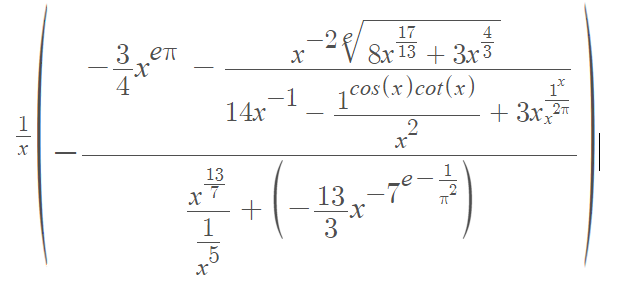

 willow bear
what am i looking at and what do you want to do with this monstrosity of an expression
velvet blade
Hey I resumed my studies today, thankfully the lorries stopped dumping soil. I have trouble with 4th question
I don't understand how to solve it
willow bear
write $z = re^{i\theta}$
obsidian monolithBOT
Ann:
velvet blade
yes I did
willow bear
one of the possible values for $w$ is $r^{1/n} e^{i\theta/n}$
obsidian monolithBOT
Ann:
velvet blade
ok?
willow bear
call this w_0 for convenience
velvet blade
Okay
willow bear
notice that $w_0^n = z$ by construction, but also $(w_0 e^{2\pi i/n})^n = z$ too
obsidian monolithBOT
Ann:
velvet blade
Okay
velvet blade
Okay I'll try and let you know, thanks.
Wait that means rest of all the other complex numbers are inside the multiples of 0 and 2pi right?
Sorry
Let me rephrase it
Rest of the complex numbers have polar coordinates which have angles in the range of 0 and 2pi
willow bear
i didn't really say anything about theta. you can have it be between 0 and 2pi if you want but you don't need to.
the $n$ numbers you're looking for are given by $$w_k = w_0 e^{2\pi ki/n}, \quad k = 0, 1, \dots, n-1$$
obsidian monolithBOT
Ann:
velvet blade
why have 2pi when it's equal to 1 though?
willow bear
since when is 6.28ish equal to 1
also note i am not involving e^(2πi) anywhere. maybe consider reading the whole thing i send instead of cherrypicking symbols
velvet blade
Ok I will. Give me 5
velvet blade
Ann I couldn't understand why to have a 2pi as an exponent, and how the numbers are said to be distinct when we're just multiplying one of the roots with a said exponent. Aren't we using one number to make another?
@willow bear
willow bear
Aren't we using one number to make another?
distinct doesn't mean unrelated
velvet blade
Okay but it'll just form one number right?
wait
sorry
I got it
What about 2pi as an exponent though?
I didn't get that part
willow bear
the exponent isn't 2π it's 2πki/n
or 2πi/n for my first thing
$e^{2\pi i/n}$ is a number that when raised to the $n$'th power gives 1
obsidian monolithBOT
Ann:
willow bear
i.e. $e^{2\pi i/n}$ is an $n$'th root of unity.
obsidian monolithBOT
Ann:
leaden stratus
earnest jungle
<@471700471753605121> anyhow, for 135 the numerator (when plugging in $-\infty$)...
Yes, but I'd need the passages
willow bear
sounds like you overthought things a lot again @velvet blade
velvet blade
All of this feels new AF. I am unable to figure out how to think about a problem most of the time
willow bear
does the book teach you how to think of complex number multiplication as scaling & rotation
obsidian monolithBOT
lazypawtato:
willow bear
no that is not the answer as written
velvet blade
Is it $e^{i\theta}= e^{\frac{2\pi i}{n}}$ ?
obsidian monolithBOT
lazypawtato:
velvet blade
willow bear
what stopped you from at least writing out
1, e^(2πi/n), e^(4πi/n), e^(6πi/n), ..., e^(2(n-1)πi/n)?
velvet blade
I really don't know
wait why n - 1 in exponent? Isn't it supposed to be n in the end?
no wait
I can't
willow bear
if you go up to n you'll get e^(2πi), which is 1 and so you're taken right back to the beginning of the list
viscid thistle
Im super confused by question c here
I dont see why they are using velocity x acceleration for these intervals
Acceleration should be the only thing that matters here
leaden stratus
What should I do here? Take out x^3 and have [x^3(9+X)/2]???
sour hemlock
I think the limit would be inf
 astral mountain
just plug in - inf and see what happens
sour hemlock
just put inf in there
leaden stratus
If I plug -inf we have the undetermined form inf - inf
leaden stratus
But isn't x^3 greater and dominate over x^2?
astral mountain
yes
leaden stratus
Then I would have to take out x^3 🤔
leaden stratus
Ok, I'm trying
earnest jungle
@leaden stratus I have already explained it man
leaden stratus
Yes, but I didn't understand it
earnest jungle
So basically, you focus on the higher powers in the denominator and numerator
The highest power in the numerator is x^3, right?
leaden stratus
Yes
earnest jungle
But we are going toward -infinity and the power is odd, so the numerator will explode to -infinity
astral mountain
@leaden stratus what u did in that pic is alrdy correct btw
earnest jungle
Since x^2, although will always remain positive, increases much slower
leaden stratus
@astral mountain yes, but we would have -inf * 9+0
leaden stratus
-inf * 0 is undetermined
earnest jungle
basically, just “plug in” -infinity to see what happens
leaden stratus
Hahaha thanks guys, I'm dumb 😅
earnest jungle
Np
leaden stratus
And what can I do here? I tried rationalising.
@earnest jungle
@astral mountain
astral mountain
I'd just pull out the x
leaden stratus
viscid thistle
third step, it should be -x^2 not -x
Ah right
At the denominator it's a mess
I'll probably have to pull +inf on every x
viscid thistle
if you fix it, you should get x^2-1-x^2 at the num
leaden stratus
Yes, fixed that
viscid thistle
which simplifies to something nicer...
leaden stratus
Yes, I already fixed that, thanks
velvet blade
Is induction just used to prove stuff? not derive it?
he just gave the equation for it. No derivation
willow bear
induction per se is not used for derivations, but the ideas behind induction naturally give rise to the idea of recurrence relations
and a recurrence relation may be analyzed (in a context-dependent manner) and solved
and the solution, if necessary, verified by induction
velvet blade
So binomial theorem isn't derived in highschool?
okayy
when is it derived though?
willow bear
there is a slightly informal combinatorial explanation for why the binomial theorem is what it is
is that what you're looking for?
depending on the highschool and exactly what goes into its math classes, the combinatorics may be accessible to its students
willow bear
if you insist
idk like
there is a difference between arriving at a result and proving it
the former tends to be more informal and exploratory
velvet blade
Okayy
I assumed assertion is true and added n+1 numbers. Which gave me $1+3+5+...........+(2n-1)+2n = n^2 + 2n$
obsidian monolithBOT
Researcher in Pre-algebra
obsidian monolithBOT
Researcher in Pre-algebra
velvet blade
Is that it?
willow bear
your last term isnt correct
also why not make a ton more dots in that ellipsis if you like it so much
1 + 3 + 5 + .............................................................................................................................................................................................................................................................................................................................................................................................................................................................................................................................................................................................................................................................................................................................................................................................................................................................................................................................................................................................................................................................................................................................................................................................................................................................................................................................................................................................................................................................................................................................................. + (2n-1)
anyway
velvet blade
I didn't even make comically many
willow bear
the terms go up by 2 here not by 1.
velvet blade
Okay
willow bear
the (n+1)st term would be 2n+1
and you would have n^2 + 2n + 1, or (n+1)^2 as intended
velvet blade
I didn't understand