#precalculus
1 messages · Page 269 of 1
 opaque idol
 obsidian monolithBOT
egocarpo:
opaque idol
No
 burnt sonnet
ah then we need to modify
 steel swan
how hard is skipping pre calc
opaque idol
Positive
opaque idol
No
burnt sonnet
okay
burnt sonnet
,w plot -x^2
obsidian monolithBOT


 Requested by egocarpo#2723
burnt sonnet
Requested by egocarpo#2723
burnt sonnet
This one has a max point at (0,0)
burnt sonnet
okay so we want the sign on the x^2 term to be negative
yes
f(x)=-x^2+bx+c we have now 🙂
burnt sonnet
lets see if we can find a b and c so that it f(-3) is equal to -6
f(-3)=-6 this is what we want
opaque idol
Ok
burnt sonnet
$f(-3)=-(-3)^2+b(-3)+c=-6$
opaque idol
Mhm
obsidian monolithBOT
egocarpo:
burnt sonnet
oh we need it to be the max point aswell
hmm have you shifted functions before
like if you look at f(x) and then at f(x-1)
opaque idol
No?
burnt sonnet
We are working here wait for your turn 😛
opaque idol
I don’t think so
steel swan
k.
obsidian monolithBOT
 Requested by egocarpo#2723
opaque idol
Requested by egocarpo#2723
opaque idol
The graph shifted
opaque idol
Mhm
burnt sonnet
,w plot -x^2-6
obsidian monolithBOT
 Requested by egocarpo#2723
opaque idol
Requested by egocarpo#2723
opaque idol
?
opaque idol
The Max is (0,-6)
opaque idol
(-3,-6)
burnt sonnet
do you remember how we did to shift the all the points of the function? 😄
opaque idol
Yes
burnt sonnet
f(x)=-x^2-6
opaque idol
For this we have to move to the left 3 times a
burnt sonnet
this has a max at (0,-6)
and yes we want to move allt points three steps to the left
so when we took f(x-1) we shifted to the right
so if we take f(x+1) we shift to the left
,w plot -(x+1)^2-6
burnt sonnet
,w plot -(x+1)^2-6
obsidian monolithBOT
 Requested by egocarpo#2723
opaque idol
Requested by egocarpo#2723
opaque idol
Ok cool
obsidian monolithBOT
 Requested by egocarpo#2723
burnt sonnet
Requested by egocarpo#2723
burnt sonnet
and then if you write on in standard for you have to simply it
-(x+3)^2-6, write this out on ax^2+bx+c form
burnt sonnet
there is a square
opaque idol
Yes I put that
burnt sonnet
$-(x+3)^2-6=-(x^2+6x+9)-6$
obsidian monolithBOT
egocarpo:
opaque idol
So would you have to do 9-6?
 opaque idol
So the answer will be -x^2-6x-15?
burnt sonnet
that is one answer
there is infite solution 🙂
This is how I would view it there might be smarter ways to go about it!
opaque idol
So I should put -x^2-6x-15?
burnt sonnet
I mean do you think it fits the description?
opaque idol
I think so
burnt sonnet
it it a quadratic function with max value at (-3,-6)
opaque idol
Imma put it in the calc.
burnt sonnet
Good do that to be sure
opaque idol
How do I find the max?
burnt sonnet
Have you done derivatives?
opaque idol
Yeah
burnt sonnet
you can just plot it between some x-values around x=-3 and see if it is a max
burnt sonnet
If you are asking you probably need it
steel swan
khan academy explains it well
burnt sonnet
yeah and I said if you ask that question then you should probably do it
steel swan
I'll ping u later nvm
burnt sonnet
haha don't
steel swan
im interputing
burnt sonnet
And yes you kinda were, you need to wait on your turn, and I dunno if you should skip it...
@opaque idol are u able to work it out?
steel swan
@burnt sonnet so u
since jpiggy is not here for now
May I ask why I shouldnt skip pre calc
I mean I did most of the khan academy course
burnt sonnet
If you felt safe about it you wouldn't ask
steel swan
and it seemed pretty easy
burnt sonnet
I don't even know what this is we don't do that in my country 😛
steel swan
bruh
steel swan
wait where do u live
burnt sonnet
europe 😄
burnt sonnet
Maybe try and take some online test for it and see if you know it well enough
steel swan
yes
burnt sonnet
Ye that is good for further studies
 paper pier
Not sure if i did this right...
 willow bear
is that $y = x\csc(x^2)$ or $y = x(\csc(x))^2$?
obsidian monolithBOT
Ann:
 sick steppe
Im assuming csc(x^2)
willow bear
half these n's are horribly written
$\lim_{n \to \infty} \sqrt[n]{n}$ is this what you want the limit of?
obsidian monolithBOT
Ann:
willow bear
write $n^{1/n}$ as $e^{\frac{1}{n} \ln(n)}$
obsidian monolithBOT
Ann:
 drowsy helm
alright and then what
willow bear
$\frac{\ln(n)}{n} \to 0$
obsidian monolithBOT
Ann:
willow bear
e^0 isn't 0
drowsy helm
yeah it's 1
 quaint mason
Is anyone good with piecewise function, i somehow got this problem right 2 weeks ago and somehow forgot how to solve it :)...
quaint mason
Nvm i got it
 pallid marlin
1-sin^2\left(\frac{7\pi }{6}\right)
 viscid thistle
Hello, can someone explain to me why n=8?
 blissful ridge
Try to write i in the form of e^{ix}
 fickle plaza
Could anyone help me with the first part of this question?
fickle plaza
Yeah @willow bear
fickle plaza
thing is I don't really know how to do that, I can use differentiation of first principles to differentiate but that's about it I don't know about X or y cords ;-;
willow bear
...
ok so like this is way too early for differentiation
are you... telling me you don't know anything about the coordinate plane??
fickle plaza
dnusbaj nononono, I just don't understand how to use differentiation to find the y cords
fickle plaza
I'm not?....
willow bear
A lies on the curve y = x^2 - 6x + 5 and its x-coordinate is 2. what is its y-coordinate?
willow bear
so what is it then
fickle plaza
-3
willow bear
there we go
B also lies on the curve y = x^2 - 6x + 5 but this time its x-coordinate is (2+h).
what is B's y-coordinate?
fickle plaza
(4+2h+h^2) - 6(2+h) + 5
fickle plaza
h^2 - 2h - 3
willow bear
ok great
so A and B have coordinates (2, -3) and (2+h, h^2-2h-3) respectively.
are you able to find the gradient of AB?
fickle plaza
mhm
I think
Y - y1 / X - x1
but how do I do this when I've got h terms?
-3 - H^2-2h-3 / 2 - 2+h
ifkhnjfdlksjhfkj
willow bear
okay so there are several things wrong with this
most starkly the absence of parentheses and the random capitalization
why not write $\frac{(h^2 - 2h - 3) - (-3)}{(2+h) - 2}$
obsidian monolithBOT
Ann:
willow bear
yes it can
it can be simplified plenty
and in fact SHOULD be.
@fickle plaza sorry for the delay, had some irl shit to attend to
 north pagoda
Anyone know how to solve this $ \frac{3^{3-x} } { (3^{3-x} ) + 3^x } = .5 $
obsidian monolithBOT
pancakehammer:
north pagoda
I think I reduced it to $ \frac {3^3 } {3^3 + 3^{2x}} = .5$
obsidian monolithBOT
pancakehammer:
north pagoda
but not sure what to do here
obsidian monolithBOT
Al𝟛dium:
viscid thistle
$27=\frac12 (27+3^{2x})$
obsidian monolithBOT
Al𝟛dium:
obsidian monolithBOT
pancakehammer:
north pagoda
$ 27 = 3^{2x} $
obsidian monolithBOT
pancakehammer:
viscid thistle
Yeah
north pagoda
now is where I confuse
viscid thistle
From here you can do it by logic/trial or just log properties
north pagoda
how would you use log properties
obsidian monolithBOT
Al𝟛dium:
north pagoda
yo this actually makes sense how logs work now
opaque idol
Can someone help?
viscid thistle
@opaque idol what have you tried
obsidian monolithBOT

 Requested by Al𝟛dium#4084
viscid thistle
Requested by Al𝟛dium#4084
viscid thistle
Have you got anything?
opaque idol
Yeah
viscid thistle
Or how to get f(x+4)
viscid thistle
Not sure how you got there
viscid thistle
Say we have h(x)=x-3
Then h(👀 )=(👀 )-3
h(🍞 )=(🍞 )-3
h(71863849916)=(71863849916)-3
h(x²+x)=(x²+x)-3
Does this clarify it
opaque idol
Wym
viscid thistle
It's an analogy i use to make you understand that whatever is inside the parens on h(x) is gonna be plugged into the x
As i did with the bread, the eyes, the number and the x²+x
Do you understand what i did
opaque idol
Oh ok I get it now
viscid thistle
Oh can you get f(x+4) by yourself then?
opaque idol
Yeah?
viscid thistle
i'm not getting that exactly
What did you got for g(x) first
Like the expression of g
opaque idol
I think (1,3)
viscid thistle
No like the function g
opaque idol
Oh
opaque idol
Would u plus in x^2-2x+3+4?
opaque idol
Wait so
viscid thistle
Say we have h(x)=x-3
Then h(👀 )=(👀 )-3
h(🍞 )=(🍞 )-3
h(71863849916)=(71863849916)-3
h(x²+x)=(x²+x)-3
Remember this
opaque idol
I got it from the g(x)
viscid thistle
Don't be sorry
So
If you have f(x)=x²-2x+3
Find f(x+4)
Let's do this step by step
Forget about g for now
And focus on that ^
What you want to do is to plug x+4 into all the x you see at x²-2x+3
What do you get
opaque idol
Ok
obsidian monolithBOT
Al𝟛dium:
viscid thistle
Now we get into the obscure world of algebra
Remember that (a+b)²=a²+2ab+b² and NOT a²+b²
Try to simplify that
@opaque idol
opaque idol
(X+4)^2-2x-8+4
viscid thistle
Yes
So far so good
Expand (x+4)² now
@opaque idol ???
Do i have to ping you?
For you to answer?
 strong fossil
viscid thistle
strong fossil
viscid thistle
That would make it (x+4)(x-4)
@opaque idol how?
(x+4)² is (x+4)(x+4) on any case
But why not just use $(a+b)²=a²+2ab+b²$ instead of expanding (a+b)(a+b)
obsidian monolithBOT
Al𝟛dium:
 limpid wyvern
viscid thistle
limpid wyvern
viscid thistle
Alright i'm tired of waiting and getting ghosted. I'm out unless you change your attitude.
viscid thistle
No. Jpiggy
limpid wyvern
o
 blissful flower
Could any of you help me get the flow of how this works, I've studied it before but it's been years so I've forgotten
As in the steps you take to solve it
I'd love to google myself but I'm not quite sure what to google about it
 velvet granite
so you've got a composite function
Meaning, first, you need to find the inverse of f(x)
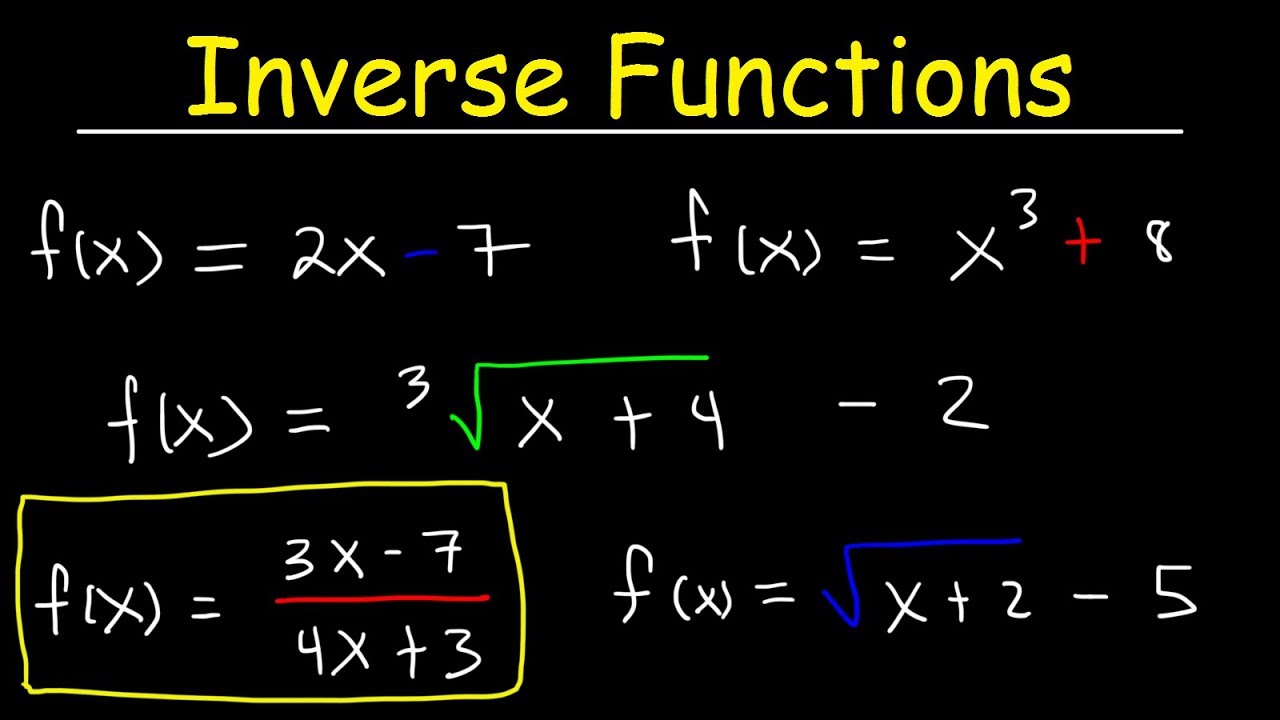
This algebra 2 and precalculus video tutorial explains how to find the inverse of a function using a very simple process. First, replace f(x) with y. Next, switch x with y. Finally, solve for the y variable and that's it. This video contains examples and practice problems ...
 uncut mulch
why not just apply the definition of the inverse
velvet granite

This algebra video tutorial provides a basic introduction into composite functions. it explains how to evaluate composite functions. This video contains a few examples and practice problems.
My Website: https://www.video-tutor.net
Patreon: https://www.patreon.com/MathScie...
blissful flower
Thank you, I didnt see someone answered
Thanks a lot
i got −5^√5 for the inverse of x^5-3
correct?
velvet granite
Whats that?
uncut mulch
$f(f^{-1}(x)) = x$
obsidian monolithBOT
ramonov:
velvet granite
But you still have to do the inverse and do a composite function right
uncut mulch
nope
uncut mulch
but you should deduce that an inverse actually exists for that function
blissful flower
i wish i was taught that too lol
 steady seal

 past meadow
split it up and write tan^2x as 1+sec^2x and it will simplify down but yeah wrong channel
sick steppe
@steady seal do you still need help?
 fossil locust
how do i approach this
@steady seal 5-5sin^2theta = 5 (1 - sin^2 theta)
sick steppe
@fossil locust try not to just give the answer if you can 🙂
 humble current
@lament fiber you will get DNE
 lament fiber
yeah I was about to correct that sorry
lament fiber
it's been a while since I've done this I'm basically starting over
lim sin x/x =1
lim tan x/x=1
I think it'll work
yes it should
as x approaches 0 lim sin(x)/x=1
small angle approx is the same thing
humble current
@lament fiber I just did it on paper, it's actually indeterminent
because tan(0) = 0 and sin(0) = 0
lament fiber
yeah you're right
 serene heath
divide top n bottom by x @viscid thistle
lament fiber
you'll get 0/0 then
I suggested the same thing
(1-1)/(1-1)
@serene heath
and they aren't supposed to use l'hopital
also can someone help me in #help-0
I asked here but it got ignored like my prev question so I removed it from here and stuck it in questions and even pinged the Helpers twice 
viscid thistle
@lament fiber are you still stuck on that limit?
divide top n bottom by x @viscid thistle
@serene heath
U'll get 0/0
lament fiber
it was @viscid thistle ‘s question @viscid thistle
 whole vessel
\frac{x^{2}}{4}-\frac{\left(y-3\right)^{2}}{5}=1
You can input this into desmos if you want. Why is there a hole at y = 3 for the vertices?
 sonic arrow
for all $ A,B \in \mathbb{R}^{+}$ such that $A \neq B$, and that neither $A$ or $B$ are $1$, and $\log_{A}B = \log_{B}A$. Find $AB$
the problem is that if you let $n = \log_{A}B = \log_{B}A$ then $A^n = B$ and $B^n = A$. Therefore $AB = (AB)^n$ and here $n$ can only be 1. But that means that $A = B$
any ideas?
sonic arrow
oh nvm im stupid
 warped dagger
did i go overboard here or did i do it right?
 patent beacon
You're taking the square root of both sides which should give sqrt(9π) not sqrt(9)π
@warped dagger
warped dagger
Okay, what do you mean by that?
warped dagger
alright, may i know why? it just kind of doesnt make sense to me
because pis cancel out?
 lapis sphinx
Exactly
Pi is still a number
Imagine it was x
If u have 18x/2x it would be 9 not 9x
Similarly 18 pi/2pi is 9 not 9pi
warped dagger
i see, thanks.
lapis sphinx
Np
warped dagger
was there anything else that i did wrong there?
lapis sphinx
I don’t believe so
Yeah other than r=3 I think ur fine
However
If in some scenario u did in fact end up with r^2=9pi, r would equal 3*sqrt(pi) not 3pi
@warped dagger ^ sry for tag, responded late
 livid fjord
What did u get for a?
livid fjord
Yeh bro I can’t help u cause I’m dumb but I think since it’s been 15 minutes you can @ the helpers
 knotty echo
<@&286206848099549185> I need help with the trig question
someone i just can't get sin - cos by itself
knotty echo
Anyone has any idea how to even start?
lapis sphinx
Yes almost done
knotty echo
I can't get a hair out of this problem
lapis sphinx
Change tan and cot into terms of sin and cos and then common denominator
Try from there
knotty echo
I got $\frac{sin^2x+cos^2x}{sinxcosx}=8$
obsidian monolithBOT
chene12:
lapis sphinx
Yep and what does the numerator equal
knotty echo
1
knotty echo
well i got $sinx=\frac{8}{cosx}$ and $cosx=\frac{8}{sinx}$
obsidian monolithBOT
chene12:
knotty echo
well adding them directly wont do me any good
lapis sphinx
Keep the sin and the cos together
knotty echo
how so?
lapis sphinx
Sinxcosx=1/8
lapis sphinx
This one requires a bit of creative thinking . Can u think of anyway possible to get a value sinxcosx
Utilizing not only ur first equation, but ur second one too
knotty echo
not sure
lapis sphinx
I’ll give u a hint, it has to do with squaring the second expression
obsidian monolithBOT
chene12:
lapis sphinx
I think u missed a part of the term in the middle but that’s alright, I was referring to the sinx+cosx
How could u get sinxcosx from that
knotty echo
something to do with $1+tan^2x=sec^2x$ and $1+cot^2x=csc^2x$?
this latex rendering speed is slow 😦
lapis sphinx
Hm
obsidian monolithBOT
chene12:
knotty echo
im guessing something to do with these?
lapis sphinx
Not really. Think back to the sin x + cosx part
Strictly from that expression
What operation would u perform on that expression to give u sinxcosx
knotty echo
oh you can convert tanx and cotx into its sines and cosines
lapis sphinx
Nahnah just try this: What operation would u perform on that expression to give u sinxcosx
Multiply, add, subtract, exponent, log? What would give u sinxcosx
knotty echo
multiply?
knotty echo
$cos^2xsin^2x$ to cancel out the denominators of tan and cot
obsidian monolithBOT
chene12:
knotty echo
right?
lapis sphinx
Hm
How would u use an exponent to get there tho
What is the simplest exponent that we know?
knotty echo
square
lapis sphinx
The one that we learned first, other than 1
Exactly
Try squaring it
See what u get
By it, I mean squaring sinx+cosx btw
 north niche
Wat is the inverse of f(x) 5x-2
knotty echo
substituting cosxsinx with 1/8?
north niche
Wat is the inverse of f(x) 5x-2
lapis sphinx
Sure, and how about the first two terms?
knotty echo
which is 1
lapis sphinx
Yep so what do we get
knotty echo
1 + 1/8
lapis sphinx
Remember it’s 2(sinxcosx)
north niche

lapis sphinx
Leave it in fraction form, what’s the left side of the equation?
knotty echo
not sure
lapis sphinx
How did u end up with sin^x + cos^x + 2sinxcosx
knotty echo
(cosx + sinx)^2
lapis sphinx
Exactly
knotty echo
then take square root?
lapis sphinx
U got it
knotty echo
yay thanks
livid fjord
Yooo noice
north niche
Wat is the inverse of f(x) 5x-2
knotty echo
$sinx + cosx = \frac{\sqrt{5}}{5}$
obsidian monolithBOT
chene12:
livid fjord
Bro derp u gotta wait for chene to finish being helped and then can I get help cause I’ve been waiting for and hour
lapis sphinx
So (sinx+cosx)^2 = 5/4
Yes exactly
But what happens
When u take sqrt
Think abt the signs
knotty echo
$\pm 2$
obsidian monolithBOT
chene12:
knotty echo
$\frac{ \sqrt{5} }{ \pm 2 }$
obsidian monolithBOT
chene12:
knotty echo
thanks
lapis sphinx
Np
livid fjord
Bro I keep making absurdly wrong one’s. This may be too large of a problem but I would really appreciate some help
I need to make 2 rational functions that meet those requirements
lapis sphinx
Scout I can give u a 2 minute explanation for the first one then I gotta go man
livid fjord
Yeh anything helps
livid fjord
Well it’s a hole
lapis sphinx
Yup, but how does it occur
livid fjord
U get it when you can factor out of the numerator and denominator
lapis sphinx
Exactly
livid fjord
Like if u have (x+4) in the numerator and denominator
livid fjord
x(x+4)(x-8) over (x+4)(x-8)
livid fjord
Ok yeh
livid fjord
Yee
lapis sphinx
How do u get a vert asymptote
lapis sphinx
Yup, but specifically changes made to the function
Well
Remember that those are the holes
So they can’t be the inf discontinuities
U would have to make up 3 more
livid fjord
Um
livid fjord
7?
livid fjord
I figured out what x could equal that would make the denominator equal to zero
lapis sphinx
Bingooo man
So what would u do to the original equation with the holes in it already
livid fjord
K imma write it real quick
lapis sphinx
just write the final expression i wrote
so how could we finish it up
based off what i did
livid fjord
Well the numerator would be x^3-4x^2-32x
livid fjord
Ok
livid fjord
To the numerator
lapis sphinx
nahh cuz we tryna do vert asymptotes which always go in denominator
livid fjord
K
lapis sphinx
so what would u do
livid fjord
No clue
lapis sphinx
how do u get a vert asymptote again? refer to what i did with 4/(x-7)
lapis sphinx
nope, cuz -4 and 8 are already holes so we cant use them for infinite discontinuites/vert asymptotes
we gotta create new ones
livid fjord
Division?
lapis sphinx
and u need 2 more new ones
i mean, we just put x-7 in the denominator to get an asymptote
so what would we do to get 2 more
livid fjord
Hm
livid fjord
Make more idk
lapis sphinx
Yes
livid fjord
Oh ok Yee
livid fjord
So (x+6)
livid fjord
And (x-2)
livid fjord
Bro that took me too long to figure that out lol
lapis sphinx
Lol
Just take picture of what u wrote for final expression
Just to make sure u got it
lapis sphinx
Does ur teacher demand u to simplify?
livid fjord
Cool awesome
livid fjord
Yee
lapis sphinx
Try plugging it in to see if it’s right
livid fjord
I also got my TI-84
livid fjord
Shoot I wrote it wrong
livid fjord
Cya
lapis sphinx
Tap on the places where ur supposed to have holes
It should say “undefined” for the y values @livid fjord
livid fjord
To find the oblique asymptote I think I’m doing the division wrong
uncut mulch
where's your quotient?
also there won't be an oblique asymptote here.
livid fjord
Ah okay thank you
 wintry yacht
serene heath
wintry yacht
serene heath
your therapist
 cedar pawn
Can someone do it fast to see if it's -inf.
I have -inf but in my textbook I have +inf
serene heath
,w lim as x approaches -inf of (sqrt(x^4-3)-xsqrt(9x^2-1))/(2x+7)
obsidian monolithBOT

 Requested by the one n only#2885
cedar pawn
Requested by the one n only#2885
cedar pawn
Sqrt(x^4) is always +x^2?
,w lim as x approaches -inf of (sqrt(x^4-3)+xsqrt(9x^2-1))/(2x+7)
obsidian monolithBOT

 Requested by grubby#2374
cedar pawn
Requested by grubby#2374
cedar pawn
It's inf, thought so I rechecked it and it's inf not -inf
 humble pagoda
Sqrt(x^4) is always +x^2?
@cedar pawn yeah
cedar pawn
Same for any even exponent except for 2?
 sick seal
hello yall, im struggling with this question here
ive tried a multitude of things including whats in the answer box atm and i cant seem to pin down the answer

 calm granite
 fiery wren
 potent imp
huh
how can the cosine of any real number be -6
also thats not how the double angle formula works
cos(2x) is cos^2(x) - sin^2(x) not 2cosx
so ig the last one
potent imp
yeah looks right
 proud raven
@viscid thistle what made you say 65?
viscid thistle
@viscid thistle what made you say 65?
@proud raven 65 is the right answer
but idk how you get it
 uncut mulch
properties of arc length
viscid thistle
properties of arc length
@uncut mulch great explaiantion
 vapid gate
Anyone that can me with this problem please
velvet granite
@vapid gate SOH CAH TOA
vapid gate
Are the two problem solving Sin and Tan @velvet granite
velvet granite
Well, you need to use the identities to solve for the missin sides
You have the angles 61, 90, and whatever 61+90-180 equals as your third angle
vapid gate
WELL i have x already but struggling witth y
vapid gate
Thanks
velvet granite
np
velvet granite
so 8.87^2+ 16^2 = y^2
vapid gate
I did it by using the sin found it much easier but thank you so much!
 azure hedge
hello does anyone have answer key to math 1103 precalculus spring 2016?
uncut mulch
course content is different everywhere
obsidian monolithBOT
mirzathecutiepie:
 rugged linden
since $180-\theta$ can be the angle between the x axis and the 6m vector as well, and from there we use the identity $cos(180 - \theta) = -cos(\theta)$
obsidian monolithBOT
mirzathecutiepie:
rugged linden
if so, which one is "correct"? Do we solve for both angles and say hey I want an obtuse one so I'll choose the largest one?
 quick mirage
@rugged linden Because the angle lies in a quadrant where the "x" value is negative, or where the angle > 90, (cos(angle) = x/r after all), the only value that would be appropriate in this case would be where x < 0, so 2/3 would not be a solution here
willow bear
same reason you can't cancel out the fives in $\frac{5-2}{5}$ to get $-2$
ok texit is dead
lemme just handwrite it
obsidian monolithBOT
Ann:
willow bear
ah there it goes
 quartz oxide
help
velvet granite
for a It says a has to be positive and for b a has to be negative
@velvet granite @quartz oxide
 opaque vault
https://media.discordapp.net/attachments/773215149535526962/773645132968755240/image0.jpg?width=508&height=677
for this how can i fit the 12 years on the x axis
 quartz oxide
@velvet granite ok but how do i make the graphs
velvet granite
Treat the years starting from1996 like x values
Number of adult animals like your y values
 iron inlet
How do I find the maximum angle that I rotate f(x)=(3x^2+x+3)/(x^2+1) such that f'(x) is still a function, where f'(x) is the new equation after rotation?
I feel like it has something to do with injectivity, since the rotated function needs to pass the vertical line test
So I found that the function is injective on (-infinity,-1) U (1,infinity) and (-1,1), but I'm unsure how to use that info.
 calm whale
probs try asking in a different channel
iron inlet
in what channel
 violet knoll
 full pagoda
should be correct
potent imp
yeah looks good
 round quest
i got 8,28,88
 humble cedar
how do i solve this
says minimum height of bridge over road is 4 but how is that relevant, the height is already 5
highway road is 10m wide which only gives 5 on each side, still dont know
 willow bear
you're dividing by a quadratic, so the remainder is a polynomial of degree at most 1
so you have: P(x) = (x+4)(x-3)Q(x) + ax + b
where ax + b is your remainder, and a, b are constants that you need to find
 astral sedge
@uncut mulch the other person is actually posting my working out
I posted the question originally on a different sever titled "Homework Help"
and he posted my question to this server before I did

he then messaged me to join his server
 echo wagon
This is a bizarre conspiracy, wth
echo wagon
Not cool tbh for him to copy Ram's help and pass it off as his own
viscid thistle
How do I do part a?
 harsh smelt
@viscid thistle so look
for example which % of students take a postgraduate degree?
👻
 kind elm
t!goal claim
 junior sable
What does it mean to raise something by a decimal? 10^4.640878 = 43740, but what does it mean to raise something by a decimal? To raise something by 4, sure, 10^4 is 10,000, but how do you wind up with a number like 43740, a very "unsquare" number?
lapis sphinx
so
for ur case
its 10^4.640878 right?
so 10^4.640878 is the same thing as
10^(4 + (640,878/1,000,000))
if we simplify that mixed fraction we get
10^ (4,640,878/1,000,000)
and then think about it like this
if 9^(1/2) is the same thing as √(9^1) with an index of 2
similarly
10^ (4,640,878/1,000,000) will be the millionth root of 10^4640878
junior sable
The beginner understanding of exponents as "this number multiplied by itself this many times" just won't apply anymore, huh?
lapis sphinx
i guess
junior sable
i see your steps, and thank you for that, but intuitively, 10^x in my mind should make a number that ends in many 0's. But you can put a decimal in x, any decimal into x and get any number you'd like out of it. How does that happen?
lapis sphinx
alright, so im not entirely sure abt why it happens, but we can also represent it utilizing logarithms
for example
10^x = 506
this means that log 506 = x
plug in into the calculator and u get 2.70415051684
then go back to ur original equation 10^x = 506 and plug in 2.70415051684
u should get 506
junior sable
are those irrational numbers, those decimals?
lapis sphinx
i dont think so, given the fact that the answer comes out exactly to 506. and plus just think abt it, if u were to plug in a number with decimals that never ended, the final answer would never end either right? but the answer we have, 506, is a rational number that ends
i may b wrong, but thats what i think is right
junior sable
I'm having a hard time learning logs, exponents and square roots. They all seem like different ways of expressing the same thing. How did you learn all those identities, just with sheer willpower?
lapis sphinx
i mean, i just think about it like this. For squares, ur just multiplying a number/variable by itself. That was just memorization. For integer exponents greater than 2, i just remember once again ur just multiplying that number by itself however many times the exponent is equal to. For exponents less than 0, u just do the same thing as the exponents greater than 2 except u gotta take the reciprocal. For numbers and variables raised to the power of 0, its just memorization that the answer comes out to 1.
junior sable
square roots mb
lapis sphinx
o
sqrt of what types of values?
perfect squares? non perfect? variables?
but for logs its just memorization imo
the basic concept behind them
junior sable
stuff like this
lapis sphinx
i mean, that right there is just a bit of creative thinking
junior sable
i don't understand what's going on step by step
lapis sphinx
Step 1: problem. Step 2: tries to convert the denominator of that fraction into a value that can be inputted into the larger sqrt expression adjacent to it. Step 3 (tricky step): because u can combine sqrts, he puts them together under the radical. Step 4: simplify by factorization and by splitting up the fraction
Step 3 is a bit tricky
I'll give u an example
lets say u have (1/3) (sqrt(25))
in order to put the whole thing into the sqrt, one must change the 3 into the sqrt 9
since ur mutiplying, u can put 1 * ((sqrt (25)) / (sqrt 9))
once u have ((sqrt (25)) / (sqrt 9)), u can take out the square root from each individual number, and give it to the whole thing
u will be left with 1*sqrt (25/9)
that gives u 5/3
which, equals our problem from the beginning: (1/3) (sqrt(25)) = (1/3) * 5 = 5/3
junior sable
Whenever I multiply fractions, I multiply top to top, bottom to bottom. In step 2 they convert a denominator into a value that can be inputted into the square root. What's going on there?
lapis sphinx
if they didnt convert it, they wouldnt be able to input it into the sqrt
or u could also think abt it like this
junior sable
gotcha
i don't think i know how to simply that either
lets see if I can use microsoft math for this
junior sable
that's a big help, thank you
lapis sphinx
no probs man
except what i did isnt the answer for the problem u saw in the video thing
its the sqrt of the final thing i got
but thats alrdy on the video thing so
junior sable
since all of it is under a sqaure root, would it be 2 root -1/x^3?
lapis sphinx
nah u cant separate it because its bonded by a "-" sign
if it was a multiplication, then u could bring out the 2
but with addition or subtraction, u cant
willow bear
not without a bit of extra work you aren't
as-is, you lose a whole bunch of solutions
yes
uncut mulch
if this is a solve question, you shouldn't divide by stuff that could be 0
instead consider factorisation
 cobalt storm
cosx = 2sinxcosx
 halcyon chasm
i'm having trouble solving $\cot(2\pi t)=-1$
obsidian monolithBOT
acex:
serene heath
uhhh
viscid thistle
Uhh
serene heath
<@&268886789983436800> hi
viscid thistle
Dang you sniped me
serene heath
forgot i can delete stuff
viscid thistle
Lmao
(for the mods seeing this, a guy posted an innapropiate pic and now it's deleted)
 severe verge
yea i banned em
 misty ocean
Can someone explain to me why this is true?
knotty echo
take a look at $sin^2x - 6sinx + 9$
obsidian monolithBOT
chene12:
knotty echo
what do you notice about the form of that expression
misty ocean
its ax^2+bx+c
knotty echo
yes it is quadratic, therefore try factoring
knotty echo
since the right side is all in terms of cscx, then use your reciprocal identities to set the left side in terms of cscx
misty ocean
ok now i got (1-3)/cscx but where does the top cscx come from?
knotty echo
ok good so $\frac{1}{cscx} - 3$
obsidian monolithBOT
chene12:
knotty echo
np
 hallow bison
 idle moat


 thin pulsar
Hello
viscid thistle
Hi can someone check if my answer is correct? I got N 58.77 degrees E.
uncut mulch
seems you got the direction wrong
viscid thistle
Would it be S W?