#precalculus
1 messages · Page 234 of 1
 pale bison
3^x wouldn't work because it doesn't pass the point (1, 1)
 fluid sable
Yeah
 uncut mulch
the base you choose doesn't really matter
fluid sable
Hm?
pale bison
take it over Ramonov, i dip, ty
uncut mulch
since the constant in the power adjusts for that
 native sequoia
3^x was pretty close because of that reasoning
fluid sable
Right?
But idk
how to get it right
Its wrong ik for sure
@native sequoia any clue ?
On what it is
uncut mulch
if you determined a constant ratio of 3 as x increases by 1,
you'd get something like:
y = a * 3^x
and then sub in any of the points to determine a.
uncut mulch
what are you subbing?
fluid sable
1/3
 normal crown
Hi guys, I'm not exactly in an English speaking country so a lot of terms are plain alien to me
but if I wanna ask about the monotony of a function, should I ask here ?
whit this sorta function, grade 2 I guess it's called
normal crown
I'm having a problem with the monotony table
tthanks
so the way I learned in school
is to diferentiate* f(x) to f'(x)
then do f'(x)=0
and get two x values
pretty much this style of table, values are very weird here
so let's say x1 = -1
and x2 = 1
the sign between them is the opposite sign of a
so if a is for example 6
then the sign in the table is minus, no ?
 muted granite
When I multiply AB I get the same answer as multiplying AC. But it says that I am getting the product wrong for AC. Any idea why?
 drowsy karma
Write an equation of the line passing through point (-6, 5) and parallel to the x axis.
what does it mean by parallel to the x axis?
 viscid thistle
Free matrix multiply and power calculator - solve matrix multiply and power operations step-by-step
@drowsy karma parallel to x-axis means a straight horizontal line
muted granite
@viscid thistle thats the same calculator I used. And AB=AC but the homework im practicing on says otherwise.
drowsy karma
Given the line joining the points (2,5) and (8, -q) where q is a whole number, is parallel to the line 3x-2y-5=0, then the value of q is ___
So I understand finding the parallel slope to the equation part
But I don't understand what it wants me to do with the points?
Parallel slope is 3/2 and for the points I have -q -5 / 6
so I'm kinda stuck
viscid thistle
@drowsy karma general concept, if two lines are parallel, their slope MUST BE EQUIVALENT
After having both slopes, set them equal and solve for q
viscid thistle
you got A right tho
 spark cliff
can I have help
viscid thistle
Transform each polar equation to an equation in rectangular coordinates. Then identify and graph the equation. [math]r \sin \theta=-2[/math]
viscid thistle
cardoid
spark cliff
yeah whoops
What are the polar coordinates of (-5, 3pi/4) in rectangular coordinates?
is it
wait
ok i got it im too lazy to type out
spark cliff
yeah we good lol
oh
never mind
i got it lmao
no i didn't get it how do you do that lmao
is it legit the same thing? @viscid thistle
oh angle measures
i have no idea then lol
spark cliff
yeah im not gonna lie i just plugged it itno mathway
viscid thistle

Socratic.org
Cartesian form: (x,y)=(-6,0)color(white)("XX")rArrcolor(white)("XX")Polar form: (r,theta)=(6,pi) The point (x,y)=(-6,0) color(white)("XXX")is on the X-axis (since y=0) and color(white)("XXX")is a distance of 6 to the left (in the negative direction) from the origin
spark cliff
-6, pi?
viscid thistle
actually this is better
Socratic.org
Polar coordinates (r, theta) = (6, 0) To convert from Cartesian Coordinates (x,y) to Polar Coordinates (r,theta): r = sqrt( x^2 + y^2 ) θ = tan^-1 ( y / x ) Given x = 6, y = 0 r = sqrt(6^2) = 6 tan theta = 0 / 6 = 0 " or " theta = 0
viscid thistle
The rectangular coordinates of a point are given. Find polar coordinates of each point. Express $$ \theta$$ in radians. $$( - \sqrt { 3 } , - 1 )$$
spark cliff
what lol
12, 5pi/6?
uhhh wait r has to be negative
then i have no idea lol
wait
viscid thistle
what about that?
spark cliff
that's the answer right lol
viscid thistle
yah
spark cliff
bruh okay not the answer???
viscid thistle
uh what?
viscid thistle
its -12, -pi/6
viscid thistle
idk
spark cliff
ok wait
im stupid
LMFAO
bruh
wait
wtf
they're both positive???
12,5pi/6
what the fuck
viscid thistle
whatsthe other answer
spark cliff
it was 12,5pi/6
bRUH
im so
dumb
i thought it said less than zero
not greater than
lmfao
okay well then
viscid thistle
where does it say greater than
spark cliff
Let r > 0
At the end lol
its obviously not A and im pretty sure its not C but idk about B or D lol
spark cliff
i dont know where you're going with this tbh
i dont see it
i'd guess B but im not sure lol
@lilac pier sorry lol
viscid thistle
The letters x and y represent rectangular coordinates. Write each equation using polar coordinates (r, theta).
2x^2 + 2y^2 = 3
The letters r and theta represent poalr coordiantes. Write each equation using rectangular coordinates (x, y).
r = cos theta
viscid thistle
the answers always C
spark cliff
what kek
viscid thistle
lol its a meme
viscid thistle
lol
viscid thistle
viscid thistle
its not the exact same question
 lilac pier
x^2 = 6y or 19y?
viscid thistle
^
lilac pier
dude you're asking multiple questions
spark cliff
i mean i posted the exact question lmao
viscid thistle
it has x^2 = 6y bc i didn't bother to look for x^2 = 19 when i saw this
spark cliff
f
viscid thistle
its C
spark cliff
yeah i got it lol
viscid thistle
good
spark cliff
2 more and then im going to bed lol
so
yeah i really dont know how to do this one lmao
viscid thistle
thx 🙂
spark cliff
wait so (x^2+y)/9 = 0?
viscid thistle
what?
viscid thistle
lmaooooo
spark cliff
wait bruh
this one is even harder
im gonna stba myself
i legit havent learned this in over a year lmfao
lilac pier
try it yourself first
lilac pier
apply it
spark cliff
bruh do you really have to square that whole thing
viscid thistle
i dont think so
spark cliff
wait bruh
how'd you get the thing under saying y=rsin(theta)
x=rcos(theta)
im blind af sorry
viscid thistle
idek
 willow bear
why should it be just x^2
 harsh cipher
because the length is 2 meaning
willow bear
aight hold on
harsh cipher
okay
willow bear
yeah you're right
as written there is no correct answer and it should be $x^2 + \frac{y^2}{9} = 1$
 obsidian monolithBOT
Ann:
willow bear
if they wanted $\frac{x^2}{4} + \frac{y^2}{9} = 1$ they should've made the semi-minor axis be 2 units long
obsidian monolithBOT
Ann:
 prime prawn
is there an explicit formula for something of the form:
$t_{n+1} = a + b*t_n$
a and b are constants
obsidian monolithBOT
Linguist = Trash:
prime prawn
must be parabolic
edit cubic
edit i fucked up, but the differences between the terms are exponential
 harsh smelt
viscid thistle
harsh smelt
viscid thistle
hi
i need help
height of a rock thrown off a cliff can be modelled with h(t)=-4.9t^2+12t+50
t is time in seconds and h(t) is height in meters
a) find speed at 4 seconds
b) find avg speed over the first 4 seconds
c) when would speed be 0
@viscid thistle t is time, so time at 4 seconds is h(4)
ok
do i do the derivative?
this is on a derivative ws
ok so at 4 seconds
h(4)=19.6m
19.6m/4s
?
4.9 m/s
is that my answer for a?
@viscid thistle
,calc -4.9(4)^2+12(4)+50
obsidian monolithBOT
Result:
19.6
19.6m/4s
@viscid thistle HECK NO
?
- This is NOT a constant acceleration movement
- This is not the typical motion problem $x=vt$
obsidian monolithBOT
Al𝟛dium:
viscid thistle
oh ok
So
$\begin{cases} x=x_0+v_0\cdot t-\frac{1}{2}\cdot g\cdot t² \ v=v_0-g\cdot t \end{cases}$
obsidian monolithBOT
Al𝟛dium:
viscid thistle
@viscid thistle you should know these
ok
Its physics-oriented
alright
So
Which of both do you think we gotta use
hm
bottom/?
One is velocity
Yeah
And $v_0$ is the initial velocity, which is the velocity at t=0
obsidian monolithBOT
Al𝟛dium:
viscid thistle
ok
so how do we find v at t=0?
and what is g
h(0)
ok
g is the gravitational acceration
so h(0)=50
$g≈9.8m/s²$
ohh and thats some constant
obsidian monolithBOT
Al𝟛dium:
viscid thistle
ok yeah
Yeah
ok h(0)=50-9.8t
Plug those in and you have a
ok h(0)=50-9.8t
@viscid thistle ?
Oh wait
shit
h(0)=50
yeah
Okok
ok
ok
Lol
so yeah h(0)=50
and noww
v=50-g*t
?
Yeah
t is obviously 4s
g is what i said before
ok i got 10.8
And you have a
,calc 50-9.8*4
obsidian monolithBOT
Result:
10.8
Aight cool
ok awesome
now avg speed over 4 sec
Well
Do you know the eqn of average speed
no
$\text{average speed}=\frac{\text{total displacement}}{\text{total time}}$
obsidian monolithBOT
Al𝟛dium:
viscid thistle
oh ok
so h(4) i need to find ya?
$\text{average speed}=\frac{\text{total displacement}{\text{total time}}$ is applied to our problem $\text{average speed}=\frac{h(4)}{4}$
Hmm...?
$\text{average speed}=\frac{h(4)}{4}$
obsidian monolithBOT
Al𝟛dium:
viscid thistle
@viscid thistle
nah
a isnt right
u take the derivative
h(t)
h'(4)=-27.2m/sec
Excusez moi
ah yeah u heard me bro
ur wrong
wrong
No
Thats another approach
Wtf
Wait
@viscid thistle maybe physics approach isn't what you want so keep looking for help
Repost it
Bruh you are just annoying smh
Im out
------free channel--------
viscid thistle
No one said that
@uncut mulch this was what i said
$\begin{cases} x=x_0+v_0\cdot t-\frac{1}{2}\cdot g\cdot t² \ v=v_0-g\cdot t \end{cases}$
obsidian monolithBOT
Al𝟛dium:
uncut mulch
20 minutes ago-ish
uncut mulch
yeh, they're different
obsidian monolithBOT
 Requested by ramonov#0921
uncut mulch
Requested by ramonov#0921
uncut mulch
yeh definitely different here
viscid thistle
Aight, wasn't noticed of that detail at all
So speed is the derivative of s(t)?
?
uncut mulch
what's s(t)?
viscid thistle
Displacement in the function of time
uncut mulch
no
viscid thistle
We use displacement for s :(
viscid thistle
When a=0
And its not falling
we use d(t) for displacement
Each country uses another letter so im not learning yours :( lol
viscid thistle
ight hol up
uncut mulch
arccos both sides to see if you get a nice value
spark cliff
how did you get 105
what
f answer was 75
Would’ve gotten it wrong if I did it myself too so LMAO
I got like 30 lmao
uncut mulch
rent mistranscribed w
spark cliff
oh i see where lol
uncut mulch
,w arccos (( sqrt(3)-1)/ (2sqrt(2))
spark cliff
f
obsidian monolithBOT
Requested by ramonov#0921
uncut mulch
,w 5pi/12 * 180/pi
obsidian monolithBOT
Requested by ramonov#0921
uncut mulch
wolfram hates degrees
obsidian monolithBOT
 Requested by burnt toast#0001
spark cliff
Requested by burnt toast#0001
spark cliff
,w arccos (10/(sqrt(26)sqrt(21)))
obsidian monolithBOT
Requested by burnt toast#0001
spark cliff
ummm
uncut mulch
,w arccos (10/(sqrt(26)sqrt(21))) * 180/pi
spark cliff
well
obsidian monolithBOT
Requested by ramonov#0921
uncut mulch
what was the question
obsidian monolithBOT
Requested by ramonov#0921
spark cliff
uhhh
it said it was wrong apparently
idk
i tried 10 and -10 lol
oh
wait
wait
no i see what ur saying im dumb
so its 115.3 degrees?
uncut mulch
yeh
spark cliff
dang
spark cliff
don't remember the equation of ellipses either kek
the vertices are obviously (-4,2) and (4,2) but idk the foci
viscid thistle
the numbers aren't exactly the same tbh
spark cliff
ic
viscid thistle
the process is right though
spark cliff
ah
where'd you get -6 for the horizontal radius
and 4 for vertical
lol
like what if it isn't exactly on the line in the graph given kek
i dont really see how you got half those numbers lmfao
viscid thistle
@spark cliff imma link the diagram
this should help u
so your horizontal radius should be -5
viscid thistle
you have to apply the steps from the solutions onto your ellipse
 snow iris
Good evening, im having a bit of trouble with this:
Due to an unexpected heavy storm the water level in a dam must be lowered one foot. The output of gate A manages to reduce the level in 4 hours. If we open the A&B gates simultaneously, the desired level is achieved in 2 hours and 24 minutes. In how long will only gate B succeed? Hint: The output of gate B is smaller than that of A
 patent beacon
That's a pretty useless hint lol
viscid thistle
@prime crypt
patent beacon
Think in terms of rates.
A lowers at 0.25 ft/hr.
A and B lower at 0.41666 ft/hr
 prime crypt
Damn it’s blurry
patent beacon
So clearly, B alone has a rate of their difference
prime crypt
@viscid thistle thanks, very similar but you got a better quality shot of it?
 rich flint
For spruce I got between 150 and 250 and for cedar I got between 180 and 300 planks
Oh I see your getting help
prime crypt
yeah, not sure how to approach it
rich flint
You see the inequalities that you solved for earlier? You use the same concept but this time use compound inequalities. Meaning it will look something like this 1800<x< 3000
viscid thistle
prime crypt
🐐thank you!
patent beacon
Note you can keep the weight constant by replacing 6 cedar planks with 5 spruce. As well, doing so is always cost saving. It looks like the strategy then is to get as many spruce in as possible
rich flint
Cute dog
patent beacon
My Suki is the best dog! Thx.
prime crypt
@viscid thistle how’d you find that so fast btw? was working so didn’t ask then lol
viscid thistle
I have my ways 😉
 violet quail
willow bear
violet quail
willow bear
multiply through by e^(3x) lol
harsh cipher
Hi question
pale bison
what's up?
harsh cipher
in this video around 0:58. He says if one of them move to the other side it would become negative
lol naisu
what is "one of them" ?
pale bison
harsh cipher
okay..but how does that relate to writing the restriction
pale bison
so like, Ax^2 + Ey = 0
then Ax^2 = -Ey, and RHS is surely going to be negative, since E is positive
harsh cipher
(A)(E) must be greater than zero
pale bison
huh?
harsh cipher
okay
pale bison
if AE > 0
then both must be non zero, and share the same sign
pale bison
E doesn't represent any translation, it scales the function parallel to the y axis
harsh cipher
ok I don't understand why AE must be greater than zero
pale bison
the parabola opens down
so ignoring all other terms, if you write
Ax^2 + Ey = 0
then that simplifies to y = (-Ax^2)/E
if they're less than 0, then it opens up
ok bad wording there sorry
the coefficient of x^2 is -A/E
so if A/E > 0, then -A/E is negative, hence the parabola opens down
so then the question becomes, when is A/E > 0?
it's when AE > 0
pale bison
if red > 0, then it opens up
if red < 0, it opens down
your goal is to get red < 0
i.e.
-A/E < 0
multiply both sides by -1 (remember that flips the sign)
A/E > 0
you can then multiply by E^2, which is surely positive, since square of any number is positive
this yields AE > 0
i'm excluding the possibilities of either of them being 0 for the sake of simplicity
let me know if anything confuses you
harsh cipher
okay thanks for the detailed explanation
 rustic quest
hello please help me i got the answer 1 and im not sure how to solve this
 stuck lark
presumably a poor rewriting of R\{0}
 brittle fable
But he says 0 < u < 2 pi
Im not sure if u = 0 means the open ray (-,0) or something else
stuck lark
full context?
brittle fable
this is the first time i've seen this notation, and the context is not appropriate for this channel
but its about the mobius strip
I'm going to move it to topology-geometry
stuck lark
@brittle fable oh you're looking at a region in the uv plane. the open interval u=0 likely refers to {0}xR
brittle fable
ah that makes sense
 split bay
I am not sure how to find the exact value of theta here
lilac pier
It would help to first find sin(theta) and cos(theta) and then use double angle identities.
 vague aurora
I understand Sine and cosine, but why do the other functions work together in this neat pattern?
Why can cot be represented as a segment from csc to cos and tan as from sec to sin? The others I more or less understand
 blazing parrot
say for tangent, it means O/A right
if we had the radius be A, then O would be where tangent is
vague aurora
If the radius was A, wouldn’t O be 0?
 sour eagle
@vague aurora So tangent is defined as O/A in a right triangle, right? In right triangle ABC, with A = 90 degrees, tan(ABC) = AC / AB
But AB is the radius of the unit circle ( which is 1 ), so AC = tan(ABC)
So the segment AC is defined as the tangent of the angle.
Also this could be taken to #geometry-and-trigonometry
rich flint
@viscid thistle if you plug in 0 what do you get?
If you plug in the angle 45 what do you get?
Yes you do get 15 I just want you to see that if you plug in those angles for alpha it will tell you those values
If you plug in 90 it will be undefined
@viscid thistle check 30,60,45, and 0 and look at the behavior of the numbers
 still yew
Idk if this is the right area, but I have a question regarding Eulars formula (or just trying to derive it from its power series)
rich flint
@still yew just post the question so people can see if they can answer
rich flint
What class is that?
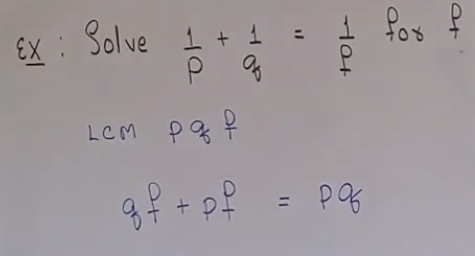 uncut mulch
that's an "f"?
 frigid sapphire
it's my math teacher sorry
I know I didn't even know it was an f at first
haha
willow bear
the right-hand side is 1/f
frigid sapphire
ok I see that now Ann, thank you
yeah isn't that wrong? solving for f is isolating f
willow bear
unless, of course, you believe that every single equation can and should be solved in a single step with a single algebraic trick, and that multi-step solutions are invalid and """wrong"""!
frigid sapphire
now I wonder why she did that other than to teach us how to do that.
 misty heath
you could multiply through by pqf then distribute to take out the f, or divide over each side
frigid sapphire
she isolated f afterwards lol
I guess I forgot or didn't know that I can just multiply something random like that
willow bear
you could multiply through by pqf
that's what was done
frigid sapphire
I know for example multiplying by 2/2 would be equivalent to 1
but pqf isn't so obvious
willow bear
it's the lowest common multiple of all the denoms
so the motivation is that you wanna get rid of the fractions
bc equations without fractions are generally less complex than those with
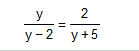 uncut mulch
what's that interval supposed to represent?
frigid sapphire
the domain , sorry
someone else told me it
(-inf, -5) U (-5, 2) U (2, inf)
only thing I don't get now is why exclude -inf and inf?
rich flint
@frigid sapphire solve for y then find the domain
rich flint
What did you get for y ?
frigid sapphire
the domain is of x?
rich flint
Yes I see. When I thought I saw the x variable in there when it wasn’t. So you will see you will have a polynomial meaning what?
uncut mulch
do you have the original question?
since its a bit weird to be asked for the 'domain' of something like this
frigid sapphire
it's ok, someone else helped me. thanks a lot
uncut mulch
and deals with something that seems to be called the "implied domain"
that seems much more appropriate as a solve question
rich flint
@frigid sapphire yes a quadratic equation which is a polynomial. Therefore the domain is -inf to positive inf. Ramanov is right you may want to go ahead and post the original question to make sure that is what is being asked the presentation threw me off cause I see no x variable only a y.
frigid sapphire
I'm stuck on this one now https://i.imgur.com/ekytBE8.png

I tried doing 1188/0.2 but nope
1188 * 0.2 also nope
viscid thistle
@frigid sapphire the strat is making up a system of eqn
Call x the solded tickets on July and y the solded tickets on August
frigid sapphire
damn really
frigid sapphire
only an x
frigid sapphire
I don't sorry I was looking at my book
viscid thistle
R u sure?
frigid sapphire
yeah
viscid thistle
Ok so first i suggest to watch some videos about system of 2 eqn
viscid thistle
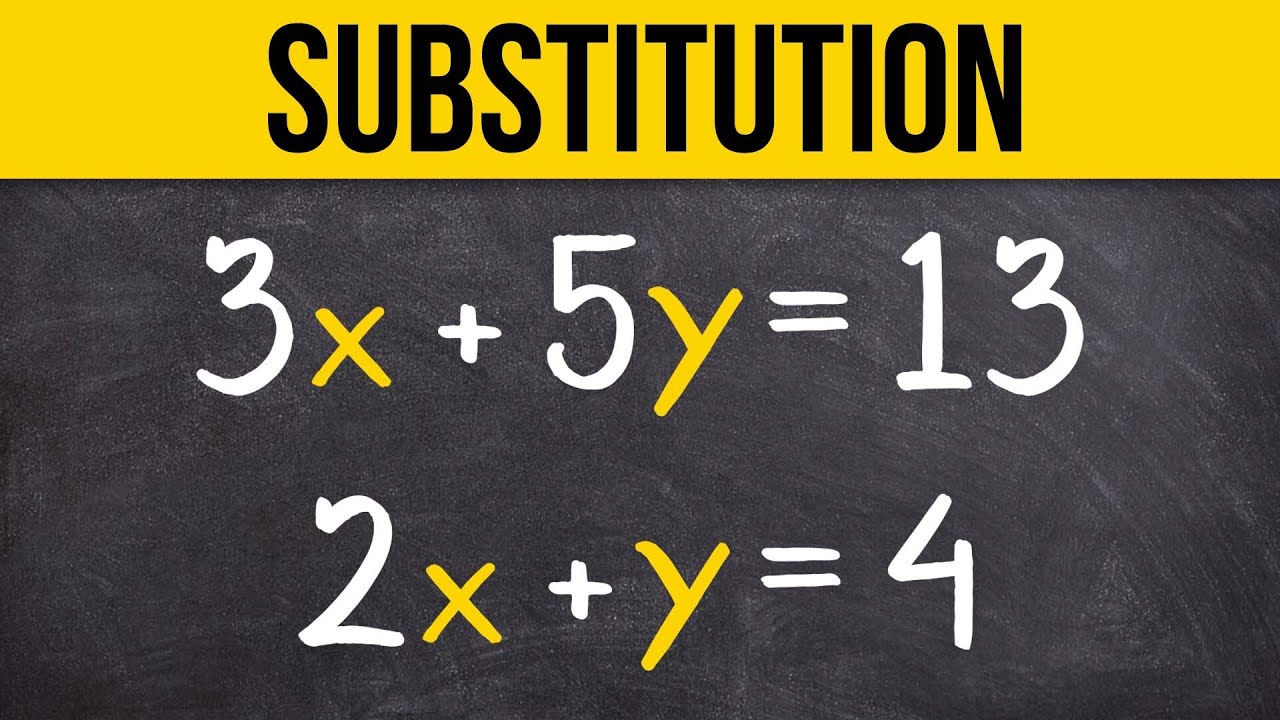
👉Learn how to solve a system of equations by substitution. To solve a system of equations means to obtain a common values of the variables that makes the each of the equation in the system true. To solve a system of equations by substitution, we solve for one of the variables ...
Re-watch in case
frigid sapphire
2 variable systems of equations are very simple from what I remember
it's the 3 digit that's hard
I just need to formulate it into a system of eqn
viscid thistle
So for first eqn: we have the info that x and y adds up to 1188
Translate this onto mathematical language for our first eqn
frigid sapphire
yes I got that one right somehow
frigid sapphire
x + y = 1188
viscid thistle
Cool
viscid thistle
For the second one its a lil bit more adv
Wait
So if we say that y (August) had 20% more of sold tickets than x, considering that the expression: 20% more means to multiply by 1.2
Try again for the 2nd eqn
frigid sapphire
x + 1.2y = 1188?
viscid thistle
Nono, forget the 1188
viscid thistle
For the second eqn we want an equivalence between x and y
x + 1.2y =
@frigid sapphire not literally
You almost got it
So if we say that y (August) had 20% more of sold tickets than x, considering that the expression:
20% moremeans to multiply by 1.2
@viscid thistle consider this again
viscid thistle
Almost
Thats not an eqn
Its an expression
Uhh
I gtg for some time so ill leave the second eqn here, DON'T SPOIL IT BEFORE TRYING ||1.2x=y||
frigid sapphire
ok thanks
viscid thistle
Np
 tepid basin
Hello, does anyone know how to rotate i by 40 degrees. I don’t know the formula
viscid thistle

Khan Academy
Finding the image of a point under a rotation. The example includes positive and negative angles of rotation.
frigid sapphire

I'm having trouble writing this as a system of eqn
one sec, gonna write my stuff down
0.08x + 0.04y = 1400
that's the only one I think is right
 cyan kernel
There's a couple ways to define an x and y, but I'll say x + y = 1, where x and y are the percents (as decimals) of the year that they were invested at; obviously they need to add to 1 = 100%
frigid sapphire
ah
it's not a system of eqn
(29000 - x) = amount invested
0.08x + 0.04(29000 - x) = 1400
so they just turn "y" into that pretty cool
cyan kernel
It is a system there too
They said x + y = 29000 and made that substitution y = 29000 - x that you see
x and y mean different things there but it's perfectly fine to do it that way
 thin sky
how do you prepare for putnam
 pale kettle
@thin sky are you in college?
 honest radish
How to check if function increases on <a,b> where a and b are some real numbers.
f(b) - f(a)  > 0
or
f`(a) > 0 and f'(b) >0
neither
a function can satisfy one of these - hell, even both - yet fail to be increasing on [a,b]
you need (∀x, y ∈ R)(a ≤ x < y ≤ b -> f(x) < f(y))
honest radish
(∀x, y) what is it?
 winged breach
okay so im doing differentiation now and i need to find the derivative of $3√x^2 - 1/√x$
obsidian monolithBOT
Ross:
willow bear
$3 \cdot \sqrt{x^2} - \frac{1}{\sqrt{x}}$?
obsidian monolithBOT
Ann:
winged breach
yes
willow bear
not $\sqrt[3]{x^2} - \frac{1}{\sqrt{x}}$?
obsidian monolithBOT
Ann:
willow bear
just to make 100% sure we're on the same page
winged breach
okay sorry 2nd one
willow bear
:|
okay, so that's $x^{2/3} - x^{-1/2}$... how familiar are you with the power rule?
obsidian monolithBOT
Ann:
winged breach
oh okay so thats the final answer
willow bear
no it's not.
and you also avoided my question of
how familiar are you with the power rule?
obsidian monolithBOT
Ann:
willow bear
yes
the derivative of $x^{2/3}$ is $\frac{2}{3} x^{-1/3}$. glad we could get that sorted out.
obsidian monolithBOT
Ann:
winged breach
yes thank you
obsidian monolithBOT
Ross:
winged breach
and now $\frac{2}{3} x^{-1/3} +\frac{1}{2}x^\frac{3}{2}$ ?
obsidian monolithBOT
Ross:
willow bear
no, $-\frac12 - 1 \neq \frac{3}{2}$
obsidian monolithBOT
Ann:
winged breach
ohh $-\frac{3}{2}$
obsidian monolithBOT
Ross:
willow bear
go review your fraction arithmetic
obsidian monolithBOT
Saveable:
uncut mulch
$\frac85x =\frac{58}{5}$?
obsidian monolithBOT
ramonov:
viscid thistle
@fluid sable if its what Ram wrote, yes.
viscid thistle
ok
uncut mulch
use sufficient parentheses in plain text.
practice with latex in bots
there's a cheat sheet in #resources
(not much point in latex if the ambiguity is still there)
vague aurora
@sour eagle but isn’t triangle ABC in your example different from the triangle in the circle?
thin sky
@pale kettle No; I am doing my first semester at college this fall
but I heard about the putnam competition and was curious about it
sour eagle
@vague aurora The triangle ABC has the same angle ABC that defines the sine and cosine
sour eagle
😔
willow bear
that was in reference to a now deleted message, dan
viscid thistle
Can someone help me with that
willow bear
with what 
 paper pecan
with that, of course. pftt
uncut mulch
that was in reference to a now deleted message
viscid thistle
if you have like a
matrix multiplication sequence like
ABCDD^(-1)BC
can you like ignore the order you multiply them in
and turn the DD^(-1) into the identity matrix
in other words
is ABCDD^(-1)BC = ABCBC?
no u can't ignore the order you multiply them in
that doesn't answer my question tho
why does what i wrote seem to be true
your question and what i answered are different
you aren't ignoring the order in your question
polynomial: is ABCDD^(-1)BC = ABCBC?
is what i asked
yes thats correct
oh i thought u meant u were asking can u rearrange them
no but i mean can you just ignore the DD^(-1) in the middle of a matrix multiplication like that
why is that
since you haven't mulitplied it out yet
like you still have BC
on the right
yah u can just ignore it bc you can get back to it later. it's not going anywhere.
its usually done first though because it's the easiest to solve
ok so what about
ABCCBD
can you make that into
ABC^2BD
or are you now ignoring order
u can make that into C^2
why tho
idk if i understand matrix multiplication properly lol
i know that AB is not BA in almost all cases
but why can you do that
well bc C * C = C^2.
yes but dont you need to compute BD first
and then C(BD)
and only then C(C(BD))
no
matrix multiplication is associative.
oh
i didn't know that
wtf
lol
my education has failed me
damn
viscid thistle
danm
paper pecan
namd
paper pecan
lol
obsidian monolithBOT
Ann:
viscid thistle
Has anyone used an especially commendable resource for understanding trig identities? (Using OpenStax but looking for others too).
rich flint
@viscid thistle ask in book discussion as well
viscid thistle
@weak sierra any issues still?
 frank flame
<@&286206848099549185>
 smoky pagoda
?
 fossil crownBOT
From
Rule 1
The help channels are solely for help with math, so feel free to post your question. Asking whether you can ask a question or if anyone knows about some specific topic is unnecessary, so please try to avoid questions of that nature.
 north crescent
Ask the q @frank flame I can probs help with limits
north crescent
Ann is helping, she’ll do better than I could ever do
 coarse storm
@frank flame I can try helping you
frank flame
thank you so much!! Ann helped me
coarse storm
Ohh, so you are all good?
 weak sierra
can someone help with this question
i got the first part but i cant figure out the second
ping me if you can help
coarse storm
@weak sierra
Ok
This is fairly easy
For part I you know p has to be in the direction of -10i+24j
weak sierra
yep
for part i i got
-15i + 36j
using magnitude of the -10i +24j and comparing
@coarse storm
weak sierra
so how do i do ii
coarse storm
What you did in case you were confused is you calculated the length of the given vector and divided the vector by it's length
Giving you a vector of length one in the same direction
weak sierra
yep
coarse storm
And then you multiplied that by 39
Cool
Now for 2p + q being parallel of the positive y-axis and mag of 12 units
What is the vector that is 12 units long and in the positive y direction going to be?
Well i is in that direction but only is one unit long
weak sierra
mhm
weak sierra
yea
coarse storm
So we can say that 12i = 2p+q
Right
So 12i-2p = q
And you know what p is
so just sub in p and do the calculation and you should be done
weak sierra
oh ok
@coarse storm could you dm me the written process if possible
i dont quite get it
weak sierra
alright thanks
weak sierra
alr thx
coarse storm
Does it all make sense?
weak sierra
yep
coarse storm
Glad I could help
weak sierra
wait one more thing
im using my calc for the third part
where we have to find the magnitude of q in the form k root5
im getting a completely different answer
@coarse storm
so im getting 6root 193
idk why
coarse storm
Ohh
weak sierra
yea
weak sierra
?
coarse storm
I accidentally wrote i instead of j in my working out
coarse storm
Wait, you got answers!?
weak sierra
?
coarse storm
You said "lemme just check" as if you have the correct answers.
weak sierra
i got the answer with root 5
 maiden pebble
I believe that I have forgot how to take the derivative of logs
is the derivative of 5lnx --> 5ln(1) times x
willow bear
no
ln(1) is 0 for a start so that sort of thing would mean 5ln(x) is constant which it isn't
$\dv{x} \ln(x) = \frac{1}{x}$
obsidian monolithBOT
Ann:
maiden pebble
Ooh, is this like when you said that in sinx, x isnt a constant
maiden pebble
huh, didnt mean to sorry
willow bear
i mean of course x isn't a constant, you're differentiating with respect to x
so how can x be a constant
willow bear
lnx = 1/x
do you really think the equals sign means "next step"
because it doesn't, and what you said right there is some bullshit
maiden pebble
chill
willow bear
ln(x) is not the same thing as 1/x
maiden pebble
Idk what I said to put you off but im just trying to get some help
willow bear
i pointed out EXACTLY what you said to "put me off"
so if you still don't know then you must not have paid attention to the message i sent nearly a minute ago, and i cannot be blamed for that
what you probably MEANT to say is
"so since the derivative of ln(x) is 1/x, would the derivative of 5ln(x) be 5/x?"
to which the answer would be that yes, the derivative of 5ln(x) is 5/x.
maiden pebble
well I am confused, so that could be one reason as to why I dont understand what your talking about
willow bear
to which the answer is yes.
what part of
do you really think the equals sign means "next step"
because it doesn't, and what you said right there is some bullshit
do you not understand



 willow bear
and then you just chose not to read any of what follows?
maiden pebble
I have read everything you said
willow bear
what part of me pointing out your improper use of mathematical notation in "lnx = 1/x" do you not understand then?
maiden pebble
I understand that you were pointing out my notation
but my questions so far have not involved notation
willow bear
again
what you probably MEANT to say is
"so since the derivative of ln(x) is 1/x, would the derivative of 5ln(x) be 5/x?"
to which the answer would be that yes, the derivative of 5ln(x) is 5/x.
maiden pebble
Cool, glad we got the answer in the end
willow bear
i'm not entirely happy i only got a half-assed acknowledgment from you of your own misuse of notation
ie writing one thing while intending to say another
but w/e i guess i'm not gonna get that out of you any time soon
and you'll keep writing things like "x^2 = 2x" or "1 = 0" without caring for the actual meaning of the equals sign and one day you'll fuck up in a problem and spend a fuckload of time trying to hunt it down
but hey who am i to stop you