#precalculus
1 messages · Page 233 of 1
 harsh smelt
harsh smelt
harsh smelt
,w 52.31/sin(86deg)-45/sqrt(1-16.5649)
 obsidian monolithBOT
 Requested by Commander Vimes#7532
 viscid thistle
Welp we assumed that if you are taking cosine law or trig you had some good base on algebra
 gloomy mortar
So would you say then that I should’ve taken a and isolated it before doing all this?
Yeah I did and you plugged in stuff into your equation
harsh smelt
here everything is fine
gloomy mortar
It would still give the same result as if you isolated the cosC if you do the math right and yeah I didn’t divide the cosC but that’s the thing I didn’t divide cosC I don’t have to isolate it all first I’m gonna get the same thing right?
Just like in that equation
I didn’t isolate a, I plugged it into my equation
 remote veldt
The two will give the same final result, if you do it correctly. Plugging in numbers is more error prone though - for example, you took 3633 and 3138cosC, and you subtracted 3138 from 3633
gloomy mortar
Like how you get the same thing doing x+4=0 as having x=-4
remote veldt
this is an error that's far less likely to occur when you're working strictly with variables
gloomy mortar
Okay well I’m saying that’s not how I’ve been taught. I’ve been taught to plug things into my equations. I would’ve made this same mistake with variables
remote veldt
do you know why 3633 - 3138cos(C) isn't the same as (3633 - 3138) * cos(C)
gloomy mortar
I don’t get how I’m supposed to get cosC by itself with so much multiplication
remote veldt
division is what undoes multiplication. I'm going to work with only variables, because I don't want to type in the numbers. I'll be as detailed as I can be
gloomy mortar
Hold on
Yeah I know what undoes multiplication
Doing it in the variables confuse me with it even more though
remote veldt
$$c^2 = a^2 + b^2 - 2ab\cos(C)$$
$$c^2 + 2ab\cos(C) = a^2 + b^2 - 2ab\cos(C) + 2ab\cos(C)$$
$$c^2 + 2ab\cos(C) = a^2 + b^2$$
$$2ab\cos(C) = a^2 + b^2 - c^2$$
$$\frac{2ab\cos(C)}{2} = \frac{a^2 + b^2 - c^2}{2}$$
$$ab\cos(C) = \frac{a^2 + b^2 - c^2}{2}$$
$$\frac{ab\cos(C)}{ab} = \frac{a^2 + b^2 - c^2}{2ab}$$
$$\cos(C) = \frac{a^2 + b^2 - c^2}{2ab}$$
obsidian monolithBOT
Nicholas:
gloomy mortar
Yeah I figured it out but I told you it confuses me more
remote veldt
why?
gloomy mortar
See I already did this when I said hold on
Because I had to do it many times since there’s so many letters
That confuses me having so many variables
Which is why plugging it in (if I did the math right) works better for me
remote veldt
if you do it with numbers, you have just as many numbers as letters
and the numbers are longer to write
gloomy mortar
It’s just easier to me seeing the numbers, idk, just how my brain works
I was originally making the same mistakes with the variables as I did with the numbers
I had to redo it several times
remote veldt
alright; if you've found somethign that works, leave it there. Leave your mind open to the possibility of working with variables however - it really will end up simpler
gloomy mortar
Variables confuse me because of all the letters. I think the reason numbers are easier is because I can simplify them as I go
How’s this
 inner karma
just imagine that the letter is a number
just without giving it the number properties
like the property of 1 that any number times it equals the number itself
gloomy mortar
It’s just easier for me to do the numbers, I just separated cosC from the rest of the multiplication and that messed it up but I would’ve done the same with variables
Is that question right now
Also what about this one? Is this correct?
inner karma
yes
correct
but my question is
why derive it all over
when you could've just known what side is opposite the angle you wanna find(which is the length 20 side)
then use $$\cos(C) = \frac{a^2 + b^2 - c^2}{2ab}$$
obsidian monolithBOT
TheDucc:
inner karma
where the lowercase c is the side opposite the angle you want to find
a and b are the other 2
sides
that's it
gloomy mortar
For 2, I didn’t have a originally, I had to find it
And like I said, numbers are just easier for me to keep track of since I can simplify them as I go instead of having tons of letters in there constantly
Just how my brain works idk
 velvet garden
Here goes a set of exercises from our last assignment
About exponential, logarithmic and trigonometric equations.
velvet garden
Factor x
velvet garden
Yea happened to me in a chem exam, didn't even think about factoring a var in order to get it alone
viscid thistle
@vague jewel do you have to prove that they are the equal?
 vague jewel
no
viscid thistle
Then?
viscid thistle
Where
 serene heath
x=e^(ln(x))
 steep fox
what is the point in #geometry-and-trigonometry if trigonometry can also exist here
gloomy mortar
Calculus is also in here, and precalc is a specific subject in the US
vague jewel
was that about my qs?
steep fox
my message was about mythical's
 vivid nebula
 zinc raft
 past meadow
yes
viscid thistle
can someone help me with number 1?
 uncut mulch
@zinc raft @past meadow actually no. it implies - (2 + 2/5) = -2 - 2/5
mixed fractions
past meadow
oh you're right. didn't see the -
harsh smelt
you are liuterally given answer in the matrix
look on row where 4th entry is not zero
and on constants vector column
harsh smelt
yes
 austere zinc
ok thank you
harsh smelt
in general in rref you get 1 and some A in constant's vector and it means that x_i is A
past meadow

 willow bear
who wrote the thing in purple?
harsh smelt
why you say it is parabola and draw hyperbola?
willow bear
can you fast forward a few seconds
 harsh cipher
that's the end of the video
harsh cipher
that's the whole video
willow bear
can i have a link to the video
willow bear
urgh
 willow bear
no i'm just quoting what the guy in the vid said
harsh smelt
why you say it is parabola and draw hyperbola?
willow bear
those are meant to be two parabolas
 silver matrix
Hello, I have no clue on how to do this. Any help would be appreciated.
 lilac pier
@silver matrix In my opinion, it would be easier if you think about this question in terms of probability. That is, the probability that a student purchases tickets to a play is 0.65 and the probability that a student purchases a ticket to a football game is 0.6. Now think about P(A∩B)
silver matrix
The maximum would be 0.60 from that intersection but I don't know how to calculate the minimum.
Maybe Baye's Theorem?
willow bear
no
silver matrix
Ok
willow bear
inclusion-exclusion
let A be the event that a randomly selected student purchased a play ticket and let B be the same for the football game
we're given that P(A) = 0.65 and P(B) = 0.60
inclusion-exclusion gives $P(A \cap B) = P(A) + P(B) - P(A \cup B) = 1.25 - P(A \cup B)$
obsidian monolithBOT
Ann:
willow bear
so $P(A \cap B)$ is minimized when $P(A \cup B)$ is highest, and in this case it can go all the way up to 1
obsidian monolithBOT
Ann:
willow bear
which leaves you with 0.25 for the minimum
silver matrix
Wow, thanks for the answer. I didn't know about this principle. It makes a lot of sense.
Thanks.
silver matrix
What I've done so far is
f(4) = 3 · 4^2 - 4 · 4
= 3 · 16 - 16
= 32
So if I substitute on the formula, it gives me:
,align
\frac{(4+h) - f(4)}{h} \
&= \frac{32 + h - 32}{h} \
&= \frac h h \
&= 1
obsidian monolithBOT
Pa_u_los:
obsidian monolithBOT
Publius:
silver matrix
Why?
willow bear
$f(x) = 3x^2 - 4x$
obsidian monolithBOT
Ann:
willow bear
$f(\thonk) = 3(\thonk)^2 - 4(\thonk)$
obsidian monolithBOT
Ann:
willow bear
did i make myself clear enough
 pale bison
not quite ann, what about f(🥒 )?
 sour eagle
what about f( ) = ?
silver matrix
,align
&=3(4+h)^2 - 4(4+h) \
&=3(16+8h+h^2) - 16 - 4h \
&=48 + 24h + 3h^2 - 16 - 4h \
&=\frac{3h^2 + 20h + 32}{h} \
&=3h + 20 + 32 \
&=3h + 52
obsidian monolithBOT
Pa_u_los:
silver matrix
What am I doing wrong?
sour eagle
why are you dividing by h
pale bison
- line 3 and line 4 are NOT EQUAL, so don't put an equal sign
- you forgot to minus f(4)
silver matrix
No, I did not forget to minus f(4), it's -16 and -4h with the minus in front.
sour eagle
that's -4(4+h) but there is also f(4) = 32
silver matrix
Ok, thanks for the answers.
obsidian monolithBOT
Publius:
viscid thistle
guys, may I get help with this?
@viscid thistle lol
dude, im lost
@viscid thistle
@viscid thistle what was your grade last week
for the written problem
let me check
wait
are you in AoPS too?
no i am psychic
what?
nvm what was your grade last week
like overall?
polynomial: for the written problem
ah
6.6
 fossil crownBOT
From
Rule 6
Do not ask for help on tests. Any violation of this will lead to appropriate action being taken at mod discretion.
viscid thistle
6.6?? wtf lol
its not a test 🙂
out of 8
now you are lying
show a screenshot
prove it 🙂
how about
i send it after the due date?
send the week b4 that one then
lol
ah fs
nice screenshot dude
wrong one
yeah 6.6
lol
lmao, dude their grading is so ass
why
the overall explaining it, for example, I can understand the problems fine its just putting them in words are very diffucult
i think thats the point
lol
just a guess tho.
yea probably
im still very confused about that question though
protip
get rid of the parameters
smart
lmao your tabs @viscid thistle
"interval notation latex"

dude i didnt even learn it
its so wack
gloomy mortar
Could someone help me with how to start this problem?
gloomy mortar
Yes, I know it’s going to be a triangle but there are all these speeds and stuff, I’m confused what would be what and where on the triangle
I tried earlier but I ended up getting confused where each value would go
viscid thistle
what do you mean
you have the length of the triangles sides in miles
@gloomy mortar bruh i already told you guidance
gloomy mortar
This is the next problem we just did the other
gloomy mortar
Yes and I have it saved I’m still confused what’s what though
remote veldt
@robust rover your selection is definitely wrong. Anything squared is positive, so how would it be possible for csc^2(x) to be negative?
We also know that sin(x) is between -1 and 1; this means that csc(x) can't be between -1 and 1, so that exclused the second option.
To decide between the other three, you need to know some special angles. I would suggest simplifying csc^2(x) and cot(x), and see if you recognize any special angles/ratios
I kinda figured; it's still important to know why those first two are wrong
guessing between 3 is much more likely to be correct than guessing between 5
https://www.khanacademy.org/math/trigonometry khan academy has a whole bunch on this stuff. The entire first section should be relevant

Khan Academy
Learn trigonometry for free—right triangles, the unit circle, graphs, identities, and more. Full curriculum of exercises and videos.
gloomy mortar
Did I set this up right?
Because I feel like the triangle should be flipped but then there isn’t two angles
Unless I were to make two triangles in one?
viscid thistle
looks right, remember to put arrows tho
uncut mulch
its recommended you actually draw a diagram with at least N↑
when bearings are involved
and no, the diagram looks wrong
gloomy mortar
I still feel like it should be flipped but how would there be two angles if it were flipped
viscid thistle
@uncut mulch are you available?
uncut mulch
maybe. use an open channel. i'm im unable, someone else will
viscid thistle
yea no worries
uncut mulch
@gloomy mortar still there?
gloomy mortar
Yes
uncut mulch
did you follow the initial instruction?
uncut mulch
better approach than before, but not accurately representing the bearings
N18°E is 18° East of North
and S62°E is 62° East of South
uncut mulch
the angles are right now. but you mixed up the planes
gloomy mortar
N18°E and S62°E
uncut mulch
the plane going S62E and travelled 570mi/3 = 190mi
gloomy mortar
Oh whoops yep
uncut mulch
the plane going N18E and travelled 525mi/3 = 175mi
gloomy mortar
Okay so is that right now?
gloomy mortar
uncut mulch
perfect
uncut mulch
yeh
 keen sigil
could someone help me out with this? im not sure how to do it
keen sigil
i would assume so
oh is it csc^2(x) = 4/3
i worked it out and got pi/3 as the reference angle
willow bear
yup
remote veldt
wait this exact question was posted a little bit earlier
choices rearranged though
interesting
viscid thistle
np
🙂
@viscid thistle isnt it cosine law
You prolly meant cosine law not sine law
@hallow belfry its cosine law not sine
viscid thistle
Np
 hallow belfry
how do i find c tho
viscid thistle
@viscid thistle yah cosine law my b
use cosine law to find C
big brain working overtime
This'll help :)
@hallow belfry
hallow belfry
ye i got it but ty
viscid thistle
np 🙂
 sinful viper
find the number of possible pathways, u can move in any direction as long as it spells “level”
probably related to Pascal’s triangle but I’m not sure how to apply it
viscid thistle
sinful viper
would it still work if you can do the puzzle backwards? ie bottom up
if it was like a word that wasn’t level I can just add up the sum of the 5th row
viscid thistle
i found 11
 full garden
Hey guys i have a very quick question please
For all values of x, let f(x)=4. Calcluate f(3)
I think it should be 4 but idont think question can be that simple
can someone please clarify it for me
past meadow
4 seems to be correct. thats an odd question
full garden
can someone please clarify it for me
viscid thistle
well if for all values of x gives a f(x) = 4, and 3 is an example of x , then f(3) must be 4
full garden
okay thank u bro
viscid thistle
np 🙂
full garden
I don't know if I should pick C or D
I really don't know because they both seem to be correct
can someone please clarify for me
viscid thistle
i'd guess C if iwere u
full garden
😅 okay bro thank u ❤️ very very much
 somber thicket
im in pre calc 11
somber thicket
yea
 smoky needle
Can someone help me with this?
viscid thistle
viscid thistle
What?
No. Its sum of angles formula
@rigid beacon you prolly mean it, didn't you
 modern wolf
I think so... Every 5 days it multiplies the number of bacteria by 2
full garden
okay thank u so so much buddy
modern wolf
Np
full garden
Here it defines a function so one input and one output
so it cannot be 4, or 2
but I think it can be -2 and also 1 and the function would still be defined
cansomeone please please clarify this question for me
harsh smelt
that's true
full garden
oh
full garden
i think 1 is valid 😅
because I think two inputs can have the same output if the numbers are different
viscid thistle
@harsh cipher they did a process called complete the square
I suggest you to watch some videos about it
sinful viper
I’m stuck on this question again
viscid thistle
I guess every term is a sum of a geometric sequence
sinful viper
ah yeah, I did some work and term 2 (0.11) is equal to 1/10 + 1/100, and 0.111 is equal to 1/10 + 1/100 + 1/000
how should I apply that to determine the general/explicit term?
sinful viper
what is i?
 stuck lark
$\sum_{i=1}^n10^{-i}$
obsidian monolithBOT
RokettoJanpu:
stuck lark
seen smth like this?
viscid thistle
I didnt know you could do that
stuck lark
not you
sinful viper
I have but quarantine happened so teacher didn’t go in depth whatsoever x_x
or go into any detail into what it is LOL
stuck lark
it's summation notation, a way to shortly write sums. use google
sinful viper
ah ok, I googled it and got the gist of it
harsh cipher
@viscid thistle the +1 is complete the square part.
in order to find the centre I need to factor that
 warm grail
Anyone remember the details of half angle identities?
I think that it's simple, but it's been awhile since I've touched the subject so I forget most of what I knew!
viscid thistle
warm grail
Yes exactly
viscid thistle
does this help:
warm grail
So if I have sin^4x set equal to a phrase, where do I go from there?;
Well I have this stuff in my notes, I just can't remember what to do with the info if that makes sense
I forget how the whole interval thing works, too
Should I watch a Khan academy vid? Maybe that's the strategy here
viscid thistle
nice arm
viscid thistle
that was my initial thought but it looked like you were wearing a shirt
viscid thistle
looks to thin to be a leg imo
viscid thistle
i think for the first question you should expand the fraction on the outside of the brackets with the stuff inside the brackets
warm grail
Think so?
Then it would all be over 8
Maybe I replace cos2x and cos4x with they're identities
Like another form of the phrase
viscid thistle
yah maybe
viscid thistle
no worries haha
i think you should make everything on the right side in terms of sinx
for 6)
viscid thistle
can someone help me with two questions i have for my online precalc class please im genuely stumped
 tawny nacelle
 hardy galleon
Ok so I'm not sure if this goes here or in algebra but
I'm minimizing an expression with AM-GM inequality and I can't figure out how to do it
The question goes
a>b>0, a + 1/[(a-b)b]
The farthest I got with this is that
viscid thistle
AM-GM?
hardy galleon
a + 1/[(a-b)b] - b + b > (a-b) + 1/[(a-b)b] > 1/2 * [(a-b) + 1/[(a-b)b]] > sqrt(1/b)
arithmetic geometric mean inequality
=tex \sum_{k=1}^{n} \frac{a_k}{n} >= \sqrt[^n]{\prod_{k=1}^{n} a_k}
.help
viscid thistle
,tex
obsidian monolithBOT
Please give me something to compile! See ,help and ,help tex for usage!
hardy galleon
,tex
obsidian monolithBOT
Please give me something to compile! See ,help and ,help tex for usage!
hardy galleon
,tex \sum_{k=1}^{n} \frac{a_k}{n} >= \sqrt[^n]{\prod_{k=1}^{n} a_k}
obsidian monolithBOT
Jasper:
Compile Error! Click the  reaction for details. (You may edit your message)
hardy galleon
this is the am gm inequality
hardy galleon
so I need to somehow apply this to minimizing
a + 1/(a-b) * 1/b
Does anybody have any idea
viscid thistle
you might wanna ask in #❓how-to-get-help people come here less and its more for discussion
 hazy geyser
smoky needle
hazy geyser
smoky needle
Can someone help me with this?
viscid thistle

Socratic.org
sin(arctan x)=x/(+-sqrt(x^2+1)) The solution: arctan x is an angle whose tangent function =x/1 Considering the sides of the right triangle. We have opposite side =x, adjacent side =1 and hypotenuse =sqrt(x^2+1) Therefore the sine of this angle =("opposite side")/("hypotenuse")...
smoky needle
@viscid thistle thank you!
viscid thistle
np 🙂
 drowsy karma
When you're converting a slope y-intercept equation into a general form, how do you know which terms to bring over to the other side? Does Y always stay?
 muted granite
Why is y=(.30/2)(x)+1.30 not the proper equation for the table of values?
drowsy karma
Like I'm looked at some answers in the key. Equation was 3y = 21x -8, then they brought Y over so it became 21x - 3y - 8 = 0 . But in another equation 3y = -5x + 10, they brought the right hand over so it became 5x + 3y - 10 = 0
viscid thistle
bc as your x increases your y decreases
drowsy karma
So like how would you know which side would you bring over
viscid thistle
plus, 1 - .84 isn't .15, it's .16
muted granite
So, how do I find the equation?
viscid thistle
are you sure the numbers for the y-value are correct?
muted granite
yes
@drowsy karma I think for general form you have to make both variables positive terms. That decides what crosses.
muted granite
oh nvm then.
drowsy karma
Yeah idk
viscid thistle
it doesnt matter
drowsy karma
Apparently it needs X to be positive all the time
Thats how it decides
according to megan on youtube
muted granite
@viscid thistle Do you know how to derive the equation from that table of values? Any two points I always get a different slope. im at a lost.
viscid thistle
@muted granite your slope should be -0.3, not 0.3
muted granite
-0.3/2?
viscid thistle
also, since its in a decimal form, you might wanna convert it into a whole number
muted granite
y=(-0.30/2)+1.30 is not correct.
viscid thistle
well thats bc you can't have a decimal in a fraction
muted granite
that didn't work either.
muted granite
y=-0.15x+1.30
the issue is the slope. because the value of y is not decreasing at a constant rate.
viscid thistle
maybe they want the equation of the slope from x= 0 to x = 5?
so (.56 - 1.3) / (5 - 0)
muted granite
I tried that. Did not work either.
i dont get it. You should be able to find slope viz. slope formula, and the y intercept, and call it a day.
viscid thistle
maybe the answer in N/A
muted granite
@viscid thistle the answer is y=-.148x+1.30. But Idk why.
viscid thistle
@muted granite its bc (.56 - 1.3) / (5 - 0) = -.148
you said you tried that but it didn't work
past meadow
 fluid sable
How would you go about solving this ?
o is this not precalc
I feel like I'm slowly
uncut mulch
it is
willow bear
27 is not 9^3
fluid sable
no
willow bear
and 243 is not 27^3
willow bear
$\frac{3^3}{3^{2(3p-1)}} = 3^5$
obsidian monolithBOT
Ann:
past meadow
so now how can we simplify that?
fluid sable
$\frac{3^3}{3^(3p-1)}} = 3^5$
obsidian monolithBOT
Saveable:
Compile Error! Click the reaction for details. (You may edit your message)
uncut mulch
9 = 3^2
pale bison
$3^{2(3p-1)}=(3^2)^{3p-1}$
pale bison
nvm
fluid sable
what is that
im p sure
its something to do w getting the same denominators
and then life becomes easier
past meadow
not quite. think index laws maybe
obsidian monolithBOT
Publius:
fluid sable
alright i think
I have to review those before trying to answer this
I haven't done so in a while
How old are you sneaky out of curiosity lol
you seem much better than me
past meadow
whats gonna be useful here might be $\frac{a^{b}}{a^{c}}=a^{b-c}$
obsidian monolithBOT
Sneaky:
fluid sable
Oh my god
past meadow
thats an odd question 
past meadow
16 myself... back to the maths.
past meadow
can you see how to apply that rule here?
obsidian monolithBOT
Saveable:
viscid thistle
you forgot a + I think
viscid thistle
-3p+1
past meadow
im assuming you mean $3^{3-(3p-1)}$
viscid thistle
exactly
fluid sable
Oh you meant that
past meadow

obsidian monolithBOT
Sneaky:
fluid sable
my bad
past meadow
sorry typo above. its --1, which is +1
viscid thistle
- times -
past meadow
^
obsidian monolithBOT
Saveable:
willow bear
no
fluid sable
No?
willow bear
left-hand side fucked up
fluid sable
theres supposed to be a 2
before the 3p-1
cause its 9 ?
9=3^2
$\frac{3^{3}}{3^2{(3p-1)}}=3^{3-2(3p+1)}$
obsidian monolithBOT
Saveable:
fluid sable
Something like that ?
past meadow
}{ around the exponent
obsidian monolithBOT
Saveable:
past meadow
theres an error in there
fluid sable
like with the latex ?
viscid thistle
$\frac{3^{3}}{3^{2(3p-1)}}=3^{3-2(3p-1)}$
obsidian monolithBOT
HoboSas:
past meadow
you seem to have learnt it pretty fast so nw
fluid sable
Ah you meant mathematically
viscid thistle
you just forgot a +
fluid sable
Oh yeah
accidental
ny bad
I'm currently studying alg 2 but i genuinely hate maths now
past meadow
ok, so now we have $3^{3-6p+2}=3^5$
obsidian monolithBOT
Sneaky:
past meadow
I'm waiting
fluid sable
I have a feeling the answer is 0
viscid thistle
I guess p=0
past meadow
still worth going through the memes of equating exponents or using logs to solve it more analytically
past meadow
sure, so lets take log_3 of both sides
past meadow
$\log_3(3^{3-6p+2})=log(3^5)$
obsidian monolithBOT
Sneaky:
fluid sable
yeah
past meadow
so we can hit em with the log laws and we get what?
viscid thistle
hit em hard
fluid sable
Is it the property of equality or something
past meadow
$\log(a^b)=b\log(a)$
obsidian monolithBOT
Sneaky:
past meadow
h?
fluid sable
hm*
well in that case
I'm screwed with logs too
I completely forgot the laws also
past meadow
just using the one i posted above here
past meadow
$(3-6p+2)\log_3(3)=5\log_3(3)$
fluid sable
huh
obsidian monolithBOT
Sneaky:
past meadow
oh if that doesnt make sense we can just equate exponents from
here:$3^{3-6p+2}=3^5$
obsidian monolithBOT
Sneaky:
past meadow
log_3(3) is just 1 was more my approach
viscid thistle
yes im stupid
past meadow
yes
fluid sable
-6p = 4 ?
past meadow
nope
past meadow
check your signs
past meadow
you're telling me 5-3-2 is -10?
past meadow
yeah nice work
past meadow
well you solved it so
past meadow
you picked up everything i said very quickly
you're not bad at all
the speed at which you picked up latex was impressive as well
fluid sable
Thank you for your kind words
but in actuality
logs, radicals, fractional radicals and stuff
they're all extremely hard for me
past meadow
well feel free to come back here and ask whenever you get stuck 
fluid sable
will do :))
and you guys respond so fast haha
At least i have today and tomorrow to study, so hopefully it'll work out.
If I study logs today and the rest tomorrow
 narrow peak
a curve is such that $\frac{d²y}{dx²}=6x-2$ and P$(2,8)$is a point on the curve. The gradient of the normal at $P$ is $-\frac{1}{2}$. Find the equation of the curve.
obsidian monolithBOT
Hmm:
narrow peak
do i integrate
sub in 2
wait let me latex my solution
$\frac{d²y}{dx²}=6x-2\\frac{dy}{dx}=\int{6x-2dx}\=3x²-2x+c=2\3(4)-4+c=2\8+c=2\c=-6\\int{3x²-2x-6dx}=x³-x²-6x+c$
obsidian monolithBOT
Hmm:
 rigid beacon
F
narrow peak
LOL
uncut mulch
nah just regular calculus or general questions
narrow peak
anyway…
rigid beacon
o u right
uncut mulch
questionable 3rd line
uncut mulch
the slope isn't 2 for all values of x
narrow peak
yeah i got lazy to put in latex am on phone rn
rigid beacon
why is 3rd line bad?
uncut mulch
the slope isn't 2 for all values of x
rigid beacon
oh yea
narrow peak
should have capitalized the c as well to make it clearer
rigid beacon
I think they subbed in the point and slope over 2 lines
narrow peak
bad presentation on my part
uncut mulch
just ditch writing =2 in that line and put all details in the line after
rigid beacon
^
narrow peak
o
uncut mulch
if you started it here and were already getting help, might as well finish it here
narrow peak
sure
rigid beacon
yea so after you're done with that bottom line
uncut mulch
used a different constant for the second integral
rigid beacon
you have info to solve for the new constant
uncut mulch
like d
narrow peak
should have capitalized the c as well to make it clearer
uncut mulch
and use the given point to determine it
narrow peak
yes
rigid beacon
or c with a subscript
narrow peak
i am on the right track tho?
rigid beacon
looks like it to me
uncut mulch
yeh. justify that you determined the slope is 2 at x=2 though.
narrow peak
cuz
uncut mulch
which i assumed you did on your side
narrow peak
normal at P=-1/2
stated in question
so dy/dx=2
then solve for that constant
then integrate again
uncut mulch
might be good to put y = in that last line
and then determine your new constant by using the given point
uncut mulch
just some pedantry, but overall pretty good.
narrow peak
ok ima ask my next qn in calculus channel
nvm this is simple factoring which idk im dumb as fuck
nvm i figured it out
viscid thistle
hey does anyone know examples of transformations that dont require to go in order
 austere cloud
if you ask for non commutative operations, division works
obsidian monolithBOT
ramonov:
 vague aurora
what does it mean when the trig function has a number next to it?: Like tan54°37'
i dont understand the extra 37'
past meadow
the 37' is minutes. there are 60 minutes in a degree
vague aurora
ohhhh, thanks
harsh cipher
hmm ok let me check
so I did get it down to (2(x^2-6x+9))/40) + (3(y^2-4y+4))/(40)= 1
couldn't solve the (y-2)^2 where it had 3 infront
uncut mulch
p/q = 1/ (q/p)
harsh cipher
rationalize?
uncut mulch
rearrange it so that the coefficient of the numerators are 1
and a and b will be your radii of the ellipse
e.g.
uncut mulch
$\frac{py^2}{q} = \frac{y^2}{q/p} = \frac{y^2}{ \sqrt{q/p}^2}$
obsidian monolithBOT
ramonov:
uncut mulch
what are you getting?
harsh cipher
so root 9 in the denom is simplified to root 3
uncut mulch
there is no 9 in the denom
harsh cipher
root 3 ^ 2?
uncut mulch
or get sqrt(3) *sqrt(3)= 3 directly
harsh cipher
oh its root 1600
uncut mulch
huh?
harsh cipher
root 40 ^ 2
uncut mulch
doing too much extra stuff
harsh cipher
okay
uncut mulch
your y terms: $\frac{3(y^2-4y+4))}{40} = \frac{(y-2)^2}{40/3} = \frac{(y-2)^2}{\sqrt{40}{3})^2}$
harsh cipher
how the hell did it get a 4
uncut mulch
$\frac{3(y^2-4y+4))}{40} = \frac{(y-2)^2}{40/3} = \frac{(y-2)^2}{\left(\sqrt{\frac{40}{3}}\right)^2}$
obsidian monolithBOT
ramonov:
uncut mulch
where your minor radius is sqrt(40/3)
harsh cipher
you mean 3?
uncut mulch
yeh
harsh cipher
simplifying sqrt(40/3)^2
uncut mulch
$=\frac{\sqrt{40}}{\sqrt{3}} = \frac{2\sqrt{10}}{\sqrt{3}} \times \frac{\sqrt{3}}{\sqrt{3}} \ \
\frac{2\sqrt{30}}{3}$
obsidian monolithBOT
ramonov:
uncut mulch
and then multiple that 2 to get the length of the whole (minor) axis
harsh cipher
yep
got it now
thanks for the help..
when I see this question on the test I will not get it wrong lol
uncut mulch
np
 sterile notch
Is there an easy way to tell whether a polynomial is easily factorizable or not?
Like x^3-x^2+9x-9 looks kinda difficult, but turns out to be (x-1)(x^2+9)
But x^4+2x+8 looks easy but seems difficult to factorize
Is there a way to identify if one is difficult?
As much as I've noticed (x-1) seems to be the usual one you can try factorize, but idk.
willow bear
a polynomial's factorization difficulty depends on how many techniques it takes before it budges
rational root thm is pretty powerful but even that won't get them all
viscid thistle
Hmm idk about figuring out if a polynomial is easily factored... but just try all the normal methods. Rat root theorem is good, but If those don’t work, brute force your way into finding the zeroes.
tawny nacelle
wolfram ftw
viscid thistle
lol
past meadow
just use the cubic formula
viscid thistle
What if 4th degree poly?
sterile notch
Wolfram broke for some of them for me.
past meadow
quartic formula
viscid thistle
aAa ima try to derive those before I use them.
sterile notch
I've been using synthetic division, but it seems to break every now and then.
past meadow
you arent gonna have much luck with deriving the quartic formula squid
as it looks like this
tawny nacelle
something something galois
viscid thistle
That’s perfectly fine.
past meadow
soap sometimes polynomials arent gonna have real roots
viscid thistle
that too
past meadow
the quartic one you posted above does not, as a matter of fact
tawny nacelle
which soap are you talking to
sterile notch
I'm going to try look into rational root theorem hopefully it elps.
tawny nacelle

sterile notch
lol i frgot to change name lel
tawny nacelle
yes wth man
viscid thistle
multiple sOaps
 fluid shore
i mean
viscid thistle
Don’t drop it
past meadow
other soap lol
sterile notch
i'll just change it to soup
tawny nacelle
nice
fluid shore
factorizing these things, honestly, can also just be a matter of cleverly adding 0s to the given polynomial
sterile notch
wth, i cant change nicknames here lol
tawny nacelle

viscid thistle
@sterile notch rational root theorem is powerful. I happen to use it a lot when doing polynomials.
fluid shore
you gotta play around and see what works and what doesn't
past meadow
^
sterile notch
Okey, this should do lol
viscid thistle
Agreed.
sterile notch
Thanks, ill give em a go.
viscid thistle
If all else fails, plug it into graphing calculator and see if the zeroes have weird decimals and such. If so, it’s most likely not easily factored.
If looking for zeroes as a question and not easily factored, rational root theorem or brute force it.
fluid shore
urm i'm against brute forcing. Usually, there is a clever trick with adding 0s in the right places
depends on the polynomial
play with it and see what you get, i suppose
viscid thistle
hMm well you’re the boss. I’m still studying the subject so I should listen to more qualified advice before administering my own.
fluid shore
Nah, brute forcing is fine as a method. I just don't like to do if i can help it.
You are free to give advice, no one here should be stopping you from doing that.
viscid thistle
Well thank you for the reinforcement, but I agree, it’s a taxing process in some cases, and some of the other methods should be explored first.
viscid thistle
if you understand a certain derivation of the quadratic formula very well you also, in principle, know how to derive the quartic equation
And could do it by hand even, given a lot of time
harsh smelt
find amount off all combinations of 4 out of 60
and 1/divided by ^ is the answer
because to win he has only one combination
{3, 15, 46, 49}
but he may get {1, 2, 12, 48} as well
or {4, 5, 6, 7}
in general he can get 60C4 combinations
with only one winning
viscid thistle
Hey guys! Quick question! what double angle identity should I use to turn cos(4w) into sine?
uncut mulch
that's an ambiguous question
viscid thistle
completely solvable though, right?
uncut mulch
there are many ways to express cos(4w) in terms of the sine of something
uncut mulch
and it is unclear what you actually want, and/or whether double angle identities are actually needed
viscid thistle
cant u just turn it into sin(4w + pi/2) ?
uncut mulch
yes
viscid thistle
well there u go then
@viscid thistle hey can you tell me howyo ucame to that?
sin is just cos, but pushed pi/2 units to the right
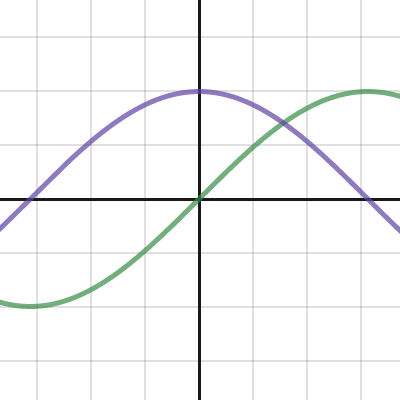
Desmos
 desert kiln
for any value of w, sin(4w+pi/2) will equal to cos(4w)
viscid thistle
look at the graphs for sin and cos
desert kiln
oops I was too late
viscid thistle
no worries
yea i get that
wow i should have not have fixated on the double angle part of that
and thought more out of the box
yah
uncut mulch
and it is unclear what you actually want, and/or whether double angle identities are actually needed
uncut mulch
it should tell you specifically that the want it in terms of sin(what they want)
viscid thistle
my hw specifically asked for double angle, but that answer was accepted
sterile notch
If I'm given some points say: (1,2), (3,4), (5,6), and asked to make a parabola which crosses all these points
It can be turned into a linear algebra problem since applying: ax^2 + bx + c = 0,
to each point lets me create a system of linear equations (x^2, converted to coefficients since they are known)
Can these kind of problems be only solved with linear algebra?
Or are there different or better methods?
past meadow
(1,2), (3,4), (5,6) does not define a parabola. those 3 points are colinear
sterile notch
yea, idk i was just thinkin of random numbers
past meadow
but there are ways to solve systems of equations in 3 variables without linear algebra
sterile notch
(1,2),(2,1),(3,4)
Here's one that does make a graph
And the first thing I did was, put it in the parabola thingo
a1 + b1 + c = 2
a4 + b2 + c = 1
a9 + b3 + c = 4
Got a matrix:
1 1 1 2
4 2 1 1
9 3 1 4
And solved for a,b,c (2, -7, 7)
So 2x^2-7x+7 will *touch* those points
How would you do it without linalg?
Or solving a bunch of linear equations.
sterile notch
Thats linalg bruh
lilac pier
is it? 😮
sterile notch
Yea?
lilac pier
Hm I dont think there is any other way
sterile notch
Gonna bet u there is another way
sterile notch
Okay, I think there is a way, it's pretty gross, but it's by using the two points with the highest gradient, and approximating the vertex, then exhaustively checking it's neighbours until it works.
I think theres a better way using some basic geometry
pale bison
can't be too sure just by looking at the graph
pale bison
then yeah, exponential i guess
but keep in mind you can approximate that graph with a polynomial very well
pale bison
you can probably get a good guess by finding some nice integer value points
fluid sable
I did but like
pale bison
and assume the function has the form y = ae^(bx)
fluid sable
(2,3) (3,9)
uncut mulch
+c
pale bison
fair point but it seems to have a horizonal asy. at y = 0
in any case, plug those points into the equation and solve
uncut mulch
also consider (1,1)
fluid sable
Hm?