#precalculus
1 messages · Page 230 of 1
 rare pagoda
Well the dot product is a scalar so you can't find the magnitude of that anyway
 desert socket
Ooh
That explains it
I just found it odd they decided to put it within a magnitude thing
rare pagoda
It's an absolute value
desert socket
Okay
rare pagoda
Lol
desert socket
Yep that clears it up
rare pagoda
Gotta hate those tricky notations
desert socket
I was going nuts thinking somehow my process was wrong
Cross referencing examples etc.
 foggy lake
wat does the symbol sigma mean?
 past meadow
Capital or little sigma? And in what context
foggy lake
$\sum_{k=0}^{n}$
 obsidian monolithBOT
Goosy<3:
foggy lake
like this one
obsidian monolithBOT
Sneaky:
 azure sinew
yo
past meadow
F isnt a number. Its a function
 mental cove
If f(x) = [expression], then f(4) = [that expression, but with al of the x's replaced with 4].
 hard mulch
F isnt a number. Its a function
@past meadow ahhhhhhhhhh
past meadow
But what red herring said is how youre suppoed to solve it
hard mulch
Okay, Thanks a lot
 sullen canyon
cos 4x = 2 cos^2 (2x) - 1
right?
oh cool
so then i got 2(4cos^4 - 4cos^2+1)-1
8cos^4 x-8cos^2 x +2-1
sullen canyon
Also
if i have f(x) = (sin x)(tan x) + cos x
what can i do to get it to 1/cos x
i've gotten to ((1 - cos^2 x)/cos x) + cos x
 patent beacon
Can you put everything over that cos(x) denominator?
sullen canyon
yep just realised
i didn't need to make 1-cos^2x
cuz cos^2 x / cos x = cos x
so i can just put everything over denominator
thanks @patent beacon
 tame wedge
Hey guys can anyone help with this sum? I'm trying to get it into a form where I can use the formula for the sum of i^2 on it but I'm getting stuck.
The i on the bottom should be a j
 north crescent
Expand (i-1)^2
And then split it up into 3 sigmas
Each one would have a formula to solve for it
so i^2-2i+1
1 would be n
2i would be 2* i(i+1)/2 I think
tame wedge
Yeah that would work hey, I didn't notice that thanks !
 willow bear
i is not the imaginary unit here
 viscid thistle
oh obviously lmao
viscid thistle
hi
How do i solve this?
i have a 30 question bonus and i can't seem to solve some questions
@viscid thistle seems like a test
it ain't a test
it's a mathspace homework task
@viscid thistle
@viscid thistle have you heard of cos(A+B) or cos(A-B)
yes
For example for the first one apply it
With 3x being A and 2y being B
And same with cos(x-3y)
@viscid thistle
 coral garnet
 exotic spindle
i was absent on the day this was explained and i dont get how it works?
viscid thistle
@exotic spindle Still need help?
exotic spindle
no i got it, thank you though
 smoky needle
Can someone help me with this problem?
viscid thistle
what is $\tan(\theta)$ equal to?
obsidian monolithBOT
Botnuke:
viscid thistle
in terms of sines and cosines
viscid thistle
yea
viscid thistle
yes
viscid thistle
lol
smoky needle
can i show you my work after i attempt to do it?
viscid thistle
sure
smoky needle
@viscid thistle I got this. lol
 fluid shore
That is incorrect
viscid thistle
yea
smoky needle
yikes
fluid shore
If it was just 6, then sin(theta) = sqrt(61) and that wouldn't make sense
smoky needle
thanks for catching that!!
fluid shore
You're welcome. Be very careful about such things.
smoky needle
yeah, it can screw me up a lot!😅
fluid shore
🙂
smoky needle
Hello again, i'm stuck on the same kind of problem. I tried to use reciprocal identities or even tried to manipulate some. But I couldn't get it
fluid shore
Well
$\tan(\theta) = \frac{\sin(\theta)}{\cos(\theta)} = \sin(\theta) \cdot \sec(\theta)$
obsidian monolithBOT
Abhijeet Vats:
fluid shore
Does that help?
smoky needle
yes, i tried to use that, but i don't have cos theta
obsidian monolithBOT
Abhijeet Vats:
smoky needle
yes, will i just have to manipulate that somehow to get cos theta?
fluid shore
You don't need cos(theta), my dear
$\frac{\sin(\theta)}{\cos(\theta)} = \sin(\theta) \cdot \frac{1}{\cos(\theta)} = \sin(\theta) \cdot \sec(\theta)$
obsidian monolithBOT
Abhijeet Vats:
smoky needle
Ohh i see.  i was on the right path! lol but i tried to solve for cos(theta). this helped so much, i will try and redo it again! thank you!!!
fluid shore
You're very welcome.
smoky needle
hello, again. I'm still on the same problem and i can't seem to figure it out.. 😦
fluid shore
What is the issue?
smoky needle
i think i am getting confused on the identities
like how does it result in sin (theta) multiplying by sec (theta)?
sorry i'm kinda slow
fluid shore
Well, $\sec(\theta) := \frac{1}{\cos(\theta)}$
obsidian monolithBOT
Abhijeet Vats:
smoky needle
Yes, i have that written down. I guess where i'm having trouble is using the identities in general.
fluid shore
Well, so:
$\tan(\theta) = \frac{\sin(\theta)}{\cos(\theta)} = \sin(\theta) \cdot \frac{1}{\cos(\theta)} = \sin(\theta)\sec(\theta)$
$\sin(\theta) = \frac{\tan(\theta)}{\sec(\theta)}$
obsidian monolithBOT
Abhijeet Vats:
smoky needle
ohhh!!! it was probably my algebra. thank you! that helps a lot. i can see it in a different way now! thank you!
fluid shore
You're welcome.
 compact tide
Are any of you good with solving trig functions
fluid shore
Nope
rare pagoda
what do you need help with?
rare pagoda
lol i'll see
rare pagoda
xP
compact tide
sinx + cosx = -1 in the interval [0, 2pi)
 thorn mountain
What have you tried?
compact tide
im not exactly sure how to do it is the thing
thorn mountain
But what have you tried?
thorn mountain
I mean, that’s not wrong, but not really useful
rare pagoda
yeah technically you can combine sinx + cosx into the form acos(x-t) but plugging in should work just as well
thorn mountain
Square both sides gives you something to work with tho
rare pagoda
in this case sinx + cosx = sqrt(2)cos(x-pi/4)
fluid shore
Not if you want to find all solutions
compact tide
that would help
doing that now thanks
i got 2 of them like that
i have 2 more
I keep getting domain error when i attempt -3csc(theta) = 3root2
any ideas?
@rare pagoda
fluid shore
You're trying to solve $-3\csc(\theta) = 3\sqrt{2}$? What's the interval you're interested in?
obsidian monolithBOT
Abhijeet Vats:
viscid thistle
Why not solve for all intervals.
fluid shore
Well, yea you can solve it for all intervals if you want to
Okay:
$\sin(\theta) = -\frac{1}{\sqrt{2}}$
obsidian monolithBOT
Abhijeet Vats:
fluid shore
So, in the interval $[0,2\pi)$, does this have any solutions?
obsidian monolithBOT
Abhijeet Vats:
fluid shore
?? Can you take a picture of the problem?
thorn mountain
Then either learn the right way to do it or just try the solutions offered
fluid shore
Can you post a picture of the problem?
compact tide
yes 1 sec
obsidian monolithBOT
Malix:
obsidian monolithBOT
Abhijeet Vats:
thorn mountain
Yep
compact tide
oh i was putting in sin^-1
so whats the what from there
i did terribly on this unit and i have a retake soon
thorn mountain
Are you familiar with the unit circle?
fluid shore
Okay, so you need to look at the quadrants of the unit circle where $\sin(\theta) = -\frac{1}{\sqrt{2}}$. You already know that $\sin(\frac{\pi}{4}) = \frac{1}{\sqrt{2}}$. So, you just need to make sure that the sine itself is negative
obsidian monolithBOT
Abhijeet Vats:
compact tide
ok
so thats 7pi/6 and 11pi/6
wait thats not right
this is my last problem of the day
im genuinely confused on what im being asked to complete, since 1/root2 isnt on my unit circle anywhere
@fluid shore @thorn mountain
thorn mountain
You probably know it as $ \frac {\sqrt{2}}{2} $
obsidian monolithBOT
Malix:
compact tide
uhh yes yes
fluid shore
Eh malix, can you help him out
compact tide
that makes sense
fluid shore
Sorry lol, i'm busy
thorn mountain
It’s fine, I got it
compact tide
so wherever sin value is that, is my answer
thorn mountain
Just rocking a kid to sleep
thorn mountain
Yes. Those are where sin(x) is negative pi/4
compact tide
ok tysm
thorn mountain
👍
 gilded mirage
nvm i see
 acoustic laurel
@orchid hearth sure
 orchid hearth
orchid hearth
orchid hearth
@acoustic laurel
thorn mountain
are those two minus signs in the numerator?
 wraith kernel
for the f'(x) is an =
wraith kernel
this is correct?
 gritty sandal
No, if f(x) was xy then you have to apply product rule
But usually implicit difs are equal to something
So it’s a hard case
Like x^2 + y^2 = 1
But the derivative of xy is y + (dy/dx)x
derivative of $xy = y + \frac{dy}{dx} x $
Getting used to Texit
I still suck
obsidian monolithBOT
Parking Ticket:
viscid thistle
Excuse me can someone help me with verifying and proving trig identities
I have a quiz tomorrow and a test Friday and I’m definitely not ready for them
So if someone could help me understand it better I’d be very grateful
past meadow
Hey just ask your questions. #geometry-and-trigonometry might be better though
 pale bison
 past meadow
im not from america so idk what the different classes are.
fluid shore
Same tbh
gritty sandal
same
mental cove
B-b-but... if you're not from America, then where else could you be from? :^)
 fleet yew
if america's so great why isn't there an america 2
mental cove
America II is a racing sailboat and one of the final America's Cup 12 Meters. There were a total of three America IIs commissioned for the New York Yacht Club's challenge in the 1987 America's Cup. These were US 42, 44 & 46 and all boats were named America II.
America II (US ...
czechm8

 slate scroll
can you guys help me with my homework
my professor mixes our topics into homework all the time
its so fkn annoying
 viscid thistle
🗿
 craggy dune
well I feel 2 would have been legit as well
north crescent
How is this pre uni pre calc
mental cove
You know what? I don't think 19 or 163 make sense. I don't think there's any number past 2.
I remember learning this in pre uni pre calc.
 misty heath
Why is problem 1 even there
viscid thistle
Your teacher is a savage.
slate scroll
yes we started the semester with addition
we had an exam on that
and now we have started complex analysis
but I don't know why he is still putting the addition stuff in the homework
viscid thistle
@slate scroll ur a funny guy
 viral trail
I tried it for n^3 and n^4 and got 1/3 and 1/4 so i think answer should be 1/2020 but how to prove
willow bear
you can write the sum in the limit as the riemann sum with $n$ subintervals for $\int_0^1 x^{2019} \dd{x}$
obsidian monolithBOT
Ann:
willow bear
i.e. $\frac{1}{n} \sum_{k=1}^n (k/n)^{2019}$
obsidian monolithBOT
Ann:
viral trail
Right ty

 uncut mulch
what's that supposed to be?
past meadow
is that supposed to be the derivative of that function
viral trail
Ty
I have no idea except that f(n) = 0 is a solution.
f(n) = n also works
So are there infinte sol or finitely many?
 maiden pebble
@uncut mulch https://i.imgur.com/bRanF45.png
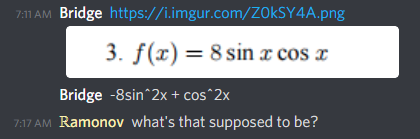
Sorry, is that the derivative of that function
uncut mulch
no
thorn mountain
Hint: $ 8 \sin x \cos x = 4 ( 2 \sin x \cos x ) $
obsidian monolithBOT
Malix:
uncut mulch
if you tried to differentiate by product rule, you didn't apply it properly
thorn mountain
Lost parentheses
maiden pebble
I did (Deriv 8sinx)(cosx)+(8sinx)(deriv cosx)
il redo
@thorn mountain are you saying that sin x cos x =/= (sinx)(cosx)
thorn mountain
Then check your trig identities
Or do it the way you were going to before but don’t lose pieces
maiden pebble
I cant find any trig identities that look like what you gave me so il do that
thorn mountain
$ \sin (2 x) = 2 \sin x \cos x $
obsidian monolithBOT
Malix:
thorn mountain
Yes
fluid shore
$\frac{d}{dx} cf(x) = c \frac{df}{dx}$, where $c \in \bR$.
obsidian monolithBOT
Abhijeet Vats:
fleet yew
what if $c\in\C$
obsidian monolithBOT
AMD:
 stuck lark
that's fine too
maiden pebble
hope im not meant to know waht yall talking about
fleet yew
yeah that's what i was thinking
thorn mountain
Other than AMD, yeah you should
stuck lark
no bridge, you SHOULD know what it means
maiden pebble
no clue what this c trident R is
fluid shore
It means that the derivative of a constant times a function is the constant times the derivative of the function
It's not a trident wtf
thorn mountain
Never seen set notation apparently
maiden pebble
 fluid shore
How dafuq does that look like poseidon's trident?
maiden pebble
Trident!!!
fluid shore
Lmao HAH
fleet yew
he ain't wrong lmao
thorn mountain
Ignore that one little piece, the rest you should know
fluid shore
Okay, $\in$, very loosely speaking, just means "belong to"
obsidian monolithBOT
Abhijeet Vats:
fluid shore
I hate to attach a meaning to it but you can think of it like that
maiden pebble
Well then whats the wierd font for R and C
fluid shore
So $\bR$ is the set of real numbers
maiden pebble
I assume that means something too
stuck lark
teach bridge notation naive set theory later, abhi 
obsidian monolithBOT
Abhijeet Vats:
fluid shore
Okay yea fair
maiden pebble
yea i have no clue what u guys are talking about
thorn mountain
The derivative of (a constant times a function) is the constant times the derivative of the function
fluid shore
How tf are you doing derivatives without knowing what the real numbers are?
maiden pebble
ok, so your trying to tell me that i keep the 8 in
fluid shore
Surely you must've seen this notation somewhere?
thorn mountain
Yes
thorn mountain
I’m still not clear how your precalculus class is doing so many derivatives but whatever
thorn mountain
No, for notation reasons
maiden pebble
I can factor out that 8
fluid shore
Okay first of all
maiden pebble
AND
thorn mountain
And as I said earlier, lost parenthesis
fluid shore
(cos(x))^2
maiden pebble
that simplifies
fluid shore
Parentheses!!
maiden pebble
8(((cosx)^2)-((sinx)^2))
thorn mountain
$ 8 ( \cos^2 x - \sin^2 x ) $
obsidian monolithBOT
Malix:
thorn mountain
No
fluid shore
$\cos^2(x)-\sin^2(x) \neq 1$
obsidian monolithBOT
Abhijeet Vats:
obsidian monolithBOT
Malix:
maiden pebble
rly?
thorn mountain
Trig identities
uncut mulch
^ is something you should be well versed in by the time you're doing differential calculus
thorn mountain
And had you used the one I told you earlier, we would have gotten here much quicker
maiden pebble
I mean, we wouldve got here much quicker in many different ways
thorn mountain
And trig identities are actually an appropriate topic for this channel
willow bear

 sly osprey
can someone help me w surface area
 silk sail
Can someone help with this problem? I dont think I understand what to do with a negative exponent for the (4+h)
thorn mountain
What do negative exponents mean?
thorn mountain
$ \frac{1}{4+h} - \frac{1}{4}$
obsidian monolithBOT
Malix:
thorn mountain
So what can you do when you need to add/subtract fractions with different denominators?
silk sail
need a common denominator, so add h to both sides of 1/4?
thorn mountain
That’s not how that works
silk sail
ya this is where im getting stuck i guess
thorn mountain
Adding fractions with unlike denominators
thorn mountain
Yep
silk sail
so i realized that i need to multiple the left side by 4/4 and the right by (4+h) but then i still get an equation that comes to 0 when plugging in 0 for h.
craggy dune
you prolly forgot the h
$ \frac{1}{4+h} - \frac{1}{4} \neq \frac{\frac{1}{4+h} - \frac{1}{4}}{h} $
obsidian monolithBOT
deekaan:
silk sail
$ \frac{4}-{4+h}{4}{4+h}{h}$
obsidian monolithBOT
admrhds:
Compile Error! Click the  reaction for details. (You may edit your message)
craggy dune
yes and now simplify
silk sail
ya and then i take the h out of the denominator by making it 1/h. so now i have 4-(4+h)/4(4+h)h
craggy dune
okay now divide nom and denom by h
silk sail
ya that lost me... i dont understand how or why... 😦
craggy dune
well you need to send h to 0
right now that would cause a lot of trouble because the denom has an h in it killing the whole thing
so you need to get rid of that
you divide everything by h and then everything will work out fine
craggy dune
well in the nominator you have 4 - 4 - h
that gets you -h
now divide -h by h
and the denominator in the nominator is h
so if you divide that by h you get something as well
 slow roost
sorry if im interrupting something. couldnt tell if it concluded or not, but can i get some help with this. Im not sure if theres a formula i should be using
silk sail
you're good thank you @craggy dune i can figure it out from here i think
fluid shore
@slow roost Draw a picture
Don't think in terms of formulas, draw a picture first. We'll worry about the formulas later.
fluid shore
That isn't a proper diagram
The point of drawing a diagram is so that you can have access to something that can help you visualize the situation.
Right now, you know that the plane is flying in a 2D plane and you know that it is flying with direction angle 245. Do you know how to convert that into a diagram?
slow roost
no
these are the notes i got so im guessing the |v| represents 530
and theta represents 245
fluid shore
Why are you guessing? Are you not actually sure?
Based on that, can you draw a diagram that reflects the information in the question?
slow roost
Nvm I got it
viscid thistle
God I feel like such a failure for not understanding trignometic functions
No matter how much I practice it I just can’t grasp it
past meadow
you aren't a failiure for that
viscid thistle
I always get stuck midway through a problem and it sucks
viscid thistle
Well here’s the thing
craggy dune
sooner or later you'll find a way
viscid thistle
I get help
But no matter how much I get I still don’t get it
Like I understand it
But I just can’t physically do the problem if that makes sense
craggy dune
write out the steps
like make a guide for yourself
before you do something ask yourself what do you have to do and why
and when you ask for help think about every step
if you can't do it by yourself that means there is a step you haven't fully grasped
and that means you'll have to observe yourself when solving a problem
so you can find that point where your understanding fails you
past meadow
well we can start by setting up some equations with those points, right? for instance, you can get c very quickly by just substituting -1=a* 0^2+b*0+c
 lethal oracle
So c=-1?
past meadow
yeah. now set up equations with the other points using the same method.
it might not seem as obvious how to figure out a and b from that, so come back if you aren't sure after you've set those up
past meadow
yeah so 14=4a+2b
lethal oracle
Ya
past meadow
do you know how to solve these?
lethal oracle
Do I just use substitution?
past meadow
sounds right
lethal oracle
Now I just plug those into my parabola
past meadow
yeah
lethal oracle
Thank you so much
past meadow
no worries
lethal oracle
If I was solving this system
Can I do it by turning it into an augmented matrix and then multiplying the inverse
By the matrix of 5,5, -1
mental cove
The augmented matrix representing this system is
     2    -3     1     5
     4     0    -1     5
    -2     6     2    -1
but if you wanted to solve it by taking inverses, you'd want the inverse of the coefficient matrix
     2    -3     1
     4     0    -1
    -2     6     2
But yeah, you'd get the inverse of the coefficient matrix and multiply on the left of
     5
     5
    -1
I wrote the rows in the wrong order
lethal oracle
You mean since they are matrices?
willow bear
for matrices you do not have $AB = BA$ generally
obsidian monolithBOT
Ann:
lethal oracle
Oh
willow bear
yes it's because they're matrices
lethal oracle
So I need to explain that AB=BA doesn’t work for matrices
willow bear
if A and B commute, i.e. if they happen to be such that AB does equal BA, then the equation is true
but otherwise, no.
and it was probably explained at least once in class. i don't know if you're expected to endlessly repeat yourself.
willow bear
have you learned matrix multiplication at all
because any teacher worth their salt would mention that matrix multiplication is not commutative
lethal oracle
Yes I have
I mean he did explain that
But maybe I just didn’t connect it to this example
This is the correct start, right?
lethal oracle
does one need to be (x)
lethal oracle
Oh does one need to be (x-1)^2
willow bear
yes there we go
lethal oracle
Oh alright I think I got the rest
Thank you
Alright apparently I don’t know how to do it
I tried some stuff but it wasn’t working
viscid thistle
can somoene tell me what a left continious graph looks like?
gritty sandal
use common denominator
lethal oracle
How do you mean
lethal oracle
I’m doing partial fraction decomposition
gritty sandal
Looks to me like normal partial fractions
If u multiply A by x-1 then you get
$2x-3=A(x-1) + B$
obsidian monolithBOT
Parking Ticket:
obsidian monolithBOT
Parking Ticket:
obsidian monolithBOT
Parking Ticket:
gritty sandal
Well you also need to sub B back in as well
obsidian monolithBOT
Parking Ticket:
 trim karma
gritty sandal
trim karma
gritty sandal
$\frac{1}{2x-2}$?
obsidian monolithBOT
Parking Ticket:
willow bear
i said #calculus, not #precalculus.
 rich light
I'm in precalc tho 🙈
rich light
and it heads towards infinity I'm assuming?
willow bear
"it"
yes, x^2 -> +∞ as x approaches infinity.
so why'd you write zero?
do you think $\frac{+\infty}{99} = 0$?
also, in (e), you seem to have thought for a moment that $+\infty = 0$ too
obsidian monolithBOT
Ann:
willow bear
do you think $\frac{+\infty}{99} = 0$?
obsidian monolithBOT
Ann:
rich light
nah, I see what you're saying
I just did it as sqrt x^2/99
so + x/11
which makes no sense either way
🙂
willow bear
i mean
x/11 would still approach +∞
but 11 isn't even the square root of 99
so yeah it's nonsense
rich light
🙄
so it would be infinity, okay
for e, I did this
which I think is also incorrect
but not sure why
like idrk how I'm supposed to be solving this exactly
willow bear
ok now
take a close look at the limit
and without jumping ahead
answer me this
what is x approaching?
rich light
-inf
willow bear
no
rich light
Positive
willow bear
yes, positive infinity.
so why are you plugging in zero?
do you still think $+\infty = 0$?
obsidian monolithBOT
Ann:
rich light
No
willow bear
then why are you plugging in 0 for x when x -> +∞?
gritty sandal
u could l'hopital rule
rich light
I just plugged it in like that cuz that’s how they did it in an example I saw 💁🏻♀️
gritty sandal
kind of aggressive man
rich light
why are you surprised?
willow bear
l'hop is EXCESSIVE here.
also, plugging in infinity as is will lead to ∞/∞, which is indeterminate
gritty sandal
so you l'hop
gritty sandal
that's kinda the point of l'hop
gritty sandal
I mean deriving linear functions is rly ez
willow bear
NOT EVERYTHING NEEDS TO BE DONE WITH FUCKING L'HÔPITAL'S RULE.
anyway, you're better off first dividing the num and denom by x, and THEN plugging in infinity.
rich light
I did that the first time tho didn't I?
when I posted in prealg
but still got a shit value
gritty sandal
plug in infinity
willow bear
$\frac{2}{x} - \frac{x}{x} \neq \frac{2}{x}$
obsidian monolithBOT
Ann:
willow bear
and also
WHY
ARE
YOU
STILL
PLUGGING
IN
FUCKING
ZERO
FOR
X
WHEN
X
IS
APPROACHING
rich light
I didn't update it brah
rich light
I was just posting it so we could see where we went wrong lmaooo
willow bear
i already told you several times
rich light
I**
okay hold on
so I don't plug in zero
okay lit lit
I plug in infinity instead?
gritty sandal
yes
willow bear
yes AND ALSO REALIZE that $\frac{x}{x} = 1$ and not 0 so $\frac{\frac2x - \frac{x}{x}}{\frac{x}{x} + \frac{4}{x}}$ does \textbf{\textit{\underline{NOT}}} simplify to $\frac{2/x}{4/x}$
obsidian monolithBOT
Ann:
rich light
look at this
gritty sandal
this whole conversation is kinda funny
willow bear
...
gritty sandal
forgot the minus
gritty sandal
it should be $\frac{\frac{2}{x}}{-1}$
rich light
woman, that's literally what they did in the example I linked
that's how I learned it
gritty sandal
yeah plug in infinity, might help you understand the problem
past meadow
is that supposed to be 2/infinity? the reason they have 0 in your example you posted is because its n/infinity
gritty sandal
that did not work
past meadow
which approaches 0
willow bear
woman, that's literally what they did in the example I linked
no they didn't
and don't you fucking take that tone with me
they replaced 1/x with 0
NOT X ITSELF WITH 0
AT NO POINT DID THEY WRITE 1/0 OR 7/0 OR WHATEVER OTHER NUMBER/0
are you DELIBERATELY ignoring or CHOOSING to misunderstand this or what
gritty sandal
also remember its $\frac{2}{x} - 1$ not $\frac{2}{x} +1$
obsidian monolithBOT
Parking Ticket:
willow bear
and also that.
rich light
yeah I changed the symbol^
gritty sandal
and also plug in infinity please
willow bear
you're refusing to listen to me
rich light
so you guys want me to plug x with infinity?
gritty sandal
yes
willow bear
finally.
rich light
so inf/inf right?
gritty sandal
oh god
gritty sandal
x/x simplifies to 1
gritty sandal
so no need to evaluate x/x
willow bear
since you are clearly just gonna continue not listening to me at all
rich light
how about you just do it on paper so I know wtf you're talking about
instead of mentioning hospital rule
gritty sandal
ok ok wait a bit
gritty sandal
l'hopital is very useful
rich light
I'd love to use it if I had an idea as to what it actually was
also yes, sorry I didn't listen to you @willow bear
gritty sandal
do u want me to do it and send u a photo
rich light
sure
willow bear
apology rejected
rich light
🤷♀️
rich light
not to trigger you again
but in this example
with the exception of the +
did I do that incorrect?
rich light
so what I did wrong was I didn't plug in the infinity
which would have resulted in 0 values anyway, right?
for that particular fraction?
gritty sandal
The limit does not approach 0
rich light
I got my inspiration from this
gritty sandal
It approaches infinity
rich light
past meadow
yes i know, and they didnt do what you did
gritty sandal
They subbed infinity which got them to 0
past meadow
they didnt plug in 0 for x
the got the limit as x of 3/x and all the other fractions as x approaches infinity.
That is the limit that is equal to 0
rich light
nah it's chill
I solved the question haha
thank you boys
and ty Ann 😁
Denom is x^4, do I apply the same to the numerator? Or do I do x^2 for the numer
gritty sandal
Everything the same
Whatever you do to the denominator, you do the same for the numerator
Fraction laws
It’s like if you have $\frac{2}{4}$
obsidian monolithBOT
Parking Ticket:
gritty sandal
And you divide the numerator by 2
You still have to divide the denominator by two
You can’t just divide the denominator by a diffferent number
Different*
patent beacon
In this case, the denominator gets larger than the numerator, and the function goes to 0
gritty sandal
why negative infinity
nvm
yeah its right
probably another line of working out evaluating all those fractions to something neater would be nice but not needed
patent beacon
Oh the limit is negative infinity haha, I didn't see that either
rare pagoda
should be -infty
patent beacon
Yes, make sure that when you plug -inf into x⁴, you get positive infinity
patent beacon
Thx Suki is the best
4x³, as x approaches negative infinity
Doesn't come out to 0
rare pagoda
^
rare pagoda
nah his/her work is right, they just didn't plug in for x correctly
patent beacon
There's no great solution here because the limit does approach -inf. The numerator is larger, and so the function acts like x³
rare pagoda
^
gritty sandal
ye
rare pagoda
its like a pseudo squeeze theorem kinda thing
patent beacon
You have it right that the function is
4x³ / (1 - 8/x³)
And near the limit, it acts like
4x³
gritty sandal
this definitely should be in calculus
gritty sandal
texit is running slow today
obsidian monolithBOT
 Requested by Kaynex#7520
patent beacon
Requested by Kaynex#7520
patent beacon
For x that is very negative, the limit gets very negative.
rich light
okay yes
patent beacon
And that's the answer lol. The limit is -inf
rich light
algebraically, can you pinpoint where I went wrong
like in my algebra where I fucked up
patent beacon
Just saying "= 0" where that's not true haha
gritty sandal
if u divide something by infinity, it's pretty small, so we say its 0
including -infinity but -0 doesn't rly change 0
rich light
alright
so just to clarify
all the other examples in which I ended up with zero values in similar equationm
s*
was cause of /inf/-inf right?
thorn mountain
what?
gritty sandal
what
patent beacon
what
gritty sandal
yes
patent beacon
1/xⁿ approaches 0, for large (or largely negative) x.
gritty sandal
'approaching'
thorn mountain
Not correcting you parking ticket.
Looking at the work written down
Has stuff like $ \frac{6}{\infty} $
obsidian monolithBOT
Malix:
viscid thistle
Yeah.
rich light
thank you all for the help
that was my last question so your eyes will now be spared 😊
viscid thistle
:0
 polar oyster


 mental cove
Well, you're given that x = 5 is a root. What does that tell you about the linear factorization of f?
gritty sandal
so you have two roots
sullen canyon
i need to explain the transformations used to get f(x) = x^2 to g(x) = x^2 +4x+11
i get that +11 is a vertical shift
but what is the 4x? is it a horizontal stretch?
willow bear
actually no
there will not be a vertical shift by 11 at all
complete the square to get (x+2)^2 + 7
willow bear
yes
willow bear
write out the areas of OBC and sector OAB in terms of r and θ
sullen canyon
i wrote out OBC = 1/2 (r cos (x)) (r sin (x))
but then how would i write out the sector
if i don't know the radius
willow bear
do you know the formula for the area of a sector in terms of its radius and angle
...
sullen canyon
oh
willow bear
if i don't know the radius
somehow this didn't stop you from writing out the area of the triangle lol
sullen canyon
allow it
i got it
sometimes i don't know what i say
3/5 (1/2 r^2 x) = 1/2 (r cos (x)) (r sin (x)) right?
willow bear
assuming you're using x for θ, yes
willow bear
i mean you could just divide out by r^2...
willow bear
no it wouldn't
sullen canyon
so i would have 0.3θ = 1/2 cos θ sin θ ?
willow bear
yes
obsidian monolithBOT
Disabled_Skooter:
viscid thistle
$ABC$ is an equilateral triangle with side length 4. $M$ is the midpoint of $\overline{BC}$, and $\overline{AM}$ is a diagonal of square $ALMN$. Find the area of the region common to both $ABC$ and $ALMN$.
obsidian monolithBOT
Disabled_Skooter:
viscid thistle
may i get help with this?
You may draw it @viscid thistle
And what have you tried
nvm lol I got it just a simple arithmetic error
 full garden
hey guys can someone please guide me through this
I don't know how to do it with no double angle formula
viscid thistle
divide each side by 2 and use unit circle values
full garden
so I have $ sin 2 theta = 1 /2 $
obsidian monolithBOT
iRazur:
full garden
and then i dont know what to do after this
past meadow
$\sin(2\theta)$
obsidian monolithBOT
Sneaky:
full garden
yes how do i solve this bro
past meadow
so what if you just did
full garden
sorry what?
past meadow
if the solution to sin(theta)=1/2 is theta=30
full garden
yes
past meadow
the solution to sin(2theta)=1/2 is 2theta=30
do you follow the logic?
we just have 2theta instead of theta
full garden
yeah....
past meadow
so divide both sides by 2
past meadow
👍
full garden
oh
past meadow
you just did it no?
full garden
so the angle is 15?
past meadow
yes, so long as you're only looking for an acute angle
full garden
yes bro im sorry I for some reason despite having my status online
didn't get any notifications
past meadow
don't worry about it
full garden
thank u
I thought 120-15 would give the right answer
180-15 sorry
thank u so much bro ❤️
if it wasn't for you I would've not been able to solve it
thanks a lot
past meadow
you sure about 180-15? maybe thats meant to be 180+15 😉
full garden
oh
why bro
when I take the sin of 165 I get 0.258
and when I take the sin of 15 I get 0.285
maybe it's different because I don't know how to do it for double angle formulas?
@past meadow u there bro?
past meadow
What you should be doing is more along the lines of finding solutions for 2sinx=1 between 0 and 720 and then dividing them all by 2
Just using the unit circle from here will confuse you
full garden
does that mean 75 is another solution..?
past meadow
It most certainly does
 wide lynx
How would I factor 6x^3+17x^2+11x+2
craggy dune
well a and d arent dependent on r so so you just keep summing them up and get na and nd
in the middle they just pulled the d out
 radiant ibex
im good up to there