#precalculus
1 messages · Page 221 of 1
 drowsy quail
 lost mesa
oh true this is precalc
drowsy quail
That's like 5 year old stuff lol
lost mesa
maybe they had that in a precalc question ¯_(ツ)_/¯
drowsy quail
True haha
 carmine elbow
Soo, circumference?
carmine elbow
It's been awhile
 tardy ridge
and 2r is 2* the radius
you are given the diameter which is 2* the radius
also there is google
drowsy quail
$C=πd$
 obsidian monolithBOT
MisterLJGibson:
tardy ridge
The real question is why is this in precalc
drowsy quail
Where $d=2r$
carmine elbow
because it's part of my school's precalc lesson
drowsy quail
I would say this is more pre-alg
lost mesa
you mean $d=2r$?
obsidian monolithBOT
andrwxlin:
drowsy quail
Ofc, what an idiot I am, sorry lol
lost mesa
lol np
obsidian monolithBOT
MisterLJGibson:
drowsy quail
@lost mesa I'm solving a fractional calculus problem atm where and I need to find the $πth$ derivative of a function, so I have π in my head rn haha
obsidian monolithBOT
MisterLJGibson:
lost mesa
lol
 past meadow
angular speed by radius probably
drowsy quail
Yes
drowsy quail
@lost mesa do you want to try the problem?
lost mesa
sure
i dont think i've gotten into fractional calc
but it might be fun to try
$\pi'th$ derivative tho
obsidian monolithBOT
andrwxlin:
drowsy quail
Ok, I'm gonna try and use the Text bot
lost mesa
we just answered your question
drowsy quail
Yup
lost mesa
find the circumference
it's going 7200 circumferences per minute
convert that to a circumferences per hour unit
then you have your answer
drowsy quail
Evaluate ${d^π}/{dx^π} of x at x=π$
obsidian monolithBOT
MisterLJGibson:
Compile Error! Click the  reaction for details. (You may edit your message)
lost mesa
$\frac{a}{b}$
obsidian monolithBOT
andrwxlin:
drowsy quail
Oh thanks
carmine elbow
I'm still confused, but I'll try it
drowsy quail
Ok
lost mesa
ok you're given the length of the diameter
actually let's back up for a second
which part is confusing you
carmine elbow
All of it. I'm a visual learner, so if the question is broken down visually, I'll be able to understand
it's also easier to see where I'm getting stuck
tardy ridge
People also ask
What is the circumference of a circle definition?
In geometry, the circumference (from Latin circumferens, meaning "carrying around") of a circle is the (linear) distance around it. That is, the circumference would be the length of the circle if it were opened up and straightened out to a line segment.
tardy ridge
Speed is a measure of how quickly an object moves from one place to another. It is equal to the distance traveled divided by the time
carmine elbow
got it
lost mesa
diameter is the width of the circle
tardy ridge
a circular disk is a disk that is a circle
carmine elbow
ok
lost mesa
ok here's a diagram
if we were to take that red circle
and stretch it out into a straight line, that's the length of the circumference
the green line, which goes from one point in the circle to another and passes through the center, is the diameter
the radius is half of the diameter and a straight line drawn from the center to the edge
now let's say that the point they're asking for in your question is represented by the black dot
carmine elbow
ok
lost mesa
when that black dot goes all the way around the circle and back to its original position, that's 1 rotation
when i say "around the circle", i mean it follows that red line back to its original position
you follow?
carmine elbow
yes
lost mesa
so in other words, that black dot just travelled the circumference of the circle
carmine elbow
sooo, in my case, the black dot goes around 7200 times?
lost mesa
per minute, yes
it's asking for the linear speed of that black dot per hour
linear meaning it's a constant speed throughout
speed = distance/time
speed is the measure of rate of change of distance in a certain time interval
so like a car goes 60 miles/hour, its speed is 60 and then unit is miles/hour
it goes 60 miles in one hour
carmine elbow
ok
lost mesa
so in order to find the distance unit, we need to find the circumference of the circle
the equation for circumference is $C = \pi d$, where $C$ is circumference and $d$ is the diameter
obsidian monolithBOT
andrwxlin:
carmine elbow
c= pi(2.5)?
lost mesa
yes
and that's how far the black dot travelles every 1 rotation
in this case, it states that the disk rotates at 7200 revolutions per minute
and it asks for the speed (how far it's gone in a time interval) in miles per hour
so we have two ways of approaching this
we can either find the inches/minute speed, or we can find the inches/hour speed
carmine elbow
wait, before we go on, do i need to round the answer for the circumference
lost mesa
right now, we're keeping the answer for circumference in terms of pi
so we're keeping it as 2.5pi
carmine elbow
ok
lost mesa
just because that makes life easier
so let's say we want to find the inches/minute
if we know that it goes 2.5pi inches per revolution, and the disk goes 7200 revolutions per minute, how many inches does it go per minute?
carmine elbow
give me a minute to calculate
lost mesa
treat pi as a variable for now
carmine elbow
9047.79?
lost mesa
ignore the pi for now
carmine elbow
I divided the 2.5pi by the 7200 revolutions
lost mesa
you should be multiplying 2.5pi by 7200
because if it goes 2.5pi inches per 1 revolution, and we're finding how far it goes in 7200 revolutions, we have to multiply 2.5pi in/revolution by 7200 total revolutions
do you understand why?
carmine elbow
ummm, no
lost mesa
if im walking at a constant pace (linear speed) of 1 mile per minute
and you want to know how far i will be in 10 minutes
how do you calculate that?
lost mesa
yes
so now let's apply this same logic to the question at hand
if this disk is going at a linear speed of 2.5pi inches per revolution, then how far will it go in 7200 revolutions
lost mesa
correct, 18000pi inches
carmine elbow
I'm asking because i want to understand
lost mesa
we dont divide because the original unit is smaller than the one we're finding
like back to the walking example i gave you
how did you find 10 miles?
here let me show you in fractions
carmine elbow
it took some time, but then I thought, If you are walking 1 mile per minute, and I want to know how far you have gone in 10 minutes, then you must have walked 10 miles
obsidian monolithBOT
andrwxlin:
lost mesa
so the easy way to solve for x is by getting rid of that 10 in the denominator
so we multiply the left and the right side by 10
then you get $\frac{10}{1} = x$
obsidian monolithBOT
andrwxlin:
carmine elbow
ok
lost mesa
therefore, x=10
which shows that 1 mile/minute, then in 10 minutes i must have gone 10 miles
so in this case, we multiply to find the answer
let me show you a case when we would divide
$\frac{x mile}{1 minute} = \frac{10 miles}{10 minutes}$
obsidian monolithBOT
andrwxlin:
lost mesa
if i asked you how many miles i have gone in 1 minute, then how would you find that?
remember, our unit of speed in this question is miles/1 minute
carmine elbow
would that be one?
lost mesa
yes
if i told you that i had gone 20 miles in 10 minutes, how many miles do i go per one minute?
 native crag
lost mesa
native crag
lost mesa
hm haven't worked with velocity questions in a while
what i would do is set time to the x-axis, set velocity to the y-axis, and plot those two points
since they're asking for a linear model, what i would do is find the equation of a line that passes through both points
and then plug in 4.9 to find the predicted velocity
does that make sense?
@native crag
carmine elbow
5?
lost mesa
@carmine elbow how did you get 5
carmine elbow
you said 20 miles in 10 minutes, so I thought it was 5 @lost mesa
lost mesa
@sharp marsh evaluate each function at 2pi and pi, then express that in whatever format it's asking
i think express it as a range interval?
because sin(2pi) = 0, and sin(pi) = 0
but the curve of sin(theta) from pi to 2pi goes down to (3pi/2, -1)
 sharp marsh
Oh?
lost mesa
i think my explanation was kinda crappy, but do you see what im trying to get at
sharp marsh
Nope
carmine elbow
you said you traveled 20 miles in 10 minutes, so I thought it was 5
lost mesa
heard you the first time
carmine elbow
oh
lost mesa
sorry, but i've tried my best explaining it
carmine elbow
it's fine
maybe we could just move on from 18000 and I could just figure how I got it later
lost mesa
kk
so 18000pi inches travelled in 7200 revolutions
7200 revolutions per one minute
therefore, 18000pi inches travelled in one minute
does that make sense?
carmine elbow
yes
lost mesa
and it's asking for the speed miles per hour
60 minutes/hour
18000pi inches per minute * 60 minutes = 1,080,000pi inches per hour
does that make sense?
carmine elbow
kind of
lost mesa
it moved 18000pi inches in the first minute, then another 18000pi inches in the second minute, etc etc for 60 minutes
so that's basically 18000pi added to itself 60 times
which is the same thing as 18000pi * 60
so we have 1,080,000pi inches per hour
but it asks for miles per hour
there are 63360 inches in 1 mile
so to convert 1,080,000 inches to miles, we divide 1,080,000pi inches by 63360 inches per mile
 fleet yew
cora do you know about dimensional analysis
carmine elbow
no
fleet yew
let me show you
lost mesa
https://cdn.discordapp.com/attachments/363224154469826562/698999676027797616/196732296202682368.png this was her question
 fleet yew
it's way easier to keep track of unit conversions
carmine elbow
I'm open to learning it
fleet yew
$\frac{18000\pi \space inches}{1 minute} \times \frac{60 minutes}{1 hour} \times \frac{1 miles}{63360 inches}$
lost mesa
i dont think latex counts spaces
fleet yew
eh good enough
obsidian monolithBOT
andrwxlin:
fleet yew
lmao it's fine
anyway the whole principle is that you can cancel units diagonally
just like numbers
carmine elbow
1 minute = 18pi in?
lost mesa
18000pi inches/minute
obsidian monolithBOT
AMD:
carmine elbow
ok
fleet yew
Yeah exactly. You can treat units just like numbers in that sense
fleet yew
Units cancel
So you are left with
(18000pi * 60) miles /(63360 hours)
Then you just simplify it so you have the rate per hour
fleet yew
looks good
carmine elbow
ok good!
Thank you for the help! Sorry it took soo long for me to get it @fleet yew
 novel dirge
also a question from me, if we have 2 black rabbits and 4 white ones in a cage and they start to randomly leave it, what is the probability of the last reabbit leaving to be a white one?
past meadow
@harsh cipher yes
wouldnt that just be the same as the probability of picking a white rabbit?
novel dirge
Idk
cause it says it has to exist the last
so I am not sure if there are any other conditions
past meadow
im pretty sure that it should just be the prob of picking a white rabbit, but i would wait for someone else to give an answer
novel dirge
hopefully someone will come soon
can you try helping me with another one?
if there is a colored cube
and it is divided into 1000 equal parts
how many new cubes have 2 sides colored
 proud sparrow
Yeah, same
novel dirge
I tried doing this by thinking of the cube as 10x10x10
but when I added everything up, got 1005 cubes
which is 5 too many
proud sparrow
You can always rearrange the events to get an equally likely scenario
what 1005?
calculations please
past meadow
2 sides exactly or 2 sides or more?
novel dirge
of, forgot to write
colored cue is divided into 1000 parts
how many of them have 3 sides colored, how many 2, how many 1 and how many 0
when I added everything up I got 1005
past meadow
oh, 2 would just be the amount of edges that arent on vertices
novel dirge
I divided the cube like 10x10x10
yes
for 2 sides I looked at edges
3 sides are the 8 corners
1 side are 12 sides * (8*8) ?
this leaves me with much more than just 1000
my main problem here is not knowing how to divide the big cube
because it seems that dividing it into 10x10x10 doesn't work
and for the rabbit problem, can I write out of 4 w rabbits choose 1 and out of 2 black ones chose 0 ?
because they already left
 harsh cipher
@past meadow ty
novel dirge
you still here?
past meadow
huh
i am, what do you mean by
1 side are 12 sides * (8*8) ?
by side do you mean face?
2 sides is edges minus vertices, 3 sides should just be vertices, 1 side should be faces - vertices-edges
novel dirge
yeah, I meant faces
past meadow
you sure there are 12 faces on a cube
past meadow
is this for one side painted?
novel dirge
yes
just realized I am stupid
I wrote it in my notebook correctly
but read the part for 2 sided
past meadow
sounds right to me i think
novel dirge
which was 12x8
novel dirge
yes
novel dirge
and on each edge 2 are taken by the corners
novel dirge
yes
and for the non colored ones
it will be 8x8x8
which is 512
wtf
it fits now
past meadow
ye
novel dirge
8+96+384+512 = 1000
past meadow
yup
past meadow
how the fuck did you get an odd number
novel dirge
I have no clue
that is why I was so confused
because I was pretty sure that I can divide a cube correctly
so I thought that maybe it shouldn't be divided into 10x10x10
can you check out what I wrote for the rabbits?
out of 4 w rabbits choose 1 and out of 2 black ones chose 0
past meadow
im not sure what you mean, i would have just thought 2/3
since you're choosing 1 white rabbit, essentially, the change of doing that is 4/6=2/3
novel dirge
Im a thinking this because it is supposed to be the last
and there can't be any black rabbits left
past meadow
why cant there be any black rabbits left?
novel dirge
because this one is the last one to leave
past meadow
im not sure what your problem is, it seems pretty obviously like it would be 2/3 to me but idk, im pretty sure element agreed. repost and ill give one last look at the problem, and someone else can try answer i guess idk
i could be wrong too
 manic sky
nobodys helping in the calc channel ;-; how do I figure out which quantities vary, are constant, and which are parameters.
novel dirge
@past meadow if we have 2 black rabbits and 4 white ones in a cage and they start to randomly leave it, what is the probability of the last reabbit leaving to be a white one?
but the more I think about it the more logical your solution sounds
they probably said last just to confuse us
 willow bear
why are you pinging this one random person
manic sky
its his niche
novel dirge
I just realized, arent the chances of a white rabbit being last, much smaller than the chances of picking any whjte rabbit, not regarding the order
novel dirge
Can anyone here help me with this?
novel dirge
would a valid approach be to calculate the probability of the 5 others getting out first?
and then getting the probability for the last from that?
novel dirge
This doesnt really make sense
That the probability would be so low
I know that I am probably annoying with the rabbits, but I am really confused
 muted steeple
Hi guys, i got a question about "special factoring formula's for polynomials" specifically the $A^3+B^3$ one.
So my book states that $A^3+B^3 = (A+B)(A^2-AB+B^2)$
Should it not be $A^3+B^3 = (A+B)(A^2+2AB+B^2)$ because $A^3+B^3 = (A+B)(A^2+B^2)$ and $A^2+B^2 = A^2+2AB+B^2$?
obsidian monolithBOT
꧁༺Vocal༻꧂:
willow bear
no
 uncut mulch
$A^2+B^2 \umwhat A^2+2AB+B^2$
obsidian monolithBOT
ramonov:
past meadow
A^2+B^2/=A^2+2AB+B^2
willow bear
$A^2 + B^2 \wtfeq A^2 + 2AB + B^2$
obsidian monolithBOT
Ann:
muted steeple
oh, i meant $(A+B)^2$
obsidian monolithBOT
꧁༺Vocal༻꧂:
uncut mulch
$\fdream$
obsidian monolithBOT
ramonov:
willow bear
$A^3 + B^3 \wtfeq (A+B)(A+B)^2 = (A+B)^3$
obsidian monolithBOT
Ann:
past meadow
vocal try expanding the (A+B)(A^2+2AB+B^2) out if you want
muted steeple
I still need to figure out why the factoring formula is the way it is.
past meadow
it wont be what you want
willow bear
expand out $(A+B)(A^2 - AB + B^2)$ and see.
obsidian monolithBOT
Ann:
muted steeple
$A^3 - B^3$?
obsidian monolithBOT
꧁༺Vocal༻꧂:
past meadow
no
muted steeple
okay, how do they came up with that right trinomial?
uncut mulch
factor theorem with long division and/or alternative methods
also that expression above doesn't expand to A^3 - B^3
muted steeple
$(A+B)(A^2-AB+B^2) = A(A^2-AB+B^2)+B(A^2-AB+B^2) = A^3-A^2B+AB^2+A^2B-AB^2+B^3$ it expands like this right?
obsidian monolithBOT
꧁༺Vocal༻꧂:
muted steeple
oh
past meadow
Looks right to me
muted steeple
A^3+B^3
ty.
alright, hopefully it will tell me how they came up with these factors.
novel dirge
I gave up on the rabbits, now I am stuck on another one
if x can range from (0, 1/2], and y(1/2,1]
what are the chances of picking x and y randomly and fulfill the condition |y-x| < 1/3 ?
willow bear
are their distributions uniform?
novel dirge
what do you mean?
on a scale from 0 to 1, the points x and y are randomly picked
x=(0, 1/2] and y=(1/2,1]
and I have to find the probability of them fulfilling |y-x| < 1/3
 forest crypt
Hey can any1 help me with this quest?
novel dirge
@willow bear any idea how I can do it?
sorry for bothering you, but i really need help
willow bear
@forest crypt your thing is false as stated bc the left hand side is undefined for x = -1
 brittle fable
is it defined for x = 0?
willow bear
no
brittle fable
so yeah this thing is weird
willow bear
there's an x inside a log
@novel dirge ok so uniform
graph the region {0 < x <= 1/2 < y <= 1} in the plane and take its intersection with the strip {|y-x| < 1/3}
the ratio of their areas will be your probability
brittle fable
draw an xy plot
novel dirge
idk how to do it
this is the best attempt so far, but I am not sure if it is correct and how to fill/use it
,rccw
obsidian monolithBOT
novel dirge
so what I started is good?
brittle fable
yes, you can also make sure that zero on x is dotted and 1/2 on y is dotted
then use |y-x| < 1/3
willow bear
since we're concerned with areas here it really doesn't matter what's dotted and what isn't
brittle fable
thats true
novel dirge
so how exactly do I make that "path"?
the blue one
I can see that it is probably going from 1/3
brittle fable
you can start by expanding the absolute value
willow bear
you can rewrite |y-x| < 1/3 as -1/3 < y-x < 1/3
novel dirge
but do I just take some random samples that fit the criteria or what_
novel dirge
I understand the first 2 parts
but not the last one
how do I get x and y from that?
brittle fable
well think of x+1/3 as a line
 novel dirge
I am supposed to find the probability
and my teacher probably didn't even look at what problems she gave us
because she doesn't care if we learn anything
willow bear
if you could plot that strip, you could take the intersection of it with the square
i.e. that triangle
and then find its area
and divide that by the area of the square
willow bear
bc you said x ∈ (0, 1/2] and y ∈ (1/2, 1]
the set of all points (x,y) which meet those conditions is that square up there
novel dirge
This one says 2 people are meeteing eachother bwtween 7 and 8PM, and they made a deal that the first one to arrive will wait 20 minutes and go home
and what are the chances of that encounter happening
below is the solution
looks like the same kind of graph
brittle fable
think of the square as the set of all points x and y that you currently have and you're going to pick 2 random points x and y from that square such that |y-x|<1/3
that triangle is the set of all points x and y such that the distance between x and y is less than 1/3
so it makes sense that this set of points when divided by the total set of points gives you the probability
do you understand?
brittle fable
the triangle is formed from the inequality x-1/3 < y < x+1/3
so..
look at x+1/3 for a moment
set x=0, then you get y<1/3
 stable pasture
btw my limit problem is done
brittle fable
same for the negative side
novel dirge
oh, so y is x+1/3?
stable pasture
by using sin x and cos x mc lauren expansion
brittle fable
y is inscribed in the region
bounded by x-1/3 and x+1/3
you can think of these two as the lines
y=x+ 1/3 and y = x-1/3
then draw the 2 lines
idk if you're familiar with lines
if you're not, then try taking y=x+1/3 and set x=0 and see which y you get, then plot that point, then try setting y=0 and see which x you get, plot that x, then join the two points together
novel dirge
brittle fable
thats the line y=x+1/3 you tried it yourself?
now you can do the same for y=x-1/3 , it doesn't really matter here because its outside the region, but its good practice
brittle fable
yes
novel dirge
and the second line is y= x + (-1/3) ?
brittle fable
exactly
brittle fable
okay so remember what was the goal
you wanted to know how likely it is to pick x and y from that square such that |y-x| <1/3
brittle fable
good
so now you have the given |y-x|<1/3
which is the region between the 2 lines
and you have the square, which is the thing that you 'pick' from
so the intersection of |y-x| <1/3 and the square is what?
brittle fable
you know a pie chart right
imagine a small slice in a pie chart
it represents the probability
its kinda the same situation here
the square is the whole pie
and the triangle is the slice
so use the area of the triangle and the area of the square now
 warped dagger
https://cdn.discordapp.com/attachments/501175742504239106/699246707321602098/674711032127553540.png wondering how to start solving this, just not sure cause theres many variables
 warped dagger
Yeah, i do
brittle fable
try using exponent properties on 5^(2x-3) and 5^(x-2)
novel dirge
how am I supposed to do that?
I am terrible at geometry
and is it possible to do something similar to what is done in the pic I sent?
brittle fable
@novel dirge well the most important thing is that you understand why we've been doing all that
novel dirge
Up untill now, I understand what is done
brittle fable
the area formulas dont matter
you can look up the area of the triangle and the area of the square
novel dirge
but just not sure what to do next
brittle fable
ok, the height atleast?
novel dirge
I have an idea
the base of the triangle is from x(1/6,1/2) to x(1/2,5/6)
so it is just 1/6 to 1/2
which is 1/3
so the base is 1/3
and the height is from 1/2 to 5/6
which is 1/3 again
and since this triangle has an angle of 90
it will be (1/3)^2 +(1/3)^2 = c^2 ?
brittle fable
the base of the triangle is from x(1/6,1/2) to x(1/2,5/6)
@novel dirge notice that the base is at a constant y value which is 1/2
so 5/6 cannot possibly be right
novel dirge
damn
wait
I said those coordinates
because that is the y for the x I want
because the sqare ends at x = 1/2
and y for that is 5/6
novel dirge
yes
brittle fable
now the height is from (1/2 , 1/2) to (1/2 , 5/6)
novel dirge
yes
brittle fable
so the length of the base is 1/2 - 1/6 , right?
brittle fable
and do the same for height
brittle fable
then use the area formula of the rectangle which is A = (1/2) * (base) * (height)
sorry, triangle
what do you get
brittle fable
correct, now calculate the area of the square which is length * width
novel dirge
(1/2)^2?
brittle fable
which is equal to
novel dirge
1/4
brittle fable
so you got the area of the triangle and the square now, what should you do with them?
novel dirge
divide the triangle by the square
brittle fable
thats the probability i hope you understood now
tardy ridge
@warped dagger and make 5^x as U and solve for U
uh I have imaginary number - edit from the future - because I did it wrong
tardy ridge
then I covert it to $(5^x)^2/(5^3)=2*5^x/(5^2)+3$
obsidian monolithBOT
Fishraider:
tardy ridge
and I covert 5^x to U
and I get u is imaginary
oh I am dumb
I got it
(u+15)(u−25)
very nice, now it is goo
obsidian monolithBOT
PhysicsMonster:
stable pasture
how do you do this
 viscid thistle
try combining the fractions
actually you could try squeeze theorem
@stable pasture
 serene heath
$\lim_{x \to 0} \frac{x-\sin(x)}{x^3}$
obsidian monolithBOT
the one n only:
drowsy quail
@stable pasture just keep applying L'Hopital's Rule
stable pasture
yes but I dont want a solution use Lhopital
stable pasture
if you can evaluate this then your limit is straightforward
yes I can evaluate this, using sin x mc lauren series
but how do I go from @serene heath series to the one I posted?
viscid thistle
u sub for arcsin(x)
stable pasture
um I mean I dont want a solution using Lhopital, as I'm sure there's a slick solution without it
viscid thistle
$\left(\frac{\sin\left(x\right)^{2}-x^{2}}{x^{2}\sin\left(x\right)^{2}}\right)$
obsidian monolithBOT
sanath1237:
 undone pawn
obtained by substituting x=siny
serene heath
@stable pasture yea what sanath said
stable pasture
ah nice, got it. I think I can do this now using mc lauren on sin x
I already have, its quite boring honestly
stable pasture
-1/3
viscid thistle
thats right?
stable pasture
yes
drowsy quail
I haven't done it yet
viscid thistle
also don't you need derivatives to find the mclaurin series of sin(x)
i don't see the point
drowsy quail
Indeed
stable pasture
ofc you dont
drowsy quail
What do you mean by that? @stable pasture
stable pasture
I mean you can now just apply McLauren for f(x)=sin x into what @viscid thistle said
undone pawn
I mean using the power series is kinda the same as applying lhopital
drowsy quail
😆
 solid gazelle
obsidian monolithBOT
solid gazelle
obsidian monolithBOT
 fallen crane
I have a question
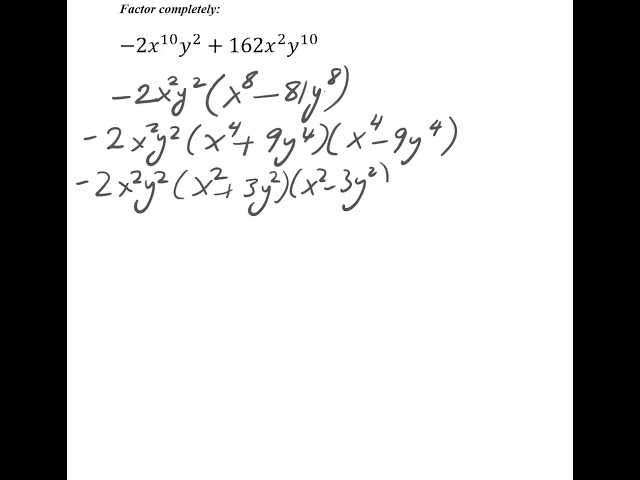
I needed help identifying the mistakes my teacher made
there are multiple, but the only one I can seem to find is that he factored the difference of squares of x^4 - 9y^4 incorrectly
can anyone help?
fallen crane
he is not exactly the best with wording, sorry
fallen crane
is that it?
serene heath
seems so
serene heath
yes
 hardy kiln
u can
serene heath
that's the error
hardy kiln
okay so a difference of squares is when a square of a number - another square of a number can be factor as its conjugate pairs so you want some the powers on the variables to be 1
so you just gotta find numbers A and B that you can factor 4 or 3 times to get (cx-dy)
so like uh
exept i think in ur case ud actually write the 2^8 to its full number to get A
and B
but that is just an example
fallen crane
okay, thank you!
viscid thistle
oof big factoring

 vague crystal
@eager path are you asking for help?
 eager path
I figured it out
vague crystal
okee dokee


 narrow peak
i didnt know complex numbers was precalc
lost mesa
i'd say demoivre's theorem counts as precalc
and in precalc (at least in my US public high school) complex numbers are used
harsh cipher
Hi
 drowsy karma
how do i factor a^2+1a/4+1/2
I'm trying to factor by inspection by finding a factor that adds to 1/4 and multiplies to 1/2 but I don't know if I'm doing it wrong or?
past meadow
,w a^2+a/4+1/2
obsidian monolithBOT
 Requested by Sneaky#0928
past meadow
Requested by Sneaky#0928
past meadow
Yeah, that cant be factored in the reals
past meadow
Not possible
obsidian monolithBOT
 Requested by Stewie#8321
past meadow
Requested by Stewie#8321
past meadow
You can figure out yourself whether it can be factored by considering the discriminant
drowsy karma
my brain no work rn
 wild cobalt
tbh for lack of a better channel I’m going to throw this in here.
let’s say I have $15k in the stock market, expecting an average annual return of 10%. I want to purchase a new car for $15k, so I finance it at 0 down, 5% interest, over 5 years, which is a payment of $283. every month I’m making money from stock market growth, but also making the payments on the car, how would I model this mathematically?
 summer monolith
Why am I being asked to fill the table without the calculator? How is it possible to do without it? The "hepful hint" is making no sense.
Nah...
Doesn't really matter. Forget it
muted steeple
Is this channel taken?
willow bear
guess not
muted steeple
Hi, could someone explain to me how to factor a polynomial where the coefficient of the term with the highest power is not 1?
Let me send an example.
$8x^2-14x-15$
obsidian monolithBOT
꧁༺Vocal༻꧂:
willow bear
a quadratic specifically?
muted steeple
Aa yes.
willow bear
one way to do this is to just use the quadratic formula and get the roots
another is to divide out by the leading coefficient, factor that, then multiply the leading coefficient back in
muted steeple
I've seen someone suggest this, but i don't quite understand what they say divide out by the leading coefficient.
so, in this case it's 8.
?
muted steeple
oh, so now i need to look for factors which will sum up to 14/8 and give a product of 15/8?
willow bear
yes, though you might consider simplifying 14/8 to 7/4 before doing so.
er
you need the product to be -15/8
not 15/8
tardy ridge
You should do decomposition
another way is prime factoring the 8 and 15, but that takes a lot of guesswork
I think it's called the cross method or something
tardy ridge
I got it
first you want to try this
log a=p*logx
so a=x^p
similarily b=x^q
c=x^r
b^2=x^2q
then you divide and get the answer
@viscid thistle
viscid thistle
Could I get help with 3?
tardy ridge
idk what it means by simplest form because I have never done this subject
but you can subsitute 2^-2k as U
and then end up with something that looks like a/b^k
@viscid thistle
viscid thistle
Still kinda confused
tardy ridge
have you tried substituting $2^{-2k} = U$
obsidian monolithBOT
Fishraider:
tardy ridge
you don't have to do that, but it makes it easier
also am I dumb
I can't solve question 4
viscid thistle
We have our days lol
tardy ridge
did you solve 3 yet
tardy ridge
wdym
2^-(2k+1) = U/2
you can do that with the others can get something that is nice
 lapis onyx
how do i show a graph is symmetrical in the line y=x?
 acoustic talon
are there asymptotes in a rose curve?
tardy ridge
@viscid thistlecan explain to me how you solved 4
past meadow
lmao
 honest spear
Oh-, but I picked this book for pre-calculus so asking it in Advanced Maths category might be, um, awkward ?
honest spear
Well, I did heard that it's bit too technical but good to catch up with US curriculum
It's Basic Mathematics
Serge Lang
 pale kettle
What page was your picture from?
honest spear
371
honest spear
I just wanted to know that we arrived at that conclusion because no. of orbits of this permutation is invariant, right?
Or there is something else too
Dunno why just that + an odd/even integer bother me a bit
pale kettle
I'm not sure which conclusion you're talking about
honest spear
Well nevermind
I was thinking on it for a while
I was just confused on that last part
No. of orbits - n is either odd or even
I thought of it backwards so far and confused myself
Lels Thanks though to consider it !
viscid thistle
how do you fractional negative exponents
past meadow
like 2^(-1/2)? just like you would with any normal fractional or negative exponent
if you're talking -2^(1/2). then thats not a real number
although there are situations where it might be real, like -2^(-2/3)
willow bear
if you're talking -2^(1/2). then thats not a real number
au contraire, $-2^{1/2}$ is just $-\sqrt{2}$
obsidian monolithBOT
Ann:
willow bear
you meant $(-2)^{1/2}$.
obsidian monolithBOT
Ann:
willow bear
"you know what i mean" is no excuse for improper notation
viscid thistle
=1/5
 misty heath
ok not sure why that doesn't work
obsidian monolithBOT
Sneaky:
Compile Error! Click the reaction for details. (You may edit your message)
misty heath
I don't know what's happening anymore
 buoyant hound
am I insane or is this unsolvable
this is what we were given as a practice problem
there are 4 other questions like it
there's no other info on the pdf
literally none
it's a bunch of stuff about orthogonal angles
and then that
serene heath
its 7
buoyant hound
it's a true or false on the pdf
serene heath
post the whole thing
buoyant hound
this is the most crackhead study sheet I've ever seen
let me just post the other problems specifically as there's some school and location info elsewhere on the page

what am I supposed to be learning from this
serene heath
post the entire problem
serene heath
thats not a problem
serene heath
thats just an equation
buoyant hound
that's why I'm asking
it's saying "true or false, circle one" beneath it
with no values
serene heath
so its not the whole thing then
buoyant hound
it's listed as a whole problem
and there are 4 of them
I guess it's just a weird error?
idk
no
nope
anyway can someone explain this to me
I don't really get the dot product stuff
and I haven't been able to ask the teacher about it because of eschool and shit
serene heath
what does it mean for 2 vectors to be parallel
buoyant hound
they have an angle of either 90 or 270 between them
serene heath
how are they related
in terms of their components
ok well if theyre parallel then theyre scalar multiples of each other
that should help you
buoyant hound
honestly, I still don't really get it. I probably sound stupid, but explain it to me like I know nothing past the basics of what vectors are, because I don't. There hasn't really been any instruction on this.
sorry if I sound stupid, as I said
also I just realized I meant "0 and 180" not "90 and 270"
tardy ridge
You should search it up
buoyant hound
I did, and didn't find anything specifically on the question there
I mean I guess I sorta get dot product I just don't get that problem specifically
god all this weird school closure stuff stuis messing me up
 proud gate
What if imaginary numbers were included with a hyperbola? Could it still be graphed on a complex plane?
 copper vigil
hello friends
this is a physics question but it is confusing the hell out of me
basically these are momentum vectors
and at the top you can see that the initial object collides with the object at rest
i've ruled out all the ones at angles because this is linear momentum
and i know that 4 and 7 are wrong for some reason
but i have no fucking clue how or why
it's gotta be 2
but i don't know why
 patent beacon
@copper vigil
Conservation of momentum. The sum of the momentums before collision = the sum of the momentums after
Why do you say it's 2? I'd say it's very clearly not
There's no reason why angles can't happen. Let's say one ball hits another on the edge
copper vigil
@patent beacon
what do you mean by the sum of the vectors?
sum of their magnitudes?
or the actual sum of the vectors
patent beacon
The literal vector sum
patent beacon
Did I studder?
Jk fair question. Conservation of momentum still holds
You also get conversation of energy but that's not related here
Again, there's no restriction on angles
copper vigil
ohh ok
i was assuming center of mass
but i guess it could go off at an angle
OHH
It's number 6
because the upwards and downwards cancel out
and the horizontal length is the same
stable pasture
i think both the objects are meant to be point sized
also since the initial velocities of the objects is in the x direction only (also the centre of mass velocity), velocity at angles arent possible
unless they arent point sized ofc
copper vigil
yes that's exactly what i was thinking
4 is wrong, 7 is wrong, 6 is wrong
wtf
2 must also be wrong because there is no leftwards motion
patent beacon
A planet is point sized, if you take an approximation
copper vigil
it's gotta be 3 then?
patent beacon
3 is one of them!
copper vigil
this question is unfair lol
there's no way it could go off at an angle if it's point sized
and there's only velocity in the x direction
3 is right
wtf
i ended up having to use an online ruler to actually measure the pixel lengths
copper vigil
i have a quick question about proving trig identities
why isn't it ok to manipulate both sides?
 proven marten
could you give an example
copper vigil
let's look at something trivial like
tan * cos = sin
the way my teacher expects me to do it
is to keep the right side the same
and then arrive at
sincos/cos = sin
so that sin = sin
uncut mulch
that's dodgy too
generally you shouldn't be using
= like that for stuff that hasn't been confirmed to be true
copper vigil
but isn't it equally valid to say that if tan*cos = sin, then tancos/cos = sin/cos so that sin = sin
obsidian monolithBOT
ramonov:
copper vigil
but here's the thing though. you still end up with the identity that sin=sin which is always true. if you don't end up with an identity after manipulating both sides then you would instead only have a conditional eq
uncut mulch
there are ways to mix sides, but its frowned upon by most teachers as the required notation isn't included by students.
and most up them just want you to do
LHS = ...
= ...
=RHS proofs
copper vigil
yeah i see what you're saying
they just want me to do it a certain way
but it's not technically invalid to manipulate both sides as long as you still end up with an identity though right?
uncut mulch
as long as you include the extra symbols and/or comments
copper vigil
so it would look something like this
$\tan(x) \times \cos(x) =\sin(x) \iff \tan(x) = \sin(x)/\cos(x)$
is that how you use the iff symbol?
obsidian monolithBOT
EndTimes:
uncut mulch
yeh
copper vigil
and then you just use the definition of tan(x) which is sin(x)/cos(x) so then the identity is proven
i see thanks
so it's a matter of notation really
you can't use equal signs like that
uncut mulch
in cases like these, you may also need to clearly describe how you're getting that. (i.e. dividing both sides by cos(x))
patent beacon
You run the possibility of something like
x = 2
x² = 4
But x = -2 satisfies that, so -2 = 2
Where instead showing that both sides are literally the same thing is error-free
copper vigil
not an identity though
uncut mulch
do you know the law?
 inner spear
i have no idea what this even is my teacher is just giving us work and not teaching the material
like we arent even doing zoom classes or anything
i kind of know how the law of sines works
but this is cosine so idk if that helps me at all
uncut mulch
$c^2 = a^2+b^2 - 2ab\cdot\cos(C)$
obsidian monolithBOT
ramonov:
uncut mulch
have you ever seen that before?
uncut mulch
yes
inner spear
like how the sin has the formula rule thijg
aii bet
so how can i use it to solve these
uncut mulch
if you know the sin law already, you should know the convention for labelling sides and angles of a triangle right?
inner spear
yes
uncut mulch
in your diagram, you are given 2 sides and the angle between them right?
inner spear
si
uncut mulch
which would be represented by a,b and C in the formula
conveniently this form matches the placement of variables of the diagram and you can just sub in the values and solve for c
inner spear
ok thank you
 proud jetty
C) it’s sine graph how would I go finding the b and c value