#precalculus
1 messages · Page 215 of 1
 maiden igloo
 steel venture
prefect
maiden igloo
a little
i know
logging it
removes the
variable from the exponent
like pulls it down ?
maiden igloo
aight
 daring yarrow
u dont need logs to solve this do you?
maiden igloo
i don't think so
daring yarrow
just equal exponent rule thing
 sour inlet
i'm completely lost maximo, still can't figure out
 fleet yew
$(2^2)^{x^2} = 2^{2x^2}$
 obsidian monolithBOT
AMD:
fleet yew
$2^{2x^2} \times 2^{5x} = 2^{3}$
obsidian monolithBOT
AMD:
fleet yew
doesn't matter lol
maiden igloo
ahh so it's your preference ?
fleet yew
yeah sure
maiden igloo
aight
fleet yew
32 = 2^5
fleet yew
and 5 = 3 + 2
so we can just add the exponents together
and put it over the same base
2^2 * 2^3 = 2^5
see
maiden igloo
care to throw up that wonderful text
fleet yew
let's just look at the left hand side of the equation now.
fleet yew
$2^{2x^2} \times 2^{5x} $
obsidian monolithBOT
AMD:
fleet yew
$ = 2^{2x^2+5x}$
obsidian monolithBOT
AMD:
fleet yew
because you add the exponents together
maiden igloo
ahh we can combine
okay
and we can do this because we share the same base
is that correct
obsidian monolithBOT
AMD:
 tardy ridge
the bases are the same
tardy ridge
so if 2^5=2^x what is x
maiden igloo
0 = 2^2x2+5x - 2^3
tardy ridge
(that x has nothing to do with the question just an example)
tardy ridge
$ 2^5=2^x$
obsidian monolithBOT
Fishraider:
tardy ridge
what is x
obsidian monolithBOT
Fishraider:
tardy ridge
so what is 3 equal to
tardy ridge
lol
maiden igloo
😦 lost me
obsidian monolithBOT
Fishraider:
obsidian monolithBOT
Fishraider:
fleet yew
yes
tardy ridge
YES!!
fleet yew
but only over the reals
daring yarrow
cmon amd
tardy ridge
so if you try that with your equation
maiden igloo
x = 3
daring yarrow
no nono
tardy ridge
that's what I think s/he is doing anyway
maiden igloo
based on the examples you gave me I am assuming whatver my x is on one side it's reflected on the other
but i feel like that isn't right
daring yarrow
$b^(n)=b^(5+2)$
obsidian monolithBOT
piece:
daring yarrow
wtf
tardy ridge
I think you use the swiggly one
daring yarrow
eh just nvm me i'll lurk
tardy ridge
ok it might be easier to explain if you use log, do you know what log is @maiden igloo ?
daring yarrow
2^(x²+2x+1) = 2^-1
idk if this example could help but this is what got one of my friends to understand how it works
daring yarrow
still messed up 
obsidian monolithBOT
Nightingale:
daring yarrow
and you know that
$b^n=b^x$
obsidian monolithBOT
piece:
daring yarrow
when n=x
tardy ridge
I think subi is long gone
tardy ridge
do you know what log is
maiden igloo
i do know
tardy ridge
just log 2 both sides
tardy ridge
nice
maiden igloo
I realized that
it was
3 2x^2+5x
I kept thinking we had to do something with the bases
so i got confused
But i understand now that the example you showed me
$2^x=2^n$
obsidian monolithBOT
Subi:
maiden igloo
is saying
x = n
which are my exponent values
so set
x = n whatever that is and in my case was
tardy ridge
yes
maiden igloo
$ 2^3= 2^{2x^2+5x}$
tardy ridge
so what's the answer you got
obsidian monolithBOT
Subi:
maiden igloo
-3 , 1/2
daring yarrow

tardy ridge
nice
daring yarrow
goodjob
maiden igloo
but dinner timw
ill be back
i appreciate you guys
a lot
im trying to get better
daring yarrow
dont give up and you'll be fine
tardy ridge
if the bases are different but they can turn into the same you can do that
like 4^x = 2^2x
daring yarrow
$4^x=2^{2x}$
obsidian monolithBOT
piece:
daring yarrow
ez
tardy ridge
ok piece do want to try a problem relating to this? It's not too difficult but I'll just put this here cause i came up with it like a minute ago
$b^{2k}=(-b)^{k^2+1}$
obsidian monolithBOT
Fishraider:
daring yarrow
its 4am so cant guarantee ill be able to solve
daring yarrow
lemme get up and grab a piece of paper
 unique hill
you gonna solve for k or b?
daring yarrow
k
unique hill
2 unknowns
tardy ridge
if k^2+1 is even then there is
daring yarrow
figured but idk how to get there without just thinking
tardy ridge
if you square (-2)^even then it's 2^even
unique hill
but you dont know if it's odd or even
tardy ridge
@unique hill if k^2+1 is even, k=1 k=-1 but -1 doesn't work so k=1
and k^2+1 is indeed even because 1+1 is even
the equation basically becomes b^2=(-b)^2
when k=1
maiden igloo
I have two more question , the first one I just wanna confirm if im understanding the problem correctly
which is this
Information is given about a polynomial f whose coefficients are real numbers.
Find the remaining zeros of f .
Degree 5; zeros: -4, i, 5 − 3i
I said the remaining zeroes were -4 , i ,-i , 5-3i , 5+3i
 cedar pawn
Can u send a picture
maiden igloo
Yes sir
cedar pawn
Oki
maiden igloo

 uncut mulch
don't need to list all 5
maiden igloo
you talking to me
uncut mulch
the remaining (2) zeroes in Q11 would just be the:
-i and 5 + 3i
unique hill
he's doing prev question
maiden igloo
Okay so i figured it was those for question 11
it just seem so simple
so thought it was wong
wrong*
I got 12 btw
the demon question
I skipped cause I was struggling is this one
uncut mulch
that info layout is horrid
uncut mulch
3 is a zero with multiplicity of 2
i is also a zero
cedar pawn
(2+i)2
maiden igloo
but why is I not listed with the zeroes
cedar pawn
(2+i)^2
maiden igloo
i thought it would be
cedar pawn

maiden igloo
(x-3)^2
uncut mulch
they separated the list with ;
cedar pawn


maiden igloo
Can someone walk me through or point me to resources to explain this better
cedar pawn
Khan academy
uncut mulch
it uses the idea as the previous questions
maiden igloo
The degree should reflect the amount of zeroes ... is this correct
uncut mulch
conjugate root theorem
maiden igloo
gotta look that up
fleet yew
if a+bi is a root, then a-bi is a root, assuming the polynomial has real coefficients
uncut mulch
its pretty much exactly the same thing as what you just applied
fleet yew
because (a+bi)(a-bi) = a^2 + b^2 so it must have the conjugate so the imaginary parts can cancel out
fleet yew
yeah
unique hill
wait im pretty sure complex numbers are not precalculus
cedar pawn
Ain't it prealgebra
unique hill
for my curriculum, calculus is taught before complex numbers
maiden igloo
Complex nums is College algebra
But I don’t recall these theorems
I’ll openly admit I didn’t try as hard as I should have in the past and I’m obviously paying for it now , but I’m willing to go through that now
Cause I need this to be where I wanna be
unique hill
i havent touched on complex numbers
maiden igloo
What math are you in
unique hill
as in?
maiden igloo
so
fleet yew
complex numbers are like algebra 1 wtf
fleet yew
like how else do you solve x^2+1=0
fleet yew
no i'm just saying how do you do calculus without knowing what i is
maiden igloo
x^2 = -1
oh square root of negative
give ...
i know it's like i or something
i think
fleet yew
+-i
fleet yew
conjugate root theorem says
if $(x - (a + bi))$ is a root of a polynomial with real coefficients, then $(x - (a - bi))$ must also be a root of the polynomial
obsidian monolithBOT
AMD:
unique hill
@fleet yew in response to ur comment, ik what i is but havent done anything with it
all ik is 1/i = -i
and stuff i did in calculus has no use of complex numbers
 willow bear
@fleet yew factor not root
maiden igloo
I am referring to my question
I thought Degrees were connected to the zeros
for exmaple
Degree 3
zeroes 1, 2 , 1+i
sorry
Degree 4 zeroes 1, 2,1+i
i would assume it's the conjugate paiur
pair*
But here
the Degree is 3
 patent beacon
If you count multiplicity, then there's exactly as many zeroes as the degree
 harsh cipher
Good morning Ann
maiden igloo
I am aware of it for determining if
patent beacon
If the polynomial has real coefficients, then 1-i is a root as well
patent beacon
Oh, but you said it's degree 3. So, the polynomial must not have real coefficients
maiden igloo
Here
Form a polynomial f (x) with real coefficients having the given degree and zeros. Show your work! Degree 4; zeros: 3, multiplicity 2; i
Oooooooo
wth
I kept reading it like this
Degree: 4
Zeroes:3
Multiplicity:2
i
So multiplicity is apart of the zeroes
patent beacon
A zero also has a multiplicity, yeah
maiden igloo
is i not apart of the zero ?
harsh cipher
question
(2)^1-x = (5)^x
solve exactly for x then evaluate your solution rounding to 3 decimals
why cant I log both sides and perform simple algebra?

harsh cipher
opps
steel venture
i.e. $2^{1-x}=5^x$
obsidian monolithBOT
Maximo:
harsh cipher
its that one
steel venture
ok
harsh cipher
I forgot parentheses
steel venture
they aren't the same base
steel venture
lmfao
steel venture
the problem is you can't because theyre not the same base
what can be done though is using one of the log rules
$log(a^b)=blog(a)
$log(a^b)=blog(a)#
$log(a^b)=blog(a)
$
fuck
obsidian monolithBOT
Maximo:
harsh cipher
power rule?
steel venture
yep
harsh cipher
okay
do I apply the power rule to both sides of the equation?
I just solved the previous problem
using the same rule
(3)^(2x+5) = 54
harsh cipher
I did it different way
(log 54 )/ (log3) = 2x+5
also that did not make sense when you said 3*18
harsh cipher
because 3^(2x+5)= 3*18
basically what you're telling me is that
I can equate (2x+5) to 18?
obsidian monolithBOT
Maximo:
fleet yew
RHS simplifies to 3 + log_3(2)
steel venture
oh
willow bear
\log
steel venture
thanks ann
harsh cipher
oh hi there
steel venture
ill remember for next time
maiden igloo
last question before i go to bed. Dealing with these real world problems as such , I get confused with what data goes where
Between 12:00 PM and 1:00 PM, cars arrive at a bank’s drive-thru at the rate of 12 cars per hour (0.2 car per minute). The following formula from statistics can be used to determine the probability that a car will arrive within t minutes of 12:00 PM.
F (t) = 1 − e −0.2t
Determine the probability that a car will arrive within 10 minutes of 12:00 PM. Round to two decimal places as needed.
harsh cipher
I can be patient let's help subi first
fleet yew
No lets finish your question
harsh cipher
okay sure
harsh cipher
okay thank you
harsh cipher
so my question (2)^(1-x) = (5)^(x)
 viscid thistle
@maiden igloo
maiden igloo
yeah it is
viscid thistle
oh constant
maiden igloo
I believe this is an expotential growth function
viscid thistle
yes
willow bear
(2)^(1-x) = (5)^(x)
three of these four pairs of parentheses are redundant
 steel venture
ann you're very nitpicky haha
viscid thistle
is it not simply F(10)? @maiden igloo
maiden igloo
uh
viscid thistle
oh
maiden igloo
Idk
viscid thistle
within
maiden igloo
I am trying to understand how to break this down
steel venture
mirrion go to a questions channel ill help you
viscid thistle
hmm
harsh cipher
which channel
steel venture
any one not occupied
harsh cipher
okay thank you see you there
maiden igloo
do i put 10 in for F(T)
viscid thistle
It would be negative
maiden igloo
and put 10 where t is
maiden igloo
correct
viscid thistle
Are you sure F(t) is written correctly
maiden igloo
let me send pic
viscid thistle
ok
maiden igloo
viscid thistle
so thats
different
now please tell me
i have never taken probability
but its between 0 and 1?
yes
ok
yes it should just be F(10)
maiden igloo
let me work it out
viscid thistle
86.4%
 distant rampart
How do you graph a 3d plane
Like
Its easy to plot the points by just finding intercepts
But i dont know how to draw the plane
distant rampart
Hmm i thanks
I tried that already i still couldnt get it
What im thinking of right now is just make up line equations in two dimensions then just somehow piece them together
maiden igloo
Is there a way for me to donate to you guys
maiden igloo
THANK YOU !
sour inlet
Guys I'm supposed to use a calculator to solve for theta on the interval [-90deg,90deg]
for Sin(theta) = 3/4
I did arcsin(.75) and got 48.5903 deg
unique hill
48.6 (rounded) degrees is one of the solution
sour inlet
and I also got 131.4096 deg from subtracting 48.6 from 180 deg
since sin i positive in q2 right?
unique hill
yep
unique hill
from a neg, you go clockwise along the ASTC circle
so from 0 to 90 degrees, u go anticlockwise
but from 0 to -90 degrees, u go clockwise
 maiden igloo
+369
360
I think would give coterminal angle
That is the same
One of the smart guys can verify
patent beacon
There's only one solution in that range, the one your calc gave you
sour inlet
hmm i see
sour inlet
thanks guys
maiden igloo
90 -41.4
unique hill
that's arcsin 3/4
maiden igloo
Would that be the coterminal
Ahh okay I’m dumb
Got it
Thanks for all the help guys
I hope this discord is around for the next 2 years help me through college
Goodnight
sour inlet
gn
sour inlet
Last question for the day if anyone is still here
how would you go about getting the equivalent of 6sinxcos(5x)
would it be
3sin(6x)+3sin(4x)
?
willow bear
"the equivalent"?
unique hill
are you talking about double angles?
willow bear
no that's not what nightingale means
willow bear
$\sin(a) \cos(b) = \frac12 (\sin(a+b) + \sin(a-b))$
obsidian monolithBOT
Ann:
unique hill
thx for typing it in texit
unique hill
a and b are the respective angles
sour inlet
how would you get angles from something like this

doesn't look like I have much to work with, not much that i can see anyways
unique hill
first focus on the ones inside the brackets
ignore the 1/2 for now
so just $sin(a+b)+sin(a-b)$
sour inlet
sin(5x+x)
obsidian monolithBOT
Nightingale:
sour inlet
?
obsidian monolithBOT
Nightingale:
sour inlet
all I can think of is
6sin(X+5X) + sin (X-5x)
6sin(6x) + sin(-4X)
sour inlet
6sin(6x) - sin(4X)?
unique hill
minus in the middle
you're using a different formula now
becuz a and b are switched
sour inlet
o ok
so to avoid negative in bracket
formula was different and sign was switched
?
obsidian monolithBOT
Nightingale:
unique hill
that is just 2 multiplied by the whole thing
ok now, u know that a=5x and b=x
you have everything u need to know
sub into $2cosAsinB=sin(A+B)-sin(A-B)$
obsidian monolithBOT
Nightingale:
sour inlet
oh right cus we multiplied first in the paranthesis
unique hill
so now what's your LHS and RHS
sour inlet
2cos5XsinX
sin(6X)-sin(4x)
I'm not confused by the question, what do you mean what's on my left hand side and right hand side.
unique hill
there's an equal sign in between them
cuz you subbed in a and b into the formula which has an equal sign in the middle
so LHS=2cos(5x)sinx and RHS=sin(6x)-sin(4x)
sour inlet
right
sour inlet
Well it's the first time I've seen something like that, but yes we have a LHS and RHS
and they're set to equal each other
unique hill
now what's the question asking?
sour inlet
Which of the sums is equivalent to 6sinxcos(5x)
my best guess would be 3sin(6x)-3sin(4x)
sour inlet
but our RHS is completely different
ever since we dropped the 3 and moved onto a new formula
so i'm confused
unique hill
since u found out 2cos(5x)sinx, u can times 3 on the other side since the question is asking for 6cos(5x)sinx
sour inlet
ohhh
sour inlet
typo
unique hill
okok
 unique hill
no worries
daring yarrow
lim(f(x)) = -inifinity
(x -->+inifnity)
i have to prove this using the epsilon gamma method but i uh
yeah i dont really get it
tardy ridge
What is the question
daring yarrow
wait nvm they're being as vague as ever in the book
just want me to write it in epsilon-delta form
aight then
maiden igloo
good morning
harsh cipher
good morning
 sturdy haven
steel venture
sturdy haven
steel venture
,rotate
sturdy haven
Help with number four PLease
obsidian monolithBOT
sturdy haven
IM SO OCNGUSED
steel venture
try different points to see how it looks
sturdy haven
uhhh what
Thats not
I mean how do I space it out
And what intervals
And when use period
steel venture
ok the center is zero
and you have all that room on the right to get to 2 pi
so space it as you will but utilize the room wisely
sturdy haven
So i spaced it out an it is PI OVER FIVE
WHAT
ALSO THE PERIOD IS FOUR PI
what does that mean
how is im so confused right now
steel venture
ok
sturdy haven
because listen if spaced OUT evenly
steel venture
lets take it slow
sturdy haven
21
sturdy haven
o
sturdy haven
I Wrote two pie now what
sturdy haven
ok infucekd up
its only 20
so i wrote two pied at the end
And wrote pie in centrez
ok no waht
steel venture
then just earase and rewrite it
sturdy haven
oh shet i fucked up
steel venture
until you can fill in the lines
sturdy haven
but the frequences
steel venture
the question didn't ask for that
all its asking is for you to plot the graph in the given interval haha
sturdy haven
i can’t
steel venture
and theta = pi/2
sturdy haven
ghe graph
ok
wait
so
for two pie
Is just cos pie
so
thats neg one
how on gods green earth do i do 3pie over Two
steel venture
unit circle
steel venture
looks fine
sturdy haven
if i fail i will blzme you but i thinkz you did it right sonidk
BRUH
HOW THE FUCK
steel venture
😗
steel venture
,rotate 270
sturdy haven
!rotation
obsidian monolithBOT
steel venture
dawg i taught you how to do it
steel venture
you just need to plot points until ou find the shape
steel venture
listen my guy i got some sleep to catch up on
sturdy haven
LIKE ONE AND NEGATIVE ONE
steel venture
think about it
plot points and figure out what the maximum and minimum y values can be
sturdy haven
i like you
steel venture
😄
 molten forge
How do you do this? It's in an online worksheet
They didn't explain how
this too
viscid thistle
@sturdy haven still need help?
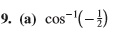
 stuck lark
think in reverse, think of an angle x between 0 & pi such that cos(x)=-1/2
tardy ridge
two values I think?
tardy ridge
yeah
 dim basin
can someone quick help me with this?
tardy ridge
1 thing is that theta is in the 4th quadarant
dim basin
yep
tardy ridge
are you supposed to use a formula or something for this?
what's stopping you from just saying theta=-80.53
dim basin
tbh we did this before corona/spring break and its been 3 weeks since we have done this so i completly forgot how lol
oh
tardy ridge
and just plugging the value in
unique hill
i think you're fine
dim basin
ok
 glad vale
The perimeter of a stadium is an ellipse with major axis 640 feet and minor axis 549 feet. Find the distance between the foci of this ellipse.
giw di u di this?
how do i do this lol sorry
 maiden furnace
ok i need someone to walk me through this one i managed to solve my other problem

so i know the answers isnt 7pi/6 because of the restriction of inverse cos being between 0 <= x <= pi
so what do i do next?
tardy ridge
well cos (pi+theta)=-cos(theta)
so cos 7pi/6 is -cos pi/6
and you can calculate that
also the answer would be 7pi/6 and another value if there wasn't that restriction, don't think 7pi/6 isn't right though
maiden furnace
well back of the book we have answer and it says the answer is 5pi/6
and going through some website it says to use the refence angle
tardy ridge
it is 5pi /6
but 7pi/6 is also an answer if the restriction wasn't there
do you know cos (pi+theta)=-cos(theta)
maiden furnace
no i dont know thecos (pi+theta)=-cos(theta)
tardy ridge
you could use that and change cos(7pi/6) into -cos(pi/6)
oh it's because of the unit circle
do you know the unit circle
maiden furnace
yup
maiden furnace
is that just a reference angle?
tardy ridge
theta?
tardy ridge
theta is a variable angle
if that's what you mean
theta is usally a variable referring to angles
and cos pi/6 is cos 30 which is sqrt3/2
that's also on the unit circle
since we are taking the arcos of -sqrt3/2 it's in the 2 or 3rd quadarant
but by the restriction it can only be the second one
which would be 180-30 degrees
150 degrees
did you know that cos (180-theta) also equals -cos theta?
maiden furnace
nope i didnt know that
tardy ridge
well it'll be hard to explain
maiden furnace
well looks liek this math teacher missed out on alot of information in that case
unique hill
have u learnt ASTC?
maiden furnace
yeah
unique hill
pretty sure ASTC covers that
tardy ridge
draw a triangle
 gaunt bay
cant figure out how to start this
if someone can pm me. i know that i should use tan but i keep getting a negative number and not a big enough number
unique hill
looks like the channel's taken
@slate oracle draw a diagram of the building and the shadow
 slate oracle
For the measure(in feet) of the shadow and top of building.
unique hill
angle between the end of shadow and vertical side of building from the person
slate oracle
Yes.
slate oracle
Tangent..?
unique hill
that's correct
slate oracle
So then, tantheta= 100/230.. correct?
unique hill
yes
slate oracle
And then we would move tan to the other side making the equation theta=tan^(-1)100/230
Right?
unique hill
yep
slate oracle
So then, we would find the degree.. which is.. ~23.
Right..?
Would be estimate the degree or not?
unique hill
if it's rounded to one decimal place, it's 23.5 degrees
unique hill
it says to the nearest degree
slate oracle
Oh, sorry.
unique hill
round to nearest degree
slate oracle
So it's 25 degrees..?
slate oracle
You said it's 23.5 which is 24.
unique hill
no that's if its rounded to one decimal place
unique hill
that's it, you've found the angle
unique hill
yeah that's the answer
unique hill
np
unique hill
just make sure the 47 degree angle is clear
unique hill
your diagram looks correct
slate oracle
I would use sin, which leads it to being sin35=x/59 which would make x=(sin35)(59). Then x would be 33.84 or ~34 meters.
Ye?
unique hill
uh not sine
slate oracle
Then what..?
slate oracle
sohcahtoa?
slate oracle
cosine?
unique hill
ok first, dont guess
slate oracle
ok
unique hill
what's the trig ratio for cosine?
slate oracle
Uh. I don't know.
unique hill
ok you're trying to find the height of the building right? excluding the radio tower
slate oracle
Yeah, which would be considered the opposite.
unique hill
mhm, and you are given the distance of the person to the building, which is adjacent
slate oracle
Yeah
unique hill
you need to find the opposite and you are given the angle and adjacent
so what trig ratios would u use?
unique hill
uh okay, first tan 35 = opp/adjacent correct?
unique hill
you follow?
unique hill
the tan ratio is opp/adj, and you are given the adj
slate oracle
Yeah but not the oppo.
unique hill
$tan{35}=\frac{height of building}{59}$
obsidian monolithBOT
Nightingale:
slate oracle
Yeah
unique hill
yes, you make the height the subject
slate oracle
So multiply everything by 59
unique hill
@viscid thistle this channel's taken
slate oracle
Making the equation (tan35)(59)
viscid thistle
?
gaunt bay
@viscid thistle im waiting for someone to help me next
slate oracle
(tan35)(59)=~41
slate oracle
So then what would be doo
unique hill
you have just found the height of the building, excluding the height of radio tower
unique hill
the second part is find the height of building and the radio tower together
slate oracle
Ok