#precalculus
1 messages · Page 158 of 1
 tropic crown
im not too sure lightning what u meant by that
and idk if this is exactly delta
it has an epsilon sign, but i havent done any questions like this before
that has epsilon - N
only epsilon - delta
 echo plaza
it's mostly the same
echo plaza
it's just a different measure of "closeness" if you want, because it's a limit as x tends to infinity
mostly the same
given some arbitrary $\ep>0$ just find some $N$ satisfying this
 obsidian monolithBOT
CaptainLightning:
echo plaza
symbolically ofc
tropic crown
ill take ann suggestion and move the convo to calculus
but ill try something
and show my work
in calc soon
 royal gull
2= 0.5 + 1.5
 willow bear
maybe consider $\frac{x+2}{2x+1} - \frac12$ instead
obsidian monolithBOT
Ann:
tropic crown
so half angle formula for cos^2x is 1/2(1-cos(2x))
but if i have something in x, like, cos^2(2x)
what would the half angle look like
would it be 1/2(1-cos(4x)?
willow bear
indeed it would
tropic crown
so to confirm, cos^2(4x) would turn into 1/2(1-cos(8x)?
were just multiplying whatever is inside the intial ( ) by 2?
willow bear
well like
first off, +
not -
and second, yes, $\cos^2(4x) = \frac12(1 + \cos(2 \cdot 4x))$
obsidian monolithBOT
Ann:
 fervent lagoon
yo could someone help me out with this problem?
i was thinking about law of cosines but idk how to approach with two unknown values
 grizzled orchid
yah same lol
 viscid thistle
Im wondering if the 180 in the 2nd triangle applies for all 3 sides
Its not an equilateral triangle right?
 proud raven
i doubt it
viscid thistle
Got it
grizzled orchid
if we know perimeter equals 140 we can label AD and BC as x and y and say x + y = 280
proud raven
if it was equilateral
the condition that the two unknown sides are different wouldnt be true right
or maybe it would
640*
grizzled orchid
regardless we can't just assume : p
proud raven
640-(180*2)=280 youre right sorry >.>
grizzled orchid
yah
proud raven
so one is 280-x other is 280-y
grizzled orchid
ye
proud raven
then uh
viscid thistle
Theres too many tricks in geometry
viscid thistle
Or you could ping the mods
proud raven
admins yea
help we dont understand geometry
it also looks like the asker evaporated
proud raven
bummer
guess ill never know
geometry is a nonsense anyways
which is to say im too stupid to get it
anyways
grizzled orchid

 native sequoia
7/9, you have answer so I can check my answer?
oh wait I can check it while writing the solution
 valid flint
thats what i get too, 7/9
native sequoia
didn't realise they moved to #geometry-and-trigonometry rip
viscid thistle
Hey John Doe smith
 spark cliff
This is C, correct?
 pale cedar
yes
 mystic dagger
Please help simplify this would be a huge help
 uncut mulch
start with factorisation
uncut mulch
you've reached the solution
mystic dagger
thank you @uncut mulch really appreciate it
 rugged ice
having a hard time reading this one
uncut mulch
assuming ur trying to find the eqn?
rugged ice
just the equation for it
willow bear
can you post the entire problem
judging by the graph alone, this looks like a circle centered somewhere around (-1, 6) with radius around 3.5
rugged ice
That's what I had figured but I wasn't completely sure, thanks
mystic dagger
Anyone know where to begin?
 river kindle
What do you do when you divide fractions?
 harsh spoke

i think this is precalc
idk its summer homework for calculus
anyway how would i go about solving it
mystic dagger
Recripical got it
 serene heath
ok what's 0.125 as a fraction
harsh spoke
lmao i got all of those finally
except the last
cuz log (10^1/2
so i thought it would be 1/2
but it needs u or v
and idk how to put u or v in there
 limber bone
log_10(10^1/2) = 1/2log_10(10) = 1/2
 wraith idol
$\log_{10} (10^{\frac{1}{2}}) =\frac{1}{2} \log_{10}(10)=\frac{1}{2}$
obsidian monolithBOT
Whoever:
mystic dagger
Where do I even start?
pale cedar
can cosecant be written as a more friendly trigonometric function?
mystic dagger
1/sin
pale cedar
so if you substitute that in, can you rearrange to get sin theta = constant?
pale cedar
you can do that; tho this happens to be a nice angle
mystic dagger
So I just solve from there getting theta alone @pale cedar
pale cedar
yea at that point you do have theta alone (if thats what ur asking? im not sure haha)
mystic dagger
I get this as an answer but how do I write that in radians in terms of pie?
Or am I still wrong?
pale cedar
ur fine; you found a solution.... since it seems ur calculator is in radians (which means 0.7854 = x * pi) just divide 0.7854 by pi
(also i will recommend you sketch the graph; these things sometimes have more solutions!)
mystic dagger
That’s where I am a bit confused is there something I can look up because I am not sure what this topic is
pale cedar
the radians part or the graph part?
pale cedar
how familiar are you with sine?
mystic dagger
Haven’t done this in months so def need a refresher. Any thoughts on what to look up
I appreciate the help as well but I would hate to waste your time on something I can look up
pale cedar
you could google sine? or pull up a graphing calculator (i recommend desmos) and plug it in?
mystic dagger
ok thank you
pale cedar
😄 gl!
mystic dagger
Please help for final solution
willow bear
what is giving you trouble here
mystic dagger
taking the 80 out of rad @willow bear
willow bear
well, how do you normally simplify radicals with large constants?
mystic dagger
nvm i got it thank you
mystic dagger
ik its trig identity i am just having trouble subtracting the sin over for substitution
do i subtract 2sinx and leave the 2?
cos^2x - 2sinx = 2
is this correct?
<@&286206848099549185>
 surreal mesa
Wait 15 minutes before tagging helpers
wraith idol
15 min 
 tawny nacelle
 grizzled orchid
reee
mystic dagger
Thank you and sorry for not waiting 15
viscid thistle
So given two sequences that satisfy the recurrence relations a(n)=Aa(n-1)+Ba(n-2) and b(n)= Cb(n-1)+Db(n-2) where A,B,C,D are positive real constants, what's the limit as n goes to infinity of their ratio?
 frozen needle
You should be able to fully determine those two sequences
viscid thistle
do you mean i need to solve the recurrence equation?
frozen needle
that would be a way
viscid thistle
ok say i solve the recurence relations what then
frozen needle
then you calculate the limit with usual techniques
it'll probably be expressed in term of a(0), a(1), b(0) and b(1)
and A, B, C and D of course
viscid thistle
well if A=B=1 then a(n)=a(n-1)+a(n-2) which is the recurrence that the fibonacci sequence satisfies
 late pewter
whats the closed form for fibonacci sequence though?
viscid thistle
it's kind of ugly
 patent beacon
It's fibonacci-like
viscid thistle
the closed form is on the wikipedia page for fibonacci numbers
under mathematics
Relation to the golden ratio
late pewter
they really used the 2 most similar looking symbols
ok yeah i think i remember this
but I imagine deriving it for the general equation a(n) = Aa(n-1) + Ba(n-2)
wouldnt be that easy
viscid thistle
maybe it can be done without solving the recurrence
late pewter
yeah thats what im thinking
viscid thistle

Part Two of Golden Ratio Trilogy Proof that an infinite number of sequences have that "golden ratio" property - not just the Fibonacci Numbers. More links & ...
patent beacon
Move the terms up to
a(n + 2) = Aa(n + 1) + Ba(n)
Then assume the solution is Cλⁿ. This brings us to
λ² = Aλ + B
Let the solutions of λ to that be r and s.
Then the solution to the whole thing is
a(n) = C1 rⁿ + C2 sⁿ
patent beacon
There's a few problems here, that r and s could be complex. As well, C1 and C2 depend on your starting point
frozen needle
(-A)²-4(-B) > 0, r and s are real
viscid thistle
the best rational approximations to root 2 are kind of like this
like the numerator terms
satisfy the recurrence a(n)=2*a(n-1)+ a(n-2) where a(0)=2 and a(1)=2 but like half of this sequence
and the denominators
b(n)=2*b(n-1)+b(n-2) ,b(0)=0 b(1)=1
and the limit of their ratio is root 2
any ideas?
<@&286206848099549185>
So given two sequences that satisfy the recurrence relations a(n)=Aa(n-1)+Ba(n-2) and b(n)= Cb(n-1)+Db(n-2) where A,B,C,D are positive real constants, what's the limit as n goes to infinity of their ratio?
Repost
anyone?
viscid thistle
of a(n)/b(n) you mean?
i think this is done the same way this is done
Prove that the limit a(n)/b(n) as n goes to infinity = sqrt(2) where a(n)=a'(n)/2, a'(n)=2a(n-1)+a(n-2), a(0)=a(1)=2 and b(n)=2b(n-1)+b(n-2), b(0)=0 ,b(1)=1
so a(n) is half of this:
and b(n) is the nth pell number
and this is definitely true
proud raven
hmm
i think thats over solving it
should be 1, right?
or maybe some variable ratio
viscid thistle
the limit of their ratio is definitely the square root of 2
not of the general sequences i gave
but the other ones
proud raven
that doesnt make sense
viscid thistle
they give the best rational approximations to the square root of 2
proud raven
the only differece between the two are variable constants
proud raven
theyre not numerical in the context of this problem
how do you get a numerical answer
idk you might be right
i doubt it
viscid thistle
if we use the general sequences then of course the result will depend of A,B,C,D and maybe a(0),a(1),b(0),b(1) as well
but since in that more special case A,B,C,D and the rest have numerical values
the result will also have a numerical value
proud raven
ill take a look when im home
viscid thistle
cool thanks\
late pewter
idk if this is helpful at all but I got:
a(n) = (fib(n - 1)A + fib(n - 1)B) * a(1) + (fib(n - 2)A + fib(n - 3)B) * a(0)
where fib(n) = nth fibonacci number
viscid thistle
hmm interesting
late pewter
i might be wrong
but i just expanded a(n) a bunch
and noticed the pattern
obviously the same applies to b(n)
late pewter
yeah, maybe you could use the closed form for fib() but it seems like you would get a very nasty answer
let me double chcek that expression I gave is even correct
oh yeah wait thats totally wrong lmfao
i forgot to plug in the A and B
🤦
viscid thistle
so maybe focusing on the more special case will help cause we know that the ratio of half of the companion pell numbers and the actual pell numbers is the square root of 2
and thos sequences have that form
those
a(n) = 2a(n-1) + a(n-2),
with different a(0) and a(1)
i thought that the proof would be kind of like the one in that numberphile video
although that one was for the limit of the ratio of consecutive terms of the same sequence
i believe it's close enough but idk
proud raven
i need to sit down and check if its telescoping
viscid thistle
i thought that term was used in series' only
like sums and stuff
wdym?
is there such a thing as a telescoping limit or smth?
proud raven
a telescoping series
viscid thistle
yeah but what series?
viscid thistle
anw if you make any progress you're free to DM me or just post it on here and make a mention
anw
harsh spoke
can anyone help me with the last one
proud raven
@viscid thistle its not telescoping
i would post your question in #calculus
and then ping helpers if you dont get a reply
because im not sure but it seems fundamental so maybe its important
proud raven
no not you @harsh spoke
i was talking to another guy
@harsh spoke I don't think theres a way to write it without the square root
harsh spoke
shit
proud raven
so then its just a matter of simplifying the radicand, or maybe you don't even need to do that
proud raven
$\sqrt{55225*2}$?
obsidian monolithBOT
jan Niku:
proud raven
has a nice prime factorization
harsh spoke
oh!
harsh spoke
3v+3u inside rad
harsh spoke
it didnt work lmao
i tried sqrt(3u+3v)
maybe instead of using the square root i could use fractions as the
uhh
coeficcient
obsidian monolithBOT
jan Niku:
harsh spoke
ye i know that one
pale cedar
can you write the stuff inside the log as 10^number
proud raven
and know that 1000 has a prime factorization into 5's and 2's
so if you can write 1000 in terms of 5's and 2s
harsh spoke
but how does the square root work
proud raven
you can write log 1000 in terms of log5's and log2's
just put it under the radical, i think
harsh spoke
oh
proud raven
its not a nice number, so i dont know how you would do it without that
harsh spoke
what
proud raven
unless there's a special way
harsh spoke
it turns into 3/2
proud raven
like this
pale cedar
yea thats correct
pale cedar
so what do you currently have?
proud raven

 spring thunder
stoopid webassign
spring thunder
express your answer in terms of u, v and numbers


 young ridge
hey guys how would I solve this inequality. 2x - 3 < x + 4 < 3x - 2
willow bear
solve 2x-3 < x+4, then solve x+4 < 3x-2, then take the intersection of the resulting solution sets
young ridge
Thank you @willow bear
young ridge
How do I solve this one: | x + 3 | = | 2x + 1|
frozen needle
split cases
 sour plinth
|x+3| = x+3 for x>-3 or -x-3 for x<-3
and |2x+1| = 2x+1 for x>-1/2 or -2x-1 for x<-1/2
i think it's easier to understand if you plot it
frozen needle
look at what happens on $]-\infty,-3],~[-3,-1/2],~[-1/2,+\infty[$ separately
obsidian monolithBOT
Tuong:
 fiery wave
Another way to see it if you don't like restricting x values like Tuong suggests (but still a good way)
You can consider the 4 equations:
- x+3 = 2x+1
- x+3 = -(2x+1)
- -(x+3) = 2x+1
- -(x+3) = -(2x+1)
As you allow solutions to be different signs due to absolute values. Therefore you have all the possibilities up there^
But you should notice equations 1 and 4 are the same, and
equations 2 and 3 are the same too
So you should find all possible solutions by solving the 2 (remaining) equations
young ridge
Thank you guys. I understand now
frozen needle
🍻
serene heath
just sketch it tbh
rugged ice
Having a hard time finding the missing variable for this parabola related question, someone mind?
A company produces headlights for cars which are parabolic. If the equation for the headlights is 220xy, how far from the vertex should the bulb be placed?
Yikes that didn't format correctly
the equation is x^2 = 20y
mystic dagger
How should I go about this?
 rocky bison
oof
okei
So first bit of mega useful info
dividing by a fraction is the same as multiplying by it's reciprocal
The reciprocal of a fraction is the same fraction just turned upside down
@mystic dagger
So that'll take us from that
To
mystic dagger
ok ill try do that thank you
rocky bison
,$ \frac{14c^3d}{3ab^2}\cdot\frac{6b^3}{7c^5d^4}
obsidian monolithBOT
Pseudo:
mystic dagger
so thats the same as dividing or same equation from above @rocky bison
rocky bison
Yes
But instead of dividing by the fraction we're multiplying by it's reciprocate
Because that's easier
mystic dagger
ok thank you
rocky bison
Got it from there?
mystic dagger
yea
rocky bison
Awesome
mystic dagger
@rocky bison just would have to simplify and multiply across correct?
rocky bison
Yep
Just multiply top by top
bottom by bottom
Then just work by cancelling terms out a bit at a time
mystic dagger
ok got it
 silk sequoia
why is this C and not B?
i tried to figure this out by coming up with all the possibilities by hand and only came up with 6 
2314 2341 1234 4231 1423 4123
rugged ice
How do I find the direction angle of a vector?
 short sorrel
@silk sequoia B is correct
whatever answer key you're using is wrong
maybe they meant, "if the digit 2 and digit 3 are always adjacent" or something?
@rugged ice draw the vector as a right triangle, and consider what trig ratio allows you to find the angle
this can be generalized
rugged ice
I don’t have any way to visually represent it
rugged ice
v = i - 2j
short sorrel
oh whoops
so this
that should be i - 2j in the bottom-right
the length of the left-right vector i is 1
the length of the up-down vector -2j is -2
so with some trigonometry
$\tan \theta = \frac{-2}{1}$
obsidian monolithBOT
Namington:
short sorrel
solve for theta
short sorrel
other way around
rugged ice
thanks
grizzled orchid
can't believe i need to ask this but: how can i rewrite $\frac{\sin ax}{\sin bx}$ in terms of $\frac{\sin x}{x}$
obsidian monolithBOT
hegel:
grizzled orchid
ye
grizzled orchid
ah
serene heath
then it should be fine
serene heath
is this for a limit
grizzled orchid
rewrite in terms of $\alpha$ where $\alpha = \frac{\sin x}{x}$
serene heath
x to 0 yea?
obsidian monolithBOT
hegel:
obsidian monolithBOT
hegel:
grizzled orchid
smh its just 1 ree
serene heath
lol
grizzled orchid
oh god are you shitting me
this can't be right
$\cos (2bx) = 2 \sin (\frac{\pi}{4} - bx) \sin (\frac{\pi}{4} + bx)$
🤢
obsidian monolithBOT
hegel:
grizzled orchid
i wolfram'd it
grizzled orchid
serene heath
so what u got now
grizzled orchid
im at $\frac{\sin (ax) \sin (bx)}{\sin^2 (bx)}$
obsidian monolithBOT
hegel:
grizzled orchid
this limit is grossss
serene heath
yea so just multiply by x/x now
grizzled orchid
that's what i started with
serene heath
and split it up
serene heath
some juicy limit rules that allow such manipulation
obsidian monolithBOT
hegel:
serene heath
yup
simplify the right term a bit
then u can take the limit of the 2 terms separately
 grizzled orchid
oh ok
serene heath
yea WA gets too excited sometimes
serene heath
yea
grizzled orchid
*sin bx
serene heath
cheeky manipulation
grizzled orchid
hmm
but we still have all our sins as sin (ax) or sin(bx)
how do we get those a and b out?
serene heath
that's easily fixable
grizzled orchid
maybe im just dumb
grizzled orchid
ye
obsidian monolithBOT
hegel:
Compile Error! Click the  reaction for details. (You may edit your message)
grizzled orchid
and we can say that $\lim_{x \to 0} \frac{\sin x}{x} = \lim_{u \to 0} \frac{\sin u}{u}$
obsidian monolithBOT
hegel:
grizzled orchid
right?
serene heath
not quite
grizzled orchid
hmm
serene heath
what does sinbx/x approach
 obsidian monolithBOT
hegel:
serene heath
(sinbx/x)^-1=(bsinu/u)^-1=(b alpha)^-1
 grizzled orchid

 cinder glade
 shrewd urchin
The sum of two force at a point is 16N. If the R[resultant] is normal to the smaller force & has value 8N find the two forces ?
R is normal to smaller forces means its perpendicular
R is perpendicular to small F ?
??????
anyone ?
viscid thistle
F1+f2=16N
shrewd urchin
i know that
serene heath
yes normal means perpendicular
 blazing parrot
Try drawing a diagram. If you say there is a point O and that the resultant is OR, f1=OF, then f2=RF
then you know angle ROF=90 or ROF=pi/2, whichever u prefer
Now relate the 3 sides and solve the simultaneous equations
shrewd urchin
A body moving with speed 20m/s turns by 60 degree and continues with 20m/s. find the change in velocity?
I drew a diagram used the formula for resultant but got the wrong answer
$|R^2|=20^2+20^2-2 \cdot 20^2 \cdot cos(120)$
obsidian monolithBOT
Krishna (An average mathy):
shrewd urchin
$R=20\sqrt{3}$
obsidian monolithBOT
Krishna (An average mathy):
shrewd urchin
scoll up
 jolly silo
hmmm
The sum of two force at a point is 16N. If the R[resultant] is normal to the smaller force & has value 8N find the two forces ?
R is normal to smaller forces means its perpendicular
R is perpendicular to small F ?
??????
?
this is it
jolly silo
A body moving with speed 20m/s turns by 60 degree and continues with 20m/s. find the change in velocity?
I drew a diagram used the formula for resultant but got the wrong answer
shrewd urchin
A body moving with speed 20m/s turns by 60 degree and continues with 20m/s. find the change in velocity?
I drew a diagram used the formula for resultant but got the wrong answer
$|R^2|=20^2+20^2-2 \cdot 20^2 \cdot cos(120)$
obsidian monolithBOT
Krishna (An average mathy):
shrewd urchin
YES
Wait i realised my mistake .
Change in velocity = v_2-v_1 not v_1-v_2
 dumb me
No wait reeeeeee3
????
I mean it doesn't even mention directions
Does the question has less information
I can't figure out what's wrong
<@&286206848099549185>
wraith idol

shrewd urchin
Heck u . If you wanna help then help don't troll
late pewter
Can't you just subtract the vectors
late pewter
Shouldn't the answer be a vector
shrewd urchin
The question lacks information I think
shrewd urchin
shrewd urchin
Q lacks information I guess
late pewter
Since it changes in velocity in the y direction as well
Are u sure the answer they give is 20
shrewd urchin
Yes
late pewter
That doesn't seem right in any world
shrewd urchin
Is my answer correct ?
late pewter
I'm honestly not sure what you're doing
I would think it's 10
Why do you square the numbers
shrewd urchin
@late pewter
late pewter
Can't really read that
late pewter
What's R
shrewd urchin
Resultant
late pewter
Resultant of what
Resultant of subtracting the vectors?
Oh I see
It uses law of cosines to get length of the resultsnt
Yyah 20 should be correct
I wasn't understanding the question usually vectors arent expressed in purely magnitudes
shrewd urchin
Laws of cosine ?
late pewter
Isn't that where it comes from
shrewd urchin
It's a parallelogram law of vector addition
shrewd urchin
Oh kay
shrewd urchin
They subtracted the first vecotr from the second (the one after making 60°)
shrewd urchin
Wait
shrewd urchin
I know all that
late pewter
Yes
shrewd urchin
Bruh
shrewd urchin
They subtracted the 1rst with the second whereas change in velocity is v_2-v_1
late pewter
You agreed with me above
The resultant is a triangle
Lemme look at your calculations
But just from that logic alone it should be 20
I'm pretty sure you should be using cos60
Instead of cos120
shrewd urchin
So the subtract the first from second right
late pewter
I mean in the first screenshot you sent
It shows you subtracted 220cos120
Should be cos60
You should look into the law of cosines if you want to understand the formula you're using
shrewd urchin
@willow bear sorry to ping but they they took cos\theta and not cos(180-\theta) because the change in velocity is final velocity-intital velocity
willow bear
why would it be 180° - θ
shrewd urchin
Because final velocity- intial velocity
shrewd urchin
Angeles are formed by the velocity vector tho tho
Because of initial v-f v then final v vector will be opposite
late pewter
The basis of the formula is the law of cosines there's no way 180-theta makes sense
shrewd urchin
And if fv-iv then the iv will be opposite
late pewter
the vectors will be opposite thats correct
If you add them head to tail the angle they form is still theta
shrewd urchin
I finally got what u said
No I don't
We were asked vector a-vecor b
So that's why 180-\theta
shrewd urchin
We have to join tail to tail
late pewter
Ok then u make a parallelogram
shrewd urchin
Yeah
late pewter
This is why I'm saying look at the law of cosines because you cant solve for the resultant vector with 180-pi
shrewd urchin
180-theta
late pewter
The law of cosines is the way of calculating the length of a third side using the other 2 and the angle between them
If you use the law of cosines with 180-theta, you're calculating the length of the long side joining the two ends of each vector
You want to calculate the blue vector not the red one
If you use 180-theta you're calculating the red one
shrewd urchin
I can calc it
shrewd urchin
Reading my physics textbook brought laurels in my life lol
viscid thistle
,rotate 90
obsidian monolithBOT
viscid thistle

silk sequoia
 how do you do this problem??
 pale kettle
Is there another angle in the picture with the same measure theta?
silk sequoia
no
pale kettle
are you sure
pale kettle
that's right
well that angle is in a nice triangle
if you can find the side lengths of that triangle, you can use the law of cosines to find theta
silk sequoia
i thought if you have 2 sides you need to know a 3rd angle to use law of cosines
or if we can find the third side on the bottom them im not sure how
pale kettle
you can find all 3 sides
silk sequoia
 im not even sure how to find the length of the first 2 sides in the first place
trying to figure it out rn
 karmic topaz
pythagorus
silk sequoia
that doesnt help
silk sequoia
the problem is that this graph doesnt give you exact values
you can tell that by when the graph intersects the y axis
karmic topaz
they give you the functions
karmic topaz
no
pale kettle
We've told you
karmic topaz
where a and b are perpendicular
if you found the height of the triangle, and the length of its base
just halve the base
karmic topaz
the angle youll get is half of the actual angle
silk sequoia
ye
limber bone
when is something ^ something =1
when that something is 0
the other something X
like the power it self
or u can say this
3^(2n-4) = 1 --> 3^(2n-4) = 3^0 ---> 2n-4 =0
n=2
viscid thistle
In this area of study I'm not suppose to be using logs yet
so that first answer was bette
r
karmic topaz
kay
viscid thistle
thanks
karmic topaz
👍
jolly silo
this?
young ridge
How do I solve this: if sinx = 1/3 and secy = 5/4, where x and y lie between 0 and pie/2, evaluate sin(x+y)
rocky bison
Well first, what's sec?
young ridge
4/5
young ridge
sin(x+y) = sinxcosy+cosxsiny?
rocky bison
Yep
rocky bison
We've already got cos(y)
young ridge
cosx i mean
 prisma marten
Draw a little triangle
With angle y, adj 4, hypotenuse 5
You can solve for opp
And do the same with the sinx
 prisma marten
 snipe
snipe
young ridge
what type of triangle? r-angle triangle?
 young ridge
so when solving for cosx i found the unknown side to be 3 (i hope) so is cosx = 3 then?
willow bear
i mean
disregarding the fact that you missed some parentheses
cos(x) is always between -1 and 1 for any angle
how can it ever be equal to 3
what are you doing rn
young ridge
yes u are a great help thanks ann. wheres the other guys
young ridge
alright sec
How do I solve this: if sin(x) = 1/3 and sec(y) = 5/4, where x and y lie between 0 and pie/2, evaluate sin(x+y). im at the stage where im trying to find cos(x) and sin(y)
young ridge
lol Jesus
young ridge
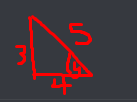 willow bear
ok, wait
young ridge
did i do it right
young ridge
oh i need to make a triangle for x?
willow bear
i mean duh how else are you gonna find cos(x) given sin(x)
you're gonna need a triangle for x too
willow bear
please don't call me annalicious
prisma marten

young ridge
sorry
shrewd urchin
How can I find $\vector{A}-\vector{B}$ when the direction are not given just magnitude
obsidian monolithBOT
Krishna (An average mathy):
Compile Error! Click the reaction for details. (You may edit your message)
shrewd urchin
I think the answer is -1m
Because I think it's the only value that difference of vectors A and vectors B can attain.
pale kettle
Can the magnitude of a vector be -1?
shrewd urchin
Let me think
If the vectors were parallel then the magnitude will be 1 and if they were anti parallel then 7.
pale kettle
That's true
pale kettle
yes
 brave topaz
@exotic tide remember that vectors don't have to just be parallel (0 degree difference in vector angle) or anti-parallel (180 degree difference in vector angle). Also remember that the difference vector connects the end points of the two vectors being subtracted from each other, forming a certain geometric shape. Try visualizing the A and B vectors connected to a single origin point, and visualize them parallel, anti-parallel, perpendicular, and all sorts of angles in between, and think about what that means about the possible values of the difference vector's magnitude. You have already found two values, so see if this visualization helps you find any others
shrewd urchin
So the difference of the vectors can take on any value between 1 and 7 inclusive
brave topaz
Yes! Nice job! Now what other answer choice/choices does that lead you to pick?
rugged ice
A hot-air balloon is moving on a bearing of 291 degrees at 47mph. A wind is blowing with the bearing of 271 degrees at 14mph. Find the component form of the velocity of the balloon.
I don't know how to find velocity with a shift, can someone help?
Oh, I just add the value of the wind to the plane.
Alright, never mind
rugged ice
I have no idea what this is asking
 forest canopy
isn't it the distance between the 2 points ?
 charred hull
it's asking you to find the magnitude of the vector $\vec{GF}$, which would just be distance formula here essentially
obsidian monolithBOT
çölórôdòrōdõ brøwn stæìn:
Compile Error! Click the reaction for details. (You may edit your message)
shrewd urchin
U are asked to find the magnitude of the vector
What are the direction cosines good for ?
in physics
$\cap{i}$
obsidian monolithBOT
Krishna (An average mathy):
shrewd urchin
how do i denote a unit vector using latex
willow bear
$\hat{i}$
obsidian monolithBOT
Ann:
willow bear
$\hat{\imath}, \hat{\jmath}, \hat{k}$
obsidian monolithBOT
Ann:
willow bear
\imath and \jmath give you i and j but without the dot
shrewd urchin
Ok
$\overrightarrowhead{a}=acos(\alpha)\hat{\i]+acos(\gamma)\hat{\j}+acos(\phi)\hat{\k}$
whats wrong ?

obsidian monolithBOT
Krishna (An average mathy):
Compile Error! Click the reaction for details. (You may edit your message)

 shrewd urchin
lol
obsidian monolithBOT
BewareillEatYou:
shrewd urchin

 knotty spear

shrewd urchin
Tank u
 hard hornet

 hushed ember
ok let me send in the questions
hushed ember
oh the question is
find the value of a b and c for the following polynomials using appropriate methods.
hard hornet
question b first?
hushed ember
yeah
hard hornet
what topic of math are you doing right now?
hushed ember
polynomials
hard hornet
it looks like questions that ask you to compare terms from both sides
$a(x-2) + b(x+3) = 5$
obsidian monolithBOT
MemesPlease:
hard hornet
do we have to figure out x too?
hushed ember
it only says find the value of a b and c
hard hornet
o actually doesnt matter
hushed ember
im just confused what to do because theres only 5 on the other side
hushed ember
oh its not a equal sign its the three bar sign
hard hornet
but im just going to assume it's going to ask you to compare terms on both sides
so first question
i would recommend distributing everything, and comparing terms
let me know what you get when you distribute everything
im too lazy to look at your work LOL
obsidian monolithBOT
woa:
hard hornet
correct
and now, we are going to do some comparing
on the left side, you can see that there are x terms, but on the right side, there are NO x terms
so
hushed ember
yeah
hard hornet
what is the first equation you can set up
its all about figuring out what is equal, based on what terms you have
hushed ember
i have no clue
hard hornet
ill start the first equatoin for you
ax + bx = 0
why is this true you ask?
because the right hand side has no x terms
hushed ember
oh because no x values
hard hornet
thus
hushed ember
ahhh
hard hornet
any x values in the left must be equal to any x values in the right
now set up the second equation
hushed ember
3b-2a=5?
hard hornet
correct
by finding the right values for (a,b), any x value, and i mean LITERALLY any x value would work with (a,b)
hushed ember
ohh do i do substition now
hard hornet
substitution, combination, whatever method you're most comfortable solving systems
Check your answer at your own discretion: ||(-1,1)||
hushed ember
ok is it ax+(5x+2ax/3x)=0
hard hornet
actually
hushed ember
i mean 3ax+5x over 3x =0
hard hornet
u know in the equation ax+bx = 0
hard hornet
you can actually ignore the x's, and only take care of the coefficients
so you really get
a + b = 0
because we know the x terms have to be equal to the x terms
so we can take their coefficients
its like saying 100y + 1245246y = 200y, we dont relaly care what the y value is
we only care about the coefficients
tho please ignore that equation above, its complete nonsense