#precalculus
1 messages · Page 133 of 1
 patent beacon
 main ledge
tyvm
 thick raptor
yw
patent beacon
You'd have less steps like so:
ln(2) - 0.5ln(2⁴)
ln(2) - 2ln(2)
-ln(2)
 distant flume
I got 0 as a result, fair enough
thick raptor
Definitely not 0
distant flume
If I have (1/t+1/sqrt(t))(sqrt(t+1)-1) With Lim of 0, I rationalize the last part so that I can then divide 1/t+1/sqrt(t) by (sqrt(t+1)+1)/t. I then multiply t and 1/t+1/sqrt(t), which if I put the limit, it gives me 0; the denominator is sqrt(t+1)+1 aka 2
If you can, tell me what I didn wrong please
distant flume
(sqrt(t+1)+1)*(sqrt(t+1)-1)
I am using (sqrt(t+1)+1)/(sqrt(t+1)+1) to rationalize (sqrt(t+1)-1)
I don't get where I got the mistake
thick raptor
Okay, so you have this:
$$\left(\frac1t+\frac1{\sqrt t}\right)\frac{(\sqrt{t+1}-1)(\sqrt{t+1}+1)}{\sqrt{t+1}+1}$$
 obsidian monolithBOT
Simple_Art:
distant flume
Yup
thick raptor
So what does the numerator become?
distant flume
Everything except for sqrt(t+1)+1
Oh you mean that I have to multiply all the denominators together
obsidian monolithBOT
Simple_Art:
thick raptor
Okay so what's sqrt(t+1)+1 approach?
distant flume
2?
If t gets close to 0 then sqrt(1)=1 which means 1+1=2
And that's the denominator part
distant flume
You have 0/2 on the last part though, and given that the first part has infinite, I don't know
I think that the logical answer would be infinite since the first part approaches infinite faster than the second part, given how we can simplify the first part to (t+sqrt(t))/(tsqrt(t)) and we multiply that by t/2, getting (t^2+t)/(2t(sqrt(t))
This problem isn't supposed to be hard man
@thick raptor I give up
 cursive cave
@distant flume there?
distant flume
I'll read
obsidian monolithBOT
Simple_Art:
thick raptor
$\frac1t\times t=~?$\$\frac1{\sqrt t}\times t=~?$
obsidian monolithBOT
Simple_Art:
thick raptor
@distant flume
distant flume
But why was the denominator of the second part 1 instead of 2, as I said before?
 waxen ruin
It's been almost 4 years since I took calculus and longer since I had trig/algebra, is this a good place to ask for help? I'm starting a calc class this semester since I want to be better at it for my cs degree and this is just review stuff that I have trouble with, should it go in a different channel?|
https://i.imgur.com/0KbwLtP.png
https://i.imgur.com/aQkcsec.png
https://i.imgur.com/dWHcon2.png
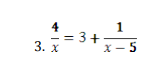
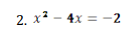
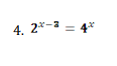 patent beacon
@waxen ruin. Nah, can do here. You just want to solve these for x?
For 3, you want to clear the denominators. Just multiply everything by x(x - 5)
waxen ruin
Ooooooooohhhhhh yeahhhhh, I remember that now. Thanks a bunch! @patent beacon I figured out the other ones too
 potent viper
o ty
i still dont get it
for the first one right
i' d get like log2M^6+log2N^3
@patent beacon
 hexed ermine
Oh Kaynex is helping you lel
potent viper
wait
THATS IT
damn the properties thing rlly helps
oh theres another thing
i cannot like understand no matter what
this
like i'd get to the part where you do the 1/2+ 1/4 over and over again
i think this is the answer but i dont understand
how it gets to that
waikt nvm
but um
when it gets to this part, is there a way to get them faster, or the only way is by looking at the pattern
 spiral vale
Hey guys I have been having trouble solving this problem, could anyone help me? Thanks
Part b
 sharp pagoda
Anyone care to help sketch this word problem?
I missed a few classes while I was gone for vacation and I regret it haha
 shrewd flame
I hated log
distant flume
@sharp pagoda positive Cosine function with distance of 12 seconds between periods
You can work out the function on your own I suppose
Negative Cosine function, sorry
 formal fable
Yo quick question because I'm dead tired and am not figuring this out
If I have a function of time and the unit of my time is, say, months
How do I convert that to weeks
Ie my function is $2\cdot3^{n-1}$ for n amount of months
obsidian monolithBOT
LikeALol:
formal fable
Of course
 earnest nymph
No, it's actually n/4 - 1
formal fable
4 years in uni and I don't realise this shit
Thanks
earnest nymph
👍
 sweet wind
Heeey guys, does the straight line equation go here? I don't know if that's what it's called in english
patent beacon
y = mx + b? Linear equations
sweet wind
Yeaaah but i have learned its like y = kx + m
patent beacon
Just labels. Same thing
sweet wind
I feel like a complete fool but im a first year sicence student and im desperate
Yeah okay
I need help with a problem
patent beacon
y = qx + λ
sweet wind
a:”the rectangle can be puzzled together by the parts to the right. Solve how many pieces of each you need” and b:”Prove that it’s impossible to make a chessboard out of these pieces” there are 77 squares. 39 Black and 38 white.
 gritty blaze
,rotate left pi/2
 native sequoia
,rotate 180
obsidian monolithBOT
 craggy burrow
^what?
 spice wadi
please stop spamming channels
 vernal lantern
Does anyone know what is included in the precalc cirriculum?
 rocky bison
precalc mostly
 limber bone
 viscid thistle
=tex \Re
 granite stirrupBOT
Command disabled
The sever owner has disabled that command in this location.
viscid thistle
It cost a bus company $225 to run a minibus on a ski trip, plus 30$ per passenger. The bus has seating for 22 passengers, and the company charges $60 per fare if the bus is full. For each empty seat, the company has to increase the ticket price by $5. How many seats should the bus run with maximize profit from this trip?
how do i solve this
obsidian monolithBOT
cix:
 compact galleon
Cos(-x)/1+Sin(-x) = Sec(x)+Tan(x) Proof Got left side to Cos(x)/(1-Sin(x)) and right to (1+Sin(x))/Cos(x)
Don’t know where to go
 swift glacier
Have you tried seperating the fraction on the left?
compact galleon
In what way?
obsidian monolithBOT
Autistic Hoodie:
 slow wharf
I would assume?
 flint lichen
Would someone be willing to help me out with this? I’ve tried solving it my self but haven’t gotten anything close to what the answer is. I’ve also tried mixing up the numbers to make sure I didn’t flub something but nothing matches any of the answer choices.
flint lichen
(Just specifying what I tried doing) For #1 I tried using 58cos/sin(14) and
196cos/sin (270). I then added the vector points together and used inverse tan to find the angle. However this gave me something like -63.
flint lichen
I’m sorry I don’t quite understand.
If you mean like vector point 1 is <a,b> and vector point 2 is <c,d> and add c and a along with d and b that’s what I did
flint lichen
<@&286206848099549185>
 static vapor
@flint lichen yes
but for the diagonal vectors you need to use trig to separate the vectors
flint lichen
@static vapor sorry phone ran out of charge so I didn’t get the notification so like 196cos(270) and 196sin(270) ? Or do you mean something else and I just don’t understand
flint lichen
I did that sorry I did cos/sin because I got lazy totally backfired and wasted even more of yours and my time. It says it comes due south which is 270 on the unit circle
I’m fairly certain I also tried it with 90 degrees and just got a negative value instead of a positive one on the vertical component
I’ll try again though
Yeah just a positive value
I tried doing the problem again and ended up with 273 (well -87 but I added 360) the same I got before. I have no clue what I’m doing wrong
 clever inlet
some say it's necessary, other's say not
viscid thistle
Depends on what you already know
clever inlet
^
viscid thistle
If you know how to work with functions, took a class on trigonometry and did some analytic geometry, you're basically set already.
static vapor
@flint lichen sorry for the VERY LATE response i went to sleep
notice how angles D and E are given?
you will have to form a vector "triangle" using this
and use trig
ive done a triangle for vector a for you
all you need to do is fill in the numbers whip out ur calculator and use some trig
remember that EVERY VECTOR is made up of a horizontal and vertical component
and thus a right angle triangle can ALWAYS be formed
because horizontal is PERPENDICULAR to vertical
hence a RIGHT ANGLE is formed
and theres 3 vectors so its a triangle (horizontal, vertical and resultant technically theres only 1 actual vector but i hope you get my point)
I got C as my answer
You need to:
Separate Vectors
Add Vectors
Use Pythagoras (for vector size)
Use arctan (for the angle)
 buoyant ore
for this problem, would i need to use this formula?
 trim coyote
https://gyazo.com/9d82ad1d3e1d1830b48e9494309f10a4
can someone explain how you'd write a function for this?

I'm seriously too lost

 strange prism
Bruh
obsidian monolithBOT
Autistic Hoodie:
patent beacon
What do you mean "do"?
slow wharf
How do you solve for y...
patent beacon
No chance. Won't happen for this function
slow wharf
Really?
How am I supposed to graph it
Actually
I am supposed to get the function for the tangent and normal of the function...
At a certain point
Hm
Hmm
patent beacon
That's a good question, what are you supposed to do with it?
patent beacon
That's much easier, but it needs implicit differentiaton
slow wharf
What about this
I solve for x
So it is an inverse function
I find the tangent function for the inverse function
and I inverse the tangent function
viscid thistle
Someone answer this question

cause it makes me want to punch my fucking computer screen
patent beacon
No, you're going to want to apply implicit differentiaton
It's easy if you know how
viscid thistle
?
These questions are so boring I can't concentrate
My mind repels against it
so can you answer it for me
ah I'll take it some where else
obsidian monolithBOT
Autistic Hoodie:
swift glacier
if two vectors are parrellel, then the dot product would be one, right?
strange prism
i wonder if its possible to get an A in precalaus
 limber compass
Guys i think this is precalclulas

What you need to know about gradient functionsto achieve in NCEA Maths L2 Calculus. For other videos and resources please visit http://www.learncoach.co.nz
Can someone frking explain thsi too me
i dont understand it
and veererererrey new to calc
--
the guy says :
find the steepest point sloping upwards. What does he mean? by sloping upwards
and what is a gradient function ?
static vapor
the most "straight" like close to vertical point
where the graph is moving up
so from left to right
the graph is increasing
static vapor
its precalc i doubt he knows what the derivative is
i think this is more of the start of calc so i think it would be better to describe it graphically
and doesnt second derivative =0 just mean possible point of inflexion?
it should be second derivative >0
@limber compass
 thick kayak
limber compass
thick kayak
limber compass
@static vapor thnx dude 🙂
 prime prawn
"You intercepted the following cryptogram and have intel suffesting it was encoded with a 2x2 matrix."
8 21 -15 -10 -13 -13 5 10 5 25 5 19 -1 6 20 40 -18 -18 1 16
The last word of the message is _RON. What is the message?
How do i do this problem, all I have done is transformed the series of numbers into a matrix w/ 2 columns, and converted _RON --> 0 18 15 14
the letters follow the alphabet, and _ is 0.
it's part of the matrix intro in our precalc book.
<@&286206848099549185>
prime prawn
I'd be really grateful if anyone could help me, ping me or DM me please. thanks
 rare zephyr
No. 8
Topic is Quadratic Equations
I need help on "translating" it into a quadratic equation
<@&286206848099549185>
 fallen cloud
!15m
 spring thunder
rekt
viscid thistle
his speed increases by 5 km/h
then the time he needs decreases by 15 minutes
which is also 1/4 of an hour
so if his speed increases by 5km/h then he needs 25% less time to get there
spring thunder
1/4 h less doesn't mean -25% tho
viscid thistle
but it should in this case 
because if his new speed is 20km/h then he needs 0.75h (=45 min) to get to the post office
so it fits the -15 min part
spring thunder
how do you know it takes him 1h originally?
viscid thistle
its based on the assumption that if he increases his speed by 5km/h then the time decreases by 15min
and given that an hour has 60 minutes
the time decreases by 1/4
when the speed increases by 5
 viscid thistle
what did you have in mind @spring thunder
spring thunder
actually doing quadratic equations lel
rocky bison

viscid thistle
but i don’t know how i would make it quadratic
spring thunder
we know distance = speed*time
so if we apply this to the two situations we get
$$\begin{cases}15=vt \ 15=(v+5)(t-\frac14)\end{cases}$$
obsidian monolithBOT
emeric75:
spring thunder
(v and t being the original speed and time taken)
viscid thistle
yea that’s what i had as well
spring thunder
$$\text{ie }\begin{cases}\frac{15}{v}=t \ 15=(v+5)(t-\frac14)\end{cases}$$
obsidian monolithBOT
emeric75:
spring thunder
substitute and expand
viscid thistle
i see
viscid thistle
Regarding the ambiguous case, my text book says if a<b there are zero triangles, h < a < b there are two, and if a> b there are one
But for a>b
Can’t there be two possibilities? If a is long enough it could stretch over b and form a narrow triangle
Not a right triangle tho
So really only a = b has one because it’s either line or triangle
 odd yarrow
15 = tv = (v + 5)(t - 0.25)
tv = vt + 5t - 0.25v - 1.25
tv = t(v + 5) - 0.25(v - 5)
t(v+5) - 0.25(v - 5) = (v+5)(t-0.25)
= 15
idk I'm in high school Geometry I shouldn't even be posting in this channel :/
static vapor
@viscid thistle for sine rule?
its not really related to length
its more like angle sum
so say u had a triangle
35 degrees is the given angle
youre given 2 sides
you get a result of say 20 degrees
but because of the ambiguos case it could be 160 or 20
but it cant be 160
because 160+30 is =190>180
larger than the max angle sum of triangle
35*
but say if the result was something like 36 degrees
then you get either 36 OR 144
and 144+35 = 179
which is less than 180
so if you get a result
where a 3rd angle exists
i.e its "degrees/angle" is more than zero
viscid thistle
Can someone post a problem you were given in your Pre-calc. class. I just want to know what it looks like
 open star
viscid thistle
open star
viscid thistle
,rotate 270
obsidian monolithBOT
viscid thistle
How do you solve these nested rectangle problems?
well you know the area inside is 35cm²
,$ 35 = a*b \ a = 7-2x \ b = 9-2x
obsidian monolithBOT
yami:
 viscid thistle
What if it’s? A cube
so you know that V = 128cm³
they wrote cm² but thats a typo
the height of the thing is 2cm, so you can divide the volume by 2 to get the area of the square
do you know how to get the rest
also its not a cube because the height would have to be like 3 or 4 times of what it is
w*l = 128/2
And to find w * l
That’s the part I’m asking abt
well you have a square so W = L
ohhh
but what if a rectangle
then you have to do the thing you asked above
Okay

Thanks
so what do you get for the length of the cardboard thats needed
or size, whatever
viscid thistle
Why is log base-10^-1000 undefined? Shouldnt the answer be 3 since -10^3 = -1000.
<@&286206848099549185>
 sullen shoal
 polar lodge
You can't because of how logarithm function is defined.
viscid thistle
Fair enough
just was curious what the motivation was for defining the log function that way
Also, does the notation "a sub n" denote a series or a sequence? Or is it ambigous?
@polar lodge
polar lodge

The history of logarithms is the story of a correspondence (in modern terms, a group isomorphism) between multiplication on the positive real numbers and addition on the real number line that was formalized in seventeenth century Europe and was widely used to simplify calcula...
But, most of the maths they discuss will probably be out of scope for you depending on your mathematical background.
@viscid thistle, it depends on where it's used so, it's contextual.
viscid thistle
So in the case of "the limit as n approaches infinity, of a sub n, equals 8"
Does the context of the limit clarify it or is it still ambigous?
polar lodge
Well, you ask yourself then where does limit work on?
viscid thistle
In my mind I could concieve of it two ways. The limit is the value the sum of all the terms is approaching (series), or the limit could be the value of the nth term (sequence)
polar lodge
So, here, a_n can be either sequence or function whichever terms the writer uses.
If it's series it will likely have summation symbol but again, it depends on the pre-assumption before u see that.
 prisma scroll
t!remindme breakfast in 30 minutes
 brisk micaBOT
⏰ | Got it! I'll remind you in 30 minutes!
viscid thistle
That makes a lot of sense. Thanks! @polar lodge
 knotty garden
Hi there. Looking for some help with a logarithmic equation question, can i ask here?
 knotty garden
I tried to use the latex formatting but I dont think it fully worked
$\frac{1}{log_y(4)}=log_\frac{1}{4}\frac{1}{8x}$
obsidian monolithBOT
peterdorvay:
knotty garden
oh it worked! awesome. So I'm trying to express y as a polynomial
what would be a good way to approach this? change of base? I'm lost.
knotty garden
ooh im getting closer
 royal gull
1/log_y(4) = log_4(y)
and then try to have same base rhs and lhs?
yeah
y=8x
@knotty garden you got it?
knotty garden
hmmm i got y=2x
let me put everything i did down and maybe someone could show me what I did wrong
$\log(y) = log(4) log_\frac{1}{4}(\frac{1}{8x})$
$\log(y) = log(4) \frac{log(\frac{1}{8x})}{log(\frac{1}{4})}$
$\y=4\frac{\frac{1}{8x}}{\frac{1}{4}}$
obsidian monolithBOT
peterdorvay:
Compile Error! Click the  reaction for details. (You may edit your message)
knotty garden
ok so this is what i did
the bottom line should have y= but im not sure how this bot works
and after evaluating it I get 2x. But I think 8x is the correct answer @royal gull
royal gull
@knotty garden the way I did it: 1/log_y(4) is just log_4(y) (y is the base)
then you change RHS to be a log in base 4
RHS after changing the base is - log_4(1/8x) = log_4(8x)
so you have the same logs on both sides with constant base, so you just need to compare the things inside
getting y=8x
at least that's what I got
and you cant just multiply the things inside the logs like you did
log(a) * log(b) =/= log(ab)
knotty garden
yeah i just tried getting them all log base 10
knotty garden
yes ok ill try that now
when you change the base you do log_1/4(1/8x) = log_4(1/8x) / log_4(1/4) right?
like the change of base formula.. log_a(b) = log_c(b) / log_c(a)
because doing this i got y=0.5x 😦
royal gull
umm yeah, you get that fraction
but log_4(1/4) is just -1
so its -1 * log_4(1/8x) = log_4(8x) (because you take -1 into the log and you get (1/8x)^-1 )

 eternal lotus
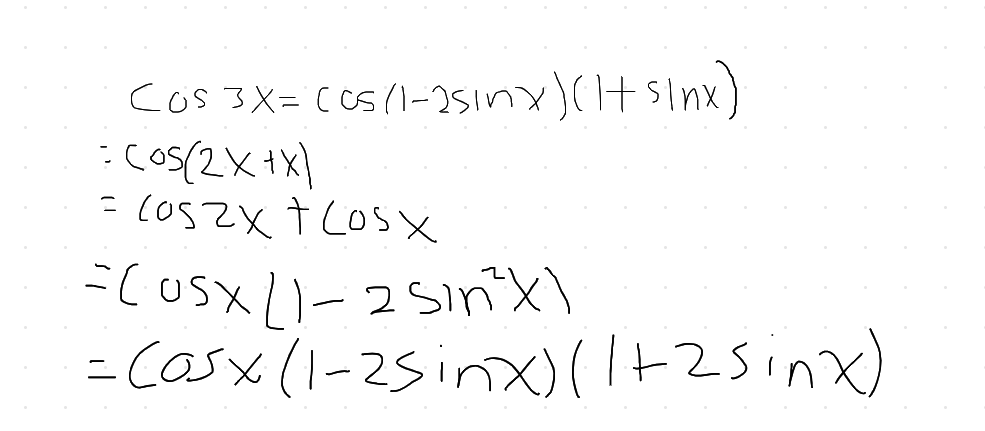
$cos(2x+x) \ne cos(2x)+cos(x)$
obsidian monolithBOT
stephen:
eternal lotus
Instead use the additional formula: $cos(a+b)=cos(a)cos(b)-sin(a)sin(b)$
obsidian monolithBOT
stephen:
 eternal lotus
What exactly are we trying to prove here?
$cos(3x)=cos(x)(1-2sin(x))(1+2sin(x))$ \
or $cos(3x)=cos(x)(1-2sin(x))(1+sin(x))$
obsidian monolithBOT
stephen:
eternal lotus
Also the picture you just sent, you forgot to multiply the cos(2x) and cos(x)
 steady cove
In this question I've been asked to find the rate of change in this function
How do I find the rate of change?
patent beacon
The rate of change is the slope of the tangent line. The derivative gives those
patent beacon
dy/dt means the derivative of y in terms of t
steady cove
Ok
patent beacon
So they want you to find dy/dt with the derivative
steady cove
So I just do first differentiation then plug in the t value?
patent beacon
No t value necessary, dy/dt is just the function from differentiaton
patent beacon
You'll want to curve your t's, mistaking that for a + is inevitable!
That derivative looks right
steady cove
Same question but now I'm trying to find the max temparture
Is 15 the max temparture?
shrewd flame
@eternal lotus it's cos3x=cosx (1-2sinx)(1+2sinx)
eternal lotus
$cos(3x)=cos(x)[1-2sin(x)][1+2sin(x)]$ \
LHS: $cos(3x)=cos(2x)cos(x)-sin(2x)sin(x)$ \
$cos(3x)=[1-2sin^2(x)] \cdot cos(x) - 2sin(x)cos(x) \cdot sin(x)$ \
obsidian monolithBOT
stephen:
eternal lotus
@shrewd flame Can you continue from here?
 vast star
Alright, third time posting this, but it seems like I can't get an answer for this.
I just can't find how to perform it.
viscid thistle
I mean. You said it - the thing is already symmetric
vast star
Ugh, I meant elementary symmetric polynomials.
vast star
I did.
viscid thistle
It's that easy
vast star
It isn't.
viscid thistle
The expansion is elementary lmao
viscid thistle
Check if you don't believe me
vast star
I did.
Still sure this is elementary?
I'm pretty sure it isn't.
Unless your definition is different.
viscid thistle
Nah I goofed
vast star
No problems.
I just want an answer, this was supposed to be so simple. .-.
Yet neither I can do it nor I can get an answer.
viscid thistle
Woah woah woah
Hold up a Dusseldorfing minute
(a-b)(b-c)(c-a) = (a-b)(bc-c^2-ab+ca)
= abc-ac^2-a^2b+ca^2-b^2c+bc^2+ab^2-abc
Check the terms
 warm nebula
Easier way is just to expand all 3 at once
vast star
I did.
viscid thistle
And what do you get?
vast star
They aren't elementary and cannot be factored into elementary factors.
Thing is, you don't have to factorise.
warm nebula
Factor what question
vast star
Like, I suppose you know the identity,
a^3 + b^3 + c^3 = (a + b + c)^3 - 3(a + b + c)(ab + bc + ac) + 3abc
It'll be something like this, won't be factored but rewritten.
viscid thistle
Ye it's made with the ring of symmetric polynomials of n-variables
vast star
And since its square is well known, although a lot more messy, I'd thought this would be easy to rewrite.
viscid thistle
Might be easier to attack from the factors
For instance how would you write "a-b" in terms of elementary symmetric polynomials?
vast star
Well, good idea, it can definetly help to start from simpler things.
 flat turret
Guys tf are you even doing
flat turret
You can't write a non-symmetric polynomial in terms of symmetric polynomials
a-b change variables b-a
it's not equal
viscid thistle
ab(b-a)
flat turret
Kek it happens
vast star
Happens a lot more often when you are me.
:)
Since I managed to get some of you here,

Would you like to take a look at this one?
The first line tries to say a, b and c are in the interval [0, 2pi).
flat turret
Everything is symmetric and the product says cos(x+y)=-1 for some x, y among A, B, C
So we can WLOG assume cos(A+B)=-1
which means A+B is an odd multiple of pi
which means $3(A+B)=n\pi$ for some odd n
obsidian monolithBOT
Gonzo17:
flat turret
so $\cos 3A=\cos (n\pi -3B)=\cos (\pi-3B)=\cos (3B-\pi)=-\cos (3B)$
obsidian monolithBOT
Gonzo17:
flat turret
from parity of cos and the fact that $\cos(x-\pi)=-\cos x$
obsidian monolithBOT
Gonzo17:
flat turret
Wait but if $(A, B, C)=(0, \pi, \frac{\pi}{2})$ it doesn't work I think
obsidian monolithBOT
Gonzo17:
flat turret
$\cos 3A+\cos 3B+\cos 3C=1+(-1)+0=0=12\cdot 1\cdot (-1)\cdot 0=12\cos A\cos B\cos C$
obsidian monolithBOT
Gonzo17:
flat turret
and $\cos (A+B)+1=\cos (\pi)+1=-1+1=0$
obsidian monolithBOT
Gonzo17:
vast star
Don't the equations still hold?
obsidian monolithBOT
Gonzo17:
vast star
Hm-hm.
shrewd flame
how does cos3x become cos2xcosx? @eternal lotus
 obsidian monolithBOT
Colen:
rocky bison
but what if x = 0  @elfin night

 slender river
smgh
simplify cos3x to cos(2x+x) then do a sum simplification and then some double angle stuff
idk
ok lol idk the context so ignore me maybe?
 elfin night
Idk the Q but still gonna give my opinion that SA should get the biggest  available
gritty blaze
Baduk ?
elfin night
 just say go you pleb
gritty blaze
Weiqi ?
elfin night

eternal lotus
@shrewd flame
obsidian monolithBOT
stephen:
viscid thistle
hello i need some guidance pls
 shell salmon
For first one, use trig ratios to get horizontal distance between b and c
For second one, use triangle area formula to find the perpendicular line length, then trig ratios to find x
For the third one, you can create a triangle with a leg through c, perpendicular to ad. Use lengths and trig ratios to find d
viscid thistle
Review for exam not worth marks,,, how do I do this question
 tawny nacelle
=pup maximize x(150 - 3x/2) fro x > 0
tawny nacelle
so the maximum area is 3750
 serene heath
set up variables and 2 equations
tawny nacelle
oh he asked HOW to do the question
odd yarrow
what kind of trigonometry would go here as opposed to #geometry-and-trigonometry?
rocky bison
What u confuse about with integral
odd yarrow
the concept of it as opposed to derivates/differentiation
rocky bison
You know how derivatives work and such?
rocky bison
Well integration is the opposite to that
So
,$ \int\left(\frac{d}{dx}f(x)\right)dx=f(x)
obsidian monolithBOT
Pseudo:
odd yarrow
thats the notation for integrals?
obsidian monolithBOT
Pseudo:
odd yarrow
o
rocky bison
,$ \int f(x) dx
obsidian monolithBOT
Pseudo:
rocky bison
Is the integral of f(x) with respect to x
Integration of polynomials is pretty ez
like derivs
rocky bison
,$ \int\left(x^n\right)dx=\frac{x^{n+1}}{n+1}+C\n\neq-1
obsidian monolithBOT
Pseudo:
obsidian monolithBOT
Pseudo:
obsidian monolithBOT
Pseudo:
 frozen needle
ouch
rocky bison
wot
frozen needle
not an equivalence relation
rocky bison
huh?
frozen needle
,$ f(x)=x^3\implies f'(x)=3x^2
obsidian monolithBOT
Tuong:
rocky bison

frozen needle
but no iff
rocky bison
PEDANTIC
rocky bison
d/dx(f(x))
odd yarrow
yeah
elfin night
Pedantry, my favourite
 stuck palm
So all I do is literally plug the f(x) function which is 2 and just square it in that bracket for this example? No other steps in this instance?
patent beacon
Formally,
lim [f(x)]²
= [lim f(x)]²
= [2]² = 4
stuck palm
Sweet, that's exactly how I did it. Lol the 1 and 0 functions are just in there to confuse people... smh
patent beacon
Indeed, they don't seem related. Are they part of another question?
patent beacon
Np! Feel free to ask if you have anything else
stuck palm
Thanks will do! 😃
 rotund surge
tanx-secx=-1, solve by squaring both sides
patent beacon
Okay. Have you squared both sides?
rotund surge
yes, and i have tan^2x+sec^2x-2tanxsecx=-1
patent beacon
Should be +1 on the right
patent beacon
Hmm. Let me suggest doing this instead
tan(x) = sec(x) - 1
rotund surge
yeah
patent beacon
Then square that
tan²(x) = sec²(x) + 1 - 2sec(x)
rotund surge
and tan^2(x)+sec^2(x)=1?
patent beacon
No, tan²(x) + 1 = sec²(x)
patent beacon
So you could write
tan²(x) = sec²(x) + 1 - 2sec(x)
tan²(x) + 1 = sec²(x) + 2 - 2sec(x)
sec²(x) = sec²(x) + 2 - 2sec(x)
0 = 2 - 2sec(x)
My phone has some exponents on it
rotund surge
ah
patent beacon
And thus
sec(x) = 1
cos(x) = 1
x = 0 + 2kπ
stuck palm
So on this graph for problem g) what would the answer be since there is a point on both sides of that? Would it be 1,-1 or undefined? So confused about that
patent beacon
Undefined. The limit does not exist there.
Remember, the limit only exists if the left and right limits agree
stuck palm
They would both have to be either open or closed circles? Not one or the other?
rotund surge
how do i set it so that wolfram alpha gives me 0-2pi
stuck palm
Wait so how would I know on that problem if the left and right limits agree?
patent beacon
The left limit at x = 2 is -1
The right limit at x = 2 is 1
stuck palm
So just to be clear there can't be 2 limits on the same spot of the x axis?
patent beacon
Since the left limit and the right limit are not the same, the total limit does not exist
patent beacon
A limit to infinity is technically undefined, but your teacher probably expects you to put infinity
stuck palm
Gotcha I will do infinity/undefined just to be safe. Thanks
stuck palm
I got one more for you, I have no idea where to even start on this problem. The entire thing is confusing me
stuck palm
@patent beacon Just whenever you have time, no rush
patent beacon
Oh boy ε-δ definitions
 rocky girder
Pls help with 42
stuck palm
Like I am so screwed
patent beacon
@stuck palm
The ε-δ definition is the rigourous definition of the limit.
Imagine we're playing a game. We start with where the limit is, and we want to build a rectangle around the limit point such that the function is contained inside the rectangle.
I start by giving you a height. Call it ε.
I want you to give me back a length, δ.
Use this length and height to create a rectangle with a center on the limit point. If the function leaves the top or bottom of the rectangle, you "lose". If you can contain the function with appropriate choice of δ, you "win".
If you can always win, no matter what ε I give you, then you've proven the limit. If there's a case where you can't win, then the limit must be false.
viscid thistle
help help help
patent beacon
There's definitely a lot there, this isn't the easiest concept
stuck palm
@patent beacon See I understand the concept, it's just the functions and finding out what point they want me to write down for epsilon, delta, b & C
patent beacon
From that picture
ε = 0. 05
f(b) = 2 - 0.05
f(c) = 2 + 0.05
stuck palm
Epsilon makes sense to me, but how did you come up with B & C?
patent beacon
You can see it on the picture. b, when drawn up to the function, has a height 2 - 0.05
f(b) = 2 - 0.05
stuck palm
So that's what the answers would be for B & C? Since anything between those 2 points is epsilon?
patent beacon
I don't know about that, but from the picture, f(b) = 2 - 0.05
This is enough to find both b and c
Then, δ is the shortest distance necessary to bound the function within ε. In this case, that's a - b
stuck palm
Then so how would you go about finding B and C based on the 2+- 0.05?
patent beacon
If you start at x = b, then draw up to the function, then you go to a height y = 2 - 0.05
Ergo, f(b) = 2 - 0.05
stuck palm
Oh I see!
shrewd flame
Question: Modelling Exponential Growh and Decay Problems.
- In 1985, there were 285 cell phone subscribers in the small town of Centerville. The number of subscribers increased by 75% per year after 1985. How many cell phone subscribers were in Centerville in 1994?
My question is, how does 75% become 1.75??
shrewd flame
but why 1.75?
patent beacon
Or, you can think about adding 75% on.
That is, increasing x by 75 is the same as doing x + 0.75x
stuck palm
@patent beacon Btw if you scroll up to my message where I sent the last picture. That definition sucks 😂
stuck palm
The definition they gave me on my problem lol yeah the delta epsilon definition. Could be so much easier to explain like you did
viscid thistle
I dont know what to do next though
thick raptor
Don't advertise your questions in other channels. #❓how-to-get-help for rulez.
viscid thistle
Sorry
patent beacon
You'll need tan(π) = 0
patent beacon
Know your unit circle, of course
stuck palm
So I basically squared my epsilon’s since y = square root of X. Do these figures I put on the right look accurate? @patent beacon
obsidian monolithBOT
Result:
3.8025
Sweet! So everything else seems fine apart from that? (I changed it)
patent beacon
,calc 3.8025 - 4
obsidian monolithBOT
Result:
-0.1975
Everything looks good!
stuck palm
Yesss I am so glad I am getting the hang of this. Would mean absolutely everything if I can get an A in Calculus.
patent beacon
Definitely worth going for. Anything else bugging you?
stuck palm
That's everything 😃 I'm sure my professor will assign more difficult problems this week. I got him tomorrow morning and Thursday morning. I'll let you know later this week if I need help! Thanks! 😃
viscid thistle
x^0 (the constant) controls the point at which the polynomial starts (y-intercept), x controls the slope at y-intercept, what about x^2 and higher degree terms, what do they control in a polynomial?
 deft flume
I need help with finding the exact solution of this equation 8sinxcosx=1 I set the equation to 0 and got stuck Any help would be appreciated.
deft flume
oh okay
thanks, i will try to evaluate it further
wait @patent beacon , wouldn't it make sense to not convert the sinxcosx into sin2x?
patent beacon
4 sin(2x) = 1
sin(2x) = 1/4
2x = sin¯¹(1/4)
x = 1/2 sin¯¹(1/4)
If you can make your equation have only one x in it, you can always solve for that x
deft flume
for the inverse sine, how exactly do you approach that
patent beacon
Take the inverse sin of both sides
You can use a calculator to get it
If you want. The above is an answer as well
patent beacon
Not "times" there's no multiplication there
deft flume
that's what im confused about
patent beacon
sin is a function. It takes a number as an input and gives a different number back as an output
As well, there's sin¯¹ which is another function, that does sin in reverse
If
y = sin(x)
Then
sin¯¹(y) = x
viscid thistle
What is the difference between cos^2(pi) and cos(pi)^2
Same thing
@viscid thistle
Just different way to write
Hmm
ok so cos(pi)=-1
cos^2(pi)= -1^2= 1?
@viscid thistle
cos(pi)=-1 indeed
cos^2(pi)=cos(pi) * cos(pi)
-1 * -1 = 1
confirm
@viscid thistle
=pup cos^2(pi)
viscid thistle
OK got it! Thanks man 😃
Just a confusion of the notation
so
x^2 = x * x
cos^2 = cos * cos
@viscid thistle
just remember that
Got it, that is intutive
Thank you for the hlep
swift glacier
How would you find a vector that is parallel to a given vector?
rocky bison

viscid thistle
whats the problem
rocky bison
Parallel
viscid thistle
if <-1,-1,-1> is a vector
rocky bison

viscid thistle
<1,1,1> is parallel
swift glacier
Like, is there a particular formula
deft flume
im having trouble with factoring this: 2cos^2x-1+cosx=0 any help?
deft flume
just 2(cos^2x)-1 + cosx = 0 ?
viscid thistle
rocky bison
Two vectors are parallel if they're scalar multiples of each other
wtf
@viscid thistle overcomplcating it
@deft flume do you know what quadratics are?
swift glacier
wouldn't the angle be zero?
viscid thistle
Theres 2 reasons they would be paralell,
one is a scalar multiple of the other
swift glacier
tru
rocky bison
There is no or tbh the first case always hold
unless one is 0
or both
cos then it make no sense
rocky bison
viscid thistle
denominator = norm of u * norm of v
the | wont write out
it either boils down to -1 or 1
 swift glacier
So the angle between the two vectors is 1 or -1?
deft flume
well for the quadratic formula
rocky bison
so not -1 or 1
deft flume
oh nvm, just factor using the values
deft flume
nvm that doesn't even work either
viscid thistle
@swift glacier
if you get the last line
to theta = cos^-1 (-1)
or to
cos^-1(0)
then they are parallel
swift glacier
Isn't that just the formula for the angle between two vectors?
viscid thistle
because cos^-1 (-1) is pi (180 degrees)
swift glacier
So, would I just use that formula and set it for 1 or -1
viscid thistle
If needed yeah you could
obsidian monolithBOT
Pseudo:
rocky bison
,$ x=\frac{-b\pm\sqrt{b^2-4ac}}{2a}
obsidian monolithBOT
Pseudo:
obsidian monolithBOT
Pseudo:
obsidian monolithBOT
Pseudo:
rocky bison
Solve for X
deft flume
i got stuck at x^2+x = 1/2
rocky bison
You said you knew how to solve quadratics
deft flume
lmao, im kind of trash at it
rocky bison
Use quadratic equation tbh if you can't see an obvious factor
rocky bison
doesn't help
viscid thistle
x=1/2
x+1=1/2
x=-1/2
rocky bison
not sure how you got from that factor to that tbh but ok
deft flume
lol
obsidian monolithBOT
Pseudo:
rocky bison
That's our facotered version
rocky bison
But we need to know how to get there from quadratic
viscid thistle
oi i see
rocky bison
So are you familiar with quadratic equation
viscid thistle
u rite pseudo
 rocky bison
,$ ax^2+bx+c=0\implies x=\frac{-b\pm\sqrt{b^2-4ac}}{2a}
obsidian monolithBOT
Pseudo:
obsidian monolithBOT
Pseudo:
deft flume
ye
rocky bison
We just plug those bois in and use calculator
or work it out in brain
just takes bit longer
And you get the solutions
x=1/2
and x=-1
Ye?
deft flume
didn't even touch a calc yet
rocky bison
make sure you get same answers
deft flume
just gonna do it on paper
rocky bison
good idea
deft flume
i got .911 and -.41
rocky bison
That doesn't sound like it
oke we go thru the process of reducing fraction
,$ \frac{-1\pm\sqrt{1^2-4\cdot2\cdot\left(-1\right)}}{2\cdot2}
obsidian monolithBOT
Pseudo:
obsidian monolithBOT
Pseudo:
deft flume
oh no wonder
i wrote c as 1
lmao
btw, there's no point in using the quadratic formula
rocky bison
why not
deft flume
since i just needed to factor the expression
swift glacier
is it possible for a dot product to be greater than the product of it's magnitudes?
obsidian monolithBOT
stephen:
eternal lotus
The angle between two vectors wouldn't hold I suppose as it would lead to cos(theta)>1?
eternal lotus
A second opinion would be helpful as im not 100% sure
 nocturne wraith
I think this is precalc, just trying to make sure my understanding is correct. So if I have a function f(x) with two given points in the form of (a, b) , if it's one to one, if i were to plot it's inverse, I just have to plot the two points (b,a) right?
nocturne wraith
Gotcha, just wanted to double check before I inputed lol
nocturne wraith
Taking calc 2 online, little rough remembering some of the previous stuff
hexed ermine
Nice, Lagrange Inversion Theorem is pretty cool to learn when you get to a point of learning power series for inverse functions
nocturne wraith
It's name sounds like i'll be back in the future for a more in depth explanation xD
hexed ermine
If you are given f(x) you can find the power series of f^(-1)(x)
thick raptor
Basically Taylor expansion for inverse function
viscid thistle
trying to find where these functions intersect, y^2=x , x=2y. setting them equal to each other and solving for 0. i keep getting stuck, would anyone be able to help?
nvm, i cant believe i didnt see it before, i got it
hexed ermine
:+1:
viscid thistle
the one in the middle of the third pic
serene heath
3x+6 one?


 clever inlet
this one is a nice enough case
viscid thistle
what am I supposed to do?
clever inlet
do you know how to long divide?
viscid thistle
I do
viscid thistle
yes
clever inlet
divide by that
viscid thistle
then
?
clever inlet
h
viscid thistle
The limit tends to 1
viscid thistle
sth over 0 is undefined