#precalculus
1 messages · Page 125 of 1
 sleek path
 patent beacon
There's three forces on the mass. The tension in each rope, and gravity. These forces should sum to zero
If you're comfortable with component notation:
A[cos(30), sin(30)]
- B[cos(135), sin(135)]
- [0, -20g]
= 0
Gives two equations and two unknowns
sleek path
are A and B the tensions?
patent beacon
Yes! Forgot to mention
patent beacon
Yeah, that's the components of each of the vectors
sleek path
wouldnt it be B[cos(45), sin(45)] then? or why are you using 135 instead of 45
patent beacon
Because if you take the angle from the x-axis, then vectors always split in terms of [cos(), sin()]
You should probably draw the diagram and split them the way you like
sleek path
ohh the 135 is the exterior angle? got it
patent beacon
But that's the procedure. Split the vectors, add them componentwise to get two equations
patent beacon
Np. Feel free to ask if you have anything else!
 hearty plinth
Hey guys I need help for this
Find the std.eq of all circles having center at a focus of 21x^2-4y^2+84x-24y=36 and passing through the further vertex
And
Find the std.eqn of the hyperbola of which has focus and vertex that are the same as these of x^2-6x+8y=23 and whose conjugate axis is on the directrix of the same parabola
 viscid thistle
Just complete the square on the first one?
 finite jolt
 sullen shoal
 stark violet
<@&286206848099549185>
sullen shoal
Fucking hell
 fallen cloud
ask it
 half ridge
use absolute value to describe the interval [2,8]
I know the answer is |x-5| < or = 3
 gritty blaze
And ?
 cedar chasm
when u find the domain of a rational function and like put numbers in to see if its positive or negative
do u use the simplifed version you get by cancelling out terms
or the original equation
viscid thistle
Forty-five percent of a radioactive substance decays in four years.
By what percent does the substance decay each year?
Round your final answer to two decimal places.
 mental trench
Wouldnt you use a a decay formula? The whole A(1-r)^t
viscid thistle
yeah but im lost about the specific one year part per 4 years @mental trench
The amount of radioactive substance as a function of time in years is an exponential function of the form y=ab^t . Use this formula and the fact that after 4 years only 55% remains to find the growth factor b. The growth factor can then be used to find the annual percent growth rate, or growth factor, which will be negative as the substance is decaying.
mental trench
And youre given no principle amount?
mental trench
Okay, i tried it and i got 0.86 which is 86 percent but that sounds extremely sus.
viscid thistle
it still displays as incorrect lol. very odd
 graceful egret
<@&286206848099549185>
viscid thistle
@graceful egret
graceful egret
what
viscid thistle

graceful egret
i might have posted my question in the wrong section so here it is again
<@&286206848099549185>
 bitter nova
counting to 8
viscid thistle
Oh okay. Thanks a lot.
I don't know how I didn't get that but that makes sense thank you.
Does that only work in that quadrant? Because if I do 150 degrees I get 6pi/6 not 5pi/6
Ignore that.. figured it out.
viscid thistle
When determining the period of -sin((x/2)+(pi/4)+5 why does x/2 = 1/2?
 solar abyss
=tex -sin(\frac{x}{2} + 5) + 5
 granite stirrupBOT
solar abyss
granite stirrupBOT
granite stirrupBOT
solar abyss
=tex \frac{2\pi}{b}
granite stirrupBOT
solar abyss
where b is the coefficient in front of the x in the sin
so for that function the period is
\tex = 4\pi
$$ 4\pi $$
granite stirrupBOT
 forest prawn
Hi all, I’m having trouble with factoring out a function in order to find it’s zeros.
I’ve tried the rational root theorem with synthetic division, as well as factoring out via grouping
I’m wondering if I’m just missing something, or if I am doing something fundamentally wrong
Also, as far as I know regarding the rest of the question, (Please correct me if I am wrong) it is an odd function as f(-x) = -f(x), it’s end behavior is positive approaching Inf. and -Inf, it is to the sixth (sextic) degree with a leading coefficient of 1.
patent beacon
@forest prawn
It is not odd. Odd polynomials only have odd exponents. This is a neither.
End behavior is ∞, but since the degree is even, the "start" behavior is -∞.
You're correct about the degree and leading coefficients
forest prawn
Thank you for pointing that out, not sure how I forgot how to find an odd/neither/even function
Regarding the second point, that is due to the fact that, as the line comes in from the left, it is sloping downward causing it to be -Inf?
Lastly, could you give me a starting point for factoring out the polynomial so that I can get off the ground with that? I feel like I have exhausted every option that I know
I appreciate the help.
patent beacon
= pup roots of x^6 - 5x^5 - 5x^4 - 45x^3 - 108x
patent beacon
Not sure how you're supposed to find these
Sorry, I misstated, the "start behavior" is ∞. It's on the same side because the degree is even
forest prawn
Hmm, might have to bring this up to the teacher. He hasn’t officially handed this out, but I just happened to check the website and saw it was there so I figured I would take a crack at it.
Just to clear it up, End behavior as x approaches -Inf can be found by starting at 0 and going left correct?
patent beacon
Agreed, those aren't zeros you can find. Run it by him!
= pup graph y = x^6 - 5x^5 - 5x^4 - 45x^3 - 108x
patent beacon
cos(a + b) = cos(a)cos(b) - sin(a)sin(b)
 vale pewter
using the first identity you learn in trigonometry?
 north bough
can someone help me with this proof?
=tex \frac{sin\left(x\right)}{1-cot\left(x\right)}+\frac{cos\left(x\right)}{1-tan\left(x\right)}=sin\left(x\right)+cos\left(x\right)
granite stirrupBOT
north bough
I can't solve by doing something like subtracting cos(x) from both sides
I already tried multiplying the part with sin(x) in the numerator by sin(x)/sin(x) and the part with cos(x) in the numerator by cos(x)/cos(x)
I have also tried multiplying them by the conjugate of the expression on the right hand of the equation
viscid thistle
about rectangular hyperbola
(proving y=1/x is a hyperbola)
the fourth equation, i have no idea where the square root of 2 came from
even how the y-x appeared there
 spring thunder
$$\left(\frac{x+y}{2}\right)^2 - \left(\frac{x-y}{2}\right)^2 = 2\frac{\left(\frac{x+y}{2}\right)^2}{2}+2\frac{\left(\frac{x-y}{2}\right)^2}{2}$$
granite stirrupBOT
spring thunder
$$\left(\frac{x+y}{2}\right)^2 - \left(\frac{x-y}{2}\right)^2 = \sqrt{2}^2\frac{\left(\frac{x+y}{2}\right)^2}{2}+\sqrt{2}^2\frac{\left(\frac{x-y}{2}\right)^2}{2}$$
$$\left(\frac{x+y}{2}\right)^2 - \left(\frac{x-y}{2}\right)^2 = \sqrt{2}^2\frac{\left(\frac{x+y}{2}\right)^2}{2}+\sqrt{2}^2\frac{\left(\frac{x-y}{2}\right)^2}{2}$$
spring thunder
:O shuts
(Fking internet)
$$\left(\frac{x+y}{2}\right)^2 - \left(\frac{x-y}{2}\right)^2 = \frac{\left(\sqrt{2}\frac{x+y}{2}\right)^2}{2}+\frac{\left(\sqrt{2}\frac{x-y}{2}\right)^2}{2}$$
granite stirrupBOT
spring thunder
$$\left(\frac{x+y}{2}\right)^2 - \left(\frac{x-y}{2}\right)^2 = \frac{\left(\frac{x+y}{\sqrt{2}}\right)^2}{2}+\frac{\left(\frac{x-y}{\sqrt{2}}\right)^2}{2}$$
granite stirrupBOT
 tame plaza
hi friends ! can I ask for help with understanding this...I'm not sure what you call it
spring thunder
(Let it here : my internet is shit tho ATM)
granite stirrupBOT
 fickle moat
yes
 rocky bison
Can you give full context please?
fickle moat
ok one moment
rocky bison
Are you trying to find all of the imaginary roots of a quadratic?
fickle moat
let me take a picture
i get every answer EXCEPT x^2 = 0
the answer from book says +,- i
how????
fickle moat
2x^5 -11x^4 +12x^3 -3x^2 +10x +8
 limber bone
hehe xd
rocky bison
What did you do to try factor it
fallen cloud
omgr....
limber bone
gl bois
fickle moat
i used syntheic division
fallen cloud
synthetic, yep i learned it and then forgot it, never used it since
fallen cloud
well... lets multiply that out to check if thats correct
rocky bison
rocky bison
Well for a start your polynomial
fickle moat
but x^2 =0 HOW is it =,- i
rocky bison
has a constant on the outside
So there should be no x^2 isolated
Because that means all terms have a common factor
which they don't
fickle moat
i factored out x^2 from grouping
rocky bison
ok I'm lost
fickle moat
fickle moat
can you just explain to me how do you get X^2 = 0 is +.- i
fallen cloud
i think something happened with the synthetic division
rocky bison
It's x^2+1
fickle moat
the professor says x =0 is wrong answer
fallen cloud
i works
rocky bison
that has sqrt -i and +i
fickle moat
the answer is +,- i
fickle moat
i get it when you have x^2 = -1 you get x = +,- i
rocky bison
yes
 rocky bison
I'm not familiar with synthetic division so I won't be helpful
I thought you were just doing standard division with some extra information
fickle moat
i got a 91 on test but i want to know where did that +,- i come from
so is there any helper could help out ?
@rocky bison
 dapper oar
you missed a + sign here
dapper oar
wdym
fickle moat
ok so u got 2x^3+x^2
u factor x^2
u get 2x+1
i get you will get x = -1/2
but for x^2
how is it +,- i
dapper oar
how have you got 2x^3+x^2
fickle moat
you group
dapper oar
what do you group
fickle moat
oh my god

do the grouping
insteed factoring that
insteed factoring out i grouped so i can factor out easier
(2x^3+x2) (2x+1)
now you can factor out x^2 for 2x^3+2
x^2 ( 2x+1)(2x+1)
now you solve that for all zero
u get x = -1/2
but MY QUESTION HERE is x^2 = +,- i
dapper oar
No
2x^3 + 1x^2 + 2x + 1 does not equal (2x^3+x^2) (2x+1)
fickle moat
ITS GROUPING
can you factor x^2?
for 2x^3 + x^2
or not
so what is it
2x+1
x = -1/2
but xlfjaskldfjweri gki
sorry frustration is rela
dapper oar
you keep saying ITS GROUPING, but this is where you're making the mistake
there is no factor of x^2
fickle moat
you try to factor https://cdn.discordapp.com/attachments/363224154469826562/496789212578840577/unknown.png
without grouping
dapper oar
I don't know what you mean by "grouping", but let me grab a pen and paper
fickle moat
ok so insteed using quadratic formula
i am spliting that each side
so i can find all acution zeros
dapper oar
fickle moat
2x^3+x^2+2x+1 same thing what i mean as group is ( 2x^3+x^2 ) ( 2x+1 ) l for 2x^3+x^2 what can you factor out?
dapper oar
No, you've gotten rid of the + sign again
fickle moat
the plus sign goes inside (
i did not miss the sign
ok one sec
let me retake pic
if you solve that you will get orginal equation x^3
i found all the x of real zeros
but X^2
dapper oar
you did miss out the sign
dapper oar
You don't, because you don't get x^2 = 0
fickle moat
please thats all i really want to know
dapper oar
Because if you don't miss out the sign, you get a different equation to solve
x^2 = 0 does not give you x = +/- i
fickle moat
so your saying x^2+1?
dapper oar
Yes
dapper oar
it's not a "sign" in the same way that you have positive and negative signs, it's an operation, it's addition
fickle moat
x^2 +1 = 0 => x^2 = -1 => x^2 root both side => x= root -1 ?
x= +.- i?
@dapper oar
forest prawn
@fickle moat
if you have (x^2+1)
you can set x^2 = -1
square root both sides and you get x = sqrt(-1)
which is equal to i
forest prawn
no problem
 patent beacon
Exactly. So this is a 6th root that's been "applied onto" x³ - 9. The outer function is - that yes
6th root of x
 neon vale
wow thanks that was easier than i thought how embarrassing lol
 violet latch
is anyone here at the moment?
I need help with a max/min kind of problem
quadratic equation
viscid thistle
Can someone tel me the domain and range of -3(x - 3)^2 + 9?
 hexed ermine
What do you know about the domain and range for a standard quadratic
forest prawn
@viscid thistle If vertex form is y=m(x-h)^2 + k, your vertex is (h,k).
Your domain is = to all the values of x that your graph can possibly touch, with range being all values of y.
You can use the rest of your knowledge about graphing functions to determine the domain and range fairly simply as long as you know the vertex
hexed ermine
Use log rule
hexed ermine
loga^b = bloga
 clear coral
i still don't get how to use it in the context of first problem tho
hexed ermine
log_9(5^log_5(27))
clear coral
huh I'm reading it as (log base 9 of 5 ) * (log base 5 of 27)
I can't see where you're bringing down an exponent
clear coral
Is it the same thing as that integer coefficient thing I'm used to but just with a log instead?
so x = 3/2
clear coral
and 8?
hexed ermine
I dont feel like explaining , I'm sorry, someone else can help you
hexed ermine
With these types of problems I have to use paper bc it's hard keeping track of everything
viscid thistle
@clear coral whats the question?
viscid thistle
using ln/log?
clear coral
ehhhh ummm idk how to isolate the 8^(x)
viscid thistle
u can always ln it
viscid thistle
clear coral
I understand the power rule but there are no logs in this question
clear coral
could you try explaining it in the context of the problem
viscid thistle
would u like me to write it out?
clear coral
yeah
viscid thistle
lol i would like to know how to solve it too 😛
do u mind posting ur results in the end?
clear coral
ooooooh okaaayyy I can tryyy
viscid thistle
lololol we are all in the same boat...
viscid thistle
@hexed ermine wait.... isnt that like an exponent rule?
oh no... nvm
sorry... 😦
viscid thistle
can someone message me if they are good with TVM solver or finance math (compounding stuff etc)
 drifting hollow
The most you can simplify 3^3 * 2^3x would be either 27*2^3x or 27 * 8^x
 dense zealot
smh
patent beacon
1 / (2 + 9i)
viscid thistle
k thx
patent beacon
Np here for ya
 atomic harness
viscid thistle
atomic harness
viscid thistle
@viscid thistle normally you would want to take the imaginary part out of the denominator if you want to represent it in general complex number form.
U can do that by multiplying both nunerater and denominator by conjugate of the denominator
Similar to how u rationalise denominators when u have irrational numbers as denominators
viscid thistle
Yeah
 sterile portal
$$8/(2+h) $$
granite stirrupBOT
sterile portal
Could I do 8/2 and get 4 and then have 8/h still or is that against the maffs rules
 civic plaza
that is not valid
sterile portal
👍Thanks
I'm trying to find the slope of the tangent but I need an H variable in the answer for the slope of the secant
I tried getting rid of the fraction by just multiplying the denominator but I guess its not right
Ping me please & thank you :)
 severe verge
rawrr
sterile portal
I need helps I've been stumped
severe verge
hmmmm
(f(2+h)-f(2))/(2+h-2)
(8/(2+h) - 8/2)/h
(8/(2+h) - 4(2+h)/(2+h))/h
(8-8-4h)/h
-4
seems legit

sterile portal
But then what would the slope of my tangent be
severe verge
-4
sterile portal
That was for the secant
severe verge
but all the secants are -4
and tangent is basically a secant but one of the good ones
sterile portal
And for the tangent u have a limit of H approaching 0
severe verge
lim_{h→0} of -4 = -4
severe verge
ya prob
sterile portal
Ok thanks👍👍
sterile portal
My textbook got lots of error cause it's old and needs to be revised tbh lol
sterile portal
Idek
severe verge
I am bamboozled
sterile portal
Wooaahh woog bamboozled?!!?
sterile portal
Thanks guysss now I feel stupid cause it wasn't that complicated
 vapid oxide
how do i convert this into polar? 4x^2+3y^2-2y-1=0
i brick myself with some nonsense fraction expression that isnt the same graph
 somber plaza
It’s a circle graph imao
vapid oxide
yes i get that but i brick when i try to convert to polar
:/
can someone help me :?
civic plaza
use the substitutions: x=rcos(theta), y=rsin(theta)
fallen cloud
4xx + 3yy - 2y -1 = 0,
0 = rrcos(theta)cos(theta) -2rsin(theta)-1,
solve for r
r = (2sin(theta) +- 2)/(2cos(theta)cos(theta))
r = (sin(theta) +- 1) / (2cos^2(theta))
wait...
i think i did something wrong
yep, i forgot the + 3...
or something like that
vapid oxide
i always have a r left over on the other side for some reason D:
thats what i meant by brick
 desert jackal
can someone explain compound interest y = ae ^bx to me
patent beacon
Have an example question?
desert jackal
you invest 100$ at 6% per annum compounded quarterly. how long will it take for balance to exceed 120$?
patent beacon
You want to find interest per compound. Banks are lazy af and they just decide that 6%/4 = 1.5% per quarter
desert jackal
would you use equation A=P(1+r/n)^nt
patent beacon
Yeah, you would!
desert jackal
ok
patent beacon
Ok. Feel free to ask if you have anything else!
vapid oxide
can anyone help me convert this into polar? 4x^2+3y^2-2y-1=0
i keep ending up with an r on the other side that i cant get rid of :/
vapid oxide
actually nvm i finally found out why i bricked
 thick summit
I need hand simplifiying a really weird question:
x^-(3a+7b)-8(-a-b) / x^a-5b
Never dealt with a question before that had more then a single number as the exponent, so I'm rather confused.
and sorry if I should be asking this elsewhere, I tried using a question channel but my message wasn't sent for some reason.
thick summit
<@&286206848099549185>
viscid thistle
Uhm could you specify? @thick summit
thick summit
Like the equation or what I need done with it?
e.e
I just need to simply x to the power of -(3a+7b)-8(-a-b) divided by x to the power of a-5b.
thick summit
Anyone?
thick summit
Simplify somehow?
 bleak fractal
could someone help me with a complex number question?
why do they say that (z+6)^8=81 is the same as z^8=81??
wouldnt the +6 offset the answer
spring thunder
we're translating the triangle, but there's no rescaling : the area will be the same @bleak fractal
bleak fractal
that makes sense, thx!
spring thunder
👌
vapid oxide
can someone show me the work for this :/
(convert to polar)
4x^2+3y^2-2y-1=0
 calm whale
ah
patent beacon
4x² + 3y² - 2y - 1 = 0
x² + 3(x² + y²) - 2y - 1 = 0
r²cos²θ + 3r² - 2rsinθ - 1 = 0
vapid oxide
yea i get that but i brick afterwards
patent beacon
(cos²θ + 3)r² + (-2sinθ)r - 1 = 0
Any easier?
vapid oxide
:/
calm whale
ax^2+bx+c=0 ..
patent beacon
This is a quadratic in r. Know the quadratic formula?
patent beacon
Lel. Think you've got it from here?
vapid oxide
yea now i got it
thanks so much 😄
aighty poggers
finally got it
r=(2sintheta+4)/(2cos^2theta+6)
fickle moat
So the equation for this problem i have is
A = 1500e^(.02 x 10)
And i plugged into calculator it only showa same number
Can someone tell me where did mess it up?
fallen cloud
you dont have a variable
 calm thicket
== 1500e^(0.210)
granite stirrupBOT
1‚500×exp(2) = 11083.584148396
fallen cloud
it's a constant that you plugged in
unless 'e' is your variable
because 'e' is an actuall number, e = ~ 2.718281828
viscid thistle
e and i represent numbers
viscid thistle
=tex log_3(2x+5) - log_3(x) = log_3(\frac{2x+5}{x}) \neq log_3(\frac{x}{2x+5})
granite stirrupBOT
viscid thistle
And you forgot to flex.
 rare zephyr
I'll try to keep forcing them muscles to flex itself
viscid thistle
It's just a quiz.
 earnest finch
Wow. Apparently it was a teacher's mistake. I actually got a 96% on that quiz. That's a bit better.
 rocky girder
How do i do #3 ?
viscid thistle
look at the leading coefficient and the constant
somber plaza
@rocky girder look at rational root theorem
earnest finch
All the factors of the leading coefficient and the constant (last term)
viscid thistle
Yo guys I know the answers to this problem but I don't know how to get to them I'm looking for arc length, theta in radians and area of the section. This is a homework assignment.
 faint acorn
 primal yarrow
Can you help me with a question?
It involves only high school Mathematics
@rancid ether
 rancid ether
sure
rancid ether
sure
hexed ermine
@rancid ether make a reference triangle with the given information
arcsin(1/5) indicates an angle value, we will call theta
with that, sin is opposite of hypotenuse
once you have that you can label the adjacent side of theta using the pythagorean theorem
once you do that you do adjacent over hypotenuse for that
viscid thistle
for a greatest integer function, ex. [2x-1], when do we know to stop graphing
 chrome grove
Is this where I can ask about trigonometry?
 frozen needle
yes
chrome grove
Ok I need help understanding these two questions.
https://i.imgur.com/PzmmwkO.png
so I was able to get this so far for the first one
amp = 5, Period=2π/3
How would I go about graphing? I know that the wave is contained 5 and -5
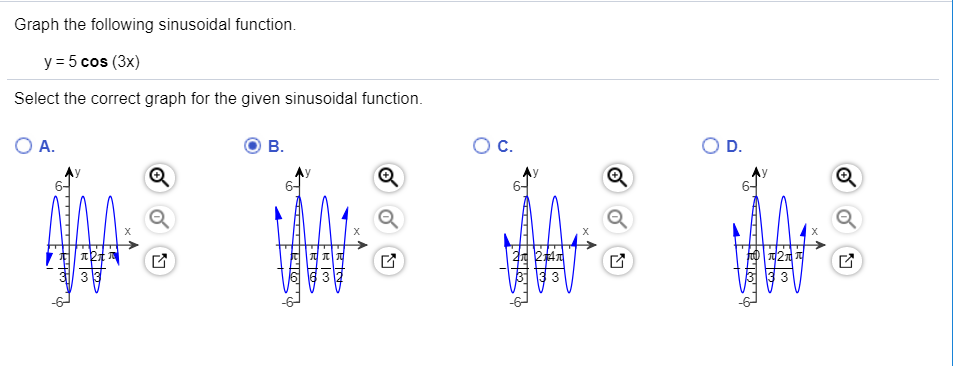
 fickle moat
simplify the expression how do you do that
#25
can someone explain to me? or Do i have to write it in y = b^x? formet
<@&286206848099549185>
sullen shoal
1
 limpid plover
1
fickle moat
how tho
sullen shoal
8^1=8
 elfin night
👀
limpid plover
Let $$log_8 8=x$$
granite stirrupBOT
fickle moat
what about 27
sullen shoal
lol it's \log
limpid plover
$$8^x=8$$
granite stirrupBOT
fickle moat
hm....
limpid plover
I am 9000% sure that I put a slash there
sullen shoal
Well, fuck you!
limpid plover
$$log_n 1=0$$
granite stirrupBOT
sullen shoal
n^0=1
limpid plover
That's true for all n>0
sullen shoal
^
sullen shoal
7.5
fickle moat
what am i missing
granite stirrupBOT
sullen shoal
==65465467^0
granite stirrupBOT
1
limpid plover
$${7.5}^x=1$$
granite stirrupBOT
limpid plover
What's x
fickle moat
1?
 granite stirrupBOT
15/2 = 7.5
sullen shoal
chrome grove
oof
fickle moat
How do you simplify the expression
 thick raptor
#❓how-to-get-help wait a minimum of 15 minutes after posting to ping helpers.
fickle moat
oh...woop sorry
earnest finch
5log5 cancel out so you're literally left with 3 @fickle moat
sullen shoal
$$5^{\log_5(3)}$$ in log form is $$\log_5(x)=\log_5(3)$$
granite stirrupBOT
viscid thistle
what is an equation that will move the vertex of the function y=x^2 to the point (-3,1)
nvm i got it
sullen shoal
xd
limber bone
y = (x+3)^2 +1



 odd lichen
It's mainly identities and rearranging.
Identities found through symmetries in the unit circle. Like sin(-x)=-sinx
Oh and similar and common triangles.
@chrome grove
viscid thistle
hi hi
can i please get some assistance
this is my work
i've gotten to the graph part but im confused on finding the intervals for this problem
can i please get some help 😃
the first point of the graph should start at (-5,0)
im only graphing for one period
so when trying to find the last point of the graph (where it ends), i did
-5+(-20/7)
since the period is (-20/7)
my last point should've been -55/7
BUT, when i checked desmos it was wrong
i didn't get (-55/7,0) like i should have
@patent beacon i know, it's all sorts of fucked up
lmao
hexed ermine
Indeed -55/7 is a zero
And it looks from what I graphed it's a zero
Perhaps yours is a bit messed up
viscid thistle
but why is it giving a weird fucked up number on desmos?
a scientific notation sort of number?
viscid thistle
yeah, that what im wondering as well
also
check this out
if i had done -5+(20/7)
i would've gotten a zero
-55/7 is also less than -5
so how does ur last interval is less than ur first
like this question is weird af
the period is negative
BUT
if it was positive
i would've gotten the end point for the graph
it doesn't make sense
hexed ermine
-5+(20/7)?
viscid thistle
-20/7 is your period right?
is that what u got?
cuz that's what i got
BUT
if the negative wasn't there
i would've gotten a flat 0
and the graph would've been right
but since the period=(-20/7), we are both getting -55/7
if -5 is our first point, then how is -55/7 gonna be our last point
hexed ermine
-5-(20/7)?
viscid thistle
yes
that's what i did in order to find the last interval
but
it gives us a number less than -5
which shouldn't be right
we might need more peeps on this problem
lmao
im so confused with the intervals
viscid thistle
can we talk about this in a vc, i feel like i can explain myself better
never mind, there is no vc's on this server
ok
which value are you referring to in which i circled?
hexed ermine
So -5+(20/7) and -5-(20/7) which gi es you -15/7 and -55/7
viscid thistle
yes
-15/7 should be the last interval
BUT
since we are subtracting both numbers, we get -55/7
which is not a flat 0 for the y
hexed ermine
-55/7 =x gives you a 0 for y
viscid thistle
can i see ur graph
granite stirrupBOT
-55/7 = -7.85714285714286
viscid thistle
now check this out
the last interval should be greater than -5
not less than -5
you see what's wrong tho right?
hexed ermine
Your period is just a magnitude, if you add 20/7 to -5 you get a value greater than -5
viscid thistle
yes
there should be no point less than -5
if my first point is gonna be -5
all points succeding should be >-5
hexed ermine
Why do you say that?
viscid thistle
because
the graph starts at (-5,0)
if im finding the period from there, then all the x values succeding should be >-5
so how is it that the last interval is <-5
that doesn't make sense
the graph doesn't go backwards
there's an order to these graphs. the last interval will never be less than the first interval. it doesn't make sense
the last interval should've been -55/7. i got that BUT, it's not giving a flat 0. it's giving me some fucked up scientific notation
also, -55/7 doesn't make sense because it's less than -5
hexed ermine
So you are saying that for a regular sin(x) graph, -2pi isnt valid
viscid thistle
im saying the graph shouldn't go backwards. that's what im confused about. why is it saying that the last interval is -55/7 when it gives me a scientific notation and it's less than the first interval
-2pi is valid
but since the amplitude and horizontal stretch are both negative, it reflects just as a regular sin graph should
they both cancel out
returning to it's natural form as if the negatives were not present
hexed ermine
The period is -20/7 so since you are saying -5 is the starting point you should go back to find the number after that since the period is negative
viscid thistle
im saying that the last interval shouldn't be -55/7
hexed ermine
Why not though?
viscid thistle
because it's not giving us a flat 0 as it should
desmos isn't fucking up, it's something with this equation
also, -55/7 is less than -5
which doesn't make sense
goow, what do u think
spring thunder
it's not giving a 0 cause floating arithmetic isn't accurate
spring thunder
(And screw my internet)
spring thunder
The calculations with floating numbres
Yes
It's just that computers can't store infinite digits
So there's a small error
spring thunder
trust your mind, not those computer scumbags
viscid thistle
but wait
ahh fuck this
im just gonna go off of -55/7
this question has fucked with my head too much
thanks for the help y'all
i appreciate it (:
hexed ermine
👌
spring thunder
🍻
 odd knoll
I don’t know what phi symbol means
for number 131
it looks like theta but its wonky
bitter nova
it's the other 3d angle
bitter nova
yea it's just another greek letter for another angle
bitter nova
p h i
odd knoll
another variable
bitter nova
yea
gritty blaze
$$z=\sqrt{6}e^{i\arctan\left(\frac{\sqrt{2}}{2}\right)}$$.
granite stirrupBOT
 grizzled solstice
Ahh thanks 🙏🙏
odd lichen
π/4 +2nπ >>> arctan(sqrt(2)/2)
somber plaza
@grizzled solstice think about a Pythagorean triangle.
The R in the polar form is the hypotenuse
So the angle must be the theta
grizzled solstice
I see . Thanks you very much 🙏😁 @somber plaza
somber plaza
But of course you may have to change the angle depending on which quadrant the point lies on in an Argand diagram .@grizzled solstice
grizzled solstice
I got it ! Thx again @somber plaza
spring thunder
still need ahelp ? @subtle narwhal
 vapid skiff
Where can I post trig questions?
spring thunder
here is pretty relevant
vapid skiff
Not to sure how to do this
somber plaza
@vapid skiff graph sin(x + 2π /3 ) first
then shrink that graph by a third vertically
 subtle narwhal
@spring thunder yes
spring thunder
ok so you know what a difference quotient is at least?
granite stirrupBOT
spring thunder
so f(t+h) blocks you i believe....
subtle narwhal
spring thunder
i mean, i didn't tell you to use symbolab
spring thunder
ah k lel
subtle narwhal
i didnt actually calcualte it
spring thunder
i was like wtf
subtle narwhal
thats stupid whats the point of coming here then lol
spring thunder
so you did 2(x+h) + 3 right (ie 'replaced' that x with x+h)
so for $$h : x \mapsto \frac{1}{4x}$$
granite stirrupBOT
subtle narwhal
1/4t+4h
all over h ( i dont know how to write it over h lol )
but how do i simplify it further?
patent beacon
Get a common denominator
spring thunder
put them at the same denominator and rationalize basically
vapid skiff
@somber plaza how would I do that?
 solid reef
#48?
 ruby hill
help D:
 gleaming vine
?
ruby hill
i'm not good at writing functions from looking at a graph of sinusoidal function
gleaming vine

Khan Academy
Sal finds the equation of a sinusoidal function from its graph where the minimum point (-2,-5) and the maximum point (2,1) are highlighted.
maybe this?
idk i just read the title
ruby hill
ahhh.
north bough
how do I write this as an algebraic expression not using trig functions?
=tex sin\left(cos^{-1}\left(x\right)+sin^{-1}\left(x\right)\right)
granite stirrupBOT
gritty blaze
$$\sin(a+b)=\sin(a)\cos(b)+\cos(a)\sin(b)$$.
granite stirrupBOT
north bough
I'm aware of the addition identity for sine, but how would you represent the inverse cosine and sine functions?
civic plaza
let a=cos^-1(x) and let b=sin^-1 (x)
rocky bison
exactly the same way
civic plaza
that should be easier to see
north bough
why can we arbitrarily do that?
civic plaza
what do you mean
we aren't doing anything
in the end a is still cos^-1(x) and b is still sin^-1 (x)
north bough
ok
can you represent the values in terms of ratios of x?
like sin B in this case would be x
gritty blaze
$$
\begin{aligned}
\sin(\arccos(x)+\arcsin(x)) &= \sin(\arccos(x))\cos(\arcsin(x))+\cos(\arccos(x))\sin(\arcsin(x)) \
&=\sqrt{1-\cos^2(\arccos(x))}\sqrt{1-\sin^2(\arcsin(x))} + x^2 \
&=1-x^2+x^2 \
&=1
\end{aligned}
$$.
granite stirrupBOT
desert jackal
@sour wolf
 sour wolf
yes?
 quartz bronze
I know where the mistakes were made but not how to show the correction algebraically.
fickle moat
I have a question for number 14 and 15, 18
For number 13
Log 3 35 then i know its log 3 5 + log 3 7
But for number 14 15 17¿? How do you solve it
granite stirrupBOT
fickle moat
yes
spring thunder
that's what you used for the first q
spring thunder
yea, do you get why we substract?
fickle moat
i wrote in equation here
but
lost bit
@spring thunder is it this correct?
something like this?
spring thunder
yea those are correct
spring thunder
yea i didn't say that was false
fickle moat
than for 18 log 3 45/49
its subtraction
but can i like divide by 9 and 7
log 3 5/7
log 3 5 - log 3 7
i am not sure even i am doing this correct
fickle moat
so the answer for 18 is log 3 5 -log 3 7
your just following the rules of properties and same time solving it
i just have so many doubting myself...
granite stirrupBOT
spring thunder
they just want to write that big log_3(45/49) with some log_3(5) and log_3(7), that's all they want
and i didn't say this had only one step
fickle moat
so in the end you can write this in any form of -
45 -49 and 5 -7
so for number 15. log 3 7/25 = log 3 7 -log 3 25
spring thunder
and 25 is 5^2
fickle moat
log 3 7 -log 3 5^2?
spring thunder
yup and then what can you do?
spring thunder
what do you even mean by solve?
it's not an equation
can you use a rule to get something*log_3(5) instead of that log_3(25)
that's what i mean
fickle moat
now next question i hve is log 3 175
spring thunder
we're not finished with that one
spring thunder
$$\log(a^b) = b\log(a)$$ hmmm
granite stirrupBOT
fickle moat
log 3 7 - 2log 3 5?
spring thunder
yas^^
spring thunder
yeah that's the idea
spring thunder
it will be a little bit more complicated than just log_b(x^some power) tho
spring thunder
do you know what prime factor decomposition is?
spring thunder
each integer > 1 can be uniquely decomposed as a product of prime factors
and a way to find it to start by the smallest prime number existing (ie 2)
fickle moat
so its like finding constand and LC
constant"
constand of 10 is 1 2 5 10
etc
CONSTANT""""
175 / 5 = 35 / 5 =7
5 x 5 x 7?
spring thunder
you forgot the + between the two but yeah
fickle moat
OOPs
okok so i got the right idea
i finished the homework but i wanted to get better at it for my exam next week
spring thunder
👌 sure
fickle moat
so far i studied 2.7 3.1 3.2 solving least 90 problems
including word problems
so i can understand the full chapter
thank you!
for this you need to use subtract
to do that do you have to x power to cube to cancel the root along with 3?
spring thunder
how would you write cubert(x) as a fractional exponent?
that's the trick @fickle moat
spring thunder
yup that's the right step
now 1/3 hmmm......
$$\log(b \cdot \frac1{b}) = \log{1} = \mathbf{0 = \log{b}+\log{\frac{1}{b}}}$$
granite stirrupBOT
 tardy olive
find all solutions to 3x - 2^x- 1 =0