#precalculus
1 messages · Page 82 of 1
 silver mason
 winter comet
silver mason
wouldnt that 4 have to be a 0 in the definite integral?
winter comet
silver mason
wouldnt that 4 have to be a 0 in the definite integral?
nah, f(a + (b-a)k/n), where a=0 and b=6, is f( 6k/n )
so f(x) = (4+x)^2
silver mason
winter comet
nah, f(a + (b-a)k/n), where a=0 and b=6, is f( 6k/n )
so f(x) = (4+x)^2
is a =0, why is it not (0+x)^2
winter comet
silver mason
is a =0, why is it not (0+x)^2
f(0 + 6k/n) = [4 + (0 + 6k/n)]^2
silver mason
winter comet
f(0 + 6k/n) = [4 + (0 + 6k/n)]^2
how
winter comet
the "4+" is not the "a+" part, the "a+" part goes away since a=0. the "4+" part is part of the function
silver mason
OHHHH
OHH MY GOSHH
BECAUSE IF U HAD 0+ IT WOULDNT EVEN BE THEREEE
DUDEE THANK YOU SO MUCH
winter comet
yeh 😂
 hushed sphinx
Of course we can also see the same limit-of-sums as the integral of x² over 4<x<10.
 icy verge
guys
 neon relic
Hey*
 tired bluff
how did the sum function turn into an integral 💀
as n approaches infinity, shouldn't the 6/n turn to 0
making the whole thing 0
idk
hushed sphinx
tired bluff
how did the sum function turn into an integral 💀
We know the integral exists (since the integrand is continuous, for example), and the n->infy limit is a limit of some of the Riemann sums that (in some books) define the integral.
hushed sphinx
tired bluff
as n approaches infinity, shouldn't the 6/n turn to 0
making the whole thing 0
i...
Yes, the terms go to 0, but that is counteracted by there being more and more of them as n increases.
 buoyant badge
Anyone know how to do part iii and iv?

 fluid sorrel
buoyant badge
Anyone know how to do part iii and iv?
fluid sorrel
buoyant badge
Anyone know how to do part iii and iv?
What did u get for part 2
Show ur work
 acoustic apex
Lol beta function
 round geyser
Hey does inverse function work
 median spear
round geyser
Hey does inverse function work
median spear
round geyser
Hey does inverse function work
Work uhhh?!
buoyant badge
 final grail
<#326138772477575180>
final grail
<#326138772477575180>
Bro this is high school level
Not even uni calc
Note this is the pinnacle of high school level
 willow bear
round geyser
Hey does inverse function work
willow bear
round geyser
Hey does inverse function work
on the most basic level, f^-1 does whatever it takes to undo the effect of the original function f
if f(x)=y then f^-1(y)=x
 main bone
round geyser
Hey does inverse function work
main bone
round geyser
Hey does inverse function work
f(x) = y
f⁻¹(y) = x
(fof⁻¹)(x) = x
(f⁻¹of)(x) = x
winter comet
buoyant badge
Not even uni calc
it's definitely calculus, not precalculus so it would belong in the calc channel. whether ur in uni or hs doesn't matter
round geyser
willow bear
on the most basic level, f^-1 does whatever it takes to **undo** the effect of t...
Is it f(g(x))=x and g(f(x))=x
willow bear
sure
 sleek magnet
round geyser
Is it f(g(x))=x and g(f(x))=x
sleek magnet
round geyser
Is it f(g(x))=x and g(f(x))=x
Yep but only if g is inverse of f or f is inverse of g
 raw hill
<@&268886789983436800>
buoyant badge
raw hill
<@&268886789983436800>
Why am I surprised snitching still happens in the math server. Lol what was even the previous message
 ancient anvil
buoyant badge
Why am I surprised snitching still happens in the math server. Lol what was even...
ancient anvil
buoyant badge
Why am I surprised snitching still happens in the math server. Lol what was even...
The rules are the rules
winter comet
buoyant badge
Why am I surprised snitching still happens in the math server. Lol what was even...
a scam ad
it was a scam ad
median spear
buoyant badge
Why am I surprised snitching still happens in the math server. Lol what was even...
Ahah this is a study server mate!!
Use #chill
 tired ridge
hello! i really need help with my math exam and how to explain how to do it. basically, what is required is how to explain how to solve the equation, and not to solve the actual equation itself, so it’s more of a written math exam.
what i struggle with most is 1-4 and 7-8
 frail lion
Bruh ts safe to download?
 uncut mulch
!nopdf
 tender questBOT
Please post images (such as PNGs or JPGs) of the question rather than other filetypes such as PDFs which have to be downloaded. Non-image downloads can potentially contain viruses or other security risks.
frail lion
Ok yeah it is now atleast
@tired ridge about 1-4 , they are just basic power addition subtraction and basic factorization
About 7th
Domain of a function is the set of values which you can put in it
So basically X coordinate values
Range are the values we get and
A function is discontinuous at a point where the graph is breaking
And about 8th
Whenever even odd function is asked
Substitute -x in place of x and see if the function changes
If it changes , it's odd
If it doesn't, it's even


 hollow nymph
 warped shuttle
how to find the inverse function of f(x) = sqrt(x) + floor(x)
raw hill
warped shuttle
how to find the inverse function of f(x) = sqrt(x) + floor(x)
the inverse is only defined piecewise
If you restrict $x \in [n, n+1)$, then $f(x)=\sqrt{x}+n$
 obsidian monolithBOT
Civil Service Pigeon
 raw hill
then follow your standard procedure
warped shuttle
raw hill
If you restrict $x \in [n, n+1)$, then $f(x)=\sqrt{x}+n$
we do this so we don't need to make a inf long piecewise function right ?
make a general function which satisfies a part of a piecewise function something like that
raw hill
the benefit of restricting to $[n, n+1)$ is that $\lfloor x \rfloor$ becomes a constant
obsidian monolithBOT
Civil Service Pigeon
 raw hill
not sure if that answers your question
because otherwise working with the floor is pretty difficult
warped shuttle
raw hill
because otherwise working with the floor is pretty difficult
is it possible tho ?
raw hill
values like $1.2$ aren't in the range of $f$ though
obsidian monolithBOT
Civil Service Pigeon
 warped shuttle
raw hill
values like $1.2$ aren't in the range of $f$ though
warped shuttle
raw hill
values like $1.2$ aren't in the range of $f$ though
wdym
raw hill
warped shuttle
wdym
Recall that the domain of the inverse is the range of the original function. Like I said, there's a lot of values (like 1.2) that aren't in the range of f (and hence that aren't in the domain of the inverse). So even if you tried to take the inverse in one shot, there would be a lot of excluded values, which makes it kind of a moot point when partitioning into intervals [n, n+1) takes care of that so easily.
 warped shuttle
raw hill
Recall that the domain of the inverse is the range of the original function. Lik...
warped shuttle
raw hill
Recall that the domain of the inverse is the range of the original function. Lik...
oh i get it now
what for other functions is it possible to work with the floor function without restricting the domain ?
i always had some issues with the floor functions idk why lol i don't have good times when working with them
raw hill
eh most of the time (at least for simpler questions), restricting to intervals so that the floor function evaluates to a fixed value is the way to go
warped shuttle
raw hill
eh most of the time (at least for simpler questions), restricting to intervals s...
is there a time where restricting to intervals and changing floor(x) -> x would cause issues ?
raw hill
as long as what you do is correct, it should be fine
whether or not it's helpful depends on context
warped shuttle
is this correct ??
 raw hill
warped shuttle
is this correct ??
raw hill
warped shuttle
is this correct ??
$f^{-1}(x)=(x-n)^2$ for $x \in [n+\sqrt n, n+\sqrt{n+1})$ is fine
obsidian monolithBOT
Civil Service Pigeon
 warped shuttle
ok thanks
obsidian monolithBOT
The following error occured while calculating:
Error: Undefined symbol x
 patent glen
,calc 9.74 * 2.84
obsidian monolithBOT
Result:
27.6616
 clever siren
are save my exam notes any good?
 willow skiff
clever siren
are save my exam notes any good?
willow skiff
clever siren
are save my exam notes any good?
yes
 stone vale
clever siren
are save my exam notes any good?
stone vale
clever siren
are save my exam notes any good?
notes are okay, but id rather use videos or bbc bitesize, they're good for questions tho
 half ice
clever siren
are save my exam notes any good?
half ice
clever siren
are save my exam notes any good?
It is easier to firefox the details if your notes are very specefic, you would take time, I take conceptual notes nowadays which stay relevant and they are digitally stored. But paper notes, imo, for a specefic exam, not very useful to store.
 weak terrace
,ask d/dx(cot(x))
obsidian monolithBOT


 Requested by pineapple_pizza3421


 random furnace
obsidian monolith
random furnace
obsidian monolith
Isn't it ln(sinx) + c?
 subtle pond
random furnace
Isn't it ln(sinx) + c?
subtle pond
random furnace
Isn't it ln(sinx) + c?
they differ by constants
 random furnace
round geyser
Is this easy
random furnace
round geyser
Is this easy
It should be
round geyser
 thick breach
What do you think the domain would be
thick breach
What do you think the domain would be
X≠1
thick breach
Vertical asymptote
round geyser
I heard domain and VA will be related
 desert lintel
hey yall
 solemn iris
round geyser
Is this easy
solemn iris
round geyser
Is this easy
wdym cross. because if x≠1 it cant cross is that what its asking
round geyser
Cross is
round geyser
solemn iris
wdym cross. because if x≠1 it cant cross is that what its asking
Or hole
solemn iris
oh lol ok yeah theres a hole at 1
basically the graph is continous everywhere except 1
but a zero is not a hole so be careful because the graph is undefined there
solemn iris
this is what the graph looks like
 round geyser
And the middle one is like a parabola
 solemn iris
so its hard to see but i scaled the graph wrong
let me show you the graph closer to 1
if you had a vertical line at 1

it would never touch
@round geyser but you also have to realize that you can never have an output of -1 either
round geyser
Yes
solemn iris
so you would also have a horizontal asymptote at -1
round geyser
I wonder what’s the crossing point
round geyser
 round geyser
solemn iris
wdym like the holes?
round geyser
solemn iris
wdym like the holes?
(1,-1)
round geyser
It’s (HA,VA)
solemn iris
Yes
solemn iris
well try and put a vertical line through it
solemn iris
what math are you required to go to or are you not in uni?
round geyser
I am in Pre-Calc in HS
round geyser
solemn iris
what math are you required to go to or are you not in uni?
I’m not in uni
solemn iris
@round geyser ok the best way to think about a verticle line the equation exponents
if there is an even exponent there is a very high chance it doesnt pass the VLT
just had to gage on what type of math you have ahead of you
so for example y=2x+1 passes but y=2x^2+1 doesnt because its a parabola
solemn iris
exactly because the x is to the power of 1
uneven
look how the graph changes when its to the second power

that wouldn't pass
because a line would cross 2 points
solemn iris
round geyser
Like y=1/(2x^2+1) will have a slant asymptote
does this make sense
becareful though because rational functions this is hard to apply
expecially if there bottom heavy
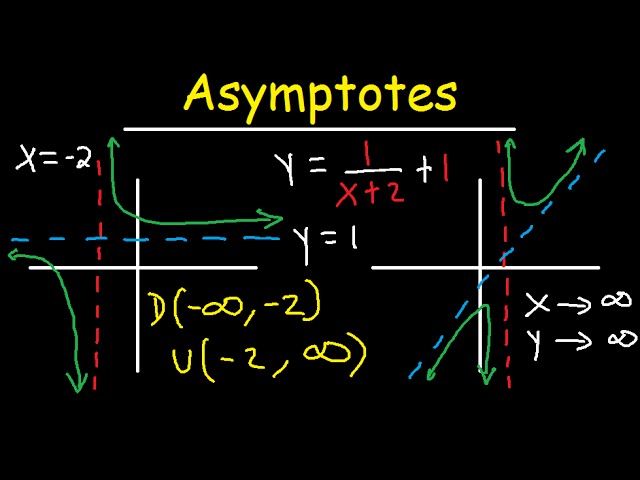
This math video tutorial shows you how to find the horizontal, vertical and slant / oblique asymptote of a rational function. This video is for students who might be taking algebra 1 or 2, precalculus or calculus in high school or those who might be taking college algebra in an university. This video contains plenty of notes, examples, and pra...
watch this video its a great tool
@round geyser if you have any other questions you can always dm me im going to go play roblox
 hybrid hamlet
<@&268886789983436800>
 umbral dew
hybrid hamlet
<@&268886789983436800>
umbral dew
hybrid hamlet
<@&268886789983436800>
bruh why
 pliant lodge
hi
 tender hare
∫ from 0 to π/2 ( sin ²x) dx=?
 west ice
tender hare
∫ from 0 to π/2 ( sin ²x) dx=?
west ice
tender hare
∫ from 0 to π/2 ( sin ²x) dx=?
!status
tender questBOT
tender hare
∫ from 0 to π/2 ( sin ²x) dx=?
What step are you on?
1. I don't know where to begin.
2. I have begun but got stuck midway.
3. I got an answer but I was told that it's wrong.
4. I got an answer and would like my work checked.
5. I have a question about someone else's work/solution.
6. I have completed the problem and don't need help anymore. Thank you.
7. None of the above
btw there's a calculus channel #calculus
tender hare
oh sorry
tender hare
tender quest
```
What step are you on?
1. I don't know where to begin.
2. I have begun but go...
4
west ice
tender hare
4
show your working out
 west ice
tender hare
west ice
tender hare
Uhh what
tender hare
one another method
 tender hare
i used gamma function in first method
west ice
yeah yeah
west ice
tender hare
i used gamma function in first method
I expected you use antiderivative so I was a bit surprised in the first image
tender hare
oh.
west ice
But yeah that's the right answer
tender hare
I was frightened because i didnt suppose to publish the solution
west ice
tender hare
I was frightened because i didnt suppose to publish the solution
Uhh, huh? you can post solution to your own problem
tender hare
ohh. im newbie. idk I just joined this year .im in grade 9
west ice
 okay
okay
tender hare
okay.
 round geyser
solemn iris
https://www.youtube.com/watch?v=qGCKjuhA4eQ&t=141s
round geyser
solemn iris
https://www.youtube.com/watch?v=qGCKjuhA4eQ&t=141s
That’s how limits was invented
 celest tulip
 cyan cove
=(2,2)
cyan cove
=(2,2)
Good so far! Now that you have a point the tangent passes through, how do you find the slope of the tangent line using limits?
round geyser
How can I graph this

 next drift
Can someone help me with calc
next drift
Please draw graph for me

 forest hawk
next drift
Please draw graph for me
forest hawk
next drift
Please draw graph for me
First of all go to a help channel for help, this isn’t for help on math problems
Second of all helpers are here mostly to guide you to the right answer, not do it for you
Read #❓how-to-get-help
 shut gazelle
Hey guys I'm new here and I really really need help. I have a Pre calc test tomorrow and I feel like I havent learned anything. Can someone VC with me and help teach me some stuff? Sorry if I seem desperate or anything like that
shut gazelle
forest hawk
First of all go to a help channel for help, this isn’t for help on math problems...
oh oops im sorry
forest hawk
shut gazelle
Hey guys I'm new here and I really really need help. I have a Pre calc test tomo...
We don’t offer tutoring, but if you’d like to prepare for the test you can use resources online like khan academy
shut gazelle
Thank you :)
 green haven
shut gazelle
Hey guys I'm new here and I really really need help. I have a Pre calc test tomo...
green haven
shut gazelle
Hey guys I'm new here and I really really need help. I have a Pre calc test tomo...
In case you get stuck on a particular problem or have a more specific question, you may use the help channels to ask as well
shut gazelle
green haven
In case you get stuck on a particular problem or have a more specific question, ...
Thank you so muchh :)
fluid sorrel
 rapid gyro
can anyone help me with studying for an ezam
rapid gyro
can anyone help me with studying for an ezam
What help?
fluid sorrel
rapid gyro
10 or so questions i think
Ok make a help form and post the questions there along with us work
We will try to help
 nocturne ocean
rapid gyro
10 or so questions i think
nocturne ocean
rapid gyro
10 or so questions i think
Can you please post them?
 willow breach
 blissful sandal
precaculus
blissful sandal
precaculus
?
 atomic viper
i posted a question on the help thing bc i lowk need help ik its simple gcse maths but i missed the lesson on it😓 can someone look at it?
 crimson acorn
Need an expert in this area for questioning
west ice
!da2a
tender questBOT
No need to ask “Can I ask…?” or “Does anyone know about…?”—it’s faster for everyone if you just ask your question!
crimson acorn
Topics in question are Power rule, Log of 1, Log of base
 echo sinew
$$\log_{\text{whatever base}}(1) = 0$$
Nothing else to say
obsidian monolithBOT
Alberto Z.
 echo sinew
log of base doesn't mean anything honestly
And also, are you referring to the derivatives with power rule?
 somber void
echo sinew
And also, are you referring to the derivatives with `power rule`?
somber void
echo sinew
And also, are you referring to the derivatives with `power rule`?
most certainly not. Probably a log(b) = log(b^a)
willow bear
echo sinew
`log of base` doesn't mean anything honestly
it's good filler for people who don't know how to write a syllabus
echo sinew
somber void
most certainly not. Probably a log(b) = log(b^a)
Oh yeah sure I don't know why I didn't think of that lol
crimson acorn
echo sinew
And also, are you referring to the derivatives with `power rule`?
Mhmm, base is 1 and the log of 1 is zero
Honestly, I don't know. We weren't taught this
crimson acorn
Both
blissful sandal
AND WHATS LOGG
crimson acorn
blissful sandal
why log
Professor's orders
blissful sandal
IM GRADE 7 im typing what i know
crimson acorn
crimson acorn
Topics in question are Power rule, Log of 1, Log of base
According to the file topic, these are supposedly laws
 sonic hill
I mean. I guess you don't need logarithms for derivatives...
crimson acorn
blissful sandal
IM GRADE 7 im typing what i know
Oh, I'm far up
crimson acorn
sonic hill
I mean. I guess you don't need logarithms for derivatives...
How come?
blissful sandal
is logaritm on grade 10 idk
sonic hill
crimson acorn
How come?
Because they don't involve logarithms.
blissful sandal
 sonic hill
The concept of a derivative doesn't need them.
crimson acorn
sonic hill
The concept of a derivative doesn't need them.
Why?
crimson acorn
blissful sandal
is logaritm on grade 10 idk
I'm in eleventh
sonic hill
Because it isn't defined with logarithms
I mean, some derivatives need logarithms, but not all
It would make more sense if you knew what a derivative was. I assume you don't
crimson acorn
sonic hill
It would make more sense if you knew what a derivative was. I assume you don't
I told you, we weren't taught this
sonic hill
Have you taken calculus yet?
crimson acorn
We're supposed to make a presentation in place of the teacher to teach it
blissful sandal
我是七年级
sonic hill
What...
sonic hill
Yeah, thats has zero calculus in it
blissful sandal
no i dont learn precalculus yet
sonic hill
Until you get to limits, youre not doing calculus
blissful sandal
INFINITY
blissful sandal
n1
crimson acorn
blissful sandal
不知道了
You're Chinese, I thought you guys are next level in Asian math
blissful sandal
im not chinese but i can spek chinese
crimson acorn
I stand corrected
crimson acorn
sonic hill
Until you get to limits, youre not doing calculus
Okay then, what am I supposed to do about this?
sonic hill
crimson acorn
Okay then, what am I supposed to do about this?
About what
crimson acorn
crimson acorn
We're supposed to make a presentation in place of the teacher to teach it
It's due
blissful sandal
:0
sonic hill
Oh
Well, teach it to yourself theh make your presentation
If you need help, thats why I'm here
What questions do you have
sonic hill
blissful sandal
precalculus is calculus but before
Precalculus is "let's make sure your algebra and trig is good"
blissful sandal
algebra
crimson acorn
Common Mistakes & How to Avoid Them - Show wrong ways students use the law and explain why they're wrong
Real-Life Application or History - Where do we see this law in real life? (science, finance, engineering, computer science, etc.) OR give a short historical fact about who discovered it.
Algebraic Proof - Prove the law using exponential-log properties show steps on a poster or slides).
blissful sandal
quadratic equation
crimson acorn
crimson acorn
Common Mistakes & How to Avoid Them - Show wrong ways students use the law and e...
This
crimson acorn
algebraic
Although someone is supposedly assigned to that. The group can't thoroughly explain things properly
Like we partly get it, but not so much
crimson acorn
blissful sandal
y = ax2 + bx + c
You can run that on desmos
sonic hill
Wait so
crimson acorn
I think
sonic hill
crimson acorn
Common Mistakes & How to Avoid Them - Show wrong ways students use the law and e...
What are you presenting on?
blissful sandal
GRAPH
crimson acorn
sonic hill
What are you presenting on?
What do you mean?
blissful sandal
crimson acorn
You can run that on desmos
i can also run geometry dash on desmos
crimson acorn
What I'm using to present the slides?
blissful sandal
.-.
sonic hill
I'm on my computer now
crimson acorn
sonic hill
What is your presentation about?
Power Rule, Log of 1 & Log of the Base
sonic hill
Do you know what logarithms are?
blissful sandal
power rule, 10 to the power of 10 to the power of 100
sonic hill
What do you mean by power rule?
blissful sandal
power up
crimson acorn
Not entirely, say I get the process
How to solve
But not the definitions
I learn through pattern recognition
blissful sandal
1 = 1, 2 = 4, 3 = 9, 4= 16
crimson acorn
blissful sandal
1 = 1, 2 = 4, 3 = 9, 4= 16
Yeah, I get that
blissful sandal
1+3=4, 4+5=9, 9+7=16, 16+9=25
crimson acorn
Kind of, not entirely
blissful sandal
oh OK
obsidian monolithBOT
pebble
 sonic hill
or like
blissful sandal
sonic hill
$(a^b)^c=a^{bc}$
huh money symbol
sonic hill
$a^{bc}=a^ba^c$
obsidian monolithBOT
pebble
 sonic hill
blissful sandal
huh money symbol
sonic hill
blissful sandal
huh money symbol
yeah, lol
crimson acorn
No
sonic hill
okay well
crimson acorn
wait
sonic hill
I don't know what power rule you're talking about
blissful sandal
a to the power of b to the power of c
obsidian monolithBOT
pebble
 blissful sandal
a = 10, b = 10, c = 100
crimson acorn
Real life applications and history, I'll send the link of the sources
Do you think you can simplify?
sonic hill
history of logarithms? I don't know jack about that
crimson acorn
The sources are credible
sonic hill
I can maybe talk about real life applications though
crimson acorn
That's why I'm giving the link, man
I've been collecting them like shells on the beach
blissful sandal
real life application of logarihm
sonic hill
banking
crimson acorn
blissful sandal
real life application of logarihm
I saw, I can't explain expertly
So I kinda know
But I don't get the whole spider web
blissful sandal
hmmm
crimson acorn
Just a few points
sonic hill
I used logarithms to make pan pipes once
blissful sandal
boom
sonic hill
I did
crimson acorn
Thank you
 austere wigeon
crimson acorn
Real life applications and history, I'll send the link of the sources
austere wigeon
crimson acorn
Real life applications and history, I'll send the link of the sources
For real life, understanding logarithms
Is needed for fully understanding pH in chem and HR Diagrams in Astrophysics
crimson acorn
Interesting
sonic hill
True, pH is a logarithmic scale
crimson acorn
sonic hill
True, pH is a logarithmic scale
So it's not connected?
To the context of what I trying to learn?
sonic hill
It is
The way pH works is that, each pH level you go up, the concentration of OH- goes up by a factor of 10 times
So pH 8 has 10 times more OH- ions in it than a pH of 7. A pH of say 14 has 100 times more OH- ions than a solution with pH 12.
 crimson acorn
sonic hill
So pH 8 has 10 times more OH- ions in it than a pH of 7. A pH of say 14 has 100 ...
crimson acorn
sonic hill
So pH 8 has 10 times more OH- ions in it than a pH of 7. A pH of say 14 has 100 ...
Wait, I'll send my sources
 plain stone
blissful sandal
i can also run geometry dash on desmos
plain stone
blissful sandal
i can also run geometry dash on desmos
you guys dont know sonic wave on desmos twin
blissful sandal
plain stone
you guys dont know sonic wave on desmos twin
wdym
sonic hill
No
blissful sandal
10 to the power of -1000 so its 0. followed by 997 or 998 zeroes then 1
 blissful sandal
x4 + 6x2 + 9
willow skiff
round geyser
Can we use P/Q
what is p/q?
 agile fog
Can anyone recommend a good precalc yt channel or a website or literally anything that can help
 viscid thistle
agile fog
Can anyone recommend a good precalc yt channel or a website or literally anythi...
viscid thistle
agile fog
Can anyone recommend a good precalc yt channel or a website or literally anythi...
i think
books are better
for pre calc
learning urself
idk
uncut mulch
khan, organic chem tut
for the documentation, there isn't much difference to what a book / online resource can provide at that level
books have a large question set for practice
round geyser
willow skiff
what is p/q?
Factoring
blissful sandal
plain stone
there is a youtube video
IK
i watch gd on yutube
i see acheron in desmos
 round geyser
How come when I graph y=gcf they give out a stair graphs
uncut mulch
round geyser
How come when I graph y=gcf they give out a stair graphs
wdym by y=gcf
you have a history of posting questions without full context
can you provide all the relevant information.
round geyser
uncut mulch
wdym by y=gcf
you have a history of posting questions without full context
can y...
Like y=gcf(x,8)
uncut mulch
are you doing this in something like desmos?
if so, its because desmos rounds the values before calculating gcd/f
,w graph gcd(x,8) from x=0 to 24
obsidian monolithBOT

 uncut mulch
is what the graph should look like
round geyser
Yes
round geyser
uncut mulch
are you doing this in something like desmos?
Yes
willow bear
the value of gcf(x, 8) is only ever going to be a factor of 8
 gritty walrus
agile fog
Can anyone recommend a good precalc yt channel or a website or literally anythi...
gritty walrus
agile fog
Can anyone recommend a good precalc yt channel or a website or literally anythi...
Calculus Early Transcendentals by Stewart J
Also Precalculus
 regal igloo
what is the equation for this graph...
 raw hill
regal igloo
what is the equation for this graph...
raw hill
regal igloo
what is the equation for this graph...
Reposted here: #help-20 message
round geyser
regal igloo
what is the equation for this graph...
I’m doing this
 hazy delta
Hello, would there be a faster way to solve this?
raw hill
hazy delta
Hello, would there be a faster way to solve this?
I’d do the same thing - maybe some steps can be skipped here, but that depends on how comfortable you are with the material.
hazy delta
raw hill
I’d do the same thing - maybe some steps can be skipped here, but that depends o...
Okayy thank you
Do you know why we write the answer în log base 10?
 smoky helm
Its easier to compute in base 10 because we use base 10 decimal system that’s basically all
It’s like how rationalizing the denominator from 1/sqrt2 to sqrt2/2 makes it easier to compute
uncut mulch
hazy delta
Do you know why we write the answer în log base 10?
There is no requirement to use log base 10
hazy delta
uncut mulch
There is no requirement to use log base 10
At our school they ask to write in log base 10
It seemed random at first
uncut mulch
it's not always necessary, use the log base most convenient in the question/ what you have
and here that log base is 2
hazy delta
uncut mulch
it's not always necessary, use the log base most convenient in the question/ wha...
Yeahhs I know, my teacher just removes marks if it isn’t in log 10
round geyser
I do

Here
It’s easy to move the logs to the side that has logs
This case you used, power rule, quotient property, addition property, change base
@hazy delta
hazy delta
round geyser
This case you used, power rule, quotient property, addition property, change bas...
Ooh yeah
It’s another technique
round geyser
What are some differences with your work and mine
hazy delta
My teacher doesn’t allow us to use cross products if there is a variable
round geyser
We do
hazy delta
round geyser
What are some differences with your work and mine
It’s pretty much similar
Instead of putting the log left we put if on the right
hazy delta
round geyser
We do
She asks to put all the variables on 1 denominator
So that we don’t forget the forbidden values
round geyser
We have Domain, Hole, VA, Zeros, HA, SA, Cross
hazy delta
I usually tend to avoid rational functies because they suck
hazy delta
On my exam I had one with rationals
round geyser
In polynomial
hazy delta
What do you mean?
Nono
On my final exam
Not on that test
I’ll show an example of how she asks us to dit
round geyser
We did Long division, synthetic division, Factor theorem, Zero theorem, rational root theorem, and complex zero theorem
hazy delta
In america?
round geyser
Yes
hazy delta
Yeah
round geyser
Like the 3 quizzes
round geyser
round geyser
We did Long division, synthetic division, Factor theorem, Zero theorem, rational...
2 is on that and plus graphing bounces and crosses
hazy delta
multiplicity
even or uneven multiplicity
fastest way to solve a rational inéquation
round geyser
1 is on min/max word problem using A=LW, P=2(X+Y), V=Lwh, and distance formula on graph
hazy delta
we use the multiplicity rule to solve inequations
hazy delta
round geyser
We did multiplicity of how to graph polynomials
If the multiplicity is even, it touches the x-axis
So the sign doesn’t change
And it crosses when it’s uneven
hazy delta
I like to talk about tricks and tips
 hazy delta
Can be useful to help eachother
round geyser
That’s relates to end behavior
round geyser
I also learned limits
hazy delta
I still have to learn them
round geyser
And how to solve for limits
hazy delta
the juicy epsilon delta definition
round geyser
hazy delta
the juicy epsilon delta definition
I am in a college prep class
hazy delta
Yeah so it’s easy for you
round geyser
Yes
round geyser
round geyser
Substitution
Rewrite expression
What’s the 3rd way to solve limits
It’s has something something error
hazy delta
I don’t know it yet
We haven’t seen limits and continuity yet
I am only in grade 11
In april we will see them
hazy delta
Me too
round geyser
Okay
hazy delta
We are now doing matrices
round geyser
Cramer rule
hazy delta
round geyser
Okay
I meant grade 11 also in hs
hazy delta
I’ll see if we learn it
round geyser
I took Algebra 1, Geometry, Algebra 2, and Pre-Calculus
round geyser
Ok
hazy delta
It’s different in belgium
round geyser
Ok
winter comet
💀
 dense zealot
🔥
 mortal nimbus
for those of you who’ve finished precalc and are about to start calculus 1, i’ve put together a free resource (https://math-website.pages.dev/) on differential calculus. i’ll probably use it the next time i teach an honors calculus course, and i’d love for people to take a look.
Calculus 1: A Geometric and Linear Approach
A mathematically honest introduction to differential calculus in the spirit of rigorous mathematics courses. Work in progress—content updated frequently. Part of a planned sequence covering core undergraduate mathematics.
 astral apex
at a glance it looks quite nice. I very much agree with your approach of beginning with sequences. One thing I’ll point out is you kind of whip out the notation for a function $a: \mathbb{N} \to \mathbb{R}$, and some precalculus students may not have seen that before
obsidian monolithBOT
ManifoldCuriosity
 astral apex
a brief review of functions and common number systems may be good to do before that
you did write that familiarity with functions is assumed as a prereq, which is fair, but just to get on the same page as the reader with basics of notation and like, the distinction between a codomain and a range, could be helpful
typo spotted in example 2.3.0.4: “We conculde that…”
it looks nicely organized and I like the examples you give
 jaunty lake
anyone did de precalc?
applied for one at a state college
jaunty lake
jaunty lake
anyone did de precalc?
applied for one at a state college
how was it?
hard?
jaunty lake
I appplies for a de precalc at a state school, I don’t know if I’m going to be accepted but I’m pretty sure I would be cuz they require a 85 in trig/alg 2 and I got a 91 there
I hear some people say precalc is easy but I’m interested in hearing from people who did de precalc
 arctic dragon
how do i remeber all those special angles in trig pre calc 12
astral apex
arctic dragon
how do i remeber all those special angles in trig pre calc 12
they're derived from looking at 45-45-90 and 30-60-90 degree triangles
arctic dragon
astral apex
they're derived from looking at 45-45-90 and 30-60-90 degree triangles
yep ik that but struggle to remeber them? cant derive them everytime i need them right?
astral apex
yeah you don't really want to have to derive them every time
how about this, the 30-60-90 triangle is the one that involves sqrt(3)/2, and there's a 3 in both 30 degrees and sqrt(3)/2
that may help you remember which is which
astral apex
yeah that's also helpful
arctic dragon
astral apex
yeah that's also helpful
yeah cz i think i only need the speical angles since otherwise there are way too many angles
arctic dragon
arctic dragon
i should be good if i got this down right?
astral apex
yeah, if you get those 5 angles down, then all the other ones in different quadrants will have the same values except possibly with minus signs
arctic dragon
astral apex
yeah, if you get those 5 angles down, then all the other ones in different quadr...
can i just plus or minus 180/360 from those angles to find these angles?
how do their signs change?
astral apex
 hushed sphinx
The easiest way to get the signs is just to plot the angle roughly on the full unit circle, and then see if its y and x coordinates are positive or negative.
astral apex
all the special angles in the other quadrants are reflections of the 5 coming from the hand trick
or rotations by 180
arctic dragon
hushed sphinx
The easiest way to get the signs is just to plot the angle roughly on the full u...
oh ic ty
arctic dragon
astral apex
all the special angles in the other quadrants are reflections of the 5 coming fr...
icic ty
mortal nimbus
astral apex
typo spotted in example 2.3.0.4: “We conculde that…”
THANKS! yikes
 vocal harbor
Yo anyone here grade 12 pre cal? I just wanted to know if its harder than 11
 neat path
arctic dragon
neat path
arctic dragon
You know that cos60 is sin90-60 so sin30
arctic dragon
vocal harbor
Yo anyone here grade 12 pre cal? I just wanted to know if its harder than 11
significantly,but only trig is a little challenging, overall pretty easy
echo sinew
vocal harbor
Yo anyone here grade 12 pre cal? I just wanted to know if its harder than 11
These things are pretty subjective, imo
 sacred vault
👋
 long lynx
Could someone help me rq
 pearl lintel
seems like you can just ask the question here and it’ll most likely get answered
long lynx
pearl lintel
seems like you can just ask the question here and it’ll most likely get answered
Yeah I’m just waiting for someone to reply so I can be present
pearl lintel
fair enough
half ice
long lynx
Could someone help me rq
!da2a
tender questBOT
long lynx
Could someone help me rq
No need to ask “Can I ask…?” or “Does anyone know about…?”—it’s faster for everyone if you just ask your question!
 opal sluice
Im going to take ap pre calc next year but im not sure if im ready for it yet? what basic fundamentals do pre calc students have to know?
 celest lantern
Can I ask for help on this?

I am unsure of how to continue
Well how to find the x coordinate
 real snow
,rccw
obsidian monolithBOT
 celest lantern
obsidian monolith
celest lantern
obsidian monolith
may i ask for help
long lynx
half ice
!da2a
Yk id much rather prefer it if people could answer my question instead of asking me how it should be asked
Help me or don’t, simple
half ice
long lynx
Yk id much rather prefer it if people could answer my question instead of asking...
The factoids exist for a reason. It just makes it faster for everyone. Point is we cannot help you without knowing the problem.
long lynx
half ice
The factoids exist for a reason. It just makes it faster for everyone. Point is ...
I already explained myself above
Don’t be that guy that nitpicks on everything just let me do what i actually prefer
You don’t lost anything on it and I am not breaking any rules
half ice
celest lantern
may i ask for help
yes, you wish to find the x-coordinate in subquestion i, correct?
celest lantern
half ice
yes, you wish to find the x-coordinate in subquestion i, correct?
Yes
half ice
celest lantern
Yes
The frequency is 50 revolutions per second, what does this mean? Hint: ||Frequency is the number of cycles per unit time||
 obsidian horizon
celest lantern
Can I ask for help on this?
obsidian horizon
celest lantern
Can I ask for help on this?
Looks pretty fun
 real wigeon
does anyone know to do this in numworks calculator, im reviewing for my final but we've never used a calculator in any test so idrk how to do this
 willow skiff
real wigeon
does anyone know to do this in numworks calculator, im reviewing for my final bu...
willow skiff
real wigeon
does anyone know to do this in numworks calculator, im reviewing for my final bu...
do you know how to set the equations up?
the nth term is a r^(n - 1)
 plucky vine
👋
hushed sphinx
<@&268886789983436800> waving bot
 drowsy vessel
Handled!
 livid lagoon
soln plz guys
 raw hill


Mathematics Stack Exchange
The question I am working on: Evaluate
$$\frac{1}{2} \int^1_0{x^4 (1-x)^4 } dx \le \int^1_0{\frac{x^4 (1-x)^4}{1+x^2}} dx \le \int^1_0{x^4 (1-x)^4 } dx$$
So using integration by parts to solve:
(
hazy delta
real wigeon
does anyone know to do this in numworks calculator, im reviewing for my final bu...
Is it linear or exponential growth
willow skiff
hazy delta
Is it linear or exponential growth
geometric sequence means exponential growth
hazy delta
willow skiff
geometric sequence means exponential growth
okay, i'm not american so we use different vocabulary
it is
f(t) = beginvalue * growthfactor ^ t
willow skiff
willow skiff
the nth term is a r^(n - 1)
yep
hazy delta
we had similary questions on the test
willow skiff
I see
hazy delta
a bit harder though
willow skiff
@half kiln I searched it up and there's so many solutions online
you should be able to make progress from here

oh lmao that doesn't add up
there's a sign error in their working after that last line
so that answer can't be right
raw hill
 low widget
what is the derivative of tan(x)
low widget
what is the derivative of tan(x)
,w derivative of tan x
obsidian monolithBOT

 Requested by civil_service_pigeon
 ionic forge
how do i know algebraically if i have a horizontal or vertical dilation
i looked it up and all of these websites explain the same thing but it makes like 0 sense to me
mainly bcuz theyre just showing graphs
 static zealot
so who wants to teach me everything from unit 1 and 2 of ap precalculus
 surreal spire
static zealot
so who wants to teach me everything from unit 1 and 2 of ap precalculus
surreal spire
static zealot
so who wants to teach me everything from unit 1 and 2 of ap precalculus
Hmm...
You got a list of those topics?
I don't have the book.
 mild cloak
@round geyser

 mild cloak
yeah so can you apply the formula
round geyser
How about the constant part
mild cloak
well what does the question ask u to do
round geyser
Use the equation constant to plug it in to the determinate formula
like the number before the variable
mild cloak
wait can you post the full question so i can see
is it asking to solve for x,y,z?
if so you use cramer's rule
idk did they teach you that
mild cloak
so you set up the four matricies from the equations (D, Dx, Dy, Dz) then find determinant of each
mild cloak
round geyser
1 -2 3
-1 3 0
2 -5 5
D is this
the solution will be x = |Dx| / |D|, y = |Dy| / |D|, z = |Dz| / |D|
so do you know what Dx, Dy, Dz are?
round geyser
We know Dx is (3x5)-(-5x0)=15
mild cloak
no no no Dx is a seperate matrix
round geyser
Ok
mild cloak
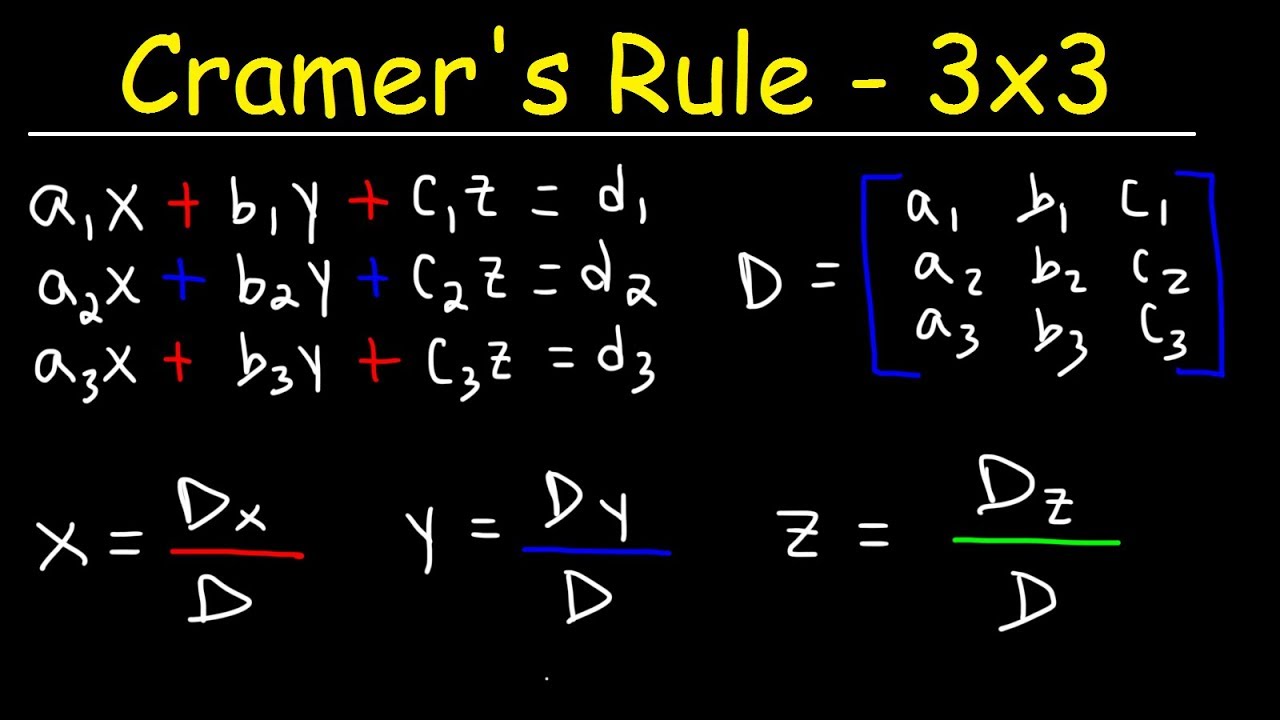
This precalculus video tutorial provides a basic introduction into Cramer's rule. It explains how to solve a system of linear equations with 3 variables using determinants of 3x3 matrices.
Algebra Review: https://www.youtube.com/watch?v=i6sbjtJjJ-A
Matrices - Free Formula Sheet:
https://www.video-t...
this will explain better than i can
but yeah you get the four matricies from the equations, then you find determinants, then you can get x,y,z from those determinants
round geyser
Is D=2
mild cloak
yeah
determinant of D = 2
what about determinant of Dx, determinant of Dy, determinant of Dz (once you have found what Dx, Dy, Dz are)
round geyser
Dx we know is 15
X=15/2
Dy = (-2x0)-(3x3)=-9
Y=-9/2
Dz= (-1x-5)-(2x3)=-1
Z=-1/2
mild cloak
round geyser
We know Dx is (3x5)-(-5x0)=15
this is incorrect
what formula are you using?
 mild cloak
no, for the matricies Dx, Dy, Dz
like what did you find Dx to be
from the equations
round geyser
(ei-fh)
round geyser
mild cloak
like what did you find Dx to be
15
 mild cloak
yeah, but from cramer's rule, what would Dx be?
you replace the x column with the constant values
so Dx =
9 -2 3
-4 3 0
17 -5 5
now you can find the determinant of Dx
with Dy, you take D and replace y column with constant values. with Dz you take D and replace z column with constant values
mild cloak
who are you talking to?
mild cloak
round geyser
So Dx is 268
i think it should be 144 64
round geyser
I watched the video while I’m doing it
mild cloak
yeah cause det(Dx) = 3 * (20 - 51) + 5 * (27 - 8) = 64
so x = 64/2 = 32
anyway follow with that same proccess for Dy and Dz
that video explains cramer's rule well
surreal spire
No worries.
surreal spire
mild cloak
who are you talking to?
I guess it's nothing.
 half kiln
willow skiff
<@728482160927047742> I searched it up and there's so many solutions online
half kiln
willow skiff
<@728482160927047742> I searched it up and there's so many solutions online
ye they dont make sense
sleek magnet
mild cloak
https://www.youtube.com/watch?v=Ot87qLTODdQ
cramers rule 2x2 was more fun lol
I tried deriving it myself after learning it before
round geyser
Yes
 dry verge
Huh, statistics is part of precalculus?
 winter comet
dry verge
Huh, statistics is part of precalculus?
winter comet
dry verge
Huh, statistics is part of precalculus?
precalculus is a combination of algebra, trig, and introductions to various topics explored deeper in later math. So yeah it can be
dry verge
winter comet
precalculus is a combination of algebra, trig, and introductions to various topi...
Huh, that's really interesting.
I'm finally getting back into statistics... through precalculus... through the Integrated Math section on Khan Academy!
surreal spire
dry verge
Huh, statistics is part of precalculus?
Umm....
That's not Statistics.
surreal spire
dry verge
Huh, statistics is part of precalculus?
That's Probability.
dry verge
I thought probability was part of statistics.
winter comet
probability is typically considered to be part of statistics
winter comet
round geyser
How about Rational Equation
is there more context...?
 vagrant lake
😭 im just trying to study for my final using ai and this is what i get
 viscid thistle
winter comet
precalculus is a combination of algebra, trig, and introductions to various topi...
viscid thistle
winter comet
precalculus is a combination of algebra, trig, and introductions to various topi...
Review
mortal nimbus
been working on a resource for differential calculus (calc 1), with some linear algebra and animations to illustrate the ideas.
i’m thinking of teaching out of it next time i run a calculus course and would really appreciate any feedback on its clarity and usefulness. here’s the link: https://math-website.pages.dev/
 mental wind
 rigid breach
and is it important for IMO and stuff
rigid breach
and is it important for IMO and stuff
Naah
 plucky rover
winter comet
precalculus is a combination of algebra, trig, and introductions to various topi...
plucky rover
winter comet
precalculus is a combination of algebra, trig, and introductions to various topi...
bruh statistics is not in precalculus
winter comet
plucky rover
bruh statistics is not in precalculus
permutations and combinations are commonly taught in a precalculus class, and these are topics that most people consider to be "statistics"
not that precalculus goes deep into statistics though
winter comet
nice
 void ruin
hie
plucky rover
Hi
 modest bolt
Don't send your checkpoints in math channels. 
 deft gull
vagrant lake
😭 im just trying to study for my final using ai and this is what i get
deft gull
vagrant lake
😭 im just trying to study for my final using ai and this is what i get
I haven't even graduated highschool, but i feel the flow to study this
 floral belfry
How to learn Calculus?
celest tulip
floral belfry
How to learn Calculus?
There are a lot of options to choose from :)
I personally got introduced to calculus via Khan Academy. The course is pretty beginner friendly, and guides you through the basics of calculus. It's not that in-depth, but it does give you a framework of what topics in calculus you need to study.
https://www.khanacademy.org/math/calculus-1
Furthermore, there are other youtubers such as Professor Dave and OrganicChemTutor on youtube that have hundreds of videos on these topics, so feel free to check them out too!
https://www.youtube.com/playlist?list=PL0o_zxa4K1BWYThyV4T2Allw6zY0jEumv
https://www.youtube.com/playlist?list=PLybg94GvOJ9ELZEe9s2NXTKr41Yedbw7M
I think however both of these resources are a little limited. If you want a more rigorous approach to understanding calculus, you should get a textbook. The type of textbook depends on where you are, but I would recommend getting any calculus textbook recommended by your school or by your college. For reference, I used a lot of the Cambridge Maths books, so if you can find a Cambridge book then that could be useful.

YouTube

YouTube
Everyone thinks calculus is super hard! And it is, kind of. But with this series, you'll get a superb foundation of conceptual understanding regarding differ...
celest tulip
floral belfry
How to learn Calculus?
If you are asking for a more personal-oriented way to learn calculus, the best advice is the same for most topics - take it slow, and be curious. Calculus is a step up from algebra such that you are now introducing the concept of 'infinity' into your analysis. As such, it can be a little difficult trying to understand calculus, since they introduce a whole new way of thinking about functions. So, the only thing you can do is take it slow. Make sure you properly understand the content - if you can understand content, you will save yourself time (as you won't need to go back and reread chapters!), and also try and look for the interesting parts of calculus (why are you studying calculus? What new or interesting things did you find when you read through a chapter?).
Importantly so, make sure your knowledge of functions is strong. In calculus, you are sort of expected to have a good understanding of how functions work, as well as have a wide repetoir of them. If you are doing a textbook problem and you find you don't understand how a function is behaving, go back to your precalculus notes an look into that function a little bit more. My standard would be that you should know and have dealt with most of the elementary functions:
(Linear, Quadratic, Cubic, Polynomial, Square Roots, Logs, Exponentials, sin cos and tan graphs ESPECIALLY).
static zealot
surreal spire
Hmm...
its too late now 💔
mortal nimbus
celest tulip
There are a lot of options to choose from :)
I personally got introduced to calc...
surreal spire
static zealot
its too late now 💔
As expected.
 hot raven
hi I’m running into pre calc and how do you solve for integrals again?
ancient anvil
hot raven
hi I’m running into pre calc and how do you solve for integrals again?
your precalc class talks abaout integrals?
hot raven
yes
ancient anvil
well i'd be damned that's a full calc topic
hot raven
oh it is?
ancient anvil
which I haven't reached yet
hot raven
yeah but rn we learning about it
ancient anvil
what country you live in???? ap precalc in the us doesn't get to that??
hot raven
I’m in California
winter comet
bros precalc class is just a calc class in disguise
ancient anvil
hot raven
What do u guys usually learn in pre calc
see the channel description
hot raven
How do u check that
ancient anvil
click the text next to channel name at the top
hot raven
what do I press after that
ancient anvil
it's the textbox that pops up
hot raven
Do I press links?
 modern yarrow
I got pre calc next semester is it bad
ancient anvil
hot raven
Do I press links?
there are no links its just the textbox
anything in the us precalc curriculum goes here, examples include: trigonometry, logarithmic and exponential functions, function sketching, etc.
hot raven
I can’t find it can u just tell me
modern yarrow
bruh
ancient anvil
hot raven
I can’t find it can u just tell me
i just sent the fucking textbox text
 fervent valve
Yeah I’m in cali too and we learned that before pre calc
If it’s different here
Ig*
ancient anvil
fervent valve
Yeah I’m in cali too and we learned that before pre calc
you did not learn integral calculus before pre-calc what country is this
modern yarrow
california
hot raven
it’s kinda easy
fervent valve
ancient anvil
you did not learn integral calculus before pre-calc what country is this
No I meant the text u sent
modern yarrow
the country of cali
hot raven
just some equations can get confusing with integrals in pre calc
ancient anvil
california is all sorts of messed up is what I'm taking away from this
fervent valve
Like the trig and stuff
I haven’t seen an integral yet
But I have seen everything in this channel description before pre calc
ancient anvil
did you all see the integral symbol in that class because I sure did not
fervent valve
ancient anvil
did you all see the integral symbol in that class because I sure did not
nope
ancient anvil
i'm falling for interaction bait /j
fervent valve
I’ll send you my algebra 2 homework from last year 😭
 fervent prawn
If you have a question asking you to work out the set of values for which some function is decreasing
Can u do that with the gradient functions sketch
uncut mulch
Yes

 sly spade
 verbal dew
what is the function p(i) and is B a const? if so what is B
verbal dew
the context is that this is the formula for the binary to decimal conversion
willow bear
verbal dew
not an equation therefore no solution
willow bear
verbal dew
the context is that this is the formula for the binary to decimal conversion
what are you actually trying to do?
are you trying to learn non-ten bases?
do you have a practice question in front of you, or did you think that mathematicians are wizards who can decipher any magic spell aka bunch of symbols you throw at them?
willow bear
verbal dew
I'm gonna go with the wizard one
well then you are extremely wrong abt that
winter comet
verbal dew
final answer
bro thinks hes on Who Wants To Be a Millionaire
 remote crest
I dont get what im doing wrong I think this should be correct
 tender questBOT
Show your work, and if possible, explain where you are stuck.
celest tulip
remote crest
I dont get what im doing wrong I think this should be correct
^
Any justification for your ordering?
Maybe some sort of diagram :)
remote crest
celest tulip
^
Any justification for your ordering?
well ik that u+v have to be the biggest cuz its in the first 90deg
celest tulip
remote crest
well ik that u+v have to be the biggest cuz its in the first 90deg
Hm, well you are right - but your justification is a little dodgy. What about them both being in the first 90 degrees makes them have the largest magnitude?
remote crest
celest tulip
Hm, well you are right - but your justification is a little dodgy. What about th...
cuz they are both positive
and also like the smallest one is gonna be w+z cuz they in quad 2 and 3
and those and negitive
celest tulip
remote crest
cuz they are both positive
Wdym? Complex numbers don't have parity
As in, you can't say the complex number 1 - 2i is 'positive' or 'negative'.
remote crest
celest tulip
Wdym? Complex numbers don't have parity
wait is that true
celest tulip
Well yeah I mean
remote crest
oop I forgot about that
celest tulip
In a real number space, we define positive and negative to be "positive when bigger than 0" or "negative when less than 0". So yeah, we don't have that ordering in complex numbers.
remote crest
oohhh
celest tulip
remote crest
I dont get what im doing wrong I think this should be correct
If I were to recommend a strategy,
I would consider the hint provided in the question :)
remote crest
Okay thank you
celest tulip
As another hint: ||Complex numbers are vectors. That means if we add complex numbers, it is the same as adding vectors. How do we add vectors?||
 sweet halo
why does dy/dx tend to infinity at a vertical tangent to a curve
thick breach
sweet halo
why does dy/dx tend to infinity at a vertical tangent to a curve
tangent is the slope at the point, if slope parallel to vertical axes then it is 90 degrees
tan90 tends to infinity
willow skiff
sweet halo
why does dy/dx tend to infinity at a vertical tangent to a curve
if you think about any vertical asymptote, the change in y will be infinite, but the change in x will be a finite number
(change in y)/(change in x) = ...
thick breach
<@&268886789983436800> scam

 random dune
Since these are real integrals they likely fall better under #calculus but
I will say I get the same answer
 idle hawk
yay!!
random dune
:))
 hidden latch
idle hawk
ok i got 1/20 *sin(5x^4)+c for number 4
hidden latch
idle hawk
ok i got 1/20 *sin(5x^4)+c for number 4
That's absolutely correct
I assume you put m=5x^4 and integrated it further
 haughty nexus
how hard is pre calc
thick breach
haughty nexus
how hard is pre calc
Easier than calc
 neon root
haughty nexus
how hard is pre calc
neon root
haughty nexus
how hard is pre calc
Not
haughty nexus
So it's easy?
 patent surge
 ionic temple
just curious any textbook recommendations for calculus
im currently in alg2 but i wanna self study out of curiosity
sweet halo
willow skiff
if you think about any vertical asymptote, the change in y will be infinite, but...
wouldnt there be no change in x
as a vertical tangent indicates that its one constant x value
sweet halo
thick breach
tangent is the slope at the point, if slope parallel to vertical axes then it is...
oh i didnt think abt it that way
 reef acorn
is there any channel for normal calc in pre university or is it undergrad
ok it's undergrad
thick breach
sweet halo
as a vertical tangent indicates that its one constant x value
We compare change of dy w.r.t dx as dx is constant and dy goes from -infinity to +infinity slope is undefined or infinite
 pale nacelle
I am wondering if you can obtain the maximum value of $x^{\frac{1}{3}} - x^2$ without using calculus?
obsidian monolithBOT
KrisOFC
 pale nacelle
The problem was to find the range of that function
It's an upside down (imperfect) parabola and basically trying to find the vertex
hushed sphinx
pale nacelle
I am wondering if you can obtain the maximum value of $x^{\frac{1}{3}} - x^2$ wi...
I don't think so. The natural approach would be to change variables to t=x^(1/3), and then differentiate t-t^6 to find the stationary point, which ends up with a nice exact solution in terms of radicals (in other words, better than we'd expect just from the degree).
pale nacelle
hushed sphinx
I don't think so. The natural approach would be to change variables to t=x^(1/3)...
I see, thank you!
 clear violet
I got $f(x) = \sqrt{2}\cdot(1.4142)^{x}$
Is this correct?
 raw hill
clear violet
I got $f(x) = \sqrt{2}\cdot(1.4142)^{x}$
Is this correct?
raw hill
clear violet
I got $f(x) = \sqrt{2}\cdot(1.4142)^{x}$
Is this correct?
I'd just leave it in exact form as
$$f(x)=\sqrt{2} \left(\sqrt{2} \right)^x=\left(\sqrt{2} \right)^{x+1}$$

 raw hill
obsidian monolith
**Civil Service Pigeon**
raw hill
obsidian monolith
**Civil Service Pigeon**
but this is fine
you can also write this as ||2^((x+1)/2)|| if you want to
clear violet
obsidian monolith
**Civil Service Pigeon**
Ah yes I see now. Thank you. I don't get how that exact form simplifies to (sqrt(2))^{x+1} though
raw hill
clear violet
Ah yes I see now. Thank you. I don't get how that exact form simplifies to (sqrt...
Use the exponent rule $$a^b \cdot a^c=a^{b+c}$$
obsidian monolithBOT
Civil Service Pigeon
 clear violet
obsidian monolith
**Civil Service Pigeon**
clear violet
obsidian monolith
**Civil Service Pigeon**
OH man, of course. You're a lad!

 swift sphinx
ok so im doing calculus rn, specifically trigonometric integration and i have a question, why do we label some functions as "u", "du", "-du" etc. i heard my teacher say that its just for simplicity but i don't understand it..
willow bear
swift sphinx
ok so im doing calculus rn, specifically trigonometric integration and i have a ...
you must be thinking of u-substitution?
theres gotta be a chapter on that in your book
 vapid raptor
swift sphinx
ok so im doing calculus rn, specifically trigonometric integration and i have a ...
vapid raptor
swift sphinx
ok so im doing calculus rn, specifically trigonometric integration and i have a ...
I thought it was just people changing the variable x to u?
Purely due to preference?
sonic hill
Well, you change like the varibale x to be some function of u. But you have to change the differential as well
So for example
If you wanted to integrate something like this:
\begin{equation*}
\int 2x\sin(x^2)dx
\end{equation*}
What you could do is let another variable, which we just call $u$, we let $u=x^2$. If we do this, then it follows that $\frac{du}{dx}=2x$. And now, multiply both sides by $dx$, we get
\begin{equation*}
du=2xdx
\end{equation*}
Comparing this to the integral we started with, $\int\sin\underbrace{(x^2)}{u}\underbrace{2xdx}{du}$, this just becomes:
\begin{equation*}
\int 2x\sin(x^2)dx=\int\sin udu
\end{equation*}
Which we can integrate easily, right?
obsidian monolithBOT
pebble
 sonic hill
That's the entire idea of variable substitution
And when you integrate sinu, you get -cosu, -cos(x^2) + C
swift sphinx
willow bear
theres gotta be a chapter on that in your book
believe it or not there isnt a chapter on substitutions even tho everyone seems to be doing 'substitutions'
only my teacher
told me this method
its not in my textbook
i just double checked
swift sphinx
vapid raptor
I thought it was just people changing the variable x to u?
me too
sonic hill
swift sphinx
i kinda get it
You should practice with it now
 plucky ivy
tis shiii correct ? pls someone conifrim tis

 echo quartz
What do you guys think about my website ? https://quant-forge.com/
 pale anchor
Hello guys, can you explain the parity of this function ?

 smoky stratus
pale anchor
Hello guys, can you explain the parity of this function ?
smoky stratus
pale anchor
Hello guys, can you explain the parity of this function ?
isn't it an even function?
pale anchor
Apparently this is not an even function (not for this interval)
But idk how to prove it
 charred rapids
pale anchor
But idk how to prove it
charred rapids
pale anchor
But idk how to prove it
Because that function doesnt satisfy that f(x)=f(-x) for every x on domf , as domf isnt "centered" in 0
(Because how the interval is defined, not because of the expression x^2 )
 hasty relic
pale anchor
But idk how to prove it
hasty relic
pale anchor
But idk how to prove it
take any x in the domain, except 0, and if f(x)=f(-x) doesn't hold, it's not even
 quick pebble
charred rapids
Because that function doesnt satisfy that f(x)=f(-x) for every x on domf , as do...
quick pebble
charred rapids
Because that function doesnt satisfy that f(x)=f(-x) for every x on domf , as do...
not exactly the right way of putting it
quick pebble
hasty relic
take any x in the domain, except 0, and if f(x)=f(-x) doesn't hold, it's not eve...
this misses the point too
quick pebble
pale anchor
Hello guys, can you explain the parity of this function ?
take a look at the definition, that should answer all your questions
A function f: U -> R is called even if for every x in U, -x is also in U and f(-x) = f(x)
2pi is in the domain of f but -2pi is not so f cannot be an even function
simple as that
hasty relic
quick pebble
this misses the point too
could you clarify how
quick pebble
hasty relic
could you clarify how
you don't know a priori that -x is in the domain for your arbitrary x
hasty relic
quick pebble
you can't talk about f(-x) if -x isn't in the domain
let me be a little more precise
the mirror image of the function in the y axis, is not the same function, therefore it isn't even
here mirror image means for y=f(x), the mirror image if y=g(x) where g(x)=f(-x)
quick pebble
that's not precise
and it still has the same issue as the previous thing
A function f: U -> R is called even if for every x in U, -x is also in U and f(-x) = f(x)
simple enough
pale anchor
Okay I underdstand now thanks guys for ur helps
 brave hinge
pale anchor
Hello guys, can you explain the parity of this function ?
brave hinge
pale anchor
Hello guys, can you explain the parity of this function ?
These are the intervals from 0 to ≈6.28, since pi = 3.14
And the value of the function is equal to this number squared.
- ∀x — this inverted "A" icon reads as "For any" or "For every" x.
- ∈[0, 2π[ — this icon means "belongs to the gap".
• The number 0 is the beginning.
• The number 2π is approximately 6.28 (since π≈3.14).
• A strange parenthesis [at the end — in some countries, this is how they designate a "round" parenthesis. This means that the number 2π itself is not included in the interval. That is: "for any number from 0 to 6.28". - f(x) = x^2 — well, you already know that. This is a common x-squared function (a parabola).
brave hinge
brave hinge
And the value of the function is equal to this number squared.
That is, this