#precalculus
1 messages · Page 81 of 1
 frail lion
 sweet hearth
thanks
sweet hearth
I am not necessarily thanking you because you helped me,I am just thanking because people nowadays barely have it in them to read a full paragraph. Even about enjoyable stuff like I have made long anime theories and most of the comments are like "I ain't readin allat".
frail lion
Anime theories
sweet hearth
yeah
frail lion
Ok man cool
I guess
Small thing
Infinitesimally small
Is dx
Continuously adding dx gives us big thing
And that continuous adding is integral
 lone temple
so integration is integral but limited?
lone temple
no i mean thats obvious but im telling about the meaning of integral and stuffs
if i understand dx i think i might understand integration using subsitution xd
frail lion
Integration might not be limited
Don't give limits to it
Write c constant after integral
 trim shard
this is a very nice (and loaded) question
frail lion
Lucy gonna be typin sum crazy explaination about dx probably
trim shard
lone temple
if i understand dx i think i might understand integration using subsitution xd
you probably already know this, but in an integral, dx mostly just tells us that we are integrating with respect to the variable x. however, what dx really represents is this really infinitesimally small change (smaller than delta x and for that we represent it as dx) in x. when we sum up the product of some functions height by the infinitesimally small widths (dx), we get the total area under the curve which is our integral
trim shard
frail lion
Lucy gonna be typin sum crazy explaination about dx probably
 where there is maths there is some cool history too
lone temple
f(x) as height and the symbol of integral is sum so its sum of infinite rectangles with each area is f(x)*dx with dx extremely small to make the area more accurate?
trim shard
lone temple
f(x) as height and the symbol of integral is sum so its sum of infinite rectangl...
exactly that!
lone temple
i understood it, thanks!
trim shard
area of each rectangle would be f(x)*dx where f(x) represents h and dx represents width
trim shard
lone temple
i understood it, thanks!
ofc 
 forest sleet
Say you have a function f(x), you can stretch it, invert it, change the x and y position of the index, but how do you rotate it by theta degrees upon the origin?
 summer ruin
apply the rotation matrix to the graph, if that's your intent
forest sleet
summer ruin
apply the rotation matrix to the graph, if that's your intent
Thanks
 uncut star
frail lion
Anime theories
uncut star
frail lion
Anime theories
But I am one of them
frail lion

I want information about this parabola
How can I deduce things about a tilted parabola ?
Like axis , directrix and all
 raw hill
frail lion
How can I deduce things about a tilted parabola ?
raw hill
frail lion
How can I deduce things about a tilted parabola ?

Mathematics LibreTexts
In previous sections of this chapter, we have focused on the standard form equations for nondegenerate conic sections. In this section, we will shift our focus to the general form equation, which can …
Rotate the axes
Then rotate everything back
 obsidian monolithBOT
Civil Service Pigeon

 proud tangle
raw hill
$(x+y)^2=4x-2$
proud tangle
raw hill
$(x+y)^2=4x-2$
What do the $ signs mean?
frail lion
$wassup$
obsidian monolithBOT
Sam
 obsidian monolithBOT
nomnom15

 fair minnow
I have a multivarible system question. Ik it's more algebra, but these have 4 varibles. Does anyone have a method for solving these?
uncut star
Gaussian elimination or just long substituting
uncut star
fair minnow
I have a multivarible system question. Ik it's more algebra, but these have 4 va...
I am assuming linear equations here
fair minnow
uncut star
I am assuming linear equations here
Well, 4D systems i guess.
uncut star
Can you show the equations
frail lion
uncut star
Gaussian elimination or just long substituting
Bro what is gaussian
Elimination
frail lion
Hmm idk about matrices
fair minnow
It's not one specifically, but more of an algorithm i could follow
to keep the numbers straight.
frail lion
What question do you wanna solve bro
Or you're jus randomly asking
No specific question
fair minnow
nothing specific. sorry. nvm
uncut star
fair minnow
nothing specific. sorry. nvm
Certain equations involving logs are unsolvable using elementary algebra
 faint sail
Anyone got files for amplitudes?
frail lion
What wym
 celest lantern
Can someone tell me what I’ve done wrong?

 upbeat vine
celest lantern
Can someone tell me what I’ve done wrong?
upbeat vine
celest lantern
Can someone tell me what I’ve done wrong?
Sin inverse -1 is -π/2
 ornate mist
what the hell kinda pre cal are u taking
cos starts from the top, sin starts from the bottom
from the origin
if its -cos and - sin just flip them
 obtuse narwhal
hello everyone, someone can recommend me a good book for precalculus? i need theory, not the problems
like "precalculus from stewart" or something like that
 molten hearth
can someone explain how to graph trig functions, specifically cot/sec/csc? i need some practice problems/example problems
 timid spruce
why does $real(e^{ix}) = \cos(x)$ and $imag(e^{ix}) = \sin(x)$?
obsidian monolithBOT
esoij
 timid spruce
please ping btw
 river drift
timid spruce
why does $real(e^{ix}) = \cos(x)$ and $imag(e^{ix}) = \sin(x)$?
river drift
timid spruce
why does $real(e^{ix}) = \cos(x)$ and $imag(e^{ix}) = \sin(x)$?
are you familiar with taylor series?
frail lion
timid spruce
why does $real(e^{ix}) = \cos(x)$ and $imag(e^{ix}) = \sin(x)$?
It's actually by Taylor series
timid spruce
river drift
are you familiar with taylor series?
nope
frail lion
Yeah actually bro the thing is that
river drift
well do you know any calculus?
frail lion
Yeh exactly my question too
timid spruce
river drift
well do you know any calculus?
yeah
i like just started calculus class a few month ago
im still learning derivatives in my class
river drift

Euler's formula about e to the i pi, explained with velocities to positions.
Help fund future projects: https://www.patreon.com/3blue1brown
An equally valuable form of support is to simply share some of the videos.
Special thanks to these supporters: https://www.3blue1brown.com
Not familiar with the calculus referenced in this video? Try takin...
not sure if this is at your level yet but you can try watching it
timid spruce
river drift
https://www.youtube.com/watch?v=v0YEaeIClKY
thank you
makes sense to me
 fallow hemlock
obtuse narwhal
hello everyone, someone can recommend me a good book for precalculus? i need the...
fallow hemlock
obtuse narwhal
hello everyone, someone can recommend me a good book for precalculus? i need the...
better to ask in #book-recommendations
frail lion
 obsidian monolithBOT
 raw hill

Mathematics Stack Exchange
If n is a positive integer I need to show that
$2^n-(n-1)2^{n-2}+\frac{(n-2)(n-3)}{2!}2^{n-4}-...=n+1$
My guess: Somehow I need two equivalent binomial expression whose coefficients I need to
frail lion
I don't understand the solution can ya explain?
frail lion
@raw hill bro wot
 neon ingot
upbeat vine
Sin inverse -1 is -π/2
neon ingot
upbeat vine
Sin inverse -1 is -π/2
which is 3pi/2
 limber holly
frail lion
limber holly
frail lion
which book's questions is this? i want.to buy it
frail lion
It's in no book
limber holly
frail lion
It's in no book
so what it is?
raw hill
frail lion
I don't understand the solution can ya explain?
Which solution? What specifically don’t you understand? We need some more context to help you out here.
frail lion
limber holly
so what it is?
Some assignment that I got
frail lion
raw hill
*Which* solution? What specifically don’t you understand? We need some more cont...
Yeah I got it
No problem
upbeat vine
neon ingot
which is 3pi/2
Yh
limber holly
frail lion
Some assignment that I got
so which class or some exam's assignment is it?
 bitter shoal
hello
Help me understand this if I’m doing it wrong because my precalc teacher can’t teach properly she just give us a packet
For the first property the x->4^-is the hole in the graph and the -5 is what the solution of the function should be once the hole is put into x in the equation
The second property the x->2^+ is the vertical asymptote and the negative infinity is how the graph behaves from the right side
And the last property is the horizontal asymptote
 raw hill
bitter shoal
Help me understand this if I’m doing it wrong because my precalc teacher can’t t...
raw hill
bitter shoal
Help me understand this if I’m doing it wrong because my precalc teacher can’t t...
The first property doesn't necessarily mean that there's a hole at $x=4$. The graph could just pass through $(4,-5)$.
obsidian monolithBOT
Civil Service Pigeon
 raw hill
your second and third ones are fine
limber holly
frail lion
Jee advanced pattern
can u please dm it to me?
limber holly
 azure mist
As a tenth-grader, I'm curious
azure mist
As a tenth-grader, I'm curious
its much easy brother,its just an a binomial function
azure mist
limber holly
its much easy brother,its just an a binomial function
Explain
raw hill
raw hill
https://math.stackexchange.com/questions/1618039/show-that-2n-n-12n-2-fracn-2n-3...
@azure mist
frail lion
limber holly
can u please dm it to me?
No
frail lion
Too lazy
uncut star
frail lion
Too lazy
But where are you getting these from
The question looks insanely hard
limber holly
uncut star
The question looks insanely hard
bro do challanges and thrills of precollege mathematics 4th edition book,then u will know the real meaning of "hard"
uncut star
limber holly
bro do challanges and thrills of precollege mathematics 4th edition book,then u ...
Isn't that hard
Except geometry
Well it is known for geometry
limber holly
uncut star
Isn't that hard
did u done tht book?
uncut star
So what am I even doing
uncut star
limber holly
did u done tht book?
Only the combinatorics part
limber holly
so is it a good book?
limber holly
uncut star
Only the combinatorics part
Why not the whole?
uncut star
limber holly
Why not the whole?
I never got the time to complete it
But the combinatorics wasn't too bad
 cinder heron
frail lion
cinder heron
frail lion
looks like something related to the binomial theorem 
limber holly
uncut star
I never got the time to complete it
why did u evn just did the combinatorics part then?
uncut star
limber holly
why did u evn just did the combinatorics part then?
Uh I like combinatorics
That is the only reason
And then I gave up on mo
uncut star
limber holly
why did u evn just did the combinatorics part then?
Excursion was much harder though
limber holly
uncut star
That is the only reason
means?say clearly
limber holly
uncut star
Excursion was much harder though
in that book? well,which book did u may prefer me to do for deeper understanding in mathematics?
uncut star
limber holly
in that book? well,which book did u may prefer me to do for deeper understanding...
Whichever book you like
It depends on the reader
Pretty much any standard book does the trick
Excursion is good though
limber holly
uncut star
Pretty much any standard book does the trick
and did u do That book for whom's saying or by whom u get to know Abt tht book)?
limber holly
uncut star
Excursion is good though
in tht book?
uncut star
limber holly
and did u do That book for whom's saying or by whom u get to know Abt tht book)?
I saw it online
It was recommended by pretty much everyone
limber holly
uncut star
It was recommended by pretty much everyone
So which book r u doing now? and did u choose tht book for exam or self study?
uncut star
limber holly
So which book r u doing now? and did u choose tht book for exam or self study?
I am not doing any book now
As I said I quit mo
limber holly
uncut star
As I said I quit mo
oh olympiad prep ,noice ,so wht r u doing now? drinking juice?
uncut star
limber holly
oh olympiad prep ,noice ,so wht r u doing now? drinking juice?
Nothing really
limber holly
well ,u probably tlking to me
uncut star
Wasting time
Anyways you can go through any number of books you like but most competition math books do not have a lot of theory
So it is better to just search up competition math problems online
limber holly
uncut star
Wasting time
\documentclass[12pt]{article}
\usepackage{amsmath, amssymb}
\begin{document}
\section*{Elite-Level Challenge Problem}
Let (a, b, c) be positive integers such that
[
\frac{1}{a} + \frac{1}{b} + \frac{1}{c} = 1
]
and (a \le b \le c).
\begin{enumerate}
\item Find \textbf{all possible triples} ((a, b, c)).
\item Prove that there are \textbf{exactly finitely many solutions}.
\end{enumerate}
\end{document}
obsidian monolithBOT
THE ONE
Compile Error! Click the  reaction for more information.
(You may edit your message to recompile.)
 limber holly
done this qstion
uncut star
I have seen it somewhere
uncut star
limber holly
its toooooop esy
?
uncut star
Have a nice day mate
 arctic raptor
hi
i dont understand the unit circle thing in precalc
anyone know of any good ytbers for precalc bc i wasnt there for my teachers lectures
 haughty spoke
arctic raptor
anyone know of any good ytbers for precalc bc i wasnt there for my teachers lect...
haughty spoke
arctic raptor
anyone know of any good ytbers for precalc bc i wasnt there for my teachers lect...
The Organic chemistry tutor is best
He explains it very well
arctic raptor
tyyy
 craggy canyon
frail lion
craggy canyon
frail lion
Hi
raw hill
<@&268886789983436800> spammed amongst multiple channels
 stuck dagger
arctic raptor
anyone know of any good ytbers for precalc bc i wasnt there for my teachers lect...
stuck dagger
arctic raptor
anyone know of any good ytbers for precalc bc i wasnt there for my teachers lect...
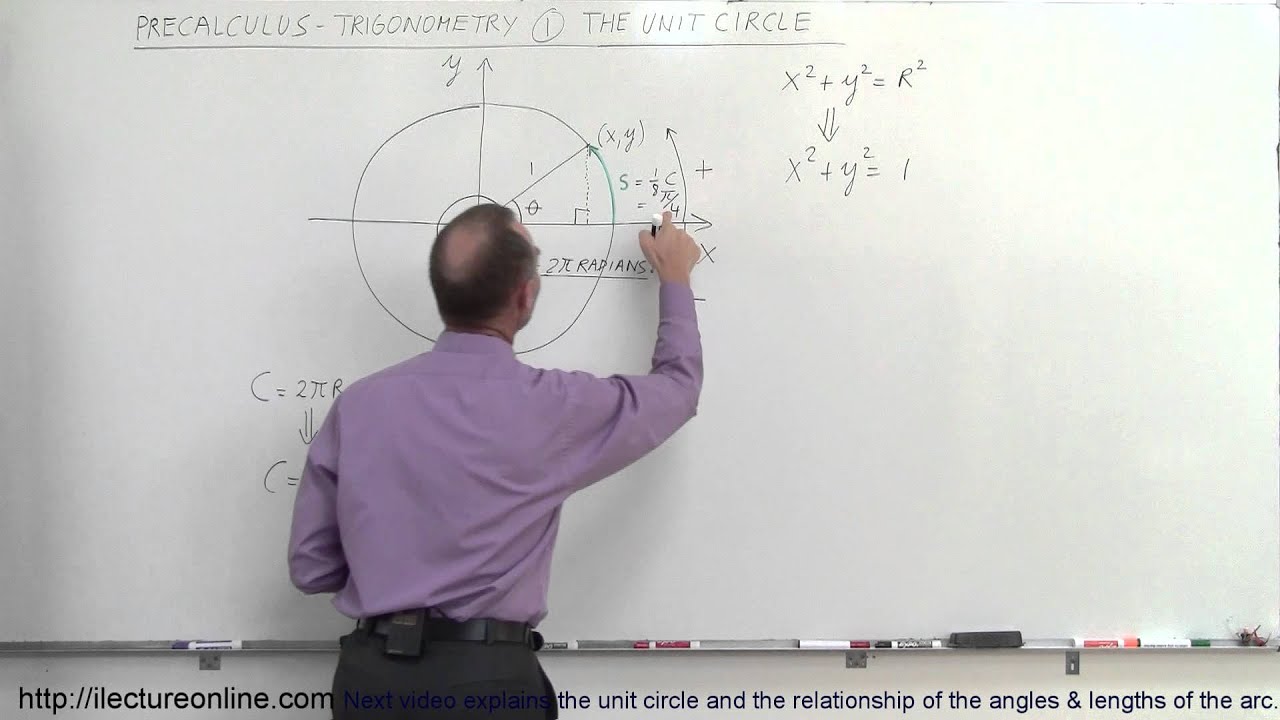
Visit http://ilectureonline.com for more math and science lectures!
In this video I will introduce and explain the unit circle and the relationship of the sides and angles.
This guy is pretty good
Darn
His name is Michel Van Bizen
raw hill
<@&268886789983436800> multiple channel spam

 unkempt lodge
I'd assume "gradient of 1" means that y = 1 if x = 2, so you can just substitute y with 1 and x with 2, then evaluate for k
unkempt lodge
oh wait sorry, gradient means slope i forgot huhu
unkempt lodge
 cedar garnet
But i dont know how to differentiate with fractions
cedar garnet
But i dont know how to differentiate with fractions
use quotient rule
 hard kernel
can soemone expalin triangular numbers and the bionomial theorem to me
 willow skiff
hard kernel
can soemone expalin triangular numbers and the bionomial theorem to me
willow skiff
hard kernel
can soemone expalin triangular numbers and the bionomial theorem to me
do you still need help?
 acoustic apex
Whats a gradient
acoustic apex
hard kernel
can soemone expalin triangular numbers and the bionomial theorem to me
Triangular numbers are numbers that are triangular
 hushed sphinx
An analogue of "slope" that works for linear functions of several variables.
acoustic apex
hushed sphinx
An analogue of "slope" that works for linear functions of several variables.
Oh ok
willow skiff
acoustic apex
Oh ok
imagine you are climbing up some hill
the direction where you gain elevation the fastest is the gradient
acoustic apex
Ok
hard kernel
willow skiff
do you still need help?
na ty though
 lethal lion

 dense zealot
 neon herald
How do I know what to do first (stretch flip etc)
neon herald
How do I know what to do first (stretch flip etc)
🤔 what exactly do you mean by this
What are you trying to do?
neon herald
We have to identify the parent function, then graph it, then graph the changes.
dense zealot
Im not sure where the confusion is here
Are you concerned with the manual graphing?
neon herald
Ye
I just don’t know in what order to do the things
Specifically the things outfrount
dense zealot
neon herald
Oh well something nice about this parabola is that it’s in vertex form
dense zealot
neon herald
I just don’t know in what order to do the things
Well I like to start with getting the important stuff down like your plotting a point for ur vertex
Do yk how to find the vertex?
neon herald
We already have it? I’m just trying to do transformations.
dense zealot
Well I thought the confusion was the order of transformations
neon herald
Ye?
dense zealot
You only have shifts in the horizontal and vertical axis
No stretches no compressions
Those are the only transformations
neon herald
I think I’m just gonna ask my teacher tomorrow
 willow breach
neon herald
willow breach
neon herald
you too have adhd?
i also, always, even now, have a video running in the background, when im doing something else.
 fallow hemlock
neon herald
fallow hemlock
neon herald
yay transformations
translations come last
work from the inside-out
neon herald
willow breach
Nah I’m just bored and wanted to watch a tornado vid while doing my hw
willow breach
neon herald
Nah I’m just bored and wanted to watch a tornado vid while doing my hw
can you help me in dms
neon herald
No sorry
fallow hemlock
neon herald
How do I know what to do first (stretch flip etc)
correct me if i am wrong, but this should be the order:
\begin{enumerate}
\item horizontal shift: replace $x$ with $x - h$ (right $h > 0$)
\item horizontal reflection: replace with $-(x - h)$
\item horizontal stretch/compress: $b \cdot (\pm (x - h))$ (stretch by $1/|b|$)
\item input absolute: $|b \cdot (\pm (x - h))|$ (erase/reflect left of y-axis)
\item apply base $f$: $f(|b \cdot (\pm (x - h))|)$
\item output absolute: $|f(\cdot)|$ (reflect below x-axis up)
\item vertical stretch/compress: $a \cdot |\cdot|$ (stretch by $|a|$)
\item vertical reflection: $-a \cdot |\cdot|$
\item vertical shift: $\pm a \cdot |\cdot| + k$ (up $k > 0$)
\end{enumerate}
*for the form
[
y = \pm a \left| f\left( \pm b \left| x - h \right| \right) \right| + k
]
obsidian monolithBOT
∫_M dω = ∫_∂M ω

 heady bluff
This might be a bit vague but can anyone give me a basic overview of the essential topic areas to know about exponential and logarithmic functions?(I have a test tomorrow) and I’m doing a last minute review
Thanks!
fallow hemlock
heady bluff
This might be a bit vague but can anyone give me a basic overview of the essenti...
firstly, do you know the definition of an exponential and logarithmic function?
heady bluff
fallow hemlock
firstly, do you know the definition of an exponential and logarithmic function?
Yes
fallow hemlock
heady bluff
Yes
what are they?
and also make sure you know your properties of exponents/logarithms too
aside from that do exponential growth/decay problems
you should be familiar with the limit and series definitions of e and e^x also
heady bluff
fallow hemlock
what are they?
Exponential function is of the form y= b^x / y = a•b^x or f(x) whtever and b can never be negative if I’m correct
heady bluff
fallow hemlock
and also make sure you know your properties of exponents/logarithms too
Yup
heady bluff
fallow hemlock
and also make sure you know your properties of exponents/logarithms too
I’m working on tht tonight too lol
heady bluff
fallow hemlock
you should be familiar with the limit and series definitions of e and e^x also
Kk
For logarithms it’s of the form log in base 10 usually X = Y
And X also cannot be negative too I forgot
And ik the basic stuff like how to convert between exponential and logarithmic form already so im pretty good with tht
fallow hemlock
heady bluff
And X also cannot be negative too I forgot
how about telling me what the domain and range of log(x) are?
that should answer your question lol
fallow hemlock
heady bluff
Exponential function is of the form y= b^x / y = a•b^x or f(x) whtever and b can...
there is another restriction on b
can you tell me what that is?
heady bluff
fallow hemlock
how about telling me what the domain and range of log(x) are?
All real numbers?
fallow hemlock
heady bluff
Kk
oh if you didn't cover that in class, don't worry about it
they'll likely show up later in precalculus
heady bluff
heady bluff
All real numbers?
Oh shoot wait no
The uh
Domain is
All positive numbers
Cuz since the domain can’t be negative
The graph doesn’t go below the x axis into the negative
fallow hemlock
heady bluff
All real numbers?
nope
heady bluff
heady bluff
All positive numbers
Mb I corrected myself here I was thinking of the range probably
Idk
Is that right?
fallow hemlock
range is all real numbers
domain is all positive real numbers
do you know interval notation?
you can write this as (0, ∞) for the domain and (-∞, ∞) for the range
( means greater than
[ means greater than or equal to
) means less than
] means less than or equal to
or do you use set-builder notation?
heady bluff
fallow hemlock
do you know interval notation?
I do
heady bluff
fallow hemlock
you can write this as (0, ∞) for the domain and (-∞, ∞) for the range
Yes
heady bluff
fallow hemlock
or do you use set-builder notation?
We use interval notation
So when solving for equations of logs and exponential functions would I use the same properties of logs to rearrange and solve them?
 grim magnet
Could someone please help me with this?
I don’t know if this is right 😭

 slow zinc
@grim magnet so that cant actually be factored further from 2x(2x^2-x+3)
but your method is still wrong, the way you tried to do it is called slide and divide factoring
above is just a random pdf i found online on the correct method
grim magnet
Thank you but all three numbers have an X….🤔
slow zinc
?
2x(2x^2-x+3) cannot be further factored
the (2x^2-x+3) does not have x on all the terms
fallow hemlock
heady bluff
So when solving for equations of logs and exponential functions would I use the ...
example?
obsidian monolithBOT
Couldn't find an attached image in the last 10 messages.
 hidden birch
,rccw
obsidian monolithBOT
 obsidian monolithBOT
south
 heady bluff
willow skiff
do you mean e^(2x + 1) = 200?
heady bluff
willow skiff
do you mean e^(2x + 1) = 200?
Yes
willow skiff
heady bluff
Yes
alright, what happens when you take ln of both sides?
heady bluff
Would the e and the ln cancel on the left and then the ln stays on the 200 on the right?
After I put the exponent infront of the ln infront of the e?
willow skiff
heady bluff
Would the e and the ln cancel on the left and then the ln stays on the 200 on th...
yep! the e and ln undo each other
heady bluff
Okay!
willow skiff
so can you write out the new equation you get then?
willow skiff
heady bluff
(2x + 1) = ln 200
yep!
so then remember that ln(200) is just a number, like any other number
2x = ln(200) - 1
and so on
willow skiff
heady bluff
By 2?
yep!
so to write this online you need brackets around the (ln(200) - 1)
on paper you don't need brackets cause you can write it as a fraction
heady bluff
So X = ln (200) -1/2 and then I simply to a decimal if needed?
willow skiff
heady bluff
So X = ln (200) -1/2 and then I simply to a decimal if needed?
careful
x = (ln(200) - 1)/2
heady bluff
Oh whoops mb!
willow skiff
heady bluff
Oh whoops mb!
no worries!
 jagged dust
Hi I'm new to pre calc any tips
 uncut mulch
make sure you're 100% good with basic algebra
 tame elk
hello
hushed sphinx
heady bluff
Is anyone available?
It is unlikely that anyone will promise to answer your question before you even ask it. The most reliably way to find out whether anyone is willing and able to answer a question from you is to ask it. That will give readers a chance to figure out whether they have an answer before they make any rash claims.
tame elk
hello troposphere how are you my friend
hushed sphinx
Do I know you?
 dapper harbor
hushed sphinx
Do I know you?
dapper harbor
hushed sphinx
Do I know you?
LOL😂
 hardy igloo
I’m planning to start an electronics engineering university next year, not a native english speaker (though I’m at C1 level), and I’m looking for a good book to learn pre-calculus. Could anyone recommend one?
fallow hemlock
hardy igloo
I’m planning to start an electronics engineering university next year, not a nat...
aops precalculus
if that's too difficult, read aops intermediate algebra first
or if you want something a bit more challenging, "basic mathematics" by serge lang
 celest minnow

 desert shadow
Heyy, good night from my country.
Im looking for a book that clearly explains limits, functions and graphs. Do you know of any? 👀
willow skiff
desert shadow
Heyy, good night from my country.
Im looking for a book that clearly explains l...
yes, James Stewart's Precalculus
 desert shadow
willow skiff
yes, James Stewart's *Precalculus*
desert shadow
willow skiff
yes, James Stewart's *Precalculus*
Thank you✨️
raw hill
 bronze sorrel
The idea is fine, but your use of the implication symbol and dropping the limit notation is off
\begin{align*}
\lim_{x \to 0} \frac{1 - \cos(3x)}{x^2 + 2x} &= \lim_{x \to 0} \frac{1 - \cos(3x)}{x(x + 2)} \
&= \lim_{x \to 0} \frac{1 - \cos(3x)}{(3x)^2} \cdot \frac{(3x)^2}{x(x+2)} \
&= \lim_{x \to 0} \frac{1 - \cos(3x)}{(3x)^2} \cdot \lim_{x \to 0} \frac{9x^2}{x(x+2)} \
&= \frac{1}{2} \cdot \lim_{x \to 0} \frac{9x}{x+2} \
&= \frac{1}{2} \cdot \frac{9(0)}{0+2} \
&= \frac{1}{2} \cdot \frac{0}{2} \
&= \frac{1}{2} \cdot 0 \
&= 0
\end{align*}
obsidian monolithBOT
Civil Service Pigeon
 raw hill
Something like this would be better
bronze sorrel
obsidian monolith
**Civil Service Pigeon**
ok thanks
 void pine
I just bombed my test -_-
 woven thicket
everyone does, not many don't
 brisk mica
Bro i feel like i couldve just skipped ap precalc, it feels so ez
 hazy delta
bronze sorrel
why do u use if and only if? ( <=> )
hazy delta
bronze sorrel
why do u use if and only if? ( <=> )
Manditory by our school and teachers
Because the propositions are correct in both ways
bronze sorrel
i guess
hazy delta
Not using an equivalency arrow is a wrong notation, they say
bronze sorrel
u can just exapand (x-1)(x+1)......
and say vx³
will be dominant
or does that not
if x € R and not N
bronze sorrel
let me get my pen and paper
hazy delta
All the factors in the denominator must be ≠
bronze sorrel
and try to solve it myself
hazy delta
Okayy
bronze sorrel

@hazy delta
sorry for my messy writing
im on 2 hours of sleep
but see how the terms are +,-,+,-/-,+,-,+
that means that k/v ≤ 0
the other cases are just what ifs
pretty sure they will never be dominant unless maybe with x=1
i forgot
that its all Real numbers
maybe this doesnt if its all real numbers
hazy delta
bronze sorrel
but see how the terms are +,-,+,-/-,+,-,+
Why are you expanding all of this
fallow hemlock
hazy delta
Because the propositions are correct in both ways
works but nobody does that lol it's kinda bloated
in solving inequalities, it's not strictly necessary unless you're emphasizing that each transformation preserves the solution set
you can simply use "→" or proceed step-by-step without any symbol, as long as each manipulation is valid
@hazy delta i can show you how i'd solve this
 echo kraken
Im not sure if this is the right thread: But how do you find the last 2 digits of 7^3^2^(1/3)^(-1)^9^2^i^6? Saw this online (lost the source)
And another question: How should I solve x(4^x)=80? Online calculators work, but im not sure what are the steps and working.
woven thicket
echo kraken
Im not sure if this is the right thread: But how do you find the last 2 digits o...
From right to left you should be able to simplify the last 6 exponents
echo kraken
woven thicket
From right to left you should be able to simplify the last 6 exponents
Which gives 7^3^8, right?
echo kraken
woven thicket
From here probably some number theory tricks
... Like what? The issue is that 7^3^8 is... extremely large and the laws of indices dont help much from here.
echo kraken
I think we should look at the 3^8 part - given that its 7^(3^8)
woven thicket
I am, but haven't found anything useful
hushed sphinx
You only want the last 2 digits, so 7^(3^8) mod 100, and phi(100)=40, so by Euler's theorem you want 3^8 mod 40.
However 3^4=81 which is 1 modulo 40, so 3^8 is also 1 modulo 40, and you're now looking for 7^1 mod 100.
echo kraken
hushed sphinx
However 3^4=81 which is 1 modulo 40, so 3^8 is also 1 modulo 40, and you're now ...
Which is 7.
hushed sphinx
Explicit calculation with a bignum calculator confirms that 7^(3^8) is a 5545-digit number that ends with ...,741,152,007
echo kraken
hushed sphinx
Explicit calculation with a bignum calculator confirms that 7^(3^8) is a 5545-di...
I see, thanks! Sorry for the trouble.
hushed sphinx
Was no trouble.
hushed sphinx
echo kraken
And another question: How should I solve x(4^x)=80? Online calculators work, but...
There's no good general symbolic method for that.
If we look for integer and then rational solutions by trial and error, it doesn't take long to find x=5/2 -- but if there had not been such a nice solution, there wouldn't really be anything to do but to approximate it numerically (say, by more trial and error, or bisection, or Newton-Raphson).
You can get tools like Wolfram Alpha to create a symbolic expression for the solution that involves the Lambert W function -- but for most practical purposes that is just a cop-out that says if you want actual digits you'll have to find them numerically anyway.
 lusty light
hello
 runic dew
 dreamy basin
Next year 🥵
dreamy basin
Next year 🥵
is it difficult
 autumn spire
runic dew
is it difficult
autumn spire
runic dew
is it difficult
no
 viscid thistle
what does precalculus mean
hushed sphinx
It's a group of loosely connected topics that in American school systems are named for the fact that they are taught before calculus.
(Silly naming if you ask me, but what can you do?)
viscid thistle
hushed sphinx
It's a group of loosely connected topics that in American school systems are nam...
ohh, mhm thanks. weird but then ok
 harsh rune
viscid thistle
what does precalculus mean
harsh rune
viscid thistle
what does precalculus mean
highschool calculus
woven thicket
Okay I'm not sure what category this question is, so I just ask here. I remember a theorem states that there's always at least [I think] a prime between p and 2p, does anyone know what's it called?
hushed sphinx
woven thicket
Okay I'm not sure what category this question is, so I just ask here. I remember...
Bertrand's postulate.
 magic wyvern
anyone here a teacher that i can interview?
 jagged badge
So im in middle school but i really like math and physics and i know basic differential and integral calculas but i always have this doubt that how is the differentiation of sinx = cosx
all yt teachers just said like its a formula i have to learn it but i want to know how it was like derived pls dont include too high level stuff
 modern wedge
you can use the definition of a derivative
f'(x) = f((x+h)-f(x))/h as h approaches 0
put in f(x) = sin x
use a few identities and the fact that sin h/h approaches 1 as h tends to 0
jagged badge
oh thanks
and can u also tell a like a good yt channel that explains calculas from the basics in a interesting way language english
@modern wedge
 woven thicket
hazy delta
woven thicket
hazy delta
You can't conclude 2^x=12 or 2^x-1=12 from the line above
Or even not at all in this problem
woven thicket
Wydm cancel them
woven thicket
If x(x-1)=12 does that imply x=12 and/or x-1=12
 stray lynx
hey can someone help rq. I keep trying to so this and I get similar answers but never right on.
 hushed sphinx
Could you explain what you're doing and which wrong answers you get?
(Also: weird bizarro world where interest rates stay constant for 15 years at a time and the interest is compounded continuously).
 winter comet
hushed sphinx
(Also: weird bizarro world where interest rates stay constant for 15 years at a ...
winter comet
hushed sphinx
(Also: weird bizarro world where interest rates stay constant for 15 years at a ...
Hey I wouldn't complain
 shadow mantle
stray lynx
hey can someone help rq. I keep trying to so this and I get similar answers but ...
shadow mantle
stray lynx
hey can someone help rq. I keep trying to so this and I get similar answers but ...
use the compound interest formula
 dusky oxide
stray lynx
hey can someone help rq. I keep trying to so this and I get similar answers but ...
dusky oxide
stray lynx
hey can someone help rq. I keep trying to so this and I get similar answers but ...
is this deltamath
dreamy basin
runic dew
is it difficult
yes
dreamy basin
autumn spire
no
HELLLLLLLLLLLL NAHHHHHHHHHHH

I actually took it last year
I mean, this year but :v
🤡
its hard as hell
 magic mist
Good luck soldier
 dry sierra
I don't understand lmvt properly,what is it's main uses
hushed sphinx
"lmvt"?
 woeful cosmos
hushed sphinx
"lmvt"?
woeful cosmos
hushed sphinx
"lmvt"?
i believe he means lagrange mean value theorem
dry sierra
woeful cosmos
i believe he means lagrange mean value theorem
yes
 raw hill
 stiff elk
You can check this yourself in #bots
,w remainder when x^10 + x^8 is divided by x-1
obsidian monolithBOT


 Requested by civil_service_pigeon
hushed sphinx
Requested by civil_service_pigeon
hushed sphinx
In general, when you divide any polynomial p(x) by x-a, the remainder is always p(a).
(And here f(1) is obviously 2).
stiff elk
,w remainder when X^6-10 is divided by x-2
obsidian monolithBOT

 Requested by 1__shiny__1
stiff elk
Requested by 1__shiny__1
stiff elk
is this how you use it?
hushed sphinx
Weird that it doesn't deign to show any result; it shouldn't be all that bad.
Ah, it's confused because you mixed X and x.
stiff elk
oh
hushed sphinx
stiff elk
nice thank you
what I do is for the x - 2 I set it equal to 0 then use the 2 and plug it into f(x)
is this the right way or are there other ways?
hushed sphinx
That's generally the quickest if your divisor is of degree 1 and you just want the remainder.
stiff elk
alright thank you
hushed sphinx
It's not the only way, of course -- for example, you could use the generic polynomial long division method.
stiff elk
ok nothing to complicated thanks
 ancient kelp
guys i just started into calculus can any of yall explain what its abt
 tender hare
There are two parts of calculus. One is differential calculus and another is integral calculus. In differentiatial calculus i.e. derivatives u have to find slope of a line and its intercept point on respect to x axis. More clearly The derivative measures the instantaneous rate of change of a quantity with respect to another. It tells you how much a function's value is changing at a specific point.and in integral calculus u have to find areas of curve ,rectangles that represents a function in a graph. It's the inverse method of derivative. Thats it .Good luck
 honest canyon
Any good lecture video of differential and integral calculus where they teach from basic also
 slow solstice
I might need help later if I can’t do this homework right😭
This class is making me break down😭
 magic void
Pre calculus
 sonic hill
tender hare
There are two parts of calculus. One is differential calculus and another is int...
sonic hill
tender hare
There are two parts of calculus. One is differential calculus and another is int...
I find it makes more sense in terms of differentials, but yea
slow solstice
slow solstice
I might need help later if I can’t do this homework right😭
I think I got it finnaly😭
 thorn leaf
matrices are scary
lone temple
thorn leaf
matrices are scary
i havent known much about it yet but indeed it looks scary lol
thorn leaf
they terrify me
lone temple
also can someone explain me about chain rule, why is
[f(g(x))]'=f'(g(x))*g'(x)????
sonic hill
lone temple
also can someone explain me about chain rule, why is
[f(g(x))]'=f'(g(x))*g'(x)??...
I mean, just kind of intuitively, whatever ypu change about the inputs of a function like f(x + 5), or f(5x) or f(g(x)), those operations transform the graph that's shown sure, but think about it like they're transforming the xaxis itself, and all the points on the graph follow along with it. So for f(g(x)), the function f is of course going to change at a rate f'(g(x)), but then you habe to also multiply it by the rate that the x axis changes now because of g, so you multiply by g'(x).
And this surely isn't precalc...
lone temple
 drowsy citrus
[f(g(x))]' is equal to f'(g(x))*g'(x)
drowsy citrus
[f(g(x))]' is equal to f'(g(x))*g'(x)
sorry i wrote it wrong lol
lone temple
sonic hill
And this surely isn't precalc...
i find this channel to ask calculus only
sonic hill
sonic hill
I mean, just kind of intuitively, whatever ypu change about the inputs of a func...
Does this make sense?
 modern zodiac
Wanted to confirm if this question is correct or not?

If it helps, this question was taken from the UNSW Integration Bee 2022 Knockout Round-3 Question 2
 arctic prism
does calculus help distracting me
 storm halo
modern zodiac
Wanted to confirm if this question is correct or not?
storm halo
modern zodiac
Wanted to confirm if this question is correct or not?
bitfh that’s not even pre calc
that’s like multi variable on steroids
modern zodiac
storm halo
that’s like multi variable on steroids
😭 but it's only 2 variables...
storm halo
modern zodiac
😭 but it's only 2 variables...
oh!
well idk what type of pre calc YOURE learning but that’s like so complicated and im in honors pre calc
modern zodiac
I'm just a JEE aspirant that likes to tackle Olympiad problems i guess
storm halo
modern zodiac
I'm just a JEE aspirant that likes to tackle Olympiad problems i guess
oh clock it
 left laurel
What is 1+1
hushed sphinx
left laurel
What is 1+1
A fairly reliable recipe for being thrown out of a math server if that's all you appear to want to use it for.
 echo sinew
left laurel
What is 1+1
echo sinew
left laurel
What is 1+1
10
left laurel
Ohhh
modern zodiac
left laurel
What is 1+1
Everyone gangsta until you need to prove it
 hardy crypt
left laurel
What is 1+1
hardy crypt
left laurel
What is 1+1
1+1
1+succ(0)
succ(1+0)
succ(1)
2
slow solstice
Anybody know what the heck question 6 and beyond talking about😭 why does it have sin and cos😭

 swift sequoia
slow solstice
Anybody know what the heck question 6 and beyond talking about😭 why does it hav...
swift sequoia
slow solstice
Anybody know what the heck question 6 and beyond talking about😭 why does it hav...
the question asks you to solve the inequality of (2cos -1)(sin +1) < 0 then ig
 patent barn
At least one side is already 0
So just use your tricks and summon the answer
slow solstice
😭
 modern zodiac
 woeful widget
Can you send a more complete photo? I can't see the whole problem...
 honest marlin
Can someone hop on a call with me and explain integration?
Kindly DM me, any help is appreciated
 gaunt sleet
Someone teach me differentation
echo sinew
gaunt sleet
Someone teach me differentation
Be more specific
Do you have an exercise?
gaunt sleet
Yh
echo sinew
gaunt sleet
Like first principles
Go watch Khanacademy or Organic Chemistry Tutor on YouTube
They explain everything from scratch
gaunt sleet
Ok
 muted widget
woeful widget
muted widget
woeful widget
Is this college algebra in your country?
gaunt sleet
What are topology
echo sinew
It's almost impossible and too many things to be taught here in Discord
echo sinew
gaunt sleet
What are topology
! redir
 tender questBOT
gaunt sleet
What are topology
tender questBOT
gaunt sleet
What are topology
This channel is only for on-topic discussion. Please take casual conversation to #discussion or #chill.
 hallow tartan
id love someone to be my study partner that is doing atleast 3 out of the 5: maths, computer science, biology, chemistry, physics. I am currently in yr11 but im already learning as-level at home. I just finished as pure maths and am doing as physics and chem. I am actually decently smart. add me if u wanna be my partner and message me
sonic hill
hallow tartan
id love someone to be my study partner that is doing atleast 3 out of the 5: mat...
I'm also doing those / have done them already :p
hallow tartan
Nice
 still brook
what is 0.5% as a fraction
winter comet
still brook
what is 0.5% as a fraction
what does % mean
still brook
percentage 💔
winter comet
yeah, if its a percent you multiply it by 1/100
winter comet
yes
 prisma ferry
hi gang im severely uneducated in the world of calculus may i ask how do i start learning and what do i need to know before learning 
im a 9th grader idk if that helps and i just like math and want to learn in advance 
 gloomy vector
prisma ferry
im a 9th grader idk if that helps and i just like math and want to learn in adva...
gloomy vector
prisma ferry
im a 9th grader idk if that helps and i just like math and want to learn in adva...
I think if you have a solid grasp of these 3 then you’ll be good

 gloomy vector
I’m also in 9th grade but I’ve seen some visualization videos of calculus through YouTube and it’s really interesting
gloomy vector
prisma ferry
thank you!!
You’re welcome! I hope that helped
 swift sphinx
i just got a question, why do we sometimes add +C in different integration equations
dense zealot
swift sphinx
i just got a question, why do we sometimes add +C in different integration equat...
integration is just the opposite of differentiation
whenever u differentiate a function that has a constant u just leave it out
we factor in that constant whenever we integrate
swift sphinx
dense zealot
whenever u differentiate a function that has a constant u just leave it out
oh ok
 somber void
Alternatively, because to find area under a curve from an antiderivative you have to find F(x_2) - F(x_1), so if you have a constant there it's going to cancel out
woeful widget
muted widget
Is this college algebra in your country?
Yes
 pearl hinge
would anyone be able to hop in a vc and explain how to find limits and prove continuity using the epsilon-delta definition of a limit?
 normal saffron
anyone got tips for learning permutations and combinations? really need some
 red ivy
prisma ferry
hi gang im severely uneducated in the world of calculus may i ask how do i start...
red ivy
prisma ferry
hi gang im severely uneducated in the world of calculus may i ask how do i start...
If you just want to learn integrals and derivates then go Source: Pauls Online Math Notes https://share.google/7C2503dXaoXcn7bN4
If you want to understand the concept behind calculus then watch some youtube videos
But i shud tell you that you should first learn limits and series before starting to integrate and derive as this will make it easier later on when u need to combine them
Here is a set of notes used by Paul Dawkins to teach his Calculus I course at Lamar University. Included are detailed discussions of Limits (Properties, Computing, One-sided, Limits at Infinity, Continuity), Derivatives (Basic Formulas, Product/Quotient/Chain Rules L'Hospitals Rule, Increasing/Decreasing/Concave Up/Concave Down, Related Rates, ...
red ivy
normal saffron
anyone got tips for learning permutations and combinations? really need some
There are like 4 theories for them
No point to get tips
prisma ferry
red ivy
If you just want to learn integrals and derivates then go Source: Pauls Online M...
tysm!!! 
 whole void
red ivy
There are like 4 theories for them
whole void
red ivy
There are like 4 theories for them
wdym?
red ivy
whole void
wdym?
Like there are only 4 theorems for those 2 stuff
whole void
red ivy
Like there are only 4 theorems for those 2 stuff
I think there’s more than that, but it depends on what u want to do
red ivy
whole void
I think there’s more than that, but it depends on what u want to do
What are there
The formulas for both
Einsteins thingymajig and something im probably forgetting so thats 4
whole void
red ivy
What are there
The formulas for both
Einsteins thingymajig and something im prob...
Einsteins?
I mean there are things like (n choose 0) + (n choose 1) + … + (n choose n) = 2^n
somber void
Yeah cuz that's the expansion of (1+1)^n
red ivy
whole void
I mean there are things like (n choose 0) + (n choose 1) + … + (n choose n) = 2^...
Yeah
That
whole void
somber void
Yeah cuz that's the expansion of (1+1)^n
Sure, if u prove the binomial theorem
But the binomial theorem is harder to prove
hushed sphinx
It's so useful that it has to be proved anyway.
whole void
Yeah
another classic proof is thinking about making a choice of choosing or not choosing each of n objects
 magic juniper
still brook
what is 0.5% as a fraction
magic juniper
still brook
what is 0.5% as a fraction
I just like to think of it as percent meaning over 100
that is it
somber void
I just like to think of it as a number % = 1/100
 sterile thorn
 wispy widget
Does the points where a function and its inverse meet always lies on y=x?
somber void
I don't think so
echo sinew
wispy widget
Does the points where a function and its inverse meet always lies on y=x?
I'd say it's either on y = x or they're symmetric about that line
somber void
It has symmetry about y=x, but that just means any point that already were at y=x would map to itself by reflection, if it weren't on y=x it could conceivably map to some other part of the graph
echo sinew
For example y = -x which is its own inverse as well
somber void
On the other hand, I can't immediately think of a counterexample
Ok, y = -x and y = 1/x are counterexamples, but are there counterexamples that aren't their own inverses
Yes
y = 1/x^2 - x^2
So the answer to your question is no, but it does surprisingly often
wispy widget
echo sinew
I'd say it's either on y = x or they're symmetric about that line
Yeah you are right, but it's only false in case a function is same as its inverse , otherwise the statement is true
somber void
wispy widget
Yeah you are right, but it's only false in case a function is same as its invers...
Wrong

This is a clean function, there is no multiple branches shenanigans or anything, and it isn't its own inverse
But it intersects its own inverse infinitely many times, and only one of those intersections lies at y=x
So if you want to try salvaging this conjecture, maybe consider limiting it to only polynomials, or saying that if it intersects itself, then there is at least one intersection at y=x or some other form of making it weaker
willow skiff
I'm pretty sure this works for polynomials as a consequence of FTA
hushed sphinx
How about 1-x³? It is invertible, but (0,1) and (1,0) are in the intersection between the graph and its inverse.
willow skiff
oh, good catch
yeah if you think about FTA, that implies that there can be a maximum of 2n intersections for a polynomial with degree n and its inverse, I hope
frankly there are just too many exam questions where they only intersect where y = x
cause those exam questions are contrived
 quiet juniper
theres no calculus channel so idk if i can ask this here
dont need help just curiosity
but could anyone well versed in calc tell me if an infinite taylor series is actually "equal" to the function youre trying to "approximate"?
even if you cover the entire domain of the function hence the infinite part are there any small inaccuracies whatsoever throughout the curve of say sin(x)? or does it perfectly match sin(x) for every input of x?
im thinking that it isn't completely exact because we dont take the derivative at every value but maybe my understanding is wrong
winter comet
quiet juniper
but could anyone well versed in calc tell me if an infinite taylor series is act...
it is
the approximation is only for finite taylor series
quiet juniper
winter comet
<#326138772477575180>
thanks idk why it doesnt show for me
winter comet
but an infinite taylor series is exactly the function
quiet juniper
winter comet
but an infinite taylor series is exactly the function
good to know
winter comet
just like an integral is exactly the value of the area
quiet juniper
so if its finite it'll have inaccuracies
winter comet
not an approximation anymore
winter comet
quiet juniper
so if its finite it'll have inaccuracies
yes
winter comet
quiet juniper
thanks idk why it doesnt show for me
if you grab the undergrad role you should be able to access all the channels
you don't need to actually be an undergrad to take the role you can have it if you're doing that type of math or just really if you want to lol
quiet juniper
alright i can see it now
hushed sphinx
#calculus is in the Early University category which is accessible even without any of the math-level roles.
It might not be shown in the channel list unless your choices in Channels & Roles select it, though.
 tough lake
I am in grade 12 and learning pre calculus 12
I have found a new branch of mathematics called discrete math, set theory and mathematical logic
Pre calculus 12 never covers these topics
How important are these topics from a mathematical standpoint
I plan on taking calculus and learning lots of maths
 deft jetty
set theory is a requirement for most math so thats very useful
the others can be useful as well
 round geyser
tough lake
I am in grade 12 and learning pre calculus 12
I have found a new branch of math...
round geyser
tough lake
I am in grade 12 and learning pre calculus 12
I have found a new branch of math...
You are in a similar situation with me
modern zodiac
The feeling when you apply Integral by parts and reach the original question again after 5 steps
sonic hill
modern zodiac
The feeling when you apply Integral by parts and reach the original question aga...
??
 opaque spire
Hlo
 signal crypt
opaque spire
Hlo
signal crypt
opaque spire
Hlo
bye
opaque spire
signal crypt
bye
Are you a maths expert
signal crypt
no
opaque spire
How much maths you know
signal crypt
how do yo measure it?
opaque spire
Yes I am starting maths
After a long time
How much time it will take to master integration and calculus
sonic hill
It will depend on how much time you put toward it, but you could probably get through Calculus 1 through Calculus 4 in a 8-10 months to a year maybe if you go fast?
Maybe even faster than that, I'm not really sure. Why?
opaque spire
sonic hill
It will depend on how much time you put toward it, but you could probably get th...
I have to give a exam for master which requires maths for entrance
😭8months
sonic hill
How much calculus do you need to know?
 tender questBOT
 spice aurora
What step are you on?
1. I don't know where to begin.
2. I have begun but got stuck midway.
3. I got an answer but I was told that it's wrong.
4. I got an answer and would like my work checked.
5. I have a question about someone else's work/solution.
6. I have completed the problem and don't need help anymore. Thank you.
7. None of the above
1
woven thicket
spice aurora
1
Given side lengths of both square for example a and b, how can you find the shaded area?
Let just ignore the increase/decrease rate of those sides for now
spice aurora
woven thicket
Given side lengths of both square for example a and b, how can you find the shad...
okay let me try
spice aurora
woven thicket
Given side lengths of both square for example a and b, how can you find the shad...
yea i totally faild i dont know from where to start
woven thicket
We can get the shaded are by subtract the smaller triangle from the bigger one if you know what I mean
The base of both triangle are the same and heights can be found using Pythagore
spice aurora
woven thicket
We can get the shaded are by subtract the smaller triangle from the bigger one i...
oh i see it now
spice aurora
woven thicket
The base of both triangle are the same and heights can be found using Pythagore
but i have to get the area in terms of a and b not numbers right?
woven thicket
Yeah
spice aurora
woven thicket
Yeah
if a is small square Length and b big square then it should be A= 1/2 ab - 1/2 a^2
yea i guess it is wrong
spice aurora
spice aurora
if a is small square Length and b big square then it should be A= 1/2 ab - 1/2 a...
is this right or not?
round geyser
Hey
There is 2 formulas you will use
Difference of cubes and Quadratic formula
 hidden birch
round geyser
Difference of cubes and Quadratic formula
hidden birch
round geyser
Difference of cubes and Quadratic formula
quadratic formula is for finding roots
the original problem seems to be about factoring, not finding roots
it was a polynomial expression but not an equation (doesn't equate anything)
,rccw
 somber drum
hi
say i had a line $y=-\frac{b}{a}x+b$ and i wanted the equation of a line parallel to it, thats offset by a vector of (a,b), how would i find it
obsidian monolithBOT
Vq!
 willow skiff
somber drum
hi
say i had a line $y=-\frac{b}{a}x+b$ and i wanted the equation of a line para...
willow skiff
somber drum
hi
say i had a line $y=-\frac{b}{a}x+b$ and i wanted the equation of a line para...
it would be easiest to use point slope form
sonic hill
obsidian monolith
**Vq!**
Offset by a vector?
willow skiff
so just $y - 2b = -\frac{b}{a} (x - a)$ cause that passes through $(a, 2b)$ automatically
sonic hill
Do you mean it passes through (a,b) or that the line is somehow displaced some distance relative to one of its points?
somber drum
sonic hill
Do you mean it passes through (a,b) or that the line is somehow displaced some d...
displaced
willow skiff
sonic hill
Do you mean it passes through (a,b) or that the line is somehow displaced some d...
I'm assuming that they mean to translate every point on the line by the vector (a, b)
somber drum
willow skiff
I'm assuming that they mean to translate every point on the line by the vector (...
yeah this
sonic hill
willow skiff
I'm assuming that they mean to translate every point on the line by the vector (...
Then the line wouldn't necessarily pass through (a,b)
willow skiff
oh wait I did it slightly wrong
willow skiff
obsidian monolith
**Vq!**
this originally goes through (0, b)
somber drum
willow skiff
it would be easiest to use point slope form
whats that?
willow skiff
so you would want the line to go through (0, b) + (a, b) = (a, 2b)
willow skiff
somber drum
whats that?
search it up
somber drum
oh ok
willow skiff
the equation for a line with slope m to pass through a given point
obsidian monolithBOT
south
 sonic hill
uh
y - y1 = m(x - x1)
where (x1,y1) is the point you want the line to pass through and m is the slope
willow skiff
what do you want it to do?
somber drum
okay so i was trying to make a graph thats basically the pythagorean theorem, the squares a and b work fine but whenever a≠b the purple square (c squared) gets.. funky
the graph for reference

 sonic hill
obsidian monolith
**south**
sonic hill
obsidian monolith
**south**
y = m(x - x1) + b + y1
Hmm
Shouldn't it be this?
Before the transformation it passes through (0,b), after the transformation it passes through (x1, b + y1), so point slope gives you y = m(x - x1) + b + y1
willow skiff
sonic hill
Before the transformation it passes through (0,b), after the transformation it p...
except that the vector is already (a, b)
somber drum
so like.. got any fixes 😭
sonic hill
willow skiff
except that the vector is already (a, b)
Yeah?
The vector is always (a,b)
willow skiff
after the transformation it passes through (0, b) + (a, b)
sonic hill
obsidian monolith
**south**
What I'm saying is that you wrote it wrong
It's not $y - 2b = -\frac{b}{a}(x-a)+b$
obsidian monolithBOT
pebble
 willow skiff
oh lol, corrected
sonic hill
it's supposed to be $y=-\frac{b}{a}(x-a)+2b$
obsidian monolithBOT
pebble
 willow skiff
somber drum
yeah this
willow skiff
somber drum
yeah this
yeah I edited my message too fast and it came out wrong
hopefully the most recent one works
somber drum
oh okay
sonic hill
obsidian monolith
**pebble**
Give this a try
somber drum
😭

 somber drum
sonic hill
Give this a try
somber drum
sonic hill
Give this a try
it infact did not guys
sonic hill
hmm, let me think
willow skiff
somber drum
😭
could you send the link to the Desmos graph?
sonic hill
What's the specification of this triangle?
Is it axis aligned, right triangle, what about the angles?
sonic hill
Or do you just specify the a and b length
and a is the length along the x axis toward the right, b is the length along the y axis upward?
somber drum
sonic hill
Or do you just specify the a and b length
a is the base length, b is the height
yes
sonic hill
That's it?
somber drum
yeah
sonic hill
Alright, so the slope would in fact be -b/a.
somber drum
everything ive done has worked up until finding the parallel line which is for c^2
willow skiff
somber drum
everything ive done has worked up until finding the parallel line which is for c...
I know why
you're not translating the line by a perpendicular distance of sqrt(a^2 + b^2)
sonic hill
$-\frac{b}{a}\left(x-\left(a+b\right)\right)+a$
obsidian monolithBOT
pebble
 somber drum
kk
sonic hill
I'm making a diagram to show you
 sonic hill
 obsidian monolithBOT
south
 sonic hill
You see, I've just taken the same triangle and moved it
willow skiff
they work out to the same thing
willow skiff
no worries!
somber drum
thanks guys :>
somber drum
hi guys im confused again 😭
so i was labelling right, i was putting the values in the middle of the square but um, how do i get the coordinate for the middle of c²
 sonic hill
somber drum
so i was labelling right, i was putting the values in the middle of the square b...
sonic hill
somber drum
so i was labelling right, i was putting the values in the middle of the square b...
You could average the four corners of c
somber drum
?
sonic hill
Like
hushed sphinx
@woven thicket please don't delete modpings -- that does not make the ping itself go away, and just makes it more difficult to have to look around to "why was there a ping in this channel".
sonic hill
somber drum
?
The square c has four corners right? So add up the x components for each corner, and divide by 4 to get the center of the square in the x. Then do the same for the y components
woven thicket
hushed sphinx
<@868491408489742427> please don't delete modpings -- that does not make the _pi...
 Oops my bad, there was a scammer here but I pinged mod a bit late
sonic hill
$x_{\text{center}}=\frac{1}{4}(x_1+x_2+x_3+x_4)$
obsidian monolithBOT
pebble
 somber drum
oh
somber drum
sonic hill
$x_{\text{center}}=\frac{1}{4}(x_1+x_2+x_3+x_4)$
it ended up being $\left(\frac{\left(2a+2b\right)}{4},\frac{\left(2a+2b\right)}{4}\right)$
obsidian monolithBOT
Vq!
 obsidian monolithBOT
Vq!

 somber drum
its cause the points are
0,b
a,0
b,a+b
a+b,a
so for x its 2a+2b all over 4 and y is 2a+2b all over 4
sonic hill
yep
somber drum
this is probably just a desmos thing now but how could i display the actual area of a², b², or c²
woven thicket
hmm 
 somber drum
huh
sonic hill
Uhh
woven thicket
I was finding the center... just want to post another approach
somber drum
oh
sonic hill
somber drum
this is probably just a desmos thing now but how could i display the actual area...
 round geyser
woven thicket
hmm <:blankstare:1438715334390583406>
round geyser
woven thicket
hmm <:blankstare:1438715334390583406>
This is Pythagorean theorem
You sum the two squares and it will give you c^2
somber drum
sonic hill
ty
hushed sphinx
Interesting that the line to the center of the square on the hypotenuse always bisects the right angle.
somber drum
oh wait really
somber drum
sonic hill
very interesting indeed
hi dude what if i wanted to show an angle on a graph from like any point
somber drum
what if like the angle changes....
frick im gonna have to use a bunch of stupid trig
somber drum
i finished it :) https://www.desmos.com/calculator/yfzogcjmbp
 ember ore
 last pecan
guys whats harder, Alg 2 or precalc
 icy verge
last pecan
guys whats harder, Alg 2 or precalc
icy verge
last pecan
guys whats harder, Alg 2 or precalc
precalc is harder i just moved to it from alg 2 anyway i like precalc more than alg2
last pecan
i hate alg 2
i hate pascals triangle
and dividing and subtracting and adding rational equations
 lost helm
Can anyone help me qith calc
 willow bear
lost helm
Can anyone help me qith calc
willow bear
lost helm
Can anyone help me qith calc
you should post your question(s); and also we have a #calculus channel where you may have better luck.
viscid thistle
3
 sick crystal
Guys can anyine help on this $y=\frac{1}{\ln^{2}\left(2x-1\right)}$
obsidian monolithBOT
nomaidens
 sick crystal
This is screwed
why is it shaped like that? how can i know how to sketch it on exam, for which x are y values positive..

 hidden coyote
sick crystal
Guys can anyine help on this $y=\frac{1}{\ln^{2}\left(2x-1\right)}$
hidden coyote
sick crystal
Guys can anyine help on this $y=\frac{1}{\ln^{2}\left(2x-1\right)}$

thats how it should look like on a graph
signal crypt
hidden coyote
-4
sick crystal
hidden coyote
so you used some derivation, on end it looks worse, and how do you still know how the graph looks?
the usual log graph looks very differently
signal crypt
,w differentiate (1/(ln^2(2x-1)))
obsidian monolithBOT

 Requested by heisenberg8551
round geyser
Requested by heisenberg8551
round geyser
,w graph log(x)
obsidian monolithBOT

 round geyser
,w graph e(x)
obsidian monolithBOT
 round geyser
,w graph e^(x)
obsidian monolithBOT
 round geyser
,w graph ln(x)
obsidian monolithBOT

 dense mango
how do one-sided derivatives work? in the original definition of the derivative, there's lim as h (growth) approaches 0. so how does h -> 0+ or h -> 0- make sense? I can't wrap my head around this
somber void
in normal derivative you pick point (x, f(x)) on the curve and then consider points (x+h, f(x+h)) where h is small (and approaches 0), but could be negative or positive.
For one sided it is either only positive or only negative. afaik
 grave flame
Is there a book that could help me study pre calculus on my own
Do you guys know any?
lost helm
@grave flame use khan academy, books i don't know any that could help
Or actually use college prep books from the official website
hushed sphinx
dense mango
how do one-sided derivatives work? in the original definition of the derivative,...
This is #calculus rather than pre-calculus, but:
If the derivative exists at some point, the one-sided derivatives will also exists and have the same value. So they're not very interesting in that case.
It becomes more interesting then the full derivative doesn't exist. Then we might still be lucky enough that the one-sided derivatives do exist and can capture at least something about how the function behaves, even if it's not as nice as an actual derivative would be.
 uncut mulch
,rotate
obsidian monolithBOT
 celest lantern
???
obsidian monolithBOT


 placid pebble
,w graph log(x)sin^-1(y)
obsidian monolithBOT

 bitter pier
i am doing right guys?
 willow skiff
bitter pier
i am doing right guys?
willow skiff
bitter pier
i am doing right guys?
the problem is that 1 - sin(pi/2) is still 0
but you can multiply $\frac{1}{1 - \sin x}$ by $\frac{?}{?}$ to make the denominator not have that problem anymore
obsidian monolithBOT
south
 willow skiff
the problem is that 1 - sin(pi/2) is still 0
willow skiff
willow skiff
the problem is that 1 - sin(pi/2) is still 0
and 0 * infinity is an indeterminate form
bitter pier
willow skiff
and 0 * infinity is an indeterminate form
I just do this instead

i use pythagorean identities in the 4th line
willow skiff
bitter pier
I just do this instead
that's wrong
$\sin^2 x (1 - \sin x) = \sin^2 x - \sin^3 x$
obsidian monolithBOT
south
 bitter pier
willow skiff
that's wrong
bitter pier
willow skiff
that's wrong
what part i got wrong?
willow skiff
obsidian monolith
**south**
you need to fix the denominator of your line 4
willow skiff
bitter pier
what part i got wrong?
(ping)
round geyser
obsidian monolith
**south**
Can you distribute
round geyser
obsidian monolith
**south**
What I plug 0 in
 paper thistle
bitter pier
I just do this instead
paper thistle
bitter pier
I just do this instead
fix here

 dense zealot
<@&268886789983436800>
 tepid widget
paper thistle
fix here
tepid widget
paper thistle
fix here
So it's 2 right?
river drift
@grizzled jewel this is a channel for on topic conversation about math. please keep memes in #chill
echo sinew
It's 4! - 5
Now stop trolling
#precalculus message @grizzled jewel
<@&268886789983436800>
paper thistle
tepid widget
So it's 2 right?
Yes
willow breach
bitter pier
i am doing right guys?
L'Hôpítal
modern zodiac
 willow skiff
modern zodiac
modern zodiac
willow skiff
<#326138772477575180>
willow skiff
modern zodiac
modern zodiac
willow skiff
<#326138772477575180>
Actually someone in #discussion wanted a question so I just posted it here for them
They didn't want to go to dms
willow skiff
modern zodiac
Actually someone in <#268882317391429632> wanted a question so I just posted it ...
I know but this is still the wrong channel
modern zodiac
Sorry, I'll use the correct channel from now on.
 unborn dune
how do i find all theta this is what i have rn

i know sin theta can be 1/2 but that cancels out all cosines
and isnt the only solution
 red storm
try using power reduction formula to write cos(t) in terms of sin(t)
i think it would help to add 0 inside the argument so it turns into a multiple of 2
viscid thistle
how to learn precalculus
muted widget
viscid thistle
how to learn precalculus
Go to school
viscid thistle
i do
willow skiff
Khan Academy
 viscid thistle
willow skiff
Khan Academy
viscid thistle
willow skiff
Khan Academy
aiht
 acoustic apex
 errant shard
Erm why can't I access the calculus channel??
errant shard
acoustic apex
Can you see <#326138772477575180>? You may need to enable it in <id:browse>
errant shard
Erm why can't I access the calculus channel??
errant shard
acoustic apex
Can you see <#326138772477575180>? You may need to enable it in <id:browse>
Ah, ic
My mistake
 pine geyser
unborn dune
how do i find all theta this is what i have rn
pine geyser
unborn dune
how do i find all theta this is what i have rn
Interesting method but there is actually an easier way to do this problem. See how those 4theta and 2theta are basically "3theta + theta" and "3theta - theta"? Use this type of prespective to solve the problem!
 umbral dew
pine geyser
Interesting method but there is actually an easier way to do this problem. See h...
umbral dew
pine geyser
Interesting method but there is actually an easier way to do this problem. See h...
godayumm
ong genius
willow skiff
who can spell prosthaphaeresis without looking it up
pine geyser
umbral dew
ong genius
😭😭
umbral dew
thinking out of the box bro

 main bone
willow skiff
who can spell prosthaphaeresis without looking it up
main bone
willow skiff
who can spell prosthaphaeresis without looking it up
I can spell pneumoultramicroscopicsilicovolcaniosys without looking it up yet I have never heard of that word
 median spear
main bone
I can spell pneumoultramicroscopicsilicovolcaniosys without looking it up yet I ...
median spear
main bone
I can spell pneumoultramicroscopicsilicovolcaniosys without looking it up yet I ...
even I can do it!
it's easy to spell and the only time I heard it was in a TV show
 fading iris
I love adding prefixes and suffixed to make words
Priorianticircumnavigationalisticians
 autumn harness
i mean i guess bro
 thick blade

 round geyser
How can a trig equation relate to unit circles
willow skiff
round geyser
How can a trig equation relate to unit circles
by definition, cos theta is the x-coordinate of a point on the unit circle, and sin theta is the y-coordinate
tepid widget
round geyser
How can a trig equation relate to unit circles
It originates from circles
somber void
because trig is about angles, and angles are defined as paths along a circle
 sonic hill
What's linear?
 sonic hill
.71 for what?
round geyser
Sqrt(2)/2
round geyser
I wonder is that the invention of trig
Like as radical

Like linear graph goes through 30 degree and 210 degree
I wonder how many degrees does quadratic goes through
 silver mason
how is this the same
