#precalculus
1 messages · Page 76 of 1
 modest bolt
I think ending should be like "after how many seconds will they both stop at the same time?"
 versed jolt
Those anybody have sam question ⁉️❓
 viscid thistle
one thing we can say is, that's one ABSOLUTELY MASSIVELY GARGANTUAN skyscraper.
 lunar dawn
Anyone care to explain why the integral of $e^ (-x^2)$ is root pi?
 obsidian monolithBOT
Herman Zhang

 summer ruin
you can watch any youtube video that explains this, there are many
the short answer is you square the integral and turn it into a multivariable integral, then switch to polar coordinates and integrate it to get pi as an answer, take the root of that and that's the answer
 obsidian gulch
im screwed
viscid thistle
<@&268886789983436800> there is a slur in there if you look closely
 mental stirrup
viscid thistle
mental stirrup
viscid thistle
@mоdеrаtοrs, what's your emergency?
 river drift
1 term for each function being multiplied
viscid thistle
 dusk hedge
Why derivates that look so simple end being like 10 different terms
dusk hedge
Why derivates that look so simple end being like 10 different terms
give example
 warped shuttle
is this question wrong ?
if a quadratic with y = ax^2 + bx + a - b be tangent to y = 2ax + b
what would be the y part of the tangent point

what i did was equal both equations move them to one side because they are tangent make discriminant zero solve it you have two cases b = 0 and b = -4a and then solve for each case
if we find the x part of the tangent point for both cases and plug them into the equation we got, we will get 0 but if we put them in the original equations we will get 2a so this means 2a should be equal to 0 and thus a = 0 which means we don't have a quadratic which is in contradiction with the question's assumuptions
 simple sage
warped shuttle
is this question wrong ?
if a quadratic with y = ax^2 + bx + a - b be tangent t...
simple sage
warped shuttle
is this question wrong ?
if a quadratic with y = ax^2 + bx + a - b be tangent t...
I’m not sure I understand
Can u rephrase the question
Also dy/dx is 2ax+b, this describes the gradient at any given value of x
simple sage
simple sage
Also dy/dx is 2ax+b, this describes the gradient at any given value of x
This doesn’t necessarily imply y=2ax+b is a tangent
In fact y=2ax+b cannot be a tangent
The value of y at any tangent point with x coordinate x is simply ax^2 + bx + a-b
warped shuttle
simple sage
Can u rephrase the question
If the parabola $y = a x^2 + b x + a - b$ is tangent to the line $y = 2a x + b$, what is the $y$-coordinate of the point of tangency?
obsidian monolithBOT
GodOfPro
 simple sage
warped shuttle
If the parabola $y = a x^2 + b x + a - b$ is tangent to the line $y = 2a x + b$,...
simple sage
warped shuttle
If the parabola $y = a x^2 + b x + a - b$ is tangent to the line $y = 2a x + b$,...
Okay so my thought is
If the line is tangent it will only meet the curve once
So I would plug in y=2ax+b into the parabola equation
And set the discriminant equal to 0
Wait actually will that get u anywhere
simple sage
simple sage
So I would plug in y=2ax+b into the parabola equation
So after this just solve for x I think
warped shuttle
simple sage
So I would plug in y=2ax+b into the parabola equation
what would just make it harder
equaling them to each other and finding the x would result the same
simple sage
warped shuttle
what would just make it harder
You know that bc it’s a tangent the discriminant will be 0
So the b^2-4ac in quadratic formula is 0
Therefore once u have ur coefficients in place
U can just say that x=-b/2a
Note that these a and b are dif to the one in the original question
But rather the coefficients of x^2 and x respectively
warped shuttle
i know that
i have done that my point is i am getting a = 0 which would make the quadratic a line
warped shuttle
warped shuttle
is this question wrong ?
if a quadratic with y = ax^2 + bx + a - b be tangent t...
.
simple sage
warped shuttle
i have done that my point is i am getting a = 0 which would make the quadratic a...
Ur not solving for a ur solving for x
And then for y
 terse pebble
 fresh swan
Can anyone help me asap
fresh swan
Can anyone help me asap
just post your question
fresh swan
I have an answer but my teacher has a different answer and I’m JS confused
 terse pebble
,rotate
obsidian monolithBOT
 terse pebble
fresh swan
I have an answer but my teacher has a different answer and I’m JS confused
terse pebble
fresh swan
I have an answer but my teacher has a different answer and I’m JS confused
what’s your answer
is it what’s crossed out?
fresh swan
-
(-5,-4) U (0,4)
-
(-2,3)
terse pebble
(-2, 3) is not quite right
it needs to be both increasing and concave down
at the same time
remember, it says the rate of change of g
we don’t care about g being positive
which is what it looks like you did by ending the interval at 3
it’s increasing for (-4, 0) and concave down for (-2, 4)
take the intersection of these intervals
fresh swan
(-2,0)?
terse pebble
yes
fresh swan
Alright thx. Was 11 correct?
terse pebble
yes
fresh swan
She had (-5,-4) U (2, 4)
terse pebble
no that’s definitely wrong lmao
"rate of change of g negative" means g is decreasing
g is decreasing if g(x) < g(y) whenever x > y
clearly it’s decreasing on (0, 2) as well
fresh swan
Yeahh alright that’s what I thought too. It had me really confused lmao. Alright but thank you for the help tho🙏🏼
terse pebble
you’re welcome
 wispy niche
If f(x) = x would be the simplest function, what would the most basic integral look like?
 hidden sun
wispy niche
If f(x) = x would be the simplest function, what would the most basic integral...
hidden sun
wispy niche
If f(x) = x would be the simplest function, what would the most basic integral...
I think f(x) = 0 would be the simplest function
wispy niche
hidden sun
I think f(x) = 0 would be the simplest function
Thanks cunningham ❤️ , what about the integral tho?
hidden sun
wispy niche
Thanks cunningham ❤️ , what about the integral tho?
,w integrate 0
obsidian monolithBOT


 Requested by hereischucky
wispy niche
Requested by hereischucky
wispy niche
I see now, thanks
hidden sun
wispy niche
I see now, thanks

 brazen cipher
obsidian monolith
brazen cipher
obsidian monolith
Pre-chalchulus
 dense kelp
can someone explain what this derrivative is doing and how to use apply it for future questions?


 opal patrol
so how does this happen?? 😓

 hidden birch
opal patrol
so how does this happen?? 😓
hidden birch
opal patrol
so how does this happen?? 😓
Remember the parabola formula
[
y-k=4p(x-h)^2
]
where $(h,k)$ is the vertex and $p$ is the distance from the vertex to the focus. Also the sign determines if the parabola opens upward or downward
obsidian monolithBOT
glass

 fringe cove
Hello, could you help me? How can I write the sign of this part of the function in interval notation?

I got, negative: (1 ; 1/2) and positive: (1/2 ; 2)
I don't know if this is correct
hidden birch
maybe correct
fringe cove
;-;
hidden birch
like what's the context. It's obvious on the image you shown
unless the sign of a function means something else
i haven't done pre-uni math in a long time
fringe cove
the question asks to study the sign of the function
hidden birch
tbh it makes me think of increasing or decreasing functions
hidden birch
fringe cove
the question asks to study the sign of the function
could the function be zero?
like no sign
iirc, we used + or minus to indicate if a function is increasing or decreasing over an interval
 jade glen
fringe cove
Hello, could you help me? How can I write the sign of this part of the function ...
jade glen
fringe cove
Hello, could you help me? How can I write the sign of this part of the function ...
Wouldn’t it just be 1 to 2
(1,2)
Because the line is between the two numbers
For your answer, you seem to be excluding that section instead
But i cant see the whole graph so I’m assuming it’s that odd function
jade glen
 vale pivot
anyone tryna help me
vale pivot
anyone tryna help me
With what
fringe cove
jade glen
Wouldn’t it just be 1 to 2
The sign of the function is positive when it is above the X-axis and negative when it is below it.
I thought it was negative of (1, 1/2) and positive of (1/2, 2)
apparently it is correct, but there were others that I could not solve or at least understand

I was unable to determine the sign of the function in letters B and C
jade glen
fringe cove
The sign of the function is positive when it is above the X-axis and negative wh...
Oh, i thought you mean domain since it wasnt specified
Also for pos; (-2,-1) U (-1,-1/2)U (1,2)
And for negative ur right

 tired garden
 storm shuttle
anyone wanna help me calc the area for this>
storm shuttle
anyone wanna help me calc the area for this>
convert to polar form and evaluate integral
storm shuttle
tired garden
convert to polar form and evaluate integral
we haven't started integrals and i only know basic ones
 regal tree
storm shuttle
anyone wanna help me calc the area for this>
regal tree
storm shuttle
anyone wanna help me calc the area for this>
you can see that the graph is symmetrical, so try finding the area from one of the quadrants and multiply by 4
like say in first quadrant both x and y are +ve so we can remove the absolute value
storm shuttle
tired garden
is there a reason you need this?
dont need it now
storm shuttle
tired garden
is there a reason you need this?
would be helpful if u sent the sol tho
tired garden
convert to polar:
x = r cos t
y = r sin t
r(cos^2 t / sin t) + r(sin^2 t / cos t) = 1
r = 1/(cos t cot t + sin t tan t)
notice that from t = 0 to tau/4 we get one quadrant of your shape
because we ignored the absolute value signs when we did the polar sub
now just plug into polar integral area formula
integral 1/2 r^2 dt
you get something kinda nasty so i just threw it into wolframalpha
storm shuttle
tau/4 
tired garden
,w integral 1/2 * 1/(cos(t) cot(t) + sin(t) tan(t))^2 dt from t = 0 to pi/2
obsidian monolithBOT

 Requested by cosmovibe
tired garden
Requested by cosmovibe
tired garden
so your final area for all 4 petals is 4/6 = 2/3
tired garden
storm shuttle
tau/4 <:girlbleak:1195548550378029117>
?
 acoustic apex
obsidian monolith
acoustic apex
obsidian monolith
x = tan(t) simplifies it nicely
 worldly fiber
,help
obsidian monolithBOT
A brief description and guide on how to use me was sent to your DMs!
Please use ,list to see a list of all my commands, and ,help cmd to get detailed help on a command!
worldly fiber
,tex f'(x) = \lim_{h \to 0} \frac{f(x+h) - f(x)}{h}
obsidian monolithBOT
Cuber42
Compile Error! Click the  reaction for more information.
(You may edit your message to recompile.)

 raw summit
wtf
raw summit
im doing alg 2 thats why 💀
hidden birch
worldly fiber
,tex f'(x) = \lim_{h \to 0} \frac{f(x+h) - f(x)}{h}
-# enclose the maths in dollar signs
 winged wigeon
worldly fiber
,tex f'(x) = \lim_{h \to 0} \frac{f(x+h) - f(x)}{h}
winged wigeon
worldly fiber
,tex f'(x) = \lim_{h \to 0} \frac{f(x+h) - f(x)}{h}
What would better to find the derivative? I’m still in James Stewart chapter 1 but would the normal derivative be better or would the derivative as a function be better?
hidden birch
-# or just use ,mtex or ,, instead of ,tex if it's purely maths
 covert lark
Can anyone tell what is saddle point in maxima and minima ?
river drift
a point where a function has zero slope but which is neither a maximum nor a minimum
,w graph x^3
obsidian monolithBOT

 Requested by cloudedhorizons
river drift
Requested by cloudedhorizons
river drift
for example here
raw summit
worldly fiber
im taking bc calc
imma take it 9th grade 😭
 granite wolf
can any1 link me to the general chat :/
hidden birch
regal tree
<#342850939306246145>
-# he was already linked there because he posted on multiple channels
regal tree
hidden birch
-# he was already linked there because he posted on multiple channels
yea realised later lol
 verbal portal
obsidian monolith
**Cuber42**
Compile Error! Click the <:errors:504266556054962196> reaction for m...
verbal portal
obsidian monolith
**Cuber42**
Compile Error! Click the <:errors:504266556054962196> reaction for m...
$$
f'(x)=\displaystyle \lim_{h \to 0} \frac{f(x+h)-f(x)}{h}
$$
obsidian monolithBOT
𝜗𝜚⋆₊˚ Usagi ₊˚⊹ ᰔ
 verbal portal
obsidian monolith
**𝜗𝜚⋆₊˚ Usagi ₊˚⊹ ᰔ**
verbal portal
obsidian monolith
**𝜗𝜚⋆₊˚ Usagi ₊˚⊹ ᰔ**
and i mean who else uses this lol
 main pagoda
obsidian monolith
**𝜗𝜚⋆₊˚ Usagi ₊˚⊹ ᰔ**
main pagoda
obsidian monolith
**𝜗𝜚⋆₊˚ Usagi ₊˚⊹ ᰔ**
imagine deriving a high degree polynomial with this shit
 willow skiff
main pagoda
imagine deriving a high degree polynomial with this shit
willow skiff
main pagoda
imagine deriving a high degree polynomial with this shit
you just need to apply first principles on x^n
then for example, if you have $\lim_{x \to 0} \frac{f(x + h) + g(x + h) - (f(x) + g(x))}{h}$, what must that result in?
obsidian monolithBOT
south
 willow skiff
so adding, subtracting, and multiplying by a scalar also become easy
for the derivative (and integral in fact)
so that's why anything other than the basic cases is a complete waste of time
including all of epsilon-delta, yes
worldly fiber
raw summit
imma take it 9th grade 😭
What grade u in
I still don’t believe you’ll be taking the hardest high school math class freshman year
raw summit
7
raw summit
worldly fiber
I still don’t believe you’ll be taking the hardest high school math class freshm...
no linear algebra too
jade glen
raw summit
no linear algebra too
??? What country r u from
 tough lake
Heli
I was studying graphing transformations from pre calc 12 and my book says to apply graph transformations in this order
1.) horizontal and vertical compressions and stretches
2.) reflections
3.) translations
And then I’m given the general transformation form:
(x/b +h, ay+k)
First of all does this general transformation follow the order above, I think yes it does
Second is the order of transformations correct
 fleet fox
could anyone help me solve this?

 high sequoia
fleet fox
could anyone help me solve this?
high sequoia
fleet fox
could anyone help me solve this?
Maybe separating the terms and divides both numerator and denominator of both fractions with x² can help, okay no that leaves off infinity in denominator
fleet fox
i think i solved it
high sequoia
fleet fox
i think i solved it
What's ur answer

 cobalt cradle
I've never felt so offended

 raw hill
cobalt cradle
I've never felt so offended
raw hill
cobalt cradle
I've never felt so offended
Contour integral
river drift
it's an integral along a closed loop (possibly either a line integral or a contour integral)
cobalt cradle
no I mean the i = 1 to n
 heavy pewter
seems meaningless, it just means to show the subscript and superscript on the contour integral

 near garnet
how cooked am i for precalc
 rustic bramble
near garnet
how cooked am i for precalc
rustic bramble
near garnet
how cooked am i for precalc
?
 last flax
Hi, I was wondering what this type of equation is called. I would prefer to be led in the right direction so I can understand it through videos
 hidden birch
last flax
Hi, I was wondering what this type of equation is called. I would prefer to be l...
hidden birch
last flax
Hi, I was wondering what this type of equation is called. I would prefer to be l...
not an equation. There is no equal sign in sight
hidden birch
cobalt cradle
no I mean the i = 1 to n
variables in limits may help to know which is which in multiple integrals
or when making variable substitutions, i think
 worn orchid
last flax
Hi, I was wondering what this type of equation is called. I would prefer to be l...
worn orchid
last flax
Hi, I was wondering what this type of equation is called. I would prefer to be l...
no equation, like glass said - i would search "simplifying exponents" for this. here is a video i recommend

This algebra math video tutorial focuses on simplifying exponents with fractions, variables, and negative exponents including examples involving multiplication and division of monomials. This video discusses the basic properties of exponents and their rules such as the product rule, power rule, and quotient rule. It explains how to simplify ex...
hidden birch
hidden birch
not an equation. There is no equal sign in sight
you can call it an expression instead
-# i think
 quick jungle
Hello, I skipped algebra 2 and I'm jumping into pre calc
Im wondering if I would need a strong foundation of algebra 2 for pre calculus.
Or if a minimal-mediocre foundation of algebra 2 would be fine
 echo sinew
What are the topics of your algebra 2 course?
quick jungle
echo sinew
What are the topics of your algebra 2 course?
Shoot, it's on my laptop give me some minutes I can check

These were all the chapters
We didn't have a chapter 1 btw
My schools algebra 2 course covers more in depth, so I'm probably gonna self study identies and some advanced algebra 2 concepts which I do have trouble with.
So in pre calculus I'm a bit scared on what to do and stuff, and what are the usual first chapters of pre calculus
regal tree
quick jungle
We didn't have a chapter 1 btw
you know how to solve linear equations though right?
quick jungle
regal tree
you know how to solve linear equations though right?
Yes
echo sinew
quick jungle
I'd say you definitely need these on order to do precalculus
quick jungle
echo sinew
I'd say you definitely need these on order to do precalculus
Yep, that's what they taught me
And I understood it
 hidden summit
Would finding the average of 2 secant lines be a good mediocre "approximation" for a tangent line. in which both intersect 1 point or am I high?
river drift
it is possible to combine two secant line estimates for the slope of the tangent line in order to get a better estimate, although how exactly you combine them depends on how the two relate
an instance where you would actually average the two slopes would be in combining the forward difference
[ \frac{f(x + h) - f(x)}{h} ]
and the backward difference
[ \frac{f(x) - f(x - h)}{h} ]
into the central difference formula
[ \frac{\frac{f(x + h) - f(x)}{h} + \frac{f(x) - f(x - h)}{h}}{2} = \frac{f(x + h) - f(x - h)}{2} ]
which is a better approximation
obsidian monolithBOT
cloud
 hidden summit
obsidian monolith
**cloud**
hidden summit
obsidian monolith
**cloud**
ooooooh this might take a little for me to get but i think I can procces it.
 silent roost
Hello guys, i’m a rookie in math and I need help in a question. And sorry if I write it wrong, my english isn’t good

 ripe heart
silent roost
Hello guys, i’m a rookie in math and I need help in a question. And sorry if I w...
ripe heart
silent roost
Hello guys, i’m a rookie in math and I need help in a question. And sorry if I w...
What's your doubt? Is it in the proof of induction itself or arent getting any idea at the induction step?
silent roost
I’m begining to study induction now, so I don’t know how to start the induction at all
ripe heart
silent roost
I’m begining to study induction now, so I don’t know how to start the induction ...
The idea is that you prove the statement for a starting case and then you prove that if it is true for some natural number, so it is for its successor(to falando em ingles pq nao sei se pode conversar em porutgues aqui, entrei agorinha)
it's like a domino effect
in this case, you prove it for n = 1, wich is just 2^1 = 2 > 1
Then, you suppose it's true for some arbitrary n = k (this means that k can be ANY natural number, you just have to know that the statement is true for it).
Now, you have to show that if that being true to n = k implies it being true to n = k+1
Like, if k = 1, then it'll be ttrue for 2. But then, it'll be true for 3 and so it goes
in this case you'd suppose that for some arbitrary k, 2^k > k
And then, you'll have to do some algebraic manipulation to show that 2^(k+1) > k+1 USING the fact that 2^k > k
nao sei se eu fui claro kk
silent roost
Certo, muito obrigado
ripe heart
silent roost
Certo, muito obrigado
de nada, cabecinhadegordo
 shy junco
Im not really able to solve Precalculus ques
Can anyone give me tips of how shld i study
 uncut mulch
start with the basics/definitions
it would be helpful to show a specific question your stuck on
warped shuttle
consider the solution is just one interval for $$\frac{((m^2 -1)x^2 -4mx + 4)(2x-3)}{(x-3\sqrt{x}+2)} >= 0$$
what is the value of m ?
can someone help me out with this
obsidian monolithBOT
GodOfPro
 warped shuttle
we know that the quadratic can't have a root other than these three because it will make another interval which is positive which we don't want but can't go further

 soft plover
warped shuttle
consider the solution is just one interval for $$\frac{((m^2 -1)x^2 -4mx + 4)(2x...
soft plover
warped shuttle
consider the solution is just one interval for $$\frac{((m^2 -1)x^2 -4mx + 4)(2x...
m²-1 < 0 and the discriminant of the quadratic factor must be equal to 0
storm shuttle
obsidian monolith
**GodOfPro**
root x kinda throws me off cause i think there won't be a gap for any value of x for the bottom since u can just take the other sign of it but ye idk
storm shuttle
silent roost
Can someone check this:
||2^1>1
2>1
if n=k>=1
then 2^k>=2^1
which means 2^k>1
Let's assume 2^n>n is true at n=k
then
2^k>k
2^k>1
which means 2(2^k)>k+1 => 2^k+1>k+1
since the condition holds for n=k+1 as well
2^n>n is true||
 trim salmon
Tbh I don’t understand your way
$$
\forall n \geq 1, \quad P_n : 2^n > n
$$
First we have that $2^1 > 1$ so $P_1$ is true.
Let’s say $P_k$ is true, we'll show that $P_{k+1}$ is true too. \
We assumed that $2^k > k$, so $2 * 2^k > 2k \Leftrightarrow 2^{k+1} > 2k$ \
We know that $\forall k > 1, 2k > k+1$, so $2^{k+1} > k+1$ \
Which mean that $P_k \Rightarrow P_{k+1}$ \
So by induction, $P_n$ is true $\forall n > 1$.
obsidian monolithBOT
SixScorpion
 storm shuttle
ripe heart
The idea is that you prove the statement for a starting case and then you prove ...
storm shuttle
ripe heart
The idea is that you prove the statement for a starting case and then you prove ...
look at his explanation
@trim salmon
trim salmon
storm shuttle
<@1310348749435834408>
I think it’s what I did
trim salmon
Yes that’s the same, you assume for k and show for k+1
That’s only notations
Tbh I don’t understand your way
$$
\forall n \geq 1, \quad P_n : 2^n > n
$$
First we have that $2^1 > 1$ so $P_1$ is true.
Let’s say $P_k$ is true, we'll show that $P_{k+1}$ is true too. \
We assumed that $2^k > k$, so $2 * 2^k > 2k \Leftrightarrow 2^{k+1} > 2k$ \
We know that $\forall k > 1, 2k > k+1$, so $2^{k+1} > k+1$ \
Which mean that $P_k \Rightarrow P_{k+1}$ \
So by induction, $P_n$ is true $\forall n > 1$.
obsidian monolithBOT
SixScorpion

 craggy osprey
if i got it wrong lmk
 raw hill
craggy osprey
if i got it wrong lmk
raw hill
craggy osprey
if i got it wrong lmk
,w integrate (x^4)/sqrt(x^5+2) dx
obsidian monolithBOT

 Requested by civil_service_pigeon
raw hill
Requested by civil_service_pigeon
raw hill
You can check like this in #bots
Work looks fine as well
Also this belongs in #calculus, not #precalculus
craggy osprey
oh gotcha
 willow bear
craggy osprey
if i got it wrong lmk
willow bear
craggy osprey
if i got it wrong lmk
smiley face as a variable name is quite a bold choice
 somber void
not as bold as $\mathbf{x}$
obsidian monolithBOT
CyclicTree
 craggy osprey
yes
 jagged lintel
meh
The bot dosn't support math bold latex
well I'm curious what it does and doesn't
$\mathbb{test}\mathbb{TEST}\mathbb{N}\mathrm{test}\mathcal{test}\mathfrak{test}\mathscr{test}$
obsidian monolithBOT
Stickman A
 jagged lintel
It support maj
 hushed sphinx
jagged lintel
$\mathbb{test}\mathbb{TEST}\mathbb{N}\mathrm{test}\mathcal{test}\mathfrak{test}\...
hushed sphinx
jagged lintel
$\mathbb{test}\mathbb{TEST}\mathbb{N}\mathrm{test}\mathcal{test}\mathfrak{test}\...
#latex-testing, please.
jagged lintel
hushed sphinx
<#844681108473118750>, please.
mb sry 😅
 stuck fractal
how can i self study precalc
stuck fractal
willow bear
may have better luck asking in <#1364708617072148591> btw
oop mb
stuck fractal
willow bear
khan academy
tysm
 torpid elbow
stuck fractal
how can i self study precalc
torpid elbow
stuck fractal
how can i self study precalc
The organic chemist, life saver when I took calc 1
 cyan quiver
stuck fractal
how can i self study precalc
cyan quiver
stuck fractal
how can i self study precalc
i used a website called flippedmath.com to self study algebra 2 they also have a precalc course it can maybe help
worldly fiber
If f(x) = |x| why isn’t f’(0) just 0 since it’s exactly between the slopes -1 and 1
river drift
using the limit definition of the derivative, the limit doesn't exist
uncut mulch
yes, the slopes are different, you're not allowed to just take their average
warped shuttle
my teacher gave this and didn't prove it and talk further about it, what's the logic behind this and how to prove it. If
[
f(x)=\frac{\cos!\left(\frac{2\pi}{n}\right),x+\sin!\left(\frac{2\pi}{n}\right)}
{-\sin!\left(\frac{2\pi}{n}\right),x+\cos!\left(\frac{2\pi}{n}\right)}
\qquad\text{then}\qquad
\underbrace{f\circ f\circ\cdots\circ f}_{n\text{ times}}(x)=x.
]
obsidian monolithBOT
GodOfPro

 hazy chasm
What are some techniques to compute arctan limits
willow bear
no, no, tell me.
hazy chasm
Just called you that
willow bear
why did you call me that
willow bear
i think it sounds like an attempt to mix my name with the masculine name Andreas
to which mine has no relation whatsoever
willow bear
anyway, arctan itself is continuous, therefore the limit of arctan(x) as x approaches a finite number c will equal arctan(c); additionally, the limit of arctan(x) as x approaches either +∞ or -∞ equals ±π/2 respectively
willow bear
if you have an example of an arctan limit on hand, please share it.
hazy chasm
Let me give you an example
Ill go screenshot something

See something like this
Is the a secret universal technique i can use
willow bear
no universal technique can possibly be given until you clearly and rigorously define a class of problems said technique must solve
 manic pelican
hi guys im new here is the textbook provided correct because my friend is insisting it's B^2 - 4AC
 willow bear
hazy chasm
willow bear
hazy chasm
however, this specific problem may be recognized as the limit defn of the derivative of a particular function at a particular point
willow bear
manic pelican
hi guys im new here is the textbook provided correct because my friend is insist...
this looks ripped out of context
manic pelican
willow bear
this looks ripped out of context
I can provide the entire page
willow bear
yes, do that
manic pelican
 hazy chasm
willow bear
however, this specific problem may be recognized as the limit defn of the deriva...
hazy chasm
willow bear
however, this specific problem may be recognized as the limit defn of the deriva...
We cant derive arctan yet, its not allowed
willow bear
who even says that...
willow bear
hazy chasm
We cant derive arctan yet, its not allowed
you are not allowed to claim arctan'(x) = 1/(1+x^2) ?
hazy chasm
Nope cant do it because the exercices here are tied to a lesson which deriving arctan is not teached yet
willow bear
are you at least allowed to claim lim[x->0] arctan(x)/x = 1?
willow bear
then i believe you are fucked unless you want to mess around with formulas such as arctan(x) - arctan(y) = arctan( (x-y)/(1+xy) ) or something...
manic pelican
manic pelican
I have 13 pages worth of pre-cal exam preparation, I genuinely hope this page is the only error
hazy chasm
pre carc
willow bear
hazy chasm
Value replacement work
you can try it; it just gives 0/0 on the limit you posted
hazy chasm
Okay thanks ann
 lapis shuttle
Im in ap precalc rn and im so confused to why it's even an ap
ppl were so right
WHY IS MY CLASS ALREADY FINISHING UNIT 1 WHEN THE CLASS HAS LIKE 4 UNITS AND THE 4TH ISNT EVEN ON THE NATIONAL EXAM 💀
I'm so confuzzled rn
winged wigeon
lapis shuttle
WHY IS MY CLASS ALREADY FINISHING UNIT 1 WHEN THE CLASS HAS LIKE 4 UNITS AND THE...
Yeah that’s why it gets shit on😭
 compact bay
whats the average age for someone doing precalculus?
willow skiff
compact bay
whats the average age for someone doing precalculus?
16 to 17
compact bay
willow skiff
16 to 17
ok im 13
 pure pelican
We are doing calculus at the age of 16/17 in india .
regal tree
pure pelican
We are doing calculus at the age of 16/17 in india .
jee student?
pure pelican
Kinda
regal tree
to be fair in jee we also do precalc at the same age right before calc
pure pelican
Yeah
regal tree
pure pelican
Kinda
kinda how
pure pelican
Idk
 smoky bloom
hello math people
winged wigeon
compact bay
ok im 13
I wish I started learning advance math more early in my life😭. I am currently learning calculus as a 14 year old going into my 15 soon
willow skiff
winged wigeon
I wish I started learning advance math more early in my life😭. I am currently l...
why?
I mean why do you regret not studying earlier
winged wigeon
willow skiff
I mean why do you regret not studying earlier
It was fun getting into math. I was really bored in my early age
Lowkey just staring at my wall😭
willow skiff
understandable
hidden sun
winged wigeon
It was fun getting into math. I was really bored in my early age
Same
And I also studied precalc at 14
 nimble wolf
Me too, I'm also doing it rn.
 tawny flicker
I feel so behind
lapis shuttle
i started studying calc when i was 12 but i wont actually have calc ab until next year (at 15)
 tender mist
My school was too cheap in general to have courses at the same time that other schools have. I didn't start having precalc until I was about 15/16, and calc ab at 17
Not throwing shade at my school, just that it wasn't a very big school, it was pretty small, so they had a more focused approach to its classes like that, not a whole lot of variance to what people could take even if they were good enough
Mind you, at the time, I was shit at math anyway, I wasn't able to go any higher than what they gave me, but yeah, they didn't have anything resembling levels of learning really
 tender grove
tender mist
My school was too cheap in general to have courses at the same time that other s...
tender grove
tender mist
My school was too cheap in general to have courses at the same time that other s...
I'm in the same boat, taking calc AB rn
As a senior
 silent acorn
tender grove
I'm in the same boat, taking calc AB rn
silent acorn
tender grove
I'm in the same boat, taking calc AB rn
The exam is super easy don’t even sweat it
Well its not easy but its curved very well
tender grove
Aight
 willow skiff
 normal gale
i cant believe im stuck on the first question
normal gale
i cant believe im stuck on the first question
you know that's the same as z^12 - 1 = 0 right
oh wait I completely forgot that they overlap with z^4 - 1 = 0 and z^3 - 1 = 0, so start with the first and then take the other roots out
tender mist
silent acorn
Well its not easy but its curved very well
Definitely. First course in calc is definitely not too bad
willow skiff
willow skiff
you know that's the same as z^12 - 1 = 0 right
oh wait I completely forgot that...
@willow bear brain not braining
willow bear

cyan quiver
is pre calc honors hard
like i learned algebra 2 in a week and a half and got an 85 on my exam should i be fine in that class

 outer river

 arctic sedge
cyan quiver
is pre calc honors hard
arctic sedge
cyan quiver
is pre calc honors hard
depends on your teacher
cyan quiver
ok
hidden birch
 arctic swan
shouldn't the limit be zero?
sequence will have the pattern $\frac{3^n-2^{n-1}}{3^n}$ which is $1-\frac{2^{n-1}}{3^n}$
obsidian monolithBOT
glass
 hidden birch
maybe I'm wrong
,w infty-infty
,w infty/infty
nvm limit as 1 was right
it's because the denominator goes to infinity faster than the numerator so it approaches zero, ig
i wrongfully presumed infty/infty=1
 astral girder
anyone want to teach me some coordinate geometry on call?
willow skiff
arctic swan
Assume the limit exists as L then L = 2/3 L + 1/3
 glossy heath
arctic swan
glossy heath
arctic swan
calculus in #precalculus ?
arctic swan
glossy heath
calculus in <#363224154469826562> ?
i don't really know the difference sorry 😭
arctic swan
willow skiff
Assume the limit exists as L then L = 2/3 L + 1/3
i didn't really undersyand where 2/3l + 1/3 came from :(
willow skiff
arctic swan
i didn't really undersyand where 2/3l + 1/3 came from :(
so $\lim_{n \to \infty} u_n = L \iff \lim_{n \to \infty} u_{n+1} = L$
obsidian monolithBOT
south
 arctic swan
obsidian monolith
**south**
arctic swan
obsidian monolith
**south**
oh wow what?? this is like a thing?
willow skiff
of course the challenge is now to show the limit exists, so:
-
show by induction that $\frac{1}{2} \le u_n \le 1$ for all $n$
-
show that $u_{n + 1} - u_n > 0$
obsidian monolithBOT
south
 willow skiff
arctic swan
oh wow what?? this is like a thing?
willow skiff
arctic swan
oh wow what?? this is like a thing?
yep!
so you have a monotonic sequence (u_n) and the supremum is 1, from these two facts
so the limit exists, and the supremum is attained as L = 2/3 L + 1/3 gives L = 1
you cover this material and terminology in introductory real analysis
willow skiff
willow skiff
of course the challenge is now to show the limit exists, so:
1) show by inducti...
should be <1 actually but anyways
arctic swan
if i get another similar style question can i also apply this?
willow skiff
definitely!
arctic swan
yayy omg thank u
willow skiff
so you can conclude all of this without finding the closed form
of course finding the closed form can be useful
but you don't need it for similar problems
no worries!!
 tired bloom
its the 2nd question out of 50 this is pushing me out of my comfort zone

 fleet wren
tired bloom
its the 2nd question out of 50 this is pushing me out of my comfort zone
fleet wren
tired bloom
its the 2nd question out of 50 this is pushing me out of my comfort zone
write it as ∫ 1/[x^2 + (1)^2]
Now using the property given in this image
you can easily get the answer
 tired bloom
thanks for the help

 hazy frost
Any lessons that can help me slowly get into precalc? I do precalc next year
willow skiff
hazy frost
Any lessons that can help me slowly get into precalc? I do precalc next year
KhanAcademy
 compact egret
 thick blade
tired bloom
its the 2nd question out of 50 this is pushing me out of my comfort zone
thick blade
tired bloom
its the 2nd question out of 50 this is pushing me out of my comfort zone
quotient rule i think
 willow skiff
hazy frost
This one?
willow skiff
hazy frost
This one?
sure, if that's what you want to cover
yeah don't assume that precalculus is all functions and algebra
it might not be depending on your school, or where you live
 real prism
f(x)=(4x+-68/6x)/0.4y
Find all possible values of x to turn f(x) = 17
modest bolt
what's y?
echo sinew
real prism
f(x)=(4x+-68/6x)/0.4y
Find all possible values of x to turn f(x) = 17
!original
 tender questBOT
real prism
f(x)=(4x+-68/6x)/0.4y
Find all possible values of x to turn f(x) = 17
tender questBOT
real prism
f(x)=(4x+-68/6x)/0.4y
Find all possible values of x to turn f(x) = 17
Please show the original problem, exactly as it was stated to you, with the entire original context. A picture or screenshot is best. If the original problem is not in English, then post it anyway! The additional context might still be helpful. Do your best to provide a translation.
 mystic cloud
can someone give me like links to learn calc again i haven't done this for a few years im trying to teach my self again
willow bear
khan academy perhaps?
 hollow plaza
hello, does anybody know how to do the integral of cosec^2(x) (ik it should be -cotx) but how should I do it without knowing it's meant to be -cotx).
echo sinew
Make a u-substitution, such as u = x - π/2
So that you can use the fact that the integral of sec²x is tanx + C
hollow plaza
echo sinew
Make a u-substitution, such as u = x - π/2
oh right, thx
hollow plaza
echo sinew
Make a u-substitution, such as u = x - π/2
what about evaluating the integral of sec²x without knowing the answer is tanx?
echo sinew
Haven't you been taught that the derivative of tanx is sec²x?
Or have you been taught it to be 1/cos²x? Or maybe 1+tan²x?
These three are all equivalent, if you were wondering
hollow plaza
echo sinew
Or have you been taught it to be 1/cos²x? Or maybe 1+tan²x?
yeah thx i havent learnt that in school I just self learnt it (I just did my GCSE last summer) so I wasn't very sure how to work backwards without knowing the answer as tanx. Thanks
 quasi nova
im getting this but its sayings its wrong, can somebody help
Increasing on the interval(s): (−2,1)
Decreasing on the interval(s): (−∞,−2) and (1,∞)
 raw hill
quasi nova
im getting this but its sayings its wrong, can somebody help
Increasing on the ...
raw hill
quasi nova
im getting this but its sayings its wrong, can somebody help
Increasing on the ...
Are you sure 1 is the cutoff

 queen grail
are horizontal asymptotes only for end behavior or for the entire graph?
it's technically "the line that never touches y = 0 (or another number)"
the function (x+1)/(x^2) touches 0 at x = -1, however the end behavior is that it approaches zero but doesn't touch it
is it still considered a horizontal asymptote despite (-1,0)
 sick sorrel
Guys im gna go from Alg 2 Accelerated to Calc BC
W or L move? 🔥
willow skiff
sick sorrel
Guys im gna go from Alg 2 Accelerated to Calc BC
W or L move? 🔥
I said W to you in #prealg-and-algebra
echo sinew
queen grail
are horizontal asymptotes only for end behavior or for the entire graph?
it's te...
"An asymptote is a line that never touches the graph" is a wrong way of conveying roughly what it means, it is a (wrong) simplification that though helps understand what they are, at least when introducing the topic
The right horizontal asymptote is just a horizontal line (say, $y = h$) for the functions satisfying $\lim_{x \to +\infty} f(x) = h \in \mathbb{R}$.
Similarly, $y = k$ is a left horizontal asymptote if $\lim_{x \to +\infty} f(x) = k \in \mathbb{R}$
hidden birch
an asymptote is a line that a graph approaches but never touches
-# \infty
-# also for open quotation marks, it's `` (two backticks)
obsidian monolithBOT
Alberto Z.
 echo sinew
obsidian monolith
**Alberto Z.**
echo sinew
obsidian monolith
**Alberto Z.**
Note that you could have:
- only right horizontal asymptote
- only left horizontal asymptote
- both left and right horiz. asymp.
- none of them
@queen grail
storm shuttle
idk if its just me or is asymptote just limits till infinity lol
queen grail
echo sinew
"An asymptote is a line that never touches the graph" is a wrong way of conveyin...
i see
thx
 neon steppe
What actually is a matrix? 👀
Does it represent something?
In 3Blue1Brown's explanation, a matrix is referred to as the transformation of basis vectors, is it? 👀
The columns are the individual basis vectors?
The rows would define what dimension the vectors are in? 🤔
Nvm, I don't fully understand things

Like
In that sense
A matrix is just a collection of vectors right?
Does it mean that a collection of vectors if you were to multiply with a vector would result in that individual vector to be transformed? But hmm
I don't fully process what my own doubt is, It's overall just confusing
willow skiff
neon steppe
What actually is a matrix? 👀
in case the 3b1b on matrix multiplication wasn't clear enough ^
the idea is that you just need to see where the basis vectors e1 = (1, 0) and e2 = (0, 1) get transformed to
then if you want to transform (3, 5), that's just 3 * (transformed vector of (1, 0)) + 5 * (transformed vector of (0, 1))
neon steppe
willow skiff
then if you want to transform (3, 5), that's just 3 * (transformed vector of (1,...
Hmm 👀
What happens in case of
[[3, 4] [5, 6]] . [x, y]
Here [x, y] gets transformed right? 🤔
How to actually visualize this? 👀
The result is no longer a direct transformation of [x, y] because the matrix itself has values? So is the result a scaled and transformed version of [x, y]
neon steppe
neon steppe
What happens in case of
[[3, 4] [5, 6]] . [x, y]
Here [x, y] gets transformed ...
Oh hmm
Actually the formula
So x and y ends up as scalars which multiply the individual vectors and the sum of these is the final transformed vector oh hmm 🤔
willow skiff
neon steppe
Oh hmm
Actually the formula
So x and y ends up as scalars which multiply the in...
https://www.youtube.com/watch?v=kYB8IZa5AuE
have you watched this video?
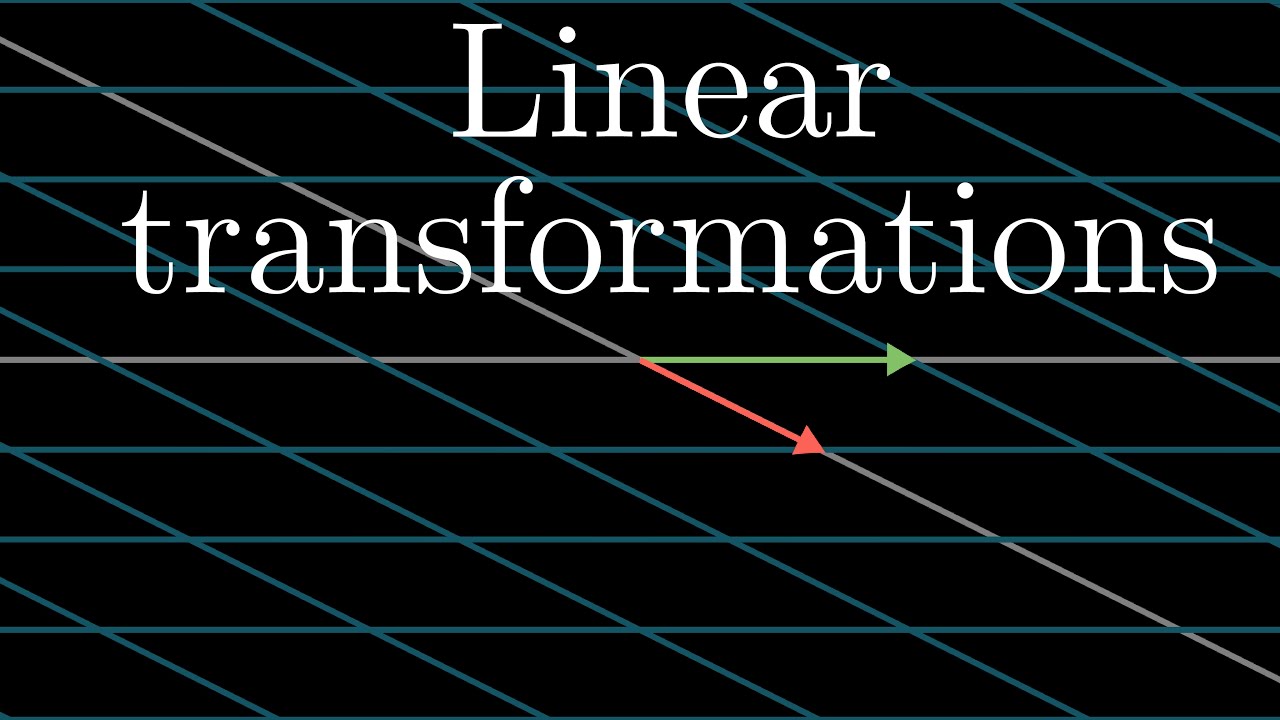
Quite possibly the most important idea for understanding linear algebra.
Help fund future projects: https://www.patreon.com/3blue1brown
An equally valuable form of support is to simply share some of the videos.
Home page: https://www.3blue1brown.com
Full series: http://3b1b.co/eola
Future series like this are funded by the community, through P...
neon steppe
willow skiff
https://www.youtube.com/watch?v=kYB8IZa5AuE
have you watched this video?
Yep 😭
willow skiff
neon steppe
How to actually visualize this? 👀
The result is no longer a direct transformati...
you need to think of (x, y) as x * (1, 0) + y * (0, 1)
willow skiff
neon steppe
Oh hmm
Actually the formula
So x and y ends up as scalars which multiply the in...
yes, so I think you're beginning to understand
neon steppe
Hmm 👀
neon steppe
willow skiff
you need to think of (x, y) as x * (1, 0) + y * (0, 1)
Oh 👀
True 🤔
willow skiff
neon steppe
What happens in case of
[[3, 4] [5, 6]] . [x, y]
Here [x, y] gets transformed ...
so when you have the matrix [3, 4] [5, 6]]
that tells you that the vector (1, 0) gets transformed to (3, 4)
and (0, 1) goes to (5, 6)
you just look at the columns as you said
so then knowing that (x, y) = x * (1, 0) + y * (0, 1)
neon steppe
willow skiff
so when you have the matrix [3, 4] [5, 6]]
that tells you that the vector (1, ...
Oh 👀
Aaah
willow skiff
(x, y) gets transformed to x * (3, 4) + y * (5, 6)
neon steppe
Hmm hmm
Understood it
For some reason my brain didn't comprehend the idea that the basis vectors could end up transforming into those sorts of values, I didn't pay as much attention to the sheer transformation and others he mentioned, so hmm
willow skiff
it's okay a lot of people don't get it the first time either
neon steppe
This isn't as related tbh~
But in the mathematics representation of a matrix, the vectors are columns of a matrix 👀
But in CS, Usually you'd take the individual arrays as a row right in a 2D array?
Would this not result in any changes in the results of the two? 🤔
willow skiff
neon steppe
This isn't as related tbh~
But in the mathematics representation of a matrix, th...
the concept should still be the same though
willow skiff
willow skiff
(x, y) gets transformed to x * (3, 4) + y * (5, 6)
through this process you did end up with the rows as the entries
matrix multiplication is matrix multiplication regardless of discipline
neon steppe
Hmm 👀
But with the rows and columns being swapped respectively, Would the results remain the same irrelevant?
neon steppe
willow skiff
through this process you did end up with the rows as the entries
Oh hmm 🤔
willow skiff
neon steppe
Hmm 👀
But with the rows and columns being swapped respectively, Would the resul...
swapping the rows and the columns gives you the transpose matrix
willow skiff
then you actually have something different, since matrix multiplication is not commutative
$(AB)^t = B^t A^t$
neon steppe
Hmm 🤔
obsidian monolithBOT
south
 neon steppe
Then a 2d array defined as [[1, 2] [3, 4]] , the individual vectors would be [1,2] and [3,4] oh right hmm I believe that's how it's taken as 🤔
My bad
 halcyon dragon
Why do we take the derivative of g(x) in d/dx (fog(x))?
willow skiff
halcyon dragon
Why do we take the derivative of g(x) in d/dx (fog(x))?
the derivative of f(g(x)) must depend on g(x) clearly
so to see why it depends on the 1st derivative of g(x), not g(x), or the integral of g(x) and so on
you could use the limit definition!
$\lim_{h \to 0} \frac{f(g(x + h)) - f(g(x))}{g(x + h) - g(x)} \frac{g(x + h) - g(x)}{h} = ?$
obsidian monolithBOT
south
 willow skiff
(recall the two-point form of the derivative also)
halcyon dragon
Thank you so much, i didn't even think about the limit definition
sick sorrel
willow skiff
I said W to you in <#326138737606262786>
im tryna ask others
 stable vessel
This function has a minimum at x = 5/4. But what's the maximum? If a quadratic function has a minimum and I'm given an interval for x, the maximum is always at the greatest number in the interval? Here, x = 4?
 summer ruin
no, the maximum for x^2 on [-2; 1] is not at 1, but at -2
stable vessel
summer ruin
no, the maximum for x^2 on [-2; 1] is not at 1, but at -2
at [-2, 1, 0, 1, 2], which one is it?
If the maximum of the function is the number with the greatest absolute value, then I assume it'd be both -2 and 2?
summer ruin
not necessarily since the maximum for -x^2 on [-2; 1] happens to be at neither -2, nor 1, but at 0
stable vessel
summer ruin
not necessarily since the maximum for -x^2 on [-2; 1] happens to be at neither -...
But its minimum would be -2?
summer ruin
yes
stable vessel
By minimum and maximum here, are we talking about the functions max() and min()?
are they related?
summer ruin
we are talking about the argument at which the function takes it's lowest/largest value
stable vessel
oh
the maximum or minimum of a quadratic function on an interval m <= x <= n, it'd be either m or n, the one whose output is the largest?
summer ruin
summer ruin
not necessarily since the maximum for -x^2 on [-2; 1] happens to be at neither -...
no
stable vessel
That's because it already has a maximum, so we are concerned about its minimum at a certain interval
stable vessel
stable vessel
This function has a minimum at x = 5/4. But what's the maximum? If a quadratic f...
like the original question, it already has a minimum, now it's to know its maximum at that interval
summer ruin
my example also has a minimum
you're suggesting that the maximum should be on the boundary of the interval, but I'm showing how that's not always the case
stable vessel
yes, because the functions goes to the infinite
summer ruin
the same applies to a minimum too which isn't necessarily located at the boundary, for e. g. x^2 on [-1; 1] the minimum is not on the boundary
stable vessel
wouldn't the minimum be either of them?
actually, minimum is 0?
cus 0 gives the smallest value
summer ruin
yes
stable vessel
so how is it not on the boundary?
summer ruin
because 0 is neither 1 nor -1
stable vessel
but it is inside the interval [-1, 1]
summer ruin
inside is exactly what it means to be not on the boundary
stable vessel
Therefore, minimum or maximum are given by the number x in the interval such that it outputs either the smallest or biggest value?
summer ruin
yes
stable vessel
but
let's now consider f(x) = x², x in [-2, 2]. It has a minimum of 0, now we wonder about the maximum. The maximum here is either of the boundaries?
summer ruin
yes
stable vessel
I see, thank you
 karmic brook
for first principles when given f(x) and asked to find f'(x) and you use the notation in the equation f'(x) = lim h-> 0 f(x+h)- f(x)/h. when given y= something and asked to do find dy/dx (using first principles) do i use the same notation but like dy/dx = lim h-> 0 f(x+h)- f(x)/h, i know it would give the same answer but is the notation correct?
should i state that y=f(x) in my working out before substituting in the formula?
neon steppe
Every vector is a linear combination of the basis vectors and the coordinate scalars, Right?
You can also obtain any given vector through the linear transformation of basis vectors right?
So given a matrix, are we assuming that the given matrix is the linear transformation of its basis vectors? 👀
Any matrix can be seen as a linear transformation of basis vectors, suppose we were to multiply this transformation with a vector, It gives the transformation of that vector? 🤔
Whatever movement happens with the basis vectors happen to this vector as well? 👀
v = ai + bj
T(v) = a T(i) + b T(j)
So i and j are the basis vectors, the transformed versions are the matrix elements, ah so hmm
we obtain the transformation of the vector ends up as a linear combination of the scaled transformations of the basis vectors? 🤔
Apologies for this, I am not exactly sure what I am saying either but trying to visualize things
neon steppe
Basis vectors can be linearly combined to obtain any given vector in the space, You can obtain any given vector by changing the scalars 🤔
The properties of linear transformation mentioned in the Khan Academy video~
Combining the two you get what happens to the scalar 🤔
T(a+b) = T(a) + T(b)
T(ca) = c T(a)
v = ai + bj
T(v) = a T(i) + b T(j)
A transformation of a vector is the sum of the transformation of the basis vectors multiplied by the coordinate scalars
Naruhudo
That's fine 🤔
Sorry, I am repeating the same thing
I see, it makes sense now, It's easier to see why it is the way it is 🤧
Though feels like I went around in circles to reach the obvious stated by the formula
neon steppe
neon steppe
Basis vectors can be linearly combined to obtain any given vector in the space, ...
In matrix multiplication,
Is the final result always the transformation of the vectors on the right side of the operation, So we're always just visualizing the left side to be the transformation of the basis vectors which then can be used to transform the vectors on the right side of the operation 🤔
We have the rule that the number of columns of the left matrix has to meet the number of columns of the right matrix for matrix multiplication
Hmm
In this context, the reasoning for that is because to transform a 3 dimensional vector we'd need a basis vector which corresponds to the transformation in each dimension,
Each column being a basis vector, each row being a dimension
That makes more sense now as well 🤔
 obtuse island
Hey guys do you think it’s reasonable to try to keep up with ALL types of problems at all times and the ways to solve them? Or is it normal to be able to solve the ones that you’re working on currently and actively studying in class but like problems from last year or semester need looks at notes bc you don’t know anymore?
Is this something I should be working on as I go thru precalc?
Any advise appreciated
I’m def someone who doesn’t try to keep unnecessary info until I need it but I’m open to changing my methods
hidden birch
obtuse island
Hey guys do you think it’s reasonable to try to keep up with ALL types of proble...
it's normal to forget
and look at notes
the important thing is you understand the concept
obtuse island
Okay thx! :)
viscid thistle
ok ok si
 vernal quartz
Am i missing anything here in? Can i optimize anything?


 viscid thistle
Hello, I’m taking precalc in high school. I wanna know how I can excel in this course especially since it’s complex and I just want to take any tips from y’all
 shy vine
lost of practice
 copper gyro
Hi I’m currently in calc 2 but we’re reviewing precalc, how do I solve limits like this, where its a rational function with x raised to some power? Do I rewrite it in some form of ln? Kinda stuck here with what I can “legally” do

 pale anchor
 copper gyro
Hi I’m currently in calc 2 but we’re reviewing precalc, how do I solve limits li...
copper gyro
copper gyro
Hi I’m currently in calc 2 but we’re reviewing precalc, how do I solve limits li...
lowk I think its 0 because the denominator would grow faster than the numerator, but idk if thats a mathematically sufficient explanation. lmk what yall think
copper gyro
pale anchor
looks like (3,6) because it is going physically up but at a slower rate (its curving down), rather than some other spot like (18,30) where it is going physically up at an increasing rate
Wait new question bc what the heck can I do here

 low torrent
copper gyro
Wait new question bc what the heck can I do here
low torrent
copper gyro
Wait new question bc what the heck can I do here
I’m not in that yet
 heavy pewter
 still brook
doesnt it include all y values??
still brook
doesnt it include all y values??
?
still brook
[5, 1)

 still brook
does it not include all the y. alues?
heavy pewter
it does
heavy pewter
still brook
then why cant it be written as [5, -4, 0, 1]?
Because its not discrete
still brook
what does discrete mean
heavy pewter
As in only containing integers
still brook
?
heavy pewter
still brook
then why cant it be written as [5, -4, 0, 1]?
bro look it contains 0,5 so obviously this is insufficient
still brook
what
still brook
yall are supposed to help not give me resources smh
copper gyro
 jolly spire
that is beautiful and you are the nerdiest nerd of all nerds
i aspire to be like you
i ended up just graphing it and visually seeing it approaches zero, i'll see what my teacher says tmrw
 quasi tartan
i need help with my graphing pls

 regal tree
!da2a
tender questBOT
No need to ask “Can I ask…?” or “Does anyone know about…?”—it’s faster for everyone if you just ask your question! See https://dontasktoask.com/
 steel kernel
Why the second derivative can determine if a function is a concave or convex?
 tulip hedge
is there a resources channel or a resources webpage, I want to test my knowladge on exponents by solving problems
echo sinew
tulip hedge
is there a resources channel or a resources webpage, I want to test my knowladge...

LetMeGoogleThat.com
For those who think it's easier to annoy you than to Google 'Problems with exponents exercises' themselves.
 fervent forge
 royal pagoda
Does this explanation work?
royal pagoda
Does this explanation work?
Can't we just differentiate it and equate to zero?
fervent forge
 daring dew
i’m in pre calculus in 9th grade
daring dew
i’m in pre calculus in 9th grade
Where?
willow skiff
fervent forge
Can't we just differentiate it and equate to zero?
yes
willow skiff
royal pagoda
Does this explanation work?
you're making it harder for yourself by using both $x - a$ and $x + a$
obsidian monolithBOT
south
 willow skiff
,w -5(x+a)^2 + 40(x+a) + 1 - (-5x^2 + 40x + 1) simplify
obsidian monolithBOT

 willow skiff
so you want -5a(-a - 2x + 8) = 0 for the sign of this to change from positive to negative
since a is allowed to be any (positive) real number
you can't set a = 0, so -a - 2x + 8 = 0
but look what happens if you take the limit of -a + 2x + 8 as a goes to 0
as you bring the two points closer and closer together
you just have -2x + 8 = 0 or x = 4 as the limiting case, so the two points are the same and that's when the function changes from increasing to decreasing
by overcomplicating it you're forcing yourself to include unnecessary assumptions and it just becomes a big mess
royal pagoda
Ohh right obviously thank you
willow skiff
No worries!
 astral apex
steel kernel
Why the second derivative can determine if a function is a concave or convex?
astral apex
steel kernel
Why the second derivative can determine if a function is a concave or convex?
because the second derivative encodes the rate of change of slopes of tangent lines to a curve
if tangent line slopes are increasing, we call it concave up; if decreasing, we call it concave down
it's best not to speak of convex in this context
convex in math means something else, and a convex shape can have pieces that are either concave up or concave down (or both)
for example a circle is convex, and the upper half is concave down, lower half is concave up
here I'm using convex to mean "the shape contains all line segments between its points"
echo sinew
I thought convex meant concave up
I mean, not the convex things in topology, like convex hull and so on
astral apex
echo sinew
I thought convex meant concave up
this appears to be one of those quirks that some teachers use and others dont
echo sinew
It might also be something about language because for example where I live (Italy) we don't have any transnation of concave up and concave down
We use the words convex (for concave up) and concave (for concave down)
 ripe eagle
anyone free to help me with 15 pre calc questions before my exam? just trying to study the problem solving steps
 latent flame
can u show it
ripe eagle
they
they're on a few diff topics all within similar concepts etc graphs of circles,parabolas.hyperbolas,asymptotes,functions,piece-wise functions,absolute value functions,inverse function,difference quotient
latent flame
can i see some of the problems
ripe eagle


 latent flame
is the ellipse one E?
ripe eagle
one E?
latent flame
(0, -4) (0, 4)
the graph that counts as a function is figure c yeh?
cus every domain has a range matching it
 latent flame
oh i was right on that one too
try the number before it
is the focii 0,-4 and 0,4
oh wait im sorry
im just bad LMAO
latent flame
LMFAOAOAOO
 proven willow
any tips for calculus i never took it before
 pseudo summit
could someone help me solve the domain for gof? The
square roots confused me😭
 worldly fiber
 modest bolt
pseudo summit
could someone help me solve the domain for gof? The
square roots confused me😭
modest bolt
pseudo summit
could someone help me solve the domain for gof? The
square roots confused me😭
- Find domain of g.
- Then find range of f.
- Then see which part of that range lies inside domain of g.
- Finally, collect all x from domain of f for which f(x) falls in that overlap.
You can start by first step and tell us what domain of g you got and continue like this and if you get stuck anywhere then we can help.
||hint: for domain of √(ax+b), you have to find solutions to ax+b >= 0||
pseudo summit
Thank you! Someone helped me already! I will notice the steps down and try a smiler problem later!
hidden birch
or just inspect the new function formed by f(g(x))
hidden birch
modest bolt
- Find domain of g.
- Then find range of f.
- Then see which part of that range ...
what answer do you get
because your final steps is confusing to me. The answer i got is
,texsp||$-2-\sqrt5\le x\le-2+\sqrt5$||
obsidian monolithBOT
glass

 fluid olive
I want to start calculus. I know nothing about it. Where do i start?
 acoustic sparrow
fluid olive
I want to start calculus. I know nothing about it. Where do i start?
acoustic sparrow
fluid olive
I want to start calculus. I know nothing about it. Where do i start?
prerequisite: precalculus
you can do the khanacademy course for calculus I
khanacademy, professor dave
or use a book
fluid olive
acoustic sparrow
prerequisite: precalculus
you can do the khanacademy course for calculus I
prerequisite?
acoustic sparrow
fluid olive
prerequisite?
yes
you should know all of precalculus(matrices and determinants are optional) before starting with calculus
 inner hawk
 willow skiff
inner hawk
integral (e^root(x) dx)
willow skiff
inner hawk
integral (e^root(x) dx)
oh yeah, sub then IBP
 red storm
integral e^dx
 chrome acorn
ripe eagle
chrome acorn
ripe eagle
khan acad right?
willow skiff
chrome acorn
khan acad right?
no
it's some online learning platform that schools and unis use
I know for a fact it isn't Canvas
I think it's Blackboard?
chrome acorn
 plush nymph
can someone please help me with a precal assignment
I will literally pay you I need this done asap and i'm really stuggling
 heady bluff
I need help. I don't know how to solve this backwards from the output to figure out what input(s) could've given the output of 3..

 polar marsh
heady bluff
I need help. I don't know how to solve this backwards from the output to figure ...
polar marsh
heady bluff
I need help. I don't know how to solve this backwards from the output to figure ...
equate p² + 2p to 3, p²+ 2p = 3, p² + 2p - 3 = 0
modest bolt
heady bluff
I need help. I don't know how to solve this backwards from the output to figure ...
you also think of it as p(p+2)=3
So what two numbers where one number is 2 unit larger than the other multiply to give 3?
3 has factors ±1,±3 and these are indeed 2 units apart from each other, so you can check them and guess what 1×3=3, or p=1 gives 1(1+2)=3. If you are doing it this way, I want you think and try the other solution for p.
heady bluff
Oh ok
regal tree
modest bolt
you also think of it as p(p+2)=3
So what two numbers where one number is 2 unit ...
id much more recommend solving the quadratic that favlic made. you wouldnt always find nice, easy solutions which you could think of the way you did
 proper eagle

This was first posed as a problem by Srinivasa Ramanujan in the Journal of the Indian Mathematical Society in 1911. A solution to the same is discussed in the video.
Connect with us on discord: https://discord.gg/W6pzkGWM
 gleaming matrix
how are you guys learning pre-calc?
 tawny plank
use stewart pre calc textbook
 tawdry arrow
 civic thicket
why is calculus so hard 😭
echo sinew
Probably because you don't have a full understanding of your prerequisites
At least this is very common, I don't know if this is your case as well
inner hawk
🕊️
willow skiff
civic thicket
why is calculus so hard 😭
90% of all calculus struggles are caused by not fully understanding the material before calculus
civic thicket
no
not that
i just started it
it is extremely different from precalc and algebra
willow skiff
civic thicket
it is extremely different from precalc and algebra
but you would agree, that you are constantly using concepts and techniques from these in calculus right?
civic thicket
no. its not the problems in struggling in. its understanding what it is. like i dont even understand it
willow skiff
civic thicket
no. its not the problems in struggling in. its understanding what it is. like i ...
https://www.youtube.com/watch?v=WUvTyaaNkzM
I recommend this video series then

What might it feel like to invent calculus?
Help fund future projects: https://www.patreon.com/3blue1brown
An equally valuable form of support is to share the videos.
Special thanks to these supporters: http://3b1b.co/lessons/essence-of-calculus#thanks
In this first video of the series, we see how unraveling the nuances of a simple geometry que...
civic thicket
ty
willow skiff
civic thicket
wyd rn in math?
I'm actually not studying maths at uni anymore
the highest course which I attempted and passes was topology
civic thicket
ohh

 trim flax
 sonic loom
is trig identities hard? <:joethink:962324189023469618>
sonic loom
is trig identities hard? <:joethink:962324189023469618>
depends what level of trig, like sin^2 + cos^2 =1 is light but inverse trig is not nice
winged wigeon
Derivatives inverse trig 
a^2 = b^2 + c^2-2bccosA
Guys I still have it remembered right
Laws of cosines
raw hill
winged wigeon
a^2 = b^2 + c^2-2bccosA
Yes

You can also look up facts like this yourself btw
viscid thistle
who can speedrun calculus wi me (hw) 🙁
 modest bolt
All the functions are of form b^x±c
modest bolt
You have to add or subtract certain number 'c' from every output and see if it forms a proportional growth
for example in 1st case, adding 1 in all outputs yields 1, 3, 9, 27, 81. Notice that they are the powers of 3 as 3⁰,3¹, 3², 3³, 3⁴. So function is g(x) = 3^x - 1
Similarly try to add or subtract small numbers like 1,2,3 in 2nd and 3rd case and try to see if you notice the outputs forming powers of any number as we saw 1st one formed powers of 3
@celest lantern
 timid widget
can anyone teach me binomial expansion using the theorem? in pre calculus. im having alot of trouble not understanding it.. like i do but only for like 5 seconds then i forgot or something always changes
hidden birch
timid widget
can anyone teach me binomial expansion using the theorem? in pre calculus. im h...
pascal's triangle
 brisk crystal
i know it's not proprely pre-calculus but i have problems in fully understanding the path of resolution of limits. I think that i understand the concept of limit but when i have to calculate it i lost the right path to follow. For example how can i know wich limit formula i have to use just by seeing what the function is?
modest bolt
timid widget
can anyone teach me binomial expansion using the theorem? in pre calculus. im h...
,tex this one?\
[
(x+a)^{n} = \sum_{k=0}^{n} {n \choose k}, a^{n-k} x^{k}, \qquad n \in \mathbb{N}.
]
obsidian monolithBOT

 celest lantern
modest bolt
<@1006321888823345212>
celest lantern
modest bolt
<@1006321888823345212>
Thank you!
viscid thistle
civic thicket
no. its not the problems in struggling in. its understanding what it is. like i ...
You could also try professor Leonard on YouTube
 rigid ridge

would appreciate any help here
I do online school and i got a really bad math teacher this year who has been horrendus
quick jungle
Precalc ch 1 test on Thursday
I heard that there will be quadratic word problems
But I need like a couple examples
On how they work
 wind holly
Indicate the error

 rocky wind
,rccw
obsidian monolithBOT
 queen grail
my teacher keeps saying a point can be a hole and a zero at the same time in a rational function but google says otherwise 😭
rocky wind
wind holly
Indicate the error
please turn it to the correct orientation, so that PC users can view them more easily
wind holly
queen grail
my teacher keeps saying a point can be a hole and a zero at the same time in a r...
For me, a point is the same as a multiplication signal(* or ×)
wind holly
Wdym
uncut mulch
not u
queen grail
wind holly
For me, a point is the same as a multiplication signal(* or ×)
a point on the graph i meant
queen grail
uncut mulch
do you have what they said written down exactly
we were solving for zeros/asymptotes/holes
she said that a point can't be a vertical asymptote and hole at the same time but 5 seconds later she said a point can be a zero and hole at the same
uncut mulch
did she give a specific example
queen grail
she showed the rational function ((x+1)(x-2)^2)/((x-2)(x+1)^2)
and said there's a hole at (2,0) and also a zero at x = 2
uncut mulch
ok, yeh she's wrong
queen grail
which doesn't make sense to me it wouldn't be touching the x axi
queen grail
uncut mulch
ok, yeh she's wrong
ok
queen grail
i understand but I'm scared cuz idk if she'll let points be a zero and a hole at the same time for the test 😭
uncut mulch
bring it up before the test
 eternal parcel
can anyone help me with this
 raw hill
eternal parcel
can anyone help me with this
raw hill
eternal parcel
can anyone help me with this
Reposted: #help-45 message
 hasty heron
To find dy/dx do i multiply by yx ?
 inner hawk
hasty heron
To find dy/dx do i multiply by yx ?
inner hawk
hasty heron
To find dy/dx do i multiply by yx ?
use u/v on both terms and then transpose everything but dy/dx
willow bear
,rcw
obsidian monolithBOT
 willow bear
hasty heron
To find dy/dx do i multiply by yx ?
willow bear
hasty heron
To find dy/dx do i multiply by yx ?
multiplying by xy before taking the derivative is a smart move
inner hawk
hasty heron
To find dy/dx do i multiply by yx ?
dy/dx = (x^2 . y - y^3) / (x^3 - y^2. x) ?
hasty heron
willow bear
multiplying by xy before taking the derivative is a smart move
It will be x^2+y^2 = A i guess ? In the end its x/-y which is the same as y/x if im not wrong
willow bear
hasty heron
It will be x^2+y^2 = A i guess ? In the end its x/-y which is the same as y/x if...
no
x^2+y^2 = Axy
inner hawk
hasty heron
It will be x^2+y^2 = A i guess ? In the end its x/-y which is the same as y/x if...
how
willow bear
i did say to multiply BOTH SIDES by xy
oh no
i am a fool and didn't explicitly mention "both sides"
inner hawk
😂
hasty heron
Im a fool for forgetting that 😕
inner hawk
 hasty heron
inner hawk
hasty heron
inner hawk
thanks
viscid thistle
im in last year of highschool and i have no idea about calculus and trignometry(inverse trig and the identities only),what respurces you guys use for learning these subjects?
its my additional subject and i just wanna pass in it
uncut mulch
khanacademy can get you started
and a few mathtubers
like organic chem tutor and professor leonard
hasty heron
viscid thistle
im in last year of highschool and i have no idea about calculus and trignometry(...
as a student like you i guess just solve. diving deep into it will only give birth to new questions and curisoity .
viscid thistle
hasty heron
as a student like you i guess just solve. diving deep into it will only give bi...
yep that's one of my habit of going in depth
you are right
hasty heron
dont like dive deep but get a superficial understanding for what it means , but it really doesnt matter in an exam
viscid thistle
uncut mulch
khanacademy can get you started
i have kickstarted trigonometry journey from khan academy recently
thank you @uncut mulch and @hasty heron for your advice!
 left crypt
guys can you suggest me resources where I can study and understand trignometry more better. Like the solutions and identites . I face a lot of problem in these. I fail to understand the approach . Please help if u can
 vagrant lichen
red storm
the organic chemistry tutor
vagrant lichen
red storm
the organic chemistry tutor


Why does 6x sqrt of 3x become 6 sqrt of x
viscid thistle
The previous step is wrong
It's just 6sqrt(x)-10xsqrt(3)
vagrant lichen
Wait what did I do wrong
viscid thistle
 vagrant lichen
Is it 6 sqrt 3x
viscid thistle
2sqrt(9x) is supposed to be?
vagrant lichen
Wait I don’t know
Since its a square root
I did 3 x3
And there’s a 2 on the coefficient
So multiply by 3 x 2
viscid thistle
viscid thistle
2sqrt(9x) is supposed to be?
This step is right
vagrant lichen
Get 6 sqrt of 3x
viscid thistle
I'm asking what will be get by simplifying 2sqrt(9x)
vagrant lichen
vagrant lichen
Is it 6 sqrt 3x
This
I’m confused with the variable
Like what should I do when the variable isn’t a square
viscid thistle
Well just rewrite it as 2sqrt(9)sqrt(x)
viscid thistle
What's sqrt(9) again?
vagrant lichen
3
viscid thistle
vagrant lichen
it becomes 6 sqrt 3 and
Yes then why would we have a sqrt(3) left over?
viscid thistle
So what do we get in the end?
vagrant lichen
what happens to the x
viscid thistle
Nothing it stays In the square root so we have
6sqrt(x)
viscid thistle
Yes
 shut rampart
i’m wondering if this is what i should try to practice a lot with active recall for cal 2 (integral calculus i think it’s called)


i’m also wondering any tips for learning most of this in one semester
vagrant lichen
u can't
vagrant lichen
shut rampart
i’m wondering if this is what i should try to practice a lot with active recall ...
ur cooked
red storm
shut rampart
i’m wondering if this is what i should try to practice a lot with active recall ...
series and sequences as well
 silent plaza
shut rampart
i’m wondering if this is what i should try to practice a lot with active recall ...
silent plaza
shut rampart
i’m wondering if this is what i should try to practice a lot with active recall ...
Bro is practicing Trigonometry in order to learn calculus😂
I mean yeah, trigonometry is one of the contributors that makes calculus hard
silent plaza
shut rampart
i’m also wondering any tips for learning most of this in one semester
Learn of how to derive them bro instead of random ahh memorizations
modest bolt
I'll be solving calculus question easily then comes cosA cosB and I am done cause I don't remember the formula
silent plaza
modest bolt
I'll be solving calculus question easily then comes cosA cosB and I am done caus...
Yeah bro that's the problem, y'all do be memorizing everything
Learn the concept and learn of how to derive them formulas
For example, deriving the power reducing formula. Suppose we have :
cos²(x)
Then we want to reduce its power, we know that :
cos²(x) + sin²(x) = 1
(Derived from the equation of the Unit Circle x²+y² = 1, and x = cos(x), y = sin(x)), then we want to isolate sin²(x), so :
cos²(x)+sin²(x) = 1
sin²(x) = 1-cos²(x)
Then we also know that the double angle formula for cosine is this following :
(Derived from compound angles formula that requires geometry for its derivation)
cos(2x) = cos²(x) - sin²(x)
We know that sin²(x) = 1-cos²(x), so substitute it in, we get :
cos(2x) = cos²(x) - (1-cos²(x))
cos(2x) = cos²(x) -1 + cos²(x)
cos(2x) = 2cos²(x) - 1
cos(2x)+1 = 2cos²(x)
(cos(2x)+1)/2 = cos²(x)
Therefore the reduced power of cos²(x) is :
(cos(2x) + 1)/2
inner hawk
silent plaza
For example, deriving the power reducing formula. Suppose we have :
cos²(x)
Th...
damn 💀
shut rampart
silent plaza
For example, deriving the power reducing formula. Suppose we have :
cos²(x)
Th...
how do you get stuff like $\int \frac{1}{u^2 + 1},du = \arctan(u) + C$
obsidian monolithBOT
Jelly
 silent plaza
shut rampart
how do you get stuff like $\int \frac{1}{u^2 + 1}\,du = \arctan(u) + C$
silent plaza
shut rampart
how do you get stuff like $\int \frac{1}{u^2 + 1}\,du = \arctan(u) + C$
Draw a triangle
With =
Hypotenuse = √(u² + 1)
Opposite = u
Adjacent = 1
Angle = n
Then let tan(n) = u/1
d/du (tan(n)) = d/du (u)
sec²(n)dn/du = 1
sec²(n)dn = du
Then substitute them in
∫ 1/(u²+1) du
∫ 1/(tan²(n)+1) sec²(n)dn
∫ 1/sec²(n) · sec²(n) dn
∫ 1 dn
n + c
Since tan(n) = u
We can just do some algebra so that we get
n = arctan(u)
So the answer is
arctan(u) + c
shut rampart
silent plaza
Draw a triangle
With =
Hypotenuse = √(u² + 1)
Opposite = u
Adjacent = 1
Angle...
i will try to investigate this today thank you very much!
silent plaza
shut rampart
i will try to investigate this today thank you very much!
Yeah, wait i'll give you a video about it
I learned this from a youtube video honestly
shut rampart
silent plaza
I learned this from a youtube video honestly
yeah it seems like my teacher assumes everybody just knows but i’ve spoken with other classmates and no one seems to know lol
silent plaza

An easier way to apply trig substitutions when integrating. Learn how to set up the right triangle that will give you what you need to integrate with trig substitution. Trigonometric substitution integrals are easier when you use the right triangle method to solve. I’ll show you how to use trig substitution to integrate.
▶ Watch
Trig ...
silent plaza
shut rampart
yeah it seems like my teacher assumes everybody just knows but i’ve spoken with ...
And now you don't need to memorize shits, good luck👍
viscid thistle
guys how would you solve this question? Ik you need to get the formula of Sn = n/2[2a1 + (n-1)d] but how do you do ahead of that?
 inner hawk
viscid thistle
guys how would you solve this question? Ik you need to get the formula of Sn = n...
inner hawk
viscid thistle
guys how would you solve this question? Ik you need to get the formula of Sn = n...
i got n=11
inner hawk
viscid thistle
guys how would you solve this question? Ik you need to get the formula of Sn = n...
the first summation simplified is :
12 (a + 11d) = -72a/5 , take a+11d = a12 and simplify
final is a+5d = 0 --> d= -a/5
now use sum of series on 2nd summation to get a= d (1-n)/2
substitute value of d in this eqn a will cancel out on both sides and n=11
 storm shuttle
viscid thistle
guys how would you solve this question? Ik you need to get the formula of Sn = n...
storm shuttle
viscid thistle
guys how would you solve this question? Ik you need to get the formula of Sn = n...
try to find some kind of relation b/w frst term and common difference
 acoustic rover
Hellooo
Is the AoPS book or Jame's Stewart's book better as a foundation for calculus
I am also taking AP Calculus btw^
 dreamy canopy
hey guys i am having a reallyy bad time solving the question 41 can someone help pls??

 fluid sorrel
dreamy canopy
hey guys i am having a reallyy bad time solving the question 41 can someone help...
fluid sorrel
dreamy canopy
hey guys i am having a reallyy bad time solving the question 41 can someone help...
Just apply L'hospital rule
And u will get ur answer in 2 steps
Do u know this rule?
ripe eagle
can not for the life of me understand this
 modest bolt
did you find fog?
ripe eagle
i get stuck after i fill it all in as in i don’t know the next steps to take i might just be missing basic algebra etc
modest bolt
good, now simplify that
ripe eagle
 modest bolt
you can use brackets () [] {} to write it neatly
ripe eagle
that’s where i get stuck i feel like im missing out on the basics of trig and algebra, i tested into a accel pre calc course and i didn’t have the option to refuse it
any yt vids or stuff you suggest to fill that in?
i can understand the concept it’s just so hard to apply when missing parts like this
modest bolt
try to simplify numerator and denominator seperately
2(x+3)/(3x-2) - 1
how would you simply this?
can you think of your first step?
You know you can write 1 as 1/1 then take LCM to get a common denominator
ripe eagle
i’d group like terms first apply the 2
2x+6/(3x-2) -1 i would then find a common factor like 6 to cancel them out then do 6/(-2)-1 turns to positive 6/2 =3
so x = 3
modest bolt
no no, you are not supposed to find value of x
How would you simply
a/b + c/d?
to get a common denominator?
ripe eagle
i have no idea tbh i never learned that
obsidian monolithBOT
$\frac{a}{b}$ + $\frac{c}{d}$ = $\frac{ad-bc}{bd}$
 modest bolt
do you understood how this happened?
modest bolt
oops i meant to add + sign there on right
modest bolt
ripe eagle
cross multiply denom and numerator
yes
modest bolt
modest bolt
2(x+3)/(3x-2) - 1
you have to do the same here
a = 2(x+3)
b=(3x-2)
c=1
d=1
you think you can cross multiply numerator like that?
modest bolt
ripe eagle
from here
ripe eagle
modest bolt
you think you can cross multiply numerator like that?
no cause i mean anything divided by 1 is itself i mean you can but i dont see how it would move the problem forward
modest bolt
$\frac{2(x+3)}{(3x-2)}$ + $\frac{1}{1}$ = ?
obsidian monolithBOT
 modest bolt
you have to cross multiply to simply it
this is the numerator you got from fog
you have to simplify numerator and denominator of fog seperately then divide them and simplify further to obtain proper expression for fog
 modest bolt
i said I mistakenly put that minis sign there
ripe eagle
ah
ripe eagle
 modest bolt
$\frac{2(x+3)}{(3x-2)}$ - $\frac{1}{1}$ = ?
obsidian monolithBOT
 modest bolt
It was my mistake I didn't notice, there needs to be a minus sign here like this
this is the numerator you got in your photo
now cross multiply and what you get?
ripe eagle
obsidian monolith
cross multiply this ? or the pic i sent
ripe eagle
modest bolt
It was my mistake I didn't notice, there needs to be a minus sign here like this
no worries thank you for the help
modest bolt
ripe eagle
here look at the numerator, it's the same thing shown in the image above
left crypt
hey guys sry to interrupt but whats the question asking
fluid sorrel
 ripe eagle

trying to understand my pre calc i get lost i got into accel pre calc and i don’t know how
fluid sorrel
ripe eagle
trying to understand my pre calc i get lost i got into accel pre calc and i don’...
It's not calculus... Just put value of gx in place of x in fx
That's algebra
Basic
Basickkkk
I know it's calculus
But after substituting
ripe eagle
i understand that, i do not have good trig or algebra foundations i asked for help in where to understand those topics or etc
fluid sorrel
It's algebra
modest bolt
fluid sorrel
It's not calculus... Just put value of gx in place of x in fx
this is precalculus channel
left crypt
fluid sorrel
It's not calculus... Just put value of gx in place of x in fx
ya for u and me bro for ohers it isnt
fluid sorrel
left crypt
ya for u and me bro for ohers it isnt
Kryptonian my brother
left crypt
just saw ur profile pic lost brother
modest bolt
well yes the question is about precalculus but idk why I need to teach him algebra to start the question 
fluid sorrel
modest bolt
this is precalculus channel
Ur not helping him.... Just write it n show him n save ur as well as his time
modest bolt
ok ok
left crypt
ye
fluid sorrel
left crypt
just saw ur profile pic lost brother
 ripe eagle
it’s pre calc hw, i get lost in the foundation steps not really the concept
fluid sorrel
ripe eagle
it’s pre calc hw, i get lost in the foundation steps not really the concept
😭 sorry for yaa bro
ripe eagle
that being said do you guys have good online resources you can recommend me for those concepts?
no worries
fluid sorrel
ripe eagle
that being said do you guys have good online resources you can recommend me for ...
English???
left crypt
khan academy ig
fluid sorrel
ripe eagle
where can i learn

YouTube
I am currently accepting middle school and high school students for math tutoring.
Tutoring sessions are conducted in-person in the Orange County, CA only. (Sorry, no online tutoring.)
Please email me at mensatutor@gmail.com for more information.
UCLA, Bachelor of Science in Mathematics.
American Mensa Member
25 years of teaching experience.
Th...
viscid thistle
inner hawk
the first summation simplified is :
12 (a + 11d) = -72a/5 , take a+11d = a12 an...
thanks
viscid thistle
storm shuttle
try to find some kind of relation b/w frst term and common difference
ohk thank u
shut rampart
silent plaza
Draw a triangle
With =
Hypotenuse = √(u² + 1)
Opposite = u
Adjacent = 1
Angle...
hello i watched the video you linked and read what you said but i don’t understand how do you identify which is which side for the triangle.
how do you pick opposite as u instead of 1 or vice versa? hypotenuse is easy in this case bc we add but also how do we know when we do the sqrt( x^2 - a^2)
 quiet river
How to begin this?
 astral apex
I would regard the equation as a quadratic in x
i.e. treat everything except for x as a constant
I have no idea if that's wise
wait, I misread what we're trying to do
I think you just start by working with ðf/ðx = 0, show that it leads to the equation written next to it
and similarly for the one under that
maybe you also need to say something about why setting those partials to 0 is the right thing to do
silent plaza
shut rampart
hello i watched the video you linked and read what you said but i don’t understa...
You can pick opposite or adjacent as 1 or u, but for consistency purposes always pick dummy variable as the opposite, if the dummy variable is on the hypotenuse, that means the square root stuff goes onto the opposite side, and the constant on the adjacent.
For example, suppose you have :
√(x² - 1)
Hypotenuse = x
Opposite = √(x² - 1)
Adjacent = 1
Angle = θ
I think it's the standard triangle configuration
Here is what happens if you pick constant as the opposite :
Suppose you have this integral :
∫ 1/(1+x²) dx
Then you draw this triangle :
Hypotenuse = √(x²+1)
Opposite = 1
Adjacent = x
Angle = u
Then let,
cot(u) = x/1
d/dx [cot(u)] = d/dx [x]
-csc²(u)du/dx = 1
-csc²(u)du = dx
Then let,
csc(u) = √(x²+1)
Solve for x²+1
csc²(u) = x²+1
Plug them in :
∫ 1/(x²+1) dx
∫ (1/csc²(u)) · (-csc²(u))du
-∫ csc²(u)/csc²(u) du
-∫ 1 du
-u + c
u = arcot(x)
or
u = arccsc(√(x²+1))
Therefore the answer is :
-arccot(x) + c
or
-arccsc(√(x²+1)) + c
I think they are valid answers but not standard.
Lemme work things out with :
-arccot(x) + c
We know this identitiy :
arccot(x) + arctan(x) = π/2
Letme proof this identity,
Let,
arccot(x) = u
x = cot(u)
from the cofunction identity, we can convert the cot function, so :
x = cot(u)
x = tan(π/2 - u)
arctan(x) = π/2 - u
And we know that u = arccot(x), let substitute them in :
arccot(x) + arctan(x) = π/2
arccot(x) + (π/2 - u) = π/2
arccot(x) + π/2 -arccot(x) = π/2
π/2 = π/2
Now we know that it's true, we can solve the equation for arccot(x), so :
arccot(x) + arctan(x) = π/2
arccot(x) = π/2 - arctan(x)
Substitute them in, we get :
-arccot(x) + c
-(π/2 - arctan(x)) + c
-π/2 + arctan(x) + c
And we know that -π/2 is just a constant, then the c can just absorb that shit up and we get our good ol' standard answer
arctan(x) + c
I think the -arccot(x) + c answer is just the shifted version of the standard answer.
 sinful estuary
hey guys i have a precalc placement test and i need to ace it, does anyone have a good practice test or/and what major concepts i should go over?
willow skiff
sinful estuary
hey guys i have a precalc placement test and i need to ace it, does anyone have ...
try Khan Academy's algebra 1 and 2 quizzes