#precalculus
1 messages · Page 72 of 1
 modest bolt
 hoary iris
modest bolt
how do i get helpful role, does it need 1000 msg per day or what <:bking:1373112...
hoary iris
modest bolt
how do i get helpful role, does it need 1000 msg per day or what <:bking:1373112...
You've actually helped a lot
idk why you didn't get
anyways may we ask that cursed limit to Ann
?
that tetration limit
 river drift
modest bolt
how do i get helpful role, does it need 1000 msg per day or what <:bking:1373112...
river drift
modest bolt
how do i get helpful role, does it need 1000 msg per day or what <:bking:1373112...
help in the help channels or forum
modest bolt
ok thx
 terse pebble
no
modest bolt
its automatic, i understand dw
hoary iris

terse pebble
modest bolt
its automatic, i understand dw
i had to leave the server for 3 months
hoary iris
terse pebble
i had to leave the server for 3 months
What?
modest bolt
its like bot auto assigns roles at reaching certain msg per day in help channels i think
modest bolt
terse pebble
i had to leave the server for 3 months
why
modest bolt
you lost all your msg count, sad
 winter comet
touch grass
hoary iris
modest bolt
you lost all your msg count, sad
but he got helpful role
winter comet
hoary iris
what are you studying rn?
between linear algebra and discrete 😂
modest bolt
hoary iris
but he got helpful role
 then aah maybe bot stores msg count and doesn't reset it after leaving or he really helped a lot after joining
winter comet
i finished the LA course but i still study a bit, and will take discrete
but rn im doin programmin :l
terse pebble
modest bolt
<:sully:651816820122189834> then aah maybe bot stores msg count and doesn't rese...
nah you need to leave for 3 months to get it
modest bolt
terse pebble
nah you need to leave for 3 months to get it
thats some crazy requirement
terse pebble
word
winter comet
get the green role by touching the green thing for 3 months
terse pebble
yep
modest bolt
 mods really wanted us to touch grass to get the role
winter comet
you're very helpful when ur not on the server
hoary iris
Anyone ping me here when you've got an interesting limits or sum or prod
 elfin jay
Can someone explain me this pls (supposedly this can be classified as precalculus), the only I know is that is something similar to a summatory

 raw hill
elfin jay
Can someone explain me this pls (supposedly this can be classified as precalculu...
raw hill
elfin jay
Can someone explain me this pls (supposedly this can be classified as precalculu...
This denotes the cardinality of the union of ${0}, {1}, {2}, \cdots {10}$
 obsidian monolithBOT
Civil Service Pigeon
 elfin jay
raw hill
This denotes the cardinality of the union of $\{0\}, \{1\}, \{2\}, \cdots \{10\}...
elfin jay
raw hill
This denotes the cardinality of the union of $\{0\}, \{1\}, \{2\}, \cdots \{10\}...
Tysm❤️
 errant shard
I still dont get precalc definitions
like what is d/dx, or dh/dy, ect
I get what they may mean through proxy, but I dont understand what they are trying to say
hoary iris
errant shard
I still dont get precalc definitions
like what is d/dx, or dh/dy, ect
I get wh...
Is d/dx trig?
errant shard
hoary iris
Is d/dx trig?<:bking:1373112658169040996>
I mistyped
hoary iris
errant shard
I mistyped
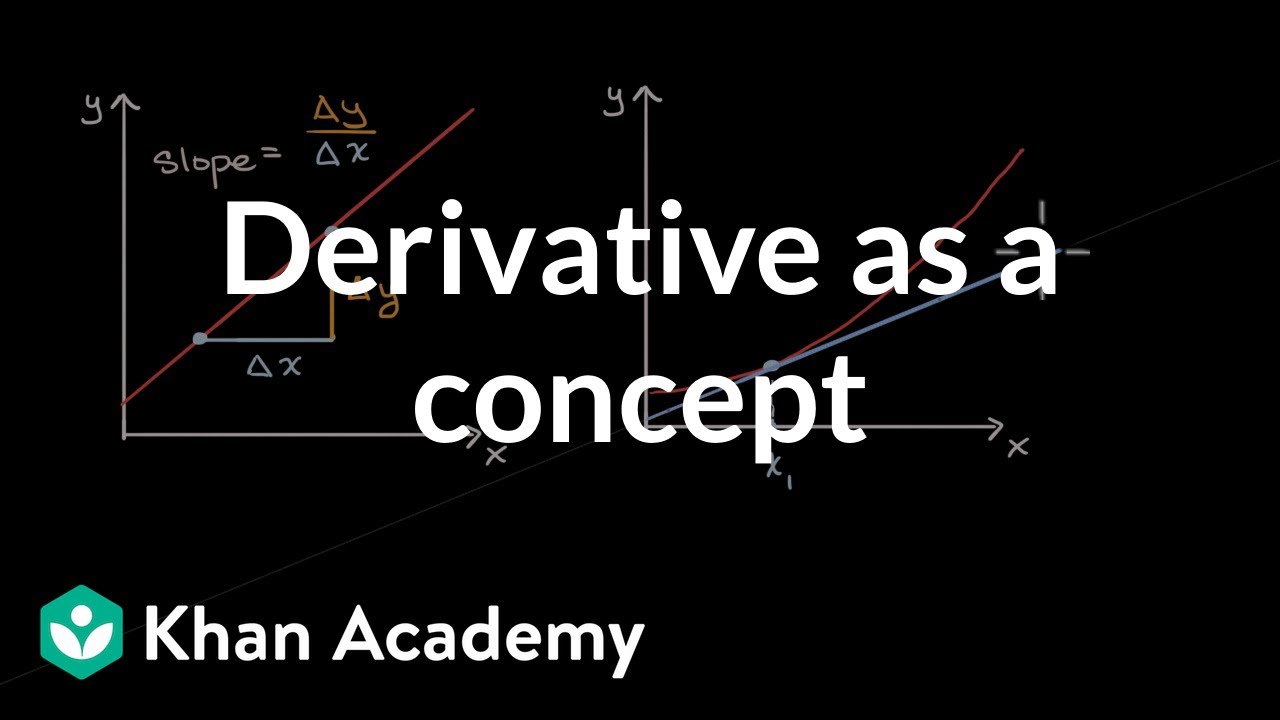
Courses on Khan Academy are always 100% free. Start practicing—and saving your progress—now: https://www.khanacademy.org/math/ap-calculus-ab/ab-differentiation-1-new/ab-2-1/v/derivative-as-a-concept
Why we study differential calculus. Created by Sal Khan.
Watch the next lesson: https://www.khanacademy.org/math/ap-calculus-ab/ab-derivative...
errant shard
ty
hoary iris
errant shard
I still dont get precalc definitions
like what is d/dx, or dh/dy, ect
I get wh...
also there is no such thing called precalculus definitions
I sent you the concept of derivatives
like
d/dx
errant shard
hoary iris
also there is no such thing called precalculus definitions
I dont know what precalc is
I just assumed
We dont do precalculus where we live
And as there is no precalculus channel, well I assumed as I just started...
hoary iris
idk is derivative precalculus
https://www.khanacademy.org/math/precalculus @errant shard try this
Do we need to do "get ready for precalculus" before precalculus?
in KA
 hushed sphinx
Derivatives are the central concept in calculus.
So it wouldn't make sense for them to be part of something sold as PREcalculus.
hoary iris
I see
hoary iris
hoary iris
https://www.khanacademy.org/math/precalculus <@694112558092648539> try this
Is this all the precalculus stuff? @hushed sphinx
errant shard
hoary iris
Do we need to do "get ready for precalculus" before precalculus?
I have no idea
We just do calculus
hushed sphinx
hoary iris
Is this all the precalculus stuff? <@217922183169572864>
I have no idea, "precalculus" appears to be a chiefly American topic grouping that I have no first-hand experience with. I can just deduce from the name that it has to be different from calculus itself...
 noble lava
Precalc is actually just different subjects like trigo and stuff combined lol, if you good at that stuff you can just start calculus
Not a real thing imo
hoary iris
noble lava
Eating rn. Maybe later
 willow bear
hoary iris
Is L(x) factorials?
willow bear
hoary iris
Is L(x) factorials?
... what
hoary iris
idk is it L
willow bear
can you write on paper what function you're referring to
hoary iris
yes
 willow bear
oh yeah that's an old fashioned notation for factorials
in modern notation this would be $\lim_{n\to \infty} \frac{(n+2)!+(n+1)!}{(n+2)!-(n+1)!}$
obsidian monolithBOT
Ann
 hoary iris
obsidian monolith
**Ann**
hoary iris
obsidian monolith
**Ann**
I see
Will gamma function do the same thing as factorials when the input is positive integers?
hoary iris
Can I learn gamma function now?
willow bear
how good are you at integration
hoary iris
idk at which level i am
willow bear
hmm
hoary iris
I know basic integrals
willow bear
<@&268886789983436800> scam
willow bear
hoary iris
idk at which level i am
hm ok let's try this first: $\int\limits_{-\infty}^{+\infty}\frac{\dd{x}}{1+x^2}$
obsidian monolithBOT
Ann
 willow bear
does this look like something you're able to calculate
hoary iris
,, [tanx]_{-\infty}^{\infty}?
obsidian monolithBOT
Monkey•D•Luffy

 drifting oyster
arc
hoary iris
oh shit
willow bear
yeah i mean you might wanna learn not to confuse tan with arctan for starters lol
drifting oyster
Wow throwing shade
hoary iris
willow bear
yeah i mean you might wanna learn not to confuse tan with arctan for starters lo...
mmm sure!
drifting oyster
 willow bear
no direct link to Gamma ftr i just wanted to gauge your level
hoary iris
Am I eligible?
willow bear
drifting oyster
Wow throwing shade
??
hoary iris
lol
willow bear
hoary iris
Am I eligible?
id say probably not yet? like don't take my words as gospel but i do think you might wanna spend time getting better at integration (and tbh also probably learning some real analysis)
willow bear
i mean
eh
line in the sand ig but i don't necessarily expect him to spend 17 years with epsilon bashing
hoary iris
willow bear
id say probably not yet? like don't take my words as gospel but i do think you m...
Thank you for your suggestion! but what is real analysis?
willow bear
calculus concepts but rigorous
drifting oyster
I recommend the bright side of mathematics
Good view into starter stuff...
Wow that's some exciting math
What is that?
Scam analysis?
<@&268886789983436800>
hoary iris
willow bear
calculus concepts but rigorous
calculus concepts but not calculus?
willow bear
im refusing to draw any line in the sand between calculus and analysis.
 uncut star
hoary iris
https://s2pnd-matematika.fkip.unpatti.ac.id/wp-content/uploads/2019/03/Real-Anal...
uncut star
hoary iris
https://s2pnd-matematika.fkip.unpatti.ac.id/wp-content/uploads/2019/03/Real-Anal...
I don't think now is the best time for you to do real analysis
hoary iris
Where are you preparing for JEE?
 willow skiff
try not to study for 12 hours a day challenge
uncut star
willow skiff
try not to study for 12 hours a day challenge
I don't know about him but I am definitely not studying for more than 30 mins
@hoary iris how much do you study on a daily basis
hoary iris
uncut star
<@1034363540242448404> how much do you study on a daily basis
I Just don't do unecessary stuff lol
uncut star
hoary iris
I Just don't do unecessary stuff lol
Same i don't really study physics and chemistry
hoary iris
and study for both for my JEE and school as I am not in integrated one
hoary iris
uncut star
Same i don't really study physics and chemistry
Same here
it is like math (-1/12) while physics and chemistry (the probability of determining the position and momentum of an electron simultaneously)
lmao
uncut star
hoary iris
it is like math (-1/12) while physics and chemistry (the probability of determin...
The difference from math to physics and chemistry just discourages me
hoary iris
Are you in integrated or normal school? @uncut star
hoary iris
uncut star
Same i don't really study physics and chemistry
eventhough I waste time in math in others pov
 robust pecan
obsidian monolith
**Ann**
robust pecan
obsidian monolith
**Ann**
π
noble lava
hoary iris
eventhough I waste time in math in others pov
Yeah you do you don't need to know what gamma functions are when you've barely started limits 
hoary iris
I do know some basic integrals lmao
noble lava
hoary iris
I do know some basic integrals lmao
Still, stuff like gamma isn't necessary at even jee adv level, do chem or smtg instead
uncut star
hoary iris
Are you in integrated or normal school? <@1261742170835128382>
I am in an integrated school
Unfortunately
robust pecan
hoary iris
and study for both for my JEE and school as I am not in integrated one
12th grade?
robust pecan
noble lava
Still, stuff like gamma isn't necessary at even jee adv level, do chem or smtg i...
no need
noble lava
robust pecan
no need

robust pecan
definitely complete integral calculus from cengage
Especially definite integration
trust
noble lava
What do you mean by "no need" lmao? No need to study chem?
robust pecan
bro
robust pecan
noble lava
Still, stuff like gamma isn't necessary at even jee adv level, do chem or smtg i...
No need of stuff like gamma
noble lava
Ah
robust pecan
I am still recovering
noble lava
Grind hard fr, even my chemistry was a bit weak before giving jee but definitely not as bad as it used to be before i tried to actually do it properly
robust pecan
How can i strong my physical chem
noble lava
Physical chem is just grinding numericals imo
Organic is about doing ms chauhan
And inorganic i have no idea, i just studied from notes usually
robust pecan
Inorganic is memory based
hoary iris
uncut star
I am in an integrated school
It's not unfortune 
errant shard
Is rate of change the same as the derivative?
 safe basin
errant shard
Is rate of change the same as the derivative?
safe basin
errant shard
Is rate of change the same as the derivative?
it could be if you’re talking about rate of change locally at some point
But people could also refer to the average rate of change over some interval as that
take some differentiable function f, the first one is computing f’(p) to give you the derivative at some point p
the second one is fixing some a and b in f’s domain and taking (f(a) + f(b))/(a-b)
i.e. slope of the line going through the points a and b
if f is linear then these will give you the same thing because the derivative of f will be constant
 bleak forge
what is the derivative of 8?
safe basin
what do you think
bleak forge
I have no clue
safe basin
look at the definition and give it a try
bleak forge
définition of what
safe basin
the derivative
bleak forge
what’s that
safe basin
how does f change at any point x
bleak forge
f(x)
bleak forge
We haven’t covered variables yet
safe basin
ight I would look at that before looking at derivatives then
bleak forge
ok can you explain them really quick please
safe basin
but the answer to your question is 0
because it just looks like a flat line going through y=8
so the rate of change is 0 bc it never changes
bleak forge
We just finished multiplication in my class it’s a class for kids with learning disabilities
Im going to uni next year so im tryna learn it cuz im going into a math major
safe basin
to khanacademy you go lil bro
bleak forge
what’s a variable I don’t get it
Why is it not a number
it’s a letter
is it like Greek numerals like does x equal 10
drifting oyster
 safe basin
deadass
bleak forge
Im so cooked guys
safe basin
indeed you are
bleak forge
I think it’s to late to go for liberal arts
bleak forge
safe basin
I think step 1 is to touch some grass
« Grass » is one of my triggers so lets stay respectful please
 boreal crag
hoary iris
boreal crag
hoary iris
What is the use of homogenous functions?
 sullen python
hoary iris
What is the use of homogenous functions?
sullen python
hoary iris
What is the use of homogenous functions?
what do you mean by homogenous functions?
hoary iris
I just wanna know what are it's uses and I don't has any other questions!
hoary iris
sullen python
what do you mean by homogenous functions?
something like this

 echo sinew
hoary iris
I just wanna know what are it's uses and I don't has any other questions!
echo sinew
hoary iris
I just wanna know what are it's uses and I don't has any other questions!
I meant that homogeneous can have different meanings according to the context you're working with
hoary iris
in context of JEE
hoary iris
echo sinew
Then I can't help you lol
You can tell me about the pure mathematical homogenous equations too
I wanna know about it!!!!
 dusk forge
cud someone explain linear differntial eqn in a simple yet definition based
river drift
a linear differential equation is a differential equation which is linear
 ivory fractal
wut?
 worldly grove
then f(x) is
a) continuous for all 1 <= x < 7 but not differentiable at x = 1
b) continuous for all -1 <= x < 7 but not differentiable at x = 1
c) neither continuous at [1,7) nor differentiable at x = 1
d) continuous and differentiable at x = 1

How can i solve this?
ive taken the left and right hand limit at x = 1 for which i got the result 3 and 6 so the function is not continuous as x = 1 which also implies its not differentiable at x = 1
should i evaluate the left and right hand limits for the intervals [-1,7) and [1,7) as well?
noble lava
worldly grove
then f(x) is
a) continuous for all 1 <= x < 7 but not differentiable at x = 1
b...
All these options seem suspicious.
f(x) is neither continuous and hence nor differentiable at x=1
However, it is differentiable at x belongs to (1,7)
worldly grove
wait mb i typed the option wrongly, its
c) neither continuous at [1,7) nor differentiable at x = 1
 open mason
ok c then!
 strange lichen
I have a ti84 plus ce and casio fx9860, however my school wants me to get the casio fx-cg50. Would that really make a difference idk? I use the casio 9860 for math cuz it gives exact values but the ti for physics and chem for easy storing and rentry of previous answers. The fx cg50 is 100-150 dollars depending where i go for purchase

 shut willow
 cold vale
can anyone integrate this
cold vale
can anyone integrate this
Substitute x^2 + a^2 = k
shut willow
cold vale
i still cant get thru it
where r u stuck
cold vale
when i take tht = k , i get dx = dk/2x
then
when i substitute dx in the integral
can i cancel 2x and x in numerator?
..alr i got the answer
hoary iris
In which pattern does tan x goes?

 high pelican
iirc tanx maclaurin series is a bit cursed
i cant imagine a scenario where you have to know more than the first couple terms by memory
 summer ruin
$\tan(x) = \sum_{n=1}^\infty \frac{|B_{2n}| 2^{2n}(2^{2n} - 1) x^{2n - 1}}{(2n)!}$
obsidian monolithBOT
Transparent Elemental
 summer ruin
where B_2n is 2n-th bernoulli number
high pelican
I think 'a bit cursed' adequately describes that
hoary iris
Then it is no longer humane!
river drift
<@&268886789983436800>
 vagrant nymph


This is what I tried but I don’t really know how do I find n from here
Like I can’t do the algebra part😭
vagrant nymph
<@&286206848099549185>
vagrant nymph
 spice nymph
you called me son.
spice nymph
you called me son.
how do i even solve these high exponents😭
spice nymph
vagrant nymph
how do i even solve these high exponents😭
latex it down
and ill help you
vagrant nymph
idk latex if u want i can write it properly and send it

$$ \frac{\left(\frac{3\left(3^n-1\right)}{2}\right)}{\frac{1}{6}\left(1-\frac{1}{3^{2n}}\right)} $$
obsidian monolithBOT
TPD
 vagrant nymph
here i did it
hoary iris
obsidian monolith
**TPD**
What do you wanna do with this? @vagrant nymph
vagrant nymph
Find n for which thing thing =3^10
vagrant nymph
vagrant nymph
this was the og question i might have made some calc mistake i tend to make a lot of those
hoary iris
<@&268886789983436800>
 viscid thistle
hoary iris
<@&268886789983436800>
viscid thistle
hoary iris
<@&268886789983436800>
what did he say
viscid thistle
hoary iris
lmao
The message that got deleted
hoary iris
viscid thistle
The message that got deleted
It is some scamming spammer!
lol
not tpd
viscid thistle
hoary iris
It is some scamming spammer!
Oh
 snow marlin
Could someone please sidebar with me for fda/real zeros? I'm still pretty confused about some stuff
drifting oyster
snow marlin
Could someone please sidebar with me for fda/real zeros? I'm still pretty confus...
pardon?
 crude zodiac
hi
 candid condor
prove the following
a) The sum of a rational number r andban irrational number t is irrational
b) The product of a rational number r andban irrational number t is irrational
 tender questBOT
candid condor
prove the following
a) The sum of a rational number r andban irrational number t...
tender questBOT
candid condor
prove the following
a) The sum of a rational number r andban irrational number t...
What step are you on?
1. I don't know where to begin.
2. I have begun but got stuck midway.
3. I got an answer but I was told that it's wrong.
4. I got an answer and would like my work checked.
5. I have a question about someone else's work/solution.
6. I have completed the problem and don't need help anymore. Thank you.
7. None of the above
 midnight kernel
candid condor
prove the following
a) The sum of a rational number r andban irrational number t...
midnight kernel
candid condor
prove the following
a) The sum of a rational number r andban irrational number t...
What did you try so far?
 dry nest
 void charm
man this equation seems unsolveable
 drifting oyster

 red storm
drifting oyster
https://cdn.discordapp.com/attachments/1165428384059379762/1353543919937388595/c...
drifting oyster
red storm
drifting oyster
https://cdn.discordapp.com/attachments/1165428384059379762/1353543919937388595/c...
drifting oyster
X=3 btw...
noble lava
Unsolvable indeed
red storm
immaculate equation
 dusk magnet
void charm
man this equation seems unsolveable
dusk magnet
void charm
man this equation seems unsolveable
6x/10x=x/5
3/5=x/5
x=3

 muted moth
Y'all fast
 empty otter
void charm
man this equation seems unsolveable
empty otter
void charm
man this equation seems unsolveable
3
hoary iris
drifting oyster
https://cdn.discordapp.com/attachments/1165428384059379762/1353543919937388595/c...
This is the reason why big shots shouldn't come here lol
 rough zinc
empty otter
3
rough zinc
empty otter
3
 viscid thistle
void charm
man this equation seems unsolveable
viscid thistle
void charm
man this equation seems unsolveable
so hard
 muted moth
Hmm?
drifting oyster
vagrant nymph
Can someone tell me how do I read this set E1
$\frac{x}{x-1}>0\cap (\mbb{R}/{1}$
 rotund jewel
Banned in different channel
obsidian monolithBOT
Enterlessguy
 drifting oyster
There we go
drifting oyster
vagrant nymph
So all they are saying is x/x-1>0?
That inequality + the fact that x has to be a real number thats not equal to 1
So in summary you have the set x/x-1>0 intersect R minus set of 1
vagrant nymph
Okay thankss these confuse me
vagrant nymph
muted moth
Hmm?
There was some spam message
 late harbor
is ap precalc bc really that hard guys
im an incoming sophemore and im lowk scared
background info, i took honors alg 2, 1 semester i got a b+ and 2 semeter i got an a-
willow skiff
late harbor
is ap precalc bc really that hard guys
it's just AP precalc: you mixed it up with AP Calc BC
but it's not that hard
given your background
willow skiff
 south oar
There's an AP Precalc?
south oar
There's an AP Precalc?
it's fairly new but yes
no more new than the digital SAT though
willow skiff
out of the loop indeed
willow skiff
south oar
I'm shocked we have APs at all
from how you reacted you could also be Canadian or something
south oar
willow skiff
the rural education gap is shocking
Indeed it is
I constantly look to places outside my school at this point
The math program is decent but the sciences
Hoo boy
My last bio teacher doesn't believe in dinosaurs
The one before that said 5G causes cancer
Idek anymore
But Precalc was fun <3
 deep otter
south oar
There's an AP Precalc?
deep otter
south oar
There's an AP Precalc?
When I took Precalculus in the senior year of high school, we just called it an Honors class, but it had IB styled problems. IB was like my school's version of AP. It was uh, weird? And british?
Don't quote me on the british part.
willow skiff
deep otter
Don't quote me on the british part.
it's not British at all
it's very international though
British would be IGCSE then A levels
deep otter
willow skiff
it's not British at all
I thought somebody told me it was at one point but I know the I stands for International so what you say checks out.
Truthfully I don't really remember, that was a long while agoZ
river drift
IB is french
willow skiff
river drift
IB is french
did you know there's a European Baccalaureate
south oar
deep otter
When I took Precalculus in the senior year of high school, we just called it an ...
That’s how it was for me as well, it was Honors Precalc
I took it two years back
I think it may be “CHS” or whatever now
deep otter
south oar
That’s how it was for me as well, it was Honors Precalc
Truthfully? I am not sure if it was a knowledge gap (I got into math very late, I didn't really realize I was really into math until late high school) but I took non-honors math classes until Precalc Honors and I struggled with most things. I got a lot of certain topics but others I really didn't click with, and for some of my other friends who were more academically inclined they found it rough too, so maybe it was the teacher or teaching or how things were set up, but I got a C in that class. And I was happy. It was the first time I did get a C, though.
I later went on to breeze through Calc 1, very graciously mind you, with an A. I did really well in Calc 2 as well, so I guess Precalc did its job in prepping me.
south oar
deep otter
Truthfully? I am not sure if it was a knowledge gap (I got into math very late, ...
No I’m the exact same way. I took honors Precalc my freshman year and finished with a C average, and then got an A overall in Calculus
Idk what it is
willow skiff
repetition legitimises (Neely)
south oar
But Precalc felt so much harder
willow skiff
if you see precalc for the first time it's going to be hard to do well
give students a second chance and they can do much bettert
south oar
That’s fair yeah
willow skiff
truthfully, half of calc is just precalculus content applied to new situations
deep otter
Maybe they make it hard so they know you'll do well!
Like imagine if a giant, buff, muscular dude just clocked you in the jaw and then some really scrawny 10-year-old kid kicked your shin.
Like yes the latter did hurt, but the pain was lessened in a way because you were worried about your face not your shin.
Weird analogy maybe.
Or maybe I'm weird.
south oar
Calculus felt like the cool older brother to precalc
You met precalc went to his house and just were astounded by the coolness
deep otter
willow skiff
truthfully, half of calc is just precalculus content applied to new situations
Yeah I remember in Precalc we talked a lot about domain and ranges of certain functions and the graphs of functions you don't see all the time like exponential functions and functions with radicals. You learn about those briefly in algebra 2 and then never really touch upon them again. Stuff like asymptotes, etc.
It's also where I learned the unit circle for the first time. That was something I was really happy I picked up early. I took it to heart, later in college my classmates were spending time trying to memorize it, I already had it all down.
Ah, also wear I graphed sine and cosine and tangent functions and learned how to for the first time.
Good times.
willow skiff
yeah there's great benefits to doing precalc
in short all of this filler, alg 1 and alg 2 can be fast-tracked if someone has the ability
really what we need to be testing is precalc for those students
to see what they don't understand and do understand, out of everything they've studied so far


 regal oar
noble lava
Correct.
regal oar
noble lava
Correct.
Thank u
 hoary zephyr
regal oar
hoary zephyr
regal oar
to have a more complete answer you could do start by determining the domain of the function ,then check if -x is in this domain.
noble lava
hoary zephyr
to have a more complete answer you could do start by determining the domain of t...
Wdym find if "-x" is in the domain? x is a variable.
uncut star
what is an even function
noble lava
uncut star
what is an even function
f(x)=f(-x)
uncut star
oh
noble lava
Hm?
hoary zephyr
for example for (3) it would be:
$f(x) = 1/x^2$
the domain of the function (where the function is defined) is: $D_f = \left{x\in\mathbb R/ x^2 \neq 0 \right} = \left{x\in\mathbb R/ x \neq 0 \right}$= $\mathbb R^{*}$.
obsidian monolithBOT
Koka
 hoary zephyr
let $x \in D_f$.
$x \in D_f$ $\iff$ $x \in \mathbb R^{}$ $\iff$ $(x < 0 $ or $ x > 0)$ $\iff$ $(- x > 0 $ or $ -x < 0)$ $\iff$ $(- x > 0 $ or $ -x < 0)$ $\iff$ $-x \in \mathbb R^{}$ $\iff$ $-x \in D_f$.
obsidian monolithBOT
Koka
 hoary zephyr
and then you do $f(-x) = 1/(-x)^2 = 1/x^2= f(x)$.
obsidian monolithBOT
Koka
 hoary zephyr
noble lava
I can't think of a case where it wouldn't?
hoary zephyr
noble lava
I can't think of a case where it wouldn't?
let me think
it's been a long time since i did those kind of exercices
maybe for a function defined by pieces..
noble lava
x is still a variable so wouldn't the pieces of the function just adjust accordingly?
hoary zephyr
like for x > 0 f(x) = something and x < 0 f(x) = another thing
noble lava
noble lava
x is still a variable so wouldn't the pieces of the function just adjust accordi...
Like if f=1 for x<0 and f=2x for x>0,
when we put -x,
We get f=1 for x>0 and f= 2x for x<0
noble lava
Yeah that's why I can't really see the point of $D_f$
obsidian monolithBOT
Executor (ask on server b4 DM)
 hoary zephyr
noble lava
Like if f=1 for x<0 and f=2x for x>0,
when we put -x,
We get f=1 for x>0 and f= ...
hoary zephyr
noble lava
Like if f=1 for x<0 and f=2x for x>0,
when we put -x,
We get f=1 for x>0 and f= ...
but to do those kind of manipulation you should determine first where the function exists
hence the use of Df
hoary zephyr
noble lava
Yeah that's why I can't really see the point of $D_f$
do you know how to code?
noble lava
hoary zephyr
do you know how to code?
A bit, why?
hoary zephyr
Actually i want to learn how to code but i don't know where to start
i think it will be very useful to learn
noble lava
I see
imo you shouldn't start with something high level like python
By high level here I mean user friendly and more compile time
noble lava
noble lava
imo you shouldn't start with something high level like python
Like all the concepts can be learned well
But when you move to something like cpp or assembly the syntax requirements will trouble you
Maybe you should start with something like Arduino.
hoary zephyr
arduino
noble lava
Hm, not the compiler, but if you want to see the hardware you'd need to buy that
hoary zephyr
thanks
noble lava
hoary zephyr
thanks
Arduino mostly has applications with hardware, so if you don't want to buy that I'd suggest cpp.
That was my first language.
hoary zephyr
cpp , i will keep it in mind
noble lava
Yeah cool, it stands for c++, look it up 
 hallow dew
Does any1 here in teach uhm math like one on one
$50 for 5 hours doesnt have to be the same say
noble lava
Fr
willow skiff
hallow dew
$50 for 5 hours doesnt have to be the same say
Min hourly wage for tutoring is double that, hun
But you can ask in the help channels for free!
 willow skiff
 dim thistle
Does this count as precal?
dim thistle
Does this count as precal?
this is straight up calculus dude
also the integral is missing a +c
and the integral is in terms of which variable? that's also missing
dim thistle
willow skiff
this is straight up calculus dude
Btw , does rational integration hard ?
willow skiff
dim thistle
Btw , does rational integration hard ?
yes, unless you integrate in the complex numbers
if you integrate in the complex numbers you can decompose any polynomial denominator into its linear factors
so PFD
dim thistle
Can someone check no.3 answer?
 willow skiff
dim thistle
Can someone check no.3 answer?
willow skiff
dim thistle
Can someone check no.3 answer?
ask in the help channels or ask in #calculus
not here
dim thistle
dim thistle
Isn't pre cal!
It*
willow skiff
dim thistle
Isn't pre cal!
is what you sent before calculus? no
it's straight up calculus
anything in the us precalc curriculum goes here, examples include: trigonometry, logarithmic and exponential functions, function sketching, etc.
dim thistle
Thanks, I'm new to cal (I'm a high schooler)
 ionic crystal
J wein
can u help me with geometry
im going into 8th grade
and i dont know shit
willow skiff
dim thistle
Can someone check no.3 answer?
but yes your work is correct for no. 3
nice work!
dim thistle
ionic crystal
can u help me with geometry
Sup?
willow skiff
there's also a technique called the reverse chain rule that helps you integrate f(kx) where k is constant, without doing the substitution
if you just want to check your answer, not the process next time
,w integrate sin(3x) cos(3x)
obsidian monolithBOT


 dim thistle
Thanks bro
willow skiff
np!
red storm
dim thistle
Can someone check no.3 answer?
can't you let u = sin(3x)
so that du = 3 * cos(3x) dx
dx = 1/[3 * cos(3x)] du
also just a good tip whenever you see integrals like this with linear trigonometric functions
you can assume it's u-substitution
d/dx sin(x) = cos(x)
d/dx cos(x) = -sin(x)
d/dx sec(x) = sec(x) * tan(x)
but if it's like degree 2 and above you have to find a way to get an identity
 narrow elm
can someone teach me calculus
echo sinew
Don't you feel like it's too much to ask? 😅
noble lava
narrow elm
can someone teach me calculus
Your textbook can.
narrow elm
noble lava
Your textbook can.
i dont understand it
echo sinew
Change textbook
narrow elm
i cant
echo sinew
Or tell us why you don't understand it
You could probably have some prerequisites missing
narrow elm
well
what prerequisites do you need to understand it?
as far as i understand
calculus is about finding the area of a curvy graph
echo sinew
narrow elm
what prerequisites do you *need* to understand it?
Precalculus, prealgebra, trigonometry
narrow elm
echo sinew
Precalculus, prealgebra, trigonometry
i know trignometry
idk what prealgebra is
idk what precalculus is
maybe ive done it before
echo sinew
Pre-algebra is a primary branch of algebra designed to prepare students for a standard high school algebraic course.

In mathematics education, precalculus is a course, or a set of courses, that includes algebra and trigonometry at a level that is designed to prepare students for the study of calculus, thus the name precalculus. Schools often distinguish between algebra and trigonometry as two separate parts of the coursework.
narrow elm
95% of pre-algebra is done
echo sinew
Awesome
Make sure to know how to deal with fractions very well
Both with numbers and letters
red storm
narrow elm
idk what prealgebra is
pre-algebra is introductory algebra
red storm
narrow elm
what prerequisites do you *need* to understand it?
copious amounts of algebra and trigonometry
narrow elm
oof
red storm
calculus 2 and 3 is trigonometry-heavy
you have to learn stuff like conversion to polar form, polar coordinates, evaluating using radians, how to integrate or differentiate trigonometric functions, etc, etc
just for clarification integration is what you specified about "area under a curvy line"
it finds it
while derivatives find the rate of change at some point of a curvy line
open mason
narrow elm
calculus is about finding the area of a curvy graph
No
That’s just one minor niche you can use it for
 queen hedge
Hey dude I am new here
noble lava
queen hedge
Hey dude I am new here
Welcome! 
 iron gate
Hi guys, I’m taking Ap pre calculus next year, can any of you guys give me tips on how to pre study it so I can get ahead?
red storm
iron gate
Hi guys, I’m taking Ap pre calculus next year, can any of you guys give me tips ...
trigonometric identities, unit circle, trigonometric equations and de moivre's theorem
also equations of circle, ellipse, hyperbola and parabola
make sure you also have good algebra skill and basic trigonometry knowledge as prerequisite
 magic remnant
Guys how do you find the interval of a trig function
Is it something set in stone
or is something you have to find?
if so how
red storm
magic remnant
Is it something set in stone
t his
also you have to learn your trigonometric identities
remember tanx = sinx/cosx
if cosx = 0, then tanx will be undefined
and cotx = cosx/sinx
if sinx = 0, then cotx will be undefined
magic remnant
red storm
t his
Okay so I just have to memorize them
magic remnant
red storm
domain of sinx and cosx
sinx is -pi/2 to pi/2 right?
on unit circle?
or am I being sumb
hushed sphinx
Both sin and cos have all the real numbers as domain.
 noble lava
"Interval"? Your solution is just all the values of x for which cos(5x)=0
So just find the general solution
And see which of the options fit it
magic remnant
How do you tell if the value represents the max or min?

would I just have to graph it and check that way?
raw hill
magic remnant
would I just have to graph it and check that way?
You could graph the sine function to figure it out yeah
sin has a min at 3pi/2 and a max at pi/2
magic remnant
raw hill
sin has a min at 3pi/2 and a max at pi/2
so if I'm not able to graph it it's always safe to assume that when it's 3pi/2 it's talking baout minimum value
and if it's pi/2 it's max?
drifting oyster
sir
raw hill
magic remnant
so if I'm not able to graph it it's always safe to assume that when it's 3pi/2 i...
You could learn that off for sin if you want to 
drifting oyster
sine has its max and min at arcsin(1) and arcsin(-1)
find the general solutions to those arctrigs
and then make sure the inside value of the sine matches to those values
aka if its sin(ax+b) the ax+b inside has to be equal to the x value for sin's minimum
open mason
sin and cos can be analytically continued to the entire complex plane
The complex inverse trig functions attain complex values on non principle branches
And by maximum modulus principle they are technically unbounded ;)
magic remnant
Did I solve this right?

 digital sage
you're wrong right at the 1st step
magic remnant
digital sage
you're wrong right at the 1st step
We don’t use the identities do we
I couldn’t subtract the cos(x)?
digital sage
the identity you used is wrong also
my suggestion here is convert sin^2(x) to cos^2(x)
and solve it like a quadratic

 tight bobcat
 timid widget
Basically you find the slope of the lines and make it pass through your desired points somehow
For example, in 1) the slope of 2x-5y+10=0 is 2/5, so the slope of the line perpendicular to it is -5/2.
timid widget
tight bobcat
For example, in 1) the slope of 2x-5y+10=0 is 2/5, so the slope of the line perp...
it says find the "equation" what that does mean? should i only find the slope and thats it or it means somethin
tight bobcat
It means to find a line
Since a line can be defined using an equation
For example the line y=mx+b has slope m, here we need to find b so that the line passes through the point given
- the line we need to find has slope -5/2 so there's y=-5x/2+b
Since it passes through (1,-2), just sub x=1 and y=-2 and solve for b
timid widget
ohhh i kinda get it now.. but il take my time to comprehend it more
thank you
also should i also do the same for the rest?
tight bobcat
timid widget
also should i also do the same for the rest?
It's pretty much the same, find the points the line needs to pass through as well as the slope (depends on paralel or perpendicular)
willow bear
@regal oar ayo
ok so when it comes to fractions in general
you can cancel things out on the num and denom if they're factors of each
regal oar
yoo
willow bear
namely, $\frac{a \cdot b}{a \cdot c} = \frac{b}{c}$
obsidian monolithBOT
Ann
 willow bear
this is the core idea of any kind of fraction cancellation
and it remains in effect no matter what
regal oar
yea
willow bear
ok right
regal oar
I udnerstand that part
willow bear
notice that if the numerator was instead something like
ab + d
then it would no longer be in the form of a * something
and so cancellation would be impossible
willow bear
* means multiplication as always
dusk magnet
is this task incorrect?(Find the maximum point of the function y=-(x²+400)/x)
 dusk magnet
because it's limit when x->-0 is +inf
willow bear
имеется в виду локальный максимум
dusk magnet
там не написано что локальный и не написано про промежутки
willow bear
про глобальный речь не идет
dusk magnet
dusk magnet
там не написано что локальный и не написано про промежутки
обычно в заданиях егэ всегда пишут какой промежуток чтобы не было вопросов
willow bear
локальный максимум у этой функции вроде бы один
dusk magnet
так и есть
но в условии не указано что нужен локальный и на каком он должен быть промежутке
мне кажется что файл с этим заданием содержит не все данные
dusk magnet
dusk magnet
мне кажется что файл с этим заданием содержит не все данные
и в оригинале условия были другими
willow bear
локальный максимум -- точка, в которой первая производная 0, а вторая -- отрицательна
dusk magnet
willow bear
локальный максимум -- точка, в которой первая производная 0, а вторая -- отрицат...
это я знаю
но математика точная наука, и когда не говорят что нужна точка локального максимума на промежутке, а говорят найти просто точку максимума у функции которая не ограничена сверху то явно что-то не так
rotund jewel
Hey @willow bear @dusk magnet, for moderation purposes we request that all extended non-English conversations be moved to DMs
willow bear
k
rotund jewel
I apologize for the inconvenience
 knotty copper
noble lava
knotty copper
noble lava
Multi post?
 obtuse olive
noble lava
Multi post?
obtuse olive
noble lava
Multi post?
didnt know where i was supposed to post mb
already found it tho
noble lava
Alr you can delete it if it's solved
hoary iris
rotund jewel
I apologize for the inconvenience
Apologising to whom for what??
hushed sphinx
Apologizing to Ann and Uo for shooing them out to DMs.
 willow bear
for the record, uo did not DM me
drifting oyster

 proud raven
to those that are out of school and training and job interviews and normal places to encounter an actual test
what is the hardest test/quiz you find yourself given in your normal life
using test/quiz loosely, obviously
hoary iris


magic remnant
How would you find the exact answer of this without a calc

Or is it already simplified enough to be considered exact?
river drift
,rccw
obsidian monolithBOT
 river drift
that's as simplified as it's going to get
magic remnant
river drift
that's as simplified as it's going to get
Okay ty 🙏
 rugged sundial
How do I tell what function it is exactly? I can only find the x-intercepts being x=-3, x=1, and x=5.
 willow skiff
rugged sundial
How do I tell what function it is exactly? I can only find the x-intercepts bein...
willow skiff
rugged sundial
How do I tell what function it is exactly? I can only find the x-intercepts bein...
That's interesting
It's a rational function assuming ing the part before x = 0 goes to positive infinity
rugged sundial
I've been staring at this for 20 minutes and im so lost
willow skiff
Furthermore, the numerator must be at least of degree 3 + 1 = 4, cause the denominator is linear (only one vertical asymptote)
rugged sundial
x=-3 being asymtote right?
willow skiff
rugged sundial
x=-3 being asymtote right?
No, that's the root
My best guess based on the graph is x = -2
 whole void
rugged sundial
How do I tell what function it is exactly? I can only find the x-intercepts bein...
whole void
rugged sundial
How do I tell what function it is exactly? I can only find the x-intercepts bein...
impossible, without futher information (if u want to be pedantic)
tight bobcat
rugged sundial
How do I tell what function it is exactly? I can only find the x-intercepts bein...
pick a random function and pray
rugged sundial
ok
tight bobcat
At least use the roots tho
willow skiff
willow skiff
Furthermore, the numerator must be at least of degree 3 + 1 = 4, cause the denom...
It's possible but you have to keep trying functions of this form until it matches
You must have (x - 1)^2 (x + 3) (x - 5) in the numerator cause of the roots
But 1) you don't know the vertical asymptote and 2) you don't know the vertical stretch
tight bobcat
Maybe vertical stretch isn't a problem here, the graph passes through (2,-5)
willow skiff
tight bobcat
Maybe vertical stretch isn't a problem here, the graph passes through (2,-5)
Ah cool
Yeah there are plenty of integer points
rugged sundial
tight bobcat
At least use the roots tho
i figured it out
willow skiff
That one looks the most exact
rugged sundial
rugged sundial
How do I tell what function it is exactly? I can only find the x-intercepts bein...
its f(x)=(x+3)(x-1)^2(x-5)/(x+1)
tight bobcat
That looks correct
magic remnant
Is this correct?
 tight bobcat
magic remnant
Is this correct?
tight bobcat
magic remnant
Is this correct?
Move 4 to the other side first before taking log
tight bobcat
Yeah...
tight bobcat
Then 1/(4+e^2x)=11/50
magic remnant
Is there still a 1 left over…
After we cross out..
The 50 😭
Oh god
I see it now
This
 tight bobcat
alr
magic remnant
if we have the equation
r = 6
and it has to be graphed on a polar graph
would I plot a singular point or have to plot a circle?
 spice mica
well r=6 means you’re graphing everything 6 units away from the origin
so a full circle
magic remnant
Does this look right
 spice mica
that should be a circle
cos graphs in polar are circles with a diameter of the coefficient, in this case 3, and the left most point is on the origin
magic remnant
I tried but if I need the edges to touch 1.5
I don't think making a circle would work on this graph
spice mica
yeah the radius is 3/2 because the diameter is 3
magic remnant
because then I'd hhave to change the diamters
magic remnant
spice mica
yeah the radius is 3/2 because the diameter is 3
yeh so this is probably the best I can get it
unless I'm missing somethingz?
spice mica
no it should definitely be a circle
spice mica
why not
spice mica
magic remnant
The circles circumference has to touch 1.5 and -1.5
yeah the radius is 3/2 so that’s done
like I said
magic remnant
yeah and it is on the graph
spice mica
I don’t really get what you’re confused about
magic remnant
Do you think you could js draw it somewhere
magic remnant
spice mica
I don’t really get what you’re confused about
I don't get what's wrong about it
spice mica
 magic remnant
yeah
 magic remnant
spice mica
I was curious why cosine graphs made circles so I went ahead and proved it
magic remnant
spice mica
I was curious why cosine graphs made circles so I went ahead and proved it
Woah
That’s so cool 😭
spice mica
well not actually a valid proof because I would need to show more rigorously that the angle there is 2theta
kinda just hand waved that
chatgpt gave a better proof anyway
 magic remnant
Can someone please check my graphs and what I wrote for point of intersections at poles?

 magic remnant
spice mica
well not actually a valid proof because I would need to show more rigorously tha...
magic remnant
spice mica
well not actually a valid proof because I would need to show more rigorously tha...
I figured out the problem with my r = 3cos(theta)
It’s now a circle
magic remnant
Are the values of theta for which the polar graph of 3cos(theta) 0<=theta<=2pi or just pi
magic remnant
magic remnant
Can someone please check my graphs and what I wrote for point of intersections a...
I have to find those for the shapes formed by the graphs here
I just don't know how to find said intervals
you mean just plug it in
and find it like that?
wait
Oh my god I'm an idiot 😭
I literally drew out the graphs for the equations
which have the innterval I need 😭
You explained it good (I watched the limits vid)
But the audio was a bit difficult to understan
but yeah it was pretty good js the audio 🔥
 spare panther
hi guys are there any linear algebra sources you could recommend? anything to help self-study before university hits
echo sinew
spare panther
hi guys are there any linear algebra sources you could recommend? anything to he...
spare panther
echo sinew
<#540211747613704221> or <#716264872018706443>
didn't notice these chats thanks
 arctic swan
I learned sigma and product operator today and got too excited 😭😭
 tight bobcat
arctic swan
I learned sigma and product operator today and got too excited 😭😭
tight bobcat
arctic swan
I learned sigma and product operator today and got too excited 😭😭
I'm not sure what I'm seeing but I'm not lovin' it
whole void
arctic swan
I learned sigma and product operator today and got too excited 😭😭
Yes I love those. Learn how to drag sigma a bit better 🙏
hoary iris
magic remnant
Can someone please check my graphs and what I wrote for point of intersections a...
This is pleasing to the eyes. Anyway, what were you studying then? I mean the topic you're going through
noble lava
arctic swan
I learned sigma and product operator today and got too excited 😭😭
Good luck solving that
You gonna be hella lucky if the answer is even finite 
willow bear
arctic swan
I learned sigma and product operator today and got too excited 😭😭
yes you did
hoary iris
How to find the least value of n for (sqrt(3)+i)^n to become real and purely imaginary without trying every n values from 1 to some number which gives the answer?
The real and purely imaginary are separate questions
drifting oyster
Well least is 0 for it to be R
hoary iris
Sorry n should be positive mb
drifting oyster
Interesting question...
I would set it equal to a+0i and try to use binomial formula
Perhaps we can also use the fact that (a+b)^n>=a^n+b^n
Not sure if that will help though
hoary iris
drifting oyster
I would set it equal to a+0i and try to use binomial formula
What will a be?
drifting oyster
hoary iris
What will a be?
Any real number
hoary iris
How to find n in this way btw?
drifting oyster
not sure... but
willow skiff
hoary iris
How to find the least value of n for (sqrt(3)+i)^n to become real and purely ima...
Find the argument of sqrt3 + i then multiply by n
It's based on De Moivres
hoary iris
Sorry I am not taught what is argument and de moivres @willow skiff
I am only taught the arithmetic of complex numbers
drifting oyster
Argument is angle between z and the origin
hoary iris
With some properties of it
willow skiff
hoary iris
I am only taught the arithmetic of complex numbers
Come back when you know it
hoary iris
willow skiff
Come back when you know it
I see
willow skiff
It's clearly designed for someone who knows
hushed sphinx
hoary iris
How to find the least value of n for (sqrt(3)+i)^n to become real and purely ima...
If you don’t know the geometric interpretation of the complex multiplication, then it would seem your only cance is to try every n until you find the first purely-imaginary power.
But you won't need to try very far!
hoary iris
willow skiff
It's clearly designed for someone who knows
But not for us
hoary iris
hushed sphinx
If you don’t know the geometric interpretation of the complex multiplication, th...
I see
I will give it a try after I have done the graphical thing
Thank you for your information!
hushed sphinx
The graphical thing?
hoary iris
um what do you mean by geometrical representation of multiplication of complex numbers? @hushed sphinx
I only know that multiplying a number by 'i' rotates the number by 90 degrees in the argand plane
tight bobcat
That's one example. Basically every complex number has a magnitude (absolute value) and an angle, which is the argument of the number.
Multiplying some complex numbers will multiply the magnitudes together while adding the angles up
For example, i has a magnitude of 1 and a 90° angle, while 1+i has a magnitude of √2 and a 45° angle.
Their product is -1+i, which has a magnitude of √2 and a 135° angle.
hoary iris
whooooaaaaaaaaaaaaaaaaa
can we represent argument of some complex number z as Arg(z)?
tight bobcat
Yeah I think that's correct
hoary iris
Can we say z=cos(arg(z))+i sin(arg(z))?
noble lava
Mhm
But
That's only if |z|=1
Otherwise the general formula is z=|z|(CiS)
(CiS) is a shorthand way of writing cos(argz)+isin(argz) btw
hoary iris
is r=|z|?
noble lava
Yeah
noble lava
noble lava
Otherwise the general formula is z=|z|(CiS)
This is the polar form of complex numbers
hoary iris
we can find the arg of some number z if we represent them in polar form. right?
noble lava
You'll also learn the euler form eventually
hoary iris
it is e^(i arg(z)). right?
noble lava
hoary iris
we can find the arg of some number z if we represent them in polar form. right?
The polar form is just a representation like the normal z=x+iy, in the polar form if you factor out the common multiple, that will just be your 'r'
noble lava
hoary iris
it is e^(i arg(z)). right?
Mhm
hoary iris
I have a doubt regarding r=|z|
is it really true?
can you give me an example on this?
axe cutter
@noble lava
noble lava
hoary iris
I have a doubt regarding r=|z|
Wdym?
noble lava
r is just a representation for |z|
noble lava
Yeah
drifting oyster
and the magnitude of z denotes the distance of z from 0
and thats the same as the hypot
hence r=mag(z)
hoary iris
yes it is but........
drifting oyster
but?
hoary iris
noble lava
Otherwise the general formula is z=|z|(CiS)
what does this mean?
hoary iris
Is cis(argz) the unit thing?
obsidian monolithBOT
Enterlessguy
 drifting oyster
$z=re^{i\theta}$
obsidian monolithBOT
Enterlessguy
 drifting oyster
$\abs{z}=\abs{re^{i\theta}}$
obsidian monolithBOT
Enterlessguy
 hoary iris
noble lava
.
hoary iris
noble lava
.
ye bro but is cos(arg z)+ i sin(arg z) the unit thing of that number?
drifting oyster
$\forall z \in \mbb{C}: r\ge 0$ hence $\abs{z}=r\abs{e^{i\theta}}$
obsidian monolithBOT
Enterlessguy
 drifting oyster
hoary iris
ye bro but is cos(arg z)+ i sin(arg z) the unit thing of that number?
drifting oyster
hoary iris
ye bro but is cos(arg z)+ i sin(arg z) the unit thing of that number?
yes because thats r=1
tight bobcat
hoary iris
ye bro but is cos(arg z)+ i sin(arg z) the unit thing of that number?
That's the angle part, the magnitude is the r
hoary iris
How to represent z=1+i as in this form btw?
hoary iris

noble lava
What part's not clear?
hoary iris
How to find arg z?
drifting oyster
hoary iris
How to find arg z?
$\arg(z)=\arctan{\frac{b}{a}}$
obsidian monolithBOT
Enterlessguy
 drifting oyster
(but)
hoary iris
What are b and a here?
drifting oyster
you need to make adjustments based on the quadrant of z
tight bobcat
hoary iris
What are b and a here?
z=a+bi.
drifting oyster
but here since both of your a and b are positive
drifting oyster
obsidian monolith
**Enterlessguy**
you can just use this formula
 tight bobcat
The range of arctan is (-90°,90°) iirc
hoary iris
yes
tight bobcat
The argument's range is [0°,360°)
-# i was wrong oops
drifting oyster
so for some quadrants,
you need to consider starting from 180 degrees
thats what I mean
drifting oyster
tight bobcat
The argument's range is [0°,360°)
-# i was wrong oops
negative pi to positive pi



 noble lava
drifting oyster
negative pi to positive pi
noble lava
drifting oyster
negative pi to positive pi
(]
tight bobcat
drifting oyster
negative pi to positive pi
yeah I don't really remember things correctly so I'm not sure
noble lava
Conventional principal argument is defined that way 
drifting oyster
yes
hoary iris
but why not 0 to 2pi?
tight bobcat
hoary iris
but why not 0 to 2pi?
Because everyone sure loves seeing other people suffer 🥰
hoary iris
tight bobcat
Because everyone sure loves seeing other people suffer 🥰

lessguy and cutterr
whyyyy nottt?
they're gone without telling it 😭
noble lava
 noble lava
noble lava
noble lava
It's just how it's defined
drifting oyster
its just nicer to define it the other way
so when you don't slightly move under the positive reals
you immediately don't jump to 2pi
tight bobcat
drifting oyster
and nicer...
From this I conclude that I'm not nice. □
drifting oyster
noble lava
for quadrant 1 arg(z) is just theta
for quad 2 arg(z) is theta +pi
etc...
hoary iris
hoary iris
How the formula came??
tight bobcat
hoary iris
How the formula came??
Quadrants 1 and 4 are quite easy to see
drifting oyster
hoary iris
How the formula came??
math 
its trigonometry...
I think you can derive it yourself...
hoary iris
I want to know the math behind it!
tight bobcat
For 2 and 3 you just throw in a pi and pray it works
drifting oyster
just pay attention to the domain restriction on tangent
hoary iris
drifting oyster
just pay attention to the domain restriction on tangent
whooaaa yeah
I still don't get it sowwy
everyone
drifting oyster
draw a triangle...
to z
where a is the adjacent side to theta
and b is the opposite
you have that tan(theta) = opp/adj =b/a
hence theta= arctan(b/a)
pretty simple...
tight bobcat
Hmm
drifting oyster
I think you can understand this better visually...
tight bobcat
For 2 and 3 try reflecting z over the y axis and find the supplementary angle of the argument of the new point
Explanation: trust me bro
drifting oyster

notice that for the 3rd quadrant
we have -pi rotation already?
so the argument is theta-pi
hoary iris
Thank you so much!!
drifting oyster
also to write z in its polar form
you just need to calculate arg(z) and |z|
and then plug it into $|z|e^{i\arg(z)}$
obsidian monolithBOT
Enterlessguy
 drifting oyster
(|z|) is r
noble lava
euler form*
river drift
noble lava
euler form*
that's usually called polar form at least in my experience
noble lava
river drift
that's usually called polar form at least in my experience
 really?
river drift
you could define it that way but we always just used e^(i theta)
echo sinew
In Italy we call it exponential form lol
echo sinew
drifting oyster
technically polar is the cos(theta)+isin(theta) one
Amd this one trigonometric form
And z = a + ib algebraic form
There are so many names 🙈
 small solar
In France it's the same. But we also can call |z|e^(iarg(z)) the exponential form.
By the way if you like the exponential form, you can solve : $$\arg(z)\equiv\arg(z^2+i)\ [2\pi]$$
obsidian monolithBOT
gottawakup
 hoary iris
echo sinew
In Italy we call it exponential form lol
hoary iris
echo sinew
In Italy we call it exponential form lol
In India(especially in tamil nadu) too
magic remnant
what do I right for the limit as x approaches infinity for the sin, cos and tan functions?
i know it has no limit because y never reaches a certain point but I just wrote
lim x -> inf, y = NL
and at the top wrote NL = no limit
Is tehre a formal way to write this
river drift
they way i've seen it written is $\lim_{x \to \infty} \sin x$ does not exist'' or $\lim_{x \to \infty} \sin x$ DNE'' but how you write it isn't super important
obsidian monolithBOT
cloud
 magic remnant
river drift
they way i've seen it written is ``$\lim_{x \to \infty} \sin x$ does not exist''...
magic remnant
river drift
they way i've seen it written is ``$\lim_{x \to \infty} \sin x$ does not exist''...
okay, thanks 🙏
magic remnant
How would you find the interval of a piecewise function

Like how do I find it for this graph
(I’m talking about increasing/decreasing interval)
 dry lantern
Increasing = positive slope
Decreasing = negative slope
magic remnant
dry lantern
Increasing = positive slope
Decreasing = negative slope
Yeah but for piecewise functions what would that look like
Because this one has 3 functions
So 3 diff intervals right
dry lantern
It works the same for analytic functions