#precalculus
1 messages · Page 69 of 1
 heavy pewter
 willow skiff
it's pattern recognition
consider using Quizlet (or Anki if you're dedicated) for simple recall, with the name on one side and the picture/definition on the other
 trim shard
ive never studied from it but stewart does it best from what ive seen
i use it for my calculus course and it clarifies all the important rules and gives pretty great examples, so it cant be a bad pick when it comes to precalc either
willow skiff
LibreTexts better
 echo sinew
!noping
 tender questBOT
Please do not ping individual helpers unprompted.
 remote cove
M sorry
 willow bear
if you wanted to follow up with me about something i said then you should say so explicitly ("I wanted to follow up / ask you again about [thing]...")
if you have a new doubt/problem/question/whatever then you should just post it
maybe i will come help you maybe i will not
you should not hold out hope for me specifically
willow bear
when you post your doubt directly, you give me a chance to decide whether or not i have enough energy to explain it to you
willow bear
remote cove
But I was asking
so far you have not asked anything at all
remote cove
I'm posting...
Why did they mention the y-x curve not the x-y curve and what is the difference? What is the purpose of introducing the rate of change at the curve that is dy/dx = 0

 willow bear
ok nope sorry you will have to wait for somebody else
i do not have the energy for this
 uncut star
remote cove
Why did they mention the y-x curve not the x-y curve and what is the difference?...
uncut star
remote cove
Why did they mention the y-x curve not the x-y curve and what is the difference?...
At dy/dx slope is 0
So it is the local maxima or minima
I am not sure if this was what you were asking
 alpine shore
You can name a graph by mentioning what's in y-axis vs what's in x-axis e.g voltage (y-axis) -current(x-axis) relationship because we know slope=dy/dx which for this case gives resistance.
 winged epoch
A little confused about this thing. So I understand least common denominator and how to apply it to adding/subtracting rational expressions and simplifying complex rational expressions yet there's a nuance that is confusing.
In the first problem, I can multiply the expression by (x+1)(x-3)/(x+1)(x-3) and then I can cancel out the denominators of the rational expressions in the numerator and denominators giving me the correct answer.
However in the second problem, I can't cancel anything out in the numerator or denominator. I have to multiply the terms in the numerator after I put them all over the LCD. Yet before I multiply some of the terms in the denominator can be canceled out. Why is it different?

 winged epoch
A little confused about this thing. So I understand least common denominator and...
winged epoch
winged epoch
A little confused about this thing. So I understand least common denominator and...

Yet I can't do that in the third screenshot
oh well actually if someone wants to answer they can but i believe i see it
 raven laurel
How do you eliminate T in parametric eqations?
 winter comet
raven laurel
How do you eliminate T in parametric eqations?
winter comet
raven laurel
How do you eliminate T in parametric eqations?
with algebra
do you have an example lol
 winter comet
raven laurel
number 60
winter comet
raven laurel
number 60
try using the fact that cos^2(theta) + sin^2(theta) = 1
 novel tusk
I wanna ask, does the inscribing shape in a circle trick work for all polynomials?
 bleak forge
im doing this in chem rn
 oak ferry
bleak forge
im doing this in chem rn
oak ferry
bleak forge
im doing this in chem rn
teach me pookie
bleak forge
what is the equation for decomposition of N2O4
willow bear
novel tusk
I wanna ask, does the inscribing shape in a circle trick work for all polynomial...
what trick
 viscid thistle
Hi guys
Any tips to improve indefinite integration , I'm able to do easy ones but the jee level I cant
 wild bramble
viscid thistle
Any tips to improve indefinite integration , I'm able to do easy ones but the je...
wild bramble
viscid thistle
Any tips to improve indefinite integration , I'm able to do easy ones but the je...
wdym integration were in precalc 😭😭😭
viscid thistle
wild bramble
wdym integration were in precalc 😭😭😭
I'm from India we don't have such things as precalc and stuff
wild bramble
viscid thistle
I'm from India we don't have such things as precalc and stuff
oh okie
but i suggest you find the #calculus channel, because you're more likely to find help there
viscid thistle
wild bramble
but i suggest you find the <#326138772477575180> channel, because you're more li...
Oh thank you , I didn't see it sorry
 fiery crest
I have a precalc 2 midterm this week and I'm already really behind I don't know what to do really. It feels like the questions given on tests don't match what we did in class or on homework.
It's the first time I've had a teacher not allow notes at all during tests and I keep bombing all the tests
 zinc matrix
i'm so frustrated, i feel like i can't understand anything and my mind is just blocking information
 whole void
viscid thistle
Any tips to improve indefinite integration , I'm able to do easy ones but the je...
whole void
viscid thistle
Any tips to improve indefinite integration , I'm able to do easy ones but the je...
do u have an example of one?
 idle field
zinc matrix
i'm so frustrated, i feel like i can't understand anything and my mind is just b...
idle field
zinc matrix
i'm so frustrated, i feel like i can't understand anything and my mind is just b...
I've been frustrated for the last 10 years.
and that wasn't enough to stop me
 gleaming olive
fiery crest
I have a precalc 2 midterm this week and I'm already really behind I don't know ...
gleaming olive
fiery crest
I have a precalc 2 midterm this week and I'm already really behind I don't know ...
im not sure if this will help but it seems like to me that the tests must go much more in depth into concepts only really outlined in class or in homework. for me this helps, try going through the basics of the concepts again, and try to explain the concepts to someone else. if youre able to understand a concept well, u can teach it to someone else or have a conversation abt it. then it would be good to try word problems or problems that connect together several concepts or problems that require more abstract uses of the concepts. 👍
fiery crest
gleaming olive
im not sure if this will help but it seems like to me that the tests must go muc...
The main problem I'm facing is not understanding fractions I think
gleaming olive
fiery crest
The main problem I'm facing is not understanding fractions I think
i see. im not in precalc yet so i ddont really know the specifics but have u tried watching vids on it and asking for help in class?
idle field
fiery crest
The main problem I'm facing is not understanding fractions I think
What grade are you at the moment?
fiery crest
idle field
What grade are you at the moment?
1st year college
idle field
fiery crest
1st year college
What's the difficulty with fractions?
fiery crest
idle field
What's the difficulty with fractions?
I don't really understand how to do anything with them. I've almost never used them
idle field
I think this topic is covered on duolingo math, try that, or any lower level text book.
gleaming olive
fiery crest
I don't really understand how to do anything with them. I've almost never used t...
i dont know abt precalc fractions. can u try to explain them. it should help trying to outline what u know about them anyway
fiery crest
gleaming olive
i dont know abt precalc fractions. can u try to explain them. it should help try...
I'm just talking about normal fractions
Missed all of elementary school
gleaming olive
fiery crest
I don't really understand how to do anything with them. I've almost never used t...
in terms of this are u referring to operations with fractions?
fiery crest
Yeah it feels like there's all these rules with fractions
willow bear
fiery crest
I don't really understand how to do anything with them. I've almost never used t...
do you mean like just-number fractions or do you mean algebraic fractions
 dim matrix
fiery crest
Yeah it feels like there's all these rules with fractions
dim matrix
fiery crest
Yeah it feels like there's all these rules with fractions
Fairly understand the rules adding and subtracting fraction first then move on to understanding the rule when diving a whole number with a number expressed in a fraction form. If you nail those basics down, then you will more confident on taking the exam
If your exam covers problems regarding solving problems about fractions, not rate problems (which are word problems that involves fractions), then you should focus on doing many problems.
viscid thistle
any precalc textbook to buy
 chrome ether
there are tons of free texts online
openstax, libretexts, etc surely have something
whole void
gleaming olive
i dont know abt precalc fractions. can u try to explain them. it should help try...
wdym “precalc fractions”
heavy pewter
fractions are fractions what
precalc fractions doesn't really mean much if you don't explain 
viscid thistle
In terms of textbooks, any one will do?
I sort of don’t like the way some textbooks are, where it doesn’t feel like it’s enough info
Or they omit something that other textbooks have, weird quirks like that
I’m more curious about the why’s as I engage in the how’s
viscid thistle
looking for algebra and pre calculus textbooks
I briefly saw art of problem solving, openstax, and stewart textbook. But confused which one to go for
I don’t mind purchasing the book, need physical copies as digital does me no good
 cedar sparrow
who can help me on this

 cedar sparrow
heavy pewter
what is g(-5)?
cedar sparrow
heavy pewter
what is g(-5)?
example problems but i still dont get it

like i hate graphs
heavy pewter
ugh just think of it this way
$f\circ g(a)$ means whatever you find for $g(a)$ i.e. let's say $g(a)=k$ then that becomes the input for $f$ i.e $f(k)$
 obsidian monolithBOT
parabolicinsanity
 heavy pewter
then all that's for you to do
cedar sparrow
okay
cedar sparrow
alright
cedar sparrow
heavy pewter
then input that for f
would 5. be f(g(-5)) = 2
heavy pewter
$f:A\longrightarrow B \land g: B \longrightarrow C$ so $g\circ f: A\longrightarrow C$
hmmmm
obsidian monolithBOT
parabolicinsanity
 cedar sparrow
heavy pewter
$f:A\longrightarrow B \land g: B \longrightarrow C$ so $g\circ f: A\longrightarr...
cedar sparrow
heavy pewter
$f:A\longrightarrow B \land g: B \longrightarrow C$ so $g\circ f: A\longrightarr...
would the second one be g(f(2)) = 1
 cedar sparrow
heavy pewter
yeah
cedar sparrow
heavy pewter
yeah
g(f(-1))=1 for the last one?
cedar sparrow
uhm how
cedar sparrow
tysm
 fallen swift
hi
 silk yacht
heavy pewter
maths is fun
silk yacht
heavy pewter
maths is fun
Real
silk yacht

I solved the integration but how tf do I find f(x)
this is the answer I got

but Can't find f(x)
 raw hill
silk yacht
raw hill
silk yacht
Ok this is rlly bad question design but I’ll digress on that front
Finding $f$ explicitly seems like too much effort here. Just note that $$\frac{\sin 1+\cos 1}{\sin 1-\cos 1}=\tan \left(\frac{\pi}{4}+\frac{f(1)}{2} \right)$$ and compare.
obsidian monolithBOT
Civil Service Pigeon
 silk yacht
raw hill
Ok this is rlly bad question design but I’ll digress on that front
silk yacht
raw hill
Ok this is rlly bad question design but I’ll digress on that front
what if I wanted to find f(x)
????
silk yacht
obsidian monolith
**Civil Service Pigeon**
also this is wrong I believe
denomiantor would cos1 - sin1
silk yacht
raw hill
Finding $f$ explicitly seems like too much effort here. Just note that $$\frac{\...
I got the answer by comparing but what if I wanted to find the function?
should I just differentiate both the sides?
raw hill
silk yacht
what if I wanted to find f(x)
Uh you could do the algebra but it’ll be ugly
raw hill
silk yacht
denomiantor would cos1 - sin1
Eh whatever I’m not too worried about the details - as long as the concept gets across
raw hill
raw hill
Uh you could do the algebra but it’ll be ugly
,w solve for y if |(x sin x + cos x)/(x cos x - sin x)|=|tan(pi/4 + y/2)|
obsidian monolithBOT


 Requested by civil_service_pigeon
raw hill
Requested by civil_service_pigeon
raw hill
I assume you’re working over the reals
So you don’t need to worry about the complex stuff
But it’s still not the prettiest
 crisp fractal
Hello is this a channel for calcul ? like division and stuff ? 👀
raw hill
crisp fractal
Hello is this a channel for calcul ? like division and stuff ? 👀
“calcul” as in “calculus” or “calculation” (arithmetic)?
crisp fractal
calculation i think in this case about patterns
raw hill
Throw it in #prealg-and-algebra ig
crisp fractal
About 1;4;9:16 etc
raw hill
raw hill
Throw it in <#326138737606262786> ig
Or just open a help channel ngl
crisp fractal
analysis
raw hill
raw hill
Or just open a help channel ngl
Those get way more attention
crisp fractal
ok thanks 😄
viscid thistle
Hi there I need quite a bit of help
So I’m stuck on how to graph the inverse of functions

It’s 18-20 and I really have no issue with 21-23 but it’s solely 18-20
& Yes I did page back to section 6.3!
There is actually no way to graph 18

I can’t graph said set

 lethal sand
viscid thistle
So I’m stuck on how to graph the inverse of functions
lethal sand
viscid thistle
So I’m stuck on how to graph the inverse of functions
isnt to graph inverse functoins is js switch the x and y coords
viscid thistle
lethal sand
isnt to graph inverse functoins is js switch the x and y coords
Yes for basic ones but in this scenario Desmos wasn’t picking up my answer so what I had to do was
F(x)=-logbase9(x)
Instead of the actual relevant answer
willow bear
viscid thistle
it doesn't like F^-1 as a function name.
if you clicked the ⚠️ symbol you could have seen desmos' exact complaint.
 hollow geode
viscid thistle
hollow geode
viscid thistle
look at the error messages
heavy pewter
desmos doesn't like function inverses besides the library functions
don't even try

just define it as another function
viscid thistle
heavy pewter
desmos doesn't like function inverses besides the library functions
Ye I can’t lie I have no way to graph this
or know wtf it means

For comparison I tried this as well

 lean drum
viscid thistle
For comparison I tried this as well
lean drum
viscid thistle
For comparison I tried this as well
That works
 normal quail
I'm 26 years old and self studying math too. Some friend suggested this:
1a
https://artofproblemsolving.com/store [Introduction-level & Intermediate-level]
For if you need a review of “basics”. I suggest working through Introduction to Algebra & Intermediate Algebra & Precalculus.
#############
1b
Brilliant dot org [Problems of the week Archive]
2
-The two volumes on the contest preparation section.
-Book: The Art and Craft of Problem Solving, Paul Zeitz
Have a look on these. And feel free to select only one of them (I recommend the second)
You may also check George Polya books::
Notably, Mathematical Discovery on Understanding, Learning, and Teaching Problem Solving, Volumes I and II
3
The two volumes of Tom Apostol, Calculus [main]
Spivak Calculus [have a look at the problems here while working through Apostol first volume]
-
Book: An Introduction to Mechanics, Kleppner and Kolenkow
-
Book: Electricity and Magnetism, Purcell [Make sure that you have the third edition with David Morin]
I am personally self studying pre calc from AOPS.
Buy print or online math books for gifted students. Purchase a full math curriculum plus math contest preparation for elementary through high school.
They say AOPS is challenging compared to others.
I'm also reading the art and craft of problem solving by Paul zeitz.
Seems like a good book to complement with the pre calc textbook
silk yacht
obsidian monolith
OH HELL NAWW, I AIN'T DOING ALL DAT
 drifting oyster
viscid thistle
drifting oyster
viscid thistle
I don't think desmos supports $f^{n}(x)$ notation
obsidian monolithBOT
Enterlessguy
 drifting oyster
That's probably the issue
You could just define $g(x)=f^{-1}(x)$ and graph it as $g(x)$ instead
obsidian monolithBOT
Enterlessguy
 drifting oyster
He has to stop the car, that means it has an intersection at that point, ie $v(k)=0 s.t k>0 \in \mathbb{R}$ it also need to be $v(0)=0$ since the initial velocity before driving was 0. I'll try not to use derivative logic here since you probably haven't learnt it but basically when he's driving to school, the graph is most likely going to increase at a certain rate (assuming he doesn't random stop for something or suddenly reduce his velocity drastically) so that means until a certain point our velocity graph needs to be greater than 0. After that interval, since he is going to stop the car, our velocity needs to decrease and eventually hit 0. Now graph A satisfies both of these, it is increasing from the interval [0,pi/2) (I know that because its a sine graph) and decreasing from [pi/2,0). However the question says that when he is returning home, assume that velocity>0 therefore our velocity graph cannot be less than 0 for any interval of t. Therefore graph A does not satisfy this condition. So you need to find the graph which best represents these conditions. Hope that helpz
obsidian monolithBOT
Enterlessguy
 viscid thistle
Does anyone know which one is the right one?? The one on the right is the solution my teacher gave in class... but the one on the left is the solution i saw on a different book
 drifting oyster
viscid thistle
Does anyone know which one is the right one?? The one on the right is the soluti...
drifting oyster
viscid thistle
Does anyone know which one is the right one?? The one on the right is the soluti...
Let $u=3x=> du=3dx, u_{1}=3,u_{2}=9 => I=\frac{1}{3}\int_{3}^{9} \ln{u}du$
obsidian monolithBOT
Enterlessguy
 viscid thistle
 uncut mulch
also not in pre-calc territory anymore
uncut mulch
also not in pre-calc territory anymore
The calculus channel isnt showing up for me
drifting oyster
Now using integration by parts we have: $I=\frac{1}{3}[u\ln{u}-u]_{3}^{9}$
obsidian monolithBOT
Enterlessguy
 obsidian monolithBOT
Enterlessguy
 drifting oyster
$I=5ln{3}-2$ that's the solution but if you're wondering about the anti derivative it's: $x\ln{3x}-x+C$
obsidian monolithBOT
Enterlessguy
 viscid thistle
Thank you
drifting oyster
Your teacher simplified but forgot to exclude $\frac{1}{3}$
obsidian monolithBOT
Enterlessguy
 obsidian monolithBOT
Enterlessguy
 viscid thistle
Does anyone know which one is the right one?? The one on the right is the soluti...
viscid thistle
viscid thistle
Does anyone know which one is the right one?? The one on the right is the soluti...
The one on the right had to be the same on the left
One forgot the 1/3)*3
viscid thistle
viscid thistle
The one on the right had to be the same on the left
One forgot the 1/3)*3
So the right one is the completely correct one??
drifting oyster
viscid thistle
So the right one is the completely correct one??
No that one is wrong
Your teacher simplified the expression ambut forgot to exclude 1/3
viscid thistle
drifting oyster
Your teacher simplified the expression ambut forgot to exclude 1/3
That’s what I wanted to say
It’s quite evident what mistake had occurred in the right one

 hushed sphinx
What do you get in (m) if you write 1-x³ as (1-x)(1+x+x²) and put on a common denominator?
 turbid skiff
viscid thistle
Sorey i am stupid how do you do question m and z
turbid skiff
viscid thistle
Sorey i am stupid how do you do question m and z
For z, make x² -5x +6 as (x-a)(x-b)
viscid thistle
turbid skiff
For z, make x² -5x +6 as (x-a)(x-b)
Oh i mean the small z
Not capital Z
viscid thistle
hushed sphinx
What do you get in (m) if you write 1-x³ as (1-x)(1+x+x²) and put on a common de...
Ohh you do it like that?
Not every limit is L'H
 lethal hedge
viscid thistle
Not every limit is L'H
lethal hedge
viscid thistle
Not every limit is L'H
It will turn into L'H prob
Similar principle for z)
viscid thistle
lethal hedge
It will turn into L'H prob
Not every limit is just L'H
turbid skiff
viscid thistle
Oh i mean the small z
$(x^2)^2 - (1^2)^2$
lethal hedge
You do a little work by expanding and doing common denominator to turn into something that you can do L'H on like on the rest
obsidian monolithBOT
╰ 𝕃 𝕌 ℂ 𝕀 𝔽 𝔼 ℝ ╮
 viscid thistle
x^4 - 1
turbid skiff
Yes
hushed sphinx
Well, you'd need to put on a common denominator before you can use LHospital, but by then you might just as well proceed by polynomial division anyway.
turbid skiff
a² - b² = (a-b)(a+b)
viscid thistle
lethal hedge
You do a little work by expanding and doing common denominator to turn into some...
I always forget commen denom
viscid thistle
What
lethal hedge
I thought you meant something else by L'H
turbid skiff
turbid skiff
a² - b² = (a-b)(a+b)
@viscid thistle
viscid thistle
lethal hedge
I thought you meant something else by L'H
What
turbid skiff
Consider a = 1² and b = x²
So a² = 1⁴ and b² = x⁴
viscid thistle
lethal hedge
I thought you meant something else by L'H
What did you think i meant with L'H other than hospriala rule
viscid thistle
Difference of cubes
lethal hedge
viscid thistle
What
If all of your limits have polynomial fractions (rational functions) , then you dont even need wasting time doing L'H, say for b) you immediately write 1/2 without doing anything not even need to calculate derivative
Well
The only thing you would be doing in b)
Is just looking at the degrees
Of your polynomials
And at coefficients near highest powers of x
Oh waot
I mightve mistaken for sequence limits oops
Wasnt there one for real functions too?
Or im tripping rn
hushed sphinx
That is a useful shortcut when the limit is for x->0.
hushed sphinx
No, the "coefficient with highest power" principle Prelude spoke about.
viscid thistle
turbid skiff
Is he even authorized to use it?
90% of the limits here are lh
viscid thistle
lethal hedge
I mightve mistaken for sequence limits oops
Wha-
lethal hedge
Dont you just substitute for such limits
hushed sphinx
There's no such thing as a limit "being LH".
viscid thistle
lethal hedge
If all of your limits have polynomial fractions (rational functions) , then you...
Ohhhh when likeee
viscid thistle
hushed sphinx
There's no such thing as a limit "being LH".
I know
lethal hedge
The ones with infinity work exactly the same as the ones for sequences
hushed sphinx
And limits in PREcalculus should not need L'Hospital, since by the nature of the name, derivatives are not even available yet here!
hushed sphinx
lethal hedge
For other cases cant u just sub in for the x?
You can, but doing the substitution can easily be so much work that it's not a shortcut anymore.
lethal hedge
Ah they make it so you cant plug in that easily breh
turbid skiff
viscid thistle
90% of the limits here are lh
I think you can solve them all without it + I don't think you learned l'hobital before university
hushed sphinx
(Perhaps I misunderstood you. What I meant was that for a limit x->3 you can substitute x = 3+t, simplify the polynomials and then look for a limit t->0. But that is rarely a shortcut).
lethal hedge
hushed sphinx
(Perhaps I misunderstood you. What I meant was that for a limit x->3 you can sub...
Yea ik
I just misremembered which method for which but now ik
lethal hedge
viscid thistle
Sorey i am stupid how do you do question m and z
So basically these limits is just simplifying to plug in x or substitutions or L'H spam or the common denominator and expanding stuff
Meaning that its kinda boring and cumbersome
lethal hedge
viscid thistle
Sorey i am stupid how do you do question m and z
so b) is gonna be -4/3, e) will be -1/2 etc
When tending to 0 need look at lowest powers of x it seems
But it wont even apply in b) hm
lethal hedge
hushed sphinx
That is a useful shortcut when the limit is for x->0.
Shit might not even hold
Well it does seem to work for when deg(P(x)) = deg(Q(x))
But in g the limit is a bit ohio
hushed sphinx
well, you need the right rule of thumb for looking at the coefficients of course :-)
Oh, sorry, I was confused.
For a limit x->0 you can look at the terms with lowest degree on each side of the fraction bar and ignore the rest.
hushed sphinx
So in (b) we have $$\lim_{x\to 0}\frac{x^3-4x}{2x^2+3x} = \lim_{x\to 0}\frac{-4x}{3x}$$
obsidian monolithBOT
Troposphere
 lethal hedge
Maybe a form of L'H spam
lethal hedge
lethal hedge
Maybe a form of L'H spam
Where u only differentiate at highest powers of x
lethal hedge
hushed sphinx
For a limit x->0 you can look at the terms with _lowest_ degree on each side of ...
U cant rly
Look at g)
Its limit is 0
But u will get 1/1 if u look at lowest powers of x
hushed sphinx
If I look at the lowest-degree terms, I get lim x²/x = lim x = 0.
 terse pebble
lethal hedge
But u will get 1/1 if u look at lowest powers of x
terse pebble
lethal hedge
But u will get 1/1 if u look at lowest powers of x
that’s not what they’re saying
hushed sphinx
It's not enough simply to take the coefficients, you need to have the entire terms.
terse pebble
he didn’t say divide coefficients
lethal hedge
Oooooh
cedar sparrow
anyone can help me understand this, I’m horrible at understanding graphs
 willow skiff
cedar sparrow
anyone can help me understand this, I’m horrible at understanding graphs
willow skiff
cedar sparrow
anyone can help me understand this, I’m horrible at understanding graphs
try doing q5 first
for the inverse function, you swap x and y for each point
so graphically, that means you draw the dotted line y = x then draw the mirror image of g(x) across y = x
after you do that, is this mirror image a function?
then that's your answer to q4
willow skiff
cedar sparrow
so it’s not an inverse
you mean, g(x) is not invertible
but yes that's correct
hopefully you've found online the condition for a function to be invertible
by doing a graphical example it should hopefully click why
cedar sparrow
@willow skiff Is this a good sketch ?
 willow skiff
cedar sparrow
<@1151031274413228043> Is this a good sketch ?
willow skiff
cedar sparrow
<@1151031274413228043> Is this a good sketch ?
you've mistakenly reflected it across y = -x instead
cedar sparrow
oh lemme fix that 😭
echo sinew
cedar sparrow
<@1151031274413228043> Is this a good sketch ?
The dashed line you've drawn is not y = x, by the way
heavy pewter
cedar sparrow
<@1151031274413228043> Is this a good sketch ?
which is the function and which is its inverse because it looks kinda weird
willow skiff
willow skiff
you've mistakenly reflected it across y = -x instead
yeah I can't make heads or tails of what you just did

 drifting oyster
yes
cedar sparrow
thanks
 versed nexus
cedar sparrow
these are the class examples
versed nexus
cedar sparrow
these are the class examples
That looks interesting. Does anyone mind explaining this to me. Am in grade 10 rn.
 fringe ridge
versed nexus
That looks interesting. Does anyone mind explaining this to me. Am in grade 10 r...
fringe ridge
versed nexus
That looks interesting. Does anyone mind explaining this to me. Am in grade 10 r...
- Find D and R of the original function (this is being taught in earlier lectures)
- swap all x and y in f(x), D and R. (This is mirroring the graph y=f(x) by the line y=x)
- After step 2 you get "x = expression of y". Solve this equation into "y = expression of x"
all those steps is to make sure one x does not map to multiple f^(-1) (x)
 smoky stirrup
versed nexus
That looks interesting. Does anyone mind explaining this to me. Am in grade 10 r...
smoky stirrup
versed nexus
That looks interesting. Does anyone mind explaining this to me. Am in grade 10 r...
Change Y TO X, SOLVE FOR Y. THATS HOW YOU FIND THE INVERSE OF F(X) (f of x)
chrome ether
(did you forget to turn off your caps lock)
drifting oyster
No I think he was just yelling
smoky stirrup
chrome ether
(did you forget to turn off your caps lock)
skibidi dop dop dop yes yes
 🙏
🙏 drifting oyster
I don't know if there's a trick here but technically you can just evaluate both sequences to the minimum required n and then take their sum ig 💀
There is some simplification that you can do with the factors of 2 though to make it "easier" to calculate
drifting oyster
(You could combine the sums till n=8 , factor by 2^n-8 and that will cancel out an important term since the definition of Bn relies on An which has n+1 at the end and the second sum has n in the numerator. Then evaluate the first sum from n=9 to 10. Should make the sum easier (maybe).)
Also I don't know why the question states for all n greater than equal to 2 and then starts from n=1
👍 😭
Nvm technically the recurrence starts from n=2 and both terms are pre defined on n=1 so its fine...
fringe ridge
silk yacht
<:opencry:586078614865444865> 🙏
This is university level problem (except if you are indian or chinese) , you should ask in competition-math or theoretical-cs.
I was reading Concrete Mathematics and found this problem similar to that book's
drifting oyster
drifting oyster
Also I don't know why the question states for all n greater than equal to 2 and ...
(Alternatively you can derive that An here has the closed form solution : n(n-1)/2+1)
hushed sphinx
Doesn't really look like theoretical-cs to me.
 desert phoenix
silk yacht
desert phoenix
silk yacht
can't you just brute force
 true geode
fringe ridge
This is university level problem (except if you are indian or chinese) , you sho...
true geode
fringe ridge
This is university level problem (except if you are indian or chinese) , you sho...
It's from the Indian National Astronomy olympiad, for what it's worth
 coarse pasture
what is conical sections abt
viscid thistle
silk yacht
The T is just a geometric series uptill 8
willow bear
coarse pasture
what is conical sections abt
several classes of curves which can all be obtained by slicing through an infinite cone with a plane
viscid thistle
willow bear
several classes of curves which can all be obtained by slicing through an infini...
two cones
coarse pasture
willow bear
several classes of curves which can all be obtained by slicing through an infini...
oh ok
 wintry bane
hi everyone! is anyone familiar with radical expressions/equations and absolute value? i would like if someone could explain it to me. if anyone has video or article recommendations please feel free to provide them!! Thank you!
chrome ether
!da2a
tender questBOT
No need to ask “Can I ask…?” or “Does anyone know about…?”—it’s faster for everyone if you just ask your question! See https://dontasktoask.com/
 copper monolith
How many 3 of a kind hands contain the card queen of spades in standard deck
tender questBOT
No need to ask “Can I ask…?” or “Does anyone know about…?”—it’s faster for everyone if you just ask your question! See https://dontasktoask.com/
heavy pewter
copper monolith
How many 3 of a kind hands contain the card queen of spades in standard deck
whats a 3 of a kind
copper monolith
exactly three cards of the same rank and two cards with uniquely different ranks.
copper monolith
it's poker
 fickle igloo
@heavy pewter just google it
fickle igloo
wait ill solve it
heavy pewter
hmmm 3 cards from 5....
fickle igloo
man dont answer if u dont understandthe qs
fickle igloo
i solved it
If queen of spades in three of kind:
1 * 12C2 * 3C2 * 13 * 13 = 11286
If queen of spades not in three of kind:
3 * 13C3 * 2 * 13 = 1716
11286+1716 = 13002
Am I right?
oh sorry
the * sign made the text italic
lemme edit
heavy pewter
fickle igloo
If queen of spades in three of kind:
1 * 12C2 * 3C2 * 13 * 13 = 11286
If queen o...
you couldve just picked 4C3 for three queens
oh wait
queen of spades
hmmm i guess it should be correct
but uhm
you didnt factor in that the remaining two have to be different
and could be either spade, diamond, clubs, etc.
maybe...
fickle igloo
heavy pewter
you didnt factor in that the remaining two have to be different
i did
silk yacht
true geode
It's from the Indian National Astronomy olympiad, for what it's worth
nah bro
its from JEE Mains
silk yacht
fringe ridge
This is university level problem (except if you are indian or chinese) , you sho...
I am indeed Indian
true geode
But I'm referring to where they sourced the question (INA Jan 29 2023)
silk yacht
true geode
But I'm referring to where they sourced the question (INA Jan 29 2023)
It's JEE Mains 29th January 2023 bro
I gave that exam
💀
INA doesn't stand for that😭
Idk why they wrote INA
but it's definitely JEE Mains
true geode
yh found the original question

It doesn't help however that the question posted here was also labelled "115"
 long tapir
How do you find the ratio of a geometric sequence if not given the first term, nor are you given 2 terms which are next to one another? (EX: N = 3 and N = 4)
heavy pewter
long tapir
How do you find the ratio of a geometric sequence if not given the first term, n...
uhm, pretty easy
lets say you are given ith term and jth term
then we know
$t_i =ar^{i-1}, t_j = ar^{j-1}$
obsidian monolithBOT
parabolicinsanity
 obsidian monolithBOT
parabolicinsanity
 heavy pewter
$\frac{t_i}{t_j}=r^{i-j}$
then just take the root of i+j
$r=\left(\frac{t_i}{t_j}\right)^{\frac{1}{i-j}}$
@long tapir something like this
ive generalised it to any ith term and jth term but you can do it for i=3, j=4
long tapir
heavy pewter
$\frac{t_i}{t_j}=r^{i-j}$
Because division minuses the exponents
heavy pewter
yes!
heavy pewter
ohh yeah i forgor a little bit of laws of indices

 heavy pewter
generalisation is always good
heavy pewter
oh that
long tapir
And make it part of the left side
heavy pewter
just take the root of i-j
long tapir
Im not the best with factoring exponents
heavy pewter
raising the whold equation
long tapir
ohhhh true
heavy pewter
to one over i-j
does that make sense to you?
like we have x²=5y
then we raise the whole equation to a powe of ½ i.e. square root the whole thing
to leave us with x=(5y)½
admittedly thsres plus or minus as well but thats besides the point
long tapir
Makes sense makes sense
long tapir
heavy pewter
does that make sense to you?
Question
Should i be the smaller value
And j the larger value
 vast acorn
what the heck is the antiderivative of x^4
 vast charm
can someone help to explain to me how to find derivatives using log and e
willow skiff
vast acorn
what the heck is the antiderivative of x^4
the antiderivative is the same thing as the (indefinite) integral
because the antiderivative of a function f(x) is a function whose derivative is equal to f(x)
vast acorn
right, maybe I dont understand well enough to ask the right question, im trying to solve the indefinite integral of
(5x-7)^4
but im just hung up on reversing the chain rule yknow
willow skiff
vast acorn
right, maybe I dont understand well enough to ask the right question, im trying ...
ohhh okay
so the reverse chain rule only applies to f(ax + b)
check: you have this (where f(x) = x^4) ✅
when you differentiate this you need to multiply by d/dx (5x - 7) = 5
so to undo the differentiation, you need to divide by 5
if you want to further convince yourself, try the normal u-sub method
u = 5x - 7 and du = 5 dx, but you want to replace dx with du
willow skiff
vast acorn
right, maybe I dont understand well enough to ask the right question, im trying ...
the other thing is that you integrate this normally, without changing the inside
so, u^5 / 5, where u = 5x - 7
careful with brackets also
(you can add the +c on the end yourself)
vast acorn
ok i think this was enough to send me in the right direction thanks m8
heavy pewter
long tapir
Should i be the smaller value
any i and j
doesnt matter
thats how generalisation works
heavy pewter
vast charm
can someone help to explain to me how to find derivatives using log and e
this is #precalculus 😔
willow skiff
vast acorn
ok i think this was enough to send me in the right direction thanks m8
no problem matey
willow skiff
heavy pewter
this is <#363224154469826562> 😔
happens all the damn time
willow skiff
vast charm
can someone help to explain to me how to find derivatives using log and e
ehhh your textbook will explain, or org chem tutor on YT will also explain
it's hard without showing a problem and telling us what you don't understand
most probably, if I have to guess, is some mistake when applying the chain rule to ln(f(x)) or e^(f(x))
heavy pewter
you could try deriving it yourself using the definition of a derivative
as well
or something
lethal sand
can anyone here teach me limits
i dont really understand why some limits dont exsist
and some do
willow skiff
lethal sand
and some do
do you recall this definition for a limit to exist?
(the top one)

the limits from the left and the right must be equal
 tender vault
Can anyone tell me what's the correct choice?

 floral sigil
tender vault
Can anyone tell me what's the correct choice?
floral sigil
tender vault
Can anyone tell me what's the correct choice?
B
Bc if it’s concave down, the second derivative is negative
So the first derivative is decreasing
Therefore f(2)>f(3)
Derivatives *
tender vault
floral sigil
Derivatives *
Okay but we don't know the concave is increasing or decrease
Like this

I mean the first derivative won't be the same as it is the tangent
floral sigil
You do
The 2nd derivative is the derivative of the derivative
So
If it’s negative
Then the derivative is decreasing
Just as if the derivative is negative, the function is decreasing
So f’(2)>f’(3)
floral sigil
tender vault
Like this
What your saying is the derivative could be negative or positive which is true, but it will still be decreasing
tender vault
floral sigil
What your saying is the derivative could be negative or positive which is true, ...
Okay thanks
 marsh cipher
im bit confused with this, where should I start?

 full yew
marsh cipher
im bit confused with this, where should I start?
full yew
marsh cipher
im bit confused with this, where should I start?
try drawing a graph with any value of m and b of the function
then find the vertices of the triangle
marsh cipher
so i just make up m and b and deteremine the area of triangle?
full yew
no, but try graphing f(x) with any m and b and seeing the height and the base of the triangle in respect to m and b
marsh cipher
so its like 1/2(b)(formula for xintercept) ?
full yew
yeah
floral sigil
marsh cipher
im bit confused with this, where should I start?
when in doubt draw it
marsh cipher
Well yeah, I just wasnt sure what question were asking in first place, evotushon reworded question so i understand what it asked for
vast acorn
would the antiderivative of e^-0.1t = 1/0.9e^0.9t?
also is there a latex discord bot or something that can make these equations more readable
 river drift
if you type a message in LaTeX it will automatically be rendered
winter comet
vast acorn
would the antiderivative of e^-0.1t = 1/0.9e^0.9t?
no, it would be 1/(-0.1) e^(-0.1 t) = -10 e^(-0.1 t)
and you could add whatever constant you'd like ofc
vast acorn
winter comet
no, it would be 1/(-0.1) e^(-0.1 t) = -10 e^(-0.1 t)
why did you put -0.1 under 1?
winter comet
vast acorn
why did you put -0.1 under 1?
whats the derivative of e^(ax)
vast acorn
ae^(ax)
winter comet
so whats the antiderivative of e^(ax)
vast acorn
hmmm
winter comet
when you differentiate you multiplied by a on the outside
so when you integrate, you would divide by a....right
vast acorn
i think that makes sense
winter comet
you can also differentiate your result to make sure
vast acorn
right but if you differentiated -10 e^(-0.1t) wouldnt you have to multiply it by the coefficient and then subtract the exponent by 1?
omg i think i get it
winter comet
winter comet
no, you would sub if you were differentiating x^a rather than e^(ax)
by "sub" i meant use the power rule
not sure why i said sub lol i'm not paying attention 💀
oh i meant subtract one lol
vast acorn
lol
winter comet
XD
vast acorn
your good
so you mean that for x^a you would subtract 1, so what would you do for e^(ax) instead?
winter comet
use the chain rule, and the fact that the derivative of e^x is e^x
so d/dx (e^(ax)) = d/d(ax) e^(ax) * d/dx(ax) = e^(ax) * a = a e^(ax)
vast acorn
ok ok, this helps, do you know of a good resource i can look into
coarse pasture
y min value will be -4 at x=3/4 right??
 willow skiff
coarse pasture
y min value will be -4 at x=3/4 right??
willow skiff
coarse pasture
y min value will be -4 at x=3/4 right??
y min is indeed -4
but it's not x = 3/4
I recommend you learn where x-coordinate of vertex = -b/(2a) comes from
heavy pewter
coarse pasture
y min value will be -4 at x=3/4 right??
😔 pre calc but trivially solvable by derivatvies
but
you have to understand what happens in a parabola
hmmm
coarse pasture
heavy pewter
you have to understand what happens in a parabola
no i do have some knowledge abt it but first time studying differ..
coarse pasture
willow skiff
y min is indeed -4
using double differentiaion right?
willow skiff
coarse pasture
using double differentiaion right?
no
willow skiff
coarse pasture
using double differentiaion right?
you just set the first derivative to zero
because that means the slope equals zero, which all turning points satisfy
slope equals zero could also imply a saddle point however
like what happens with the graph of y = x^3 at x = 0
so the 2nd derivative test does check if a turning point is a maximum or a minimum or neither, but given that the 1st derivative is already zero
coarse pasture
willow skiff
so the 2nd derivative test does check if a turning point is a maximum or a minim...
yea that
heavy pewter
second derivative just tells you where its bent
by it i mean
uhhh
inflection intervals or whatever
coarse pasture
yep got it
true geode
Given this is precalc tho
And that this is a quadratic
I'd recommend completing the square
willow skiff
but yeah it's a bit dumb to apply calculus to a quadratic
the point of calculus is that you can find these things out for functions which are not straight lines nor quadratics
as an exercise it's fine though
 tight berry
how to explain relations between coefficients in area and volume of, respectively, circle and sphere?
willow skiff
tight berry
how to explain relations between coefficients in area and volume of, respectivel...
https://www.youtube.com/watch?v=GNcFjFmqEc8
this is really good viewing
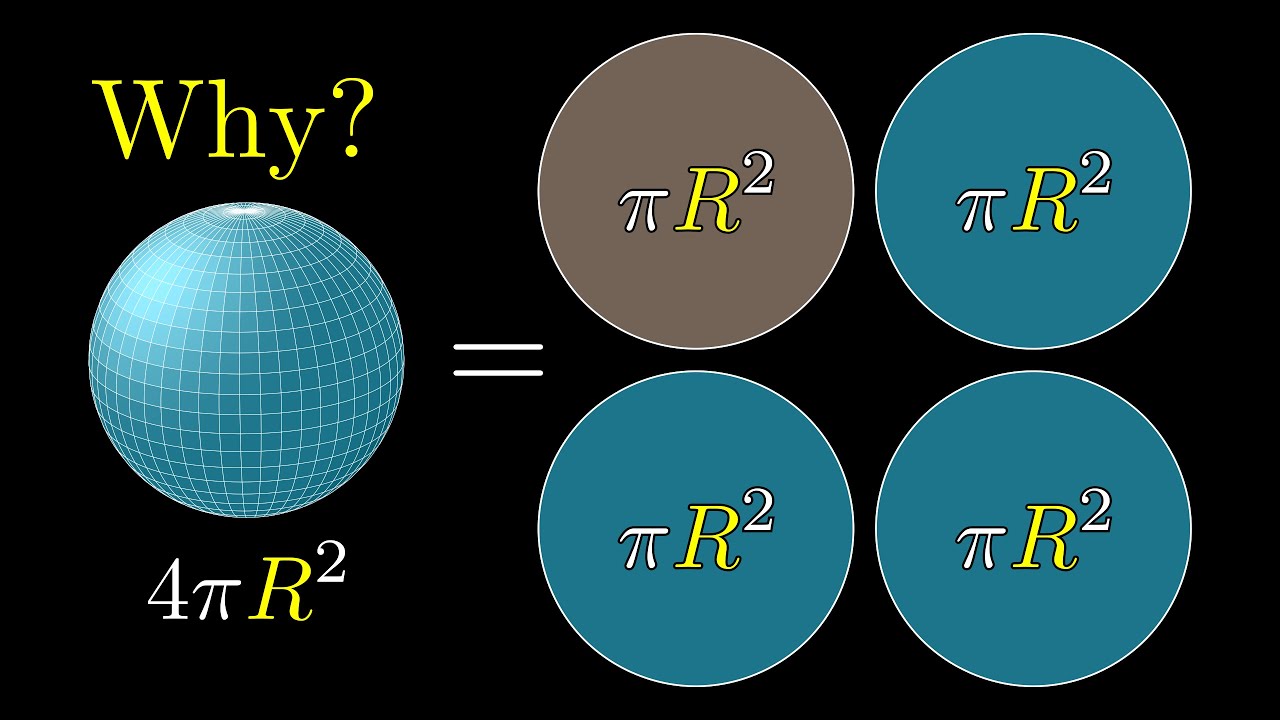
The formula is no mere coincidence.
Help fund future projects: https://www.patreon.com/3blue1brown
An equally valuable form of support is to simply share some of the videos.
Special thanks to these supporters: http://3b1b.co/sphere-thanks
Discussion on Reddit: https://www.reddit.com/r/3Blue1Brown/comments/a2gqo0/but_why_is_a_spheres_surface_are...
tight berry
thx!
willow skiff
tight berry
thx!
there's not as neat of an answer for the volume
depends if you already accept the formula for the volume of a cone
 sweet grove
 hushed sphinx
If that has a nice solution at all, the only way to attack the problem is probably to guess (based on experience and trial-and-error) what the answer is, and then try to prove that answer correct.
It must be a typo that is says f: R->R instead of f: N->R.
 willow mesa
 ebon locust
I have the same question as well
 sturdy scaffold
 hushed sphinx
The condition doesn't menion values of f other than f(1), f(2), f(3) ...
 prisma oxide
I need some help on this

 autumn spire
prisma oxide
I need some help on this
autumn spire
prisma oxide
I need some help on this
lets see
P is on the unit circle and it makes an angle theta

so ur looking at this
and x = 2y
can u express x and y in terms of theta?
solution:
||x = cos theta, y = sin theta||
||therefore cos theta = 2 sin theta||
||therefore ½ = tan theta||
||therefore theta = arctan(½) = 0.464||
 weary trellis
Or equivalently:
||tan(θ) = y/x
θ = arctan(y/x)
x = 2y
θ = arctan(y/2y)
θ = arctan(1/2) ≈ 0.464||
lethal sand
autumn spire
solution:
||x = cos theta, y = sin theta||
||therefore cos theta = 2 sin theta||...
doesnt x=rcostheta and y=rsintheta
hushed sphinx
Yes, but the problem said "the unit circle", so r=1 here.
lethal sand
hushed sphinx
Yes, but the problem said "the unit circle", so r=1 here.
oh ok
winter comet
viscid thistle
anybody got the surface area and volume of a sphere through calculus?
#multivariable-calculus , also wdym "anybody got"...are you looking for the derivation?

 hidden birch
or use disc/washer method
viscid thistle
winter comet
<#496784996510466057> , also wdym "anybody got"...are you looking for the deriva...
i tried integrating with cylinders instead of rectangles where the radius is governed by the eq x^2 + y^2 = z^2
hidden birch
viscid thistle
i tried integrating with cylinders instead of rectangles where the radius is gov...
so you did the shell method?
probably not. idk
viscid thistle
hidden birch
so you did the shell method?
i dont know what im doing here
winter comet
viscid thistle
i tried integrating with cylinders instead of rectangles where the radius is gov...
thats a cone......
viscid thistle
winter comet
thats a cone......
Nope
Integrated within the bounds of-r and r
Multiply by 2
Got the volume of a sphere
viscid thistle
winter comet
using the equation of a cone.....
I never used it
Don’t have to
No wait you have to
viscid thistle
winter comet
using the equation of a cone.....
Also I don’t think it’s for the cone
winter comet
z^2 = x^2 + y^2 is the equation of a cone
viscid thistle
In 2d I mean
winter comet
not sure how you'd get volume of a sphere outta that
it has three variables so it lives in 3d idk what u mean
viscid thistle
I let z be a constant quantity for the radius
It is not a another variable
I know wrong notation
 primal crane
hello, this is calculus right?
primal crane
thanks
 native dagger
I think im being a bit special, or i may have just forgotten

but why is this true
nvm
i was being special
willow bear
native dagger
i was being special
what are you using "special" as euphemism for :X
 safe basin
😭
fiery crest
Im really behind in my trig class and apparently I have a quiz Wednesday on material I don't understand and we don't get any notes or formulas
lethal sand
fiery crest
Im really behind in my trig class and apparently I have a quiz Wednesday on mate...
whATs the material?
lethal sand
fiery crest
i missed the day he talked about the test so idk exactly whats on it
do you have a textbook?
fiery crest
i think
lethal sand
did he say what sections the test is on?
fiery crest
we have a packet we do and he said if you can do the first 2 pages of trig youll be fine
he was annoyingly upset with me for asking
lethal sand
fiery crest
we have a packet we do and he said if you can do the first 2 pages of trig youll...
can you send me the first 2 pages of the packet?
fiery crest
yeah
vast charm
heavy pewter
this is <#363224154469826562> 😔
I am in pre calc but sorry for the confusion maybe I’m in a different curriculum
 shell crest

 warped shuttle
How to find the range of this function
((cosx - 2)(cosx - 3))/((sinx - 4)(cosx - 5))
willow bear
$\frac{(\cos(x) - 2)(\cos(x) - 3)}{(\sin(x) - 4)(\cos(x) - 5)}$
obsidian monolithBOT
Ann
 warped shuttle
willow bear
this?
warped shuttle
willow bear
this?
Yes!
willow bear
god ok this looks ugly LMAO
if the bottom left bracket were cos(x)-4 it would have been much easier
what's your progress thus far
warped shuttle
I tried calculating the derivative to find the critical points but it would take ages
 solar olive
warped shuttle
solar olive
warped shuttle
Sometimes ugly things need to be solved
drifting oyster
Nah just graph it on a calculator lol
warped shuttle
That’s not so analytical lol
drifting oyster

warped shuttle
warped shuttle
How to find the range of this function
((cosx - 2)(cosx - 3))/((sinx - 4)(cosx...
Any thoughts ?
drifting oyster
I would probably just try it's derivative
But then again finding an analytical solution to that is quite hard
 vagrant raptor
 viral warren
can someone help me
 high pelican
!da2a
tender questBOT
No need to ask “Can I ask…?” or “Does anyone know about…?”—it’s faster for everyone if you just ask your question! See https://dontasktoask.com/
 lavish sage
Why not simply make the bottom equal to 0?
winter comet
drifting oyster
Wow epic ping fail
i'm not sure if you mean ping the moderators or ping everyone but neither one seems to be working
the mods are all asleep, nobody on the nightwatch 💀
hidden birch
the guy is gone
winter comet
hidden birch
the guy is gone
what guy?
drifting oyster
winter comet
i'm not sure if you mean ping the moderators or ping everyone but neither one se...
I meant my ping 😭
hidden birch
winter comet
what guy?
the guy who sent scam stuff. He was not in the server when his message was still here. Probably sent it and left or got kicked out without his messages getting removed
warped shuttle
 inner crag
double integrals
inner crag
double integrals
That’s not so precalc
lethal sand
warped shuttle
That’s not so precalc
it could be
im in precalc and im learning about derivitavtaves
willow skiff
lethal sand
im in precalc and im learning about derivitavtaves
Different
willow skiff
inner crag
am learning about polar coordinates
Usually r is the inside integral and theta is the outside integral, if the question asks for the area of some sector
Also split the integral up into parts, from when the upper and lower functions swap places
Beyond it's just general integration
In particular trig subs and recognising integrals of trig functions
 vital galleon
can someone help me do part A idk how to get the x coordinates

 karmic karma
doesnt it cycle
sorry im still in middle high school
like
after pi/2 radians it goes down/up/up again
inner crag
willow skiff
In particular trig subs and recognising integrals of trig functions
yh
thx
inner crag
willow skiff
Usually r is the inside integral and theta is the outside integral, if the quest...
i thought trig identites had something to do with it thats why
i need to think simpler sometime
 rough frigate
 steep blade
vital galleon
can someone help me do part A idk how to get the x coordinates
steep blade
vital galleon
can someone help me do part A idk how to get the x coordinates
is help still needed
 grim flame
The chain rule is a good method for starting calculus
 grim flame
vital galleon
can someone help me do part A idk how to get the x coordinates
grim flame
vital galleon
can someone help me do part A idk how to get the x coordinates
Do you need help? Or is it too late?
winter comet
marsh cipher
1 1/pi x^2?
I would avoid that, you could write like (pi + 1)/pi * x^2
marsh cipher
should i lump up pi and change it all into one fraction
 heavy pewter
marsh cipher
should i lump up pi and change it all into one fraction
heavy pewter
marsh cipher
should i lump up pi and change it all into one fraction
yes it would be better for the eyes
marsh cipher
like this better, got accepted as well
 heavy pewter
i guess that's fine too
 high whale
Wish I could figure out the steps you did to arrive at that
 dire ginkgo
 elfin niche
tips for getting good at conics in 2 days?
heavy pewter
elfin niche
tips for getting good at conics in 2 days?
practise
elfin niche
heavy pewter
practise <:sully:651816820122189834>
woah
Hey so these are my answers, this is the problem and this is the answer key, I personally think I am correct, but where did I go wrong?


 hushed sphinx
Hard to say where you went wrong when you're not disclosing why you think your answer is correct?
E.g. why do you think 32 would look like C?
elfin niche
hushed sphinx
Hard to say where you went wrong when you're not disclosing _why_ you think your...
I think it is d because the eccentricity is greater than one but after looking at another assignment I think that re looking at my notes could help
hushed sphinx
What I immediately think for (32) is, "hmm, the denominator is always >1, so r cannot be larger than 5."
So everything that shows a curve escaping to infinity can't be it.
On the other hand, in (33) the denominator vanishes for two different angles, so there should be two asymptotes.
 covert jay
why is the asnwer d even if the maximum favlue is at t=0.451 ? i also dont understand what roc is neg or pos means
 river drift
the function is modeling the rate of change of the number of people
covert jay
river drift
the function is modeling *the rate of change* of the number of people
how does that show that the center is at its maximum
river drift
at a maximum the function goes from having a positive rate of change (increasing) to having a negative rate of change (decreasing), and is 0 at that point
 covert jay
ohh ok thanks
prisma oxide
Yo gango
If a function has x^2 in the numerator and just x in the denominator
Would that be a hole at x?
 torpid cape
prisma oxide
If a function has x^2 in the numerator and just x in the denominator
torpid cape
prisma oxide
If a function has x^2 in the numerator and just x in the denominator
i think so
since its removed from the denominator
kind of like
(x^2)/x is undefined
because you cant exactly divide by 0
prisma oxide
torpid cape
because you cant exactly divide by 0
No but like
It would be a hole
With a x left
In the numerator
torpid cape
prisma oxide
It would be a hole
yes
torpid cape
its a hole dont overthink it (i think)
prisma oxide
torpid cape
its a hole dont overthink it (i think)
Can we go to dm I have a couple questions before my exam tmrw?
prisma oxide
Alr
torpid cape
lemme se
torpid cape
ok sure
heavy pewter
!noping
tender questBOT
Please do not ping individual helpers unprompted.
prisma oxide
heavy pewter
x²/x has a removable discontinuity
Can u help w this why is it b?
heavy pewter
its a logarithmic graph of base 4
its inverse will be an exponential graph with base 4
prisma oxide
heavy pewter
its inverse will be an exponential graph with base 4
How do u know it’s base 4
heavy pewter
because
prisma oxide
IM CONFUSED
heavy pewter
$\log _x{(4)}=1\implies x^1=4$ i.e. $x=4$
obsidian monolithBOT
parabolicinsanity
 heavy pewter

prisma oxide
heavy pewter
$\log _x{(4)}=1\implies x^1=4$ i.e. $x=4$
Ok but why wouldn’t 8 work
Why 16
I still dk why it’s log base 4
How do h know?
heavy pewter
prisma oxide
I still dk why it’s log base 4
do you literally not see what i just did?
if it was not base 4
hpw would inputting 4
give you 1
in the graph?
prisma oxide
Why do we input 4?
heavy pewter
because its in the graph?
(4,1)
thats in the graph
-_-
so you use x=4,y=1 in the function
obsidian monolithBOT
parabolicinsanity
 heavy pewter
obsidian monolith
**parabolicinsanity**
heavy pewter
obsidian monolith
**parabolicinsanity**
here?
heavy pewter
prisma oxide
WHAT IS THAT 🥲🥲
for all x>1, logarithm base x of 1 is 0
i think you should really brush up on
logarithms
and exponentials
heavy pewter
before pursuing anything any further
prisma oxide
Can u show what u did
heavy pewter
erm
prisma oxide
Why wouldn’t 8 work
heavy pewter
because $4^2\neq 8$
obsidian monolithBOT
parabolicinsanity
 heavy pewter
$4^2=16$
obsidian monolithBOT
parabolicinsanity
 heavy pewter

prisma oxide
obsidian monolith
**parabolicinsanity**
Ok but I’m confused how the 4 became the x
heavy pewter
oh no, thats true for
any x>1
that
it passes (1,0)
i just wanted to illustrate that
prisma oxide
heavy pewter
i meant that (1,0) is passed by any base
Isn’t exponential 0,1
OH YEH ITS THE INVERSE
prisma oxide
heavy pewter
(4,1) is only passed by base 4
So the base changes?
WAIT
IT MAKES SO MUCH SENSE
torpid cape
prisma oxide
Ok but why wouldn’t 8 work
its because the exponent is a variable
prisma oxide
torpid cape
its because the exponent is a variable
?
prisma oxide
Yeh
prisma oxide
Im lowk scared for the mcq
torpid cape
prisma oxide
Im lowk scared for the mcq
me too amigo
prisma oxide
torpid cape
you made the mistake of
Like the questions are worded weirdly
torpid cape
prisma oxide
Like the questions are worded weirdly
the graph is exponential 😭
prisma oxide
torpid cape
the graph is exponential 😭
Do u know the transformations in logs?
torpid cape
huh?
prisma oxide
Translation or dilation
prisma oxide
torpid cape
huh?
Transformations???
torpid cape
prisma oxide
So like when is it horizontal
you worded it weirdly
prisma oxide
torpid cape
you worded it weirdly
Yeh
torpid cape
horiz translations are inside the parentheses and are "the opposite" of what it says
torpid cape
prisma oxide
Translation or dilation
dialations make stuff wider and smaller
transformations just move the graph
torpid cape
prisma oxide
Translations
thats what i mena
prisma oxide
torpid cape
i have it at 8am tomorrow
Same
torpid cape
this question is simply not fair

no calc section
youve gotta do the damn quad formula
in like 4 mins
heavy pewter
unless you don't have a calculator you could jsut.... add the value in...
torpid cape
heavy pewter
unless you don't have a calculator you could jsut.... add the value in...
y = 0
you cant plug it in
heavy pewter
huh
torpid cape
you have to zero out
torpid cape
wait omg
heavy pewter
if you have a calc (lazy route)
torpid cape
i dindt think of that
torpid cape
heavy pewter
if you have a calc (lazy route)
its on the non calc section
heavy pewter
well shii
you have to find it then
convert the cos into a sine
and yeah, quadratic equation solution
should give you 4 answers honestly
not just 3 atmost
prisma oxide
heavy pewter
should give you 4 answers honestly
Thought it gives 2
heavy pewter
prisma oxide
Thought it gives 2
pi periodicity
prisma oxide
heavy pewter
pi periodicity
Oh
heavy pewter

prisma oxide
torpid cape
because its the entire circle
Well depends on if it’s the cos or sin value
U end up with
torpid cape
prisma oxide
Well depends on if it’s the cos or sin value
no its 2 no matter what
torpid cape
yeah with sin
torpid cape
prisma oxide
Can u not factor by grouping
its not a whole number
need to quad fomula without a calc
prisma oxide
torpid cape
its not a whole number
U can still do u that
torpid cape
no xbox
 viscid shale
Can someone exlpain why this isn't A?

 uncut mantle
is anyone else taking ap precalc test tomorrow
 warm cove
AP exam tomorrow for this course, I wished I'd actually studied days prior because my stress is through the roof right now
uncut mantle
i feel pretty confident, though polar might be the death of me
also tranformations are kinda not my best
 mystic sluice
viscid shale
Can someone exlpain why this isn't A?
mystic sluice
viscid shale
Can someone exlpain why this isn't A?
when the function is graphed you can see that the rate changes faster (meaning decreasing to increasing) so its not A. Rate of change means how fast the function’s output is changing with respect to the input not just whether it’s going up or down.
mystic sluice
uncut mantle
is anyone else taking ap precalc test tomorrow
yes
warm cove
warm cove
AP exam tomorrow for this course, I wished I'd actually studied days prior becau...
my confidence is actually fading... I don't know what to do at this point, the study material im using is just not helping me 😭
mystic sluice
warm cove
my confidence is actually fading... I don't know what to do at this point, the s...
is it cause you already know it or you dont understand it
warm cove
mystic sluice
is it cause you already know it or you dont understand it
I dont understand
mystic sluice
warm cove
I dont understand
show me a problem
also if this makes you feel any better https://www.albert.io/blog/ap-precalculus-score-calculator/

Ready for AP® Precalculus? See for yourself with this AP® Precalculus score calculator. Find out if you're on the right track to a 3, 4, or 5.
uncut mantle
thanks
torpid cape
mystic sluice
also if this makes you feel any better https://www.albert.io/blog/ap-precalculus...
Outdated
We aren’t doing unit 4
And the exam is much harder in terms of criteria
mystic sluice
k
mystic sluice
torpid cape
We aren’t doing unit 4
yeah unit 4 has been out of question
mystic sluice
torpid cape
And the exam is much harder in terms of criteria
not really
only very slightly based on what i see on college board
uncut mantle
are there any resources with practice ap questions