#precalculus
1 messages · Page 66 of 1
 woeful star
 jade sand
I studied math cuz i was forced, you know default school curriculum, then i didnt opt for it cuz school made me hate it, nom im graduation school on 29th march, and i finally realise i actuqlly love maths
So ye, im not really clear with basics, but i want to study math in deep
woeful star
o
jade sand
I trying to get my basics clear and also get confy with stuff in maths, prob gonna take an year or two
woeful star
do you know trig
jade sand
Only the basic six functions, sin coz tan cosec sec cot
jade sand
What? Inverse? Idk about that, and i know thats also part of the basics, currently im focusing on algebra stuff, next ill do geometry and trig, but rn im onto algebra
Well, ill study it too. Eventually, until then. Thanks for the help tho
jade sand
How to solve this? As in how do i approach this?

 willow skiff
jade sand
How to solve this? As in how do i approach this?
willow skiff
jade sand
How to solve this? As in how do i approach this?
oh, so like if you try to solve for y in each of these equations
do you get one function, or do you get more than one function (say, square rooting both sides gives you plusminus, so that'd be two functions)
jade sand
For eg in first, y=(3x-7)/5. Then y is a function kf x in this case right?
willow skiff
willow skiff
oh, so like if you try to solve for y in each of these equations
by the vertical line test, if one x value gives more than one y, then it's not a function
willow skiff
jade sand
For eg in first, y=(3x-7)/5. Then y is a function kf x in this case right?
yep!
jade sand
Yes, i know, algebraically.
jade sand
willow skiff
do you get one function, or do you get more than one function (say, square rooti...
Wait uh, why do would it get that? Like why would it get a plusminus there?
willow skiff
jade sand
Wait uh, why do would it get that? Like why would it get a plusminus there?
x^2 = 4 gives x = -2, 2 for example
jade sand
Oh, rightt, okok, got it 👍. But is there any other way that it might be not a function? Also tysm
willow skiff
willow skiff
by the *vertical* line test, if one x value gives more than one y, then it's not...
yeah, so this is the other part
you can deduce that 13 isn't a function but that 14 is
jade sand
Yes cuz 150 has two corresponding y values
willow skiff
also there's an especially clever way to do q10 which is to just sub x = 0
you get 5y^2 = 4, so by the vertical line test, that's also not a function
jade sand
Rightt, okay, i see, intuition is also at play, well anyways, i understood the approach, thanks!
willow skiff
yeah so the key is the concept of a 1-to-1 function
x^2, x^4, x^6.... are not 1-to-1
but x^1, x^3, x^5.... are 1-to-1
willow skiff
jade sand
Rightt, okay, i see, intuition is also at play, well anyways, i understood t...
no worries!
jade sand
willow skiff
yeah so the key is the concept of a 1-to-1 function
Yeahh, okay.. Ok.., but wait, odd powers still have 1to1 cuz you cant obatin a plusminus situation from them, right?
willow skiff
jade sand
Yeahh, okay.. Ok.., but wait, odd powers still have 1to1 cuz you cant obatin a...
that's what I'm saying, yep
x^5 = k only has one solution, x = k^(1/5)
jade sand
Okay 👌
Thanks again, preety much to this entire server, such a big big help in maths to me, a heartfelt thanks indeed
willow skiff
no problemo!!
willow skiff
jade sand
Alr, so in q8 too, y is not a function right? Cuz x can have both 2,-2
no, like if you let x be some number
then 3x^2 is a constant, and let's say that constant is k
so k - 2y = 5 and you only get one value of y for each k
well you could have rearranged q8 to find y, and gotten the same conclusion
jade sand
willow skiff
well you could have rearranged q8 to find y, and gotten the same conclusion
I did, though. Its (3x^2-5)/-2
willow skiff
jade sand
I did, though. Its (3x^2-5)/-2
exactly so it's a function
it's just not a 1-to-1 function
also it's y = (3x^2 - 5)/2 but anyways
willow skiff
jade sand
But, 3x^2 will be 12 both in the case of -2 and 2
no, to use the vertical line test, you only choose one value of x at a time
you're confusing it with the horizontal line test for 1-to-1 functions
jade sand
Oh man, im confused.
Hang on, uh.. So this is not one that has a 1to1 but nonetheless it still is a function
jade sand
willow skiff
also it's y = (3x^2 - 5)/2 but anyways
Right? I felt like that only, i double-checked it into the wrong answer..
willow skiff
jade sand
Hang on, uh.. So this is not one that has a 1to1 but nonetheless it still is a ...
yep
jade sand
Man, ill have to do a lot of work i guess, well its fine i guess
jade sand
willow skiff
yep
Oh right, cuz even tho two x values give the same y, no two y values give the same x, right?
willow skiff
jade sand
Oh right, cuz even tho two x values give the same y, no two y values give the ...
almost
wait let me read
willow skiff
jade sand
Oh right, cuz even tho two x values give the same y, no two y values give the ...
yes that's correct
jade sand
willow skiff
almost
Ya know, when confusion gets cleared, it feels like "wow, im so utterly stupid i couldnt understand that much? Yikes"
Lol, anyways, thanks again
 fathom sphinx
Hola people need help with question 6 🥺. The Inductive step ( ignore question 5 on the whiteboard)

 willow skiff
fathom sphinx
Hola people need help with question 6 🥺. The Inductive step ( ignore question 5...
willow skiff
fathom sphinx
Hola people need help with question 6 🥺. The Inductive step ( ignore question 5...
your base case is $n = 1$ and thus you want to verify $u_3 = 6u_2 - 9u_1$
 obsidian monolithBOT
south
 willow skiff
you need to calculate u3 to verify the base case
willow skiff
fathom sphinx
Hola people need help with question 6 🥺. The Inductive step ( ignore question 5...
the inductive step is just showing that:
$$6(n - 1) \cdot 3^n - 9(n - 2) \cdot 3^{n - 1} = n \cdot 3^{n + 1}$$
obsidian monolithBOT
south
 willow skiff
oh well use a different variable k to show this
where k is an integer such that k > 1
fathom sphinx
I wish that south was my math teacher 😔
willow skiff
fathom sphinx
I wish that south was my math teacher 😔
wait no your base case is correct
yeah I had something else in mind; you want to prove that the formula works after all for n = 1, 2

Powered by https://www.numerise.com/
This video is a tutorial on Proof by Induction (Recurrence Relations) for Further Maths 1 A-Level. Please make yourself revision notes while watching this and attempt my examples. Complete the suggested exercises from the Edexcel book. After this then move to my next video on Further Maths 1 EDEXCEL A-Leve...
there's another example here
and the video explains why you can just sub the formula in
there's two assumptions
fathom sphinx
willow skiff
https://www.youtube.com/watch?v=yBbKFSLHlFw
I actualy watched that video 💀
doing a lvl fp1
willow skiff
yeah I just found a video that explains better than I can
willow skiff
the assume true for n = k and n = k + 1 bit is important, then you can just draw arrows to where you have used both IHs in the exam
instead of having to write them out in full, as the video has done
willow skiff
fathom sphinx
thx south!!!
no worries!
 fallen moth
hello, I need help with this

it's asking for cos x
I don't know how sin x = -1/2 is sin (-30)
willow skiff
fallen moth
I don't know how sin x = -1/2 is sin (-30)
mmm do you know the unit circle definition of trig?
that sin theta is the y-coordinate
willow skiff
fallen moth
prob not
 willow skiff
fallen moth
ohhh sin -30 is sin (360-30)?
willow skiff
fallen moth
ohhh sin -30 is sin (360-30)?
yep!
follows by periodicity of sin = 360 deg
fathom sphinx
willow skiff
no worries!
south i wanted to ask is it weird how i self study a level math but have only done book questions and not a single past paper (topicals included) i want to start doing topicals and past papers after i finish studying a level math as a whole 😭
willow skiff
fallen moth
ohhh sin -30 is sin (360-30)?
then you can use ASTC or whatever method you have learnt already
willow skiff
fathom sphinx
south i wanted to ask is it weird how i self study a level math but have only do...
that's not weird at all
fallen moth
fallen moth
hello, I need help with this
i dont get how it was sin -30 and it suddenly converts to cos at the same value (cos -30)
or is that just how it is?
fathom sphinx
willow skiff
that's not weird at all
oh ayy thx!
willow skiff
fallen moth
i dont get how it was sin -30 and it suddenly converts to cos at the same value ...
the proper reasoning is given by the unit circle, and it's a shame you don't learn it in your curriculum
or you could use the graph of cos x and you know it's symmetric across x = 0
fallen moth
willow skiff
the proper reasoning is given by the unit circle, and it's a shame you don't lea...
i probably learnt it but i forgot
it was something like quadrant 1, 2, 3, 4
willow skiff
fallen moth
it was something like quadrant 1, 2, 3, 4
yeah that's ASTC
which I personally don't like
but -30 is the same as 330 (deg), so the 4th quadrant
in the 4th quadrant, only cos is positive
the rest are negative
fallen moth
ohh ok
willow skiff
so sin(-30) is negative and tan(-30) is also negative
fallen moth
yeah it was something like quad 2 tan is neg, quad 3 sin is neg
willow skiff
cos(-30) is positive
willow skiff
fallen moth
yeah it was something like quad 2 tan is neg, quad 3 sin is neg
that's the acronym
then quad 1 is everything, or all
willow skiff
cool
willow skiff
fallen moth
yeah it was something like quad 2 tan is neg, quad 3 sin is neg
so it's ASTC actually
fallen moth
alright
willow skiff
fallen moth
yeah it was something like quad 2 tan is neg, quad 3 sin is neg
yeah only sin is positive in quad 2
only tan is positive in quad 3
so it's like a huge logic puzzle to figure out which are negative
fallen moth
i wouldn't want to know
willow skiff
which is why I hate this method and wished that everyone learns the unit circle way
anyways
fallen moth
willow skiff
which is why I hate this method and wished that everyone learns the unit circle ...
too late to change that now
 rain flower
hey guys how i solve this question about complex numbers?

 willow bear
de moivre's thm and/or polar form
 fading monolith
rain flower
hey guys how i solve this question about complex numbers?
fading monolith
rain flower
hey guys how i solve this question about complex numbers?
Multiply top and bottom by its conjugate
 winter comet
fading monolith
Multiply top and bottom by its conjugate
winter comet
fading monolith
Multiply top and bottom by its conjugate
its to the 6th power tho
rain flower
winter comet
its to the 6th power tho
wait. the 6 is not multiplying?
winter comet
yea i wasn't sure what i was looking at at first either 💀
winter comet
rain flower
wait. the 6 is not multiplying?
its raised above the other numbers and it comes after so i think its safe to assume yeah
that's why you'd use de moivres theorem rather than just directly usin the conjugate
rain flower
winter comet
its raised above the other numbers and it comes after so i think its safe to ass...
i made this solution. sorry my handwriting is very bad lol

but i think is wrong lol
winter comet
<@&268886789983436800>
winter comet
rain flower
i made this solution. sorry my handwriting is very bad lol
that would be more like if it was multiplying by 6 yea
rain flower
winter comet
that would be more like if it was multiplying by 6 yea
yeah u right
rain flower
winter comet
that would be more like if it was multiplying by 6 yea
could u show me how to solve?
i'm dumb lol
rain flower
winter comet
<@&268886789983436800>
why u called mod? '-' i did something wrong?
 echo sinew
I believe he was referring to a spammer, whose messages have then been deleted
 granite ibex

cengage making lots of mistakes
2 incorrect problems on my homework now this
xd
willow skiff
 hot crane
the derivative rules are too wacky
hot crane
the derivative rules are too wacky
!help
 tender questBOT
hot crane
the derivative rules are too wacky
tender questBOT
hot crane
the derivative rules are too wacky
To ask for mathematics help on this server, please open your own help channel or help thread. See #❓how-to-get-help for instructions.
willow skiff
also this is the wrong channel for calculus
hot crane

 solar olive
rain flower
hey guys how i solve this question about complex numbers?
solar olive
rain flower
hey guys how i solve this question about complex numbers?
$-\frac{1}{2} - i \frac{\sqrt{3}}{2} = -e^{i \frac{\pi}{3}}$
obsidian monolithBOT
impract1cal
 solar olive
$\frac{i}{\left(-e^{i \frac{\pi}{3}}\right)^6} = \frac{i}{e^{i \frac{\pi}{2}}}$
obsidian monolithBOT
impract1cal
 solar olive
$= \frac{i}{i} = 1$
obsidian monolithBOT
impract1cal
 solar olive
wait... did i mess up
 elder scaffold
Guys I’m struggling with function analysis any tips on how I get this stuff down?
 tawdry pilot
elder scaffold
Guys I’m struggling with function analysis any tips on how I get this stuff down...
tawdry pilot
elder scaffold
Guys I’m struggling with function analysis any tips on how I get this stuff down...
typically this is not a good way to get help. a better way would be to provide a specific example or a more specific aspect of function analysis that you're struggling with. tell us what you understand, what you're good at, and what specifically is tripping you up
TLDR: be more specific
solar olive
obsidian monolith
**impract1cal**
oh nvm it whould be e^(i pi 2)
which means its i/(-1)
which is -i
woops!
i
jade sand
How to tell if a function has a constant or changing slope, also, do we normally grapg functions with nonconstant slopes or we can put that to the computer
Oh and come to think of it, what is it in a relation that it is not used in calc but only a function is
jade sand
Also, how do i write this grqph's range. Its domain is [-3,2] but range? Should i write it as [-3,-2],[-1,3]?
 willow bear
jade sand
Also, how do i write this grqph's range. Its domain is [-3,2] but range? Shou...
willow bear
jade sand
Also, how do i write this grqph's range. Its domain is [-3,2] but range? Shou...
$[-3, 2) \cup [-1, 3]$. it's a union of two intervals -- and mind the upper endpoint of the first one as it's excluded
obsidian monolithBOT
Ann
 jade sand
Oh, right, its a hollow circle, thanks!
 dusk fiber
jade sand
How to tell if a function has a constant or changing slope, also, do we normal...
dusk fiber
jade sand
How to tell if a function has a constant or changing slope, also, do we normal...
Have you studied differentiation yet?
Basically, if the variable has the power of 1 then has a constant slop
jade sand
dusk fiber
Basically, if the variable has the power of 1 then has a constant slop
Ohh, ok, that makes sense
dusk fiber
jade sand
Ohh, ok, that makes sense
Constant slope means a straight line
jade sand
dusk fiber
Constant slope means a straight line
Yes, i know
So, say we have something like x^(2)+x?
Would that mean it has a nonconstant slope
dusk fiber
Yes
jade sand
Alr
 opal sparrow
is this alright?

 lapis sparrow
It would be alright if you took the integral of x from sin to cos, then converted the I into the u from x^2. Make sense?
fathom sphinx
Hi for question 8 is my working for on the Inductive step correct? (My book doesn't have a markscheme : ( )


 rocky wind
these aren't real induction question
cuz induction isn't necessarily needed
there's certainly an alternative way to find the sum (without knowing it in advance)
 inner topaz
i mean any question isnt a real induction question based on your logic
 brazen scaffold

ignore the integral sign bit
which partial fraction form can this be rewritten in
 echo sinew
$$\frac{A}{x + 1} + \frac{B}{2x - 3}$$
obsidian monolithBOT
Alberto Z.
 echo sinew
But first you need to perform polynomial division
Because you can do partial fractions only when
deg(numer.) < deg(denom.)
 willow skiff
 stark ether
ugh can someone pls help
stark ether
ugh can someone pls help
what happens if you sub in x = 0 into all 4 equations?
 wanton isle
stark ether
ugh can someone pls help
wanton isle
stark ether
ugh can someone pls help
You just want the answer or an explanation
Cuz i kinda suck at explaining
inner topaz
stark ether
ugh can someone pls help
well if you want an actual understanding of what is going on ignoring the +140 note that the period of tanx is $\pi$, which means the graph normally repeats itself after pi times, but instead we have $\frac{\pi}{6} x$, we let that = $\pi$ to find the period
then the multiplication by 140 outside simply stretches the whole thing by 140 vertically (ig u can imagine a long tall but thin rectangle), note that if it was negative it would also flip the graph of tan
then at the end you move the whole y value up by +140
obsidian monolithBOT
Ryse

 lament glacier
obsidian monolith
**impract1cal**
lament glacier
obsidian monolith
**impract1cal**
what the freak
 warped shuttle
how to solve this limit ? i got a 0/0 even after L'Hôpital's rule

 lean cove
Make sure you get an intederiminate form then repeatedly apply L Hopitals rule until it works or you do not have an intederminate form
 uncut mulch
difference of two squares / conjugates
similar idea with difference of two cubes
uncut mulch
 chrome inlet
Answer is 1 not zero
chrome inlet
Answer is 1 not zero
why did the limit change from 1 to 0, also don't just give away fully worked solutions and/or answers like that
chrome inlet
uncut mulch
why did the limit change from 1 to 0, also don't just give away fully worked sol...
Should I delete it?
uncut mulch
yes
warped shuttle
uncut mulch
difference of two squares / conjugates
similar idea with difference of two cubes
how would this apply to the question ?
fading monolith
warped shuttle
how would this apply to the question ?
A hint to solve the limit(?
warped shuttle
fading monolith
A hint to solve the limit(?
well i know but can't figure where to use difference of two squares rn
fading monolith
warped shuttle
well i know but can't figure where to use difference of two squares rn
a^2-b^2=(a-b)(a+b) and you have there a-b form so
dusk fiber
warped shuttle
how to solve this limit ? i got a 0/0 even after L'Hôpital's rule
Use it again
 sturdy hound
can someone check if i got the right answers for this problem:
T_B_ = 2169.5157 lbs
T_A_ = 3611.1112 lbs
 fallen moth
I need help with this please

 south hemlock
fallen moth
I need help with this please
south hemlock
fallen moth
I need help with this please
a common Trick with square root limits is to multiply by the conjugate
south hemlock
the conjugate of a+sqrtb is a-sqrtb
fallen moth
hwo would that look like?
south hemlock
fallen moth
hwo would that look like?
Try to bring it into the form above
fallen moth
a=1 and b=-10?
fallen moth
hmm
south hemlock
fallen moth
I need help with this please
 fallen moth
oh that's what my friend told me
south hemlock
However i believe this trick in this case doesn’t help that much
south hemlock
fallen moth
I need help with this please
I would suggest you take out an x2 of the inner expression in the root
fallen moth
alright
south hemlock
fallen moth
alright
Can you post your work after you’re done
fallen moth
yeah I posted it on a help channel
my friend helped me through messages
I still don't understand much though
 wheat oar
Will there ever be a case when A¹A = I but AA¹ ≠ I? I'm trying to figure out if I need to perform the verification twice for each of these expressions...
 winter comet
wheat oar
Will there ever be a case when A¹A = I but AA¹ ≠ I? I'm trying to figure out if ...
winter comet
wheat oar
Will there ever be a case when A¹A = I but AA¹ ≠ I? I'm trying to figure out if ...
they are both true simultaneously
you would only need to verify one and that would mean the other is true as well
if A^(-1)A = I, then A(A^(-1)A) = A ->(A A^(-1))A = A, and you know IA = A, so A A^(-1) = I
assuming associativity of matrix multiplication and just the uniqueness of matrices lol
inner topaz
wheat oar
Will there ever be a case when A¹A = I but AA¹ ≠ I? I'm trying to figure out if ...
think this would go in group theory but yes it will always be true
winter comet
inner topaz
think this would go in group theory but yes it will always be true
why group theory?
inner topaz
in every group a * a^{-1} = a^{-1} * a = e
a is any element belonging to a group
e is the identity element
ig this doesnt apply if the det is 0
but ignoring non singular matrices matrix multiplication forms a group under multiplication i believe
wheat oar
winter comet
if A^(-1)A = I, then A(A^(-1)A) = A ->(A A^(-1))A = A, and you know IA = A, so A...
This simplifies to AI = A and IA = A but matrix multiplication is not commutative so how does this prove that the order doesn't matter?
wheat oar
inner topaz
think this would go in group theory but yes it will always be true
This problem is from a pre calc textbook
winter comet
wheat oar
This simplifies to AI = A and IA = A but matrix multiplication is not commutativ...
matrix multiplication is associative, so A (A^(-1) A) = (A A^(-1)) A
you can simplify this to AI = IA, but this assumes that A^(-1)A = I and that A A^(-1) = I
but if we just assume AI = IA = A is true, then it implies that A^(-1)A = I and AA^(-1) = I
I don't see why group theory is needed unless I'm assuming things from group theory, I wouldn't know if I was :l
inner topaz
i mean group theory is only needed here for associativity and inverse but yeah not rly needed
winter comet
can't you just prove associativity element-wise lol
wheat oar
winter comet
matrix multiplication is associative, so A (A^(-1) A) = (A A^(-1)) A
you can sim...
Oh okay this makes sense when you set them equal to each other! Thank you!
sturdy hound
i need help with this problem:
also ignore my writing on the picture but this is my work and i just wanna confirm if i am right
240cos(30 degrees) + 110cos(-25 degrees) + xcos(0 degrees) = 500
x = 192.4600, so bill neds to pull 192.4600 pounds in order to move the boulder
is the method i used correct?

 raven laurel
sturdy hound
can someone check if i got the right answers for this problem:
T_B_ = 2169.5157 ...
raven laurel
sturdy hound
can someone check if i got the right answers for this problem:
T_B_ = 2169.5157 ...
i had that exact fucking problem in my textbook like 3 months ago
Can anyone here explain mathamatical induction?
sturdy hound
raven laurel
Can anyone here explain mathamatical induction?
i can, but i can probably explain it better if u have a specific problem u need help with
 late silo
What's weird is I never learned matrices in pre-calc. I have no idea how to find inverse or even what that means. I don't even know the point in a matrix other than for solving systems of equations, which is more for algebra than calc.
winter comet
late silo
What's weird is I never learned matrices in pre-calc. I have no idea how to find...
you don't need to, you learn it all in linear algebra anyway lol
late silo
Oh yeah? Ok then I feel happy again lol
winter comet
XD
 cursive glen
Anybody here?
 celest rock
cursive glen
Anybody here?
celest rock
cursive glen
Anybody here?
?
 celest rock
cursive glen
Would it be simplified to -15?
celest rock
cursive glen
Would it be simplified to -15?
Squaring never results in a negative number, it's 15
So it's 15+49=64
 hybrid plinth
do you learn matrices in algebra 2 or precalc?
willow bear
definitely precalc if at all tbh
 fleet ridge
unsure if this is algebra or precal but what on earth are multiplicities
like i get it but i dont
im using it for zeroes for polynomials but ig the questions are worded pretty oddly
from what i gathered it's the exponent of the factors once completely factored out?
 astral apex
pretty much
like the multiplicity of the root x = 3 of f(x) = x(x - 3)^4 (x - 5)^2 is 4
and the multiplicity of x=0 is 1
and of x=5 is 2
 lean imp
i need some help for my pre calc test 😭 if anyone can help me in #help-22 i would appreciate it
astral apex
and for roots with odd multiplicity, the polynomial's graph "passes through" the x axis at those
for even multiplicity, the graph "bounces off" them
 storm lodge
 formal wren
Help
 willow skiff
formal wren
Help
willow skiff
formal wren
Help
I see you've written some work out
what do you get if you let f(x) = g(x) then simplify
formal wren
willow skiff
what do you get if you let f(x) = g(x) then simplify
Lemme see one sec
formal wren
willow skiff
I see you've written some work out
You get sin^2 x= cos^2 x +1
willow skiff
formal wren
You get sin^2 x= cos^2 x +1
yeah, and is that an identity or not
formal wren
willow skiff
yeah, and is that an identity or not
I mean yeh Pythagorean but they won’t equal the same thing
It will be - and positive
willow skiff
formal wren
I mean yeh Pythagorean but they won’t equal the same thing
it's not the Pythagorean identity
yep cause of what you said
sin^2 x - cos^2 x = 1 is not sin^2 + cos^2 x = 1
formal wren
willow skiff
it's not the Pythagorean identity
So it’s not identity?
willow skiff
formal wren
So it’s not identity?
yeah, no identity is the answer
formal wren
Eyyy
formal wren
willow skiff
yeah, no identity is the answer
Thank you
formal wren
@willow skiff I have a question for this function, why is there a phase shift im so confused

 normal gale
If w = cos (theta) + i sin (theta), show that (w-1)/(w+1) = i tan (theta/2)
willow skiff
formal wren
<@1151031274413228043> I have a question for this function, why is there a phas...
Cos has a maximum at t = 0
So the maximum is shifted 3 to the right
willow skiff
normal gale
If w = cos (theta) + i sin (theta), show that (w-1)/(w+1) = i tan (theta/2)
What did you try?
normal gale
willow skiff
What did you try?
nothing yet, my math teacher is gonna check the answers tmr
 sleek jay
cursive glen
sleek jay
cursive glen
I am a bit late here but in the calulation, the square and square root of 15 cancels out resulting in 15, -7^2 = 49, so the answer is supposed to be the square root of 64 which is 8
normal gale
It can be shown that $\int (e^{ix} \cdot e^x) dx = \frac{1}{i+1} e^{(i+1)x}$, find $\int (\cos x \cdot e^x) dx$.
obsidian monolithBOT
preciousnectar

 jaunty tendon
(unit circle) hello, theres a given where sin = 2 sqrt of 3/3 and cos = negative, ive tried tracing sin back to 2/sqrt of 3, but that makes h lower than o, what am I missing?
 hollow pasture
 willow skiff
jaunty tendon
(unit circle) hello, theres a given where sin = 2 sqrt of 3/3 and cos = negative...
willow skiff
jaunty tendon
(unit circle) hello, theres a given where sin = 2 sqrt of 3/3 and cos = negative...
yeah there's an error in the question then
willow skiff
normal gale
It can be shown that $\int (e^{ix} \cdot e^x) dx = \frac{1}{i+1} e^{(i+1)x}$, fi...
can you take the real part of 1/(i + 1) e^((i + 1)x)?
fathom sphinx
willow skiff
can you take the real part of 1/(i + 1) e^((i + 1)x)?
South is it possible to self study discrete math?
willow skiff
fathom sphinx
South is it possible to self study discrete math?
yes
fathom sphinx
willow skiff
yes
Ah alr thx South!
jaunty tendon
willow skiff
yeah there's an error in the question then
well that sucks theres 4 more questions exactly like it 😕
 jaunty tendon
(unit circle) hello, theres a given where sin = 2 sqrt of 3/3 and cos = negative...
jaunty tendon
jaunty tendon
(unit circle) hello, theres a given where sin = 2 sqrt of 3/3 and cos = negative...
how about if cos = sqrt of 7/9 and csc is negative? is it solvable?
willow bear
ok real quick.
you should use parentheses, and not the word "of", when writing stuff with roots in plaintext.
fathom sphinx
is it possible to self teach undergraduate and postgraduate level math. (With digital textbooks, videos and such.)
?
willow bear
we don't know if \verb|sqrt of 7/9| means $\sqrt{\frac{7}{9}}$ or $\frac{\sqrt{7}}{9}$ --- these are more properly rendered in plaintext as \verb|sqrt(7/9)| and \verb|sqrt(7)/9| resp.
obsidian monolithBOT
Ann
 willow bear
fathom sphinx
is it possible to self teach undergraduate and postgraduate level math. (With di...
willow bear
fathom sphinx
is it possible to self teach undergraduate and postgraduate level math. (With di...
postgraduate? highly unlikely.
fathom sphinx
willow bear
**post**graduate? highly unlikely.
Oh I see thx Ann!
Wth is the difference 😭
I legit don't knowwww
Oh nvm postgraduate is after a degree or smth
willow bear
undergrad is when you're working towards a bachelor's
postgrad is anything that comes after
jaunty tendon
willow bear
you should use parentheses, and not the word "of", when writing stuff with roots...
oh sorry, that is how we write it in online exams and thats how we were taught for 6 years, its cos = sqrt(7)/9
fathom sphinx
willow bear
undergrad is when you're working towards a bachelor's
Oh I see thanks for the explanation.
willow bear
cos(theta) = sqrt(7)/9
fathom sphinx
willow bear
cos(theta) = sqrt(7)/9
Ann are you post grad and if so are you aiming for a PhD!!
willow bear
you could have just @'d me instead of replying to a completely irrelevant message
and also, frankly, that's none of your business whether or not i'm going for a phd.
fathom sphinx
Whatever
 late nimbus
i wanna start teaching myself precalc. how and where should i start
 plain marten
late nimbus
i wanna start teaching myself precalc. how and where should i start
plain marten
late nimbus
i wanna start teaching myself precalc. how and where should i start
trignometry
teach your self a lot of trig
 soft flare
late nimbus
i wanna start teaching myself precalc. how and where should i start
soft flare
late nimbus
i wanna start teaching myself precalc. how and where should i start
As the guy before me said u need trig but also algebra if u want i can send you some of the stuff i used to teach myself the basics of pre calc
late nimbus
soft flare
As the guy before me said u need trig but also algebra if u want i can send you ...
sure pls do
soft flare
late nimbus
sure pls do
nvm
also go on this website called desmos
its probably one of the best tools for learning alot of preclac
raven laurel
sturdy hound
i can, but i can probably explain it better if u have a specific problem u need...
its not a specific problem i just dont understand it at all
sturdy hound
raven laurel
its not a specific problem i just dont understand it at all
basically for me i have to do proofs proving that both sides are equivalent or that the equation is divisible by a number or a multiple of a number
u start out with the normal equation p(n)
then u do p(#) to prove that when u plug in a number it is right
then you change the variable n to k and write out p(k) and assume it is true
then you change the variable from k to (k+1) and write out p(k+1), and you have to make p(k) appear within that equation so you can plug it in and then prove it
its easier if i have an example to show u
wheat oar
late nimbus
i wanna start teaching myself precalc. how and where should i start
A Pre Calc textbook is a good option. The big pre calc textbooks are used to teach classes in both pre calc and trig
 celest nacelle
sturdy hound
basically for me i have to do proofs proving that both sides are equivalent or t...
celest nacelle
sturdy hound
basically for me i have to do proofs proving that both sides are equivalent or t...
Same 💀
There is also a pre calculus chorus on YouTube if your interested I will link it down below 😄
 soft flare
brazen scaffold
in the uk?
soft flare
brazen scaffold
in the uk?
yes
 silver mist

 summer ruin
this is correct
 muted hinge
Is greater than / less than defined for complex numbers
 river drift
there are ways to define an order but none of them behave nicely with arithmetic the way that the ordering of the real numbers does
willow bear
muted hinge
Is greater than / less than defined for complex numbers
no
it is in fact impossible to define such a notion on C and have it play nicely with complex number arithmetic
 neon steppe
720 seems reasonable in the sense that you can arrange in 5! ways and then partition them into two 🤔 Though having asked chatgpt and alike it consistently seemed to bring up 3840 as the answer, in which it takes the total distributions 32 and multiplies it by total arrangements 🤔
but like 120 x 6 already accounts for every possible arrangement right?
wanton isle
Guys how do i solve this: Use De Moivre's Theorem to find (1 + ∛i)6
Its the sixth power btw
willow skiff
wanton isle
Guys how do i solve this: Use De Moivre's Theorem to find (1 + ∛i)6
which cube root of i? the principal cube root?
wanton isle
If i understand principal cube root correctly then yes
willow skiff
wanton isle
If i understand principal cube root correctly then yes
great, so write i^(1/3) in Cartesian form
then add 1 and convert back to polar form
wanton isle
Hold up how do i change it to polar form when the i is cube rooted
willow skiff
wanton isle
Hold up how do i change it to polar form when the i is cube rooted
you should get i^(1/3) = (cos pi/2 + i sin pi/2)^(1/3) = cos pi/6 + i sin pi/6 first
wanton isle
Oooooooooooooh
Yeah that makes sense now
And how do i add the 1?
Hold up i think ik how to
 tired garden
neon steppe
720 seems reasonable in the sense that you can arrange in 5! ways and then parti...
tired garden
neon steppe
720 seems reasonable in the sense that you can arrange in 5! ways and then parti...
what even is the question?
 wintry rover
<@&268886789983436800>
 viscid thistle
wintry rover
<@&268886789983436800>
viscid thistle
wintry rover
<@&268886789983436800>
What was there
Seen a lot of those
Their account got hacked
 deep crystal
somewhat important
wheat oar
Being able to picture the graphs of the six trig functions helped me a lot. I remember spending a day or two playing around with transformations questioning if I was wasting my time but it turned out to help give a lot of natural intuition when solving trig identities. I haven't started calc yet so I can't speak to how much it helps in that department.
warped shuttle
how to evaluate this limit ?

 remote cove
Hello guys
willow bear
$\lim_{x \to 0} \frac{x \floor{2/x} - x - 2}{x}$ this?
obsidian monolithBOT
Ann
 remote cove
I have bunch of doubts from this video could anyone help to resolve my doubts
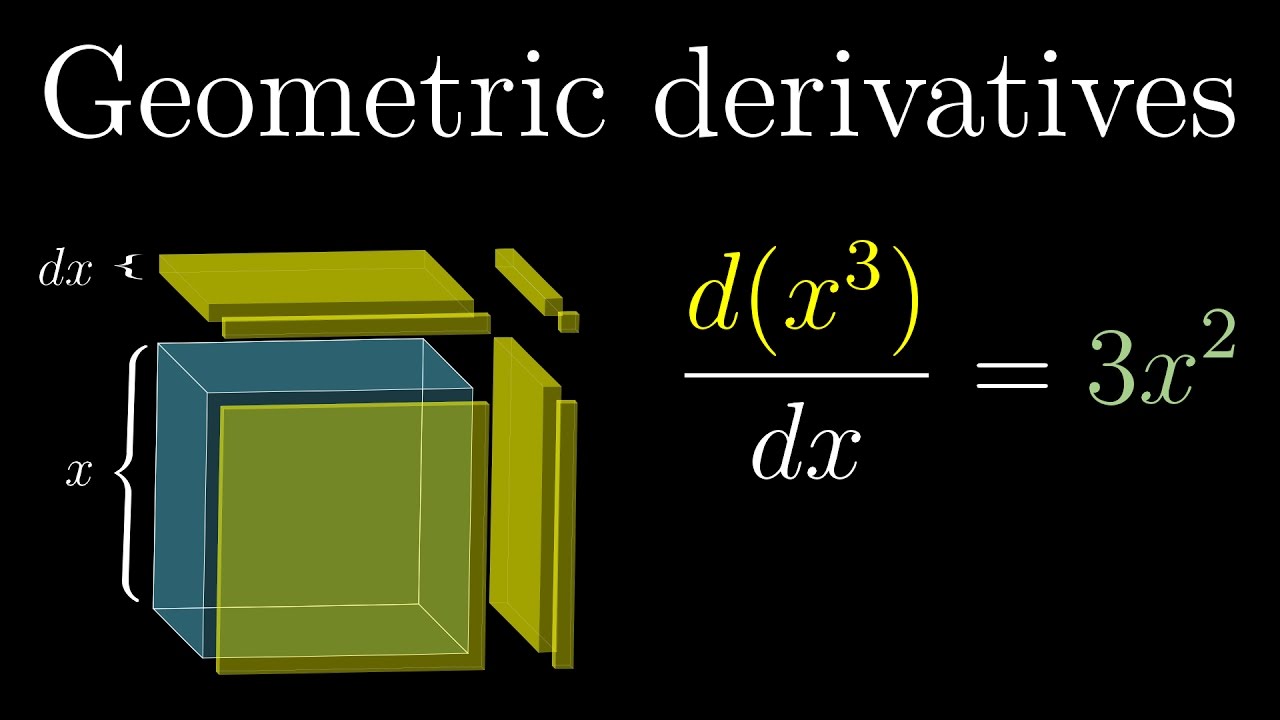
Some common derivative formulas explained with geometric intuition.
This video was sponsored by Brilliant: https://brilliant.org/3b1b
Help fund future projects: https://www.patreon.com/3blue1brown
An equally valuable form of support is to share the videos.
Special thanks to these supporters: http://3b1b.co/lessons/derivatives-power-rule#thanks
...
willow bear
you're probably best off posting your doubts (along with the video) in a help channel.
remote cove
willow bear
you're probably best off posting your doubts (along with the video) in a help ch...
Send that channel
willow bear
read #❓how-to-get-help for instructions.
you should take any chanel with a name like #help-[NUMBER] which doesnt have anybody else's username on it
warped shuttle
willow bear
$\lim_{x \to 0} \frac{x \floor{2/x} - x - 2}{x}$ this?
yep
willow bear
well the $-x$ can be pulled out and so the function will turn into $$\frac{x \floor{2/x} - 2}{x} - 1$$
what have you done so far for it tho
obsidian monolithBOT
Ann
 warped shuttle
willow bear
what have _you_ done so far for it tho
warped shuttle
willow bear
what have _you_ done so far for it tho
at first i wanted to try the l hopital rule but the floor function is in the way so i'm kinda stuck
no progress per say
willow bear
l'hop is inapplicable because floor(2/x) is discontinuous in too many places
warped shuttle
yea ik that's why idk what to do
warped shuttle
willow bear
the fraction can be simplified as floor(2/x) - 2/x
where did the -1 go?
willow bear
it didnt go anywhere i just didnt mention it
i said "the fraction" meaning (x floor(2/x) - 2)/x
the -1 stays as is and doesnt rly spoil anything for us that much
warped shuttle
the range of floor(2/x) - 2/x would be 0 to -1 right ?
 oblique raptor
obsidian monolith
**Ann**
oblique raptor
obsidian monolith
**Ann**
[2/x] can be written as 2/x , so the form is 0/0
U can use L hospital rule
Is the ans -1?
warped shuttle
oblique raptor
[2/x] can be written as 2/x , so the form is 0/0
why ?
willow bear
oblique raptor
[2/x] can be written as 2/x , so the form is 0/0
floor(2/x) is not equal to 2/x...
remote cove
@willow bear what does tiny nudges means?
willow bear
oblique raptor
U can use L hospital rule
no, the numerator has too many discontinuities
willow bear
remote cove
<@183668144404037632> what does tiny nudges means?
i literally do not know how else to explain it. look up "nudge" in the dictionary idk
sorry
remote cove
What does nudge mean in google it says a push to someone but whatd that wanna do in derivative
warped shuttle
remote cove
What does nudge mean in google it says a push to someone but whatd that wanna do...
give the full context
remote cove
3b1b repeatedly says tiny nudges are the heart of derivatives
In his video
What does nudge means?
warped shuttle
tiny parts
remote cove
Oh okk
oblique raptor
willow bear
floor(2/x) is not equal to 2/x...
One of my teachers told me that when a gif function is tending to infinity it can be written 2/x
willow bear
gif function 💀
oblique raptor
warped shuttle
why ?
We can write [f(x)] = f(x) - {x} and if the limit on [f(x)] tending to infinity, u can ignore the fractional part cuz its range is too small [0,1)
warped shuttle
oblique raptor
We can write [f(x)] = f(x) - {x} and if the limit on [f(x)] tending to infinity,...
but the answer isn't -1 and it's undefined
 pastel mountain
hellloo
 mint cedar
Greetings.
pastel mountain
I’ll send the problem

I understand how to get my HA,VA, x int, however i have a difficult time figuring out my y int and hole
I’ve done so many problems and I’ve only been getting my y int and holes incorrectly, so I just want a review of how I can get my y int and holes
mint cedar
pastel mountain
I’ve done so many problems and I’ve only been getting my y int and holes incorre...
I don't think there is a y-intercept.
Since the function is undefined when x = 0.
The hole should be at x = 0 too, and you should be able to get the y-coordinate using L'Hôpital's rule.
mint cedar
pastel mountain
0 is undefined right?
When x = 0, the denominator becomes 0, and you cannot divide by 0.
$f(0) = \frac{0}{0}$
obsidian monolithBOT
arvin
 mint cedar
So yes, undefined.
pastel mountain
Okay thank you
 blazing canopy
mint cedar
When x = 0, the denominator becomes 0, and you cannot divide by 0.
blazing canopy
mint cedar
When x = 0, the denominator becomes 0, and you cannot divide by 0.
Nice hole
 bleak forge
how do you do the derivative of sqrt(e^x-1)
 gaunt pumice
bleak forge
how do you do the derivative of sqrt(e^x-1)
gaunt pumice
bleak forge
how do you do the derivative of sqrt(e^x-1)
chain rule
willow bear
bleak forge
how do you do the derivative of sqrt(e^x-1)
⛓️ 📐
bleak forge
i dont understand how please explain
also explain how you came to that conclusion, that you had to used the chain rule
winter comet
bleak forge
also explain how you came to that conclusion, that you had to used the chain rul...
composite function
willow bear
bleak forge
i dont understand how please explain
ok first off: is it $\sqrt{e^{x-1}}$ or $\sqrt{e^x - 1}$
obsidian monolithBOT
Ann
 bleak forge
Second
oblique raptor
Its a composite function so chain rule
remote cove
Where can i ask my calculus doubts?


 uncut mantle
Is this Newton
willow bear
 long rapids
offtopic posts go in #chill
 rancid bluff
This is not a homework assignment just trying to see if I understood the material correctly. Hope I'm posting in the right channel.
So for the mean rate of change, it measures how much a function changed in a specific interval, right?
So for example if I were to say that in 40 minutes I drove 40 kms. And I need to figure out the how much the graph changed I do it like this? Stupid question, but how do I know what numbers to put into the formula= f(x)=x²+px+q , its the right one, right?
Also how can I read graphs correctly? Where is the turning point etc.?

 queen grail
e^iπ + φ^2 - φ = 0
 next drift
how do i do this
 fierce viper
Is a three days enough to study for my pre cal test on trig functions
winter comet
fierce viper
Is a three days enough to study for my pre cal test on trig functions
are you actually curious or just looking for some motivation
winter comet
fierce viper
I’m actually curious
then its a very vague question 💀
depends on
- where you are now
- what your test will cover
- how fast you can learn it
and we know...none of these
XD
winter comet
fierce viper
Is a three days enough to study for my pre cal test on trig functions
I would say probably...? but I really have no idea 😁
 winter comet
fierce viper
Is this easy
winter comet
fierce viper
Is this easy
it doesn't look bad
viscid thistle
have you learnt sin= p/h etc for every identity?
willow bear
p/h ?
winter comet
popposite/hypotenuse
viscid thistle
willow bear
p/h ?
perpendicular /hypotenuse etc
viscid thistle
fierce viper
Is this easy
he/she needs to learn those identities for that
willow bear
she's got the pronoun role diamond for she/her
but even if m didn't, you should never say he/she like that
singular "they" is a thing
fierce viper
viscid thistle
he/she needs to learn those identities for that
Yes I know all of them
viscid thistle
willow bear
singular "they" is a thing
I didn't see sorr
viscid thistle
fierce viper
Yes I know all of them
cool just practice more you'll ace it
 primal iron
does anyone have practice questions for year 11 precalculus i have a test tmr and i haven’t studied anything 😭
willow skiff
primal iron
does anyone have practice questions for year 11 precalculus i have a test tmr an...
https://madasmaths.com/archive_maths_booklets_standard_topics_trigonometry.html
https://madasmaths.com/archive_maths_booklets_standard_topics_various.html
these are more exam-style
MadAsMaths Mathematics Archive
MadAsMaths Mathematics Archive
KA is more quizzes
primal iron
thank youuu (:
willow skiff
no worries!
 whole void
primal iron
does anyone have practice questions for year 11 precalculus i have a test tmr an...
whole void
primal iron
does anyone have practice questions for year 11 precalculus i have a test tmr an...
what’s it on
 abstract grail
What is this math
brazen scaffold
primal iron
does anyone have practice questions for year 11 precalculus i have a test tmr an...
your in the uk?
 merry tide
abstract grail
What is this math
merry tide
abstract grail
What is this math
Pre calculus
abstract grail
merry tide
Pre calculus
What is pre calculus
merry tide
The math you learn to prepare for calculus
Which are things like algebra, functions, trigonometry
abstract grail
oh, can you give me some examples?
 dry lantern
 formal bronze
Can someone explain to me how the answer is -5?
 willow skiff
formal bronze
Can someone explain to me how the answer is -5?
willow skiff
formal bronze
Can someone explain to me how the answer is -5?
which part are you confused on?
formal bronze
willow skiff
which part are you confused on?
The answer (-5), I solved it entirely up to the last step before the answer
willow skiff
formal bronze
The answer (-5), I solved it entirely up to the last step before the answer
right, and do you see how -8/12 simplifies to -2/3?
willow skiff
no worries!
formal bronze
willow skiff
no worries!
So if am correct we simplified eight to -2 then we divided -2 with 10 to get -5, correct?
willow skiff
formal bronze
So if am correct we simplified eight to -2 then we divided -2 with 10 to get -5,...
yep, so you would just do $\frac{10/3}{-2/3} \cdot \frac{-3}{-3} = \frac{-10}{2}$ to simplify the fraction
obsidian monolithBOT
south
 willow skiff
the big thing with fractions is you need to multiply/divide the top and the bottom by the same number
then you're guaranteed another equal fraction
well like don't multiply or divide by 0 but everything except that
formal bronze
willow skiff
the big thing with fractions is you need to multiply/divide the top and the bott...
To get a common denominator right?
willow skiff
obsidian monolith
**south**
here you already have a common denominator
so you want to get rid of the common denominator so that you simplify it
10/3 and -2/3, common denom is 3
formal bronze
Ohh okay
formal bronze
Tysm this really helped me
willow skiff
no worries!!
formal bronze
🙌
primal iron
brazen scaffold
your in the uk?
nooo i’m in aus also sorry for the late reply i just got home
primal iron
whole void
what’s it on
it was on functions and graphs and symmetry i think but it’s too late now it’s all goods tho i have time for my next test to figure it out lol
viscid thistle
primal iron
does anyone have practice questions for year 11 precalculus i have a test tmr an...
i do!
this or evb in this server
i 100% recommend
u use this website
gives you worksheets, with answer keys
for ever pre-calc topic
it also even has calc there too
 stone cloud
For this question, why is the first solution wrong and we have to convert to sin^2x


 old garden
stone cloud
For this question, why is the first solution wrong and we have to convert to sin...
old garden
stone cloud
For this question, why is the first solution wrong and we have to convert to sin...
lim x-> 0 (tanx/x) = 1 .
Here if theta tends to 0, cos^2theta would be 1 and thus it would be tan(pi)/pi
So you can't use it here
stone cloud
Ok thanks
 swift creek
stone cloud
For this question, why is the first solution wrong and we have to convert to sin...
swift creek
stone cloud
For this question, why is the first solution wrong and we have to convert to sin...
gys i think that's equal to 0?
 crisp fjord
hello can someone help me with proving derivative of csc(x)
winter comet
crisp fjord
hello can someone help me with proving derivative of csc(x)
with other derivative rules or with the limit definition of derivative?
crisp fjord
i get to lim h approaches 0 1/sinxcosh+sinhcosx-1/sinx/h and am stuck
winter comet
ah
crisp fjord
all vids i watch dont make sense
pls dont make fun i am to new to this and am only 12
wintry rover
 hoary iris
,, \lim_{\alpha \rightarrow 0}{\left(\frac{\sin{\alpha^{n}}}{(\sin{\alpha})^{m}}\right)}
obsidian monolithBOT
Monkey•D•Luffy
 hoary iris
I have reduced this to $\lim_{\alpha \rightarrow 0}{\alpha^{n-m}}$
obsidian monolithBOT
Monkey•D•Luffy
 winter comet
hoary iris
But 1 if n=m (how?)
winter comet
hoary iris
But 1 if n=m (how?)
consider lim n-> 0 [n^0]
hoary iris
0^0 is indeterminate form, isn't it?
winter comet
mhm
hoary iris
Ok thank you
hoary iris
winter comet
mhm
Why do you need big lego brick?🤣
winter comet
hoary iris
Why do you need big lego brick?🤣
well I certainly don't need small one
hoary iris
winter comet
well I certainly don't need small one
🤣
Are you doing undergraduate math?
winter comet
I guess it's considered undergraduate
hoary iris
Are you self learning?
winter comet
no i'm taking classes
w dual enrollment
well i mean it involves self-learning but i don't think thats what you meant 😂
hoary iris
Math with what?
winter comet
what?
hoary iris
The other course
winter comet
the math i'm taking?
hoary iris
What does dual enrollment mean?
winter comet
ohhh it means I take hs classes and classes at local community college
well i suppose it doesn't have to be community but mine is 💀
hoary iris
winter comet
well i suppose it doesn't have to be community but mine is 💀
😁
Have gone through calc 1?
winter comet
hoary iris
Have gone through calc 1?
yeez
hoary iris
What are the math courses you're taking?
winter comet
just LA this semester
i mean physics too but physics doesn't count as math but it should
winter comet
hoary iris
What are the math courses you're taking?
what are u taking?
hoary iris
I am a high school student of grade 11(In India though)
hoary iris
It has basics of calc i suppose
winter comet
winter comet
💀
death 💀
hoary iris
winter comet
are you going to take the JEE
I want to enroll in MIT or yale University for math
But my parents want me to write JEE
hoary iris
hoary iris
I want to enroll in MIT or yale University for math
Is it possible?
@winter comet Do you think is it possible?
winter comet
hoary iris
<@764342735732867072> Do you think is it possible?
what is possible?
to get into those colleges of course its possible
winter comet
yes its possible, although it requires a lot of work + luck XD
hoary iris
winter comet
yes its possible, although it requires a lot of work + luck XD
Does it really require extra curricular activity?
hoary iris
thank you xd
winter comet
i'd say the more you do the better off you are probably
I hear people say extra curricular activities are good and then i hear the colleges saying just do what you are passionate about and honestly just do both if you can 😂
 hoary iris
winter comet
some other kind of pepper
hoary iris
winter comet
some other kind of pepper
Yeah I suppose
 arctic dagger
🌶️
winter comet
that
hoary iris
arctic dagger
🌶️
Yeah probably
Can we take limits inside log of some function? @winter comet
winter comet
hoary iris
Can we take limits inside log of some function? <@764342735732867072>
you can take limits inside of continuous (composite) functions if the limit exists... otherwise i don't know what you mean
 vast quartz
hoary iris
<@764342735732867072> Do you think is it possible?
vast quartz
hoary iris
<@764342735732867072> Do you think is it possible?
I'm not viper, but just go to the college that you realistically think will get you the best mathematics education for you personally.
I'd genuinely prefer a state university over a T20 for numerous reasons, and I've confirmed my enrollment to one, happily.
winter comet
vast quartz
I'm not viper, but just go to the college that you realistically think will get ...
only viper can have the ultimate knowledge about this ofc so your opinion doesn't matter
but i agree with you
 jkjk
jkjk
vast quartz
The expectation of going to a T20 to be successful in your academic field is just nuts
There are Nobel Prize winners who graduated from state universities 😭😭
hoary iris
vast quartz
There are Nobel Prize winners who graduated from state universities 😭😭
What are state universities?
vast quartz
hoary iris
What are state universities?
Sorry, I assumed you were American since you were asking about MIT.
hoary iris
vast quartz
Sorry, I assumed you were American since you were asking about MIT.
No, I am indian.
winter comet
vast quartz
The expectation of going to a T20 to be successful in your academic field is jus...
<5% of people in the world would be successful in their academic fields if that were the case
vast quartz
State universities are universities in the United States that are publicly funded by the state (equivalent to a province, district, prefecture).
hoary iris
vast quartz
State universities are universities in the United States that are publicly funde...
Is MIT a state university?
vast quartz
Not even remotely close
It's a private university, meaning it is not funded by its state
And it's a T20 school (top 20)
hoary iris
vast quartz
It's a private university, meaning it is not funded by its state
Yeah I had heard about it.
hoary iris
vast quartz
And it's a T20 school (top 20)
Yes
vast quartz
State universities are generally viewed as lesser than private universities because they get less funding, are smaller, less selective, and lesser known
Historically, most people who are famous in their fields went to a T20
Imma quit yapping now
hoary iris
vast quartz
Historically, most people who are famous in their fields went to a T20
A comman man can't?
@vast quartz Eclipse ryu?are you here?
winter comet
hoary iris
A comman man can't?
can't what?
hoary iris
Enroll in T20?
hoary iris
She says historically most famous ones went to T20
hoary iris
winter comet
which implies some did not
Is community college different from State University?
winter comet
hoary iris
Is community college different from State University?
yeah community college usually just has the lower division early undergraduate classes (one's you'd take in the first 2 years) and then people can transfer to four year colleges for upper-div
i think thats how it works ish
hoary iris
,, \lim_{x \rightarrow \infty}{\log{\left(\frac{x+a}{x}\right)^x}}
obsidian monolithBOT
Monkey•D•Luffy
 hoary iris
,, log{\lim_{x \rightarrow \infty}{\left(\frac{x+a}{x}\right)^x}}
obsidian monolithBOT
Monkey•D•Luffy
 winter comet
lim x->a f(g(x)) = f(lim x->a g(x)) if lim x->a g(x) = L exists and f is continuous at L
hoary iris
Like this
winter comet
obsidian monolith
**Monkey•D•Luffy**
i take this to mean (log( (x+a)/x ))^x, not log ( ((x+a)/x)^x )
it could theoretically mean either one but typically it means the first one
hoary iris
winter comet
i take this to mean (log( (x+a)/x ))^x, not log ( ((x+a)/x)^x )
No no second one
winter comet
oh it is the second one?
hoary iris
winter comet
oh it is the second one?
Yes
winter comet
obsidian monolith
**Monkey•D•Luffy**
then yeah you can do this as long as that limit exists
hoary iris
Thank you
@vast quartz is Indian University as equal as state universities of america?
 west arch
willow skiff
hoary iris
<@806295300116578325> is Indian University as equal as state universities of ame...
west arch
willow skiff
hoary iris
<@806295300116578325> is Indian University as equal as state universities of ame...
equal in what way?
 granite sigil
I forecasted for precalc can someone tell me what to expect? I want to make sure I’m making the right choice
I enjoy algebra and find it easy once I learn the formulas and techniques
But I literally HATED geometry/trig
Is it similar to algebra?
willow skiff
granite sigil
Is it similar to algebra?
precalc is more algebra and deeper
granite sigil
Oh ok!!!
willow skiff
well it takes an adjustment period for sure, because the central theme in precalc is functions
you may know functions as graphs and indeed precalc has a million graphs
but the idea of a function is actually more something like this:

it's just a rule that you apply
you put in a number, apply some consistent rule, then get an output number
willow skiff
granite sigil
Oh ok!!!
also the higher up you go in maths the more you'll be expected to learn the how and why
so not blindly applying formulas
granite sigil
Oh cool!
willow skiff
practicing loads of different question types to make sure you patch up all the holes in your understanding
granite sigil
That’s nice
willow skiff
but yeah this is actually general study advice for at least all of STEM
granite sigil
So precalc seems like a good fit for me then
willow skiff
yep absolutely
granite sigil
Why continue to take math classes if you don’t learn new stuff is what I say
That’s why I’m not taking stats
arctic dagger
,w riemann sphere


 arctic dagger
i think I've seen this in wikipedia
and it like shows how conic sections are just the same
like they're just all ellipse?
parabola: an ellipse with the other focus (?) on infinity
and yea hyperbola is like an ellipse wrapped around the sphere
i didn't try to understand it but that's what i got skimming the page
yea that's really interesting
so it's riemann sphere, i see. i didn't remember it
it really caught my interest
i could use it as a motivation to learn about it
true
 haughty iron
oh lol fogot to attach question
arctic dagger
the decimal form of ⅙ is 0.166666…
haughty iron
arctic dagger
the decimal form of ⅙ is 0.166666…
yeah i realised after posting 😆 thanks man good day!
 wild bramble
 knotty goblet
Is anyone there
knotty goblet
Is anyone there
yes. no. no longer. bye (why am i even awake at this time br ts pmo
 leaden cave
Hi there! I just have a really quick question I noticed that in this Calculus course I am taking that there is this formula which is put as delta f/delta x I was wondering if this is the same as delta y/delta x
 arctic dagger
leaden cave
Hi there! I just have a really quick question I noticed that in this Calculus co...
arctic dagger
leaden cave
Hi there! I just have a really quick question I noticed that in this Calculus co...
it is
y=f
y=f(x)
they're just names at the end of the day
you may use different letters
leaden cave
Ah okay, thank you very much!
arctic dagger
the top one is the dependent variable, and the bottom one is the independent variable
haughty iron
why we shift graph right when the graph fxn is y=f(x-c)
same for y=f(x+c) we shift graph toi left
 strong flicker
try evaluating a few values for f(x) = x^2
and f(x-3)
particularly, f(0) = 0 so the x-intercept is at (0,0)
now,
f(x-3) = (x-3)^2
to get the x intercept, we need (x-3)^2 = 0 which means x = 3
so the intercept was shifted to the right by 3 units
haughty iron
strong flicker
try evaluating a few values for f(x) = x^2
okay i did its comes +ve always
strong flicker
strong flicker
particularly, f(0) = 0 so the x-intercept is at (0,0)
now,
f(x-3) = (x-3)^2
t...
now this applies to all values for x in domain
so there is a rightward shift
 hoary iris
willow skiff
equal in what way?
hoary iris
willow skiff
equal in what way?
Equality in their approach in mathematics department
winter comet
hoary iris
Equality in their approach in mathematics department
are indian universities equal to each other?
 vagrant raptor
I have a couple math professors that have degrees from Indian universities. They usually come to the US to get their doctorate though
as far as I know, if you're asking "does my indian degree have meaning in the US", the answer is that as long as it's a proper university then yes
celest nacelle
vagrant raptor
as far as I know, if you're asking "does my indian degree have meaning in the US...
well said
vagrant raptor
It goes for anywhere, really. I would look for people that have graduated from your university and see if they've had success in foreign nations, or even within your own nation
Not sure who asked the original question, but if you're curious I can grab a couple of the universities that my Indian professors went to
 winter comet
 karmic karma
what have u tried
hoary iris
winter comet
are indian universities equal to each other?
No the way of teaching Mathematics is best in which side?
willow bear
@karmic karma do you still need help with this
willow skiff
hoary iris
No the way of teaching Mathematics is best in which side?
The US
In India a lot of the mathematics courses have been cannibalised by engineering
Consequently there aren't many course options for pure maths in India
But teaching quality between the two countries I believe doesn't substantially differ for the top Indian and US unis
Where it does differ is that smaller US colleges will definitely be stromger
 boreal wharf
a^-∞ is 0?
 safe basin
kinda wild notation
safe basin
yeah how you should be saying it is like lim_x->infty a^-x = 0
or you could say a^-x -> 0 as x -> infty (less formal but like still understood if you're explaining something)
and specify that a>1 as well
hoary iris
willow skiff
In India a lot of the mathematics courses have been cannibalised by engineering
Yeah true
 lyric cradle
Why is the derivative of a function zero at the maxima and minima of a function. Is there a proof I can follow as a calculus freshman
willow bear
lyric cradle
Why is the derivative of a function zero at the maxima and minima of a function....
have you seen the limit definition of the derivative?
you can reason using that and it isn't terribly hard
lyric cradle
willow bear
have you seen the limit definition of the derivative?
The first principle?
d/dx = (f(x+h)-f(x))/h
h tending to zero?
willow bear
yes, the first-principles thing
ok, so
probably easiest to just take you through the proof right here and now
let $c$ be an extremum point of your function. we assume $f$ is differentiable at $c$ (ie $f'(c)$ exists), and also let's say that $c$ is a local minimum for your function. (the case when it's a local maximum will proceed similarly, just with some signs reversed)
obsidian monolithBOT
Ann
 willow bear
consider the one-sided equivalents of the limit that defines $f'(c)$, namely:
$\lim_{h\to 0^+} \frac{f(c+h)-f(c)}{h}$ and $\lim_{h\to 0^-} \frac{f(c+h)-f(c)}{h}$.
these two are equal of course, but it will help us to reason separately about each one.
obsidian monolithBOT
Ann
 willow bear
@lyric cradle do you follow so far
lyric cradle
willow bear
<@1037664549475725372> do you follow so far
Yes
willow bear
ok right
now for the right-hand limit
the numerator, for h close enough to 0 (and thus c+h close enough to c), will be positive or 0, because f has a local minimum at c and so f(c) <= f(c+h).
the denominator will also be positive because h goes to 0 from above.
thus the fraction as a whole is positive and we get $f'(c)\geq 0$.
obsidian monolithBOT
Ann
 willow bear
does that make sense to you?
lyric cradle
Yes
willow bear
for the left hand limit the logic is almost the same: the numerator is positive and the denominator is negative
so the whole thing is negative and so $f'(c)\leq 0$
obsidian monolithBOT
Ann
 lyric cradle
Thank u.
willow bear
for a maximum, the logic will be the same only the inequalities will be the other way around
hoary iris
Can I prove the limit $\lim_{x \rightarrow 0}{\frac{\log{(1+x)}}{x}}=1$ using the binomial expansion of log(1+x) as well as using the result $\lim_{x \rightarrow 0}{\frac{e^{x}-1}{x}}=1$?
obsidian monolithBOT
Monkey•D•Luffy
 hoary iris
Can I use the L'Hospital rule here to prove it, even though my teacher didn't teach it and my TB didn't tell me?
hoary iris
obsidian monolith
**Monkey•D•Luffy**
My book has the e^x limit in its prove therefore I am asking can I prove it using the expansion?
hoary iris
<@&286206848099549185>
hoary iris
,, \lim_{x \rightarrow \infty}{x-x}=0
obsidian monolithBOT
Monkey•D•Luffy
 hoary iris
obsidian monolith
**Monkey•D•Luffy**
hoary iris
obsidian monolith
**Monkey•D•Luffy**
what does this mean?
arctic dagger
The limit of $x-x$ as $x$ approaches infinity is $0$
obsidian monolithBOT
0_א
 summer ruin
you can't split limit of sum into sum of limits, if either one of the limits doesn't exist
and in this case the limit of x as x->infinity doesn't exist
hoary iris
,w lim_(x -> \infty)(x-x)
obsidian monolithBOT


 Requested by kingdanger6266
obsidian monolithBOT
Requested by kingdanger6266
obsidian monolithBOT

 Requested by lkjsfkjsiu
hoary iris
Requested by lkjsfkjsiu
hoary iris
i thought x-x is already 0 which is a constant
therefore the limit is zero i thought
isn't it correct?
arctic dagger
idk I think i never properly learned the subtleties of limits
hoary iris
arctic dagger
idk I think i never properly learned the subtleties of limits
isn't it essential for calc?
arctic dagger
i guess they don't teach non essential stuff
hoary iris
arctic dagger
i guess they don't teach non essential stuff
are you doing courses other than pure math i suppose?
arctic dagger
hoary iris
are you doing courses other than pure math i suppose?
no. nothing
i did. but rn I'm learning partial derivatives
hoary iris
obsidian monolith
**Monkey•D•Luffy**
anyone tell me about this
willow skiff
hoary iris
Can I prove the limit $\lim_{x \rightarrow 0}{\frac{\log{(1+x)}}{x}}=1$ using th...
even simpler, $\lim_{x \to 0} \frac{x}{e^x - 1} = 1$ and now sub $x \mapsto \ln(1 + u)$
obsidian monolithBOT
south
 willow skiff
see what happens
fading monolith
hoary iris
isn't it correct?
It is
I mean, when you try to subs on the limit you have inf-inf an indeterminate form. But if you do some algebra then x-x=0 so the limit is 0
arctic dagger
ok i see. nice
so u can do that
should've thought of that. if ur allowed to divide variables u can also add/subtract them
willow skiff
hoary iris
,w lim_(x -> \infty)(x-x)
so this is not equal to $\lim_{x \to \infty} (x) - \lim_{x \to \infty} (x)$ !!!
obsidian monolithBOT
south
 arctic dagger
i see
 hasty lily
hoary iris
what does this mean?
hasty lily
hoary iris
what does this mean?
This means it equals zero
 rose birch
is there a calculus channel and do I have to choose undergraduate math?
or does this count for calculus too
 rapid tartan
How do you get a linear function from the derivative of y^2=2px? I forgot
 raven spear
derivative of both sides
 balmy eagle
Hi, could someone please explain to me, what is Indermediate value theorem used for?
You can prove that there is a zero in the given interval, but how is this information helpful in calculating the roots?
What about doubled zeros? Those that just touch the x axis go back
summer ruin
it proves that your question has a solution when you ask whether there is a root in the interval, provided the theorem holds
i. e. your problem is not unsolvable
 scarlet wyvern
When you square root r both sides you have the plus or minus but do i base my interval off that?

sorry i kinda phrased my question weirdly but i think it's more clear in the 2nd picture
the original equation would be r^2=9sin(2theta)
willow skiff
scarlet wyvern
When you square root r both sides you have the plus or minus but do i base my in...
X would be $[0, \pi/2] \cup [\pi, 3 \pi/2]$
obsidian monolithBOT
south
 willow skiff
first consider $r = -3 \sqrt{\sin 2 \theta}$ which traces out $X$ for $\theta \in [0, \pi/2]$
obsidian monolithBOT
south
 willow skiff
then multiplying r by -1 corresponds to a rotation of 180 degrees
so r = 3 sqrt(sin 2 theta) for theta in [pi, 3pi/2] is the other piece
 vernal path
set notation stuff on the first page of my probability notes: what does it mean and how do i get used to reading this like how i read equations?
 summer ruin
"all omega such that X of omega is equal to x"
vernal path
how does this make sense? if every omega within Omega makes X return x then is X a constant function? then whats the point of probability?
vernal path
so its the left thats satisfying the conditions on the right
as opposed to the right side being a propoerty of the left
summer ruin
I don't see the difference you're making here
you can say X(omega) = x is a property of omega
vernal path
like
vernal path
vernal path
so its the left thats satisfying the conditions on the right
"all omega" only if "X(omega) = x"
vernal path
vernal path
as opposed to the right side being a propoerty of the left
X(omega) = x for all omega
summer ruin
$\omega \in \Omega$ doesn't mean "for all $\omega \in \Omega$"
obsidian monolithBOT
Transparent Elemental
 summer ruin
you can say X(omega) = x for some omega from capital omega
vernal path
obsidian monolith
**Transparent Elemental**
oh thx
 potent marten
say i wanna learn calculus before my calculus class in school
because why not
where could i go to do that
 elfin cargo
potent marten
where could i go to do that
elfin cargo
potent marten
where could i go to do that
KhanAcademy might be a good place to start
 brave spruce
Online resources for self study calculus 2??
 oblique wave
brave spruce
Online resources for self study calculus 2??
oblique wave
brave spruce
Online resources for self study calculus 2??
What is calculus 2?
I'm learning integration now, is that what calculus two is?
winter comet
oblique wave
I'm learning integration now, is that what calculus two is?
calculus 2 includes the common integration techniques, calculus with parametric/polar functions, sequences and series, ect...
oblique wave
Ah
 vestal nest
just a question is there any pre-university claculus channel
 blissful hill
hey guys i have some questions on exponentials
winter comet
vestal nest
just a question is there any pre-university claculus channel
#calculus , "pre-university" and "early-university" or "undergraduate math" are just titles for the math you're doing not for your actual school status
vestal nest
winter comet
<#326138772477575180> , "pre-university" and "early-university" or "undergraduat...
oh thank you
it just wasn't on my channels list

 honest pulsar
Yo I got a F in precal rn, past 2 quarters I got a D, comeback soon or nah?
raven laurel
does anyone know how to find the focus of a parabola
brave spruce
honest pulsar
Yo I got a F in precal rn, past 2 quarters I got a D, comeback soon or nah?
Lock in.
 weak brook
please help me
 pine plaza
can anyone teach me calculus
 silent prism
honest pulsar
Yo I got a F in precal rn, past 2 quarters I got a D, comeback soon or nah?
silent prism
honest pulsar
Yo I got a F in precal rn, past 2 quarters I got a D, comeback soon or nah?
I know someone like that
Very sad
 arctic meteor
$$lim_{x \to 0} \bigg (\frac{ln(x+1)}{x}\bigg)^\frac{1}{x}$$
obsidian monolithBOT
wolly5114
 arctic meteor
the answer should be -1/2 but I get 1/2


 obsidian monolithBOT
wolly5114
 arctic meteor
How does this equal -1/2
?
I used the limit properties of log and the exponent e
 exotic barn
,w Limit[(ln(x+1)/x)^(1/x),x->0]
obsidian monolithBOT

 Requested by adoniszgks
exotic barn
arctic meteor
the answer should be -1/2 but I get 1/2
Requested by adoniszgks
exotic barn
arctic meteor
the answer should be -1/2 but I get 1/2
jokes on you, both are wrong
exotic barn
last step it seems you forgot the 1+ you added before
arctic meteor
exotic barn
last step it seems you forgot the 1+ you added before
where?
arctic meteor
1/x got multiplied with that fraction
i have a method of eliminating the exponent
i don't know if this is learned in the USA
arctic meteor
obsidian monolith
**wolly5114**
If I get this answer do you multiply it by x+1+e^x like in the radicals?
This is what confuses me
obsidian monolithBOT
 exotic barn
after that idk what you did
arctic meteor
after that i tried to use the log property so i added 1 then subtracted 1 and I used the formula
$$lim_{x \to 0} \frac{ln(1+u(x)}{u(x)}=1$$
obsidian monolithBOT
wolly5114
 arctic meteor
where u(x) is the function
is this wrong what i did?
The limit would be like this
$$\lim_{u_x \to 0} \frac{ln(1+u(x)-1)}{u(x)-1}$$
obsidian monolithBOT
wolly5114
 exotic barn
no
if you do that tho you translate it
like that is goes to 1 if u_x goes to 1 now
it's like doing a sub
u(x) = v(x)+1
arctic meteor
In google I found this

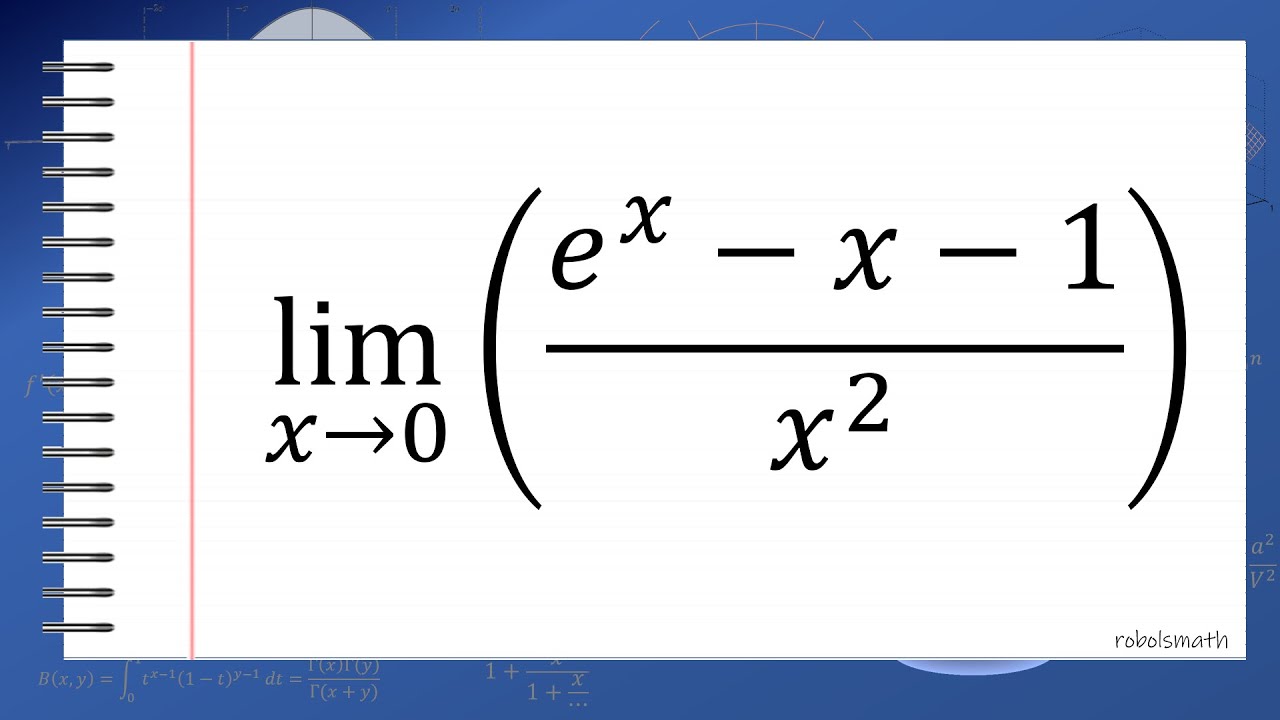
In this video, we discuss several solutions to evaluate the limit of (e^x - x - 1)/x^2 as x approaches 0.
Minor correction at 13:53, the time factors should be (e^x - x - 1)/x^2 * (e^x + x + 1).
Where does e^x-1^2 come from this limit?
 civic fractal
@everyone hi friends
willow skiff
arctic meteor
Where does e^x-1^2 come from this limit?
it's a problem solving technique
arctic meteor
Also how does this apply to
arctic meteor
$$\frac{x+1-e^x}{x^2}$$
obsidian monolithBOT
wolly5114
 obsidian monolithBOT
wolly5114
 willow skiff
arctic meteor
$$\frac{x+1-e^x}{x^2}$$
willow skiff
arctic meteor
$$\frac{x+1-e^x}{x^2}$$
oh just multiply by -1
arctic meteor
?
willow skiff
multiply (e^x - x - 1)/x^2 by -1
civic fractal
help please with this question
An ice cube tray of negligible mass contains 0.315kg of water at 17.7 degrees Celsius How much heat must be removed to cool the water to 0.0 degrees Celsius and freeze it?
Express your answer in joules, calories, and in Btu.
willow skiff
civic fractal
An ice cube tray of negligible mass contains 0.315kg of water at 17.7 degrees C...
what have you tried so far?
civic fractal
willow skiff
what have you tried so far?
at this point ive tried to solve it so many times i cant remeber what i tried becasue of how much it has hurt my brain
willow skiff
civic fractal
at this point ive tried to solve it so many times i cant remeber what i tried be...
alright, Q = mc (delta T) to cool down the water to 0 degrees, and then Q = mL to turn the water into ice right?
silent prism
arctic meteor
In google I found this
Bless l'hopital I am not tryna do allat
 fair lantern
hello can someone please tell me how to check which parts of the graph of a cubic function are above or below the x-axis between the x-intercepts or if anyone can find a video on it thanks
obsidian monolithBOT
 rocky wind
fair lantern
hello can someone please tell me how to check which parts of the graph of a cubi...
rocky wind
fair lantern
hello can someone please tell me how to check which parts of the graph of a cubi...
in general you need to solve the cubic equation and see
for classic topics like this, i think you can search it yourself
 empty island
can anyone find the sum of T

 fallow oasis
Doing school project on end-users insights sort of like an interview where. https://docs.google.com/forms/d/e/1FAIpQLScGqyZVUqd6ohqK1bVYawpHwb1nddQU9krMmMakseYh6PyekA/viewform?usp=header

Google Docs
Survey to gather insight on end-users opinions on gaming conventions.
arctic meteor
$$\lim_{x \to a} \frac{x^n-a^n}{x-a}$$
obsidian monolithBOT
wolly5114
 obsidian monolithBOT
wolly5114
 arctic meteor
I want to solve it without differentiation
summer ruin
binomial expansion
summer ruin
yes
 magic owl
arctic meteor
i replace x-a with u?
magic owl
arctic meteor
i replace x-a with u?
there is another way