#precalculus
1 messages · Page 41 of 1
 whole void
 viscid thistle
Like the value would be 2 for 2.9 rather than 3?
viscid thistle
Yeah I got it thanks
 cloud wadi
viscid thistle
Like the value would be 2 for 2.9 rather than 3?
cloud wadi
viscid thistle
Like the value would be 2 for 2.9 rather than 3?
Its all got to do with the function property like you can notice it for yourself if you compare the calculations with the function graph
It rounds down so to speak because from open 2 to closed 3 the function is a horizontal line (y=2)
viscid thistle
cloud wadi
It rounds down so to speak because from open 2 to closed 3 the function is a hor...
I don't really understand what u meant 😅
cloud wadi
The graph (the image)
If you observe it at the value you want to calculate it
It starts to make sense
From zero to 1 is zero
From 1 to 2 is 1
Its called a step function because its made up of small honrizontal lines
That go up a certain integer at a time
viscid thistle
cloud wadi
Its called a step function because its made up of small honrizontal lines
Yeah but this kind of graph is also possible for other functions right?
Like other examples of step function instead of the greatest integer function
cloud wadi
Step function IS a greatest integer function
 lament ferry
Do you need deep understanding of algebra to start calculus
 willow skiff
lament ferry
Do you need deep understanding of algebra to start calculus
willow skiff
lament ferry
Do you need deep understanding of algebra to start calculus
No
You should have a reasonable understanding of algebra to not make silly mistakes / misconceptions such as that sin(x + y) is the same as sin x + sin y
If you find you don't understand a computation in calculus, you probably need to go back and revise that section of algebra
see how you go
willow skiff
lament ferry
Trigonometry?
yes, and
logarithms/exponential functions, rational functions
umm what else
Function transformations in general are super important
factor/remainder theorem, long division (if you have time I recommend learning synthetic division also)
discriminants of quadratics
Ah coordinate geometry, so tangent lines, normal lines
point-slope form
lament ferry
What about deivatives
 hushed sphinx
I think a good familiarity with the concept of function is the most important.
The standard functions show up in a lot of examples (and exercises), but their particular properties are not the central stumbling block.
Derivatives are calculus.
willow skiff
binomial expansions
if you have time also learning basic summation notation will come in handy
and prob and stats and matrix algebra are other things you could be learning at this stage, though not directly relevant for calculus
lament ferry
What is even calculus
willow skiff
lament ferry
What is even calculus
the study of how functions change
so differentiation is about the slope of a function if the slope is constantly changing
Integration is the (signed) area under a curve if that area is not changing linearly
So the area of a triangle is easy
The area under a parabola, harder
lament ferry
Is phytagorian theorem made by calculus or just proven
hushed sphinx
willow skiff
factor/remainder theorem, long division (if you have time I recommend learning s...
That whole laundry list begins too look a lot like "deep understanding of (high school) algebra" ...
willow skiff
hushed sphinx
That whole laundry list begins too look a lot like "deep understanding of (high ...
Depends on what you mean by 'deep'
hushed sphinx
The Pythagorean theorem is geometry and not particularly connected to calculus.
willow skiff
hushed sphinx
The Pythagorean theorem is _geometry_ and not particularly connected to calculus...
But if you're learning calculus you should know the Pythagorean theorem
And you should know how to apply it to the distance between two points
otherwise you'll trip up later
lament ferry
hushed sphinx
The Pythagorean theorem is _geometry_ and not particularly connected to calculus...
Why is calculus common used in geometry
willow skiff
Like maybe not all of those things will be immediately useful, but imagine you're studying calc 2 and you have no idea about how to write (1 + 2x)^4 in terms of a constant, x, x^2 and so on
And then your first introduction to this topic is infinite series, and Taylor series
I'm not asking them to memorise the binomial formula
It's going to be on some formula sheet anyways
hushed sphinx
I dunno, it sounds like you're setting the bar very high. Yes, all of these things find some kind of application in calculus exercises, but it's not like one needs to have them all super memorized before one can even start learning what calculus is about.
willow skiff
hushed sphinx
I dunno, it sounds like you're setting the bar very high. Yes, all of these thin...
true
But I would expect a student to have a basic understanding of these things by the time they start calculus, I mean I don't think I'm being too unreasaonable
Of course if you're self-studying then you can learn whatever you want at whatever time
And I guess I assume that students learn calculus at roughly the same mathematics level
IDK some topics in there are much more useful than others, but the point is to not have a too limited view of mathematics at this stage
You don't need to spend hundreds of hours practicing every single topic in a lot of detail
lament ferry
hushed sphinx
I dunno, it sounds like you're setting the bar very high. Yes, all of these thin...
I do not memorizing i learning with understanding, beacuse deep understanding is important
willow skiff
It's more about being familiar with what mathematics is out there at this level
Dweck says that facts come before skills, in other words you should know about what something is before you apply it
willow skiff
lament ferry
So, i just need to learn until im fell ready for calculus
You could technically start now but yeah, there might be gaps in your knowledge that prevent you from studying other concepts in calculus later on
The idea of the derivative being what the value of the slope approaches as you bring two points closer together
willow skiff

In this video, I use Desmos to animate how the secant line is used to approximate the tangent line.
Many thanks to Desmos and the authors of the two graphs! Here are links so you can try out the animations yourself:
Secant Line to Tangent Line
https://www.desmos.com/calculator/zr7siihtmz
Tangent Line Slider
https://www.desmos.com/calculator/...
Yeah start here
You could start with integration also (Riemann sums or rectangular sums is what you need to search for)
no worries
yeah honestly study how you like man, cause there's no one order you have to study maths in
like, wanting to know more about calculus can be the motivation for learning those topics before calculus
viscid thistle
I just watched 3blue1brown the essence of calculus and searched my way into understanding it
willow skiff
Ayyy good rec
viscid thistle
also, https://tutorial.math.lamar.edu/Classes/CalcI/CalcI.aspx for practice and more deep information
Here is a set of notes used by Paul Dawkins to teach his Calculus I course at Lamar University. Included are detailed discussions of Limits (Properties, Computing, One-sided, Limits at Infinity, Continuity), Derivatives (Basic Formulas, Product/Quotient/Chain Rules L'Hospitals Rule, Increasing/Decreasing/Concave Up/Concave Down, Related Rates, ...
 lean nest
this is like so cool
 jovial lodge
Quick question why can we just take out the 9 from the integral

 hallow tide
jovial lodge
Quick question why can we just take out the 9 from the integral
hallow tide
jovial lodge
Quick question why can we just take out the 9 from the integral

properties assume convergence; more specifically property 5 is the 2nd fundamental theorem
 winter comet
jovial lodge
Quick question why can we just take out the 9 from the integral
winter comet
jovial lodge
Quick question why can we just take out the 9 from the integral
it's an infinite series, you can factor it out
jovial lodge
What are those symbols at bi) and why do I need to write them

And also for bii and biii
I don’t rly understand when to use those symbols nad when to write that x≠0 and the range and stuff
 untold sun
jovial lodge
What are those symbols at bi) and why do I need to write them
untold sun
jovial lodge
What are those symbols at bi) and why do I need to write them
For bi), It represents a condition for another function, g(x). It states that 1 is less than or equal to g(x), which is less than or equal to 3. Additionally, g(x) is an element of the real number set.
untold sun
jovial lodge
So what does that weird e thing mean
Apologies for the late reply, it means is an element of/belongs to
It is used in set theory
 austere hazel
can someone explain sin (x/2) = cos (x/2)
austere hazel
 chrome ether
how to solve it?
chrome ether
how to solve it?
yes
chrome ether
ok so first we use the cofunction identity sin(x)=cos(pi/2-x)
(to see why this identity is true, either look at a right triangle or consider what happens when you shift a sine or cosine graph)
now we have cosines on both sides, what can we do to get rid of them?
 uncut mulch
less tedious to divide by cos(x/2) and use tan
chrome ether
ah shit that would probably work too^
uncut mulch
esp if you want the general solution
 vapid plaza
No, the set of rational numbers is written as Q. R for the real numbers is correct
willow skiff
the names are taken from German where there were many set theorists
no wait, Italian, Peano was Italian
quoziente for quotient
but Z for Zahlen does come from German
 alpine bolt
jovial lodge
And that weird R means it’s a real number?
alpine bolt
jovial lodge
And that weird R means it’s a real number?
exactly - it's called blackboard bold and there are a bunch of sets of numbers that have their own corresponding letter: r is real, q is rational, n is natural, z is integer, c is complex, and u is the universal set, which represents all possible numbers
but the most common are probably r and z, at least from what i've dealt with
 manic wasp

 obsidian monolithBOT
938c2cc0dcc05f2b68c4287040cfcf71

 stiff sluice
how do I find them k?
willow skiff
stiff sluice
how do I find them k?
what's e^0?
stiff sluice
1
obsidian monolithBOT
south
 willow skiff
as e^x is one-to-one
willow skiff
no worries man
 narrow briar
Hi! One question: how im supposed to study the continuity of these two functions? Tanks

without drawing the graph
in both the limit x->1 exists and the function evaluated in x=1 doesnt exist, so, how do i know if it has an evitable or inevitable discontinuity?
its difficult😓
 thin thorn
narrow briar
Hi! One question: how im supposed to study the continuity of these two functions...
thin thorn
narrow briar
Hi! One question: how im supposed to study the continuity of these two functions...
You just take the right and left hand limits of the function and compare it with the functional value which in this case isn't defined. So the function is discontinuous at x=1
 smoky panther
What happened to that 2x 4x and 6x??

The explanation is written but isn’t in English and i don’t understand technical talk in my native language
willow skiff
narrow briar
Hi! One question: how im supposed to study the continuity of these two functions...
Look at x = 1.0001 for example
Then 1/(1.0001 - 1) = 1/(0.0001) = 10,000
So the limit actually doesn't exist cause they both diverge to +infinity
for f(x)
For g(x), you can factor out (x - 1) from the numerator and you are left with a quadratic
So g(x) has a removable discontinuity at x = 1
willow skiff
smoky panther
What happened to that 2x 4x and 6x??
,rotate
obsidian monolithBOT
 willow skiff
Sub $u = x^2 - 1$, then $du = 2x \ dx$
obsidian monolithBOT
south
 willow skiff
So you're left with the integral of u^(-3) du, which is (u)^(-2) / (-2) + c
The other two cases use exactly the same reasoning
jovial lodge
See for this question I got everything correct except I minus’d the wrong curve from the right one

How do I know what one to minus from the other
?

 paper tartan
jovial lodge
paper tartan
jovial lodge
(4x - x^2) - (x^2 - 6) = 4x - x^2 - x^2 + 6 = 4x - 2x^2 + 6
they distributed the -1 into (x^2 - 6) and then added
jovial lodge
Huh
 jovial lodge
I don’t understand sorry, why did they minus one curve from the other
winter comet
jovial lodge
How do I know what one to minus from the other
the one that is above
winter comet
jovial lodge
I don’t understand sorry, why did they minus one curve from the other
to find the area
jovial lodge
Oh
winter comet
they aren't finding net area, just regular area
jovial lodge
Oh
winter comet
jovial lodge
Positive side?
no, just the positive entire area
like ignore the x axis
its all positive area
not the net area
jovial lodge
I’m still confused 😭
winter comet
ok uhm
jovial lodge
Why do you minus I don’t understand
I just tried to integrate that

And then sub in 3 and -1
winter comet
jovial lodge
I just tried to integrate that
thats correct
jovial lodge
Is it?
winter comet
jovial lodge
Why do you minus I don’t understand
you're subtracting the area under one curve from the area under the other
winter comet
bruh
ok
so you set them equal to find the bounds, right?
does that part make sense?
jovial lodge
Yea
winter comet
alr
jovial lodge
I got 3,-1
jovial lodge
Oki
winter comet
yeah ok
thats right
then on the interval
which curve is above and which curve is below?
jovial lodge
Ah
winter comet
do you know like definition of integral
jovial lodge
I don’t actually understand
jovial lodge
winter comet
it's the infinite limit of a sum of very small rectangles?
Is it like the trapezium rule?
Or just some random thing
I don’t know.
winter comet
jovial lodge
Is it like the trapezium rule?
what exactly do you mean by the trapezium rule?
jovial lodge
To find approx area
winter comet
you may be talking about riemann sum, which is an estimate, or ahh
no thats just the estimate
jovial lodge
Yea
winter comet
you add up a finite number of trapezoids together
jovial lodge
Yea
winter comet
but if you add up an infinite amount of trapezoids, you get the exact area
jovial lodge
I have like an equation for it
winter comet
thats the definition of an integral, more or less
winter comet
so here like uh
lets just say you're adding up an infinite amount of rectangles

cuz i cant draw trapezoid lol
winter comet
winter comet
lets just say you're adding up an infinite amount of rectangles
it has an infinitely small length of dx
winter comet
and for each dx, it has a certain length that i called R
jovial lodge
👍
winter comet
for each x value, the length of R will be 4x - x^2 - x^2 + 6
it will be the distance between the curves
a.k.a top curve minus bottom curve
does that kinda make sense or
winter comet
jovial lodge
So will it always be top curve minus bottom
yeah, pretty much
jovial lodge
Oh well that helps a lot tbh
winter comet
sometimes it might flip and you'd have to do it with respect to the y axis
in which case it would be right minus left
but yeah
jovial lodge
 winter comet
jovial lodge
Oh well that helps a lot tbh
winter comet
jovial lodge
Oh well that helps a lot tbh
im not gonna say ALWAYs cuz there "could" be exceptions, i can't think of any tho pretty much just top minus bottom
jovial lodge
What dis
winter comet
volume
jovial lodge
winter comet
im not gonna say ALWAYs cuz there "could" be exceptions, i can't think of any th...
If I get it wrong I’m blaming u in test! 😠
jovial lodge
winter comet
volume
Oh
winter comet
do you know shells method or disk method?
winter comet
jovial lodge
If I get it wrong I’m blaming u in test! 😠
alr 😂 💀
winter comet
yeah
winter comet
it looks like they want you to stop at x = 4
jovial lodge
x=0 and x=4
winter comet
jovial lodge
So I basically square y and integrate that
and multiply by pi yeh
jovial lodge
So does my answer change?
winter comet
no
winter comet
i don't know 💀
jovial lodge
Damn I hate maths questioners
winter comet
they should honestly just say "full rotation" 💀
jovial lodge
What does that even mean tho like why are we rotating it 💀
I’m just tryna find the volume and dip
winter comet
jovial lodge
I’m just tryna find the volume and dip
you're finding the volume of the object made when the curve made a full rotation around the x axis
winter comet
XD
winter comet
jovial lodge
My understanding of integration is getting slightly better
you know how theres like the trapezoidal sums?
jovial lodge
Yea
winter comet
you know how the more trapezoids you have, the more accurate the estimate is?
winter comet
yeah
so if you have an infinite number of them
thats basically the integral
its not an estimate anymore, it IS the area
jovial lodge
What’s ornates btw
winter comet
jovial lodge
What’s ornates btw
no idea
winter comet
uh
this is the definition

f(x_k) means like the height of each rectangle
or each trapezoid
jovial lodge
It was ordinates btw
winter comet
oh 💀
jovial lodge
What’s that
jovial lodge
Ah
winter comet
of the sum of infinitely small rectangles
jovial lodge
So between 0 and infinity
winter comet
delta x is the width, f(x_k) is the height
winter comet
jovial lodge
So between 0 and infinity
no?
it just means like
as the number of rectangles/trapezoids gets bigger
jovial lodge
Yea I see
winter comet
💀
viscid thistle

What is the domain and range here like the input values and results? What would be the case if it's (gof)(x) instead of (fog)(x) ?
 wraith sleet
I learned something
 smoky panther
willow skiff
The other two cases use exactly the same reasoning
smoky panther
willow skiff
The other two cases use exactly the same reasoning
Alr thank you :)
winter comet
viscid thistle
What is the domain and range here like the input values and results? What would ...
if it were (gof)(x), then the range of f is a subset of the domain of g
winter comet
viscid thistle
What is the domain and range here like the input values and results? What would ...
the range of the inside function is a subset of the domain of the outside function
since you input the y value of the function as the x value of the new function, essentially
viscid thistle
winter comet
the range of the inside function is a subset of the domain of the outside functi...
Yeah but wdym by u value?
winter comet
u value?
winter comet
viscid thistle
Yeah but wdym by u value?
wdym by what do i mean by u value, i didnt say u value and idk what ur referring to 💀
viscid thistle
Sorry I mean y value
viscid thistle
Like in gof f(x) is y value and g(f(x)) x value ?
winter comet
y = f(x), g(f(x)) = g(y)
so y is the range of f(x), but its a subset of the domain of g(x)
viscid thistle
Got it , thanks 🙏
smoky panther
I cant figure out what i did wrong here can someone help?


 river drift
your 1/2 somehow turned into a 2 in line 5
smoky panther
river drift
your 1/2 somehow turned into a 2 in line 5
The last line?
river drift
the one next to the 5️⃣ i mean
smoky panther
river drift
the one next to the 5️⃣ i mean
was I supposed to leave the 2 in the denominator?
river drift
yes
smoky panther
Oh alr, do i always leave the number next to x where it is? cuz i think i saw some take them both
river drift
if you wanted to pull 2 to the numerator you'd need to give it a negative power as well
smoky panther
chrome ether
<#326138772477575180>
Is this meant for me?
chrome ether
ye, integrals are calculus lol
smoky panther
Ah alr mb lol, where i am we literally call it all math so idk what’s considered calculus or algebra or anything
 echo sinew
I wouldn't worry too much, actually
 chrome ether
a_n explodes to infinity, making that limit a 1^infty exponential indeterminate form
try taking the log of that expression and finding the limit of that first
stiff sluice
we need to use algebra bro
But lowkey that 4 is being very annoying
If that would be 1 this has already ended
chrome ether
taking the log is “using algebra” is it not?
stiff sluice
the limit of what first?
ok we can use log then i didnt know it was algebra
but i cannot yse log because there is no rhs of an equation
i need more hints
chrome ether
let L be that expression above
log L = [log of whatever that is]
now take n—>infty
when you’re done, just exponentiate back
OH wait a sec
I think this might be like one of the limit expressions for e
stiff sluice
you must be joking
chrome ether
nope
stiff sluice
 chrome ether
all that matters is that a_n goes to infinity as n goes to infinity
stiff sluice
how to get rid of the 4 so we use e limit
chrome ether
therefore, we can rewrite the limit as $\lim_{a_n\to\infty} \left(1+\frac{4}{a_n}\right)^{a_n}$
obsidian monolithBOT
elrichardo1337
 chrome ether
that comes out to be $e^4$ I believe
obsidian monolithBOT
elrichardo1337
 stiff sluice
Sure but 4 on top is fked
i know but i need to justify
Like there is an algebraic manipulation for this

i did a simpler exercise earlier
this is how i should use e limit but i cannot use e^x
Ohh i can double flip
chrome ether
ah wait
I think what you can do is
$\left(\lim_{a_n\to\infty} \left(1+\frac{4}{a_n}\right)^{a_n/4}\right)^4$
obsidian monolithBOT
elrichardo1337
 chrome ether
the stuff inside goes to e, so the overall limit is e^4?
 stiff sluice
Like there is an algebraic manipulation for this
stiff sluice
stiff sluice
Like there is an algebraic manipulation for this
i did double flip like in here
So i can use e
then evaluate the limit on top of e
but is 0
So answer is e^0
narrow briar
willow skiff
So the limit actually doesn't exist cause they both diverge to +infinity
Isn't it assumed that if both limits tend to the same value, then the limit exists?
winter comet
narrow briar
Isn't it assumed that if both limits tend to the same value, then the limit exis...
they aren't tending towards a value, they are tending towards infinity
but both sides of the limit are tending to +infinity
so the limit is +infinity
the problem is, infinity doesn't exist
so the limit doesnt exist
and its infinity
same thing
 surreal crescent
So close, yet so, so far
 surreal crescent
winter comet
and its infinity
surreal crescent
winter comet
and its infinity
Another way to say it is the limit is indefinite, there are so many ways to say the same thing
 warped cipher
 vernal pine
,w $-\frac{\pi}{2} \le \frac{2\pi}{12}\left(t-0.3\right) \le \frac{\pi}{2}$
obsidian monolithBOT


 agile sparrow
@woven remnant
 plucky osprey
surreal crescent
So close, yet so, so far
plucky osprey
surreal crescent
So close, yet so, so far
Nah thats insane, would they not round it?😭
 granite coral
stiff sluice
granite coral
stiff sluice
where can i learn how to do this
 sharp perch
granite coral
where can i learn how to do this
sharp perch
granite coral
where can i learn how to do this
those are limits, search it up on youtube "introduction to limits", Im assuming that you're a beginner
stiff sluice
granite coral
where can i learn how to do this
do what exactly?
I just used the e limit and algebra
 stiff sluice
granite coral
where can i learn how to do this
stiff sluice
granite coral
where can i learn how to do this
if you want tough limits, look up demidovich, or maybe other tough mir books, but beware his book has little theory


 flat yacht
Heya everybody, I was just watching this video: https://youtu.be/S0_qX4VJhMQ?si=0yR95MZ6hHh-tBQB
And around 8:40 the guy from the channel says 'you can "choose" mostly x's and one dt'. What does he mean with choose? Choose for what?
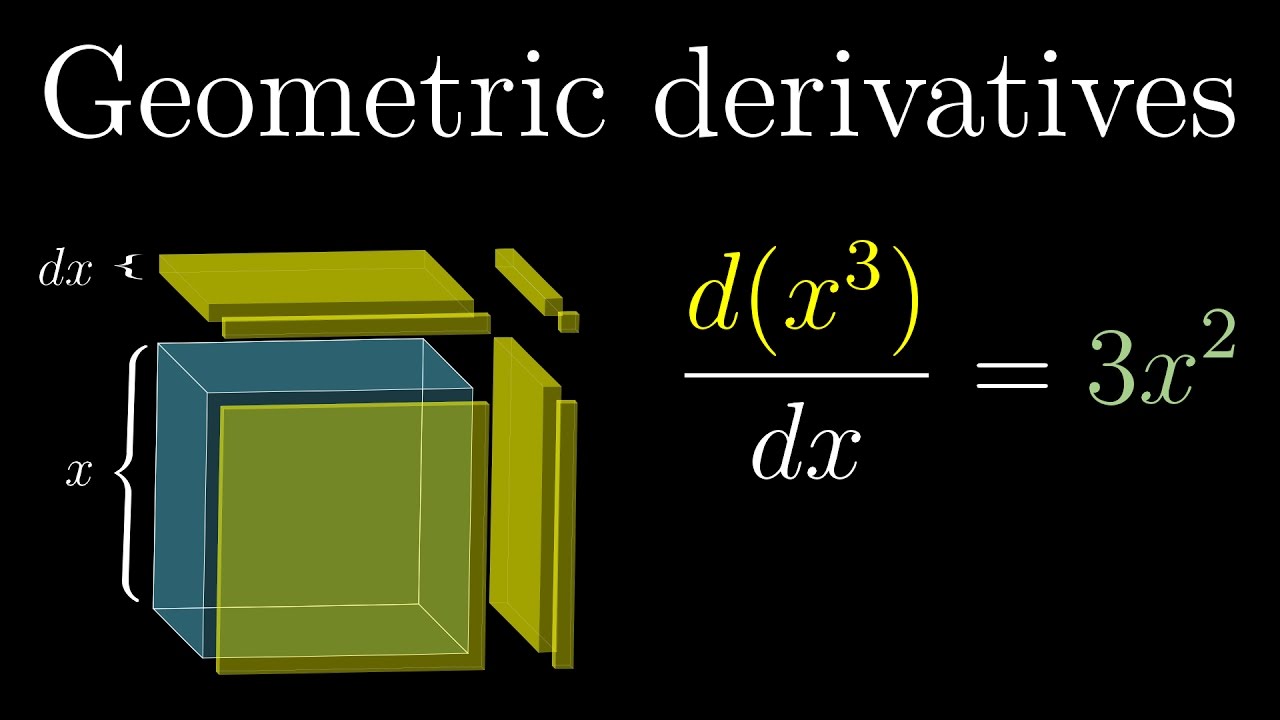
Some common derivative formulas explained with geometric intuition.
This video was sponsored by Brilliant: https://brilliant.org/3b1b
Help fund future projects: https://www.patreon.com/3blue1brown
An equally valuable form of support is to simply share some of the videos.
Special thanks to these supporters: http://3b1b.co/lessons/derivatives-powe...
I'm watching this video just to learn some calculus since me and a friend are really interested in advanced physics like particle physics and quantum physics, and our school Math curriculum isn't that far yet, since we're only in third year of high school right now.
Please do ping me if you want to give an answer :)
vapid plaza
@flat yacht
when multiplying/expanding expressions with multiple terms, you can think of each term after the expansion as the result of "choosing" one term from each factor
for example
(A + B)(C + D + E)
would be AC+AD+AE+BC+BD+BE
note that each of the six terms correspond to a possibility when "choosing" either A or B in the first bracket, and then either C or D or E in the second bracket
and of course this works if you have even more brackets
flat yacht
Ah, like that. Thank you so much! Just seems to be a struggle cos I'm not a native English speaker, terms like expressions are kinda new to me 😅
vernal pine
Just wondering, is R^2 the same thing as the correlation coefficient squared?
 crystal vector
Yes, ( R^2 ) (R-squared) is indeed the square of the correlation coefficient (( r )). It represents the proportion of the variance in the dependent variable that is predictable from the independent variable(s) in a regression model.
obsidian monolithBOT
Arrow ♡
 vernal pine
crystal vector
Yes, \( R^2 \) (R-squared) is indeed the square of the correlation coefficient (...
vernal pine
crystal vector
Yes, \( R^2 \) (R-squared) is indeed the square of the correlation coefficient (...
Thank you very much : )
crystal vector
ofc
 white rapids
Uhh is unit circle required for precalculus?
winter comet
white rapids
Uhh is unit circle required for precalculus?
wdym?
you mean as a prerequisite, or is it definitely part of precalculus
white rapids
I dont know
Im learning it right now for math III according to the curriculum here in california
winter comet
ah
white rapids
Im gonna assume its required
winter comet
i think they would cover it in precalc
white rapids
Cuz this stuff is confusing
winter comet
i dont know what you mean by required tho
white rapids
Oh
winter comet
you have to understand it by the end of precalc
white rapids
winter comet
i dont know what you mean by required tho
I mean just for necessities for it if there was trig
white rapids
winter comet
you have to understand it by the end of precalc
Alright
winter comet
white rapids
I mean just for necessities for it if there was trig
it would teach the unit circle early on in the trig part
white rapids
Oh alright
 golden cairn
How do I solve for x in this, over [0,2pi]: 3sin2x+cosx=0
hushed sphinx
I'd start by sketching the function to get an idea of how it moves. E.g. plot its values at all multiples of pi/2.
golden cairn
Well I have a unit circle drawn out
winter comet
golden cairn
Well I have a unit circle drawn out
you'll need that later, but im pretty sure he meant the function like f(x) = 3sin(2x) + cos(x)
golden cairn
Well that’s not what I needed help with. I got up to here: cosx(6sinx+1)=0. And then I wrote sinx=-1/6 and cosx=0
winter comet
oh
golden cairn
I got the x values for sinx=-1/6 in my calculator
But the problem is
My answer key has different answers for cosx=0. I wrote down pi/2 and 3pi/2 but the answer key has 2pi,0
As the x values for cosx=0
hushed sphinx
Uh ... cosx(6sinx+1)=0 doesn't seem to have anything to do with 3sin2x+cosx=0.
golden cairn
Wait
winter comet
hushed sphinx
Uh ... cosx(6sinx+1)=0 doesn't seem to have anything to do with 3sin2x+cosx=0.
sin(2x) = 2sin(x)cos(x)
winter comet
golden cairn
My answer key has different answers for cosx=0. I wrote down pi/2 and 3pi/2 but ...
thats weird
golden cairn
So is it a mistake in the answer key?
winter comet
i guess so
golden cairn
Ok
winter comet
if you're sure thats all the context then yeh lol
golden cairn
Yeah that’s all they said
hushed sphinx
Ah, it looked to me like the sine was inside the argument to the cosine.
winter comet
hushed sphinx
Ah, it looked to me like the sine was inside the argument to the cosine.
oh lol
viscid thistle
Where's the calc channel?
viscid thistle
Thanks
 autumn snow
Can someone explain this one question to me please
It’s pretty simple but I want clarification
hushed sphinx
The only way to find out is to ask your question and see if someone answers.
winter comet
autumn snow
Can someone explain this one question to me please
no
 daring tapir
autumn snow
It’s pretty simple but I want clarification
daring tapir
autumn snow
It’s pretty simple but I want clarification
!da2a
 tender questBOT
autumn snow
It’s pretty simple but I want clarification
tender questBOT
autumn snow
It’s pretty simple but I want clarification
No need to ask “Can I ask…?” or “Does anyone know about…?”—it’s faster for everyone if you just ask your question! See https://dontasktoask.com/
 final pier
Yeah I got it 😭
golden cairn
I need help with this question

I asked several different ai chat bots and they all get different answers which are wrong. The answer key says n=4
 charred epoch
Oh wow I wish I had been reading the free online OpenStax textbook alongside my class.
We learn everything without it, but the textbook goes into so much detail.
white rapids
Can somebody help please?
 chrome ether
golden cairn
I asked several different ai chat bots and they all get different answers which ...
chrome ether
golden cairn
I asked several different ai chat bots and they all get different answers which ...
!nogpt
tender questBOT
golden cairn
I asked several different ai chat bots and they all get different answers which ...
Please do not trust ChatGPT or similar AI tools for mathematical tasks, as they often generate output which "sounds correct" but has numerous factual or logical errors. Use of these AI tools to answer other people's help questions is strictly against server rules (see #rules).
golden cairn
chrome ether
!nogpt
Yeah well duh. I got the wrong answer so obviously
chrome ether
this is just plugging into the definitions of nPr and nCr
hushed sphinx
If I recall correctly (but check this!) nP3 means n(n-1)(n-2) and nC4 means n(n-1)(n-2)(n-3)/24. Set these two equal to each other and divide away the common factors.
The answer cannot be 4 because 4P3 is 24 but 4C4 is only 1.
white rapids
white rapids
Can somebody help please?
@winter comet
winter comet
white rapids
<@764342735732867072>
cosine graphs don't go through (0,0), for one thing, right?
i mean
not like that
they could technically i need to be more specific
uhh
i don't know how to explain it too well
white rapids
Uhh
hushed sphinx
You can plug x=0 in to find where the graph should cross the y-axis.
winter comet
thats true
hushed sphinx
Figure out what the smallest and largest possible function values are; the midline is halfway between them.
white rapids
What if I have an amplitude and a minimum
Do I subtract or add those values to get the midline?
Im kinda lost right now
golden cairn
hushed sphinx
If I recall correctly (but check this!) nP3 means n(n-1)(n-2) and nC4 means n(n-...
I dont know why almost every single answer in the answer key is incorrect
This is a like a final exam review the teacher made
It’s not official so maybe that’s the reason
winter comet
white rapids
What if I have an amplitude and a minimum
if you have a minimum, if you add the amplitude you should get the maximum, and half way between the minimum and the maximum should be the midline
hushed sphinx
Twice the amplitude.
white rapids
Uhh
winter comet
oh yeah mb
white rapids
Alright I'll try
winter comet
you only have to add the amplitude to get the midline 💀
golden cairn
hushed sphinx
If I recall correctly (but check this!) nP3 means n(n-1)(n-2) and nC4 means n(n-...
I got up to that step already but I don’t know what to do after that. It just looks like a bunch of expanding to me
hushed sphinx
Nono, don't expand.
white rapids
winter comet
you only have to add the amplitude to get the midline 💀
Uh if im trying to find midline, should x always = 0
hushed sphinx
Instead notice that most of the factors appear on both sides of the equation!
golden cairn
So first do I multiply by 24 on both sides to get rid of the denominator?
winter comet
white rapids
Uh if im trying to find midline, should x always = 0
the midline is a straight line, y = something for all x
hushed sphinx
Well yes you can do that.
golden cairn
Ok
 mortal laurel
river drift
mortal laurel
river drift
cos(x - π/2)
 summer juniper
how do I solve this (without l'hopitals rule)

the answer is allegedly 2/3
and I have 2 for the numerator
but i'm getting 2 for the denominator as well
i tried to rationalize by multiplying the numerator and denominator by (cube root(1+x))^2 + (cube root(1-x))^2
but now i'm stuck
 twilit oyster
do you know about perfect cube binomials
chrome ether
summer juniper
i tried to rationalize by multiplying the numerator and denominator by (cube roo...
that's not the correct multiplication to use
 hidden lagoon
twilit oyster
do you know about perfect cube binomials
hidden lagoon
twilit oyster
do you know about perfect cube binomials
the what
chrome ether
twilit oyster
do you know about perfect cube binomials
that's not it either, you need difference of cubes
twilit oyster
Dang rlly
chrome ether
if you want to completely get rid of the cube roots in the numerator
twilit oyster
Wait that was what I was talking about
chrome ether
(a+b)^3?
twilit oyster
Ya
chrome ether
i'm not sure how that helps here
twilit oyster
Like a^3-b^3
chrome ether
oh yea that's difference of cubes
hidden lagoon
twilit oyster
Like a^3-b^3
you use the formula for a difference of cubes
twilit oyster
Yeah do you not use that
hidden lagoon
(a - b)(a^2 + ab + b^2)
chrome ether
we just called it different things
twilit oyster
Lol
viscid thistle
final pier
Yeah I got it 😭
👍 I was just guessing tho
viscid thistle
Why has the h become 1 instead of 0 in LHL?

 royal ingot
daring tapir
viscid thistle
Why has the h become 1 instead of 0 in LHL?
royal ingot
daring tapir
viscid thistle
Why has the h become 1 instead of 0 in LHL?
what is g(x)?
summer juniper
chrome ether
that's not it either, you need difference of cubes
i'm not sure how exactly to do that
willow skiff
summer juniper
i'm not sure how exactly to do that

So if you let $(1 + x)^{1/3} = a, (1 - x)^{1/3} = b$, your numerator is $a - b$
obsidian monolithBOT
south
 daring tapir
(proving the formulas would be a fun exercise too)
willow skiff
Multiply top and bottom by $\frac{a^2 + ab + b^2}{a^2 + ab + b^2}$
obsidian monolithBOT
south
 willow skiff
then you can directly sub in once you simplify
viscid thistle
daring tapir
what is g(x)?
x-[x]
viscid thistle
 summer ruin
what do the square brackets mean?
summer ruin
what do the square brackets mean?
Greatest integer function
summer ruin
what does that mean
daring tapir
viscid thistle
x-[x]
there you get it why it equals one
viscid thistle
This is the question
 summer ruin
so it's the integer part
viscid thistle
daring tapir
there you get it why it equals one
Wdym?
summer ruin
[c-h] = c-1 when h > 0
viscid thistle
summer ruin
[c-h] = c-1 when h > 0
👍 Thanks 🙏
winter comet
🫠
chrome ether
what do you want us to do with that 😭
daring tapir
cry about how weird shit can look i guess
winter comet
daring tapir
cry about how weird shit can look i guess
💀
"math is so complicated"
literally just didnt define it so nobody can understand because it has no meaning ._. 💀
or no singular interpretation 💀
daring tapir
that doesnt even look like math lmaoo, there is the gravitational constant plancks constant and idk what else floating around in that
winter comet
daring tapir
that doesnt even look like math lmaoo, there is the gravitational constant planc...
some sort of applied math lol
daring tapir
winter comet
some sort of applied math lol
xD
daring tapir
fr
winter comet
how many inches is in 2
daring tapir
winter comet
how many inches is in 2
4 obv
winter comet
daring tapir
4 obv
nah 8
winter comet
☠️
daring tapir
winter comet
nah 8
oh fuck i forgot mb
winter comet
daring tapir
oh fuck i forgot mb
yeeeh
daring tapir
(i hope someone continues the chain and says 16 but oh well)
 sour lynx
16
 gaunt osprey
 river drift
it's a jagged edge, the derivative approaching from the left is different from the derivative approaching from the right
river drift
you may have an easier time if you multiply both sides by r
winter comet
river drift
you may have an easier time if you multiply both sides by r
r^2 = -3rcos(theta)
x = -3r(cos(theta)), x = r^2
i'm not exactly seeing how any of this information gets to a rectangular equation :l
oh wait
my bad
x = rcos(theta)
lol
-3x = r^2
._.
 severe night
yo based of the plus and minus how do i know what function to use
 river drift
- means from the left, or the limit as x approaches 2 from lower values
severe night
so as x as comes to -2 from other neg numbers
river drift
well it means approaching -2 from negative numbers lower than it (think -2.0001 for example) as opposed to -2 from negative numbers higher than it (like -1.999)
severe night
so i would use bottom equation for - and top for +
winter comet
river drift
r^2 has a nice formula in rectangular form
r^2 = x^2 + y^2?
river drift
yes
winter comet
winter comet
r^2 = x^2 + y^2?
i know its a circle, i dont know how to logically know its a circle
and i know its not centered at 0,0
river drift
well once you have
-3x = x^2 + y^2
you can complete the square to get it in standard circle form
chrome ether
this is assumed to be well known background knowledge from alg2/geometry/wherever the heck they covered it
winter comet
well uh
what if its not a circle
._.
do you have to know the shape already in order to get the rectangular equation?
like there isnt a set method or anything?
winter comet
chrome ether
this is assumed to be well known background knowledge from alg2/geometry/whereve...
well I know r = sin(theta) and r = cos(theta) are circles
I don't know how I know that
I was never officially taught polar coordinates or parametric equations lol
just kinda picked up stuff :l
chrome ether
you try to force your expressions for r^2 or x,y into the equation
either squaring, multiplying through by r, etc.
winter comet
chrome ether
you try to force your expressions for r^2 or x,y into the equation
into what equation?
winter comet
um
winter comet
chrome ether
you try to force your expressions for r^2 or x,y into the equation
in order to get what
:l
chrome ether
chrome ether
that you want to convert to rectangular
^^^^
me when reading comprehension
golden cairn

How do I solve this
They don’t even give the intensity of a standard earthquake or anything like that
chrome ether
you don’t need to know that value, it cancels out
golden cairn
Can you show me
winter comet
chrome ether
me when reading comprehension
you force r^2 or x,y into the polar equation that you want to convert to rectangular
chrome ether
yeah
winter comet
but that doesn't tell me how to get to rectangular
._.
does it?
maybe "force" is too vague to give me an idea
lol
chrome ether
you then substitute $r^2=x^2+y^2$ or $x=r\cos\theta$ or $y=r\sin\theta$
obsidian monolithBOT
elrichardo1337
 winter comet
what if its not a circle :l
will it still be a circle?
oh
oh wait
oh i see
💀
hmm
let me think this through 💀
chrome ether
golden cairn
Can you show me

I probably shouldn’t be giving this all at once but
key idea is you can break down that log of a quotient
into a difference of logs
winter comet
so what about r = 3sin(2theta)
r^2 = 3rsin(2theta), r^2 = 6rsin(theta)cos(theta)...
x = rcos(theta)
y = rsin(theta)
chrome ether
double angle
winter comet
rcos(theta) = r^2/[6sin(theta)]?
chrome ether
so that gives you x^2+y^2=6y*cos(theta)
winter comet
:l
...
bruh
so im hearing with polar coordinates to rectangular coordinates
its basically always x^2 + y^2 = something
something = r^2, but i said something instead to indicate thats the only thing that changes
basically? ._.
chrome ether
I haven’t finished converting, trying to see how to finish it
winter comet
oh, its not converted?
golden cairn
chrome ether
Wait but what do they mean by how many times more intense was the Japan earthquake. How do I figure that out?
chrome ether
you need there to be only x and y for it to be rectangular
winter comet
oh
chrome ether
golden cairn
Wait but what do they mean by how many times more intense was the Japan earthqua...
intensity of Japan earthquake over intensity of Vancouver earthquake
winter comet
by the way, i made this problem up on the spot, its like a cardioid or a limacon or something
but is the rectangular equation of that still just x^2 + y^2 = something?
🤔
no its a flower actually
mb
lol
golden cairn
chrome ether
intensity of Japan earthquake over intensity of Vancouver earthquake
So is 10^2.6 the answer?
Oh so is the answer (10^8.9)/(10^6.3)
?
chrome ether
those two are the same lol
yea
first square then multiply by r^4

@winter comet
golden cairn
Can you also tell me the answer to this? I just wanna check my answer. I got 63 times greater
 chrome ether
yeah
chrome ether
npnp
 sour phoenix
hello please who knows where i can learn improper integrals online?
winter comet
sour phoenix
hello please who knows where i can learn improper integrals online?
khan academy
paper tartan
sour phoenix
hello please who knows where i can learn improper integrals online?
seconding Khan Academy, but also consider taking a look at Paul's Online Notes
https://tutorial.math.lamar.edu/classes/calcii/improperintegrals.aspx
daring tapir
sour phoenix
hello please who knows where i can learn improper integrals online?
No one mentioned proff leonard so i will xD
viscid thistle
winter comet
khan academy
I feel it's good, but some topics aren't very in depth
chrome ether
it's an ok introduction
just to get off the ground with doing computations
although i agree that it either
- wasn't that good to begin with
- has fallen off quite a bit (see their peddling of whatever “AI” snake oil bullshit is on the market now)
- has been outclassed by newer better resources
or probably a bit of all three
viscid thistle
sour phoenix
hello please who knows where i can learn improper integrals online?
(Also this channel is precalculus)
 torpid ivy
we can take the pre common factor, pre(calculus) then divide by pre and it's gonna be calculus, so they're basically the same thing
daring tapir
Lmfao
 daring tapir
golden cairn
Can someone prove this identity
daring tapir
golden cairn
Can someone prove this identity
write numerator as 1-sin^2(x) and then add annd subtract sin(x) in the numerator
golden cairn
Okay I’ll try that
Wait I just realized that’s what I did
But I did something wrong after that maybe
I’ll try it again
 silent spear
How do I understand calculus better
winter comet
silent spear
How do I understand calculus better
practice, and spending time thinking about it
what dont u understand
sometimes its rly conceptual
paper tartan
silent spear
How do I understand calculus better
nothing beats practice 
viscid thistle
golden cairn
Can someone prove this identity
perhaps this might help ya

by the way…im new here…and I was wondering if anyone could help me with the topic of interchanging of functions like log and limit ….
daring tapir
viscid thistle
!nosols
tender questBOT
viscid thistle
As a helper, please do not give out answers that could be copied as a homework solution. Have the student work through the problem themselves and guide them along the way.
viscid thistle
tender quest
As a helper, please do not give out answers that could be copied as a homework s...
ohh..ok..im really sorry…i was unaware of this fact😅
 proven night

Hello
I tried using logarithm with base 3 and with base k, but both options didn't help me
winter comet
hmm
i can see the answer thru trial and error but the process...idk
thats tougher
leme think
daring tapir
proven night
you can write that as 3^9 = (k/3)^k
 brazen rivet
proven night
brazen rivet
proven night
whats q
brazen rivet
proven night
no solutions
daring tapir
brazen rivet
no solutions
k = 9 is a solution..
brazen rivet
daring tapir
k = 9 is a solution..
yes i made a typo sorry
brazen rivet
daring tapir
or that there is only one solution
i mean there will be always one, no?
cuz in the right hand we have k+9
daring tapir
brazen rivet
i mean there will be always one, no?
not until we have proved that
brazen rivet
and left side is xlog3(x)
brazen rivet
daring tapir
but definitely not until we have proved it
if u divide by x
both sides
ull have 2 functions
proven night
daring tapir
you can write that as 3^9 = (k/3)^k
I dont understand it
daring tapir
brazen rivet
both sides
wdym
brazen rivet
divide xlog3(x) = x+9 by x
daring tapir
proven night
I dont understand it
3^9 * 3^k = k^k
dividing both sides by 3^k
brazen rivet
ull get logx= 9/x+1
daring tapir
brazen rivet
ull get logx= 9/x+1
hm sure
brazen rivet
brazen rivet
ull get logx= 9/x+1
obviously has 1 solutuon
daring tapir
brazen rivet
obviously has 1 solutuon
why
daring tapir
oh- frick lol didnt realise that
daring tapir
brazen rivet
ull get logx= 9/x+1
though x = 9 doesnt satisfy this
but it satisfies the original equation
brazen rivet
daring tapir
though x = 9 doesnt satisfy this
its fine
daring tapir
brazen rivet
its fine
we need to find the solution too not just prove its existence 😭-
summer ruin
k^k is not a monotone function though
daring tapir
brazen rivet
then u just take ur 9
but how did we get 9?
hit and trial is not a reliable method
brazen rivet
daring tapir
not good enough
why?
daring tapir
summer ruin
k^k is not a monotone function though
for positive nums it is i mean
summer ruin
still not monotone
brazen rivet
its not so hard to guess
summer ruin
plot a graph of x^x to see it's not monotone
brazen rivet
summer ruin
still not monotone
huh?
daring tapir
summer ruin
still not monotone
greater than 1 😭-
brazen rivet
daring tapir
greater than 1 😭-
of course
why should we care about this small numbers
daring tapir
brazen rivet
its not so hard to guess
you could say that for anything
prove everything
you do
brazen rivet
daring tapir
you could say that for anything
no, this one is really not hard
u just need to plug in 9 values
and get the result
summer ruin
you can divide by $3^k$ to get $\left( \frac{k}{3}\right)^k = 3^9$, take cube root to get $\left( \frac{k}{3}\right)^{\frac{k}{3}} = 3^3$, now it's easy to guess $\frac{k}{3} = 3$
obsidian monolithBOT
Transparent Elemental
 daring tapir
summer ruin
you can divide by $3^k$ to get $\left( \frac{k}{3}\right)^k = 3^9$, take cube ro...
daring tapir
summer ruin
you can divide by $3^k$ to get $\left( \frac{k}{3}\right)^k = 3^9$, take cube ro...
dont guess.
brazen rivet
daring tapir
dont guess.
huh?
daring tapir
brazen rivet
and get the result
no
brazen rivet
on math olympiads u sometimes need to plug into like 40 values
daring tapir
i know but this isnt an olympiad problem
brazen rivet
okay ill try to solve it
xlog3(x)=x+9
log3(x)=1+9/x
x=3^(1+9/x)
im pretty sure u cant do much about it
the problem is about guessing
and proving thats 1
 quartz inlet
You could argue by inequalities, that is rewrite the equation to the “equivalent” form of
k/9*log_3(k/3)-1=0
Now consider values in which k>9 and 0<k<9 respectively
And argue that LHS must be either bigger than zero or less
For example, for k>9,
we know log_3 is a strictly increasing function,
so k > 9 => log_3(k/3) > 1
and obviously k/9 > 1.
So taking this into account we have that the LHS must be strictly bigger than 0.
quartz inlet
proven night
But is k=9 is the only solution right?
Now do the same when k is less than 9 and bigger than 0. That’ll require a bit more work however.
Hopefully this is easy enough for you to convince yourself that k=9 is the only possible answer!
quartz inlet
daring tapir
dont guess.
One way of motivating the solution without guessing is by “comparing” base and exponent in the form you wrote before.
That is 3^9 = (k/3)^k are equal if both
k/3 = 3 and k=9.
And then afterwards resorting to the above argument to conclude it’s unique
quartz inlet
quartz inlet
One way of motivating the solution without guessing is by “comparing” base and e...
I do wonder if this can directly be made to an iff statement; but not sure
quartz inlet
daring tapir
dont guess.
But I also realize, they just misspoke since they’re comparing too in this case, but in neater way. So it’s not really guessing
daring tapir
quartz inlet
But I also realize, they just misspoke since they’re comparing too in this case...
But you proved that there is a unique solution
They did not
quartz inlet
Well they did not claim it was unique, but I can see what you mean
daring tapir
Hmmm
brazen rivet
actually transparent + proof of uniqueness its a good solution
daring tapir
willow skiff
hey you got active
thank you!! (had it for the last like week or smthn but i had the not very ppl role so the colour was being overridden 🙃 )
brazen rivet
anyone got any other problems?
 vestal bison
how to convert degrees to minutes and seconds form? I know how to convert otherwise (minute to degree) but i cant do it other way
for instance i got 30.43° i need to convert it to minutes
how do i do that?
daring tapir
1 degree = 60 minutes
0.43 degrees = 0.43*60minutes
do the same again with minute for seconds
vestal bison
okay so i am gonna do 30 + 0.43*60 + ?
vestal bison
daring tapir
do the same again with minute for seconds
and 0.436060?
0.43 * 60 * 60
daring tapir
,calc 0.43*60
obsidian monolithBOT
Result:
25.8
so you get 30 degrees 25.8 minutes right?
daring tapir
now 1 minute = 60 seconds
vestal bison
0.8*60
daring tapir
yea
proven night
There is quadratic equation $$ x^2 - 4ax + 4a^2 - 25 = 0 $$. It has two solutions: x1 and x2. How many values of a (integers only) that satisfy the inequality x1 < 1 < x2 are there?
obsidian monolithBOT
freddie_macha1
 proven night
I almost solved it, but
The solutions to the equation are 5 + 2a and 2a - 5 to
And i dont know which one is x1 and which one is x2
Because inequality 5 + 2a < 1 < 2a -5 doesnt make any sense because the answer is a<-2 and a>3
Whereas the answer for inequality 2a - 5 < 1 < 5 + 2a is alright, it makes sense because it's a = (-2;3)
Should i solve both inequalities and rule out the one that doesn't have solution?
daring tapir
proven night
Because inequality 5 + 2a < 1 < 2a -5 doesnt make any sense because the answer i...
2a-5 is smaller
than 2a+5
sooo x1 = 2a-5
x2= 2a+5
proven night
daring tapir
2a-5 is smaller
That's right, thanks. It seems like i solved the whole question but didn't notice such a detail
daring tapir
everyone has brainfarts
proven night
By the way, in terms of quadratic equations, x1 is always smaller than x2, right?
daring tapir
proven night
By the way, in terms of quadratic equations, x1 is always smaller than x2, right...
wdym?
proven night
I mean is it always smaller?
daring tapir
x1 + 10 = x2 so yea
uncut mulch
proven night
By the way, in terms of quadratic equations, x1 is always smaller than x2, right...
no, numbering the roots is arbitrary
x_1 represents one of the roots
x_2 the other
you can have x_2 represent the smaller one if you wanted to
its just usually more aesthetically pleasing to have x_1 represent the smaller one
daring tapir
uncut mulch
no, numbering the roots is arbitrary
They said x1 < x2 soo no
daring tapir
proven night
There is quadratic equation $$ x^2 - 4ax + 4a^2 - 25 = 0 $$. It has two solution...
.
uncut mulch
their follow up question seemed to be asking about quadratics in general
 clever dock

can someone help me to find the problem?
i swear I've spent like 20 minutes trying to find the problem and i can't
i feel like it's in the indicated part cause the answer should be 3ln|x+2|
but i don't seem to find where I've made the error
|| feels weird to have a 0 on the numerator from the decomposition but i checked it more than twice with the calculator lmao ||
winter comet
clever dock
|| feels weird to have a 0 on the numerator from the decomposition but i checked...
you don't have to use partial fractions because you can just factor and cancel lol
6x + 3 -> 6(2x+1)
2x^2+5x+2 -> (2x+1)(x+2)
clever dock
omfg
that's true
I didn't realise I could do that
but anyways, being able to factor or not, where did I make the error?
winter comet
uh
oh
where did the 1/2 go
lol
(x+1/2)(x+2) = x^2 + 5x/2 + 1
you need to multiply the bottom by 2, so multiply the entire thing by 1/2
its more like A/(x+1/2) + B/(2x+4)
so when B = 6, 6/(2x+4) = 3/(x+2) so yeh
 warped wharf
proven night
warped wharf
proven night
Is it even possible to solve?!
daring tapir
warped wharf
Is it even possible to solve?!
uh yea it was solved read the chats
winter comet
daring tapir
uh yea it was solved read the chats
im glad its not just me who has trouble with that 😅
daring tapir
lmaoo
golden cairn
How do I prove this?
 daring tapir
golden cairn
How do I prove this?
daring tapir
golden cairn
How do I prove this?
try multiply and dividing by something to get a more familiar expression
golden cairn
Which side do I work on?
daring tapir
LHS by convention but honestly either is fine
golden cairn
Ok
 lime parrot
golden cairn
How do I prove this?
lime parrot
golden cairn
How do I prove this?
bottom is equal to sec^2(theta)
then split up the fraction into two
daring tapir
lime parrot
then split up the fraction into two
spoiler to the problem ||or 1/sec^2(x) = cos^2(x), then multiply that sucker with the numerator||
 white crane
1/(1+tan^2)=cos^2 => left side=cos^2 * (1-tan^2) = cos^2 * (1- sin^2 / cos^2) = cos^2 - sin^2 = right side
daring tapir
!nosols
tender questBOT
As a helper, please do not give out answers that could be copied as a homework solution. Have the student work through the problem themselves and guide them along the way.
golden cairn
daring tapir
!nosols
It wasn’t for homework, it was just practice for my final exam
And I already figured it out
Also are both of these the same thing?

 river drift
multiply the numerator and denominator of the left one by $\sqrt 3$
obsidian monolithBOT
cloud
 golden cairn
To rationalize it or something?
Oh I get it
It just wasn’t fully simplified
Thanks
daring tapir
golden cairn
It wasn’t for homework, it was just practice for my final exam
Still
Youd learn more doing it yourself than having the solution handed out to you
golden cairn
No like I’m going back to old material the teacher gave me
So I already have done these questions before, I just don’t know where
I put the papers
golden cairn
daring tapir
Youd learn more doing it yourself than having the solution handed out to you
I agree, I wasn’t asking for the solution
Somebody just gave it
I was just asking for help
daring tapir
golden cairn
I was just asking for help
Yea so my factoid call was directed to them not you
golden cairn
I mean I get where you’re coming from. I could have been giving homework questions even thought I wasn’t.
winter comet
is ln^2(x) correct notation for [ln(x)]^2? just like how sin^2(x) is correct for [sin(x)]^2?
viscid thistle
winter comet
is ln^2(x) correct notation for [ln(x)]^2? just like how sin^2(x) is correct for...
yes
viscid thistle
winter comet
what about just regular logs
you also can
winter comet
💀
viscid thistle
:))
chrome ether
that notation is not standard at all, i usually just write (ln x)^2 to make it totally unambiguous
river drift
it's not as common though, so it's good to include an explanatory note if you use that
viscid thistle
it is common lmao
winter comet
chrome ether
that notation is not standard at all, i usually just write (ln x)^2 to make it t...
oh 💀
I just saw it in a math video but i always thought you couldnt lol
viscid thistle
chrome ether
that notation is not standard at all, i usually just write (ln x)^2 to make it t...
it is standard
obsidian monolithBOT
Mercury
 brazen rivet
viscid thistle
it is standard
brazen rivet
viscid thistle
it is standard
yes
 shadow summit
viscid thistle
it is standard
shadow summit
viscid thistle
it is standard
$$(f(x))^{n}=f^{n}(x)$$
Not to be confused with
$$f^{(n)}(x)=\frac{d^{n}y}{dx^{n}}$$
obsidian monolithBOT
TheLord26
 winter comet
ln^(2)(x) may imply the second derivative of ln(x) ?
willow skiff
winter comet
ln^(2)(x) may imply the second derivative of ln(x) ?
yes cause there's a bracket around the (2)
winter comet
ah