#precalculus
1 messages · Page 35 of 1
 winter comet
f(x) = -72/x + 1
f(3) = -72/3 + 1
Yeah
And then u know how to solve it from there ri?
I mean then you have to simplify -72/3 + 1
Cool 😎
Ok
Yeh
Yep
Yes...
Then subtract 1 ofc
Yeah
No it's just 0 lol
I mean you already did
Like when you plug 4 into x/4 - 1 you get 4/4 - 1 = 0
Right?
So f(4) is 0
XD
Yep
Yeah but it actually divides evenly
Do you know what it's equal to?
Yeah so what do you get
12-52/4
52/4 is 13, what's 12 - 52/4
Right
Cuz that's the entire expression
Yeh
Negative
Yeah
👍
What's ur first step
 whole void
whats ur logic for this?
winter comet
Yeh
Yes
Then what do u get
No
you replace x with 1 right?
So u were multiplying by x
Now ur multiplying by 1
You can think of it like
f(x) = 11-6x
f(1) = 11 - 6(1)
Yea
Ur just replacing x
With the number in the function
Yes
Actually wait
It would be 11 - 6 x 1 right?
not quite
Like uhh
f(x) = 11-6(x) right?
11 minus six times x
So when you have f(something)
Replace x with that something
 white rapids
Ye I was trying to find the mistake turns out the base 2 wasn’t actually so I read it wrong it was z
winter comet
Uhh kinda...
Yea
Yea
XD
Cool 😎
You have to divide 82 by 41 but yeh
And then don't forget
The rest of the expression
Wut
Um
The fraction is, not the answer but yeh
Yea
No
11-2, not 2-11
It's positive
Yeh
💀
☠️
Uh
Maybe?
Lemme see
I think u can as long as it's not derogatory or smthn
Yeh
You know abs value ri?
 cedar juniper
um
so u multiply 11 by the absolute value of 9 right
and since 9 is positive
9 stays positive
so it becomes 7 + 11 * 9
 proven void
yeah

 willow bear
to make everyone else's eyes not hurt:
$f(x) = \lim_{n \to \infty} n^2 \paren{x^{1/n} - x^{1/(n+1)}}$, for $x > 0$
 obsidian monolithBOT
|Ann⟩
 proven void
did you rationalized?
 viscid thistle
it won't help ?
i substituted 1/n as h
where h tends to zero
and this is what i have done
 willow bear
why does your x look like æ
and your ∞ is impossible to tell apart from 8
anyway did you like
attempt to l'hôpital this or something?
proven void
its not zero
also we have x and the limit is from n to infinity?
how is the result log?
willow bear
because there's three things you did wrong:
- you didnt check whether l'hop is even applicable
- you differentiated wrt x instead of wrt h. x should be a constant
- you misused thee
=>symbol. those should all be=here.
viscid thistle
willow bear
why does your x look like æ
i write it like that so i don't get it confused with the multiplication symbol
viscid thistle
willow bear
because there's three things you did wrong:
1. you didnt check whether l'hop is ...
- l'hop is applicable
0/0 form
obsidian monolithBOT
|Ann⟩
 willow bear
viscid thistle
i write it like that so i don't get it confused with the multiplication symbol
willow bear
viscid thistle
i write it like that so i don't get it confused with the multiplication symbol
$\cdot$ is hard to confuse with $x$
obsidian monolithBOT
|Ann⟩
 viscid thistle
you missed division by h^2
willow bear
viscid thistle
you missed division by h^2
no i didn't, i am asking you about the numerator specifically
i want you to tell me what the numerator approaches
viscid thistle
obsidian monolith
**\|Ann⟩**
oh it is 0
willow bear
is it?
willow bear
ah, yes, you're right.
ok
your differentiation was all wrong on the num tho still.
viscid thistle
willow bear
$\cdot$ is hard to confuse with $x$
in most cases i use "x" instead of "."
one more question

for finding f(x)
why can't i use infinity G.P formula ?
willow bear
because this is not a GP
viscid thistle
it is with a common ratio of 2(x^2)
willow bear
no
if that were so, then the last term would be 2^n * x^(2n-1)
but the coefficient increases as an AP
willow bear
yes (but it's only useful if you have tortured yourself with the memorization of a formula for that.)
proven void
,w D[n^2 (x^(1/n) - x^(1/(n + 1))), n]
obsidian monolithBOT


 viscid thistle
convert n as 1/h
viscid thistle
proven void
if you factorise n^2 I’m still getting zero
you will get a 0/0 form
viscid thistle
viscid thistle
convert n as 1/h
h tends to 0

 chrome ether
find the sum of the first term
and the first two terms
and the first three
and the first four
there’s really nothing to it
 wispy valley
what unit is this???
chrome ether
clearly you don’t know what you’re talking about
this is like very basic sequences and series
wispy valley
is it a part of precalculus?
chrome ether
some US schools teach it in precalc, some teach it in alg2
wispy valley
i think i did that in grade 11 i dont remember
i just started trigonometry
am i cooked?
chrome ether
you don’t really “need” any series stuff until calc2
 abstract zephyr
chrome ether
and the first four
abstract zephyr
chrome ether
and the first four
that is the fibonacci series?
chrome ether
??????????????????????????????
what the fuck when did I ever say that was the Fibonacci series
do you even know how that sequence is defined?
wispy valley
😭😭😭
chrome ether
what
 compact spade
hey elrichardo just so you know right now you sound like an asshole
not saying you are
but you're definitely sounding condescending and REAL pretentious my guy
chrome ether
ok and
i just tend to be impatient when people either
clearly don’t understand what they’re talking about
or
compact spade
chrome ether
i just tend to be impatient when people either
we can tell
chrome ether
are not using sufficiently precise language
compact spade
ngl imma just leave you be
chrome ether
anyway, i outlined the procedure for finding partial sums above
“nth partial sum” = “sum of the first n terms”
abstract zephyr
compact spade
Oh, my bad, i dont leard XD
compact spade
you don't what
abstract zephyr
read*
compact spade
ahhh ok
abstract zephyr
chrome ether
what the fuck when did I ever say that was the Fibonacci series
i read wrong
chrome ether
why else is that not the Fibonacci sequence:
the terms alternate in sign
the terms are decreasing in magnitude, while the Fibonacci sequence is increasing
abstract zephyr
i read wrong
 compact spade
yeah not quite lmao
take this advice with enough salt to kill a man, but you might want to start by taking log_8() of both sides
wispy valley
and then?
abstract zephyr
XD
compact spade
im sorry im terrible at math 😭
willow bear
better to write both sides as powers of 2, given you can do that with relative ease
abstract zephyr
2x-1 = log_8(1/4)·X + log32
2x - log_8(1/4) = log_8(1/4)·X. And I don't know what else
chrome ether
no need to take it log 8
take it log 2
in general, try to make everything have the same base
these "textbook" questions will usually make that easy for you by making everything in terms of powers of "friendly" numbers like 2, 3, 5, 7, 10
abstract zephyr
wispy valley
1
 true sluice
help
abstract zephyr
abstract zephyr
2x-1 = log_8(1/4)·X + log32
2x - log_8(1/4) = log_8(1/4)·X. And I don't know wha...
in this
2x - log_8(1/4) = log_8(1/4)·X. log_8(1/4 = A)
true sluice
 willow bear
well what is b then if it isnt a real number
abstract zephyr
i think the same thing
 willow bear
??
wait this all seems piecemeal
can you show the full context of your exercise
the whole thing
cause i, for one, am confused as shit
 willow bear
true sluice
willow bear
true sluice
was there anything before this?
true sluice
willow bear
was there anything before this?
I need to demonstrate in a hypothetical case what happens to the absolute value of b if b is not real
abstract zephyr
abstract zephyr
1
I WAS RIGHT, BUT I DONT KNOW HOW XD
willow bear
true sluice
I need to demonstrate in a hypothetical case what happens to the absolute value ...
what happens to it is that such a concept makes no sense at all
abstract zephyr
i^2 E Real?
true sluice
 willow bear
"not a real number" doesn't even imply b is a number of any kind to begin with
so again |b| just isnt a thing
true sluice
:v
willow bear
you have to be more precise in telling us what b is rather than choosing to only tell us what it isnt
abstract zephyr
This is a absolute value or is the definition of Z = sqrt(a^2 + b^2) being b a not real number
??
 peak token
willow bear
peak token
willow bear
well there are two terms that just cancel out, aren't there
and there's also two like terms
unless you meant $15 \sqrt{8x - 7 \sqrt{2 + 6\sqrt{8x + 7 \sqrt{2}}}}$, which i think doesn't simplify
obsidian monolithBOT
|Ann⟩

 unreal lake
willow bear
unless you meant $15 \sqrt{8x - 7 \sqrt{2 + 6\sqrt{8x + 7 \sqrt{2}}}}$, which i ...
unreal lake
willow bear
unless you meant $15 \sqrt{8x - 7 \sqrt{2 + 6\sqrt{8x + 7 \sqrt{2}}}}$, which i ...
typing math is a skill
wispy valley
abstract zephyr
1
i already solved it but thank you sm for your time!

 silent oasis

In this video, we will understand the idea of integration. The basic idea of integration was known to people since ancient times, and it was called the method of exhaustion. But this method was not a general one that could be used for everything. The technique of integration is a general method used to find the area of curved shapes. Watch this ...
silent oasis
willow bear
does the video not explain it?
not much.
willow bear
ok gimme some time and i'll give this a watch...
willow bear
hm
so they just state it without explanation
very good question how to get this thing without resorting to coordinates...
silent oasis
willow bear
so they just state it without explanation
yeah. they just said it's simple geometry
is it called Archimedes' quadrature or something?
silent oasis
silent oasis
is it called Archimedes' quadrature or something?
i read few blogs related to this but still couldn't understand.
willow bear
silent oasis
i read few blogs related to this but still couldn't understand.
can you share some
maybe i will have better luck deciphering what they have to say
silent oasis
there's one youtube video i found too.
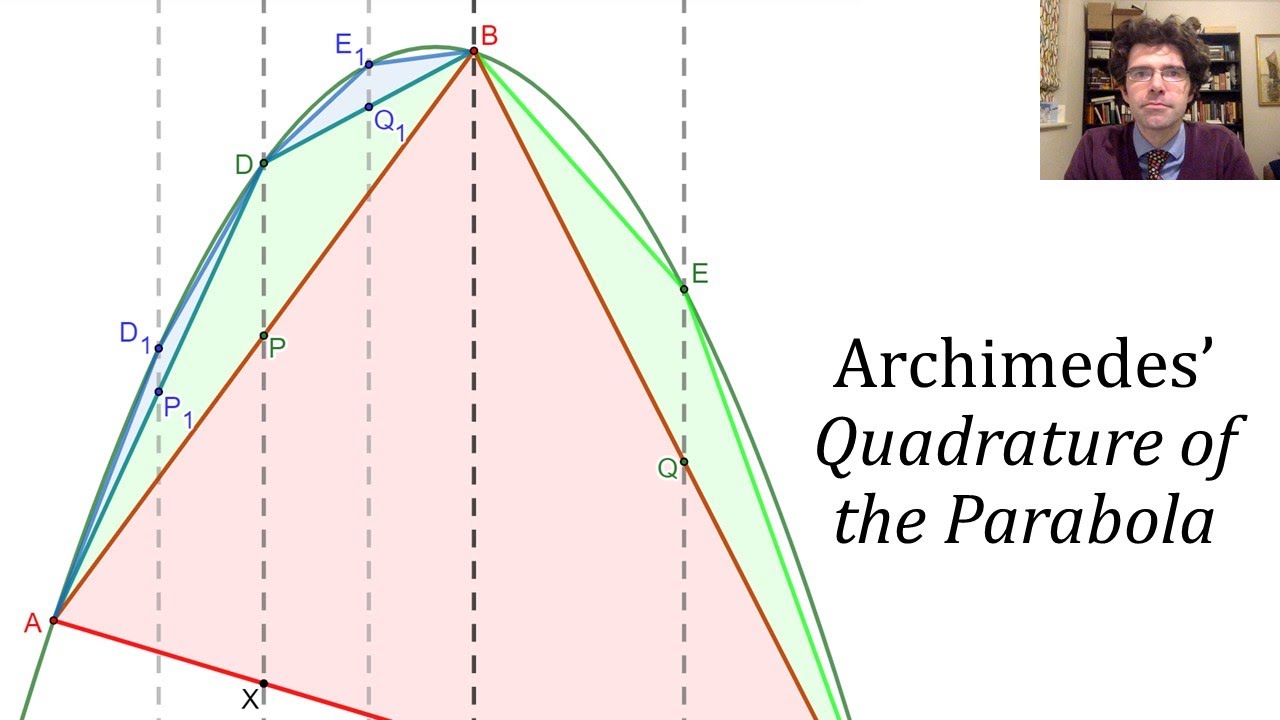
This video introduces Archimedes' Quadrature of the Parabola, which discusses the area between a parabola and a straight line without using integration. I take you through the simpler (second) proof that Archimedes gave of his result, including some important features of conic sections.
silent oasis
willow bear
can you share some
ok

Archimedes had a good understanding of the way calculus works, almost 2000 years before Newton and Leibniz.
 silent oasis
No idea what neet is
viscid thistle
Its an entrance exam for medical uni
viscid thistle
viscid thistle
calculus is math
Its used in physics bud
silent oasis
ohh i see
viscid thistle
Yeag
viscid thistle
silent oasis
https://youtu.be/odBiKFAdEXc?si=N25L4HGIrs-q5s93
This is hard
 willow bear
it has x intercepts at x=0 and at x=k
silent oasis
willow bear
it has x intercepts at x=0 and at x=k
so?
willow bear
since you are allowing yourself to use coordinates at all, might as well say that the equation of this parabola is quadratic
which you are writing down in factored form based on the known roots
silent oasis
By the way, do I need to know what Archimedes' quadrature is for now? I am just beginning to learn calculus.
willow bear
it has historical value
but not so much for subject matter
i can tell you i learned calculus without focusing at all on archimedes' quadrature and turned out fine
silent oasis
willow bear
i can tell you i learned calculus without focusing *at all* on archimedes' quadr...
How do I begin?
I see some 12 hours long lectures on youtube. Is that what I need to watch?
willow bear
dunno
i'd probably go to khanacademy and do the problems that they offer
and watch their videos according to need
silent oasis
willow bear
i'd probably go to khanacademy and do the problems that *they* offer
alright. I'll do that only.
 mortal vine
how to determine if smt is a function or not?
 hushed sphinx
That depends on which information about "smt" you already have.
mortal vine
 willow bear
,rcw
obsidian monolithBOT
 willow bear
1 or 2? if both, which first?
mortal vine
1 first
willow bear
for the purpose of functions, all these pairs in the relations should be thought of as (input, output)
and the one thing you CAN'T have in a function is
two pairs with the same input but different outputs
for example the relation {(1, 6), (4, 11), (4, -5)} is NOT a function bc we have two pairs with the input 4 but with different outputs 11 and -5
do you understand this? Y/N
mortal vine
ohh yes
willow bear
are you able to analyse your X, Y and Z now?
mortal vine
wdym
willow bear
are you able to look at your relations X, Y and Z, and tell which of them are functions (if any)
mortal vine
kinda, i still need help with q2
willow bear
in these, it is implied x is the input and y is the output
your goal is to say which formulas can have y isolated in them so that there's never two different values of y for the same x
mortal vine
how do i tell
willow bear
isolate y in each one
to give you a non-example: y^2 = x would become y = **±**sqrt(x), which is two values for any x greater than zero
viscid thistle
how do you find the number of digits in an exponent ?
willow bear
do you mean in a power?
viscid thistle
yes
willow bear
like the digit count of a^b for known a and b?
viscid thistle
yes
willow bear
the digit count of $x$ is $\floor{\log_{10}(x)} + 1$
obsidian monolithBOT
|Ann⟩
 willow bear
thats the most you can say generally
if you show us what your a and b are then we can tell you what can be done in your case
viscid thistle
5^100
willow bear
i presume you need to do this calculatorless?
willow bear
i mean calculating 100 * log_10(5) is very possible on a calculatorr
viscid thistle
yes
oh
69.89
i used a calculator
+1
so that would be 70.89
now is it just 70 or 71 ?
willow bear
i thought i was clear when i used the floor function
or if you didnt know what i meant you had like 100 opportunities to ask me
willow bear
yes
willow bear
i do not use [] for it because (a) LaTeX has special brackets specifically reserved for it and (b) that way i don't have to type "oh by the way [x] means the greatest integer ≤x just so you know" 10000 times
viscid thistle
okay
 tranquil inlet
$r^{2}=3\sin2\theta$
obsidian monolithBOT
Cyberr
 obsidian monolithBOT
mrRandomPerson_II

 elfin patrol
I would like to thank everyone here who helped me with my test review, I got an 86% which is way better than I thought I would've got
Anyways
I have another question I need help with

I need to simplify this and identify the non-permissibles
I got it to the point where the denominators have been factored
elfin patrol
Like x ≠ 5 for example
 solar olive
yeah.
thats what isaid
u just have to combine the fraction, not really hard , but tedious
elfin patrol
That's the problem
I'm stuck at the common denominator
One sec lemme type it out what I got
solar olive
$\frac{(x - 1)(x^2 + 4x + 3) - (x - 2)(x^2 + x - 6)}{(x^2 + x - 6)(x^2 + 4x + 3)}$
obsidian monolithBOT
impract1cal
 solar olive
eitherway it doesnt really matter, u just have to only look at the denominator
elfin patrol
Thats not the way my teacher wants us to do it
solar olive
what do they want
solar olive
then whats the problem?
do ur teacher wants u to factor the denominator and combine?
because if thats so, u arrive at $\frac{4x-5}{(x + 1)(x + 3)(x - 2)}$
elfin patrol
 obsidian monolithBOT
impract1cal
 elfin patrol
She wants the denominators of both fractions to be the same
solar olive
wtf
elfin patrol
Because when you add or subtract a fraction, the denominators have to be the same
Common denominator basically
And then you would combine to one fraction
solar olive
a/b - c/d = (ad - bc)/(bd) ???
if they want the denominator to be same, then '
a/b - c/d = ad/(bd) - bc/(bd)
elfin patrol
Aside from multiply by each other which seems way more complicated
solar olive
a = x - 1
b = x^2 + x - 6
c = x - 2
d = x^2 + 4x + 3
elfin patrol
Basically I would have to multiply (x+1)(x+4) • (x+3)(x-2)?
And then vice versa on the other side
solar olive
huh? show ur work
elfin patrol
K one sec

Idk why it's sideways
That's what I would have to do to get common denominators
But it's confusing me because it just doesn't seem right to me
I swear I'm actually stupid
This shouldn't be difficult
Omg wait
I see where I went wrong
I wrote a 4 instead of a 3 for the numerator
I'm actually dumb
Sometimes I wonder how I have a 90% in math
 silver kraken
when yall got a test tmrw do yall study/review all day even if you understand pretty much everything and did all the reivew
winter comet
silver kraken
when yall got a test tmrw do yall study/review all day even if you understand pr...
Not all day, but still practice quite a bit anyway
silver kraken
winter comet
Not all day, but still practice quite a bit anyway
do you just redo the same problems?
winter comet
Even if I understand it's still possible to make mistakes yk
silver kraken
my main issue is the applications of it so like word problems but i only got like 4 examples
so just been doing through em but not rly helpin
winter comet
silver kraken
do you just redo the same problems?
Oh usually I look in the book or online, r u out of practice problems tho?
silver kraken
winter comet
Oh usually I look in the book or online, r u out of practice problems tho?
yeah
silver kraken
winter comet
do you have any way of looking for more of that type of problem ?
i was thinking about using chat gpt
putting my used examples and asking for similar new ones
silver kraken
stuff on inequalities
winter comet
U might be able to like look it up online or smthn if u don't have any book
silver kraken
il try that
winter comet
Hmm ok
 torn atlas
Would this be considered the proper way of solving for sinø over the domain 0<=Ø<2pi

If I’m missing any small step or the tiniest detail please let me know, cause my teacher won’t let it slide
elfin patrol
silver kraken
when yall got a test tmrw do yall study/review all day even if you understand pr...
Yes. I find that doing the same questions over and over again helps it imprint in your memory
 echo cove
Sorry if this is the wrong channel but can anyone help me with the answers for these questions i have my own but trying to see if they are right or wrong
 willow bear
,rccw
obsidian monolithBOT

 echo cove
 echo cove
Sorry I wasn’t able to see the channel before now
echo cove
?
willow bear
 whole oyster
I am sorry but that is political incorrect.
whole oyster
I am sorry but that is political incorrect.
troll?
oh, looks like they left
 midnight pawn
Just wondering what are the main mathematicians that created precalculus as it is today?
 summer ruin
archimedes, pythagoras, euclid and descartes

 fallow quiver
 marble rose
Why do you no longer have x in the denominator for the second term?
marble rose
ive solved it already but yeah that was one of the issues
fallow quiver
The other is 1/9 thingy
fallow quiver
But you solved it already so whatever.
marble rose
dw ty either way
 summer ruin
factoring 5^n out
proven void
how?
summer ruin
a+b = a(1+b/a)
proven void
I know but I meant how do I take the 5^n out of the radical
summer ruin
summer ruin
a+b = a(1+b/a)
do this
then use the fact that root(xy) = root(x) * root(y)


 lone maple
u okay for the right part?
lone maple
👍
 plucky totem
I had a question about some math terms not necessarily about calculations per se. When talking about Der Moirve's therom. What is a modulus and argument? Specifically my notes say r is the modulus of Z and theta is the argument of Z. I understand the mechanics of the algebra and arithmetic. I'm just curious what the verbiage actually means.
I.e what is a modulus and argument.
hushed sphinx
The modulus of a complex number z is the same as "absolute value", i.e. the straight-line distance between 0 and z.
Argument is the direction from 0 towards z, measured counterclockwise from the positive real axis.
plucky totem
hushed sphinx
The modulus of a complex number z is the same as "absolute value", i.e. the stra...
THANK YOU. I was just mindlessly doing calculations but had no idea what these two words meant. Makes tons of sense.
winter comet
hushed sphinx
The modulus of a complex number z is the same as "absolute value", i.e. the stra...
is this kinda like if you were to graph it on a polar plane, the modulus would be r and the argument would be theta? and the point Z would be (r,theta)?
hushed sphinx
Yes.
midnight pawn
summer ruin
archimedes, pythagoras, euclid and descartes
Just wondering is there any other important mathematicians that contributed to precal?

 river drift
power series, if you know that (although i suppose that's really just advanced differentiation)
proven void
thats differentiation though 
also i’m bad at taylor expansions
is there any other way ? 
 arctic sundial
Can someone pls help me
willow bear
proven void
is there any other way ? <:holoapple:587464687105343518>
no not really
youd have to have an a-priori definition either for ln(x) or for e^x
proven void
,, \lim_{x \to \infty} \frac{1}{x} ln(1+x) = ln\left(\lim_{x \to \infty} (1+x)^{\frac{1}{x}}\right)
obsidian monolithBOT
milanesa de pollo
 proven void
mmm
,, ln\left(\lim_{x \to \infty} (1+x)^{\frac{1}{x}}\right) = ln\left(\lim_{x \to \infty} (x(1 + \frac{1}{x}))^{\frac{1}{x}}\right)
obsidian monolithBOT
milanesa de pollo
 proven void
,, ln\left(\lim_{x \to \infty} (x(1 + \frac{1}{x}))^{\frac{1}{x}}\right) = ln\left(\lim_{x \to \infty} (x)^{1/x} (1 + \frac{1}{x}))^{\frac{1}{x}}\right)
obsidian monolithBOT
milanesa de pollo
 willow bear
obsidian monolith
**milanesa de pollo**
willow bear
obsidian monolith
**milanesa de pollo**
this step is sus
river drift
tbh the question seems like it's set up for using series expansions, since ln(1+x) has a well-known maclaurin series
proven void
is this true?¡
 proven void
obsidian monolith
**milanesa de pollo**
proven void
obsidian monolith
**milanesa de pollo**
if so, this step is fixable
1/inf is similar to 1 + x when x approaching 0
1/0 == ^infty
Idk if I am making myself clear
whatever
this exercise is fucked
winter comet
obsidian monolith
**milanesa de pollo**
where did the extra x come from?
oh i see u factored out nvm
winter comet
proven void
is this true?¡
yea thats true
viscid thistle
proven void
is this true?¡
you can realize this by taylor expansion of (1+x)^1/x
which is just e-ex/2 + 11e/24x^3 +......
and so on
you can use this for any limit of form (1)^infinity
viscid thistle
proven void
is there any other way ? <:holoapple:587464687105343518>
L'hospital's rule
lol
how do i solve
for
f(x) = sgn(sin^x - sinx - 1)
where i want the minimum value of n for x belongs to (0,npi)
for which function has exactly 4 points of discontinuity
<@&286206848099549185>
sgn is sign function
1 for positive -1 for negative and 0 for 0
silent oasis
How do I find limit of composite function?
willow bear
question too general to give a conclusive and useful answer
however, if f and g are the two functions you are composing (as f(g(x)) specifically), and by a miracle of fate the following are satisfied:
- lim[x -> a] g(x) = b, which may be a finite number or +∞ or -∞ (but it must exist)
- lim[t -> b] f(t) exists
then lim[x -> a] g(f(x)) = lim[t -> b] f(t)
passing from lim[x -> a] g(f(x)) to lim[t -> b] f(t) is often called substitution
it would be better if you posted the limit you're looking at
@silent oasis
silent oasis
 silent oasis
lim of g(h(x) as x approaches 1
obsidian monolithBOT
|Ann⟩
 silent oasis
it's equal to 2
obsidian monolithBOT
|Ann⟩
 willow bear
silent oasis
does it mean limit of g(h(x)) doesn't exist?
willow bear
silent oasis
does it mean limit of g(h(x)) doesn't exist?
yes, also your second closing parenthesis is missing
g(h(x)) not g(h(x)
silent oasis
willow bear
yes, also your second closing parenthesis is missing
but
willow bear
but what
if you have something to say, then say it in full. don't cut yourself short after one word.
 willow bear
ah
oh my bad
yeah ok i overlooked it
there's a caveat here in that h(x) approaches 2 from below
so in fact we only need to look at the left-hand limit of g at 2
which exists, even though the two-sided one does not
silent oasis
is there any definite rule for this?
silent oasis
willow bear
however, if f and g are the two functions you are composing (as `f(g(x))` specif...
like you mentioned here.
willow bear
i mean hopefully you should be developing some graphical intuition for limits instead of memorizing 100 different rules and 35000 different exceptions and caveats
silent oasis
is limit all about intuition?
willow bear
no
 drowsy loom
How do i solve the one i circled in white
 willow bear
do you know the range of the raw absolute value function, ie y=|x|?
drowsy loom
No
willow bear
do you know what its graph looks like?
drowsy loom
No it doesnt give an example question
willow bear
do you know what the absolute value function is?
drowsy loom
No idea
willow bear
bruh ok well we found the problem
you don't know what |these things| mean
one moment...
drowsy loom
|this| is modulus right?
willow bear
modulus yes
drowsy loom
I underatand how to sketch a graph but i dont know how to
willow bear
it's what i have been asking you about all along
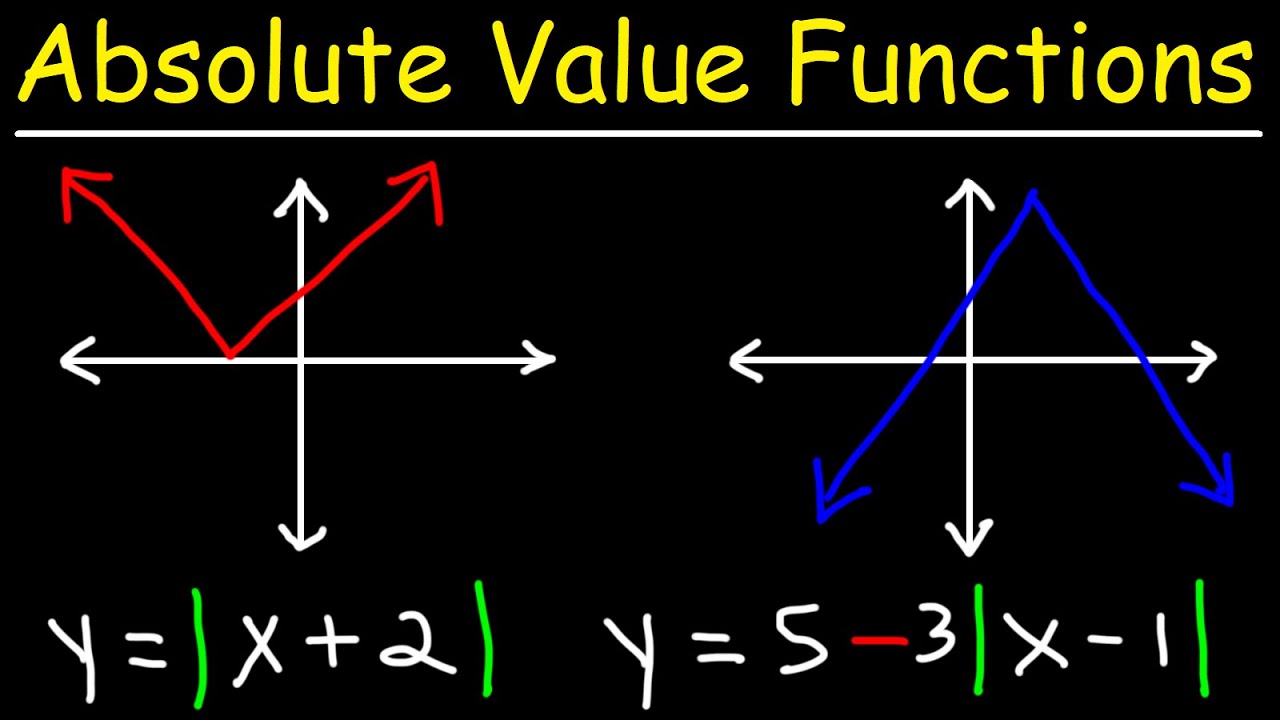
This Algebra video provides a basic introduction into graphing absolute value functions using transformations and data tables. It explains how to find the domain and range of absolute value functions.
Functions and Graphs Practice Test: https://www.youtube.com/watch?v=kvU9sOzT2mk
Transformations of Functions: ...
watch this ig
 narrow briar
Hi! Does someone know how to solve this limit? I would appreciate it a lot, thanks.

When I try to solve it i get into an indetermination, but when i evaluate the function on large numbers it approximates to pi!
summer ruin
the limit doesn't exist
hushed sphinx
I think a limit of pi sounds reasonable, assuming the cosine works in degrees.
narrow briar
hushed sphinx
I think a limit of pi sounds reasonable, assuming the cosine works in degrees.
yes, i have worked on degrees
narrow briar
summer ruin
the limit doesn't exist
so, why when i evaluate the function with larger and larger numbers, its still equal to 3,14159265...
hushed sphinx
Note that "indeterminate" just means "the approach you're trying right now is not strong enough to find the answer" -- it doesn't mean there is no answer.
narrow briar
hushed sphinx
Note that "indeterminate" just means "the approach you're trying _right now_ is ...
so, when working on limits, an indetermination just says that you are not trying it on the right way, but there is a way with which you can solve it?
every function has a determinate limit on infinite?
winter comet
narrow briar
so, when working on limits, an indetermination just says that you are not trying...
no, indeterminate means that you can just get a more conclusive answer. either it doesn't exist or it does.
but indeterminate doesn't tell u if it exists or not
narrow briar
winter comet
but indeterminate doesn't tell u if it exists or not
interesting, thank you
hushed sphinx
There are functions that don't have limits. "Indeterminate" tells you something about the method you're trying, not anything about the function.
narrow briar
so when i get into an indetermination, the limit may exist or not, i dont know
winter comet
narrow briar
so when i get into an indetermination, the limit may exist or not, i dont know
yeh
hushed sphinx
Right.
winter comet
but when you get indeterminate don't go like ok this is the answer xD
winter comet
narrow briar
trying ona different way?
yeh
narrow briar
is there a limited amount of different ways to solve a limit?
hushed sphinx
In this case, good first steps would be to note that $$\cos\bigl( \frac{90x-180}x \bigr) = \cos(90-\tfrac{180}x) = \sin(\tfrac{180}x)$$
obsidian monolithBOT
Troposphere
 hushed sphinx
But to get onwards from there, I think you need to switch to radians.
narrow briar
hushed sphinx
But to get onwards from there, I think you need to switch to radians.
i can try it although im not very used to radians
summer ruin
narrow briar
so, why when i evaluate the function with larger and larger numbers, its still e...
probably because you assumed writing 90 inside a cosine would mean 90 degrees, but it actually means 90 radians, it doesn't even make sense to divide degrees by real numbers
narrow briar
summer ruin
probably because you assumed writing 90 inside a cosine would mean 90 degrees, b...
ok ok, im trying to pass it to radians
hushed sphinx
summer ruin
probably because you assumed writing 90 inside a cosine would mean 90 degrees, b...
They specified that they're working in degrees, in which case pi is a correct limit.
proven void
he never said he is working in degrees
hushed sphinx
(Why wouldn't it make sense do divide a number of degrees by a real number?)
hushed sphinx
narrow briar
yes, i have worked on degrees
Here.
proven void
mb
winter comet
hushed sphinx
(Why wouldn't it make sense do divide a number of degrees by a real number?)
technically wouldn't he be dividing by infinity which technically wouldnt be a real number XD
its irrelevant tho 💀
narrow briar
 hushed sphinx
winter comet
technically wouldn't he be dividing by infinity which technically wouldnt be a r...
hushed sphinx
winter comet
technically wouldn't he be dividing by infinity which technically wouldnt be a r...
No, he wouldn't. The limit is about what happens when you insert ever larger, but always finite numbers in place of x.
narrow briar
narrow briar
thats the limit on radians
winter comet
hushed sphinx
No, he wouldn't. The limit is about what happens when you insert _ever larger, b...
oh ig
hushed sphinx
Do you know that $\lim_{t\to 0} \sin(t)/t = 1$ when the sine works in radians? (Otherwise I'm not sure how you would get through).
obsidian monolithBOT
Troposphere
 winter comet
obsidian monolith
**Troposphere**
winter comet
obsidian monolith
**Troposphere**
you may also wanna use this identity if u havent to do yeh
narrow briar
narrow briar
how would you solve this limit?
winter comet
narrow briar
how would you solve this limit?
using the trig identity
winter comet
obsidian monolith
**Troposphere**
and then using this
proven void
obsidian monolith
**Troposphere**
you were asked a question, do you know this special limit?
winter comet
basically everything troposphere said XD
narrow briar
sorry for asking too much, but i dont know how to continue without the infinite*0 indetemination...
 hushed sphinx
Do you know that $\lim_{t\to 0} \sin(t)/t = 1$ when the sine works in radians? (...
hushed sphinx
hushed sphinx
Do you know that $\lim_{t\to 0} \sin(t)/t = 1$ when the sine works in radians? (...
You haven't answered this question yet.
narrow briar
obsidian monolith
**Troposphere**
i dont understand it
limit to cero of sin(x) isnt 0?
sin(0) = 0, so if x=0, it makes sense that the limit is = 0, where am i wrong?
hushed sphinx
I said $\lim_{t\to 0} \frac{\sin(t)}{t}$, not $\lim_{t\to 0}\sin(t)$.
obsidian monolithBOT
Troposphere
 narrow briar
ohh sorry
i understood wrong
well, now i know it xd
but my limit is tending to infinite, not 0, how im supposed to use that indentity on my limit?
hushed sphinx
Note that the argument to the sine actually goes to 0, so if you switch variables to t=pi/x, you get a limit for t->0 instead of x->infty.
 hushed sphinx
Looks right (except x->0 should be t->0, of course)
narrow briar
oh yes yes
but i havent understood something of before
limit to infinite of sin(pi/x) isnt 0?
hushed sphinx
obsidian monolith
**Troposphere**
☝️
narrow briar
lim to infinite of sin(pi/x) = lim to 0 of sin(t)
hushed sphinx
obsidian monolith
**Troposphere**
☝️
narrow briar
thats the reason because i can do the varible change
lim to 0 of sin(t) / t = 1
but lim to infinite of sin(pi/x) = 0
so these limits arent equal
hushed sphinx
Why would they be?
narrow briar
im so sorry if the answer is very easy, im not seeing it
narrow briar
hushed sphinx
Why would they be?
if they arent equal, why would the variable change be right?
hushed sphinx
narrow briar
so, the next step would be this?
You've got the division by t right here.
narrow briar
hushed sphinx
You've got the division by t right here.
:0
wait im trying to understand it 😆
hushed sphinx
$$\frac{\pi}{t}\sin(t) = \pi \frac{\sin(t)}{t}$$
obsidian monolithBOT
Troposphere
 narrow briar
the thing i dont understand is why the variable change from pi/x to t that changes the limit from infinite to 0, is right
sorry, maybe its too easy
i dont want to annoy with silly questions
hushed sphinx
When x is very large, pi/x is very small, and vice versa.
To be completely pedantic we should perhaps have said t -> 0+ instead of just t -> 0.
narrow briar
hushed sphinx
When x is very large, pi/x is very small, and vice versa.
To be completely pedan...
i think i get it
yes, i get it
thank you
so much
hushed sphinx
You're welcome.
narrow briar
😄
proven void
how do I find all $x \in \mathbb{R}$ such that this sequence $\frac{x^{2n +1}}{n^3 4^{n+1}}$ converges
obsidian monolithBOT
milanesa de pollo
 willow bear
do you actually want something with that sequence, or are you actually looking at a series (infinite summation)?
("yes" isn't a valid answer, we need to know which)
proven void
I need to find all x in R for which this sequence converges. then for those x values I should calculate the limit of the sequence
sorry, my english is dogshit
obsidian monolithBOT
|Ann⟩
 willow bear
augh
proven void
no sigma no sum
willow bear
well ok whatever
proven void
😁
willow bear
you can write this as the product of a constant, a geometric sequence, and 1/n^3
proven void
constant is $x^{2n + 1}$ probably
obsidian monolithBOT
milanesa de pollo
 obsidian monolithBOT
milanesa de pollo
 hushed sphinx
Yes, except you forgot the last remaining factor of 2 in the denominator (not that it actually matters in the end).
proven void
I dont get it
what did I missed in the denominator?
on a side note, how can I write this as the product of a constant, a geometric sequence, and 1/n^3
hushed sphinx
Do you know what those terms mean? Above you have a product of 1/n^3 and a geometric sequence, and I just told you you've misplaced the constant.
proven void
$\frac{x^{2n +1}}{n^3 4^{n+1}} = \frac{1}{n^3} \cdot \frac{1}{2} \cdot \left(\frac{x}{2 }\right)^{2n+1}$ mayhaps
like this?
😭
4^(n+1) = 2·2^(2n+1)
obsidian monolithBOT
milanesa de pollo
 hushed sphinx
Yes.
proven void
what do I do now?
hushed sphinx
You need to know, hand-wavingly speaking, that a geometric sequence always wins over a polynomial unless it is constant.

 thin thorn
I'm sorry man I just know the name
This uses some permutations and all as far as I've seen it, vaguely
compact spade
Nah you're good dw
 pine geyser
compact spade
pine geyser
compact spade
 proven void
how to find the limit of this sequence? $\2 - \frac{3}{2^n} < 5 - 2a_n < 1 + (n)^{\frac{1}{n}}$
obsidian monolithBOT
milanesa de pollo
 proven void
this is my progress so far: $\\frac{2 - \frac{3}{2^n} -5}{-2} < a_n < \frac{1 + (n)^{\frac{1}{n}} - 5}{-2}$
obsidian monolithBOT
milanesa de pollo
 proven void
oh, 3/2 due to squeeze theorem
I wanted to ask, to calculate the limit of the $a_n$ in this case $\\frac{1}{a_n} > \left(1 + \frac{1}{n}\right)^{n^2}\\$ would be something like: $\\frac{1}{a_n} > e \implies 1 > e \cdot a_n \implies ln(1) > ln(e \cdot a_n) \implies 0 > ln(e \cdot a_n)\\$ which is only true when $\lim_{n \to \infty} a_n = 0$?
obsidian monolithBOT
milanesa de pollo
 summer ruin
limit of (1+1/n)^(n^2) is not equal to e
moreover you have to justify why that inequality for some n implies 1/a_n > e (if it were equal to e in the first place)
summer ruin
notice that a_n > 0
transform the inequality and compute the limit of a_n instead of 1/a_n
 summer ruin
the inequality sign flips
and you have to write limit on both sides
and make inequality not strict
proven void
summer ruin
the inequality sign flips
why?
summer ruin
because a > b <-> 1/a < 1/b
proven void
ok
makes sense
1/4 vs 1/2 is 0.25 vs 0.5

so?
also how am I going to apply squeeze theorem here if I only have RHS
summer ruin
summer ruin
notice that a_n > 0
.
summer ruin
summer ruin
and make inequality not strict
.
proven void
summer ruin
notice that a_n > 0
I see
but why inequality not strict
because its equal to zero
summer ruin
because limits don't preserve strict inequalities
1/n > 0, the limit of 1/n as n->infinity is not > 0
proven void

how do I clauclate this limit?
,, \lim_{n \to \infty} (3^n \cdot n^2 + n)^{\frac{1}{n}}
obsidian monolithBOT
milanesa de pollo
 proven void

now what do i do?
,, \lim_{n \to \infty} \left(3^n + \frac{1}{n} \right)^{\frac{1}{n}}
obsidian monolithBOT
milanesa de pollo
 proven void
i can factor again my 3^n and apply multiplication of roots to get the 3 out and make it a 1
maybe
summer ruin
factor out 3^n
proven void
limit is equal to 3
summer ruin
except I don't think you factored out n correctly
proven void
summer ruin
except I don't think you factored out n correctly
where?
summer ruin
$3^n n^2 + n = 3^n n\left( n + \frac{1}{3^n}\right)$
obsidian monolithBOT
Transparent Elemental
 proven void
then?
summer ruin
n + 1/3^n isn't the same as 3^n + 1/n
summer ruin
it is 1 in the limit
proven void
?
summer ruin
do you think indeterminate form implies we can't ever find out the limit?
summer ruin
I said the limit is equal to 1
you can consider it an exercise if you want to prove that
you're calculating limits far more involved that n^(1/n) anyway
proven void
,w lim n to infinity n^(1/n)
obsidian monolithBOT
 summer ruin
proven void
so its 3?
summer ruin
proven void
so its 3?
why did you assume that
proven void
,w lim n to infinity (n^2)^(1/n)
obsidian monolithBOT
 proven void
,w lim n to infinity (3^n)^(1/n)
obsidian monolithBOT
 proven void
summer ruin
why did you assume that
proven void
summer ruin
why did you assume that

im not sure about the last one tbh

is that 1 aswell?
,w lim n to infinity (1 + 1/(3^n * n))^(1/n)
obsidian monolithBOT
 river drift
it's in the form (1 + 0)^0, so i'd say that's expected
plucky totem
hushed sphinx
The modulus of a complex number z is the same as "absolute value", i.e. the stra...
One nit pick. My professor today said that it's measured counter clockwise not clock wise. Which makes sense to me. We read the unit circle counter clockwise from 0,90,180,270,360. Unless you were eluding to something else I just wanted to make sure this is correct.
hushed sphinx
plucky totem
One nit pick. My professor today said that it's measured counter clockwise not c...
Whoops, horrible typo on my part, fixed now.
plucky totem
hushed sphinx
Whoops, horrible typo on my part, fixed now.
No worries. I was just comparing my notes and noticed it. Then asked my prof and was like. So which one is it?
river drift
just kind of unfortunate that "counterclockwise" is the default direction chosen by mathematics whereas "clockwise" is the default direction picked by the english language
 solemn parcel
I'm assuming you have graphs that give possible answers?
you probably need to decide what form this equation would take depending on unknowns
try graphing it out with constants and you might see some similarities
plucky totem
Just like cartesian coordinates lol. Who ever made the compass system wasn't in touch or just wanted to be a jerk. Ya lets tilt this 90 degrees lol. Like WHY. just make them the same. So annoying @river drift
Like why did we have to do this lol.
 winter comet
plucky totem
Just like cartesian coordinates lol. Who ever made the compass system wasn't in ...
winter comet
plucky totem
Just like cartesian coordinates lol. Who ever made the compass system wasn't in ...
i mean they were probably made completely seperate from one another
its like why do ppl speak different languages, why doesnt everyone just speak 1 language lol
river drift
it makes sense for north (or south) to be the reference point based on the way a compass works
plucky totem
winter comet
i mean they were probably made completely seperate from one another
I get you but I think you missed my point slightly. I'm not saying everyone should. More along the lines of it would have been nice if. Hell the Greeks were so close to figuring out basic calculus they just didn't have the Arabic numbers and letters systems we use today. If only they had a faster way to communicate.
winter comet
plucky totem
I get you but I think you missed my point slightly. I'm not saying everyone *sho...
yea
world issues
lol
plucky totem
river drift
it makes sense for north (or south) to be the reference point based on the way a...
Oh I totally agree. If they were made at the same time with people who were in touch maybe they'd be the same. But like Vicious viper said. World issues
white rapids
Can someone tell me how I can get this f(x) to f(-x)?
f(x) = x * ^3√x-1
f(-x) = -x * ^3√-x-1
Do I just leave it like that or is there anything i have to do
winter comet
is that cubed root?
if so, you can factor a negative out of the cube root to cancel with the one outside
if not, i have no idea what that says 💀
chrome ether
white rapids
Can someone tell me how I can get this f(x) to f(-x)?
f(x) = x * ^3√x-1
f(-x) =...
that looks fine
 remote ivy
why is this statement incorrect?
 summer ruin
because the left hand side doesn't depend on x
proven void

help
can i use ratio test here?
first off
how do I show that (n^2)^(1/n) is 1?
if possible without proofs
just algebra
hushed sphinx
(n^2)^(1/n) is not 1.
proven void
i mean
the limit of that
sorry for not being precise with my wording
,w lim n to infinity n^(2/n)
obsidian monolithBOT

 junior willow
remote ivy
why is this statement incorrect?
junior willow
remote ivy
why is this statement incorrect?
When x approaches infinity we have 1/ very large number so the limit is 0
remote ivy
junior willow
When x approaches infinity we have 1/ very large number so the limit is 0
so does that mean they are equal?
since the are nothing in-between 1/x and 0
summer ruin
1/x is not equal to 0 for any x
summer ruin
no
remote ivy
why not?
summer ruin
then one should write the limit of 1/x as x->infinity equals to the limit of -1/x as x->infinity, this is not what was written however
summer ruin
remote ivy
why not?
tbh I don't even see where you're getting this from
junior willow
remote ivy
that must mean it equlas zero
The limit is zero
If u mean
Nvm can't display latex
Oops
summer ruin
it's \lim
obsidian monolithBOT
w
 junior willow
It only took 3 tries
summer ruin
you can edit the message to recompile
junior willow
Oh
junior willow
obsidian monolith
**w**
@remote ivy if that's what you meant, it's correct, both limits approach 0
willow bear
both limits are 0
 willow bear
 agile sparrow
+0 and -0
agile sparrow
+0 and -0
and the point of this correction is?
willow bear
??
junior willow

remote ivy
junior willow
<@774627299101507605> if that's what you meant, it's correct, both limits appro...
yeah thanks, i did write it incorrectly
 clear scarab
How to integrate the sin t part
 viscid thistle
Let f and g be such that g(x) = 3x − 2 and f(g(x)) = 9x^2 − 3x + 1
Calculate f(4)
willow bear
!status @viscid thistle
 tender questBOT
What step are you on?
1. I don't know where to begin.
2. I have begun but got stuck midway.
3. I got an answer but I was told that it's wrong.
4. I got an answer and would like my work checked.
5. I have a question about someone else's work/solution.
6. I have completed the problem and don't need help anymore. Thank you.
7. None of the above
4
willow bear
show what you've got then
viscid thistle
a) g(4)=3.4-2=12-2=10
f(10)=9.10^2-3.10+1=9.100-30+1=871
f(4)=81.4^2-117.4+43=f(4)=871
f(x)=9(3x−2)^2−3(3x−2)+1
=9(9x^2-12x+4)-(9x-6)+1
=81x^2-108x+36-9x+6+1
=81x^2-117x+43
f:R -> R is f(x)=81x^2-117𝑥+43
willow bear
are you using . for multiplication?
viscid thistle
yes
willow bear
how did you get that formula for f(x)...?
that sounds like you calculated f(g(g(x)))...
viscid thistle
viscid thistle
Let f and g be such that g(x) = 3x − 2 and f(g(x)) = 9x^2 − 3x + 1
Calculate f(...
i exchanged
viscid thistle
how do I do it?
willow bear
find x such that 3x-2, a.k.a. g(x), equals 4.
then evaluate f(g(x)) with that value of x.
viscid thistle
I will try...
willow bear
well it is not like there is a minefield on that route
viscid thistle
willow bear
well it is not like there is a minefield on that route
kind of. I'm still learning
willow bear
what grade are you in?
viscid thistle
finished high school, but didn't have math because of covid and also education problems
didn't learn pre-calculus at school, nor calculus, now I'm learning at my first year of college
I don't have a good background in math so sometimes I also get stuck with the basics
proven void
you got this brother
viscid thistle
proven void
you got this brother
I'm not that confident loll
proven void
solve 3x-2 = 4 then for the x you got plug it in the f(g(x)) to get f(4) I think
willow bear
proven void
solve 3x-2 = 4 then for the x you got plug it in the f(g(x)) to get f(4) I think
congratulations you have successfully repeated my instructions almost to the letter
proven void
sorry
viscid thistle
3x-2=4
3x-2+2=4+2
x=6/3=2
viscid thistle
viscid thistle
3x-2=4
3x-2+2=4+2
x=6/3=2
should I keep going?
proven void
proven void
solve 3x-2 = 4 then for the x you got plug it in the f(g(x)) to get f(4) I think
read
viscid thistle
but is it correct?
proven void
,w solve 3x -2 = 4
obsidian monolithBOT
 viscid thistle
should I keep going?
viscid thistle
viscid thistle
should I keep going?
.
proven void
proven void
solve 3x-2 = 4 then for the x you got plug it in the f(g(x)) to get f(4) I think
read
willow bear
then evaluate f(g(x)) with that value of x.
the formula for f(g(x)) is given directly in the problem, and no work needs to be done to find it.
viscid thistle
I'm brazilian, I'm having trouble trying to comprehend you guys
willow bear
f(g(x)) = 9x^2 - 3x + 1
and x=2
proven void
you got this


 indigo dew

 supple sky
Does anyone know the best online website to teach myself Pre calc for free?
 uncut mulch
khan
supple sky
Does it give you like the full course
Because like the videos are only like 5 minutes long
proven void
there is prolly not best website, khan academy is good, openstax is good, pauls online notes is good, why not take a little of everything?
supple sky
Just picked this up at the library is this book good for learning the subject matter?
 river drift
try it out and see if you like it
proven void
best book is the one you stick with, imo
 near sentinel
supple sky
Just picked this up at the library is this book good for learning the subject ma...
near sentinel
supple sky
Just picked this up at the library is this book good for learning the subject ma...
Try Cengage Calculus for JEE Advanced.. It's pretty good
supple sky
Found this YouTube channel I dunno if this guy is legit or not

YouTube
This Channel is dedicated to quality mathematics education. It is absolutely FREE so Enjoy! Videos are organized in playlists and are course specific. If they have helped you, consider Support:
You may find and support me at Patreon.com/Professorleonard
Please consider "Whitelisting" this Channel on your AdBlock if it is enabled.
Your su...
supple sky
Every time I look through Pre calc I’m just getting what seems to be a copy of algebra 2 and trig
Doesn’t seem legit
uncut mulch
precalc isn't clearly defined
summer ruin
supple sky
Every time I look through Pre calc I’m just getting what seems to be a copy of a...
if it walks like a duck and quacks like a duck... 
uncut mulch
it's more or less knowledge required for calculus
which is mostly stuff related to algebra, trig, exponents, logs, functions
supple sky
So yeah I’m looking at the right stuff
I thought I was just looking at stuff that seemed to be a copy of the trig and algebra I was learning in 10th grade
uncut mulch
if you've already learned the stuff, it can serve as a review
supple sky
That’s good then
Because I was going over functions and it seemed a little sus to me
It was like as almost the exact thing I already learned
Just a little bit more complex
But now it makes more sense since it’s just like a class where you put different stuff you learned in the past and just add a tiny bit more
winter comet
supple sky
But now it makes more sense since it’s just like a class where you put different...
yea thats basically all precalc is
supple sky
Right now there’s a chapter on evaluating a function which seems to be Pre calc
supple sky
winter comet
yea thats basically all precalc is
Oh I thought I was just wasting hours finding stuff that seemed to be the same thing
summer ruin
if you feel like you already know this it's better to skip to calculus to not waste time
supple sky
Smart
But I think I might continue to watch this videos made by this person named Professor Leonard he seems pretty legit.
To prepare me for my college pre test
It seemed pretty confusing at first because when I was looking up Pre calc it was a lot different then the other classes
Like with algebra 2 most of them started with factoring and then went into the rest of the stuff
But with pre calc you have some of them starting with functions some starting with slopes and some starting with trig
winter comet
supple sky
It seemed pretty confusing at first because when I was looking up Pre calc it wa...
it goes over a lot of the stuff you see in algebra 1 and 2 and geometry, but then it goes into introductory concepts from calc 1 or calc 2 or linear algebra
ish
supple sky
Which makes it super confusing on where to start