#precalculus
1 messages · Page 33 of 1
 proven void
 queen shoal
is gamma function x! or something i think he told me about it
 willow bear
aint NO FUCKING WAY hes gonna hand you a function whose DEFINITION involves IMPROPER INTEGRALS when you're looking for BASIC DERIVATIVE PRACTICE.
queen shoal
ok
willow bear
queen shoal
is gamma function x! or something i think he told me about it
yes kind of
its derivative is not really easily expressible in terms of anything
 vapid plaza
queen shoal
is gamma function x! or something i think he told me about it
vapid plaza
queen shoal
is gamma function x! or something i think he told me about it
Your friend is trying to give you a hard time from what it looks like
Lol
willow bear
except another moderately nasty integral
queen shoal
ok then
willow bear
vapid plaza
Your friend is trying to give you a hard time from what it looks like
as neurotypicals typically tend to do, stemming from the belief that math is for nerds and torture is funny.
 proven void
neuro-what?

 vapid plaza
I think you’re looking for quotient rule
willow bear
queen shoal
is this easier
this one's doable but very very unpleasant.
because of the x^x
vapid plaza
queen shoal
is this easier
Why don’t you just come up with some random functions yourself and try
 queen shoal
thanks
 thin surge
willow bear
thin surge
willow bear
I know how to do it all except the last one
willow bear
so then you know both the chain rule and the product rule, yes?
thin surge
yes
willow bear
then what is the issue?
thin surge
I never did any math with "ARCTAN"
willow bear
$\tan^{-1}$ ?
 obsidian monolithBOT
|Ann⟩
 proven void
what is the derivative of arctan(sqrt(x))?
I mean prolly the derivative of tan^-1(x)
willow bear
do you know what d/dx arctan(x) is
it might appear on your table
here we go again deleting all your msgs...
proven void
willow bear
do you know what d/dx arctan(x) is
I know derivative of arctan(x) because of cookbook 1/x^2 + 1
but dunno how they got there tho
willow bear
missing parentheses, you meant 1/(x^2 + 1).
anyway you can derive it via the chain rule or implicit differentiation
or you could look up how to differentiate inverse functions generally
 viscid thistle
hi, need help, sorry, and thanks.
in this problem
lim x-> -2
(x+2) (x³ - 10x² + 24x - 50)
x+2
i can cancel the denominator, how about the rest of numerator? should i keep factoring them or i can stop there?
willow bear
viscid thistle
hi, need help, sorry, and thanks.
in this problem
lim x-> -2
(x+2) (x³ - 10x...
why are you apologizing for doing exactly what the server is for?
also, two things
- you should write fractions with a slash -- this will require both the numerator and the denominator to be properly parenthesized: in your case,
(x+2)(x^3 - 10x^2 + 24x - 50)/(x+2). if this is hard to do, it is better to write on paper.
- after your cancellation, what you are left with is:
$\lim_{x \to -2} (x^3 - 10x^2 + 24x - 50)$
obsidian monolithBOT
|Ann⟩
 willow bear
remember that the whole reason you had to do any factoring and cancellation last step was because direct substitution led you to 0/0 (which is a sign you need to do something else)
but here you are left with a polynomial. a continuous function into which you can plug things without worry.
viscid thistle
willow bear
remember that the whole reason you had to do any factoring and cancellation _las...
so since it will not equal to 0/0, i don't need to use the rational zero theorem again even if i can? (in the video i watched, he did it twice so I'm not sure how to proceed)
willow bear
show the video and timestamp
before you do this:
when calculating limits like this, your motivation for doing anything is to make direct substitution possible.
the only thing that was stopping you was the division by zero.
but that isnt a thing now.
direct substitution works, therefore direct substitution is all that's needed -- and so doing anything else is extra work that is not required and not helpful.
viscid thistle
https://youtu.be/yx2RetjV1Bo?si=Z1fCyRKblqEsAlRc
5:43
(this is only for factoring 5 term polynomials, i watched it so i can factor mine)
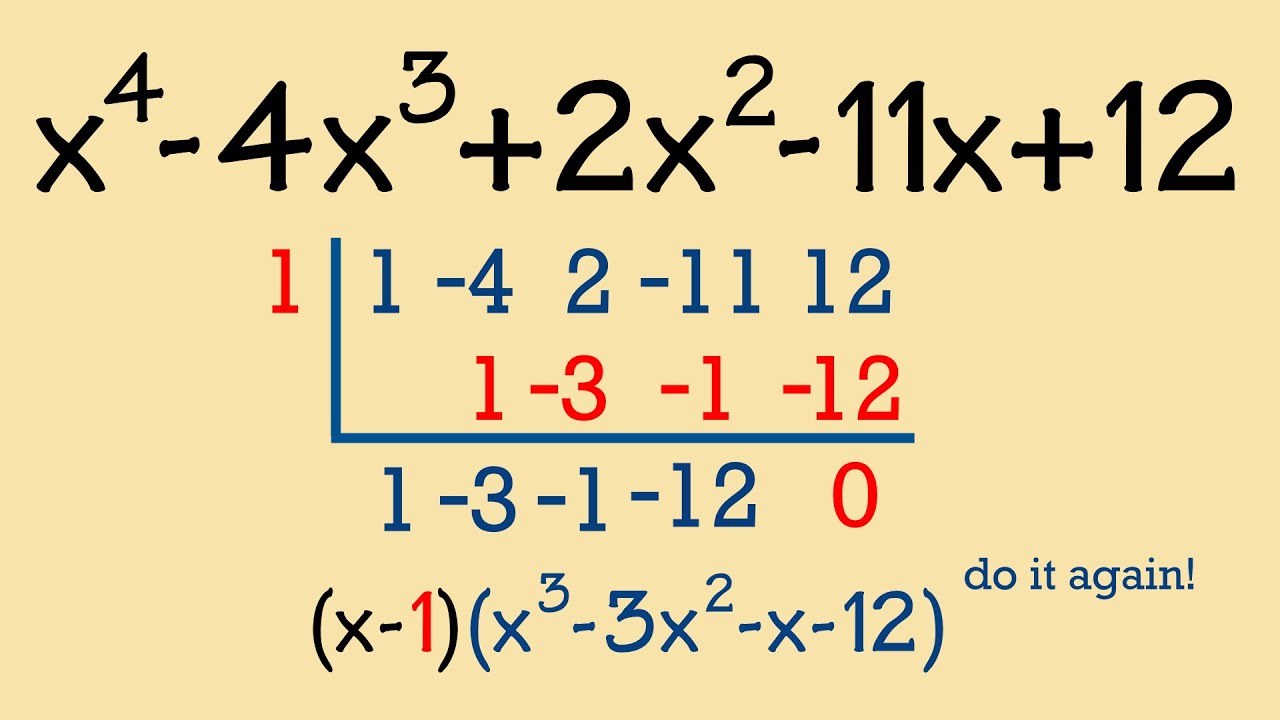
Algebra tutorial on factoring a 5-term polynomial x^4-4x^3+2x-11x+12 using the rational zero theorem (aka the rational root theorem) and the synthetic division. Factoring polynomials is crucial for solving polynomial equations for your algebra and precalculus classes. Check out different methods of factoring this 5-term polynomial below.
By ra...
willow bear
ok so that's about factorization, not about limits.
viscid thistle
willow bear
direct substitution _works_, therefore direct substitution is all that's needed ...
thank you very much!!! thank you really!
willow bear
here it matters that you are calculating a limit.
viscid thistle
okay thank you again, just to confirm so I don't need to ask many times, as long as i managed to make the uh.. expression(?) that will not equal to 0/0, it's good?
willow bear
0/0 and infty/infty are the two most common indeterminate forms
there is also infty - infty sometimes
 potent oxide
Guys give me good book for precalculus
potent oxide
proven void
there is also pre calculus version
Iam very good at pre
Am good at functions and sum
proven void
I only used the calculus one, so I cant really say anything about the pre
potent oxide
Just need good book for it
proven void
maybe #book-recommendations '
potent oxide
I gonna try openstax
 proven void
you are asking if you did the polynomial division correctly
viscid thistle
oh sorry no, the way i write the fraction with variable, not sure if that's where you put the x
like -23/3 x²
i just need to know where the placement of x in the fraction
thank you
proven void
numerator
queen shoal
queen shoal
is this easier
how do i do this
 austere girder
can I get help with a calc one question?
idk if this is the right channel
queen shoal
send it
austere girder
its about the fundamental theory of calculus

i mainly guessed with these questions but i want to understand how you get them
queen shoal
oh idk i only know how to find derivatives of functions
queen shoal
you can go to #❓how-to-get-help or just leave it here
proven void
that you expand and simplify by taking the x^20 out I think
willow bear
expanding (2x - x^4)^14 will give you a bunch of terms which are powers of x
you're asked to find and return the term where the exponent on x is 20
 desert void
austere girder
i mainly guessed with these questions but i want to understand how you get them
desert void
austere girder
i mainly guessed with these questions but i want to understand how you get them
try #calculus
willow bear
@old bane so your problem is to find the range of $f(x) = \frac{|x-4|}{x-4}$, yes?
obsidian monolithBOT
|Ann⟩

 old bane
yes
willow bear
ok, progress so far?
old bane
Im not able to understand this question
willow bear
which part of the question confuses you?
or did you mean that you can't understand my question of "how much progress do you have so far?"
willow bear
ok, so let's start with a more general question
do you know what |these| bars represent?
old bane
mod
willow bear
- do not use the capital letter
Ias a substitute for the vertical bar|. - that's an example and not a proper definition.
old bane
my bad
willow bear
again not a full proper definition.
$|x| = \begin{cases} x & x \geq 0 \ -x & x < 0 \end{cases}$
obsidian monolithBOT
|Ann⟩
 willow bear
does this look familiar to you?
old bane
yes
old bane
1?
willow bear
always?
old bane
uhm ig yes
willow bear
you guess?
old bane
always 1
willow bear
what if x = -10? what will |x|/x be then?
old bane
1 only
willow bear
are you 120% sure
old bane
yes
willow bear
ok what's |-10|?
old bane
|10|
willow bear
|10| is?
old bane
|10| only
willow bear
you claim that it isn't equal to 10 itself?
old bane
it is
willow bear
then why did you just say "|10| is equal to |10| only, and not to anything else ever"
old bane
ok |10|=10
willow bear
so if you refer again to this definition:
$|x| = \begin{cases} x & x \geq 0 \ -x & x < 0 \end{cases}$
obsidian monolithBOT
|Ann⟩
 willow bear
(which you could've looked at the first time around, but for some reason you didn't)
you will notice that |x|/x equals 1 for positive x, and -1 for negative x, and that it never returns any other values.
vapid plaza
What is the range of |x-2|?
old bane
mb bro
vapid plaza
Well actually
The answer is [0, +infinity) (so it can be zero as well as positive)
Because when x+2=0, the absolute value of it is also zero
old bane
can u explain
vapid plaza
When x=-2, we have x+2=0, so |x+2|=0
old bane
ok then
vapid plaza
And actually you can get any nonnegative number c by setting x=-2+c, so that x+2=c and so |x+2|=c too
On the other hand, it is impossible for absolute value to be negative
old bane
c= complex no?
vapid plaza
So the range of |x+2| is [0, +infinity)
what
No
Bro I said c is some nonnegative number
old bane
ok but the ans in my book is (-infinity,0]
vapid plaza
Well we are not done with the problem yet
old bane
ok go ahead
vapid plaza
You want to find the range of 1 - |x+2|
old bane
yes
vapid plaza
so try to think of 1 - something in [0, +infinity)
Then the largest number we can end up with is 1-0=1
and any smaller than that we can get
But larger than 1 we cannot get
vapid plaza
Idk how to explain it simpler
proven void
old bane
ok but the ans in my book is (-infinity,0]
(-infinity, 1]? wdym (-infinity. 0]?
,w range of 1 - |x-2|
obsidian monolithBOT


 proven void
if you check f(2) = 1 so why 0?
the maximum value you can get out of
1 - | x - 2|
is when | x -2 | = 0
which is when x = 2
1 - 0 = 1?
the range is (-infty, 1] clearly
proven void
old bane
ok but the ans in my book is (-infinity,0]
take a screenshot
willow bear
that's not what "take a screenshot" means
proven void
${x \in \mathbb{R} \mid \frac{1}{x} < \frac{4}{x}}$
obsidian monolithBOT
milanesa de pollo
 willow bear
the latex is much better than what's typically seen as "bad" here
but anyway you are asking how to solve the inequality 1/x < 4/x, yes?
proven void
yeah, sorry.
willow bear
do you know how to solve inequalities in general?
willow bear
move [...] to the left side
bad
what exactly are you planning to do?
add something to both sides? multiply by something on both sides? be precise. it matters.
proven void
just substracting both sides
willow bear
"I think its easier to dodge the question instead of answering it directly"
but ok yeah
you get 3/x > 0
so what set does x live in
proven void
reals but not zero
proven void
aaaaaaaaaaaaaaaaaaaaaaaaaaa
no sorry
(0, +infty)
if we plug a negative sign automatically its false
proven void
,, \set{x \in \mathbb{R}}{|x| > 3}
obsidian monolithBOT
milanesa de pollo
 proven void
may I ask about this one
willow bear
what about it
wait
i helped you with THIS EXACT PROBLEM a week ago.
so reread that convo @proven void
willow bear
but i have a feeling that i know where you screwed up.
(still, i'll need to see your work to point it out)
willow bear
well i had in fact premoved ``$e^{\ln(6)\cdot x}$ and chain rule.'' in this convo.
obsidian monolithBOT
|Ann⟩
 willow bear
ok, so what did you do next? do you have your work on paper so you can take a picture?
 winter comet
try showing and then try to explain if need be
willow bear
ok alright
queen shoal
I did it again
 willow bear
the derivative of log(6) is not 1/6.
queen shoal
oh
willow bear
also miswritten product rule.
queen shoal
isnt the derivative of log(x) 1/x
queen shoal
so is it 0?
willow bear
yes it's 0.
also (fg)' is not equal to (f * g') times (f' * g).
review product rule.
queen shoal
is it (f * g') + (f' * g)
winter comet
yes
queen shoal
oh ok
winter comet
btw by log do you mean natural log
queen shoal
yes
winter comet
ok
willow bear
log(6)*x is just a linear function
queen shoal
ok
winter comet
queen shoal
thanks
you COULD also know the rule d/dx(a^x) = a^x * ln(a) where a is a constant
but of course its good to know how they got there, and also you need to know how to do it when it isn't a constant so yeh
queen shoal
ok
i have (6^x)+(x^x)/2^x
i used quotient rule but wolfram it changed x^x/2^x into x^x * 2^-x
willow bear
$6^x + \frac{x^x}{2^x}$?
obsidian monolithBOT
|Ann⟩
 queen shoal
yes
willow bear
ok
willow bear
queen shoal
i used quotient rule but wolfram it changed x^x/2^x into x^x * 2^-x
yeah, so?
willow bear
yeah, so?
queen shoal
instead of using quotient rule
willow bear
does every problem have exactly 1 and only 1 legal solution path?
winter comet
queen shoal
is that what i should be doing?
using the product rule instead of the quotient rule is good a lot of the time, but sometimes its just simpler to use the quotient rule
honestly up to u
willow bear
if you wanted to ask whether there was a better method than what you did, then you should have asked that lol
but yes generally quotient rule is hairy
queen shoal
winter comet
using the product rule instead of the quotient rule is good a lot of the time, b...
oh ok
queen shoal
willow bear
if you wanted to ask whether there was a _better_ method than what you did, then...
ok
willow bear
if you can avoid using it, it's probably a good idea to do so
queen shoal
ok
proven void
willow bear
what about it
after visualizing it on the real line it made more sense
may I ask about |x + 2 | < 3 tho?
is it (-5,1)?
willow bear
i don't know, is it?
how did you get (-5, 1)?
do you have the number line you drew for it?
 willow bear
do you remember how to view absolute value as distance? Y/N
proven void
n
 spice breach
does anyone know well about the simpson's paradox?
proven void
distance to 0?
willow bear
spice breach
does anyone know well about the simpson's paradox?
#probability-statistics is a better place to ask this -- and be more concrete.
spice breach
ty
willow bear
proven void
distance to 0?
|x| is the distance from x to 0 yes.
but here you've got |x+2|, which is the distance from x to what point?
willow bear
|x+2| is not the distance from x to 0.
willow bear
are you sure?
proven void
no im just guessing
willow bear
(i would have asked this regardless of if you're right)
spice breach
|x+2| is the distance from 0, no?
willow bear
spice breach
|x+2| is the distance from 0, no?
distance is never just "from something", distance is between two things.
anyway
@proven void |a - b| is the distance between a and b.
this is true always.
do you know and understand this?
proven void
no
proven void
willow bear
<@937210660037726309> |a - b| is the distance between a and b.
since when is that true
proven void
willow bear
yes/no
y
willow bear
proven void
since when is that true
since 1806, when the concept of absolute value was introduced.
willow bear
proven void
y
ok.
so first, WITHOUT REFERRING TO THE CONCEPT OF ABSOLUTE VALUE,
can you tell me, in words, how you would find the distance between two points on the number line?
willow bear
ok
so let's say the points are called a and b
if a > b, then what would the distance be?
proven void
a-b
willow bear
and if a < b instead?
proven void
b-a
willow bear
right.
so if a > b [i.e. if a-b > 0] then dist(a,b) = a - b
and if a < b [i.e. if a-b < 0] then dist(a,b) = b - a = -(a-b)
do you agree or disagree?
 indigo dew
agree
proven void
agrred
willow bear
indigo dew
agree
the question was not addressed to you.
willow bear
proven void
agrred
ok cool
do you now understand why |a-b| is the distance from a to b?
y/n
indigo dew
yes
proven void
yeah
willow bear
indigo dew
yes
again the question was not addressed to you.
indigo dew
ok bye gn im going to study chem
willow bear
ok @proven void now we've gone over this,
can you justify why |x+2| is the distance from x to -2?
willow bear
well
proven void
how to draw it on the real line
willow bear
now look at the original equation
|x + 2| < 3
we can rewrite it in words:
the distance from x to -2 is less than 3.
do you understand the translation? Y/N
willow bear
ok.
proven void
what about it
 willow bear
what exactly do you not get?
 obsidian monolithBOT
 willow bear
is this another guess? or are you now able to say for certain that you drew "x is closer than 3 units to the point -2" correctly?
proven void
I think I understand it a little better no0w
willow bear
do you mean math in general
or do you mean this thing we just went thru in detail
no, you won't get away with deletion
you said "math is confusing".
proven void
willow bear
is this another guess? or are you now able to say for certain that you drew "x i...
im not guessing
now I understand it better
spice breach
@proven void try drawing this
|x-2|>4
queen shoal
Found the derivative of some random function on my shirt (replace y with x)
 spice breach
try doing with y
 spice breach
proven void
spice breach
proven void
yes good I think you know these problems well now
if you want to challenge your self you could try doing questions with
x^2
this will probably come in your next unit
or you could try doing a mix of 2 different inequalities
and finding a value of x that complements both the inequalities
proven void
I literally suck at math
spice breach
how old u?
proven void
I will try to find those exercises
queen shoal
spice breach
try doing with y
Ok
 candid mortar
so is the derivative function kind of like a conversion rate? like if we find an infinitesimally small change in y over x, is that the value that we can multiply by any input from the domain to find the instantaneous rate of change at that point of x?
for example, if i had x^2, if i find an infinitesimally small change in y over x, is the answer 2? since the derivative is 2x?
 empty willow
candid mortar
empty willow
candid mortar
 summer ruin
the derivative is the rate of change of the function at the point
summer ruin
the derivative is the rate of change of the function at the point
dang. It makes sense to me how we find it at a singular point, but i cant get an intuition for the function that can find it for any given point
summer ruin
what
candid mortar
this sort of makes sense to me to find the rate of change for 1 value of x, but i dont understand how a function can find the instantaneous rate of change at any given point
 summer ruin
plug in every single point in the definition
 willow skiff
candid mortar
this sort of makes sense to me to find the rate of change for 1 value of x, but ...
willow skiff
candid mortar
this sort of makes sense to me to find the rate of change for 1 value of x, but ...
Notice that doing the right hand side gives you another function also
It helps if you look up some simple examples
Like y = x^2
candid mortar
willow skiff
It helps if you look up some simple examples
will do, thank you
willow skiff
No worries
So like knowing that the right hand side is also a function, that explains why you can plug in any value of x
To find the derivative (the gradient of the tangent line) at that point
proven void

is this upper bounded?
if so by what? 2?
why is math so hard tho
yeah its upper bounded
by 2 and 1
I just realized
what about lower bounds?
there isnt?
 random yoke
proven void
proven void
random yoke
proven void
proven void
how do I get infimum and supremum of this?
,, \set{\frac{1}{n}}{n \in \mathbb{N}}
obsidian monolithBOT
milanesa de pollo
 proven void
how do I get infimum and supremum?
summer ruin
try to find a number A such that A >= 1/n for any natural n
then reduce that number as much as possible
proven void
its not possible then you are saying
summer ruin
it is possible
summer ruin
well is there a smaller number than 1, such that it's also bigger 1/n for any natural n?
no
summer ruin
supremum
proven void
supremum is 1
summer ruin
what do you think infimum is
proven void
not possible
summer ruin
why not
proven void
infimum is defined as greatest lower bound
I recognized there are some lower bounds for this function 0 , -1 , -2, -3, -4
summer ruin
by definition it also doesn't have to be part of the set
summer ruin
proven void
I recognized there are some lower bounds for this function 0 , -1 , -2, -3, -4
so is -1/2, -pi, -e^pi
infimum is the largest lower bound
summer ruin
yes
obsidian monolithBOT
milanesa de pollo
 proven void
lower bounds: 1/2, 0, -1, . . .
upper bounds: 1, 2, . . .
interval notation: [1/2; 1[
infimum: dne
supremum: 1
?
proven void
wait, if supremum does not exist then immediately I can say sup and inf dne
 real crypt
If this is precalc I'm dead
 remote sable
How do I solve part a)? This is what I know for now
I would differentiate the equation of the curve to get gradient of the curve then equate it to 0. I would then sub in 4 which is the x coordinate of point p. This gives me the gradient. After this point do we sub into the equation of circle or what?
 obsidian monolithBOT
wind from the landscape
 winter comet
real crypt
If this is precalc I'm dead
winter comet
real crypt
If this is precalc I'm dead
eh
it looks bad when u dont know what it means
just see weird symbols and ur like nuuuuuuuuuuu
xD
 shadow summit
 jagged garnet
$$\lim{x=4}(7x/frac{5}{x-x^.5}$$
jagged garnet
$$\lim{x=4}(7x/frac{5}{x-x^.5}$$
$\lim_{x\rightarrow4}(7x\frac{5}{x-\sqrt{x}})$
obsidian monolithBOT
TheLord26
 jagged garnet
The exponent is .5 not 5
shadow summit
jagged garnet
The exponent is .5 not 5
$\lim_{x\rightarrow4}(7x\frac{5}{x-\sqrt{x}})$
obsidian monolithBOT
TheLord26
 proven void

how do I find interval notation for this set?
I am trying to find the upper bounds
winter comet
why would there be bounds?
hold up what is the question asking
not the spanish i mean the notation
for y including all real numbers, y = x^2 - 3x + 2, for x including all real numbers...?
or wut
proven void
y is a real number x is a real number
winter comet
proven void
I am trying to find the upper bounds
there wouldn't be any upper bound
its a parabola
goes up infinitely
right
proven void
i’m not sure tbh
i know it goes up infinitely
but dunno what that means in terms of upper bound
winter comet
are you writing the interval notation for the domain or the range, or both seperately, or both together
because idk how to do it both together
not sure if its a thing
winter comet
proven void
but dunno what that means in terms of upper bound
if you're talking about upper bound for the range
it goes up to infinity
if you're talking about upper bound for domain
it still goes to the right infinitely
right
cuz its a parabola
proven void
what about finding infimum and supremum for this shit?
proven void
im not sure but I think in this case its about the y axis
meaning infimum: greatest lower bound is f(3/2) = -1/4
sup: smallest upper bound: +inf
no idea really
I think I was talking about the range yeah
winter comet
ah
proven void
how can I write the rational number
0.122424. . .
as a fraction?
winter comet
- how did you find it
- how does it repeat
proven void
how did I find it?
in my homework problems? xD
how does it repeat?
0.122424242424242424242424
winter comet
proven void
how did I find it?
was it like the result of a weird number?

 winter comet
oh dang hmm
proven void
write the rational number 0.122424. . . as a fraction
its the translated exercise 11
winter comet
0.12424... and i have no idea ig lol
viscid thistle
It is 0.1 + 0.0242424….
winter comet
viscid thistle
It is 0.1 + 0.0242424….
and whats 0.024242424...
winter comet
💀
obsidian monolithBOT
 winter comet
i forgot abt that lol
proven void
,w 24/990
viscid thistle
Bruh
viscid thistle
winter comet
and whats 0.024242424...
(24/99)/10
obsidian monolithBOT
 proven void
viscid thistle
(24/99)/10
proven void
viscid thistle
(24/99)/10
thanks
viscid thistle
finally
winter comet
i haven't done the weird dividing by 9 stuff in a long time lol
proven void
viscid thistle
finally
123/990 is the fraction as a whole, I think
thanks
,w 123/990
obsidian monolithBOT
 proven void
nice ^^
 normal ridge
excuse me
but
can someone please explain limits
like what is c, delta, epsilon, and l
obsidian monolithBOT
milanesa de pollo
 proven void
Nice
Thx
What about this series?
,, -1, -\frac{1}{2}, -\frac{1}{3}, -\frac{1}{4}, …
obsidian monolithBOT
milanesa de pollo
 proven void
Divergent, no?
winter comet
proven void
Divergent, no?
how do you figure?
obsidian monolithBOT
milanesa de pollo
 winter comet
not necesarily
the fractions are getting smaller
also this is a sequence but details lol
but um
lets just say ur going to a wall which is 1 meter. first you go half the distance, so 1-1/2, then you go half of the remaining distance, so 1-1/2-1/4, then you go half of that remaining distance, 1-1/2-1/4-1/8... ect.
eventually you're going to get there
like eventually ur gonna get to 0
so that series converges
i'm pretty sure
proven void
Yeah
winter comet
obsidian monolith
**milanesa de pollo**
not sure about this one though
i haven't had much practice with series, but i should knowing its in calc 2 😅
wait i think sequences are just a list, whereas series is where you add them
i think a converging/diverging sequence would be if you add all the terms and its either converging or diverging right
that was unclear
i said that unclearly
wait
winter comet
obsidian monolith
**milanesa de pollo**
u might be right actually
i'm honestly not sure ☠️
proven void
,w -1/10000
obsidian monolithBOT
 proven void
Its converging
viscid thistle
proven void
,, 1,2,3,4,…
This is a sequence not a series
proven void
Sorry
viscid thistle
obsidian monolith
**milanesa de pollo**
This is also a sequence
viscid thistle
proven void
Is it convergent sequence
You can find the general formula for the nth term and take the limit as n approach infinity
winter comet
viscid thistle
You can find the general formula for the nth term and take the limit as n approa...
oh thats the limit comparison test for series right?
or sequences
is that right
i've heard of the term and im guessing thats what it is
viscid thistle
winter comet
oh thats the limit comparison test for series right?
That’s a different thing
proven void
Maybe $\lim_{n \to \infty} \frac{-1}{n}$?
viscid thistle
viscid thistle
You can find the general formula for the nth term and take the limit as n approa...
This is just a way to see if the sequence diverges or converges for large n
viscid thistle
proven void
Maybe $\lim_{n \to \infty} \frac{-1}{n}$?
Close, small typo
proven void
Im just guessing at this point
winter comet
yeah i mean you can plug in the first few terms
and see
its the summation from n to infinity of dat
but you dont take the summation when doing the limit
winter comet
viscid thistle
That’s a different thing
mk
proven void
Ohhh
winter comet
rip
proven void
I seeeeeeeeee
obsidian monolithBOT
milanesa de pollo
 proven void
?
viscid thistle
obsidian monolith
**milanesa de pollo**
You can see that this converges to 0
winter comet
obsidian monolith
**milanesa de pollo**
this definitely does not converge to 0
winter comet
viscid thistle
You can see that this converges to 0
yeah but the og doesnt
its negative all the way thru
like -1 and then subtracting after that
viscid thistle
winter comet
its negative all the way thru
It does?
-1/(really large number) is just 0
But if it’s a series then it diverges
viscid thistle
winter comet
-1 - 1/2 - 1/3 is not approaching 0
Yeah duh
winter comet
right
viscid thistle
It approaches infinity
winter comet
so it doesnt converge to 0?
viscid thistle
It doesn’t
proven void
?
winter comet
obsidian monolith
**milanesa de pollo**
so whats this then?
viscid thistle
The harmonic series diverges so why do you think this series converges
viscid thistle
winter comet
so whats this then?
That’s the limit for the nth term of the sequence as n approaches inf
winter comet
oh
and i was doing series
and you cant do that
i see
wait
maybe i see
hold on XD
proven void
,w Sum[-1/n, {n, 1, 1000}]
obsidian monolithBOT
 proven void
so it diverges because it goes to -infinity
proven void
sorry
viscid thistle
Because limits
potent oxide
obsidian monolith
Dayum
 near sentinel
Guys they finally taught us lhopital 🔥💯🔥
willow skiff
near sentinel
Guys they finally taught us lhopital 🔥💯🔥
Students love LH but always forget to check if it's in the right form
0/0 or infinity/infinity
near sentinel
Yeahh, that's the reason our teacher wasnt teaching it to us, he said first do everything by lhopital so you can see the other stuff before it and not use the wrong stuff
proven void
I will be taught sequences today. next week limits 
willow bear
do what it says
calculate f(1.1), calculate f(1), then calculate that fraction there
the instructions are fairly straightforward
your arithmetic is correct
but you might wanna tidy that up a little
i think you were able to do this on your own. what was blocking you? were you just overthinking?
shadow summit
willow bear
i think you were able to do this on your own. what was blocking you? were you ju...
Probably just wanted confirmation, not everyone is confident in their abilities/want to make sure they are on the right track.
Have you tried graphing the function?
old bane
no and idk how to
proven void
the radicals can’t have negative inside otherwise it’s imaginary
shadow summit
That will probably give you a deeper understanding of the question.
shadow summit
old bane
no and idk how to
Use desmos.com

As you can see here the function doesn’t go past x=4 (nor is it defined at that point) and it goes to infinity when x=1 (think of 1/0)
willow bear
shadow summit
Probably just wanted confirmation, not everyone is confident in their abilities/...
this can and should be said explicitly
shadow summit
willow bear
this can and should be said explicitly
Not a big deal though.
willow bear
big difference between that and "idk wtf the problem is saying" / "the problem stmt completely paralyzes me bc i have a debilitating phobia of all things math"
shadow summit
Well you can always try to help people nonetheless.
And if you can’t be bothered, then just ignore it.
proven void
how do I calculate this limit?
$\lim_{n \to \infty} (-1)^n \cdot n$
obsidian monolithBOT
milanesa de pollo
 proven void
can I use lhopi
also I got this limit by taking the general term in this sequence
-1,2,-3,4,…
I dont want to make it a xy problem
willow bear
proven void
can I use lhopi
a million times no!!!
anyway as you can see the sequence keeps going back and forth and further and further each time.
it doesn't approach anything.
willow bear
you can only even consider l'hopital when you are looking at the limit of a function defined on at least an interval or some other unbroken stretch of the number line.
not when it's only defined at integer points!!
proven void
how can I convert this to a general term a_n? 0, 1/2, 0, 1/3, 0, 1/4 so I can find limit?
 small gyro
hello! I am trying to do this exercise for partial fractions and I can't find a way to get the right answer. I make it a system of equations where I find that A = B (which is true), and then when I try to substitute A into B for the rest of the equations, I consistently get incorrect numbers for C and A. (-31 and 25 respectively). Why is it that the method I'm using doesn't work, and how do I actually get the correct values for A B and C? (the answers being 1, 1, and -1)

 uncut mulch
show your attempt
small gyro
oh lord, ill write it in chat. My working got quite messy because I started going insane over it
oops
i figured it out
for B(x+1)(4-x) I made a tiny flip of the sign where i wrote -3x instead of +3x
The lies always hide within half truths 😭
 vagrant nymph
What did I do wrong ans is suppose to be 39.3
 winter comet
vagrant nymph
What did I do wrong ans is suppose to be 39.3
winter comet
vagrant nymph
What did I do wrong ans is suppose to be 39.3
is the entire page the problem?
vagrant nymph
winter comet
is the entire page the problem?
The soln yes
I tried
I don't know what I did wrong
winter comet
this is calc 😂 bu ok lemme see
vagrant nymph
There is difference between them?
winter comet
yea precalc is like the stuff to learn like the basics for understanding calc and above
vagrant nymph
Bro calc is a chapter for us for next year they are teaching this for physics basic
So like I thought this is pre calc
winter comet
aha
vagrant nymph
Did u spot the mistake?
winter comet
ye
its uh

distributed wrong
or like the opposite of distributed wrong
it should've been
vagrant nymph
Oh ok
winter comet
yea
vagrant nymph
It's 3/10
winter comet
-3/10 ye
vagrant nymph
Yea forgot to type that
 vagrant nymph
Ty for help
 obsidian monolithBOT
milanesa de pollo
 summer ruin
it's the same as finding the limit of b_n
obsidian monolithBOT
milanesa de pollo
 summer ruin
that's not what I said and not what you asked
you asked how to find the limit of c_n, I'm saying the process is exactly the same as finding the limit of b_n
summer ruin
how did you find the limit of b_n
proven void
is it 0?
winter comet
proven void
is it 0?
how did u get 0
 obsidian monolithBOT
 summer ruin
then do the same thing
 obsidian monolithBOT
 proven void
?
proven void
got it thanks

here the limit doesnt exist
no?
same with this one, doesn’t exist
 summer ruin
you need to argue why in both cases
proven void
how
summer ruin
why would you even try to guess it if you didn't even try to arrive at the answer?
try every limit solving technique you've learned so far
 obsidian monolithBOT
 summer ruin
try dividing by n^2
 obsidian monolithBOT
 proven void
how do I get rid of -4n
summer ruin
you don't need to
summer ruin
obsidian monolith
observe what you get here
summer ruin
proven void
but the sequence is divergent
can you explain why
proven void
its unbounded or something? like the 4n is infinity
everything will become infinity?
summer ruin
nobody says that
you just didn't provide any explanation to why you believe the answer was that what you guessed initially
 obsidian monolithBOT
 proven void
is this enough proof E doesnt exist aswell?
it doesn’t converge
what would the limit be equal to? +inf?
or just is undefined
summer ruin
n^(3/2) is not equal to n^2 * n^(3/4)
proven void
oops
 half pollen
How many 3-digit natural numbers $n$ are there such that the ones and tens digits of $n^2$ are the same as those of $n$?
proven void
-1/2
obsidian monolithBOT
nyxie9151
 half pollen
i think i'm very close lol 😭 can someone help me "finish the thought"
100 | n^2 - n
what's next?
actually i havee this

i don't understand what happens after ->
proven void
summer ruin
n^(3/2) is not equal to n^2 * n^(3/4)
converges to zero?
summer ruin
yes
proven void
ty
viscid thistle
half pollen
what's next?
 proven void
how to compute $\lim_{n \to \infty} n(\sqrt{n+2} - \sqrt{n})$
obsidian monolithBOT
milanesa de pollo


 surreal crescent
Why is it that integrals require dx, and how do you find the delta of one value?
summer ruin
sqrt(ab) = sqrt(a) * sqrt(b)
summer ruin
you already learned in multiple previous exercises how to factor out an n out of the root
summer ruin
n+2 = n*(1+2/n)
proven void

after the simplification I got this?
but this is still a divergent series
2/+inf
the final simplification is $\frac{2}{\sqrt{n+2} + \sqrt{n}}$
obsidian monolithBOT
milanesa de pollo
 proven void
wait
I did it a little better now
but its simplifying to
,, \frac{2 \sqrt{n}}{\sqrt{1 + \frac{2}{n}} + 1}
obsidian monolithBOT
milanesa de pollo
 proven void

dunno why math is that hard
but should be diverging
the sequence i mean
whatever
this exercise is fucked
 obsidian monolithBOT
milanesa de pollo [it; its[
 proven void
find $b \in \mathbb{R}$ s.t. $0 < \lim_{n \to \infty} a_n < 1$
obsidian monolithBOT
milanesa de pollo [it; its[
 proven void
Help
summer ruin
find the limit of a_n
proven void
another rationalization problem?
summer ruin
yes
proven void

 desert swallow
guys
how solve
how u solve this ¬(∃x∃y ¬P(x, y) ∧ ∀x∀y Q(x, y))
demergans law
viscid thistle
desert swallow
how u solve this ¬(∃x∃y ¬P(x, y) ∧ ∀x∀y Q(x, y))
#proofs-and-logic I guess
desert swallow
when i use the vector projection does it still have i and j components
 spring sapphire
proven void
spring sapphire
proven void

How to find p knowing its positive?
After rationalizing I get this $\frac{5n^2}{\sqrt{n^p +7} + \sqrt{n^p + 2}}$
obsidian monolithBOT
milanesa de pollo [it; its[
 proven void
Does it mean p is 4?
summer ruin
factoring again

 tired portal
near sentinel
Q41
tired portal
near sentinel
Q41
Do you know differentiation of cot^-1 x and cos^-1 x ??
tired portal
Ohkk wait I'll write it and send, was too lazy to write 😅
tired portal
near sentinel
Can u pls tell
They're standard results, just search on google for each trigo identity
near sentinel
tired portal
They're standard results, just search on google for each trigo identity
Ya I'll do that
tired portal
near sentinel
Also W username
😁
near sentinel
Do we have to do some simplification before differentiating because it seems terrible to differentiate
tired portal
near sentinel
Do we have to do some simplification before differentiating because it seems ter...
If you simplify f(x) it'll be 3cot^-1x & g(x) 2cos^1x
C ans?
near sentinel
tired portal
If you simplify f(x) it'll be 3cot^-1x & g(x) 2cos^1x
Ohkk
near sentinel
tired portal
C ans?
It's D
tired portal
Don't mind my writing 😅

Differentiation was not needed 😅
It was 0/0 form so I directly jumped to L'HOSPITAL


 river drift
if you just want to show that it works, it suffices to plug in pi/4 and show that both sides are equal (since pi/4 is a known angle on the unit circle)
 golden cairn
I did
willow bear
golden cairn
I don’t know how to prove that it’s true for pi/4
do you know how to prove it's true for x = 30°?
it's the exact same process just the numbers are different
golden cairn
Yeah
I know but I don’t know how to do stuff like 1-1/squareroot2
I don’t know how to subtract fractions with square roots
willow bear
i mean
golden cairn
Without a calculator
willow bear
you would encounter roots with 30° as well
golden cairn
No
willow bear
yes?
golden cairn
Well
golden cairn
But the root isn’t in the denominator
And it cancels out
So it’s easier
For that one
willow bear
the root would still happen in a denominator
but ok whatever.
so you know cos(pi/4) = sin(pi/4) = sqrt(2)/2 [= 1/sqrt(2)] yes?
willow bear
$\cos(\pi/4) = \sin(\pi/4) = \frac{\sqrt{2}}{2} = \frac{1}{\sqrt{2}}$
golden cairn
The symbols like brackets and stuff
obsidian monolithBOT
|Ann⟩
 willow bear
that better?
willow bear
golden cairn
How did you write that so quick
i can type 90 wpm in english ¯_(ツ)_/¯
right ok
so then
LHS is $\frac{\frac{1}{\sqrt{2}}}{1 - \frac{1}{\sqrt{2}}}$
obsidian monolithBOT
|Ann⟩
 golden cairn
Yes
willow bear
my first idea at seeing this big nasty nested fraction is to clear the inner denominators
here specifically this means multiplying the outer num and denom by sqrt(2)
you'll still have a fraction after this but it will not be nested
golden cairn
Ok
willow bear
and also let me try to jog your memory by mentioning the technique of rationalizing the denominator
does that sound familiar to you?
golden cairn
Yes