#precalculus
1 messages · Page 31 of 1

 river drift
what is the size of each matrix? What has to match for the two matrices to be multiplied?
 compact spade
river drift
what is the size of each matrix? What has to match for the two matrices to be mu...
compact spade
river drift
what is the size of each matrix? What has to match for the two matrices to be mu...
sizes don't match, eg. impossible?
 winter comet
um
actually
i mean its not possible
but its not because the sizes aren't exactly the same
uhh
compact spade
what
winter comet
basically you gotta make sure the number of columns in the first matrix has the same number of rows in the second matrix i think
idk how to explain
wait i swapped them lol
💀
river drift
you had it right the first time...
river drift
you can think of the entry in the i'th row and j'th column of the product matrix as the dot product of the i'th row vector of the first matrix, and the j'th column vector of the second matrix
for such a product to be defined, such vectors must be the same length
 burnt wolf
winter comet
basically you gotta make sure the number of columns in the first matrix has the ...
burnt wolf
winter comet
basically you gotta make sure the number of columns in the first matrix has the ...
That’s only if you’re adding or subtracting
winter comet
but you can't multiply them, right?
winter comet
burnt wolf
That’s only if you’re adding or subtracting
no its if your multiplying
burnt wolf
You can multiply them!
winter comet
if you're adding or subtracting they have to have the exact same dimensions...
burnt wolf
Yeah
river drift
burnt wolf
You can multiply them!
you can find BA but not AB
burnt wolf
river drift
you can find BA but not AB
Why is that?
 kind schooner
AB is 3x2 * 3x3, BA is 2x3 * 3x3
compact spade
h
 winter comet
compact spade
h
winter comet
compact spade
h
do you know how to multiply matrices?
compact spade
no
winter comet
hmm
compact spade
if i did i wouldn't be here
winter comet
true
compact spade
:(
river drift
let's put it this way: A is 3x2, B is 3x3. you need the "inside dimensions" of AB: 3x2 3x3 to match
kind schooner
compact spade
h
wait is this the same book im using what book is this
burnt wolf
Ohhh, the last thing I’ve learned was composing matrices 💀
I have no room to speak here
kind schooner
it looks like precalc w/limits by ron larson
winter comet
compact spade
>:(
idk if you want to but this is gud video channel so its prob good video https://www.youtube.com/watch?app=desktop&v=2spTnAiQg4M&ab_channel=TheOrganicChemistryTutor
compact spade
kind schooner
it looks like precalc w/limits by ron larson
yeah probably
sounds like it
river drift
burnt wolf
Ohhh, the last thing I’ve learned was composing matrices 💀
composing linear transformations represented by matrices is the same as multiplying matrices
burnt wolf
river drift
composing linear transformations represented by matrices is the same as multiply...
Wait really? I’d no idea, better go practice now
winter comet
i haven't actually done matrices in a while
so i keep tripping up and being unsure 💀
i need to review them lol
 surreal crescent
Just hear me out:
1/3=0.333…
3(1/3)=1
3(0.333…)=0.999…
0.999…=1
kind schooner
thas crazy
winter comet
technically...
surreal crescent
And that’s calc boys and girls
river drift
the calculus involved is making the number "0.333..." have any particular meaning in the first place
surreal crescent
Is limits that fancy f
surreal crescent
winter comet
you're probably thinking of integrals
I just want to use the fancy f
winter comet
limits
 river drift
if you mean $\int$ that's an "s" (an old fashioned variant called the "long s")
 obsidian monolithBOT
pnoןɔ

 surreal crescent
winter comet
limits
surreal crescent
winter comet
limits
It’s like if an asymtote was roided up
burnt wolf
I’ve gotten through everything up to limits without finishing Algebra II or Pre-calculus 💀
winter comet
surreal crescent
It’s like if an asymtote was roided up
limits are used for asymptotes... if thats wut ur saying
burnt wolf
burnt wolf
I’ve gotten through everything up to limits without finishing Algebra II or Pre-...
Now I’m drilling pre-calc so I can take it over summer with less difficulty
winter comet
burnt wolf
Now I’m drilling pre-calc so I can take it over summer with less difficulty
thats good
surreal crescent
river drift
if you mean $\int$ that's an "s" (an old fashioned variant called the "long s")
Yes but what does it mean
burnt wolf
winter comet
thats good
Yeah!
winter comet
surreal crescent
Yes but what does it mean
the integral means the area between the curve and the x axis
river drift
surreal crescent
Yes but what does it mean
as the "s" suggests, it's a sort of sum (being calculus, it's really the limit of a sum we call a "riemann sum")
surreal crescent
winter comet
the integral means the area between the curve and the x axis
Of a particular point, or of like the point of derivative or smth
river drift
everything in calculus is really a limit in disguise
burnt wolf
Indeed-y
winter comet
surreal crescent
Of a particular point, or of like the point of derivative or smth
i mean there are integrals with bounds
so like
f(x) = x

from -2 to 2
the shaded region is the integral
except the negative area cancels out with the positive area
so i don't know why i used a confusing example
💀
obsidian monolithBOT
Root
 surreal crescent
Why did I think that would work
winter comet
lol
i think its like
backslash int_lowerbound^higherbound
or something
not sure
river drift
the integral $\int_a^b f(x) \odif{x}$ is the (signed) area between the function $f(x)$ and the $x$-axis between the points $x=a$ and $x=b$. because of the fundamental theorem of calculus'', it turns out that the integral is an operation related to the anti-derivative'', so we use $\int f(x) \odif{x}$ to mean the ``anti-derivative'' of $f(x)$, i.e., the function whose derivative is $f(x)$
obsidian monolithBOT
pnoןɔ
 winter comet
we're making this look way more complicated than it is
just take a funciton. its a line right? take the area between that line and the x axis, and thats the integral
lol
surreal crescent
$int_-2^2$
obsidian monolithBOT
Root
 obsidian monolithBOT
Root
Compile Error! Click the  reaction for more information.
(You may edit your message to recompile.)
 winter comet
oh lets go kinda worked not really
😭
maybe its .
not _
i'm not sure
don't take my word for it i'm really not sure
lol
river drift
the _ worked as intended, but it only includes one character by default
surreal crescent
$\int_-2^2f(x)$
river drift
to include more characters, enclose it in braces: _{-2}
winter comet
oh
surreal crescent
$\int_{-2}^2f(x) $
surreal crescent
It’s like learning to code exept it’s only /print
burnt wolf
For real 😭…
winter comet
💀
river drift
you can click the reaction to get the error message
the problem is that you backslashed the dollar sign
winter comet
i thought you sighed lol
surreal crescent
$\int_{-2}^2f(x)$
obsidian monolithBOT
Root
 river drift
\ is a prefix for latex commands
for example, \$ is a command that prints a dollar sign (the dollar sign otherwise is a signal to start/end math mode), \int prints an integral sign, \frac prints a fraction, etc
surreal crescent
Huh, anyways ima go to bed, I don’t think math is a good eneugh exuse to get 5 hours of sleep
compact spade
 river drift
do you know how a system of linear equations corresponds to a matrix equation?
compact spade
river drift
do you know how a system of linear equations corresponds to a matrix equation?
yes
river drift
so then you are trying to find if, in part 49a, [ \begin{bmatrix} x \ y \end{bmatrix} = \begin{bmatrix} 2 \ 1 \end{bmatrix} ] is a solution to the system of linear equations
obsidian monolithBOT
pnoןɔ

 agile sparrow
compact spade
agile sparrow
compact spade
a for 49 and 50
compact spade
i dont feel like you need matrix multiplication for that...
hmm
thank you though
agile sparrow
Sorry not a for 50
river drift
matrix multiplication comes out to the same operation as any other method, just in a different format
agile sparrow
Oh yeah a for 50

 compact spade
how would i go about doing that
river drift
ok so for example
[ \begin{cases} 3x_1 + 6x_2 = 7 \ 2x_1 + 3x_2 = 9 \end{cases} ] then by the way we define matrix multiplication, that's equivalent to: [ \begin{bmatrix} 3 & 6 \ 2 & 3 \end{bmatrix} \begin{bmatrix} x_1 \ x_2 \end{bmatrix} = \begin{bmatrix} 7 \ 9 \end{bmatrix} ]
obsidian monolithBOT
pnoןɔ
 river drift
(you can multiply out the left side to see how that's true)
river drift
the next thing is to construct an augmented matrix
river drift
obsidian monolith
**pnoןɔ**
if we call the matrix equation in this example [ AX = B ] then we have: [A = \begin{bmatrix} 3 & 6 \ 2 & 3 \end{bmatrix}, \quad X = \begin{bmatrix} x_1 \ x_2 \end{bmatrix}, \quad B = \begin{bmatrix} 7 \ 9 \end{bmatrix} ]
obsidian monolithBOT
pnoןɔ
 river drift
an augmented matrix is just a matrix where we've combined the entries of two different matrices into one for calculation purposes
so in this example we have: [ \begin{amatrix}{1} A & B \end{amatrix} = \begin{amatrix}{2} 3 & 6 & 7 \ 2 & 3 & 9 \end{amatrix} ]
obsidian monolithBOT
pnoןɔ
 river drift
the instructions say to use gauss-jordan elimination
compact spade
yes and also i gotta understand the damn thing not just solve it
agile sparrow
adj would be
3 -6
-2 3
river drift
so in linear algebra, we have 3 basic row operations
agile sparrow
And determinatant -3
compact spade
please do not mention linear algebra those words scare me 💀
compact spade
ahhh terrified ahhh
agile sparrow
Coordinate geometry
compact spade
ok sorry cloud you can continue
agile sparrow
Who's cloud
compact spade
the helpful one
river drift
the idea is that performing such operations does not change the set of solutions to our equation
agile sparrow
So I am not helpful
compact spade
agile sparrow
So I am not helpful
you're trying and that's helpful in terms of morale
river drift
the aim is to make a matrix equation with the same solutions, but which is easier to read. we call this "reduced row echelon form"
compact spade
compact spade
you're trying and that's helpful in terms of morale
but im finding cloud's explanations more helpful personally rn
compact spade
river drift
the aim is to make a matrix equation with the same solutions, but which is easie...
ok, makes sense
 proven geyser
is it possible to skip pre calc over the summer
compact spade
proven geyser
is it possible to skip pre calc over the summer
yes
proven geyser
without getting a B or below in ap calc
ok
is it like light light or light
cause i lowkey already know half the shit they have on khan academy
compact spade
possible? sure. feasible? idk, idk you or your cirriculum
proven geyser
besides matrices and the advanced trig
i am relativley good at math
curriculum follows calc ab
doesnt matter for pre calc cause its not in school
compact spade
river drift
the aim is to make a matrix equation with the same solutions, but which is easie...
sorry, the "makes sense" was an acknowledgement that i was getting it so far - i'm still not 100% of the way there
proven geyser
also
when we use the word "mod" in pre calc is it reffering to abs value or actual remainder from division
cause i was reading this master math trigonometry book and the topic was polar equations
and it said mod was abs value
but mod in cs and combinatorics means remainderf rom div
river drift
most preferably, we would prefer our system of equations to look like:
[ \begin{cases} 1x_1 + 0x_2 = a \ 0x_1 + 1x_2 = b \end{cases} ] which in the augmented matrix format looks like: [ \begin{amatrix}{2} 1 & 0 & a \ 0 & 1 & b \end{amatrix} ]
obsidian monolithBOT
pnoןɔ
 compact spade
so rref?
river drift
yes
river drift
Gauss-jordan elimination is a procedure to apply row operations to make our matrix into reduced row echelon form (rref)
our 3 row operations are:
- multiply a row by a scalar
- swap two rows
- add a multiple of a row to another row
in principle there are many different sequences of row operations that can get you to RREF, but gauss-jordan elimination gives you a consistent procedure
compact spade
obsidian monolith
**pnoןɔ**
still on this
river drift
unfortunately the amatrix environment is custom
compact spade
how get from that to
compact spade
obsidian monolith
**pnoןɔ**
that
river drift
I in my infinite wisdom picked an equation with no solutions. So choosing a different augmented matrix (we will follow the same procedure): [ \begin{amatrix}{2} 1 & 3 & 5 \ 2 & 7 & 14 \end{amatrix} ]
obsidian monolithBOT
pnoןɔ
 river drift
The first step in Gauss-jordan elimination is to find the first pivot: this is the top left-most number
river drift
if the pivot is 1, we will leave it alone. If not, we will multiply the whole row by whatever we need to in order to make the pivot 1
 strong epoch
So much work lol
compact spade
strong epoch
I hated matrices bro
I hate them too
compact spade
river drift
if the pivot is 1, we will leave it alone. If not, we will multiply the whole ro...
Ok, makes sense
So usually it will be a fraction?
strong epoch
Could I get help with question 9?
 river drift
yes, usually it's multiplying by 1/(something)
compact spade
And you multiply the row?
river drift
yes, so for example if we started with: [ \begin{amatrix}{2} 3 & 9 & 15 \ 2 & 8 & 14 \end{amatrix} ] then we would multiply the first row by $\frac{1}{3}$ to make the pivot 1: [ \begin{amatrix}{2} 1 & 3 & 5 \ 2 & 8 & 14 \end{amatrix} \begin{array}{l} R_1 \to \frac{1}{3} R_1 \ \mbox{} \end{array} ]
obsidian monolithBOT
pnoןɔ
 river drift
once we've done that, we "eliminate" every entry below the pivot by adding a multiple of the current row
so in this example, we'll add (-2) * the first row to the second row
in order to make the 2 below the pivot into a 0
[ \begin{amatrix}{2} 1 & 3 & 5 \ 0 & 2 & 4 \end{amatrix} \begin{array}{l} \mbox{} \ R_2 \to R_2 - 2 R_1 \end{array} ]
obsidian monolithBOT
pnoןɔ
 river drift
next, we take a new pivot down and to the right of our first pivot, in this case the 2
we again multiply the row by whatever's necessary to make the pivot 1:
[ \begin{amatrix}{2} 1 & 3 & 5 \ 0 & 1 & 2 \end{amatrix} \begin{array}{l} \mbox{} \ R_2 \to \frac{1}{2}R_2 \end{array} ]
obsidian monolithBOT
pnoןɔ
 river drift
since we've hit the bottom row we'll now eliminate above the pivot, to make whatever's above the pivot a 0 by adding a multiple of the second row to the first row
[ \begin{amatrix}{2} 1 & 0 & -1 \ 0 & 1 & 2 \end{amatrix} \begin{array}{l} R_1 \to R_1 - 3 R_2 \ \mbox{} \end{array} ]
obsidian monolithBOT
pnoןɔ
 river drift
now that we've achieved rref, the solution is made obvious. this seems like a lot of steps, but once you know the pattern it's mostly just rote work
if you search "gaussian elimination" or "gauss-jordan elimination" on youtube or google i'm sure there will be plenty of other explanations as well
compact spade
ok, thank you so so much
strong epoch
Do you know about combinations and stuff ?
compact spade
Me?
 strong epoch
Thanks
If anyone knows how to do it reading this isn’t it 1 - (probability of it not happening )
So isn’t it 83 choose 7
1- that
I got it let’s gooooo
strong epoch
strong epoch
So isn’t it 83 choose 7
1 - 83C7/108C7
 willow skiff
 arctic sundial
Mock exam today
arctic sundial
Mock exam today
Good luck!
 candid mortar

having trouble with these sort of questions. But the sheet full of them that i have dont come with solutions. On this one i got
(25-a^2) / a(5+a)
surreal crescent
candid mortar
having trouble with these sort of questions. But the sheet full of them that i h...
The best way I’ve found is the use and actual division symbol-➗ (in case you forgot, lord knows I have) between the fractions, then put any non fraction terms above 1 and flip and multiply it out
 willow bear
candid mortar
having trouble with these sort of questions. But the sheet full of them that i h...
willow bear
candid mortar
having trouble with these sort of questions. But the sheet full of them that i h...
that's correct but you can simplify it further still
25-a^2 factorizes
(also the goal is to simplify, right?)
candid mortar
yea id gotten caught up in my frustration toward this complex fraction business and didnt realize until i wrote it down here
candid mortar
surreal crescent
The best way I’ve found is the use and actual division symbol-➗ (in case you for...
ill give this a go
 ripe siren
hi can anyone help me with 3 precalc math problems?
so for the 3rd pic its the same option choice for both of the last question


 willow bear
@ripe siren do you still need help with these?
ripe siren
willow bear
<@892169335546740766> do you still need help with these?
yes pls
willow bear
ok, let's start with the first pic, which i'll repost standalone for my own convenience

any progress on this one so far?
ripe siren
so i got someone to help me and for a) i got 27017.7 b) idk yet
willow bear
can you tell me how you got 27017.7?
ripe siren
willow bear
can you tell me how you got 27017.7?
so since 1 revolution is 2pi radians and there are 4300 revolutions per minute, it should be 8600pi rad/min
ripe siren
ye then i simlified it
willow bear
you put it in a calculator.
i wouldn't call that simplification.
you were asked to round to 2dp and you did.
... might wanna go to a help channel or wait
@ripe siren ok so now you want to find the linear speed of a point at the edge of your saw
do you know in general the relationship between angular speed and linear speed for circular motion?
yes/no
(no numbers yet!)
ripe siren
willow bear
<@892169335546740766> ok so now you want to find the linear speed of a point at ...
yes as the angular speed increase linear speed increase, no?
willow bear
that's too vague
do you know how to calculate linear speed given angular speed and radius?
ripe siren
willow bear
do you know how to **calculate** linear speed given angular speed and radius?
no i do not
willow bear
right ok in that case
ripe siren
srry i dont kow much math
willow bear
let's step back a bit
since there's something we need to go over
instead of speeds let's talk about lengths first
so you know what a radian is, yes?
(yes i'm going somewhere with this, i just want to explain things fully before we get back to your problem)
ripe siren
willow bear
(yes i'm going somewhere with this, i just want to explain things _fully_ before...
thank you for trying so hard to try to explain it to me but i got the answer right 🙂
sorry i cut u off like that
:((
i didnt mean to waste ur time
willow bear
bruh
ripe siren
willow bear
bruh
im soo sorrryy
ripe siren
genuinely
willow bear
cause now you've shown me that you will throw away any attempts of mine at giving you a coherent explanation (and not just feeding you a formula you could plug&chug into)
ripe siren
willow bear
do you still need anything from me?
no, sorry that it :((
 harsh basalt
willow bear
... might wanna go to a help channel or wait
harsh basalt
willow bear
... might wanna go to a help channel or wait
yo do u think u could help me now possibly
willow bear
no guarantees
but deezniks and i appear to be done, so you can post your problem (in full) now
harsh basalt
i need to use the function in the rectangular coordinate system
which is pretty easy to get the mins/maxes
harsh basalt
willow bear
but deezniks and i appear to be done, so you can post your problem (in full) now
would i just use the rectangular coordinate system again?
willow bear
if you want to grab my attention, DON'T do it by reply-pinging on a message that's got nothing to do with your question.
anyway, furthest point from the origin just means r is maximized. so you need to take the max point for that you found in part A, and your point will have polar coordinates (f(θ), θ) with that value of θ.
willow bear
that's what i said, yes
harsh basalt
alright thank you so much i appreciate the help
 naive dock
Anyone here good with angle of rotation?
willow bear
naive dock
Anyone here good with angle of rotation?
!da2a
 tender questBOT
naive dock
Anyone here good with angle of rotation?
tender questBOT
naive dock
Anyone here good with angle of rotation?
No need to ask “Can I ask…?” or “Does anyone know about…?”—it’s faster for everyone if you just ask your question! See https://dontasktoask.com/
 viscid thistle
naive dock
Anyone here good with angle of rotation?
viscid thistle
naive dock
Anyone here good with angle of rotation?
Is that Yamato?
naive dock
viscid thistle
Is that Yamato?
Yeah
Find the angle of rotation for 13x^2+6sqrt(3)xy+7y^2-32=0
viscid thistle
Bro
naive dock
I got cot(2theta) = 1/sqrt3
viscid thistle
Is that even precalculus?
naive dock
It is
viscid thistle
Sqrt????
naive dock
naive dock
I got cot(2theta) = 1/sqrt3
Is it possible for me to transfer 2 to the other side?
naive dock
viscid thistle
Sqrt????
Square root
naive dock
Im in college
viscid thistle
Thank God.
naive dock
2nd year 1st sem
viscid thistle
Alright so I am safe fore a few years
Angle of rotation as in those idk transformations?
naive dock
Wdym
 mental fable
viscid thistle
Alright so I am safe fore a few years
mental fable
viscid thistle
Alright so I am safe fore a few years
a few prob means 2 buddy
viscid thistle
mental fable
a few prob means 2 buddy
Nah, 5
mental fable
how old are u
viscid thistle
11
mental fable
oh hell nah
mental fable
oh nice im 16
viscid thistle
Am in grade 9
mental fable
viscid thistle
Am in grade 9
oh really?
naive dock
mental fable
oh hell nah
☠️
viscid thistle
viscid thistle
10?
You in grade 10?
mental fable
11
viscid thistle
Nice
mental fable
im not too sure about these grade things
viscid thistle
Ohh shit, imma be 16 when I finish 10
mental fable
cus i learnt the stuff youre learning when i was 14
 queen shoal
how do you find derivatives of functions
willow bear

This calculus 1 video tutorial provides a basic introduction into derivatives.
Full 1 Hour 35 Minute Video: https://www.patreon.com/MathScienceTutor
Direct Link to Full Video:
https://bit.ly/3TQg9Xz
Full 1 Hour 35 Minute Video:
https://www.youtube.com/watch?v=0b2tdhF4oGM
...
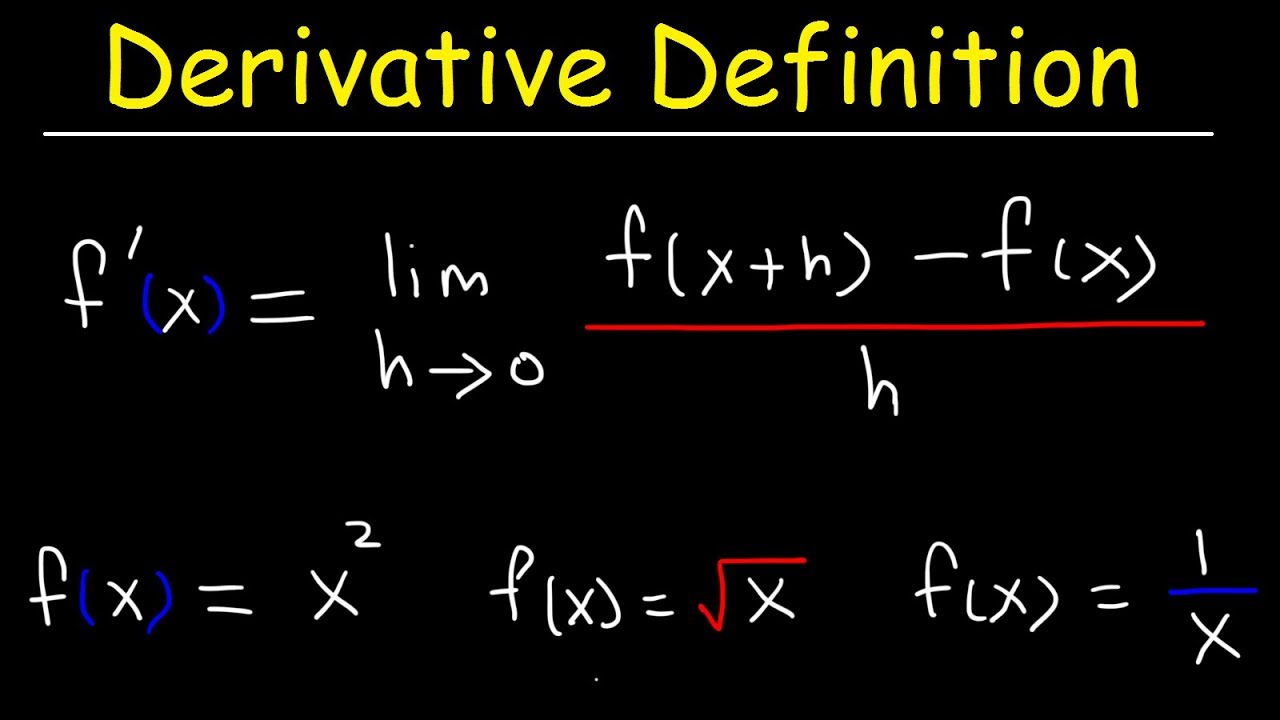
This calculus video tutorial provides a basic introduction into the definition of the derivative formula in the form of a difference quotient with limits. It explains how to find the derivative of a function using the limit process. This video contains plenty of examples and practice problems.
Derivatives - Fast Review:
https://ww...

This calculus video tutorial provides a basic introduction into derivatives for beginners. Here is a list of topics:
Derivatives - Fast Review: https://www.youtube.com/watch?v=5yfh5cf4-0w&t=1s
Limit Definition of the Derivative:
https://www.youtube.com/watch?v=-aTLjoDT1GQ
Derivatives - Alternate Limit Definition: ...

Finding the slope of a tangent line to a curve (the derivative). Introduction to Calculus.
Watch the next lesson: https://www.khanacademy.org/math/differential-calculus/taking-derivatives/derivative_intro/v/calculus-derivatives-2?utm_source=YT&utm_medium=Desc&utm_campaign=DifferentialCalculus
Missed the previous lesson?
https://www.khanacadem...
@queen shoal here, you might wanna give these a watch to start with.
 fiery creek
queen shoal
how do you find derivatives of functions
fiery creek
queen shoal
how do you find derivatives of functions
do you have a specific function you want to differentiate
if so I can walk you through it
arctic sundial
willow skiff
Good luck!
I got a 5! 38/40 for mcq and idk about frq yet but I def got more than 4 points out of 24 to meet the minimum for a 5 bc we went over one FRQ in class today
 quiet merlin
Does anyone know how to do these number 6,7,9,11,12
viscid thistle
quiet merlin
Does anyone know how to do these number 6,7,9,11,12
Yes
Wait what
No
quiet merlin


 crisp hinge
I'm in algebra 1, i just am learning this stuff
but what are integrals? and what are derivatives?
and what are hyperbolic sine/cosine/tangent
 summer ruin
you shouldn't worry about this in algebra 1
crisp hinge
no i should because half of my class is foreshadowing for this
and its like
what you're learning is baby math
compared to
[insert trig or other stuff like calculus]
river drift
almost all math is baby math compared to something. but math builds on itself, so you have to have a solid foundation
summer ruin
well the simple explanation isn't going to be useful and proper explanation isn't going to be short
summer ruin
then you can just open a book/search the web/watch a lecture on it
crisp hinge
i did
but
I need somebody to personify it
because i dont understand what they say
summer ruin
this is why you learn basic stuff first
you're not going to find a lot of people that are willing to explain material for hours
crisp hinge
true
summer ruin
so it would be better if you have specific questions about stuff you don't understand
crisp hinge
alright
is altitude easier to explain?
because i need to know all of this for math olympiad
and im in 6th
summer ruin
altitude?
crisp hinge
so idk any of this
 summer ruin
sure
crisp hinge
so how would i do it?
summer ruin
draw a straight line from vertex B to the side AC
crisp hinge
does the angle have to be a right though?
because then
if it isn't it can be anything
summer ruin
crisp hinge
does the angle have to be a right though?
what angle exactly
crisp hinge
if the point we are drawing from B to is named E
summer ruin
the vertex can have any angle, the altitude always creates a right angle with the side it touches
crisp hinge
then BEC
crisp hinge
summer ruin
the vertex can have any angle, the altitude always creates a right angle with th...
ok
makes sense
none of the resources i found said that
summer ruin
my first search result is wikipedia's page on altitude https://en.wikipedia.org/wiki/Altitude_(triangle)

In geometry, an altitude of a triangle is a line segment through a vertex and perpendicular to a line containing the side opposite the vertex. This line containing the opposite side is called the extended base of the altitude. The intersection of the extended base and the altitude is called the foot of the altitude. The length of the altitude, o...
and it says it right there
crisp hinge
my browser is broken
 river drift
,w rref {{5,-3,2,2},{2,2,-3,3},{-1,7,-8,4}}
obsidian monolithBOT


 Requested by cloudedhorizons
river drift
Requested by cloudedhorizons
river drift
it's not inconsistent, but it does have infinitely many solutions
river drift
rewrite this back into a system of equations
river drift
then you can solve for x and y
compact spade
can i??
river drift
just move the z term to the other side on each side
then you have a formula for x and y in terms of z
compact spade
but thats in terms of z then
river drift
yes, that's why there are infinitely many solutions
compact spade
so
river drift
each value of z corresponds to a different solution
compact spade
not sure how to properly turn this into a system of equations
 summer ruin
find the number of beef required to produce some amount of muffins, bones and cookies
compact spade
ohhh wow that's really really helpful thanks
oh shit wait
sorry
i thought that was a sarcastic message until i reread it and you were unironically being helpful sorry 💀
...i still do need a little more help though given that im stupid
summer ruin
since you want to find the number of muffins, bones and cookies it makes sense to give each quantity a variable to represent each number
summer ruin
summer ruin
find the number of beef required to produce some amount of muffins, bones and co...
then do this
compact spade
summer ruin
then do this
so, what would each variable be representing here
summer ruin
summer ruin
since you want to find the number of muffins, bones and cookies it makes sense t...
the number of muffins, bones and cookies produced 👆
queen shoal
willow bear
<@971473182219468860> here, you might wanna give these a watch to start with.
Thanks
 deft adder
The function f is given by f(x) = (sin(x) + cos(x)) (sin (x) - cos (x)).
A student is trying to solve f(x) = 1. Which of the following equations
could be used to find the values of x that solve the equation f(x) = 1?
A) cos(2x) = 1
B) sin(2x) = 1
C) cos(2x) =-1
D) sin(2x) =-1
How do i solve this? I feel like i get most of it but then I get stuck
 chrome ether
what is “most of it”? show us what work you have
 rugged harness
let's say i can calculate the volume of a rotating block by calculating the area of several smaller shapes that making up that block, can i calculate the area of that block by calculating the circumference of those shapes
well particularly the torus
queen shoal
fiery creek
do you have a specific function you want to differentiate
Wait I do actually
 viscid thistle
compact spade
57 is impossible right
viscid thistle
compact spade
57 is impossible right
Greatness can be attained through rigorous exercise.
Though this is quite a difficult math
Is it related to functions?
river drift
it's introductory linear algebra
viscid thistle
river drift
it's introductory linear algebra
College level?
river drift
linear algebra is usually taught at the college level, although some high schools teach a small amount as part of an algebra/precalculus curriculum
 night elbow
queen shoal
Wait I do actually
night elbow
queen shoal
Wait I do actually
the derivative of the function: ln(f(x)) is generally f'(x)/f(x)
willow bear
night elbow
the derivative of the function: ln(f(x)) is generally f'(x)/f(x)
... which is just a particular case of the chain rule.
fiery creek
queen shoal
Wait I do actually
this requires a bit of something called "chain rule"
are you familiar with derivative rules @queen shoal
fiery creek
ok well that's a pretty tough derivative for someone who's never done derivatives before
queen shoal
i dont know chain rule either
fiery creek
i'd recommend learning the basics first
queen shoal
fiery creek
ok well that's a pretty tough derivative for someone who's never done derivative...
ok
what are the basics
winter comet
viscid thistle
Though this is quite a difficult math
it's either a "complicated" algebra 2 problem or a "basic" linear algebra problem
winter comet
queen shoal
what are the basics
the derivative of ax^(n) = anx^(n-1), where a and n are constants
example:
lets say you want to find the derivative of 5x^2
here, a = 5 and n = 2.
thus, plug it into the "formula".
the derivative of 5x^2 = (5)*(2)x^(2-1) = 10x^1 = 10x
 crisp timber
why is the derivative of x^n = x^(n-1)/n?
It is kind of noticeable that it is x^(n-1), but why is it divided by n?
obsidian monolithBOT

 Requested by transparent_elemental
winter comet
crisp timber
why is the derivative of x^n = x^(n-1)/**n**?
It is kind of noticeable that it i...
Requested by transparent_elemental
winter comet
crisp timber
why is the derivative of x^n = x^(n-1)/**n**?
It is kind of noticeable that it i...
it's multiplied by n
make sure you aren't getting it confused with the antiderivative
crisp timber
True lol. But then, why is it multiplied by n?
winter comet
to prove the generalized chain rule you can always fall back on the definition of a derivative
i forgot exactly how they prove the chain rule
you can look it up if you want
but that's just what you do
you multiply it by n
 limpid wasp
crisp timber
True lol. But then, why is it multiplied by n?
limpid wasp
crisp timber
True lol. But then, why is it multiplied by n?
use the limit definition of derivative, and use binomial theorem for (x + h)^n
 loud valve


 barren gorge
hi
viscid thistle
Someone tagged me?
winter comet
winter comet
it's either a "complicated" algebra 2 problem or a "basic" linear algebra proble...
here mebbe?
viscid thistle
winter comet
here mebbe?
Nah nah someone else
queen shoal
winter comet
the derivative of ax^(n) = anx^(n-1), where a and n are constants
example:
lets...
Thx
willow skiff
The hint is very useful about negative numbers
Is your problem with how to get the domain or writing it in the given notation?
 plush quail
Getting the domain
willow bear
you did not answer my question
if you don't know the domain of sqrt(x), then you should just say "no, i don't know the domain of sqrt(x)"
willow bear
plush quail
Idk the sqrt (x)
do you mean "I don't know what you mean when you say sqrt(x)" or do you mean "I don't know the domain of sqrt(x)"?
plush quail
I think i did 5 right
More so need help with 6
Actually no if i did 5 i can do 6
Number 10 is what i truly dont understand
 plush quail
No
plush quail
It sounds familiar, but i couldnt tell u what mx or c is from
willow bear

This Algebra video tutorial provides a basic introduction into linear equations. It discusses the three forms of a linear equation - the point slope form, the slope intercept form, and the standard form of the equation. This video explains how to calculate the slope of a line that passes through two points and how to graph a linear equation in...

This algebra video tutorial provides a basic introduction into point-slope form. It explains how to write a linear equation given a point and the slope. It also explains how to write a linear equation given two points. Finally, it discusses how to graph a linear equation in point-slope form.
Algebra For Beginners: ...
give these a watch, and perhaps also search youtube for "organic chemitry tutor straight line equations" and watch the other vids that show up.
and/or also do that but for khanacademy instead of ochem tutor.

 deft turret
I did it y’all
I got into ap precalc
The 2 weeks of staying up until midnight was worth it
winter comet
deft turret
I got into ap precalc
ayy
winter comet
 lapis bramble
never trust cha.gpt 😅
lapis bramble
never trust cha.gpt 😅
chat gpt actually made a mistake??? 🤣
unless it was talking about limits
then you ignore that kind of domain restriction
idk tho
lapis bramble
winter comet
chat gpt actually made a mistake??? 🤣
yep I asked it to help me simplify and it say'd that -64=-8
lapis bramble
well cuz it canseled out x-64 and x-8 meaning their the same and also implying that -8=-64
winter comet
yeah
but they couldn't cancel it out anyway unless they noted that z != 8
thats what i saw originally
i didnt even notice the 64 💀
lapis bramble
lol
burnt wolf
deft turret
I got into ap precalc
I was just expressing my rage over AP Pre-Calc 😞
I had no problem with it until I found out everything from Matrices and up aren’t on the exam, and they don’t cover any actual Calculus content. Like not even like an introduction to limits or anything. Half of the questions from practice tests I could answer just from my Algebra II knowledge!
winter comet
burnt wolf
I had no problem with it until I found out everything from Matrices and up aren’...
no literally thats why i transferred out of precalc in the first two days lol
i realized i already knew everything they were gonna teach
so i just self studied the other stuff that they werent gonna teach
precalc is so undefined some of the classes are practically algebra 2 and some are actually purely stuff for calc
river drift
if a class taught calculus it would be called a calculus class...
burnt wolf
winter comet
i realized i already knew everything they were gonna teach
Exactly! I’m taking it over the summer since I basically know all the material, I don’t wanna spend an entire school year reviewing stuff I already know..
burnt wolf
river drift
if a class taught calculus it would be called a calculus class...
AP Precalculus should at least introduce the topics in the first 2 units of Calc AB/BC or else what difference does it really make?
winter comet
river drift
if a class taught calculus it would be called a calculus class...
i think they teach basic limits sometimes in precalc
burnt wolf
winter comet
i think they teach basic limits sometimes in precalc
I thought they did…but they don’t even talk about it in the AP 😭
river drift
the point of a precalculus course is to cover everything you need to know before a calculus course, not to teach the "first part" or "introduction"
burnt wolf
burnt wolf
I thought they did…but they don’t even talk about it in the AP 😭
I already know limits too…
winter comet
i remember i looked at the syllabus for precalc and i was like "bruh i thought this was algebra"
burnt wolf
river drift
the point of a precalculus course is to cover everything you need to know *befor...
Yeah, a regular Precalculus course. If the AP just teaches the same stuff and doesn’t even slightly delve in Calc AB stuff, then what makes it different?
winter comet
i thought precalc was matrices, polar coordinates, conic sections mebbe, vectors, limits, probability? idk
river drift
what makes an ap course, an ap course, is that it offers college credit (in this case, for the type of precalculus course taught in college). nothing really more or less than that
burnt wolf
winter comet
i thought precalc was matrices, polar coordinates, conic sections mebbe, vectors...
The AP exam doesn’t cover matrices, vectors or limits
burnt wolf
river drift
what makes an ap course, an ap course, is that it offers college credit (in this...
But AP Precalc doesn’t even give you credit at most colleges given that Precalculus is a high-school course
AP classes are typically either the first semester, or the first-year of a college course
river drift
most colleges do offer a precalculus course for students who do not yet have the pre-requisite knowledge for a first-year calculus course
burnt wolf
river drift
most colleges do offer a precalculus course for students who do not yet have the...
Yeah, but again, most colleges won’t give you credit for AP Precalc given that as you said, it’s only taken for those who don’t have the prerequisite
river drift
for non-stem majors some colleges allow for their pre-calculus course to count for whatever math requirement they have. it's certainly not useful to every student, although that's also the case for any ap course
i think the broader issue is that the range of topics a "precalculus" course may cover is extremely wide, depending on the level of knowledge a calculus course expects you to know vs what they expect to teach you
burnt wolf
river drift
for non-stem majors some colleges allow for their pre-calculus course to count f...
I suppose sure, but I’m just saying, there’s nothing that makes it “college-level” like an AP course is supposed to be
river drift
i don't know enough about the ap precalculus curriculum to know whether it is "college level" (which a precalculus course can be, as evidenced by the fact colleges offer them), but nothing about a course being "college level" implies it must teach calculus
burnt wolf
river drift
i don't know enough about the ap precalculus curriculum to know whether it is "c...
Not straight-up teach Calculus, but introduce some of the topics at a slightly more basic level perhaps. Cause like I said, AP Pre-Calc doesn’t even cover matrices, vectors, or “functions involving parameters”
And those topics are not that difficult, at a Precalculus level, matrices are super easy to wrap your head around
 sinful halo
@steep estuary
chrome ether
AP precalc is not college level.
that is the big thing that just makes me go "why are they even making this a thing" 😭
a lot of colleges will likely just not take it for credit, period
viscid thistle
chrome ether
AP precalc is not college level.
Ap calculus?
viscid thistle
chrome ether
not ap CALC
Nah i know but like I was asking whether or not ap Calc Is college level. Follow up question, what can be considered college level then?
chrome ether
calculus is barely scratching the surface of actual undergraduate mathematics
winter comet
viscid thistle
Nah i know but like I was asking whether or not ap Calc Is college level. Follow...
i think calc 1 is where undergraudate starts
which would technically be 'college level'
viscid thistle
chrome ether
calculus is barely scratching the surface of actual undergraduate mathematics
How do you scratch undergrad maths from both ends?
winter comet
viscid thistle
How do you scratch undergrad maths from both ends?
what does that even mean 🤣
chrome ether
the meatier parts of the undergrad curriculum begin when you start to move away from just endless computation and move towards proof-based stuff
viscid thistle
chrome ether
the meatier parts of the undergrad curriculum begin when you start to move away ...
Ahh I just love smth that's meaty like proof.
viscid thistle
I tried proof, understood some of it, but like it's quite conceptual I felt.
chrome ether
the most important undergrad courses are probably abstract algebra and analysis
chrome ether
viscid thistle
I tried proof, understood some of it, but like it's quite conceptual I felt.
.... that is a completely vacuous statement
chrome ether
some undergrads take it
viscid thistle
Ahh I see
chrome ether
the point of undergrad is more to
develop the mathematical maturity you need for intensive graduate level research
willow skiff
viscid thistle
What's Complex anal?
No it's a standard upper undergrad course for pure maths
viscid thistle
I probably won't even be picking maths in undergrad since I am going into bio but still it's quite interesting.
willow skiff
Cool
deft turret
At my school you have to be the top score’ers to get into ap calc
But that only applies to honors im2 I’m in regular im2
But there was space for ap pre calc so she gave it to me
But I do know that pre calc won’t be accredited as much as ap calc since college doesn’t teach or calc
Pre calc*
burnt wolf
deft turret
At my school you have to be the top score’ers to get into ap calc
Oh, all you have to do for me is to get an C or higher in AP Pre-Calc, or an A in regular with a teacher recommendation. And that’s for BC, it’s even more lenient for AB
viscid thistle
Hey guys
Need your help

I need to calculate the derivative of this function
I dont understand this moment

Why x^5 became x^2
obsidian monolithBOT
pnoןɔ
 viscid thistle
I still dont understand it
river drift
,tex \exprules
obsidian monolithBOT
pnoןɔ
 viscid thistle
I understood it but another way
Anyways thanks
We can also figure it out this way: cube_root(x^5) = cube_root(x^3x^2). And then we basically get x^3 out of the root. xcube_root(x^2)
viscid thistle
river drift
,tex \exprules
Whoa, are there cmds for other types of formulas aswell?
 warped cipher
 clear scarab
,tex \integrationrules
clear scarab
,tex \integrationrules
you need preamble for that
 willow summit
any one help me i have high school additional math exam in this year
willow bear
willow summit
any one help me i have high school additional math exam in this year
post the question(s) that you need help with
viscid thistle
Guys
Why (a^x)' = ln a * a^x
Can it be proved?
Or i should just remember it
Generally, i dont understand what a natural logarithm has to do with it
willow skiff
viscid thistle
Generally, i dont understand what a natural logarithm has to do with it
$a^x = e^{(\ln a) x}$ and the chain rule
obsidian monolithBOT
south
 willow skiff
viscid thistle
What do you discuss here
willow skiff
viscid thistle
What do you discuss here
Trig and functions
Like logs, exponential functions, rational functions, sin, cos, tan etc
viscid thistle
Usually if i have smth regarding to trig, i go to trigonometry channel
agile sparrow
Let f : (0,1) be the function defined as f ( ) x n if 1 1,
1
x
n n
where n . Let
g : (0,1) be a function such that 2
1 () 2
x
x
t
dt g x x
t
for all x(0,1). Then
0
lim ( ) ( )
x
f xgx
(A) does NOT exist
(B) is equal to 1
(C) is equal to 2
(D) is equal to 3
 modest bay
😧😧😧😧
willow bear
agile sparrow
Let f : (0,1) be the function defined as f ( ) x n if 1 1,
1
x
n n
...
give us a picture.
 viscid thistle
agile sparrow
shit
viscid thistle
agile sparrow
shit
So high.......
viscid thistle
viscid thistle
So high.......
Bad joke mb.
agile sparrow
viscid thistle
So high.......
wat
 proven void
,, \text{Find } a \text{ and } b > 0 \text{ such that the } \lim_{x \to \infty} \left( \frac{\sqrt{ax^4 + bx^3}}{x} - x \right) = 4.
obsidian monolithBOT
milanesa de pollo
 willow bear
you don't have to do a million \text{} btw
you could have typed the same thing like this:
Find $a, b > 0$ such that $\lim_{x \to +\infty} \left( \frac{\sqrt{ax^4 + bx^3}}{x} - x \right) = 4$.
obsidian monolithBOT
|Ann⟩
 willow bear
also show all your progress thus far.
tender questBOT
What step are you on?
1. I don't know where to begin.
2. I have begun but got stuck midway.
3. I got an answer but I was told that it's wrong.
4. I got an answer and would like my work checked.
5. I have a question about someone else's work/solution.
6. I have completed the problem and don't need help anymore. Thank you.
7. None of the above
no, it's much better than leaving the status query on read.
for step 1 i suggest rewriting this thing as a single fraction
then you can do some bullshit with conjugates.
 agile sparrow
proven void
agile sparrow
proven void
Take x^4 common
From root
That would give x^2
Take both x^2 common
And cut one x
willow bear
proven void
recommend against manipulating the limit and dragging it all along with you
just work algebraically with the function inside of it
as mentioned earlier, do some conjugate bullshit
namely multiply top and bottom by sqrt(ax^4+bx^3) + x^2
willow bear
not any more so than any other limit with roots like this.
agile sparrow
It's useful when tending towards 0
proven void
I dont get it
willow bear
trust me it is still helpful here
willow bear
proven void
I dont get it
mb because two people are trying to tell you different things
and so high is doing it in a somewhat hard to read way
proven void
 willow bear
i have to go sleep tho so maybe it will have to be the blind leading the blind
agile sparrow
proven void
take x suare common
proven void
 agile sparrow
a has to be 1
proven void
why?
agile sparrow
i solved it ]
in my mind
it could be not right
but it should be
my mind calc sucks
after u take x^2 common
u'd be left
ith]
x(underroot[a+b/x]-1)
underroot a+b/x-1 has to be 0
to create inderminant form
put the limit x = inf
b dissapears
and a=1
and b is 8
 tender mist
agile sparrow
my mind calc sucks
tender mist
agile sparrow
my mind calc sucks
I had 0 context before seeing you say that, so for a moment I thought you were saying that calculus sucks, lol
river drift
viscid thistle
Whoa, are there cmds for other types of formulas aswell?
i made it myself, so you can get such commands by making them

 north anchor
what’s the formula for an alternating series like this? i cannot remember lol
 river drift
alternating geometric series don't have a separate formula from other types of geometric series
agile sparrow
proven void
I dont get it dammit
lets talk tomorro
agile sparrow
north anchor
what’s the formula for an alternating series like this? i cannot remember lol
a/(1-r)
1/5
1/26 is tat the ans
north anchor
river drift
alternating geometric series don't have a separate formula from other types of g...
ok ty!
north anchor
agile sparrow
1/5
oh that’s an s not a 5
agile sparrow
oh my fucking gad
river drift
agile sparrow
1/26 is tat the ans
!nosols
tender questBOT
agile sparrow
1/26 is tat the ans
As a helper, please do not give out answers that could be copied as a homework solution. Have the student work through the problem themselves and guide them along the way.
willow bear
north anchor
what’s the formula for an alternating series like this? i cannot remember lol
this is still a geometric series
$\frac{(-1)^n}{s^{2n+2}} = \frac{1}{s^2} \cdot \paren{-\frac{1}{s^2}}^n$
obsidian monolithBOT
|Ann⟩
 proven void
Represent the following sets on the line. Write them as intervals or as a union of intervals
${ x \in \mathbb{R} \mid |x| > 3 }$
obsidian monolithBOT
milanesa de pollo
 proven void
sorry if its badly translated wtf should I do here?
in general if |x| < 3 that means
-3 < x < 3
but how is it for |x| > 3 tho
proven void
yeah
willow bear
well
|x| > 3 means x is further than 3 units from 0
this should enable you to draw it on the number line
proven void
-3 > x > 3 maybe?
so strange smh
but I only know because if |x| < 3 then -3 < x < 3
willow bear
proven void
-3 > x > 3 maybe?
no
proven void
then prolly |x|>3 means -3 > x > 3
willow bear
i said draw on the number line
willow bear
proven void
then prolly |x|>3 means -3 > x > 3
no, stop trying to mash symbols together
do as i say
dont play 5D chess with my instructions
again
draw a number line
mark the points 3 and -3 on it
then color all of the points which are further than 3 units away from 0
 willow bear
erase the gd -3 > x > 3
but yes the diagram is correct
thats what you were supposed to do
thats what i asked you to do
by the way -3 > x > 3 would translate to (-3 > x) AND (x > 3), but there's no point which satisfies both inequalities at once -- you cannot be under -3 while also being above 3.
proven void
That was the lesson learnt that the two side inequality is wrong
How to write that as union of intervals?
proven void
not sure
willow bear
look at it.
ok let me reproduce yours in somewhat better visual quality.

how many intervals are colored?
don't overthink this, i know for a fact that you're able to answer this.
im not asking you to do the whole thing at once. just do what i say.
do what i say nothing more. nothing more. dont do more than i ask for.
proven void
two
willow bear
right.
let's look at the first interval, on the left.

how do you write this in interval notation?
proven void
not sure if the ifinity is inclusive but
(-infty , -3) would be my guess, since you cannot include infinity
willow bear
you never include infinities.
but yes, (-∞, -3) is correct.
now look at the second interval, on the right.

what's that in interval notation?
proven void
(3, +infty)
willow bear
right.
 viscid thistle
,tex \exprules
viscid thistle
river drift
i made it myself, so you can get such commands by making them
How do you make em?
river drift

An online LaTeX editor that’s easy to use. No installation, real-time collaboration, version control, hundreds of LaTeX templates, and more.
read the pins in #latex-help for a more general introduction to latex
proven void
how can I graph $f(x) = cos(2x + \pi)$ just from knowing how to graph $g(x) = sin(x)$ and $h(x) = cos(x)$
?
agile sparrow
@proven void
proven void
wassup
agile sparrow
What's senx
obsidian monolithBOT
milanesa de pollo
 proven void
typo, mybad
proven void
,w plot cos(2x)
obsidian monolithBOT

 proven void
how do I flip it
agile sparrow
nah
I thought u meant on paper
Like for general understanding
Do u know how to plot cos2x=
proven void
no
agile sparrow
Draw cosx and shifts the point by half
Life π/2 becomes π/4 due to the 2x
And vice verse
cos(2x+π) the pie makes it shifts to the 3rd quadrant
thats why it flips
proven void
how do I
agile sparrow
anyway
agile sparrow
cos2(x+π/2)
proven void
?
agile sparrow
2cos^2(x+π/2)-1
agile sparrow
proven void
?
Im checking it for myself
I don't see the use of sinx graph in this
Also
meh
agile sparrow
Well I hope u understand the graph
proven void
how to I sketch cos(x) ?
agile sparrow
Shift sinx
Graph
Making it start from 1
as cos 0 = 1
where 0s the x and 1 is the y
And at π/2 it's zero
Use desmos for reference
 willow bear
$\lim_{x \to 0} \frac{(16+x)^{1/4} - \frac{1}{32}x - 2}{x^2}$
obsidian monolithBOT
|Ann⟩
 willow bear
i think i'd rather wait for OP to give confirmation that i have the problem written correctly
proven void
@near sentinel
willow bear
assuming that it \textit{is}, i would rewrite $(16+x)^{1/4}$ as $2(1 + \tfrac{1}{16}x)^{1/4}$, and then expand that into its taylor series up to and including the $x^2$ term.
obsidian monolithBOT
|Ann⟩
 willow bear
failing that (such as if op doesn't have access to taylor series), we could resort to l'hôpital's rule.
proven void
what are the conditions that need to be met so lhopitals is possible to be used?
proven void
willow bear
assuming that it \textit{is}, i would rewrite $(16+x)^{1/4}$ as $2(1 + \tfrac{1}...
2^4 = 16 I didnt noticed
taylor series?
willow bear
proven void
what are the conditions that need to be met so lhopitals is possible to be used?
i mean, by asking this question you admit to not knowing what l'hôpital's rule is.
but the most important condition is that the limit is in either of the two forms 0/0 or ∞/∞.
here it is 0/0.
proven void
oh yeah its 0 numerator as well didnt noticed, again 2^4 = 16
willow bear
proven void
taylor series?

In mathematics, the Taylor series or Taylor expansion of a function is an infinite sum of terms that are expressed in terms of the function's derivatives at a single point. For most common functions, the function and the sum of its Taylor series are equal near this point. Taylor series are named after Brook Taylor, who introduced them in 1715. A...
(1+x)^p in particular has a known and simple(ish) taylor expansion.
 willow bear
$(1+x)^p = 1 + px + \frac{p(p-1)}{2!} x^2 + \frac{p(p-1)(p-2)}{3!} x^3 + \dots$
obsidian monolithBOT
|Ann⟩
 willow bear
this could also be obtained as a generalization of the binomial theorem (the generalization being that the exponent no longer has to be a natural number)
proven void
willow bear
$(1+x)^p = 1 + px + \frac{p(p-1)}{2!} x^2 + \frac{p(p-1)(p-2)}{3!} x^3 + \dots$
was tough to see at first glance, but this is covered in two weeks for me
whats next?
 near sentinel
willow bear
did i read the problem correctly?
near sentinel
willow bear
did i read the problem correctly?
yupp
willow bear
ok then i repeat my suggestion:
near sentinel
proven void
we got to clear the x^2 from the denominator no?
yeah
willow bear
expand (1 + x/16)^(1/4) into a power series up to and including the x^2 term
do some simplification
the answer will just pop out
if you don't have access to power series, then apply l'hôpital.
near sentinel
here's what I did, I rationalised the numerator and got until {16+x - (x/32 +2)^2]/32x^2
near sentinel
willow bear
if you don't have access to power series, then apply l'hôpital.
idk both of these 🫠
wait whats power series
willow bear
can you show your work for rationalization
near sentinel
i think ik it but with a dff name
near sentinel
willow bear
can you show your work for rationalization
sure
 willow bear
then that is what i meant
near sentinel
willow bear
then that is what i meant
ohkk
my teacher did teach us aa method uding binomial expansion, but im not very good at it
willow bear
yeah binomial expansion is exactly what i am suggesting here.
$(1+x)^p = 1 + px + \frac{p(p-1)}{2!} x^2 + \dots$
obsidian monolithBOT
|Ann⟩
 willow bear
explain what
near sentinel
the method; i tried it but i couldnt get rid of the x/32 and 2 term
ill send pic of my working
if i apply DS, im left with 1/x^2
willow bear
rewrite $(16+x)^{1/4}$ as $2(1 + \tfrac{1}{16}x)^{1/4}$ and then as $$2 \paren{1 + \frac{1}{4} \cdot \frac{x}{16} + \frac{\frac14 \cdot (-\frac34)}{2} \cdot \paren{\frac{x}{16}}^2}$$
near sentinel
 obsidian monolithBOT
|Ann⟩
 willow bear
near sentinel
willow bear
near sentinel
you are not expanding far enough
you need the x^2 term from the expansion too
near sentinel
ohkk
ill try doing that
thank you!!

that way there will remain a term of x in the denominator
near sentinel
near sentinel
this is what im getting
the x^2 term got cancelled
but the ans is wayyy off
ok not wayy off
close
but not accurate
where am i going wrong
hmm
i can try that
proven void
I got x^3 from the expansion and Is still not enough
did you managed to solve?
I still cannot
I dont think any other more terms will work because it cannot get cancelled with the denominators x^2
so will be zero, without providing any more preciseness, e.g. the third term of the expansion is x^3 something so it will result in something multiplied by x and since x is approaching zero . . .
if someone manages find out the answer ping me
proven void
near sentinel
also I dont get it your prof is saying the answer is positive but when I try do it I also get the middle x^2 being negative
mm
whatever
near sentinel
proven void
did you managed to solve?
nope 😦
near sentinel
proven void
I dont think any other more terms will work because it cannot get cancelled with...
yeah, it only works till 3rd term, we were told to ignore the rest of them as it approaches to zero
proven void
💀
near sentinel
proven void
also I dont get it your prof is saying the answer is positive but when I try do ...
exactly, and even the ans is coming diff
proven void
@willow bear , any idea?
near sentinel
its actually a build up question
ill send the prev q
like its implied you have to solve it like the prev question
 proven void
did you rationalized for 3?
or binomial expansion/ taylor series around x = 0
?
why is 4 repeated twice
but with different functions
near sentinel
thats a diff question, its like a hw assignment and our sir is too lazy to change index
near sentinel
proven void
did you rationalized for 3?
yupp
i got the answer for 3
by rationalisation
but im supposed to do it by binomial exp
and the ans comes either way
willow bear
,w lim[x -> 0] x^-2 * ( (16+x)^(1/4) - x/32 - 2)
obsidian monolithBOT

 near sentinel
💀
willow bear
did your prof proclaim that the answer is positive?
 proven void
really nice question tho
near sentinel
or the ans key
near sentinel
proven void
really nice question tho
yeahh
proven void
whatever
 hot kayak

 hoary mountain
What to do?
