#precalculus
1 messages · Page 23 of 1
 gaunt sand
 verbal rock
hey i actually prefer living here than nsw i used to live in a crack house now i live in a mansion
 shadow summit
verbal rock
hey i actually prefer living here than nsw i used to live in a crack house now i...
shadow summit
verbal rock
hey i actually prefer living here than nsw i used to live in a crack house now i...
Average affordable house in NSW:
Dam, nice
Dam even the crack houses cost a fortune
verbal rock
ok bye #discussion

 spice steeple
 celest nexus
no comprendo
celest nexus
no comprendo
integrals have linearity property you know that right
celest nexus
spice steeple
integrals have linearity property you know that right
no
i just learned this
like 2 secodns ago
spice steeple
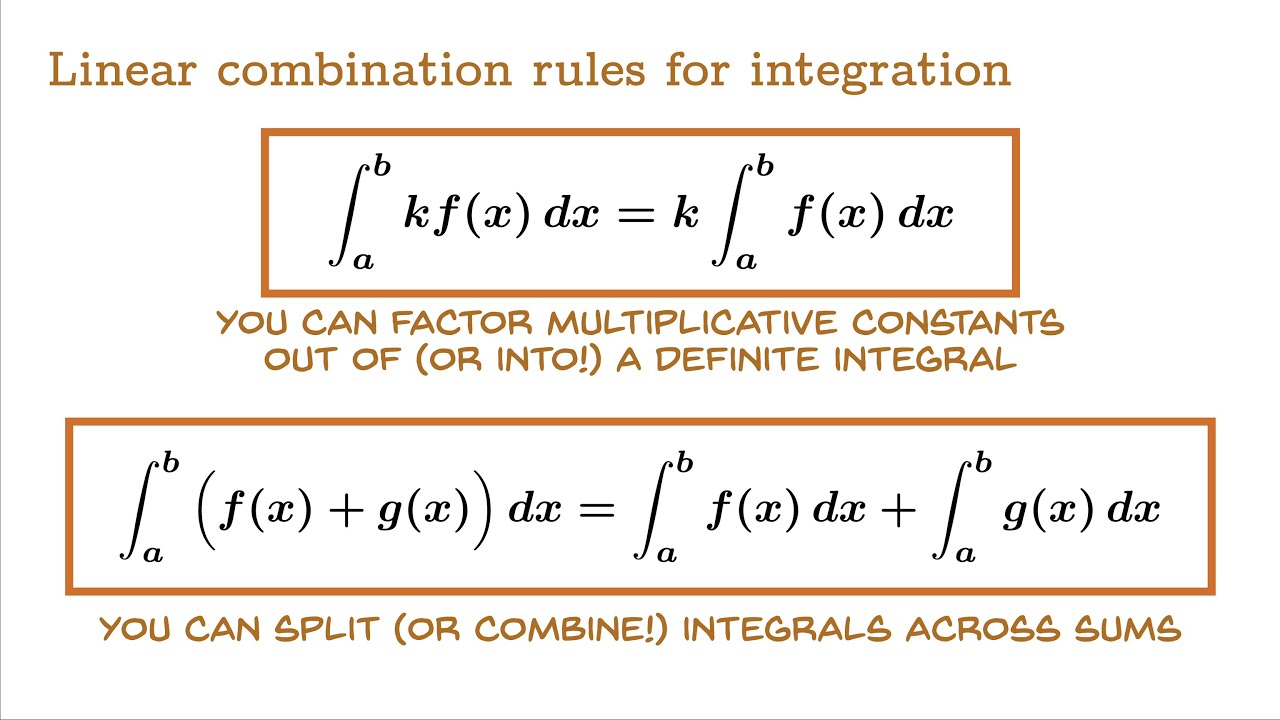
integral of f minus g is the same as integral of f minus integral of g
man i wish i knew lateX
 plush sparrow
yeah
celest nexus
what
plush sparrow
spice steeple
man i wish i knew lateX
yk u can copy paste equations from desmos to overleaf right
celest nexus
what is goingon
 supple wagon
Basically, integral of (x+y) is the integral of x + integral of y
supple wagon
No, the integral
plush sparrow
do u know the constant law in integrals
plush sparrow
integral of c dx = cx
supple wagon
 celest nexus
supple wagon
https://i.ytimg.com/vi/-QlWEG2j_mM/maxresdefault.jpg
celest nexus
supple wagon
https://i.ytimg.com/vi/-QlWEG2j_mM/maxresdefault.jpg
does it equal 0
😭
shadow summit
celest nexus
$\int (f(x)+g(x))dx = \int f(x)dx + \int g(x)dx$
 obsidian monolithBOT
TheLord26
 shadow summit
so you would do: $ \newline \int^{5}{-2} f(x)dx + \int^{5}{-2}-6dx \newline 18+[-6x]^{5}_{-2} \newline 18-6(5)-6(-2)$
latex?
cmon
work
$\int^{5}{-2} f(x)dx + \int^{5}{-2}-6dx \newline 18+[-6x]^{5}_{-2} \newline 18-6(5)-6(-2)$
obsidian monolithBOT
TheLord26

 lavish crystal
18-6(5-(-2))= 18-42=-24
lavish crystal
celest nexus
<@&286206848099549185>
18-6(5-(-2))= 18-42=-24
 glad widget
lavish crystal
18-6(5-(-2))= 18-42=-24
glad widget
lavish crystal
18-6(5-(-2))= 18-42=-24
18 - 30 + 12
glad widget
Whats a ghost ping
 ivory mango
if you need help open up a help channel in the help forum
ivory mango
glad widget
Whats a ghost ping
its actually different from what he actually did i just confused a ghost ping with what he did which was a cold ping
glad widget
ivory mango
its actually different from what he actually did i just confused a ghost ping wi...
Ive never head of either of those before
ivory mango
ghost ping = sending a message with the ping and then deleting the message
cold ping is like pinging someone with an issue that the person they pinged has nothing to do with their problem
also on a side note: "18-6(5-(-2))= 18-42=-24" is not precalc
glad widget
ivory mango
also on a side note: "18-6(5-(-2))= 18-42=-24" is not precalc
its 18 - 30 + 12
18 - 6(5) - 6(-2)
if i do what you did instead of straight up simplifying it i will pull out the -6 and get
18 -6(5-2)
= 18 - 6(3)
= 18 - 18
= 0
 tender mist
I was always confused on what is actually considered pre-calc, lol. I know the channel description says trig, logs, and exponents, but my precalc classes back then had like, everything including algebra
tender mist
Yeahh, like I know it's normal for math to have a TON of overlap, but it feels like pre-calculus is the only early math subject that doesn't really have explicitly its own direction, it's just a combination of things
ivory mango
like right now I was given a notes packet in class and it had "what is e" and "what is a natural log"
and I was the only person in class to not only know the value but what e represents
 river drift
the weird stuff is when pre-calc classes cover limits, because for me limits are definitionally a calculus topic
tender mist
Yeahh, that definitely stumps me as well. Not even just definitionally, but historically limits were conceived with derivatives
so it's a bit odd for sure
Or at least, limits as we know them. Limits were technically informally used in the Greek era, but not the way we use them, and it definitely wasn't a well-researched topic at the time
 shrewd flicker
Heyy! Is anyone interested in reviewing pre-calc with me for the next 2 weeks? We can be study buddies 😎 I completed pre-calc during my first semester of college and want to make sure that I review the units before starting Calculus.
shadow summit
lavish crystal
18-6(5-(-2))= 18-42=-24
where did you get the 42 from? also it would just be easier to evaluate from the last line
shadow summit
ivory mango
also on a side note: "18-6(5-(-2))= 18-42=-24" is not precalc
the original question is.
i mean, its more like calc than precalc, but eh
glad widget
ivory mango
it doesnt belong here as it's algebra
it is the answer for the calc question
ivory mango
Where
All I read was that algebra
Oh
It's right above it
I didn't see it at first
 barren finch
Hey guys, a quick question. I have already done pre-calculus and even tho I am moving to calculus. I don't feel confident moving toward calculus, so can you provide me with some suggestions? Thanks.
ivory mango
Do some practice problems
 fleet sinew
Hi and what?
 tepid timber
Why not just leave
 analog flower
@pure oak ^
 swift stone
The Stewart's book for PreCalculus has been pretty decent so far
 willow bear
analog flower
<@1185932789024034997> ^
willow bear
analog flower
<@1185932789024034997> ^
what happen here
analog flower
willow bear
what happen here
good question
i think it was the logs from them
but they got banned i think
willow bear
something something "logs" pun
banned for logs in the precalc channel [vine boom x4]
 uncut mulch
they were asking to get banned and also try see what happens when you look up messages from them
 fast kiln
Can anyone explain how, after finding the length of PQ, to do next part ii)
 willow bear
this pic is very low res
take a better one
The diagram shows part of the curve y = x(9-x^2) and the line y = 5x, intersecting at the origin O and the point R. Point P lies on the line y = 5x between O and R and the coordinate of P is t. Point Q lies on the curve and PQ is parallel to the y-axis.

(i) Express the length of PQ in terms of t, simplifying your answer.

(ii) Given that t can vary, find the maximum value of the length of PQ.
ok i transcribed it
@fast kiln do you know how to find the max value of a function in general
fast kiln
willow bear
<@751814647346102303> do you know how to find the max value of a function in gen...
Yes
Setting the derivate equal to 0
willow bear
well, why don't you do it here?
you've got PQ as a function of t.
maybe before that, it would be nice to find the range in which t can vary. so that you're clear on the domain.
 kindred basin
fast kiln
willow bear
you've got PQ as a function of t.
kindred basin
fast kiln
willow bear
you've got PQ as a function of t.
Okay but I’m still a little confused on how it works. Isn’t dy/dx a gradient function? Like for a curve I get how you can find the max or min points but how does it work for a vertical line?
willow bear
you're overthinking it right now
you should just view 4t - t^3 as a function of t REGARDLESS of where it came from
you have this function and you need to maximize it on the domain 0 ≤ t ≤ 2, that's it.
abstract away from the details, so that they do not cause such confusion.
fast kiln
Okay yeah but now I’m curious. Does this change anything about dy/dx being a gradient function and that by setting the derivate of a curve equal to 0, you are simply finding a horizontal part of the curve?
i still dont really get it (i can answer the question now but dont get why/how)
 viscid thistle
Hello, I'm just new here can someone please help me with my math 🥲
Legit just joined here cause I've been stuck with this math for 2 hours and I haven't made any progress 🙃
shadow summit
viscid thistle
Hello, I'm just new here can someone please help me with my math 🥲
!da2a
 tender questBOT
viscid thistle
Hello, I'm just new here can someone please help me with my math 🥲
tender questBOT
viscid thistle
Hello, I'm just new here can someone please help me with my math 🥲
No need to ask “Can I ask…?” or “Does anyone know about…?”—it’s faster for everyone if you just ask your question! See https://dontasktoask.com/
willow bear
viscid thistle
Legit just joined here cause I've been stuck with this math for 2 hours and I ha...
well you'll have to show us the thing you're stuck with
we need to see it in order to help you don't we
 glad widget
how can i figure out where these 2 equation intersect?

setting them equal gives a linear equation
glad widget
nvm i figured it out
viscid thistle
hello anyone
im new to these kind of stuff uhh
can i ask
f:x→2x+1
f(x)=2x+1
y=2x+1
are these 3 the same value ?
please ping me because i rarely check servers😭
 worldly marsh
viscid thistle
f:x→2x+1
f(x)=2x+1
y=2x+1
are these 3 the same value ?
worldly marsh
viscid thistle
f:x→2x+1
f(x)=2x+1
y=2x+1
are these 3 the same value ?
they all equal to 2x+1
viscid thistle
worldly marsh
they all equal to 2x+1
oh okay tysm
river drift
viscid thistle
f:x→2x+1
f(x)=2x+1
y=2x+1
are these 3 the same value ?
2 of those are functions, 1 of those is an equation
viscid thistle
shrewd flicker
Heyy! Is anyone interested in reviewing pre-calc with me for the next 2 weeks? W...
sureeeeee
viscid thistle
hi, terrible high school, learn almost nothing. Recently bought Axler's pre calc book and im loving it. Do you think someone can learn the entirety of pre calc plus the entirety of calc 1 and 2 in 4 years while studying for 1 hour a day?
 summer ruin
it's not efficient to study 1 hour a day math subjects
you can learn all of this in under a year
 vapid plaza
you can learn all of calc 1 and calc 2 in a day if you're really smart
 whole void
vapid plaza
you can learn all of calc 1 and calc 2 in a day if you're _really_ smart
whole void
vapid plaza
you can learn all of calc 1 and calc 2 in a day if you're _really_ smart
no u cant
shadow summit
viscid thistle
hi, terrible high school, learn almost nothing. Recently bought Axler's pre calc...
I don’t think it’s a viable way to learn.
 grim maple
glad widget
how can i figure out where these 2 equation intersect?
grim maple
glad widget
how can i figure out where these 2 equation intersect?
first of all you have to check if this line represents a pair of straight lines or not, find Delta for it.
if delta = 0 , its represents pair of straight line
if you wanna find the angle between them, you can use tan(theta) = (2(h^2-ab)^1/2)/a+b
swift stone
is there a free version of wolfram floating around
something that shows you the result and how it got to it
?
swift stone
viscid thistle
hi, terrible high school, learn almost nothing. Recently bought Axler's pre calc...
I would say it's a start, but I would advise 2 things
first off make sure you're stuyding for the 1 hour like no outside distractions nothing just you and the work
second thing I would say if you can try and increase the time as you go along
a little focused studying is better than none / hours of unfocused studying
also if we're giving advice could we like actually add something of use besides saying nah that's kinda dumb
 old pollen
summer ruin
you can learn all of this in under a year
old pollen
summer ruin
you can learn all of this in under a year
100% I can testify to this. My goal is like topology in a year or two which is Duable
old pollen
vapid plaza
you can learn all of calc 1 and calc 2 in a day if you're _really_ smart
Nope
Way to much stuff
 old pollen
Hi rocinate
viscid thistle
 hollow crypt
uhh
hollow crypt
uhh
hi
old pollen
hollow crypt
uhh
Isn’t this like a sinsuodial function
Cause it’s like constant
T-10 obviously but idk
viscid thistle
well just off the top of my head, it looks like it covers 180 degrees during 10 minutes (for times less than 10 minutes)
old pollen
I think either cos or sin is good?
Idk though
Oh it’s like geometry sort of?
Oh it’s geometry
Ha ha
Unit circle moment
viscid thistle
yeah maybe, what can we do about it, lol?
hollow crypt
ok yeah
viscid thistle
yeah maybe 19 or 20
old pollen
280 degrees from 0 to 35 mins I think
old pollen
One circle is equal to 360 degrees
hollow crypt
itll be even less tho right
old pollen
🤓
hollow crypt
cuz now the interval is 5
viscid thistle
i think you will need to the any of the ones that involve the "upper" part of the time in pieces
hollow crypt
and 1 minute
viscid thistle
like split into 2 different problems
old pollen
I’m not helping I’ll leave
hollow crypt
it would be less than the first answer right
like 5 degrees
cuz its asking in 1 min
so
viscid thistle
oh so problem 2... it has a constant rate still (but the other constant rate)... ok let me try
so what do you think, from 35 to 11 minutes on the dial is about 90 degrees?
viscid thistle
I got 3.6 degress for teh 2nd problem
hollow crypt
ok thanks
wwait thats what the question is asking right
like
its asking to scale it down
viscid thistle
it wants to know how many degrees the knob will turn during a certain time period?
well part 3... is kind of like slope.... we divided the change in one quantity by the change in the other
for the first problem: (180 - 0)degrees/(10 - 0)minutes = 18 degrees/minute
in the second one: (90 - 0)degrees /(35 - 10)minutes = 3.6 degrees/minutes
Δy/Δx same idea
hollow crypt
ok thanks
 surreal yoke
anyone got great videos that help you learn linear and quadratic systems (grade 11 Alberta curriculum) to make it easier to understand?
 hard verge
surreal yoke
anyone got great videos that help you learn linear and quadratic systems (grade ...
hard verge
surreal yoke
anyone got great videos that help you learn linear and quadratic systems (grade ...
share the curriculum
our school follows indian system, so we got high level stuff
 spiral sonnet
What did I do wrong? Given 1/x+6 and the interval [7, 7+h] I was asked to find the rate of change so I plugged them in y1 = 1/13, y2 = 1/h+13 and then did y2-y1 / x2-x1 and ended with h^2 / 13(h+13)
viscid thistle
, ask (1/(h+13) - (1/13))/(7 + h - 7)
, ask simplify{(1/(h+13) - (1/13))/(7 + h - 7)}
obsidian monolithBOT


 Requested by rocinantexyz
viscid thistle
Requested by rocinantexyz
viscid thistle
not sure where you got h^2 in your numerator; but I'm kind of rusty, heh
double check it maybe
spiral sonnet
Uhhh well…. I musta done something either on accident or I just have no idea what I was doing lol
 whole spruce
is (2x-1, -6y+4) the right mapping notation for this functions?

 gentle tartan

 lean tundra
gentle tartan
lean tundra
gentle tartan
this is really not complicated I would advise you to read more carefully the question
shadow summit
gentle tartan
$f^{-1}(f(x))=x$ that should help for q1
obsidian monolithBOT
TheLord26

 lethal patrol
 shadow summit
lethal patrol
shadow summit
lethal patrol
So you know how to calculate period?
 shadow summit
 arctic sundial
How do I do this
arctic sundial
How do I do this
You could try just substituting in the answers.
arctic sundial
But I wanna try without substituting
uncut mulch
numerator would need to evaluate to 0 when x=k
arctic sundial
uncut mulch
numerator would need to evaluate to 0 when x=k
Why?

Don’t you need to factor so the numerator is the denominator
Oh
Wait
I’m still cpnfused
uncut mulch
factor theorem
arctic sundial
I found the answer key but I don’t understand
 uncut mulch
if (x-k) is a factor of the numerator,
the numerator will be 0 when x=k
arctic sundial
When x = k its a hole and undefined, no?
You have to factor it before you can find y value of the hole
Oh wait
arctic sundial
uncut mulch
if (x-k) is a factor of the numerator,
the numerator will be 0 when x=k
Yes
So what does that mean
I can create whatever binomial I want?
I’m still confused sorry
I substituted k for x

And x is 3 which means k is 3
But idk how that works still

But then that gives me this
Which is undefined
 solemn moss
Does anyone know where I can learn calculus for free cos I can’t afford university and I can’t take calculus at my school
spice steeple
solemn moss
Does anyone know where I can learn calculus for free cos I can’t afford universi...
mit ocw, khan academy
solemn moss
Thank you🙏
spiral sonnet
I’m confused about reflecting the y/x axis when it’s something like 5^x
I thought reflecting the x axis meant flipping it horizontally so -1 would equal 1, etc. but apparently doing -5^x is reflecting the x axis?
 novel sigil


 lean jasper
How do you graph piecewise function?
shadow summit
lean jasper
How do you graph piecewise function?
Do you mean piecewise functions?
lean jasper
shadow summit
Do you mean piecewise functions?
Yes, sorry, it was a typo
shadow summit
lean jasper
Okay but where are the domains?
eg 0=<x=<5 means that x can be equal or in between 0 and 5.
lean jasper
Okay
And
Probably the last question: when do you need to pluck the number in a domain into f(x) = mx + b ?

I am quite confused at this point
 lunar flame
Can you guys please share some topic exam questions to practice for Edexcel Further Pure Maths IGCSE: Sequences and Series, Vectors, Binomial Expansion and series, Quadratics, Coordinate Geometry, Exponents and Logarithms, Inequalities and Identities, Sketching Polynomials
 strong epoch


 dense cobalt
lunar flame
Can you guys please share some topic exam questions to practice for Edexcel Furt...
dense cobalt
lunar flame
Can you guys please share some topic exam questions to practice for Edexcel Furt...
i think this should be in alg
lean jasper
lean jasper
Probably the last question: when do you need to pluck the number in a domain int...
Nvm, I finally understand
Anyway thanks @shadow summit
 last pine

 mystic basalt
i think change cosx into sin(90 - x)
then apply formula sina + sinb
u get smthin like this
2sinxsiny = 0, from there you can make a general solution
in the next one put sec^2x = tan^2x + 1
 slim crystal
alr

so how do u even start this problem
ik sec is inverse of cosine
but how do i find secant of pi over 5
without a calculator btw
slim crystal
what
 marble leaf
slim crystal
marble leaf
slim crystal
u can use the period of sec and the fact that it’s an even function
 exotic sky
 stable vessel

 pure copper
slim crystal
pure copper
slim crystal
Does the given answer is c?
 lime lotus
Am I saying this statement right?
A ↔ B
"A corresponds to B"
lime lotus
Like ∠A ↔ ∠B
"Angle A corresponds to Angle B"
 random yoke
what do you mean by correspond
random yoke
the angles are equal in measure?
lime lotus
yes like that
summer ruin
lime lotus
Am I saying this statement right?
A ↔ B
"A corresponds to B"
there is not a unique way to read this
and this is not how mathematicians would read it
lime lotus
summer ruin
and this is not how mathematicians would read it
so how would a mathematician read it?
vapid plaza
"correspond" is not a mathematically conventional word afaik
lime lotus
What is the correct way?
summer ruin
there is not a single correct way
a mathematician would read it as A if and only if B
summer ruin
depends on the context
summer ruin
can you post the entire context?
lime lotus
like a one-to-one correspondence of vertices of two triangles
wait I'll take the picture
lime lotus
summer ruin
can you post the entire context?
Here:
 summer ruin
read it how your book reads it, a correspondence
summer ruin
a corresponds to b
lime lotus
summer ruin
a corresponds to b
Thank you!
whole void
I don’t think explaining it as a bijection is a great way to put it
willow bear
do you have something better in mind then @whole void
whole void
willow bear
do you have something better in mind then <@760182506698833950>
no I meant simply for two equal angles
but yeah for triangles it makes more sense
willow bear
well this is in the context of triangles
whole void
yeah sorry i misread i thought it was talking about just two angles
 gentle sapphire
Guys do you think that the precalculus book by james stewart takes a good approach on trigonometry because i dont think so, its very short and doesnt explain anything in detail, is there a reason for that? Should i go with an alternative?
 shut current
i have a composite functions test and Rates of Change test on the same day and i cant find a good review sheet. does anyone here have one?
 abstract quarry
Guyss suggest any good self study (with a good explanation) for precalculus
abstract quarry
Plzz anyone
uncut mulch
khan can give you a decent intro
abstract quarry
did u mean khan academy
if yes then I'll definitely try, I'm learning from this channel called "Bhannat Maths"
But finding it difficult to solve questions on relations
 gentle sapphire
Guys, when it comes to the unit circle in the unit circle, i dont understand how the points in p calculated, like where did we get square root of three over two and 1/2? Is it somethin specific to that triangle or how can these numbers be calculated?
 willow bear
Is it somethin specific to that triangle
yes
how can these numbers be calculated?
by viewing the 30-60-90 triangle as half of an equilateral
abstract quarry
Guyss suggest any good self study (with a good explanation) for precalculus
gentle sapphire
willow bear
> Is it somethin specific to that triangle
yes
> how can these numbers be calcul...
Yeah already figured it out, thanks
shadow summit
abstract quarry
Guyss suggest any good self study (with a good explanation) for precalculus
You have literally already asked that and someone has responded with khan academy. Do not repeat questions especially if you are given a good response.
 patent tundra
please help how can i solve part a of this?
 summer ruin
"is a solution" means when you plug it in the equation, it turns true
 jolly dew
Hello! I need some help. How would I find the zeroes of trig functions without a graphing calculator?
ex.f(x)= 1/2 (cos2x)
summer ruin
jolly dew
Hello! I need some help. How would I find the zeroes of trig functions without a...
use trig circle
jolly dew
Okay I know the trig circle but how?
summer ruin
see where on the trig circle the cosine turns to zero
jolly dew
Okay but in that case,
1/2 cos2x=0
cos2x=0
and then what should I do?
summer ruin
do you see for what inputs the cosine turns to zero on the trig circle?
jolly dew
1 or -1
summer ruin
there are no such points on the unit circle

remember that the horizontal axis is for cos(x) and vertical axis is for sin(x)
 fading monolith
No(?
 crisp bluff
ok
river drift
,,\frac{\log (a)}{\log (b)} = \log_b(a)
obsidian monolithBOT
cloud
 fading monolith
That yes
viscid thistle
i need some advice regarding studying calculus, before accessing topics like derivatives and integrals, what are the topics i need to study?
summer ruin
trig, algebra, learn all the basic functions and their properties
viscid thistle
im studying applied maths
( no trig )
does the chapter Relations relate to it?
like calculus
summer ruin
summer ruin
trig, algebra, learn all the basic functions and their properties
all of these are very much applied math
if you don't have solid foundation in trig you're going to suffer a lot in calculus
viscid thistle
alright, thanks a lot
viscid thistle
viscid thistle
does the chapter Relations relate to it?
may I request you help with this as well ?
summer ruin
well how could I know that based off of chapters name
 mossy hound

 rough jasper
Hello I am having trouble with Models and Applications. Can anyone recommend any resources to help me understand the topic better. I am having a problem with verbal expressions in word problems and having to turn it into mathmatical expressions.
 rancid forum
Why isn't the answer no roots? I got x=-17, but when i plugged x back into 0=... get 8=0. I asked wolfram alpha and it said there's no roots..
 river drift
if you plug in x = -17 it should give you 0. i think you must have made a mistake when plugging in
 delicate oriole
someone good with complex numbers?
rancid forum
river drift
if you plug in x = -17 it should give you 0. i think you must have made a mistak...
yeah i think i just did something dumb cus i got cube root of -64 = 4 which makes no sense
thx
tender questBOT
delicate oriole
someone good with complex numbers?
No need to ask “Can I ask…?” or “Does anyone know about…?”—it’s faster for everyone if you just ask your question! See https://dontasktoask.com/
delicate oriole

 solar olive
patent tundra
please help how can i solve part a of this?
solar olive
patent tundra
please help how can i solve part a of this?
both c and d are correct
 tropic obsidian
is there anyone that wants to vc and work through math problems? im on exponential and logarithmic functions and kind of have nobody to talk to in my class to sort them through
 rain scroll
Sorry i am to sleep
tropic obsidian
all good!!
lean tundra
tropic obsidian
is there anyone that wants to vc and work through math problems? im on exponenti...
the logarithm function is the reciprocal function of the exponential which means that if $ln(x)=y$, $e^y=x$, For example $ln(1)=0$, and $e^0=1$
It's a function that is defined in $\mathbb{R}+$
$\lim{x\rightarrow 0} ln(x)=+\infty$ and $\lim_{x\rightarrow +\infty} ln(x)=+\infty$
The derivative of the function is $\frac{1}{x}$
This is the basic of the function ln but I would do reseaches on google because the function has quite a lot of properties TBH and to understand some of the demonstrations for the derivative etc.
obsidian monolithBOT
Birby
 willow bear
lean tundra
the logarithm function is the reciprocal function of the exponential which means...
willow bear
lean tundra
the logarithm function is the reciprocal function of the exponential which means...
are you by any chance french and/or from somewhere that speaks french
 thin dome
prove continuity of the function $\cos x$
obsidian monolithBOT
spdie

 glass dove
what am i doing wrong here?

the differential quotient should be 2
since it goes up 2 points
someone please help
lean tundra
willow bear
are you by any chance french and/or from somewhere that speaks french
yep i guess my english betrayed me 😂
willow bear
lean tundra
yep i guess my english betrayed me 😂
yeah bc what you call réciproque we call inverse
and what you call inverse we call reciprocal
lean tundra
willow bear
yeah bc what you call _réciproque_ we call inverse
well thank you because I didn't know that lol
 rancid bluff
What exactly is euler's number and how does it relate to logarithm?
I don't really understand. Cause like the log2 8=3 makes sense. But I have no idea what e does or why its even a thing
I hope I explained that well. English is not ny first language
river drift
euler's number e is a number with a lot of special properties that makes it show up a lot in calculus. the functions e^x and ln (natural logarithm, log_e) have very nice properties when it comes to calculus. So they show up very naturally in calculus courses. unfortunately i don't think there's much justification to give other than "you'll need it for your calculus course"
rancid bluff
Oh I see. Thank you so much for answering my question :))
spiral sonnet
To find the regression equation on desmos I input the data then on a separate line do y1 ~ mx1 + b
and then I use the M and B to make my equation right?
river drift
if it's a linear regression then yes
spiral sonnet
Thats what I thought but it never seems to satisfy the question
river drift
what do you mean by that?
spiral sonnet
I am asked to find the regression equation to the accurate 2 decimal place using desmos as part of some exercises
This is what I was told to input to find it but when I respond with y = 1.77x - 75.09 it doesn't satisfy the question

Am I doing something wrong?
river drift
you didn't round them correctly
spiral sonnet
So this is asking me to round it? I figured accurate to two decimals just meant what it is
 river drift
"accurate to two decimals" means round to two decimals. 1.78 is closer to 1.77915 than 1.77, so it's more accurate
spiral sonnet
I hate math in english. That was my problem, thank you
river drift
in general if a problem asks for a certain number of decimals, you should always round it
spiral sonnet
Somehow I never knew that, thanks for the clarity.
lean tundra
spiral sonnet
I am asked to find the regression equation to the accurate 2 decimal place using...
do it by resolving linear least square

no jk
river drift
that's what the calculator is doing anyway
viscid thistle
spiral sonnet
Somehow I never knew that, thanks for the clarity.
also because if it is a computer grading you, well they aren't very smart so if it asks what pi and tells you to type in 2 digits after the decimal, and you put in 3.1416 it is prob going to test to see if 3.14 = 3.1415 and when it finds that it doesn't match, it will probably decide the answer was wrong.
,ask 3.14=3.1416
obsidian monolithBOT
 Requested by rocinantexyz
viscid thistle
Requested by rocinantexyz
viscid thistle
that is what it is prob gonna do
cuz it is a computer
computer grading has to be hell... I feel so bad for you guys (I'm kind of old so I didn't have to deal with this crap).
 alpine anvil
can someone help me pass this test
like hop on call and explain the entire test to me
<@&286206848099549185>
 coral pewter
how do i convert a cartesian equation to a rectangular one i kinda forgot
river drift
is that not the same thing?
 toxic jetty
Chat, I got a precalc exam tmrw, any tips for it?
 honest aurora
 willow bear
you in a test or what?
 uncut jay
worksheet
willow bear
how come you have a limited number of attempts
 willow bear
Q5 appears correct but for Q6 it doesn't say to round so you might want to go for an exact fraction in terms of pi
 velvet iris
it's not incorrect but the automatic grading might fault you for rounding
 idle goblet
Don't know what I did wrong here the answer is -4÷3 but I get -8÷3

 rough minnow
 willow bear
missing dx?
willow bear
rough minnow
Can someone solve this integral for me
!noans
tender questBOT
rough minnow
Can someone solve this integral for me
The purpose of this server is to help you learn, not to hand out answers. Do not ask someone to give you the answer directly.
rough minnow
Hmm i solved it but idk if it's the correct answer
Ok is this correct please tell me


I've solved it but idk if this is correct please verify if any mistakes
rough minnow
willow bear
!noans
Now?

 half solar
That looks like a rational function
 shrewd bronze
 silk needle
what is this type of function called?
silk needle
what is this type of function called?
I think it’s a cusp something to do with it being differentiable
If something is differentiable it’s continuous, but something continuous is not necessarily differentiable
silk needle
idk
silk needle
shrewd bronze
If something is differentiable it’s continuous, but something continuous is not ...
might it be piecewise or composite?
river drift
the general class would be an algebraic function, which also includes polynomials and rational functions
silk needle
river drift
the general class would be an algebraic function, which also includes polynomial...
this is the problem im stuck with

its just im unfamiliar with the name of the function itself
river drift
note that your graph was entered onto desmos wrong
not every function necessarily has a special category it fits into
silk needle
i understand
idle goblet
How can I write any quadratic equation as the multiplication of two expressions?
For example 2sin^2(x) + sin(x) - 1
fading monolith
idle goblet
How can I write any quadratic equation as the multiplication of two expressions?...
Susbtitute sinx=y for example and solve it for y, that is, 2y^2+y-1=0
 brazen valley
I was doing this integral (integral of cos^3xsinx) the other day, and found something peculiar which I would love for someone to explain to me. Using the substitution ‘u = cosx ‘ the answer I got was -1/4 * cos^4x + C, and using the substitution and some repeated use of the Pythagorean identity I got the answer ‘1/2 - 1/4 * cos^4x + C’
These are both equivalent given the 1/2 can be absorbed into the constant
But I was wondering where exactly the 1/2 came from
I asked my marhs teacher and he said probably the u sub due to a different transformation being carried out, but he couldn’t explain exactly why
Could someone please explain where exactly the 1/2 comes from
I was thinking the pi/2 phase shift between cos(x) and sin(x) has something to do with it but I don’t know exactly
brazen valley
silk needle
what is this type of function called?
It looks like that because you have a modulus in there
the sqrt(3x^2) basically means sqrt(3)|x|
if u swap that out for sqrt3 x u would get a hyperbola I think
some transformation of y = 1/x
 brazen valley
I was doing this integral (integral of cos^3xsinx) the other day, and found some...
brazen valley
brazen valley
I was doing this integral (integral of cos^3xsinx) the other day, and found some...
<@&286206848099549185>
silk needle
lean tundra
i know
fading monolith
brazen valley
I was doing this integral (integral of cos^3xsinx) the other day, and found some...
Can you show the process? When you get that 1/2
brazen valley
fading monolith
Can you show the process? When you get that 1/2

Sry i lost it i had to rewrite
but I got 1/4 this time
Might have made a mistake before
Or now
But it’s the same thing
Where did it come from
And y did the u sub do thay
that
1/4 is 1/4 of their periods maybe smth to do with that
brazen valley
brazen valley
Forgot + C at the end
fading monolith
Mmmm well I wont care to much about that 1/4, thr integral is a family a functions that differs one constant so
brazen valley
Yeah Ik
that’s what i keep getting told
But I just wanna know y the u substitute brings that 1/2 into the equation
It’s a neat number so there must be some good reasoning
related to the substation being a transformation
the actual integral doesn’t matter it’s just interested in what’s happening when you do different substitutions
fading monolith
brazen valley
the actual integral doesn’t matter it’s just interested in what’s happening when...
Should be because you are putting cos^2(x) in term of sin(x)
Since your sustitution is with sin and not cos, and is cos^3 whats bothering you
brazen valley
fading monolith
Should be because you are putting cos^2(x) in term of sin(x)
Using the Pythagorean identity shouldn’t have done anything #
The only difference is the u sub
fading monolith
I know
But did more algebraic manipulation for the second substitution. Again, dont worry about that 1/4
Appears because of getting different substitution and thats it
Notice that arcsin(u)=x and cos(arcsin(u))=sqrt(1-u^2) so if you susbtitute from the begining you will get u(1-u^2)=u-u^3 so its inevitable to get that 1/4
spiral sonnet
Given the points (2003, 1483) and (2007, 2239) I use point-slope formula to get the equation y=189x-377084
with this i manage to get every single question I am asked correct (by an automated grader)
but when they ask for the equation for some reason this doesn't satisfy it?
willow bear
are you 110% sure that there's no arithmetic fuckup in your work
also show a screenshot of the problem as it appears on your device
spiral sonnet
Yes because they ask me to give specific Y's using my equation and I satisfy all the given x's
obsidian monolithBOT
Result:
1483
 willow bear
,calc 189*2007-377084
obsidian monolithBOT
Result:
2239
ah here's the thing
t years after 2000
t isn't the year itself
it's the number of years since 2000
so you would be using the points (3, 1483) and (7, 2239)
spiral sonnet
ooooh
willow bear
this is why the !original factoid exists lmao
willow bear
!original
tender questBOT
Please show the original problem, exactly as it was stated to you, with the entire original context. A picture or screenshot is best. If the original problem is not in English, then post it anyway! The additional context might still be helpful. Do your best to provide a translation.
willow bear
we have a factoid for this exact situation
spiral sonnet
wait actually this doesn't solve my problem, because when I calculate for M it's still pretty much 7-3
Or am I just being stupid
 lapis bramble
I'm actually so confused like I know the trig identidys and stuff but how in the world do I do this with no calculater
 summer ruin
lapis bramble
I'm actually so confused like I know the trig identidys and stuff but how in the...
summer ruin
lapis bramble
I'm actually so confused like I know the trig identidys and stuff but how in the...
just think about it, you're already given the hint that arccos(-0.65) is a number whose cosine is -0.65
arccos(-0.65) = x -> cos(x) = -0.65
recall what is the range of arccos - that would be the domain of cosine in the equation cos(x) = -0.65
then recall the trig circle and see where you get the cosine to be approximately -0.65
lapis bramble
one ces lemme draw out what I'm getting from this
sec
so like this and because 2.28 is closest that whould be right?
 summer ruin
I don't get what you're trying to say
lapis bramble
whoops not -6.5 -0.65
summer ruin
try to answer the question on what x is in the equation cos(x) = -0.65 instead of trying to measure arclength
summer ruin
sure, but that only complicates the question
you should know at what x you get cos(x) = -1/2
lapis bramble
yeah I do but I only remember when I draw out the unit circle so thats why I did 3pi/4
summer ruin
well you won't be able to answer the question with that information because you don't know what cos(3pi/4) evaluates to approximately
-sqrt(2)/2 is some difficult to estimate number
summer ruin
what x do you need such that cos(x) = -0.65
lapis bramble
yeah I get that but like how do I figure that out (also thx so much for helping me with this)
summer ruin
just give me a range of values of x such that you can ensure that cos(x) achieves value -0.65 in that range
summer ruin
summer ruin
recall what is the range of arccos - that would be the domain of cosine in the e...
given the restriction
summer ruin
I mean the question is setup in such a way that just saying x belongs to 0 to pi already makes the answer obvious
summer ruin
lapis bramble
pi/2 throu pi
you can make this tighter
summer ruin
summer ruin
you should know at what x you get cos(x) = -1/2
👆
lapis bramble
3pi/4 right
summer ruin
well why suddenly it wouldn't contain any pi? such a value is certainly not on the trig circle
 summer ruin
cos(pi/3) = 1/2, not -1/2
lapis bramble
or 4pi/6 I mean
summer ruin
yes that's the same thing as 2pi/3
well then you know that 2pi/3 < x < pi
this answers the question
lapis bramble
yes
so then whats the answer
like ig 5pi/6 for an aprox and the clossest to that wins
summer ruin
summer ruin
well then you know that 2pi/3 < x < pi
you can estimate pi easily and get a bound
and conclude the answer from that
lapis bramble
so its 3.28?
lapis bramble
lapis bramble
I'm actually so confused like I know the trig identidys and stuff but how in the...
here
lapis bramble
2.28 whoops
summer ruin
yes
lapis bramble
lapis bramble
so like this and because 2.28 is closest that whould be right?
thats what I said up here
ok I understand it now thank you
 willow bear
 rugged ferry
could anyone solve these
rugged ferry
could anyone solve these
!noans
tender questBOT
rugged ferry
could anyone solve these
The purpose of this server is to help you learn, not to hand out answers. Do not ask someone to give you the answer directly.
rugged ferry
willow bear
!noans
help me to learn to how to tackle these types of questions ?
willow bear
write out both planes' trajectories as parametric equations in 3D space tbh
like, run the x-axis parallel to one of the planes' courses, the y-axis hoizontally perpendicular to that, and the z-axis upward
also be careful with units (feet for distance vs. mph for speed... one of these gotta get converted at least)
 twilit echo
can anyone tell me how to solve this?
 river drift
try substituting the part under the square root
in general integration questions should go in #calculus
shadow summit
twilit echo
can anyone tell me how to solve this?
,,\int 8x(1-x^{2})^{\frac{1}{2}} dx
obsidian monolithBOT
TheLord26
 shadow summit
Now apply the reverse chain rule or use u-substitution
shadow summit
willow bear
what are integrals doing in heree
because they posted it here. and its easier to just answer a question than tell them to go to a different channel to post the same question.
 dense hound
Pre Uni roles don't have access to calculus
fading monolith
But the guy have an undergraduate role
willow bear
 atomic haven
-8/3 . ( 1-x^2)^3/2
atomic haven
-8/3 . ( 1-x^2)^3/2
!nosols
tender questBOT
atomic haven
-8/3 . ( 1-x^2)^3/2
As a helper, please do not give out answers that could be copied as a homework solution. Have the student work through the problem themselves and guide them along the way.
atomic haven
willow bear
!nosols
you don't need the answer?
atomic haven
willow bear
!nosols
you need solution?
uncut mulch
answers, solutions, same thing
the point is don't give them away like that
spiral sonnet
Would have had a 100% on my exam if I didn't accidently give all decimal points instead of reading "to the nearest one decimal" 😦
viscid thistle
spiral sonnet
Would have had a 100% on my exam if I didn't accidently give all decimal points ...
to me you got 100% 🙏
shadow summit
viscid thistle
to me you got 100% 🙏
No, that is a valid reason for not getting 100%. It’s harsh but it was also stated in the question. Besides, if you “give all decimals”, especially in a non-calculator exam, you are probably wrong. The standard is rounding to 2 decimal places.
viscid thistle

uncut mulch
rounding of stated is part of the question after getting a more precise answer
you're essentially missing a step which is cause for deducting marks
much more important if it's stuff related to significant figures
spiral sonnet
There were only 4 decimals but I do agree it was my fault.
Sucks though lol
shadow summit
uncut mulch
much more important if it's stuff related to significant figures
sig figs and scientific notation are the best of friends.
 onyx lotus
hi what is the formula they are using to solve?
 river drift
that's the formula for the slope of a secant line to the function passing through the specified points
it's a special case of the general formula for the slope of a line passing through two points
 naive tundra
Need help

 silver dove
@naive tundra Let's put the second one in the form y = -x-1
and let's make them equal to each other and find the points where they intersect
Then apply integral
naive tundra
silver dove
and let's make them equal to each other and find the points where they intersect
Umm ok so, if I find the intersection point then I get this coordinate
 naive tundra
silver dove
Then apply integral
naive tundra
silver dove
Then apply integral
You mean apply integration for both eq of function?
silver dove
naive tundra
Umm ok so, if I find the intersection point then I get this coordinate
Well, we learned that they intersect at points 3 and -1
Now we need to find which function is higher than the other in this range
Finding the focus point of the quadratic function may be useful
-x²+x+2
We need to replace -b/2a
b = 1
a = -1
-1/-2 = 1/2
when x = 1/2
the function is at its maximum point
well let's try
-(1/2)²+1/2+2 = -1/4+1/2+2
= 2.25
as you can see
They intersected at (-1,0)
first
If we start from the left
Well, then we know that the polynomial must increase to reach the value 2.25
but they never intersected again until x = 3
So between -1 and 3 the polynomial was larger than the linear function
After 3 the polynomial is smaller
because it reached its focus point at 1/2 and will decrease because the a is negative
ax²+bx+c
This is what is meant by "a"
Now we will subtract the lower function from the higher function in the range -1,3
like -x²+x+2-(-x-1)
= -x²+2x+3
and we will integrate this in the range -1,3
dx of course

So this means, first integrate the polynomial in the range -1,3
you will find an area
but it will be incomplete
Then you will integrate the linear function between -1 and 3
and you will get an area too
but you have to subtract it from the first integral
because it is higher and if you subtract the lower from higher you get a positive value
So think of it as if line segments were drawn between them in the range -1,3
and when you add the lengths of these line segments in the given range, you get the area
The lengths of the line segments are f(x)-g(x) for each x value
where f(x) = -x²+x+2
and g(x) = -x-1

If we were asked to do it in the range -1 to 4, first we would subtract the linear function from the polynomial again since the polynomial is larger in the range -1 to 3.
But since the linear function is larger than the polynomial in the range 3.4, we subtract the linear function from the polynomial
and we take the integral in the range 3,4
and then we would add these two values
Area in range -1,3 and area in range 3,4
It's like dividing a square in half and such as finding the areas of the two rectangles formed by dividing the square in half and adding them together
again you get the area of the square
naive tundra
silver dove
like -x²+x+2-(-x-1)
I have a question, why the integration of -x^2+x+2 - (-x-1) have to substract integral -x-1 again? Isn't we have already the area between the line and the curve?
silver dove
naive tundra
I have a question, why the integration of -x^2+x+2 - (-x-1) have to substract in...
To prevent the area found from being negative
silver dove
silver dove
To prevent the area found from being negative
and maybe to avoid miscalculation of areas
because there are overlapping areas
if you noticed
If you can find a video about this, maybe you will understand it better
area limited by two functions
shadow summit
naive tundra
Need help
In future have these discussions in the appropriate channels.

 karmic igloo
where are you blocked?
shadow summit
 dusky moon
For question 1 you have to cube equation 3. You can do this by just expanding or using the binomial expansion.
For question 2 set make equations 1 and 2 equal, and then solve for x.
For question 3, multiply the top and bottom by the conjugate (1+i). Seperate the fraction, then you can find the real part.
dusky moon
yo thanks
shadow summit
dusky moon
yo thanks
Do you think you can solve all of the questions with this info? Or do you need me to explain how to do the other ones
dusky moon
i think i'm ok
a) is -8
i think
@shadow summit Where are you from, or how did you learn to speak Spanish?
normally on this type of servers nobody speaks other languajes than english
shadow summit
dusky moon
<@474093529396936716> Where are you from, or how did you learn to speak Spanish?
I haven’t. I just kinda guessed what each of the questions were.
I mean, most of the key words are pretty similar, so understanding what they wanted was kinda easy.
dusky moon
yo your'e a god guesser and also good at math
 sour glade
shadow summit
,,\int 8x(1-x^{2})^{\frac{1}{2}} dx
sour glade
shadow summit
,,\int 8x(1-x^{2})^{\frac{1}{2}} dx
How do you use the TeXit bot?
shadow summit
Skill.
sour glade
shadow summit
Skill.
Serious answer though.
shadow summit
Type “,,” or put latex code in $between solar signs$
obsidian monolithBOT
TheLord26
 shadow summit
I’m not teaching you latex.
sour glade
,, \int_{0}^{\frac{1}{e}}\left(\frac{\cos\left(x\right)\sin\left(x\right)^{x}}{\pi x^{\tan\left(x\right)}}-\frac{\int_{0}^{e}\left(x^{a}-60^{a}+9\right)da+\tan\left(x\right)^{\pi x}-68x^{\sin\left(x\right)}e^{e^{x}}+\ln\left(x^{x}\right)}{\int_{0}^{\pi}\left(a^{x}-x^{60}+9\right)da+\tan\left(x\right)-\sec\left(x\right)+68\sin\left(x\right)^{x}e^{x^{e}}+e^{x^{x}}}\right)dx
obsidian monolithBOT
Vanouper
 sour glade
Lol, this equation is so large that it can't even fit it all in.
shadow summit
This should either be in #calculus or #latex-testing
 woven ravine
how the heck does it just become 1/sinx-sinx to 1- sin^2x/sinx?
 solar olive
do u not know how to combine a fraction
 lament glacier
woven ravine
how the heck does it just become 1/sinx-sinx to 1- sin^2x/sinx?
lament glacier
woven ravine
how the heck does it just become 1/sinx-sinx to 1- sin^2x/sinx?
Csc is the inverse of sin, if sin is equal to (opposite/hypotenuse), csc is equal to (hypotenuse/opposite)
willow bear
lament glacier
Csc is the inverse of sin, if sin is equal to (opposite/hypotenuse), csc is equa...
that doesn't answer op's question
also be careful with the word "inverse"
lament glacier
Yes I know, the inverse of sin is actually arcsin
Sorry for my bad english
Sorry, My bad 😑, how did I explain it? 😪
lean tundra
lament glacier
Yes I know, the inverse of sin is actually arcsin
"reciprocal" csc is the reciprocal of sin
dusky moon
hi
Can someone help?

I need to find the value of Y
is for tomorrow and I just don't undestand
willow bear
... this picture looks like the (geometric) definition of a derivative
do you have the exact problem statement in writing? i.e. a written specification of what they want you to do?
dusky moon
is just find the value of Y
 fiery creek
Y or y?
dusky moon
using the information of the graphic
willow bear
well we don't understand what "Find the value of Y" is supposed to mean here either.
dusky moon
fiery creek
Y or y?
y sorry
fiery creek
so you want us to find the function?
willow bear
even still...
fiery creek
there's not enough given information to do that
willow bear
^
dusky moon
fiery creek
so you want us to find the function?
I think that is that
fiery creek
what
dusky moon
find the function
willow bear
dusky moon
I think that is that
you think?
you're the one with the full problem statement, not us
dusky moon
yes, beacuse my teacher asked for the value of y but I also think that's impossible with the given info
willow bear
did your teacher ask in writing or orally?
dusky moon
he just sent that image
dusky moon
He often makes tricky questions
fiery creek
your teacher off the perc
 slow dagger
your teacher is stupid
willow bear
"Do this for tomorrow."
"No, I will not elaborate."
"Read my fucking mind or something."
fiery creek
no way that's 50% of the grade impossible
dusky moon
ok, we all agree about my teacher, but I need to solve the problem
willow bear
the problem is unsolvable
dusky moon
I think is a tricky question
slow dagger
dusky moon
ok, we all agree about my teacher, but I need to solve the problem
you are fucked up bro
 fiery creek
ok wait
dusky moon
find the value of y
fiery creek
let me think this through
i've seen similar things before in my calc 1 class
consider tan(theta)
slow dagger
fiery creek
let me think this through
u got this!
fiery creek
tan(theta) = y/x but you also have similar triangles
triangle QPB also has theta as an angle
dusky moon
pitagoras?
fiery creek
no, similar triangles
slow dagger
nmms
dusky moon
fiery creek
no, similar triangles
tales?
slow dagger
...
fiery creek
can you do what i'm asking
@dusky moon
have you learned similar triangles
and the ratios between the sides
@willow bear am i even on the right track?
i think they just want an expression for y in terms of the other variables
dusky moon
I think if you're doing well. because last month we saw that topic
slow dagger
...
dusky moon
@slow dagger please help
slow dagger
why me?
dusky moon
 slow dagger
@fiery creek is already helping you bro
dusky moon
My teacher stated "Find the value of y"
50% final grade
and no calculator but fuck up that, i'm using it
willow bear
fiery creek
<@183668144404037632> am i even on the right track?
i don't know
fiery creek
Wait till I get home and then I ca. help @dusky moon
slow dagger
you are a hero bro
dusky moon
okok thanks man
dusky moon
I'm solving my problem bro
if I had time I would help @fiery creek
Why don't you help him? @slow dagger you seem to have plenty of free time
slow dagger
dusky moon
I'm solving my problem bro
@dusky moon , we need to be realistic, you are fucked up bro
slow dagger
dusky moon
Why don't you help him? <@828361430004269076> you seem to have plenty of free ti...
i am also doing homework
im just watching this conversation
 cold gorge
Would the phase shift of y=-5cos(2x+pi) be -pi/2
because C/B=phase shift so it is pi/2 and flip signs because it is out of the parenthesis
 pastel fossil
B giving me a difficult time, if anyone knows this stuff better
 cold gorge
pastel fossil
B giving me a difficult time, if anyone knows this stuff better
cold gorge
pastel fossil
B giving me a difficult time, if anyone knows this stuff better
Have you learned the unit circle yet?
cold gorge
Think of which quadrant can result in tan being negative
pastel fossil
4 and 2
pastel fossil
If tan was 1 the answer would be 4/pi right?
I mean pi/4
Oh I think I see actually
Pi-pi/4
Then the answer is 3pi/4
cold gorge
yeah
pastel fossil
Thanks
cold gorge
cold gorge
Would the phase shift of y=-5cos(2x+pi) be -pi/2
because C/B=phase shift so it ...
mathway seems to agree with me yet the quiz says I’m wrong
 weary dock
Gunter borrows $1500 at an annual interest rate of 12% and invests all of it at 1% monthly interest rate. approximate the instantaneous rate of change for gunters net gain in 10 years.
i dont know if this counts as precalculus but im gonna put this here i think its close enough cuz its grade 11 functions
i genuinely dont know how to solve this
its out of my math book and I have the answer but nothing i do is getting me it
 prime venture
weary dock
Gunter borrows $1500 at an annual interest rate of 12% and invests all of it at ...
prime venture
weary dock
Gunter borrows $1500 at an annual interest rate of 12% and invests all of it at ...
Don’t trust me bro
12 percent of 1500 is 180
 dim orchid
can i have help with shown work with these
 prime venture
✌🏽
 rugged crater
dim orchid
can i have help with shown work with these
rugged crater
dim orchid
can i have help with shown work with these
just simplify everything to sin and cos and then its just algebra with a few of the identities
willow bear
dim orchid
can i have help with shown work with these
we won't do your work for you
but if you have an attempt for at least one of these, we can take a look and point you in the right direction
 willow bear
$\sin\paren{\frac{24}{25}}$ is not a thing you should be writing here at all
obsidian monolithBOT
アンナ
 willow bear
you are not interested in the sine of 0.96 radians
also cos(θ) is negative, since tan(θ) < 0 and sin(θ) > 0.
so your "adj" would have beeen -7 and not 7.
and cos(θ) = -7/25
 wind linden
ooh u right
willow bear
and then cos(θ) + sin(θ) = -7/25 + 24/25, NOT cos(-7/25) + sin(24/25).
wind linden
ooh okay that makes sense
so then i would just simplfy those fractions and get my final anwser
willow bear
...yes
wind linden
thank you! that helped a ton ^-^


i need some guidance on this question
im not rlly sure on what to do without the arc length or without a degree
willow bear
without the angle*, you mean?
willow bear
 willow bear
wind linden
i think i can assume that the arc length is 3θ since s=θ(radius) right?
willow bear
wind linden
i think i can assume that the arc length is 3θ since s=θ(radius) right?
you don't need to assume that...
wind linden
oh ok
willow bear
the radius is clearly readable as 3 in the picture
willow bear
well there are tick marks
 willow bear
no, you're not
for the formula $A = \frac{1}{2} r^2 \theta$, the angle must be in \textbf{radians}, not in degrees.
obsidian monolithBOT
アンナ
 wind linden
ohh ok
after i convert it into radians
do i just plug it in again and do i get my final answer
or is there still more to it
willow bear
no, there's nothing else
wind linden
ooh okie thank you very much :)
 viscid thistle
I hate logarithms goodluck
 thorn creek
start by taking the exponential of each side of the equation, apply the rule that e^(a-b) = (e^a)/(e^b), then apply the rule that e^(ln x) = x
willow bear
 low solstice
help
low solstice
help
show your work
 weak vessel
wind linden
weak vessel
wind linden
31/25
weak vessel
wind linden
u are doing smth wrong
u are taking sin of the answer
but u have to do sin of theta is 24/25
not sin of 24/25
hope it helps
willow bear
weak vessel
31/25
!nosols
tender questBOT
weak vessel
31/25
As a helper, please do not give out answers that could be copied as a homework solution. Have the student work through the problem themselves and guide them along the way.
weak vessel
willow bear
!nosols
i didnt knew that sorry
willow bear
now you do.
weak vessel
ok thanks

 warped cipher
low solstice
can someone solve this and tell me what the answer u get is
warped cipher
low solstice
can someone solve this and tell me what the answer u get is
have you tried anything yet?

 warped cipher
seems correct
warped cipher
I am sure
low solstice
ok ty
warped cipher
check alpha if needed
willow bear
low solstice
i got 4/-5
you gotta show us how you got it, not only the final answer.
solar olive
low solstice
can someone solve this and tell me what the answer u get is
4 = 2^2
8 = 2^3
willow bear
low solstice
can someone solve this and tell me what the answer u get is
!noans
tender questBOT
low solstice
can someone solve this and tell me what the answer u get is
The purpose of this server is to help you learn, not to hand out answers. Do not ask someone to give you the answer directly.
solar olive
So i derived this and i was wondering if theres a way i can also derive a partial fraction decomposition for 1/(1+x^N)
 fading monolith
I think there is a easy way using complex numbers
For 1/(1+x^N) I would say power series
solar olive
fading monolith
I think there is a easy way using complex numbers
I was under the preface of avoiding complex number, hence the need of a piecewise factoring
Though i derived a general case with complex number, i want to try with real numbers
pastel fossil
I have to compare the graphs of sin and cos with tan and find the similarities between them, so far I got that all 3 graphs are periodic, exhibit repetitive patterns, and exhibit symmetry, are these bad answers?
fading monolith
solar olive
Though i derived a general case with complex number, i want to try with real num...
Mmm i see
solar olive
pastel fossil
I have to compare the graphs of sin and cos with tan and find the similarities b...
they're not bad perse, though i think the word ur looking for is "periodic" rather than "repetitive patterns"
cos and sin are translations of eachother
due to the fact that cos(pi/2 - x) = sin(x) and sin(pi/2 - x) = cos(x)
etc
pastel fossil
Oh I see, so periodic would be a “synonym” of repetitive pattern
solar olive
sort of yeah
fading monolith
pastel fossil
I have to compare the graphs of sin and cos with tan and find the similarities b...
Find the points where sin(x)=cos(x)