#precalculus
1 messages · Page 20 of 1
 viscid thistle
 sinful halo
you can rewrite this as $2(\frac{ln(x)}{ln(2)})=x$
 obsidian monolithBOT
prime
 sinful halo
ah, this is an intermediate step

 arctic dragon
Can you explain how you got this please
 willow skiff
 exotic skiff
dude this is the precalculus channel
you want to go to the calc channel
 worn cape
exotic skiff
worn cape
exotic skiff
I can help you in dms if you need
 charred fiber
I got a question. I had to determine if a equation would be even and odd on a graph by using f(-x) and -f(x) on a quiz. I got the answers right; however, she subtracted 1 point off of each question because when showing my work I didn't include f(-x) and -f(x) in my problem. So for example I wrote 2x+4 instead of f(-x) = 2x+4. She never told the class this. The answer she wanted was either odd or even so I just did the work and didn't bother labeling because I only needed to circle odd, even, or neither. But those points she subtracted off left me with a 19/22 on a test that I would have gotten a 100% on. Is this fair? Should I ask her about it or is it my fault?
 jovial seal
charred fiber
I got a question. I had to determine if a equation would be even and odd on a gr...
jovial seal
charred fiber
I got a question. I had to determine if a equation would be even and odd on a gr...
To be honest, it seems more like miscommunication than a fault on your part, so you could talk about it to your teacher. Tell her you understood the concept and correctly identified whether the equation was odd or even, even though you didn't write out f (-x) and -f (x), and that the main understanding was the mathematical concept, and the labeling requirement wasn't explicitly communicated. 
charred fiber
okay thanks 👍
my friends who got a 100% on the quiz said that they just put that there out of habit and also didn't know you had to as well. And they all said I should talk to her about it.
viscid thistle
What are some great books that teach precalculus through real world applications like physics or engineering?
 normal coral
willow skiff
dude this is the precalculus channel
normal coral
willow skiff
dude this is the precalculus channel
everyone always sees the precalc channel and is like yep, precalc has integrals
 remote mesa
its cause they take the 'calc' in precalc too far
 warm oyster
then arent we allowed to ask help for integrals etc things here?
willow skiff
warm oyster
then arent we allowed to ask help for integrals etc things here?
not in this channel
you should ask in #calculus
 shadow summit
warm oyster
so im confused
shadow summit
warm oyster
so im confused
are you learning this stuff in high school, and if so, are you perhaps doing a higher math class?
warm oyster
calculus is a part of high school wdym
derivatives, limits belongs to this channel right?, arent they
 untold shuttle
warm oyster
derivatives, limits belongs to this channel right?, arent they
untold shuttle
warm oyster
derivatives, limits belongs to this channel right?, arent they
PRE calculus, thus stuff you learn BEFORE taking calculus
 hushed sphinx
warm oyster
calculus is a part of high school wdym
hushed sphinx
warm oyster
calculus is a part of high school wdym
In the US, whose traditions inform the channel organization, calculus is commonly taught in the first year of university. Therefore the #calculus channel is located in the "early university" category. That doesn't mean one has to actually BE in university to use it. The categories are just a practical arrangement to avoid having all of the channels lumped together in one long list.
warm oyster
oh ok, thanks 👍🏼
untold shuttle
hushed sphinx
In the US, whose traditions inform the channel organization, calculus is commonl...
wait calc is for university?
????????
i never knew that
interesting
hushed sphinx
Depends on which country/system you're in.
 elfin matrix
hushed sphinx
Depends on which country/system you're in.
elfin matrix
hushed sphinx
Depends on which country/system you're in.
this
calc can be taught at pretty much any level depending on the country and education system
elfin matrix
untold shuttle
wait calc is for university?
typically, unless youre taking math as a course, most university STEM courses etc will require you to do math as a module which includes calculus
hushed sphinx
I'm led to believe it is not all that uncommon in the US to learn calculus in high school. They just tend to think of it as "particularly bright/interested students get to learn some university topics early".
Conversely, it is not uncommon to see basic calculus taught at European universities -- just billed as "remedial high-school mathematics for STEM students who followed a low-math track in high school".
So the actual differences on the ground might not be as profound as the overall generalizations suggest.
untold shuttle
hushed sphinx
Depends on which country/system you're in.
im a hong konger taking IB. Usually we math nerds get taught it early in 10th or 11th, but we also have it for 9th grade as a super-extension task. I am a freshman, but because of 🤓 , i've already learnt the equivalent of roughly 25-30% of calc 1
including me, there are 3 people in my maths class (higher level, rigour based, we call it "Pure maths") who know calc
i thought it was a high schooler subject
 deep prism

 vagrant goblet
hi whats the log in base 1 of 1?
hushed sphinx
"Log in base 1" does't make sense.
 thin roost
can anybody explain the rational root theorem and how syntetic/long divison for polynomials work
like why does the algorithm work
 wet nest
Can anyone help me to solve this?
 wet nest
Can anyone help me to solve this?
wet nest
wet nest
Can anyone help me to solve this?
Eq. 41
 viscid thistle
dawg is this multi variable calculus
 twilit eagle
nah precalculus 💯
viscid thistle
thin roost
can anybody explain the rational root theorem and how syntetic/long divison for ...
watch youtube videos about the topic; just search up on youtube about the rational root theorem and long division...and you will understand my friend
 valid parrot
Is there any limit
[ \lim_{x \to k} f,(x) = 0 :, \quad \lim_{x \to k} g,(x) = 0 :, ]
such that
[ \lim_{x \to k} {f,(x)}^{g,(x)} \neq 1]
obsidian monolithBOT
ταυταυ
 valid parrot
I found one btw
thin roost
viscid thistle
watch youtube videos about the topic; just search up on youtube about the ration...
ive been finding videos on its application
i havent been able to find any videos on the why though
ill keep searching
 grave bear
anyone know why ap precalc is a thing now
 smoky pendant

for these problems do you reflect first, translate left/right, then up/down?
for example, 37 would be reflect over x axis, then shift 1 right, and up 2
 whole spruce
quick question is ratio of cotθ the same thing as finding the exact value?
whole spruce
viscid thistle
u by ratio u mean the ratio of the lengths of the triangle sides
im sorry to bother, but can you help me with this question? given sinθ = 4/5, secθ<0, determined the ratio of cotθ
worn cape
and how can you rewrite tangent then?
whole spruce
worn cape
and how can you rewrite tangent then?
idk what youre trying to ask, i just know that cot is inverse of tan
worn cape
There’s a special way you can rewrite tangent in terms of sine and cosine
and since cotangent is the reciprocal you can flip that
whole spruce
whole spruce
im sorry to bother, but can you help me with this question? given sinθ = 4/5, se...
I tried the question myself, is the answer cot = 3/4?
viscid thistle
whole spruce
im sorry to bother, but can you help me with this question? given sinθ = 4/5, se...
draw out your triangle it makes things easier
whole spruce
worn cape
and since cotangent is the reciprocal you can flip that
I understand that
viscid thistle
whole spruce
I tried the question myself, is the answer cot = 3/4?
yes
now why do you wanna confuse the lad
bruh
ok
worn cape
whole spruce
I tried the question myself, is the answer cot = 3/4?
Wait so how did you solve it?
Can you put your work in here?
whole spruce
worn cape
Can you put your work in here?
I could
worn cape
whole spruce
I could
will you though
 worn cape
whole spruce
that’s basically what i did
worn cape
whole spruce
that’s basically what i did
yeah that’s a valid way to do it
whole spruce
am I complicating myself?
viscid thistle
not that ur way is complicated but there's an easier way
whole spruce
viscid thistle
ig?
Is there an easier way ?
worn cape
but the way we were thinking is by doing cot (theta) is cos/sin
then you sub in the value for sine and the pythagorean identity version of cosine
and plug in and simplify
your way is completely valid and probably less abstract anyways
whole spruce
If one of you guys can write it down for me, that’d be great
viscid thistle
worn cape
but the way we were thinking is by doing cot (theta) is cos/sin
u don't even have to use that you can just use sohcahtoa
worn cape
viscid thistle
u don't even have to use that you can just use sohcahtoa
you still have to solve for c that way, it’s basically the same
viscid thistle
u can understand the sin bit through sohcahtoa
whole spruce
secθ<0
can someone explain this to me?
i view it as when cosine is + or is it -?
The inverse
The negative
Sec=- ?
whole spruce
1/cos
This sign means “<“ greater then right?
So then cosine is greater then 0?
its the same question from above
i just want to make sure I understand it
Cause i guess on that sec part
all i want to know is
when sec < 0 is equal to +
when sec > 0 is equal to -
?
when putting it inside the quadrant
ok thanks
I havent learn that yet, but it’d come in handy soon. I appreciate the help
 dry chasm
While finding max of function using derivative can we directly assume the point of Max the point we get after equating first derivative to 0 without checking the sign of second derivative ?
 raw hill
dry chasm
While finding max of function using derivative can we directly assume the point ...
raw hill
dry chasm
While finding max of function using derivative can we directly assume the point ...
no
Consider x^2
 viscid thistle
Then he just calculated the 3² so it became 9x² ?
dry chasm
raw hill
no
Oh okay thanks !
 slim steppe
Well, I believe the correct way of saying it would be "the negative reciprocal"
 warped plume
viscid thistle
Then he just calculated the 3² so it became 9x² ?
warped plume
viscid thistle
Then he just calculated the 3² so it became 9x² ?
its the quantity squared, so yeah
 cinder prairie
hi calculus here 😎
warm oyster
damn
 wind flint
cinder prairie
hi calculus here 😎
wind flint
cinder prairie
hi calculus here 😎
C A L C L U S
calclus is best type of calculus
fr
cinder prairie
ikr?
 steady bear
cinder prairie
hi calculus here 😎
steady bear
cinder prairie
hi calculus here 😎
Yo calculus can you tell your friend statistics that nobody likes him and he should just leave this plane of existence
warm oyster

cinder prairie
steady bear
Yo calculus can you tell your friend statistics that nobody likes him and he sho...
Will do
 steady bear
Lmfao
warm oyster
predicting
slim steppe
bravo to the people that have actually went into that field of research
 summer mirage
Quick question: How do I verify this identity?

sinx/cosx (I just simplified if from tanx)
 summer ruin
do something about left hand side
 snow root
Hold on am I bugging or does the left simplify to -cosx
If u plug in pythagorean identity for 1
summer mirage
snow root
If u plug in pythagorean identity for 1
I did
The original identity was:
 summer mirage
summer ruin
do something about left hand side
summer mirage
summer ruin
do something about left hand side
This is the original identity.
summer ruin
what is your question?
why is there a second identity and which one are you asking about
snow root
summer mirage
The original identity was:
How did u go from this to the first pic
snow root
Can u send solution I am curious
snow root
Lol

 summer mirage
you're welcome
summer mirage
Do I cancel out the 9/4 sec^2theta. Or do I simplify the radicand first?
 summer ruin
there's nothing to cancel
 white lion
cinder prairie
hi calculus here 😎
white lion
cinder prairie
hi calculus here 😎
oh lord
 solar olive
summer mirage
Quick question: How do I verify this identity?
solar olive
summer mirage
Quick question: How do I verify this identity?
-1 + sin(x)^2 = -(1 - sin(x)^2) = -cos(x)^2
-cos(x)^2/cos(x) = -cos(x)

 uncut mulch
you dropped the - sign from the previous line
which came from chain rule/derivative of
35 - 5sec(x)
also with the presence of differentiation, it's calc not pre-calc
please use the correct topic or claim your own channel
viscid thistle
cinder prairie
hi calculus here 😎
you're missing a U 🤨
cinder prairie
viscid thistle
you're missing a U 🤨
No way 🤯
viscid thistle
uncut mulch
which came from chain rule/derivative of
35 - 5sec(x)
Thank you ❤️
shadow summit
summer mirage
Do I cancel out the 9/4 sec^2theta. Or do I simplify the radicand first?
You can’t cancel the $\frac{9}{4}\sec^{2}(\theta)$, you can rationalise the denominator though, but that would make it very chunky. It depends on what is expected of you to do, but I probably wouldn’t change anything about this.
obsidian monolithBOT
TheLord26

 north sable
Is there a section for calculus bc I am taking AP calculus ab
 crimson prism
uts probably grouped together
 terse tiger
north sable
Is there a section for calculus bc I am taking AP calculus ab
terse tiger
north sable
Is there a section for calculus bc I am taking AP calculus ab
How you taking geometry and calc
crimson prism
terse tiger
How you taking geometry and calc
ryan has been exposed
 vast quartz
north sable
Is there a section for calculus bc I am taking AP calculus ab
vast quartz
north sable
Is there a section for calculus bc I am taking AP calculus ab
just #calculus 😭
cinder prairie
vast quartz
just <#326138772477575180> 😭
dont tag
whole spruce
when its csc(5pi/2) can i look at it as sin(5pi/2) ?
hushed sphinx
Both csc(5pi/2) and sin(5pi/2) happen to be 1, so they are the same -- but only for that mostly accidental reason.
whole spruce
how to i go from exact values to radians
example -> cos(1/2)
what would that be in radian form?
hushed sphinx
Huh. Do you mean the cosine of half a degree, and you want to write that half a degree in radian form?
whole spruce
hushed sphinx
Huh. Do you mean the cosine of half a degree, and you want to write that half a ...
i figure it out,
cos (1/2) = pi/3, 5pi/3
thats all i wanted to know
 vapid plaza
whole spruce
i figure it out,
cos (1/2) = pi/3, 5pi/3
thats all i wanted to know
vapid plaza
whole spruce
i figure it out,
cos (1/2) = pi/3, 5pi/3
thats all i wanted to know
You mean to say the solutions to cos (x) = 1/2 are x = pi/3, 5pi/3.
 open plank
trigonometry is fun !
 glossy delta
 restive carbon
How do you find the slope on a graph ?
restive carbon
How do you find the slope on a graph ?
At any given point or like finding secant lines
Given 2 points
glossy delta
restive carbon
How do you find the slope on a graph ?
If it's linear like a line you can just do rise over run
Difference in y/difference in x
glossy delta
What about calculus
glossy delta
In your highschool probably
 gaunt carbon
 dusty bear
tell me where i can stuy caluclus ( 0 money )
dusty bear
tell me where i can stuy caluclus ( 0 money )
probably youtube or something
you might wanna work on algebra and trig some more before you start studying calculus though
can't really do it well without the foundational stuff
gaunt carbon
literally tbh
dusty bear
gaunt carbon
probably youtube or something
you might wanna work on algebra and trig some more...
ik trignometry and algebra
trignometry basic lvl
lol
gaunt carbon
have you done like. csc sec and cot stuff
gaunt carbon
I'm in 11th grade
dusty bear
W
gaunt carbon
when it comes to algebra how do you feel to that end
 dusty bear
gaunt carbon
when it comes to algebra how do you feel to that end
dusty bear
gaunt carbon
when it comes to algebra how do you feel to that end
personally i likee algebra more than anything in maths
gaunt carbon
okay cool
if I were you instead of looking at calculus i'd become more familiar with trigonometry
probably look at trigonometric equations, polar coordinates, and complex numbers just to get again a good base
they usually come in handy later
and then when it comes to algebra if you haven't done this stuff already I recommend getting very very comfortable with conic sections and piecewise functions along with inequalities
all those are really prep for calculus
if you want to dive straight in though, I would check out 3blue1brown's video on the subject and maybe see if you could do some on khan academy as they have fairly in-depth calculus resources
gaunt carbon
yeah of course
dusty bear
which country are u ?
gaunt carbon
from the US
dusty bear
oh ok
shadow summit
gaunt carbon
when it comes to algebra how do you feel to that end
calc on top, linear algebra scares me
valid parrot
linear algebra in uni is very fun you'll see 
shadow summit
valid parrot
linear algebra in uni is very fun you'll see <:bleakkekw:913344117981999125>
i do uni-level linear algebra, its definitely not fun.
gaunt carbon
linear algebra truly is iconic tbh
valid parrot
i love it
crimson prism
dusty bear
can anyone teach me calculus
uhh js go on yt or start with the stewarts textbook
if u wanna learn p basic calc go up till chp ig 6?
after that its haevy integratation based
also make sure u can do basic math rly well cuz like it is very heavy algebra based when ur solving the stuff
imo u dont rly need precalc for calc
gaunt carbon
you dont need it necessarily but it does have its usefullness later down the line
 plain frigate
Guys,would you mind some of you can help about that

 hoary meadow
plain frigate
Guys,would you mind some of you can help about that
hoary meadow
plain frigate
Guys,would you mind some of you can help about that
Solved in #prealg-and-algebra
willow skiff
hoary meadow
Solved in <#326138737606262786>
thanks for the heads up btw
 warm spoke
dusty bear
warm spoke
dusty bear
2 + 2 is 4 minus 1 is 3
 inner moat
can someone help with composite functions

 brisk adder
inner moat
can someone help with composite functions
brisk adder
inner moat
can someone help with composite functions
Those are not composite functions
Can you show what you have so far?
hushed sphinx
They're plainly composed of f and g (and the addition and subtraction operations).
 halcyon trout
Anyone can help me with this

 halcyon trout
-
( \lim _{n \rightarrow \infty}\left(\frac{2 n^{-2}(n !)^{3}}{3(n-1) ! \cdot(n+1) ! \cdot(n-2) !}\right) = \lim _{n \rightarrow \infty}\left(\frac{2 n^{3}}{3(n+1)(n-2)}\right) = 0 )
-
( \lim _{n \rightarrow \infty}\left[2 n^{2}\left(\sqrt[3]{2 n^{3}-1}-\sqrt[2]{2 n^{3}+1}\right)\right] = \lim _{n \rightarrow \infty}\left[2 n^{2}\left((2n^3)^{1/3}-(2n^3)^{1/2}\right)\right] = -\infty )
-
( \lim _{n \rightarrow \infty}\left(\sqrt{n^{2}+5 n+3}+\sqrt{4 n^{2}+2 n-1}-3 n\right) = \lim _{n \rightarrow \infty}\left(n\sqrt{1+\frac{5}{n}+\frac{3}{n^2}}+2n\sqrt{1+\frac{1}{2n}-\frac{1}{4n^2}}-3 n\right) = n )
-
( \lim _{n \rightarrow \infty} \frac{\sqrt{n+2}-\sqrt{n-1}}{\sqrt{9 n^{2}+2}-3 n} = \lim _{n \rightarrow \infty} \frac{1}{3\sqrt{n}} = 0 )
-
( \lim _{n \rightarrow \infty}\left(\frac{1+3+\ldots+(2 n-1)}{n+3}-n\right) = \lim _{n \rightarrow \infty}\left(\frac{n^2}{n+3}-n\right) = \lim _{n \rightarrow \infty}\left(\frac{n(n-3)}{n+3}\right) = \infty )
-
( \lim _{n \rightarrow \infty} \frac{1+\frac{1}{2}+\frac{1}{3^{2}}+\ldots+\frac{1}{3^{n-1}}}{1+\frac{1}{5}+\frac{1}{5^{2}}+\ldots+\frac{1}{5^{n-1}}} = \frac{\frac{3}{2}}{\frac{5}{4}} = \frac{6}{5} )
-
( \lim _{n \rightarrow \infty} \frac{\sqrt{n}}{\sqrt{n+\sqrt{n+\sqrt{n}}}} = \lim _{n \rightarrow \infty} \frac{1}{\sqrt{1+\frac{1}{\sqrt{n}}}} = 1 )
-
( \lim _{n \rightarrow \infty} \frac{n \cdot \sin n}{n^{2}+1} = 0 )
-
( \lim _{n \rightarrow \infty}\left(\frac{\mathbf{1}}{\mathbf{1} \cdot 3}+\frac{\mathbf{1}}{2 \cdot 4}+\ldots+\frac{\mathbf{1}}{n \cdot(n+2)}\right) = \frac{1}{2} )
-
( \lim _{n \rightarrow \infty}\left[\left(1-\frac{1}{4}\right)\left(1-\frac{1}{9}\right) \ldots\left(1-\frac{1}{(n+1)^{2}}\right)\right] = \frac{2}{3} )
obsidian monolithBOT
Zeuro
 halcyon trout
 heady elbow
@heady elbow check
 arctic magnet
Holy

 tropic bone
halcyon trout
tropic bone
halcyon trout
Is it asking for the rate per hour?
plain frigate
Folks in this graph problems ,we suppose to use vertical and horizontal asymptote or Someone have a idea ?

 granite temple
plain frigate
Folks in this graph problems ,we suppose to use vertical and horizontal asymptot...
granite temple
plain frigate
Folks in this graph problems ,we suppose to use vertical and horizontal asymptot...
103?
granite temple
halcyon trout
so 340 = 170(1+x)^5 where x is your percent
plain frigate
granite temple
103?
Yes this one
gaunt carbon
plain frigate
Folks in this graph problems ,we suppose to use vertical and horizontal asymptot...
basically you're able to tell graphs based on their shape and where the holes are
the holes being where things on the top and bottom camcel
whole spruce
for this equation can you cube a negative number?
 hushed sphinx
Why wouldn't you be able to?
whole spruce
so you can cube a negative number?
gaunt carbon
yeah?
whole spruce
so when i cube it does it become -1? like how you would square root 1?
 tender mist
I think I see what you're asking. Yeah, it's possible to do that. All odd roots are able to be done on positive or negative numbers. It's only even roots that are bound to positive numbers
whole spruce
whole spruce
for this equation can you cube a negative number?
when i cube it, it becomes 2cosx=-1?
hushed sphinx
Umm, what is the "it" you're cubing to get that?
whole spruce
hushed sphinx
Umm, what is the "it" you're cubing to get that?
the equation up there
whole spruce
whole spruce
for this equation can you cube a negative number?
that^
hushed sphinx
Cubing (each side of) that gives 512cos^9(theta) = -1.
whole spruce
hushed sphinx
Cubing (each side of) that gives 512cos^9(theta) = -1.
im isolating the equation to find cosine
tender mist
You isolate by doing the opposite operation. So dividing by 8, and cube rooting
Which is why I mentioned the odd and even root thing. Thankfully since it is an odd root, you can root a negative
warm spoke
@exotic barn ok so i noticed that when you have a zero in the denominator thats not in the numerator of a rational function thats a vertical asymptote and if theres a shared zero in the numerator and denominator then its a hole but is it possible to have a jump
 exotic barn
warm spoke
<@587715738484211754> ok so i noticed that when you have a zero in the denominat...
exotic barn
warm spoke
<@587715738484211754> ok so i noticed that when you have a zero in the denominat...
yeah, why did you ping me hahaha, you said the same thing previously to that girl of yours lol
warm spoke
exotic barn
yeah, why did you ping me hahaha, you said the same thing previously to that gir...
on god shes my girl 🥶 but i pinged you because you r smart
exotic barn
haha thanks
warm spoke
i cant think of when a rational function would have a jump
im getting the vibes
that it has something to do
with limits
and rates of change
but vibes only take you so far
hushed sphinx
Rational functions don't jump, but they can have vertical asymptotes even where the numerator is 0 -- consider for example x/x².
(Silly example, but the instances of this are generally silly in the same way).
warm spoke
hushed sphinx
Rational functions don't jump, but they can have vertical asymptotes even where ...
mannnn
why cant they jump though
oh wait
rational functions are just polynomials
nevermind
i mean any function with a numerator and denominator part
hushed sphinx
Hmm, I don't have an elementary argument for that ready.
warm spoke
hushed sphinx
Hmm, I don't have an elementary argument for that ready.
nah ur good i kinda get why polynomials dont jump but if u got an explanation at any point pls share
hushed sphinx
Well, in that case |x| / x does jump.
warm spoke
hushed sphinx
Well, in that case |x| / x does jump.
how would you identify jumps in a graph
other than by just looking at it
hushed sphinx
I'm not sure how to do anything with a graph that's not looking at it ...
warm spoke
moreover how would you describe them like would you describe them by their left and right point and which point is defined
warm spoke
hushed sphinx
I'm not sure how to do _anything_ with a graph that's not looking at it ...
noo i mean like
actually
idk what i mean
 dusky current
If f(x) = x^3-5x^2-4x
and g(x) = 2f(x) + q
Find all values of q if g(x) has exactly one x-intercept
 half vector
hello guys, u discuss here about the basics of calculus?
 warm oyster
 stable vessel
What this notation means?
stable vessel
What this notation means?
closed interval
stable vessel
warm oyster
closed interval
So it is the union of -infinite to -3 and 0 to infinite?
warm oyster
stable vessel
So it is the union of -infinite to -3 and 0 to infinite?
are you talking about the red one or the blue one?
 stable vessel
The red one
warm oyster
oh okay so yea it is the union of -infinite to -3(not included) and 0(included) to + infinite
and the x in blue is thier final result, that is thier intersection
stable vessel
warm oyster
and the x in blue is thier final result, that is thier intersection
This is another part I don't understand. Every negative x ≤ -3 would result on the equation "x²+3x" being ≥ 0
Why it shortened it to [0, 3]?
 oblique sapphire
you mean $\cup$ and $\cap$ right
obsidian monolithBOT
RottenGold
 oblique sapphire
$\cup$ is called the "union" of 2 sets, it combines 2 set. $\cap$ is the "intersection" of 2 sets, it finds the overlapping elements of 2 sets
obsidian monolithBOT
RottenGold
 stable vessel
This is another part I don't understand. Every negative x ≤ -3 would result on t...
stable vessel
stable vessel
This is another part I don't understand. Every negative x ≤ -3 would result on t...
Oh, I understand now
I missread the question
warm oyster
lmao that happens
stable vessel
Because of |x| ≤ 3
A thing I hate about learning maths is sometimes having to spend more than half an hour on a single page tl understand it, but it is fun
 unique path
whole spruce
for this equation can you cube a negative number?
unique path
whole spruce
for this equation can you cube a negative number?
you can take the cubic root out of the equation, it would be 2cosx=-1 then cosx=-1/2 and finally arccosx=-1/2 then x= 120 or 2pi/3
 lunar cairn
hello everyone i have a question , im 10 grade right now and i want to start learning precalc and after calculus by my self but i dont know where can i start can any one tell me the roadmap or something like that
viscid thistle
lunar cairn
hello everyone i have a question , im 10 grade right now and i want to start lea...
I recommend using An igsce addmath book
That's where I studied all my base of calculus from
lunar cairn
alright thanks let me search about it
 digital mirage
is this not a dirichlet function ?
 vast quartz
I'm studying my precalc with the openstax book
viscid thistle
lunar cairn
alright thanks let me search about it
Ill tell you chapters that are normally hard is binomial and vectors
The calculus part such as derivitives and intergrals are easy
Trignometry is also a hard chapter
lunar cairn
so which one i have to start first and also i want to take ap calc ab at next year
viscid thistle
lunar cairn
so which one i have to start first and also i want to take ap calc ab at next ye...
The book starts of with functions
I sent you in dms
The book I used
tender mist
Just curious what I should be finding with a question like this. I understand the end goal, and generally what it is I'm supposed to do, but I don't really know how to start it
I'm just self-learning, and I'm not in an official course, so I'm just a bit confused. My school back then never really covered trig with functions, so I'm inexperienced with this type of situation

I don't need the answer, just want to know what processes I should be applying to that question
 gentle kettle

 strong epoch
Does anyone know how to simplify this
 warm oyster
idk think it can be simplified any further but the only thing i can make sense of is multiplying both side by 1-sin theta
@strong epoch
strong epoch
I tried that

Got that bottom would become cos^2x
Then wouldn’t it be -cossin/cos
I thought it was -sinx but it was marked wrong
uncut mulch
how are you getting
-cos(x)sin(x)/cos(x)
strong epoch
uncut mulch
how are you getting
-cos(x)sin(x)/cos(x)
Doesnt cos/cos^2 simplify to 1/cos
uncut mulch
cos/cos^2 does simplify to 1/cos,
but you don't just have cos/cos^2
strong epoch
uncut mulch
cos/cos^2 does simplify to 1/cos,
but you don't just have cos/cos^2
I know that’s where the -cosxsinx comes from
Can I just simplify it like that?
uncut mulch
no
uncut mulch
fractions get simplified from cancellation of a common factor
and not erasure of expressions that happen to appear
uncut mulch
here you'd want to factorise the numerator
or not have expanded in the first place
strong epoch
So -cos(sin)
uncut mulch
no
uncut mulch
no
strong epoch
What is it cos( 1-sin)
strong epoch
Cos( 1-sin)/cos^2x
uncut mulch
$\frac{\cos(x)(1-\sin(x))}{\cos^2(x)}$
obsidian monolithBOT
ℝαμΩℕωⅤ
 uncut mulch
now that it's clear that cos(x) is a factor of both the numerator and denominator, you can cancel
 fast plover

not really sure how to finish this question
this is my working out, but i dont know how to eliminate the value for a
 radiant kite

 fringe quest
radiant kite
fringe quest
radiant kite
Just use the formula sin-1 x + sin-1 y
Then we know that sin-1x = pi/2-cos-1x
Then just euqate the angles for x
willow skiff
alternatively, take the sin/cosine of both sides
the identities can be found from a right triangle
 shadow creek
anyone have any tips for gauss elimination
 spark moat
shadow creek
anyone have any tips for gauss elimination
spark moat
shadow creek
anyone have any tips for gauss elimination
google fang cheng
its gaussian eliminqtion without fractions

Fractions got you down? We illustrate an ancient Chinese method of solving multilinear systems that avoids fractions until the end of the problem.
For more math, subscribe to my channel: https://www.youtube.com/channel/UC1KV5WfubHTV6E7sVCnTidw
and then convert to gauss-jordan
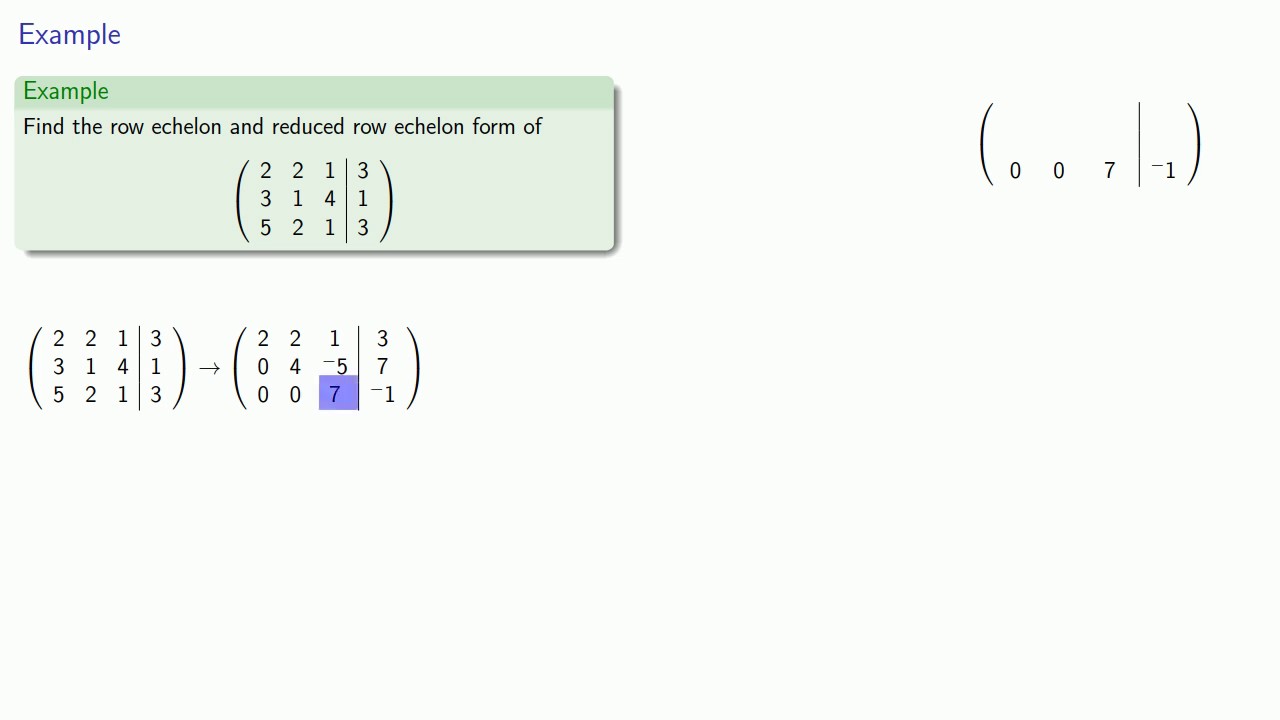
Getting a matrix into reduced row echelon form.
spark moat
spark moat
https://youtu.be/Nuoq-qdLrmo?si=0xhChLwZwMblUY_b
this is seperate from gaussian elimination
well its a type of gaussian elimination j without fractions
shadow creek
it's standard gaus
spark moat
no bc this way avoids fractions
 grave crag
 whole spruce
How do i find this point? Where the arrow is pointing
im looking for the phase shift of the function
 summer ruin
solve f(x) = 0
 potent gull
I urgently need someone who knows Calculus
 frigid trout
potent gull
I urgently need someone who knows Calculus
frigid trout
potent gull
I urgently need someone who knows Calculus
Google is pretty good at it
shadow summit
whole spruce
How do i find this point? Where the arrow is pointing
im looking for the phase s...
if you know the function of the graph, you can find the phase shift. in the form $a\cdot\sin(b(x+c))+d$, a is amplitude, b is the period, \emph{c} is phase shift and d is verticle shift. in the form $a\cdot\sin(bx+c)+d$, the phase shift is found with $\frac{c}{b}$
obsidian monolithBOT
TheLord26
 willow skiff
 open badger
2cm+4cm(4+1)
open badger
2cm+4cm(4+1)
it's 2 cm + 4 * (4 + 1) cm
shadow summit
open badger
2cm+4cm(4+1)
22cm
whole spruce
shadow summit
if you know the function of the graph, you can find the phase shift. in the form...
im suppose to write an equation for the graph, ik the amplitude, and vertical displacement, im missing phase shift and period
shadow summit
whole spruce
im suppose to write an equation for the graph, ik the amplitude, and vertical di...
Just approximate then, you aren’t given any exact values.
whole spruce
the only values im given is the numbers that are marked on the graph
shadow summit
whole spruce
the only values im given is the numbers that are marked on the graph
If that is all the information you have got, then this is the answer: $y=6\cos\left(\frac{2\pi}{3}\left(x+\frac{\pi}{24}\right)\right)-2$.
obsidian monolithBOT
TheLord26
 shadow summit
potent gull
I urgently need someone who knows Calculus
shadow summit
potent gull
I urgently need someone who knows Calculus
What with?
 fervent crag
What do I need to know before I venture into calculus?
whole spruce
shadow summit
If that is all the information you have got, then this is the answer: $y=6\cos\l...
is there an equation i can use to find the phase shift or period?
shadow summit
whole spruce
is there an equation i can use to find the phase shift or period?
Count.
Basically what I did was counted how big each of those units are, which was pi/24, from there it was pretty easy.
 worn cove
fervent crag
What do I need to know before I venture into calculus?
worn cove
fervent crag
What do I need to know before I venture into calculus?
trig
and a good amount of algebra
worn cove
yeahh
i gotta step up my algebra game more ngl
im not in college still but next semester, i'll be taking up basic calculus
shadow summit
worn cove
im not in college still but next semester, i'll be taking up basic calculus
The most important things that you should revise is logarithms, exponents, fractions. (At least that’s what I think)
Also if you’ve done complex numbers before those are pretty annoying to divide.
 arctic sundial
Help

I don’t understand why it’s not the thing I circled on the top (not the answer)
Isn’t converting it to a different time rate make it like that?
shadow summit
arctic sundial
Isn’t converting it to a different time rate make it like that?
Because the value increase one per month, it stands to reason that it will increase 12 times per year. And because t is time in years, you have to multiply the value by 12.
What you have done is multiplied 12 (the number of times the price increase per year) by t/12, which cancel out, thus leaving you with just t.
And because the price doesn’t increase only once per year this is wrong.
arctic sundial
Omg Ty so much
fervent crag
shadow summit
Calculus is 90% algebra
Okay I can do most algebra
Trig needs more work
tender mist
For a bit of background context, I'm technically not in school right now, and haven't been for a little while, so while I have taken pre-calculus before, I'm a bit rusty. I understand what the question is asking me to do, but I'm not sure how I'm supposed to go about doing it. Can anyone tell me what formulas or rules I'm supposed to use on this one? Not necessarily asking for the answer (you can provide if you want, I don't mind), I'm just curious about the process itself

 elder bane
Help, what are the rules for integrals
 warped cipher
elder bane
Help, what are the rules for integrals
warped cipher
elder bane
Help, what are the rules for integrals
,tex .int rules
obsidian monolithBOT
Akira (fumo)

 left zodiac
i was doing random stuff with exponents when i found smth weird
so i have x^x right, and it's defined on [0;+infinity[ since apparently 0^0 is 1
but as far as i know you can write x^x as exp(xln(x)) which cannot be defined on 0
my question is where did i go wrong, is there something i didn't do correctly when i rewrote x^x ?
summer ruin
because 0^0 is not 1, it's undefined
tender mist
tender mist
For a bit of background context, I'm technically not in school right now, and ha...
What about this? I've been having trouble with this, lol
left zodiac
summer ruin
because 0^0 is not 1, it's undefined
ah, i've seen from some sources that it's 1
thanks
summer ruin
tender mist
What about this? I've been having trouble with this, lol
draw the picture
shadow summit
left zodiac
ah, i've seen from some sources that it's 1
Pro tip for math: don’t mess with 0.
left zodiac
i guess i'm just gonna


 gentle sapphire
Guys, what algebra and trigonometry do i need specifically to be able to understand calculus?
shadow summit
left zodiac
i guess i'm just gonna
👍
summer ruin
gentle sapphire
Guys, what algebra and trigonometry do i need specifically to be able to underst...
all of it
left zodiac
gentle sapphire
Guys, what algebra and trigonometry do i need specifically to be able to underst...
a whole lot of algebra
idk about trigonometry
but probably all of it too
shadow summit
summer ruin
all of it
Lol I thought that as well when I first read the message.
gentle sapphire
summer ruin
all of it
all of the algebra and trigonometry? wdym by that? Everything that has been published? 😄
shadow summit
Google “what does a pre calculus course have”
summer ruin
everything that's part of the school algebra and trig course
left zodiac
 shadow summit
left zodiac
shadow summit
left zodiac
Ahh yes, my favourite precalculus course, Algebra A.
Once again, calculus is 90% algebra
tender mist
summer ruin
draw the picture
I generally know what it looks like, the problem is I'm not sure about the equations. I don't think I'm supposed to find the answer with a graphical solution
summer ruin
it's not like the exercise explicitly forbids you to use valid mathematical tools?
tender mist
Of course, but I'm pretty sure there's an algebraic solution, no?
summer ruin
once you draw the picture the equations will be obvious
I mean if you can't even visualize the problem in your head and what it's asking, then it's not clear how you would come up with algebraic solution
 kind topaz
taylor series
tender mist
I wouldn't have a problem with the question if it was asking for just a function period. But it's asking about the function of the slope. I'm not sure how to create the final answer based off of just that variable
summer ruin
try to figure out the slope of the line joining P with the origin first
tender mist
And is a graph required to do that? Like I can't do it any other way?
summer ruin
depends on how well you understand what the problem is asking
you already given the information what the coordinates of P are technically
in the problem statement
tender mist
The problem is, I don't know how to find the coordinates. I was trying to find them earlier, but I must've been doing it wrong. That's why my original question was asking what equations or rules I have to use to find it. I've done a problem like this before, but it was years ago, and I'm just rusty
summer ruin
suppose P has coordinates (p_1, p_2) and you're given that P lies on the graph of f(x) = sqrt(x)
what can you say about coordinates of P now?
and it being in the first quadrant
shadow summit
Try graphing stuff on Desmos.
tender mist
Am I just misunderstanding the question?
shadow summit
What do you think the question is asking?
tender mist
I thought it was asking what point on the unit circle had the same point as a point on the line of sqrt(x). I know, I know, the question didn't explicitly mention it, but I assumed because of the word "quadrant", I think that threw me off
Am I only worrying about the sqrt(x)?
shadow summit
tender mist
I thought it was asking what point on the unit circle had the same point as a po...
You understanding of the question is incorrect. A quadrant means the positive/negative values of x and y (google Cartesian plane quadrant). And you are trying to find the slope of a point passing through y = sqrt(x).
shadow summit
Yes
tender mist
Okay, thanks, that simplifies what rubbish I was trying to assume it meant, lol
That should be good, I think I know what to do now
shadow summit
The first quadrant is whenever the x and y values of a point are both positive (in this case every point you are working with should lie in the quadrant).
tender mist
Right. I just never heard that term outside of trig when I used to go to high school, so I always treated it as a "trig term"
shadow summit
Understandable.
shadow summit
tender mist
Right. I just never heard that term outside of trig when I used to go to high sc...
If you need any more help I’ll probably be around
tender mist
Aighty thanks. I should be fine for now. I'm actually not looking at a pre-calculus textbook, I'm doing calc, but I'm in the first chapter which consists of pre-calc stuff, so I'll probably stick around here for now
Actually one more thing. What is meant by a "natural domain"? I don't think that term ever showed up where I went to school. I know about domain, but I don't know what a natural domain is
shadow summit
tender mist
Actually one more thing. What is meant by a "natural domain"? I don't think that...
Well the domain is what you set it as, and the natural domain is what is defined by the essence of the function. Take f(x)=sqrt(x) for example. It’s domain is everything in the first quadrant, not because you defined it as that, but because that’s just how the function is.
tender mist
So depending on the question, they can mean exactly the same thing, if there wasn't a domain restriction, since natural domain has no restrictions except what the function itself has. Gotcha
I figured that's what it was, but I was confused, lol
shadow summit
tender mist
I figured that's what it was, but I was confused, lol
Don’t worry, you might not be used to how some text books say or do things.
My teacher absolutely hates a certain textbook because of how it says stuff.
tender mist
Yeahh, I think my schools always had their own sources, so I'm not familiar with math textbooks in general
shadow summit
I got used to it cuz I used 3 different text books.
tender mist
Dang, nice. Right now I'm using Thomas' Calculus book. I know this covers like 3 courses in 1 book, but it should still be helpful anyway
shadow summit
Nice, might check it out.
shadow summit
Well, I’ve got some time to kill later today. I’ll get a start on it so I don’t feel lazy.
whole spruce
can someone help me find the phase shift of this cosine graph

 unkempt drift
can any one solve this
 brisk adder
whole spruce
can someone help me find the phase shift of this cosine graph
brisk adder
whole spruce
can someone help me find the phase shift of this cosine graph
There is none or it depends really
warm oyster
unkempt drift
can any one solve this
$\int \rm{x^n dx}= \rm{nx^{n-1}}$
obsidian monolithBOT
ഴajat
 warm oyster
and then put the limits
unkempt drift
ok thanks
whole spruce
brisk adder
There is none or it depends really
yes, youre right! there is none.
 delicate bloom
warm oyster
$\int \rm{x^n dx}= \rm{nx^{n-1}}$
delicate bloom
warm oyster
$\int \rm{x^n dx}= \rm{nx^{n-1}}$
No, that’s the derivative instead
 scenic coral
obsidian monolith
**ഴajat**
scenic coral
obsidian monolith
**ഴajat**
Yea that's just wrong
$\text{power rule}\ \int x^n dx = \frac{1}{n}x^{n+1} + C\ \text{and then use fundamental theorem of calculus} \ \int_{a}^{b} f(x)dx = F(b) - F(a) \ \text{where b > a and F(x) is the antiderivative of f(x)}$
obsidian monolithBOT
someone1010

 stuck harbor

are the vertical asymptotes 4 and -3
it says it’s only 4 on mathway
but i think i’m supposed to plug in -3 and 4 on the number to find the limits
scenic coral
stuck harbor
it says it’s only 4 on mathway
That is correct
If the binomial cancels in numerator and denominator you get a point discontinuity rather than a vertical asymptote
Ex: (x+1)x/(x+1)
,w graph (x+1)x/(x+1)
obsidian monolithBOT


 Requested by someone1010
scenic coral
Requested by someone1010
scenic coral
notice that there is no asymptote
scenic coral
Well, a/a = 1
stuck harbor
yeah
scenic coral
It doesn't go to inf bc it cancels
scenic coral
Not sure how to rigorously prove, but 4 doesn't cancels so it makes an asymptote, though that's not a satisfying explaination
stuck harbor
ok
stuck harbor
stuck harbor
is because the x+3 already cancels out
so in other words is this right too
scenic coral
stuck harbor
is because the x+3 already cancels out
Probably
 untold adder
Is this the notation of a primitive function ?
 summer ruin
it's second derivative
untold adder
Thanks.
warm oyster
delicate bloom
No, that’s the derivative instead
oh yea lmao didnt noticed that lmaooo
 lunar creek
Total number of calls:
We know that the average number of calls per hour is 30. Therefore, the total number of calls in 150 hours follows a Poisson distribution with parameter (\lambda = 30 \times 150).
Number of men in calls:
Since 60% of the calls are made by men, we can consider the number of men in 150 calls as a binomial random variable with parameters (n = 150) and (p = 0.6).
Waiting time for reward:
The time between calls follows an exponential distribution with parameter (\lambda = 1/30) (since there are on average 30 calls per hour). So, the total time elapsed before the 100th call arrives is a sum of 100 exponential random variables.
For calculate these probabilities, we use the approximate Poisson distribution for the sum of independent random variables. The Poisson distribution can be used when the number of events is large, and the probability of success for each event is small.
In detail, you can use the Poisson distribution approximation for a binomial random variable when the number of trials (n) is large and the probability of success (p) is small.
For the first point, you want to find the probability of having at most 75 men in 150 calls, we can use the binomial distribution.
For the second point, we want to find the probability that the waiting time for the hundredth call is at least 3 hours, we can use the Poisson distribution.
@viscid thistle
obsidian monolithBOT
☆⃞゙۪ ᪤hiִgh࣪nᧉ͟s̲s: 🫶🏻 𝖨𝘇𝗓𝕪 ܲ 𖧪
 lunar creek
[ P(X \leq k) = \sum_{i=0}^{k} \binom{n}{i} p^i (1-p)^{n-i} ]
- ( n = 150 ) (total number of calls)
- ( p = 0.6 ) (probability of a call being made by a man)
- ( k = 75 ) (maximum number of men)
Calculate is
[ P(X \leq 75) = \sum_{i=0}^{75} \binom{150}{i} (0.6)^i (0.4)^{150-i} ]
For the second point, you use the Poisson distribution to calculate the probability that the waiting time for the hundredth call is at least 3 hours. The formula is:
[ P(T \geq 3) = 1 - P(T < 3) ] - ( \lambda = 1/30 ) (rate of calls per hour)
- ( T ) is the sum of 100 exponential random variables with parameter ( \lambda )
Calculate is
[ P(T < 3) = \sum_{i=0}^{299} \frac{(1/30)^i e^{-1/30}}{i!} ]
In the end:
[ P(T \geq 3) = 1 - P(T < 3) ]
obsidian monolithBOT
☆⃞゙۪ ᪤hiִgh࣪nᧉ͟s̲s: 🫶🏻 𝖨𝘇𝗓𝕪 ܲ 𖧪
 viscid thistle
lunar creek
<@456226577798135808> <@696818171100921918>
viscid thistle
lunar creek
<@456226577798135808> <@696818171100921918>
thank you very much, will look into it
lunar creek
Np
viscid thistle
lunar creek
Np
can you also explain the second one?
lunar creek
viscid thistle
can you also explain the second one?
Sure
You can use those methods:
• Method of Moments:
The method of moments uses sample moments to estimate the parameters of a distribution. In the case of an exponential distribution like this one, the first sample moment is equal to the expected value of the distribution. So, we need to equate the first sample moment to the first theoretical moment. For the exponential distribution, the first theoretical moment is ( \frac{1}{a} ).
Calculate the first sample moment (( \bar{X} )) and solve for ( a ):
[ \bar{X} = \frac{1}{a} ]
[ a = \frac{1}{\bar{X}} ]
• Maximum Likelihood Method (ML):
The maximum likelihood method finds the value of the parameter that maximizes the likelihood function. For the exponential distribution, the likelihood function is given by:
[ L(a) = \prod_{i=1}^{n} a^2x_i e^{-ax_i} ]
It's often more convenient to work with the logarithm of the likelihood function (log-likelihood):
[ \ln L(a) = \sum_{i=1}^{n} [2\ln(a) + \ln(x_i) - ax_i] ]
Take the derivative with respect to ( a ) and set it equal to zero to find the value that maximizes the log-likelihood.
obsidian monolithBOT
☆⃞゙۪ ᪤hiִgh࣪nᧉ͟s̲s: 🫶🏻 𝖨𝘇𝗓𝕪 ܲ 𖧪
 viscid thistle
lunar creek
You can use those methods:
• Method of Moments:
The method of moments uses sa...
viscid thistle
lunar creek
You can use those methods:
• Method of Moments:
The method of moments uses sa...
thank you very much
warped cipher
How's this precalc
viscid thistle
warped cipher
How's this precalc
thats what im fuckin sayin
technically 1+1=2, is pre calc
viscid thistle
warped cipher
read the channel's description
is it before calculus: yes
 shadow creek
<@&286206848099549185>
 candid gale
matrices- my enemy-

 shadow creek
<@&286206848099549185>
shadow summit
shadow creek
what are you plugging into your calculator? and what is the problem, is it the negative? perhaps one of your assumptions is wrong.
 blissful pier
can anybody help me with understanding the basics of transformations, translations, and dilations of a linear function?
 solemn shore
Use desmos
When 2X replaces X, less of a value is needed to replace Y value
Hence graph is factor of 1/2 along X axis
 lapis sable
shadow summit
blissful pier
can anybody help me with understanding the basics of transformations, translatio...
lapis sable
shadow summit
blissful pier
can anybody help me with understanding the basics of transformations, translatio...
what are you using to transform the line? are you using matrices or just calculus?
 proper zodiac
what are the cosh and sinh functions for, i know they exist but i’ve never seen them be used
 wraith hawk

 sinful moth
It doesnt workk
It shows different answer
x^2/(3sqrt(2)/2)^2 + (y + 21/5)^2/(3sqrt(2))^2 = 1
,help
obsidian monolithBOT
A brief description and guide on how to use me was sent to your DMs!
Please use ,list to see a list of all my commands, and ,help cmd to get detailed help on a command!
sinful moth
x^2/9+(y+4.2)^2/36=0.5

 odd cloak
how
odd cloak
brains not braining
viscid thistle
n=19
n=23,27,31
ok done
idk why my butt is itching and i see the form 2^(3n)-3^n being divisible by 5
viscid thistle
sorry i am bit drunk today
i scratched my butt and for n=3+2k for k>=2 and k=0 agrees
 kindred egret
Is anyone good at logarithms and exponentials?
shadow summit
kindred egret
Is anyone good at logarithms and exponentials?
Don’t ask a question like that. Just post the question you are resale trying to ask. Otherwise you will probably not get a response, and even if you do get a response you will have to follow up with another response to ask the question you initially wanted answered.
kindred egret
My apologies I have it posted I've just been patiently waiting
shadow summit
kindred egret
My apologies I have it posted I've just been patiently waiting
Well what’s the question?
kindred egret
It's in the channel help 37
shadow summit
kindred egret
It's in the channel help 37
Can you link the channel?
 real cloud
can anybody help me
shadow summit
real cloud
can anybody help me
just post the question bro
i swear, people just be asking for help instead of just asking the question.
 real cloud
shadow summit
note: sqrt(3)/3 = 1/sqrt(3)
real cloud
shadow summit
note: sqrt(3)/3 = 1/sqrt(3)
bro i spent 20 minutes just to get that too😭
shadow summit
 real cloud
shadow summit
are you aware of exact value triangles?
real cloud
shadow summit
are you aware of exact value triangles?
no im supposed to be by this point tho
shadow summit
real cloud
no im supposed to be by this point tho
They are pretty easy to learn, and they are basically the holy grail of trigonometry.
arctan(1/sqrt(3))=60 degrees.
x+135=60
x=60-135
x=-75
real cloud
are there any more answers or is it just -75
shadow summit
if it didnt ask for anymore solutions than you dont need any more.
real cloud
shadow summit
if it didnt ask for anymore solutions than you dont need any more.
its between 0 and 360 degrees so there can be multiple answers
shadow summit
Not that I've heard of before.
shadow summit
real cloud
its between 0 and 360 degrees so there can be multiple answers
Figure it out if you think there are more answers.
They have exact values for the side lengths of triangles with interiors 45-45-90 and 30-60-90
i said exact value triangles.
huh, ive never heard of them being refered to as anything different, neither in text books, youtube videos or from teachers.
they arent really special, other than the fact that they have some of the most commonly used angles in them, and easy to represent side lengths.
Well all triangles have constant proportional sides.
take a right angle triangle with interior angles 15 and 75.
Set one of the side lengths equal to 1.
Solve for the remaining sides.
bam, proportional triangle.
What makes it proportional then?
yes, the triangle i have just created has all 3 sides being constants.
you do know what a constant is, right?
I made them the constant, therefor anything that shares the same angles will be proportional to the triangle i made.
They just have commonly used angles.
real cloud
tanx/secx simplified is sin x right
shadow summit
Yes
 kindred egret
I have a question: what are all the rules for logarithms and exponentials?
shadow summit
kindred egret
I have a question: what are all the rules for logarithms and exponentials?

 shadow summit
real cloud
shadow summit
real cloud
This is correct.
kindred egret
shadow summit
Thank you, and which one would be the one you mentioned before? It was like a^log_a(x)=x
shadow summit
those arent all the log laws, but you should be able to do all questions using them.
kindred egret
Oh
shadow summit
here are a few more
 kindred egret
Thank you
 jolly harbor
shadow summit
here are a few more
jolly harbor
shadow summit
here are a few more
M and N must be positive factorial
shadow summit
jolly harbor
M and N must be positive factorial
it says that in the second image, the one you replied to.
jolly harbor
shadow summit
it says that in the second image, the one you replied to.
I’m making a joke with ! And factorial
shadow summit
oh
im too tired to realise
dammit
i should have picked up on it, i love those kinds of jokes.

 shadow summit
 severe musk
anybody here 😭
severe musk
anybody here 😭
It’s just a trig function. Tan(31)=450/x
 shadow summit
kindred egret
shadow summit
kindred egret
It means you’ve messed up.
Try dividing the entire equation by a constant (hint:||3||)
kindred egret
shadow summit
Try dividing the entire equation by a constant (hint:||3||)
Which equation?
shadow summit
kindred egret
Which equation?
3x+9z. It’s the only one I can see, so there might be an easier way to go around solving it.
kindred egret

I'm trying to find x,y,z
At this stage I would find out what x was but it becomes zero?
The calculator says I get
z=z
x=0-3z
y=6+z
But idk how
shadow summit
I don’t have a piece of paper on me rn, but start by doing equation 2-3(equation 3)
kindred egret
shadow summit
I don’t have a piece of paper on me rn, but start by doing equation 2-3(equation...
You're saying 2-3 then plug that into equation 3?
That gets me 0 = 0 I've tried
shadow summit
kindred egret
You're saying 2-3 then plug that into equation 3?
Solve for y and z first.
Do you know how to calculate where two lines meet?
kindred egret
shadow summit
Solve for y and z first.
Yes, using elimination I got 0 = 0
kindred egret
shadow summit
Do you know how to calculate where two lines meet?
Huh
shadow summit
kindred egret
Yes, using elimination I got 0 = 0
Check back in your working out, are you doing -(eq3), remember into distribute the -1 onto all terms?
shadow summit
kindred egret
Huh
Because if you focus on eq2 and eq3 by them selves, it is the same process for finding the values of y and z.
kindred egret
shadow summit
Check back in your working out, are you doing -(eq3), remember into distribute t...
So I do
-(y-z)=6?
I get -y+z=-6
What i do with this
shadow summit
kindred egret
What i do with this
Multiply it by 3 giving you -3y+3z=-18
Then add the second and third equations together
kindred egret
That make zero?
shadow summit
kindred egret
That make zero?
No it doesn’t.
Wait
I’m getting confused with something else
shadow summit
Lemme just go do this on paper rq
kindred egret
Okay
Appreciate it
Considering one of the equations I got was x+3z=0, and the calculator says x is supposed to be 0-3z, it looks to me I'm supposed to get x by itself? But why
And how does z=z
shadow summit
Does this question come from a textbook?
kindred egret
Nope
shadow summit
So you created it?
kindred egret
No
shadow summit
Where’s this question from then?
kindred egret
It's a practice question generated from a professor
shadow summit
Uhhh
kindred egret
But the calculator provides answer
shadow summit
What does calculator give you?
kindred egret
X = 0-3z
Y = 6 +z
Z = z
kindred egret
kindred egret
Considering one of the equations I got was x+3z=0, and the calculator says x is ...
I was saying here
shadow summit
Wait
kindred egret
Ok
shadow summit
You’ve got 5 equations?
kindred egret
I made the next 4 and 5
shadow summit
Huh
kindred egret
3 were the question part
shadow summit
Are you trying to find z?
kindred egret
I'm trying to find x,y, and z
kindred egret
Yeah but what is the reason we write the answers like that
shadow summit
When I say “find z”, I mean like, it’s value (4, 19, 3.14, ect)
And if the calculator just says z=z, that means it’s impossible.
kindred egret
I see so since I got 0 = 0 it's impossible to find z and we have to write x and y in a different way
?
I think it's like you have to write x and y in relation to z
shadow summit
Put it this way, it’s like trying to the intersection point of two lines, but the they are the same line. So there is no single intersection point.
kindred egret
Yeah
shadow summit
That means the value of z does not exist.
kindred egret
What abt x and y
shadow summit
Well considering how we can’t solve for x or y without using z, it means that they are also impossible to find.
kindred egret
Oh
shadow summit
This happens because eq2 and eq3 are just the same equation.
kindred egret
but the calculator gave an answer?
shadow summit
No
kindred egret
No?
shadow summit
I used a calculator to check if there were any solutions and it basically just said it impossible.


 shadow summit
Well it tells you x=-3z, and because there is no value for z it is impossible.
 willow skiff
the two roots can be the same
you're missing the part "counted with multiplicity"
so (x - 0)^2 tells us that x = 0 is a root with multiplicity 2
 solemn notch
Does anyone have a roadmap or website I can follow
To learn pre calc and calc
Properly simply and correctly
Without confusing shoot
Like excsersises and stuff toowebsute
Too website*
willow skiff
solemn notch
Does anyone have a roadmap or website I can follow
Paul's Online Maths Notes
 zenith vapor
Help me pls
 viscid thistle
OMG I thought I got banned for no reason.
shadow summit
zenith vapor
Help me pls
What is the question asking?
 clever dock
Someone give me any clue about what to do please. I don't even know where to start lmao.
The exercise asks to develop (1+n)^n with Newton's binomial and derivate the result of that in order to prove those identities.
Any clue would be very helpful

 light forge
clever dock
Someone give me any clue about what to do please. I don't even know where to sta...
light forge
clever dock
Someone give me any clue about what to do please. I don't even know where to sta...
Did you start off by developing (1+x)^n ? If so what did you get?
clever dock
light forge
Did you start off by developing (1+x)^n ? If so what did you get?
I tried to develop it as the sumatory definition of the newton's binomial, and when I tried to derivate it I almost got the first identity, but it wasn't so easy. This is what I got

I probably have made an error, but idk where
the other stuff I have are just random calculations in case I came up with sth, but that led me to nowhere
shadow summit
the original question starts with k=1, not k=0.
shadow summit
clever dock
cant you use proof by induction?
clever dock
shadow summit
the original question starts with k=1, not k=0.
Yeah I know, that was one of the things I was not sure about what to do
clever dock
shadow summit
cant you use proof by induction?
Probably that's the method to get the answer right, but tbh, we haven't used so much induction, so I would still don't know where to start lmao
shadow summit
clever dock
Probably that's the method to get the answer right, but tbh, we haven't used so ...
Expand the sum and it will make proof by induction very easy.
shadow summit
clever dock
Probably that's the method to get the answer right, but tbh, we haven't used so ...
You are trying to prove the binomial theorem correct?
Anyways, I can’t help rn, I’m on my phone. I would’ve helped earlier though but its 12am now.
clever dock
shadow summit
You are trying to prove the binomial theorem correct?
I'm trying to, by developing (1+x)^n amd derivating it, prove the two identities shown in the image, I don't think I have to prove the binomial theorem
I'm not sure but I think it supposes that it has been already demonstrated
clever dock
shadow summit
Anyways, I can’t help rn, I’m on my phone. I would’ve helped earlier though but ...
Don't worry, I'll try sth, thanks a lot
 whole void
zenith vapor
Help me pls
whole void
zenith vapor
Help me pls
haven’t taken precalc yet
but if find f(0)
u gotta evaluate 1/2 + 2/4 + 3/8 + 4/16 + …
which is two and there’s only more choice that matches up to this
 grim maple
 shadow summit
viscid thistle
How do you draw this?
shadow summit
viscid thistle
How do you draw this?
How accurate do you want your graph to be?
Because you can jus make a table of a points that lie along the graph.
If that’s the level you are at
viscid thistle
shadow summit
How accurate do you want your graph to be?
Hmm would that matter?
I have a question that’s kinda irrelevant to that i think
basically The height of a tree in centimeters t years after it was planted, is given with the function shown
Then I need to determine grapgically the momentary growth rate after 10 years
viscid thistle
shadow summit
How accurate do you want your graph to be?
very accurate
shadow summit
Honestly, I forgot how to do this without derivatives.
So if you are at the level where you can use derivatives and set the equal to 0, just use the first derivative to find the turning points, the second derivative to find the inflection point, and then just plug all those bales back into h(t).
But if your not at that point, idk.
viscid thistle
shadow summit
Honestly, I forgot how to do this without derivatives.
😭
and there goes my help
I’ve tried deriving
shadow summit
Sorry mate
viscid thistle
viscid thistle
I’ve tried deriving
let’s just say it went horrible
this midterm went HORRIBLE
I’m so far behind it’s outrageous
viscid thistle
shadow summit
So if you are at the level where you can use derivatives and set the equal to 0,...
I need to factorize before deriving no?
shadow summit
$h’(t)=-\frac{1}{10}t^{2}+5t$
obsidian monolithBOT
TheLord26
 shadow summit
Set h’(t)=0 to find the x value for the turning points.
viscid thistle
oh God…
shadow summit
viscid thistle
How did it come to that conclusion?
That is the first derivative.
viscid thistle
I’m so tired rn
shadow summit
viscid thistle
I’m so tired rn
Bro this is my 2nd day without sleep and I just did a derivative in my head. I am relying on autocorrect to not mess up.
viscid thistle
Yes but you’re an undergraduate or a graduate 😂
a math major perhaps
I’m a preuni student
shadow summit
Don’t have school rn.
viscid thistle
shadow summit
Bro this is my 2nd day without sleep and I just did a derivative in my head. I a...
also why tf would you torture yourself 😭
Sleep!!!
Are you trying to hallucinate?
shadow summit
Well I can’t sleep now, it’s 6:17am
 tranquil gull
What are you studying
shadow summit
tranquil gull
What are you studying
This is a precalc channel, so precalc ig?
Anyways I’m going I don’t have the mental strength for math rn.
tranquil gull
shadow summit
This is a precalc channel, so precalc ig?
Lol sorry im new
Not new actually
 tender questBOT
The purpose of this server is to help you learn, not to hand out answers. Do not ask someone to give you the answer directly.
untold adder
Use this property, and you'll find the answer.
 restive carbon
whats good to study for a pre cal test ?
uncut mulch
algebra, functions, geo, trig, exponents, logs
 near viper
can someone explain?
 willow skiff
near viper
can someone explain?
willow skiff
near viper
can someone explain?
which part?
near viper
willow skiff
which part?
part a pleawe
hushed sphinx
Compute the first few terms by hand -- do you see a pattern?
near viper
grows by 2n
willow skiff
near viper
grows by 2n
really? that would mean the population after 1 hour would be 2,200
near viper
willow skiff
really? that would mean the population after 1 hour would be 2,200
oh 2 to power of n
right:
willow skiff
stop guessing
willow skiff
willow skiff
really? that would mean the population after 1 hour would be 2,200
you forgot to take away 1,000
near viper
(1110)2^n-1 -1000
willow skiff
near viper
(1110)2^n-1 -1000
how many are there after 1 hour?
near viper
willow skiff
how many are there after 1 hour?
wait nvm it would be 1200
willow skiff
yes
near viper
then 1400
willow skiff
near viper
wait nvm it would be 1200
now how many would there be after 2 hours?
near viper
cuz only 100 doubles i think
viscid thistle
ok
so it has to do with derivatives
which I don't have a problem with
the problem is the fricken equation
that has a cube and a square
with a fraction
 tropic coyote
alright can i look
viscid thistle
i'll just show you here
tropic coyote
maybe i can help
viscid thistle
 tropic coyote
oh that
viscid thistle
t is 10
viscid thistle
I get 216.666, but I can't derive it cuz the factor is hard
viscid thistle
tropic coyote
set t=10?
I should find the growth rate at t = 10
tropic coyote
oh
just find derivative and set t=10
wait let me solve it first so i can help
will take like 2 minutes
viscid thistle
I did that, but no avail
viscid thistle
tropic coyote
just find derivative and set t=10
lim
t --> 0 no?
tropic coyote
nah
lim
h->0
viscid thistle
that's the limit value of deriving for growth rate
viscid thistle
tropic coyote
nah
lim
h->0
yes but t is h in this case
tropic coyote
i mean you could say so
viscid thistle
wait...
viscid thistle
t is x in this case, and I wanna find the growth rate at x = 10
tropic coyote
yes
viscid thistle
so where the heck am I making an error?
tropic coyote
i got 40 as value
viscid thistle
HOW?
tropic coyote
wait let me graph it to see if im right
viscid thistle
That's the correct answer but i couldn't come to that conclusion
tropic coyote
yeah
viscid thistle
💀
tropic coyote
t is supposed to be what youre inputting into the derivative
not the difference thing in the derivative
viscid thistle
wdym
tropic coyote
like
tropic coyote
oh i was about to rewrite
tropic coyote
yes
viscid thistle
man...
tropic coyote
and you have to use another variable as variable -> 0
tropic coyote
nah you dont have to pull a limit trick