#precalculus
1 messages · Page 14 of 1
 opal vault
under the infulence
of a strong gravitational force
ex: the sun's
follow a relatively eliptical orbit
 ripe meteor
Thanks!
opal vault
hyperbolic
is when
it passes the escape speed
very easy to calc escape speed using energy eq
earths is around 11.7 i think
km/s
im not sure
fun fact: keplers 3rd law is not entirely precise 😁

 stiff nebula
You just need to figure out how many numbers can fit between 0.25 to 0.5
So try to experiment using trial & error for say 3/7, 3/8, etc until you each a fraction that is equal to 0.5
 vapid plaza
 chilly cypress
can someone help me with this
chilly cypress
can someone help me with this
Solving each half of the inequality yields x < 12 and 6 < x.
 solar olive
opal vault
fun fact: keplers 3rd law is not entirely precise 😁
solar olive
opal vault
fun fact: keplers 3rd law is not entirely precise 😁
yep, u may use newtons gravitational theorem to derive the relationship between the period and the radius
 thorn creek
also in reality there are more than two bodies in most real systems, and the three-body problem has no analytic solution in the general case
solar olive
also that
solar olive
solar olive
yep, u may use newtons gravitational theorem to derive the relationship between ...
just for curiosity,
F_grav = F_centipetral
G M m/r^2 = m a
G M /r^2 = w^2 r
G M/r^2 = (2pi/T)^2 r
G M/r^3 = 4 pi^2 /T^2
T^2 ~ r^3
 fleet pendant
solar olive
just for curiosity,
F_grav = F_centipetral
G M m/r^2 = m a
G M /r^2 = w^2 r
G M...
fleet pendant
solar olive
just for curiosity,
F_grav = F_centipetral
G M m/r^2 = m a
G M /r^2 = w^2 r
G M...
$\begin{aligned}
F_c=F_g \
\frac{mv^2}{r}=\frac{GMm}{r^2} \
v^2=\frac{GM}{r}; \left(\frac{2\pi r}{T}\right)^2=\frac{Gm}{r} \
\frac{4{\pi}^2 r^2}{T^2}=\frac{GM}{r} \
\therefore \frac{4{\pi}^2}{GM}=\frac{T^2}{r^3} \
\end{aligned}$
 obsidian monolithBOT
anonymous.h
 solar olive
ur right
thorn creek
you need some very basic calculus to do this rigorously
that said, in a two-body system the trajectories of both bodies will be conic sections
(provided that neither collides with the other)
 wind kayak
1+1 = 11😎 xd
 thorny heart
three sides and three angles = 90% geometry? sad
 warped cipher
fleet pendant
$\begin{aligned}
F_c=F_g \\
\frac{mv^2}{r}=\frac{GMm}{r^2} \\
v^2=\frac{GM}{r};...
warped cipher
fleet pendant
$\begin{aligned}
F_c=F_g \\
\frac{mv^2}{r}=\frac{GMm}{r^2} \\
v^2=\frac{GM}{r};...
Bro this isn't a physics server lmao
 steady shore
warped cipher
Bro this isn't a physics server lmao
steady shore
warped cipher
Bro this isn't a physics server lmao
i mean physics is basically maths with a few extra steps
fleet pendant
warped cipher
Bro this isn't a physics server lmao
it aint but i typed out the guy's steps
"just for curisoity"
warped cipher
steady shore
i mean physics is basically maths with a few extra steps
Oh I didn't know that
thorn creek
warped cipher
Bro this isn't a physics server lmao
we get a lot of physics questions regardless
 summer ruin
no
it's a line such that the distance between the curve and this line approaches 0
I guess you wouldn't be asking that if you knew precisely what that meant, so no
summer ruin
<@&268886789983436800>
summer ruin
opal vault
that never meets
that's not true
sin(x)/x as x-> infinity has asymptote y = 0, which is crosses infinitely many times
fleet pendant
opal vault
that never meets
ya that's like the definition my teachers gave us when I was in grade 11, it's not accurate, cross overs can occur
 prisma ember
anyone know how to find the limit of this?

x=/=5 basically, i was wondering if lim x--> 5- was undefined or 10?
 remote dune
prisma ember
anyone know how to find the limit of this?
remote dune
prisma ember
anyone know how to find the limit of this?
if approaching from the left side, yes you do use the formula given that represents the left side
 unkempt jolt
The only reason that I didn't finish precalc with a d or f last semester is entirely due to the mercy of my professor
that is despite me allocating hours daily into studying precalc, going to tutoring centers, etc.
Concepts that people understood in minutes take me hours
I might be genuinely too stupid for college
Still have no idea how to simplify radicals
 uncut mulch
post specific questions you're having difficulty with
unkempt jolt
I don't know anything confidently. I can only grasp everything very gently. Therefore, I don't really know anything and don't know where to start.
I do frequent here with specific problems, but that can only do so much
There are no good interactive courses online for doing math. Khan academy is mediocre, but others either require you to be part of an IRL class, or don't exist.
uncut mulch
khan gives a basic intro
is adequate for the basic stuff
if you have access to the content, just takes practice
 lavish adder
.
 fickle cedar
Is this true? $:x\left(x^2+1\right)^{-\frac{3}{2}}=\left(x^3+x\right)^{-\frac{3}{2}}$
obsidian monolithBOT
Chuti | Argentina
 warped cipher
fickle cedar
Is this true? $\:x\left(x^2+1\right)^{-\frac{3}{2}}=\left(x^3+x\right)^{-\frac{3...
warped cipher
fickle cedar
Is this true? $\:x\left(x^2+1\right)^{-\frac{3}{2}}=\left(x^3+x\right)^{-\frac{3...
no

 stone robin
fickle cedar
Is this true? $\:x\left(x^2+1\right)^{-\frac{3}{2}}=\left(x^3+x\right)^{-\frac{3...
stone robin
fickle cedar
Is this true? $\:x\left(x^2+1\right)^{-\frac{3}{2}}=\left(x^3+x\right)^{-\frac{3...
chat is this real
vapid plaza
no
 jaunty nebula
 cyan wave
For the upper half and lower half
notice that these are both functions
so think of how you can isolate y so that it's in the form y = f(x)
cyan wave
whats the point of this
 summer ruin
you solve the inequality (x-3)(x+2)(x+5) < 0
even though first 3 lines are unnecessary
 willow bear
summer ruin
even though first 3 lines are unnecessary
willow bear
summer ruin
even though first 3 lines are unnecessary
can be helpful
cyan wave
summer ruin
you solve the inequality (x-3)(x+2)(x+5) < 0
wut
 gritty wren
When Susan was born her aunt was 18 years old. Now her aunt is three times as old as Susan. What are their ages?
helpppp pleaseee😭😭😭
<@&286206848099549185>
 viscid thistle
gritty wren
When Susan was born her aunt was 18 years old. Now her aunt is three times as ol...
viscid thistle
gritty wren
When Susan was born her aunt was 18 years old. Now her aunt is three times as ol...
susan is 9 and her aunt is 27
@gritty wren
gritty wren
viscid thistle
susan is 9 and her aunt is 27
yes I got this but I don’t get it
viscid thistle
3x= aunt's age
gritty wren
if aunt is x + 18 and then Susan becomes 3x how is 3x equal to x + 18
 void walrus
See,
If Susan is x years old, her aunt is (x + 18) years old.
So now there current ages follow the following relation as per the question,
Susan age = 3 * Aunt age
3x = (x+18)
x =9
 gloomy rover
gritty wren
if aunt is x + 18 and then Susan becomes 3x how is 3x equal to x + 18
gloomy rover
gritty wren
if aunt is x + 18 and then Susan becomes 3x how is 3x equal to x + 18
you set them equal and find which x allows them to be equal
then you have what susan's age is
and you can use x+18 to get aunts age
viscid thistle
aunt= 9*3=27
gritty wren
I love u guys for this but I am not getting it😭😭
so Susan is x and aunt is x + 18 right
so then in three years time
Susan will be 3x
Then wouldn’t aunt be 3(x+18)
 late heart
Susan is 9
Aunt is 27
 gritty wren
tyy I know this but I don’t get how if now Susan is three times older would the x +18 also multiply by 3
 dense mango
bc to create an equation both sides must be equal
so you have to multiply the smaller age by 3
bc the older person is 3 times older
gritty wren
ohhhh
so the aunt = x + 18
but now
Susan is 3x
so
aunt now is
3x
Wait
I don’t got it
viscid thistle
no susan's current age is x
viscid thistle
u welcome
gritty wren
like literally tysm all of u😭😭😭
dense mango
lol yw
 unique schooner
gritty wren
I love u guys for this but I am not getting it😭😭
unique schooner
gritty wren
I love u guys for this but I am not getting it😭😭
Don't complicate it. It's simple,
aunt = susan + 18 years old
aunt = 3 times susan
Now you substitue,
susan + 18 years old = 3 times susan
-susan -susan
18 years old = 2 times susan
/2 /2
9 years old = susan
 civic mural
hi
 manic skiff
I need help
15x=2.6^56>-5-{-4.8^436/7*[14.097657124-43+81/43+43/43+-9803^5-(-0.87912*7^98-17%74^3-13^2=-18-)-41+86.42371/45-3113+56.9740.9-]-41/98+33/33+33/33-}-412=2091628628516.709920820. Solve for x
My brain stop work
 opal plover
manic skiff
15x=2.6^5*6>-5-{-4.8^43*6/7*[14.097657124-43+81/43+43/43+-9803^5-(-0.87912*7^98-...
opal plover
manic skiff
15x=2.6^5*6>-5-{-4.8^43*6/7*[14.097657124-43+81/43+43/43+-9803^5-(-0.87912*7^98-...
so like how did u get allat
manic skiff
opal plover
so like how did u get allat
I forgot, it just appeared…
opal plover
oh
manic skiff
So I need to find an answer or else my math experiment doesn’t work
Those people
I’m scared of them
willow bear
manic skiff
So I need to find an answer or else my math experiment doesn’t work
what math experiment?
@manic skiff did you just type out some seemingly random symbol soup?
there's a few that don't belong, namely:
...(0.87912 * 7^98 - 17% * 74^3 - 13^2 = -18**-**) ...
this equals sign and this minus right after the eighteen
and then later there is another minus sign right before a closing bracket
 gritty sage
what is the congruent equation for y = (x - 4)^2 - 1 ?
what is the range for y = -3x^2 - 6x + 9 ?
send help 😭
willow bear
wdym "the congruent equation"
do you have the full text of the problem? @gritty sage
 willow bear
ok that did not help
gritty sage
omg 😭😭
willow bear
but at least we know it's the problem's fault
no idea wtf they want for either of these lmfao

 marble leaf
willow bear
wdym "the congruent equation"
marble leaf
willow bear
wdym "the congruent equation"
haha wtf is a congruent equation
frick I didn't mean to ping
sorry for the randomish ping
marble leaf
gritty sage
anyone know any of these?
The domain of a quadratic is always all real numbers and the range of a quadratic is always y≥y vertex or y≤y vertex, depending on if the parabola opens up or down. In this case it opens up, so the range is y≥-18. The axis of symmetry is always the line x=x vertex, so the line x=4 in this case. The min/max value is just the y vertex, and u should be able to figure out if it is a minimum or maximum based on the graph.
 grave forge
gritty sage
grave forge
gritty sage
I think the congruent equation is the factorised form
So for first one just use the a² - b² identity
For the second u can easily factorise
grave forge
gritty sage
i think the x intercepts is (5,0) , (3,0)
Yes
marble leaf
grave forge
I think the congruent equation is the factorised form
oh that makes sense ig
grave forge
xd
gritty sage
thank uu
 untold spindle
<@&268886789983436800>
viscid thistle
$x^3-5x+\frac{40\sqrt{5}}{27}=0$
obsidian monolithBOT
john.1970
 viscid thistle
how can i solve this polynomial?
 wind grove
Can someone help me solve 2^x = e^(x+1)
summer ruin
e^(x+1) = e * e^x
wind grove
How did u do that?
summer ruin
that's just how exponents work
viscid thistle
viscid thistle
how can i solve this polynomial?
Well you could use the long division method
If you know how to use it
Or you could use long division
Assuming you know what the root is simplified
I think you’d have to simplify the top first 40 root 5 then do it
Using synthetic division could help once you find all of the terms
Because it’s to a degree to 3 then it makes sense
If you plan to use synthetic division you’d swap a 0 in
@viscid thistle
i'm here
Yeah, so can you simplify the root thing
what do you mean by simplify ?
Like simplify the top
It’s a 3rd degree polynomial
Do you understand that first of all? @viscid thistle
Do you understand you cannot use the quadratic formula as well
You want to solve right not factor? @viscid thistle
yes
Okay
like i just need the values of x that hold this equality
but i don't how to do that
Yes, you’re solving for X correct?
You’re not factoring right?
you suggest doing horner methkd and euclidean division but i don't see how is that applicable
viscid thistle
viscid thistle
You’re not factoring right?
no
wouldn't be the same if i'm factoring ?
like i will have to find the values of x for this equality
You’re not factoring though
So you cannot use any factoring methods
You need to simply isolate x
I don’t think you can factor
If you do then you’d withhold like 4 answers
You’d have to check if some are extraneous
@viscid thistle okay you need to use synthetic division.
Once you use synthetic division I assume you’d know the factors
Once you find the 2 factors you’d just solve for it
The last term you’d have to simplify
You’d essentially go 1, 0, 5, last term whatever it is
Then use synthetic division to solve
That’s the best way I can think of
can i ask you a question@viscid thistle
viscid thistle
viscid thistle
can i ask you a question<@456226577798135808>
Yeah
you mean using the synthetic division on an arbitrary element a?
I mean you wouldn’t know what to use for the last term unless it is simplified
cause you’d have to use either a fraction, or a whole number whatever works
It’s to the 3rd degree you cannot follow up with a 2nd degree
Essentially using long division method, or synthetic works if you know all the terms
@viscid thistle let me explain it more simply. Do you understand how a polynomial works as in x3, x2, x
Basically if it goes x3, x, (term) you have to use something called synthetic division, and replace the x2 with zero
Assuming you use the method
untold spindle
<@&268886789983436800>
 warm patio
Should i go back and review matrices / conic sections or can i go into more advanced math classes without knowing
 clever parcel
In my example, why is it said that equality occurs at a=2, b=c=d=0. It can also occur at a=b=c=d= fifth root of 8, or some other random combinations of a b c d.


And when you have to prove an inequality by splitting it up into smaller ones, those smaller inequalities may equal at 2 or more numbers, then which one do I choose? In my example, the equality cases for those helper inequalities were either 0 or 2. I could pick one number equal two and the rest equal 0 because I was working with a concrete number (32). If I was given something non-specific, I probably would have thought that equality occur at a=b=c=d=2.
 autumn wadi
Me when I walk into precalc after 10 years and the first thing I see is a mod ping:
breathes in "the good ol' smell of #precalculus "
grave forge
Sad
 late geyser
clever parcel
In my example, why is it said that equality occurs at a=2, b=c=d=0. It can also ...
late geyser
clever parcel
In my example, why is it said that equality occurs at a=2, b=c=d=0. It can also ...
a=b=c=d=fifth root of 8 doesn't satisfy the assumed equality.
clever parcel
late geyser
a=b=c=d=fifth root of 8 doesn't satisfy the assumed equality.
eh? why?
late geyser
,w compute 4(8^(1/5))^4
obsidian monolithBOT


 Requested by zybikron#0
late geyser
Requested by zybikron#0
late geyser
it's not 16
late geyser
read the first line of your problem.
clever parcel
ye?
late geyser
your choice of a,b,c,d don't satisfy that inequality. So those values don't work for a,b,c,d
clever parcel
i see i see
clever parcel
clever parcel
And when you have to prove an inequality by splitting it up into smaller ones, t...
can you help me w this too?
 jolly sparrow
hey, i wanted to ask what seperates precalc from algebra?
opal vault
jolly sparrow
hey, i wanted to ask what seperates precalc from algebra?
not much
imo its pretty useless
just know ur trig and e shit
viscid thistle
hey guys
quick question
what all does one need to know before going into calculus
because I know algebra 1, conic sections, I think most of algebra 2 (still a bit weak on probability and statistics), and trig
is that enough?
warped cipher
ever started with logarithmic and exponential functions?
 stark stream

 restive plinth
How to do this question?

 marble mauve
You have to use number theory
Basically you have 3 digits you have to place
And 7 numbers
The restraint is that you can't start with zero(Problem a)
So the possibilities for the first digit is 7
The second digit also has 7 possibilities(1 number is used up)
The final digit has 6
The rest is fairly simple
vapid plaza
marble mauve
You have to use number theory
This aint number theory tho🗿
 celest glade
It kinda has to use number theory it seems though
But yeah this is something like finding the number of cases problem
vapid plaza
I guess the only thing slightly “number theoretic” Is the fact that even numbers have even last digit
 craggy solstice
f ( x ) = 3 − 21 · e − x , x ∈ R .
Task: The straight line with the equation y = 12 x + 25 is a tangent to Kf . Describe how to obtain the coordinate of the corresponding point of contact
I dont know how to describe it
wait is this the wrong chat?
opal vault
viscid thistle
because I know algebra 1, conic sections, I think most of algebra 2 (still a bit...
not much, just be very thorough with ur algebra knowledge, it would help if u knew algebra 2 but not much. also u need to have extensive knowledge in trig, trig identities, the graphs, the equations, all of that. also make sure u know logs and exponential stuff, that always helps but if u have a good book, it should teach u a lot abt logs itself.
calc is more like another idea like algebra is, so instead of having like addition and subtraction, u have like derivatives and integration
so in my opinion u dont need to know a looot of knowledge to dive into calc just make sure u grasp the ideas rather than memorizing the identities
cause there are too many to mem
 jaunty crow
In the function (x-4)^2
The interval will be [0, infinity) or (0, infinity)?
 main rapids
hello guys i need a bit of help with this question and im not too sure on how to go about it

this question as well
 opal vault
it gets hella confusing once u get to integration in my opinion
im talking abt when u learn stuff like u sub or integration by parts
trig sub especially
main rapids
opal vault
trig sub especially
i can do basic differentiation and integration
im just having some issue understand what is going on
applications for me is kinda hard
no as in this topic is applications of ... because its not just the thing by itself but your doing it in an irl scenario, like normal calculus is basically having the eqn and just having to do the math, you need to understand what they're saying
opal vault
main rapids
no as in this topic is applications of ... because its not just the thing by its...
that comes when u understand
the concepts
main rapids
opal vault
that comes when u understand
mhm
opal vault
 inner stag
how do you understand them
inner stag
how do you understand them
yeah im not one with math either
unfortunately
but i mean that if someone gives u a calc prob, u should understand what it is asking for, and be able to apply the right tools to solve it
and some theorems/methods for example finding volume, should be kinda instinctive and something u can derive everytime rather than mem
cyan wave
can i get some help with this
 viscid thistle
warped cipher
ever started with logarithmic and exponential functions?
viscid thistle
warped cipher
ever started with logarithmic and exponential functions?
yep
I know ln and how to convert to exponenetial form
will I need to know about polar coordinates?
 burnt nymph
I'm trying to test out Descartes Rule of Signs with R. This function afaik should have 3 sign changes, and with it 3 possible x-intercepts or one positive x-intercept:
#### Function 1 ####
fx1 <- function(x){
  (-4*x^7) + x^3 - x^2 + 2
} # 3 sign changes (from pos to neg), 1 pos x int.
When I plot it, it gives me one positive x-intercept, which looks like it matches:
#### Check Intercept ####
ggplot()+
  geom_function(fun=fx1,
                xlim=c(-1,1))+
  geom_vline(xintercept = 0,
             linetype = "dashed")+
  geom_hline(yintercept = 0,
             linetype = "dashed") # only crosses once as expected

However, when I evaluate f(-x), I get unexpected results
The negative should be coded like so:
#### Evaluate Negative Fx ####
fx1.neg <- function(x){
  (4*x^7) - x^3 - x^2 + 2 # change all odd powers to -
} # 2 sign changes, 0 negative
And when plotted:
ggplot()+
  geom_function(fun=fx1.neg,
                xlim=c(-1,1))+
  geom_vline(xintercept = 0,
             linetype = "dashed")+
  geom_hline(yintercept = 0,
             linetype = "dashed")
The relationship is opposite of the last result, however, the x-intercepts don't match

If using Descartes rules, shouldn't this have either 2 or 0 negative x intercepts?
 warm jay
abc for apple juice
burnt nymph
?
 fierce anchor
is a definite integral treated as a cosntant
 charred frigate
fierce anchor
is a definite integral treated as a cosntant
charred frigate
fierce anchor
is a definite integral treated as a cosntant
it depends. if the bounds are constant, then yes.
$f(x)=\int_0^x2s\dd s$ is a definite integral which is not a constant
fierce anchor
OHHH SHIT TRUEEE I FORGOT THAT THE BOUNDS CAN BE PARAMETERS AND SHIT
SO FUCING REAL FOR HTAT
then
how would you differentiate something like that
because i was gonna differentiate this integral but then i thought nothing would happen because it would be treated as a constant, but i have a parameter t in the bounds

wait maybe i just integrate then differenatiate
with respect to t
obsidian monolithBOT
nixxy nilpotent (raving lunatic)
 charred frigate
fierce anchor
how would you differentiate something like that
charred frigate
fierce anchor
how would you differentiate something like that
if it's just the parameter by itself, it's easy
$\dv{x}\int_a^xf(s),\dd s=f(x)$
obsidian monolithBOT
nixxy nilpotent (raving lunatic)
 warped cipher
viscid thistle
will I need to know about polar coordinates?
warped cipher
viscid thistle
will I need to know about polar coordinates?
yes
 thorn hare
 glass dove
fierce anchor
OHHH SHIT TRUEEE I FORGOT THAT THE BOUNDS CAN BE PARAMETERS AND SHIT
glass dove
fierce anchor
OHHH SHIT TRUEEE I FORGOT THAT THE BOUNDS CAN BE PARAMETERS AND SHIT
just asking, but aint that calculus?
glass dove
@vocal current @crystal sky if $f(x)=\frac{x^2}{2} - x+7$ then what is $f(3)?$
 vocal current
17/2
obsidian monolithBOT
Belgian
 glass dove
vocal current
17/2
glass dove
vocal current
17/2
how
vocal current
plug in x
glass dove
replace the x with 3
vocal current
ye
vocal current
yeah
vocal current
well i like fractions better sometimes
obsidian monolithBOT
Belgian
 vocal current
are you doing hw
vocal current
idk
vocal current
yeah
celest glade
glass dove
you just expressed it the hard way
Fyi fractions are much more frequently used than decimal points when it comes to calculus
But as long as the value is correct it works
glass dove
This is precalc
 opal tree
Decimals kinda stinky
 dense grail
yoo
 wise marsh
 crystal sky
17/3
crystal sky
17/3
What question u answering because for the one above that's wrong
wise marsh
Bruh ur just trolling
wise marsh
crystal sky
3x=1 slove
x= -1/12
crystal sky
Nice
viscid thistle
Focusing on the epsilon delta definition of a limit, why is the derivative of the function multiplied by delta equal to the value of epsilon?
 hushed sphinx
That doesn't even make sense.
viscid thistle
But it works like that
I think,m
?*
I might have been unclear
Ok so this is the limit, ignore the language
 obsidian monolithBOT
 viscid thistle
You take the derivative of the function and multiply it by delta and for some reason it gives the value of epsilon, I think. I'm not sure if I.may be wrong

This is the classic way anywaus
 hushed sphinx
If you're looking at a correct limit, there will be some pairs of epsilon and delta that have the property in the limit definition. The definition requires that for each epsilon, there must be at least one delta that works-- but if there is one delta that works, there will be many that work, and they won't all have the same ratio to the epsilon they were chosen for.
viscid thistle
What does that conclude
hushed sphinx
That it makes no sense to say "the derivative of the function multiplied by delta equal to the value of epsilon".
viscid thistle
Ok but how should I call that process anyways and why does it occur?
 stark shuttle
State how many complex and how many real zeros the function has: f(x) = x^3 - x + 3
viscid thistle
?
fierce anchor
glass dove
just asking, but aint that calculus?
i think so but idk where to put it
im a high school student in australia and we dont call it ap calculus, or caluculus or whatever, it goes in levels of standard, advanced, ext 1 and ext 2
atleast in the state that i am in..
how come there is no claculus chat
dont you guys also have a calc curriculum?

 lucid trench
fierce anchor
how come there is no claculus chat
lucid trench
fierce anchor
how come there is no claculus chat
it's in the early university section
fierce anchor
section is missing for me 😭
celest glade
viscid thistle
You take the derivative of the function and multiply it by delta and for some re...
The delta-epsilon states that for any arbitrary ε, that satisfies |f(x)-L|<ε, if δ exists that satisfies |x-a|<δ for any ε, the limit value of f(x) approaching a is L
In other words, you can't conclude that δ or ε is relevant to each other or something as there can wxist multiple values of δ for one value of ε
In other words, it is not worth it to multiply by δ or ε
 floral ore
log3 base 4 should be positive right?
a book I was referring to wrote that it was negative
which did cause me confusion
willow bear
log_4(3)?
floral ore
yep
willow bear
yeah, it is positive. can you show the page from the book?
floral ore
alright

Honestly, could be a misprint
or maybe the solution was more checking whether x was greater or less than 1
willow bear
yeah could be either of those things
viscid thistle
celest glade
The delta-epsilon states that for any arbitrary ε, that satisfies |f(x)-L|<ε, if...
Yeah I see, but what would be the name of the process then or how does it work?
celest glade
viscid thistle
Yeah I see, but what would be the name of the process then or how does it work?

Formal derivatives, the epsilon-delta definition, and why L'Hôpital's rule works.
Help fund future projects: https://www.patreon.com/3blue1brown
An equally valuable form of support is to simply share some of the videos.
Special thanks to these supporters: http://3b1b.co/lessons/limits#thanks
Home page: https://www.3blue1brown.com
Timestamps
0:0...
Here's a 3B1B video that I find them explaining well how we should interpret epsilon-delta arguement visually , from 4:52
Epsilon-delta arguement is more like "do we know that δ will exist if I give you any values of ε, no matter how I give the value very small?" and it's more focused on the EXISTENCE of δ, NOT the value of δ
So dividing δ by ε or multiplying it or such is just not meaningful in any way
Since that approach is more focused on finding the value of δ or ε
So in the case of derivatives:

For any values of ε (examples: letters written in red, or letters written in blue), we can see that the value of δ EXIST and can be anything,
if the limit of (f(a+x)-f(a))/x exists at x=0
This is what epsilon-delta arguement is
We don't care about the values of δ as long as it exists, hell even it can be something small as 0.0000001 or as large as 100 as long as both values makes if 0<|x|<δ, L-ε<(f(a+x)-f(a))/x<L+ε
celest glade
viscid thistle
Focusing on the epsilon delta definition of a limit, why is the derivative of th...
So your answer to the question
It may or may not
We will never know if δf'(x)=ε
celest glade
celest glade
For any values of ε (examples: letters written in red, or letters written in blu...
Because, this whole thing (which is epsilon-delta arguement) does not show any relevance with what you gave: δf'(x)=ε
viscid thistle
celest glade
Here's a 3B1B video that I find them explaining well how we should interpret eps...
I see, so that's the classical way on proving if a limit exists right?
celest glade
viscid thistle
I see, so that's the classical way on proving if a limit exists right?
It is a definition of what limits are
viscid thistle
celest glade
So in the case of derivatives:
The only part I don't understand whenever I encounter the definiton by using the graph is the reason why they add a range/radius to the limit created by f(x) and the x value approached
viscid thistle
celest glade
We don't care about the values of δ as long as it exists, hell even it can be so...
Why is it always mentioned if it may be small or large, what is its impact on it?
celest glade
viscid thistle
The only part I don't understand whenever I encounter the definiton by using the...
"Approach" is not defined well mathematically, so Augustin-Louis Cauchy decided to define what it exactly is using ranges, showing that radius of range by δ and ε
celest glade
viscid thistle
Why is it always mentioned if it may be small or large, what is its impact on it...
for example, let's say ε=1
If when 0<|x|<100 , L-1<f(x)<L+1, δ can be any value between 0 and 100 or 100
As long as ε=1
So yeah
in this case ε/δ can be any value
That doesn't mean anything meaningful when we try to define the limit though
viscid thistle
I see
celest glade
Because, x and δ or ε is not related
Once again, we're only interested on the existence of δ when we're given a specific value of ε
Btw irrelevant question but do they teach epsilon-delta in your country in highschool?
viscid thistle
celest glade
for example, let's say ε=1
If when 0<|x|<100 , L-1<f(x)<L+1, δ can be any value ...
What would happen if delta is a value not included in that range? the limit does not exist?
Let me ask it again. The limit only exists if the value of delta is within that range?
viscid thistle
celest glade
Btw irrelevant question but do they teach epsilon-delta in your country in highs...
kinda
celest glade
We're only interested in the existence of δ that makes the following satisfied
celest glade
viscid thistle
What would happen if delta is a value not included in that range? the limit does...
It does not matter if there is a value of δ that does not satisfy the equation
The important fact here is that there EXISTS a value of δ that makes the thing satisfied
viscid thistle
What causes delta to exist?
celest glade
Idk, the graph of how the function looks, and the value of L and ε
viscid thistle
celest glade
Idk, the graph of how the function looks, and the value of L and ε
Is it just the allignment with the L-ε and L+ε values?
celest glade
It depends on the function
celest glade
viscid thistle
Is it just the allignment with the L-ε and L+ε values?
Not necesarrily
I'm not sure how to explain things when it gets to philosophical things but
The important thing is
viscid thistle
Oh
celest glade
viscid thistle
What causes delta to exist?
We found that delta exists
So we can say the limit exist
If delta does not exist for a certain value of ε, we say the limit doesn't exist
Think of limit as a property of a function
And epsilon-delta is a way to describe that property fully mathematically
viscid thistle
Oh I see
celest glade
celest glade
https://youtu.be/kfF40MiS7zA
Please do review epsilon-delta several times so you don't get confused about it
It's quite confusing when you learn it for the first time, and I was as confused as fuck as you were when I first learned it as well
viscid thistle
Yeah I'm on that
viscid thistle
celest glade
It's quite confusing when you learn it for the first time, and I was as confused...
Oh yes
celest glade
If you're still unsure those youtube videos are for you to explain things visually
 rough moon
why is the area of a parallelogram defined by vectors (a,d) and (b,c) ac-bd
/cross product
 amber scaffold
Hi
summer ruin
rough moon
why is the area of a parallelogram defined by vectors (a,d) and (b,c) ac-bd
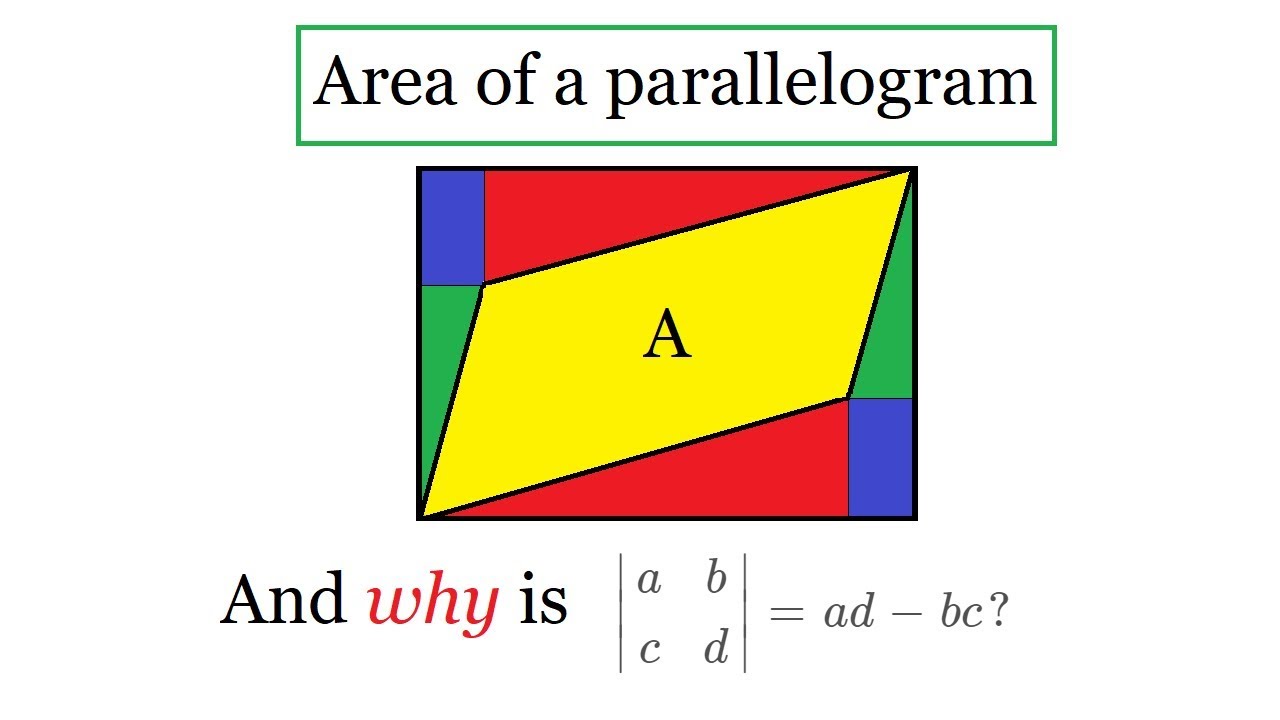
Area of parallelogram using determinants. Why the determinant of a 2x2 matrix is ad-bc. Finally, calculating the volume of a parallelipiped using determinants.
Check out my Determinants playlist: https://www.youtube.com/playlist?list=PLJb1qAQIrmmDqVlGW1_0JOiiMZzT6-AUE
Subscribe to my channel: https://www.youtube.com/channel/UCoOjTxz-u5zU0W38zM...
rough moon
ok
 summer crag
|A×B| = |A| |B| sin(angle b/w A & B) , area of a parallelogram with sides A and B is base times height, sin(angle b/w A & B) = height/adjacent side(either A or B).
So the denominator term in sin(theta) get cancelled with either A or B giving height times base
rough moon
summer crag
|A×B| = |A| |B| sin(angle b/w A & B) , area of a parallelogram with sides A and ...
i see, thank you
 summer ruin
can you guess the third root?
cyan wave
summer ruin
can you guess the third root?
no 😭
or like idk what ur even asking i havent payed attention at all
summer ruin
if -6 -4i is a root of a polynomial, then what would be another root?
summer ruin
no
cyan wave
bruhhh
summer crag
cyan wave
bruhhh
conjugate pairs
cyan wave
english pls
summer crag
comlpex roots are always in conjugate pairs
cyan wave
what does that mean
summer crag
conjugate of a complex number z = x + iy is x - iy
summer crag
summer crag
conjugate of a complex number z = x + iy is x - iy
you understand this ?
so for example 1+3i is the conjugate of 1-3i
summer crag
now can you guess the other root ?
summer crag
summer crag
comlpex roots are always in conjugate pairs
this ?
cyan wave
no
or like
kinda
WAIT
IM SO DUMB
I JUST RE READ THE QUESTION
I thought -6 and -4i were 2 seperate zeroes 😭
summer crag
hmm so can you now guess the third root ?
also you understand that (x-4) is a term in the given polynomial of degree 3 ?
cyan wave
yeah yeah
summer crag
great you're good to answer it then
summer crag
just multiply the last two terms which have complex numbers
and write it in quadratic
 willow bear
,w 1/6 + 1/8 - 1/10
obsidian monolithBOT

 Requested by ann_dec#0
willow bear
Requested by ann_dec#0
willow bear
,calc 120-5*23
obsidian monolithBOT
Result:
5
@muted turret did you just want confirmation regarding this work & answer or was this written by somebody else and you wanted an explanation of what they did?
 granite basin
9

 muted turret
willow bear
<@648375361557626900> did you just want confirmation regarding this work & answe...
muted turret
willow bear
<@648375361557626900> did you just want confirmation regarding this work & answe...
This was my work. Just showing this work as a sample
The things right
viscid thistle
granite basin
9
what have you tried?
untold spindle
<@&268886789983436800>
 tardy glen
Hello guys, do someone have the demonstration of this pls ?
 hushed sphinx
The simplest is to write y^x = e^(x·ln(y)) and use the chain rule.
(But I don't think this is meaningfully __pre__calculus).
tardy glen
Yeah sorry i don t have acces to the calculus channel
OK thanks for the information i will do some research on the chain rule
hushed sphinx
Hmm, it shouldn't need any special privileges to see it, but Discord does some funky thing where it sometimes hides channels it thinks you're not interested in. You can try clicking "Channels & Roles" and select the "browse channels" tab to get a fuller list.
(You'll probably get to see it automatically if you switch from "pre-university" to "undergraduate" -- the topic division follows American tradition of considering calculus to be something first taught in college).
tardy glen
Yeah you are right, when i joined this server discord asked me what kind of things i wanted to see.
The thing is that in english and in french the words "college " and "university" don t have the same meaning at all, so my mistake was here
But fine now i can see all the channel
With the tips you said
So, thanks you for the help and thanks for being a good moderator
Have a great Day
 gray magnet
tardy glen
OK thanks for the information i will do some research on the chain rule
gray magnet
tardy glen
OK thanks for the information i will do some research on the chain rule
What 3b 1b video
It’s explain everything thing’s pretty well
 dense blade
can someone please explain to me what the average rate of change means.
hushed sphinx
It's pretty much defined as [amount of change in total] / [time it took for that change to happen].
This makes most intuitive sense if the time it took is a large number of units, e.g. seconds.
Then the average rate of chage is the amount of change that -- if that amount of change kept happening consistently every second -- would have led to the actually observed total change after the time period has passed.
dense blade
then why are the outputs subtracted instead added together
summer ruin
because subtraction measures change, while addition measures average
for a line segment [a;b] the point x = (b+a)/2 is the midpoint, while the value (b-a) shows how much you need to add to left point "a" to get to the left point "b" (in other words how much change needs to be made to "a" to get to "b"), indeed a + (b-a) = b
dense blade
ok ty
 hushed knot
I have a matriculation exam to pass if I want to go to university.
I'm 23, but better late than never.
thorn creek
this is a mix of precalculus and calculus by the looks of it
some analytic geometry
i saw trig but didn't look to see if it was straight trig or caluclus involving trig functions
 quick jolt
could someone mind trying to explain how to find the coordinates of the terminal side of an angle on a unit circle given the arc length? my textbook tried but it didnt really make sense
quick jolt
thorn creek
i saw trig but didn't look to see if it was straight trig or caluclus involving ...
speaking of trig...
thorn creek
quick jolt
could someone mind trying to explain how to find the coordinates of the terminal...
i don't know of a good way to approach this without invoking calculus
there are ways to do it without calc, but i don't remember them
thorn creek
you will be better served by someone else's tuition
quick jolt
ok
ill go consult a guy with a random accent on the internet. dont let me down now pls (idk if youll get the joke or not but thank you for trying to help :P)
summer crag
Isn't the coordinate just (cos(theta),sin(theta)) , theta = arc length/radius = arc length (becuase it's a unit circle)
burnt nymph
This video series has been excellent so far, but a specific video today has been confusing me. I get that you factor the equations, use long division, etc. but I'm not understanding when solutions belong to "the real number system" and "the complex number system" here. I must have missed that in a previous video:
https://youtu.be/xuhk2kSVwe0
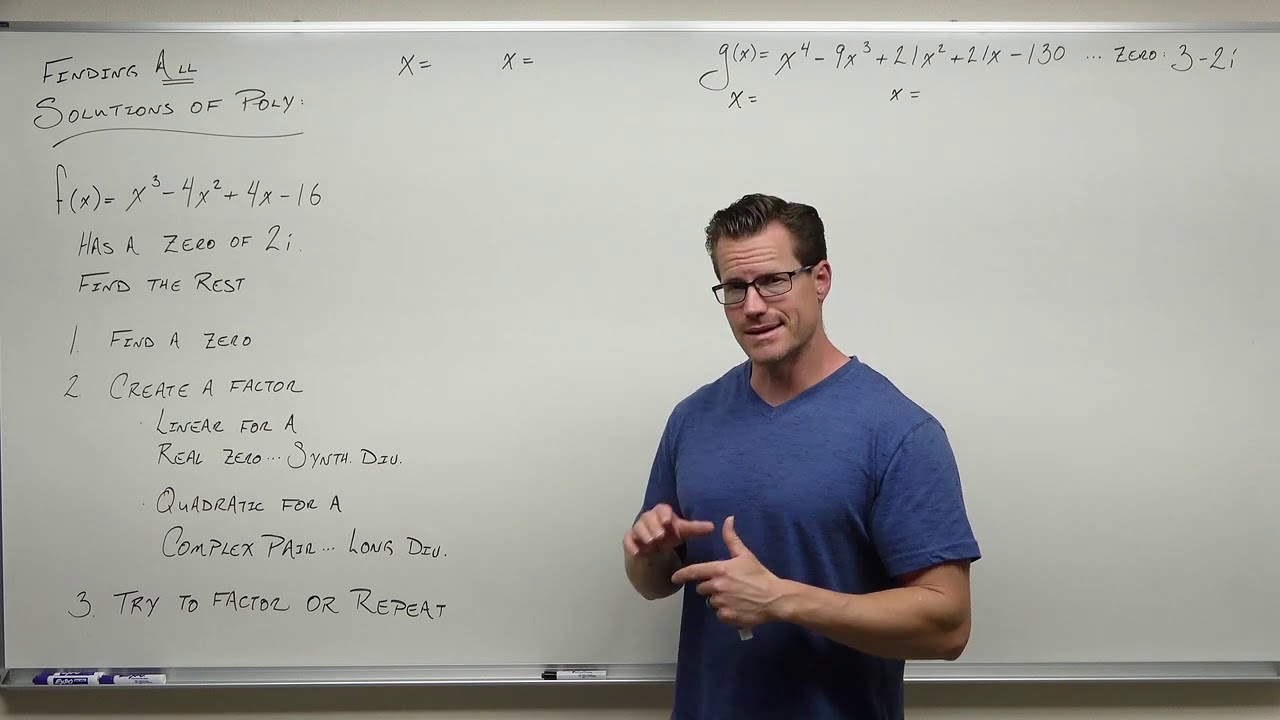
Support: https://www.patreon.com/ProfessorLeonard
Professor Leonard Merch: https://professor-leonard.myshopify.com
How to completely factor a polynomial over the complex number system and find all of the solutions, including complex.
thorn creek
you understand that not all quadratic polynomials have real solutions, right?
all linear polynomials with real coefficients have exactly one real solution
all quadratic polynomials with real coefficients have exactly two solutions (up to multiplicity), but only some of those will have solutions that are real numbers
burnt nymph
Yes I understand all of that
I guess I'm more lost on what are the last steps here sometimes
I think he's done and then it continues going on until there is more
thorn creek
i guess i don't understand what your question is
 thorn creek
in this context, it's probably easiest to uinderstand that all of the solutions of a polynomial are complex numbers
burnt nymph
I think he's done when its x = 5i and x = -5i
thorn creek
and that some of those (those with no imaginary part) will also be real numbers
thorn creek
at that point he's reduced the polynomial to a product of linear terms with complex coefficients
since each linear term contributes one root, that gives you a polynomial with four roots
burnt nymph
Yeah so that part I understand too
Once you have something like a five order polynomial, there should be 5 solutions right?
burnt nymph
So that part I understand and I get when you use long division and all that but I think the complex numbers bit is what messes me up
But I think I just figured out my issue
thorn creek
it is a bit confusing because of how we write complex nyumbers
burnt nymph
My brain just wasn't connecting the pieces til just now
thorn creek
(x-(a+bi))
burnt nymph
Yeah
I think before when it was focused on real numbers and when he began with complex numbers it was simple enough
Now that I'm doing this it throws me off
thorn creek
it's a bit easier if you think of complex numbers as a single number and ignore the fact that they're made of two "pieces"
burnt nymph
But ive also forgotten the initial steps we learned like Descartes Rule of Signs and Zero Whatever the Name is
Rational Zeroes Something
thorn creek
i can never remember that one either
burnt nymph
The joys of getting older. Miss learning this stuff when I was really young. Much harder to pick up now.
Anyways thanks for the discussion.
thorn creek
np
burnt nymph
Sorry I have one last question. Why is it that the left part with the real number solutions and the right part with the complex number solutions match, but he does an intermediary step where he subtracts 2 from zero and divides 1 by 3? Is this just to show the logic behind why he square roots the unfactorable x^2 + 9 ?
 thorn creek
those are to demonstrate the values of the roots
a factor of x+2 corresponds to a root of -2 (x+2=0 => x=-2), and a factor of 3x-1 corresponds to a root of 1/3 (3x-1=0 => x=1/3)
similarly the two imaginary roots of 3i and -3i correspond to terms of (x-3i) and (x+3i), which when multiplied make (x^2+9)
remember the fully factored polynomial is zero exactly when any one of the factors is zero
burnt nymph
Ah right
 knotty sequoia
I have a question: .
The graph of a function that is to the 4th root or with an even index number is:
B and C only
Broken
Continuous
Always straight
glass dove
Is there someone that wants to talk precalculus
celest glade
knotty sequoia
I have a question: .
The graph of a function that is to the 4th root or with an...
I didn't understand the question, (on the part B and C only)could you take a pic of your question
knotty sequoia
 celest glade
So I assume B and C only is broken and continuous only?
And "Broken" in this context means piecewise
 zinc fulcrum
there was a discussion about this question already and everyone decided it made no sense for like 4 different reasons at least
knotty sequoia
Yup
celest glade
Yeah ofc because it isn't specified what the function is
Let f(x) be x⁴ and (f(x))^¼= |x|
So it can be a piecewise function
While let f(x) be 2x² and it doesn't become a piecewise function anymore
Both functions are not straight
So I assume the answer is probably "continuous" unless someone pulls up a counterexample where (f(x))^¼ isn't continuous where it is defined
Whoever made this question needs to be bonked
"Broken" is not even mathematically defined well here
thorn creek
i also don't know what an "index number" is
or what it means to be "to the 4th root"
also is |x| "always straight"?
what does "always straight" even mean
zinc fulcrum
and what does broken mean
honestly one of the worst questions i’ve ever seen
“a function that is to the 4th root” kills me
knotty sequoia
thorn creek
i also don't know what an "index number" is
An Index I believe is the number above the radical
thorn creek
knotty sequoia
An Index I believe is the number above the radical
honestly did not know anyone had given a name to that
knotty sequoia
Me neither
quick jolt
I was able to get a graph and find the solutions using a graphing calculator, but how would i solve that algebraically?
 dense mango
You have to know values of trig functions for 30 and 60 degrees
Tan x = √3 for x = 60° or π/3
But you're also adding the period
So you get π/3 + nπ where n is an integer
viscid thistle
dense mango
Tan x = √3 for x = 60° or π/3
-sqrt(3)
so x should be 2pi/3 + pi*n
but you gotta only find answers in the interval from -2pi to 2pi
knotty sequoia
zinc fulcrum
and what does broken mean
apparently the graph was broken
burnt nymph
I have no idea what is being "proven" here
https://youtu.be/x5cWX-EyLEI

How to prove summation formulas by using Mathematical Induction.
Support: https://www.patreon.com/ProfessorLeonard
Professor Leonard Merch: https://professor-leonard.myshopify.com
I love this guys videos, but he spent like 15 mins explaining how this works and I'm still completely lost about what he actually did
 wicked viper
burnt nymph
I have no idea what is being "proven" here
https://youtu.be/x5cWX-EyLEI
wicked viper
burnt nymph
I have no idea what is being "proven" here
https://youtu.be/x5cWX-EyLEI
i think he's just trying to show how stuff gets proven by mathematical induction
so the two formulas on top are his lab rats to test mathematical induction on
based on the work on the board (too lazy to watch the whole thing lol) it looks like he's just plugging in consecutive numbers into the formula to find a pattern
lucid trench
zinc fulcrum
and what does broken mean
probably discontinuous
 tacit prairie
burnt nymph
I have no idea what is being "proven" here
https://youtu.be/x5cWX-EyLEI
tacit prairie
burnt nymph
I have no idea what is being "proven" here
https://youtu.be/x5cWX-EyLEI
That 1+3+5+...+(2n-1)=n^2. It is right there at the top center for the entire video.
celest glade
knotty sequoia
apparently the graph was broken
And whoever made this question needs to be bonked for making the question bad
🔨🐢
BONK
burnt nymph
tacit prairie
That 1+3+5+...+(2n-1)=n^2. It is right there at the top center for the entire vi...
I can read
Im more looking for the intuition here
burnt nymph
wicked viper
based on the work on the board (too lazy to watch the whole thing lol) it looks ...
Yes I understand that so far, but Im just lost on how this proves it
charred frigate
burnt nymph
Yes I understand that so far, but Im just lost on how this proves it
here is an induction explanation I got from a professor a few years ago
the process of proof by mathematical induction is like proving that you can climb an infinitely long ladder to the heavens. to climb an infinitely long ladder, you only need the ability to do two actions, and those actions alone can allow you to climb as high as youd like, given enough time.
the first action is climbing onto the ladder in the first place. if you cannot get on the ladder, how can you climb it? this action is the base case.
a simple verification that what youre trying to prove works for the smallest case which it is supposed to. usually just showing that plugging in n=0 or n=1 gives a true statement.
the second action is climbing from one step to the next. once youre on the ladder using the base case, you can simply perform this action over and over again until you're as high as you desire. this is called the inductive step.
to do this you suppose that it's true for some value n=k (this is called the inductive hypothesis), and show that the fact it is true for n=k means it must be true for n=k+1 (the inductive step). so as long as you can stand on one step, you can climb to the next.
burnt nymph
Okay I think that makes more sense. Thanks for the useful analogy.
dense mango
viscid thistle
-sqrt(3)
I didn't want to give the solution, just a clue...
viscid thistle
dense mango
I didn't want to give the solution, just a clue...
i was saying the problem said -sqrt(3) not +sqrt(3)
you just made a small error
dense mango
I did that on purpose, I wanted them to figure out what to do when tan x = -60°
 short saddle
The two red spheres are tangent both to each other and internally to the green sphere; the blue spheres, all of different radii, form a ring around the point of tangency of the two red spheres. How many blue spheres are there, and how are their rays related to each other?
 hushed sphinx
I think you have the best hope of calculating anything if you start by assuming the green sphere has twice the diameter of the red ones, so the red/green contact points are diametrically opposite -- in that case the blue spheres are actually identical.
Afterwards I think one can appeal to inversive geometry to argue that the number of blue spheres will be invariant as you make the red ones smaller.
What does "their rays" mean here?
hushed sphinx
Oh, or better yet: invert the whole configuration with respect to a sphere centered on the point where the two red spheres touch. Then those two spheres turn into parallel planes, and every sphere that touches both -- that is, green and blue alike! -- become spheres that just touch the two planes, and therefore all have the same size. It is now pretty easy to count the blue ones.
willow bear
hushed sphinx
What does "their rays" mean here?
their radii i think
but run through a translator
dense mango
How to evaluate limit c without l'Hospital

 slim steppe
multiply by conjugate
 obsidian monolithBOT
 summer ruin
continue
dense mango
Idk what to do now
summer ruin
think about why you can't evaluate this limit still
dense mango
I have 2 square roots in the denominator so I probably have to somehow get rid of them
But am I really supposed to multiply by conjugate again?
summer ruin
are they a problem?
dense mango
Hmm
dense mango
I can't figure it out...
summer ruin
well what did you do
dense mango
obsidian monolith
I'm stuck on this, idk what to do next
summer ruin
didn't you want to multiply by the conjugate?
dense mango
Ok I'll try
 visual torrent
logx(a^b) = b multiplied logx(a)
right?
summer ruin
absolute value of a
summer crag
If f and g are periodic functions (from R to R) then can we say that f+g is also a periodic function (from R to R) ?
for some p,q,c in R⁺, f+g(x) = f(x+p) + g(x+q) = f+g(x+c) = f(x+c) + g(x+c) for all x in R ?
here f and g are periodic fn (from R to R) with period p and q respectively
vapid plaza
summer crag
If f and g are periodic functions (from R to R) then can we say that f+g is also...
No because the periods may never “match up”. For example, f may have period 1 and g may have period sqrt2
summer crag
vapid plaza
No because the periods may never “match up”. For example, f may have period 1 an...
hmm can you give a example ?
charred frigate
summer crag
hmm can you give a example ?
,w period of sin(x)+cos(sqrt2 x)
obsidian monolithBOT

 Requested by nilpotentnix#0
 woven quail
Could someone help me understand how and why DeMoivre's Theorim works? Why do I have to convert the equation to trigonometric form?
 finite void
im very confused... my teacher said square root of a real number cant be negative...
x = sqrt(56-x)
x^2 = 56 - x
x^2 + x - 56 = 0
(x-7)(x+8) = 0
x = 7,-8
then my teacher said -8 is impossible bcuz:
-8 = sqrt(56-(-8))
-8 = sqrt(64)
-8 = 8
i always thought squart root of a real number is always +- and not only positive
(idk if im in the right channel lol)
summer ruin
sqrt(5) is positive as is for any positive number
sqrt(x^2) ? well, depends on what x is
if x is negative, e. g. x = -1, then sqrt((-1)^2) = sqrt(1) = 1 = |-1| = |x|
if x is positive such as x = 1, then sqrt(1^2) = sqrt(1) = 1 = |1| = |x|
therefore sqrt(x^2) = |x|
finite void
so what u r saying is sqrt(<a real number>) can only be positive but sqrt(x^2) like sqrt(2^2) = |2|?
summer ruin
it's simpler than that, x is a real number just like any other
the problem is that it's not determined whether it is positive or negative
finite void
so my teacher is right or not 💩 im too stupid to understand... i almost argued with him but no one else in the class seem to agree with me that sqrt(64) can be -8
summer ruin
the teacher is right because it's pretty important that you learn it this way to not make silly mistakes like sqrt((-8))^2) = -8
but you're also right, but for a more complicated reason
finite void
thanks btw
summer ruin
(the reason being the existence of 2 squares roots, 3 cubic roots, 4 4th roots, etc thanks to complex numbers)
cyan wave
could someone explain this to me
 short saddle
hushed sphinx
What does "their rays" mean here?
short saddle
hushed sphinx
What does "their rays" mean here?
radius dian er
 buoyant aurora
willow bear
buoyant aurora
willow bear
,calc 0.34*60
obsidian monolithBOT
Result:
20.4
1°20' maybe? hold on
,calc acos(1/4.286) * 180/pi
obsidian monolithBOT
Result:
76.507517683468
@cyan wave where did you even get 1.34° from
ah, looks like you switched your calculator to radian mode
cyan wave
willow bear
<@882086691295358986> where did you even get 1.34° from
idek what i was doing
viscid thistle
Is this equal to 1/4? when x equal to 0

(evaluating continuity)
I multiplied by conjugate and applied division by x in both, and then lim x->0 sin(x)/x = 1 but Idk...
viscid thistle
how do u integrate lnx?
obsidian monolithBOT
square_pie
 viscid thistle
$\int \ln{x}dx$
obsidian monolithBOT
square_pie
 willow bear
 marble elk
and dv=dx/dx
marble elk
and dv=dx/dx
dv = 1 dx
 vagrant anvil
math
 charred frigate
 west swallow
why range wrong?
west swallow
why range wrong?
you only look at the y values for the x values in the domain. i dont see any x values where the function has values of -100, or -100000000.
woven quail
west swallow
why range wrong?
your range is wrong for a couple reasons.
First of all, the function does not go down to negative infinity. It has a starting point at (-2, 0) and an ending point at (3, -5). This would mean that (-∞, y) would be a wrong range.
Second, your upper part of the range lands on the number 4, as you say in your range. But it includes the number 4, and doesnt exclude it. Therefore, you would want to use a "]" bracket instead of a ")" bracket after the number 4.
cyan wave
need help
 viscid thistle
cyan wave
need help
viscid thistle
cyan wave
need help
The diagram of the triangle??
 steep sapphire
cyan wave
need help
steep sapphire
cyan wave
need help
is a findable without diagram?
its 35 . √3 / 3
or just 35 . √3
if we cant find "a" I dont know any way to find c too
knotty sequoia
west swallow
(-5,4)
untold spindle
knotty sequoia
(-5,4)
Don't give out solutions, especially if its not even correct and has no explanation behind it.
knotty sequoia
untold spindle
Don't give out solutions, especially if its not even correct and has no explanat...
No the range isn’t wrong. The range is between -5 and 4 because the graph is restricted to those Y values
untold spindle
knotty sequoia
No the range isn’t wrong. The range is between -5 and 4 because the graph is res...
The numbers you put are correct but the parenthesis are incorrect
knotty sequoia
untold spindle
The numbers you put are correct but the parenthesis are incorrect
I’m aware
untold spindle
Then why leave your answer as is instead of correcting it?
Actually that's besides the point. Point is, don't send the answer to a question in general. It helps the questioner more if instead you provide an explanation of their problem and give them nudges in the right direction.

 onyx saffron
i need a bit of help
 ripe wave
For the thing N sent?
 gaunt sand
west swallow
gaunt sand
west swallow
it touches the y axis and intercepts at 4 so that value is inclusive
in the range
so the [ bracket gotta be used to indicate that 4 is inclusive
and there is a restriction on the graph so it doesnt continue for forever so infinity wouldnt be right
glass dove
Im trying to learn functions
Are inverse functions like:
If $f(x)=2x\cdot(2-7x)$
Then
$f^{-1}(x)=\frac{2x}{2+7x}$
obsidian monolithBOT
thatonebelgian61
 celest glade
No
glass dove
I dont really understand it so
celest glade
Also f(x) does not have an inverse function in that case
Let's say y=-14x²+2x=f(x)

Look at the green locus
celest glade
gaunt sand
Is it cuz it's not a function
Yeah
glass dove
I think i kind of get it
celest glade
If you say though y=-14x²+2x when x>=2 it has an inverse function, because it's surjective and injective(one-to-one)
Khan academy should explain better than me so check that
Sorry it seems I suck at explaining lol
glass dove
So lets say $$f(x)=2x+7$$,where
So $$y=2x+7$$
Then $$x=2y+7$$
Now we need to find x
$$x+7=2y$$
$$\frac{x+7}{2}=y$$
$$\frac{x+7}{2}=f^{-1}(x)$$
celest glade
You seem to get the essence
glass dove
Finally
obsidian monolithBOT
thatonebelgian61
 celest glade
Though there seems to be an error in your process
glass dove
Sorry for editing so many timss
glass dove
celest glade
Though there seems to be an error in your process
Where?
glass dove
On yeah
Mb
Was just a thought error
Whatever
Its vacation
We can make mistakes 😉
celest glade
But you do get how to find the inverse functions generally
glass dove
Yes
Also if one of the variables is $n^m$, then you need to turn it into $\sqrt[m] n$ at the end
obsidian monolithBOT
thatonebelgian61
 celest glade
depends though as you try for y= x², it doesn't have an inverse function(try graphing the locus for x=y²)
gaunt sand
Say for a question where like this:
Find the coordinates of the stationery points of the graph y=x^3-3x^2-24x
So Find the derivative
Dy/dx =3x^2-6x-24
3x^2-6x-24 = 0
3(x^2-2x-8)
3(x-4)(x+2)
X=4, x = -2
I plug it back in to find the two stationery points but how do I know whether it is a minimum or a maximum?
Or how would I figure that out
celest glade
gaunt sand
Say for a question where like this:
Find the coordinates of the stationery poin...
To #calculus
warped cipher
I mean you can use help forum if the help channels are full or smth
I do think they're both the same
I found comments like !status and !nosols don't work in help forum
It seems like mniip already said this #1026808241067405312 message
 digital pendant
glass dove
I dont really understand it so
digital pendant
glass dove
I dont really understand it so
You can visualize the inverse like this:
Where you just change the direction of the arrows
 dense mango
I have a question, why this

is not the same as this

I thought of this rule and I'm confused
 summer ruin
because the expression under the root sign must be non-negative
dense mango
so basically if there is a possibility that the expression under the root is negative then I can't use this rule?
summer ruin
this rule already assumes that a>=0, b>=0
if a < 0, b < 0, then a/b > 0, yet the right hand side doesn't exist
digital pendant
dense mango
I have a question, why this

Essentially the bottom function isn't defined for x>1/4 because then the 1-4x term is negative.
 astral moat
cyan wave
can someone explain
astral moat
cyan wave
can someone explain
cos 70
cyan wave
astral moat
cos 70
yeah i figured that it wanted me to add them
burnt nymph
In this part of a precalc video I'm watching, the inside of the cos function is multiplied by 3, so he adds another 2 pi to each alpha.

However, earlier he had something with a similar product on the inside of sin and added more to each alpha

Why is there a difference?
summer ruin
was this constained to some segment?
burnt nymph
I believe that he just said they were within each of the function's respective periods
Beyond that I don't recall any other commentary about constraining something to a particular segment
summer ruin
then these are just wrong
burnt nymph
Which one is correct then?
summer ruin
sin(x) = -1 is true for x = 3pi/2 + 2pi*k for any integer k
burnt nymph
So basically I just need to add as many 2pi as there are multiplications of theta?
summer ruin
no? this has no relevance to why the solution is wrong
summer ruin
writing sin(alpha) = -1 and then saying that alpha = 3pi/2 or 7pi/2 or 11pi/2 is wrong because it doesn't account for all solutions
summer ruin
summer ruin
sin(x) = -1 is true for x = 3pi/2 + 2pi*k for any integer k
because of this
burnt nymph
This was the full calculation of one of the problems

This was the other complete calculation

The solutions are supposed to be at the bottom
summer ruin
well as I was saying earlier this doesn't account for all solutions
burnt nymph
Hmm
Lemme see if there was a part where he clarified why he did this
Otherwise I wouldn't know where to begin with figuring out what is right
Does it matter if he is just talking about within the unit circle?
Idk im confused
summer ruin
not a single thing is right here
summer ruin
burnt nymph
Does it matter if he is just talking about within the unit circle?
the unit circle is infinite, you can traverse it forever
burnt nymph
Okay I looked at the beginning and he said he is looking for all of the solutions between 0 and 2pi
Does that matter or nah
summer ruin
it does because then there's only finitely many solutions
burnt nymph
burnt nymph
I believe that he just said they were within each of the function's respective p...
I guess this was what I was getting at but I didnt realize that til now
So for those two equations, what is going on with them?
I understand mathematically what he is doing for the parts where he is adding 2pi stuff to each part, I just don't get why they're different
summer ruin
you just make a change of variables 3*theta = alpha and solve the simplest possible trigonometric equation sin(alpha) = -1
after figuring out what alpha is you backsubstitute to find theta
summer ruin
burnt nymph
I understand mathematically what he is doing for the parts where he is adding 2p...
I don't see where they're different
burnt nymph
For this one he is only adding 2pi

But in this one he is adding 2 pi and then another 2 pi
 summer ruin
it doesn't matter how many you add
you want to find all theta that solve the equation that belong to [0:2pi)
so you pick more alphas than you could possibly need just in case, to not miss out on solutions
burnt nymph
I don't get it. You get to just make up how many you add? Why would he do it differently here if he could have just used one method?
summer ruin
because the point is not to memorize "what's the perfect amount to add"
if you want to figure out exactly how many needs to be added - that's more work
if you want to do it - you can
burnt nymph
I guess I'm just not understanding then how you are supposed to come up with these then
It felt simple enough when he covered it the first time but now this is just more confusing
summer ruin
because when you convert back to theta you will have to divide by some number, namely by 3
therefore all alphas that you have chosen will be scaled down by 3
what if you didn't cover all possible cases and all your thetas are inside the [0;2pi) interval? then you could potentially miss some solutions
if at least one theta appears outside this bound then you'll know for sure that you checked all cases
burnt nymph
I understand the why, im not getting the how
You are simulataneously saying "it doesn't matter how many you add" and also saying "but they need to be sufficient to meet [0,2pi]"
How do you achieve this then?
Its super confusing to me
summer ruin
you just pick enough
burnt nymph
So how do you know what is enough?
I think that is the meat and potatoes of my question
summer ruin
isn't that pretty intuitive that if you pick twice as much as you need you'll meet all possible demands?
you consider the interval 0 to 2pi, for alphas you pick 3pi/2, one that's 3pi/2 + 2pi and one that's 3pi/2 + 4pi
the third point is at least twice the required distance from first one
it's not a precise calculation, as I was saying if you want to do it precisely - that's more unnecessary work, but it's a rough estimate
of course if you guessed wrong you'll have to start over
burnt nymph
summer ruin
you consider the interval 0 to 2pi, for alphas you pick 3pi/2, one that's 3pi/2 ...
So why then does 2pi/3 not have the same calculation
Wouldn't it also be 2pi/3 + 2pi and 2pi/3 + 4pi
summer ruin
I mean if you want to be sure you can always include more
burnt nymph
Nevermind I think I figured it out after he explained another part
The key here is that you are doing some guess work on which of these solutions will eventually surpass 2pi?
I think you were basically saying that already but I'm just rewording it in a way I understand
In other words, the multiplier doesn't really matter until the end, you are just trying to figure out how many solutions you can use before later multiplying (here by 3)?
summer ruin
when you're working in terms of new variable alpha there's no multiplier at all
and you're not multiplying, you're dividing by 3
burnt nymph
Ah right dividing by 3
Okay I think I get it now
Thanks for your patience and wisdom Transparent
 topaz belfry
Where from and how is 'e' derived? Because, as a high school student, I am aware of some of its special properties in calculus and logs, but how does its derivation allow/create the special properties?
hushed sphinx
Part of the wonder is that several of the many special properties can each be used as the basic definition and then the rest of them can be derived from it.
So if Alice defines it as "the number a such that f(x) = a^x satisfies f'(x)=f(x)" and Bob defines it as "the limit of (1+1/n)^n for n -> infinity", then each of them can eventually prove that their number satisfies the other one's definition. So there's no need to come to an agreement about which of them is THE definition.
(Meanwhile Claire defines it as the infinite sum 1/0! + 1/1! + 1/2! + 1/3! + ... (where 0!=1), and Dan defines it as the number a>1 such that the area bounded by the curves y=0, xy=1, x=1 and x=a is exactly 1).
An interesting fact is that each of these definitions can be viewed as really defining the same function exp(x), and then just say that e means exp(1).
(This is not equally obvious for all of them, though).

 dull tendon
 thorny shore
*Also who uses z in u substitution.*
thorny shore
*Also who uses z in u substitution.*
x for independent variable, y for dependent, next natural order is z :\
dull tendon
dull tendon
https://cdn.discordapp.com/attachments/1130035163649282058/1130035163905151026/d...
the correct answer is supposed to be 2/3 sin^-1 (x^3/2) + c
even my answer might be correct cause i can't find any mistake and, if i differentiate it I get back to the integral question
i guess it's just different because of inverse trigonometric transformations or something..
opal tree
,w graph -1/3 arcsin(1-2x^3) and 2/3 arcsin(x^3 / 2)
obsidian monolithBOT

 Requested by umbraleviathan#0
opal tree
Requested by umbraleviathan#0
opal tree
They ain't equivalent whatsoever
 lusty phoenix
Can someone show me how I can simplify a natural log I know there's a formula log a+ log b= log (ab) but I don't know if it's same for ln

 spice bane
lusty phoenix
Can someone show me how I can simplify a natural log I know there's a formula l...
spice bane
lusty phoenix
Can someone show me how I can simplify a natural log I know there's a formula l...
It is the same for ln
 sick summit
how do I determine if this is an identity please?

 edgy tartan
lusty phoenix
Can someone show me how I can simplify a natural log I know there's a formula l...
edgy tartan
lusty phoenix
Can someone show me how I can simplify a natural log I know there's a formula l...
ln is just a log to the base e
celest glade
lusty phoenix
Can someone show me how I can simplify a natural log I know there's a formula l...
ln x= log x/log e= log(e, x).
Basically log with any base has the property you mentioned if the two has the same base
 peak delta
can an augmented matrix have multiple row-echelon forms that give the same solution?
summer ruin
yes, but reduced row echelon form is unique
 snow flame

I need help after this part.
How am I supposed to find the trigonometric functions using a calculator?
I know I can use this, except I don't know how to use it with a scientific calculator.

Please ping me so I see your message.
dense mango
snow flame
I need help after this part.
You need to know that sin has a period of 2nπ where n is an integer, and also sin(-x) = -sinx
So your solutions would be -π/6 + 2nπ and -5π/6 + 2nπ
 thorn kestrel
snow flame
I know I can use this, except I don't know how to use it with a scientific calcu...
thorn kestrel
snow flame
I know I can use this, except I don't know how to use it with a scientific calcu...
shouldn't the +-infinity instead just be undefined?
thorn kestrel
thats like saying 1/0 = +-infinity
dense mango
Yeah thats bs
snow flame
thorn kestrel
shouldn't the +-infinity instead just be undefined?
Yeah it should.
There's no proper mathematical sollution for it.
snow flame
dense mango
So your solutions would be -π/6 + 2nπ and -5π/6 + 2nπ
Thanks, can you explain how you did that?
As well as how you would solve this problem with a calculator?
I'd really appreciate it.
dense mango
I think that solving it with a calculator is completely unnecessary
You just have to memorize values of trig functions for angles 30°, 45°, 60° degrees
And maybe 90° for sin and cos
@snow flame
snow flame
dense mango
I think that solving it with a calculator is completely unnecessary
On my tests it's going to be useful though, right?
snow flame
dense mango
You just have to memorize values of trig functions for angles 30°, 45°, 60° degr...
What about 120, 135, 150, etc?
dense mango
You can use trig formulas, eg. sin(180°-theta) = theta
There is plenty of them though
But when it comes to solving trig equations with a calculator, I've never done that
snow flame
dense mango
But when it comes to solving trig equations with a calculator, I've never done t...
Really?
You just memorized the values?
snow flame
dense mango
You can use trig formulas, eg. sin(180°-theta) = theta
What do you mean?
dense mango
snow flame
What do you mean?
Something like this

I know it's not english but more or less you know what it's all about
dense mango
snow flame
You just memorized the values?
Yeah
snow flame
dense mango
Something like this
I can't see it clearly.
dense mango
Just zoom in

 thorn kestrel
works fine for me
snow flame
dense mango
Maybe cause I'm on my phone rn
Perhaps.
thorn kestrel
 thorn kestrel
just curious, what do the square brackets mean?
 dense mango
thorn kestrel
just curious, what do the square brackets mean?
dense mango
thorn kestrel
just curious, what do the square brackets mean?
Normal parentheses but squareshaped to avoid confusion
dense mango
snow flame
Pure memorization?
Yeah
thorn kestrel
dense mango
Normal parentheses but squareshaped to avoid confusion
okay i see
snow flame
dense mango
Yeah
How long did it take you?
thorn kestrel
I guess you would have to memorise but i dont see why you cant just use it by itself
or at least memorise the important ones like 30, 45, 60, 90, 180 and figure out the others by formula
dense mango
snow flame
How long did it take you?
Also, when did you start doing trigonometry?
snow flame
dense mango
Also, when did you start doing trigonometry?
I'm learning Precalculus this summer.
I started the trigonometry unit like one or two weeks ago.