#precalculus
1 messages · Page 8 of 1
 willow bear
just because the product of two numbers is 1, does not mean either one of them has to be equal to 1
it's called the null factor law for a reason.
 pale hazel
Oh okay 👍
 primal quail
a counter example would be (-1)(-1)=1 or any other number, call x, choose 1/x and we have they multiply to 1, (given x is not 0)
 sick quartz
trigonometry was significantly harder
there's just a lot more to remember
but it's also more conceptually loaded, having to learn the unit circle
understand it
 lofty pine
Interesting
 viscid thistle
that would be 1 / cos y which can be rewritten as sec y.
in hindi?
what about post-calc?
 peak pasture
viscid thistle
what about post-calc?
peak pasture
viscid thistle
what about post-calc?
That’s where it’s proofs and it gets tricky
 onyx night
the amplitutde will be 2, and the period will be pi
 willow bear
gonna need some more context there chief
 unreal cosmos
hmm no way to just define what this is saying?
willow bear
i mean
presumably s is a function of some kind, maybe with N as its domain
and A is some number
unreal cosmos
i just wanna know what each element is saying
willow bear
and the limit of s(n) as n goes to infinity equals A
we couldn't tell you why this would be true or indeed whether it's true at all, though.
unreal cosmos
willow bear
presumably s is a function of some kind, maybe with N as its domain
s(n) is a sequence
in this case
willow bear
yeah
maybe with N as its domain
okay, so s(n) is a sequence
s(n) is a sequence which approaches A
 summer ruin
we say that the limit of infinite sequence $a_n$ is (equal to) $A$ if for any positive $\varepsilon$ there exists a natural number $N$ (which could depend on epsilon) such that for all elements of a sequence $a_n$ which are enumerated with numbers starting from some number $n_0 > N$ all such elements satisfy the inequality $|a_n-A| < \varepsilon \\$
in other words all elements $a_{N+1}, a_{N+2}, ...$ are within epsilon distance away from the limit $A$
willow bear
or rather, taken at face value, the snippet you posted reads: "The sequence s(n) [which the reader already knows about] approaches A."
 obsidian monolithBOT
Transparent_Elemental
 unreal cosmos
so. as n approaches infinity s(n) approaches A
willow bear
is this really helpful
anyway so what you're saying is you didn't know what the lim notation meant? and your question was about notation and not content?
unreal cosmos
willow bear
anyway so what you're saying is you didn't know what the `lim` notation meant? a...
well both ig
just how each element relates to the other
willow bear
element...
unreal cosmos
willow bear
element...
notation
summer ruin
obsidian monolith
**Transparent\_Elemental**
well here it is, it will take some time to parse it, but it's worth it to understand what limit means
unreal cosmos
summer ruin
well here it is, it will take some time to parse it, but it's worth it to unders...
ok let me read it
summer ruin
I suppose you already have at least intuitive notion of what a sequence is
unreal cosmos
summer ruin
I suppose you already have at least intuitive notion of what a sequence is
yes
at the very least
unreal cosmos
summer ruin
I suppose you already have at least intuitive notion of what a sequence is
you there?
a question
are limits only used when f(x) is undefined?
summer ruin
no
 rapid inlet
You can tell from the equation the x intercept, y intercept and gradient. Write those down and compare to the graphs 🙂
 leaden nimbus
what program is this
unreal cosmos
obsidian monolith
**Transparent\_Elemental**
i finally get it
took me a while to visualise it but damn it actually fit in my head
 warm glade
anyone know good resources based on how my class is structured?
Chapter 1: Functions and their Graphs
Chapter 2: Polynomials and Rational Functions
Chapter 3: Exponential and Logarithmic Functions
Chapter 4: Trigonometry (Basics)
Chapter 5: Analytic Trigonometry
Chapter 6: Applications
Chapter 7: Systems
Chapter 8: Matrices
Chapter 9: Sequences and Series
Chapter 10: Analytic Geometry
 hazy hollow

 stone walrus
Doing math corrections, can anyone explain how to do 16, 17, or 18? I need it for tomorrow

 light crescent
warm glade
anyone know good resources based on how my class is structured?
Chapter 1: Func...
light crescent
warm glade
anyone know good resources based on how my class is structured?
Chapter 1: Func...
mine was set up a bit differently last year since the 2nd half seems a bit different compared to the Units we had, but pauls online math notes would probably work although cant guarantee the units will be in order
 stone fog
anyone tryna vc and help me out?
light crescent
stone fog
anyone tryna vc and help me out?
goodluck finding that here

 tropic sage
 lucid trench
how
 inland ruin
I think pre-calc is like the junk drawer of the math classes. It's got a lot of useful things, but they're just kinda all thrown into one drawer of "this is useful, but I don't know where else I could put it."
 opal tree
Literallt
 opaque kelp
warm glade
anyone know good resources based on how my class is structured?
Chapter 1: Func...
opaque kelp
warm glade
anyone know good resources based on how my class is structured?
Chapter 1: Func...
no complex numbers?
warm glade
Did that last semester this is for this semester
opaque kelp
oh i see
i wonder, what year do u take pre-calculus
we have different systems where im from so im trying to understand the concept better
lucid trench
opaque kelp
i wonder, what year do u take pre-calculus
i'm in 12th grade taking precalculus
most people seem to take it 11th though
 waxen vale
I'm a 10th grader and I take precalculus
there's a 9th grader in my class but all he does is use photomath on assessments
idek how our teacher hasnt caught on yet
 frank plover
inland ruin
I think pre-calc is like the junk drawer of the math classes. It's got a lot of ...
frank plover
inland ruin
I think pre-calc is like the junk drawer of the math classes. It's got a lot of ...
considering its name sake is just "before calculus" and not connected to any one section of mathematics, I guess it's to be expected
 brisk vortex
lucid trench
i'm in 12th grade taking precalculus
brisk vortex
lucid trench
i'm in 12th grade taking precalculus
That’s the normal curriculum some people are 1 year ahead and even more 2 or 3 years ahead
So that’s why
But you’re just where you need to be
 vapid plaza
 night palm
when should i begin precalc
night palm
when should i begin precalc
As early as you wish; if you get stuck, go back and review your knowledge
Better to be familiar with precalc concepts sooner rather than later
 daring drum
 covert helm
@everyone
covert helm
@everyone
Don't try to ping everyone for math help please... it doesn't work and it's not appropriate
vapid plaza
Bro really told 130000 people to join vc
 analog glade
and only 4 came
unreal cosmos
guis
why do we complete squares.
sorry if its a dumb question
i know how
i just wanna know why
till now ive only done it because book tells me to
summer ruin
because it simplifies the expression
e. g. show that the expression 2x^2 + 5y^2 + 6xy is greater or equal to zero for any x and y
 uncut mulch
it converts expressions to an equivalent form from which certain info may be more easily obtained
hazy hollow
Write an equation for a cosine function with an amplitude of 1, a period of 4pi, a phase shift right of 5pi/6 and a vertical shift up of 3.
What would that be^?
 fringe pulsar
asking for the answer here doesnt really benefit anyone

This trigonometry video tutorial focuses on graphing trigonometric functions. It explains how to identify the amplitude, period, phase shift, vertical shift, and midline of a sine or cosine function. In addition, it discusses how to graph sinusoidal functions using transformations. The graphs of tangent, cotangent, cosecant and secant are cov...
this is helpful
 gleaming prairie
hazy hollow
Write an equation for a cosine function with an amplitude of 1, a period of 4pi,...
gleaming prairie
hazy hollow
Write an equation for a cosine function with an amplitude of 1, a period of 4pi,...
there are 2 general ways of plotting. The first is to follow transformation steps, ie horizontal compression with the A in the expression. The 2nd is to locate certain points on the graph like max or min and connecting the dots
unreal cosmos
uncut mulch
it converts expressions to an equivalent form from which certain info may be mor...
how do i know what kind
summer ruin
unreal cosmos
how do i know what kind
?
 exotic moss
does anyone have a recommendation for a precalc textbook?
 oblique ice

Someone help me
I tried solving it many times
But my answer doesn’t match the final answer

 balmy blaze
 hot sigil
We can factor out cosθ, and we get cosθ(cscθ - 2) = 0. Now we can see that either cosθ is 0 or cscθ - 2 = 0. The only values of θ that make cosine 0 and are within the bounds are pi/2 or 3pi/2.
balmy blaze
hot sigil
If cscθ - 2 = 0, then cscθ = 2. We can substitute cscθ for 1/sinθ, which gets us 1/sinθ = 2, or sinθ = 1/2. The only values of θ that make this true and are within the bounds given are pi/6 or 5pi/6. So our final answer is θ = pi/6, pi/2, 5pi/6, or 3pi/2.
 queen ibex
Am I doing this right?

 spark wolf
not the five part
oh nvm im stupid
its 1/2 or 2
smh u wrote cosx=1
oh nvm 2 doesnt exist
queen ibex
💀 oh
queen ibex
You’re right

 viscid thistle
queen ibex
Am I doing this right?
viscid thistle
queen ibex
Am I doing this right?
cos x = 1/2 cos x = 2
you got it right mostly except the last part
queen ibex
Thank you
spark wolf
np
queen ibex
I fixed it
spark wolf
 viscid thistle
well done
uncut mulch
what's people classify as algebra 2 or equivalent covers mostly the same stuff
khan is a decent place to start
viscid thistle
Hello, can someone explain to me why arctan of -1 is pi over 4? In my head, I'm thinking it would be 7 pi 4 (going off of a unit circle) with consideration to the tangent restrictions. I'm guessing since 1 is negative, I should start clockwise?
 summer ruin
because the range of arctangent is from -pi/2 to pi/2, 7 pi/4 is bigger than pi/2
so arctan(-1) is some number between -pi/2 and pi/2
specifically it's a number x such that it's tangent tan(x) = -1 given the constraint on the range of arctangent (and hence domain of this equation)
and the angle there isn't pi/4, but negative pi/4
7 pi/4 describes the same angle, but as I said it's outside of range of arctangent
viscid thistle
Thank you for answering. I think this makes sense to me now.
viscid thistle
cot - root 3 is - pi over 6*

 hallow thunder
viscid thistle
cot - root 3 is - pi over 6*
hallow thunder
viscid thistle
cot - root 3 is - pi over 6*
,calc -pi/3-pi/6
obsidian monolithBOT
Result:
-1.5707963267949
jedben2
 viscid thistle
can someone teach me calculus from beginning i have to do hc verma
 zinc fulcrum
viscid thistle
can someone teach me calculus from beginning i have to do hc verma
zinc fulcrum
viscid thistle
can someone teach me calculus from beginning i have to do hc verma
lmaoo idt anyone is going to do that
you could try learning some stuff on the internet or asking for some resources and coming back with more specific questions 🙂
viscid thistle
ok
viscid thistle
viscid thistle
can someone teach me calculus from beginning i have to do hc verma
email hc verma to teach you
🙂
viscid thistle
lmao
spark wolf
viscid thistle
can someone teach me calculus from beginning i have to do hc verma
three blue one brown is good
on youtube
he provides some pretty intuitive explanations for all the rules and stuff
intuitively understanding maths is like always helpful on top of concrete proof and stuff
at least for me so far lol
spark wolf
viscid thistle
can someone teach me calculus from beginning i have to do hc verma
and btw this is precalc channel i just saw
 balmy gorge
Got a 96% on my precalc midterm exam
viscid thistle
balmy gorge
Got a 96% on my precalc midterm exam
Is your name really Ryan Chapman? There’s a philosophy YouTuber with the same name. Congratulations btw on the score!
balmy gorge
viscid thistle
Is your name really Ryan Chapman? There’s a philosophy YouTuber with the same na...
Yeah that is my name lol
 hard tinsel
what do you guys advice me to learn before precalculus?
 cosmic girder
know your algebra
like moving around stuff in an equation should feel natural to you
viscid thistle
so pre-precalculus
viscid thistle
viscid thistle
can someone teach me calculus from beginning i have to do hc verma
3blue1brown
Blackpenredpen
The organic chemistry tutor
Eddie woo
Are all good youtube channels for those new to calculus. Although they also cover more advanced stuff as well.


 cinder briar
if a cubic graph has 0 as a function what does that do to the solutiobn
 sand quarry
Hey, can I ask a simple question about limits?
It's really simple, it will take 2 seconds, I promise.
sand quarry
I did. it's in help-27
It's not even a problem really, i'm just confused over some definitions.
viscid thistle
@viscid thistle try Professor Leonard’s Lectures on YouTube too
If you want something more like a classroom experience
Pair that up with Paul’s online math notes
viscid thistle
viscid thistle
3blue1brown
Blackpenredpen
The organic chemistry tutor
Eddie woo
Are all good y...
LMAO I watch the organic chemistry tutor for chemistry like periodic trends stuff I saw from him, I see math Olympiad questions from blackpenredpen others I don't know
viscid thistle
viscid thistle
<@456226577798135808> try Professor Leonard’s Lectures on YouTube too
Okkkk
 untold spindle
Yo, do you learn integration during precal or is that reserved for only calculus?
 drifting parrot
yea but in the last chapter.
 twilit dew
in what dimension are yall learning integration in precal wtf
viscid thistle
Lmaoo
In my high school introduction to limits and continuity is included at the end of precalc
viscid thistle
viscid thistle
In my high school introduction to limits and continuity is included at the end o...
lmao what
 harsh vale
Anyone good with unit circle stuff
vapid plaza
If you have a question, just ask; the worst that’ll happen is that you get ignored completely
@harsh vale
uncut mulch
@grizzled citrus
note that after
$$\br{x+\frac1x}^3 = x^3 + \frac1{x^3} + \underbrace{3x + \frac3x}_{3\br{x + \frac1x}}$$
$$f\br{\red{x+\frac1x}} = x^3 + \frac1{x^3} =\br{\red{x+\frac1x}}^3-3\br{\red{x+\frac1x}}$$
and hence
$$f(\blue{x}) = \blue{x}^3 - 3\blue{x}$$
obsidian monolithBOT
ℝamonov

 grizzled citrus
uncut mulch
<@872095482208481352>
note that after
$$\br{x+\frac1x}^3 = x^3 + \frac1{x^3} + ...
grizzled citrus
uncut mulch
<@872095482208481352>
note that after
$$\br{x+\frac1x}^3 = x^3 + \frac1{x^3} + ...
Oh, I just sub -1 on the second function to get -1 + a - b + c then do the same thing on the first function to get -1 -3(-1) from x³ + 1/x³
 fleet pendant
viscid thistle
In my high school introduction to limits and continuity is included at the end o...
fleet pendant
viscid thistle
In my high school introduction to limits and continuity is included at the end o...
that's normal
you even do some linear algebra in high school at my place, it's not too abnormal but yea
viscid thistle
viscid thistle
In my high school introduction to limits and continuity is included at the end o...
easy
fleet pendant
viscid thistle
easy
if you replied to mines, ya duh, its high school math; not meant to be hard lol
 slim steppe
fleet pendant
you even do some linear algebra in high school at my place, it's not too abnorma...
slim steppe
fleet pendant
you even do some linear algebra in high school at my place, it's not too abnorma...
Well hello
slim steppe
Yeah, only a total of seven messages from you
fleet pendant
slim steppe
Yeah, only a total of seven messages from you
oh damn ya
viscid thistle
I’ve been introduced to derivatives but my math textbook sucks because it doesn’t have enough optimization problems which is my weaker side. Do you have a good source for harder problems for free?
slim steppe
viscid thistle
I’ve been introduced to derivatives but my math textbook sucks because it doesn’...
Albert.io, Khan Academy, or just make up your own problems
 elder token
yo, does anyone have any recommendations for pre-calc textbooks
 maiden crest
viscid thistle
elder token
yo, does anyone have any recommendations for pre-calc textbooks
maiden crest
viscid thistle
elder token
yo, does anyone have any recommendations for pre-calc textbooks
aops book or even this website
nvm that website has been take down
lol
it was a illegal website
lukcily i downloaded the books but cant share here as file too big
untold spindle
viscid thistle
it was a illegal website
🧐 📸
 lucid pebble
elder token
yo, does anyone have any recommendations for pre-calc textbooks
lucid pebble
elder token
yo, does anyone have any recommendations for pre-calc textbooks
does OpenStax have any?
viscid thistle
$$\trig$$
obsidian monolithBOT
ItzDRIPz
Compile Error! Click the  reaction for more information.
(You may edit your message to recompile.)
 viscid thistle
$\trig$
obsidian monolithBOT
ItzDRIPz
Compile Error! Click the reaction for more information.
(You may edit your message to recompile.)
 willow bear
@viscid thistle what are you trying to achieve?
viscid thistle
willow bear
<@456226577798135808> what are you trying to achieve?
literally nothing
i didnt even mean to do that in this channel
i wanted to do it in #latex-testing
 mental steppe
I missing the day we learned about polar coordinates with squares. Can someone help explain this to me?
 viscid thistle
untold spindle
🧐 📸
viscid thistle
untold spindle
🧐 📸
well not illegal but the internet says otherwise. its libgen
untold spindle
usually, illegal websites like free movie websites are only illegal if you download any movies. i think it should be ok as long as you use a vpn. or so im told.
im not sure if the same thing applies to libgen
 fluid oxide

 haughty burrow
Guys, is the general formula of a circle and graphing it considered as pre calculus?
fluid oxide
haughty burrow
Guys, is the general formula of a circle and graphing it considered as pre calcu...
So it has to be unsolved
haughty burrow
What is calculus anyways. I'm still quite new to algebra so I don't know what Calculus is all about
fluid oxide
Im not sure lmao
I dont even know what algebra is to
Its like we use coffe and water and not knowing anything about the differences lmao
fluid oxide
06
fluid oxide
haughty burrow
What year are you in <@964178685328494603>?
Or i am not sure what u r asking
haughty burrow
Like r u on secondary hs?
Idk man im not sure what other countries education system is using
fluid oxide
O
Im grade 11
Someone who is 16 year old
And has one year left of high school
Which is at grade 12
haughty burrow
Ohhh
fluid oxide
Yessir
haughty burrow
Im 1 year behind you
haughty burrow
So which country do you live in?
cosmic girder
haughty burrow
What is calculus anyways. I'm still quite new to algebra so I don't know what Ca...
calculus is applied real analysis
real analysis is about looking at real valued functions
cosmic girder
haughty burrow
Guys, is the general formula of a circle and graphing it considered as pre calcu...
do you know pythagoreas
viscid thistle
What makes you think someone who is new to algebra, and asking about what calculus is, will understand what “applied real analysis” and “real valued functions” means
 chilly hazel
if you substitute a limit, and it outputs a non undefined answer, will that always be the answer to the limit
chilly hazel
though the value at f(x) can be different from the limit of f(x), so should I verify the limit with other methods to make sure?
or is substitution not calculating the value at f(x)
summer ruin
value of f(x) at a point has little in common with what the limit at a point is
chilly hazel
and substitution calculates value of f(x)?
summer ruin
and as I said earlier if you compute a limit it is not possible for that limit to have two or more different values
summer ruin
chilly hazel
and substitution calculates value of f(x)?
what
 summer ruin
you can directly substitute only because 5x+2 is continuous everywhere and at x=-4 in particular
chilly hazel
should I skip substitution entirely if it only works sometimes
except for simple limits like this
summer ruin
I never said that
well for a more difficult limit you're not going to be able to directly substitute anyway
because you won't get any meaningful result
chilly hazel
summer ruin
a sequence cannot have two or more limits
so does this mean, if substitution gives a solution to the limit, then you don't have go any further with solving the limit?
just want to make sure
 misty helm
chilly hazel
so does this mean, if substitution gives a solution to the limit, then you don't...
misty helm
chilly hazel
so does this mean, if substitution gives a solution to the limit, then you don't...
hmm
summer ruin
yes
chilly hazel
thank you
 lean rover
(z+1)^5 = z^5 implies |z+1|^5 = |z|^5
Which would imply |z+1| = |z|
Then write z=a+ib
This would imply (a+1)^2 + b^2 = a^2 + b^2
Thus, (z+1)^5 = z^5 has no solution
This is definitely wrong
But I can't see where the argument fails
We're over C
untold spindle
Wait, I'm not familiar with these but taking the 5th root on both sides gets you z+1=z. I dont think there is a solution to that. Is this a viable method?
lean rover
"The fifth root" doesn't make sense for complex numbers
It does have solutions over C
untold spindle
Ah I see. Ok
lean rover
I'm an idiot lol
(a+1)^2 + b^2 = a^2 + b^2
This has solutions
Ignore everything
Fundamental theorem of algebra still works
 eager adder
Can someone please explain for me why when a plane intersects the vertex of a cone we have a degenerate conic section? In terms of rotations and stuff
viscid thistle
Just learned rationale zero therom today. Professor said "look only 23 possibilities"
 boreal escarp
chilly hazel
for example
boreal escarp
chilly hazel
for example
exchange x with -4
summer ruin
transform csc(x) into sine
summer ruin
what can you say about sin(-x)
 azure gyro
no clue \
summer ruin
how can you express sin(-x) using sin(x)
chilly hazel
how do you cancel off an absolute function like this?
 summer ruin
what is the sign of x+7 when x approaches -7 from the left?
 jolly sandal
Can someone explain this briefly?

 pseudo hamlet
Brother this is calculus not precalculus
jolly sandal
Ok I'll ask in the Uni chat. I'm not from the US and this is a part of our high school curriculum. I'm not really familiar with your terms of pre calc vs calc etc
 pseudo hamlet
Construct a triangle
 pseudo hamlet
 tardy thicket
Hope it's not too late but I think it should be 18/x
tardy thicket
pseudo hamlet
Hope it's not too late but I think it should be 18/x
how come it 18/x
pseudo hamlet
tardy thicket
how come it 18/x
because the height of the ladder is 18ft
pseudo hamlet
np
lucid trench
here are some cool precalc notes i took #8 and #9 (sorry i forgot to post)


 burnt hare
@lucid trench Your notes are so neat holy
slim steppe
Yeah, but do they understand the concepts>
 steady python
 whole hound
Bro those notes are god tier
 split hinge
lucid trench
here are some cool precalc notes i took #8 and #9 (sorry i forgot to post)
split hinge
lucid trench
here are some cool precalc notes i took #8 and #9 (sorry i forgot to post)
pov me in algebra
lucid trench
slim steppe
Yeah, but do they understand the concepts>
of course
viscid thistle
burnt hare
I would hope so
Nice pfp
burnt hare
viscid thistle
Nice pfp
ty
 solemn relic
lucid trench
here are some cool precalc notes i took #8 and #9 (sorry i forgot to post)
solemn relic
lucid trench
here are some cool precalc notes i took #8 and #9 (sorry i forgot to post)
godly notes , best ones I've ever seen
 cyan jetty
 summer ruin
multiply numerator and denominator by x
 wintry mortar
lucid trench
here are some cool precalc notes i took #8 and #9 (sorry i forgot to post)
wintry mortar
lucid trench
here are some cool precalc notes i took #8 and #9 (sorry i forgot to post)
these type of notes get you straight Cs
 cerulean ruin
wintry mortar
these type of notes get you straight Cs
cerulean ruin
wintry mortar
these type of notes get you straight Cs
bro the handwriting hater
the penmanship police
wintry mortar
Taking pretty notes is honestly a bad habit, I know cause I used to do it
The return on investment (the investment being time) is super low
wintry mortar
cerulean ruin
bro the handwriting hater
But this is really funny though, I chuckled
 barren lagoon
hey i need help with how to start this, this is an exponential problem, it aint homework just extra stuff

basically exponential growth and decay stuff
pseudo hamlet
ok so the paper is .75 mm thick
and when you rip it, you have two pieces with a thickness of .75 mm
so stacking them would double the height of the stack
repeating the process will double the height again
until you've done it 50 times
barren lagoon
yes yes alright i got it
now what kind of equation you use for that? i mean i know there are a couple
barren lagoon
okay
chilly hazel
wintry mortar
Taking pretty notes is honestly a bad habit, I know cause I used to do it
How do you spend your time more effectively in class?
viscid thistle
chilly hazel
How do you spend your time more effectively in class?
First of all, you pay more attention. And especially in Math and Physics, try to visualize and analyze the steps you are learning. Try to figure out if there are any other methods and etc. And take notes without without that much time.
fleet pendant
Can someone check my work? \
Find: $D_{f\circ g},$ given $f(x)=\frac{x}{x+5}, g(x)=\frac6{x}.$ \
$$R_g \subseteq D_f \implies \frac6{x}\neq-5 \implies \textcircled{1}, x\neq -\frac6{5}.$$ \
$$\because D_{f\circ g} \subseteq D_g$$ \
$$\textcircled{2} \therefore x\neq 0$$ \
$$\textcircled{1} \cup \textcircled{2} : D_{f\circ g}={x \mid x\neq 0, x\neq -\frac6{5}}.$$
obsidian monolithBOT
Anonymous_H

 brisk pasture
I got 5697.25
 slim steppe
brisk pasture
I got 5697.25
slim steppe
brisk pasture
I got 5697.25
5679, 5697.25 isn't an integer
brisk pasture
slim steppe
5679, 5697.25 isn't an integer
Ah, I didn't even see the whole number part, but is my answer correct?
slim steppe
Yes
brisk pasture
Is it 5679 or 5697?
slim steppe
5697
brisk pasture
Ok thanks
slim steppe
Actually wait
@brisk pasture
That's wrong
On the first day the viewer count is 1590
It only then increases by 20 percent for the next six days
brisk pasture
I already sent it
slim steppe
It's 4202
brisk pasture
Bruhh
slim steppe
Just say to your teacher that you made an error and show your work
pseudo hamlet
slim steppe
It's 4202
how'd you get that?
slim steppe
1590*1.2^6

 feral coral
brisk pasture
I got 5697.25
feral coral
brisk pasture
I got 5697.25
wow Math classes are reaching out to gen z hahahahaha
brisk pasture
feral coral
wow Math classes are reaching out to gen z hahahahaha
?
feral coral
brisk pasture
?
this is sarcasm
 willow bear
we do not give answers here @icy merlin
slim steppe
 icy merlin
Can someone solve
icy merlin
Can someone solve
Can you rewrite the question
slim steppe
icy merlin
Where
No where. This is a place to learn and expand your knowledge and not a place of freebies
icy merlin
slim steppe
Can you rewrite the question
 uncut mulch
well supposedly the heading for your question d) which I'm assuming is part of question 1 would describe the type of method that would be used to solve that
and also this is calculus, not pre-calc
 limpid pine
lucid trench
here are some cool precalc notes i took #8 and #9 (sorry i forgot to post)
limpid pine
lucid trench
here are some cool precalc notes i took #8 and #9 (sorry i forgot to post)
love the frog lol
fleet pendant
lucid trench
here are some cool precalc notes i took #8 and #9 (sorry i forgot to post)
wow those notes are so neat jeez
 vale cargo
how do you calculate this exactly

huh?
the limit is 4/3 but how do you end up with that
fleet pendant
vale cargo
how do you calculate this exactly
Well, if you were to directly substitute it'd make the whole expression be 0/0, indeterminate form. That means you're able to evaluate the following by using L'hopital's rule. \
$$ ,If, \lim_{x\to a}\frac{f(x)}{g(x)}=\frac0{0}, \frac{\infty}{\infty}, then:,$$
$$\lim_{x\to a}\frac{f(x)}{g(x)}=\lim_{x\to a}\frac{f'(x)}{g'(x)}.$$
That should be in #calculus but pre-calculus
obsidian monolithBOT
Anonymous_H
 vale cargo
much appreciated
fleet pendant
👍
vale cargo
fleet pendant
That should be in <#326138772477575180> but pre-calculus
will keep note
 slender idol
I know this is true, but how do I "show" that it is true?
 summer ruin
mathematical expressions do not change if you use different letters
 worn geyser
@lucid trench tysm!! Your notes are great
You should ping me whenever u post notes
I'm jowo
slender idol
summer ruin
mathematical expressions do not change if you use different letters
fully aware, i just was curious how i would show understanding in my answer rather than writing "they are the same." i ended up just writing that they both produce the same values in a table and the same graph.
 cursive crag
slim steppe
vale cargo
how do you calculate this exactly
cursive crag
slim steppe
vale cargo
how do you calculate this exactly
l'hoptials
 safe forge
L'Hôpital = bad
obsidian monolithBOT
kappa

 hushed sphinx
No, not even if you fix k=2.
(That gives one of the prototypical examples of a lacunary function, which is too ill-behaved in the complex plane to be described by a nice closed expression).
 pale marlin
Thanks

 summer ruin
factoring out cosecant
 viscid thistle
for number 4, i got cos^2x instead of 1-2cos^2x

is the answer key wrong or can somebody explain why the answer of 2sin^x - 1 is right
 orchid kindle
for number 4?
act. 2sin^x - 1 =1- 2cos^x
cause 2sin^x - 1 =sin^x+sin^x-1=sin^x+(sin^x-1)=sin^x+(-cos^x)=sin^x-cos^x
1- 2cos^x=1-cos^x-cos^x=sin^x-cos^x
 rose raft
how can i find the monotonicity of function f(x)=(x+4)/(x+1) ?
hushed sphinx
The typical systematic approach would be to look at its derivative, but that's hardly a "precalculus" solution...
 orchid kindle
I have no idea, I just practiced a lot and remembered
 glass canopy
orchid kindle
I have no idea, I just practiced a lot and remembered
glass canopy
orchid kindle
I have no idea, I just practiced a lot and remembered
Thanks

 pseudo hamlet
barren lagoon
pseudo hamlet
barren lagoon
The left should be sin theta
pseudo hamlet
Ye
 pseudo hamlet
I'm not sure about a method, I usually just base it off of patterns
Ig you could rewrite the equation as tan theta=1 and then take the inverse
pseudo hamlet
barren lagoon
Wait are there more answer choices not shown here?
pseudo hamlet
I get how pi/4 and 5pi/4 are answers but not pi/2 and 3pi/2
pseudo hamlet
But pi/2 is a 90 degree angle
barren lagoon
yes yes
i think
um
that
the sin, cos, or tan oif something is equal to 90*
then convert to radians at the end
thats what you do
pseudo hamlet
Idk it doesn't really concern me anyway
barren lagoon
its alright thank you though
pseudo hamlet
Np
 willow bear
a pair of common factors was cancelled out from the top and bottom
slim steppe
 cloud crest
can someone tell me what happened in the last step?
cloud crest
can someone tell me what happened in the last step?
Factored out the four to cancel out the factor pairs
 thorn orbit
if I am given a quadratic, and 2 factors, how would I find the intercepts?
pseudo hamlet
Set the 2 factors=0 and solve for x in each
slim steppe
thorn orbit
if I am given a quadratic, and 2 factors, how would I find the intercepts?
Set the factors equal to zero
 gloomy pulsar
barren lagoon
then convert to radians at the end
gloomy pulsar
barren lagoon
then convert to radians at the end
You want to convert degree measure to radian measure?
thorn orbit
slim steppe
Set the factors equal to zero
so if I have (-3x+7)(x-4), I just set (-3x+7) = 0, and (x-4) = 0and solve for both x-intercepts
pseudo hamlet
Yes
thorn orbit
coolio thx 
slim steppe
thorn orbit
so if I have (-3x+7)(x-4), I just set (-3x+7) = 0, and (x-4) = 0and solve for bo...
Yes
thorn orbit
if there is no denominator to a function, does it automaticely make it unrestricted?
summer ruin
no
 snow gorge
thorn orbit
if there is no denominator to a function, does it automaticely make it unrestric...
snow gorge
thorn orbit
if there is no denominator to a function, does it automaticely make it unrestric...
example: f(x) = ln(x) it is restricted to positive real numbers since ln function is undefined for x <= 0. There are other undefined things than division by zero
 lime frost

 pseudo hamlet
Pretty sure it's based off of cos^2(x)+sin^2(x)=1
Which can also be expressed as 1+tan^2(x)=sec^2(x) and cot^2(x)+1=csc^2(x)
 astral bone

im lost on all of these but just 41 for now 
i’m supposed to do 41-54 but the textbook and teacher arent much help
vapid plaza
,rotate
obsidian monolithBOT
 summer ruin
ln(a/b) = ln(a * b^-1)
 plush umbra
Yo guys
Need help on this one

It about principle of mathematical induction and stuff
 remote ledge
for any shape, given that the surface area increases by x cm squared per second and all, and the formula for surface area is S, how to find the rate of change as a general formula ?
 storm lodge
plush umbra
storm lodge
plush umbra
Show n=2 works then do induction step with algebra
Doesn’t seem like precalc tbh
 junior rampart
Hello, I wnated to ask a question about the domain of an inverse function
Can I send a picture of the problem?
untold spindle
Sure but I can't guarantee I'll be able to answer it
junior rampart

so this is the answer
but
originally i put that the x cannot equal 2
but that was wrong apparently. So what is this domain
summer ruin
domain of what
junior rampart
the inverse function
summer ruin
everything besides x = 2
junior rampart
or did i solve it wrong
i may have solved it wrong
oh
i put a negative on 2x
wait no
i think i’m right
alright i just forgot to write a negative
viscid thistle
is there a way to find local minimum and maximum values algebraically?
Dont need help with anything just wondering if it is possible
Without having to use a table and waste time
summer ruin
by showing that the function is bounded above/below by some value and then constructing a point which achieves this bound
or by taking first derivative and finding extreme points, if you can solve the resulting equation
 mystic creek
Quick question but if in a fraction, if the numerator and denominator are both negative, is it correct to simply them to a positive fraction even though the fraction hasn’t been evaluated?
viscid thistle

 naive shale
https://youtu.be/QP0inFktTOo
found this video helpful on determining a limit of a rational function
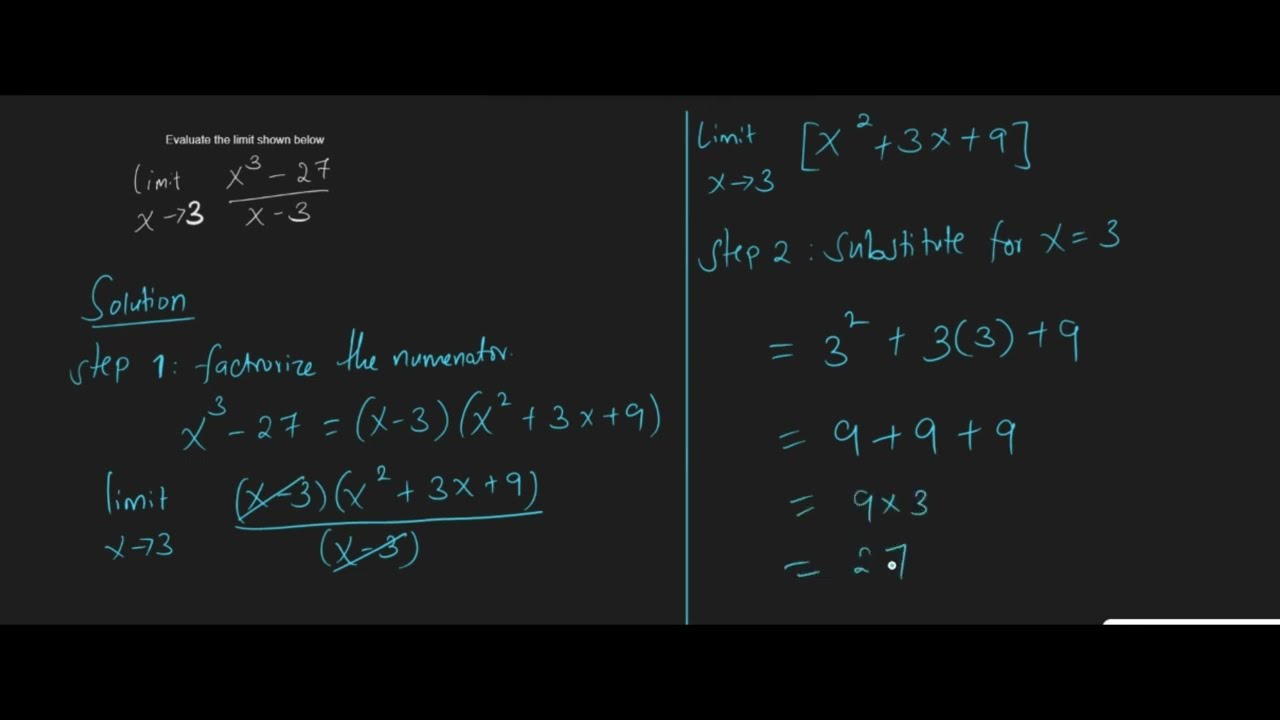
The video shows how to evaluate a limit.
 unkempt jolt
What are some good online sources to learn and master precalc?
viscid thistle
plush umbra
yoo, is that sqa exam type ques,,???
thorn orbit
how would I do this?
 viscid thistle
When a function is described like this: f : R x R -> R, does it means that its domain is R x R and its range is R?
 stuck lark
viscid thistle
When a function is described like this: f : R x R -> R, does it means that its...
stuck lark
viscid thistle
When a function is described like this: f : R x R -> R, does it means that its...
what your definition of range
viscid thistle
hmmm
viscid thistle
stuck lark
what your definition of range
kinda ambigious but i think of it as the set of what f(x) equals to for all x
stuck lark
ok do you know what a codomain is
viscid thistle
stuck lark
ok do you know what a codomain is
ive heard of it
but idk what it is exactly
stuck lark
its the set of allowed outputs
as opposed to the range which is the set of actual outputs
when writing f:A->B, A is the domain and B is the codomain
viscid thistle
stuck lark
when writing f:A->B, A is the domain and B is the codomain
thanks 
ill search some more about codomain
obsidian monolithBOT
RokettoJanpu
 stuck lark
the domain and codomain is R. the range is [0,infty) which doesnt equal the codomain R
stuck lark
$\trig$
obsidian monolithBOT
RokettoJanpu
 stuck lark
obsidian monolith
**RokettoJanpu**
slim steppe
stuck lark
obsidian monolith
**RokettoJanpu**
slim steppe
Have you studied limits with graph interpretation
 woven roost
slim steppe
Have you studied limits with graph interpretation
woven roost
slim steppe
Have you studied limits with graph interpretation
kind of. I got DNE, 1, and -3 for a b and c
idk if they are correct
do you know what the rest would be
woven roost
slim steppe
B is wrong.
would it be 0
slim steppe
Are you guessing
thorn orbit
is finding zeros with the quadratic equation the same as completing the square
woven roost
slim steppe
Are you guessing
yes, I dont know how to do this
slim steppe
woven roost
yes, I dont know how to do this
Okay, so, what is the defined function value at x=1
woven roost
slim steppe
Yeah, there you go.
so b is 1?
slim steppe
Yes,
woven roost
A doesnt exist correct?
slim steppe
Correct
woven roost
slim steppe
Correct
thanks, how would I do d?
slim steppe
Do you see that minus sign above the number?
Called a superscript
The question is asking you: What function value is the function approaching to from the left of 1
The minus indicates that you are approaching from the left side
And what do you think a plus sign will indicate?
woven roost
slim steppe
And what do you think a plus sign will indicate?
approaching from the right side
woven roost
slim steppe
Okay, so using that, what do you think the answer to d) is?
I think its -3?
woven roost
slim steppe
You're approaching to positive 1 from the left side
is it the value on the x axis?
slim steppe
Yes, you're approaching 1 on the x axis, and what is the limit as you approach 1 from the left side of it
Basically, to what function value are you approaching to as x-> 1
from the left side
woven roost
would it be -1
slim steppe
No, okay, look at (1,0)
woven roost
yes, there is a hollow circle
slim steppe
The question is asking you, what is the function value approaching to as the domain of the function approaches to x=1 from an infinitesimal distance
I'm going to draw it out for you, so you can see
woven roost
OH its 0
slim steppe
Yes, there we go
woven roost
lets go
slim steppe
Finally
woven roost
slim steppe
Finally
I believe e must be 0 as well?
slim steppe
Do you know what a hyperbola is?
woven roost
yes
slim steppe
Okay, so, do you know the behavior of it as the domain extends far out to positive infinity?
woven roost
[1,infinity) ?
woven roost
okay
slim steppe
It's an asymptote
woven roost
yes, i understand
slim steppe
That means, that there is an infinite discontinuity for that function at x=1
woven roost
okay
slim steppe
So, the function will approach to positive infinity from the right of x=1
and negative infinity from the left of 1
woven roost
yes
slim steppe
Do you understand why that is?
woven roost
so would the answer be infinity?
im sorry, Havent taken any math classes for over a year so im braindead
slim steppe
Okay
Take 1/x-1
And take some infinitesimal number to the right of one
like 1.000000000000001
woven roost
okay
slim steppe
and take an even smaller number
1.000000000000000000000000000001
and continue this
@woven roost Don't actually do this
This is basically intuitive
woven roost
yeah I get it
slim steppe
But, the point is, the closer you approach to 1, the larger your result will become
woven roost
okay
woven roost
oh
so why would it be 0 from the left? and why not negative infinity
because its in one piece right?
slim steppe
Both work, but I prefer positive infinity
More discrete
than just saying "dne"
Okay, now, try problem f)
woven roost
is it a numerical answer
slim steppe
Can't tell you, you figure it out
woven roost
so its as x approaches negative infinity, the numebr gets smaller
slim steppe
Where is the function approaching to as x gets innumerably large
in the negative domain
slim steppe

What is the approaching function value as the domain of the functions approaches to greaters negative numbers?
woven roost
that is 1 on the y axis
woven roost
so the answer is 1?
slim steppe
Yes
woven roost
okay finally last one looks too confusing i got no clue
slim steppe
For this one, you can just plug in 0 into f(x)
woven roost
OH
woven roost
so that comes out as 0
slim steppe
and what is the approaching y coordinate as x approaches to 0
woven roost
1
woven roost
slim steppe
Now substitute one for f(x)
im getting -4
slim steppe
Yes, it's 0
woven roost
thank you very much, was a lengthy assignment lol
thorn orbit
if I'm trying to find the points of intersection between 2 functions, would I just combine the 2 and solve for x?
 crystal star
thorn orbit
if I'm trying to find the points of intersection between 2 functions, would I ju...
crystal star
thorn orbit
if I'm trying to find the points of intersection between 2 functions, would I ju...
What kinda functions are they
Cuz you can just solve for x like you said
Then just plug the x values into the function that’s intersecting
Or any
To find the points where they intersect
thorn orbit
linear
thorn orbit
coolio thx
crystal star
Np
 half pine
is "Pre-university" like when your still in normal school?
crystal star
Yeah like high school
crystal star
Lol
hushed sphinx
He hasn't learned calculus yet, so it must be pre-calculus. Simple.
thorn orbit
ez
crystal star
thorn orbit
ez
You did the problem?
hushed sphinx
(sighs at bizarre American naming of school subjects)
thorn orbit
nah i was responding to tropo
crystal star
Oh
thorn orbit
lul
crystal star
So my instructions didn’t work or
thorn orbit
didn't say that
crystal star
half pine
where do i go for my level?
Prolly pre algebra
thorn orbit
what's your level
crystal star
half pine
ok
hushed sphinx
Have you even asked a question yet?
crystal star
Hurt did
thorn orbit
for all we know he could be the only PDE solving middle schooler
crystal star
I answered it
hushed sphinx
Oh, I meant, its difficult to tell which channel RoastedChicken's question belongs in when we don't know what it is he intends to ask.
crystal star
Npnp dog
thorn orbit
the question has a quadratic and a linear to find the points of intersection for
 summer ruin
write what it means for two functions to be equal at a point
thorn orbit

I think it's asking for the points of the secant line, but i'm not sure how to find those
summer ruin
find points of the intersection of two functions
secant line
huh?
it's quite literally plugging in the definition of f(x) and g(x) and solving for x
thorn orbit
one is a quadratic, one is a linear
thorn orbit
I interperated it as, when you graph each function, what would be the point of interseption. but now that i'm re-reading, there isn't even a possible secent line.
 ruby cloud
If there was something related to secant lines, the task would mention them
 compact bridge
thorn orbit
there was no x given
compact bridge
thorn orbit
there was no x given
Would love a crack at this. Share answers after? If up for it.
 viscid thistle
isn't this cal?
woven roost
viscid thistle
isn't this cal?
Wdym
viscid thistle
viscid thistle
what is a good channel for maths courses?
what math are you in
viscid thistle
viscid thistle
what math are you in
Calculus
And combinatorics
Actually In my country, you need to study a lot of stuff in high school
Which are mainly college level stuff in other countries
 fading crown
Finland got the best education system dunno what these other countries doing
Everyone should copy them
slim steppe
Having the best education does not necessarily intel the greatest outcome
Yes.
Solid point
It's a defined point
It's a graph
It can be a hollowed out or a defined point

A limit is defined as something that one is approaching to
A point is just a point
There is no left or right domain that extends from the point
Hold on, what grade are you in
No, I mean, what grade are you in in school?
What math class did you have in your senior year?
compact bridge
thorn orbit
Thanks for sharing 👍
slim steppe
A function that approaches to 2 from the right side
woven roost
slim steppe
A function that approaches to 2 from the right side
so a line?
slim steppe
If that line holds true for the other questions in the problem set, then yes
woven roost
slim steppe
If that line holds true for the other questions in the problem set, then yes
im thinkng that The points (1,2) and (1,1) are graphed as solid circles to represent the limit as x approaches 1 from the right and left
for d and e?
slim steppe
They can be open circles, the question doesn't specify which
woven roost
slim steppe
They can be open circles, the question doesn't specify which
okay, so for e, is there a horizontal line that goes from the asymtote, to 1,1?
woven roost
slim steppe
They can be open circles, the question doesn't specify which
asymtote at x=-1
slim steppe
There's a jump discontinuity at x=1
Because from the left, it's approaching to 1
and from the right, it's approaching to two
Oh, you said negative one
hold on
woven roost
does this make sense as an answer for the whole thing
slim steppe
Thing is, the questions are so ambiguously stated
woven roost
yeah, there are many possible answers
slim steppe
Because b) the graph can have a negative range
and also a positive range
It doesn't specify to which "infinity" it is approaching to
a positive
or a negative
woven roost
does my graph seem reasonable though
slim steppe
I'd have to look at it later, I have to run now
Perhaps ask transparent
He can help you
summer ruin
woven roost
does this make sense as an answer for the whole thing
no
you didn't cover half of the questions
woven roost
oh
summer ruin
and even while f(2)=0 is correctly drawn you didn't put an empty circle on the graph to show that it's not continuous there
yes
woven roost
I don't get what else I'm missing
I can tell there isn't anything on the left side of the asymtote
summer ruin
b), c), f), h)
woven roost
summer ruin
b), c), f), h)
I put b as an asymptote on x=-1. You can't really see it
And c is the point on 0,-1
F is the dotted line spanning from x=-1 to x= 1
Idk about h
@summer ruin you here
woven roost
summer ruin
h) requires for two one sided limits to exist
so 2 lines coming from the right?
like where should i plot it
summer ruin
it's already plotted I guess
woven roost
oh really
summer ruin
but f) is not quite done
recall the definition of continuity from the left in a point
or from the right for that matter
woven roost
yeah. i dont understand how ill do that with the asymtote blocking the way
summer ruin
this has nothing to do with the asymptote
woven roost
oh
summer ruin
asymptote is not even in that region
woven roost
summer ruin
asymptote is not even in that region
do i need to plot a solid point at x=1?
is f the last one i have not done
summer ruin
I don't know what your asymptote looks like
woven roost
summer ruin
I don't know what your asymptote looks like
it is what I did for the question b) i plotted a vertical asymtote at x=-1 spanning infiniteley
summer ruin
what does that mean
woven roost
i put a vertical line at x=-1
yo you there
<@&286206848099549185>
i dont want to start a new conversation with someone new
summer ruin
woven roost
i put a vertical line at x=-1
well that would be wrong
summer ruin
have you ever seen an asymptote
woven roost
summer ruin
have you ever seen an asymptote
yeah, it is a line where the function cant cross
invisible line
summer ruin
that's not true
sin(x)/x has a horizontal asymptote at y=0 which it approaches as x approaches infinity
yet sin(x)/x crosses it's asymptote infinitely many times
woven roost
oh
woven roost
summer ruin
yet sin(x)/x crosses it's asymptote infinitely many times
so in this case, i am able to plot the line through this asymtote?
summer ruin
and hardly drawing it as a vertical line is accurate
you're asked to draw a function
which meets these properties
woven roost
okay
woven roost
summer ruin
which meets these properties
what would you suggest I fix
bro im losing braincells
7 hours at this
summer ruin
look at how any other asymptotes look

the exercise is not about drawing everything in some precise way
which you seem to be trying to do drawing straight lines
woven roost
summer ruin
okay, does the asymtote exist at x=-1 though?
summer ruin
what do you think based on limit f(x) = infinity as x-> -1?
woven roost
summer ruin
what do you think based on limit f(x) = infinity as x-> -1?
its negative 1
so this graph seems right now
im actually nauseous now
summer ruin
why is your function going to negative values if the limit is infinity
you should also draw what it behaves like as it approaches x = -1 from the left
woven roost
summer ruin
why is your function going to negative values if the limit is infinity
i dont get it, do I need to make 2 lines that look like a mirror image on each side of the asymtote?
that curve up?
summer ruin
yes, though not necessarily mirror image
woven roost
summer ruin
it should be f(1) = 1
what do you mean
summer ruin
left continuity
woven roost
summer ruin
left continuity
oh a hollow point at -2,1
summer ruin
?
woven roost
summer ruin
it should be f(1) = 1
Ohh do you mean I should extend the line that cuts off at 1,1
summer ruin
what
summer ruin
function f evaluated at x = 1 outputs a value of 1
because it says that f is continuous from the left at x = 1
woven roost
summer ruin
because it says that f is continuous from the left at x = 1
Okay... so what do I need to do
Thanks for the help btw
summer ruin
think about what's wrong with your current drawing
and why it doesn't meet the left continuity at x = 1
woven roost
summer ruin
think about what's wrong with your current drawing
Because its discontinued
summer ruin
that's too broad of a reason
there are discontinuous functions which are left continuous
no
that actually didn't change anything
woven roost
summer ruin
that actually didn't change anything
do you want me to change what I already have or build onto something
can you markup edit it and show me
summer ruin
I want you to look up the definition of left continuity of a function at a point
the change is so small it's not even worth trying to give a hint because that'll be the entire answer
woven roost
summer ruin
the change is so small it's not even worth trying to give a hint because that'll...
is it changing a hollow circle into a solid one
woven roost
is that it?
woven roost
summer ruin
yes
rest is good?
summer ruin
yes
woven roost
summer ruin
yes
alright, thanks man
woven roost
summer ruin
yes
even though the function spans from [-5,5], I can have a solid circle connecting? in the center?
summer ruin
how are these concepts even related
woven roost
summer ruin
how are these concepts even related
im confusing 2 things arent I
summer ruin
I don't know
woven roost
summer ruin
I don't know
anyways, thanks
slender idol
for radical functions with an even root, the domain is only restricted by what produces a negative radicand?
ex. f(x) = 4 sqrt(x+1) - 3
isolate radicand into inequality
1. x + 1 >=  0
2.   x   >= -1
that is proper work for finding the domain here?
summer ruin
yes
chilly hazel
how do you calculate this?
 slim steppe
The exponent is the same in the numerator and in the denominator
So take the ratio of the coefficients
And that is 81
and 3 to the 4 is 81
 odd hamlet
 willow bear
,rccw
obsidian monolithBOT
 willow bear
have you done part a?
 abstract tusk
 willow bear
abstract tusk
willow bear
abstract tusk
!status
 tender questBOT
abstract tusk
tender questBOT
abstract tusk
What step are you on?
1. I don't know where to begin
2. I have begun but got stuck midway
3. I got an answer but I'm told it's wrong
4. I got an answer and would like my work checked
5. I have a question about someone else's worked solution
6. None of the above
highlight in red

since the division have the same base why is it -n+(n-1)
Instead of 2^n-1-(n-1)
tardy thicket
 zealous trout
Someone knows how i can study derive
zealous trout
Someone knows how i can study derive
read the text book
for your class they usually help and give out example how to do each problem and variation
of each problem
 snow surge
Uhhh im confused

What ariah walking got to do with this

Thats as close as i can get
hushed sphinx
Hmm, the exercise appear to make most sense if you assume that the boat's velocity relative to the water stays the same before and after it "encounters a current" -- even through I'm not sure that's a particularly realistic assumption.
hushed sphinx
I would understand it as saying
- the water moves with a velocity of (12,7) relative to the Earth
- the boat moves with a velocity of (0,35) relative to the water
- Ariah moves with a velocity of (-5,0) relative to the boat
and you're supposed to find (the magnitude of) Ariah's velocity relative to the Earth.
viscid thistle
 tardy thicket
zealous trout
Someone knows about a good book?
tardy thicket
zealous trout
Someone knows about a good book?
Unsure about books but ask your professor for the recommnded book
 short crescent
zealous trout
Someone knows how i can study derive
short crescent
zealous trout
Someone knows how i can study derive
https://www.youtube.com/@macpryma2167/playlists 10c is all the grade 10 math, 20-1 all the grade 11 math for pre cal, 30-1 math is all the grade 12 math for pre cal

YouTube
I am a teacher at Archbishop MacDonald High School in Edmonton Alberta, Canada.
I designed these podcasts to be a part of support to all students in Math.
Please enjoy them, I made them for you!
Email: Stjosephpryma@gmail.com
viscid thistle
Got my first Pre Calc exam this Thursday wish me luck!!! Im feeling pretty good going into the test.
viscid thistle
Guys i reqlly need help with this problem Proving trig identities pleaseee help me now with steps or imma fail soon😭😭😭
 slim steppe
viscid thistle
Guys i reqlly need help with this problem Proving trig identities pleaseee help ...
slim steppe
viscid thistle
Guys i reqlly need help with this problem Proving trig identities pleaseee help ...
Butterfly rule
slim steppe
viscid thistle
Please
 viscid thistle
slim steppe
viscid thistle
slim steppe
Tysm
 shut skiff
 willow bear
bad typesetting 
viscid thistle
$\sin(y) = \floor{\frac{\sqrt{1+x} + \sqrt{1 - x}}{2}}$
obsidian monolithBOT
Ryuzaki

 fierce dock
<@&268886789983436800> spamvertisement?
pseudo hamlet
viscid thistle
Guys i reqlly need help with this problem Proving trig identities pleaseee help ...
Another way would be to replace (1-cos(x)^2) with sin(x)^2 using the pythagorean identity
 sterile token
viscid thistle
Guys i reqlly need help with this problem Proving trig identities pleaseee help ...
sterile token
viscid thistle
Guys i reqlly need help with this problem Proving trig identities pleaseee help ...


 hushed sphinx
You don't need all the information in the problem there. What is the simplest way you can imagine to find out what n is?
hushed sphinx
For both ones.
 gusty pasture
wait how is the second one 7?
hushed sphinx
I mean, it's the same expression for both parts of the question -- n doesn't vary between them.
hushed sphinx
When you know n, you can apply the binomial theorem to (5x+4y)^n.
gusty pasture
so its (5x^2 + 4y^5)^7
hushed sphinx
No.