#precalculus
1 messages · Page 1 of 1 (latest)


 solar pagoda
The graph is right but not sure about your choice on a.
You said 1 <= a <= infty, for a = 1 the limit of f does not exist since left hand and right limit are not the same.
Also that is not the only a values.
 gritty spade
solar pagoda
You said 1 <= a <= infty, for a = 1 the limit of f does not exist since left han...
gritty spade
solar pagoda
You said 1 <= a <= infty, for a = 1 the limit of f does not exist since left han...
ive been scratching my head over this for the past few hours or so, is it possible you could help me out on this?
solar pagoda
Sure, what are you stuck in?
Did you understand why I said for a = 1, we have the limit of f does not exist?
Also just realizing this is not #calculus .
gritty spade
solar pagoda
Sure, what are you stuck in?
im not quite bright enough to see any thing in the graph that has the same limits for both left and right lmfao
gritty spade
solar pagoda
Did you understand why I said for a = 1, we have the limit of f does not exist?
i think i do
gritty spade
solar pagoda
Also just realizing this is not <#326138772477575180> .
pardon?
gritty spade
solar pagoda
Limits are usually in <#326138772477575180>
oh, my apologies
solar pagoda
I do one part, for a < -1, notice f approach f(a) from left and right hand side of a.
Take a = -2 for an example.
Do we have this behavior anywhere else on this graph?
gritty spade
solar pagoda
I do one part, for a < -1, notice f approach f(a) from left and right hand side ...
wait, but how so
solar pagoda
You can see it right?
gritty spade
is it because its a less than -1 sign, we consider that as an "a" value?
solar pagoda
If we get close to a from left and right side f gets close to f(a).
solar pagoda
gritty spade
is it because its a less than -1 sign, we consider that as an "a" value?
Not sure what this means?
Take a = -2 for an example.
gritty spade
solar pagoda
If we get close to a from left and right side f gets close to f(a).
but wouldn't the r.h.s be -1 instead?
solar pagoda
gritty spade
but wouldn't the r.h.s be -1 instead?
Is this for a = -1?
gritty spade
solar pagoda
Take a = -2 for an example.
yup
solar pagoda
I was only considering a < -1.
Limit does not exist at a = -1 as you said lhs and rhs limit are not equal.
gritty spade
solar pagoda
Limit does not exist at a = -1 as you said lhs and rhs limit are not equal.
oh okay, so for values less than -1, the lhs and rhs are equal in this case?
oh shit, i see it
it's because it's a straight line
gritty spade
okay, so the 'a' values would be a<-1 and -1<a<1 ?
solar pagoda
Yep and?
gritty spade
thanks man, prior to the help, it seems i didn't even have an idea of limits
 simple pollen
gritty spade
simple pollen
gritty spade
stewart chad moment
gritty spade
simple pollen
stewart chad moment
hell yea, got my unis starting soon so i thought id ask a senior for some textbooks so that i could have a headstart
 astral bobcat
sorry, i have a question
y < 0, x^2 + y^2 = 4 and the question is the value of the slope of the tangent drawn from the root 3 abscissa point.
I came to a solution with the parabola under the x-axis of the circle with radius 2, but I did not understand the solution using the derivative of y with respect to x.
which goes like 2x + 2yy' = 0
and y' = -x/y = -root(3)/-1
i didn't understand the process if my question is clear
 quartz inlet
Hello, in a problem I am supposed to simplify $\sin x -\cos x$ into $\sqrt{2}\cos \left(x-\frac{3 \pi}{4} \right ) $, where as a hint it was said it might be helpful to use the addition formula later on.
\
How would one go about this? I tried googling about the derivation for this identity but with no avail. Appreciate any help.
 obsidian monolithBOT
Aslan

 edgy spruce
Start with the fact that sinx=cos(x-pi/2)
let x=y+pi/4
You get cos(y-pi/4)-cos(y+pi/4)
Expand using the hint they told you to use
cosy/√2+siny/√2-cosy/√2+siny/√2
2(siny/√2)
√2xsiny and recall that siny=cos(y-pi/2(
So √2cos(y-pi/2)
Let y=x-pi/4
√2cos(x-3pi/4)
✅
edgy spruce
quartz inlet
Hello, in a problem I am supposed to simplify $\sin x -\cos x$ into $\sqrt{2}\co...
Did I answer your question the way you wanted it?
quartz inlet
@edgy spruce Yes, thank you!
astral bobcat
 verbal zodiac
<@832570766750253077> can you share original question
verbal zodiac
<@832570766750253077> can you share original question
y < 0, x^2 + y^2 = 4 and the question is the value of the slope of the tangent drawn from the abscissa of root 3.
verbal zodiac
@astral bobcat

 edgy spruce
7logx/(2log10+logx)=2
7/2=1+2log10/logx
5/4log10=1/logx
Logx=4log10/5
X=10^4/5
 young bolt
Thank you
young bolt

 burnt lodge
young bolt
burnt lodge
young bolt
Do you know double angle formula
 willow bear
burnt lodge
Do you know double angle formula
willow bear
burnt lodge
Do you know double angle formula
you do not need that here
burnt lodge
willow bear
you do not need that here
I can see that
 golden cobalt
Hi! What are the steps to solving this question?
 burnt lodge
golden cobalt
Hi! What are the steps to solving this question?
burnt lodge
golden cobalt
Hi! What are the steps to solving this question?
Can you swap 2x and 4x
Whilst deleting negative exponents
 clever basin
young bolt
clever basin
young bolt
Where do you get those math equations from?
 mild swan
golden cobalt
Hi! What are the steps to solving this question?
mild swan
golden cobalt
Hi! What are the steps to solving this question?
Rewrite this expression with no complex fraction and no negative exponents
 uncut mulch
multiply numerator and denom by x
 hot flame

 cloud wadi

how is this even possible
the base of the triangle isnt given, and neither is any of the sides of the rectangle
the only given here is the diagonal of the rectangle
willow bear
the radius of the circle is 1 so the height of the triangle is (2-H)/2 and the width of the rectangle is sqrt(4-H^2)
cloud wadi
willow bear
the radius of the circle is 1 so the height of the triangle is (2-H)/2 and the w...
the diameter of the circle is not equal to the base of the isosceles
it doesnt pass through the center
willow bear
but did i say the base of the triangle equaled the diameter?
i did not.
don't put words in my mouth.
cloud wadi
then how did you come to the conclusion height = (2-h)÷2
sorry im just trying to learn
 cloud wadi
yes
willow bear
x + H + x = 2
cloud wadi
ohhh
and when you find the width of the rectangle. you can find value of H using pythagoras
cloud wadi
there are 2 hs on the shape which are you referring to
willow bear
there's one that was there to begin with and one that was put there by me
and they are the same
 muted turret
99% can do this question. It’s easy! Find the vertex of the quadratic equation 2x^2+4x-1 and find 4 points that the parabola from this equation goes through.
willow bear
indeed, but if you're not part of those 99% then we won't do this for you
cloud wadi
muted turret
99% can do this question. It’s easy! Find the vertex of the quadratic equation 2...
my maths isnt in english so i have no idea what that means
 golden cobalt
mild swan
Rewrite this expression with no complex fraction and no negative exponents
golden cobalt
mild swan
Rewrite this expression with no complex fraction and no negative exponents
Thanks it worked
 uncut mulch
convert to polar and/or CiS form and apply exponent laws or DeMoivre

 vapid plaza
 hollow ibex
This is a geometric series
hollow ibex
ye i got the common ratio
 vapid plaza
Each horizontal slice of the cone is a circle whose radius is proportional to the height on the cone (z-coordinate)

A bit like this
See that r1/z1=r2/z2
So z = (constant) * r
burnt lodge
vapid plaza
Looks good
 viscid thistle
can someone tell me if this is good?

 rapid inlet
vapid plaza
rapid inlet
vapid plaza
Oh ofc tysm
burnt lodge
viscid thistle
can someone tell me if this is good?
Good
clever basin
E
 gentle vale

How do we deal with the case where n = -1?
it's come up in a problem i'm doing and i'm desperate 😂
willow bear
int 1/x dx = log|x| + C @gentle vale
cloud wadi

ok so i found h= 2/5 (thanks ann) by using area of both rectangle and triangle formula and used it to rearrange w and h but im the process w was eliminated and thus the value remained undetermined.
when i try to sub in h in the equation wh=(wb)÷2
(b being the height of the triangle) the equation is a dud and i get w=w. how do i find the value of w?
 delicate relic

 hybrid pewter
delicate relic
hybrid pewter
delicate relic
do we know that such an n even exists?
we can certainly find an n such that f is 0 exactly once in [0, sqrt(3)/2], but a minimum n such that there is no 0 might not exist
as in its possible n in (a, b) gives no zeroes on [0, sqrt(3)/2], so there would be no minimum
delicate relic
it does
 wise spoke
I am trying to figure out the turning points of this function, but I keep on getting two turning points but the answer says one.
$y = \frac{x^2+2x}{x^2+x+4}$
obsidian monolithBOT
∫Inheritanc-e ♦
 willow bear
show work?

 willow bear
ah, hang on.
wait, does the answer key explicitly state there's only one turning point
or what
wise spoke
willow bear
wait, does the answer key explicitly state there's only one turning point
Yes
wise spoke
The question asks how many turning points are there
willow bear
your x looks a lot like n though
wise spoke
And when I check it shows 1
 willow bear
"the answer key states there is only one"
is not the same as
"i graphed it and only see one"
wise spoke
I don’t get what u mean
willow bear
i am pointing out what might be a communication error on your part.
you are not properly reporting what exactly it is that doesn't add up.
there's a difference between "my answer does not match the answer key" and "my answer does not match desmos"
wise spoke
willow bear
there's a difference between "my answer does not match the answer key" and "my a...
My answer does not match the answer key
willow bear
show the answer key.
ideally also show the original problem statement, just to be sure we're looking in the right place.

 wise spoke
yep
viscid thistle
hi can anyone help with this?
 burnt lodge
viscid thistle
hi can anyone help with this?
burnt lodge
viscid thistle
hi can anyone help with this?
The equation here is an ellipse
The other is a circle
Can you graph these functions
hybrid pewter
viscid thistle
hi can anyone help with this?
you can write the second equation as (x-1)^2 + (1/4)(y+4)^2 = 25
then comparing that with the first equation should make the solution clear
 opal tree
Haha conics, I hate them

 alpine wraith
do you know what sine, cosine, and tangent values for each radian are?
That, Id assume means the coordinate values.
Which means including rad3/2 , 1/2
Stuff like that for each point
alpine wraith
just put like
s = whatever coordinate, like rad2/2
c = whatever, like rad2/2
t = y point over x point solved to simplest form
That way you can fit it all
 proud basin
I've made this
proud basin
Oh ok
 timid cedar
How much guess work is acceptable when finding factors?
I did a guess that (x^3 - 1) is divisible by x-1, because it looked neat with x^3 - 1^3
 summer ruin
at least here it's perfectly acceptable to find roots by guess work, in fact some cubics have roots +-1, +-2 and so on which you can find by guess work if you're stuck with it and then divide by said root
you can observe that x=1 is indeed a root of x^3-1
hence x^3-1 is divisible by (x-1)
(this is because each polynomial can be factored into a product of polynomials e. g. (x-a)(x-b)(x-c)(ax^2+bx+c) and so on, here the quadratics are assumed that they're no longer factorable with real numbers)
wise spoke
The curve C, is given as y = $\frac{x^2 + ax + b}{2x-1}$. Given that one of the asymptotes is y = $\frac{x}{2}$ + $\frac{5}{4}$ and one of the points of intersection is (0,4)
obsidian monolithBOT
∫Inheritanc-e ♦
 wise spoke
We know that the oblique asymptote is expressed as y = Q(x) + $\frac{R(x)}{D(x)}$. And we take the Q(x) part as the oblique asymptote. So what I'm wondering is, in the question above is y = $\frac{x}{2} + \frac{5}{4}$ the Q(x) or y = Q(x) + $\frac{R(x)}{D(x)}$
obsidian monolithBOT
∫Inheritanc-e ♦
 willow bear
it's the Q(x)
wise spoke
Right. Thanks
wise spoke
Okay. I couldn't figure out how to do it.
Could someone help me
i need to find the value of a and b
the value of b is -4
but idk what the value of a is
could someone help me do this?
willow bear
$\frac{x^2 + ax + b}{2x-1} - \frac{x}{2} - \frac{5}{4} = \frac{x^2 + ax + b - x(x - \frac12) - \frac54(2x-1)}{2x-1} \ = \frac{x^2 + ax + b - x^2 + \frac12x - \frac52x + \frac54}{2x-1} \ = \frac{(a-2)x + (b - \frac54)}{2x-1}$
obsidian monolithBOT
Ann
 willow bear
you want a-2 = 0 so that this fraction approaches 0 as x -> ±∞
wise spoke
hmmm
 opaque timber
Can someone help me with this?

 chilly cobalt
hey guys ik this is like a very very dumb question cus im just starting to learn precalc but like how did they got those numbers ( in red circle) im so confuse omg 😭
 viscid thistle
chilly cobalt
hey guys ik this is like a very very dumb question cus im just starting to learn...
viscid thistle
chilly cobalt
hey guys ik this is like a very very dumb question cus im just starting to learn...
uhh
that is 5^2+1
and 3^2
they got these numbers through solving the equation
viscid thistle
chilly cobalt
what is "^" that
that is the exponent notation
viscid thistle
chilly cobalt
omg sorry for such a dumb question ; _ ;
nah I'm happy to help anyone lol
chilly cobalt
what does that thing do omg sorryyyyy omg
obsidian monolithBOT
Ann
 viscid thistle
yes
viscid thistle
mhm
viscid thistle
np
chilly cobalt
hey um can i add you?
 crisp stirrup
wait what u are doing precalc and not knowing exponents
burnt lodge
crisp stirrup
wait what u are doing precalc and not knowing exponents
He doesn’t know that notation
crisp stirrup
ok
 rocky spruce
 viscid thistle
im still confused on how limits work
say f(x) = {
x, x>0
1, x = 0
x, x<0
}
then how are you computing limit (x->1) f(x) from left and right?
willow bear
well f(x) happens to be equal to x in a neighborhood of 1
so $\lim_{x \to 1} f(x) = \lim_{x \to 1} x$
obsidian monolithBOT
Ann
 viscid thistle
willow bear
well f(x) happens to be equal to x in a neighborhood of 1
viscid thistle
willow bear
well f(x) happens to be equal to x in a neighborhood of 1
how?
proof?
summer ruin
to evaluate the limit you don't have to have function even defined in your limit point, like if you had f(x) = sin(x) everywhere, but undefined at x= 0, you still can figure out that the limit at x = 0 is 0
willow bear
if you ask me why i chose this neighborhood i'll choose another one
viscid thistle
ok but how do you know firstly that the limit exists
willow bear
i do not
willow bear
the equality is an equality of elements of $\bR \cup {+\infty, -\infty, \mathrm{NaN} }$
obsidian monolithBOT
Ann
 willow bear
i do not choose a "neighbor"
i assert the existence of a neighborhood on which f(x) equals x
and i presented such a neighborhood to you
willow bear
$\lim_{x \to 1} x = 1$, as should be obvious and/or easily provable by epsilonics.
obsidian monolithBOT
Ann
 viscid thistle
Ah I should look up the precise defenition of limits
thanks
Sheesh proving limits are hard
had to find delta and all that
how are limits a prereq and not taught in the calculus
willow bear
as far as the computation of limits goes, there exist a few rules that lend themselves to easy application without worrying about epsilons.
summer ruin
well in this specific problem $\delta = \epsilon$
obsidian monolithBOT
Transparent_Elemental
 summer ruin
$\forall \epsilon > 0 \ \exists \delta > 0 : 0 < |x-1| < \delta \rightarrow |x-1| < \epsilon$
obsidian monolithBOT
Transparent_Elemental
 viscid thistle
how come you can do
lim f(x)g(x) = lim f(x) lim g(x)
will i be proving it in further courses rather than calculus 1?
 acoustic vault
Yes you will prove it in analysis
Though it’s quite simple to prove, but proofs are generally not covered until analysis
summer ruin
you can do that only if the right hand side limits exist
acoustic vault
That’s true the hypothesis is provided f(x)—>a and g(x)—>b
acoustic vault
viscid thistle
how come you can do
lim f(x)g(x) = lim f(x) lim g(x)
for a basic proof
The idea is that $\lim_{x\to a} f(x) = a$ if and only if for every sequence $x_n \to a$ and $x_n \neq a$, we have $\lim_{n\to \infty} f(x_n) = f(a)$
obsidian monolithBOT
Andrew071
 acoustic vault
Thus it suffices to prove $x_ny_n \to xy$ provided $x_n \to x$ and $y_n \to y$
obsidian monolithBOT
Andrew071
 acoustic vault
To do so, $\lvert x_ny_n -xy \rvert \leq \lvert y_n \rvert \lvert x_n - x \rvert + \lvert x \rvert \lvert y_n -y\rvert$. Now let $n\to \infty$. (Note we have implicitly used the fact that convergent sequences are bounded, the triangle inequality, limit of sum of convergent sequences equals the sum of the limits, and the squeeze lemma)
obsidian monolithBOT
Andrew071

 deft meteor
 hushed sphinx
That's usually called "analysis" of various sorts.
 vagrant yew
hello, I have a question about periods for sum/differences of trig functions
say you have the function y = sin2x - csc3x and you want the period. I found the period of sin2x which is pi, and the period of csc3x which is 2pi/3, and I found the lcm which is 2pi, and so I said the period is 2pi.
this was ultimately correct, but it seems you have to do more to determine whether or not 2pi is the period? apparently all I did was show the graph repeats at 2pi but is not necessarily the period since there could be something smaller. I was wondering how to find that period, or how to prove that 2pi is the smallest period.
any help would be appreciated
summer ruin
period of a function $f(x)$ is any number $T$ such that for any $x \in dom f$ the equality hold $f(x-T) = f(x) = f(x+T)$, so if the function repeats at $2\pi$ and $\pi$ then both of those are periods
obsidian monolithBOT
Transparent_Elemental
 vagrant yew
but what if you're trying to find the smallest period
vagrant yew
vagrant yew
hello, I have a question about periods for sum/differences of trig functions
sa...
sorry I worded this wrong
hybrid pewter
vagrant yew
hello, I have a question about periods for sum/differences of trig functions
sa...
the lcm will indeed be a period of the sum but its not necessarily the smallest (positive) period. For example consider the sum of sin(x) and -sin(x)
idk if theres a general formulaic way to find the smallest period or not
hushed sphinx
If it's a simple linear combination of sines and cosines, and you've already collected like terms and thrown out ones whose coefficients vanish, then due to the uniqueness of Fourier series, it cannot have any shorter period than the lcm.
(On the other hand "unqueness of Fourier series" is probably not a good argument to float in precalculus :-D )
vagrant yew
hybrid pewter
the lcm will indeed be a period of the sum but its not necessarily the smallest ...
I see, if possible could you explain how you would show that 2pi is the smallest period of my example
hushed sphinx
In this example, you can see that the function blows up to infinity due to the cosecant exactly 3 times per pi, and it does so with different signs every other time.
So the smallest period must be a multiple of 2pi/3.
On the other hand, plugging in a few numbers allows you to see that the period isn't 2pi/3 or 4pi/3.
vagrant yew
that's pretty intuitive, I like it
thank you
hmm I'm wondering how you would find the period of something like sin2x - cos3x, where there aren't any asymptotes to take advantage of
hushed sphinx
That's where I'd resort to the Fourier series argument. :-(
vagrant yew
:(
that's probably why my textbook gave the csc example
welp desmos says the period is 2pi
hushed sphinx
There are probably more brute-force calculational approaches for ruling out short periods in concrete situations, and then you can eliminate the larger divisors of the lcm by plugging in values. But stating that as a general procedure feels rather complicated.
What I mean: If we forget "PREcalculus" for a moment, you can calculate the derivative of such a sum easily, and bound its magnitude globally. Now if you find two points with different function values, that gives you a lower bound for the period. Then there are only finitely many possible divisors of the lcm to eliminate by direct calculation.
viscid thistle
@vagrant yew Pre Calculus prepares you for calculus
vagrant yew
yes ik
viscid thistle
Calculus is really hard it’s probably one of the hardest courses in our school may be another course in your school
vagrant yew
our high school has linear algebra
viscid thistle
vagrant yew
our high school has linear algebra
Well what’s the grade 12 math called
vagrant yew
it depends
viscid thistle
Cause different schools have different education systems
vagrant yew
some seniors take statistics, some calc 1, some calc 2, some linear algebra
viscid thistle
Yeah
It depends dude
You got to think about this
“what is my goal going into college”
What job do I want, etc?
vagrant yew
lol idrc I just like math
viscid thistle
Fair enough haha
vagrant yew
I'm not particularly good I just like math :/
viscid thistle
You taking calculus
vagrant yew
I'm prepping for a placement test
viscid thistle
My strongest subject is math personally 😂
vagrant yew
if I do well I can get on the 12th grade linear algebra track
viscid thistle
Our school system teaches different though
I’m probably going to take Pre Calc Honeslty
I can’t take Calc it will be too hard for me 😂
vagrant yew
rn subjects I still need to study are conic sections, probably need to review trig stuff and basic proofwriting
 verbal rock
CALC LOOKS HARD
opal tree
It's really not too hard
It's just patterns
Like pre Calc is harder than Calc AB and BC
vagrant yew
so I'm trying to find the solutions to sinx - cosx = 0
I tried substituting cos in terms of sin using the pythagorean identity, and I got 4 solutions (work shown below). but then I realized if you just set sinx = cosx the answer becomes quite obvious and there are only 2 solutions. can someone explain why substituting doesn't work?
 uncut mulch
,rotate
obsidian monolithBOT
 vagrant yew
oh btw I'm solving for x is in 0 to 2pi
uncut mulch
cos(x) isn't the same as sqrt(1-sin^2(x))
and squaring can lead to the generation of extraneous solutions
 fallow isle
|cosx|=sqrt(1-sin^2(x))
Bc the sqrt only give positive outputs but cosine oscillates between negative and positive values
 bleak dune

 late nacelle
 willow bear
@thorn valley still need help with that?
 thorn valley
willow bear
<@245710787610542081> still need help with that?
thorn valley
willow bear
<@245710787610542081> still need help with that?
I got it but in a little bit I'll probably get to an advanced question I can't answer 😦
 sand dune
late nacelle
sand dune
late nacelle
you didn't show what you have tried
viscid thistle
obsidian monolith
**Ann**
^ is just a computer syntax for exponent
viscid thistle
late nacelle
Well, I am getting 4x + 2h as the solution and when I simplified it, I am getting 2(2x + h). Can somebody else please check this? Thanks.
My Work:

 frank vine
viscid thistle
My Work:
frank vine
viscid thistle
My Work:
I think good
viscid thistle
frank vine
I think good
Thanks bro.
 fiery river
what is precalculus and calculus, in simple words?
viscid thistle
fiery river
what is precalculus and calculus, in simple words?
pre calculus is before calculus and calculus is basically integrals and differentiation with also differential equations.
fiery river
In which grade/class do we learn it?
viscid thistle
fiery river
In which grade/class do we learn it?
depends on the country
what country are u in
fiery river
Lithuania
fiery river
viscid thistle
depends on the country
but mostly?
viscid thistle
ok, bro. I do not know about Lithuania but usually in most countries, it is 11th and 12th grade.
hushed sphinx
"Precalculus" as a particular grouping of mathematical topics seems to be mostly an American thing.
Assuming your country's curriculum design is not insane, the reasonable default answer to "what should I know" would be "whatever you were taught in previous grades".
 loud tundra
@fiery river I have heard that this book https://www.stitz-zeager.com/ is great for precalc. Maybe check it out to give yourself an idea of what precalculus is. I want to go through it
Free Open Source College Algebra Trigonometry Precalculus Textbooks by Carl Stitz and Jeff Zeager
fiery river
loud tundra
<@841757007631745074> I have heard that this book https://www.stitz-zeager.com/ ...
Thank you mate, appreciate it
fiery river
@loud tundra There's also video on YouTube I have found https://youtu.be/eI4an8aSsgw

Learn Precalculus in this full college course. These concepts are often used in programming.
This course was created by Dr. Linda Green, a lecturer at the University of North Carolina at Chapel Hill. Check out her YouTube channel: https://www.youtube.com/channel/UCkyLJh6hQS1TlhUZxOMjTFw
⭐️ Lecture Notes ⭐️
🔗 Part 1 - Functions: http://lindagr...
gentle vale
If I know about derivatives and integrals and the methods used to solve them, is learning partial derivatives a small step or a big step to learn?
summer ruin
basically you already know how to take the partial derivative if you know how to take the regular derivative, but it's very important conceptually
gentle vale
thanks
 upper agate
Does anyone know how to use a unit circle to solve cos -17pi/3
opal tree
upper agate
Does anyone know how to use a unit circle to solve cos -17pi/3
Find what angle -17π/3 is coterminal to. Should be between 0 and 2π
 cloud star
fiery river
I'm going to grade 11th, what I should know? For what I should prepare?
cloud star
fiery river
I'm going to grade 11th, what I should know? For what I should prepare?
Frankly, I think precalculus is barely necessary. It did not help with calculus at all. Algebra 2 accomplishes everything precalculus may have accomplished. I would recommend just diving into calculus.
Note: Precalculus is only an American thing.
summer ruin
what do you know?
summer ruin
have you done definite and improper integrals, infinite series?
summer ruin
then do that
fiery river
cloud star
Frankly, I think precalculus is barely necessary. It did not help with calculus ...

Learn Calculus 1 in this full college course.
This course was created by Dr. Linda Green, a lecturer at the University of North Carolina at Chapel Hill. Check out her YouTube channel: https://www.youtube.com/channel/UCkyLJh6hQS1TlhUZxOMjTFw
This course combines two courses taught by Dr. Green. She teaches both Calculus 1 and a Calculus 1 Coreq...
You think, this should help?
cloud star
fiery river
https://youtu.be/HfACrKJ_Y2w
If you want a quick and easy intro i would go with professor Leonard’s calc series
fiery river
It's in YouTube?
cloud star

YouTube
Topics: Review of Algebra/Trigonometric Concepts, Finding Limits, Derivatives and Derivative Techniques, Integrals and Integral Techniques, and Applications.
You can watch at 1.5 to 2.0 speed
If you get annoyed slow talk
He also has calc 2, calc 3, and differential equations.
And you can probably watch all the videos from calc 1 - differential equations in 1 month then run through a textbook on weaker concepts
vagrant yew
hello, I'm studying conic sections and I want to know if there is a way of constructing a hyperbola in real life, just like with an ellipse and parabola
viscid thistle
vagrant yew
hello, I'm studying conic sections and I want to know if there is a way of const...
Yes

Hyperbola with a lamp...
vagrant yew
I meant like on paper, though there definitely is a cool physics explanation for that
physics I wouldn't get
viscid thistle
vagrant yew
physics I wouldn't get
you will if you try
vagrant yew
I'm just tryna visualize a hyperbola
I can trace out a parabola and an ellipse using the definition in my mind, but not really hyperbola
 viscid thistle
Yeah cuz an ellipse is a special case of a circle so i am assuming that a hyperbola is a special case of a parabola?
summer ruin
parabola has eccentricity = 1 and hyperbola has eccentricity > 1
viscid thistle
yeah
circle = 0; ellipse is between 0 and 1, parabola = 1 and hyperbola is greater than 1
for eccentricity
btw, if we were able to make a wormhole, won't it be similar to a hyperbola?
vagrant yew
summer ruin
I meant like the foci definitions
 vagrant yew
yeah but how do you draw a hyperbola in real life taking advantage of that definition
like you can take a string, tie it to two pins and draw and ellipse that way
and you can take a ruler and a pin with a string to draw a parabola
summer ruin
something like this? https://youtu.be/mldZ_7QwLvs?t=113
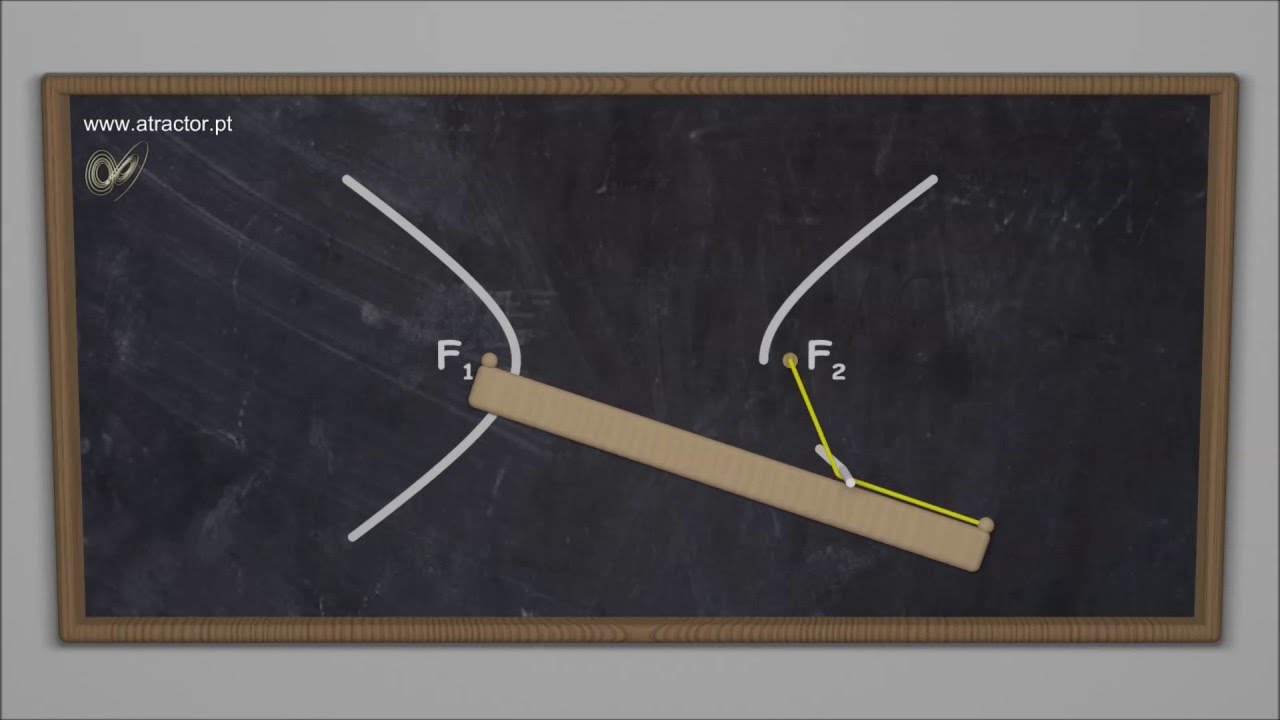
Ellipse:
There is a string attached to two nails. The string is stretched using chalk; when the chalk slides along the string, an ellipse is drawn.
Parabola:
There is a string attached to a nail and to the top of a set-square that is resting on a ruler (not touching the nail). With the chalk the string is stretched and pushed against the set-sq...
requires a special ruler though
 grizzled bough
any good books about trachtenberg and pre calc?
 trim skiff
grizzled bough
any good books about trachtenberg and pre calc?
trim skiff
grizzled bough
any good books about trachtenberg and pre calc?
I do not know books. But check out organic chem tutor on yt
In my opinion he is pretty good
 wet socket
Find the roots of the equation:
x+1=x.2^x
 lucid trench
i love precalculus 😌
lucid trench
wet socket
Find the roots of the equation:
x+1=x.2^x
are you asking for this?
 viscid thistle
lucid trench
are you asking for this?
viscid thistle
lucid trench
are you asking for this?
yes and ig the no. of root is 2
 grim jay
wait maybe wrong channel
 grim zephyr

is there a meaning behind the 0
im trying to figure out how u would interpret it
ik that u cant really use the pythagorean theorem for complex numbers
and u would use the modulus
viscid thistle
grim zephyr
im trying to figure out how u would interpret it
its a joke
obsidian monolithBOT
Plazzi


 lucid trench
?
viscid thistle
lucid trench
?
bro, u must be stupid. Can't u see he is showing pictures of his notebook of precalculus and his pen. He wants us to find the area of the pen by using precalculus. And then his second photo shows the top of his pen. That is a damn circle! The eq for a circle is (x-h)^2 + (y-k)^2 = r^2
lol
lucid trench
oh
 coarse fog
lucid trench
?
coarse fog
lucid trench
?
Its better thought of as distance instead of length. A complex number might have a distance of -1 from 0 while not being -1 on the cartesian plane.
lucid trench
oh i just didnt know the context lol
coarse fog
0 is just the sum of the distances
viscid thistle
bruh, the way he posted them photos. i thought that was the hardest math question ever...
and what was even funnier was G4J's "?"
 ashen flare
Today I have found myself in the need of denesting $$\sqrt[4]{-7+4\sqrt3}=\sqrt{\sqrt{-7+4\sqrt3}}$$
obsidian monolithBOT
TheHappyDragon
 ashen flare
I know the following identity $$\sqrt{a\pm\sqrt{b}}=\sqrt{\frac{a+\sqrt{a^2-b}}{2}}\pm\sqrt{\frac{a-\sqrt{a^2-b}}{2}},\quad a,b\ge0$$
so the radical could be denested into $$\sqrt{2i-i\sqrt{3}}$$
obsidian monolithBOT
TheHappyDragon
 ashen flare
However, I am unsure how to justify using the real identity above to denest the bottom one
I can't simply pull out the i as far as I know since such real properties do not apply to complex numbers
viscid thistle
ashen flare
I can't simply pull out the i as far as I know since such real properties do not...
why
ashen flare
viscid thistle
why
$2=1+1=\sqrt{1}+\sqrt{1}=\sqrt{(-1)(-1)}+\sqrt{(-1)(-1)}=\sqrt{-1}\cdot\sqrt{-1}+\sqrt{-1}\cdot\sqrt{-1}=i \cdot i+i \cdot i =i^2+i^2=-1+-1=-2$
obsidian monolithBOT
TheHappyDragon
 viscid thistle
damn
ashen flare
obsidian monolith
**TheHappyDragon**
If I blindly plug 2i and -3 into this formula though I do get the correct value. how do i justify plugging in a negative for b and an imaginary number for a here?
I feel like this is trivial somehow but i cant figure it out lmao and idk which channel to correctly ask this in
viscid thistle
obsidian monolith
**TheHappyDragon**
so laws of exponents dont work here right
ashen flare
viscid thistle
so laws of exponents dont work here right
there are restrictions to this rule yes
 ashen flare
? I dont know which spefici law I would apply lol
ashen flare
ashen flare
I can't simply pull out the i as far as I know since such real properties do not...
My conjecture for why this works is simply just that if we have $\Re(a, b, c)\ge0$ then $$\sqrt{a\pm b\sqrt{c}},=, \sqrt{\frac {a+\sqrt{a^{2}-b^{2}c}}{2}} \pm\sqrt{\frac {a-\sqrt{a^{2}-b^{2}c}}{2}}$$ would hold
idk how to prove this lol
obsidian monolithBOT
TheHappyDragon
 viscid thistle
it is like completing the whole square
ashen flare
?
viscid thistle
wait
hmm like if we want to find root of 7+4root3 then we would make the thing under the root perfect square and solve it
maybe here also we would do something like that
ashen flare
ive relady sovled the initial root lol
i just want to justify why i could use the formula with complex numbers
viscid thistle
COMPLEX NOS ARE COMPLEX LOL
ashen flare
i gues
viscid thistle
obsidian monolith
**TheHappyDragon**
why u said real part ig this formula should not applicable for complex nos
or it should be
viscid thistle
viscid thistle
soo what are the laws of exponents for complex nos
ig if we answer this then we ll get why u can use this fromula for complec nos
viscid thistle
ashen flare
i gues
if u get th e answer then ping me ok?
ashen flare
ok
ashen flare
viscid thistle
why u said real part ig this formula should not applicable for complex nos
well im conjecturing that it does lol
viscid thistle
ashen flare
I know the following identity $$\sqrt{a\pm\sqrt{b}}=\sqrt{\frac{a+\sqrt{a^2-b}}{...
Couldnt you write $\sqrt{2i-i \sqrt{3}} \ =\sqrt{2-\sqrt{3}} \cdot e^{i \cdot \frac{pi}{2} \cdot \frac{1}{2} \ =\sqrt{2-\sqrt{3}}\cdot \cos{(\frac{\pi}{4})}+i\cdot \sin{(\frac{\pi}{4})}$
obsidian monolithBOT
Plazzi
Compile Error! Click the  reaction for more information.
(You may edit your message to recompile.)
 viscid thistle
ashen flare
$2=1+1=\sqrt{1}+\sqrt{1}=\sqrt{(-1)(-1)}+\sqrt{(-1)(-1)}=\sqrt{-1}\cdot\sqrt{-1}...
viscid thistle
ashen flare
$2=1+1=\sqrt{1}+\sqrt{1}=\sqrt{(-1)(-1)}+\sqrt{(-1)(-1)}=\sqrt{-1}\cdot\sqrt{-1}...
This is why $i \neq \sqrt{-1}$
obsidian monolithBOT
Plazzi
 viscid thistle
Well it is, but it isn't the Definition of i
ashen flare
viscid thistle
Well it is, but it isn't the Definition of i
this is literally the definition of i
ashen flare
viscid thistle
Couldnt you write $\sqrt{2i-i \sqrt{3}} \\ =\sqrt{2-\sqrt{3}} \cdot e^{i \cdot \...
🤷 i guess this relationship can be visualized by writing sqrt(ki) = sqrt(k) * sqrt(i) which is true for all k>=0 for a real number k
you dont cross the branch cut that way
 wanton shell

Hii
Could someone help take a look at this
Does the limit exist?
My reasoning
No, left side limit isn't equal to right side limit
Left side limit doesn't exist
True?
wanton shell
wanton shell
Left side limit doesn't exist
If we take 0.99 as x for left side limit
It becomes undefined
Domain is (1,infinity)
acoustic vault
That does mean it doesn't exist
acoustic vault
You look at whether the limit exists based on the domain of the function. Whether or not the function isn't defined in an open interval containing c does not mean the limit as x-->c does not exist
acoustic vault
To clarify, you do need to be able to plug in values arbitrarily close to c
For example, suppose f is defined at the point 3, but if there is a r>0 such that f is not defined at all (besides at 3) on (3-r,3+r), then the limit is not defined
However, you need not f be defined on the entire open interval, only to be able to plug in points which can be very close to 3
viscid thistle
viscid thistle
This is why $i \neq \sqrt{-1}$
wtf
acoustic vault
For example, f is defined for all rational numbers >=3, but nowhere else
Then we can still take the limit of f as x goes to 3
viscid thistle
ashen flare
$2=1+1=\sqrt{1}+\sqrt{1}=\sqrt{(-1)(-1)}+\sqrt{(-1)(-1)}=\sqrt{-1}\cdot\sqrt{-1}...
well i found this on brilliant.in site


Complex exponentiation extends the notion of exponents to the complex plane. That is, we would like to consider functions of the form ...
ashen flare
viscid thistle
well i found this on brilliant.in site
well yes this is what i have stated before xd
ashen flare
acoustic vault
That does mean it doesn't exist
Both the left(a+bi, bi->0, a=0) and right handed limits both agree with each other to be 0. The function is continuous. You can also directly plug this in and see its answer. If you want to consider the domain of the function it also includes the point at 1 lol. I'd argue that it exists
viscid thistle
ashen flare
well yes this is what i have stated before xd
so ur root iota would have al ot of answers
but u can pull iota out it can be done bro there are restrictions to that u just would have variety of diff answers
viscid thistle
ashen flare
🤷 i guess this relationship can be visualized by writing sqrt(ki) = sqrt(k) * s...
You do
 cedar totem
how to solve sqrt(x+2) = 1.1x^5 ?
--> ((x+2)/(x^10)) = 1.21 --> (2/1.21)^(1/9) = x ?
summer ruin
I don't think you can solve it
viscid thistle
ashen flare
🤷 i guess this relationship can be visualized by writing sqrt(ki) = sqrt(k) * s...
hey so can u write underroot of ab = root ofa x root of b where a and b are complex nos
ashen flare
if their real parts are positive yea i guess
ashen flare
cedar totem
how to solve sqrt(x+2) = 1.1x^5 ?
This turns into an unsolvable dectic equation with half of the solutions extraneous lol
You can probably numerically approximate solutions to your desired precision
viscid thistle
ashen flare
if their real parts are positive yea i guess
i dont think so
ig real parts dont matter
nor imaginary
u can write any complex number into re^iotatheta format
and then can then find their roots
ig
 winter ravine
Taking this class in the 11th grade, hope it's not difficult as hell
 minor zodiac
guys quick question. Why the vertical asymptote of a rational function is x -value where the denominator of the function is zero?
summer ruin
the vertical asymptote isn't that, an asymptote is a line to which the functions approaches
or another way to say it is that the distance between function and that line approaches 0
minor zodiac
summer ruin
the vertical asymptote isn't that, an asymptote is a line to which the functions...
is it different from the discontinuity of rational function?
summer ruin
it doesn't have anything to do with discontinuity even
1/x has an asymptote y = 0 regardless of whether you consider the discontinuity at x = 0 or not as long as your domain of 1/x is (a,+inf)
where a>=0
or a simpler example of that would be arctangent which is perfectly continuous function
minor zodiac
so in this case, there are two vertical asymptotes when x = -7 and 3?
 summer ruin
no, again asymptotes have nothing to do with discontinuity
you need to check the limit as x approaches the point of interest to make conclusions about an asymptote
minor zodiac
ok thanks
opal tree
minor zodiac
so in this case, there are two vertical asymptotes when x = -7 and 3?
An asymptote only exists if the 'simplified' form of the equation's denominator = 0
You can cancel out (x+7), you'll be left with (x-3) on the denominator
So -7 is a removable discontinuity, 3 is a vertical asymptote
minor zodiac
opal tree
An asymptote only exists if the 'simplified' form of the equation's denominator ...
Oh I didn't know that! Thanks
ashen flare
viscid thistle
i dont think so
you'd cross a branch cut if you have negatives lol
viscid thistle
okk
viscid thistle
winter ravine
Taking this class in the 11th grade, hope it's not difficult as hell
well, imagine the people that take AP Calc BC or even HL Mathematics.
Now, this is only for USA. Don't get me started with what 11th graders take in India, China, Russia, Singapore, and some other countries. Boi, like lol...
lucid trench
winter ravine
Taking this class in the 11th grade, hope it's not difficult as hell
lol im taking this in 12th grade
 grim badger
wanton shell
grim badger
wanton shell

Hai
Could someone help me with this question
I would try to find the left side limit and right side limit but its impossible given the domain
Does the limit exist?
summer ruin
left and right side limits are both 1
uncut mulch
I would try to find the left side limit and right side limit but its impossible given the domain
wdym
you don't really care about whether its defined at x=4, when considering the limit as x→4
wanton shell
Tqvm
viscid thistle
winter ravine
Taking this class in the 11th grade, hope it's not difficult as hell
its not that hard bro u just have to attend regular classes and notes and do problem solving
 muted oasis
wanton shell
muted oasis
wanton shell
it should be 1
as said above, because it is a limit, you kinda ignore what happens right at that point
the graph sinks to -1 at exactly 4, but for any other value of x it is 1
is this channel also for differentiation and integration?
viscid thistle
lucid trench
lol im taking this in 12th grade
Taking honors precalc in 10th grade
lucid trench
viscid thistle
Taking honors precalc in 10th grade
nice
vapid plaza
muted oasis
is this channel also for differentiation and integration?
That would go in #calculus
viscid thistle
muted oasis
is this channel also for differentiation and integration?
Calculus
muted oasis
hmm
minor zodiac
guys quick question. Is x³ a polynomial?
minor zodiac
then this guy is wrong?
 minor zodiac
Ok so polynomials include a monomial?
lucid trench
yeah
minor zodiac
Ty!
lucid trench
no problem
 tender dune
Is Algebra and Trigonometry enough for learning calculus? Or do I need to learn topics such as matrices, conic sections and sequences
 cedar beacon
tender dune
Is Algebra and Trigonometry enough for learning calculus? Or do I need to learn ...
cedar beacon
tender dune
Is Algebra and Trigonometry enough for learning calculus? Or do I need to learn ...
matrices, conic sections and sequences, no need for these
u should have some basic understanding of sequences though
there are not many prerequisites for calc, it's pretty straightforward
tender dune
Tyvm
acoustic vault
Sure you can
And in fact the ordering of the sequence is irrelevant to the convergence of the sequence and so one may disregard “sequences” entirely and deal with neighborhoods instead
 steel olive
I think sequences are a bit too general to give to calculus
I would say series are calculus
But sequences are common for many non-analytic reasons
 willow bear
minor zodiac
guys quick question. Is x³ a polynomial?
willow bear
minor zodiac
guys quick question. Is x³ a polynomial?
yes
viscid thistle
c)
 unkempt flame
viscid thistle
try solving somebody
unkempt flame
viscid thistle
try solving somebody
Is answer options c
viscid thistle
Yes, the answer is c.
good job both of yall but did yall do it in 60 sec or less?
and did not guess?
crisp stirrup
how? can you have a brief explanation?
 weak umbra
viscid thistle
weak umbra
viscid thistle
sec(x) + tan^3(x) cosec(x)
sec(x) + tan^2(x)sec(x)
sec(x) (1+tan^2(x))
Since sec^2(x) = 1 + tan^2(x),
(1+tan^2(x))^3/2
(2-e^2)^3/2
@crisp stirrup
 stark laurel
Does anyone mind helping me
viscid thistle
What have you tried?
 visual hinge
tan(2x)^x as x approaches 0 is my last question
crisp stirrup
weak umbra
sec(x) + tan^3(x) cosec(x)
sec(x) + tan^2(x)sec(x)
sec(x) (1+tan^2(x))
Since se...
ok thx
 fleet tendon
Just wanted to solve this

In a different way just for fun
Solutions are -1 and -2
I only got -1

Oh wait
Yea i did it wrong
lmao

Well, it doesnt matter anyway
Would be +-(+- so its the same thing


There’s no way i can get the second solution by doing this?

Is it impossible?
uncut mulch
you didn't manipulate your equation properly after
x^2 = -2 - 3x
what exactly were you doing that lead to the next line
fleet tendon
$\sqrt{x^2}=\sqrt{-2-3x}$
obsidian monolithBOT
Zarpa Negra
 weak umbra
fleet tendon
$\sqrt{x^2}=\sqrt{-2-3x}$
weak umbra
fleet tendon
$\sqrt{x^2}=\sqrt{-2-3x}$
this probably aint the best way to solve it
weak umbra
u could use that ig for numerical iterations ig
fleet tendon
Does this has any solutions in complex?
 tender dune
Do I have to learn this section for calculus or is trig functions, identities and equations enough?

 steel tulip
For calc not really imo
viscid thistle
imo has NOOOO calc
but the algebra geometry number theory etc ques are extremely difficult and require severe damn analytic thinking and a logical mindset
 wild comet
viscid thistle
Taking honors precalc in 10th grade
wild comet
viscid thistle
Taking honors precalc in 10th grade
same, im a bit nervous about it considering i didn't do so good in algebra 2
weak umbra
fleet tendon
Does this has any solutions in complex?
sqrt(x) by definition is the positive root so that aint possible
weak umbra
viscid thistle
imo has NOOOO calc
they meant imo as in “in my opinion” lol
viscid thistle
weak umbra
sqrt(x) by definition is the positive root so that aint possible
principal square root is postive
viscid thistle
weak umbra
they meant imo as in “in my opinion” lol
bruh
fleet tendon
weak umbra
sqrt(x) by definition is the positive root so that aint possible
Theres still a discontinuity in sqrt complex function tho
 weak umbra
fleet tendon
Theres still a discontinuity in sqrt complex function tho
weak umbra
fleet tendon
Theres still a discontinuity in sqrt complex function tho
hmm, im not sure about complex square roots
viscid thistle
if u say imo in a MATH server, anybody is gonna think it means International Mathematical Olympiad.
weak umbra
viscid thistle
if u say imo in a MATH server, anybody is gonna think it means International Mat...
the contexts gives it away
viscid thistle
weak umbra
the contexts gives it away
yeah, i did not read the entire convo and i just say that so i was like no.
fleet tendon
weak umbra
hmm, im not sure about complex square roots
Like, $36e^{i2\pi}$ works if $(a^b)^c=a^{bc}$
obsidian monolithBOT
Zarpa Negra
 fleet tendon
Which idk if that happens in complex
weak umbra
surely it should
fleet tendon
It could be false, or it could just create discontinuity
lucid trench
imo i find precalculus to be quite necessary because there are a bunch of important topics my school doesn't talk about in algebra ii, such as matrices, specific trig identities, binomial theorem, convergence or divergence, etc etc
acoustic vault
yes, we somewhat did those things, and then I forgot about them the moment I started calc
truthfully, you will probably just forget those things even if you learn them, and it probably won't make much difference to have seen it once before in precalculus
 keen anchor
weak umbra
sec(x) + tan^3(x) cosec(x)
sec(x) + tan^2(x)sec(x)
sec(x) (1+tan^2(x))
Since se...
keen anchor
weak umbra
sec(x) + tan^3(x) cosec(x)
sec(x) + tan^2(x)sec(x)
sec(x) (1+tan^2(x))
Since se...
How did tan^3θcscθ
Become tan^2θsecθ?
How did tan^2θsecθ
Become (1+tan^2θ) ? Where did the sec(θ) on the left go?
weak umbra
keen anchor
How did tan^3θcscθ
Become tan^2θsecθ?
How did tan^2θsecθ
Become (1+tan^2θ) ...
tan(x)csc(x) = sin(x)/cos(x) * 1/sin(x) = 1/cos(x) = sec(x)
(1 + tan^2(x)) sec(x) = (1+tan^2(x))^1/2 * (1 + tan^2(x)) = (1 + tan^2(x))^3/2
for the tan^2(x) sec(x) + sec(x) i factor out a sec(x)
 astral root
How can i find the explicit formula when given the reursive formula a_(n+1) = 2a_n + 1 and given a_1 is 4?
hybrid pewter
astral root
How can i find the explicit formula when given the reursive formula a_(n+1) = 2a...
heres a hint
a_(n+1) + 1 = 2(a_n + 1)
(think of a recurrence relation for an exponential)
hybrid pewter
astral root
Not sure still
ok so we have a_1 = 4 and a_(n+1) = 2a_n + 1 for all n >= 1
Now rewriting the recurrence relation as a_(n+1) + 1 = 2(a_n + 1) for all n >= 1, we can define a new sequence b_n := a_n + 1 for n >= 1.
Writing our recurrence in terms of b_n gives b_(n+1) = 2b_n, and from here we recognize that this is the recursive formula for an exponential, giving us b_(n+1) = (b_1)2^n or b_n = (b_1)2^(n-1)
Rewriting in terms of a_n we have a_n + 1 = (a_1 + 1)2^(n-1) or that a_n = (5)2^(n-1) - 1 for n >= 1
 wanton jasper
hi! i needed help on solving a polynomial inequality
4x(x-5)(x+8)^2(2-x)>0

what i have so far
 surreal berry
wanton jasper
4x(x-5)(x+8)^2(2-x)>0
surreal berry
wanton jasper
4x(x-5)(x+8)^2(2-x)>0
so they want you to find at which points that polynomial functions is positive since yk they gave p(x) > 0
you already have the zeros of the polynomial
actually you missed one, x = 8
not just -8
since you have (x + 8)^2
both 8 and -8 satisfy it
so what's the problem?
wanton jasper
ohhh i see
thank you!! i was looking at my answer key and one of the solutions was 2<x<5
and it didn't look right because from what i did, it wasn't a solution
surreal berry

wanton jasper
thank you sm !! 
 willow bear
make a sign table
wanton jasper
not sure how -2x^2 and (x-9)^3 fits into the table
summer ruin
first you should do is get rid of the unnecessary minus sign
then realize that x^2, (5-x), (x-9)^3 etc are just polynomials that have their zeros and you should think how their sign changes as x passes over their zeros
starting from some large x to get the first sign
and you would also have to exclude points where the fraction is undefined from final answer
 summer ruin
1.11 rounds to 1.10 and 1.15 rounds to 1.2
minor zodiac
OH I see. TY!
willow bear
hundredth, mind you.
 winged juniper
Any web pages for practicing calculus properly?
lucid trench
winged juniper
Any web pages for practicing calculus properly?
khan acamedy
and also wdym properly
winged juniper
lucid trench
khan acamedy
Other
Like I want to practice with exercises on the daily basis
 glacial lantern

 worldly lantern
So I watched a video that explains that multiplying outside a function either shrinks or stretches the function. But they never really explained if it should stretch or shrink
What value should you multiply to shrink a function?
Nevermind I got it
But you multiply with fractions or divide with numbers
 sinful wing

 viscid thistle
idrk where to ask this -- but I feel like most of the mistakes I make math-wise are bc of not having enough time or making a dumb mistake, so how do I fix that? Like get quicker and have more understandable concise work
Bc I feel like it will only become more of a problem if I don't fix it by the time I get to Calculus
opal tree
viscid thistle
idrk where to ask this -- but I feel like most of the mistakes I make math-wise ...
Understand patterns really
Mathematics is just logic in patterns
But some people have a harder time finding patterns than others
So there's no real "method" of getting faster other than to hopefully realize the patterns that make up the foundation of mathematics
 mint narwhal
Hey, I don't know if this is the right place to be asking this, but can someone help me understand how to find the derivative of a function using the power rule? I've tried to search it up online but nothing explains it well enough for me to understand.
Actually, scratch that, I got it.
viscid thistle
mint narwhal
Hey, I don't know if this is the right place to be asking this, but can someone ...
Easy
d/dx [x^n] = nx^n-1
mint narwhal
Alright, thank you!
viscid thistle
The organic chemistry tutor explains it the best
 lost grove
viscid thistle
The organic chemistry tutor explains it the best
lost grove
viscid thistle
The organic chemistry tutor explains it the best
khan academy is better
viscid thistle
lost grove
khan academy is better
Yes, I agree but for a faster explantion, just go to the organic chemistry tutor. Both are good and I actually prefer Khan sir. But, I only watched org chem for derivative so I told him to watch org chem.
 elder junco


 wary summit
 stray fable
please help him
stray fable
please help him
What do u need help with
 rustic swallow
help
lost grove
rustic swallow
help me and ill venmo 1$
should be closed interval i think
 hollow summit
stray fable
hollow summit
stray fable
Range should be [0, 4]
hollow summit
rustic swallow
help me and ill venmo 1$
Range should be [0, 3]
 oak gulch
does anybody have notes from their precal lessons? preferably under 11th grade
 carmine bobcat
can someone help with this?
 viscid thistle
carmine bobcat
can someone help with this?
viscid thistle
carmine bobcat
can someone help with this?
Answer is 8.
viscid thistle
carmine bobcat
can someone help with this?

 wintry jacinth
F(2) = 4x - 9 how do I find function value
hollow summit
F(2) = (2)^2 +(2)(2) -3 = 4+4-3 = 5
willow bear
do not give out answers.
 brisk pasture
Oh sorry
 limber patrol
can anyone help me
Q: if f(x) = x² + 5x + 3 find f`(2) using definition
this is the solution in my book but i can't understand the last 3 steps(the zoomed in picture)

 summer ruin
you just factor out $\Delta x$
obsidian monolithBOT
Transparent_Elemental
 summer ruin
then divide by it and evaluate the limit
limber patrol
thanks for the help i understood it
 silent quartz
 summer ruin
silent quartz
summer ruin
silent quartz
figure out where the function is undefined and exclude those points from the real line
 queen plaza
Anyone know how to write a polynomial function with real coefficients whose zeros and their multiplicities include those listed
Degree 3; zeros:√5, -√5, 3
<@&286206848099549185>
lost grove
queen plaza
Anyone know how to write a polynomial function with real coefficients whose zero...
i have never heard of a reverse cubic formula
but maybe there is one
queen plaza
lost grove
i have never heard of a reverse cubic formula
bro im so confused
lost grove
queen plaza
bro im so confused
?
queen plaza
like i can get a polynomial function but the degree it gives me is to the 4th
how do i get it to 3
lost grove
queen plaza
how do i get it to 3
what
 gray hound
Factor out a x and then solve the quadratic?
lost grove
are you trying to find a polynomial of degree 3 that has those roots or smth?
queen plaza
yeah
gray hound
Also every term in bottom has x and so does top so you can make every x go down one degree
gray hound
silent quartz
factor out an x from denominator then solve the quadratic
Also is this a test btw?
@silent quartz
opal tree
silent quartz
Set the denominator = 0
opal tree
Who tf pinged
viscid thistle
uh me
viscid thistle
opal tree
Who tf pinged
I mean to reply to the person who sent the question not you. lol
opal tree
Bruh
 tacit light
queen plaza
Anyone know how to write a polynomial function with real coefficients whose zero...
tacit light
queen plaza
Anyone know how to write a polynomial function with real coefficients whose zero...
one way to do it is $P(x) = (x-\sqrt{5})(x+\sqrt{5})(x-3)$. another way is $P(x)=(x^2-5)(x-3)$
obsidian monolithBOT
emily (she/her)
 tacit light
the key here is that if a polynomial looks like $p(x)=(x-a)(x-b)...(x-z)$ then the zeroes are $a, b, ..., z$
obsidian monolithBOT
emily (she/her)

 brisk gale
Ello
How would I approach a partial fraction whereby the Denom is a quadratic and numerator is linear
But quadratic is in form (x-4)^2
Wouldn’t the a and b be the same
Once x is found as x = 4
Then implement 4 into linear eq
summer ruin
 brisk gale
summer ruin
brisk gale
summer ruin
Thanks so much bro
Imma try figure it out from here
I’ve had help - 8 open for an hour lol
summer ruin
you should be able to find a more general explanation for what to do when you have repeated roots i. e. complete squares or cubes, etc
hushed sphinx
You haven't shown what the question is, which makes it difficult to help meaningfully.
But the handwritten calculation you show would probably make more sense if (5-1)² should have been (5-(-1))².

 tepid trout
i got (x-6)^2+(y+1)^2=40
 brisk gale
summer ruin
you should be able to find a more general explanation for what to do when you ha...
brisk gale
summer ruin
you should be able to find a more general explanation for what to do when you ha...
What about this type
X^2+x-4
All over
X+2
How do I partially fractiate that?
summer ruin
polynomial division
if you have a calculus book it should fully explain how to solve each type of a fraction
otherwise just look it up on the web
brisk gale
I’ll try that thanks
 hushed sphinx
That doesn't make much sense. As stated there, you could just set u(x)=x and then essentially do nothing.
There must be additional requirements that u(x) needs to satisfy, which are not shown in your snippet.
 paper sand
Yeah, I am confused as hell
viscid thistle
is there a main statement to the problem?
paper sand
Nope
lost grove
paper sand
Nope
where did you get this problem
what context
if it's something to do with u sub, then u would be 3x+11
 gritty nest
feel free to disagree with me but the way i see it this problem can be solved in more ways than one. basically they want you to make y a function of u and u a function of x?
so then any of the following substitutiins should satisfy this:
$u= 3x$
obsidian monolithBOT
Joe591
 obsidian monolithBOT
Joe591
 gritty nest
both get rid of x completely.
the only question is why would you choose one over the other.
hushed sphinx
What do you mean by "where the crossing of the x-axis would be"?
Would be if what?
 tight ore
 willow bear
try drawing a few of these intervals on the number line

 chrome garnet
so first of all the intersection of all such intervals for all n positive integers is the limit as n-> inf of this interval bc you are taking in cosideration all positive integers from n = 1 to inf
now try evaluating the limit as n-> inf of the right endpoint alone and the left endpoint alone
then the answer should be clear
are you there @tight ore
limber patrol
can someone explain how to solve this (proof of second picture)

 summer ruin
limber patrol
can someone explain how to solve this (proof of second picture)
summer ruin
limber patrol
can someone explain how to solve this (proof of second picture)
you're given y, use it
uncut mulch
if you are unfamiliar with the notation,
$y^{(4)}$ indicates the 4th derivative
obsidian monolithBOT
ℝamonov
 viscid thistle
limber patrol
can someone explain how to solve this (proof of second picture)
viscid thistle
limber patrol
can someone explain how to solve this (proof of second picture)
This is a differential equation btw if you want to look some things up
limber patrol
thanks for all of your help my problem was mostly the notation
 unique mauve
for the second question, shouldn't the answer be 0.5 since at t=0.2 f(0.2)=.5
 unique mauve
no, i thought f(t) = s
willow bear
ok sure
s(0.2) = 0.5
but you are not asked for s(0.2)
you are asked to estimate the velocity at t=0.2
not the position!
unique mauve
ah ok
 pulsar wind
 summer ruin
the solution is exactly the same as in previous questions
 eager plank
can someone help me simplify this? i tried 3 times and got 3 different answers
(csc(x)-sin(x))sec^2(x)
brisk pasture
eager plank
can someone help me simplify this? i tried 3 times and got 3 different answers
(...
I think it would be 1/cos^2x or just distribute the sec^2
eager plank
brisk pasture
I think it would be 1/cos^2x or just distribute the sec^2
someone explained it to me and i got cscx, thank you though (my fault for not deleting here)
fleet tendon
This is wrong, what are the conditions?
 alpine wraith
 tiny badger
whats some good pre-cal books?
tiny badger
whats some good pre-cal books?
Honestly don’t really need a book
Most classes treat it as algebra 3
And you’ll just reinforce a lot of topics you already should know
And then you’ll cover trig
Hopefully
So learn the unit circle
tiny badger
I dont want to learn it in class. I want to learn it as fast. as i can so i can get into calculus.
 fluid ivy
Same here
surreal berry
use khan academy then
fluid ivy
Ye
 fresh marsh
 elfin hull
Why is the value above x^2 a constant instead of linear (Bx+C)? I thought the numerator has to be one degree lower than the denominator...
 summer ruin
it doesn't matter whether it's $\frac{A}{x} + \frac{B}{x^2}$ or $\frac{Ax+B}{x^2}$
obsidian monolithBOT
Transparent_Elemental
 elfin hull
I see, thanks for clearing that up
 clever pewter
tiny badger
whats some good pre-cal books?
clever pewter
tiny badger
whats some good pre-cal books?
Use openstax precalculus it's great
 hot sigil
Could someone explain how to do these problems, I don’t understand what evaluate means in this context

 fiery eagle
its just asking you what the output of g(x) is when the functions input is -3.
so you'd look at the graph, find where x = -3, then find what the corresponding y value is.
hot sigil
So 13 a is -2
fiery eagle
not quite, it wouldn't be negative because the line is in the positive quadrant of the y axis still.
the 2 is correct though
hot sigil
Cool, ty
fiery eagle
np
hot sigil
What about for 17. And so on, graphing the points makes a horizontal line, idk what to do with that
 fiery eagle
for 17-20 you would just plug in the x value into the functions. So for example, for question 17, I'll evaluate f(-4). 3(-4)-7 = -19
then you'd just repeat that process for every function they are asking you to evaluate for questions 17-20
hot sigil
Do I do the same equation 5 times with all 5 values?
fiery eagle
yeah, for each question you would evaluate each of those 5 inputs they are giving you: f(-4), f(-2), f(0), f(2), and f(4)
so you'd evaluate all 5 of those for each of the 4 questions
 keen vault
can i ask ab some simple limits in here?
hot sigil
Alright, Tysm
fiery eagle
sure bugmi, still have a bit before i gotta study so go for it
keen vault
asked earlier in #calculus but
what does determining a limit graphically mean? do i just like draw a graph and then say smth like "this graph suggests that the limit blah blah"?
my textbook threw the graph in one of the examples to the side and just wrote the little sentence
fiery eagle
do you have a homework or a graph question i can see to give an example of what it means
if not i'll just draw it out in paint
 fiery eagle
okay onesecond, let me graph this in desmos and then draw it out
keen vault
ight
the answer is 1/2 i think, but im unsure how to determine it grapgically
since u just factor or whatever then plug in the 1
fiery eagle
egh, gotta use l-hopitals rule for this
uncut mulch
the answer is 1/2 i think
since u just factor or whatever then plug in the 1
yes
fiery eagle
well guess not since it's graphically, yeah the answer is 1/2, ill draw it out so u can see what it means graphically
uncut mulch
did they provide you with the graph?
keen vault
nope
uncut mulch
i suppose they may want you to use a graphing program?
keen vault
so i wouldnt have to draw a graph?
i do have my calculator and i did put the function through it
fiery eagle
 uncut mulch
i think you'd still be expected to provide a rough sketch
fiery eagle
i imagine they are wanting you to use a software like desmos, draw it approaching from both sides, and show where the limit would be.
keen vault
rough sketch is fine
can i just draw like an open circle instead of what u did or nah
fiery eagle
an open circle? like where (1,1/2) is a graph to express it as a hole?
or do you mean like drawing a hole around the location on the graph instead of the lines approaching from both sides
keen vault
the latter ig
uncut mulch
you'd draw the hole at the coordinate (1,1/2)
uncut mulch
yeh
fiery eagle
uhm, maybe? I imagine the professor wouldn't be satisfied with that though. the lines approaching from both sides expresses what a two-sides limit is graphically. Then the hole at the coordinate expresses it's a hole at that location.
ye
 keen vault
gotcha
keen vault
ok im mad since i just noticed the instructions on the google classroom only said algebraicly
💀
wasnt that much extra work anyway so idrm
 livid dew
I'm hoping this is the right place to ask this. I desperately need to do well in precal, but have made ZERO progress in the class. Is there a known online course that's proven to work? mathhelp was a godsend for my entrance exams (been out of school 7 years), but they don't do precal
 civic cedar
Hi! Does anyone have any idea how to solve this? Could you possibly walk me through the steps?
 viscid thistle
civic cedar
Hi! Does anyone have any idea how to solve this? Could you possibly walk me thro...
viscid thistle
civic cedar
Hi! Does anyone have any idea how to solve this? Could you possibly walk me thro...
Maybe Take mirror image of this graph wrt the line y=x and then u will get the graph of finverse
 sand bane
hey guys, is it okay to ask a favor?
 eternal thistle
No it isn’t
 gentle talon
Ive been trying to find answers but I just cant seem to find it..

Pre calculus Circle Real life Functions
Can anyone help me :/.
summer ruin
you're just asked to find an equation describing a circle with specified parameters
gentle talon
summer ruin
you're just asked to find an equation describing a circle with specified paramet...
Yeah that too I can already find the radius
which is 25
Is that on the rules that I should not ask that? @summer ruin
Like asking for the answers :v.
summer ruin
there's like 50 people each day asking, so I guess not
gentle talon
summer ruin
there's like 50 people each day asking, so I guess not
:/ but do you know any equation from this problem though?
summer ruin
do you know the equation describing a circle?
gentle talon
summer ruin
do you know the equation describing a circle?
Well yes but like from this example look.
