#geometry-and-trigonometry
1 messages · Page 380 of 1
 dark sparrow
 opaque gull
Yeah
Swedish
En cirkel tangerar linjen 3x-4y=0 på punkten (8,6)
Tangerar is the veb
Verb
dark sparrow
okay so that sounds like... touch
dark sparrow
a circle touches the line 3x-4y=0 at the point (8,6)
opaque gull
Yes
dark sparrow
and you are asked for its center
opaque gull
Whats the midpoint yes
I used the midpoint formula
(x1+x2)/2 (y1+y2)/2
I used another point (0,0)
opaque gull
Which I thought I could do idk
Oh sorry, the center then.
(Was called midpoint on the exam tho)
I think cuz the line seg. goes through the circle
Like a diameter and radius
 trim breach
Center is the midpoint of a diameter, yes.
trim breach
I haven’t actually looked at the problem. Just clarified why it might have been called a midpoint.
I am not really in a place to sit down and help, sorry.
opaque gull
That's fine
opaque gull

this is how I thought the graph looked like
but it could have been a teeny tiny circle too so I am just dazed
 wanton edge
You said “tangents”, but the circle in the picture you just show isn't tangent to the line 3x - 4y = 0.
Y'know what, I will try
 nocturne remnant
Correct me if I’m wrong but isn’t the question asking for something like this?

 wise pawn
that's what I had in mind too
but the wording was kind of vague from the translation so not 100%
opaque gull
nocturne remnant
Correct me if I’m wrong but isn’t the question asking for something like this?
yes
SORRY GUYS
THATS WHAT I MEANT
Oops caps
the pic elon musk sent, something like that is what i meant
WAIT
OH YEAHHHHH THE CIRCLE IS TANGENT TO THE LINE
FUCK
I made it so the line goes through shit
anyways can you explain how to find the center?
nocturne remnant
well are many things we could do
firstly, we can show that the point of tangency of the circle and the x-axis is (10,0)
nocturne remnant
this is because the lengths of the tangents are the same
opaque gull
so what does it mean that the point of tangency of the circle is (10,0)
means we can go up draw a line
thats the center?
nocturne remnant
i would probably do sth like

this
we can solve for the center by finding the equations of the two blue lines and then solve for when they intersect
nocturne remnant
:)
wanton edge
 opaque gull
OMFG
NOOOOOOOO
i knew it was too good to be true
and the distance I knew it was 10 cuz of 8^2+6^2
sqrt(100)
opaque gull
wanton edge
very nice thanks man
wanton edge
opaque gull
very nice thanks man
You're welcome 🤗
 vestal siren

 runic beacon
,rotate
 somber coyoteBOT
 opaque gull
Use pythagorean theorem but now you want b^2
wanton edge
This one basically use trigonometry. But we can approximate by using the first few terms from infinite series of sin(x) and/or cos(x) [in radians]
 solemn osprey
(Unrelated to question above) "Parallel lines are two lines that never meet. Find an example that contradicts this definition. How would you change the definition to make it more accurate?"
for the first part of the question I'm having trouble figuring out an example of a parallel line that contradicts the afore mentioned definition
wanton edge
solemn osprey
(Unrelated to question above) "Parallel lines are two lines that never meet. Fin...
I think this is like "Hey, we want to find right triangle that doesn't follow the Pythagorean theorem"
runic beacon
Ever wonder what happens when you combine graphing algebraic curves with drawing in perspective? The result uncovers some beautiful relationships between seemingly different shapes, and all because of what happens when you include infinity through projective geometry.
This video was a project for MA 721 - Projective Geometry, as part of the Ma...
opaque gull
(Arya can I DM you?)
runic beacon
runic beacon
https://www.youtube.com/watch?v=XXzhqStLG-4
this might be useful?
not sure though
hope that is what you were looking for
runic beacon
you dont need to ask to ask
 opaque gull
,rotate
somber coyoteBOT

 terse breach
somber coyote
terse breach
somber coyote
is there a trigonometric rule for finding the height of the right triangle with 20 degrees?
I mean, atan will be (x/3) in this case
wanton edge
terse breach
is there a trigonometric rule for finding the height of the right triangle with ...
I'm pretty sure it's yes. But unfortunately, it uses cube roots and the formula is more complicated
terse breach
wanton edge
I'm pretty sure it's yes. But unfortunately, it uses cube roots and the formula ...
cubic roots in trigonometry? When are cubic roots used in trigonometry?
runic beacon
which question are you talking about? i also want to know
wanton edge
runic beacon
which question are you talking about? i also want to know
"Is there a trigonometric rule for finding the height of the right triangle with 20°?
I mean, atan will be (x/3) in this case", he/she said
wanton edge
terse breach
cubic roots in trigonometry? When are cubic roots used in trigonometry?
Let's take the example for cos(3x). Look,
cos(3x) = 4cos³(x) - cos(x).
Substitute x = t/3 and we get
cos(t) = 4cos³(t/3) - cos(t/3)
Now the real challenge is solve the cubic equation in terms of cos(t/3).
And surprisingly, it's possible.
Unsurprisingly, it's more complicated than quadratic equation
And If you want to see the cubic equation, it uses cube roots and square root inside it.
terse breach
wanton edge
Let's take the example for cos(3x). Look,
cos(3x) = 4cos³(x) - cos(x).
Substitut...
I think I should do this on Khan Academy
but ffs my school doesn't even go through trigonometry
terse breach
wanton edge
Let's take the example for cos(3x). Look,
cos(3x) = 4cos³(x) - cos(x).
Substitut...
alright then, show it for this case
wanton edge
The cubic equation is proven to be solvable. I'm not gonna do that this time

 upper karma
<@&286206848099549185>
in r=+-sqrt(x^2+y^2) is +- determined by the quadrants the given coordinates (such as (1,4) are in on the tangent graph?

 silent plank
what;s your issue with this question?

 gleaming nova
 strong mica
that shaped is composed of 6 equilateral triangles
 weak patio
I have question i have to prove that BO AND EC make 90 degrees

It’s given that EOC =90 and BEO AND BCO = 90 and this shape total angles is 360 so EBC = 90 too
EB =BC and CO = EO
so this shape is dalton (or wt ever it’s name in English ) is that right ??
wanton edge
,rotate
somber coyoteBOT
 wanton edge
I make the accurate version of your drawing
 weak patio
Thx
weak patio
wanton edge
I make the accurate version of your drawing
it’s given that EOC = 90
And BEO = BCO =90 right
And this shape angles is 360 so EBC also 90 right ?
So EO = OC =r and BE =BC
What this shape called in English xd ?
3 sides r equals and the angles in front of each other’s r also equals
wanton edge
 weak patio
Why 95 ?
wanton edge
weak patio
Why 95 ?
It's 45°, not 95°
weak patio
wanton edge
But why u write CB and BE = r ?
wanton edge
weak patio
But why u write CB and BE = r ?
Because it forms a rectangle OCBE. But since those two adjacent sides have the same length, OCBE is a square
 coarse prism
 wanton edge
I think the answer is greatest common factor of 1186 and 4151
(593)
 magic lichen
wanton edge
I think the answer is greatest common factor of 1186 and 4151
(593)
magic lichen
wanton edge
I think the answer is greatest common factor of 1186 and 4151
(593)
why will it be the greatest common factor
shouldnt it be like 2
cuz at max u can have 1 edge touching 1 edge of the other polygon
wanton edge
we'll talk about vertex, not edge
magic lichen
ye i know
in 1 edge u have 2 verticies
so at max u can have 2 vertices from each polygon touching each other
but why?
magic lichen
at max only 1 edge can touch which is 2 vertices touching
opaque gull
How do you make a circle in GeoGebra freely?
magic lichen
wuts geogebra?
opaque gull
A graphing calculator
 smoky cave
can someone enlighten me
magic lichen
ye ye
smoky cave
I forgot how to answer this step by step
magic lichen
which one?
 magic lichen
what are u supposed to find?
smoky cave
sin 30
opaque gull
Sin(30)=1/2
opaque gull
,rotate
somber coyoteBOT
Couldn't find an attached image in the last 10 messages.
magic lichen
.-.
wait guys sin 60 is 1/root 2 right?
dude geo
here

applies for all 30 : 60 : 90 triangles
wanton edge
opaque gull
How do you make a circle in GeoGebra freely?
I use mobile for using Geogebra. I'm pretty sure that the same procedure can happen on computer.
opaque gull
Oh thank you a lot.
magic lichen
wanton edge
I use mobile for using Geogebra. I'm pretty sure that the same procedure can hap...
is this guy a bot or a real person cuz he just does not not know an answer to a question
wanton edge
magic lichen
is this guy a bot or a real person cuz he just does not not know an answer to a ...
A person
opaque gull
What?
magic lichen
i k n o w
opaque gull
Arya is smart.
 wanton edge
Nah I'm not that smart, but why can't I be smarter than myself in the past?
opaque gull
Knowledge is great
smoky cave
magic lichen
I use the hand trick
opaque gull
I know them by heart
magic lichen
smoky cave
I use the hand trick
how

 wise pawn
this seems silly and more difficult than just thinking about the literal 45-45-90 and 30-60-90 triangles
 dark sparrow
have you done problems like this before but with only one angle?
such as "given sin(x) = [number] and x in such-and-such quadrant, find tan(x)" or whatever
upper karma
 tidal patrol
sin(A+B) = sinA cosB + cosA sinB, you're given sinA which is -(6/7), you can use tanB to find sinB. cosA = sqrt of 1-sin^2A, so you just need to find sinB
If I'm not mistaken
nocturne remnant
upper karma
sin(A+B) = sinA cosB + cosA sinB, you're given sinA which is -(6/7), you can use...
You messed up the angle sum formula
nocturne remnant
It’s good now

 rain bay
nocturne remnant
Didnt you post this a while ago
rain bay
nocturne remnant
Didnt you post this a while ago
Don’t think so, it’s different.
rain bay
nocturne remnant
Also don’t tag helpers immediately
Okay
tidal patrol
upper karma
sin(A+B) = sinA cosB + cosA sinB, you're given sinA which is -(6/7), you can use...
ooh ok got it thx!
Explain briefly, in words, how you would determine which equivalent trigonometric identities can be used in a
scenario modelled by the following diagram.

could someone help me with this?
 amber nebula

 azure crown
amber nebula
azure crown
amber nebula
sinx = (45/53)
then sin ^-1(45/53)
 frigid hinge
i feel bad for the 8th graders in my school who taking geometry and trigonometry this looks scary
 robust dune
tidal patrol
Explain briefly, in words, how you would determine which equivalent trigonometri...
robust dune
tidal patrol
Explain briefly, in words, how you would determine which equivalent trigonometri...
What are you exactly lookin for?
The area of the triangle created?
In that case it is sin x × cos x × 0.5 i think
terse breach
rain bay
you must first find the base area of the triangle, the height which you need to find using pythagoras theorem
so 6^2 yd - 5.5^2 yds = height of the triangle
then when you have calculated the area of the triangle, you multiply the area by the height, then divide the product by three
that way, you should get the volume of the triangular pyramid
I hope this helped
upper karma
frigid hinge
i feel bad for the 8th graders in my school who taking geometry and trigonometry...
school overcomplicates maths imo. The teachers should explain why you are learning trigonometry and calculus etc, it would engage the students a lot more
frigid hinge
omg they take math as something like if u dont memorize a formula youll be stupid
robust dune
My teacher wrote his master of education how there is 2 types of doing maths
One type is doing it through understanding the other through memorizing
Of course the understanding one has better chances but it's not easy to make someone understand maths especially in higher maths since it gets more abstract
terse breach
amber nebula
Easiest question ever
Use the inverse trigonometric formulas to find the angle
 slim anvil
very confused on what im supposed to be trying to find the area of

 glossy oasis


 upper karma
 azure crown
slim anvil
very confused on what im supposed to be trying to find the area of
azure crown
slim anvil
very confused on what im supposed to be trying to find the area of
means entire trapezoid i think
wanton edge
This is what I made using Geogebra
opaque gull
wise pawn
this seems silly and more difficult than just thinking about the literal 45-45-9...
^
opaque gull
slim anvil
very confused on what im supposed to be trying to find the area of
The trapezoid
(or find the area of the rectangle then add it together with the area of the triangle however that doesn't really work here)
 still hatch
A polygon of n sides has 𝑛(𝑛−3)/2
diagonals. How many sides a polygon has with 54
diagonals?
i got the answer but would appreciate if anyone would give suitable explaination
dark sparrow
do you want an explanation of how the formula came about, or an explanation of how to use the formula to solve the problem?
@still hatch
still hatch
I would like both pls@dark sparrow
cuz I didn't used any formula
i want to see how it's done so yeah
dark sparrow
which one first?
to derive the formula: fix one of the vertices, and observe that it has n-3 diagonals coming out of it: one each to each vertex other than the one we started with & its two neighbors. adding n copies of this together (one for each choice of starting vertex) gives n(n-3), but doing this counts each diagonal exactly twice, so we divide by 2 to get the true number of diagonals.
to solve the problem: solve the equation n(n-3)/2 = 54 for n.
still hatch
🙏 thanks
 obsidian urchin
I have a quick question: Is the formula for a mathematical pendulum's oscillation time (the unprecise one) the same as taking the area of the triangle that's formed in the circle
mg*sin(v)
 vagrant ore
I need help with this problem

 hasty sun
vagrant ore
I need help with this problem
hasty sun
vagrant ore
I need help with this problem
Have you tried anything?
vagrant ore
hasty sun
Have you tried anything?
No I'm not sure what to put for a and b
hasty sun
vagrant ore
No I'm not sure what to put for a and b
Say you roll a die. What is the probability of you getting a 1?
vagrant ore
1/6?
vagrant ore
hasty sun
Say you roll a die. What is the probability of you getting a 1?
So for the red die is it 3/6 or 1/2? And for the green die it's 2/6?
hasty sun
vagrant ore
So for the red die is it 3/6 or 1/2? And for the green die it's 2/6?
justify your claims : }
vagrant ore
Because there are 3 numbers on a die bigger than 3 and 2 that smaller
hasty sun
vagrant ore
Because there are 3 numbers on a die bigger than 3 and 2 that smaller
could you list them for me please?
which numbers on a die are greater than 3?
and which ones are smaller than 3?
vagrant ore
hasty sun
and which ones are smaller than 3?
Bigger: 4 5 6
Smaller: 2 1
hasty sun
ah, i'm sorry.. i was thinking otherwise
hasty sun
vagrant ore
So for the red die is it 3/6 or 1/2? And for the green die it's 2/6?
so your claims are true!
now
what's P(A) and P(B) then?
vagrant ore
P(A) would be 3/6 and P(B) would be 2/6
hasty sun
correct! now.. what about P(A and B)?
vagrant ore
P(3/6 and 2/6)
hasty sun
vagrant ore
P(3/6 and 2/6)
not really, no
vagrant ore
Do you add them?
hasty sun
event A is that the outcome of the red die is greater than 3. event B is that the outcome of the green die is smaller than 3. are the events dependent or independent?
For independent events A and B, P(A and B) = P(A)*P(B). So you multiply the probabilities.
So P(A or B) = P(A) + P(B) - P(A and B) = P(A) + P(B) - P(A)*P(B). Don't forget to reduce your answer to lowest terms as your question asks you to.
vagrant ore
Independent
hasty sun
vagrant ore
Independent
indeed
hasty sun
hasty sun
For independent events `A` and `B`, `P(A and B) = P(A)*P(B)`. So you multiply th...
so you can use this
wait
err.. thinks
hasty sun
hasty sun
For independent events `A` and `B`, `P(A and B) = P(A)*P(B)`. So you multiply th...
yea right, you can use this
vagrant ore
So P(1/2) + P(1/3) - P(1/2) × P(1/3)?
hasty sun
vagrant ore
So P(1/2) + P(1/3) - P(1/2) × P(1/3)?
now correct what you wrote here
vagrant ore
1/2 + 1/3 - 1/2 × 1/3
hasty sun
and that simplifies to?
vagrant ore
2/5 - 1/6
hasty sun
vagrant ore
2/5 - 1/6
what does that simplify to?
vagrant ore
1?
vagrant ore
Is it 2/6?
hasty sun
no : |
dark sparrow
do you know how to add fractions
vagrant ore
Wait it's 5/6
hasty sun
Tell me. Did you just crunch them in a calculator? stares intimidatingly
vagrant ore
Yes
dark sparrow
you really should review fraction arithmetic
you will get nowhere in probability if you do not know how to add fractions
vagrant ore
I'll do it when I have spare time
hasty sun
apparently my spare time's over so.. good luck!
vagrant ore
Ok
vagrant ore
Ok I got a little refresher on adding fractions and it's 1/6
Idk where else to put it
dark sparrow
what's "it"
1/2 + 1/3 definitely is not 1/6
1/2 + 1/3 - 1/6 definitely is not 1/6 either
vagrant ore
I thought you were supposed to multiply the numerators and denominators
dark sparrow
i thought you were supposed to not be cryptic in what you mean when you say "it"
it is not clear what you were trying to do and why you got 1/6 and what you were supposed to do instead and where exactly you messed up
vagrant ore
I'm trying to do 1/2 + 1/3
dark sparrow
okay
and if you tried to claim that this is (1 * 1)/(2 * 3), then congratulations, you correctly multiplied those fractions together.
you multiplied, but you were supposed to add.
vagrant ore
I thought that's how you add
dark sparrow
no, that's not how you add fractions. that's how you multiply them.
by your logic, two halves added together make a quarter and not a whole
which should strike you as nonsense
dark sparrow
1/2 + 1/3 is 5/6, yes.
vagrant ore
I said that before and you guys made it seem like it was wrong
hasty sun
vagrant ore
I said that before and you guys made it seem like it was wrong
It wasn't wrong. But you shouldn't have used a calculator, is what I'd meant.
vagrant ore
Oh ok
vagrant ore
vagrant ore
2/5 - 1/6
Alright so to continue the problem it simplifies to 5/6 - 1/6
hasty sun
vagrant ore
Alright so to continue the problem it simplifies to 5/6 - 1/6
This simplifies further, of course. Do it.
vagrant ore
Simplified it would be 2/3
hasty sun
vagrant ore
Simplified it would be 2/3
Did you use a calculator again? stares intimidatingly
vagrant ore
No I did 5-1 and got 4/6 then simplified that
hasty sun
Hm. Tell me what 5/6 - 1/5 would simplify to.
vagrant ore
Don't you need common denominators to subtract?
hasty sun
vagrant ore
Don't you need common denominators to subtract?
it makes life easier, but it's not necessary
what's 5/6 - 1/5?
vagrant ore
Alright one sec let me do the maths
hasty sun
DO NOT use a calculator
vagrant ore
I won't
vagrant ore
19/30
hasty sun
very good!
hasty sun
vagrant ore
Simplified it would be 2/3
this is your answer
vagrant ore
Cool thanks
hasty sun
vagrant ore
Cool thanks
Want another similar problem to check if you actually got it?
vagrant ore
No I have more like this one on my computer
hasty sun
Ah. Best of luck with them!
vagrant ore
Thanks
 rancid sequoia
Can someone help me with this

 static jolt
choose a diagonal and divide it in half
rancid sequoia
Bro idk what a diagonal is man I’m dumb as shjt
static jolt
so so one diagonal would be (2,4) to (4,-4)
so the ((2 + 4)/2),(4+-4)/2)
which is (3,0)
rancid sequoia
Ok thanks man
 bright pivot
 static jolt
you could also choose the other diagonal
bright pivot
help pls
rancid sequoia
Dude I’m screwed I have a geomtry assignment by 8:25 and I don’t know like any of it I have to go to tutoring I think
static jolt
then AC = sqrt(6^2 + sqrt(40^2))
AC = sqrt(36 + sqrt(40))
which is the answer but i would use a calculator
rancid sequoia
Contrapostive is like all opposite right
static jolt
idunno what contrapositive is
rancid sequoia
I have this like 20 question practice I have to do for a grade I can repeat it but this stuff is hard
 static jolt
the line of reflectoin is the origin i think
but idunno which one that is from the multiple choice
i guess its y=x and not origin
just because the other 3 arnt right
rancid sequoia
Thanks
static jolt
idunno
rancid sequoia
This one I think is more advanced im sorry
static jolt
i wouoldnt do y=x actually
 rancid sequoia
Damn
You on something man damn
This one is less confusing but I don’t really understand it to much

 rancid sequoia
I only have like 2 questions left do you think you could help me with them
static jolt
mebbe

 static jolt
was it 130?
static jolt
i think its H
its basically asking how to draw a perindicular line using a special tool
but dont do h yet
caause i dunno
rancid sequoia
It wasn’t right and I’m kinda fed I need to get 2 more right
static jolt
😦
 static jolt
that was luck lol
 static jolt
bisector is the middle of the line
maybe use a ruler?
thats a weird question being on a computer screen
rancid sequoia
I went with x and was correct
static jolt
ok nice good job
 static jolt
H
rancid sequoia
 static jolt
H

 static jolt
H
rancid sequoia
I can’t thank you enough you saved me dude
static jolt
okay np
 vague bison
missed class when learning this- how would i solve sinθ=-.7 from 0 to 2pi. ive figured out how to graph it with desmos but i dont know how to actually find the answers algebraically
nocturne remnant
You need to solve for theta?
 sly vale
vague bison
missed class when learning this- how would i solve sinθ=-.7 from 0 to 2pi. ive f...
sly vale
vague bison
missed class when learning this- how would i solve sinθ=-.7 from 0 to 2pi. ive f...
Sin^-1 (-0.7) is -45 or -pi/4 (approx.)
More accurately, it would be 44.5 ish
 river marten
I have this geometry problem to show that the side of a rectangle with an inscribed 'snowflake'(beginning of fractal) is 1 by 2/3 sqrt3. It seems quite straightforward but using 30 60 90 triangles i can't seem to solve it..


 terse flume
geometry question , what is sinus ? (sin)
silent plank
sine is a trigonometric function
terse flume
ye ye i know but like what is it?
silent plank
there are multiple levels of answers to that
terse flume
but like what should i imagine if we re talking bout sinus , like wtf is that alien shit
silent plank
think of it as a function that can do certain things
in a right triangle
the sine of an acute angle gives the ratio of the side opposite that angle and the hypotenuse
and you can also consider the unit circle definition
river marten
what is the calculation behind trigonometric functions
what does your calculator do when you take the sine of a number
sly vale
terse flume
but like what should i imagine if we re talking bout sinus , like wtf is that al...
Perpendicular divided by Hypotenuse Of a right angled triangle in accordance with an angle.
terse flume
sly vale
Perpendicular divided by Hypotenuse Of a right angled triangle in accordance wit...
yea yea okey okey i exactly understand what u mean
its so easy
sly vale
terse flume
its so easy
It is quite easy but it's application ranges from easy to extremely hard.
It's more like a tool
sly vale
Bro no one is that free to tutor you every day. Can surely help you on a concept or two but asking for a tutor is probably too much.
vagrant ore
can you slice a tetrahedron and make a square cross section?
sly vale
Yes
sly vale
vagrant ore
can you slice a tetrahedron and make a square cross section?
It can be a square
vagrant ore
Ok thanks
 buoyant garden
I'm not sure if this is considered Algebra or Geometry but I've been put of school all week because I've been sick and I'm extremely confused. Can someone help?

 sly vale
buoyant garden
Can someone explain how to do these?
sly vale
buoyant garden
Can someone explain how to do these?
Just cube root it
As volume is mentioned in unit ^3
buoyant garden
How do I cube root it on a online calculator?
buoyant garden
Do you divide the number by 3?
sly vale
buoyant garden
Do you divide the number by 3?
Do you know it?
buoyant garden
Not really.
sly vale
Ok
So volume of a cube is Side ^ 3
Or side x side x side
So you're given Side ^3 = 216
What's Side?
Side will be root cube of 216
You know what's a root cube?
sly vale
You know what's a square root?
buoyant garden
Yes
sly vale
Man you will have to study about them from your school textbook before doing these questions.
buoyant garden
I dont have a textbook for this year 😅
sly vale
Then you can look up online what are square , square roots, cubes and cube roots.
There you'll find a detailed explanation
You can try Khan Academy or YouTube
buoyant garden
Alright thanks.
vagrant ore
I have a question. Two cards are selected from a well-shuffled deck of 52 playing cards. What is the probability that neither of them is an ace? My question is would I do 48/52 times 47/51?
vagrant ore
ok I thought so
dark sparrow
-> #probability-statistics tho
vagrant ore
ok
sly vale
vagrant ore
I have a question. Two cards are selected from a well-shuffled deck of 52 playin...
48C2 / 52C2
~~ 0.85 . So yep your answer is correct
upper karma
Have been struggling with this question lately and would greatly appreciate it if someone could give me some tips or advice on how to solve it. Thank You.


 grave pond
I wonder if the author of that problem has ever seen any video of a rocket launch. They generally pitch over (i.e., stop following a vertical line through the launch pad) long before they "disappear from view". That makes the task woefully underspecified, even if we assume that "disappearing from view" is somehow an intrinsic event that happens at the same time no matter where you're viewing the launch from.
upper karma
 umbral snow
Beni is not 0.8 km away from the pad
umbral snow
Beni is not 0.8 km away from the pad
Yes, you're correct, however, I'm not sure how i could use it to find the altitude tho, along with the angles of elevation
 ember stratus
I have a coordinate system, shown in black below, in which a point is situated along the 𝑥-axis. There is a different coordinate system rotated along the 𝑧-axis by 𝑎 degrees, shown in red in the figure. I can switch between these two systems by a rotation matrix 𝑅.
Two lines (in the black coordinate system) have constant 𝑦-values. These two lines intersect the projections of the 𝑥-point onto the red coordinate system.
I would like to find these two points 𝑃1 and 𝑃2, but it is not clear to me how I can do that. Can I get a hint?
enter image description here
 grave pond
Is the point x supposed to lie on the red line between p1 and p2?
 strange umbra
"Let ABC be a triangle with AC < BC. The circle with center C going through B intersects the line AC in D. The line DI, with I being the incenter of ABC, intersects the circle around C in another point (E).
Prove that CE is tangent to the circumcircle of ABC."
or something like that, I'm not really good at translating
 upper karma
strange umbra
"Let ABC be a triangle with AC < BC. The circle with center C going through B in...
upper karma
strange umbra
"Let ABC be a triangle with AC < BC. The circle with center C going through B in...
whats F for
oh
strange umbra
ignore it
sly vale
upper karma
Yes, you're correct, however, I'm not sure how i could use it to find the altitu...
Altitude of rocket would be 3.11 km and the distance of Alessio would be 5 km from launch pad.
upper karma
strange umbra
ignore it
sorry i couldnt solve it, imma keep it and lyk if i solve it
upper karma
@sly vale your correct! I just did the calculations, and the total distance from the launching pad was 5km and the altitude (h) of the rocket was 3.1 km. However my text book says it is 4.2 km...
I'm not sure why, but 4.2 km was the distance between beni and the launching pad, though.
sly vale
upper karma
I'm not sure why, but 4.2 km was the distance between beni and the launching pad...
That's for Beni
4.2 km for Beni and 5km for Alessio
sly vale
Yes
upper karma
Okay, than I have no idea why my textbook says it is 4.2km for some reason
sly vale
It's wrong
upper karma
I'll have to consult my teacher about this, this textbook has had numerous mistakes from the past chapter...
sly vale
Most probably a printing mistake
upper karma
Definitely, but thank you for the support 💖
sly vale
Welcome
grave pond
ember stratus
yes
Then you know the angle between the red line and the black x-axis, so you can draw some right triangles and use trigonometry to find the diffence in x-coordinate betwen x and p1 or p2.
nocturne remnant
strange umbra
"Let ABC be a triangle with AC < BC. The circle with center C going through B in...
We can see that DAIB is cyclic because angle CDI=angle CBI(by symmetry)=angle ABI
Then angle BAC=2angle BAI=2angle BDI=angle BCE(by inscribed angle thm)
Then done by tangent chord thm or sth
strange umbra
oohhh
strange umbra
nocturne remnant
We can see that DAIB is cyclic because angle CDI=angle CBI(by symmetry)=angle AB...
thx
 median matrix
Can someone help me with this exponential regression problem that i've been having trouble with
i tried a help room but the person didn't know how to solve these types of problems
 terse flume
@Rock123222#6687 just put some ice in the soup it ll be quicker
 lapis moon
put y = 80 and solve for x in the equation in part (a)
when you've finshed you may use wolfram alpha to check your answer
,w solve 80 = 180(0.9)^x
somber coyoteBOT


 Requested by vin100#3191
grave pond
Requested by vin100#3191
grave pond
Note that for temperatures,, a function of the form 180·0.9^x doesn't really make sense -- that would mean that if left for long enough, the temperature of the soup would approach 0 °F -- but the zero point of the Fahrenheit scale is arbitrary, not something soup will spontaneously converge towards in the real world.
The exercise is almost certainly looking for a best-fit solution in the form f(t) = b·a^t+c rather than just b·a^t.
(Hmm, the asker already left. Oh well.)
 scenic gust
Could somebody help me?
Al I got is a triangle with 1 know side but don't know hot to continue.
Thanks in advance

That's what i got so far.

 cursive fossil
Let d equal distance of the person from the wall.
tan = (altitude of painting-altitude of eyes)/d
Instead of solving for theta, the question asks for a general expression of tan of given a distance.
grave pond
Why do you subtract 1.75 from 2.25?
You already got 2.25 by subtracting 1.75 from 3+1...
grave pond
I find it unclear in the problem whether the angle it is talking about is the angle to the top of the painting (as in your sketch) or the middle of the painting -- as well as whether the 3 meters are measured between the floor and the top, middle, or center of the painting. The best you can do is probably to explicitly state what your assumptions are in the solution.
scenic gust
Yeah thanks
You got some more time @grave pond struggeling with another question as well trigonometry really fucks with me
grave pond
In truth I don't really. Trying to pry myself away from the laptop ...
scenic gust
No problem have a good day
 willow vessel
Why a line in hyperbolic geometry must contain two distinct ideal points?
 unborn gulch
Anyone able to help me with this? I don't really understand the question and got it wrong the last time I did this same practice exam (not for a grade)

 keen furnace
Please help

 rare wasp
is 91 degrees trisectable?
lapis moon
rare wasp
is 91 degrees trisectable?
that's impossible by compass and straightedge construction
consider
,,\cos(3x) = 4\cos^3(x) - 3\cos(x)
somber coyoteBOT
vin100
 lapis moon
$z = \cos(x)$ is the root of the cubic polynomial
somber coyoteBOT
vin100
 lapis moon
,,4z^3-3z-\cos(3x) = 0
somber coyoteBOT
vin100
 lapis moon
for a fixed $x$
somber coyoteBOT
vin100
 lapis moon
so the extension degree $[\Bbb{F}(\cos(x)):\Bbb{F}(\cos(3x))] = 3$ if $\cos(3x)$ isn't constructible
somber coyoteBOT
vin100
 lapis moon
here $\Bbb{F}$ is a field of constructible numbers
somber coyoteBOT
vin100
 lapis moon
classical rule & compass construction can only construct numbers whose extension degree with respect to $\Bbb{F}$ is a power of 2.
somber coyoteBOT
vin100
 lapis moon
to trisect 91°, you're constructing (91/3)°
lapis moon
 cyan glacier
where can i get help again
cyan glacier
where can i get help again
math help channel
gleaming nova
cyan glacier
for trig
are you aware of what the channel you’re in is called
cyan glacier
yes
lapis moon
once we know that an angle of 91° isn't constructible by rule & compass, then we may apply the above arguments with x = (91/3)° to conclude that that's not construtible.
looking back the condition that $\cos(3x)$ isn't constructible is too strong. i've quit U for a few yrs. i can only recall the rough ideas.
somber coyoteBOT
vin100
 lapis moon
but once we can that $\cos(91\pi/180)$ isn't constructible, then we would see that the desired trisected angle is neither constructible.
somber coyoteBOT
vin100
 lapis moon
by a rotation of right angle, we see that that's equivalent to asking whether $\cos(\pi/180)$ is constructible
somber coyoteBOT
vin100

 inner sandal
for this question i assumed for all x in S² that f(x) is in S² too and tried to reach a contradiction. if T is a translation T(x)=x+b b≠0 then ||T(b/||b||)|| = ||b/||b||+b|| = ||b||+1 > 1, which means f can't contain any translations (reflections in parallel planes), so its decomposition of 4 reflections which preserves orientation must be 2 rotations, 1 rotation and 2 reflections, or 4 reflections. Since the pairs of reflections aren't translations, they're rotations around the intersection of the planes, so we just have 2 rotations either way. But that can cancel to just 1 rotation, which contradicts the fact that f is no fewer than 4 reflections. Is this correct
 vagrant ore
I need help with these problems
 rare wasp
lapis moon
by a rotation of right angle, we see that that's equivalent to asking whether $\...
rare wasp
lapis moon
by a rotation of right angle, we see that that's equivalent to asking whether $\...
thx so much! the last point is a good point
but if we suppose 91 degrees to be constructible, would it be trisectable?
magic lichen
guys where do i learn intermediate trignometry?
 lilac whale
keen furnace
Please help
lilac whale
keen furnace
Please help
It would be C. Basically you use the top number and multiply it to what t is. Then you use that number for t and use algebra from there. Add each sum.
Is it okay to give the answer or nah?
rare wasp
I believe 3pi/7 is trisectable but not constructible for example. I'm having trouble finding a definitive way to determine if some angle is trisectable
magic lichen
rare wasp
I believe 3pi/7 is trisectable but not constructible for example. I'm having tro...
wuts trisectable?
lilac whale
To divide into three equal parts
magic lichen
check if its divisible by 3?
lilac whale
Yea
magic lichen
lilac whale
It has to be an integer answer
ah ok
lapis moon
rare wasp
but if we suppose 91 degrees to be constructible, would it be trisectable?
the premise "91° is constructible by rule & compass" is false, so whatever the following conclusion is, the implication is logically true, but meaningless.
from the half-angle formula for cosines
,,\cos(\frac{x}{2}) = \pm\sqrt{\frac{1+\cos(x)}{2}},
somber coyoteBOT
vin100
 lapis moon
so we consider $\cos(\pi/45)$. apply the tripe angle formula to see that it's of extension degree 3 from the field $\Bbb{F}$ equiped with $\cos(\pi/15)$, which is not constructible since that again of extension degree 3 from $\Bbb{F}(\cos(pi/5))$.
somber coyoteBOT
vin100

 austere hull
 static pasture
It may be useful to some of you to know there is a rational parametrization of the unit circle
It is e(t)= [(1–t^2)/(1+t^2), 2t/(1+t^2)]
This gives you all rational points on the unit circle except for [–1, 0] but we can modify our previous parametrization to get
e(u : t)= [(u^2–t^2)/(u^2+t^2), 2ut/(u^2+t^2)] (know that a : b is the proportion of a to b and a : b= c : d if and only if ad–bc= 0) now all rational points on the unit circle can be reached through this modified parametrization e(0 : t)= [–1, 0] and e(1 : t)= e(t)
 hard coral
Quick question, for a cut hollow cylinder, how do I find the surface area of that segment/chrod if I have its radius
Its arc length is 24.74 cm
but the segment is 6 cm
strong mica
geometry: how to find the missing value
 silent plank
apply formula for volume
lilac whale
oh thats actually cool


 pliant roost
 viscid ore
it is pretty simple
First, we know r = 8
We also remember that circle's area is πr²
Area of the sector is just α/360° * circle area, so, in final we get 80/360 * 3.14 * 8², and you can calculate that
pliant roost
viscid ore
Circle circumference is 2πr, knowing r = 5 cm, it is 10π.
Remembering that arc is a part of the circle again, the length is just (substituting for π) 72/360 * 10 cm * 3.14, which you can calculate too
 tulip vector
how to solve for x and y?
dark sparrow
tulip vector
how to solve for x and y?
this question is impossible to answer until you've posted a problem
tulip vector
 dark sparrow
if you had a similar question but with only one variable, would you be able to do it?
magic lichen
u can take 17x-70 = X
3y + 5 = Y
5y+15 = Z
2x+5 = A
u dont need to :U
actually its simple
17x-70 = 3y+5
thats a hint
magic lichen
pliant roost
it is pretty simple
First, we know r = 8
We also remember that circle's area is ...
i dont know how to calculate the area of a sector bruh i forgot to learn
pliant roost
magic lichen
i dont know how to calculate the area of a sector bruh i forgot to learn
isn't it just logic
magic lichen
pliant roost
isn't it just logic
i know
wuts the formula
im lazy to use logic
._.
pliant roost
you don't even have to learn it tho
pliant roost
just α/360° * πr^2, and if you use radians it' just α/2 * r^2
pliant roost
f
magic lichen
he screwed up his exam XD
pliant roost
i don't even have trigonometry
magic lichen
i just started learning so i basically dont
pliant roost
though it's not trigonometry
magic lichen
ye
pliant roost
though I somewhat know it (trig) since it's pretty simple
magic lichen
ye its a part of a circle
so u calculate full area of circle
and find out how much of the circle
pliant roost
and multiply
pliant roost
easy 5th grade math
magic lichen
pliant roost
easy 5th grade math
like they even know what pi is
XD
not like i didnt learn in 5th
pliant roost
well we did know
pliant roost
though we didn't pass circles on geometry yet
magic lichen
XD
pliant roost
I mean I am in like 7th grade
and even though my class is math one it's still slow
so I just cover math by myself
magic lichen
ye its what i hate about my school math
pliant roost
I mean how can you live without trigonometry
magic lichen
it doesnt teach what im learning at home
just boring at school
:U
we havent started trig and im in 9th.
they start in 10th
how bad is this school
pliant roost
we start in 8th
pliant roost
it is not indian
pliant roost
school №1540
pliant roost
I mean it's just a school
pliant roost
ok
dark sparrow
magic lichen
tell me formula >:(

magic lichen
dark sparrow
<:sully:651816820122189834>
got it got it
 steep axle
Has anyone here taken the Geometry SOL
 echo siren
Hi could anyone kindly go through how the ans (2nd pic) solves the qn (1st pic)? Been looking at the ans for a while but not really sure what's the approach used


 lapis robin
echo siren
Hi could anyone kindly go through how the ans (2nd pic) solves the qn (1st pic)?...
lapis robin
echo siren
Hi could anyone kindly go through how the ans (2nd pic) solves the qn (1st pic)?...
You can find sin c by making a triangle with the tan c value
Looks like you just expand sin(x+c) into sinxcosc+cosxsinc
Find cosc as well
Also you didn't give all the information provided for this question
echo siren
oh ok thanks! Makes sense to use the sin expansion identity
echo siren
lapis robin
Also you didn't give all the information provided for this question
That's the whole qn actually haha
 outer lagoon
Can anyone help me with unit vectors
lapis robin
echo siren
That's the whole qn actually haha
No shot that's all the information
I don't believe that
echo siren
lapis robin
No shot that's all the information
really lol
 echo siren
Nopee, it just starts with 1A-1 and so on
the information you thinking of is trigonometry identities?
lapis robin
no
 low karma
Can someone fill this completely out with the correct answers and message me when complete please and thank you


 runic dirge
 upper karma
Can anyone help me understand unit circles?
I cannot do them fast enough and always get it wrong
trim breach
low karma
Can someone fill this completely out with the correct answers and message me whe...
This server isn’t meant for you to solicit completed assignments. #❓how-to-get-help
wanton edge
Is this true?

I mean proving
$$\alpha = 2\beta \Leftarrow a = b$$
is easy for me. But how about the other way?
somber coyoteBOT
Si Arya
 nocturne remnant
Suppose on the contrary that a ≠ b. Then there must exist some other point on side a that is b units away from the uppermost point
I think you can fork out some sort of contradiction from there
Well.. I don’t think we have to use a “contradiction” proof; a phantom point construction will work as well
magic lichen
upper karma
Can anyone help me understand unit circles?
unit circles are circles with radius 1
 sudden anchor
wanton edge
I mean proving
$$\alpha = 2\beta \Leftarrow a = b$$
is easy for me. But how abou...
sudden anchor
wanton edge
I mean proving
$$\alpha = 2\beta \Leftarrow a = b$$
is easy for me. But how abou...
you can prove it like this
 wanton edge
Thanks. And now we want to prove the converse of that.\
$\alpha = 2\beta \implies a = b$
somber coyoteBOT
Si Arya
 sudden anchor
Well since $\alpha=2\beta, AD=AC \implies B\in k(A,AB)\implies AB=AC=AD=a=b$
somber coyoteBOT
Лукар
 nocturne remnant
I feel like you’re skimming over the most important part here… how did you get “B ∈ k(A,AB)”?
wanton edge
It might be better to prove the contrapositive first.\
$a\neq b \implies \alpha \neq 2\beta$
somber coyoteBOT
Si Arya

 sudden anchor
Are BB1 and AA1 angle bisectors(just making sure)
if AA1 and BB1 are bisectors then this is good
 sudden anchor
nocturne remnant
I feel like you’re skimming over the most important part here… how did you get “...
sudden anchor
nocturne remnant
I feel like you’re skimming over the most important part here… how did you get “...
well B is element of k(A,AB) cause the angle A (which is subtending BC)= 2 * angle D(which is subtending BC) so B must be a part of a circle centered at A
pliant roost
How can I prove this identity?

For the people who can't work with series notation, the left-hand side is sin(α) + sin(α + β) + sin(α + 2β) + ... + sin(α + (n - 1)β)
An example is sin(2°) + sin(4°) + sin(6°) + sin(8°) + ... + sin(176°) + sin(178°) (α = 2°, β = 2°, n = 90)
pliant roost
pliant roost
An example is `sin(2°) + sin(4°) + sin(6°) + sin(8°) + ... + sin(176°) + sin(178...
Basically the step in solving a problem I have stumbled upon and can't get over
wanton edge
My first thought is\
$\sum_{k = 0}^{n - 1}\sin(\alpha + k\beta)=\sum_{k = 0}^{n - 1} Im\left(e^{i(\alpha + k\beta)}\right) = Im\left(\sum_{k = 0}^{n - 1}e^{i(\alpha + k\beta)}\right)$
somber coyoteBOT
Si Arya
 pliant roost
I would like the proof not to use the exp(x) function properties, also this is a sum anyway, when I need that exact formula
Maybe it is somehow connected to series like geometric or arithmetic
But I didn't study series yet so I am kind of stumbled. I could study them tomorrow though, but I don't think it will help that much
lapis moon
pliant roost
How can I prove this identity?
When I was in high school, I was fascinated with exponential function with complex indices, but with improved comprehension, I'm more comfortable explaining with trigo identies that you wanted
pliant roost
lapis moon
When I was in high school, I was fascinated with exponential function with compl...
I mean I am not even in high school yet, just a year before it
exp(x) is cool but boring
you can use it sometimes because of its nice properties but I of course would like a more... trigonometric proof?
lapis moon
Let's consider a simpler problem: forget about the sine, just take sum on some consecutive terms in an arithmetic progression. The most difficult part is $$\sum_{k=1}^n k.$$. Gauss has a nice idea, but we would take a "differential approche", rather than his "global way". We observe that each term is "equidistant" with its two neighboring terms.
somber coyoteBOT
vin100
 lapis moon
we write k to be a difference of two things, then do telescopic sums
,,k=(k+1/2)^2-(k-1/2)^2
somber coyoteBOT
vin100
 lapis moon
This can be easily seen using difference of squares identity $a^2-b^2=(a-b)(a+b)$.
somber coyoteBOT
vin100
 lapis moon
The choice of 1/2 is no magic
pliant roost
arithmetic))
lapis moon
,,k=\frac{(k+1/2)^2-(k-1/2)^2}{2}
somber coyoteBOT
vin100
 pliant roost
lapis moon
That's the mid-point of our "1D-grid system"
pliant roost
lapis moon
That's the mid-point of our "1D-grid system"
is 1D-grid system just a line?
sorry to interrupt
lapis moon
I got that fixed.
It's like marks on a ruler. Sorry idk what's the right word in our daily lives.
But that doesn't affect the main idea.
lapis moon
,,\sum_{n=1}^N a_n = \sum_{n=1}^N (b_{n+1}-b_n) = b_{N+1}-b_1
somber coyoteBOT
vin100
 lapis moon
I'm on 📱 excuse me for speed
pliant roost
no problem
lapis moon
The second sum is called telescopic sum.
pliant roost
ok, I will derive this sum by hand tomorrow (too late today)
lapis moon
That allows us to get the sum for n-th term
No worries it's also late on my side.
I'll just type so that you can read tmr
pliant roost
yeah of course
is a_n that k term but with index to clarify its... index?
well yes
why wouldn't it be
pliant roost
so you just have a set and a_n is it's nth element
somber coyoteBOT
vin100
 pliant roost
oh ok
lapis moon
A set with order, or a sequence
lapis moon
$b$ is a hidden sequence to be found out
somber coyoteBOT
vin100
 lapis moon
There're some rules to make an educated guess about this sequence
lapis moon
pliant roost
ohh ok continue
That might sound weird at the first time. Unluckily idk how to draw on mobile
Like Ms paint
pliant roost
there can be some apps you may download
lapis moon
wwwwww
pliant roost
my mobile has image editor for example with a marker
pliant roost
so you have a_n correspondence to b_? - b_?
uhh I am bad on terms, it has a better name
lapis moon
Yes, and I want the b_?'s in the middle cancel out.
pliant roost
hm
and what about fractional indices
is it like set length is 2 but there are 3 elements?
so you have {a,b,c} 's length 2
1 1.5 2
lapis moon
Sorry I'm not thinking about counting here. Actually I don't really care what's inside. Instead I'll focus on the boundaries
 plush portal
pliant roost
lapis moon
Sorry I'm not thinking about counting here. Actually I don't really care what's...
plush portal
pliant roost
lapis moon
Sorry I'm not thinking about counting here. Actually I don't really care what's...
ok
lapis moon
 pliant roost
so it gets shifted? and bigger by 1 in length?
lapis moon
It's just my personal habit that's not seen elsewhere.
lapis moon
pliant roost
so it gets shifted? and bigger by 1 in length?
The indices of b are shifted by 1/2
pliant roost
continue so I understand
lapis moon
Yeah nice catch
pliant roost
oh
pliant roost
just on the pic it looks like some items in a set are inbetween the items
lapis moon
My strange habit would turn out relevant to your desired identity coz in the denominator your see beta over two
pliant roost
lapis moon
My strange habit would turn out relevant to your desired identity coz in the den...
lol
cool
anyways we shall continue on
lapis moon
Yes I give up on online drawing pad. I'm gonna download drawing app afterwards
The problem with splitting a_n with b_? using integer indices is that you can split that in at least two ways
        a_n
        |    \
        |       \
      b_n    b_{n+1}
and
a similar picture for
,,a_n=b_n-b_{n-1}
somber coyoteBOT
vin100
 pliant roost
so you can do both + and -?
lapis moon
pliant roost
so you can do both + and -?
That's in our construction of telescopic sums
pliant roost
yes, like you do it in one way or another
lapis moon
Represented in pictures, if we use integer-valued indices for b_n, you'd need to face "|\" vs "/|"
 royal portal
sudden anchor
if AA1 and BB1 are bisectors then this is good
royal portal
sudden anchor
if AA1 and BB1 are bisectors then this is good
Could you explain how you find out the first phase like ą+B=64?
lapis moon
Let's get back to your problem. You have $(\sin(a+kb))_k$
somber coyoteBOT
vin100
 lapis moon
It's like "arithmetic progression" wrapped with sines
sudden anchor
royal portal
Could you explain how you find out the first phase like ą+B=64?
Well you should notice triange ABO
and do sum of angles
lapis moon
Sorry I'm using latin alphabets to save time
pliant roost
yeah np
lapis moon
It's like a 1D grid system with points ...,a-b,a,a+b, a+2b,...
wrapped with sines
So we are writing each grid point as a difference of two terms
,,a_n = b_{n+1/2}-b_{n-1/2}
somber coyoteBOT
vin100
 somber coyoteBOT
vin100
 lapis moon
I wonder if you know sum-to-product and product to sum formulae
lapis moon
Nice observation of the principal behind
pliant roost
I don't think you will care about needing to do smth with sin or cos(kb)
since it's just sum in a sum, which is overly complicated and useless I think
lapis moon
triple angle formula would too complicated
Before I go out and take metro, I will type this:
pliant roost
pliant roost
It's just sin(a + b) = sin(a)cos(b) + sin(b)cos(a)
And sin(a) + sin(b) = 2sin((a+b)/2)cos((a-b)/2) if I am not lying
lapis moon
observe that in our "splitting of a_n" into b_n, the n is the midpoint/average of the two indices in b_?
You've found the right formula
in face the (a+b)/2 captures this idea of "midpoint"
pliant roost
Ohhhh!!!
lapis moon
You might worry about the second factor containing (a-b)/2
but that depends on the grid length
note that our 1D grid has evenly-spaced grid points
I'll let you think about these observations and take a look in the metro compartment on my way home
 pliant roost
lapis moon
I'll let you think about these observations and take a look in the metro compart...
pliant roost
lapis moon
I'll let you think about these observations and take a look in the metro compart...
ok, thank you very much! have a good day/night/whatever, I will work around this tomorrow since no time today (00:08 AM)
 slender mist
can anyone help.
 pliant roost
slender mist
can anyone help.
pliant roost
slender mist
can anyone help.
√(24²-10²)
pliant roost
rancid sequoia
Pythagoras again
slender mist
pliant roost
What's the problem?
i got it wrong when i used pythag
pliant roost
?
rancid sequoia
 pliant roost
rancid sequoia
pliant roost
rancid sequoia
it's Pythagorean theorem, don't you see
slender mist
i did the pythagrous theorem and i got it wrong 🗿
rancid sequoia
I thought it was
pliant roost
slender mist
i did the pythagrous theorem and i got it wrong 🗿
well in the wrong place prob
or bad rounding
slender mist
pliant roost
well in the wrong place prob
can you try..
slender mist
oh sorry.
pliant roost
well it's still easy since it's just √(24²-5²)
Since if you connect center and chord ends you get an isosceles triangle with a height in it
pliant roost
rancid sequoia
For you it's a right triangle with legs 15 and 24
 pliant roost
Angle R is the least
There is an interesting property of triangles
to the bigger side corresponds a bigger opposite angle
and in reverse
 lapis moon
pliant roost
And sin(a) + sin(b) = 2sin((a+b)/2)cos((a-b)/2) if I am not lying
lapis moon
pliant roost
And sin(a) + sin(b) = 2sin((a+b)/2)cos((a-b)/2) if I am not lying
Oops sorry I've mistaken. Nice try but there's no difference of two terms on the LHS of this identity that you've quoted. That's important coz we're gonna do a telescopic sum to condense the entire sum into two terms
The one that we're searching should look like ?(a)-?(b) = sin((a+b)/2) * ?
The problem with sin(a) - sin(b) is that it "wraps the average (a+b)/2 with cosine"
rancid sequoia
 upper karma
A triangle ABC is intersected by a line I at point F on AB, point E on AC, and point D on
the extension of BC. If triangle ABD has a right angle at A, BC=CD=13, AD=24, and DE
bisects angle ADB, what is the length of AF?
I got 12/5 for this question however the answer is 24/5, can anyone tell me what i'm doing wrong? thanks
rancid sequoia

I don’t really know how to do this one

Yeah but I don’t know which one
To choose the answer
None I just know they bisect each other
Reflexive thing
Sas
How do I know which one is the side and angles
I know some but not a whole lot this is my first year
I just forgot a lot of this stuff
So it is just Side side side
It is asking which Theron can be used to prove it is congruent so and you said their was 2 sides so is it h side-angle-side
I’m still confused
slender mist
can any1 here, thats free, provide some assistance
 lapis moon
pliant roost
And sin(a) + sin(b) = 2sin((a+b)/2)cos((a-b)/2) if I am not lying
lapis moon
pliant roost
And sin(a) + sin(b) = 2sin((a+b)/2)cos((a-b)/2) if I am not lying
i hope my lengthy introduction would convince you the choice of this formula
,,\cos \theta -\cos \varphi =-2\sin \left({\frac {\theta +\varphi }{2}}\right)\sin \left({\frac {\theta -\varphi }{2}}\right)
somber coyoteBOT
vin100
 lapis moon
use $\theta = a + (k+1/2)b$, $\varphi = a + (k-1/2)b$.
somber coyoteBOT
vin100
 lapis moon
their ``average'' is $a + kb$.
somber coyoteBOT
vin100
 lapis moon
their ``semi-difference'' is $b/2$. observe that in the formula that i quoted, it's "wrapped by sine".
somber coyoteBOT
vin100
 lapis moon
rearrange to match the term in the original sum
sum "average" = sum "difference"
,, \sin (a+kb) = -\frac12 \frac{\cos[a+(k+1/2)b] - \cos[a+(k-1/2)b]}{\sin(b/2)}
somber coyoteBOT
vin100
 lapis moon
,, \begin{aligned}
& \sum_{k=0}^n \sin (a+kb) \
&= \sum_{k=0}^n -\frac12 \frac{\cos[a+(k+1/2)b] - \cos[a+(k-1/2)b]}{\sin(b/2)} \
&= -\frac{\cos[a+(n+1/2)b] - \cos[a-(1/2)b]}{2\sin(b/2)} \
&= \frac{\sin[a+(n/2)b]\sin[(n+1)b/2]}{\sin(b/2)}
\end{aligned}
somber coyoteBOT
vin100
 lapis moon
,tex % https://q.uiver.app/?q=WzAsNyxbMSwwLCJhXzEiXSxbMCwxLCJiX3swLjV9Il0sWzIsMSwiYl97MS41fSJdLFszLDAsImFfMiJdLFs0LDEsImJfezIuNX0iXSxbNSwwLCJhXzMiXSxbNiwxLCJiX3szLjV9Il0sWzAsMiwiKyIsMSx7ImNvbG91ciI6WzI0MCw2MCw2MF19LFsyNDAsNjAsNjAsMV1dLFswLDEsIi0iLDEseyJjb2xvdXIiOlswLDYwLDYwXX0sWzAsNjAsNjAsMV1dLFszLDIsIi0iLDEseyJjb2xvdXIiOlswLDYwLDYwXX0sWzAsNjAsNjAsMV1dLFszLDQsIisiLDEseyJjb2xvdXIiOlsyNDAsNjAsNjBdfSxbMjQwLDYwLDYwLDFdXSxbNSw0LCItIiwxLHsiY29sb3VyIjpbMCw2MCw2MF19LFswLDYwLDYwLDFdXSxbNSw2LCIrIiwxLHsiY29sb3VyIjpbMjQwLDYwLDYwXX0sWzI0MCw2MCw2MCwxXV1d
[\begin{tikzcd}
& {a_1} && {a_2} && {a_3} \
{b_{0.5}} && {b_{1.5}} && {b_{2.5}} && {b_{3.5}}
\arrow["{+}"{description}, color={rgb,255:red,92;green,92;blue,214}, from=1-2, to=2-3]
\arrow["{-}"{description}, color={rgb,255:red,214;green,92;blue,92}, from=1-2, to=2-1]
\arrow["{-}"{description}, color={rgb,255:red,214;green,92;blue,92}, from=1-4, to=2-3]
\arrow["{+}"{description}, color={rgb,255:red,92;green,92;blue,214}, from=1-4, to=2-5]
\arrow["{-}"{description}, color={rgb,255:red,214;green,92;blue,92}, from=1-6, to=2-5]
\arrow["{+}"{description}, color={rgb,255:red,92;green,92;blue,214}, from=1-6, to=2-7]
\end{tikzcd}]
A modern commutative diagram editor with support for tikz-cd.
somber coyoteBOT
vin100
 lapis moon
\begin{align}
a_k &= \sin (a+kb) \
b_{k+1/2} &= -\frac12 , \frac{\cos[a+(k+1/2)b]}{\sin(b/2)}
\end{align}
somber coyoteBOT
vin100
 lapis moon
in the picture, $$a_1 + a_2 + \dots + a_n = b_{n+1/2} - b_{1/2}.$$
somber coyoteBOT
vin100
 lapis moon
there's a deep math meaning behind this trigo identity. this gives us a way to find us the definite integral of the sine function.


 lapis moon
use the formula $\pi r^2 \cdot \frac{\theta}{360^\circ}$
somber coyoteBOT
vin100
 lapis moon
where $\theta$ is in degrees
somber coyoteBOT
vin100
 lapis moon
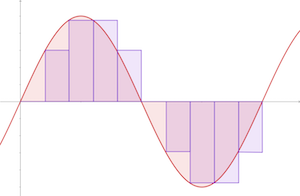

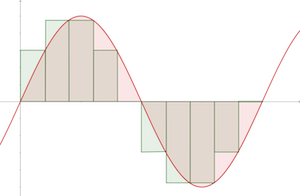

say we have a closed interval [a,b] divided into n equal subintervals.
we write the partition P = {a = x₀, x₁, ..., xₙ = b}
xₖ = a + k Δx with k = 0, 1, ..., n.
the sum of the area of "these approximating rectangles" is called the Riemann sum. The height of each strip depends on both the function and the choice of point in each subinterval.