#geometry-and-trigonometry
1 messages · Page 379 of 1
 outer lagoon
 near timber
why cant i just use the negative angle?

 dark sparrow
you can
it'll be offset by 2pi from their solution
but if you're solving an equation of the form cos(x)=c that doesn't matter
near timber
ohh ive been so confused because when i graphed it one of the awnsers was correct but the (negative) angle one was off by alot
 terse breach
I'll translate this

In an ABCD romb, the diagonal AC = 12, the AB side is equals to 3 square roots out of 5. Find the tangent of the angle BAC
Is this the correct solution?
 dark sparrow
@terse breach is it ok if i respond in russian?
terse breach
dark sparrow
<@309736335168765954> is it ok if i respond in russian?
yes
dark sparrow
что это у тебя вообще за расчеты?
откуда взялись числа 45 и 36?
и откуда взялось, что 9 = 3?
terse breach
dark sparrow
откуда взялись числа 45 и 36?
3 из корня 5 будет 5 если мы взять формулу в квадраты
 dark sparrow
то есть ты вычисляешь BO по теореме Пифагора
terse breach
да
dark sparrow
почему бы об этом сразу не написать?
terse breach
было бы и лучше так
dark sparrow
короче, значения BO и tan(BAC) у тебя правильные. проблема - с оформлением
terse breach
Да, у меня получается большой кошмар на доске в школе, хотя решаю правильно
Спасибо за обзор зато
dark sparrow
в работе было указано нецелые ответы писать десятичными дробями? если нет, то я бы записала ответ как 1/2
terse breach
dark sparrow
в работе было указано нецелые ответы писать десятичными дробями? если нет, то я ...
Видно, что не указывают, в какой форме записывать ответ, так что я написал в десятичных
dark sparrow
лучше так не делать
простые дроби предпочтительнее
особенно если что-нибудь типа 1/3...
terse breach
понятно
terse breach
dark sparrow
простые дроби предпочтительнее
теперь формулировка лучше?
 dark sparrow
в четвертой строчке в пункте 1 вместо плюса должен стоять минус
 dark sparrow
вот так нормально
terse breach
понял
near timber
to determine the highest value of 2sin(3x)+cos(3x), do i have to take the derivative and then look for max min values or is there a more efficient way?
 somber coyoteBOT
Ann
 near timber
thanks!
 upper karma
why was angle 60 chosen here?

 magic lichen
cuz theta' ig
 terse bane

Line h goes through point (0, -k) and has a gradient of 1. If that line is tangent to the circle which equation I already sent above, then the value of eight times all possible values of k is?

the radius is an imaginary number which means the circle doesn't even exist, but can you get the answer anyway?
here's the slope intercept form of the line

then just substitute it to the equation

and since the line is tangent to the circle, that means the discriminant is equal to 0

and the value of all possible ks multiplied is

since they ask for the value of 8 times all possible values of k

is this a valid answer?
 vestal siren
#3-12
vestal siren

 whole granite
vestal siren
#3-12
whole granite
vestal siren
#3-12
try to show some effort, or at least split the questions, it'll help you to get help
vestal siren
okay
vestal siren
whole granite
try to show some effort, or at least split the questions, it'll help you to get ...
wait wdym split the questions
like put it in sections
?
whole granite
vestal siren
wait wdym split the questions
post only a single question, solve it, then post the next one, not all in one like you did in the image
 vestal siren
okay
 soft marten

 vestal siren

 desert shore
this is kind of silly but does anyone understand what this question is asking me

 formal hatch
Hello, I am just a bit confused, in the textbook (french) it says that the value of the angle between vector u and vector v is 7pi/12; But I don't see how

It says that the angle between two vectors is the smalles angle theta when they have the same origin
 honest thistle
desert shore
this is kind of silly but does anyone understand what this question is asking me
honest thistle
desert shore
this is kind of silly but does anyone understand what this question is asking me
take hight as Y and t as X and do the quadratic formula
desert shore
No i meant c in specific
honest thistle
do you have the answers?
desert shore
no
honest thistle
well i would do t=0 idk about what else we could do
 onyx wasp
Anyone who knows the name of this figure? It’s supposed to be a topped off cone with a curved side
 honest thistle
 long parcel
lets say sinx = a so the question becomes a quadratic formula:
6a^2 - 5a + 1 = 0
if we solve for a we get 3a = 1 and 2a = 1 so a= 1/3 or 1/2
 signal swallow
don't do people's work for them
honest thistle
vestal siren
for 12
from the B point draw a line to |AC| so that it makes a 90° angle lets call the point that it contacts as D.
DBC angle is 45° and you can try to find |DA| from 30 60 90 triangle and get |DC| along with |DB| and find tan45
honest thistle
signal swallow
don't do people's work for them
alright, im sorry
signal swallow
honest thistle
for 12
from the B point draw a line to |AC| so that it makes a 90° angle lets ca...
again, don't do people's work for them, not to mention this is not correct
vestal siren
dang 💀
 north heart
lmfao
 crisp turret
How would one solve a problem like this

 tall coral
It's between pi16 and 324 if that helps at all
Idk how to solve it though
tall coral
crisp turret
How would one solve a problem like this
you can break the shape like this

shouldn't be that bad from there
tall coral
wait nvm
 low jungle
hey why cant arcsin have its range restricted to [π/2,3π/2] instead of [−π/2,π/2] it would still be injective right?
dark sparrow
do you mean [+pi/2, 3pi/2]?
low jungle
yeah my bad
dark sparrow
well you could take the inverse of the restriction of sin to [pi/2, 3pi/2] sure
that exists
it's just different from the canonical restriction
and is somewhat less elegant
low jungle
i see.. so its just a convenient convention of sorts right?
dark sparrow
essentially yes
low jungle
alright thanks!
 compact jasper
that is identity rule ? sin(a+b)=sinacosb+cosasinb
but why ? why just not sin (a+b) = sin(a) + sin(b) 🙂
 nocturne remnant
Why not?
dark sparrow
sin(a+b) = sin(a) + sin(b) is simply not true lol
sin(90°+90°) ≠ sin(90°) + sin(90°)
nocturne remnant
“Hey god why didn’t you make sin(a+b)=sin(a)+sin(b) that would make things so much easier bruh”
 mild briar
Just like (a+b)² = a²+b²
It would be pretty, but it's not reality
Not to mention, that would imply sin(x) = λx for some constant λ
Which would bode ill for the shape of circles as we know them
 limpid spruce
desert shore
this is kind of silly but does anyone understand what this question is asking me
limpid spruce
desert shore
this is kind of silly but does anyone understand what this question is asking me
Higher than snoop dogg
 simple rain
are supplementary congruent angles right
 slate phoenix
https://en.m.wikipedia.org/wiki/Pitot_theorem
@aakhilv#0001

In geometry, the Pitot theorem, named after the French engineer Henri Pitot, states that in a tangential quadrilateral (i.e. one in which a circle can be inscribed) the two sums of lengths of opposite sides are the same. Both sums of lengths equal the semiperimeter of the quadrilateral.The theorem is a logical consequence of the fact that two ta...
 lethal robin
does anyone know how to approach geometrical questions that want you to proove something
i look at the question, i think about how i can solve it
no methods help
then i look at the solution and it seems so obvious
simple rain
lethal robin
i look at the question, i think about how i can solve it
send me one of the questions
lethal robin
Aight
lethal robin
simple rain
send me one of the questions
Prove that the centre of a circle touching 2 intersecting lines, lies on the angle bisector of the lines.
simple rain
lethal robin
Prove that the centre of a circle touching 2 intersecting lines, lies on the ang...
do you have a diagram
lethal robin
The question doesn't have a diagram.
 fleet idol
Can anyone explain me how to calculate side BA please?

 trim breach
fleet idol
Can anyone explain me how to calculate side BA please?
trim breach
fleet idol
Can anyone explain me how to calculate side BA please?
BAC and BAD are both right triangles, if I am reading this correctly. AB is a common side. You should be able to use a system of equations to represent the situation.
 vagrant ore
Is the answer 1 line?
 trim breach
vagrant ore
Is the answer 1 line?
trim breach
vagrant ore
Is the answer 1 line?
Yes.
 pastel pewter
can some one help me to find the measure of the angle between the diagonal of trapezoid inscribed in circle?
 light fable
what did you try?
you were on the right track using cos
what's the equation with cos from soh-cah-toa?
right, and what is it in your case, with those labels
I mean write the equation about cosine
with your given diagram
 wheat walrus
similar concept
write out the cos equation you would use to solve for x
are you still on this question?
you’re just solving for x right?
you’re not going to use inverse cosine (cos -1) when trying to figure out a side length
should look something like this

you only need to do inverse sin, cosine, or tangent when figuring out angle measures
side lengths are simpler
light fable
^ that's the way
wheat walrus
that’s good, the more practice, the better
yea what you have in looks right
the horrors of deltamath
 outer bison
i gotchu
outer bison
im in algebra 2 so im not 100% sure but add all those degrees up and is all equal to 180
and solve for x
wheat walrus
YOOOOOOO
north heart
motherfucker this a test?
<@&268886789983436800> not sure if it's a practice exam or smthn?
but ig i should ping
 silk charm
banned
 ember stratus
To locate a whale, two microphones are placed 6000 feet apart in the ocean. One microphone picks up a whale's sound 0.5 second after the other microphone picks up the same sound. The speed of sound in water is about 5000 feet per second.
a. Find the equation of the hyperbola that describes the possible locations of the whale
b. What is the shortest distance that the whale could be to either microphone?
wheat walrus
north heart
but ig i should ping
it was a practice website called deltamath…
 daring wind
can there be an algebraic expression for
cos(20°)
i don’t care how complicated it is, as long as it uses all real numbers and functions
like how cos(45°) is sqrt(2)/2
something like that, but for cos(20°)
 wise pawn
I'd probably look at trying to work something out of the real part of the corresponding cyclotomic polynomial
 grave pond
cos(20°) is the real part of an 18th root of unity, so it is certainly algebraic.
grave pond
However, the minimal polynomial for cos(20°) is 8x³-6x-1. It has 3 real roots (namely the real parts of the other primitive 18th roots of unity), so it is a casus irreducibilis where the roots of the polynomial cannot be expressed using real radicals only.
 stiff tulip
I’m quite unsure tackling how to solve for X when it’s in the exponent
In example, “Solve for X” 10^3x=25
grave pond
That's not even an equation.
stiff tulip
Oop
Brb
It says round nearest hundredth
Do I begin by cube rooting ?
I got log(2.92)=X
X=0.47
I’m not sure if it’s correct or not
grave pond
Punch it into a calculator and see if you get 25 as you should.
stiff tulip
Yeah sort of
grave pond
But closer than either 0.46 or 0.48 gets you.
grave pond
You get a slightly nicer expression if you start by taking the logarithm: log(25)/3.
(Which of course has the same value).
stiff tulip
Oh ok
 pallid pilot
chat any idea how i can get AE if i have AC equals 25? (ignore the writing down there)

chats dead
wheat walrus
oh what’s up
 simple holly
wheat walrus
pallid pilot
chat any idea how i can get AE if i have AC equals 25? (ignore the writing down ...
simple holly
wheat walrus
pallid pilot
chat any idea how i can get AE if i have AC equals 25? (ignore the writing down ...
AE is proportionate to AB as AD is proportionate to AC
that’s about the only way i see it
 timid escarp
Yo I’m in accelerated algebra 1 and I might take geometry next year is there any thing I should know before hand like things that are gonna be annoying
 unborn heath
timid escarp
Yo I’m in accelerated algebra 1 and I might take geometry next year is there any...
unborn heath
timid escarp
Yo I’m in accelerated algebra 1 and I might take geometry next year is there any...
just pay attention in class and you should be fine
depending on the teacher u might have alot of memorization as theres a decent amount of theorems and angle relationships
 lean quarry
Guys do any one of you have, the formulas of triangle
Like
Areas
Similarities
Medians
Bisectors
And plenty more, all in one file ?
 glacial otter
<@&268886789983436800>
 slender wasp
tagging 8 times
silk charm
why are you pinging random people?
 weary drift
man
 gaunt lion
that was quick
daring wind
is it possible to solve binets formula for x
it’s like

coukd you solve this for n
daring wind
daring wind
this but multiplied by cos(pi•n)
grave pond
What do you mean by solve here? If you have a large Fibonacci number and want to know which it is, in practice you can just ignore the ((1-sqrt(5))/2)^n term -- it goes to zero for large n anyway.
grave pond
Hint: It's a red herring that one of the lines goes through the center of the circle.
 rocky tide
I can't understand those two different question can someone help me plz?


 odd dust
What it supposed to be 148 degrees?
 heady forge
What don't you understand ?
Let's start with the first one @rocky tide
Ask anything.
vagrant ore
I need help with this
 vagrant ore
How would that help? I tried it
heady forge
X= 60°
vagrant ore
Oh I was just going to say that lol
I noticed that it did make two 30 60 90 triangles
heady forge
Tangents that extend from the same point are identical
vagrant ore
I didn't see that at first
heady forge
They form identical triangles
And from this we extract the following
x+β=180°
β is 120° in our case
rocky tide
Is the first one good
cos(30°) = MN / 10
10 cos(30°) = MN
10 (0.866) = MN
8.66 = MN
heady forge
Yes
 rocky tide
rocky tide
rocky tide
How to work this
heady forge
You try to find X?
rocky tide
I think so
heady forge
Because there is no question. I'm assuming you need to find value of x
rocky tide
Yeah it should be it
rocky tide
Thx man but if I get the question in sin=but in fraction will it work with the formula u make.
heady forge
Since we know Hyp and an angle and we need to find adj,we take cos40°
What do you mean?
If you get sin then you have
Sin40°=BA/10
rocky tide
Like the question is similar but just numbers are in fraction
heady forge
Oh
 rocky tide
Ohhhh thx man
heady forge
Np
rocky tide
I got 15/17 X180
=2700/17x1
=158(14/17)
heady forge
Then we take the formula
grave pond
What? 15/17 is the cosine, not a fraction of a circle (or of a straight angle).
You don't even need to know the angle in degrees because the problem is telling you the values of all the trig functions.
heady forge
Oh yes
grave pond
The only thing you need to do is know which of them to use.
heady forge
Oythogoren theorem
grave pond
Pythagorean? Not even that.
heady forge
Cos =adj/Hyp=15/17
And then replace Hyp with 34 and adj with y
If I remeber correctly
grave pond
y is the side opposite to angle A, not the adjacent one.
heady forge
Then take sin
grave pond
@rocky tide, are you still here?
rocky tide
Yeah
rocky tide
My level is grade 9 so by far in trigonometry I had learn Pythagoras theorem
heady forge
Sorry,I thought that the angle was 15/17 rad. My apologies
grave pond
You don't need Pythagoras for this, but you do need to know what sine and cosine are.
rocky tide
How to solve then
heady forge
SinA=opp/hyp
vagrant ore
Is the answer circle?
 grave pond
Yes.
vagrant ore
Thanks
rocky tide
heady forge
SinA=opp/hyp
Then x 180
heady forge
SinA=y/34
grave pond
No, there's no 180.
north heart
heady forge
8/17=y/34
just isolate y
rocky tide
The 34 need to be divide by a number right
heady forge
Just gave you the solution.
grave pond
It's not good to go all the way to a complete answer just because the asker isn't getting it.
north heart
^
heady forge
@rocky tide I'll write it down again :
sinA=opp/Hyp(1)
sinA=8/17
opp=y
hyp=34
So we put all of these at (1) and solve for y
So y=16
heady forge
No it's 8/17=y/34
grave pond
Yes.
heady forge
Yes,you got it
rocky tide

vagrant ore
I need help
 north heart
look up the inscribed angle theorem and use properties of triangles for the rest
vagrant ore
north heart
look up the inscribed angle theorem and use properties of triangles for the rest
Is the answer 30?
Wait I mean 20
vagrant ore
Wdym checks out?
north heart
oh
yeah
it's 20
lmao
i think you're supposed to use something much simpler than inscribed angle lmao
vagrant ore
Lol
 silent plank
inscribed angle is one of the simplest things to apply
north heart
im 99% sure they're meant to use basic trig lmao
grave pond
Could you show the solution you think is simpler than the inscribed angle theorem?
north heart
by simpler i mean uses just trig and properties of triangles
grave pond
I don't understand what it is you're proposing.
What could possibly be simpler than "divide this number from the figure by two and you're done"?
north heart
im not proposing anything, i'm just saying that i think they were expected to use just trig and triangle properties to solve
north heart
grave pond
What could possibly be simpler than "divide this number from the figure by two a...
bc ngl im not sure if this guy is taking ms geo, but when i was, i didn't know wbt the inscribed angle theorem at all
grave pond
You're saying that you think they are supposed to use a method that you refuse to reveal what is?
 gritty plinth
Can someone please check a problem for me quickly?
north heart
north heart
fine i'll try and find it lmao
ok so
i probably should've known better than to go about disagreeing with tropo
i genuinely thought there had to be a simpler way >.>
but i dont think it's possible to do w/out inscribed angle
my b
vagrant ore
I need some help
 grave pond
draw another secant line (connecting two of the points on the circle that don't have a line between them yet), derive more angles using the incribed angle theorem (I think a pattern is showing by now), and you will be able to find x using the angle sum of a triangle.
vagrant ore
Is it 15?
grave pond
Hmm, that's not what I get, but I might be missing something. What's your reasoning?
vagrant ore
grave pond
Hmm, that's not what I get, but I might be missing something. What's your reason...
Because it looks like two 30 60 90 triangles and 30 ÷ 2 = 15
vagrant ore
I remembered what to do and got 26. Is that right?
dark sparrow
seems ok now
vagrant ore
Ok thanks


 hidden crypt
 celest radish
<:sadcat:547124024585486359>
celest radish
<:sadcat:547124024585486359>
Try using sinx+sin3x=2sin2x*cosx and cos2x=2cos^2x-1, this must help
celest radish
Did help somewhat but still couldn't solve it
hidden crypt
What did you get?
 celest radish
hidden crypt
What did you get?
celest radish
hidden crypt
What did you get?
4sinxcosx + 2sinx = 2cosx + 1
 acoustic jungle
 silent token
help mee <:pandaOhNo:513070260471988226>
silent token
help mee <:pandaOhNo:513070260471988226>
I would wlog z = 1 and trig bash everything.
not sure why they chose the value 26.656, seems kinda stupid.
hidden crypt
celest radish
4sinxcosx + 2sinx = 2cosx + 1
you should've got sin2x+2sin2x*cosx=2cos^2x+cosx
celest radish
hidden crypt
you should've got sin2x+2sin2x\*cosx=2cos^2x+cosx
Yes then I divided both sides with cosx
 azure crown
vagrant ore
I need some help
azure crown
vagrant ore
I need some help
x=1/2(66-14)
celest radish
hidden crypt
sin2x+2sin2x\*cosx=sin2x(1+2cosx)
How is that better?
hidden crypt
celest radish
How is that better?
because 2cos^2 x+cosx=cosx(2cos+1)
celest radish
Oh damm
silent token
acoustic jungle
I would wlog z = 1 and trig bash everything.
I don't get the result, I found the others and it shows that (x+y)/z is 1

acoustic jungle
silent token
<:pandaOhNo:513070260471988226>
Show your work
hidden crypt
silent token
help mee <:pandaOhNo:513070260471988226>
firstly, find angles that are equal to theta, there are plenty of them

 vagrant ore
I solved it
 mystic shadow
$$\cos(x)-\cos(y)=\frac{5-\pi}{10}$$
somber coyoteBOT
MiracleMan
 mystic shadow
$$\cos(5x)-\cos(5y)=\frac{1}{2}$$
somber coyoteBOT
MiracleMan
 mystic shadow
This is easily solvable by plotting
I was wondering if this was analytically solvable
I know 0 < x,y < pi/2, and y>x
 dire hull
Is it okay if I ask for help here and trig 😅
upper karma
mystic shadow
I know 0 < x,y < pi/2, and y>x
I tried using maclaurin series but nope
somber coyoteBOT
Holo

 rare sierra
can someone give me the equation I can use to solve this because their explanation is bogus?

I know in this scenario
A= 18/30
B=15/30
 tulip vector
hello, I'm having a bit of a problem on this one. If there are two equal sides/angles the "N", what should I do? My answer is supposed to be largest to smallest order

 valid harbor

 trim breach
 polar jewel
Please help! I dont know this topic. Need this asap!!
polar jewel
Please help! I dont know this topic. Need this asap!!
This is just knowing definitions. I could help, but I really think going back and ensuring you understood the lesson fully is probably a better starting place.
 spare moss
I want to calculate this integral, but could you help me with the visualization?

How could it be drawn?

it is the shape which is restricted by axis
 merry dew
help
 silent token
merry dew
help
silent token
merry dew
help
9x-4=4x+2
9x-4x=2+3
5x=5
x=1
LO= 9 (1)-3 = 6
64=8+7x
56=7x
x= 8
m <NPI = 8+7x = 8+7 (8)= 64
I think
 terse breach
 molten marsh
can anyone help
molten marsh
can anyone help
Why is tan multiplied by three and powered up to 2?
 worthy siren
hey, I need help on some math homework thats due in an hour. Im currently in the unit of adding vectors, and we recently learned sine cosine and tangent, which we're supposed to use for this example. How can I do it?

 hollow vortex
you can use pythagoream theorem to find the magnitude of the movment
 orchid gate
in geometry of triangle what this value mean?
somber coyoteBOT
Ausländer


 upbeat helm
 proud plover
Integrals go in #calculus . Also post the question before your solution
 nova aurora
can someone help
 sterile orchid
can someone pls help me with this question, i've drawn a diagram but i do not think i have the right equations:


 clear lark
Hi, I agree with your answer. I wonder if there is a typo and the coordinates of D are meant to be (-2,-2)
upper karma
they are all incorrect

 past charm
im pretty sure i've seen something similar on youtube
like mind your decisions probably
 errant flare
past charm
like mind your decisions probably
errant flare
past charm
like mind your decisions probably
what do you mean?
past charm
errant flare
what do you mean?
thats a youtube channel that makes videos on math problems
errant flare
past charm
thats a youtube channel that makes videos on math problems
thanks
 wanton jetty

 trim breach
vestal siren
can someone check my work
trim breach
vestal siren
can someone check my work
The first triangle was labeled incorrectly, so you used the wrong trigonometric ratio.
Actually, looking at it, all of them are.
The opposite side is one the angle does not touch.
Though the second triangle seems right, but you still labeled the sides incorrectly. And I think your final answer is incorrect as well.
vestal siren
i'm still confused
trim breach
 vestal siren
oh alright thank you
trim breach
“Adjacent” means “next to”.
Many of the steps you did were right, but you just flipped opposite and adjacent when you labeled them, so you ended up using the wrong ratio.
 vestal siren
okay thank you
sterile orchid
dark sparrow
what equations did you get for AB and AC
like y=am+c because i don't know the y values
dark sparrow
........
okay so that took me some time to decipher.
seeing as that's nearly a full day later you're saying this
but whatever
do i understand correctly that you have actually written down The equation of line AB is y = am + c as part of your work, or did you just blurt that out
sterile orchid
yeah i wrote it like that
sorry it's y=-am+c because the x value is -a
also line AC would have the same equation
dark sparrow
what is m?
sterile orchid
i don't know i don't have any definite coordinate just variables
sterile orchid
no like that is the equation of the lines with the information that is currently known to me
dark sparrow
anyway, i think you're confusing the equation of the line itself with what happens when you plug one of your points into it.
sterile orchid
hmmmm, what do you recommend that i do then?
dark sparrow
consider point A and its coordinates first and foremost
and then the angles made by AB and AC with the x axis
sterile orchid
right right, i am sure that i have no idea what the coordinates of point A are apart from the fact that the x value is greater than a
dark sparrow
the medians of your triangle intersect at the origin
and the intersection point of the three medians of a triangle divides each of them in a 2:1 ratio
dark sparrow
the lines in a triangle that connect each vertex to the opposite side's midpoint...
nocturne remnant
What “further depth” do you mean exactly
Are you struggling with something in particular?
What equations?
Well
Best I can do is to link you to some resource
https://www.khanacademy.org/math/trigonometry/unit-circle-trig-func

Khan Academy
Learn how the trigonometric ratios are extended to all real numbers using algebra. Start solving simple problems that involve this new definition of the trigonometric functions.
The unit circle definition of sine and cosine is much more general and powerful than the “ratio of sides in right triangle” definition that students are usually introduced to
So just think of using sine and cosine to solve for triangle sides/angles as an application of trig functions, not the definition of trig functions itself
nocturne remnant
true
Whereas if you look at something like uniform circular motion it’s much more sensible that the derivative of sin would be cos
 muted sail

Still confused by this.
I dont remember the formula on how to find surface area of cone. ;-;
upper karma
muted sail
Surface area is = 𝝅rl + 𝝅r²
Where l is the side of it (e.g the 11cm on the 1st one)
The 𝝅r² is the surface area of the circle face so if you cone is open at the end you don't need to use it
Hope it helped a little :)
muted sail
thanks :D
upper karma
By any chance they don't give you the 'l' side just use Pythagoras assuming they would atleast give you the height for it
muted sail
I dont really get what it means by show your awnser in terms of pi
upper karma
Oh usually your answers on your calculator will have 𝝅 with it since it was multiplied in
Just don't hit the S->D button (the button that converts fractions to decimals, still don't know the name of it lol)
Basically they dont want decimal answers
muted sail
oh, okay.
upper karma
muted sail
oh, okay.
I could go through one with you if you still feel lost
trim breach
upper karma
Can someone help me out with this?
The diagonals in a rhombus bisect one another.
So BD = 2BE
 fallen sleet
given an arc, is it possible to construct with compass and unmarked straightedge the circle upon which it lies?
this works
 fallen sleet
i understand now
 wicked fossil
upper karma
does anyone know about circles
wicked fossil
upper karma
does anyone know about circles
Do you have a specific question about them?
 near sand
Hi, so I'm working on the first one (finished the other two) and I'm a bit confused as to what to do, even with the hints. If someone could help, that would be much appreciated

,rotate
somber coyoteBOT

 warm plinth
I've been trying to solve this and i found a contradiction when i tried 2 different approaches, i cant manage to find the mistake 


This is all the information i got, heres the original exercise, (its in italian)

,rotate
somber coyoteBOT
 warm plinth
"A right pyramid has as its base a square with a diagonal of 18(sqrt2)cm. The hight of the pyramid is 1/2 of the hight of its triangles, find the volume of the pyramid in exact values."
I found only 2 approaches and one of them involves trigonometry, which we havnt learnt yet.
Exact values is like 10(sqrt2) not ≈14.14
warm plinth
I just realised that i might be in the wrong channel
 runic beacon
ok, so i am not sure if my approach is correct, but, the diagonal of the square should give you the side (by the pythagorean theorem) So, now let the height of triangle be y and then height of the pyramid will be 1/2 * y.
Now the centre of the square, the height of the triangle and the height of the pyramid also form a right angled triangle in a different plane.
So, height of pyramid by the pythagorean theorem, as in (1/2 * y)^2 + (1/2 * 18 )^2=y^2
solve for 1/2 y , you will get, height of pyramid
Then you can apply the formula for volume
warm plinth
Oh i tought i had to ask in #help
dark sparrow
no
warm plinth
Oh ok 👍
warm plinth
runic beacon
ok, so i am not sure if my approach is correct, but, the diagonal of the square ...
(1/2 * y)^2 + (1/2 * 18 *sqrt2)^2=y^2
im strugling over here, where did you get (1/2 * 18 *sqrt2)^2
runic beacon
it is half of the base
warm plinth
oh and by hight of the triangle i mean the "apotheosis" i didnt know the word for it
runic beacon
what is the apotheosis?
runic beacon
then i think i need to think what i have done
warm plinth
Heres everything i tried so far (all giving me contradicting results) i have in 'a' the apothem

(Btw the dot (•) is multiplication)
The hight of the triangle is the apothem
Thats what i meant by hight
runic beacon
i was talking about the actual height now
warm plinth
The hight of the pyramid is 1/2 of the apothem of its triangles
runic beacon
wait i misunderstood the whole question
warm plinth
Oh xD
So the diagonal of the base of a quadriangular pyramid (not sure thats a word) is 18 * sqrt2 cm, the hight of said pyramid is half of the apothem of the pyramid's triangles, find the volume in exact values.
What i found is that the side of the base is 18cm, and that the triangle that forms using the apothem as a hypothenuse and the hight and half of the length of the base (9cm) as the cathetus' is a 30 60 90 triangle
Anyways i gtg
upper karma
wicked fossil
Do you have a specific question about them?
had
warm plinth
warm plinth
Heres everything i tried so far (all giving me contradicting results) i have in ...
im going for option 3 and 4 as this is the only case where a = 2h, im strugling to understand the mistake in 1 and 2 tho
magic lichen
guys how do i start trignometry?
whats the best place
to start learning trignometry
magic lichen
thx
damn bro 8th?
me too but im learning in 9th
i just came to 9th so im still 8th?
tries to make sure that i learn hard stuff in the earlier grades
yes yes
yeah just the basics not too deep into it
trim breach
warm plinth
im going for option 3 and 4 as this is the only case where `a = 2h`, im struglin...
Your mistake in method 1 is only applying the exponent to h, not 2h.
warm plinth
ohhh thx
 candid flume
how dis

Write the general form for all the solutions to cos0= -1/2;
based on the smaller angle.
I swear my prof didn't say anything about this s***t
simple rain
is anyone here
wise pawn
 wise pawn
I'd imagine it's a complete cone with the top chopped off, so you can find the volume of the whole cone and the volume of the piece cut out, and subtract it
simple rain
you have to use similar triangles but idk which
simple rain
wise pawn
I'd imagine it's a complete cone with the top chopped off, so you can find the v...
yea but idk height
of the full cone
 coarse saddle
simple rain
you have to use similar triangles but idk which
coarse saddle
simple rain
you have to use similar triangles but idk which
that's correct
simple rain
can u tell me the sides for it
simple rain
how to set it up
simple rain
 simple rain
you have to use similar triangles but idk which
simple rain
simple rain
you have to use similar triangles but idk which
that’s what i said
i don’t tho
the teacher showed in class but i forgot
so like this
 simple rain
 coarse saddle

simple rain
noooooooo
coarse saddle
what's wrong?
 coarse saddle
probably just a calculation mistake
simple rain
can you try it and see what you get
simple rain
ping me cuz ima close discord
coarse saddle
@simple rain did you forget to delete substract the volume of the smaller cone?
upper karma
hiii can anyone help me with this? it’s geometry snf it’s surface area of composite figures

 lapis moon
divide and conquer: outer curved surface area is $2 \pi r h$
somber coyoteBOT
vin100
 lapis moon
upper and lower surface area is circle's area minus that of the square
inner surface area is four times each rectangle $sh$, where $s$ is the side length of the square
somber coyoteBOT
vin100
 lapis moon
it suffices to establish a relationship between $s$ and $r$.
somber coyoteBOT
vin100

 lapis sequoia
i need help with something in my geomotry
 deep niche

 wheat walrus
vestal siren
wheat walrus
vestal siren
you comfortable with sine, cosine, and tangent?
wheat walrus
the “0” is called theta and it’s just a variable
same for x, y, z, or any other alphabetical letter
 upper karma
so no help?
upper karma
is there someone here who specializes on geom?
upper karma
wheat walrus
perhaps consult khan academy
?
wheat walrus
khan academy
upper karma
ive never used it
wheat walrus
search up the concept on google or youtube idk
upper karma
do i upload picture?
wheat walrus
no it just teaches you the basic concept
wheat walrus
good luck
upper karma
ty
wheat walrus
what question are you referring to in the worksheet?
azure crown
upper karma
i think it's 53
upper karma
azure crown
i think it's 53
i also got 53
but im not sure if the angle is supposed to equal the bigger arc
i was absent a day and the teacher didnt teach me just gave me notes
azure crown
equation is angle = 1/2(151-45)
upper karma
why 1/2?
azure crown
thats the theorem
upper karma
i did —> angle= 151-45/2
azure crown
well that doesnt equal 53
unless u mean (151-45)/2
which is the same thing as mine
vestal siren
wheat walrus
what question are you referring to in the worksheet?
the first question
upper karma
oh yeah
 plucky mantle
Can someone give me some tips for memorizing the unit circle? I've got an exam next Tuesday (pls ping me)
upper karma
whats the unit circle @plucky mantle
azure crown
plucky mantle
Can someone give me some tips for memorizing the unit circle? I've got an exam n...
write down what u know then memorize what u dont
then repeat until u can write the whole thing
azure crown
upper karma
whats the unit circle duck?
idk im doing geometry rn i just looked it up
i didnt learn it yet
upper karma

u need to memorize this whole thing?
i would just print out a tiny version of it and place it in a pocket at that point ngl
azure crown
when do u learn that
upper karma
idk
wheat walrus
vestal siren
the first question
no
upper karma
i havent
azure crown
is that precalc or geometry
wheat walrus
@vestal siren when you’re finding the angle measures, use reverse sine, cosine, or tangent

don’t base the answer off of another angle measure you figured out in case your solving is inaccurate, stick with the information you’re given
vestal siren
ohhh
upper karma
Can someone help me with the vocab ?
-
A (blank) is the set of all points in a plane, equidistant from a given point called the center.
-
A (blank) is a segment whose endpoints are the center of the circle and a point on the circle.
-
An angle whose vertex is at the center of the circle and whose sides intersect the circle is called is a (blank).
-
A chord that contains the center is called a (blank).
 warped atlas
upper karma
**Can someone help me with the vocab ?**
5. A (blank) is the set of all points ...
warped atlas
upper karma
**Can someone help me with the vocab ?**
5. A (blank) is the set of all points ...
circle, radius, central angle, diameter?
upper karma
warped atlas
circle, radius, central angle, diameter?
ok ty lad
warped atlas
upper karma
ok ty lad
👍
vestal siren
can someone check something for me
 storm portal

north heart

 wicked fossil
vestal siren
wicked fossil
vestal siren
For x, what type of triangle is it?
vestal siren
nvm i got it
wicked fossil
ok
 opaque gull
upper karma
is it in geometry?
opaque gull
upper karma
is it in geometry?
Yes, includes trigonometry too.
opaque gull
vestal siren
nvm i got it
For next time use Pythagorean theorem then use arcsin, arccos or arctan (sin^-1, cos^-1, tan^-1)
To measure the angle
plucky mantle
Or the law of sines
opaque gull
That too
upper karma
opaque gull
Yes, includes trigonometry too.
when do i learn it
upper karma
ok
opaque gull
u can read about it if ya want
 tepid vault
help
is this valid for all integer p
$\forall p \in \mathbb{Z}$, $cos(2\pi p) = 1$ and $sin(2 \pi p) = 0$
yeah right?
just wanted to confirm cos me bad at trig
somber coyoteBOT
texaspb

 gleaming nova
first one yes
wise pawn
second one yes
gleaming nova
second one could instead be sin(pi*p) = 0
somber coyoteBOT
texaspb
 tepid vault

wise pawn
the fundamental thing to know is they both have a period of 2pi
so you can always add or subtract an integer multiple of 2pi from the argument
tepid vault
I wanted to check if $cos(2\pi p + \theta) = cos(\theta)$
somber coyoteBOT
texaspb
 tepid vault
this is vewy important for me to understand a thing here
wise pawn
cos(x)=cos(x+2pi)
tepid vault
wise pawn
so you can always add or subtract an integer multiple of 2pi from the argument
perfect
thanks
wise pawn
yw

 mystic coral
What did i do wrong?


 pure cape
what you did wrong is that you assumed the point was in the first quadrant
there isn't just one angle that satisfies tan(theta)=sqrt(3)
mystic coral
How do I find the other angles that works?
pure cape
try to solve the equation tan(theta)=sqrt(3) generally
and then choose the angle that would satisfy the following condition
mystic coral
Im not entirely sure how to go about that. I assume it would have to do with the range of trig functions?
So if my assumption is correct, then my other coordinate would be (5,-pi/3)?
pure cape
mystic coral
Im not entirely sure how to go about that. I assume it would have to do with the...
not really
pure cape
mystic coral
So if my assumption is correct, then my other coordinate would be (5,-pi/3)?
and no
that's in the fourth quadrant, which is also not where the point lies
you can search further into this since i dont have a lot of time to explain, the equation tanx=a has the general solution x=arctan(a) + kpi where k is in Z
and then just restrict this to the interval [0, 2pi], and then choose the appropriate angle
mystic coral
Alright, ill look into it, thanks
 ancient spoke
Can y’all help me on this
dark sparrow
do not ping everyone.
ancient spoke
My bad
lapis moon
sorry we're here to do your homework
dark sparrow
we're not here to do your homework.
ancient spoke
I said help
lapis moon
my bad +1
ancient spoke
Not do
dark sparrow
in any case
there are two parts to this problem
one about the length of BC, the other about the area of the whole thing
ancient spoke
I’ve been stuck on this for an hour
dark sparrow
which of these would you like help with?
if both, which one first?
ancient spoke
I just need some tips
lapis moon
what? the question writer has spoonfed students with answer? sosad 😦
you're supposed to find the length, but he/she has just stated that
and ask for an explanation for that
dark sparrow
there are two parts to this question. would you like to get help with part a first or part b first?
ok
so look at the diagram
lapis moon
just use symetry
ancient spoke
Thanks much appreciated
dark sparrow
what are you thanking us for
i for one havent even started
i was gonna take you through it
ancient spoke
For youre time
lapis moon
upper & lower half symmetric
dark sparrow
do you want to continue?
ancient spoke
dark sparrow
do you want to continue?
Yes
dark sparrow
ok
ok so you see how the shape is rectangular all throughout, yes?
so if you were to connect C and F with a straight line, it would be aligned with BC and FG
hence the line segments BC, CF and FG add up to the height of your shape, which is 20 as the diagram says
do you understand this
therefore
no
x is just x
it is just a number, and all your work will involve expressions in terms of x
the line segments BC, CF and FG add up to the height of your shape, which is 20 as the diagram says
do you understand this
what did i say?
did i say they were all 20 or did i say they added up to 20?
well that answers your own question now doesn't it
divide what by what?
...
ok you know what nevermind
 mystic salmon
Hi, I asked this ques in a help channel, but I'll put it here as well since it is to do with trig

Question: I'm trying to simplify it and get it into terms of one trigonometric function
I know tan x = sin x / cos x
I also know that it is the same as: tan x * (1-sin^-2)^1/2
so I get to the stage tan x * (1-sin^-1 x)
but every step after this I get confused
could someone offer some guidance, thanks, ps please ping @ me if you reply 📐
 slate kraken
mystic salmon
slate kraken
mystic salmon
Well...let me give u hint...sin^-2x means 1/sin^2 x....now we get within square root...1-1/sin^2 x ...again...there's the other formula of trigonometry...sin^2x+cos^2x =1 ..try and see if u can utilize these infos
 wispy iris
hi, I was wondering if "sec = sin^-1" or if they're different. Thanks in advance.
grave pond
The notation sin^-1 is almost always used to denote the inverse function of sine, not for talking about 1/sin(x).
This is inconsistent with sin²(x) meaning (sin(x))², but that the convention we have, like it or not.
wispy iris
So, if I have the Adjacent and the θ of a triangle, but my calculator only has sin^-1, then "(sin^-1 θ) * Adjacent ≠ Hypotenuse"
grave pond
Yeah, definitely not the same thing.
And not just because sec is the recprocal of cosine rather than of sine.
Your calculator ought to have a way to type adjacent / cos(theta), though.
wispy iris
huge thanks
 umbral radish
can anyone solve x for me?
 dire hull
idk much but i do know theres the right angle which is 90
add 90 + 42
then substract by 180 to get your third angle
damn it says trig ratios
mb
umbral radish
all good
 reef oxide
Use a tangent with 42°
reef oxide
umbral radish
all good
Then remember TOA
umbral radish
I really don't understand, im sorry
wicked fossil
Tan(angle)=opposite/adjacent
What side is opposite from 42?
What side is adjacent?
reef oxide
That's okay! We're solving for x, and given an angle of 42° and a length of 5. If we can put these 3 terms in one equation, we can find their values relative to each other.
Since this is a right triangle, we can use the trig ratios to set that equation up.
From the angle of 42, we have the hypotenuse above it and the adjacent side, 5 below it. To it's left, we have the opposite side, x.
The tangent of this angle is equal to the ratio of the opposite side over the adjacent side.
tan(x) = opposite/adjacent
tan(42) = x/5
Multiply both sides by 5.
(Move the 5 to the other side while observing sign rules, that's how I think about it)
5*tan(42) = x
Punch the left side of the equation into a calculator, round to the nearest tenth as the question asks, and that's your answer.
Phew
opaque gull
@umbral radish
 opaque gull
reef oxide
That's okay! We're solving for x, and given an angle of 42° and a length of 5. I...
opaque gull
reef oxide
That's okay! We're solving for x, and given an angle of 42° and a length of 5. I...
Great explanation, man.
upper karma
Hello
opaque gull
hey
upper karma
I have normalized coordinates from -1.0 to 1.0 for X and -1.0 to 1.0 for Y
-1.0 X is left, 1.0 X is right, -1.0 Y is down, 1.0 Y is up. I want the center of an euqilateral triangle to be on 0.0, 0.0, the lower left point to be on -0.5, 0.0 and the lower right point to be on 0.5, 0.0
Which one of these methods best represent the center of the triangle in this case?


My idea was to get the height of the triangle whichs is sqrt(0.75), to divide it by 2 for the Y position of the upper point and have the negative value (-sqrt(0.75)/2) for the lower points

this is the result of that

and these are the coordinates I chose

Another person used these coordinates

which had this result

And says that his triangle in the center

Does anyone know which one is actually in the center?
Btw the triangle is equilateral
magic lichen
wispy iris
hi, I was wondering if "sec = sin^-1" or if they're different. Thanks in advance...
but dont confuse between arcsin and csc
magic lichen
upper karma
Does anyone know which one is actually in the center?
another way to check the center is by taking 30 degrees from each corner and draw a line. whereever all ur lines meet, that is ur center
wispy iris
magic lichen
but dont confuse between arcsin and csc
Yeah, thanks!

 hazy holly
Hey. I'm trying to solve this problem. I drew the radii and prepared the triangle shown. I found that $r = \dfrac{3a}{8}$. I've tried using trigonometry in different ways and I keep finding that $x = \dfrac{18a}{25} = 0.72a$, but the answer says $0.6a$. This is not homework, this is problem 206 from Solving Problems in Geometry by V. Gusev, V. Litvinenko and A. Mordkovich.
 somber coyoteBOT
EvilSonidow


 sleek mirage
can someone show me how to get the answer for this or point me in the right way?
 hazy holly
Hey. I'm trying to solve this problem. I drew the radii and prepared the triangl...
hazy holly
hazy holly
Hey. I'm trying to solve this problem. I drew the radii and prepared the triangl...
Nevermind, found the answer. Using similar triangles you can show that $$\dfrac{x}{a} = \dfrac{r}{a-r},$$ and since $r = \dfrac{3a}{8}$ it follows that $x = \dfrac{3a}{5} = 0.6a$.
somber coyoteBOT
EvilSonidow
 hazy holly
terse breach
I need some help
hazy holly
terse breach
I need some help
Hard to understand what is asked
hazy holly
sleek mirage
can someone show me how to get the answer for this or point me in the right way?
Angles E and B are inscribed in the circle and "see" the same arc CD. Use inscribed angles https://en.wikipedia.org/wiki/Inscribed_angle.
terse breach
hazy holly
Hard to understand what is asked
the area of the trapezium
I've used pythagoras theorem to calculate the side and the area of the first two triangles, but the third one is missing it's height
 sleek mirage
hazy holly
Angles E and B are inscribed in the circle and "see" the same arc CD. Use inscri...
sleek mirage
hazy holly
Angles E and B are inscribed in the circle and "see" the same arc CD. Use inscri...
I get that but whenever I set them equal to each other and solve i dont get the answer given on the answer key
hazy holly
Do you mean x or did you substitute back to find the angles?
It asks for the measure of the angles
hazy holly
What x did you find?
hazy holly
The equation is $2x^2 -2 = 10x-2$, where did you go from here?
terse breach
Basically, I've found the area of the first triangle, but now I need to find the area of the last angle in order to sum it up and get the area
 somber coyoteBOT
EvilSonidow
 sleek mirage
hazy holly
The equation is $2x^2 -2 = 10x-2$, where did you go from here?
sleek mirage
hazy holly
The equation is $2x^2 -2 = 10x-2$, where did you go from here?
i got all the variables on one side and then i used the quadratic formula
hazy holly
terse breach
I've used pythagoras theorem to calculate the side and the area of the first two...
Since it's a trapezium the bases are parallel. Extend the smaller side and draw the height from the lower left point to create a right triangle with hypotenuse 10 and one angle of 30°.
sleek mirage
no wait first i factored out the 2
hazy holly
sleek mirage
i got all the variables on one side and then i used the quadratic formula
No need for that
$$\begin{aligned} 2x^2 -2 & = 10x - 2 \ 2x^2 & = 10 x \ x^2 & = 5x \ x^2 -5x & = 0 \ x(x-5) & = 0 \ x & = 0 \ x & = 5 \end{aligned}$$
somber coyoteBOT
EvilSonidow
 hazy holly
Naturally $x=0$ doesn't make sense.
terse breach
hazy holly
Since it's a trapezium the bases are parallel. Extend the smaller side and draw ...
 somber coyoteBOT
EvilSonidow
 hazy holly
terse breach
hazy holly
terse breach
Can't see anything
sleek mirage
somber coyote
**EvilSonidow**
ohhh
that makes a lot of sense actually i see what i did wrong
thank you!
terse breach
hazy holly
Can't see anything
 hazy holly
terse breach
Basically, I've found the area of the first triangle, but now I need to find the...
hazy holly
terse breach
Basically, I've found the area of the first triangle, but now I need to find the...
This is wrong, you can't be sure that what's left on the largest base after dropping heights is 6
hazy holly
terse breach
This isn't what I told you to do
terse breach
hazy holly
This isn't what I told you to do
yes, this is what I did initally
terse breach
hazy holly
This is wrong, you can't be sure that what's left on the largest base after drop...

Like this?
hazy holly
No, like this:

Crude drawing but you get it. Use right triangle trigonometry to find height AE and therefore find the area
terse breach
hazy holly
which program do you use for that?
terse breach
hazy holly
Crude drawing but you get it. Use right triangle trigonometry to find height AE ...
the AE height will be 5, as the angle is 30 degrees, therefore the opposite side must be the half of the hypotenuse
hazy holly
Exactly
terse breach
hazy holly
Exactly
but for the leftover triangle, what width will it have if it's 12 in total?
 hazy holly
Doesn't matter, you don't need it for the area
terse breach
Really? So it's not included in the area?
hazy holly
No. You would need it for perimeter, but since it's area you don't need the length
Do you know the area formula for a trapezium?
terse breach
then it's all simple, base times height
hazy holly
That's for a rectangle, not a trapezium
terse breach
hazy holly
That's for a rectangle, not a trapezium
If we find out the area for the right triangle, we need multiply it by four, since there are four of the right triangles
hazy holly
No, there are not
At least there are not 4 congruent right triangles
You are very close but you're using the wrong formula
terse breach
the area will be the sum of the two pararells, then divided by two and multiplied by the height
hazy holly
Yes
terse breach
Alright, thank yoy for the info
It's my first time calculating the area for a trapezium
our school doesn't go through it, I have to get maths from the internet
 untold tundra
dire hull
untold tundra
dire hull
Yes
 cerulean shell
 grave pond
Knowing "cot theta is undefined" and "theta is between pi/2 and 3pi/2" allows you to deduce exactly which number theta is.
 lofty depot
 trim breach
Is this an exam?
lofty depot
Naw it’s not
trim breach
Do you know the formula for arc length?
lofty depot
No what is it
trim breach
,,2πr(θ/360)
somber coyoteBOT
Lidoh
 trim breach
There we go.
lofty depot
Aii what’s next
trim breach
You have a radius, r, and an angle measure, θ.
You can just plug them into the formula.
sleek mirage
Idk where to start with this problem
 dark sparrow
do you know what standard form is for equations of circles?
 gray hull
Here's the question, let me get my work.

At first, I thought the areas of these were related but I'm pretty sure they're not. I would say something about trying to relate the lines which bisect these angles, but yeah I don't know how to prove that they go through the centroid of WXYZ.

 sweet whale
 runic beacon
@sweet whale go to an available math help
sweet whale
what?
runic beacon
 wicked dagger
sweet whale
wicked dagger
sweet whale
8^2 + 6^2 = c^2
wicked dagger
its a right triangle, so you can use the pythagorean theorem to find the third length
sweet whale
wicked dagger
its a right triangle, so you can use the pythagorean theorem to find the third l...
🫂
tulip vector
help me pls
 upper karma
180 - (19x+3) + 6x + 15 + 9x + 16 = 180
trim breach
upper karma
prove pytagoras' law
There are a ton of resources covering the proof. You might want to start with a Google search unless there is something specific you don’t understand.
 lost sable
Anybody know of any cheat sheets for all conic sections?
 steady jetty
Can someone help me with the top equation, I’m kind of confused what identities to use to deduct sin(x+y)/cosxsiny to 1+cotxtany

 wheat steeple
I mean, you've already completely 90% of the solution
if it helps, split the numerator and distribute and denominator
side note, the denominator must be given as sinxcosy
or else the identity is wrong
steady jetty
Hmm
I’m still kind of confused is it possible if you can write it out
Because after I cross out the denominator I’m stuck and can’t relate back the the other side of the equation
opaque gull
Ohhhh ok lemme just eat dinner
opaque gull
steady jetty
Using trig identities
Look up trig identities and keep trying meanwhile
steady jetty
Never mind I got it
lapis moon
hi, is there an English name for this formula:
https://zh.wikipedia.org/wiki/定比分点公式
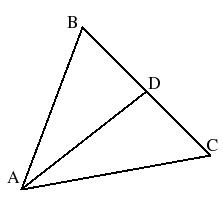
$${\overrightarrow {AD}}={\frac {|{\overrightarrow {CD}}|}{|{\overrightarrow {BC}}|}}{\overrightarrow {AB}}+{\frac {|{\overrightarrow {BD}}|}{|{\overrightarrow {BC}}|}}{\overrightarrow {AC}}$$
somber coyoteBOT
vin100
 grave pond
I'd call it something like convex interpolation, but that's not an already established name.
 tepid cave
 opaque gull
A circle tangents the line 3x-4y=0 at the point (8,6) what's the midpoint of the circle? It also intersects the positive x-axis
I solved it to y=(3/4)x and chose origo (0,0) then found the midpoint between the points I got (4;3) is that right?
I feel like it's too good to be true and a much harder process
nocturne remnant
You mean the centre of the circle?
dark sparrow
"tangent" is not a verb by the way
wise pawn
a circle constructed with its center at (4,3) will be cut in half by the line, so it can't be tangent to it
also it's not gonna be unique if it only intersects the positive x-axis, since there are many circles that are tangent to the line and intersect the positive x-axis, but it would be unique if it was required to be tangent to the x-axis
opaque gull
dark sparrow
"tangent" is not a verb by the way
Idk the verb in English
I guess intersects?