#geometry-and-trigonometry
1 messages · Page 373 of 1
 forest drift
I got the answer
forest drift
I'll send
 dire moth
Do u have the work too
forest drift
after some time
dire moth
So I can see how u did it
forest drift
dire moth
Do u have the work too
yeah
dire moth
Ok thank you
dire moth
forest drift
after some time
How long, sorry if I’m being rude
forest drift
dire moth
How long, sorry if I’m being rude
10 minutes
 hoary mango
did i use the law correctly
 forest drift
dire moth
Thx again
forest drift
dire moth
Thx again
theta = 45 degrees, w = 19 root 2, h = 9.5 root 2
x = 9.5
area = 3/4 x 361 = 270.75 m2
hoary mango
non-right triangles arent bad, it's just way too complicated
forest drift
hoary mango
non-right triangles arent bad, it's just way too complicated
its not complicated
just its weird
dire moth
forest drift
x = 9.5
area = 3/4 x 361 = 270.75 m2
Is it possible if you can do it on a screen or draw it?
Would be easier to understand
If it’s no trouble
forest drift
dire moth
Is it possible if you can do it on a screen or draw it?
see
it is a square
dire moth
Ye I can kinda see it
dire moth
Oh
 somber coyoteBOT
officalzenv2
 hoary mango
let me just remember this for later
dire moth
Yes
Like the work
So I can understand well
In case a question like this pops up in an exam
dire moth
forest drift
the answer?
If possible
forest drift
dire moth
If possible
i'll send it
dire moth
Ok
 sturdy forge
it's a square
dire moth
Can you send a picture of it if possible
sturdy forge
use the properties of a square and you'll get it easily
dire moth
sturdy forge
use the properties of a square and you'll get it easily
Ye so 19 is the x as a diameter right since it’s a square?
So I go 19/2
Which is 9.5
Which is X
sturdy forge
so x = 1/2 x 19, theta = 45 degrees, w = 19 root 2(diagonal of a square) and h = 1/2 x diagonal
sturdy forge
dire moth
Ye so 19 is the x as a diameter right since it’s a square?
yes yes
forest drift
thats the same thing i did
forest drift
sturdy forge
i taught you how to do <@!919513117296295967>
partly yeah
I had an idea
forest drift
dire moth
You actually explained it well
he's my close friend
sturdy forge
dire moth
You actually explained it well
no problem
dire moth
Wait Is that everything I need to do?
forest drift
dire moth
Wait Is that everything I need to do?
ye
sturdy forge
yeah
dire moth
Ok
sturdy forge
dire moth
Wait so W is the radius?
you mean diagonal?
dire moth
Is that theta?
dire moth
sturdy forge
you mean diagonal?
Cause I thought I do coz-^1 = (9.5/19)
Do I do that to get theta
forest drift
dire moth
Wait and to find theta
you have to know the property of parallelogram which says that diagonals bisect angles of parallelogram. The square is a modified parallelogram so yeah 2 times theta=90 and thus theta is 45 degrees
forest drift
sturdy forge
if you want to find theta using trig, then wait, i'll send solution
with trig also you'll get 45 degrees vsg
sturdy forge
arccos(19/w) = theta
dire moth
Wait so since it’s a square I just divide the 90 degree angle by 2
sturdy forge
forest drift
with trig also you'll get 45 degrees vsg
ik that
forest drift
sturdy forge
arccos(19/w) = theta
yeah yeah
dire moth
Which is 45?
forest drift
dire moth
Wait so since it’s a square I just divide the 90 degree angle by 2
exaclty
sturdy forge
yes yes
sturdy forge
yeah
sturdy forge
np np
forest drift
any other doubts?
dire moth
sturdy forge
np np
Can I add you in case I need more help some time
sturdy forge
sure
forest drift
dire moth
Can I add you in case I need more help some time
add me also
 hoary mango
non-right triangles are so shit
why couldn't trig just stick to advanced functions and right triangles
im tired of this
im skipping to calculus
forest drift
If you need help in calculus please let me know
hoary mango
its a swallowing choice but i've already dug up enough fucking dirt to know the basics of calculus
but trigonometry is just shitty
its like mining obsidian with a tree branch
forest drift
hoary mango
its a swallowing choice but i've already dug up enough fucking dirt to know the ...
nice - so u know differentiation , integration and limits?
hoary mango
yeah i could probably do some riemann sums in my head
forest drift
hoary mango
yeah i could probably do some riemann sums in my head
that is a good level
hoary mango
im used to limits
forest drift
btw which grade/year are you in?
 fiery solstice

 deep trench
any software for create maths notes or maths books?
 dim hatch
latex @deep trench
 grizzled kindle
@fiery solstice any three points on a sphere has a unique circle passing through them
Find its centre and then find it's normal line
Do it for any three faces of tetrahedron and then solve the system of equation
Coz it's normal lines will intersect
 median fern
Hi
So

Can you tell me how do I find
BF
When AD // BC and AD =16cm and BE = 10 cm
EF perpendicular BC
median fern
grizzled kindle
BC = AD = 2BF = 10
But BC = 16
grizzled kindle
Huh?
median fern
Ye
grizzled kindle
It's a parallelogram
median fern
Hm
grizzled kindle
Opposite sides are equal is in its definition
median fern
Ye
AB = BC AND AE = BF BUT
AB = BC is true but AD ain't 2BF
Besides AB = BC = 2BF = 16 cm not 10 cm
grizzled kindle
median fern
AB = BC is true but AD ain't 2BF
Perpendicular in isosceles triangle are perpendicular bisector
grizzled kindle
median fern
Besides AB = BC = 2BF = 16 cm not 10 cm
AB = BC ??
 grizzled kindle
BC = AD = 2BF = 10
grizzled kindle
grizzled kindle
BC = AD = 2BF = 10
Oh sorry here is messed up I meant 16 not 10
grizzled kindle
BC = 2 BF coz isosceles triangle property
Then that would be equal to AD coz parallelogram
Then solve it
median fern
grizzled kindle
BC = 2 BF coz isosceles triangle property
Does EF divides the BC into 2 halfs
grizzled kindle
Yes

 dusk charm
 spark moon
opposite sides are equal in a parralelogram, so equate both the sides and solve for t
spark moon
ok guys im taking a quiz right now
and its very hard for me
and i really didnt understand the class
and the teacher kicked me from multiple classes for not understanding the material
dusk charm
ayo, we need to teach u parralelograms?
do uk wht supplementary and complementary angles r?
dusk charm
yes now tell the complementary of 30
dusk charm
wht is the complementary angle of 30 degrees?
spark moon
uhhhhh
dusk charm
the complementary of an angle is 90 degrees - the angle
while supplementary is 180 degrees - the angle
so angle + complementary = 90 degrees
dusk charm
and supplementary of 30?
spark moon
180-90?
 harsh heron
Why is 6 afraid of 7?
-0.89594417
 fast ledge
 grizzled kindle
harsh heron
Why is 6 afraid of 7?
-0.89594417
grizzled kindle
harsh heron
Why is 6 afraid of 7?
-0.89594417
Coz 7 ate 9

 dreamy ridge
So if x is a positive integer, x(x-1)(x-2)!/ -x! = 120(x-2)!
The (x-2)! cancels
So x(x-1)/x! =120
Then write the x! as the numerator times (x-2)!, things will cancel
And then you can go from here I’m p sure
 buoyant oyster
deep trench
buoyant oyster
deep trench
Is the denominator (-x)! (Which are singularities at negative integers) or something else
dreamy ridge
I think it’s -(x!) as the lack of brackets implies that it isn’t the factorial of negative x but rather the negative of the factorial of x
Same sort of logic as -x^2, not (-x)^2
buoyant oyster
so it’s -1 = 120(x-2)!
The gamma function over the positive reals is always nonzero
grizzled kindle
Because it used factorial rather than gamma notation ig x is a integer so... I'd say no solution
 ivory wyvern
yo can someone help
 ivory wyvern
alr
buoyant oyster
the angle of the angle at the center of the circle is 360-267
Wait
yeah
I’m gonna guess here
the triangle is an isosceles triangle
ivory wyvern
ok
buoyant oyster
Thus the other angles are equal, and equal to the angles next to them
So decide the remainder of the triangle’s total angles (180°) by two
(90-(360-267))/2
ivory wyvern
alr alr thx


 royal citrus
median fern
How do I do it
royal citrus
median fern
How do I do it
traingle BEC is half of abcd (triangle in same base as parrallelogram)
and trangle bec = efc (divided by midpoint)
hoary mango
where should i insert the multiplication part?

use law of sines
nah law of sines is overly confusing
can i get some help with it
alright that wasn't really contextual
can i get some help with inserting sides with the law of sines with 2A1S and 2S1A?
hoary mango
plug in law of sines?
bro thats a shit ass tip
i am AWARE you need law of sines
i asked for help with PLUGGING the sides in
hoary mango
its okay though
dusk charm
1 sec
dusk charm
hoary mango
i asked for help with PLUGGING the sides in
first u have to find B
so since c/sin C = b/sin B
10/sin 59 = 14/sin B
so sin b = (sin 59/10)*14
and B = arcsin(sin B)
i should learn latex
After solving B u should be able to find A similarly
hoary mango
oh nice
dusk charm
and then i am sure can find the other length
dusk charm
law of cosines is annoying
hoary mango
i mean
the pythagorean theorem equation part is nice with a calculator
but do teachers even give you calculators when doing these shit?
hoary mango
yeah
i'd understand why calculators are used in trigonometry
because no mfs gonna wanna solve the sine of 40 degrees
dusk charm
u should be fine
hoary mango
since it has a whole damn decimal section, i'd say you'd be dead af without a calculator
dusk charm
these dont come for me lol
 iron spoke
expand 19 terms of the sine taylor series in the exam :^)
 modest birch
Is the answer 52?

 dark sparrow
no
modest birch
What is it
 silent plank
show what you did that led to 52
modest birch

 upper karma
Where does your 5 come from ?
modest birch
which 5
silent plank
at the very bottom
upper karma
You put sqrt (57^2 + 5^2) but I don’t understand where you even get the 5 from sorry
modest birch
it was meant to be 52 squared
upper karma
But that makes even less sense
silent plank
wheres 52 coming from
upper karma
It means you made a hypothesis that it was 52 and tried with that 💀
silent plank
your attempt at applying the sine law doesn't make much sense either
 modest birch
yea xd
upper karma
So what you want to do for looking for that angle is starting by getting angle C thanks to either arcos either arcsin either arctan
With the sides of your big triangle

how do i answer for part B
 grave pond
I think doing trigonometry here is a detour. With a height in a right triangle, the small triangles are similar to the large one, and since we have all the sides of the large one now, no trig is needed.
upper karma
Then once you’ve found angle C you want to add 90 to it because you obviously have angle D a right angle and substrat the sum to 180
That gets you angle E let’s call it
The subtract angle E to 90 because you have a right angle
I’m not saying that helps your problem but that’s answering to your second question lol
modest birch
upper karma
So what you want to do for looking for that angle is starting by getting angle C...
Whats arcos, arcsin, arctan ?
 upper karma
grave pond
I think doing trigonometry here is a detour. With a height in a right triangle, ...
upper karma
grave pond
I think doing trigonometry here is a detour. With a height in a right triangle, ...
I think it is needed it’s just about the “aggrandizement” in Thales theorem (that’s what we call it in France I ain’t gob lie idk what it is in the US)
silent plank
don't worry about the trig. consider similar triangles
upper karma
modest birch
Whats arcos, arcsin, arctan ?
The inverse of the sine tan and cos you normally have a tab on your calc that says that
upper karma
silent plank
don't worry about the trig. consider similar triangles
Yes that’s what you call it I think

 gritty hemlock
upper karma
gritty hemlock
upper karma
same logic as in how you got RQD
alternate segment theorem
BPR = ( RQP ) = 180 - ( CQP ) - ( RQD ) = 180 - ( PRQ ) - ( RQD ) = 180 - ( APQ ) - ( RQD ) :o
 silent plank
X+Y = 15
where's that coming from
silent plank
X and Y are points (of tangency) and don't represent any lengths or whatever
upper karma
And then if you draw the radius lines you get something like this

Both the tangents should be the same right?
gritty hemlock
Theorem: Suppose that two tangents are drawn to a circle S from an exterior point P. Let the points of contact be A and B, then PA = PB.
Also, use pythagoras for AC = √(12² + 9^2)
gritty hemlock
gritty hemlock
Theorem: Suppose that two tangents are drawn to a circle S from an exterior poin...
Idk what you're trying to find coz you just gave the figure, but I think  might help!?
upper karma
anyone plz tell how the formula given in the solution is derived?
 dark sparrow
weird how this highly nontrivial formula is presented as just something to invoke without justification
cause i personally do not see immediately how to derive it
all that's coming to mind rn is that maybe drawing the common tangents of the big circle and each of the three small circles might help?
perhaps something could be said about the areas of AER, BGJ and CLP
 upper karma
dark sparrow
perhaps something could be said about the areas of AER, BGJ and CLP
upper karma
dark sparrow
perhaps something could be said about the areas of AER, BGJ and CLP
ya i tried
dark sparrow
you tried this?
upper karma
dark sparrow
you tried this?
i am unable to do anything with this actually
dark sparrow
...
upper karma
i was trying it by similarity
dark sparrow
ok so i said this a million times already but please do not reply-ping me so often
it's very annoying especially after seeing it for the 20th time
upper karma
ok fine
actually i dropped perpendiculars from the centers of the incircles to the tangents
dark sparrow
so you dropped perpendiculars from the centers of the three green circles to T, U and V?
(referring to my picture)
upper karma
no actually H I M N D S points
dark sparrow
ah
upper karma
what is ur approach
dark sparrow
let s = area(ABC) (lowercase s so as not to confuse with the point i named S)
then area(AER) = s * rA^2/r^2, area(BGJ) = s * rB^2/r^2, area(CLP) = s * rC^2/r^2
i'm not sure if this leads anywhere, but this is what i have in mind right now.
there should be a nice way to derive the area of that hexagon in the middle
upper karma
dark sparrow
let s = area(ABC) (lowercase s so as not to confuse with the point i named S)
th...
how
dark sparrow
similarity
gritty hemlock
Uhh
dark sparrow
ah. wait.
gritty hemlock
Do you know half angle formulas?
dark sparrow
AER isnt similar to ABC is it
gritty hemlock
the sin(A/2) and the likes in terms of s, (s-a), (s-b), (s-c) :o
gritty hemlock
XD
dark sparrow
does this have to do with the problem at hand y/n
upper karma
dark sparrow
AER isnt similar to ABC is it
nope
gritty hemlock
Hmm oh y!
dark sparrow
im not convinced the formula you shared (and now deleted) is true
gritty hemlock
Not sure tho 👀 coz maybe O,O_A isn't really colinear with A
wait lol it's trivial so yeah the formula must be true
Hmm
dark sparrow
what formula
gritty hemlock
the sin(A/2) one... just connect the two centers of the big circle and any short circle given, drop perpendiculars from it to any one corresponding side and use the fact that inradius bisects the angle
dark sparrow
 gritty hemlock
Not sure tho 👀 coz maybe O,O_A isn't really colinear with A
gritty hemlock
gritty hemlock
Not sure tho 👀 coz maybe O,O_A isn't really colinear with A
wasn't sure but this is trivially true as A has tangents to both C_a and C, so OA and O_AA are both bisectors
dark sparrow
@gritty hemlock do you mean dropping perpendiculars $O_AD$ and $OF$ in this picture?
somber coyoteBOT
Ann
 dark sparrow
if so, i fail to see how this proves sin(A/2) = (r - r_A)/(r + r_A) nor how we could even use that to solve the original problem
gritty hemlock
dark sparrow
<@!706934233012371577> do you mean dropping perpendiculars $O_AD$ and $OF$ in th...
O_A S and OQ, joining OO_A and dropping a perpendicular from O_A to OQ
upper karma
this is the proof
 gritty hemlock
dark sparrow
if so, i fail to see how this proves sin(A/2) = (r - r_A)/(r + r_A) nor how we c...
gritty hemlock
dark sparrow
if so, i fail to see how this proves sin(A/2) = (r - r_A)/(r + r_A) nor how we c...
A + B + C = pi ?
:o
gritty hemlock
upper karma
this is the proof
Lol that also works but ... okay
dark sparrow
...
upper karma
gritty hemlock
Lol that also works but ... okay
yep
gritty hemlock
gritty hemlock
O_A S and OQ, joining OO_A and dropping a perpendicular from O_A to OQ
Ann
upper karma
upper karma
anyone plz tell how the formula given in the solution is derived?
hey but we were trying to prove this formula
dark sparrow
ok yes i guess i can see ansh's formula
but not how to apply it to chgupta's original problem
upper karma
dark sparrow
but not how to apply it to chgupta's original problem
actually i know the solution with this formula
dark sparrow
what did i say about the reply pings
upper karma
ok sorry
actually i want to know another solution with the formula given in the image i shared at first
dark sparrow
isnt that what we've been trying to derive all this time
upper karma
i don't think so
 upper karma
actually we are doing that ques with another formula
gritty hemlock
Are we =_= ? I just introduced a formula in an attempt to approach ur formula...?
dark sparrow
???
upper karma
gritty hemlock
Are we =_= ? I just introduced a formula in an attempt to approach ur formula......
i know
i tried it
gritty hemlock
gritty hemlock
Are we =_= ? I just introduced a formula in an attempt to approach ur formula......
sry that'd still be brute forcing  but hey, at least you have one way of proving it!

 upper karma
gritty hemlock
sry that'd still be brute forcing <:bearlain:762653539092529182> but hey, at le...
upper karma
gritty hemlock
sry that'd still be brute forcing <:bearlain:762653539092529182> but hey, at le...
ok
upper karma
gritty hemlock
sry that'd still be brute forcing <:bearlain:762653539092529182> but hey, at le...
and sorry again
Hey,
I have two Cartesian equations of plans : plan P and P’
I have to verify that they are parallel
I know that for two plans to be parallel they have to have a normal vector in common. The question is how do I find it
 next remnant
Does anyone know the formula
 grave pond
upper karma
Hey,
I have two Cartesian equations of plans : plan P and P’
I have to verify t...
grave pond
upper karma
Hey,
I have two Cartesian equations of plans : plan P and P’
I have to verify t...
If your equations are in the common form ax+by+cz=d, then (a,b,c) is a normal vector. You then just need to check whether the two normal vectors are parallel.
(by the way, it is "plane", not "plan").
grave pond
next remnant
Does anyone know the formula
Pythagoras. When (x,y) is on the unit circle, then x²+y²=1.
next remnant
grave pond
Pythagoras. When (x,y) is on the unit circle, then x²+y²=1.
ohhh ok
thanks my teacher made it seem so compucated
and went way to fast
upper karma
grave pond
If your equations are in the common form ax+by+cz=d, then (a,b,c) is a normal ve...
Nice thank you so much I don’t study in English so when it comes to mathematical terms I know nothing so thank you for teaching me that today 👍
 upper merlin
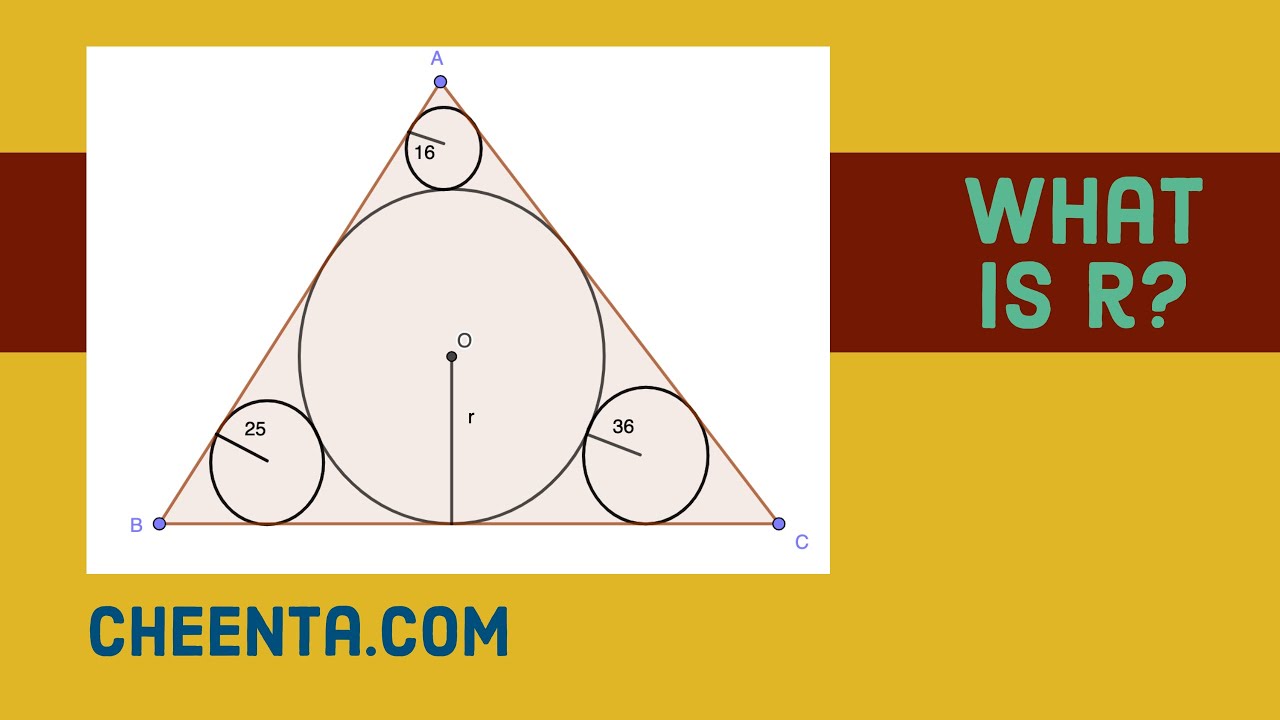
https://www.cheenta.com/ioqm-2021-problems-solutions/
The incircle Γ of a scalene triangle 𝐴𝐵𝐶 touches 𝐵𝐶 at 𝐷, 𝐶𝐴 at 𝐸 and 𝐴𝐵 at 𝐹. Let 𝑟𝐴 be the radius of the circle inside 𝐴𝐵𝐶 which is tangent to Γ and the sides 𝐴𝐵 and 𝐴𝐶. Define 𝑟𝐵 and 𝑟𝐶 similarly. If 𝑟𝐴=16,𝑟𝐵=25 and 𝑟𝐶=36, determine the radius of Γ.
Problem useful for I.S.I B.Stat B.Math...
some smart person in the comments who finished the solution

I later heard that this was a very well known question in comp math tho
tbh deriving this in exam is just not even close to being possible (at least for me)
gritty hemlock
upper merlin
some smart person in the comments who finished the solution
thx lol
ohhhhh yeah right smh, the 1-sin / 1+ sin = (1-sin / cos)² smh
n yeah, we had the same in our Solution of Triangles module in hs
upper karma
upper merlin
https://www.youtube.com/watch?v=VociZ23pA0w
thanks
gritty hemlock
@upper karma Yeah I'm from India 
upper karma
gritty hemlock
<@456226577798135808> Yeah I'm from India <:pandaWow:554697564197486598>
me too
upper karma
gritty hemlock
<@456226577798135808> Yeah I'm from India <:pandaWow:554697564197486598>
r u giving ioqm this year
gritty hemlock
can't :o I'm already in Uni 2nd yr smh
passively sat for RMO and INMO but that's the farthest I could go
upper karma
gritty hemlock
can't :o I'm already in Uni 2nd yr smh
ok👍
upper karma
gritty hemlock
can't :o I'm already in Uni 2nd yr smh
actually i have one more question
gritty hemlock
Hmm?
upper karma
do u know how to find the sum of the distances of the fermat point from the three vertices
gritty hemlock
Nope... I vaguely remember using something like that during my +2 coordinate geometry assignments and tests but I always figured a workaround so never learned what the correct method actually was 🤦♂️
upper karma
gritty hemlock
Nope... I vaguely remember using something like that during my +2 coordinate geo...
ok no prob
gritty hemlock
upper karma
gritty hemlock
https://math.stackexchange.com/questions/1695823/fermat-torricelli-minimum-dista...
thanks
upper karma
upper merlin
https://www.youtube.com/watch?v=VociZ23pA0w
but how can we prove this formula R= √Ra.Rb + √Rb.Rc + √Rc.Ra ?
gritty hemlock
upper merlin
some smart person in the comments who finished the solution
@upper karma
upper karma
gritty hemlock
<:this:489575168314966026> <@456226577798135808>
ok
 eternal locust
Can someone help me with this exercise? I feel like I'm missing a step

 mystic pond
This might be a really dumb question but is we have sin(xc) can we pull out the c to get csin(x) ?
 gleaming nova
no
mystic pond
gleaming nova
no
ty
upper merlin
gritty hemlock
<:this:489575168314966026> <@456226577798135808>
tf are you guys awake at 2 am?
 humble pulsar
upper merlin
tf are you guys awake at 2 am?
humble pulsar
upper merlin
tf are you guys awake at 2 am?
Timezones exist.
gleaming nova
no they don’t
upper merlin
humble pulsar
Timezones exist.
I also live in India 🙃
humble pulsar
That has nothing to do with timezones not existing
upper karma
upper merlin
tf are you guys awake at 2 am?
😅
 little terrace
can someone help with this pls🙏
 gritty hemlock
little terrace
can someone help with this pls🙏
gritty hemlock
little terrace
can someone help with this pls🙏
,texsp $\sin 2x\cdot\frac{\sqrt{3}}{2} - \cos 2x\cdot \frac{1}{2}= \frac{1}{2}$
somber coyoteBOT
Ansh

 balmy vale

 slate night

 grave pond
Divide by tan(75°) on both sides.
 sturdy spindle
 humble pulsar
yes
 warm eagle
gritty hemlock
,texsp $\sin 2x\cdot\frac{\sqrt{3}}{2} - \cos 2x\cdot \frac{1}{2}= \frac{1}{2}...
warm eagle
gritty hemlock
,texsp $\sin 2x\cdot\frac{\sqrt{3}}{2} - \cos 2x\cdot \frac{1}{2}= \frac{1}{2}...
Did you Type the dollar signs too or wat

Can someone help
gleaming nova
pythagorean theorem
warm eagle
I forgot this
This is all old homework and my marking period is done by this Friday
I’m so fucked cause I forgot this shot
And I need help
,
warm eagle
warm eagle
,
 stark briar
warm eagle
stark briar
warm eagle
do you know the pythagorean theorem
warm eagle
stark briar
do you know the pythagorean theorem
No i forgot
gleaming nova
when in doubt look it up
warm eagle
Ok
stark briar
warm eagle
No i forgot
you'll need to modify it a bit
grave pond
Are you saying you can't find what the Pythagorean theorem says? Textbooks, notes, google, everything is failing you?
warm eagle
 warm eagle
grave pond
Are you saying you can't find what the _Pythagorean theorem_ says? Textbooks, no...
warm eagle
grave pond
Are you saying you can't find what the _Pythagorean theorem_ says? Textbooks, no...
Yes
But is this not it
stark briar
warm eagle
a^2 + b^2 = c^2
stark briar
a and b are lengths of legs
warm eagle
You cannot multiple
stark briar
c = length of hypotenuse
warm eagle
I multiply it
stark briar
why 64-17?
warm eagle
Bc I multiple 8 x8
stark briar
warm eagle
Bc I multiple 8 x8
but why minus
warm eagle
And I can’t multiply 17 cause on the
warm eagle
stark briar
but why minus
Are you not supposed to minus it
stark briar
no
stark briar
a^2 + b^2 = c^2
warm eagle
So what’s the answer I’m confused
 steady sinew
wtf are you talking about
steady sinew
so am i
warm eagle
17 is on the left side
steady sinew
where did the 8 come from
warm eagle
So it stays the same does it not
warm eagle
steady sinew
where did the 8 come from
The 8 is on top
grave pond
Slow down, breathe.
warm eagle
grave pond
Slow down, breathe.
Okok
steady sinew
oh
warm eagle
I just type fast
steady sinew
its a diff question
warm eagle
Wait hol up
stark briar
warm eagle
17 is on the left side
the lengths of the legs are 8 and sqrt 17.
warm eagle
stark briar
the lengths of the legs are 8 and sqrt 17.
What does that mean
I don’t multiple 8
So I just subtract 8 -17?
grave pond
If you just keep posting in panic and never even wait to let anyone write anything to help you, then what did you expect?
warm eagle
True
grave pond
Please give people time to answer instead of just flailing with random guesses.
warm eagle
Idk I like to get it done bc I am very stressed in all my classes
And I have midterms
And all trust
Tamhat
warm eagle
grave pond
Please give people time to answer instead of just flailing with random guesses.
Yes yes you are right that is my fault
grave pond
It's alright if you don't want to listen to us, but in that case why are you posting here?
warm eagle
grave pond
It's alright if you don't want to listen to us, but in that case _why are you po...
No like I am
Confused
But I like to kinda learn fast
My teachers teach us the hard way
And I know some easy ways
They complicate it more
I hate it
But yea my school really does suck ass I’m not gonna lie
grave pond
You won't learn anything by being here unless you sometimes stop typing and wait for an answer. And then react to that answer instead of continuing your own train of thought.
warm eagle
grave pond
You won't learn _anything_ by being here unless you sometimes _stop typing and w...
Okok
I just overthink a lot
And slot of possibilities come in my head
grave pond
You're still doing it!
 grave pond
You got pointed to the equation a^2 + b^2 = c^2.
Write down what you know using the letters in the equation.
grave pond
b is 8, yes. But a is not 17, it is the square root of 17.
grave pond
You're eventually looking for c.
warm eagle
Okok
grave pond
So the next step is to insert your known values of a and b into the equation.
grave pond
Just take "a^2 + b^2 = c^2" and insert a=sqrt(17) and b=8.
warm eagle
warm eagle
8x8?
So this is right correct
grave pond
No.
warm eagle
Dam
grave pond
You've made several mistakes already by getting ahead of yourself and skipping steps and getting things wrong because you lose track of the big picture. So I'm really going to insist that you take it one step at a time and for now do nothing except insert a=sqrt(17) and b=8 into the equation a^2 + b^2 = c^2.
warm eagle
4
grave pond
What.
warm eagle
Sorry for asking bht what do I do with the 8
warm eagle
grave pond
What.
My fault
grave pond
Once more: The ONLY thing I'm asking for at the monent is to insert the values sqrt(17) and 8 into the appropriate places in the equation a^2 + b^2 = c^2. Do not attempt to solve it yet. Do not attempt to skip all the way to a final answer. Just insert the values, and show what the equation looks like with the known values inserted.
grave pond
Are you even listening to what I'm saying?
grave pond
It might be better to use a separate sheet of paper for your personal scratch work ...
warm eagle
o
grave pond
You're still attempting to jump all the way to an answer.
warm eagle
WAIR so I wasn’t right
I did it
I’ll tell you
So bad
Basically
17 stays the same right
grave pond
I am asking this and ONLY THIS: What does the equation a^2 + b^2 = c^2 look like when you have inserted the value sqrt(17) for a and the value 8 for b?
grave pond
Do not do ANYTHING with the equation except inserting the values for now.
warm eagle
..
So basically
I found out how to do it
Like
I know how I was just having problems with the 17
Cause that was just hurting my brain
grave pond
Your problem is that you're not listening to ANYTHING I'm saying!
warm eagle
yes yes but I found out a way with what you said before
grave pond
So again, why are you even posting here if you're just going to ignore everything I or anyone write to you?
warm eagle
I went on a separate piece of paper
No no
I went what you said
I wrote it down
Wrote the values
And boom
I got my answer
grave pond
(Hmm, it actually turns out the final answer is in fact 9).
grave pond
But that was not what I was asking.
gleaming nova
can’t blame troposphere though
warm eagle
gleaming nova
can’t blame troposphere though
Yea that’s my fault tbh
I’m just a very weird learner
But I will save ur messages so I can rem
Remember for other stuff later on
I’m getting them all right @grave pond :D
 barren musk
What are proof Theroms
 sleek isle
How does a 5 point and 3 lines look like?
gleaming nova
your question makes no sense
dusk charm
wha?
 zinc mural
Would someone help in applications of logarithm derivatives?
silent plank
not geo/trig
also post a clear question in an appropriate channel if you want help
#❓how-to-get-help
 gleaming nova
apply the formula for interior degrees in an n sided polygon
 visual basalt
Idk how to do that ...
dark sparrow
do you know what formula quantum is talking about?
 dark sparrow
@hoary karma are you asked to write the proof in two-col format

 hollow oxide
what am i doing wrong? 😦

 dark sparrow
it's just y = (7/3)x
hollow oxide
dark sparrow
it's just y = (7/3)x
oh, thanks


 knotty delta
 hoary karma
solution

 knotty delta
hoary karma
knotty delta
hoary karma
solution
 hoary karma
knotty delta
solution
hoary karma
knotty delta
solution
bro you are the best i couldnt thank you enough
knotty delta
hoary karma
bro you are the best i couldnt thank you enough
np!
 iron walrus
 grave pond
Would it sound less daunting if instead of "identify the error" it said "for each of the diagram, explain why it is impossible"?
There's not any "the" error to identify in the sense that you can know which measurement is wrong; all you can show is that they can't all be right.
 near sand
What does it mean when two angles are a linear pair?
Say I got angle QMN and angle QMP. And QMN = 40
Oh nvm
They're supplementary, so they add up to 180
I just solved my own question
 fiery jolt
knotty delta
solution
fiery jolt
knotty delta
solution
wait i thought only triangles can be congruent
grave pond
Any kinds of geometric figure can be congruent.
 near sand
Yes
near sand
Yeah. If we have an angle ABC, and a ray BD. Then the measure of the angle ABD = measure of angle DBC
fiery jolt
yea exactly
upper karma
Can you apply standard form for the expression 3c+2a+s?
fiery jolt
uou know that angles QMN is 40 therefore QMX is 20
because it bisects there
QMX+XMN=40
QMX=XMN
therefore QMX=XMN=20
fiery jolt
yea np have a nice day
near sand
You too
 tight wagon
I need help with this
 gleaming nova
distance formula
upper karma
 gritty hemlock
upper karma
gritty hemlock
upper karma
How the heck are lines 2 and 3 parallel? two lines need to have the same slope for them to be parallel
gritty hemlock
Just check the slopes of each line equation, equal slope mean parallel lines, product of slope = -1 implies perpendicular lines

 slate wren
use the similiarity of triangles
 wheat onyx
Okay so...
9/3=4+x/4
x=8
But
9/3=5/y
y=1.67 which is different from the correct answer
Are there any mistakes made in my solution?
upper merlin
BDC, CEA and AFB are equilateral. We have to prove AD, BE and CF are concurrent

preferably using ceva's and menelaus'
 willow vessel
Hello everyone
Anyone who can help me to test tge independence of each axioms of three line geometry?
hoary karma
again, my dumbass cannot figure out these problems, you are supposed to find x


 storm heath
Why and how is this so?
 humble pulsar
storm heath
Why and how is this so?
humble pulsar
storm heath
Why and how is this so?
Euler's Identity
somber coyoteBOT
Pebble

 grave nova
How do I solve this?
 grizzled kindle
$sin( arccos(4/5) - arcsin(4/5)) \newline = Sin( arcsin(3/5) - arcsin(4/5)) \newline = sin( arcsin( 3^2/5^2 - 4^2/5^2) \newline = - 7/25$
somber coyoteBOT
∆ddY
 grizzled kindle
@grave nova
grave nova
Woah, where did you get arccos from?
Wait was it the thing with sin(x+y)=sinxcosy+cosxsiny?
grave nova
The question was to compute the ordered pair (A, B)

I can do the I write left side but idk how to solve for both variables
dark sparrow
@grave nova still here?
grave nova
No I’m supposed to be sleeping sorry
grizzled kindle
grave nova
Woah, where did you get arccos from?
arccos(x) + arcsin(x) = π/2
grizzled kindle
grave nova
Wait was it the thing with sin(x+y)=sinxcosy+cosxsiny?
Yes
 frigid zodiac
i dont understand this

like
in the tan 20 = x/5
he multiplied both sides by 5
ok i understand that
but for the cos 20 = 5/y he multiplied both sides by Y
can someone help?
dark sparrow
...isn't that the exact same principle tho
storm heath
humble pulsar
Euler's Identity
Oh.
storm heath
somber coyote
**Pebble**
INTELLIGENTTTTTTT.
upper karma
 grave pond
Yes? Did you want to say something about that exercise?
 silk jacinth
if I have a triangle with side lengths of 105, 220, 320 and I want to solve angle X that's opposite to 105 through law of cosines, shouldn't the equation be:
105^2 = 320^2 + 220^2 – 2 * 320 * 220 * cos X ?
and if that's true, should X be ~6.92° ?
dark sparrow
,calc (320^2 + 220^2 - 105^2)/(2 * 320 * 220)
somber coyoteBOT
Result:
0.99272017045455
,calc acos(0.99272017045455) * 180/pi
somber coyoteBOT
Result:
6.9177052509777
seems to check out @silk jacinth
silk jacinth
yeah but is the original form of the equation correct?
dark sparrow
yes
silk jacinth
okay, so by that logic, shouldn't the area of the triangle be 0.5 * 220 * 320 * sin 6.92° ?
which would be around 4200 ?
dark sparrow
,calc 0.5 * 220 * 320 * sin(6.92 * pi/180)
somber coyoteBOT
Result:
4241.0145956378
4241 but close enough i guess
silk jacinth
yeah the computation checks out but is the formula for the area correctly determined?
silk jacinth
sry I'm tired and english isn't my first language
what I mean is
have I properly written the equation of law of cosines and the formula for triangle's area prior to solving them if I want to determine the area of a triangle with sides of 105, 320 and 220
dark sparrow
yes your formulas are correct
silk jacinth
then goddammit, the textbook I'm supposed to be using seems to be just full of errors
this is like the 3rd time I've seen an error
the "correct answer" according to the textbook should be ~8800
I'll need to run these assignments by other teachers at my school and let the writers of the textbook know that they should really be more careful bc I've just wasted so much of my time just checking my (apparently correct) answers with the answers insisted by the textbook
 raven hearth
hey can someone help me with my geometry
 weary drift

raven hearth
 upper karma
can somone help me with problems 2-4 ? i am stuck and i cannot solve them i need to fix them by tomorow for credit
 upper karma
hey guys doyou mind helping me with this
 dark sparrow
@upper karma do you still need help with this?

 tidal crest
Mb
dark sparrow
instead of posting your problem and waiting for someone to come along to help
which may or may not be me
gleaming nova

 rugged cargo
 rugged cargo
rugged cargo
rugged cargo
It's a square with side 10 . There are 2 semi circle in figure and a quadrant find area of shaded part
upper merlin
I feel like this is definitely featured in mind your decisions
dusk charm
lmao
 civic shoal
how would I determine the value(s) of theta to the nearest degree 0˚ ≤ θ ≤ 360˚ for sin theta = 0.4526 and cot theta = 0.5814 and sec theta = 1.4526?
 trail musk
3C. Point D is on side BC of equilateral ▲ABC. From point D, perpendicular line segments with lengths 4 and 8 inches are drawn meeting sides AB and AC at points R and T. Find the number of inches in the height of ▲ABC. [Hint: Draw a line segment from A to D.]
 trail musk
Can someone do without trig
 candid gyro
hii
I'd appreciate if anyone of you can help me on a Rotation project
If you have a pdf lesson or some resources that can help please share it with me.
upper merlin
trail musk
3C. Point D is on side BC of equilateral ▲ABC. From point D, perpendicular line ...
without trig we can follow their hint and use area of ADC+ADB=ABC
 distant inlet
Let H, a hyperbola be the graph of $x=\sqrt{y^2+1}$ and let P be a point lying on H. Prove that for any point P and some line l that passes through P, the probability that line l intersects H exactly twice is 1/2.
Proposed by Yuya Shan
somber coyoteBOT
AeroBennu
 dark sparrow
question is not well-posed until a probability distribution is specified for the set of all lines passing through P
silent plank
have you tried anything at all?
 mild birch
somber coyote
**AeroBennu**
mild birch
somber coyote
**AeroBennu**
exactly one possible line l would be a tangent. since there are infinite lines possible, it makes the probability of this happening 0. and the normal would usually intersect twice too except for exactly one point in H, the turning point and this has a probability of 0 too because there are infinite points. as you’d know, $\sqrt{y^2+1} > y$ so rotate the tangent upto 90 degree one way and you’ve got two intersections, rotating it the other way, you’ll only cross at that point because x of H will always be greater than x of l
somber coyoteBOT
Rylo
 mild birch
idk how to construct a formal proof for this tho
i could prolly give it a try
maybe try construct the equation of a line l
upper karma
Hello, I need some help. I'm studying for my math exam and there's one task that's bothering me. I have marked three procedures and they all gave the same and correct answer. The first one made my teacher but she haven't explained me why she did it like that and I don't understand it. Third one I did few days ago but now I don't understand it and second one I did now and it makes sense to me. I'm wondering which way is the best to solve other tasks like that cause my teacher told me my way can result wrong answer at some other tasks.
 silent plank
option 2 is the simplest
the issue with option 3 is that x is being used to represent different things
upper karma
ooh okay thank you
silent plank
i.e. x is somehow 6.4 but the real x you want is 6.4-4
to set that ratio and equation up properly you can start with
$$\frac{x+4}{4} = \frac{4}{2.5}$$
somber coyoteBOT
ℝamonov
 upper karma
alright so thats the first option
silent plank
its the reciprocals of the first option, but yeh pretty much the same
upper karma
so you said the second option is the simplest, will it always result the correct answer in other taks?
silent plank
considering that the 4 in 4/2.5 was a result of simplification of 1.5 + 2.5
$$\frac{x+4}{4} = \frac{2.5 + 1.5}{2.5}$$
$$1 + \frac x4 = 1 + \frac{1.5}{2.5}$$
$$\frac x4 = \frac{1.5}{2.5}$$
somber coyoteBOT
ℝamonov
 silent plank
is a way of justifying why that simplified ratio works
upper karma
okay, thank you for your help
 old fiber
 harsh heron
animation I made in Manim
 queen drum

 tulip shadow
i need help, part a is simple, part b i have no idea how to get it to prove its supplementary

 stiff robin
tulip shadow
i need help, part a is simple, part b i have no idea how to get it to prove its ...
stiff robin
tulip shadow
i need help, part a is simple, part b i have no idea how to get it to prove its ...
Since AED = ACB, AB/BC = AD/DE is what you would use.
\U+1F601
:U+1F601
tulip shadow
stiff robin
Since AED = ACB, AB/BC = AD/DE is what you would use.
omg thks so much
 valid chasm
Guys can anyone tell me where people discuss about 8th maths
 serene harness

 deft veldt
Need a geometry textbook with loads of questions that start off relatively simple and get progressively harder
 forest zodiac

 upbeat charm
According to what you've been taught I presume... angle PQT should be 90° right??

 thick jay
It's an inscribed angle, https://www.khanacademy.org/math/geometry/hs-geo-circles/hs-geo-inscribed-angles/v/inscribed-and-central-angles

Khan Academy
Proving that an inscribed angle is half of a central angle that subtends the same arc.
thick jay
 runic kraken
anyone can answer?
runic kraken
anyone can answer?
A lot of people can. How far do you get when you try, what's the stumbling block?
runic kraken
i dont even know what to start with lmao
i did all other questions they were ez, but this is the only complicated one
@thick jay
thick jay
runic kraken
<@!760358915925475368>
So, from the diagram, what is the angle of CBA?
thick jay
I have brain fog and the word I'm looking for is escaping me, but on line NS, all angles that connect to a point on that line at point B, what do they have to add up to?
thick jay
Like, angle CBN, CBA, ABS, what do they have to add up to
thick jay
yeah
thick jay
I didn't actually do it out
upper karma
should I take honors geometry
upper merlin
RQT will be half of ROT, then cyclic quad
 wet swan

MathOverflow
The assignment:
Let us start by defining $f:\mathbb{R} \to ]-\infty,2]$ as $f(x) = - \frac{4}{5} \sin{\left (\pi x \right )} - 1$, and $g:\mathbb{R}\to\mathbb{R}$ as $g(x) = \frac{5 x}{6}$. In this
I need help determining the value set of a composite function. You can check the link. I appreciate all tips and help
 glass harness
so im trying to really understand geometry.
I am thinking of just using the elements by euclid to reteach my self.
but i assume a regular text book work be better?
thick jay
glass harness
but i assume a regular text book work be better?
khan academy?
upper karma
can i ask for physics help here?
 abstract pollen
I'm in calc based physics and I am trying to understand a trig situation.
i have the change in x =sqrt(d^2_1+d^2_1)-d_2
d_2 is the x side d_1 is the y side.
I don't can't visualize the change in x on the triangle
 sharp flame
is this correct?

 frosty matrix
sl loney
 manic shell
upper karma
I'm trying to learn calculus, but I don't know trig
manic shell
upper karma
I'm trying to learn calculus, but I don't know trig
just use paul's math notes or something
deft veldt
upper karma
I'm trying to learn calculus, but I don't know trig
just khan academy
and questions
loads of questions
upper karma
Uhhhh
Wait
Uh
I accidentally sent that
Yeah but now I'm not sure
So SL Loney, Paul's math notes, or khan academy
 lone sandal
Help


 upper merlin
 opaque ibex
join the centres of the three circles and remember that those lines pass through D,E,F
opaque ibex
oh thank you yes
 split drift
lone sandal
Help
split drift
lone sandal
Help
What is the solution?
 grave pond
Fins a pair of known sides in one quadrilateral that have the same ratio as a pair of sides in the other. That will tell you how the sides match up.
near sand
Do three noncollinear points always determine a unique taxicab circle?
 grave pond
near sand
Do three noncollinear points always determine a unique taxicab circle?
grave pond
near sand
Do three noncollinear points always determine a unique taxicab circle?
No -- consider (0,0), (1,1), (-1,1)
 cinder iris

 vernal grotto
i dont understand how exactly you'd find the phase shift of a sine function because aren't they periodic so how would I know which point was actually the original point at x=0 before it got shifted away from it?
 versed mulch
 tidal hull
18
versed mulch
cinder iris
add all the values of x and equate it to 180 angles in a straight line make 180
upper karma
 dark sparrow
if you're drawing things in paint you don't need to screenshot the entire screen, you know. you can just select the part of the image you want to share and copy-paste it
 vast jungle
Whats the proof that sum of angle in triangle is 180?
grizzled kindle
@vast jungle let ABC be a triangle
Construct a line parallel to BC passing through A , now apply the relation between interior angles of a transversal
vast jungle
But isnt this proof cyclic. You are using the fact sum of all angles in triangle is 180 to prove the same? 🙄
dark sparrow
no?

@vast jungle they're basically saying this, where angles of the same color are shown to be equal
vast jungle
dark sparrow
<@!536177306578845708> they're basically saying this, where angles of the same c...
I agree with you but how do we prove those colour are actually the same
dark sparrow
derive it from the parallel postulate
the relation between interior angles of a transversal
vast jungle
Okay
upper karma
hey guys! i need some help in this…
Two parallel lines passing each by one of two opposite vertices of a square divide it into three parts of the same area (two triangles and a parallelogram). If the distance between the lines is d cm, what is the measure square area? When d = 1
 upper merlin
upper karma
Two parallel lines passing each by one of two opposite vertices of a square divi...
upper merlin
upper karma
Two parallel lines passing each by one of two opposite vertices of a square divi...
the triangle's area would be 1/3 of the area of the square and you can use this to find the area of the parallelogram in terms of d
 upper karma
upper merlin
the triangle's area would be 1/3 of the area of the square and you can use this ...
upper karma
upper merlin
the triangle's area would be 1/3 of the area of the square and you can use this ...
oh, but we don’t need the area of the parallelogram
we want the square area
upper merlin
you basically find x in terms of s and solve area of parallelogram=1/3 area of square
upper karma
sorry for the translation of the problem, i just used google translate cause i was so lazy 💀
oh wait
 trail anvil
what function finds the opposite side length from an angle?
like what function would I use to find AC
 upper merlin
think about which trig ratio would get you to the answer
you are given the side adjacent and want to find the opposite side
upper karma
trail anvil
like what function would I use to find AC
just memorize SOH CAH TOA
xd
upper karma
upper merlin
you basically find x in terms of s and solve area of parallelogram=1/3 area of s...
ok i still can’t arrive there

upper merlin
you found x in terms of s?
upper karma
like it has to be a enter number and my solution was decimal 🙄
upper merlin
but do you know that angle is 30 degrees?
upper karma
that’s the problem
we r not sure
ok the solution is 13, but how do u arrive there?
upper merlin
upper merlin
the triangle's area would be 1/3 of the area of the square and you can use this ...
following this diagram you'd get 1/2 s.x = 1/3 s^2 which gives x=2/3 s
now area of parallelogram would be d.sqrt(s^2+x^2)=1/3 s^2
upper karma
ohhh
upper karma
upper merlin
now area of parallelogram would be d.sqrt(s^2+x^2)=1/3 s^2
ok, after i will check it
cause we had a limit of time to do it and we couldn’t finish this one 
 wet lance
Is there any tricks to doing hard circle questions?
silent plank
depends on what you mean by a hard circle problem
upper karma
@upper merlin hey! sorry for the LONG respond, but I was able to do it

and thank you 
zinc mural
upper karma
and thank you <:thonkg:497051623760068608>
No problem
 atomic solar
I need help😭
It's due in almost two hours and my teacher won't help
It's not even a test
Rip
I give up
 charred nimbus

 fierce lodge
how do you find Cot 3pi/4
weary drift
dont ping mods for hw help
weary drift
ok
 spark stag
i'm sure that calling people "useless" and demanding an answer will make them eager to help you.
weary drift
come back in 24h
 broken dock
 fierce lodge
how do you find Cot 3pi/4
fierce lodge
fierce lodge
how do you find Cot 3pi/4
<@&286206848099549185>