#geometry-and-trigonometry
1 messages · Page 371 of 1
 mild birch
now you know
i like these types of questions
please ping me the next time you do these
 river marsh
i've gotl ike
another one after this
will probably work on it tomorrow but i can ping
mild birch
ooh sweet
river marsh
though i may need some help right now
river marsh
sum of forces in x and y are 0, which makes sense
mild birch
yeah
river marsh
so basically my equation is this 'T1z+T2z+T3z = mg'
river marsh
okay, so i don't have any of the tension forces, but the height to A from origin from trig is 0.086603m
river marsh
yes, they are
mild birch
slant height of a cone
yeah, just find the angle
you don’t need the height, just the angle really
so that you plug it in the trig thing
they all form the same angle right?
mild birch
(T1+T2+T3)sin/cos(30) =526
angle from base of the cone
or from between z axis and a string
it makes sense right ?
river marsh
so it expands out as T1 sin/cos(30) + T2 sin/cos(30) + T3 sin/cos(30) = 526?
mild birch
don’t expand i
idk if it’s sin or cos because i’ve not done it myself
you can just divide by the constant
to get your last eqn
bc both sin and cos30 are constants
river marsh
okay so
(T1+T2+T3)sin/cos(30) =526
divide 526 by the constant gives you T1+T2+T3 = 526/sin or cos 30
mild birch
yep
river marsh
okay, so then you don't know what the ratio for each cable is
river marsh
so that's one equation, the others are sum of forces x and sum of forces y?
river marsh
aight, i'll attempt that now
mild birch
nice one
don’t forget to call one direction as positive and the other as negative
when you do that, you’ll subtract a few times
but that’s exactly what we want
@river marsh
river marsh
yep, the sum of forces in x and y are the forces on the plane of the disk, there's an x and y axis so i know what's positive or negative
mild birch
yep
river marsh

@mild birch
I've done everything except the last line there, wouldn't it be tan 30?
wait, you said slant height of the cone
so yeah it would be sin
plugging that into wolfram alpha gave me these answers:
x = -0.977559 and y = 526.322 and z = 526.656
x is a weird number
well, all those numbers don't seem right
mild birch
river marsh
I've done everything except the last line there, wouldn't it be tan 30?
T is the slant height
river marsh
mild birch
what’s the 0.05
radius of the plate is 0.05m
river marsh
mild birch
T is the slant height
yep, i used sin 30
river marsh
ah, of course
mild birch
did you get these two so far

oh no, it’s 60 degrees
one sec

there
fixed it
see what you get now
river marsh
not sure what the three bottom lines are representing
mild birch
which line
 mild birch
 mild birch
river marsh
mild birch
river marsh
oh, yeah no, i tried to do it quickly, baso each of them will have sin30 as a factor when you try to make them as components of x and y.
literally every single term in 2 and 3
since the RHS is zero, i factored out this sin30 and divided by it
did you get any nice answer this time tho
 mild birch
river marsh
mild birch
river marsh
i didn’t know wolphram alpha did that so thank you
i’m not taking the piss, i genuinely didn’t
river marsh
haha no problem. yeah it looks good, it's just that for other similar examples in the textbook there's way more involved calculations
like let me show you
river marsh


though i guess this question we just did is SIMPLER in that all the cables sit at the same distance away from the center of the plate
so it eliminates the need to use this more involved cartesian method
mild birch
yeah, because it’s round plate
river marsh
thank you heaps for that. since you mentioned it, i've got another trig question, up to you whether to work on it later or have a look now or do now
 echo ibex
@upper merlinis ans 70degree
mild birch
if it wasn’t equidistant, i would have still resorted to trig vectors ,
river marsh
though i probably need to catch up on some textbook stuff lol
mild birch
river marsh
thank you heaps for that. since you mentioned it, i've got another trig question...
it’s upto you
just dm me if i’m not here
river marsh
yep, gotcha. i think the question is probably there to trick you
 upper merlin
echo ibex
<@!435784674451783680>is ans 70degree
upper merlin
echo ibex
<@!435784674451783680>is ans 70degree
no its 40
river marsh
i'll add u as a friend
mild birch
nice one
river marsh
i'll grab an image so you can look over it
mild birch
cheers
 mild birch
river marsh
mild birch
river marsh
doesn’t block and tackle pulley system reduce the required force ?
echo ibex
@upper merlinwhat is the angle DBC in the question
upper merlin
20 deg
river marsh
i'd say so, but i think the question is ignoring that
mild birch
moments are just forces that produce a rotational effect
river marsh
yeah
mild birch
river marsh
i'd say so, but i think the question is ignoring that
oh, thank god
makes life easier
river marsh
the other question i have i had to email the teacher about because they gave me a stupid angle

0 = 90 + 75 sin alpha - 239 cos 33
sum of forces in y direction
since resultant is along x axis
simplifies to sine alpha = -1.473
which is impossible lol
echo ibex
@mild birchi am getting 70 degree have u done it
mild birch
river marsh
okie dokes wait
mild birch
echo ibex
<@!880503100711010364>i am getting 70 degree have u done it
which one?
echo ibex
@mild birchangle of ECA
mild birch
echo ibex
<@!880503100711010364>angle of ECA
question please
all perpendicular forces are equal
echo ibex
@mild birchthat was ur question
mild birch
echo ibex
<@!880503100711010364>that was ur question
where ?
echo ibex
@mild birchgeometrical problem
mild birch
echo ibex
<@!880503100711010364>geometrical problem
could you please sc and send the question
i’m a bit lost
echo ibex
@upper merlinhave u done this problem
echo ibex
@upper merlinsend me
upper merlin
someone sent a trig solution too above that
mild birch
river marsh
 mild birch
mild birch
mild birch
@river marsh
river marsh
okay, let me have a look
echo ibex
@upper merlinwhere are u from sir
upper merlin
india
mild birch
sir is a bit too much tho innit
echo ibex
@upper merlinis this server for only indians
upper merlin
ikr someone said that to me the first time
mild birch
oh oops
river marsh
i think the actual angle is wrong
mild birch
but yeah
river marsh
well the teacher said
river marsh
yep, well the teacher said i can change F3 to another value so that it becomes possible to calculate
echo ibex
@mild bircho i got it what is ur major
mild birch
yeah 239 is a bit much
mild birch
echo ibex
<@!880503100711010364>o i got it what is ur major
maths aha
river marsh
so i guess it's the block question now
mild birch
i have a tragic backstory and all that
 dark sparrow
can i see the original problem
mild birch
dark sparrow
can i see the original problem
which one
dark sparrow
the one y'all are talking about rn
river marsh
there's like two being talked about haha
mild birch
river marsh
this ? or the triangle construction one
mild birch
river marsh
a more challenging one if you like challenges
mild birch
mild birch
i got that
mild birch
mild birch
a more challenging one if you like challenges
well it’s still formulaic
dark sparrow
oh yeah that one is impossible as stated y'all are right
mild birch
yeah
river marsh
so just make it a smaller value?
dark sparrow
F1 + F3 has too big of a negative y component
 dark sparrow
alright so then yeah just decrease the magnitude of F3 to like 50 or something
mild birch
yeah. because even if F2 was fully perpendicular to x, it’s not gonna equal to y
mild birch
dark sparrow
alright so then yeah just decrease the magnitude of F3 to like 50 or something
not 50, that’s too small,
dark sparrow
okay sure 100
river marsh
kk, easy done then
mild birch
mild birch
baso this formula is true
river marsh
yep, so just need to replace alpha
river marsh
yeah, meant F3 sorry
mild birch
plug in all the other values and see
mild birch
river marsh
now for the last one
 river marsh
that's all the info i get
mild birch
a for example is from. the hanging place to the axis
river marsh
yes
mild birch
d is the height at which it’s held
isb the height till centre of gravity of the object
river marsh
hm
mild birch
?
river marsh
i don't think this question will involve center of gravity
mild birch
no, cuz weight acts from the centre of gravity
any object can be modelled as a particle from its centre of gravity with a mass m
river marsh
ah right
mild birch
don’t worry about the terms
i just wanted to know what the variables meant
we’re mathematicians not physicists
river marsh
hahahha
yeah, i think it's just denoting the max height we need to worry about on that axis
echo ibex
anyone have a try

 echo ibex
@echo ibexanyone do this
river marsh
yep, that makes sense
mild birch
so it’s a vector product thing
mild birch
echo ibex
<@!914511651707965470>anyone do this
i did it, it’s d
echo ibex
@mild birchans is b
mild birch
constant dv/dt
and it’s negative
ohh, it’s it’s aceleration to displacement
apologies, my bad
i thought it was acceleration time graph
mild birch
mild birch
back to this
mild birch
echo ibex
<@!880503100711010364>ans is b
you’re right. it’s b
echo ibex
@mild birchcan u explain
mild birch
process of elimination, not a because negative acceleration and positive displacement, not c because constant acceleration but displacement increases so it should slope the other way, towards the axes, same reason for why it’s not d, b slopes the right way
echo ibex
@mild birchis it correct
 mild birch
acceleration is a negative constant and displacement is a variable that increases
echo ibex
have u seen it
 echo ibex
yeah
echo ibex
are u indian
 mild birch
echo ibex
are u indian
mild birch
echo ibex
are u indian
i’m from england why?
but realistically, not possible
but mathematically is
but anyways,
echo ibex
@mild birchjust asking
mild birch
echo ibex
<@!880503100711010364>is it correct
you seemed to complicate this one a bit too much i reckon
when you’ve got mcq, try eliminate obviously wrong answers
mild birch
echo ibex
anyone have a try
it says most suitable
echo ibex
@mild birchyeah i know i am preparing IIT thats why i am learning the process
mild birch
you know there is no way dv/dtds is equal to zero
mild birch
echo ibex
<@!880503100711010364>yeah i know i am preparing IIT thats why i am learning the...
sweet, wish you the very best my friend
i applied to oxford and i got rejected even though the disruption in my test centre wasn’t my fault
bit unfortunate really
but i hope you have some luck with your dream uni
echo ibex
@mild birchbe strong there is many more to acheive
river marsh
that sounds fucked
mild birch
echo ibex
<@!880503100711010364>be strong there is many more to acheive
true indeed
mild birch
river marsh
that sounds fucked
it’s so broken because one of the lead tutors in oxford literally scouted me kinda
she was like, just do the mat well and i’ll take care of the rest kinda thing
mat is the admissions test for oxford
i have emails to prove it
echo ibex
yeah it happens dont worry you will do something is good
mild birch
mild birch
mat is the admissions test for oxford
it’s not even hard, it’s just you bleed marks in mcqs and you have 60 marks to salvage
echo ibex
you know what india ranks first in sucide worldwide students cant handle so much pressure bcoz of exams
mild birch
ooh, i’ve got a response from dr. Bowles from ucl for my approach on collatz conjecture
ah, it’s a bit of shame really
echo ibex
hey have u heard about JEE
mild birch
nope
echo ibex
@mild birchit's considered one of the toughest exam in the world for engineering
mild birch

tried not to dox myself
that’s from ucl
you said you’re from india right ?
gandhi went to ucl
echo ibex
yeah i am indian
river marsh
yeah, everyone knows who he is

 echo ibex
@river marshthat's pretty awesome
mild birch
she literally made one of her colleagues persuade me to switch to maths and cs
mild birch
echo ibex
<@!448357218866167819>that's pretty awesome
you didn’t know people outside india knew about gandhi ?
river marsh
you'd be hard pressed finding someone in the west who doesn't know the name
mild birch
river marsh
you'd be hard pressed finding someone in the west who doesn't know the name
ye
echo ibex
@mild birchi am not a big fan of him but u will find his picture on our currency
mild birch
echo ibex
<@!880503100711010364>i am not a big fan of him but u will find his picture on o...
fair plays
mild birch
echo ibex
<@!880503100711010364>i am not a big fan of him but u will find his picture on o...
everyone knows him tho
history my friend is a bunch of lies written by the victors
echo ibex
@mild birchhow many county in west follow his principle
mild birch
river marsh
does that include the allies in ww2?
you know it
mild birch
echo ibex
<@!880503100711010364>how many county in west follow his principle
who does what
echo ibex
@mild birchyou know very well he was against violence have violence stopped there
mild birch
i’m not a fan of violence either
would much rather curl in a ball and do my maths
do mat papers and see how you find them, i averaged 80s on them under time pressure.
any maths is good, right ?
step is prolly harder tho
step is the cambridge entrance test
echo ibex
most precious gift we got from british were trains
mild birch
echo ibex
most precious gift we got from british were trains
fun fact. most trains and train lines were built by indian companies
in colonial india
you can blame oli ball if that’s not true cuz he told that to me
echo ibex
@mild birchbut technology was given by brits
mild birch
echo ibex
<@!880503100711010364>but technology was given by brits
tech exchange happens nevertheless
you didn’t need a war or colonialism for people to share tech now, do you
echo ibex
@mild birchcan u remember what we gave most precious thing to british
echo ibex
@mild birchgreat u know that but there is many more things we gave
i can say the everything what is in london museum
mild birch
echo ibex
i can say the everything what is in london museum
ah, ye, they stole a fuckton of shit from a lot of places
apologies for the language
echo ibex
data says they looted a worth of 45trillion dollar from india
mild birch
echo ibex
data says they looted a worth of 45trillion dollar from india
perhaps even more
echo ibex
@mild birchno problem
mild birch
you never know
the country is in a trillion dollar debt tho
uk i mean
the great recession changed it all
echo ibex
we lost our 20million peoples bcoz of winsten churchill
he was the reason for food shortage in india
mild birch
echo ibex
we lost our 20million peoples bcoz of winsten churchill
ah dw, not many people like churchill
echo ibex
and still he is considered great in uk
mild birch
echo ibex
and still he is considered great in uk
says who
mild birch
echo ibex
and still he is considered great in uk
see, history wise , he is quite great, cuz he inspired many people even in our country to fight
right?
but most of the other things he did
were pretty questionable
echo ibex
we are still suffering bcoz of uk
mild birch
germany had it worse, they could turn it around, it’s more to do with how corrupt is your system
dubai started with nothing but oil reserves
uk is pretty corrupt
we have corrupt governments that are keeping us from progressing my friend
echo ibex
@mild birchi agree but what about illogical partition done by brits
mild birch
echo ibex
<@!880503100711010364>i agree but what about illogical partition done by brits
not done by brits?
echo ibex
@mild birchwho was radcliffe indian?
mild birch
which partition ?

 river marsh
@mild birch how did u go on the block question?
mild birch
i’m back
mild birch
river marsh
<@!880503100711010364> how did u go on the block question?
oh yeah sorry

forgot to send this to you
mild birch
echo ibex
will u do it my friend
when a is 0
but that gives me two values
is a max and a min not the same value ?
 grizzled kindle
@echo ibex well there are 2 ways to go about it
- a function is either maximum or minimum when it's derivative is 0
So , possible answers are 0 , 2 , 4
Then you'd realise acceleration derivative is +ve in [1,2] so 2 is the answer
The other way would be ... Using familiar graphs to approximate
mild birch
yeah, to me, it looks like a = -sin(kt)
grizzled kindle
This graph looks awfully close to - sin(x)
So it's integral would look something like cos(x)
mild birch
so v = kcos(kt) +c
grizzled kindle
Ya ...
mild birch
yeah
the only problem is 2 and 4 are both valid answers
unless the graph looks more like a harmonic motion graph
mild birch
mild birch
@river marsh
river marsh
hmm, you will have to explain it to me
grizzled kindle
Noo
river marsh
i haven't done moments for a bit
mild birch
force x perpendicular distance
grizzled kindle
mild birch
the only problem is 2 and 4 are both valid answers
It's not
river marsh
i'll have to look at similar examples in my textbook to understand it
mild birch
you’ve got two perpendicular distances
river marsh
yep, force x perp. distance
grizzled kindle
Using second derivative test 4 is the answer
mild birch
so i took the hypotenuse, i’m not sure if we’re allowed to do that, but for some reason it made sense in my head
mild birch
grizzled kindle
Using second derivative test 4 is the answer
because one is negative and the other is positive
oh yeah right
you’re right
but no, it says speed
not velocity right ?
mild birch
river marsh
yep, force x perp. distance
both x and y are perpendicular to z and i’ve got both x and y
lengths
river marsh
hmmmm okay
i'll save that working out and do it on my own, see if i can come up with the same answer
mild birch
and the effective length of x and y is using one string in x and y
is the hyp
just see the answer, i wanna know if it works too
mild birch
river marsh
i'll save that working out and do it on my own, see if i can come up with the sa...
because you’re right in saying coordinate geometry would work
like, very formulaic and monotonous
but it’ll defo work
i just tried to find the answer quicker
river marsh
okay, give me one minute. why don't you try using coordinate geometry?
mild birch
river marsh
okay, give me one minute. why don't you try using coordinate geometry?
bit long to write down?
river marsh
it is
mild birch
yeah, i have a bad habit which is actually good while doing maths, try find shortcuts or alternative approaches
mild birch
river marsh
it is
i shall try your method in a bit tho,
river marsh
haha, good luck
mild birch
tell me if you’ve already done it tho
 storm heath
Example.
grizzled kindle
Okay , first tell me what you understood after reading the question?
 steady olive
If the only information given about a point is that it is "inside" a circle, could the point be on the very edge of the circle(i.e. its distance from the center is equal to the radius of the circle)?
dark sparrow
probably depends on context & exact wording
do you have the problem statement in front of you? @steady olive
steady olive
dark sparrow
probably depends on context & exact wording
the points are vertices of a triangle
dark sparrow
do you have the problem statement in front of you?
i want you to show me the problem exactly as it is stated. maybe there is something in there that will clarify whether points exactly on the circle count or not.
steady olive
dark sparrow
> do you have the problem statement in front of you?
I do but the issue is im only allowed to ask very general questions about the problem and I'm worried that sharing the problem could count as asking a specific question
dark sparrow
well the devil is in the details here
so unfortunately i do not see a way around this
maybe you could solve two versions of the problem, one where points exactly on the circle count as inside and one where they don't
maybe it won't make a difference. maybe it will. whatever it is, make it clear you are considering both cases as it was not made clear to you which one applies.
steady olive
Ok thank you
 rain solar

 alpine cliff
you should drag the vertices to match the congruencies correctly
 alpine cliff
 upper karma
that square indicates right angle
on angle GDF
its also less of a square
and more of a smaller pointy angle symbol
instead of a round one
echo ibex
@upper karmalength of arc HG is 77degree into radius i guess
alpine cliff
it is not
echo ibex
angle EDG 113DEGREE
alpine cliff
you shouldnt just give the answers thats not what this server is for
echo ibex
arc HEG is piR
alpine cliff
its to help and guide through problem solving
echo ibex
@alpine clifftell me whats the correct ans
alpine cliff
first, the first three questions are asking for arc measure not length
and im not going to put the answer in chat, again that is not what this server is meant for
echo ibex
@alpine cliffthen how will i get to know
alpine cliff
its not your question*, you will get to know when erravi answers or just message privately
echo ibex
@alpine cliffokkkay where are u from man?
alpine cliff
the US why
echo ibex
@alpine cliffjust asking
 quaint cradle
if x = cos(theta), y = sin(theta), r = hypotenuse how do we solve for theta?

i got arctan(y/x) but they said to add pi but i dont really get why
 spiral mesa
You mean to do any multiple of pi?
 silent plank
you're not representing theta properly on your diagram
 iron spoke
quaint cradle
i got arctan(y/x) but they said to add pi but i dont really get why
iron spoke
quaint cradle
i got arctan(y/x) but they said to add pi but i dont really get why
arctan's range is -pi/2 < x < pi/2
and since that angle is outside the range you need to add pi
to get the correct angle
quaint cradle
hm
i dont think im visualizing it properly
pi/2 is the top and -pi/2 is the bottom
are we talking about this angle being outside the range?
 iron spoke
 quaint cradle
if we add pi its something like this?
 iron spoke
yep
iron spoke
<@&268886789983436800>
 clear haven
band
iron spoke
epic
echo ibex
hello
upper karma
hi
upper karma
what would be the answer of this

I can't understand it cuz its for 12th grade and I am not in 12th grade
 heavy snow
not sure what they mean by focus but I would guess its the vertex point at (9.8, -0.5)
upper karma
I had this question for a competition
upper karma
heavy snow
not sure what they mean by focus but I would guess its the vertex point at (9.8,...
hmmm
 dark sparrow
@upper karma have you worked with parabolas before
cause if you havent it would probably involve like, learning about them for the first time
no real way around doing that
upper karma
oh
 prisma star
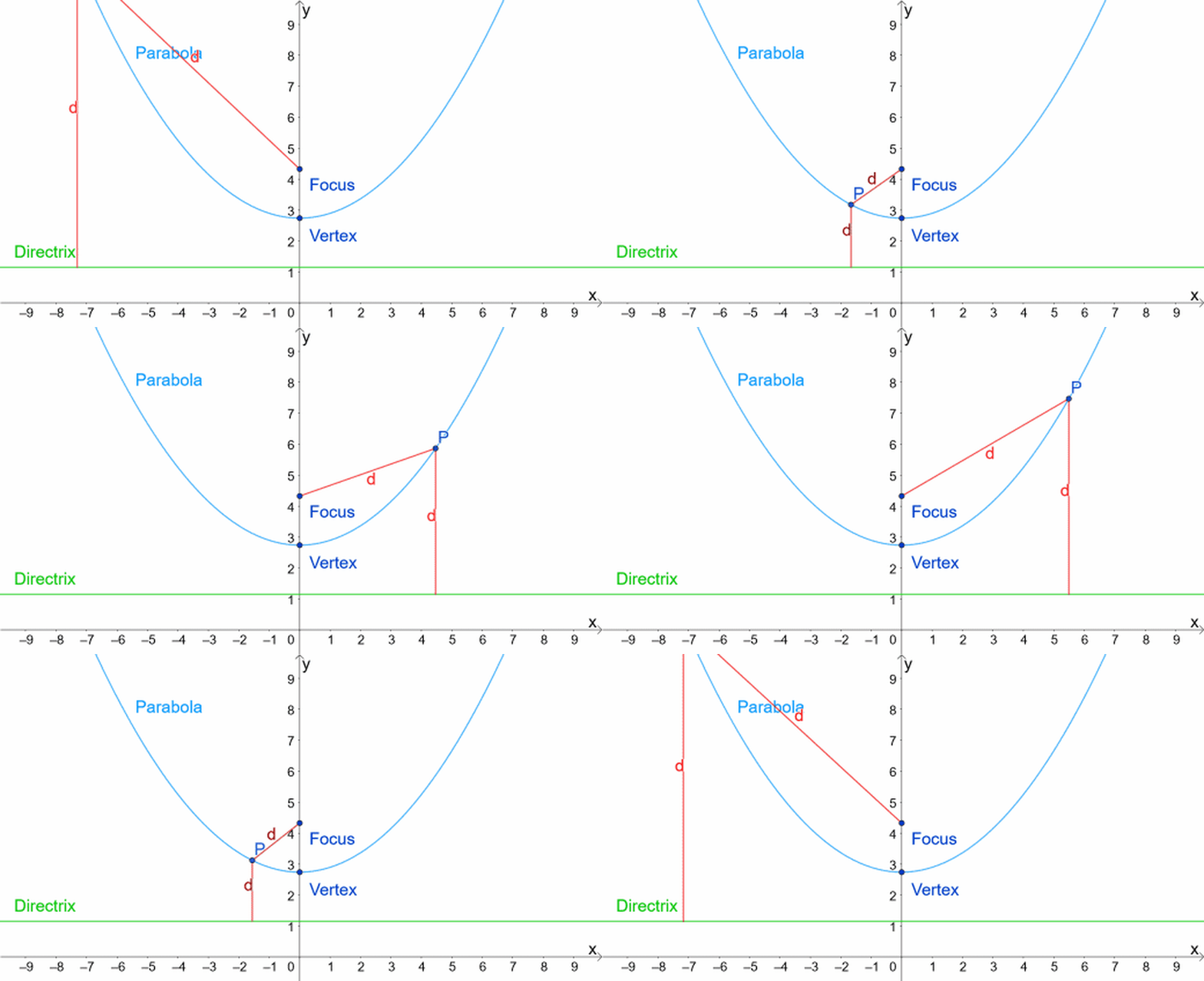
[Properties of the euclidean parabola]
Hello people, I pick hilbert's book "Geometry and the imagination" as a summer read. Yet I came upon this sentence (marked in yellow) which I am unable to make sense of. Could some explain it? maybe with a drawing?.
What I am thinking is that, if we let F be the fixed point and A, B be two points on the parabola and L be a straight line, then FA + AA' = FB + FB' = const (where A', B' are the respective distances from the point into the line), but since this doesn't hold I must be misunderstanding the sentence.
 grizzled kindle
heavy snow
https://images.saymedia-content.com/.image/t_share/MTc0NjQ1MDYzMzA0Njg0OTIy/how-...
grizzled kindle
heavy snow
https://images.saymedia-content.com/.image/t_share/MTc0NjQ1MDYzMzA0Njg0OTIy/how-...
@prisma star dude it's the above animation in words
prisma star
grizzled kindle
<@501394132833665035> dude it's the above animation in words
I don't think so, the one below of the yellow mark says that. I'm trying to understand the first one (marked in yellow), which I think is an stronger sentence.
grizzled kindle
Look at fig 5
It says BF1 + BL' = constant
That statement is this equation in words
prisma star
Indeed, but that's an special of the construction (deduced from the ellipse property/definition since F1 is a focii), what the statesment says, to my understanding is that this holds for any B, F1, L (where F1, L are fixed and B on the parabola), and i'm saying that this doesn't hold, take for instance F1 near the intersection of L with the parabola, and B near F1 on the parabola, now take B2 on the other intersection of L with the parabola, then clearly both sums are not equal.
so, could you point it out what am I misunderstanding?
grizzled kindle
Yes Actually
But not in same parabola
See focus and directrix uniquely define a parabola
So if you interpret the statement that you can choose any fixed point or line of your liking
Then you can't choose a parabola
But if you have already decided your parabola then fixed point and directrix is also decided
@prisma star
It says " Parabola is a curve with the property that the sum of the distances of any point on it from a fixed point and a fixed line is a constant "
It doesn't say anything about it being true for all points
prisma star
grizzled kindle
It doesn't say anything about it being true for all points
mmh isn't "any point" the same as "all points (on the parabola)"?
grizzled kindle
Look at that animation
Again
Parabola is the locus of P
And that "any points" is referring to P
Not F
Or the points on directrix
prisma star
grizzled kindle
And that "any points" is referring to P
that's what i am saying
grizzled kindle
The line in the figure 5 is not directrix
prisma star
grizzled kindle
Not F
i am not saying you that can move F to your linking, but that given the parabola, fixed a point F and a line, then you can move P whenever you want and the sum FP + PL is a const
which is what i understand from the sentence
right?
prisma star
okey
grizzled kindle
@prisma star you still there?
prisma star
yup
grizzled kindle
Okay
So I couldn't prove that for a general case probably do it in morning
But I proved it for that said line parallel to directrix
Let's refer the line as L
Distance between directrix and L is d
Then d = l + q
Where l is the distances of points on parabola and the line L
And q is the distance between points on parabola and directrix
Now by definition of parabola q = distance between focus and points on parabola
There you go
I'll prove it for the general case in morning it's 3 am here and my brain is not functioning
grizzled kindle
You got it right?
prisma star
yes, but i think using that definition of parabola is kind of assuming a weak version of what you are proving. I think a valid proof should (in this case) come from the definition given by hilbert (which is a degenerate case of an ellipse).
grizzled kindle
But the weak version can be proven true right?
prisma star
grizzled kindle
But the weak version can be proven true right?
mmh haven't tried, i gonna try that now
grizzled kindle
Actually several theorems are proven this way
Say Cosine rule
Is proved using Pythagoras theorem
Which is a weak version of it
prisma star
i mean, yes, but they are both proved by common axioms, i was saying that the definition given is tricky in this case because it "assumes to much"
grizzled kindle
Dude Greeks came up with parabolas
They had no concept of limits
They defined it as distance from focus = distance from directrix
Hilbert is trying to explain parabolas from his perspective
prisma star
grizzled kindle
Dude Greeks came up with parabolas
it doesn't really matters, what matters is the formalism. Like yeah, in physics everything is differentiable and so on, yet, in mathematics we don't take that for granted just because most natural fenoma were described that way.
prisma star
grizzled kindle
They defined it as distance from focus = distance from directrix
that sir, I think it need a source, could you provide it?
grizzled kindle
prisma star
that sir, I think it need a source, could you provide it?

This is from this article

In mathematics, a parabola is a plane curve which is mirror-symmetrical and is approximately U-shaped. It fits several superficially different mathematical descriptions, which can all be proved to define exactly the same curves.
One description of a parabola involves a point (the focus) and a line (the directrix). The focus does not lie on the d...
It's said Pappus proved focus and directrix
Property
@prisma star here is your source
 hollow crypt
??
 gleaming nova
hollow crypt
gleaming nova
hollow crypt
and convergence and continuity?
prisma star
grizzled kindle
<@501394132833665035> here is your source
I think is state it as a result, not as a definition.
grizzled kindle
prisma star
I think is state it as a result, not as a definition.

From the same article
Atleast read the article before arguing
prisma star
grizzled kindle
I think sir, you are not understanding, yes, it can be proven that the definition holds and describe a parabola. Yet it not the same as the natural definition as certainly (by your own source) the one given by greeks, which was the discussion all about
grizzled kindle
Define natural definition first
prisma star
grizzled kindle
Define natural definition first
the one that arises from simpler constructions
grizzled kindle
Yes
Then explain why is this not a natural definition
Infact explain why any definition is not a natural definition
prisma star
because does not arise from simplest constructions, that's what I say
grizzled kindle
prisma star
because does not arise from simplest constructions, that's what I say
What's simplest it's relative
prisma star
grizzled kindle
What's simplest it's relative
that's morally true, but not in practice
grizzled kindle
Good night dude
prisma star
have a good night
 mental crystal
How to get at trigonometry ?
Inverse especially
I know the regular one, I'm quite capable of calculating sin, cos etc from scratch with constructing shapes etc
But how would one do this inverse?
 tame seal
how do you know the side lengths of a triangle with just the angle when you have it represented in a unit circle?
for example, why does a right triangle with theta at pi/3 have sqrt 3 as the opposite
 grave pond
In triangle ABC, let O be the circumcenter. Use the central angle theorem to find angle (say) AOB, then divide the isosceles triangle AOB in two right triangles by an altitude from O and use basic trigonometry to find half of AB.
 vital moat
Can someone help me with these questions I don’t understand it

 pliant jasper
vital moat
Can someone help me with these questions I don’t understand it
pliant jasper
vital moat
Can someone help me with these questions I don’t understand it
These trig functions are periodic, so they have infinitely many asymptotic and min/max values. They want you to write this as a sequence
For example, for 1a, the asymptotes are where sin(x) = 0
I'm assuming n is an integer? I haven't seen that specific notation before
 fleet sentinel
cot x- tan x= 2 cot(2x)
for the left side i got as far as cosx/sinx-sinx/cosx
but how does it come cos^2x-sin^2x/sinxcosx
pliant jasper
fleet sentinel
but how does it come cos^2x-sin^2x/sinxcosx
$\cos^2(x) -\sin^2(x)$ and $\sin(x)\cos(x)$ are both double angle identities
gleaming nova
minus not plus
pliant jasper
whops
 somber coyoteBOT
qas

 humble pulsar
2sin(x)cos(x) is the double angle
dark sparrow
none of them are double angle identities
an identity is first and foremost an equality between two things
gleaming nova
humble pulsar
2sin(x)cos(x) is the double angle
half double angle identity 
silent plank
magic(2x) = sin(x)cos(x)
upper karma
Can somebody please tell the derivation of the equation of the rotation of axes. in conics??
grizzled kindle
@upper karma you know the derivative of cos ( x + r ) in terms of x ?
upper karma
grizzled kindle
<@456226577798135808> you know the derivative of cos ( x + r ) in terms of x ?
-sin(x+r)?
upper karma
grizzled kindle
Let X0 = kcos(t)
u mean xnot right?
grizzled kindle
Then after rotation X = kcos(t+r)
grizzled kindle
upper karma
u mean xnot right?
Yes
grizzled kindle
grizzled kindle
Then after rotation X = kcos(t+r)
Expand it , using angle sum property
upper karma
grizzled kindle
Expand it , using angle sum property
alright
upper karma
grizzled kindle
Expand it , using angle sum property
the x0 plane is your rectangular plane or the X one?
grizzled kindle
x0 is the x co-ordinate co ordinate before rotation
Similarly y0 is the y co ordinate before rotation
grizzled kindle
After expanding substitute for kcost as x0
And similarly ksint = y0
And that's how you get the formula
upper karma
I am talking about that eqn Ax^2+Bxy+Cy^2..........., are we doing this for that derivation??
grizzled kindle
Yes
This is the equation for rotation about origin
In general
Then translate to the point you want to rotate about then just simplify
Or the other way to go about it is to adjust the slope of directrix
upper karma
I am talking about this
 grizzled kindle
In general equation of conics
Dude the equation I made you do work for every function
Not just conics
upper karma
i know u r right
i've already done that tbh
thanks
but i am looking for this eqn's derivation, the second one specifically
upper karma
grizzled kindle
Or the other way to go about it is to adjust the slope of directrix
and can u elaborate more on this, I didn't really understand what u meant by adjusting here
grizzled kindle
You know the general equation of conics?
upper karma
isn't this the general one that i sent rn??
ok wait maybe i asked the wrong way at first, i should have only written eqn of conics, my bad
upper karma
grizzled kindle
You know the general equation of conics?
do u know its derivation?
grizzled kindle
upper karma
isn't this the general one that i sent rn??
Yes it is but the one I sent you is more helpful here

Here adjust 'a' and 'b' and it'll rotate
Or you can completely ditch it for polar coordinates

Idk what you need it for but if it were for me I prefer polar coordinates
upper karma
grizzled kindle
Yes it is but the one I sent you is more helpful here
Thanks a lot
grizzled kindle
upper karma
do u know its derivation?
@upper karma it's derivation can be done using focus - directrix property
upper karma
grizzled kindle
Idk what you need it for but if it were for me I prefer polar coordinates
i am just curious lol
upper karma
grizzled kindle
<@456226577798135808> it's derivation can be done using focus - directrix proper...
okk, I'll have to look at this property first, give me a sec
yeah i'm back @grizzled kindle
It's what u sent, thanks
fleet sentinel
pliant jasper
$\cos^2(x) -\sin^2(x)$ and $\sin(x)\cos(x)$ are both double angle identities
but how does it become that
pliant jasper
fleet sentinel
but how does it become that
Sin(2x) = 2sin(x)cos(x) and cos(2x) =cos^2(x)-sin^2(x)
And 2cot(2x) = 2cos(2x)/sin(2x)
Sorry I didn't use latex, I'm on mobile and have to go soon

 torpid jungle
just 30-60-90 triangles
 deep linden
 nova rose
https://cdn.discordapp.com/attachments/785319440648503359/925133407963463810/IMG...
nova rose
https://cdn.discordapp.com/attachments/785319440648503359/925133407963463810/IMG...
isn't -300 = 60?
not sure but
sin(-300)=-sin(300)=-sin(360-60)=-sin(-60)=sin(60)
deep linden
deep linden
isn't -300 = 60?
nah this one better
 native fractal
deep linden
not sure but
sin(-300)=-sin(300)=-sin(360-60)=-sin(-60)=sin(60)
native fractal
deep linden
not sure but
sin(-300)=-sin(300)=-sin(360-60)=-sin(-60)=sin(60)
so, final answer comes down to sin(60)?
deep linden
yes
native fractal
thanks, also is asking help for assignments not allowed? (this was one)
deep linden
i think its #❓how-to-get-help (i am also new here)
native fractal
deep linden
i think its <#488120190538743810> (i am also new here)
no cheating that's it, chill
i just missed a few classes ;-;

anyone?
deep linden
pretty straight application of this formula
 native fractal
i forgot to reply, thanks!
 fervent dune
How to solve this question?
 grizzled kindle
@fervent dune is trigonometry allowed?
 clever aurora
does Delaunay triangulation work on non-convex hulls?
fervent dune
grizzled kindle
<@785402706449268756> is trigonometry allowed?
I think try to answer with 2 solution, geometricly or and trigonometricly
 ripe stream
@fervent dune two questions is angle C 90 degrees and what does the top angle of a i cant see it well looks like a 24 but im not sure
fervent dune
ripe stream
<@!785402706449268756> two questions is angle C 90 degrees and what does the to...
it's 2 alpha
ripe stream
ok
fervent dune
$\angle{CAE} = 2\angle{DAB} = \alpha$
somber coyoteBOT
Its_TheMathCraft
 ripe stream
is angle BCA 90?
fervent dune
not sure
ripe stream
i think i can do it but ill have to assume that its 90
using trig

wait nv,
nvm were supposed to find the area
the area should be 0.933
do you get it?
 silk iris
I need help solving for Segment BC, I have solved all the angles and segment AB. I don’t know what BC or AC is.
 ripe stream
can you use trig or only geometry
silk iris
?
 storm portal
silk iris
?
storm portal
silk iris
?
Are you allowed to use trigonometry?
silk iris
No
ripe stream
damn
silk iris
I’m in geometry
storm portal
Oh okay
ripe stream
then im lost
 coarse surge
hellooo i was wondering if anyone could check to see if these are correct T^T (geometry)
 storm portal
I think I can cover
@coarse surge Not now - another person has a question posted
@silk iris You can figure out AB from the Pythagorean Theorem
ripe stream
wait we can use pythagorean theorum
silk iris
Yeah it was 24
storm portal
storm portal
<@!749626356731740272> Not now - another person has a question posted
Once Airo is done then you're good
ripe stream
they do that in geo right
storm portal
silk iris
Yeah it was 24
Exactly
silk iris
But idk Bc
storm portal
ripe stream
they do that in geo right
Yup - pythagorean theorem is learned before geometry
ripe stream
ohh
storm portal
silk iris
But idk Bc
Once you have the 7-24-25 right ∆, you have to use properties of similar triangles
(reposting the image so I don't have to scroll)
 silk iris
I forgot the other properties
ripe stream
so angle BAT is 56 and BAC is 34
silk iris
Ahhhh yes
ripe stream
which means angle BCA is 56
storm portal
In other words:
AB/CB = BT/BA = TA/AC
silk iris
I forgot about the dilation stuff
storm portal
Think you can take it from here?
silk iris
Yes
storm portal
👍
silk iris
Thanks
storm portal
np
storm portal
coarse surge
hellooo i was wondering if anyone could check to see if these are correct T^T (g...
This looks good to me
storm portal
I am 90% sure that given the statement If p then q:
- If q then p is the converse
- If ~p then ~q is the inverse
fervent dune
ripe stream
do you get it?
no
 main isle
I’m stuck on 14

 void atlas
main isle
I’m stuck on 14
void atlas
main isle
I’m stuck on 14
take two cases of volume V1 and V2, for V1 use radius r and for V2 use radius r/2, then take ratios
 dire vector
If I have an equilateral triangle
And I have a random point in that triangle
How would I calculate the closet distance to an edge?
grizzled kindle

@dire vector write all edges in form of a line
Then use this formula
x0 and y0 are the co ordinate of the point
Then compare them
grizzled kindle
Yes

 crude niche
you know 2 angles, and then (i forgot the theorem) u know the third angle, which means that by AAA they r congruent
i forgot how to do proofs tho lol so idk how exactly u write it down
void atlas
 formal cove
common angle X, W=X and YZW=YZX =90, three same angles so it is congruent by AAA
silent plank
AAA is not a valid justification for congruence
 knotty stump
wdym? We all know that we live in a world with negative curvature 😌 @silent plank
rectangles don't exist
 weary drift
@knotty stump pls dont shitpost
 hoary mango
nvm I’m kinda used to trigonometry
I just need help on radians and how to find ratios on a right triangle and it’ll be fine
 dark sparrow
...i see some measurements marked in pencil
what was given and what did you find yourself?
is 13 meant to be the length of AB?
 placid solar
dark sparrow
is 13 meant to be the length of AB?
placid solar
dark sparrow
is 13 meant to be the length of AB?
Yes
dark sparrow
so you are given AB = 13, AD = 6, CD = 4 and angle A = 70° and you are asked to find angle B. do i understand this correctly?
placid solar
dark sparrow
what was given and what did you find yourself?
was given AD ,DC, AB , angle DAB
placid solar
dark sparrow
where did `CF = 2.052` come from?
I found DE with sin and DE and CF are same length
dark sparrow
please do not reply-ping me so often.
placid solar
Oh ok sorry
dark sparrow
did you use a calculator to find DE?
placid solar
Yes
dark sparrow
and you got 2.052 from calculating 6 * sin(70°)?
placid solar
yes
dark sparrow
...that's strange.
placid solar
Oh wait
dark sparrow
do you have the calculator with you?
placid solar
Nnno
dark sparrow
no to what?
"no, i didn't calculate 6 * sin(70°) at all" or "no, i calculated 6 * sin(70°) but didn't get 2.052"?
dark sparrow
okay
so you calculated CF
do you understand that if you also calculate FB you will have enough info to find angle B?
dark sparrow
"i calculated" is the most vague response possible
ok, look. do you know your way around trigonometric ratios?
placid solar
yes
 dark sparrow
no, CF/FB is not cos(B)
placid solar
Tan
 still laurel
what would a solution for a question like this look like?

i understand the part where you can solve for x in the equation, but then how do you use the value to determine the number of solutions in an interval
grizzled kindle
@still laurel let's say Sint = k then how many solution are there in [0,2π]
There are 2
Now you know about streching and squeezing a function wrt to axis
Is done by multiplying the respective co ordinate by a scaling factor
So therefore it'll strech the graph by a factor of 4
Therefore 2× 1/4 is your answer
still laurel
im getting one as my answer @grizzled kindle could you explain in like math symbols, the writing is not transferring to my brain, my apologies
why would you multiply 1/4 by 2
 pine iron
still laurel
im getting one as my answer <@!693015115003461683> could you explain in like mat...
pine iron
still laurel
im getting one as my answer <@!693015115003461683> could you explain in like mat...
The answer is one
pine iron
still laurel
what would a solution for a question like this look like?
I like to think this way: for a given number k between 0 and 1, sin(x) = k will have two solutions in a complete trip around the unit circle.
(Such as sin(x) = 0.8, x could be 53.13° or 126.87°)
pine iron
pine iron
I like to think this way: for a given number k between 0 and 1, sin(x) = k will ...
Given the equation sin(1x/4) = 0.8, x in the range of [0, 2pi] the maximum "trip" you could get in the unit circle would be x = 2pi. sin(1(2pi)/4) = (sin(pi/2)). Between 0 and pi/2 there is only one solution to get sin(x) = 0.8, which is 53.13°
 foggy cosmos
can anyone help me with this pls

 novel hemlock

 carmine spear
tan(alpha) = 5/6
alpha = arctan(5/6)
alpha = 13.115
novel hemlock
my teacher tried to explain it
cant remember what he said
he said something about hypotenuse and sine
silent plank
do you know what trig functions do in a right triangle?
novel hemlock
no todays the first day of trig 💀
silent plank
and/or have you been introduced to the
mnemonic soh-cah-toa
 west ferry
It seems that I lack the knowledge of that

 dapper marlin

 past bobcat
silent plank
and/or have you been introduced to the
mnemonic soh-cah-toa
past bobcat
silent plank
and/or have you been introduced to the
mnemonic soh-cah-toa
the godly soh-cah-toa
life saver
so I get that this might sound like a stupid question but is there an equation that works for reflecting a point across any line that isn't y = 0 and the slope is greater than or less than 0?
hoary mango
trig triangles for dummies:
hypotenuse is longest (most common hyp is diagonal)
adjacent line is PARALLEL to hypotenuse
opposite line is connected to BOTH the hyp and adj.
 tardy panther
silent plank
tardy panther
silent plank
that attempt at oversimplification of triangles is unhelpful and some of it is even wrong
 wise pawn
I feel the naming already makes sense on its own, no need to add an extra layer to it. Adjacent means the leg that's literally adjacent to the angle you're making with the hypotenuse. Opposite means it's the leg opposite the angle.
silent plank
associating the hyp with orientation is also something you shouldn't be doing
and what kind of triangle doesn't have all their sides connected
hoary mango
now i feel stupid
 silk patio
I think using the words hypotenuse adjacent and opposite is a waste of time too. I directly associate the opposite with sin(x) in my mind for a unit triangle. I don’t have to think of which trig function it corresponds to, I cut out the middleman
dark sparrow
@hoary mango you know no two sides in a triangle are ever parallel right
 teal goblet

what does the || and inverted T symbol represent? something about congruency, being similar, etc?
 manic salmon
$\sum_{k=1}^{13} \frac{1}{sin[\frac{\pi}{4}+(k-1)\frac{\pi}{6}]sin[\frac{\pi}{4}+\frac{k \pi}{6}]}$ I need help with this
somber coyoteBOT
InertialObservr
 manic salmon
The problem wants me to simplify it
silent plank
teal goblet
what does the || and inverted T symbol represent? something about congruency, be...
is parallel to and is perpendicular to respectively
 astral hull
Anyone has an idea how to prove point ABCD are concyclic?

 dire marten
astral hull
Anyone has an idea how to prove point ABCD are concyclic?
dire marten
astral hull
Anyone has an idea how to prove point ABCD are concyclic?
M is the midpoint of AB and N is the midpoint of CD, then you need to draw two perpendicular lines from M and N.
dire marten
astral hull
Anyone has an idea how to prove point ABCD are concyclic?
Sorry for my English
astral hull
dire marten
M is the midpoint of AB and N is the midpoint of CD, then you need to draw two p...
thanks let me try work on this way
astral hull
dire marten
Sorry for my English
it is clear enough
 fickle grove
If I got 2 points A and B, where B determines the direction of the vector AB. How can I scale that vector to a certain bound? I.e. I want to scale the vector AB until either or both coordinates hit the "end" of the coordinate system
void atlas
there is no "end" of the coordinate system
fickle grove
that is why i put it inside " "
there is for a specific problem I am trying to solve
void atlas
fickle grove
If I got 2 points A and B, where B determines the direction of the vector AB. Ho...
do you mean by scaling that the direction remains same but you have to 'extend' its length to a certain extent
then just multiply the magnitude
fickle grove
the direction has to stay the same
void atlas
just multiply the magnitude to 'scale'
fickle grove
got it, ty
 glacial crane
How to understand trigonometry?
Nobody knows either I guess. Well, that's predictable
grizzled kindle
glacial crane
How to understand trigonometry?
What's it you need help with?
astral hull
astral hull
Anyone has an idea how to prove point ABCD are concyclic?
still unable to figure out
 smoky palm
Very dumb question
okay so
Do people capitalize the t when writing tan(x)
I mean, For Sin and Cos i do
but not for tan
gleaming nova
no
silent plank
people don't really capitalise for any of them
grave pond
Standard notation uses lowercase letters for all of the trigonometric functions.
smoky palm
really
Huh
fight me, I shall continue to capitalize Sin and Cos
and Cot
not sec though
But I will for Csc
grave pond
using non-standard notation is your prerogative; you get to pick up the pieces if it confuses your readers. ¯_(ツ)_/¯
wise pawn
why use different capitalization for some rather than others
grizzled kindle
@astral hull is there any other information ? Like C = 90° ? Or anything else?
 indigo cove
How do I show there is no isometric from R^3 to R^2
dark sparrow
you mean no isometry?
there exists a quadruplet of points in R^3 which are all at distance 1 from each other, but there is no such quadruplet in R^2.
glacial crane
grizzled kindle
What's it you need help with?
idk, i just cant get it, like, at all
astral hull
grizzled kindle
<@769741203586416650> is there any other information ? Like C = 90° ? Or anythin...
yup it is 90 degree
astral hull
grizzled kindle
<@769741203586416650> is there any other information ? Like C = 90° ? Or anythin...
and cd is along the line passing the centre of the larger circle
 gleaming nova
first one looks like some sort of sum identity
third one is just sin(2x) multiplied by something
 limber inlet
hello. can someone please help me turn 2sin^2(x) - 1 = 0 to sin(x) = 1/2?
silent plank
that's not possible
 jade ember
is there a transformation matrix for clockwise 90 degree rotation?
grave pond
Yes.
Transform (1,0) according to your specification; that becomes the first column of your matrix.
Then transform (0,1) according to your specification; that becomes the second column of your matrix.
jade ember
ah found it thanks
 grave pond
 violet horizon
 quick sapphire
hi, could i pls get help w this?
quick sapphire
hi, could i pls get help w this?
Have you gotten help
 hushed arch
@quick sapphire I would first convert 30 60 90 to 1 2 root 3 and 45 45 90 to 1 1 root2 then do guess and check to verify which triangle each value corrosponds to
knotty stump
@fleet sentinel the first one is just $sin(x-\frac{\pi}{6})$
somber coyoteBOT
Arm

 scenic garnet
yo i know soh cah toa
knotty stump
So... $x-\frac{\pi}{6} = sin^{-1}(\frac{1}{2})+2\pi k$
somber coyoteBOT
Arm
 grave pond
That's, um, not quite right.
Start by 4/x=x/9
That gives x.
Then just Pythagoras for the two last sides.
An altitude towards the hypotenuse in a right triangle cuts it into two smaller triangles that are both similar to the original one.
(Because two right triangles that share one of the acute angles are always similar).
4/5 is not equal to 5/9.
Right.
y and z become medium-ugly square roots, though.
Why?
There's no such thing as tan 90°.
If x/z=1 and z/13=1 then x=z and z=13 so x=13. Where did you get those relations from???
Can you give more details of your reasoning? Say,, why would z/13 be 1?
How do you know what that angle is?
Ahem. You cannot fight in here, this is a math room.



 gilded thunder
my dude thinks that there are no delete logs
clear haven
i think that clears it up
 grim musk
hello guys

for this pic we have an angle theta
and so (x,y) which is at some point P would be rcos theta and rsin theta respectively
now i had this one doubt
if theta here is some angle( it can be anything but lets take it as say 30 degrees)
and radius is 1
we get (x,y) as cos theta, sin theta
now lets say the initial side which is x also lies on the circle like the point P
then we will get the (x,y) of the side x to be r,0