#geometry-and-trigonometry
1 messages · Page 361 of 1
 upper karma
upper karma
upper karma
you mean integrating those functions?
upper karma
well first let's start with your question on complex numbers unless you wanna dive into calculus first
 dense marsh
i dont wanna just keep saving things like sublime text do ....
not really
i'll start it with complexe numbers .........
so
upper karma
well do you know the form for how complex numbers are written?
dense marsh
writing any complex number under the trigonometrical form ..........
yeah
i've studied that 2 weeks ago
dense marsh
right at the night of my big brother's birthday ...........
yeah
i know why did they made it
and well
i can calculate and multiply
things like that
usual ...........
and when i figured out abot the exponontial form i
i knew that m gonna need first to see how it works for the trigonometrical form first
that's why i got a bit stuck ........
and youtube didnt help thta much
upper karma
well here's the general "formula" for how the trig form should look like (using polar coordinates, smth I don't have that much intuition in unfortunately)
$z = r(cos\theta + isin\theta)$
 somber coyoteBOT
Venti
 upper karma
where r is the modulus of z
upper karma
upper karma
so you know z = a + bi
you get r from this form
the modulus is represented as
$|z| = \sqrt{a^2 + b^2}$
somber coyoteBOT
Venti
 upper karma
so that's your r
and theta
is a bit more complicated
$\theta = \arctan(\frac{b}{a})$
somber coyoteBOT
Venti
 upper karma
or you could just write it as tan(theta) = b/a to make it look simplier
dense marsh
i gotta find [r]
upper karma
yup
dense marsh
upper karma
or you could just write it as tan(theta) = b/a to make it look simplier
does the formula of the arctan always works !?!?.............
upper karma
it should, arctan is just inverse tan
upper karma
upper karma
or you could just write it as tan(theta) = b/a to make it look simplier
in the arctan one i just made theta the subject
when you move a function to the other side of the equation you have to make it, its inverse
upper karma
I wish I knew, but I don't really have the intuition for that
something I'll also be looking into so thank you
dense marsh
what interpretation that would help me to get why did we wrote that theta equal to arctan(a/b)
how old are you mate btw
dense marsh
i hate when it comes to work with someone i have no idea about ........
16 years and you know about that
 dense marsh
16 years old kid here still face problems with polynomial divisions ...........
tbh
m 12
or 13
yeah who care time is relative anyway
upper karma
I wish I started when I was your age but all well that ends well I guess
dense marsh
upper karma
in the arctan one i just made theta the subject
right i
upper karma
so good job
dense marsh
i can see that .........
dense marsh
upper karma
I wish I started when I was your age but all well that ends well I guess
mom is hell of a mom
tbh
upper karma
uhh well I gtg eat dinner, try and solve this I guess -4 + 4i
dense marsh
well
solve like that
that's a complex num so
what should i
oh yeah
i get it
so it'll be i guess
upper karma
and you can ask your calculus question in #calculus and ping a helper if no one responds cuz I may not be around
dense marsh
basing on what you said ........
upper karma

upper karma
dense marsh
where is the relation i mean
what are you asking here?
the derivation of the formula that was shown?
upper karma
upper karma
it should, arctan is just inverse tan
also this isn't true, tan itself doesn't have an inverse, if we restrict the domain to just (-π/2, π/2) then it does have it's inverse, arctan. this also explains why if you "arctan" both sides or vaguely "do the inverse" with tan and arctan, you will restrict the domain to (-π/2, π/2), so you won't receive any solution outside this range.
upper karma
upper karma
also this isn't true, tan itself doesn't have an inverse, if we restrict the dom...
ah I see, thank you
 placid gate
help?
 upper karma
What have you tried
placid gate
upper karma
What have you tried
i don't even understand it
 oblique grove
placid gate
i don't even understand it
oblique grove
placid gate
i don't even understand it
do u still need help
well if u see this u basically need to find the unknown angle in the top triangle first
then that angle's opposite angle is also the unknown of the bottom triangle
then use the fact that all the angles in the angles have to add up to 180 and write an expression for all the angles in the bottom triangle
which needs to be equal to 180
then find x from that
oblique grove
ye
 near lichen
how can I find the volume with just the width and height

 dark sparrow
this doesn't seem like enough information.
is there anything here you're cropping out?
 onyx cloud
if those ends are circular there's enough information, otherwise ann is right
in the case that they are circular:
you need to find the area of the shape from the top view, and find the volume by doing area*height
as for finding the area from the top, you need to somehow find the radii of those half circles at the end
 olive cove
Also there is no side view so who knows what the back looks like. There might be a hole or a slope. No way to know.
Maybe its a trick question
 soft arrow
Hey
I'm trying to convert 3ds max camera fov to lens.. but I'm failing... can any1 help ? >
def camLens():
    #a = 0.5 * (rt.GetRendApertureWidth() / math.tan(rt.selection[0].fov / 2.0))
    # Lens = 0.5 * (GetRendApertureWidth() / tan(FOV / 2.0))
    # and backwards
    # FOV = 2.0 * atan(GetRendApertureWidth() / Lens * 0.5)
    print("\n\n\n")
    print("Aperture : ",rt.GetRendApertureWidth())
    print(" Cur Fov : ",rt.selection[0].curFov) # the fov can be specified as horizontal/vertical/diagonal
    print("     Fov : ",rt.selection[0].fov) # horizontal fov val
    print("    Lens : ",0.5 * (rt.GetRendApertureWidth() / math.tan(rt.selection[0].fov/ 2.0)))
    print("     Fov : ", 2.0*math.atan(rt.GetRendApertureWidth()/50*0.5))
camLens()
Aperture :  35.970001220703125
 Cur Fov :  94.07093048095703
     Fov :  39.56732177734375
    Lens :  13.298355324706613
     Fov :  0.6905799705312679
 jaunty pilot
 soft arrow
😄
 upper blaze
Guys, does anyone remember is Center of triangle ABC only point that satisfy TA+TB+TC=0 where those are vectors?
 slender wasp
there are so many different 'centres' of triangles that the question isn't specific enough
upper blaze
Haha i found it and i though in english when you say center you mean intersection of medians xd
 acoustic jungle
How do you prove the larger the length of a chord on a circle, the larger the segment without using x-sin(x) (radians) is always increasing
 pure cape
dont you just need the chord length and arc length formula?
as the chord increases, i.e 2rsin(x/2) increases, x is increasing since r is staying constant
hence the segment, or rx will increase
hmm nvm, maybe proving that the arc length increase might not be enough
 dark sparrow
that doesn't sound right at all
not only is it a decimal (which you weren't asked for), it's even bigger than 2.
how can the sidelength of this octagon be longer than that of the square enclosing it?!
@upper karma
upper karma
dark sparrow
not only is it a _decimal_ (which you weren't asked for), it's even bigger than ...
but the area is 5
*4
sorry
oh wait :skil
💀
i meant the area of the hexagon would be 2.87 right
dark sparrow
what hexagon?
dark sparrow
the area of the octagon is definitely not 287/100.
how did you get that value? do you have any work to show?
upper karma
dark sparrow
how did you get that value? do you have any work to show?
ahaha my work looks super funny
I um divided it into two squares and 6 trianles
prob not the best method
 ahahha- I have no idea how to do dis besides using the 45,45,90 method
but than I hit a stagnant and I have no idea what to do afterwards
dark sparrow
 upper karma
ahdkeed wait
 dark sparrow
this does not really get you any closer to finding the sidelength of the octagon.
oh wait, nevermind.
upper karma
sorry im really new to advanced geo
upper karma
ahhaa
dark sparrow
do you understand what i did? (yes/no/i need time to digest it/i want to try something on my own)
upper karma
errr I would prefer an explanation
actually wait
ahah I have no idea why u did that
dark sparrow
did what?
upper karma
why s/sqrt 2 works
dark sparrow
and did you mean why or how? sounds like you meant how.
dark sparrow
be careful to say exactly what you mean and mean exactly what you say in the future. not just with me but every time you speak to someone else.
makes things easier on both you and the other party.
anyway...
you see those little white triangles in the corners?
upper karma
dark sparrow
be careful to say exactly what you mean and mean exactly what you say in the fut...
sorry sorry
upper karma
dark sparrow
you see those little white triangles in the corners?
yes
dark sparrow
you see how they are 45-45-90 triangles with hypotenuses equal to s?
upper karma
yes yes
dark sparrow
and you know that in a 45-45-90 triangle, the hypotenuse is sqrt(2) times either leg, yes?
upper karma
yes
dark sparrow
do you understand why i marked the legs of those little triangles as s/sqrt(2) now?
upper karma
wait how can we determine that this is a definite hypotenuse
dark sparrow
what else could it be? the vertex opposite to it is the corner of a literal square.
upper karma
dark sparrow
what else could it be? the vertex opposite to it is the corner of a literal _squ...
sorry im a bit foggy rn
I assumed that the side opposite of s/sqrt 2 is the hypotenuse
dark sparrow
sides are not opposite to sides in a triangle...
dark sparrow
dark sparrow
you see how they are 45-45-90 triangles with hypotenuses equal to _s_?
i literally said this
upper karma
sorry
dark sparrow
do you understand where the s/sqrt(2) marks come from now, Y/N
upper karma
yes
upper karma
err no
dark sparrow
you see the side of the square is broken up into pieces of length s/sqrt(2), s and s/sqrt(2), yes?
upper karma
yes
dark sparrow
can you write that as an equation?
dark sparrow
you have just sent mixed signals
you said "yes" and then immediately followed up with "no"
please do not do that
dark sparrow
unless you are deliberately trying to confuse me, in which case you should admit it explicitly
dark sparrow
if you mean you can't write the equation then say you can't write the equation, there's no shame in that
dark sparrow
if a line segment is broken into several non-overlapping pieces, and you know the length of each piece, how do you find the length of the whole thing?
(i'm looking for a description in words here)
upper karma
do u add all the pieces
dark sparrow
i don't know, do you?
dark sparrow
so if i gave you a segment made of a 9ft piece and a 3ft piece you would be uncertain whether or not the whole thing has length 12ft, did i get that right?
dark sparrow
great, so why feign uncertainty like you just did?
dark sparrow
and now let's take that 'add all the parts to get the whole' idea and apply it to your problem
 dark sparrow
that's the sidelength of the square in terms of s, yes.
now make that into an equation.
use the fact that you know how long the side of the square is.
dark sparrow
why did you square it
what stopped you from writing $\frac{s}{\sqrt{2}} + \frac{s}{\sqrt{2}} + s = 2$?
upper karma
becuz wouldnt u square one side to get the area of a squre
somber coyoteBOT
Ann
 dark sparrow
WHO SAID ANYTHIGN ABOUT AREA LMAO
upper karma
that is the faster way yeah
upper karma
dark sparrow
WHO SAID ANYTHIGN ABOUT AREA LMAO
im kinda dumb pls bear with me xd
dark sparrow
nor did the problem ask for the area of anything, not even indirectly
dark sparrow
i don't like how you keep apologizing. it strikes me as the wrong thing to do if i were you.
though i can't say i can suggest a good alternative.
anyway, now we have the equation.
are you able to solve it for s?
dark sparrow
that was fast.
dark sparrow
did you do the work for it as we were talking?
dark sparrow
but yes, s = 2(sqrt(2) - 1).
dark sparrow
who said anything about decimal approximations?!?!
dark sparrow
no
"simplest form" does not mean "approximate to two decimal places"
you are asked for an exact answer
upper karma
dark sparrow
"simplest form" does not mean "approximate to two decimal places"
"cru
oh sorry
@dark sparrow wait sorry for the ping but is it alright to assume that all values of s are the same length
dark sparrow
what?
what do you mean "all values of s"
s doesn't have multiple different values
upper karma
sorry im a bit lost because like idk if we can assume all values of an octagon are equal
dark sparrow
if several different sides are marked with the same letter it means they all have the same length
upper karma
but thats the thing
dark sparrow
idk if we can assume all values of an octagon are equal
upper karma
the question didn't mark them all
dark sparrow
you meant sidelengths
dark sparrow
it helps to read the problem
dark sparrow
no, i'm not from the US
dark sparrow
russia
upper karma
o.O u live in russia?
dark sparrow
please don't present obviously incorrect answers as fact
they are being asked for sin(θ), while the calculation you made gives tan(θ).
(plus, 10/9 is bigger than 1, so how can it be sin(anything)?)
 keen nova
hey I've got this question that I've had for over a year now and still cant prove it, i just came up with this question on my own
"given an arbitrary quadrilateral consisting of 4 distinct points, it can always be translated/rotated around in the co-ordinate plane such that all 4 of its points lie in different quadrants"
intuition is telling me it should be true but i cant seem to prove it.
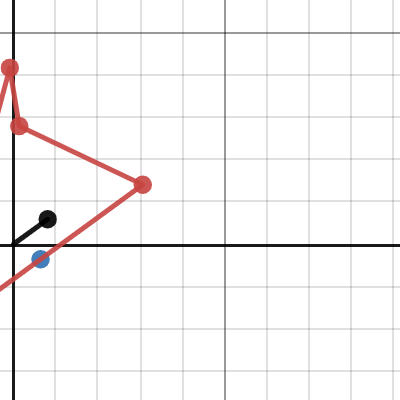
I made a desmos thing to help test it
and thus far it works
dark sparrow
this is equivalent to saying there exists a pair of perpendicular lines which crosses each of its sides once, is it not?
keen nova
no not really? do you mean each pair of opposite sides?
dark sparrow
i mean if you treat the pair of perpendicular lines as a single shape
a plus-shape for lack of a better word
what i mean is there exists a plus-shape whose four arms each intersect a side of your quadrilateral
keen nova
well in the desmos graph there is an example that doesn't cross all the sides lol
dark sparrow
??
keen nova
 dark sparrow
well this one is not aligned as we need
keen nova
yeah it would ok yeah
dark sparrow
this feels like the polygon's convexity may play a role but im not 100% sure
upper karma
What about rotating the plane
We could just inter change the positions of the points and prove the congruency of the new quadrilateral with the older.
 upper karma
We could just inter change the positions of the points and prove the congruency ...
upper karma
upper karma
We could just inter change the positions of the points and prove the congruency ...
@keen nova probably this
keen nova
upper karma
We could just inter change the positions of the points and prove the congruency ...
not entirely sure what that means
upper karma
And as Ann said we could use the plus as the diaconals
keen nova
upper karma
And as Ann said we could use the plus as the diaconals
also don't know what you mean by that
onyx cloud
dark sparrow
this is equivalent to saying there exists a pair of perpendicular lines which cr...
this should be true only for convex quadrilaterals. I'm pretty sure there are concave ones that won't satisfy this for their solutions
dark sparrow
can you present an example of one
onyx cloud
something like this should do it https://www.desmos.com/calculator/qofdhum9io

Desmos
unless i'm missing something obvious
onyx cloud
your idea should work for convex and some types of concave quadrilaterals, though, so it could still be worth exploring with an amended question
 plush cliff
how do i do the 8th one
 onyx cloud
have you heard of the law of sines, and the law of cosines?

 white jasper
onyx cloud
are you given anything else?
white jasper
onyx cloud
are you given anything else?
Nope, Im 20 years old a physics/engineering student. I tutor a kid who asked me this question from middleschool.
white jasper
onyx cloud
they all make sense
Can you explain ?
onyx cloud
yes. you aren't given any other side lengths, so these triangles could be of any size
white jasper
Understood.
onyx cloud
i'm baffled by this. there's gotta be more to it
white jasper
I guess so, why would a 16 years old kid get this -_-
onyx cloud
the better question is, why is a 16 year old in middle school
white jasper
onyx cloud
the better question is, why is a 16 year old in middle school
Idk how the system works in america bro. I might be telling it wrong. I live in Belgium.
white jasper
He is not in highschool but the year before it. ( do you understand now 😀 )
He should be in highschool but he didnt pass one year.
onyx cloud
ah makes sense
 still mica
if i pass sin(36.87) into a calculator which gives .6 and Cos(36.87) which gives .8 i know the ratio of lengths of a right triangle. what is the calculator actually doing to get the value of .6 and .8 ?
 wintry tundra
still mica
if i pass sin(36.87) into a calculator which gives .6 and Cos(36.87) which gives...
wintry tundra
still mica
if i pass sin(36.87) into a calculator which gives .6 and Cos(36.87) which gives...
idk but heres something cool, square the results of both and add them
 fast gate
There's probably a few ways to do it, and I assume calculators would use one I don't know for better precision and/or speed and/or how much stuff it has to store. One I do know is using Taylor series, which is a way of representing a function (not just sin and cos) as an (in)finite sum. I doubt it is this exactly, because it doesn't work well for x far away from 0 (maybe it adds or subtracts to get closer to 0 because the functions repeat?)

Oh this also isn't in degrees, but calculators can easily convert away from that.
 subtle palm
white jasper
subtle palm
white jasper
i might be able to help
find alpha and just go with the-OHHHHHHHHHHH I SEE THE PROBLEM
damn
uhm
i could assume; key word assume
that alpha must -mmm nah that aint gonna do
 dawn temple
anyone here familiar with the zBuffer concept for 3D graphics?
 fading galleon

 golden holly
hi
fading galleon
<@&286206848099549185>
upper karma
so i get the part of trigonometry for the sin(x) cos(x) and tan(x) and how you can use them and the reverse functions to find missing angles and sides etc, stuff like that. i'm familiar with. the thing i dont get is what the calculator actually does when you put them into it. e.g if you put cos(30) in it gives 0.15.... but what is the calculator actually doing to get from 30 to 0.15...
 storm portal
upper karma
so i get the part of trigonometry for the sin(x) cos(x) and tan(x) and how you c...
storm portal
upper karma
so i get the part of trigonometry for the sin(x) cos(x) and tan(x) and how you c...
I think the calculator uses what is called a Taylor series or a Taylor polynomial.
A Taylor series/polynomial is essentially an infinitely long polynomial that represents sin(x) or cos(x) in a polynomial form
Addition, subtraction, multiplication, and division are much easier for a computer to handle, so I think that is what calculators use to computer things like cos(30) or cos(30˚)
 small trail
How would you calculate the sides of an rectangle if you know the following:
- The area of the rectangle.
- The aspect ratio (e.g. 16:9)
onyx cloud
what does the aspect ratio tell you?
 silk patio
Socrates?
small trail
onyx cloud
what does the aspect ratio tell you?
Already solved my problem

 olive cove
there are 12 months in a year
The compounding interest is 3%
So x¹² = 1.03
And then you solve that equation
And then substract 1 of course for the interest percentage
upper karma
,rccw
somber coyoteBOT
 upper karma
what you wrote is good so far
do you have issues solving the equation?
okay, do you have any ideas on what our next step can be? @upper karma
note that we have on the left side a x+2x and a 34+120 which can be simplified.
34+120*, but yes.
which gives us 154.
and now anything else that you think we can simplify?
do you not know what x+2x is equal to?
great, yes
so we have $3x+154=154$.
somber coyoteBOT
Al𝟛dium
 upper karma
do you have any ideas at all on what step to do now?
by what precisely?
okay we can do it, but you can also substract 154 from both sides
upper karma
somber coyote
**Al𝟛dium**
x is just 0 right?
if we divide by 3, we get $\frac{3x+154}{\color{green}{3}}=\frac{154}{\color{green}{3}}$
somber coyoteBOT
Al𝟛dium
 upper karma
yes, if you notice we can substract 154 like the following: $$3x+154{\color{green}{-154}}=154{\color{green}{-154}}$$
somber coyoteBOT
Al𝟛dium
 upper karma
simplified further, 3x=0
why not
@upper karma please stop spoiling stuff, i know your intentions are good but i want them to solve it
oh
sorry
i didnt realise sorry
x can perfectly be 0, yes
upper karma
somber coyote
**Al𝟛dium**
but most importantly, do you understand what i said here?
what about it you didn't understand?
did you learn to solve equations with the vague "move to the other side with the opposite operation"?
okay then what is causing your confusion?
upper karma
upper karma
if we divide by 3, we get $\frac{3x+154}{\color{green}{3}}=\frac{154}{\color{gre...
oo are those the commands of the bot
$/frac{2/3}
$\frac{2/3}
o>O

 pure cape
the non-existent part a, your question is a very interesting one
anyhow, whatever part a asks, you are supposed to be using one of the cross section of the pyramid that includes h as a side to find h
 fervent valley
Oh ok

 ancient tusk
idk how to approach this sum can anyone help me
 onyx cloud
have you heard of the double angle formulas
ancient tusk
no
onyx cloud
its a good place to start
dark sparrow
@ancient tusk sin(2x) = 2sin(x)cos(x)
does this sound familiar to you?
 feral musk
 silent plank
what specifically don't you get?
silent plank
what specifically don't you get?
which is the correct answer
ancient tusk
dark sparrow
<@767045318294241301> sin(2x) = 2sin(x)cos(x)
does this sound familiar to you?
yes
 light loom
feral musk
light loom
feral musk
The answer is A since arcsin of 2/3 is angle a which simplifies the expression to tan(a) which you get option A
feral musk
light loom
The answer is A since arcsin of 2/3 is angle a which simplifies the expression t...
thank you so muuuuuch, i hadn't understood arcsin of 2/3 before
upper karma
can someone help me prove excenter property
silk patio
Which one
upper karma

 quartz goblet
Central line of triangle is SD/2 - diameter. so circle have a radius so the square of circle is (SD/4)^2*pi and you need just the half of (SD/4)^2pi
 umbral snow
SAD
upper karma
quartz goblet
Central line of triangle is SD/2 - diameter. so circle have a radius so the squa...
wait wut
sorry im lost lol
oh wait
nvm
wait wut
no
wait wuts
 umbral fossil
By diameter of 170feet is it talking about the maximum height?
 umbral fossil
@dark sparrow Could u help me
Ik since one trip is three minutes
that should be the frequency
or one full cycle
dark sparrow
i mean okay sure but we weren't talking about the period yet
are you able to identify the heights of the peaks and troughs of your sinusoid?
umbral fossil
Sorry the what?
dark sparrow
the min and max values
umbral fossil
Well since it's 5 feet above the ground
and diameter of 170 feet
Max value 175 min value 5?
dark sparrow
correct
umbral fossil
Amplitude would be 85 then
dark sparrow
yes
umbral fossil
vertical displacement 90
Now for the period
would I display this is 2pi/b?
so 2pi/3?
dark sparrow
you're confusing the period and the coefficient on x
umbral fossil
So it takes 3 minutes for one cycle
dark sparrow
if you're measuring time in minutes then yes the period will be 3 and you'll have cos( (2π/3)x ) pre-vertical transformations
yes the period is 3 minutes
umbral fossil
Right
dark sparrow
you need to decide if you're measuring time in minutes or seconds here
umbral fossil
Which would be easier
dark sparrow
unless you're allergic to the number sixty, they're both equally easy
dark sparrow
i mean, sure, if they really want there to be a phase shift, you could give them a phase shift
since our function 'starts' at a trough rather than a peak as would an un-shifted cosine function
umbral fossil
It's asking for one but I don't see a possible phase shift

Is this correct so far?
dark sparrow
yes this is correct (so long as you put a y= in front of it) but it may not 100% fit the form
they might want you to write $y = 85\cos\paren{\frac{2\pi}{3} x + \pi} + 90$
somber coyoteBOT
Ann
 umbral fossil
the phase shift is pi?
dark sparrow
yes
umbral fossil
how come
dark sparrow
i know this makes it sound like -85 cos(2π/3 x) + 90 is illegal or something but it isn't. this is just an unfortunate side effect of strict grading criteria and bureaucrat teachers
well $\cos(t + \pi) = -\cos(t)$ doesn't it?
somber coyoteBOT
Ann
 umbral fossil
I'm pretty sure my teacher accepts it either way
 deep zodiac
Hi, I’m having some trouble finding an exact value for cos15 by using the diagram of this equilateral triangle inscribed in a square. Any help would be greatly appreciated


 silent plank
@deep zodiacyou messed up your length for AK
deep zodiac
In what way?
Yep I see it now
Thank you
Still doesn’t give me the value for cos15 though
silent plank
show your updated work
deep zodiac
 silent plank
expand and simplifiy
deep zodiac
 silent plank
yes
deep zodiac
And then factor
silent plank
don't really need to
deep zodiac
Thank you very much
silent plank
its fine as it is
deep zodiac
Alright
 hasty mesa
How do I find the centre(point equidistant from every vertex) of a N sided convex polygon?
dark sparrow
it's not guaranteed to exist, is it?
@hasty mesa
like, the way you're defining it, there's no telling whether your polygon even has a point equidistant from every vertex
unless N=3
hasty mesa
Shit that's why I didn't get anything when I searched for it
onyx cloud
is this possible for any N-sided polygon in N-1 dimensions?
hasty mesa
Okay, I need a point as demonstrated in pic such that if we extend lines from that point through every vertex and join the ends we get a up-scaled version of polygon. Will centroid do the job? (sorry for bad diagram)
 onyx cloud
so you want the side ratios to remain equal and the angles to stay the same too?
hasty mesa
Yes, the perpendicular distance from every side should also be the same
onyx cloud
what do you mean?
hasty mesa
Do you see x? that's the distance between every side in the initial polygon and the up-scaled polygon
onyx cloud
that won't always be the case
i don't think there's a point where that will remain constant across sides
let me rephrase that
i don't think there's a point where that distance will remain constant across all sides for every convex polygon
as a quick example, take a very stretched rectangle

nevermind I confused myself
let me give it some more thought
hasty mesa
I think it'll work
onyx cloud
hm i don't think it would

the distances to the sides are much larger than to the top and bottom
hasty mesa
And all the sides moved parallel to their respective perpendicular vector away from the centroid??
onyx cloud
yes, while maintaining the side ratios
obviously this image isn't perfectly centered or perfectly scaled
but it should give you an idea of scenarios where this isn't possible
hasty mesa
Let's not worry about the maintaining the side ratios
hasty mesa
hasty mesa
And all the sides moved parallel to their respective perpendicular vector away f...
This is important
Every side moves parallel to their respective perpendicular vector away from the centroid. And I just need the area of the final polygon
dark sparrow
so you want to push each side 'out' by x units?
hasty mesa
Yes
dark sparrow
i'm not sure the resulting polygon would be similar to what you started with
it may even have less sides if some of the original's sides are too short
hasty mesa
I forgot all the co-ordinate geometry that I studied in high school 
hasty mesa
dark sparrow
it may even have less sides if some of the original's sides are too short
wot?
onyx cloud
that's why i wanted to maintain the side ratios lol
dark sparrow
maybe im wrong about that
hasty mesa
The polygon is convex
onyx cloud
do you have a more contextualized example of the question>?
it could give more variables to work with and a more concrete question
hasty mesa
Like this?
 onyx cloud
i mean, what are you applying this question to? where is it coming from?
is it a random convex polygon?
onyx cloud
i'd rather keep it in here. does the question come from a private project or something?
hasty mesa
Yes something like that
 deft veldt
What's the best book/resource for learning euclidean geometry from the ground up?
 stray void
deft veldt
What's the best book/resource for learning euclidean geometry from the ground up...
stray void
deft veldt
What's the best book/resource for learning euclidean geometry from the ground up...
-W
Wonder Book Of Geometry might be also helpful...
deft veldt
stray void
-W
Wonder Book Of Geometry might be also helpful...
Thanks looks good. Will check it out

 graceful spear
 brazen pendant
can you also pin how they got derived , so im not clueless
 shadow shadow
brazen pendant
shadow shadow
brazen pendant
why does this need to be pinned?
 shadow shadow
it can pretty easiely be derived
and also
i see a problem
xD
for the periodicity one it should be
$for all n \mathbb{Z}^{+}$
somber coyoteBOT
Elonmosqito96
 shadow shadow
eww thats gross
upper karma
No, it works just fine for Z
shadow shadow
no?
oh
im an idiot
xD
i read Z though R
xD
also no idea why i thought Z+
onyx cloud
$\forall$
somber coyoteBOT
maximo
 onyx cloud
$\forall n\in\mathbb{Z}^+$
somber coyoteBOT
maximo
 shadow shadow
onyx cloud
$\forall n\in\mathbb{Z}^+$
shadow shadow
onyx cloud
$\forall n\in\mathbb{Z}^+$
tbh $\forall$ kinda just flexing math notation... and most people in geo/trig wont understand
somber coyoteBOT
Elonmosqito96
 shadow shadow
xD
 pastel moon
lol
brazen pendant
graceful spear
can you also pin how they got derived , so im not clueless
its derived from sinx^2= (1-cos2x)/2
i think thats the right formula

 velvet arrow
hmm did you figure that one out yet?
upper karma
let me read about this theorem, then i'll be back
velvet arrow
I think it can work but, seems to be very complicated if we wish to find the angle
It is better for lengths
It may be possible to try some type of law of cosines
velvet arrow
Well when i think about it
if we shift P around, that has no effect on angle AOB
Maybe it cannot be determined?
 humble umbra
||the angle at the center is twice the angle at the circumference or whatever it's called||
upper karma
yeah this is the theorem,
humble umbra
should be a direct application of that
upper karma
yeah
upper karma
upper karma
Can someone help with this one?
Archimedes - measurement of a circle - Prop. 3
The translation by Thomas Heath in english is easy to find.
velvet arrow
135?
upper karma
yes
humble umbra
looks like it
velvet arrow
This dude Archimedes had a lot of time on his hands
upper karma
I believe you might also find an answer in Euclides' elements
velvet arrow
Idk what else I would have done in 240BC
upper karma
There must be a section which lists how to construct different shapes.
with compass and straightedge
Look for how to construct polygons of the same angle and sides
in this case the angle belongs to an octagon
Again, Mr. Heath seems to have covered it for us
yeah thx
i will look it up
https://en.wikipedia.org/wiki/Euclid's_Elements#Contents
book 3.
Book 4 even deals with circumscribing regular polygons (inside a circle) specifically.

Another topic. I have the sines of 30, 45 and 60 memorized. What is a good proof to help me memorize other common values like sine of 20, 40, etc..?
upper karma
upper karma
https://en.wikipedia.org/wiki/Euclid%27s_Elements#Contents
book 3.
Book 4 even ...
ok i will check it thx man
upper karma
upper karma
Another topic. I have the sines of 30, 45 and 60 memorized. What is a good proof...
this is out of my league , sry man,
there is no pattern in sines or other trig functions, they're just values , i just use a calculator
you can use pythagorean theorem to work out 45º for example.
sine(22.5) seems to be 1/sqrt(5)
calculator disagrees 😦
 fierce tendon
 fierce tendon
no
upper karma
I applied the inverse sine,
Maybe it can be simplified to something like n1/n2 th1= th2
slender wasp
sin theta2 = n1/n2 sin theta1
upper blaze
If I have 2 fixed points and 1 arbitrary point in plane. Can I somehow look at formula for area of triangle that has no absolute values or roots?
dark sparrow
i doubt it
you're going to at least need the distance between the two fixed points, and that is impossible to calculate without access to square roots
@upper blaze
also i'm assuming you have those points given in terms of their coordinates, is that correct?
upper blaze
yes
Actualy I am doing something for my thesis and roots must disapear
so I used formula with absolute value but even that isnt that pleasent to have but probably better then roots
dark sparrow
upper blaze
Actualy I am doing something for my thesis and roots must disapear
why must the roots disappear?
do you have any more context for this?
wait hold on i just remembered something
if you really are given the coordinates
ah yes
the shoelace formula will work

Wikiwand
The shoelace formula or shoelace algorithm is a mathematical algorithm to determine the area of a simple polygon whose vertices are described by their Cartesian coordinates in the plane.[2] The user cross-multiplies corresponding coordinates to find the area encompassing the polygon, and subtracts it from the surrounding polygon to find the area...
three points in your case
my apologies for misleading you earlier
upper blaze
Oh I have to check this 😄 Well I am doing my master thesis and its from algebaric geometry and I deal with polinomials so if I have root of x... you know 😄
Oh this might solve my problems hehe thanks a lot I never heard of this though
Oh this still has absolute value but that I can manage and this actualy may solve things in generalization hmm
 short iris
how would i find an area of a circle thats circumference is 1/2 pi squared?
pure cape
Find the radius, then find the area

 vestal lily
short iris
how do i find the radius
vestal lily
short iris
how do i find the radius
@short iris radius = C/2pi
you have C = 1/2 pi squares
Therefore you got the radius now
Now you could find the area easily
vestal lily
 smoky flower
@smoky flower

 smoky flower
Ohhhh understood thx
short iris
vestal lily
<@654033305804472331> radius = C/2pi
you have C = 1/2 pi squares
Therefore y...
thasnks
brazen pendant
does anyone have any tricks to remembering the product to sum and sum to product formulas?
dark sparrow
rederive them from angle sum/difference formulas
brazen pendant
how?
dark sparrow
here's an example
$\cos(x+y) = \cos(x)\cos(y) - \sin(x)\sin(y) \ \cos(x-y) = \cos(x)\cos(y) + \sin(x)\sin(y)$
somber coyoteBOT
Ann
 dark sparrow
adding these two gives $\cos(x+y) + \cos(x-y) = 2\cos(x)\cos(y)$
somber coyoteBOT
Ann
 brazen pendant
oh cause the sins cancel
thx
how about the other way though
@dark sparrow
from product to sum
dark sparrow
this is product to sum
you meant sum to product
i... guess those are just product to sum but backwards
brazen pendant
oh yeah i meant that
dark sparrow
like if you take u = x+y and v = x-y then you have x = (u+v)/2 and y = (u-v)/2 and you can put them into the above and get the corresponding s2p identity
brazen pendant
what does s2p stand for?
oh wait its sum to product
@dark sparrow i was going through the formulas and im stuck on sin(x+y)+cos(x-y)
its not symplifing
dark sparrow
nyeh? how did you get that
dark sparrow
yeah but then why would you multiply these
what formula are you trying to derive here
brazen pendant
yes
dark sparrow
why that would just be (sin(x) + cos(x))(sin(y) + cos(y)), no?
brazen pendant
wait how did you do that
dark sparrow
sin(x)sin(y) + sin(x)cos(y) + cos(x)sin(y) + cos(x)cos(y)
brazen pendant
oh then you factored
i see
ok imma keep working through the rest of the variations
well with a bit of algebraic manipulation i got em all!
🥳
upper karma
Can anybody help me here. Obviously to calculate the area of a triangle we do base * height over 2. Somehow he calculated the height as the magnitude of B * sine theta and I'm a bit unsure how that equals the height of the triangle? If anything, I would have done (A/2)^2 + C^2 = B^2 and took the square root to find it.
 silent plank
consider treating the length of the base as |A→|
the altitude of the triangle is represented by the dashed line
which given |B→| and theta, can be determined using basic trig
upper karma
Ah, okay I figured it out. Sine theta = opp/magnitude of B. He's multiplying it by B to get just the opposite.
Doh! Thanks a lot.
simple stuff lol
Mhm, here's another one actually, how is this true exactly?
 storm portal
upper karma
Mhm, here's another one actually, how is this true exactly?
storm portal
upper karma
Mhm, here's another one actually, how is this true exactly?
cos(π/2 - θ) = sin(θ)
You can use the cosine subtraction formula
dark sparrow
@upper karma make a right triangle in which one of the acute angles is θ, then the other will be θ'
cos(θ') and sin(θ) are the exact same ratio of sides
upper karma
dark sparrow
<@456226577798135808> make a right triangle in which one of the acute angles is ...
Ah okay, I get that now. That's interesting.
Thanks a lot.
 dark sparrow
think you might be missing a 1/2 factor...
dark sparrow
sin(u)cos(v) = 1/2 (sin(u+v) + sin(u-v))
brazen pendant
ooo
what i did is times 2
thx
express this product as a sum

1/2[sin(5x)-sin(-3x)]
is this right @dark sparrow ?
brazen pendant
oh yeah
upper karma
brazen pendant
not like that i swear
 scenic oxide
I was thinking that since each angle in the regular 10-gon case is 144, you can play a game of give and take with the angle degrees. You can make one angle acute, say 89, by giving another angle (144-89=55), but that would make it obtuse so you have to give it to two angles (27.5 each). You end up only being able to do this 4 times.

 rich wolf
180*8=1440
90 * 10 = 900
A convex polygon may not have any angles greater than or equal to 180
1440 - 900 = 540/0 = ∞ (not possible)
1440 - 810 = 630/1 = 630
1440 - 720 = 720/2 = 360
1440 - 630 = 810/3 = 270
1440 - 540 = 900/4 = 225
1440 - 450 = 990/5 = 198
1440 - 360 = 1080/6 = 180
1440 - 270 = 1170/7 = 167 + 1/7
So at most 3 acute angles. In the process above I subtracted the maximum sum of the non-obtuse angles from the total interior angle sum and then divided that by the number of remaining angles, repeating the process by removing one non-obtuse angle at a time until the average measure of the obtuse angles was less than 180.
(1440 - 90n)/(10-n) < 180
In fact ANY convex ngon may only have 3 acute angles
Let me actually make this a bit more rigorous. The interior angle and exterior angle at any vertex of a convex n-gon form a linear pair that sums to 180 degrees. This means that 180 - interior angle = exterior angle at each vertex. So the sum of the exterior angles must equal 180n - 180(n-2) = 180(n-(n-2)) = 180(n-n+2) = 180(2) = 360.
Let us represent the average measure of the acute angles in the polygon by 90-ε, for 0<ε<90. Then each corresponding exterior angle to the acute angles is 180 - (90 - ε) = 90 + ε. For some number k of acute angles, k(90+ε) must be less than 360. For k = 4 we have the sum of the exterior angles as 360 + 4ε which is not possible as the exterior angle sum must be exactly equal to 360. For k = 3 we have the sum of the exterior angles as 270 + 3ε, which depending on the exact measure of the acute angles allows for the other non-acute angles of the polygon to be less than 180, avoiding the degenerate case. Therefore the maximum number of acute angles in a convex n-gon is 3.
rich wolf
You can extend this to show that in a convex polygon with three acute angles the average of the acute angles will be greater than or equal to 60, with equality occurring only in the case of a triangle.
scenic oxide
rich wolf
So at most 3 acute angles. In the process above I subtracted the maximum sum of ...
OK that makes sense, thank you
 umbral snow
Consider instead x² - x = 0
There's two solutions to it, x = 0, and x = 1
If you divide both sides by x, then you lose x = 0 as a solution
The better method is to factor:
x(x - 1) = 0
Same with yours:
cos(x)(cos(x) - 1) = 0
That is, the incorrect solution above is missing π, (3/2)π
@idle bobcat
 idle bobcat
oh wow
that makes a lot more sense
i need to make sure i dont make this mistake on a test cause i feel like i would make this mistake 9 times out of 10 lol
umbral snow
Basically, never solve by dividing. Polynomial problems are solved with factoring always @idle bobcat
idle bobcat
gotcha thanks
 ionic bluff
yes
unless you have something that can only be solved with division
take for instance
sinx = cosx
there is no way to solve this without saying that tanx = 1
idle bobcat
makes sense
also is it just me or is the answer key wrong here

shouldnt it be neither
-(-x)^3 should be -x
slender wasp
tbf there is a way to solve sin x = cos x more nicely in that way lol just say that if cos x = 0 then |sin x| = 1, so if x is a solution then cos x is non-zero
ionic bluff
you have to divide and take the arctangent
slender wasp
yh
idle bobcat
for the domain how come the constraint it greater than or equal to

why isnt it just greater than
slender wasp
It's because sqrt(y) is defined for all y >=0
idle bobcat
why is it not defined for y=0?
idle bobcat
oh sorry my brain was broken earlier lol disregard
 dark sparrow
looks like it might be an astroid, but it's impossible to tell for sure
it may just be 4 quarter-circle arcs arranged in a pointy shape
 peak mesa
But I was looking for a specific name, because I'm creating something with geometric shapes and each shape needs to have its own name and I don't know what to name :/
oh lmao
its a astroid yeah
not 100% but yeah
thank you
and this one btw xD??

can i called Star 4?
its because a star 4 normally is something like
 dark sparrow
peak mesa
and this one btw xD??
dark sparrow
peak mesa
and this one btw xD??
idk this one doesn't strike me as one that necessarily has its own name
peak mesa
dark sparrow
idk this one doesn't strike me as one that necessarily has its own name
its like ninja star but thats not the correct name i guess?
dark sparrow
i think obsessing over names is kinda pointless...
peak mesa
i need to have names for all the shapes im using
i can give the name "Ninja Star"
but i think its not the correct one
dark sparrow
why do you need names
dark sparrow
just give them names you recognize then
 proud merlin
any software similar to wolfram alpha? WA is really broken , so any similar recommendations
proud merlin
lot of wrong answers , and not good presentation , at least from my experience
like so many errors in integrating functions and solutions of differential equations
upper karma
Wolfram alpha is a Computer Algebra System, so you can use that term to do research into alternative ones
Sage math is the most prominent free alternative
But it has a learning curve
placid gate
help?
 storm portal
placid gate
help?
storm portal
placid gate
help?
For this problem, you’ll have to identify what you do/don’t know, and how you can use the given information to find unknown angles. These unknown angles may help you get other unknown angles, or they can help you directly find the angle you’re looking for.
placid gate
storm portal
For this problem, you’ll have to identify what you do/don’t know, and how you ca...
ik PEF and EPF and FQR and don't know QRT
storm portal
How can you use the angles you know to find angles you don’t know?
The new angles you find can subsequently be used to find either one of the following:
- Other unknown angles
- The answer: QRT
placid gate
storm portal
The new angles you find can subsequently be used to find either one of the follo...
?
what other unknown angles are there other than QRT
?
storm portal
Well, what angles were you not given?
There is one angle where (if you find it), you can solve the problem
In order to find that angle, you may need other angles
placid gate
storm portal
In order to find that angle, you may need other angles
but what angles do i need?
they gave me all of them
storm portal
If they gave you every angle, then you should be able to solve the problem using the following concepts:
Vertical angles are congruent
The sum of the 3 interior angles in a triangle is 180°
A line has an angle of 180°
placid gate
storm portal
If they gave you every angle, then you should be able to solve the problem using...
r is 180
this is 180
 placid gate
storm portal
You can use the 3 concepts I gave you to find QRT
placid gate
storm portal
You can use the 3 concepts I gave you to find QRT
but i don't get them
storm portal
Vertical angles are essentially angles that are opposite each other
The second one is just that the angles in a triangle sum to 180°
storm portal
placid gate
this is 180
And I know you know the last one because you made this observation
placid gate
storm portal
The second one is just that the angles in a triangle sum to 180°
we know that is 180
but how do i find the measurment?
 hoary wedge
Can someone help? The answer is x= -0.47 but i dont know how
 dark sparrow
take u := arcsin(x), then your equation becomes u(pi/2 - u) = -1, a quadratic in u
hoary wedge
thankyou :)
silent plank
<@&268886789983436800>
 spark stag
sorry, it seems harmless but we dont allow advertising
 versed flame
what does multiplying the radian with the area of a circle and dividing it by 2pi (360 degrees in radian) do?
i saw it somewhere and im confused
silent plank
not sure what you mean exactly
versed flame
so like if i have a circle with a radius of 2, does ((pi*2^2)(pi/2))/2pi give me the area of 1/4 of the circle?
silent plank
oh 1 sec
versed flame
sry idk how to use latex
silent plank
$\frac{\theta^c}{2\pi} \cdot \pi r^2 = \frac{\theta^c}{2} \cdot r^2$ \ \
$\frac{\theta \deg}{360°} \cdot \pi r^2$
somber coyoteBOT
ℝamonov
 silent plank
this gives the area of a sector with angle theta
versed flame
wait gimme one sec to process that
silent plank
fraction of a full revolution, multiplied by the area of the full cicle
silent plank
c in superscript can be used to denote radians
versed flame
ah
wait but what does dividing by 2pi do?
$\frac{\pi}{2\pi} \cdot \pi 2^2 = \frac{\1}{\4} \cdot \pi 2^2
it not working
i cri
ok but i kidna figured out
silent plank
there are 2pi (radians) in a full revolution
 spare iris
In a certain right angled triangle one acute angle is double the other . Prove that hypotenuse is double the smallest side.
Can anyone help with this one?
upper karma

 brave needle
upper karma
brave needle
upper karma
The conversion factor is rad=deg*π/180 since π=180°
So for i) 10°*π/180°=π/18
 low oak

 nocturne remnant
There are interesting length properties of equiangular hexagons (hexagons with all angles 120) which may help you.
nocturne remnant
nocturne remnant
There are interesting length properties of equiangular hexagons (hexagons with a...
Lemma: the side lengths of such hexagons can always be expressed as
a, b, c, a+x, b-x, c+x (in that order)
(Note that x can be negative.)
This should be quite helpful cuz there’s 3 equiangular hexagons lying in your diagram
upper karma
Nvm sorry
nocturne remnant
By setting up extra variables x,y,z you can find the perimeter of the biggest hexagon
nocturne remnant
Proof of lemma: ||Consider the side lengths as vectors. Then opposite sides can cancel each other out. (Such as a and d cancels to d-a which can be negative) Then we have d-a = f-c = b-e, as desired. ||

 lyric kettle
Can someone explain how to obtain the coordinates of the vertices of this triangle?
 upper karma

 rose karma
I know it may be easy to some but I don’t even understand what this is asking me and I have been looking everywhere.
 onyx cloud
an angle ABC means the angle between lines AB and BC
or in other words, the angle created by going from A to B to C
so $\angle AEC$
somber coyoteBOT
maximo
 onyx cloud
is

the angle i drew in black (lmk if you can't see it)
$m\angle AEC$ is the measure of that angle (here the angle is measured in degrees)
somber coyoteBOT
maximo

 oblique tiger
Six questions I didn’t get
I would but when I send it
It takes forever
Do you have any other apps
onyx cloud
no
onyx cloud
maybe you could send 1 question at a time
onyx cloud
could you type out the question?
oblique tiger
Yes
It is find the volume
Of
12 is my height
And the
L is 10
W 6
And there is eight too
My only answer choice I got are
288cm^3
360^3
96^3
120^3
Choices -
oblique tiger
Yes
onyx cloud
what does it show you?
onyx cloud
you could describe it

 umbral snow
Thoughts on the problem? Anything getting in your way?
upper blaze
Have anyone ever saw any equations that can help determine is poligon positivly or negativly oriented? :/
Like I have triangle with 2 fixed points that I know coordinates A(0,0) and lets say B(1,0) and C is arbitrary in plane so C(u,v), and I wanna determine using equations (not v>0, v<0 couse I know that determins it) but some equation concerning u,v and maybe some other points posibly
Any idea would be wellcome
 wintry harbor
upper blaze
Any idea would be wellcome
wintry harbor
upper blaze
Any idea would be wellcome
You can use the determinant of the matrix with columns that are vectors AB and AC
I think that works
wintry harbor
Yeah
upper blaze
like something = something else
wintry harbor
I don't follow