#geometry-and-trigonometry
1 messages · Page 350 of 1
 upper karma
 dark sparrow
Eo?
upper karma
so*
dark sparrow
no, the circumference is not 64.
upper karma
How
upper karma
200.96?
dark sparrow
i hate to repeat myself.
dark sparrow
the problem says to leave your answer in terms of pi.
so don't do any of this calculator or rounding bullshit.
upper karma
yeah ik
dark sparrow
you could have, and should have, said "The circumference is 64pi."
dark sparrow
no, you were not.
upper karma
yh its still 64?
upper karma
…..
dark sparrow
it's 64pi.
pi isn't a trendy symbol for you to stick next to numbers or ignore at will.
dark sparrow
you seem to be under the impression that "64" and "64pi" are one and the same, when they aren't.
upper karma
okay
dark sparrow
and i would like for that not to be the case.
do you understand why you were not "still right" just because your answer was part of the actual answer [to my question]?
upper karma
mhm
dark sparrow
okay, so the circumference is 64pi. as we just established.
and now refer to this again.
what's (1/8) * 64pi?
dark sparrow
great.
the concept of "if the person helping you is asking you about something, then maybe it's something relevant to the problem & hence worth finding / thinking about". was this foreign to you?
 inner barn

Hey, I'm helping my gf with her math since she hasn't done it In a couple years
I'm a bit confused on trig, the question asks for what x is equal to
Would I just write "x=9×(x-3)"
 humble pulsar
inner barn
Would I just write "x=9×(x-3)"
humble pulsar
inner barn
Would I just write "x=9×(x-3)"
pythagorean theorem..
then solve the quadratic
upper karma
hey, i was struggling with solving the missing variable for these types of problems, how would i solve this equation?

do you know of any useful circle theorems that we can use here? if not, try looking up in your notes.
@upper karma
hi and I do not, I can look though.
yeah no, i don't see any in the notes that I have

do you mean this? @upper karma
yes, precisely.
$$(A+B)\cdot B=(C+D)\cdot D$$

 somber coyoteBOT
Al𝟛dium
 upper karma
couldn't find any better pic, and can't make a drawing rn so yeah, we'll have to stick to that.
okay
but yeah that's pretty much the theorem, are you able to apply it to our problem?
yes, I think I applied B : 9, D : 8, C : 10, A : x correct?
yes.
are you able to form an eqn and solve it from here?
yes, I am
thank you so much.
you're welcome.
 wintry tundra
somber coyote
**Al𝟛dium**
wintry tundra
somber coyote
**Al𝟛dium**
is there a video for a proof of this? im curious how one would go about solving this
upper karma
consider drawing out triangles PAD and PBC, you can maybe notice something that these triangles have in relationship with each other.

there's a youtube video if you are interested: ||https://youtu.be/wqGmSTPbojs||
 trim breach
Question 5 sounds like you need to find the total surface area of that cylinder, then subtract the area from the top and bottom parts from it.
Question 6 wants you to set up a proportion between the surface areas and values of the two cans. So you would need to calculate the surface area for the dimensions of the new can to get a solvable proportion.
 tame quail

 upper karma
wintry tundra
An arc length is equal to the angle making it
upper karma
wintry tundra
An arc length is equal to the angle making it
no.
arc length≠arc measure, you probably meant to say arc measure. arc length is well known as rθ, where theta is the angle from the center in radians and r the radius.
 marsh kiln
I just have a quick question. Given a random triangle with one altitude perpendicular to one side how would you inscribe a right triangle with one of its vertex collinear to that altitude and the other vertices lying on the same point as the vertices on the circumscribed triangle? If possible I would like to know how to solve this through a problem and not with a construction method.
 upper karma
how about drawing a diagram

 dreamy ridge
Oh so the horizontal side is 12cos60 and the vertical side is 12sin60 using basic trig definitions
Sin60 = 1/2 x root 3
Cos60 = 1/2
If you don’t remember how to get the exact values of sin, cos and tan 30 and 60, remember it’s the equilateral triangle with side length 2, with a bisecting line straight through the middle
 glacial bridge
@dreamy ridge u answering me bro?
dreamy ridge
Yea
glacial bridge
dreamy ridge
Yea
Im not going to lie, can you explain it in geometry terms cause I dont understand sin and cos
please
dreamy ridge
No problem but Wdym by ‘geometry terms’ exactly
glacial bridge
just explain it without cos and sin
dreamy ridge
So have you not met sin and cos x yet?
dreamy ridge
I don’t really know how to explain it without trig functions, because the reason the angle is given is so that can help find the sides using sin and cos
Otherwise there’d be no reason for the angle to be given
I think trig is built into the question
Does anyone else know if you can around this without using trig?
Sorry I couldn’t help you man
 glacial bridge
dreamy ridge
Does anyone else know if you can around this without using trig?
glacial bridge
dreamy ridge
Does anyone else know if you can around this without using trig?
one question though so what would 12cos60 and 12sin 60 come up to?
dreamy ridge
12cos 60 will go to 6 as cos 60 =1/2
And 12sin60 = 6 root 3
As sin60 = (root 3) / 2
 livid moss
@jade badger Let's say you have a cube of sidelength 5, you work out the surface area. Then you triple the sidelengths to 15. Then work out the sidelength. What is ratio between the old and the new sidelength? Now it turns out this ratio is independent of the original sidelength. So it doesn't have to be 5. That's why they don't specify a specific sidelength.
dreamy ridge
 jade badger
Ah ok, the length of sides will be 3 times longer, so the combined area will be 3^2 times longer as the ratio is being applied in 2 dimensions if that makes sense
glacial bridge
dreamy ridge
As sin60 = (root 3) / 2
can i ask whats the formula for cos and sin
jade badger
livid moss
<@633126238323736586> Let's say you have a cube of sidelength 5, you work out th...
tank q
jade badger
dreamy ridge
Ah ok, the length of sides will be 3 times longer, so the combined area will be ...
tank q
dreamy ridge
So what sin and cos actually means
Is just the ratio of sides of a right angles triangle
So have you heard the words hypotenuse, opposite and adjacent before?
@glacial bridge
glacial bridge
yeah
dreamy ridge
So sin (x) where x is an angle is just the ratio of the opposite over the adjacent
Cos(x) where x is an angle is just the ratio of the adjacent over the hypotenuse
And tan (x) = sin(x)/ cos(x)
Which is the opposite over adjacent
So how we could use this is
The fact that sin 60 ( for that question) is the opposite over 12 ( as 12 is the hypotenuse)
Multiplying both sides by 12, 12sin60 = opposite
Now 12sin60 is just a number in your calc
So just type that in
And you get a vertical length
Does that make a tiny bit of sense?
glacial bridge
i understand so sin would find the opposite
which is the length
i mean vertical
dreamy ridge
So for the width ( horizontally), you’d use cos
dreamy ridge
glacial bridge
i mean vertical
Yep
 dreamy ridge
What exactly did you type in your calc?
Ah ok
Is it in radians?
Should be in degrees

Basically there is another type of angle measuring unit called radians but that’s irrelevant right now
Just make sure your calc is in degrees otherwise the answer will be wrong
dreamy ridge
Yep
So the area is just those lengths multiplied together
And that’s it
Rest of the questions are identical, just think about the side you’re finding and whether it’s cos and sin and you should be all set
glacial bridge
dreamy ridge
Yep
idk for the sin one the number suppose to be that big tho u think it should be rounded?
dreamy ridge
I would leave it in exact form
In terms of surds ngl
I never use decimals
I mean don’t round it then work out area
Work out area then round it
If you wanna still use decimals
But the Google calc doesn’t give you surds
It just gives you a decimal
In surd form, sin60 = (square root of 3)/2
So 12 sin60 = 6 root 3
So area = 36 root 3
Which is approx 62.4 to 3sf
glacial bridge
dreamy ridge
I would leave it in exact form
@dreamy ridge u got a link to a surd form calculator
dreamy ridge
I only have a physical calculator
It’s worth buying one, it’ll make your life a lot easier
glacial bridge
damn ion got one rn u saying i cant convert to surds online?
dreamy ridge
I’m not saying you can’t, I have no idea if you can bc I’ve never done that
But I’m looking rn and it doesn’t seem like you can
As I said, I think it’s worth buying one bc it’s really convenient, unless you’re not allowed them for exams and stuff bc otherwise I wouldn’t get too dependent on em
But you can’t do this stuff without a calc unless you’ve been taught exact values of sin, cos and tan
glacial bridge
ig ill just do the pythagorem theorem
dreamy ridge
Yeah use phythagoras, so it’s 144- 36
Is the other side squared
108 = other side squared
Root 108 = other side squared
Split into surds and then you’ll see you still end up with 6 root 3 so it still works
Without trig
But you needed to use that one side using trig to get the other
glacial bridge
yeah i did the 2nd one i think i got it right

i got 6 as the vertical and 4 root 5 as the horizontal
 wintry tundra
Arc length = the radius times the angle in radians
1 degree =$\frac{\pi}{180}$ radians
jade badger
$
somber coyoteBOT
visual of Petter's ascendance
 jade badger
ok
jade badger
 jade badger
<@&286206848099549185>
 untold peak
Hey guys I just wanted to know if you could tell me the formula for solving this.

I can't remember it for the life of me
dreamy ridge
Solving what?
To get BA
Then you’d use the cosine rule
So BA^2 = 27^2 +21^2 -2(27)(21)cos 33 deg
dreamy ridge
No problem, was that it?
Wdym by solving the whole triangle, as in getting all angles
And sides
I’ve never heard that before lol
dreamy ridge
Ah ok
untold peak
Mainly looking how to get side c
dreamy ridge
So now we have BA
We can use either use the cosine rule
Or sine rule
To get CBA or CAB
untold peak
the assignment is sine and cosine law
dreamy ridge
And the remaining angle will be 180- the others
So yeah it’s up to you, you could use the cosine rule rearranged to find one of the angles or you could use the sine rule
I prefer the cosine rule if I can, so for eg Cos CBA = (value for BA^2 +21^2 - 27^2)/ 2(Value for BA)(21)
So you can avoid the ambiguous case of the sine rule
 untold peak
Okay so I'm still very confused
How do I find angle A using sine or cosine on this?

 pure bronze
Use the law of cosines
 elfin frigate
can someone read this
trim breach
untold peak
How do I find angle A using sine or cosine on this?
,,a^2 = b^2 + c^2 – (2bc)cos(A)
somber coyoteBOT
Lidoh
 trim breach
A is your known angle.
a is the side you want to find (which is not adjacent to angle A).
b and c are the two sides adjacent to the angle you are using.
If it helps, rename the triangle using this information.
trim breach
jade badger
You have a 90-degree angle and a 45-degree angle in that triangle. Find the last angle. You should notice something that will help you get the other leg of the triangle, and once you have two legs, you can solve for the hypotenuse using Pythagorean Theorem.
upper karma
How do you calculate the arc length and the area of a sector?
I’m a little confused.
For example: I got 45/2 * pi for the arc length.

 silent plank
how did you get 45pi/2
upper karma
for the arc length?
silent plank
yes
upper karma
pi * 2r
30 pi
multiply by 270/360
90 pi/4
simplify
45 pi /2
Did i do something wrong
silent plank
for area you can apply a similar idea
upper karma
silent plank
for area you can apply a similar idea
For that I got 168.75 pi
because fraction form would not be productive
silent plank
wdym would not be productive?
upper karma
alright, so everything is good?
silent plank
yes, where's the confusion?
 rough roost
help
 pure bronze
Find the slope of the function you’re trying to build
somber coyoteBOT
Hunnydrips
 pure bronze
And then build a linear function using the particularly well-known formula
somber coyoteBOT
Hunnydrips
 pure bronze
And also, this is NOT geometry, please move to an appropriate channel
dark sparrow
$y - y_1 = m(x - x_1)$
somber coyoteBOT
Ann
 upper karma
Could someone plz help me with the following question? "In circle O, diameter AOB is drawn and point C is located on the circle such that CA = 12 and CB = 16. What is the length of the radius of circle O?"
okay.
what have you tried so far?
Well ive tried drawing it out on paper and im still a bit confused
can i see the drawing?
Sure

that's good.
do you maybe notice any useful circle theorems that we can use here?
try looking through your notes to see if you notice one.
Well inscribed angles are half the of the arc, but idk if that’s very useful here. I don’t notice anymore in my notes
okay that's not the one i was looking for but it's good as well.
are you able to find the angle ACB, considering the theorem you just mentioned among with what the measure of the arc is?
give it an attempt.
Alright, not very good at trig but I’ll try. Give me a sec
this doesn't really contain trig, just consider the theorem you just stated and in order to find ACB, try to see if you notice what the corresponding arc's measure is.
well to find the angle of acb, i thought you need to use tan-1, cos-1, or sin-1
we can't use any of the trig ratios as we don't know if this is a right triangle.
unless you know it's a right triangle you can't use them.
upper karma
upper karma
this doesn't really contain trig, just consider the theorem you just stated and ...
consider what i said here instead. try to think on what the measure of that arc could be. give it some thoughts.
ok, so angle ACB inscribes the circle of 180 degrees i think because of the diameter so the angle ACB would be 90 degrees?
yes.
good job
Then we can use the Pythagoras therom from there giving you a radius of 10
yes. precisely, good job
Alright, thank you.
 mental crystal
What does it mean if lines/rays are distinct ?
Google translate does not do it for me
I'm not native english
 tiny snow
mental crystal
What does it mean if lines/rays are distinct ?
tiny snow
mental crystal
What does it mean if lines/rays are distinct ?
Most likely they want to indicate that the lines or rays do not coincide.
upper karma
Could someone help me please
tiny snow
Just post your question
upper karma
tiny snow
Just post your question
 tiny snow
@upper karma You know the total length of AB (which you have 100% chance of hitting) and you know the lengths of CD and DE, so you can figure out how large a part they are of AB, and thereby the chance of hitting any of those two segments.
upper karma
tiny snow
<@456226577798135808> You know the total length of AB (which you have 100% chanc...
so 11+3 over all all the numbers combined?
tiny snow
Yes.
tiny snow
Correct
@upper karma Next time, post questions like these in one of the #questions channels. This is not geometry or trig...
upper karma
tiny snow
<@456226577798135808> Next time, post questions like these in one of the #questi...
ok my bad
tiny snow
No worries
 mental loom
hi, did i do this correctly?

i used law of sines
i dont know if i applied it correctly or not though
 past geyser
@mental loom wdym
show your work
and we can correct it
but yes, using sine law is the best for this case
mental loom
past geyser
show your work
106+30=136. 180-136 = 44, so B = 44
a/A = 24/30, which is 4/5,
b/B = 4/5 and 4/5 of 44 is 35.2 (that is rounded up), so b = 35.2
c/C = 4/5, and 4/5 of 106 is 84.8 (rounded up also) so c = 84.8
so
B = 44 degrees, b = 35.2, c = 84.8
past geyser
👀
wtf
this solution is messy and unorganized
show it in full
with the trig ratios
i don't know what you mean by a/A

mental loom
a is the side length and A is the angle measure

 inland dock

73° and 73°
You can do like (360°-(115°+31°+68°))/2 for GIJ angle
And the same for the GHJ
 gilded vault
trim breach
mental loom
a is the side length and A is the angle measure
gilded vault
trim breach
mental loom
a is the side length and A is the angle measure
In the Law of Sines, you take the sine of the angle measures. I am not sure if that what you did, but your explanation makes it sound like you didn’t.
,,\frac{a}{sin(A)} = \frac{b}{sin(B)}
somber coyoteBOT
Lidoh

 teal kayak
 dreamy ridge
So we have the hypotenuse and we want to find the adjacent so it’s gonna involve cos
Cos 47 = x/33
So 33cos47=x
 eager star
inland dock
73° and 73°
eager star
inland dock
73° and 73°
thank you so much bro
And for this

would i do 7x+21=(47/2)
?
humble pulsar
eager star
would i do 7x+21=(47/2)
2 angles in the major and minor of the arc are supplementary
so 7x+21+47=180
humble pulsar
They assumed the RTP statement was true from the getgo
From the very start it's wrong
Unclear imo
ask your teacher for clarification then
dreamy ridge
See what I mean @bleak shell, the problem is the question itself
 upper karma
@narrow seal yes.
 storm portal
 narrow seal
you can check using desmos
 storm portal
You're gonna have to translate that
 narrow plinth
ive tried
for it to be bigger than 0 either both of the parenthasis have to be bigger than 0 or both less than 0
and for each of them
i've got some funky and crazy numbers which im guessing their not cirrect


Idk what to do now
narrow plinth
prolly
 icy arrow
dayum
narrow plinth
4th grade high school
icy arrow
narrow plinth
4th grade high school
wait what
do you know what class thast is in british system
narrow plinth
i'm just completly lost in this math problem
icy arrow
my brain hurted agen
upper karma
i have to go, but you can try with weirerstrass substitution on the second one if you are stuck.
tomorrow i will check it surely, if you still haven't got helped.
@narrow plinth
upper karma
In integral calculus, the Weierstrass substitution or tangent half-angle substitution is a method for evaluating integrals, which converts a rational function of trigonometric functions of
    x


{\displaystyle x}
into an ordinary rational function of
    t


{\displaystyle ...
I mean we're supposed to do this without calculus
wintry tundra
icy arrow
do you know what class thast is in british system
That is trigonometry/precalc
Learning about how trig functions work and why/how they are used
I use trig quite a bit on my high school robotics team
 fickle badger
anyone wanna help me with my hw
<@&286206848099549185> does anyone wanna help me with my hw
 onyx cloud
dark sparrow
onyx cloud
dark sparrow
is this the discord crashing gif
 pure cape
ig this is where reduced motion comes in handy
upper karma
narrow plinth
I mean we're supposed to do this without calculus
weirerstrass substitution is used in calculus but it's essentially a simple trigonometry substitution.
there's no calculus involved in it.
narrow plinth
Ok where do i do that substitution
upper karma
you can consider using it on both cos(2x) and sin(x), will eventually lead to an inequality with abs signs.
this is just one way to do it of course
icy arrow
wintry tundra
That is trigonometry/precalc
i just woke up please, no
 gloomy mural
hi guys, I am having a brain fart rn and can’t solve this, all I found is that EB is sqrt of 80 and that’s it 🤷♂️, any help is appreciated
 gloomy mural
oh ye lol like triangle ADC is similar to BCE?
gloomy mural
pure bronze
ADE
yeah thx, miss-typed
pure bronze
No sweat
Try to find line-segment DE using that
The three triangles are similar, that’s another thing to look at
gloomy mural
hmmm like what?
pure bronze
What do you mean?
pure bronze
What do you need brother
If you have side-length EB
Then you can use the proportionality between the triangles and find AE
gloomy mural
nah nah I am good, thx for the little push, triangle similarity is ez just totally forgot about it
pure bronze
It’s fine, happens
wintry tundra
icy arrow
i just woke up please, no
what
i was just telling you that thats what the class is
 tawdry saffron
-1+2cos(2x+pi/3)+5sin2x
I have to write this in form of p+qcos(r(x-s))
i tried simplifying but i couldnt get that form
wintry tundra
you can write sin as cos with phase shift transformations
 exotic heron
is it normal that with an initial velocity of 15m/s^2 to get two component vectors that don't add to 15?
 exotic heron
additive squares? excuse my ignorance
exotic heron
beautiful thank you v much
@twilit warren , if you can be so kind to help with this last equation. How would I go about solving for t? just a nudge in the right direction I should be able to get it. I just don't ever remember solving for a variable that appears twice like this.

 twilit warren
exotic heron
<@!192696739981950976> , if you can be so kind to help with this last equation. ...
twilit warren
exotic heron
<@!192696739981950976> , if you can be so kind to help with this last equation. ...
oh this is quadratic equation
at^2 + bt = 0
exotic heron
ah. thank you I'll look up the quadratic solving method.
somber coyoteBOT
aditya
 exotic heron
oh man this is a wake up call i need to refresh my precal much more.
twilit warren
and you already have a and b as coefficients, im just too lazy to rewrite that
also you could solve by graphing if you want an estimation and are allowed that method
exotic heron
algebraic only unfortunately
twilit warren
yeah that makes sense
twilit warren
exotic heron
<@!192696739981950976> , if you can be so kind to help with this last equation. ...
oh lol btw here's an alternative
you have an equation of the form
$at^2 + bt = 0$
somber coyoteBOT
aditya
 somber coyoteBOT
aditya
 exotic heron
thank you, i appreciate the extra explanation
twilit warren
np!
exotic heron
Would it solve to approx. 1.97?
twilit warren
yep, good job @exotic heron
exotic heron
thanks to you!
 keen lark
could i get some help on this please? i've tried going about this several ways and still can't get it

 dark sparrow
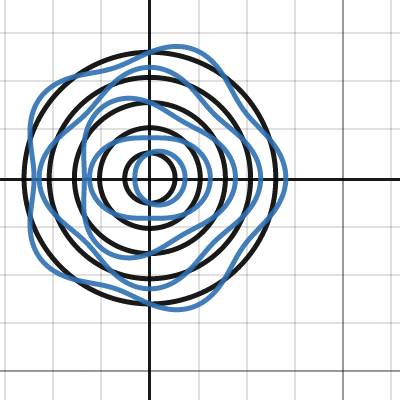
what even are these curves?
 upper karma
looks like a sine wrapped around a circle
 icy dome
@wise pawn thanks man.
@upper karma well, this is locus of an electron around a nucleus. So, ya , sine waves wrapped around a circle
upper karma
so just use polar coordinates with radius being a sine in terms of the angle
 silk patio
That debroccoli guy was wrong tho
 sonic trail
keen lark
could i get some help on this please? i've tried going about this several ways a...
sonic trail
keen lark
could i get some help on this please? i've tried going about this several ways a...
It'll form an ellipse my man. e²=(1-b²/a²). Just try that. Here a = semi major axis and b= semi minor.
sonic trail
I am a school student why?
sonic trail
No no. I'm indian.😁
sonic trail
Heyyy. Delhi ncr. I'm a dropper.
 hardy dagger
Boards cancelled 😋
sonic trail
Yeah. Lucky u. Don't slack off tho. Stay at it.
hardy dagger
@sonic trail what do you mean by dropper? Could you pls explain the term...
hardy dagger
@sonic trail yeah yeah thats for sure...other mummy's slipper is waiting
sonic trail
hardy dagger
<@740382699486838906> yeah yeah thats for sure...other mummy's slipper is waitin...
Hehehe. Yeah! The real motivation behind studying. That chappal😆
hardy dagger
@sonic trail yeah I'll also take a drop....now I'm preparing for getting a scholarship in FIITJEE
@sonic trail yeah 😅
sonic trail
Ohh yeah! Do those aptitude type ques. You can score well using that. And try going thru prev years papers + a little bit of 11nth ncert
I was in fitjee too
Hauz khas delhi.
Where are u?
hardy dagger
Ok brother....thanks for taking out some time to talk to me 😊😊
I'm fro west bengak
Bengal*
sonic trail
Oiii. Khoob bhalo
sonic trail
Ba bye
glacial bridge
 silk patio
x=-8
glacial bridge
silk patio
x=-8
fr? how
glacial bridge
This one no
silk patio
Google “sum of exterior angles”
 fiery flicker
I come here to learn Pre AP Geometry
Cuz my teacher doesnt teach
I know a bit but i need to pass the class
 old obsidian
Hello guys , I am in 9th grade and I recently learned about trigonometry in the right-angle triangle , about reduction to the first dial and the Theorems of sinus and cosinus and I didn't understand a thing , could you guys give me some help please ? ( I'm sorry if my grammar is a bit rusty )
fiery flicker
Im in 9th too
old obsidian
nice
 lofty marten
old obsidian
Hello guys , I am in 9th grade and I recently learned about trigonometry in the ...
lofty marten
old obsidian
Hello guys , I am in 9th grade and I recently learned about trigonometry in the ...
special right triangles?
old obsidian
lofty marten
special right triangles?
yes
lofty marten
the special right triangles make it easier to calculate the side of lengths of a triangle if you have the angles for them
 old obsidian
i see
lofty marten
so for a 45 45 90 if you are given X you can get the hypotenuse by just substituting
if it was 3 then the side with angle 90 would be 3sqrt2

for 30 60 90 if given X you can plug it in and get the side lengths of angle 90 and 60
hope that helps
old obsidian
yes , thank you

 full briar
What are you trying to solve? The angle?
I think the adjacent angle of that is 75deg
180-105=75 (supplementary angle)
@worn marsh
 worn marsh
@full briar I got the answer for the first
But not the second

Here’s the question
full briar
Uh for the second one the rhombus right? The second angle should be 105 and third angle is 75
full briar
Np
Just note third angle I use supplementary angle and the second one I think it has to do with the property of the shape (rhombus)
worn marsh
Alright thanks
upper karma
Hello can someone help me with the answers of my geometry hw

 jaunty sail
@upper karma do you still need help
 upper karma
 sterile cliff
I'm confused on how the SAS reflects to ABC's congruence to ADC
sterile cliff
I'm confused on how the SAS reflects to ABC's congruence to ADC
If $BC = DC, \angle ACB = \angle ACD$ and $AC$ is common, then triangle $ABC$ is congruent to triangle $ADC$
somber coyoteBOT
omeganebula

 urban vortex
looking for some kind of explanation on how to go from degrees to radians in pi form
google offers the formula degree * pi/180
to get rads
but how do i know for example that -60 = 2pi/3
humble pulsar
urban vortex
but how do i know for example that -60 = 2pi/3
they arent
$-60^{\circ}$ is co-terminal with $\frac{5\pi}{3}$
somber coyoteBOT
moshill1
 humble pulsar
yes their tans are the same, but they arent the same angle clearly
$\tan{x}=-\sqrt{3}\implies x=\frac{2\pi}{3}+n\pi , n\in\mathbb{Z}$
somber coyoteBOT
moshill1
 humble pulsar
when n=1 you get 5pi/3 and when n=-1 you get -pi/3
urban vortex
can you explain this calculation
humble pulsar
Sure, so ik arctan(-sqrt(3)) = 2pi/3, and ik tan is pi-periodic, so any integer multiple of pi added to 2pi/3 will also be a solution
humble pulsar
cause it is..?
I mean you could use double angle with tan(pi/3) to determine it's -sqrt(3)
urban vortex
how do i know that
humble pulsar
unit circle
urban vortex
i mean, how do i conjure these numbers
humble pulsar
Unit circle, the graph, just learning trig
urban vortex
i have (-sqrt3)(pi)/180
humble pulsar
idk why you have that but sure
urban vortex
allegedly thats how radians are calculated
humble pulsar
-sqrt(3) isnt radians
urban vortex
right right
ok well that just throws me a step back again
arctan on the calculator just gives me -60
do i use that to get to pi?
humble pulsar
$-60^{\circ}\cdot\frac{\pi}{180^{\circ}}=\frac{-\pi}{3}$
somber coyoteBOT
moshill1
 urban vortex
um and from this to 2pi /5 pi?
humble pulsar
tangent is pi periodic, so any integer multiple of pi added onto a solution will also be a solution
so in this case we're solving $\tan{x}=-\sqrt{3}$ and we know $x=\frac{-\pi}{3}$ is a solution, so $x=\frac{-\pi}{3}+n\pi , n\in\mathbb{Z}$ are all solutions
somber coyoteBOT
moshill1
 urban vortex
so its just convention to use positive values?
humble pulsar
Depends on how the principle angle is defined, could be [0,2pi) or (-pi,pi]
urban vortex
and is a calculator the only way to calculate the arctan?
is it a particularly horrible calculation?
humble pulsar
I mean if you want to buy the old trig table book, go ahead and use that 
humble pulsar
Cause you dont need a calculator to do basic operations with. . .
urban vortex
tan is considered a basic operation?
humble pulsar
No
urban vortex
but its just y/x
humble pulsar
ok what's tan(37 deg)?
urban vortex
is there no equivalent for arctan?
humble pulsar
I mean there's the taylor expansion, but that's calculus. Just use the calculator
urban vortex
alright
so the full route
to solve this kind of question
is tan theta = b/a
use a calculator to get the degrees out of that
then multiply by pi/180
what do you do if theres parameters/variables or something such
humble pulsar
or just put your calculator into radian mode. . .
urban vortex
this is not as trivially obvious as you might believe
besides the obvious correlation here i dont really know what radian mode is or how to use it
or how to enable it for that matter
and its only by complete chance that i have a scientific calculator nearby ;p
found a nice chart for the 0 30 45 60 90 degree values
realistically these are the only ones we will encounter in questions
fingers crossed
 frosty sphinx

 unreal beacon
Is it accurate to say that a radian is the arc length created by a central angle on the unit circle?
A radian is an angle which produces an arc length of 1 on the unit circle
 sturdy iris
The latter is a great definition
unreal beacon
When we say that the sine function relates an angle to the y component on the unit circle, is the angle in degrees or radians ?
sturdy iris
It doesn't matter
But if we're talking about the function, it is almost always radians
However, it still makes perfect sense to ask the sine of 270 degrees, for example
unreal beacon
Alright. Hmm, if it doesn't matter, why is it that when I put sin(pi) in my calculator (calc. is in degrees) - I get 0.05. And when I put sin(90) (calc. in degrees) - I get 1.
sturdy iris
By saying "it doesn't matter" I mean that both choices are possible
For calculators there are usually the degrees and radians modes you are free to switch
unreal beacon
Right, I just did, and in radians mode I get that sin(pi) is 0. Why isn't it 1 like sin(90) in degrees mode?
Oh, it's because 90 degrees is pi/2, not pi, right ?
sturdy iris
It is
unreal beacon
Alright, gotcha 🙂 Thanks
sturdy iris
You're welcome
 grand geode
do functions count as coordinate geometry?
like finding domain and range of a graph
is it possible to find the domain and range with given values like this?

 muted finch
I am pretty interested in math and failry good at it but with the whole pandemic we have been going very fast with new chapters and I just can't focus. Do any of you know good resources to learn about sinuses and cosinuses?
humble pulsar
grand geode
is it possible to find the domain and range with given values like this?
yes, cause you can determine the radius
grand geode
thanks
 scarlet basin
@muted finch sines and cosines*, you could try khan academy? they usually do a pretty good job of being thorough
muted finch
Thanks. One more thing. Do any of you know any videos on yt that will help restore my will to learn math?
 hoary prism
Yo can anyone help me with this

 vapid stag
is there a way to drop off my past exam somewhere, so people can tell me what i did wrong?
trim breach
Someone here would help you so long as it is a past exam like you said.
 inner ingot
what line represents the lower edge of the front view?
 copper marten
does anyone have tips on memorizing theorems and postulates for proofs? or can someone list out the main ones
upper karma
There are 2 ways to remember geometric proofs, one is to practice them and learn them, the other way is to understand all the proofs, and try reproducing them on ur own, (make ur own variant)
 main hornet
upper karma
There are 2 ways to remember geometric proofs, one is to practice them and learn...
main hornet
upper karma
There are 2 ways to remember geometric proofs, one is to practice them and learn...
Well I think it's a tedious task especially the second way ... making your own variant 🙏...I mean if you are preparing for some exam then definitely you should follow the first way.. PRACTICE..And if you are fascinated by mathematics then you can go further to do some research on it🙏🙏..
upper karma
Making your own variant means that u understand the proofs, like u need not remember what triangles were congruent, what lines were parallel, what was cyclic, you try to learn the pattern and recognise things on your own
 hollow shard
Evening, I would like to share my solution video on a geometry problem. Thanks.
https://bit.ly/3uk8ftE

 neon eagle
which is better
intuitive goemetry or algorithm geometry
as a person learning goemetry right now i would like to know
 wary granite

 upper karma
 true sleet
im doing a quiz
true sleet
im doing a quiz
Help on tests/quizzes isn't allowed

 peak flower
 small rivet
someone can help me?
small rivet
someone can help me?
What don't you get about that task?
It's just definitions you have to learn.
peak flower
half the distance between the highest point and the lowest point.
 shrewd kettle
I don't understand how I'd use this ratio to solve for Figure A, for the other problems I'd usually have an "X", but without one I got thrown completely off the hook
 dark sparrow
@shrewd kettle your unknown is the perimeter of A
you could find every single side of A if you want
or you could do the smart thing and realize that the perimeter of A is just the scale factor (7/2) times the perimeter of B
 storm tree

Can anyone help me with my finals for geometry
I would honestly really appreciate it
shrewd kettle
dark sparrow
or you could do the smart thing and realize that the perimeter of A is just the ...
Oh that's smart-
Thanks, I'll be sure to apply that
dark sparrow
@storm tree is this a test/quiz/exam thats going on right now
dark sparrow
not only do i personally not feel like helping someone cheat on a final, it's also kinda against the rules of the server
storm tree
I apologize
 finite swan
we're not graduating for you
 feral sleet
storm tree
feral sleet
storm tree
i could help a bit, but im becuase i genuienly think this will help by concept. for(1b) to sketch the circle find the point at (4,-3) make a line 5 unite from it and start circling.
finite swan
feral sleet
i could help a bit, but im becuase i genuienly think this will help by concept. ...
- they left
- don't help them cheat
dark sparrow
inverse trigonometry sure is a thing
as a bonus, this is the right channel to ask questions about it
 waxen vault
Yep its bonus
dark sparrow
$y = \sqrt{2}$? or $y = \sqrt{x}$?
somber coyoteBOT
Ann
 dark sparrow
anyway this is the kind of thing that can be solved using calculus, specifically the integral for arc length
yes
this will belong in #calculus tho
but in your particular case you will have $\int_a^b \sqrt{1 + \frac{1}{4x}} \dd{x}$
somber coyoteBOT
Ann
 somber coyoteBOT
ryane
 dark sparrow
let's move to calculus
hollow shard
Is this a contest problem?
 night vigil
Here I am visiting again
so there's this really weird problem
and im ataully stumped
can anyone help me?

ok I guess ill ping?
<@&286206848099549185> can you take a look at this problem?
It really has me stumped
 full briar
is the area of the shaded area of the circle the lateral area of the cone?
that's my current understanding of the problem
night vigil
yah
full briar
ok just simply speaking: if we are to calculate the area of the shaded region, it should be area of the circle times the ratio of the shaded region
so
$\pi(56)^2 * \frac{225}{360}$
somber coyoteBOT
birschlatte35
 full briar
@night vigil
night vigil
alright
so
hmm
yah that could work
oh yah that works
thats such a good formula!
full briar
haha im not usually that active
full briar
lol
night vigil
so really only like half the helpers are
full briar
i mean if you really want a helper's attention
you should go ask on one of those questions #s channel
night vigil
oh
 remote arrow
Hello everyone!
What would be a good book to start off with to revisit the basics of trigonometry and geometry?
full briar
You should also prob ask it in #book-recommendations
copper marten


how do i find the volume when there's like thickness?
the answer to #3 was 180 if thats helpful in solving it
my initial ideas:
splitting the vase into like 4 parallelogram solids
the top 3 solids are the same and the one on the bottom isn't because there is thickness on the bottom
first 3 solids:
since the thickness is 1.5 on the sides, i subtracted 6-1.5 and 3-1.5 to get 4.5 and 1.5, and that's to get rid of the thickness. and then i did 4.5x1.5x2.5 to get the volume which is 16.875, and the 3 solids are the same so 16.875 x 3 = 50.625
bottom solid:
the sides and the bottom are 1.5 thickness
6-1.5=4.5 3-1.5=1.5 2.5-1.5-1
4.5x1.5x1 = 6.75
volume: 50.625 + 6.75 = 57.375
but on the answer key its 95, so i'm not sure how they got that so pls help if u know how to do it
 tiny snow
@sand root Is it (c) you are stuck on, and what have you tried?
Note that the scribbled right angles on your questionnaire are not necessarily such.
Also, you are to prove that |AB| = |BC| (not that |CD| = |BC| which the markings on those segments suggest).
 sand root
how could i prove they are the same
tiny snow
Well, one way is to prove that the triangles ABO and ACE are similar. You then know that |AE| = 2|AO|, and from similarity |AC| = 2|AB|, from which |BC| = |AB| follows.
sand root
trianlgfe abo?
tiny snow
If you draw a line from B to O you will get a triangle from the three points ABO.
tiny snow
|AE| is twice the length of |AO| (diameter vs radius)
tiny snow
I think from the original description they want you to show that the triangles ADE and ACE are similar, but I found it easier with ABO.
The scale factor, 2 in this case, can only be applied if the triangles are similar.
sand root
but couldnt we just have skipped to ae = ao^2
tiny snow
sand root
but couldnt we just have skipped to ae = ao^2
Not squared...
sand root
x 2
tiny snow
Here's what I did: https://www.geogebra.org/geometry/sppt2pce
sand root
ahh ic ty
 neon hamlet

im kinda confused, how would you solve for this?
I know W is 70
and its asking for a quadratic equation based on the "solve for all values" part
 silent plank
why would you even need a quadratic equation for this
applying properties of radii and isosceles triangles to form a linear equation is enough
upper karma
all the lines coming from W are radius
neon hamlet
ah cool
yeah I just did 2x+70=180
and I have no idea how to do this, maybe splitting the triangle up? but I don't know if YX = WX


 olive cove
Angle BAO = angle CBD
trim breach
neon hamlet
and I have no idea how to do this, maybe splitting the triangle up? but I don't ...
It looks like you can find the diagonal of that square and split the larger triangle that way by adding the radius and diagonal to form a leg. Then you could use Pythagorean Theorem since you would have two sides.
olive cove
there is no need to use trig
 severe rapids
Someone told me too
olive cove
Angle BCD = 1/2*angleO = 90
So angle BCD = angle ABO
And 2 similar angles is enough to say 2 triangles are similar
olive cove
olive cove
there is no need to use trig
Oh sorry nvm Lidoh was answering another problem
severe rapids
What’s the proof though
 scarlet basin

uhhh
im struggling to understand how my teacher got this
like...why would finding the square root of 960 and 375 here to get the scale factor and volume ratio not work?
but yet it works here?:
 scarlet basin
anyone?
 rough stone
is anyone free in here to answer a question?
@fast pulsar
6e^i(pi/12)
=6cos(pi/12)+6sin(pi/12)i
= (This is where my calculator gives me the wrong values from my hw)
cos = 5.9999 sin=.02741 (not rounded yet)
Answer is
=5.796+1.553i
My question is maybe it is a setting problem in my ti-84 calculator but I don't know what is wrong
The problem is moving from complex to rectangular form
dark sparrow
radian vs degree mode?
rough stone
degrees
I believe I figured it out
I set my mode to real numbers instead of a+bi
stupid of me
I have gotten the right answer
on my calculator thank you for checking in @dark sparrow
 fast pulsar
rough stone
degrees
fast pulsar
rough stone
degrees
Euler's formula is completely false when in degrees. You MUST be in radians for it to be true
$e^{i90}\neq \cos(90)+i\sin(90)$
somber coyoteBOT
dackid (jump king +)
 rough stone
tytyty
 plush remnant
Can someone help me

16 and 12
Iam just confused on how to solve the formul
Formula
olive cove
Use soh cah toa
trim breach
scarlet basin
anyone?
What your teacher did was simplify the ratio between the surface areas of the triangular prisms by dividing the numerator and denominator by 15. You can see that taking the square root of the simplified ratio gives a scale factor, and that scale factor is cubed to get the volume ratio.
 empty fulcrum
how to calculate Fp

 wise pawn
separate out F_BR and F_CR into their x and y components
 idle bobcat
hi, can someone explain where this 1/10 came from?
 wise pawn
the equation on the 3rd line
the right side has x/10
the derivative of that is x'/10
idle bobcat
yeah i asked another question there
its been quiet
this question is kinda related to trig so i thought id ask here instead lol
oops i mean't I asked in #precalculus not #calculus
scarlet basin
Does anyone know how I'd go about learning the volumes and surface area formulas for 3d shapes? there are so many of them and I have a test tomorrow in which we aren't provided a key for them 😭
idle bobcat
which shapes are you struggling with
im not the best at geometry but I found it pretty intuitive to determine the volume and surface area formulas by thinking about the dimensions logically
like for a cylinder, the surface area is just the area of the top and bottom circles
and the circumfrence of the base of the circle multiplied by the height
so the area of a circle is pir^2, and since you have two of those, you multiply it by 2 to get 2pir^2
and for the side of the cylinder you basically just want the circumference of the circle multiplied by the height of the cylinder
so you have 2pirh
and then you just add them up
so you have 2pirh + 2pir^2
and for the volume, you are basically just looking for the area of the base of the circle multiplied by the height of the cylinder
so you have pir^2*h
don't know if this helps but it's how I think about things
empty fulcrum
wise pawn
separate out F_BR and F_CR into their x and y components
I found all sides of the 2 right triangles but how do I use it to find F_P
muted finch
Does anyone know if radiants are actually useful compared to deegres? I know you have a formula that you can use with radiants, but are they good for anything other than that?
dark sparrow
the word "radians" has no t in it
anyway, using radians as a unit can often make calculations simpler for things involving rotation
and there are also reasons why radians are more natural but they require calculus to fully explain
upper karma
made a circle using lua in unity and shapes, using sin and cos

 fickle sleet
Radians give vastly cleaner numbers to work with when dealing with Trig Functions
upper karma
I'm not sure how to use them to draw circles
fickle sleet
upper karma
made a circle using lua in unity and shapes, using sin and cos
that's actually pretty impressive
upper karma
oo thank you

 scenic depot
I would think that by the Pythagorean theorem
 mellow gate
scenic depot
I would think that by the Pythagorean theorem
mellow gate
scenic depot
I would think that by the Pythagorean theorem
Sorry blanked out there xD
scenic depot
no problem, it happens 🙂
 tawny dragon

 sick torrent


 trim breach
true sleet
does anyone know this
trim breach
true sleet
does anyone know this
Do you know the relationship between the scale factor and the surface area?
trim breach
Not quite. It gives you the surface area of the shape.
true sleet
would I do 4^2
trim breach
It wants to know what happens to the surface area when the dimensions are multiplied by 4.
true sleet
it increases
trim breach
Yes. Now we need to know what the surface area is after we multiply the dimensions by 4.
true sleet
51/2 x 4
trim breach
Why did you divide by two?
true sleet
2 to 1
true sleet
1:4 x 4/4
trim breach
No need to multiply.
true sleet
so u divide by 4
trim breach
1/4 is the scale factor.
true sleet
0.0625
trim breach
The relationship between scale factor and surface area is this:
If. x:y is the scale factor x^2:y^2 is the ratio of the surface areas.
true sleet
i got 0.0625
trim breach
Yes, or you could also write is as (1/16).
true sleet
ok thx
trim breach
So we can set up a proportion with this.
Since we know that the surface area of one shape is 51. But we need to get the SA of the new shape.
true sleet
its 816
true sleet
thx
 thorn tiger
hey

does anyone have any idea on how to solve this type of question?
i was thinking to do costheta = sqrt3/2
but im not sure
humble pulsar
thorn tiger
i was thinking to do costheta = sqrt3/2
yes, that's the 1st step
humble pulsar
Yeah since it's an exact value
humble pulsar
yes
thorn tiger
thanks
upper karma
Can someone help me
 upper karma
 upper karma
storm portal
> Don't ask to ask, just ask!
upper karma
storm portal
> Don't ask to ask, just ask!
Lol i posted the picture it’s just taking a long time
I have to prove this
upper karma
1+ sec^2 x (sin^2 x) = sec^2x
storm portal
multiply both sides by cos^2x
upper karma
Nvm I got it
 empty fox
Can anyone tell me meaning of this .
Find two transformations (registers) to align the vector op with the unit vector j of the positive axis of y, where o is the center of the coordinate system and p is a given 3D point. Then implement them by applying them on different primates.
humble pulsar
No cheating.
 valid magnet
hey
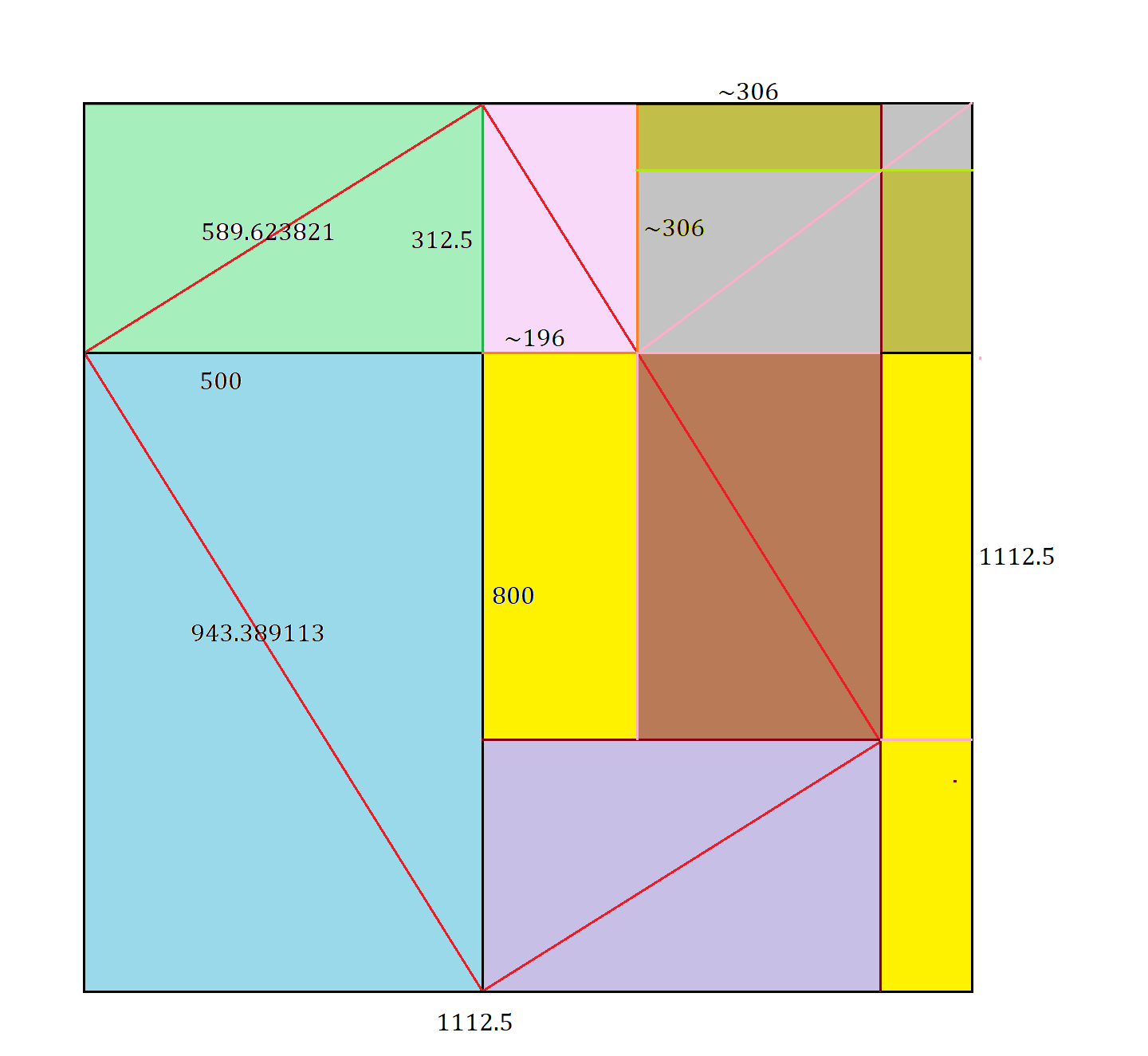
i started off with the blue rectangle
then i multiplied 500 * (800/500) to get the height of the green box (312.5)
500/312.5 = (800/500)
the hypotenuse if the red square is 800 + 312.5
let's look at the point with the black line above the blue box (length 500) and the line to the right of the blue square (length 800)
that line is 312.5 in length
what is this point called?
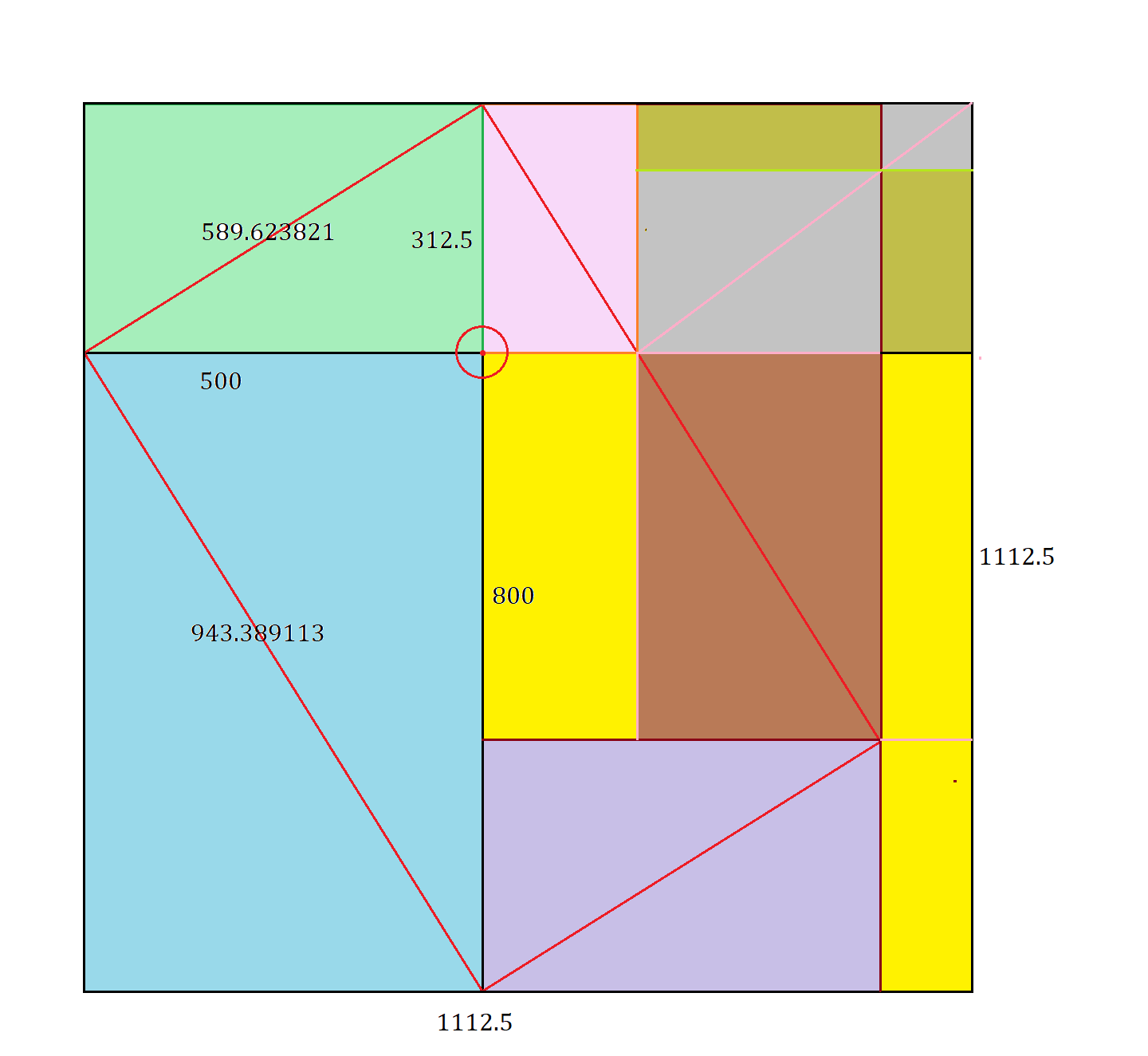


wait those squares aren't equal are they
no they are
sqrt(800 / 312.5) = (800/500) = (500 / 312.5) = (312.5 / 195.3125) = (195.3125 / 122.070313) = ...
 honest pumice
evening, quick question, sin(pi - a - b) = sin(a+b) right? when using the identity sin(a-b) = sin(a)cos(b)-cos(a)sin(b)
if i rearange sin(pi-a-b) = sin(pi-(a+b)) i can use sin(a-b) = sin(a)cos(b)-cos(a)sin(b) to make it sin(pi-(a+b)) = sin(pi)cos(a+b) - cos(pi)sin(a+b) giving me a result of sin(a+b)
honest pumice
valid magnet
(question: how is sin and cos defined?
the unit circle
valid magnet
can you define sin and cos for us?
honest pumice
it's better if i send an image, kind of hard explaining it with only words
but basically, when you make a circle of radius r=1 , the tip of the radius "lands" on the coordinates x = cos(a) and y=sin(a)
where our a is the angle made from the positive x axis with the hypotenuse
humble pulsar
the unit circle is pinned
honest pumice
 valid magnet
how is a measured?
honest pumice
this angle a is also the "semi circumference" the hypotenuse line makes with the positive
before calculus was discovered, with measuring tools
they calculated the area with different methods
valid magnet
so a can be anywhere from 0 to pi / 4?
honest pumice
slicing the circle like a cake
putting very small squares and rectangles inside it
wise pawn
honest pumice
if i rearange sin(pi-a-b) = sin(pi-(a+b)) i can use sin(a-b) = sin(a)cos(b)-cos(...
yeah that's a good proof, good job you're right
honest pumice
wise pawn
yeah that's a good proof, good job you're right
thanks for the help