#geometry-and-trigonometry
1 messages · Page 349 of 1
 gritty spindle
breifly
 dark sparrow
you can use desmos if you dont have a physical calculator
(just make sure to set it to degree mode)
as an example $A = \cos^{-1}(0.31)$
 somber coyoteBOT
Ann
 dark sparrow
these angles are all given as acute so there's no edge case bullshit to worry about
gritty spindle
ok...?
dark sparrow
literally just evaluating the inverse trig functions at the relevant points
dark sparrow
you told me you had heard of inverse trig functions
gritty spindle
once or twice
dark sparrow
maybe you saw arccos instead of cos^-1
gritty spindle
idk it
dark sparrow
bruh
dark sparrow
i mean ok like
loosely speaking, arcsin(x) is the angle whose sine is equal to x.
ditto for arccos and arctan.
gritty spindle
wht the fuck
dark sparrow
?
dark sparrow
don't call me bro, please.
dark sparrow
my name is fine
gritty spindle
Ann?
dark sparrow
yes
anyway
okay youre having trouble grasping the concept so lemme try to explain it to you differently
you've heard of and are familiar with square roots, right?
(not related to this problem im just trying to springboard off this)
gritty spindle
so arcsin is just sin but opposite?\
dark sparrow
no, you're told cos(A) = 0.31, not sin(A) = 0.31
dark sparrow
you'll use arcsin for B
gritty spindle
is ther arccos?
dark sparrow
yes.
 mellow vector
AG = d, <HED = beta, <FAH = 2alpha, ABCD is a deltoid, CO = m, and <C = 90.
I need to find the area of triangle AFH in terms of alpha, beta and d.
(That's only part 1 of the question, and in part 2 I need to use m aswell so I think m isn't related to part 1)

Can someone help me with this?
 upper karma
"<A" is vague, can you specify whether it's FAH or FAG or GAH?
mellow vector
The whole angle
FAH
I got to go eat, if someone finds the way to solve this question please tell me and I will take a look when I come back.
upper karma
i have a solution and will help you in 1 or 2h, bc i have to do smth.
will tag you when so if you still haven't got helped.
 flint wolf
Can someone help me with a couple circle problems
mellow vector
upper karma
i have a solution and will help you in 1 or 2h, bc i have to do smth.
alright thank you very very very much!!!
upper karma

okay so
i'd have loved to make a tikz diagram but i'm not available of that free time rn.
upper karma
yeah
mellow vector
I can find those angles
what next
wait
use sine law 2 times to find AH and AE...?
and then use them for the area..?
omg...
upper karma
hint: ||after finding all the "?" angles, our desired area will be bh/2, and we don't know what h or b are, and those are the ones we want to express in terms of alpha, beta and d, with those angles and some trigonometry you can archieve it. give it some attempts||
upper karma
yeah whatever works for you it's fine
upper karma
you can use x_1 and x_2 added up to find EH.
mellow vector
I did it, ty!

 upper karma
nvm ive got it

 wintry tundra
"Find the area of the area of the triangle" what does that even mean
Also I'm not even sure we have enough info to solve it
 trim breach
 obtuse thicket
can someone help me with this?
obtuse thicket
can someone help me with this?
I think we are to assume those are regular shapes. You can then use a 30-60-90 triangle in the regular triangle by drawing an apothem. You can find the length the base by doubling the length of the leg adjacent to the hexagon. Then, split the equilateral triangle in half again and solve it for the height.
I cannot see another way to solve that problem with the assumption that they are regular polygons.
trim breach
New and improved image.
 gritty spindle
@foggy pine lol u actually joined
 round flicker
Hey, I was wondering if anyone has any similar questions to this that they could send me? Thanks

 zealous forge
@solid needle
 solid needle
ask away
zealous forge
i need confirmation on my answers i finished everything but i just need to know if they are right
i got
1=a
1=a

3=A
4=D
5=C

for this i got
6=a
7=b
8=idk


for this i got 9=a
10=c
solid needle
1 is wrong
2 is wrong
3 is good
4 is wrong
5 is wrong
ok
im gonna stop here
because i found a core gap in your understanding
sec, sketching something
zealous forge
ok
 wintry tundra
Well u can see which sides correlate with each other
Make a ratio
And when u simplify the ratio u will get the scale factor
solid needle
@zealous forge
zealous forge
lol um i was asking him
upper karma
anyone open to help me on a problem
 worn anvil
Hey there, does anyone know how to get the sides of congruent triangles? I'm not begging for answers, I just need a few instructions since I got confused with my Teachers'
upper karma
send the problem
worn anvil
 upper karma
what are you confused about
it's just oriented differently on the right
so like ca is 77
upper karma
look at the bottom triangle for example
FHG
triangles add up to 180
so u add 78 and 62
180 - 140
missing angle is 40
upper karma
no problem
 jade badger


 plush basin
hi can someone help? <@&286206848099549185>

 icy dome
how to reduce the power of sin(x) having non-interger values as power
upper karma
icy dome
how to reduce the power of sin(x) having non-interger values as power
you mean something like (sin(x))^(1/2)?
it should be possible for rationals
upper karma

so if we want to express (sin(x))^(1/2) with an integer power we can substitute sin(u)=(sin(x))^(1/2)
icy dome
upper karma
so if we want to express (sin(x))^(1/2) with an integer power we can substitute ...
thanks for the heads uo
 zenith tangle

I'm asking for help,
I have been trying to figure it out for hours and zero progress the information of the question is written on the photo.
Thanks for helping.
upper karma
zenith tangle
ABCD is a square??

so i assume the problem means to say that figure ABCD is a quadrilateral
the first thing that i notice is that AGB and CGD are similar triangles
wait no we cant prove that yet
is this asking you to prove that line BD is a bisector of angle ABC?

 dapper estuary
upper karma
is this asking you to prove that line BD is a bisector of angle ABC?
dapper estuary
upper karma
is this asking you to prove that line BD is a bisector of angle ABC?
yes
upper karma
Hello! I need help understanding this material. I tried doing it but I didn’t understand it very well. It might seem easy but I don’t have the same level of understanding as my other peers.

 valid drift
can someone help

 eager hatch
valid drift
can someone help
eager hatch
valid drift
can someone help
Because all the lines are parallel to the opposite, you can use QR as a transversal to get that Q and R are supplementary, and use PQ to get that P and Q are supplementary, then because P and R are both supplementary to Q, they are congruent
valid drift
thank you
eager hatch
No problem

 pale latch


 signal otter
Can anyone explain in greater detail how we went from the second equation to the third one? I'm not clear on how that process went down.

 oblique hatch
So, if you look at the right it says "multiply both sides by cos"
Therefore all terms on the LHS were multiplied by cos x - the way sec x seems to magically disappear is because recall: sec x = 1 / cos x
So, if you multiply cos x by 1 / cos x it reduces to 1
@signal otter
trim breach
 dapper bronze
The diagonals bisect each other and there is no right angle. That should be enough to define the quadrilateral.
signal otter
Okay, so they just didn't write out the step where they converted sec into 1/cos?
That makes much more sense
oblique hatch
@signal otter Exactly - but if you look at the LHS with that knowledge, you can see how every term has been multiplied by cos x
signal otter
If I may ask a follow up - I can see logically WHY we would multiply by cos, because we want to get into quadratic form, but could one theoretically choose any value to multiply by? Is there a rule regarding this?
oblique hatch
@signal otter Theoretically...but as you mentioned this way you get a nice quadratic to work with and that's an easy thing to handle...so, I suppose the answer would be you could...and suffer the consequences lol
signal otter
Sure, I understand why we wouldn't want to. Just struck me as slightly odd that I'm allowed to multiply by any value - I would have expected that there be a 'rule' about what you could multiply an equation of this form by
Thank you for clarifying that hidden step for me
oblique hatch
@signal otter Well, they've set this problem up to be academic - it's specifically designed to be solved in this way. As you progress, that may not be the best solution...This is just an academic exercise to show the learner that sec x can become 1 when multiplied by cos x because of the reciprocal identity. TL DR; it's just an academic exercise lol
signal otter
Makes sense. I've found myself struggling to memorize the fundamental identities, and having to constantly refer to my notes from previous sections any time I encounter a scenario where one might be used. Any advice or useful mnemonic devices you know of for getting those down?
oblique hatch
@signal otter The simple trig identities? Like, sec x = 1/cos x? Those weren't too bad for me because I just remembered that co-secant seemed like it should go with co-sine....but it doesn't! As for all the trigonometric identities like sin²x + cos²x = 1, sec² = tan²x + 1, etc.....muscle memory. Sorry that's useless!
signal otter
Yeah, all of these.

Its just been a weird semester. Thanks for your continued help.
oblique hatch
@signal otter Sorry, I was hunting something down I remembered - https://youtu.be/T7D1W1oD8wo

This magical hexagon will help you with ALL the trigonometric identities or functions you know about!
To learn more about the different functions in Trigonometry, please enrol in our course - https://bit.ly/TrigonometryG10
In this video, we will learn:
0:00 Introduction
0:13 Super Hexagon Diagram
2:55 Basic Trigonometric Formulae
9:14 Co-Func...
I remember using that video a couple of times until I got it down pat, then the rest I just did a lot of problems to drill it into my brain.
signal otter
Wow this is really helpful
 surreal jetty
<@&681260373478735874>
hi i know how to do all the other steps just need help with 1

 stuck briar
Did you read #❓how-to-get-help
stuck briar
You should read it
surreal jetty
o my bad
 nova rose
wait so what's the point of this chat
 inland salmon


 upper karma
upper karma
upper karma
anyone know how to solve this?
wintry tundra
I can help
So c is the center of the circle
And the arc made by an angle with the middle point is $r\theta$ where $\theta$ is the angle
Oops
Sorry
Wrong rule
upper karma
i just need to find the measure of angle BDA lol.
wintry tundra
If you have an angle where the middle is in the center and there's another angle that shares the same ends but the middle is on the edge of a circle then that angle is half the first one

Like this
upper karma
thanks xoxo
wintry tundra
Np
trim breach
upper karma
AAA only proves similarity. Without a length, you cannot prove congruency.
 hardy ibex
hiii who knows about bearings??
i have a couple questions i need help with
word problems btw
heres an example of what they look like


 rugged sage
help
how do i "Use the unit circle to justify the fact that for all θ: (cosθ)^2+(sinθ)^2=1
 teal kayak


 kind patio


 clear juniper
 dark sparrow
okay, so i need a sanity check
is it true that a triangle is acute iff its circumcenter lies inside it?
upper karma
dark sparrow
is it true that a triangle is acute iff its circumcenter lies inside it?
yeah that's true
dark sparrow
great ty
 jagged ore
So I missed a few classes from moving issues and I need help learning how to do something like this
 wintry tundra
Two lines who meet at a point and are tangent to a circle are equal
trim breach
jagged ore
But how do I get to the center point :P
Unless I am missing something, you don’t have enough information to find the radius. If I am wrong, someone please correct me.

No other given angles for trig, and no other sides to complete the triangles.
 muted viper
I'm a bit confused by notation. Why is sin^-1(x) considered the inverse of x? Instead of 1/sin(x). Why is there a special name for the reciprocal of sin called cosecant? This seems like an unremarkable function.
Is this some unfortunate accident of history. Or am I missing some connection here?
In programming languages we tend to have functions with names like acos and asin for the inverse of cosine and sin. And the languages often don't bother to have a function for csc sec which makes more sense to me.
trim breach
x^(-1) = 1/x
And yes, you could notate the trig functions in terms of sine and cosine, but having names makes things convenient.
muted viper
trim breach
x^(-1) = 1/x
But isn't sin^-1(x) != 1/sin(x)?
Even though sin^2(x) = (sin(x))^2
sin^-1(x) = asin(x) right?
 silent plank
stems from history
muted viper
Thanks. I wish sin^2(x) actually mean sin(sin(x)). Usually when I don't understand why something is the way it is, it's because I missed some key insight about math or about convenience.
I had a really hard time googling an answer to this question.
Finally convinced it to give me relevant search results with the query ambiguous notation inverse trig
upper karma
muted viper
Thanks. I wish sin^2(x) actually mean sin(sin(x)). Usually when I don't underst...
Well sin^2(x) is sin(x)sin(x) which makes completely sense
Just like x^2 = x*x
muted viper
But on the other hand f^2(x) usually means f(f(x))
upper karma
Uh, no
If you had f(x) = 3x
And wanna have f(x)^2
U get 9x^2
f(x)^2 = f(x)*f(x)
silent plank
f^2(x) is interpreted differently than f(x)^2
upper karma
f^2(x) doesn’t make any sense unless you choose f to be a variable like x, instead of a function of x
f(x)=y=3x | ^2
f(x)^2 = y^2 = 9x^2
Using y instead should make it clear
silent plank
But on the other hand f^2(x) usually means f(f(x))
upper karma
Then just write f^2(x)= ffx instead
muted viper
I can't change the notation everyone already uses. 🙂
silent plank
the notation is a bit ambiguous, its just a thing that exists
upper karma
Not f(f(x)) which looks like f of f of x
upper karma
muted viper
I can't change the notation everyone already uses. 🙂
This is not used
silent plank
i've seen it being used like that multiple times here
upper karma
You guys are thinking about composition of Functions which is a whole different thing
 upper karma
„Sometimes“

4 years of engineering at university and never seen this mess of a notation
But guess you were right then xD
upper karma
Yeah probably
silent plank
think its more common in europe
upper karma
Hmm im from Europe 😄
muted viper
I'm reading lots of different discussions on stack exchange where people lean in all kinds of different directions on function composition notation. Some people say if you use f^n notation for function composition you should clarify that's what you're doing. Other people seem to treat it as the default. 😐
I'm going back to the comforting world of programming now where there is little to no ambiguity in my trig and non-trig functions.
upper karma
muted viper
I'm reading lots of different discussions on stack exchange where people lean in...
I support the clarification part lol
dark sparrow
ok so
another sanity check is in order for me

ABC is an acute triangle => angle D is obtuse
this can be proved by extending BD and CD past D and using that one theorem about angles between chords, right
wintry tundra
mayyyybe 
dark sparrow
what
look, im doing a problem that involves delaunay triangulations
all i want is a sanity check for like
basic geometry shit
wintry tundra
I'm going to be honest, I have no idea if this is true. The triangle thing, I mean.
dark sparrow
angle D should be equal to the average of arcs BAC and EF
 wintry tundra
Is BC a diameter?
 tiny snow
Intuitively, as long as ABC has the circle center in its inside ABC will be acute. The edge case being when one of its sides pass through the center. This is also the edge case for BDC, for which <BDC can reach its smallest value, a right angle, if D is placed on the circumference. I am assuming that D must remain in the circle and outside ABC.
(edited, wrong labeling fixed)
@dark sparrow ^
Do you need a formal proof?
dark sparrow
nah not rly
i can and probably will get away with saying "this is highschool geometry and i hope its obvious to everyone"
tiny snow
Proof that "angle D should be equal to the average of arcs BAC and EF"

May very well be some much more straightforward way to see this, but...
@dark sparrow ^
silent plank
should be able to just quote inside angles theorem or whatever its called
tiny snow
Intersecting Chord Theorem, and here's a much simpler proof: https://www.jamieyorkpress.com/wp-content/uploads/2019/08/Circle-Geometry-Proofs.pdf
Ah well 🙂
 gray minnow
pls simplify

 past geyser
@gray minnow is that sin(2x)/(1+cos(x))
yeah it is
do you know the identity of sin(2x)
 storm portal
$\frac{\sin(2x)}{1+\cos(x)}$
somber coyoteBOT
Lighthearted Sand Crab
 past geyser
 yeah i know
storm portal
📈
past geyser
📈
storm portal
📈
Even if you split it up into the most common identity for sin(2x), wouldn't you still need to multiply by the conjugate of the denominator?
oh yeah, then split up, and cancel what you can

 shrewd delta
Try drawing a diagram, you should get a right angled triangle where you know one more angle and one of the short sides
 shrewd delta
Which side is the redwood tree?
 boreal narwhal
how would you do the diagram?
shrewd delta
So the tree is one side, the line along the ground from the base of the tree to the point 115 feet away is another side, and the hypotenuse would be the straight line from the point to the top of the tree
Assuming the tree is perfectly vertical, you'll see that one angle is 90°
 boreal narwhal
 shrewd delta
Yes
 steep elk
 trim breach
If two angles add up to 90 degrees, they are called complementary angles.
And because you are given BOD is a right angle, angle 1 and COD add to 90 degrees.
 storm portal
Use Pythagorean Theorem for AC
And then you can use inverse trig functions for A, B, and C
@boreal narwhal
storm portal
👍
 storm portal
the arc is a PART of the full circumference
this may help - given that you know that the length of the arc is LESS than the circumference (less than 2πr)
boreal narwhal
storm portal
this may help - given that you know that the length of the arc is LESS than the ...
so what would i do to solve
storm portal
can you figure out what portion of the circumference the arc length is equal to?

 humble pulsar
 outer mirage
someone help me where to start?
outer mirage
someone help me where to start?
pythagorean theorem
outer mirage
thats it i thought i was supposed to use SOHCAHTOA @humble pulsar
humble pulsar
outer mirage
thats it i thought i was supposed to use SOHCAHTOA <@!186109587366215691>
Nope, just pythagorean
 blissful willow

 trim breach
 narrow seal
For triangles where you don’t have all three side lengths, use Pythagorean Theorem to solve for the last side. To get the length ratios, you just need to identify which sides are which.
This might be useful if you are stuck naming the sides.

 livid moss
trim breach
For triangles where you don’t have all three side lengths, use Pythagorean Theor...
livid moss
trim breach
For triangles where you don’t have all three side lengths, use Pythagorean Theor...
right angle triangles
 sand zodiac
Hey guys I need help with this question.
"A 40 foot ladder is set against the side of a house so that it reaches up 24 feet. If Jordan grabs the ladder at its base and pulls it 3 feet farther from the house, how far up the side of the house will the ladder reach now? (The answer is not 21 ft.) Round to the nearest tenth of a foot."
humble pulsar
draw a diagram
sand zodiac
Ok, thank you.
humble pulsar
then it's just use pythagorean twice
humble pulsar
cause you need to find the starting horizontal distance
then the final vertical distance
sand zodiac
How do I do that?
humble pulsar
draw a diagram of the initial state of the ladder and the final, and solve for the unknown sides in each
 marsh quartz


 wintry tundra
you can either use trig to find angles and eventually get to x with plug and chug or u can notice something about the angles
upper karma
 quartz torrent
calculate the area of the triangle in 2 different ways
 distant mortar
finding surface area, please help

 lofty oxide
just find a bunch of 2-d areas on a 3d shape
find the triangles
and then the rectangles
add em all up
and that is surface area
distant mortar
Would I use SA=B+1/2PL
For the triangle
I tried doing that and then the formula for a prism and adding them
But idk if that’s right
bc u cant rlly tell what the base is for the triangle “prism”
lofty oxide
is it me or do those traingles have right angles
distant mortar
Yes they do
lofty oxide
and i never seen that formula before so ill just leave this to someone else lol
distant mortar
I found the base of the triangle on the top using Pythagorean therom and got 9
oh ok nws
lofty oxide
distant mortar
I have no clue LOL
ok im pretty dang sure the base is 9 and the height is 12
so (9x12) for both triangles on the top and bottom and add up the rectangles
cause if u think about it
u could have a square that is (9x12)
and then to find the triangle with a base 9 and height 12, you would divide by 2
and since we have two traingles
we can just say the area of both is 9x12
distant mortar
wait wouldn’t the square be 15 times 14
lofty oxide
yes i believe so
distant mortar
oh okay, thank u sm for the help
lofty oxide
distant mortar
oh okay, thank u sm for the help
ye
 lament kraken

God help me
I've been banging my head against this for a solid couple hours at least
 jaunty rover
<@&286206848099549185>
 pure bronze
lament kraken
pure bronze
lament kraken
You still need help with that?
lament kraken
yes
pure bronze
I’ll try my best, although I’ve never encountered such an elaborate question.
I have no clue whatsoever on what the question desires, could you perhaps tell me what I am supposed to do?
lament kraken
prove QY and QX are the roots of the quadratic
lament kraken
welp
 digital rose
does anyone know how to do this?

 humble pebble
you could get the sides of the triangle using this formula

and then just do (base x height) / 2
 pure bronze
Yep

 inland mountain
Ohhh okay thank you

In order from top to bottom qould it be true-false-true-true?
pure bronze
Well said bud
 upper karma
inland mountain
(5,-4)?
upper karma
inland mountain
(5,-4)?
correct
inland mountain

So I didnt understand this question on my homework
Like how do I tell the difference between Them
pure bronze
Linears that are parallel have the same x coefficient
Linears that are perpendicular, will always have their multiplication of coefficients equal to -1
inland mountain
Okay thanks
pure bronze
Np
 upper karma
this open?

 trim breach
narrow seal
trim breach
narrow seal
You can use the Law of Cosines to get the last side.
Then, there are several ways to find the area from there, such as finishing the triangle to draw an altitude or using Herron’s formula.
 wicked hawk
I get a negative though
trim breach
What are you doing to isolate b?
wicked hawk
multiply both sides by 25
trim breach
Yes. And the cosine of 36 degrees is positive.
So I am not sure where the negative is coming from.
Is your calculator in radian mode?
trim breach
Cool. If you do it now, it should be positive.
trim breach
Glad to help!
narrow seal
is the answer 130.03?
trim breach
I didn’t actually work it out myself yet. Give me a sec.

 trim breach
narrow seal
is the answer 130.03?
trim breach
narrow seal
is the answer 130.03?
What did you get for the last side?
My total area is a bit off of yours…I am not sure if it is because of rounding or one of us did something wrong.
narrow seal
i got 24.84 for the last side
someone told me i should do 1/2 (16) (19) sin (67)
i did that and that got me 130.03
do i have to add all the sides together and do
a2+b2=c2??
trim breach
It isn’t a right triangle, so you can’t use Pythagorean Theorem.
The Law of Cosines is what Pythagorean Theorem is based on though.
So I got 19.48 for the last side.
narrow seal
how did u get that
trim breach
,,a^2=b^2+c^2-2bc*cos(A)
somber coyoteBOT
Lidoh
 trim breach
a is the unknown side.
A is the known angle.
You know the value of uppercase A.
You are finding lowercase a.
,,a^2=16^2+19^2-2(16)(19)*cos(67)
somber coyoteBOT
Lidoh
 trim breach
This is what it looks like when you plug the number in.
trim breach
Yes.
 vestal pendant
vestal pendant
vestal pendant
<@&286206848099549185>
Not a fan of pinging @ helpers, however i have a test on this and i dont rly understand it
trim breach
narrow seal
i tried to solve it
Did you understand the way I calculated the last side, a?
If you understood that step, I would like to know which way you calculated area.
trim breach
I’ll see if I can work out a more visual way to convey this.
narrow seal
ok
trim breach

So the top part is very general. It is how you set up the Law of Cosines for any triangle.
wintry tundra
Sides are interchangeable too
trim breach
What I did in the bottom half is take that triangle and apply the numbers you were given in the problem.
A becomes 67 degrees
b becomes 16
c becomes 19
trim breach
Okay, so now we everything we need to find a.
We use the Law of Cosines:
,,a^2=b^2+c^2-2bc*cos(A)
somber coyoteBOT
Lidoh
 trim breach
This is the general formula I wrote on the top half.
On the bottom half, I have plugged the numbers in that the problem gave me.
narrow seal
yes
trim breach
So now I have the value of a^2.
To get a, I take the square root of the other side.
In this case, I got a^2 = 379.43.
vestal pendant
channel still being used?
trim breach
So a = 19.48.
narrow seal
i don’t get the taking out the square root part
trim breach
We defined the missing side of the triangle as a. The Law of Cosine formula gives us a^2.
Algebraically, the way to isolate a from a^2 is to take the square root of both sides.
,,\sqrt{a^2} = a
somber coyoteBOT
Lidoh
 narrow seal
i see
vestal pendant
Channel still in use?
trim breach
narrow seal
i see
You can DM me if you have any more questions. I want to keep the channel less cluttered so tul can get some help.
narrow seal
ok thank u!
upper karma
somber coyote
**Lidoh**
be aware of the possible missinterpretation that may come by saying this. saying sqrt(x^2)=x is not true at all, sqrt(x^2)=|x|. but as side lengths can't be negative, you will end up with the right answer, but it doesn't justify that you can use what Lidoh said always, as x might or might not be a side length or whatever. be careful with going around saying sqrt(x^2)=x for each and every situation you encounter.
@narrow seal
inland mountain
Is this open?

 celest oar
inland mountain
celest oar
inland mountain
do you know the distance formula ?
@inland mountain

run this between adjacent points and add them to get perimeter
 wintry tundra
somber coyote
**Lidoh**
wintry tundra
somber coyote
**Lidoh**
Plus or minus
trim breach
outer mirage
Use the general equation of a circle. You will need to find its radius first and the center’s position away from the origin.
inland mountain
celest oar
do you know the distance formula ?
Yea I know distance formula thats what I used to get 160
celest oar
inland mountain
Yea I know distance formula thats what I used to get 160
then ur good
 inland mountain
<@&286206848099549185>
silent plank
coords not chords
also how are you getting (11,38)? also you should include those parentheses.
i would be inclined to say that you were close (but it depends a lot on what you did)
@inland mountain
inland mountain
Sorry fell asleep so I used distance formula
silent plank
ic. that seems to be the source of your error.
you can apply the midpoint formula directly
applying something like the distance formula here leads to some issues with signs
@inland mountain
 nimble kayak
See this GeoGebra document😀
This is about angle subtended by an arc.
I have made this myself😀
I was unable to sign in GeoGebra, therefore, I have goven this file😀
 trim breach
inland mountain
trim breach
inland mountain
I think the easiest way is use midpoint formula multiple times. Find the midpoint, take the midpoint; that becomes the new endpoint for the midpoint formula.
inland mountain
trim breach
I think the easiest way is use midpoint formula multiple times. Find the midpoi...
Im sorry im a lil confused on this
trim breach
The midpoint is (1/2) the distance between two points. Using midpoint formula gives you the coordinates of the point that is (1/2) the distance.
Actually, I think a picture would be helpful here.
Give me a sec.
inland mountain
Thanks for helping me out im behind in math rn and this is due soon
trim breach

So using midpoint formula once gives us point 1 on the line segment.
This point is (1/2) the distance between Q and T.
If we use midpoint formula, we know the coordinates of point 1.
Point 2 is (1/2) the distance between Q and 1 but it is also (1/4) the distance between Q and T.
inland mountain
So how do we find the coords of r from this
trim breach
Well, point Q has coordinates (30, -50), and T (4, 26).
Try finding the first midpoint, point 1.
inland mountain
So id use midpoint formula x1+x2/2 and y1+y2/2?
trim breach
Yes.
trim breach
Not quite.
What you did was this:
(x1 + y1)/2 , (x2 + y2)/2
Remember that coordinates are written as (x, y).
inland mountain
Ohhh so 17,-12?
trim breach
Yes!
inland mountain
So thats the coords of 1?
trim breach
Yep. So the coordinates of Q are (30, -50), and the coordinates of point 1 are (17, -12).
That is the first midpoint.
Point 2 is the second midpoint.
Point 2 is (1/4) the distance between Q and T.
So, if we find the midpoint between Q and Point 1, we have point 2.
inland mountain
So 23.5,-36?
trim breach
I got (23.5, -31).
trim breach
Yes.
So we have the coordinates of point 2.
Point 3, which is R, is (1/8) the distance between Q and T.
We can find R by finding the midpoint between Q and Point 2.
inland mountain
So 26.75,-9.5?
trim breach
Yes.
inland mountain
So thats point r?
trim breach
Yes.
inland mountain
Ayy thanks alot lidoh thanks for taking the time to help me
trim breach
No problem.
Considering the question…that point might not be correct, but the general method is.
I am not a fan of the wording…but I see how the author of the question might have interpreted it.
If it is wrong and you need help again, just ping me.
inland mountain
Okay thanks my teacher is a very confusing one at that
wintry tundra
I think the most confusing part is it doesn't specify if the segment is QR or TR
wintry tundra
Mhm
trim breach
There is no reference point.
wintry tundra
Poorly constructed question
 wintry tundra
What
trim breach
I’m confused as to what that even means.
wintry tundra
I cant help you bc its an uninterpretable question
inland mountain
Okay thanks for trying im prolly just take a wild guess and hope my grade doesn't drop horrifically
 rotund sonnet

 eager star
 silent plank
convert 232° to radians then apply formula for arclength
 steady shoal
inland mountain
This is the only other question I'm having trouble with
steady shoal
inland mountain
This is the only other question I'm having trouble with
Draw the figure on a sheet of paper and find the length of the diagonals using distance formula
 grim panther
hi
does anyone know how to do this problem "the parent function 𝑓(𝑥)=2𝑥is reflected across the x-axis,then shifted 2 units left and 6 units down. Write an equation to represent the new function."
this for a practice because i am struggling a little
its for exponential and logarithmic functions
wintry tundra
Do you mean $f(x) = 2^x$?
somber coyoteBOT
visual of Petter's ascendance
 wintry tundra
Also the thing u asked isn't geometry or trigonometry
 shy root
can someone guide me through this?

 green forum
Hi guys, I really need help with this question :/
(my sketch:https://www.geogebra.org/classic/hgyxdyxu )
Let ABC be an acute, non-isosceles triangle with D is any point on segment BC.
Take E on the side AB and take F on the side AC such that ∠DEB = ∠DFC.
The lines DF, DE cut AB, AC at M, N, respectively.
Denote (I1), (I2) as the circumcircle of DEM, DFN.
Let (J1) be the circle that internal tangent to (I1) at D and also tangent to AB at K,
let (J2) be the circle that internal tangent to (I2) at D and also tangent to AC at H.
Denote P as the intersection of (I1) and (I2) that differs from D and also denote Q as the intersection of (J1) and (J2) that differs from D.
(a) Prove that these points D, P, Q are collinear.
(b) The circumcircle of triangle AEF cuts the circumcircle of triangle AHK and
cuts the line AQ at G and L (G, L differ from A).
Prove that the tangent line at D of the circumcircle of triangle DQG cuts the
line EF at some point that lies on the circumcircle of triangle DLG.
 rough roost
i don't understand how the answer for 4 a) is 9.17
 somber coyoteBOT
xi64

 plucky sedge
Ive looked at this for a while now. I don't see how these two triangles are similar. I know that that they share C but I dont see how those 4 numbers are related
 silent plank
determine whether certain sides are in the same ratio
silent plank
consider the ratios of the given sides in each triangle
simplify 21/27
simplify 14/18
 brave zephyr
Could someone help me out?

 peak flower
brave zephyr
Could someone help me out?
peak flower
brave zephyr
Could someone help me out?
The first one seems right to me.
brave zephyr
peak flower
The first one seems right to me.
Could you explain why? I wanna understand this problem.
peak flower

In trigonometry, the law of sines, sine law, sine formula, or sine rule is an equation relating the lengths of the sides of a triangle (any shape) to the sines of its angles. According to the law,
a
sin
A
...
Why?
 storm portal
upper karma
Why?
storm portal
upper karma
Why?
That triangle's dimensions aren't accurate
A triangle like that can't be physically constructed
trim breach
Did you have specific problems in mind?
storm portal
trim breach
Did you have specific problems in mind?
The guy's name I can't take seriously lol

 gray jetty
anyone?
 wintry tundra
If you remember, for any function $a\cos{b(x-h)} + k$, amplitude = $|a|$ and period = $\frac{2\pi}{b}$
somber coyoteBOT
visual of Petter's ascendance
 upper karma
 dense island
to find the area ratio, we can first find the ratio of corresponding lengths and then square that
so we can compare the distance from the centroid of the triangle to the vertex

so to find big area / small area, we need to find (b/a)^2

a is the inradius b is the circumradius

so here we have a 30-60-90 triangle
b/a=2
(b/a)^2=4
the ratio of the big triangle's area to the small triangle's area is 4:1
wintry tundra
That's some brilliant math 👏
upper karma
this one is basically the same we can find the ratio of the radii and then square that
 dense island
upper karma
the ratio of the big triangle's area to the small triangle's area is 4:1
dense island
upper karma
the ratio of the big triangle's area to the small triangle's area is 4:1
Hm ok thabks i will take time to read
 scarlet basin
hey guys
ngl im pretty confused on how my teacher solved a couple of questions
any help is appreciated

here's the first one
this is a cylinder
the formula for volume on a cylider is pi(r^2)*h
idk how she did what she did to get the answer, and why it's incorrect as compared to what i did
what i did is recognize the 19.3 as the diameter, divide it by 2 to get the radius, then used 9.5 as the height, and plugged everything in to get 2779.25 m^3
pure bronze
Show your calculations, perhaps you just did something wrong..
scarlet basin
@pure bronze V = pi(9.65^2)*9.5 <-- that's what i plugged into the equation to get my answer below
V = 2779.25 m^3
But clearly she does something way different in the pic
pure bronze
She used the Pythagorean theorem to get the diameter, the diameter is x because this line segment x is shown to us by its intersection with both sides of the upper circle
To get the radius, divide by 2
pure bronze
scarlet basin
what i did is recognize the 19.3 as the diameter, divide it by 2 to get the radi...
The 19.3 is the hypotenuse in the right triangle
However, it’s not always the diameter, you assumed as if the hypotenuse was the diameter.
@scarlet basin got it?
scarlet basin
@pure bronze ive got classes rn but i just posted the question and what i did in advance, can we continue in a couple of hours or so?
pure bronze
Sure
pure bronze
If I’m available though
pure bronze
scarlet basin
awesome, thx!!! ❤️
Np bud
 daring nexus

is there an identity like this?
(n,w,m, a_k are whole numbers)
i also dont know if this is trigonometry really
(geometry-trigonometry for that sake)
daring nexus
yes? no? maybe? who cares? :P
 wise pawn
there might be, cause we can do something with powers of 2 in the denominator like that
 steady shoal
 dire willow
how do i solve this
dire willow
how do i solve this
From the figure you can see the radius of cylinder and sphere are same
The material used is only for the outer covering so use formula of csa of sphere and you’ll get your answer
signal otter
Can anyone help me figure out how to set my calculator up to solve the way it is asking me to?


Not sure how to graph over a certain interval
wise pawn
there's like a window button or something on the top row
you can set the x min, x max, y min and y max


 vapid stag


 silent plank
consider outside angle theorem (for circle)
 tulip grail
I havent learned that yet
 hard vale
 silent plank
the same way you'd do it if your value had pi in it
rugged sage
3 - 2pi?
rugged sage
i dont understand this question
"Explain how translating the cosine graph can be used to justify the fact that for all theta: cos(theta - 90) = sin theta"
pure bronze
rugged sage
"Explain how translating the cosine graph can be used to justify the fact that f...
You can see that when you plot the graph of cosine theta you’d have an intersection point with the y axis that is 1, whereas the sine graph intersects the y axis at 0.
pure bronze
np
tiny snow
@green forum You need to give a proper description of the construction if you want help. Can you copy the problem text exactly as stated?
 compact jasper
I working on triangulation and want to check that point inside triangles (Triangle contains point).
https://github.com/mapbox/delaunator/blob/master/delaunator.png Looks something like that
I use brute force and search inside all triangles.
Is there is a better way to do it ?

GitHub
An incredibly fast JavaScript library for Delaunay triangulation of 2D points - mapbox/delaunator
 obsidian marsh
Solve for v: sin(2v) = 0.65
I've found the first solution, 20.3, but I'm supposed to be able to find 4 different ones. Does anyone have any tips on where to start?
 molten mist
does anyone know how to solve

i set the equation up for the top problem but i don’t know how to solve it unfortunately
silent plank
what equation did you set up
 silent plank
dunno why you multiplied the left fraction by 25/25
it was pointless
molten mist
idek
silent plank
first isolate sin(x)
then use inverse trig to get x
molten mist
idk how tho that’s the problem i’m sorry
silent plank
which part?
molten mist
i just don’t know how to solve the problem
silent plank
first isolate sin(x)
then use inverse trig to get x
are you able to first isolate sin(x)
molten mist
dont you just keep it alone when you isolate it
molten mist
idk what inverse trig is tho
silent plank
inverse trig is stuff that you should definitely have already done in right triangle trig
$\arcsin, \arccos, \arctan$ or $\sin^{-1}, \cos^{-1}, \tan^{-1}$
somber coyoteBOT
ℝamonov
 molten mist
yeah idk how to do that stuff i apologize
silent plank
then you're really lacking the prerequisites for this section if this is alien to you
molten mist
yes ik Lol
silent plank
are you saying you've never done problems like this where they ask you to find the size of angle x?
 molten mist
yes we have
molten mist
yeah
silent plank
and how would you find x here?
molten mist
ok nvm i figured it out lol i made a small mistake
silent plank
because it really sounds like you've done inverse trig before
molten mist
i did i just don’t know the names of certain stuff
upper karma
inverse trigonometry 😮
tiny snow
@green forum Here's my best guess at the construction, but with arbitrary points A, B, C, D, and E (they can be moved freely in GeoGebra). The gray lines and circles are transporting the angle <BED to create an equal <DFC. The two blue circles are defined by the three points E, D, M and F, D, N respectively. P and Q are intersections of the blue and red circles, apart from D. The red dotted lines are tangents and their normals to the blue circles in D. The green lines are angle bisectors used to create the tangential circles M_1 and and M_2, where M_1 is tangential to AC and I_1, and M_2 to AB and I_2. The purple lines are the extensions of DE, DF, AB, and AC. https://www.geogebra.org/geometry/pgjxthj9
Given the construction, there are some good clues as to why A, D, Q, and P are colinear. Take particular note of how the angle is transported and where this construction coincide with the angle bisectors.

Since the transporation of an angle may be hard to distinguish, here's the transportation alone: https://www.geogebra.org/m/r5sdzakg

 night basin
What is the radius of the smallest circle that encloses an equilateral triangle
And what is the radius of the largest circle that will fit inside a triangle
I know it relates to circumcenter i think🤔
upper karma

 pure bronze
 serene obsidian
Could you explain in verbally?
serene obsidian
pure bronze
Could you explain in verbally?
wdym
arch of mJI
i dont understand im a little lost onnhow to solve this
pure bronze
No like
What is given to us though
It’s kind of tangled all around the photo
For instance, are MJ and LK tangents?
serene obsidian
i dont know he didnt specify
but he said
if a line looks tangent on a question it is
 tawny cypress

 trim breach
Do you know what types of lines those are?
 covert ridge


 safe trail
@stone sapphire multiply nominator and denomitor with sqrt(3) - 1
 stone sapphire
oh yeaah i remember now
its like the same thing with imaginary numbers
whats it called again when u use that rule
 unique condor

İts not in english but you guys probably can understand its asking for shaded area
 steady forum
unique condor
İts not in english but you guys probably can understand its asking for shaded ar...
steady forum
unique condor
İts not in english but you guys probably can understand its asking for shaded ar...
Is abd isos triangle?
steady forum
Hm
unique condor
This question is on test named sin area formula by the way
İ would post it on stack exchange but my pc isnt here right now
steady forum
1/2 ab sin C right?
unique condor
Yes

 warm elbow
unique condor
There is a similar problem
warm elbow
unique condor
There is a similar problem
yo u still need help
unique condor
Yes
Goddamn i just want to study algebra but i have at least 1000 pages of geometry left
 buoyant ibex

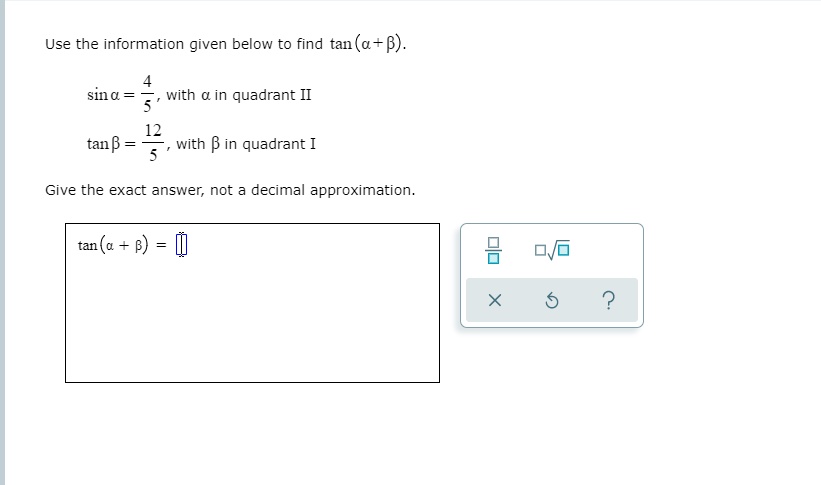
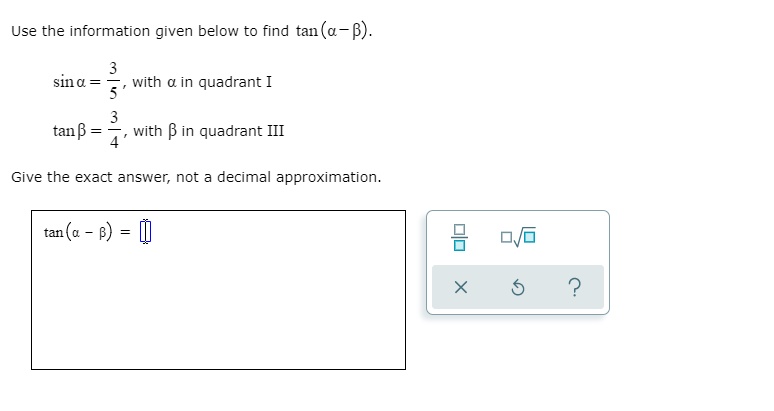
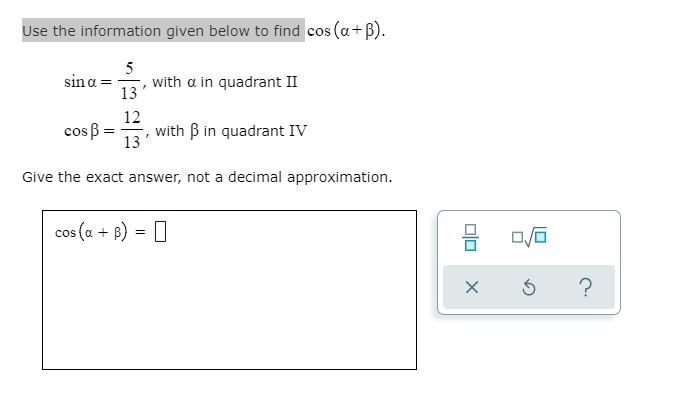
 wintry tundra
silent plank
first consider something like pythagoras
wintry tundra
silent plank
first consider something like pythagoras
definitely agree
@buoyant ibex use pythag formula
 leaden cloud
How do I draw the triangle for sin -630
-630 and 90 are coterminals right but how do u draw a triangle for that
livid moss
Draw a plane, start from the positive x axis. Go 630 degrees clockwise, and you will end up in the same place as if you went 90 degrees counterclockwise.
leaden cloud
How would the triangle look like tho
livid moss
What do you mean?
leaden cloud
cuz it is 90 degrees
livid moss
There is no triangle
livid moss
The triangle definition for sin and cos and tan only works for angles strictly between 0 and 90
leaden cloud
o I didn’t know that
livid moss
Well, yeah, you can't draw a triangle with 2 90 degree angles
tiny snow
livid moss
Well, yeah, you can't draw a triangle with 2 90 degree angles
(on a sphere you can)
 stone skiff
Oh didnt see this is chat, if anyone can help

 versed river
is that meant to be y=3sin(2t)
upper karma
 dark sparrow
okay
upper karma
What do i do
upper karma
No
dark sparrow
ok
if instead of the arc you were asked to find the length (ie circumference) of the whole circle
would you be able to do it?
upper karma
No
dark sparrow
so you don't know how to find the circumference of a circle?
dark sparrow
there we go
yes, that's the circumference formula
now look back at your problem
your arc has a measure of 45°
upper karma
yh
dark sparrow
how many degrees make a full circle?
upper karma
360
dark sparrow
great, so this means that your arc is 45/360 of the circle.
or to put it simpler
your arc is 1/8 of the whole circle.
dark sparrow
you got 0.125, evidently by simply typing 1/8 into a calculator with little to no thought.
your arc is 1/8 of the circumference.
upper karma
Huh
dark sparrow
why do you think i was asking you about the circumference? just for fun?
upper karma
No lol
dark sparrow
there are two quantities that matter here:
- the circumference of the circle, bc you know how to find it (as you just confirmed)
- the length of the arc, bc you're asked for it
and i just told you, in as clear language as i could manage, the relationship between the two.
upper karma
So its 0.125?
dark sparrow
okay, so i guess this needs to be spelled out explicitly.
find the circumference of the circle first.
as an intermediate step.
the circumference will not by itself be the answer to your problem. but it'll enable you to find the answer.
upper karma
erm
dark sparrow
and don't give me a decimal this time.
upper karma
Eo 64