#geometry-and-trigonometry
1 messages · Page 346 of 1
 lethal sigil
 near imp
so this is something new we are learning today and i’m still trying to understand how to go about solving this


 trim breach
near imp
so this is something new we are learning today and i’m still trying to understan...
trim breach
near imp
so this is something new we are learning today and i’m still trying to understan...
The question is just applying those definitions, really. Have you studied the graphs of trigonometric functions yet?
near imp
trim breach
The question is just applying those definitions, really. Have you studied the g...
not really i have the notes but no proper explanation on what i’m suppose to do this is the first day we’ve done this
i think whats really throwing me off on this equation is the numbers in the graph for some reason
trim breach
Along the x-axis, that is actually pretty standard. If you Google the graphs of f(x) = sin(x) and f(x) = cos(x), you might be able to get a feel for how the graphs look and how to apply some of the terms.
near imp
hm ok i see what you’re saying!
trim breach
Cool…just ping me back if you get stuck or have any questions!
near imp
ok thank you for your amazing help!!


 abstract prairie
man
 meager karma
do @.helpers
 wintry tundra
circles are hard im sorry ;-;
meager karma
can u help with this real quick

i just wanna know if i set it up right and how i would solve that 🧍♂️
wintry tundra
U set it up right
meager karma
wintry tundra
U set it up right
how would i solve it
wintry tundra
That's what I'm trying to see
meager karma
would u do 360/2 to find the base of one of the triangles
meager karma
o
wintry tundra
Ur learning trig?
meager karma
yeah
meager karma
okok
wintry tundra
Alright so first u need to find the supplement of the sum of the angles of depression
meager karma
huh
wintry tundra
Do u know how to do that
meager karma
noo we’re learning ab the law of sines and cosines so i think i have to use that
it’s easy but my brain is dumb so
wintry tundra
Nah ur fine
Some people either don't get math off the bat or didn't get taught an optimal way so don't beat urself up
Anyways let's break down what I said
wintry tundra
What are the angles of depression
meager karma
the 72 and 40 degrees
meager karma
so 112 degrees
 tiny snow
wintry tundra
What are the angles of depression
tiny snow
wintry tundra
What are the angles of depression
It's what you get when you evaluate the root of evil 😉
wintry tundra
tiny snow
It's what you get when you evaluate the root of evil 😉
Fair enough
Alright so what is a supplement @meager karma
With respect to geometry of course
meager karma
i have no idea 🏃♂️🏃♂️
wintry tundra
Oh
meager karma
HAHA i don’t remember
wintry tundra
Well a complement is an angle measure that makes another angle 90 degrees or pi/2 radians
meager karma
ok then
meager karma
okkkk
wintry tundra
So now find the supplement in degrees of the sum of the angles of depression
meager karma
bruh
wintry tundra
Find the supplement of 112
meager karma
68?
meager karma
yes
meager karma
ok how
wintry tundra
Do u remember interior angle and alternate angles and all those
wintry tundra
Yeah its needed here
So because we want to find how high the blimp is, we can say that the blimps height and the ground are parallel
meager karma
yes
wintry tundra
Aka the blimp is not approaching the ground or getting higher from the ground
So I want to find the rightmost angle on the big triangle
Post the hw again for me
 wintry tundra
Alright so let's say the side of the triangle that the 40 is by is infinite and is crossing both the height and the ground
Then there would be even more angles
meager karma
ya so what do we do
wintry tundra
So this is what would happen with the side

We want to find the angle with the ? by it
meager karma
so alt angles for both 72 and 40
wintry tundra
Yeah
meager karma
ok
wintry tundra
Alt int angles
meager karma
so the angle on the left would be 72 and the right 40
wintry tundra
👍
meager karma
yess so now what
wintry tundra
Now we can split the 68
So u need to find the complement of 40 and 72
Complements my bad
So the comp of 40 then the comp of 72
meager karma
very nice
meager karma
so which triangle do u wanna use to solve how high the blimp is
wintry tundra
Doesn't matter
Whatever works
But let's use 40 degree triangle bc why not
Alright so do u remember the law of sines?
meager karma
uhh yes
wintry tundra
Nvm we are good
Well we have every angle we need so we can use the law of sines
To get the sides
So what angle side pair do we have
meager karma
it would look like this right

 wintry tundra
Looks fine to me
Anyways there's only one angle and side that are opposite each other
meager karma
uhhh
wintry tundra
What are they?
meager karma
bruh idk wouldn’t there be multiple that are opposite of each other
wintry tundra
Nah bc there's only one side that we know of
meager karma
so would it just be the 68 degrees and 360
wintry tundra
Yep
So we want to find the hypotenuse of the 40 triangle
What angle on the big triangle is opposite to that hypotenuse
wintry tundra
On the small triangle yes
meager karma
ok
wintry tundra
On the big triangle no
wintry tundra
Yep
wintry tundra
So use law of sines now
meager karma
so wouldn’t that be x/sin72 and 360/sin68 or am i dumb
wintry tundra
Man I'm excited to take trig next year with these kinds of problems
meager karma
why are u excited 😭😭
wintry tundra
Bc I've already self studied this year so I can breeze thru the class
But what did u get for x
wintry tundra
Yep
And don't turn that into decimals
Just keep it like that
So we can be more accurate
But now it's time for the last step
meager karma
wait so it’s 369.27
wintry tundra
Yes but don't turn it into that yet
wintry tundra
It's less accurate
meager karma
so what do we do now
meager karma
ok
wintry tundra
So now we want to find the height which you can use the law of sines for
wintry tundra
( sin(72)360 / sin(68) ) / sin 90 = x/sin(40)
Also yeah we did
The 40 triangle hypotenuse
meager karma
1
wintry tundra
Mhm
meager karma
ok so what does that last step do 🏃♂️
wintry tundra
Get the answer
wintry tundra
Don't turn it into decimals
meager karma
o
wintry tundra
Keep it as fraction
Only turn the answer into decimals
Do u know what to do for the answer?
meager karma
oh sorry there was a police man at my door LMAO
meager karma
wintry tundra
Do u know what to do for the answer?
woukd it be 237.36
wintry tundra
It sure would
wintry tundra
No problem
 vivid schooner
I see congruence because of reflection and the sides of both triangles which I thought was -ss ; not enough info- but the correct answer was -sss congruence-. how?

 silent plank
the triangles share a common side
 upper karma
Any one willing to help me w these?

 vast python
Use Gaussian Elimination can someone walk me through this

 dark sparrow
,rccw
 somber coyoteBOT
 dark sparrow
okay so @upper karma @vast python one of you will need to move out of this channel
upper karma
Oh.. why?
dark sparrow
you posted your questions within minutes of each other
and presumably you both want help
but having that happen in one channel won't do
vast python
I’ll leave then
dark sparrow
just go to another channel, there's no need to leave the server outright lol
dark sparrow
upper karma
Any one willing to help me w these?
okay so with this
which problem number would you like to start with?
upper karma
oh but i fuigured out 9 and 10
upper karma
dark sparrow
so you've done 5 and 6 already, yes?
yea
dark sparrow
okay
the concept's the exact same here.
get the slope of your line by using its perpendicularity to the given line, and then pin down the y-intercept by using the point.
is something giving you trouble in number 7 that didn't come up in 5 or 6?
upper karma
dark sparrow
is something giving you trouble in number 7 that didn't come up in 5 or 6?
yea
dark sparrow
okay, what is it
upper karma
oh shoot nvmm i saw what i did i pinned it wrong which got me whole nother answer
upper karma
well tyyy
dark sparrow
anything else?
upper karma
nope im good😀
dark sparrow
ok
upper karma
hi
near imp
i think i’m overthinking it again but can someone help me with this problem (there’s more like this but this is just one of them i don’t wanna ask for too much)

 dense perch
We know it goes from -pi to 3pi
So the period is 4pi
Since it goes 4 to -4 on altitude... the amp is 8/2 or 4
Btw B would be 2pi / 4pi, or 1/2
Hope that helps!
Ping me if you don’t get it por favor, and I’ll try to help
near imp
dense perch
Ping me if you don’t get it por favor, and I’ll try to help
hm ok i got what you’re saying it makes total sense thank you so much!! this confuses me quite a bit you’re a really great help !!
dense perch
Np
near imp
i have 2 more equations like this if it’s alright can you help me with them as well?
near imp
here they are lol

 dense perch
Alright, so amplitude is always (highest point - lowest point) /2...
So the first one goes from 1/2 to -1/2
A distance of 1
Divide that by 2 and you have the amp
For period, we know it goes pi/8 increments
So it’s distance is 4pi/8 when we count
And B would hypothetically be 2pi /(4pi/8)
near imp
hm ok so with the amp would it be 1/2 since we divide the distance by 2?
dense perch
Yes
near imp
ok got u
dense perch
Do you want to try the amp for the second one?
near imp
i can try!
dense perch
What do you think it is?
near imp
i want to say it’s a decimal or fraction because of where it is located where it’s increasing
dense perch
First: find the max and min values:
That would be 2 and -2
We then subtract: 2 - (-2) = 4
And the amp is 4/2 = 2
near imp
oh ok i get what you’re saying
dense perch
Then, for period...
Increments of pi:
We go from 1pi to 5pi
The period would be 4pi as a result...
And B would hypothetically be 2pi/4pi = 2
Do you think you get it?
near imp
so the period in the end would be 2
dense perch
No...
Have you learned the equation for these problems yet?
If not Dw about “B”
Your answer is 4pi
dense perch
Nah lol, your good
It’s really confusing sometimes
You’re definitely not the only one
near imp
yeah it is lol but i get what you’re saying thank you for the help!
dense perch
Np, if you have more questions, feel free to ping me
 woeful gyro
Plz,backup. before i go crazy. How do i go about calculating the angle PQR
 tiny snow
Like we said in another channel...
dark sparrow
you can just calculate all sides of triangle PQR and apply the law of cosines
tiny snow
^ that
woeful gyro
to calculate RP hypotenuse id need an angle to work with? same for hypotenuse QP?
should i just assumed 90 degrees or what
dark sparrow
this whole shape is a prism, is it not?
so presumably the front and right faces are both rectangles
dense perch
woeful gyro
to calculate RP hypotenuse id need an angle to work with? same for hypotenuse QP...
Do you know how to solve for an angle given two sides of a triangle?
woeful gyro
ok if thats the case, i got RP to 12.8cm and QP to 15.6cm
i know how to solve angles for 3 sides no angle and 2 sides 1 angle.
dense perch
Basically, we know all the sides of the face (triangle on the top)
So use trig to find angle QR”X” on the face
dark sparrow
do you really need that tho
dense perch
Use the 180 degrees in a triangle rule to find RQ”X”
dark sparrow
all you need is the length of RQ, which is just sqrt(12^2 + 8^2)
dense perch
dark sparrow
do you really need that tho
Aren’t we solving for an angle or something?
dark sparrow
yeah but not the one you were talking about.
woeful gyro
yes, angle PQR
dense perch
Oh lol, my bad, I just woke up
woeful gyro
soo assuming my calculations for RP and QP is correct. how to i find myself an angle to work with/ the last side
dark sparrow
dark sparrow
all you need is the length of RQ, which is just sqrt(12^2 + 8^2)
see here
woeful gyro
what u do there tho? p^2=12^2+8^2-2* 12*8 *cosp?
woeful gyro
oh, right.
dark sparrow
after that, your angle is just $\arccos(\frac{RQ^2 + PQ^2 - RP^2}{2 \cdot RQ \cdot PQ})$
somber coyoteBOT
Ann
 woeful gyro
gotcha cheers, the the figure itself makes me confused xd
 dark sparrow
lets see...
it appears that your only problem is rounding when you weren't asked to
x should be 10/3, which is not equal to 3.30 exactly.
silent plank
problem is 4*8 = 32 not 24
 lament shell
yeah im dumb lol
 trim breach
 dapper bronze
Need help
dapper bronze
Need help
It’s a rhombus. There is a property of diagonals that makes the triangles solvable.
 candid forge
Can someone explain why e^iθ= cosθ+isinθ intuitively? I understand the proof using Taylor series but I would like a more geometric approach
I don’t if this is the correct channel to ask that
 keen abyss
Try watching 3b1b s video it's pretty nice
keen abyss
dapper bronze
Someone help
It's just 2ABE use pythagoras and inverse trig it's pretty simple
 wraith cargo
 trim breach
wraith cargo
trim breach
wraith cargo
Those are similar triangles in 10 since two angles between them are congruent. You can set up a proportion knowing this fact.
And 11 is an angle bisector problem where you can set up a proportion to solve for x.
wraith cargo

 fickle geyser
trim breach
fickle geyser
trim breach
Someone here can help, so you can just post your question.
 lofty granite
anyone available?
dark sparrow
no clearly nobody is ever available on this server which hasnt been posted to in 10 years (/massive sarcasm)
post your question.
 lofty granite
is the formula not a^2 + b^2 = c^2?
lofty granite
ooh
dark sparrow
you want the opposite of squaring.
 mint dune
~yes~
mint dune
at least you're asking questions
 fickle prairie
Hey everyone! I'm stuck with an analytic geometry problem.
Given that VABC is a tetrahedron where AB = AC = BC = a, VA = VB = VC = b, b>a, I have to prove that (VA x VB) x VC = ( (2(b^2) - a^2 ) / 2) AB
mint dune
fickle prairie
Hey everyone! I'm stuck with an analytic geometry problem.
Given that VABC is a...
you've written c and b in different places
fickle prairie
Indeed, thank you.
lofty granite
 fickle prairie
Hey everyone! I'm stuck with an analytic geometry problem.
Given that VABC is a...
fickle prairie
fickle prairie
Hey everyone! I'm stuck with an analytic geometry problem.
Given that VABC is a...
I have used the triple product expansion formula but I am stuck at the trigonometry part of this...
lofty granite
is 19.03 correct? im not sure if i did it right
mint dune
fickle prairie
I have used the triple product expansion formula but I am stuck at the trigonome...
are those vectors or lengths
fickle prairie
What I have so far is:
(b^2 cos(VA,VC)) VB - (b^2 cos(VB,VC)) VA
I have to prove for vectors, but the given data is for lengths
I don't know how to indicate vectors here

And I have to prove this


Sorry about the bad image quality.
lofty granite
can someone explain how i got the answer for X as 25.45 but it says its 18 square root 2 which is literally the same answer
upper karma
can someone help me with this
 upper karma
lofty granite
upper karma
lofty granite
 lofty granite
upper karma
lofty granite
upper karma
very appreciated. but i dont understand where the 2 square root comes from
fickle prairie
It comes from the same theorem
Think of it like this: a^2 + b^2 = c^2. In your case c is 10, and X takes the place of either a or b, but in this case of both, because of the 45 degree angle
This makes it 2 * a^2 = c^2
And now extract square root from both sides
Now you have square root 2 * a = c
And thus Heisenberg's answer follows
upper karma
lofty granite
very appreciated. but i dont understand where the 2 square root comes from
dude that's a rule

 onyx knot
How would I solve this

 wise hornet
what have you tried
wise hornet
onyx knot
How would I solve this
oi
 woven haven
onyx knot
How would I solve this
woven haven
onyx knot
How would I solve this
46/13= 3.538...
3.538...*5= 17.69230...
Round to the nearest 100th: 17.70
 upper karma
this is chemistry but anyways.
can you think of what 28% of Na, 32% of Cr and 40% of O means with respect to the mass of each component? any ideas?
 storm portal
@fallow ruin ^^
upper karma
Can anyone help

 trim breach
upper karma
trim breach
upper karma
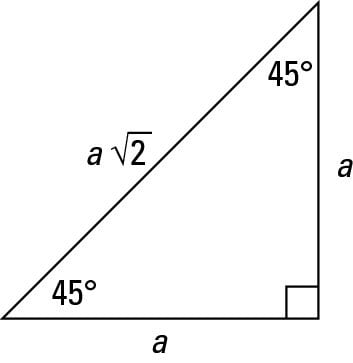
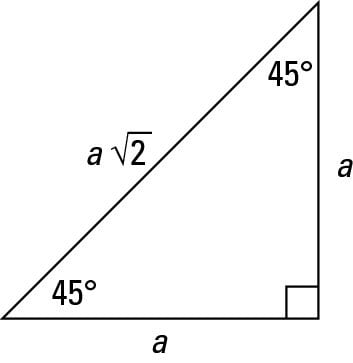
In a 45-45-90 triangle, the Pythagorean Theorem essentially is 2(a^2) = c^2.
And since it is 45-45-90, both legs are equal length.
 upper karma
Tysm!
lofty granite
is anyone able to hop in a vc and help explain this math problem to me?
 proven moat
someone help me please
 trim breach
proven moat
someone help me please
trim breach
proven moat
someone help me please
Use Pythagorean Theorem to solve for y.
 grand widget

 fickle prairie
Can someone help with university analytic geometry? I posted a problem yesterday but I'm still stuck with it
dense perch
For anyone looking to help laszlow, this was his question: Hey everyone! I'm stuck with an analytic geometry problem.
Given that VABC is a tetrahedron where AB = AC = BC = a, VA = VB = VC = b, b>a, I have to prove that (VA x VB) x VC = ( (2(b^2) - a^2 ) / 2) AB
PS: I have no clue how to answer this lol. Gl
 silk patio
Is that a cross product?
 lyric quest
trisecting an angle with straightedge and ruler
how do i do it for acute angles where it is possible
dark sparrow
straightedge and ruler?
dark sparrow
is it even possible for any acute angles
dark sparrow
so it boils down to constructing an angle of 15 or 9 degrees respectively
lyric quest
well thats my issue really
is it truly a trisection to construct an angle
because if it is, 45 degree trisection is easy
simply impose an equilateral triangle onto it
dark sparrow
trisection in the general case is impossible
dark sparrow
so thats all you can get
lyric quest
like i am not even using the 45 degree angle to trisect
i am just double bisecting a 60 degree angle
 weary barn


 feral plank

Geometry pre test lol
I missed a couple weeks due to a few personal reasons and my teacher wont help me setup a date after school or sometime to catch up
 waxen glen
feral plank
I missed a couple weeks due to a few personal reasons and my teacher wont help m...
waxen glen
feral plank
I missed a couple weeks due to a few personal reasons and my teacher wont help m...
do you still need help
feral plank
yeah lmaoo
waxen glen
hah okay lol
feral plank
im so stuck im trying khan academy shit dont work for me D:
waxen glen
do you know what is similiar triangles
waxen glen
what does similiar mean
waxen glen
do you know what is "K number" in the similiar triangles
feral plank
tbh no 😓
waxen glen
okay lets start from what is ismiliars
so similiar triangles' chosen side's ratios are always same
and ratio is showen with K letter
feral plank
yeah
feral plank
ah yeah
waxen glen
can u say which sides are similiars in your question
feral plank
okay
waxen glen
can you say that AB side and A1C1 sides are similiar?
 waxen glen
no it is not, similiarity is ratio between chosen or right sides/heights
so AC and A1C1 are similiar
in similiar triangles, their angles are always same
waxen glen

as you can see, AB side is between 90 and 30 angle
A1C1 is between 90 and 60
so, they cant be similar sides
if you want to find k, just divide similiar sides/heights/medians etc
so AB/A1B1=AC/A1C1
feral plank
ab divided by a1b1 = ac divided by a1c1?
waxen glen
yes, because, ab/a1b1= k which is ratio between similiar sides
AC and A1C1 are similar sides too
so their ratio will be equal to k
i think i did it a bit messy lol
waxen glen
oh yes lol
like, why humans write ÷ ? it looks like + and actually it is a bit different than normal divide "/"
 light fable
waxen glen
like, why humans write ÷ ? it looks like + and ***actually*** it is a bit differ...
light fable
waxen glen
like, why humans write ÷ ? it looks like + and ***actually*** it is a bit differ...
The symbol ÷ is a fraction where the numerator and denominator are unknown (dots)
waxen glen
there are more difference between / and ÷
light fable
how so?
waxen glen
their solving order are a bit different
dark sparrow
nobody uses ÷ outside of primary school
also you are NOT going to pull out this 6÷2(1+2) shit
 light fable
@waxen glen I believe they're exactly equivalent down to how they're used
waxen glen
yes'nt
light fable
and yes, ÷ is less common in professional math contexts, but there are some times it could be preferable
waxen glen
dark sparrow
also you are NOT going to pull out this 6÷2(1+2) shit
can i use 6÷2(1+2) shit for explaining p-please
light fable
dark sparrow
are fractions not good enough for you
Fractions are great but you don't always want to have to break out of normal line size
dark sparrow
then put parentheses in such a way that your expression is unambiguous.
light fable
you don't have to tell me
 fair locust
waxen glen
can i use 6÷2(1+2) shit for explaining p-please
fair locust
waxen glen
can i use 6÷2(1+2) shit for explaining p-please
is the answer to this not 9? [ like (6÷2) ×(3) = 3×3 =9 ]
or is it somehow 1 because 6 ÷(2×3) =6÷6=1 for some reason
dark sparrow
the whole point is that it's ambiguous as written.
fickle prairie
silk patio
Is that a cross product?
Yes
fickle prairie
fickle prairie
I have used the triple product expansion formula but I am stuck at the trigonome...
.
fickle prairie
fickle prairie
.
 smoky yew
hi, i'm pretty new here :)) i can solve this thing but it will take too long for me to type in each value. Is there any practical solution for solving this types of things?

 sharp plume
You need to write it summation form?
smoky yew
there is no instruction about that but if i need to, i will... my teacher isnt that strict about methods
as long as the correct answer is given
and im still in grade 9 so i might not understand a lot of stuff :<<
silent plank
consider some properties of sine
sin(x) + sin(360° - x) = 0
sin(x) + sin(180° + x) = 0
and/or the locations unit circle.
you should see that there will be a lot of cancellation
smoky yew
thank you :)) will update later if i struggle xD
tiny snow
How would you go about proving that something can be inscribed in an ellipse? Five points, foci, something else?

Fiddling with the construction can be done here: https://www.geogebra.org/geometry/ttkza5zj
Some kind of projection? A "skewed" hexagram looks like a regular hexagram seen in three dimensions from a perspective.
Maybe not, it can become quite elongated...
dark sparrow
do circles not become ellipses when seen in 3d perspective?
tiny snow
I think so.
I suppose that if I can find the projection that takes an ellipse to a circle it should take each vertex point to 60 degrees apart, and then we're done, but I am not so sure that is the simplest way.
That's also given that my hunch about the perspective is right.
silk patio
It reminds me of the reflection property of the orthocentre across a side
Are angle bisectors persevered under projective transformations? 🤔
Surely not
tiny snow
But I can by continuous movement of the point A transform that thing to a regular hexagram on geogebra, while all the bisectors remain bisectors.
 tiny snow
No, I think trilinear coordinates may be a way forward, as mentioned here: https://en.m.wikipedia.org/wiki/Steiner_ellipse

In geometry, the Steiner ellipse of a triangle, also called the Steiner circumellipse to distinguish it from the Steiner inellipse, is the unique circumellipse (ellipse that touches the triangle at its vertices) whose center is the triangle's centroid. Named after Jakob Steiner, it is an example of a circumconic. By comparison the circumcircle ...
silk patio
Bashing won’t give you a vivid solution
This reminds me of the incircle-excircle lemma if you’ve seen that
I figured it out. It’s a generalisation of the 9 point circle
The same construction works for any point, the angle bisector condition is redundant
 mighty shell

I understand the working out, but I keep getting the wrong answer. How do I put the right equation into my calculator? It keep giving me a totally different answer
That’s the answer, when I put what h equals to it’s giving my a different number
mighty shell
Nvm
tiny snow
silk patio
I figured it out. It’s a generalisation of the 9 point circle
Thanks, I’ll look into that tomorrow. Are some of the same points sufficient to determine the ellipse, or did you mean something else when you said generalization?
silk patio
Yeah 9 special points are on the ellipse. Pick a point P inside the triangle. Draw the ellipse through the midpoints of AB AC and BC as well as the midpoints of AP and BP and you’ll see it passes through the midpoint of CP as well as the intersection of AP and BC, intersection of BP and AC, intersection of CP and AB

 humble narwhal
<@&286206848099549185>
 waxen glen
@feral plank if triangle's chosen sides' ratios are same, then they are similiar
feral plank
I already turned it in man dont waste ur time
 dark sparrow
is this a test 
feral plank
pre test
the "1 point" thing is added up, like an actual test, but it goes to the hw category for our grade.
dark sparrow
okay
feral plank
I was wrong actually, it goes into the review category for my grade
dark sparrow
anyway
do you still need help with this question
i know it's been like half an hour
feral plank
yeah lol
dark sparrow
sorry for the delay on my end
ok
do you know what the midsegment of a triangle is
feral plank
yea
feral plank
i used to be good at them but like kinda forgot the stuff bc i havent done it in so long
dark sparrow
bruh
feral plank
this is last chapters stuff
lmao
i failed the test but this should help it
i mean my grade anyway
reviews are like 30 or something %
dark sparrow
nice question dodge
dark sparrow
no
feral plank
add each angle and it equals that distance?
feral plank
lol uh i thought thats what it was
dark sparrow
the midsegment connects the midpoints of two sides
dark sparrow
in any case, triangles ABC and DBE are similar, with a scale factor of 2
dark sparrow
no the answer isn't 2
just because i said the number 2 somewhere doesn't mean the answer to your problem is 2

feral plank
lol welp im dumb what can i say
i was kinda confused bc u said scale factor but thats not really the thing
the type of solving its asking
i mean
dark sparrow
one triangle is half the size of the other
feral plank
oh yeah lol
i see that now
LOL how the fuck did i not see that before
oml im special
yeah that makes sense
silent plank
is it just me or is the diagram over specified
silent plank
the angles don't seem the match the values of the sides given that DE is the mid seg
dark sparrow
why not? angle C could be 72 degrees, and angle EDB could be 63 degrees
and angle B = 45°
feral plank
so is x 45 ?
dark sparrow
bruh what the hell
dark sparrow
i was not even talking to you, i was addressing ramonov's doubt about the angles
feral plank
ik
dark sparrow
how about you actually read the messages i am sending instead of plucking a number i said out of context and asking me whether that's the answer
4 234 45367 2342 2345623 324565344 6574536345 345345 3223453 464654562 345624579 454569 223463458 42069
9919299135825 32838383548 232234 01341012049 56934596394593 220342 65534
hymnth
triangle DBE is literally the same as triangle ABC but shrunk by a factor of two
idk what else to tell you
feral plank
aight
dark sparrow
if this isnt enoyugh for you to find the length of DE
then maybe you need to review similar triangles
instead of making me majorly upset like you just did
silent plank
based on the length of sides, wouldn't the angles work out to be around: ||~55.7°,~41.4°, ~82.8°||
feral plank
if u got upset bc im retarded ...
dark sparrow
there was no need to call yourself a slur
 copper marten
feral plank
if u got upset bc im retarded ...
copper marten
feral plank
if u got upset bc im retarded ...
if u still need help here's the explanation:
they are similar triangles and the mid segment is DE, that means CE and EB are the same and AD and DB are the same. 5+5 is 10 which is one side of the triangle ABC and 5 is the length corresponding to 10 of triangle DEB
therefore we can divide the corresponding side lengths to get the scale factor:
10/5 = 2
since we now know the scale factor is 2, then we can find x
what is the corresponding side length to x? it's AC which is given the value of 8.
the scale factor is 2, so divide 8/2 which gives you 4
x = 4
hope that helped 
feral plank
thank you
copper marten
no prob !!
feral plank
it did
copper marten
yay :))
feral plank
little confusing but ill reread for the next couple to figure them out
copper marten
ok if you have any questions then just @ me or something lol
feral plank
yes i will tysm
 hidden oracle
VECTOR
 safe canyon
One message removed from a suspended account.
One message removed from a suspended account.
 vapid stag
hey if tan x= 1/3 and tan x = sin x/cos x. This means sin x = 1 and cos x = 3 right?
silent plank
no
vapid stag
well shit
i just messed up my mid term question then
how was i suppose to tackle this if not?
silent plank
draw a triangle,
apply pythagorean identities
 next flower
how would i solve for z and y. ive solved for X it is 16.2 but i dont know how to solve for z and y
 storm portal
@vapid stag not necessarily
storm portal
next flower
how would i solve for z and y. ive solved for X it is 16.2 but i dont know how t...
you have to use similar triangles
i think you also have to assume that the angle made with side x and side y is a right angle
 steel sage
Help?
 upper karma
help too? lol
 trim breach
steel sage
Help?
trim breach
steel sage
Help?
The problem gives you the range of the function, which is [4, 10], and the time span it takes to reach low tide from high tide.
Knowing that high tide would be 10ft, and low tide, 4ft, you should be able to produce a wave function.
 covert ridge
 copper marten
next flower
how would i solve for z and y. ive solved for X it is 16.2 but i dont know how t...
copper marten
next flower
how would i solve for z and y. ive solved for X it is 16.2 but i dont know how t...
similar triangles and find the scale factor
 tender grail
am i able to ask questions for geometry here?
copper marten
tender grail
am i able to ask questions for geometry here?
yep !
tender grail
ok thanks
so basically ive been working on flow charts a bit ima send a pic of the problem

all ive really gotten written down is the basic parts like whats given
i was hoping to get some help on solving this
copper marten
im rlly bad at writing proofs so um .... if u dont get a response from someone then @ the helpers tag after 15 minutes
tender grail
ok thanks
woven haven
next flower
how would i solve for z and y. ive solved for X it is 16.2 but i dont know how t...
find the ratio of the two right triangles
So 6/15= 0.4
And then 0.4 * 16.2: y
0.4 * 6 : z
tender grail
<@&286206848099549185>
 dim plaza
does anybody know how to

I need to prove that the triangle AEF is isosceles. DA and FX are parallel
AD is also the bisector of the angle BAC
dim plaza
wait I think I got it
I basically cut AD and FX with the transversal AC so DAC = AEF and then cut AD and FX with the transversal BF and BAD = BFX
no idea if it's correct though
should be
trim breach
tender grail
i was hoping to get some help on solving this
Do you still need help?
tender grail
trim breach
Do you still need help?
yes please!
trim breach
Because of the givens, you can assume that RS is congruent to QT.
tender grail
ok i got that part so far, but i was unsure of the "official" reasoning
i wrote cpctc as the reason
is that ok or should i change that?
trim breach
Hm…I am not certain what you would write in the proof for that lol.
It’s been a while.
tender grail
ah no worries
tender grail
im a bit confused what you mean by that
trim breach
Basically do you know how to prove what you need to prove besides that step.
tender grail
Not really, let me grab a screen shot of what ive done so far, its really basic

sorry one second
that was my previous one

heres the newer one
trim breach
So you have proven two sides of SQR and TRQ congruent.
And we know triangle PRQ is isosceles.
tender grail
ah ok
trim breach
Well, you’d need to document that RQ is congruent to RQ by reflexive.
tender grail
ok one second
sorry how would i write that? would it just be rq is congruent to rq by reflexive or is it something else
trim breach
The actual property is called the Reflexive Property of Congruence.
tender grail
ok thanks
trim breach
So now we have two sides of them congruent.
tender grail
ok
since you know RS=QT and PS=PT would you be able to prove they are congruent from that?
trim breach
You need one more thing.
tender grail
ah ok
trim breach
You have two sides.
tender grail
PR and PQ?
trim breach
Yes. There is a way to prove the angles in that larger triangle are congruent.
Angles PRQ and PQR
tender grail
Im not sure of the proper way to say it but
woudlnt it be because it is an isosceles
and the bases are equal as well as the legs
trim breach
Yep. The Isosceles Triangle Theorem.
tender grail
Ok so I should add that onto the chart right?
trim breach
Yep!
trim breach
So your next statement should be about the triangles you just proved are congruent.
tender grail
PRT and PQS?
trim breach
No.
tender grail
which ones would that be then?
trim breach
This is what you have.
 tender grail
Yeah
trim breach
Those angles are in the triangles SQP and TPQ.
Because we only know that the largest triangle is isosceles.
PRQ.
tender grail
in the screen shot you sent there is p on the triangle twice, which one are you referencing
tender grail
lol all good
trim breach
Bottom left should be R.
trim breach
It doesn’t matter what order when you talk about triangles.
Only angles order matters.
tender grail
ok
I think we are good
it seems pretty simple from here I was kinda struggling with the begining
I appreciate all the help
trim breach
Cool. Ping me back if you get stuck or have a question.
tender grail
ok thanks!

 wicked grove
 tardy surge
Hey guys anyone able to how me with a trigonometry question ?
tardy surge
Hey guys anyone able to how me with a trigonometry question ?
do you have the actual diagram
 tired pine
tardy surge
tired pine
tardy surge
Try connecting some points to create simpler figures
tiny snow
I believe this was given the necessary attention in one of the question channels earlier (cross-posted).
dark sparrow
alright so i got a bit of a weird question here
it's not that i don't know the solution, i'm just blanking on how to find it without coordinate-bashing
pic incoming
ABCD is a rectangle, BD = 7, AB = 4, show that BX = 3
 upper karma
sick drawing
dark sparrow
thanks i made it in 40 seconds in ms paint
silent plank
similarity?
upper karma
BX = 3
dark sparrow
excellent, this fills the gap in my student's 3d geometry problem.
upper karma
Does anyone know how to do proofs?
Not paragraph form. My teacher makes us do statements and reasons
 willow bramble
@tiny snow : Is it IM that is == 5 ? or IJ ?

 trim breach
upper karma
Can anyone explain how to do this to me?
trim breach
upper karma
Can anyone explain how to do this to me?
Do you have a specific question in mind that needs solved? You posted completed proofs, so do you just need the logic explained on those ones?
Either way, if you really don’t understand it, it might be something you want to set aside a block of time to go over with someone.
near imp
can someone please help me on this if possible
 storm portal
@near imp start with a diagram
near imp
i got everything figured out! except the function
near imp
can someone help me with these problems please


 copper marten
use sohcahtoa and sum of angles
trim breach
near imp
can someone help me with these problems please
The first one you can find angle Y easily since there are 180 degrees in a triangle. You just find the sides by using trig ratios.
Well, actually, all of the problems posted make use of trig ratios.
Except Question 2, which can be solved using an easy shortcut with Pythagorean Theorem.
near imp
trim breach
Except Question 2, which can be solved using an easy shortcut with Pythagorean T...
i don’t believe my teacher taught us how to solve that way
near imp
oh wait nevermind i got number 2
 wanton phoenix
What about law of Sine for Q2 for Q3 since it’s a 45 45 90 there is a pattern
The hyp is usually the adj side with root 2
near imp
ok i got the answer for question 2
trim breach
Good.
wanton phoenix
Sry I meant for the last question in the order that it was given sry
near imp
oh don’t worry lol!
wanton phoenix
Yeah so for Q3 just use law of sine
near imp
ok i got the answer for Q3
wanton phoenix
Cool cool
near imp
and i got Q3 now i just need the first problem
 rough grove
i need to simplify (sin x + tan x)/(1 + sec x)
i've tried everything I can think of, I can't simplify it
i know I'm just overlooking something - I really need an answer because I couldn't find anything anywhere on the internet
 trim breach
 sweet dew
Can someone please give me and explanation
sweet dew
Can someone please give me and explanation
Plug 5 in for d since it was five days later that it doubled. Basically, that second factor should equal 2, since the population doubled to 20,000.
In the correct choice, the second factor does simplify to 2 with the properties of exponents.
 torn tundra
how do i solve this? i tried it 5 times with the formula my teacher gave me and it didnt work
 trim breach
torn tundra
how do i solve this? i tried it 5 times with the formula my teacher gave me and ...
trim breach
torn tundra
how do i solve this? i tried it 5 times with the formula my teacher gave me and ...
Because those are two tangents, the measure of arc JL is double the measure of angle JKL.
You can set 2(mJKL) = mJL.
Solve for x, then the rest is straightforward.
tiny snow
Alright, so the problem I posted yesterday was missing two lengths, which made it have an infinite number of solutions. Here's the correct problem statement. It was supposed to be a continuation of a problem that was posted here yesterday, so it's not as well placed now as it was then.
 sweet dew
trim breach
Plug 5 in for *d* since it was five days later that it doubled. Basically, that...
sweet dew
trim breach
Plug 5 in for *d* since it was five days later that it doubled. Basically, that...
Thank you so much 💜
somber coyoteBOT


 Requested by Roenbaeck#4166
tiny snow
Requested by Roenbaeck#4166
tiny snow
I mixed up a square root... now the imaginary numbers are gone.

,w y^2+3^2-z^2=2^2, l=sqrt(33)+m-z-y, m^2+x^2=7^2,(l-sqrt(33)+y+z)/7 = z/3, (l-m+z+y)/7=y/2
somber coyoteBOT
 Requested by Roenbaeck#4166
tiny snow
Requested by Roenbaeck#4166
tiny snow
So, what is the obvious solution that x = 8/3? I cannot see it...
silent plank
you could do it with trig and sine rule
tiny snow
I see how we can find <AFE, but <DHG?
silent plank
sine rule
also don't explicitly need the angles
just knowing the sine of the angles is sufficient
tiny snow
You mean this "sine rule"?
 tiny snow
Radius of the circumcircle.
In order to use that you would need actual triangles, right? That have not been truncated by the square. Would you extend EF and GH to produce these, or introduce segments HE and FG?
silent plank
no additional construction is needed
tiny snow
You'll have to give me some more info then 🙂
silent plank
you can determine sin(<AFE) from triangle AFE
from that you can determine sin(<DHG) using the sine rule (in triangle FHP)
that would also be equal to x/7
and you can then determine x
tiny snow
Ah, now I see it. Ok, let me work it out.
tiny snow
Thanks @silent plank, that was much more straightforward.

Generally $x = \frac{|AE||FP|}{|HP|}$
somber coyoteBOT
Roenbaeck
 tiny snow
So $\frac{|DG|}{|FP|} = \frac{|AE|}{|HP|}$ (nice ratio)
somber coyoteBOT
Roenbaeck

 loud wolf


I need to calculate the TSA and V of this
I was wondering what do I do with the 135 degree angle, can I convert it to mm or is there a formula or formulas I can use it in to get a more accurate Area/volume
 zenith copper
Does anybody have any idea on if you can write
$\frac{1}{2} ln(1 - x^2)$ in terms of inverse hyperbolic trig functions
somber coyoteBOT
Free Martin Shkreli
 zenith copper
$\cosh\left(\tanh^{-1}{x} \right) = \frac{1}{\sqrt{1 - x^2}}$
somber coyoteBOT
Free Martin Shkreli
 zenith copper
so
$\ln\left(\cosh\left(\tanh^{-1}{x} \right) = \frac{1}{\sqrt{1 - x^2}}\right) = - \frac{1}{2}\ln(1 - x^2)$
$\ln\left(\cosh\left(\tanh^{-1}{x} \right)\right) = - \frac{1}{2}\ln(1 - x^2)$
somber coyoteBOT
Free Martin Shkreli
 zenith copper
so ln(cosh(atanh(x)) looks suspiciously like an inverse hyperb. trig function of its own to me
because $= -\frac{1}{2} \left( \ln(1 - x) + \ln(1 + x) \right)$
loud wolf
Can anyone help me...PLEASE 🥺
somber coyoteBOT
Free Martin Shkreli
 tiny snow
loud wolf
I need to calculate the TSA and V of this
tiny snow
loud wolf
I need to calculate the TSA and V of this
If you accurately model that shape in a 3d modeling program, it can immediately give you the volume.
zenith copper
loud wolf
Can anyone help me...PLEASE 🥺
don't ask to ask please.. just ask your question
loud wolf
I know I've paid a guy on fivver to make me a 3d model. But I have to show working out on area and volume
@zenith copper I asked already
 tiny snow
loud wolf
I know I've paid a guy on fivver to make me a 3d model. But I have to show worki...
tiny snow
loud wolf
I know I've paid a guy on fivver to make me a 3d model. But I have to show worki...
So this is a math exercise, or why do you need to show calculations?
loud wolf
It's an assignment
tiny snow
That's pure evil if you have to calculate it.
loud wolf
Part A is a worksheet- done that
Part B is a 3d model of a real life object along with calculations or TSA and volume showing working out
Part C is showing your research and putting together a report/ analysis
That is about 1000 words atleast
tiny snow
Wait, so you picked this object?
loud wolf
Yes becuase anything less complicated wouldn't get me an A
I need an A to get in advanced classes so a different school will take me becuase I've gone under a large amount of emotional abuse at this one and want to leave it behind
I got jumped and they gave the people a 10 minute detention. I basically go to school in the hood 😂😂
tiny snow
I'd ask what the least complex object that would give me A would be, while explaining the problems with the current one, then switch.
loud wolf
This is set in stone...
My teacher said I don't have to use the angle and just make it straight and use the height measurement for the width to get a about right answers but I'd have to compare to the one my 3d software gives me and explain why mine has a margin of error
I just want to do the angle because I want this to be perfect
tiny snow
Tough luck. I doubt calculations would be any more accurate than what you get from a 3d program.
So school pays some other person to do the modeling work?
loud wolf
I know my 3d program will give me 100% accuracy. But I want to get almost the exact same as the 3d model software gets to prove that I know my shit
I had to pay the guy...
Plus paid for the software, I've spent about $200
tiny snow
Why not do it yourself? There's free software, like SketchUp.
loud wolf
I've already gone too far. I also have no idea what I'm doing with 3d models
I've already paid the guy and brought solid works
tiny snow
But it sounds from the assignment that you should know 3d modeling?
loud wolf
It's a maths class not a 3d modelling class
They shrug and say "lol figure it out on your own lmao"

@tiny snow will you help me?
tiny snow
I'd split it into these parts:
A - rectangular prism minus semi-cylinder
B - triangular solid prism (x 2)
C- rectangular solid prism
D - rectangular solid prism minus 4 cylinders (x 2)
Given that I understood the drawing correctly. That'll give you simple calculations and a rough estimate.

If it's hollow you'd have to do some other division, but you get the idea.
loud wolf
Me and you had a preaty simmler idea

Any pointers on the other sides?
@tiny snow how do I find the measurements of A B C
tiny snow
A B C? Measurements are in the blueprint.
loud wolf
Well A has a length of 330.21mm but how do I find the width
tiny snow
What A? What are you doing?
 tiny snow
Aha
loud wolf
For the triangles I have the hypotenuse so I just do a^2 + b^2 = c^2 right?
tiny snow
The blueprint is drawn to scale, so you can measure missing stuff directly and scale it appropriately.
loud wolf
Have to find a big peace of paper lol ight thank you for your help
 dim cliff
can someone pls help with these two swaggy questions? thank you 🙂


 finite swan
Sure, I'll try. Hold on a sec
finite swan
So for 1, you can first expand the whole thing into the base functions sin and cos: $\frac{\frac{1}{\cos^{2}x \cdot \frac{1}{\sinx}}{\frac{1}{\cos^{2}x + \frac{1}{\sin^{2}x}}}$.
Then you can simplify these into: $\frac{\frac{1}{\cos^{2}x \sinx}}{\frac{\sin^{2}x+cos^{2}x}{\sin^{2}xcos^{2}x}}$
Then you can simplify the numerator of the denominator to 1. $\frac{1}{cos^{2}sinx} \cdot \frac{cos^{2}xsin^{2}x}{1}$
If you simplify this, you will eventually get an answer of $sinx$.
somber coyoteBOT
6EQUJ5
So for 1, you can first expand the whole thing into the base functions sin and cos: $\frac{\frac{1}{\cos^{2}x \cdot \frac{1}{\sinx}}{\frac{1}{\cos^{2}x + \frac{1}{\sin^{2}x}}}$.
Then you can simplify these into: $\frac{\frac{1}{\cos^{2}x \sinx}}{\frac{\sin^{2}x+cos^{2}x}{\sin^{2}xcos^{2}x}}$
Then you can simplify the numerator of the denominator to 1. $\frac{1}{cos^{2}sinx} \cdot \frac{cos^{2}xsin^{2}x}{1}$
If you simplify this, you will eventually get an answer of $sinx$.
```Compilation error:```! File ended while scanning use of \frac .
<inserted text>
\par
<*> 272412535410393098.tex
I suspect you have forgotten a `}', causing me
to read past where you wanted me to stop.
I'll try to recover; but if the error is serious,
you'd better type `E' or `X' now and fix your file.``` finite swan
oof
wait
So for 1, you can first expand the whole thing into the base functions sin and cosine.
$\frac{\frac{1}{cos^{2}x} \cdot \frac{1}{sin x}}{\frac{1}{cos^{2}x} + \frac{1}{sin^{2}x}}$
Next, you can combine both the numerator and the denominator into one fraction.
$\frac{\frac{1}{cos^{2}x sin x}}{\frac{sin^{2}x + cos^2{x}}{cos^{2}x sin^{2}x}}$
Then you can multiply the reciprocal of the denominator times the numerator.
$\frac{1}{cos^{2}x sin x} \cdot \frac{cos^{2}x sin^{2}x}{1}$
Finally, you can simplify and eventually get the final answer of $sinx$.
 foggy perch
For 2 you can rearrange it to get $(\sin x )^2=1/2$ so then you have two equations, $\sin x=\sqrt{2}/2$ and $\sin x=-\sqrt{2}/2$. Find the values of x in the asked interval for each, then combine both lists

 dim cliff
thank you guys! for number two tho mikey, i don’t really know how to do the interval thing could you help with that as well
dim cliff
foggy perch
For 2 you can rearrange it to get $(\sin x )^2=1/2$ so then you have two equatio...
^
foggy perch
dim cliff
thank you guys! for number two tho mikey, i don’t really know how to do the inte...
So this is kinda just looking at the unit circle, for the first equation find what values make sin x equal sqrt(2)/2 and do the similar thing for the second. You should find two values from each equation
 silk glade


 earnest echo
You can find the height of the given right triangle
And after that use Pythagorean theorem
 vestal pendant
@earnest echo and to find the height i'd need to do 40/tan 45, or do i use special right triangles
our teacher is out on leave and we have no one to teach us this unit, we were basically on our own
vestal pendant
45-45-90 triangle
vestal pendant
vestal pendant
our teacher is out on leave and we have no one to teach us this unit, we were ba...
excuse any dumb questions i make lol
earnest echo
How do you know that?
vestal pendant
true
we arent given a second angle measure
so it could literally be 90 44 and 46 for example, so i shouldnt use that
earnest echo
👍
vestal pendant
 upper karma
vestal pendant
https://media.discordapp.net/attachments/636011896528699414/826880741668683796/i...
upper karma
vestal pendant
https://media.discordapp.net/attachments/636011896528699414/826880741668683796/i...
 vestal pendant
@upper karma Already solved, and they arent looking fo simplest radical form
"to the nearest tenth of a meter"
Thanks though ❤️
 humble pulsar
upper karma
Does anyone know how to factor equations
humble pulsar
upper karma
Does anyone know how to factor equations
lots of people do
next time just ask your question
finite swan


 inland mountain
Ok thank you
finite swan
After you get the 3rd side, remember cosx = adjacent side / hypotenuse
inland mountain
Yea I did cos-1(12/20) and got 53.13
finite swan
Nope
You got the right side length
The adjacent side is 12. The hyponetuse is 20. Therefore, cosx =?
inland mountain
Uhm
finite swan
 silent plank
the question doesn't ask you to find x, nor do you need to
inland mountain
Oh so the answer is just 12/20
inland mountain
Oh thats why I was confused

So if I have to find the measurement of c would I use tan?
 obtuse tapir
yes
obtuse tapir
silent plank
to get the 3rd side
or use complementary angles???
silent plank
wdym
 storm portal
inland mountain
It would be 1 right?
storm portal
inland mountain
It would be 1 right?
👍
inland mountain
Steve is standing on a hill and his line of sight is 51 feet directly above the ground. He can see two deer grazing in the distance. If the angles of depression to the deer are 35° and 47° how far apart are the deer?
Okay so this is my homework question and I dont know how to even send up the triangle to this question
trim breach
inland mountain
Steve is standing on a hill and his line of sight is 51 feet directly above the ...
Have you drawn a picture of the situation?
inland mountain
I tried it doesnt look right