#geometry-and-trigonometry
1 messages · Page 336 of 1
 pure cape
 somber coyoteBOT
ℝamonov
 dull pendant
wooooah
a^2 + b^2 - c^2 = 0
so 2a + 1 + 2b + 1 = 2c + 1
and so 2a + 2b + 1 = 02c
pure cape
what?
dull pendant
oops*
pure cape
slow down
dull pendant
dull pendant
and so 2a + 2b + 1 = ~~0~~2c
2a + 2b + 1 = 2c
 sly marlin
therefore 2=3
dull pendant
pure cape
what?
~~a^2 + 2a + 1 + b^2 + 2b + 1 = c^2 + 2c + 1
as shown in the picture above
we know (for the first triangle):
a^2 + b^2 = c^2
which is:
a^2 + b^2 - c^2 = 0
you can rearrange the equation of the second triangle to this:~~
pure cape
no im reacting to your mistake
dull pendant
ohh okay
 silent plank
the slow down was in reference to you typing 0 instead of 2c
dull pendant
thanks all
 upper karma
Given the location of each point on this graph would there be anyway to 'guesstimate' pi? Would the amount of blue points / amount of orange points work?
 lucid sage
assuming that blue is supposed to be a quarter circle, it should actually be 4 * (# of blue points) / (total # of points)
 steep temple
When talking about the frequency of a wave, is it per 2pi radians? That's consider one cycle, right? So the frequency of sine and cos waves are both 1?
pure cape
well you were almost right
the frequency can also be calculated with period by this formula
where f is the frequency, and T is the period
steep temple
yes yes i see
pure cape
the period will change accordingly to the coefficient of x
steep temple
of course
i am trying to solve for the frequency of my wave
https://cdn.discordapp.com/attachments/359052604149465088/794208404385955864/180738241824030720.png
https://cdn.discordapp.com/attachments/359052604149465088/794208760146690078/Screenshot_2020-12-31_at_14.21.25.png


this one
and i was trying to calculate the frequency off 2pi radians but now i recognise that does not make sense
ah but now i am confused again

what does this mean?
pure cape
you hae to make it into the form asin(bx + c) + d first to find the period
only then can you calculate the frequency
steep temple

the frequency is how many times the wave repeats per period?
doesn't that mean there is a 1:1 ratio
pure cape
ratio to what?
steep temple
so for example in my case
the period is 8pi radians
and the wave occurs once from 0 to 8pi radians
so its frequency is 1
pure cape
uh no, thats not how frequency is defined
steep temple
ok good
pure cape
in short, frequency just means how long, will it takes for an event to repeat it self again
steep temple
so my wave's frequency is $$ \frac{1}{8\pi} $$ ?
somber coyoteBOT
dlp
pure cape
or you could also say that the wave repeats every 8pi seconds, but that doesnt really make much sense
unless more context is provided
pure cape
not really
i mean, in my experience i just call it coefficient
i heard someone call it period too
not sure why
 queen sentinel
it'd be called a horizontal scale factor in graph transformation terms
 tulip ingot
b is frequency but it should be just multiplied by x not (x + C)
so a better representation is
y = A * sin(Bx + C) + D
 versed river
that is... not tru
For C to represent the phase shift it absolutely has to be factored as sin(B(x+C))
versed river
tulip ingot
so a better representation is
```y = A * sin(Bx + C) + D```
if you write it as this, then C doesn't represent the phase shift, but instead C/B does
 slate blade
although, you gotta remember sometimes "graph transformations" can be applied to this concept of sin/cos graphs.
and tbe (x+/-c) is how the graph shifts horizontally
upper karma
A: Amplitude
B: $\frac{2\pi}{period}$
C: Phase shift or horizontal translation
D: Sinusoidal Axis
somber coyoteBOT
Shen
tulip ingot
versed river
if you write it as this, then C doesn't represent the phase shift, but instead C...
true, true, but it really depends if you want phase shift as an angle or absolute value
if you use the model I showed phase shift is just absolute in terms of units
while in your model phase shift is in terms of radians relative to the wave
silent plank
show your work
 haughty prairie
bro i threw my work away i was mad at this homework
 lost shell
upper karma
lost shell
upper karma
hi, we have a triangle ABC, where AD is the bisctor of angle BAC, when is AD = AC?
upper karma
thanks, how we can prove it?
 west basin
you know how to do a two column proof?
I cannot do that atm sorry but thats what you should do
upper karma
west basin
you know how to do a two column proof?
no..
aaa, i know how
but how i do in this case
AD=AD.
AD=AC.
aaaaa, <DAB=<DAC
 silk crown
if $\vec{a}$, $\vec{b}$ and $\vec{c}$ are unit vectors, then find the maximum value of $|\vec{a} - \vec{b}|^2 + |\vec{b} - \vec{c}|^2 + |\vec{c} - \vec{a}|^2$
somber coyoteBOT
What does "friend" mean?
silk crown
how'd i go about doing this?
i think it's something to do with rewriting the things in the mod's
 earnest echo
you'd have 2(a²+b²+c²)-2(ab.cos(alpha)+ bc.cos(beta)+ca.cos(gamma)
For maximum value let alpha=beta=gamma=π
Instead write
a.b+b.c+c.a=(a+b+c)²-(a²+b²+c²)
This is a cleaner way of doing it
So we'd have 9-|a+b+c|²
upper karma
ABC is a triangle with property if AD is bisector of angle A and AD is congruent to AC, D \in BC.
E \in AD with angle ABD = angle CED.
prove that : BD=CE

 stuck dragon
I thought that was anime for some reason but wow thats cool!
 humble pulsar
 kind sedge
proof of pythagorean theorm (idk why i sent this)
kind sedge
proof of pythagorean theorm (idk why i sent this)
that's volume of squares, not area \j
slate blade
I think the "volume bit" was supposed to represent surface area
humble pulsar
I think the \j means joking
slate blade
ahhh sorry I only know the /s one which is sarcasm
 terse chasm
How to do two column proof
silent plank
1 column for statements, the other for their justification
 silver spruce
when finding the area of a triangle with trig
is there kinda like 3 types of ways to solve the triangle with the same form if like all the info is given to you sides and angles
obv you would just use 1/2 bh but like for the sake of doing it with trig there would no?
humble pulsar
silver spruce
obv you would just use 1/2 bh but like for the sake of doing it with trig there ...
So you're given a completely "solved" (all sides all angles) and want to find the area with the trig equations?
then yes there are technically 3 ways to find the area, since you can do it about any vertex. The actual math concepts are the same for all 3 vertices tho
silver spruce
i think yea
i just wanted to know like for a abs triangle with angles A B and C correspond with their lowercase letter, so 1/2bcsin(a) is also 1/2 absin(c)
humble pulsar
silver spruce
i just wanted to know like for a abs triangle with angles A B and C correspond w...
Yep, so long as you use the 2 sides and the subtended angle between them
0.5absin(C) = 0.5bcsin(A) = 0.5acsin(B)
silver spruce
then you can prove law of cosines after that by mulipying by .5, divinging everything by abc and just flipping them over rite?
sly marlin
nah, why not ask here?
sly marlin
Have you drawn a diagram?
sly marlin
upper karma
<@!104219409991626752>
We don't give answers directly
sly marlin
upper karma
can you give me the answer
Show your work, draw a diagram.
upper karma
in situations where its less time for you
sly marlin
well, are you here to learn or get answers?
upper karma
i know the outcome to answering that
sly marlin
yes, so do you know what to do?
upper karma
i won't ask you ever again
bruh
@sly marlin
@sly marlin
@sly marlin
@sly marlin
bruh
sly marlin
Why are you just asking for the answer
if you already knew how to do it, you can do it yourself. If you don't, here's your chance to show your work.
upper karma
why is this such a big deal to you
sly marlin
I don't care about giving answers.
upper karma
and helping is more time wasted
i notice your time is limited
based on the fact that you are also in school
sly marlin
guilt tripping people into giving you answers wouldn't work
sly marlin
upper karma
thats an accusation you make
so are you going to draw a diagram?
humble pulsar
did they really throw a tantrum?
sly marlin
idk, they aren't putting in their effort, I'm not giving away answers just because someone asked for it.
humble pulsar
yeah ik, im referencing the 4 pings in a row lol
sly marlin
probably then
 ripe robin
I had to translate this one so hopefully everything's correct:
You have a right triangle ABC, AB being hypotenuse. Then you draw an inscribed circle with a center I and a point U on BC, where BC is tangent to the circle. What is the ratio of |AC| : |BC| if angles CAU and CBI are the same
I found out that triangles BUI and CAU are the same size, because their angles are the same and |CU| = |UI|
Then I managed to get this, but i'm not sure what to do now
(sorry for the bad drawing)
ripe robin
Triangles BUI and CAU are the same, i think
ripe robin
Aren't all internal angles the same?
upper karma
didnt read the last bit of the problem
ripe robin
Oh, alright
ripe robin
I tried but I couldn't move all variables to one side
...maybe I don't have to?
Oh you were right
I used pythagorean theorem but assigned a = 1
I swear i tried this before but I guess i made a mistake or something, haha
thanks
upper karma
nice
 hardy knot
Here in the qn, how do we find where the line charge is? Sorry for poor quality image
 slim saddle
when doing trig i was wondering if you could solve a missing side of a triangle by hand
Lets say we got angle g = 50 degrees and opposite side of angle g = 15.
could we solve hypotenuse
by hand with no calculator
humble pulsar
slim saddle
could we solve hypotenuse
yes, though you'd need a calc to find the actual numerical distance unless you approximate
slim saddle
how do you solve by approximatin
humble pulsar
sin40 ~ sin45
actually no, there's a quicker way
sin50 = hyp/15 -> hyp = 15sin50 ~15sin45 = 15/sqrt(2)
somber coyoteBOT
The following error occured while calculating:
Error: Undefined symbol sin50
 fervent jasper
hello everyone
where can i find trigonometry exercises with answers ?
silent plank
generic math txtbook
 late ibex
guys can you help with khan?
upper karma
@late ibex if you don't post the problem and read #❓how-to-get-help , no.
 uncut elm
If sin x - cos x = 1/3, what is (sin x)^3 + (cos x)^3?
 dusky surge
What's your first step?
uncut elm
I dont know what you are talking about my older brother just asked me to send this question on the math server @dusky surge
dusky surge
Oh...
If your brother want help from the server, he might wanna do the question with us together.
uncut elm
dusky surge
If your brother want help from the server, he might wanna do the question with u...
he is now sleeping lol
 jolly summit
 simple portal
I am confused on how to solve this triangle
as it asys that (x+1)^2+(x-1)^2 = 4^2
or rather the result from that is incorrect
I had assumed that A^2 + B^2 = C^2 would work but it doesnt
earnest echo
Why doesn't it work?
upper karma
@simple portal please don't multipost.
upper karma
,rccw
somber coyoteBOT
stuck dragon
hm
ok so at least from what i know
thats circle is inscribed in the triangle
do you know the properties of inscribed circles?
 torpid vapor
No
stuck dragon
ok that certainly is a pickle
hm where should i start
ig lets start with the circle
what do you know about circles
preferably about the radius
upper karma
Are all the angles 105 degrees?
 upper merlin
no
are u familiar with relationships between corresponding/same side interior/vertical/alternate interior angles and that stuff
humble pulsar
cos[(a-b)/2]**
 visual haven
oops wrote it wrong, but it would still be -2/2 leaving -1, -x
humble pulsar
yes
visual haven
hm I guess the pearson was wrong then
because it said the answer was cos(x) instead of cos(-x)
i found out its because cosine is an even function so any negatives become positives
The pearson was not wrong
sly marlin
 granite lintel
what about the rightmost one
granite lintel
wdym
 i literally dont know how to do this
sly marlin
i literally dont know how to do this
sly marlin
where did the 4 come from?
sly marlin
basically if I mark a side with one line, it's the same length as another side marked with one line
granite lintel
ye so 🤔
sly marlin
ditto for sides marked with 2 lines
granite lintel
oh wait
sly marlin
same problem with the middle one
granite lintel
is it 20 ? i mean i checked for formules how to do it but 2-3 examples all of uses diffrent formules
and middle one is 15 ?
 proven root
Sorta, I didn't go to school for 2 weeks (due to health reasons) and I missed this exam
He's letting me make it up
but I have no idea how to do it
 chrome fiber
ded
 polar summit
thanks for the assist kill
 livid moss
It's kind of amazing when they just own up to it. You should be more savvy if you want to cheat.

 halcyon cipher
Could someone help me with this homework
halcyon cipher
Ok thank you
halcyon cipher
So I tried to do this problem and my teacher said it was wrong is the answer not 7.33
silent plank
what are you told about PQRS
you don't seem to be applying the correct properties of said shape which I'm inclined to assume is a parallelogram unless told otherwise
don't blindly set stuff equal to each other just because they're present
 neon hamlet
upper karma
neon hamlet
upper karma
What do you know about points that are collinear? @neon hamlet
Do you know anything about them?
upper karma
Exactly.
 thick forum
do you guys know how to do this?
upper karma
Please don't ping individuals without their express permission.
Please read #❓how-to-get-help because it's not the only rule you broke.
Only after so, i can help you. @pure wigeon
 lilac bolt
silver spruce
lilac bolt
silver spruce
so r and R are diffrent right?
 quartz oxide
Trying to help my sis with trig
What does it mean to find the general solution again?
versed river
as in to an equation with trig functions? Find a solution that encompasses every single value that could solve the equation using a parameter
instead of just in a certain interval
for instance the general solution to sin(x)=0 is x=n*pi for integer n
versed river
not sure where the +1 comes from in the second line but yes you would have to factor that to solve it
and you haven't found the general solution
90 degrees is a specific solution to cosx=0, a general solution must encompass all possible x that would solve it
quartz oxide
90 is what the teacher gave them on the answer sheet 😂
Something seems amiss her classmates are confused aswell
versed river
ye lmao thats not a general solution.
but again that +1 came out of your ass and it should be sinx-3=0 in the 3rd line
versed river
just the same way you'd factor anything else right
theres a cosx common to both
so you can pull it out
and you're left with sin(x)-3
giving you cos(x)(sin(x)-3)
it doesnt actually matter that she factored it incorrectly anyway because both sinx=2 and sinx=3 have no sols lol
quartz oxide
So there isn’t even a general solution?
versed river
i mean there is a general solution
since theres no solutions from the sinx=3 side
the general solution is just the sols to cosx=0
which turns out to be $\pm \frac{\pi}{2}+2n\pi$
somber coyoteBOT
Sneaky
versed river
or if you want $\pm 90^{\circ} +360n^{\circ}$
somber coyoteBOT
Sneaky
quartz oxide
👍 once I explained that sinx=3 had no solution and to use cosx=0 she got it
Man I hope I never need to use trig professionally
versed river
lol gl if ur in engineering then
quartz oxide
I should probably relearn factoring tho
versed river
or most stem subjects
quartz oxide
Comp sci 👀
versed river
eh i have no clue where you'd use it there tbh
but im not old enough to be in uni so
versed river
fair
quartz oxide
I was never good at trig
Failed honors pre Calc cuz of the trig and had to take it over the summer
The Sumer class was EASY AF
silent plank
insufficient info
are you leaving out a crapton of info associated with the diagram??
well there's nothing fixing the positions of points U and C
is that your own diagram?
if its theirs and those lines were already green, then contextually their congruence is implied to be given
in fact you should tell me the actual/original question
and everything that comes with it
ok that's clearer
you need to fix some stuff
for you first statement, i'd recommend starting
RL bisects... on a new line. you also left out the 3rd letter on your angle
nothing you wrote in the second statement is really given
and nothing says anything about U and E being midpoints
you can omit it and instead of def of midpoint, you could use def of perp bisect
you'd need to state R is the midpoint PH using property of a (perp) bisector if you want to use that justification for that
you haven't applied
segment RL bisects <URC yet
and the perp bisector from the vertex also gives more information (which you may or not be allowed to apply directly)
 lone yew
If you have a right circular cone that's 8cm tall, with 8cm wide opening, what's the with of the cone 4 inches up?
would the ratio be constan between side and top?
so at 4cm up from the bottom, it would be 4 cm wide?
 nocturne thicket
I'm writing a geometric proof. I have proven that Angles B, C and D are all 90 degrees. Can I say that angles B, C and D are right angles because of the Definition of right angles?
steep temple
yes @nocturne thicket
upper karma
could you help me with this question i got 2.6 radians idk if its right
@steep temple
steep temple
show me your sketch
i got the same answer but show me your sketch @upper karma
 steep temple
correct
though i would use some sort of symbol to show i rounded my answer
but thats just because i care about that sort of stuff
maybe ceil or approximately equal to 2.6rad
nocturne thicket
steep temple
yes <@!254396796976103424>
thanks
 wintry tundra
You should draw a parallelogram and label the sides with the lengths
upper karma
 arctic cobalt
I did but I don’t know what to do from there
upper karma
I got a) 7pi/5 and b) 43.98 cm can someone confirm
 quartz zealot
<@&286206848099549185> ^
lucid sage
what a monstrosity lmao
 sweet dew
Can someone help me with this asap? Thanks!
I tried doing it, but i can't figure it out
lucid sage
@quartz zealot i can try helping. if you go into vc i can maybe share screen (but i cant talk rn)
@sweet dew is this a test?
sweet dew
no
It's in mymathlab, where my teacher assigns additional practice questions to help us
@lucid sage
 old cove
how would i find the height/altitude of a square pyramid if i know the surface area is 132 ft and the base edge is 6
silent plank
determine area of base,
then triangles,
slant height of those triangles and then pythag for altitude
 prisma rover
can ihave help
upper karma
@quartz zealot still stuck?
 static hollow
Just to make sure, 270 degrees is equal to -pi/2 radians right?
since -pi/2 radians is just equal to -90 degrees
silent plank
no
270° is coterminal with -pi/2
that doesn't mean their values are equal
you effectively implied that 270 = -90
$270\deg = 270\deg \times \frac{\pi}{180\deg} \neq -\frac{\pi}{2}$
somber coyoteBOT
ℝamonov
quartz zealot
upper karma
<@677624603417378830> still stuck?
no
upper karma
This is pretty much rotating angles
But ig you can prove it by working out the angles until up there
@green frost
 cold sun
cold sun
cold sun
k
 tropic violet
 green frost
@upper karma never learned about rotating angles but i ended up proving it like this https://cdn.discordapp.com/attachments/692287737147162664/797117196370313236/20210108_165846.jpg
 upper karma
Yeah that's how i said to prove it
upper karma
@upper karma i answered you on the other channel. Don't multipost, read #❓how-to-get-help
upper karma
upper karma
<@456226577798135808> i answered you on the other channel. Don't multipost, read...
where i cant find it
upper karma
@halcyon cipher is that a test
halcyon cipher
upper karma
<@567427960530010152> is that a test
No it’s classwork for today
upper karma
Want me to check the answers already written?
@odd blade this channel is occupied
Please move to a free one
 odd blade
Ok
upper karma
I’m sorry I’m dumb, but I need an explanation of how when you x15 it becomes 12.
6 (sorry for disturbing)
silent plank
because that's the approximate value when you multiply
15 and tan(40°)
upper karma
How do you x tan (40)
silent plank
tan(40°) using a calculator
upper karma
Can I find an online calculator that does that?
upper karma
Hm
somber coyoteBOT


 Requested by ramonov#0921
upper karma
Requested by ramonov#0921
upper karma
o.o
silent plank
you'll definitely need one for high school
upper karma
Yeah
 echo grove
 devout harbor
@echo grove You can write sin(3x) as sin(2x + x) then use the addition formula
cos(2x) directly has a formula so you can write it in terms of cos(x)
 tender prawn
using the case where AB is a diameter i can find out that the answer is 2(a^2 + r^2)
but i'm not sure how to prove that that's true for all cases
(the way the q is worded implies that's the answer for all cases but i need to prove it)
oh i have an idea hm
 dull tartan
If the lengths of the sides of right triangle T are 32, 42, and y, what are both possible values of y?
sqrt(337) and sqrt(175) right?
 silk patio
@tender prawn do you need a hint?
tender prawn
currently i have AM
so i think I need to show that PB^2 is a^2 + r^2 +2ar cos alpha
just trying to find a suitable angle that is 180-alpha
silk patio
Exactly
tender prawn
i think im close though
silk patio
You are
Although I’m not sure about the angles you’re considering
You want to relate MOA with MOB
tender prawn
yeah the PB one isnt rly helpful
hm
im looking at triangle MOB
it fits because MO = a and OB = r
but angle MOB isn't 180 - alpha
wait
did i get the definition for -cos x wrong or smt
no its right
crap i was looking at the wrong angle
silk patio
That’s it, nice question
tender prawn
yeap
 oak citrus
hj euler
 zealous vine
Hey is anyone Available to help with my geometry
pure cape
think of the trig functions what you can use
silk patio
You don’t need trig really, if you know ABC=30 you know ALB is an isosceles triangle. ACL is half an equilateral triangle. So you know it’s base is half it’s slanted edge which is the same as LB
silk patio
Another creative way is to drop the perpendicular down from L to the side AB to get 3 congruent triangles. So the area of triangle ALB is twice ALC. since they have the same perpendicular height their bases must be in the ratio of 1:2 also
upper karma
ABC is a triangle with AB=AC.
AD ⊥ BC, M is a point on AD such that AM=MD.
and DN ⊥ MB.
prove AN ⊥ NC
AM = AD ?
nope, my mistake sorry
AM=MD
I know it sounds lame but coord bash would do the job
silk patio
That’s lame
upper karma
centered at D
what means coord bas
bash
its first time when i hear about this:))
cartesian plane centered at D
aa
then idk set B = (-a,0) and M = (0,b)
thanks
but i need to solve with plane geometry
find a triangle similar to NBD
upper karma
if we construct DP _|_MC we have triangle DPC similar to triangle NBD
yeah those are actually congruent
Yes
NBD is similar to || DBM and NDM ||
how can i prove?
silk patio
Do you know why it’s cyclic
upper karma
lol the guy disappeared
silk patio
How’d you do it? @obtuse tapir
humble pulsar
for 6 you know the right altitude is 17 also by symmetry, so you can find the length from the altitude to the bottom right most vertex
upper karma
so whats the answer
 main lintel
zealous vine
Hey is anyone Available to help with my geometry
main lintel
zealous vine
Hey is anyone Available to help with my geometry
you should just ask the question
main lintel
 deft zodiac
Do you know formula for a line passing through the point? Have you attempted something?
deft zodiac
main lintel
Do you know formula for a line passing through the point? Have you attempted som...
i did find the gradient, which is -1/3. and the answer is y=-1/3x-2/3, though i'm not sure where did the 2/3 come from...
main lintel
There is a general formula for a line passing through a given point and a gradient. VERY IMPORTANT.
And the second one for a line passing thgouth 2 given points. VERY IMPORTANT.
You need the first of these.
deft zodiac
ok thank you!
main lintel
m is the slope (gradient), and x1, y1 are the coordinates of the point.
The second formula, which is very important for some other tasks is
So you dont have gradient in the second formula but two points the line passes through.
 obtuse tapir
How’d you do it? @obtuse tapir
@silk patio hmm try proving ANM and DNC similiar
For ang ANC to be 90 ang DNC=ang ANM
The relations in triangle BND to NDC are the same the relation between DNA and ANM
stretched horizontally two times
 sweet flume
Find the hypotenuse of an inscribed circle on a right triangle using th radius 5cm and perimeter 60 cm
Do you guys have any idea?
 vast urchin
What does this vector mean?
west basin
It means you need to translate each coordinate (x,y) to (x,y+3)
 strong basalt
I think you just need to change the y coordinate of the points to y+3
upper karma
I made this: maybe some people would find this helpful. :)
There's a pinned pic with trig identities too
main lintel
What happens if you square the second, and in the first one isolate siny on one side and square it. And then replace first into second?
@valid briar
 valid briar
alright i'll give that a shot. i did something similar tho before
i didn't continue coz i thought it would be too lenghty
upper karma
I mean one easy solution is x = y = pi/4
main lintel
This should help factorizing the final 4th order equation 😄
valid briar
yeah but i gotta find a general solution
upper karma
valid briar
both sin(x) and sin(y) have to be positive - something to note
since cos(x) and cos(y) have to be the same sign -> x and y are angles in quadrant 1
valid briar
yeah true
upper karma
if we find all solutions for (x, y) in the first quadrant, we can add 2πn to each solution and be done
$(sin(x) + sin(y))^2 = 2$
somber coyoteBOT
Shen
upper karma
$cos(x)cos(y) = 1/2$
somber coyoteBOT
Shen
upper karma
$4cos(x)cos(y) = 2$
somber coyoteBOT
Shen
upper karma
$4cos(x)cos(y) = (sin(x) + sin(y))^2$
somber coyoteBOT
Shen
upper karma
$4cos(x)cos(y) = sin^2(x) + 2sin(x)sin(y) + sin^2(y)$
\cos \sin for a better looking message
somber coyoteBOT
Shen
upper karma
ye - am too lazy lol sry
upper karma
yea - i'm just trying stuff out honestly 😦
last resort is we use a graphing calc but we really shouldn't
valid briar
i mean i got the basic idea about pi/4 being it
main lintel
I mean when I do the substitution I get
t^4 - 2sqrt(2)t^3 + t2sqrt(2)-5/4 = 0
t=sinx
And knowing that one solution is x=PI/4, that is t=sqrt(2)/2
upper karma
m and n are complex numbers?
valid briar
a general solution, but how would i get it in this form?!
valid briar
upper karma
m and n are complex numbers?
nah they're integers
upper karma
OHHH
valid briar
upper karma
ok so literally pi/4 cycled
exactly
valid briar
uhh... notation?
 main lintel
So I can factorize this into
(t-sqrt(2)/2) * (t^3 - 3sqrt(2)/2*t^2 - 3/2*t + 5sqrt(2)/4) = 0
valid briar
oh that we get that since we wanna cycle pi/4 for like 2pi or something making the coefficients of pi integers
upper karma
interesting
valid briar
for example if sin(x) = 0, i could say that x = n*pi, where n belongs to integers
but howwww would i get this in this question?!
valid briar
main lintel
So I can factorize this into
`(t-sqrt(2)/2) * (t^3 - 3sqrt(2)/2*t^2 - 3/2*t + 5s...
okay im following you too
upper karma
yea i've no idea
if you graph these equations, there is a chance you may notice something (i haven't tried it yet tho)
main lintel
Second solution can also be sqrt(2)/2.
valid briar
but ig wouldn't this be too much?
valid briar
upper karma
if you graph these equations, there is a chance you may notice something (i have...
yeah they're doing exactly what you said, cycling in intervals of 2pi
main lintel
Yes, there is a double solution into sqrt(2)/4
valid briar
yeah
valid briar
valid briar
hence the +- sign in the solutions
main lintel
I found a nice solution 😮
Maybe there is nicer but check this pro one @valid briar @upper karma @upper karma
You already concluded that sinx and siny must be positive (because their sum is sqrt(2) > 1).
Now squaring the first: sin^2(x) + 2sinxsiny + sin^2(y) = 2
Squaring the second: 1 - sin^2(x) - sin^2(y) + sin^2(x)sin^2(y) = 1/4
Subtracting these two gives: sin^2(x)sin^2(y) + 2sin(x)sin(y) - 5/4 = 0
This is a quadratic equation from which you can find t=sin(x)sin(y) = -1 +- 3/2 = 1/2, as sin(x) and sin(y) are positive.
This means we have sin(x) + sin(y) = sqrt(2) (which is given) and sin(x)sin(y)=1/2. From A-G mean:
sqrt(2) = sin(x) + sin(y) >= 2sqrt(sin(x)sin(y)) = 2sqrt(1/2) = sqrt(2).
The equality holds only when sin(x)=sin(y), and the rest is trivial.
I dont know if there is a simpler one
valid briar
wow yeah this makes sense. Thanks for your effort :) @main lintel
 cinder portal
br uh, we aint solving things for u, at least try please
if sin theta = 0.2, then what can cos theta be?
 glass rover
yeah but idk what pi/2<theta<pi means
glass rover
do you think you can one time solve then i'll attempt the next one?
glass rover
so i would plug in .2 right
cinder portal
yes
and what do you get for cos(theta)?
Hint: you should be getting 2 solutions for cos(theta)
cinder portal
itt literally says
sin(theta) = 0.2, not theta = 0.2
$$(0.2)^2 + \cos^2(\theta) = 1$$
somber coyoteBOT
Buncho Goons
cinder portal
please tell me you can solve this at least
cinder portal
what did you get for cos(theta)
cinder portal
uhhh are you sure?
glass rover
im honestly so bad at algebra
glass rover
.96
cinder portal
$$\cos^2(\theta) = 0.96$$
glass rover
and trying to find theta
somber coyoteBOT
Buncho Goons
glass rover
by itself
cinder portal
now, what is $\cos(\theta)$
somber coyoteBOT
Buncho Goons
glass rover
sqr(.96)
cinder portal
i'll trust u on that, im too lazy to pull out my own calculator
but
that's not all
there should be 2 solutions
what happens when you square root something
cinder portal
????????
glass rover
idk man
cinder portal
square root of (0.96) gives you 2 solutions
somber coyoteBOT
Buncho Goons
glass rover
2
cinder portal
wrong
glass rover
lmao
cinder portal
there's another solution
glass rover
???
cinder portal
there you go
cinder portal
squareroot of 0.96 gives you 2 solutions, 0.98 and -0.98
cinder portal
now, how do you figure out whether it's the positive version or the negative version
glass rover
uh the pi/2<theta<pi
cinder portal
exactly
glass rover
so its negative
glass rover
so the answer is -.98?
cinder portal
no
you're not done yet
we know cos(theta) is -0.98, and sin(theta) is 0.2
what is tan(theta)
glass rover
idk
cinder portal
look at your notes
glass rover
tbh
somber coyoteBOT
Buncho Goons
cinder portal
just use this lmao
glass rover
i did
cinder portal
b ruh
glass rover
but its been a while
glass rover
well i ran outta time but atleast i understand it lmao
cinder portal
good, now you'll stand a chance on the next one
upper karma
timed test?
cinder portal
u forgot a negative lad
glass rover
for a question
cinder portal
i hope so, dont want u gettin banned
upper karma
glass rover
no timed classwork
That's kinda sus
glass rover
8 min per question
5 questions
wym sus
also idk if i missed a negative
answer in my calc is .3566
cinder portal
omg you dont know how to divide
glass rover
sin(.2)/cos(-.98)
glass rover
oh
cinder portal
you dont plug it into theta
literally
0.2 / -0.98
there's no need to figure out what theta is
cinder portal
there u go
glass rover
ight thanks but next time dont be so annoying
like im strugglin here
and u just ?????????????????? what!!
cinder portal
I want you to at least try
It didn't help that I had to baby sit you every. single. step.
even dividing and basic algebra
cinder portal
yea np
humble pulsar
 oblique holly
Does this look right?
oblique holly
Does this look right?
yep it's right
oblique holly
ty 🙂
upper karma
oblique holly
Does this look right?
you can always graph it on desmos.com/calculator
oblique holly
I tried doing that and watching a few tutorials on how to but there is always errors
oblique holly
anyone know what to do for this?
not sure what to do with the maximum value of 12 when x=100
<@&286206848099549185>
 thin dove
hi, i'm a bit stuck on where to start with this question, would the first step be splitting it up into triangles?
obtuse tapir
That is an approachable method
thin dove
hmm okay, would you be able to clarify what i would need to do next? not exactly sure what to do with the triangles after
obtuse tapir
i’d name this shape ABCD
Then
Find out tan(80)
To find the right angled triangle on the right side with the 3cm leg
Then I’ll know the difference on the left side
then do tan(x)=3/whatever the difference
then subtract x from 180
 reef parrot
umm can some1 help me with this problem? i dunno where to start
im using it as a practice
 lavish torrent
earnest echo
lavish torrent
earnest echo
He meant to say "square both sides"
earnest echo
You don't need to do that
pure cape
Its telling you to find sinxcosx
reef parrot
so how
pure cape
You dont have to go all thru the hassle of finding sinx and then find cosx
You can just find it from the equation above
After squaring both side, you got 1 - 2sinxcosx = 1/25 right?
reef parrot
yea
pure cape
So can you find sinxcosx?
pure cape
Why?
Think of sinxcosx as a varible
You want to know its value
This will just need a bit of algebra
reef parrot
so i should see this as
1-2x=1/25?
pure cape
Yeah
earnest echo
Use something else instead of x
pure cape
Tho you should use another letter
pure cape
1 - 1/25 isnt -24/25
reef parrot
i transposed 1 to the rhs so it became - 1
pure cape
Then what about the - 2x
reef parrot
thats where i forgot the sign
pure cape
And try to use another letter next time lol
reef parrot
dividing both sides by - 2, i think the answer is 12/25. is it?
pure cape
Yes
reef parrot
oh sorry, why diff letter?
pure cape
That's becayse if you used x, that means you are implying that the solution for that x is also the solution for the x in the sinx and cosx
Which is false
reef parrot
ohhh
welp that will lead to misunderstanding for somebody else, not for me atleast
thanks btw. and for the tip ty
upper karma
pure cape
@upper karma have you heard of a theorem called the pythagorean theorem?
upper karma
yes, im working on it right now
pure cape
Good, can you recall what the theorem is?
upper karma
Explain step by step how you would evaluate cos(a+b)given the values of sin(a) and sin(b) both expressed as y/r, if both a and b ∈ [0,pi/2].

is this right? ^
humble pulsar
upper karma
Explain step by step how you would evaluate cos(a+b)given the values of sin(a) a...
Are you restricted to using only y and r in your expression for cos(a+b)?
humble pulsar
wait nvm, i forgot you wouldnt be able to get x without defining in terms of y and r
yes that's right, though 3 could be flushed out slightly to make it explicit that you need to take the postive root when you sqrt
upper karma
humble pulsar
yes that's right, though 3 could be flushed out slightly to make it explicit tha...
im confused what you mean by this
humble pulsar
x^2 = a -> x = +/-sqrt(a)
why cant you take the negative square root when you take sqrt?
upper karma
since its in 0 to pi/2
humble pulsar
right, cause cos(a) is positive for a in [0,pi/2]
upper karma
so do i have to mention that?
humble pulsar
but you just took square root and automatically wrote positive, which is technically wrong, since taking square root introduces a plus/minus
humble pulsar
upper karma
so do i have to mention that?
depends how specific your teacher wants the answer to be
humble pulsar
You cant really make it much simpler, you could just get rid of 4 and replace it with "Thus we take the positive roots of the expressions in 3"
or something along those lines
upper karma
no i mean is there a way i can make the final anwser more simplified
like the cos ( a+b) = part
humble pulsar
Not really, I'd personally be content with leaving the answer as that
oh also, you should probably use subscripts instead of superscripts to distinguish y's and r's, cause if im reading that im reading y to the power of 0 which is just 1
upper karma
oh okok
also one more question: Use the appropriate compound and/or double angle formulas to write cos(3x)in terms of cos(x)
is this right
@humble pulsar
humble pulsar
looks right
silk patio
@upper karma how’d you write so nice? What do you do it with?
upper karma
i do it on a ipad lol @silk patio
oak citrus
nice
steep temple
@inner forge see: https://www.bbc.co.uk/bitesize/guides/z9wjng8/revision/2
BBC Bitesize
Learn about and revise how transformations can change the size and position of shapes with GCSE Bitesize Mathematics.
steep temple
steep temple
The way I see is there are two possible tangents here so what is the question talking about?
 inner forge
I gotta find what fg =
steep temple
sure, if you see the website i linked then you'll find out how to do that
steep temple
listen dude I see quizzes in the URI so I'm not going to say anything else because I know thats american for a test
read the link I sent it has everything you need to solve the problem
humble pulsar
steep temple
listen dude I see `quizzes` in the URI so I'm not going to say anything else bec...
if you saw quizzes, why would you proceed to help to then say "dude that's a test and I knew it was" 
 turbid rain
hello, i have the following geometries: black/green/pink boxes, (rectangles, but can be polygons), the red ones are so called markers.
some markers are fully contained by geometries, some not, and some partially contained (i outlined them).
i need to "distribute" the markers into corresponding geometries with which they overlap, and i also need the non-overlapping part (the points).
please advise how i can proceed.
upper karma
 limber sinew
upper karma
limber sinew
upper karma
use pythagorean theorem
 cloud sable


 stuck dragon
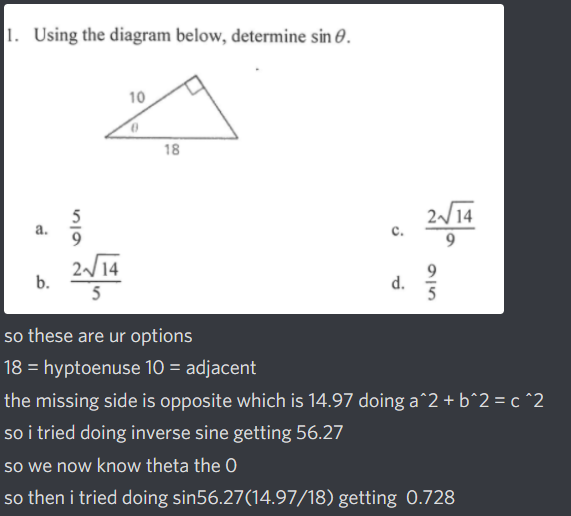
ok well
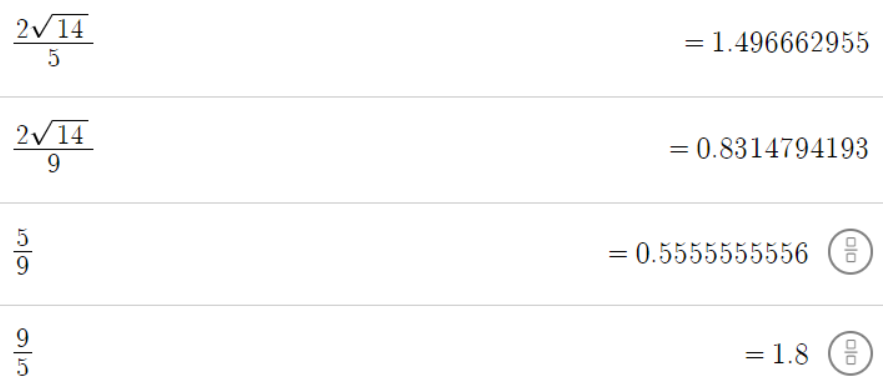
notice how it said sin(theta)
not just theta
so ur just finding the ratio
@cloud sable
stuck dragon
lol np
 true pollen
can anyone explain how to get sin(t) and cos(t) FROM only tan(t)?
I literally guessed to get these right and have no idea how to actually do it
stuck dragon
it would help if you drew out a right triangle
true pollen
oh okay, and then what :<
stuck dragon
remember that tan(t)=opposite/adjacent
ik there's a negative so ima get to that rn
we also know that tan(t)=sin(t)/cos(t)
since it says sin(t)>0
we can infer that cos(t) is negative
right?
true pollen
oh thats what u meant by drawing it out sorry, and yes !
stuck dragon
yep
upper karma
steep temple
i'd appreciate if someone could explain the first step here
what have you tried?
steep temple
i have tried nothing
i have no idea where to start
i know at some point i will need to get the perpendicular gradient however because I don't know where T is, i can't work out the original gradient
that is what has been putting me off @upper karma
however I did find an article that seems to know what it is doing (https://sites.math.washington.edu/~m124/source/supps/circleTangents.pdf) and will follow that
obtuse tapir
Whats the question
 blissful slate
steep temple
i have no idea where to start
blissful slate
steep temple
i have no idea where to start
Hey
blissful slate
steep temple
.
Is this the question ?
If it's then
From given equation we know the centre of circle. Let the centre be O
Find radius by using O and a point on y axis
Draw PT
join O and T
Since PT is a tangent
Angle PTO is a right angled triangle
Use Pythagoras theorem
steep temple
dude
where is T
how the hell am i meant to draw PT if my biggest issue is working out where the hell P is
the issue with this article is it assumes the circle is centered at (0, 0) and so you get one massive simplicity
which would be subsituting the coordinates
blissful slate
steep temple
where is T
U don't need to find T
steep temple
yes now i know
blissful slate
Ok nice
 fast tide
what is the formula to rotate points (x,y) around the origin without using imaginary numbers. I want to do this in desmos
upper karma
@fast tide it depends how far
fast tide
I am working with a formula x^2+y^2=1 to draw a circle