#geometry-and-trigonometry
1 messages · Page 323 of 1
 foggy talon
okay which part was wrong
 grave thunder
don't find b that's not the technique
its y-y1=m(x-x1)
how did i forget that
its the slope intercept form when one point is given
foggy talon
oh okay so i have to put the coordinattes into the equation
foggy talon
and whats the next step
grave thunder
no don't do that
you have to get an equation not an answer
first you changed the GIVEN question to y=mx+c form right?
foggy talon
yes
grave thunder
then you found m=6 right?
foggy talon
yes
grave thunder
then since t is parallel to u both must have their m(slope) equal. right?
foggy talon
yes
grave thunder
so u hase m=6
when we are given slope of a line and one point its passing through we use formula y-y1=m(x-x1)
you have to put m , x1, x2as given inquestion
foggy talon
im not sure
foggy talon
yes
grave thunder
y+3=6(x+2)
y+3=6x+12
y=6x+12-3
y=6x+9
that's the answer
this time for sure
foggy talon
YES its right
grave thunder
i wanted you to understand but i made a mistake so here;s evrything
foggy talon
yes thank you for helping
 quick shale
 dark sparrow
are you trying to get someone to do the test for you
foggy talon
hey can someone check my answer
i got y=1/2x+15/2
my answer sounds a bit off
please check it
grave thunder
its correct
 silent plank
check your signs
 kindred rapids
Hi...can someone help with this please?
Just started trigonometry...but I'm not sure what to do here...
kindred rapids
Um how do I do that in this though..?
kindred rapids
But how'd you get that? > 3/12+2/12
@grave thunder
grave thunder
i told you trial and error
kindred rapids
Oh..
grave thunder
just try separating it into something that will finally give you easy answer
kindred rapids
I'm sorry but I'm a bit confused...here
 upper karma
Remember your special angles?
kindred rapids
Yes
upper karma
Try to combine the special angles in such a way where their sum or difference is 5/12.
For example, 7π/12 = 3π/12 + 4π/12.
7π/12 = π/4 + π/3
After you find these two specific special angles, apply the addition or subtraction identity for cosine.
kindred rapids
Why are you saying addition or subtraction..? Could it be both that I can use..?
upper karma
You're welcome.
kindred rapids
Guys I don't understand how I'm going to get one of the answers in the choices in the pic I sent jn....
foggy talon
huh
kindred rapids
@foggy talon line s is parallel to line r therefore they have the same gradient which is -8/3....all you have to do now is substitute the points given into the equation given to find c, which is y intercept for the line s .. (the eqn is already in the form y = mx + c so it's not like you have to change it around)
Then when you find c you plug that in to the y = mx+c eqn.....m is the same as they're parallel. That's it....you'll get something looking like that => y = -8/3 (+ or -) c for your answer.
-8/3 x **
silent plank
try to represent 5pi/12 as a sum or difference of two special angles
kindred rapids
So could it be pi/12 + 4pi/12...?
silent plank
well pi/12 isn't one of the common special angles so try using something more suited to you goal
consider 5 = 2 + 3
silent plank
compound angle identities
foggy talon
@kindred rapids thank you
silent plank
cos(A+B) = that
yes
kindred rapids
Okay
..okay I've never done any question like that and idk how to work that out when I put it into the identity
silent plank
you should know the values of trig functions evaluated at special angles
kindred rapids
But its 3pi/2.....not 12
silent plank
can you show me what you have so far?
kindred rapids
I didn't work it out but ...
When I said substitute the points given in the eqn given.....you had -6 = -8/3(1) + c ..right?
foggy talon
yes
kindred rapids
And when you work it out...what you got?
kindred rapids
@foggy talon wait...
How about you carry -8/3 on the side with -6 and work it out...from there
So -6/1 + 8/3 = c
foggy talon
-26/3
kindred rapids
..lol no
Mutlolie through by 3 in the entire eqn
So... 3y = -8x - 26
That's the equation for line s
Understand?
foggy talon
yes thank you
kindred rapids
You're welcome:)
kindred rapids
Okay...I really need help for this question...please, I need more explanation because I'm confused by what yall are saying to me...
Hi...can someone help with this please?
Just started trigonometry...but I'm not sure what to do here...
@kindred rapids
 humble pulsar
I dont see any question @kindred rapids
grave thunder
you are still stuck on that
kindred rapids
Yes because I have no idea what to do....this is like a new topic where I have no clue of anything about it.
@humble pulsar
Listen...I looked at a video but I do not know how he got what he got
From cospi/4 , he got root2/2, how?
grave thunder
i told you you just have to check for it one by one
there's no trick or formula for it
humble pulsar
$\frac{5\pi}{12} = \frac{\pi}{6} + \frac{\pi}{4}$
kindred rapids
@humble pulsar yes I understand that
grave thunder
you have yyour special angles check 1 by 1 to know what you can find
 somber coyoteBOT
moshill1:
humble pulsar
cos(pi/4) = 1/sqrt(2) since its an exact value
kindred rapids
...how do you know that..? I'm just asking because I dont know
grave thunder
practice youcan say
humble pulsar
30-60-90 triangle
pi/4 = 45 degrees, cosine is adjacent on hypotenuse from sohcahtoa
so cos(pi/4) = x/(xsqrt(2)) = 1/sqrt(2)
grave thunder
@kindred rapids wait do you mean you don't know values of cospi/4 and stuff or your saying you don't know how 5pi/12 was divided to pi/6 and pi/4
kindred rapids
The values of cos pi/4
grave thunder
well he explainedit here^?
also for these special angles you just have to remember the table and that's all
kindred rapids
I dont have any table
humble pulsar
Just remember the triangles tbh, in my opinion it's easier
humble pulsar
but yeah, to answer your question: break 5pi/12 into the 2 exact value angles, use the compound angle identity, then evaluate the 4 trig values you get
 balmy meadow
The radian is defined as the ratio of arclength to radius. If we choose a radius of 1, the circumference, or maximum arclength, is 2π (you may recall the circumference of a circle is C = 2πr ). Thus a 360° angle is equivalent to 2π radians.
2π/8 = π/4 just as 360°/8 = 45°
kindred rapids
@humble pulsar okay ty
balmy meadow
Just remember the triangles tbh, in my opinion it's easier
Seconding the triangles
humble pulsar
np
kindred rapids
I think I'd rather the table ....not the triangles
Could someone Send it or it cant be sent?
humble pulsar
just make one up tbh
kindred rapids
Lol alright then
balmy meadow
upper karma
There's a unit circle pinned at this channel too
balmy meadow
I should've checked there first. New to this server
kindred rapids
What's that...?@upper karma
upper karma
What's what? the unit circle?
kindred rapids
Yes lol
upper karma
Wow
kindred rapids
I'm also new...so
upper karma
Oh okay
balmy meadow
The unit circle is that circle of radius 1 I was talking about. If we take any point on the circle and draw a line to the origin, we can obtain the coordinates of that point from the angle between the radius and the principle axis
balmy meadow
Noted
kindred rapids
@balmy meadow I see...
upper karma
You'll understand it easier with something texit's gonna send
kindred rapids
Okay
upper karma
well, not easier but like more in depth
kindred rapids
Alright
somber coyoteBOT
I have just restarted and am loading myself, please wait!
upper karma
Lol well that was unfortunate
kindred rapids
..lol
kindred rapids
Lol okay
balmy meadow
Is TeXit normally this slow?
upper karma
No, ig it's because it's restarting itself
Usually when you send it, it takes like 5 seconds
kindred rapids
Guys...what's tan 150° ?
Like how sin30° = 1/2 ....what's tan150°?
somber coyoteBOT
Al𝟛dium:
kindred rapids
Okay ty
 umbral snow
If you can get sin150 and cos150 then tan150 is immediate
upper karma
There's tears of hours spent on that pic
kindred rapids
Thank you...us beginners appreciate your effort to help us.
@umbral snow well I didnt get sin150 and cos 150 so...um
balmy meadow
There's tears of hours spent on that pic
I need to get more serious about LaTeX figures lol. Don't tell me that's using TikZ
upper karma
It is indeed using TikZ
kindred rapids
I'm sorry but how do I know what's tan 150° equal to?
umbral snow
Well, can you pinpoint 150 on the unit circle?
Use that to identify sin150 and cos150
kindred rapids
....um well I dont know where 150 is exactly...
balmy meadow
I like to think of it as 180° (on the opposite side of the circle) minus 30° (which we're familiar with from special triangles/that table from before)
We may want to explain quadrants and CAST since the unit circle was only just introduced
umbral snow
I suggest at least giving "unit circle" a quick Google.
kindred rapids
Okay I did
So there is 5pi/6
But um...the answer has to contain root of something...that kind of answer
 wise hornet
not always
balmy meadow
Maybe it would be better to think of tan(150°) as
sin(30°)/(-cos(30°))
wise hornet
so when you divide them to get tan150 there's also a root
balmy meadow
The pinned unit circle is pretty helpful for this kind of thing
Just note that the coordinates are given as (cosθ, sinθ) and tanθ = sinθ/cosθ
kindred rapids
Cos 150 is what?
balmy meadow
cos(150°) = -cos(30°)
umbral snow
So you really need to be able to identify where 150 is on the unit circle.
kindred rapids
@balmy meadow okay
umbral snow
If you can't, I suggest googling how the unit circle works.
 alpine niche
Hi, sorry for interrupting. Could anyone check if this is okay?
balmy meadow
It looks good to me. I would write the numerator as x•tanα so it doesn't look like x is a part of the argument though
I'm not super qualified. Unsure whether a helper has to check this sort of thing
Once you've found y, what do you plan to do to solve for h? (I assume that's what you're looking for, because of the = ? )
balmy meadow
Well done (:
kindred rapids
So what's the answer for that question I just sent then..?
balmy meadow
Do you normally use this server to just obtain answers?
kindred rapids
No..
I normally do my own work but this is really confusing so I just asked for help here...
I also help people when i can.
Is that bad...? Should I stop..?
balmy meadow
So we've worked out that there's this thing called the unit circle that's a powerful tool for figuring out the values of different trig functions. We've reasoned out that
tan(150°) = sin(150°)/cos(150°)
We can obtain the exact value of the numerator and denominator since
sin(150°) = sin(30°) = 1/2
cos(150°) = -cos(30°) = -√3/2
So tan(150°) must be
1/2 ÷ -√3/2
balmy meadow
Best of luck
General question about trig for someone with more experience. Where do the "less appreciated" functions like versine and haversine show up in math? I've only used them with spherical triangles
kindred rapids
Wait how...is that root3/2 negative..?
kindred rapids
I asked how..?
wise hornet
what's the problem
balmy meadow
For all intents and purposes here, the root of a negative number doesn't exist. This is a negative root
balmy meadow
I think they're concerned by -√3 since it's being mistaken with √-3
wise hornet
debatable
kindred rapids
No...I dont understand how the - sign got there..
wise hornet
maybe they're just concerned about possible negative distance issues etc
it's like
it just is
it works
on the unit circle, 150 degrees is to the left of the origin
it's negative x
does that explain anything
balmy meadow
The negative got there because I considered the positive first quadrant with θ = 30°, and then reflected the point over the y-axis
balmy meadow
For all intents and purposes here, the root of a negative number doesn't exist. This is a negative root
I was misinterpreting your confusion. Sorry about that. If you're curious check out imaginary numbers (:
kindred rapids
It's okay...thank you for your help.
Is it okay if i ask for help again...? It's okay if I shouldn't
There are alot of questions we were assigned and most of them are not what i can understand and do..
balmy meadow
It's perfectly fine to ask for help! I'm not going to be around to answer every question (I have my own assignments to work on)
kindred rapids
Oh I know you have things to do.... I wasnt referring to you to help me alone. Lol I was just asking generally
balmy meadow
My main concern about directly addressing assignment questions is that you may not learn something as fully if you're simply presented with the answer. If you're not sure about whether something's allowed it's best you ask someone with more experience on this server
I only joined the server today
kindred rapids
Oh Alright then. Ty
 opal slate
Count the Area of the "bright" in the cirkle, how do i do it?
wise hornet
the area of the bright is independent of the position of the hexagon so long as it's fully inside the circle
opal slate
I need to count the area of the hexagon, and then subtract it from the area of the circle, its the area of the hexagon that im not sure of how to count
wise hornet
ok
hexagons are polygons which means they can be split up into simpler shapes
try chopping them up a bit?
opal slate
i know i have to split it up by making triangles
 pearl lava
is there a way to solve this without trig?
pearl lava
I got the perimeter as 32.3 and for area I got 47.9. Is that right?
silent plank
you can apply properties and ratios of special triangles without explicitly using trig functions.
 green tree
 silent plank
that isn't the exact answer
the exact answer would be irrational and consist of radicals
silent plank
yes
alpine niche
hi, can anyone help me to check one trigonometry problem? it's done, it's just to check if I messed up something
 distant thistle
Anyone know how to do this one?
humble pulsar
@distant thistle isolate for sin(x), then get x using cast rule ideas
wise hornet
that won't be enough, the solution isn't nice unless i've messed something up
humble pulsar
you can still do cast rule
sin(x) = -8/15
Hence x is in Quad. 3 and 4
the principle angle is arcsin(-8/15) ~ -32 which means it's about 32 degrees
opal slate
How do i solve the area of the halfcircle and the penis
humble pulsar
"and the penis"
 cold siren
does anyone know how do do this?
cold siren
oo ty
 prime gull
does anyone know how many johnson solids there are when all the polygons of the solid have to have the same edge length?
prime gull
huh, why?
prime gull
oh ok thanks!
foggy talon
can someone help me with this pls
i cant fail this class
my parents will kick me out
 grizzled lantern
@foggy talon no then won't
foggy talon
i have strict parents
my parents dont believe school is hard
but my dad dropped out
i tried to explain i was sad and they were like its becuase of that phone
and they took it away
foggy talon
yes
foggy talon
yes y=mx+c
 glacial dawn
Nah, that’s slope-intercept form
foggy talon
oh then what is it?
foggy talon
oh right yes
glacial dawn
Alright so
What can you do given the info provided in the problem as it relates to point-slope form?
Meaning
What can u substitute in
To get the new equation
foggy talon
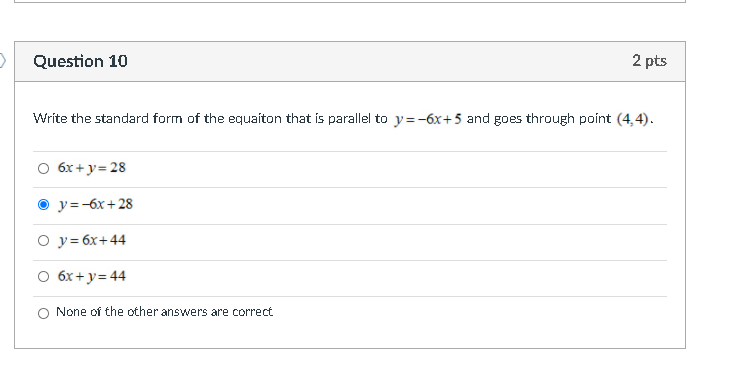
y-3=1/5(x-7)
foggy talon
yes
foggy talon
im not sure of this part
foggy talon
y=mx+b
foggy talon
y=1/5x
foggy talon
but how do i find b?
foggy talon
adding 3 to 7
glacial dawn
Nono we cannot add the 3 to the 7 because the 7 is in the parentheses
But we could just add the 3 to the other side like u said
 upper karma
oh my b
glacial dawn
All g
I’ll lyk after
So
Rosie
Let’s not worry abt the 1/5(x-7) yet
Just about the y and the 3
y-3=1/5(x-7)
To get the 3 to the other side, like u said, we gotta add it
What comes out on the right side when we just add the 3?
foggy talon
1/5?
glacial dawn
Nope, for the right side, u still gotta have the 1/5(x-7) but don’t even touch that yet
Just the 3
foggy talon
wait sorry do we just put it on the right
foggy talon
y=1/5(x-7)+3
glacial dawn
Correct
cold siren
can anyone who knows how to do proofs dm me? thx!
glacial dawn
Close, u just forgot to multiply the 1/5 by the second term, which is -7
In distribution, u have to multiply both terms by the factor outside the parentheses
So what would be the result of the distribution?
foggy talon
y=1/5x+7/5
foggy talon
-7/5
glacial dawn
Yup
foggy talon
y=1/5x-7/5
glacial dawn
What did we add to the right side at the beginning?
foggy talon
3
glacial dawn
So now what do we have?
foggy talon
y=-1/5x-7/5+3
foggy talon
-3?
glacial dawn
Nope, although it does have to do with signs
Revisit the distribution, what were the signs on the those terms?
foggy talon
plus
glacial dawn
For which?
foggy talon
y=1/5-7/5+3
glacial dawn
U forgot another thing this time xD
foggy talon
is that the complete answer
glacial dawn
Nope
foggy talon
y=1/5x-7/5+3
glacial dawn
Alright
Now we gotta add like terms
Do u want to do this in fractions or decimals?
foggy talon
fractions
glacial dawn
Alright so which terms could we combine together
foggy talon
-7/5 and 3
foggy talon
-7/5+15/5
foggy talon
8/5
foggy talon
y=1/5x+8/5
glacial dawn
And what’s the slope intercept form again?
foggy talon
y=mx+b
glacial dawn
Does it match what we have?
foggy talon
yes
glacial dawn
That’s ur answer
foggy talon
okay thank you for helping me
glacial dawn
Yea np
upper karma
is this correct?
Yes.
 umbral snow
@upper karma
Start by squaring both sides
upper karma
yeah i did
umbral snow
Keep in mind that squaring will create false solutions
upper karma
i got like x+2sqrt(x)+1=x+9
umbral snow
Nice. Rearranging that:
√x = 4
upper karma
then i just square both sides again so x=16 and i just have to check?
upper karma
ty for your help
grizzled lantern
@foggy talon you can check if a line goes through points by plugging them in
foggy talon
right but could you please check it i dont wanna mess up
grizzled lantern
it doesnt go through (-8,-6)
foggy talon
could u tell me where i went wrong
or the correct answer
pls
i got y=-1/4-4
does that work
glacial dawn
Rosie follow the steps i explained earlier
The purpose is to learn the content lol
Not just complete the assignment
foggy talon
yes i understand that but i really need to finsih quickly
i have alot of other work to do
its 8pm here
i dont want to stay til midnight
 small dock
 vague forge
when in doubt draw it out
 gloomy mesa
yes draw
 stuck dragon
yes
 rose tulip
I've been taking Geo over the summer using Khan do you think it's advised to move up to Algebra 2?
Some of the math teachers are saying it might be hard once I get into Pre-Cal
What is there that i'm "missing"
 dense egret
Complete the bigger square and minus the side pieces
 hoary trellis
i got 1600 dunno if its right
dense egret
How u get that
hoary trellis
50x50 - 15x4
dense egret
Why is it 50x50
hoary trellis
isnt a square lxw
dense egret
But u got the corners missing
hoary trellis
ah
dense egret
So make it a square first
hoary trellis
3600
dense egret
And how u get that
hoary trellis
would u do 900+2500
dense egret
900?
 main lintel
Yes, focus on the big outer square, and from that remove the 4 minor edge squares.
upper karma
main lintel
@upper karma Do you have a general idea what to do?
 urban knoll
Stuck on this hw problem can I get some help?
I think it’s either triangle or square
But im not 100% sure
dark sparrow
,rccw
are the angles on the outside (exterior) or the inside (interior) of the corridor formed by the parallel lines?
urban knoll
Exterior
somber coyoteBOT
dark sparrow
well there you have it
urban knoll
Thanks
dark sparrow
what have you tried so far & where are you stuck
 hollow raven
To add on to that, what defines an equilateral triangle?
dark sparrow
thank you wikipedia
do you know what the angles are in an equilateral triangle? @random stratus
 mighty wharf

 slate kestrel
@random stratus are you still here? because if not I will just ask my question already
 random stratus
i have a question
dark sparrow
why did you delete your original post, cool332?
 obsidian hearth
upper karma
obsidian hearth
upper karma
@obsidian hearth what is the written construction
 solid flower
Does anyone know SAS!
 jagged sapphire
angles on a straight line add to 180
@fickle walrus sooo
that means
?
its 41
 fickle walrus
yes
 odd blade
Guys can I get hl I legit don’t understand this question
 cosmic pebbleBOT
From
Rule 1
The help channels are solely for help with math, so feel free to post your question. Asking whether you can ask a question or if anyone knows about some specific topic is unnecessary, so please try to avoid questions of that nature.
jagged sapphire
pls snipe
grizzled lantern
alright, so they are similar triangles
 west basin
if they are similar the sides have the same ratio
jagged sapphire
@jagged sapphire u need help?
@grizzled lantern na got a 80
grizzled lantern
so what we can do is setup a proportion
so we can do 18/24=x/8
when we do that, we can cross multiply and solve
grizzled lantern
exaclty
odd blade
So the length of yx is x=6
grizzled lantern
yep
odd blade
Thanks
grizzled lantern
np
pearl lava
is the answer for #1 30?
wise hornet
30 is a solution
pearl lava
how would I find the other?
wise hornet
sketch the graph rq
pearl lava
would it look like this?
wise hornet
yes
pearl lava
so is the answer pi/6 and 5 pi/6?
wise hornet
yes
pearl lava
how would I do it without graphing?
wise hornet
you can see sin(x) is symmetrical about pi/2, 3pi/2, -pi/2, 5pi/2, etc.
so sin(pi/6) = sin(pi - pi/6) = sin(5pi/6)
pearl lava
oh ok
 cloud valve
main lintel
cloud valve
main lintel
No, but cos^4x is (cos^2x)^2
main lintel
Cool
 untold peak
I'm terrible with trig and I have to do this workbook. do all angles in a non right angle triangle still add up to 180?
Sorry if this sounds stupid but math is by far my worst subject
 white lichen
yes
untold peak
okay
 subtle snow
Yes
white lichen
Ok which one are you on
subtle snow
Well I attempted to it but I got everything wrong
This is my work
How should I do it or what did I do wrong?
@white lichen
white lichen
For the first one why did you think a and b had angle measures 79
white lichen
But why did you think they had to be the same
subtle snow
I’m not sure
white lichen
Have you learned about corresponding angles
subtle snow
I think so but I do t remember
white lichen
I dont rly wanna talk rn but i can listen and write here
subtle snow
Ok
white lichen
go mathematics
yes
Yes but that doesnt mean 2 angles need to be the same
Try using the picture I sent to figure out what a would be
wait ill type in #mathematics-voice
untold peak
Does this look right or did I get everything wrong?
kindred rapids
If tan (theta) = 4/3, what's tan2(theta) ?
wise hornet
i assume you mean tan^2(theta)?
generally, tan^2(theta) = (tan(theta))^2
and also sin^2(theta), cos^2(theta), sec^2(theta)... etc.
kindred rapids
@wise hornet no I meant tan2(theta)
wise hornet
tan(2theta)?
kindred rapids
tan2Ø <= it's like that.
kindred rapids
Ig
kindred rapids
Yes
wise hornet
ok
so do it
and then if you need help expressing it in terms of tan(theta) again ask me
kindred rapids
What do I do? Tan(theta) is equal to 4/3 and they're asking what's tan2(theta) .....I'm not sure what to do with the sin2theta/cos2theta
wise hornet
so what's sin(2theta) in terms of sin(theta) and cos(theta)
oh sod this from now on sin(x) and cos(x)
 azure laurel
How do I go about answering this
 wise escarp
upper karma
wise escarp
upper karma
@azure laurel consider the theorem of angle sum on a triangle
upper karma
How are you getting to 34? @azure laurel
 deft bear
ive been stuck on this for like 20 minutes
stuck dragon
for y
since the purple lines are parallel
as shown with the arrows on that pair
and that you can view the green diagonal line as a transversal
you can say that measure of y=75
via alternate interior angles
for x
we could view it the same way but with the other transversal (the other line intersecting the 2 parallel lines)
this time we can say x=100
via corresponding angles
pearl lava
Can I use law of sines to figure out the side lengths?
stuck dragon
are u allowed to use calculators or no
pearl lava
yes
pearl lava
ok thanks
stuck dragon
np
azure laurel
I j want a rolly rolly rolly with a dab of ranch!
@limpid lagoon You are dogshit at aerials
main lintel
@deft bear you got your answer above
 wary wind
@upper karma what have you done so far? How have you approached it?
upper karma
I can't even think how to start
Its the hardest geometry question in my homework
I have no idea how to approach it
wary wind
Are you doing similar triangles rn?
upper karma
What you mean?
wary wind
What's the chapter you are doing in geometry right now?
wary wind
Probably review that chapter then.
To make the long story short - The idea is to use the property that base of the equilateral triangle and the straight line drawn from a mid-point of the base being parallel to each other.
upper karma
i read the chapter twice lol
I just couldnt put my finger where i could answer that question
wary wind
Okay, let's attack this another way then
How well versed are you with trigonometry?
upper karma
Yeah i know trig
btw this is the hardest qquestion in the hw
and it called a free question
so you could use anything
even outside the chapter
wary wind
Well, this is your homework - I would like you to think through this problem and apply your approach.
Also - stop saying "it's the hardest homework" - It's not as hard as you think it is.
Well anyways - what's angle of an equilateral triangle?
upper karma
60
 silk patio
For alpha is less than 90 degrees can you work out the height of the triangle?
You know the base is always a/2 so you don’t need to worry about it
To work out the area you need the height
upper karma
hmmm
wary wind
I will just lay out the brief procedure that you can use to arrive at you result -
You angle alpha has three possibilities -
- Less than 90°
- Equal to 90°
- More than 90°
In each of these cases - you'll form an interior triangle with your equilateral triangle.
Next, your goal should be to prove that the two triangles are similar (read up on similarity criterion)
using this - find out area ratio.
Euler has given the other details you can play around with.
upper karma
yeah he said you need to work out heihght
@wary wind how could i find the height?
of the small trianlge
without the area?
wary wind
You draw the altitude for the smaller triangle in the case where your alpha is less than 90°
wary wind
Yes, you have 2 more right triangles then but that's not what we want to use the altitude for.
You want the altitude so that you are able to express your area.
upper karma
ok so if i draw that
for the small triangle
i get 2 right angle triangles
with height h
and base
1/4 a for each triangle
 wintry fog
upper karma
wintry fog
upper karma
which question?
kindred rapids
Hi...so I just need help with two questions
I had 35 in total and I did 33 but can't seem to do these two...
First it's this one ...
I've never done questions like this one so far and I'm not sure how to start...
 earnest echo
Try expanding sin(x+20)
 next jackal
@kindred rapids What's the identity of Sin(A+B)?
kindred rapids
sinAcosB+sinBcosA
next jackal
got a hint?
silent plank
it should be simpler if you apply something like cos(a) = sin(90°-a)
kindred rapids
I'm not sure what that is..
next jackal
Oh
silent plank
complementary property of sine and cosine
kindred rapids
@silent plank I looked at a video and they said something like that but I've never seen anything like before...my teacher hasn't mentioned anything like that ...
So I'm not sure what to do with that
But is there a way to work it with the identity ..?
next jackal
Sin(70-x) = Cos(x)? is it right Ramonov?
silent plank
not quite
you didn't apply the identity properly
there's probably a different way you could do it, but may get very messy
next jackal

silent plank
i didn't say sin(a) = sin(90°-a)
dark sparrow
bruh
silent plank
sin is indeed a magical expression /s
kindred rapids
So expand it..instead?
next jackal
Ok, I got Sin(70)Cos(x)-Sin(x)Cos(70) = Cos(x)Cos(20)-Sin(x)Sin(20)
@silent plank Is there a simpler way to do this?
kindred rapids
Is it okay if I send the other question I need help with..? It's just two questions...this and the one I'm sending now.
earnest echo
it should be simpler if you apply something like cos(a) = sin(90°-a)
Use this only on one side
humble pulsar
The one you just posted is double angle
silent plank
this is applying the complementary properties of sine and cosine
earnest echo
Could you explain?
e.g
sin(30°)=cos (90°-30°)
silent plank
which you could confirm using the compound angle identities
next jackal
So my expansion isn't helpful?
silent plank
not really, no
kindred rapids
So x is 35?
silent plank
applying that identity you'd reach
cos(70° - x) = cos(x°)
which allows you to easily identify one of the solutions
x=35 is one of the solutions,
there are actually infinitely many, but is probably not expected of you based on the phrasing / level you're at
kindred rapids
it should be simpler if you apply something like cos(a) = sin(90°-a)
@silent plank so this....is it always 90°...?,
next jackal
Ok I got Cos70Cos(x)+Sin70Sin(x)=Cos(x)
silent plank
its called a trig identity for a reason
why must you feel the need to apply the compound angle identity to expand cos(70°-x)
humble pulsar
There are like ~40-50 identities similar to cos(a) = sin(90-a)
all the related-corelated
kindred rapids
..ohh
next jackal
why must you feel the need to apply the compound angle identity to expand cos(70°-x)
@silent plank Because it's a compound angle?
silent plank
is it not clear that you could get one of the solutions from
equating the arguments
(and the rest if you introduce general solutions)
silent plank
cos(70° - x) = cos(x)
you can get one of the solutions simply equating
70° - x with x
next jackal
..........
silent plank
cosines of the same thing are equal
next jackal
Okay, thanks
kindred rapids
Guys...I sent the other question further up in this chat...can you all help with that please?
...is it double angle ?
silent plank
yes
kindred rapids
2tanA/ 1-tan^2A
?
 brittle gyro
I would suggest pyth
kindred rapids
I did that but ...how do I get tan2(theta) instead?
@brittle gyro
Would tan2(theta) be 8/3?
kindred rapids
What are you referring to?@silent plank
silent plank
how do i get tan2(theta) instead
kindred rapids
...I don't get it
silent plank
$\tan(2\theta) = \frac{2\tan(\theta)}{1 - \tan^2(\theta)}$
somber coyoteBOT
ramonov:
kindred rapids
Yes..?
silent plank
then sub in your tan theta
silent plank
looks good
next jackal
@silent plank can you tell me how to derive tan(2x) identity?
I'm unable to figure it out
silent plank
from sin(2x)/cos(2x)
next jackal
Okay, I did that
silent plank
then apply double angle identities
next jackal
but I'm getting cos^2(x)-sin^2(x) as denominator
silent plank
and divide the numerator and denominator by cos^2(theta)
upper karma
but I'm getting cos^2(x)-sin^2(x) as denominator
There are more forms to that
silent plank
to get everything in terms of tan(theta)
next jackal
and divide the numerator and denominator by cos^2(theta)
@silent plank I got 2Sin(x)Cos(x)/[Cos^2(x)-Sin^2(x)]
next jackal
okay, the denominator is cos(2x) right?
silent plank
divide the numerator and denominator by cos^2(x)
next jackal
okay#
Yeah got it. Thanks
Wait if I divide it by sin^2(x), I got 2cot(x)/(Cot^2(x)-1) Is that also one of the identities?
silent plank
identities can have multiple forms
 high geode
use a right triangle to write the expression as an algebratic expression. I'm a bit lost on this
high geode
i ended up getting 5/x
high geode
well sec is hyp over adj and tan is opp over adj
high geode
I was totally lost at first some of it came back to me a little
high geode
oh thanks
 cosmic sun
I made little visualization
the brightness is the ratio of a distance to point and line
and as you can see, a parabola emerges!
this is because the ratio on the parabola is going to 1, since by definition the distances between the point and line are equal
as such the brightness is going to be highest there
west basin
lol ok
earnest echo
Wow
 unkempt venture
 devout echo
So how do I find things like sss and sas for triangles, I didn’t understand it that much
dark sparrow
what do you mean by "find"
dark sparrow
SSS and SAS (and ASA for that matter) are shorthands for triangle congruence tests
for example, if you can show two triangles have three pairs of matching sides (hence SSS, "side-side-side") they must necessarily be congruent
devout echo
Oh
dark sparrow
likewise if you find two pairs of matching sides and the angles in between also match (hence side-angle-side) that also gives you congruence
devout echo
Thanks
 valid dagger
Can I ask for help regarding this question 
I think ACB is 32° aswell but Im not sure how I can get ABC
west basin
ACB is 32
to get ABC subtract the two angle measurements in the triangle ABC from 180
since you know AB||OC you know AC bisects BAC and OAC
which means OAC = BAC
same reason ACB = ACO
silent plank
how are you getting ACB as 32
west basin
would that not be correct?
silent plank
you aren't given that AO is parallel to BC,
instead you should apply stuff like angle sums / inscribed angle theorem to get <ABC first
 dusky surge
You can make use of OC and OA are the radii of the semicircle
 tender fable
How do I sketch a graph that is domain 3-10 inclusive, and 1-4 inclusive? I get how to do it if there is only 2 brackets but how do i do it like this?
silent plank
do you have the exact question
are you plotting 2 different functions on the same plane?
humble pulsar
$x \in [3,10] \cup [1,4]$ ?
tender fable
it is one function, It does not give the function
somber coyoteBOT
moshill1:
tender fable
Do I just plug this in?
humble pulsar
no im confused what you're asking since the intervals you gave overlap
tender fable
I can just send the question if that makes it easier
humble pulsar
yeah that'd help
tender fable
dark sparrow
how convenient of you to just skip over the word "range"
tender fable
my bad
dark sparrow
anyway you could probably just mark the points (3,1) and (10,4) and connect them with a straight line segment
 hybrid patrol


 upper karma
Don't multipost
cosmic pebbleBOT
From
Rule 3
Stick to one channel and don't post the same question in multiple channels. Please don't ask for help in other channels if no one is responding in the one you have posted your question in.
 round isle
you know you can verify your answers by adding angles and see if they add up to 180. Like, add up angle 1, 2 and 3 and see if it equals 180 and also add angle 1 and 6 to see if the sum is 180
 steady bolt
thank you
upper karma
cos(25⁰) = 300/(length of diagonal line in middle)
 final zenith
Yes i know that
But what is the answer
How do i get it
25 = cos^-1 (300/x)
What do i do now
upper karma
cos(25⁰) = 300/x
xcos(25⁰) = 300
x = 300/cos(25⁰)
final zenith
Does that work
upper karma
Yeah
final zenith
Wow i am stupid
final zenith
I'll have to practice then
 flat viper
<@&286206848099549185>
 solar slate
The lengths of two legs of an isosceles triangle are represented by the expressions (3x - 7) and (x + 5).
The perimeter of the triangle is 40cm.
Find the length of the base of the triangle.
Do NOT label your answer.
<@&286206848099549185>
round isle
the two sides will be equal since it is an isosceles triangle
so you can find x
use the perimeter to find the length of the base which is the remaining unknown side
upper karma
hi
round isle
hello
humble pulsar
no real efficient way that im aware of
unless you were taught point-line distance formula
 warm rose
i think the one most used
would be okay
if there is one
i know the distance formula though
humble pulsar
distance or point-line distance?
warm rose
a lot of steps i’ve seen are complicated to me
distance
i’m not sure what the point line one is
humble pulsar
Ok then dont use it lol
warm rose
ok
humble pulsar
but the typical way is you need to find the perpendicular to the base through the other vertex