#geometry-and-trigonometry
1 messages · Page 309 of 1
 deep trail
https://gyazo.com/5d9ebf83d14aafffa8e4295c208edd1f how would i do this proof i forget all the proofs help pls

 upper karma
$aπ=πr²-π(\frac{l}{2})²\implies a=r²-\frac{l²}{4}$
 somber coyoteBOT
Al𝟛dium:
upper karma
@deep trail occupied channel, move to #help-0
Following? I divided both sides by π
It gets cancelled
And then the square part
Yeah, and then u powered by 2 r and l/2
Still making total sense to me
I did nothing with the r though, it was already squared
y
Are you asking why?
No, it was mb
Oh lol
I explained it badly but i got it
So far, everything good then
Okay
Now the "big" move comes in
Let me get a pic
Kk
They are lowercase L's btw, just in case.
Okay my method starts with:
Let r be the radius of the big circle
Let l be the length of the square
Remember the callings
And now the next move would be do pythag
Yeah so u would get the value of r in function of the lenght right?
Yes.
Try to do pythag
And isolate r in terms of l as you said
Post what you get
@upper karma whoops, typo
It should be 2r not r
But yeah tag me when you've tried pythag and posted the result
Kk
Mb its
Yeah
Let me check
Its this one
Yeah totally correct
You got it!
Thanks for the help buddy, I appreciate the kindness u had while explaining to me what to do
Yw!

deep trail
https://gyazo.com/dc7a6d67a5a90ee6892edf0795cd28e7 help I don't know any proofs to find angles that are not congruent to the angle i am comparing it too
 upper karma
@deep trail if you know how $\angle{9}\cong\angle{13}$ then consider that 13 and 14 are supplementary angles, to then substitute for 9 and prove it.
somber coyoteBOT
Al𝟛dium:
deep trail
ok

 rose tulip
How did he get 30 square root of 3 and 3 sqroot 3 as 10?
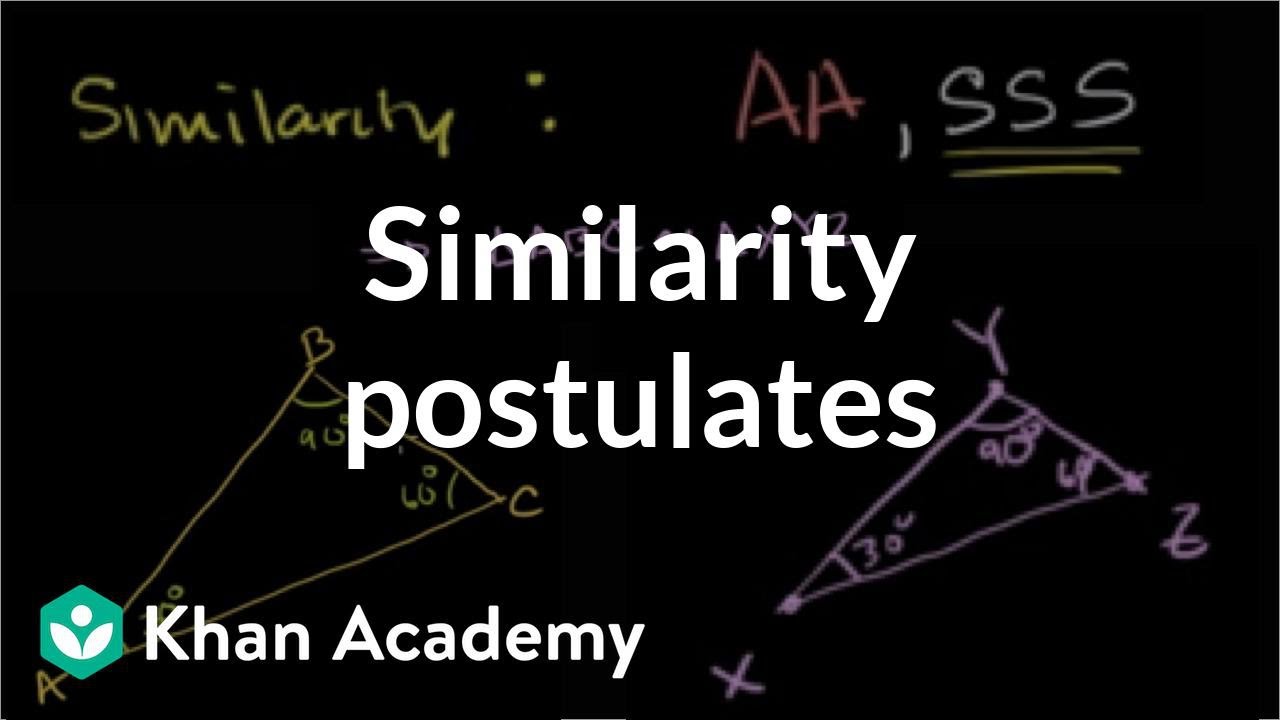
Thinking about what we need to know to determine whether two triangles are similar
Practice this lesson yourself on KhanAcademy.org right now:
https://www.khanacademy.org/math/geometry/similarity/triangle_similarlity/e/similar_triangles_1?utm_source=YT&utm_medium=Desc&utm_ca...
5:18
Or is it just dividing 30 by 3?
 acoustic jungle
(30sqrt3)/(3sqrt3)=10
 supple wedge
can i say angle YWU= angle UXY bc angle in same segment
can u use that for triangles
supple wedge
<@&286206848099549185>
 silent plank
no
 final bronze
So, I accidentally got myself in a shit position, and I need help, can anyone hep me with basic geometry?
silent plank
since you don't know whether WXYU is a cyclic quadrliateral
apply properties of parallelograms and parallel lines
 full zephyr
this question is gonna be the death of me
full zephyr
honestly I’m so lost, I just want to try and figure out how I can solve it.
if it’s to find the perimeter then yeah : )
upper karma
Well yes it looks like it is asking for the perimeter
So you need the lengths of the 3 sides
2 of them are easy to find
full zephyr
Wait rlly? Maybe I’m looking too deep into it, I’m looking at the tip and the two endpoints
I got 19, 13, but I think I got that wrong lol.
upper karma
That’s too big
Well
Wait no those are still not the numbers you want
Mind the scale
full zephyr
ah, I think I’m thinking too deep about it
upper karma
19 13 are not the side lengths but they are almost two numbers you need
One is off by 1
full zephyr
so is it by looking at where the endpoints are? Or do I need an equation to find the last one
I thought the top was 15
upper karma
Well what does the “top” being 15 mean?
full zephyr
could it mean the distance or the...
full zephyr
okay!!
upper karma
Can you tell me what this length is
full zephyr
(15,19)?
upper karma
15,19 is not a relevant coordinate here
upper karma
Try tunnel visioning on finding the length of the segment I outlined in orange
full zephyr
ok
full zephyr
ok, and you don’t subtract in this case
upper karma
Not exactly sure if I know what you mean, but I will say no, you don’t
full zephyr
I meant like, on my other problems I subtracted (x1,y1) from (x2,y2)
some kind of equation for segments
doesn’t look like I’ll be doing that here
upper karma
You are probably overthinking this
full zephyr
yeah 😔
upper karma
It’s a straight vertical line, from 0 height to... what?
full zephyr
from 0 to 15?
upper karma
That’s one of the side lengths of the triangle
full zephyr
ohh.
upper karma
You need two more, then adding them up will give the perimeter
full zephyr
omg oh
and the straight one on the bottom is at
13 and 19, would I subtract and get the length 6?
upper karma
Not 19
upper karma
Yes
full zephyr
okay so I got 7 and 15
upper karma
This is correct
full zephyr
the last one is curved
upper karma
Well, do you think it has length 2?
full zephyr
well, I thought you would add it to
upper karma
Looks longer than the other ones to me
full zephyr
oh really
upper karma
Right triangle with 2 known leg lengths and a hypotenuse to solve for
Does this ring any bells?
full zephyr
Pyathagrem theorem?
upper karma
Yes that’s it
upper karma
I like the spelling
upper karma
Uh wait, 7 and 15
upper karma
What does that notation mean
upper karma
This is not the same as your problem
If it was an attempt at a solution to the one you posted, the person who wrote it did not do it correctly
full zephyr
I think this one looks a little more accurate, also I put the variables myself and It calculated it for me which ended up weird lol
upper karma
These numbers look very off
full zephyr
oh no I meant that’s how it’s supposed to go right
You can disregard the numbers, that was just an example
upper karma
Then yes
upper karma
Does it want a decimal?
upper karma
17 you can consider the length of the last side, yes
full zephyr
and since I got the length, I would add 17 and 7 and 15?
upper karma
Yes
upper karma
Me too
upper karma
No problem
 scarlet grove
hii
i have trigonometry question
how do i find the functions of a negative angle
 undone dragon
nvmmm
 sly steeple
So I'm given the area A in red which is 81/4*pi and the radius 9. Considering the area of a circle is pi r^2. The small sections edge should be pi/4. Since pi/4 * 9^2 would give me the area 81/4pi
So if that small A sections circumference is pi/4 then the remaining circumference is 7/4 pi
Therefore the angle of the major arc is 7/4 pi
But that's wrong, apparently the answer is 3/2 pi
Where did I slip
 earnest echo
Area of sector is given by\
$A=πr^2\frac{\theta}{2π}$
somber coyoteBOT
The Godfather:
earnest echo
Theta is the angle subtended by arc at the centre
sly steeple
Aaah of course... thanks
So I'll just solve for theta and then subtract it from the total 2pi
earnest echo
Yep
 dark sparrow
@earnest echo did you really need to include those pi's in there and turn a blind eye to them canceling out
earnest echo
I just included them to make the formula more familiar
It's easier to remember that way
dark sparrow
is it really
sly steeple
Godfather is right actually, I might have not noticed how pi's disappear
dark sparrow
$S = \frac12\theta r^2$ is much shorter and also makes it much more clear that radians are the superior unit
somber coyoteBOT
Ann:
earnest echo
Is There a hierarchy in Units
\j
sly steeple
for a noobie like me it's nice to see everything that is happening in the formula
dark sparrow
well godfather
nobody is stopping you from measuring length in pico-lightyears if you so insist
earnest echo
My professor might get annoyed though
earnest echo
Once you reach Calculus,
They certainly do
 paper vale
lol degrees are actually defined in terms of radians because of how inferior they are
sly steeple
I got the right answer now  Thanks
sly steeple
Here I:
- Found the angle of the large red area by solving for theta, using the area and radius.
- Subtracted the large angle from total to get the small angle for l.
- Plugged the small angle into the circumference formula and found the arc of the l.
Are these the correct steps or is there a quicker and better way to find the answer?
acoustic jungle
yes
upper karma
@upper karma you still need help?
 prime jasper
If i would of done this in the actual exam i would of only gotten around 3/5 or 4/5
I feel like i am really close to the answer
And sorry for messy handwriting .3.
upper karma
Okay ugh
paper vale
well if u want to be more picky you need to define what number system x is in, so maybe reals here
 pallid edge
How many sides would there be in a convex polygon if the sum of all but one of its interior angles is $1070^{\circ}$?
somber coyoteBOT
Josiah Mo:
 junior light
The remaining angle certainly can't exceed 180 degrees
pallid edge
well yes...
junior light
So it seems to be an Octagon(with the sum of interior angles being 1080 degrees), with 8 sides
junior light
You can use the formula for sum of interior angles of a polygon
junior light
But we know their sum, right?
junior light
Yes, correct
pallid edge
but we dont know what n sides adds up to
also i like the pfp i should change mine to doge
junior light
The remaining angle can't exceed 180 degrees
junior light
An Octagon has sum of its interior angles as 1080, while the next polygon has sum 1260. Notice that 1260-1070=190 degrees. Getting my point now?
pallid edge
ahhh i see
junior light
So it can only be an octagon
pallid edge
very smart
cuz if it was 9
itd be 1260
if it was 7
itd be too small
so it has to be 8
soooo
junior light
Correct!
pallid edge
answer is 10??
cuz
8-2 = 6
*180 = 1080
-1070 = 10
oof
i got it wrong
i get second chance tho
junior light
You've been asked about the number of sides, right?
pallid edge
i is huge stupids
junior light
I hope you got it now?
junior light
Np :)
 somber coyoteBOT
Al𝟛dium:
upper karma
@fathom root
 fathom root
Thanks!
 distant tartan
for geometry, is anyone able to explain how to list the angles in a rotational symmetry cause it was never explained to me
acoustic jungle
distant tartan
yeah
how do you find the amount of degrees it’s rotated by?
its easy to find in a triangle but in weird figured
figures its kinda dumb
all i know is that it has to be lower than 360 and greater than 0
acoustic jungle
you connect all the vertices to the orthocenter of the polygon or something
for ex equilateral triangle would be 120
square would be 90
hexagon would be 60
pentagon would be 72
yeah.
distant tartan
i guess that helps a bit, hopefully she doesnt give weird shapes
acoustic jungle
if a weird shape has rotational symmtry it probably contains one of those regular polygons inside it (I think)
distant tartan
so do you just count the amount of lines and divide that by 360?
acoustic jungle
no I connect it to the circumcenter of that shape.
distant tartan
what would it be for this figure?
cause this is one of the examples
she said its 120 and 240 but
idk how she got there
acoustic jungle
E is the circumcenter
wtf
that should be 120
it's basically an equalateral triangle
proof by intuition honestly
distant tartan
oh i kinda see it now lul
acoustic jungle
another way to see it is
how many rotations can it do before it goes back to it's starting point
and you do 360/that
so for the triangle it's 3
360/3=120
distant tartan
how about this figure?
would you just see that it forms a square outside
so would it just be 90
acoustic jungle
yes you can rotate it 4 times so 360/4=90
distant tartan
im confused cus she put 90, 180, and 270
acoustic jungle
oh those are the degrees of rotations that keep the shape the same
distant tartan
ah ok
another one was a figure of a snowflake which is basically a hexagon right so it would 360/6
acoustic jungle
and the degrees would be the multiples of 60
distant tartan
ok i think i understand it a bit better, thanks lol
acoustic jungle
basically what your teacher wants is listing 60,120,180... etc probably
upper karma
anyone know any good calculators for geometry. trying to find some good calculators online for my lil bro. ping me dm me.
or any good youtubers or vidyas or whatever?
upper karma
anything in general for umm geometry, not really sure what hes doing in it rn
thing hes doing in equalities
im guessing hes in advanced algebra and geometry?
 ruby bramble
Hey guys, I am in calc II rn and we are going over finding the domain and range of functions and I have forgotten how to find them for trig functions...
for instance h(x) = 1/(1-sin(x))
earnest echo
Do you what domain and range is?
ruby bramble
I want to understand how to get the domain and range for trig functions essentially
(thats an example question)
 austere mica
i would note that -1<sinx<1
and from there think about 1/1-x for -1<x<1 for the range
bc its slightly easier to deal with
for domain, think about what it cant be
sinx cant be 1 or you divide by 0
@ruby bramble
upper karma
,help
somber coyoteBOT
A brief description and guide on how to use me was sent to your DMs! Please use ,list to see a list of all my commands, and ,help cmd to get detailed help on a command!
supple wedge
hi
Circle $C_2$ is a reflection of circle $C_1$ along the line $y=x+1$, find the equation of $C_2$.
somber coyoteBOT
Hmm:
supple wedge
eqn of $C_1$ is $(x-5)²-(y-0)²=9$
somber coyoteBOT
Hmm:
supple wedge
yeah in general how do i do these kinds of problems
upper karma
try drawing the circle and the line
somber coyoteBOT


 somber coyoteBOT
HoboSas:
upper karma
otherwise it's a hyperbola
supple wedge
its + oops
ik
how do i "reflect"
@upper karma
.
zzz
any1
<@&286206848099549185>
reeee
supple wedge
sure
The lines $x=2$ and $y=3$ are tangents to a circle $C_1$. Given the centre of the circle $C_1$ lies on the positive x-axis, find the equation of $C_1$. Circle $C_2$ is a reflection of Circle $C_1$ along the line $y=x+1$, find the equation of $C_2$.
@past geyser
somber coyoteBOT
Hmm:
supple wedge
the eqn of c1 is above
austere mica
consider the perpendicular distance from ur centre to the mirror line...
supple wedge
oh
austere mica
supple wedge
so i use the same x coordinate and sub into y=x+1
i find the distance btwn the centre and that coordinate
austere mica
not exactly
supple wedge
like
x coordinate of centre
plug into y=x+1
bc u said perpendicular
so the x coordinate doesnt change
supple wedge
oh
supple wedge
ima head to bed
ruby bramble
@austere mica Oh I know pi/2 would make it divide by 0 which means that it is not in the domain
However its not only pi/2 , how do I find the other values?
like the formula
 heady lynx
Okay, so I have a problem on a homework that I did about a week ago, I got the answers both right, but the second part, I did not understand HOW I got the answer(honeslty I looked at the example question and copied the basic answer from there). I am looking more for what exactly was done to get the answer, more than the answer itself, it was a bit confusing for me
"Choose an expression in terms of R and (theta) for the distance between M and N"
how?
 pliant osprey
they're taking CM-CN
pliant osprey
it doesn't seem greater than the radius though
acoustic jungle
lmao I was in radians
google calculator sucks
search bar calculator I mean
yeah it's 284
never trust search bar calculator
heady lynx
Lol
 craggy wedge
pls help
 simple leaf
Tell me what you’ve done so far
pliant osprey
well okay so firstly your answer is going to be something like (y+3, x) right? (just to be clear about what single coordinate notation is)
craggy wedge
ye
pliant osprey
okay so take the first step. what are the coordinates of (x, y) after reflection across y=x+2?
pliant osprey
okay, i didn't get that in one step either. is there a line like y=x+2 that you know how to reflect (x, y) across?
(-x, -y) would be y=-x i think
craggy wedge
ehhhh im bad at math so idrk
pliant osprey
i lied it's not y=-x. it's more like rotation by 180 degrees
craggy wedge
yeah
craggy wedge
y=x?
pliant osprey
hm okay let's think. what is (1, 2) reflected across y=x?
craggy wedge
ehhhhhh
pliant osprey
okay, let's look at (1, 1). (1, 1) is on y=x, right? so its coordinates can't change
after reflection
craggy wedge
yes
pliant osprey
so we know it can't be (-x, -y)
craggy wedge
yyes
pliant osprey
so we see that (1, 2) becomes (2, 1) after reflection
pliant osprey
right, yeah!
so we have that transformation over y=x. but we're given y=x+2 instead
craggy wedge
yeah..
pliant osprey
note that y=x+2 is just a translated version of y=x
craggy wedge
yes ik
pliant osprey
so if we just push our whole coordinate system down two units
then we really won't know the difference between them
craggy wedge
yeah
pliant osprey
like y=x before and y=x+2 after the push
so let's push the coordinate system down, reflect our new (x, y), and then push it back up again
what does (x, y) become after the push?
pliant osprey
hm, close. so note that we're pushing y=x+2 down to y=x
so all of the y-values decrease by 2
pliant osprey
yeah, basically. do you see that?
craggy wedge
yeah
pliant osprey
okay, great. so now flip it across y=x, what do you get?
craggy wedge
wait flip waht across
pliant osprey
(x, y-2)
craggy wedge
oh
pliant osprey
that's our new (x, y) after the push
craggy wedge
(y-2,x)
pliant osprey
okay, awesome. now we're pushing the coordinate system back up, so what happens to that point?
craggy wedge
it moves up 2 units?
pliant osprey
yeah, exactly
actually i get that my terminology is very ambiguous, when i say "coordinate system" i really mean the plane, oops
so like the coordinate system stays in place
craggy wedge
yeah
pliant osprey
and we're moving the plane with its lines and points around
okay, great. so what's our new point after reflection across y=x+2?
pliant osprey
^ that would be across y=x.
craggy wedge
(y+2,x)
pliant osprey
okay, wait
remember how we said reflection across y=x+2 is the same thing as pushing the plane down, reflecting the new (x, y), and pushing the plane back up?
so after pushing the plane down and reflecting across x=y we got:
(y-2,x)
as you said
and then when pushing the plane back up you'd said it meant that the point:
it moves up 2 units?
oops sorry for the ping
craggy wedge
yea
pliant osprey
so what are the coordinates now?
pliant osprey
yup! awesome
craggy wedge
yay thanks for the help
pliant osprey
np! hf with that
paper vale
@prime jasper i have a proof
OCB is isosceles so OCB=OBC=46, so COB=88
therefore CAB=44
now u can use ACB being isosceles to work out ABC=ACB=68
therefore ACO=22, and also from opposite angles, CFO=107
now we know 2 angles in OFC, so we can discern FOC
now we know FOC and OCD(90degrees) therefore we can get CDO
prime jasper
Ahh i see
paper vale
basically what motivated this solution was trying to work out FOC from the start
prime jasper
Thanks man
paper vale
np
 sharp narwhal
Say you are given a solid in three dimensions. Can one obtain the rotation along the xy plane using some combination of rotations along the xz and yz plane?
Like for cube for instance
Can you get roatation by 90 degrees in xy as some combination of rotation in 90 degrees in yz and rotation by 90 degrees in zx
paper vale
yea lol doing 2 out of the 3 is the same as doing just the 3rd
 stone salmon
omg im having so much trouble with this
whats the angle? i thought it was like 14.... but it has to be a fraction
pliant osprey
how did you get 14?
pliant osprey
that's probably in degrees then. it's asking for an answer in radians
pliant osprey
yeah then multiply by pi/180, right?
pliant osprey
so we have 14 * pi/180 radians, right?
pliant osprey
well if we simplified it would be 7pi/90, right? or we could just plug it into the calculator with it set to radians
pliant osprey
okay i took the 14 from your 14, but it's fine. you can plug in 14.475 if you like
pliant osprey
lol okay, i meant plug it into the expression like (14.475*pi/180). but either way i did it on the calculator
and it comes out to 0.25268 ish
yeah the other expression comes out to that too
stone salmon
dude
the answer is a fraction
that obv cant be a fraction
ahhh i just need to find it whats sin angle = 1/4 in radians
why is this so hard
silent plank
wdym by it has to be a fraction
stone salmon
ik but it would make my life way easier for the other questions
there is like 4 more involving it after this
silent plank
which can be calculated without evaluating theta
stone salmon
how?
silent plank
by using famous pythagorean trig identitites
stone salmon
we did do that in class
silent plank
$\sin^2(x) + \cos^2(x) = 1$
somber coyoteBOT
ramonov:
stone salmon
ok so now what
silent plank
use theta instead of x,
solve for cos(theta) and apply the appropriate sign based on the location of theta
stone salmon
ok yea i didint understand one bit of that
😭
can you demonstrate how i would do the first one and then i can try doing the rest alone
@silent plank
 north epoch
 mellow ravine
Does that identity have a name or is that something I'm just supposed to know
pliant osprey
^ you can think of it as factoring the quadrilateral
and @stone salmon okay so say sin(theta) was 1/2. then i could say (1/2)^2 + cos^2(theta) = 1, so cos^2(theta) = 3/4. say theta is in the first quadrant, so i know cos is positive, and cos(theta) = rt(3)/2.
stone salmon
@pliant osprey wdym rt
pliant osprey
square root
pliant osprey
instead of 1/2, you have 1/4
stone salmon
ok i will give it a shot
LETS GOOO
whats the thank function again in this discord?
Thanks @pliant osprey
Thank @pliant osprey
thank @pliant osprey
looks like there is no thank function
pliant osprey
haha your gratitude is appreciated anyway
stone salmon
the lim x -> -1 -
its equal to
-2 right?
im kinda confused because there are like 2 dots
pliant osprey
if you get arbitrarily close to -1, the function gets close to what?
pliant osprey
i mean who knows?
if you get arbitrarily close to -1, the function gets close to what?
stone salmon
-2 i guess
stone salmon
@pliant osprey how is the second one not 1/4
oh cuz its only angle nvm
but still how would i go about solving that
AAAAHHH why is this so hard
pliant osprey
you can transform sin to cos using a horizontal translation @stone salmon. maybe try searching up their relationship?
stone salmon
nvm i got all of them @pliant osprey
fantastic i completed the entire thing but the only thing stopping me from submitting it is an impossible question
 austere breach
so the exercise goes: Find the symetrical dot to dot M1(1,2,8) in relation to the line $$ p: \frac{x-1}{2} = \frac{y}{-1} = \frac{z}{1}
somber coyoteBOT
Lonac:
Compile Error! Click the  reaction for details. (You may edit your message)
austere breach
Yes, my bad
now from here i know that
$ \overrightarrow{Sp} = (2,-1,1)$ and that because the line from point M1 to line p is orthogonal that $ \overrightarrow{Sq} \perp \overrightarrow{Sp}$ meaning $ \overrightarrow{Sq} * $ \overrightarrow{Sp} = 0
somber coyoteBOT
Lonac:
Compile Error! Click the reaction for details. (You may edit your message)
austere breach
and then if we mark $ \overrightarrow{Sq} $ as (x,y,z) we get 2x-y+z=0, so can i say (2,-1,1) is $ \overrightarrow{Sq}$ ?
somber coyoteBOT
Lonac:
austere breach
And then from there i could get the line q, and since M1 is an element of that line we get $$ q: \frac{x-1}{2} = \frac{y-2}{-1} = \frac{z-8}{1}
somber coyoteBOT
Lonac:
Compile Error! Click the reaction for details. (You may edit your message)
austere breach
But i think im making a mistake when going from $ \overrightarrow{Sq} \perp \overrightarrow{Sp}$ to $ \overrightarrow{Sq} * $ \overrightarrow{Sp} = 0
somber coyoteBOT
Lonac:
Compile Error! Click the reaction for details. (You may edit your message)
austere breach
So to rephrase the question, if i know two lines are perpendicular and i have $ \overrightarrow{Sp}$ how do i find $ \overrightarrow{Sq} $
somber coyoteBOT
Lonac:
 regal meadow
what would the diagram be for this question?
upper karma
calculate: .....
acoustic jungle
probably: largest distance between the intersections.
which can be calculated using pythagorean
 glass pawn
heady lynx
glass pawn
heady lynx
The best thing to do is draw a diagram
I.e two triangles one with base x and one with base x +10
 peak mesa
Sorry guys I forgot the theoretical name of this and I don't remember how to calculate someone can help me?
 umbral sparrow
a^2 + b^2 = c^2
peak mesa
that
umbral sparrow
pythagoras
paper vale

upper karma
pi
 pale cargo
@lament shell First find X it will be easier
the square next to it means you have a 90 degree angle so the function $(10x-24)$ is equal to 90 degrees
somber coyoteBOT
Albot1288:
pale cargo
alright do you understand so far?
 lament shell
y3ah
 wild storm
if I wanted to find 20 % of the area of a circle, do I multiply that area of that circle by .20 to get it ?
acoustic jungle
yes
 past geyser
why is this in trigonometry channel
also start off by labeling the parts that you know on the diagram
past geyser
also what have you tried so far
also don't ping helpers until you waited 15 minutes and no one responded
upper karma
oh sorry thanks for telling me
i didnt do anythin yet bc i have no idea how to start
im a beginner so thats why
i labelled everything i know of the diagram
upper karma
Thats okay
upper karma
what do i do first
whats the first step
im confused, im new to this
well its been over 15 min ;/
<@&286206848099549185>
i rlly need help on this question, ive been waiting for more then an hour
 north glade
 proven vine
I don’t get this. I put 1/6pi but it was wrong l, so I tried -1/6pi and it was right
upper karma
@upper karma just start filling in numbers, eventually something will click. And if it doesn’t, start with your goal and try to figure out how to get there, and if you can’t do that we will provide guidance
proven vine
How is it negative if the cosine is going to the right
upper karma
Angle is in 4th quadrant including boundaries.
Cos(x) = (sqrt(3))/2
if x = -pi/6 then it is in fact in quadrant 4.
I could draw a diagram if I am not incorrect
upper karma
yes
proven vine
I am confused as to why it’s negative if it’s in quad 4
upper karma
The angle is negative
The cosine of the angle is positive
cos(-pi/6) = (sqrt(3))/2
-pi/2 < x < 0
upper karma
Uhh wdym
silent plank
because that's what the question stated/wants
proven vine
Oh I see. Retard moments
proven vine
Give me a break ;-; I reviewing this shit for calc 1
upper karma
dude ur doin good
We all have those mega brain moments
I once spent 45 minutes factoring and then unfactoring a poly, turns out I wrote the question down wrong too
proven vine
Yeah fuck polynomials
Does calc 1 go past quadratics?
I don’t want to review that too ;-;
upper karma
Uhh yes lol
Functions are a big part of it
If you need help they’re fairly simple to understand
I’ve spent some time studying them
proven vine
Alright I’ll have to study that too 😛
upper karma
Kewl 😄
 wicked slate
 unborn karma
Does anyone here know the game euclidia?
dark sparrow
have heard of it, have briefly played it, didn't get into it much
unborn karma
Well im stuck on a level that i honestly dont have the slightest idea of how to pass
And i feel like this is the best channel for me to go to because its basically all geometry in the game
dark sparrow
what are the L's and E's again
unborn karma
Thats how they score it, L is lines, E is energy
Energy is used for tools like the perpendicular line tool uses like 2 energy
dark sparrow
does the perpendicular tool also cost 1 line
unborn karma
Yup and 2 energy
dark sparrow
anyway ok the idea here would be to make a right triangle with legs both equal to 1, and the right angle at B
unborn karma
The midpoint tool uses 1 line and 3 energy
dark sparrow
its hypotenuse will have length sqrt(2)
dark sparrow
maybe you don't even need to trace that hypotenuse specifically
unborn karma
Okay
dark sparrow
just make a circle with A as the center passing through that other point
dark sparrow
did you start over
unborn karma
Yeah
dark sparrow
ok start over AGAIN
unborn karma
Lol sorry, did you mean to just add that circle?
dark sparrow
yes i did
unborn karma
Oh ok
Okay i solved it
But... why does that equeal radical 2?
But thank you for the help, i got stuck on that problem and ended up quitting the game because i couldnt find anyone to help me for a few months lol
dark sparrow
pythagorean theorem lol
unborn karma
I think i did just work it out in my head lol
Thank you for the help and onto new levels
 night snow
J
upper karma
can someome help me with this?how did this thing do it?
Btw thats a trigonometric identity
silent plank
which step don't you understand
silent plank
pi/2<t<pi
t is between pi/2 and pi, effectively telling you t is in quadrant 2
upper karma
i dont understand a bit 🤔
silent plank
Tan in terms of sin t
expressed using sin(t) and constants (no other trig functions, different arguments of sine etc)
are you familiar with the unit cirlce
upper karma
Yeah
silent plank
then you should be able to understand what i said
upper karma
someone could help me @!@
Wtf are those problems
from ig @upper karma
How would you even start
thats why i posted
Wtf are those problems
@upper karma go ig and go to gercekboss page
 covert tendon
which identity im supposed to use to prove this 1? im confused
upper karma
@covert tendon maybe this tan(x+y) = (tan x + tan y)/ (1−tan x •tan y) / and this tan(x−y) = (tan x–tan y)/ (1+tan x • tan y)
covert tendon
@upper karma oh i made a mistaken when i used this 1 .... mb , i will try again thanks !
upper karma
@covert tendon np budd 👍


 wind gale
@upper karma THANK YOU !!
upper karma
@wind gale np 😋
covert tendon
@upper karma bruh i literally wrote 3 pages trying to solve it but couldn't... can u help me with it ?
upper karma
xdddddddddddd
@upper karma bruh i literally wrote 3 pages trying to solve it but couldn't... can u help me with it ?
@covert tendon yah sure
ah w8 a sec
covert tendon
so how im supposed to solve this 1? i feel horrible lmao
upper karma
which prob u mean
covert tendon
this 1
how can i prove it
wait imma just go 5 mins drink some water and do something , this 1 literally consumed my energy ..
upper karma
k
covert tendon
@upper karma im back , so ye how can i solve it ? , sorry for annoying u tho , but i literally tried my best XD
upper karma
@covert tendon im tryin @!@
covert tendon
oh u solving it on ur own ? LOL
covert tendon
rip thanks dude
upper karma
lmao @!@ xddd
covert tendon
dont try so hard tho, fuck it idc anymore im really so god damn tired lmao
upper karma
dont try so hard tho, fuck it idc anymore im really so god damn tired lmao
@covert tendon nahhh i'll sove it
silent plank
express the tans in terms of sine and cosine and then apply product to sum formulae
covert tendon
@upper karma i hope so tho LOL
@silent plank i tried
i literally tried
but
im doin something wrong
i cant get it at all idk why , i solved a lot of questions but this 1 ... is a nightmare
silent plank
$\frac{\tan(\alpha + \beta)}{\tan(\alpha - \beta)} = \frac{\sin(\alpha + \beta)\cos(\alpha - \beta)}{\cos(\alpha + \beta)\sin(\alpha - \beta)}$
somber coyoteBOT
ramonov:
silent plank
did you do this?
upper karma
@covert tendon use this identity
silent plank
that typesetting 😦
upper karma
so.
covert tendon
i think no i didnt ... i mean how did u change it to that 1 ? i think i need a break LOL im getting stupid @silent plank
@upper karma did u solve it using that 1 ?
silent plank
definition of tan
upper karma
nah but i found it
silent plank
tan(x) = sin(x)/cos(x)
covert tendon
but u wrote it wrong then didnt u ? @silent plank
silent plank
i simplified it
covert tendon
it should be like :
(sin(a+b)/cos(a+b))/(sin(a-b)/cos(a-b))
?
wait what ?!
why ?
silent plank
oh edited now
silent plank
you had insufficient parentheses before
covert tendon
ye ye i forgot them,mb
silent plank
yeh. and getting rid of the skyscrapers, you'd get what i typed
covert tendon
oh ye i tried this 1 too
but didnt work
idk if i made a mistake or something
i was so god damn tired XD
silent plank
maybe it'd be more helpful if you showed your work
covert tendon
that's the problem i cant , cuz i canceled it with a big "X" lmao and nothing is clear in the pic
silent plank
if you applied the product to sum/difference formulae properly,
you'd end up with double angles
and then reach the result in the step after
covert tendon
i wish i can send a pic tho
i think i will take a break
and try to solve it again later
but ye thanks everyone , i really appreciate it
pale cargo
I have to be doing something wrong.
silent plank
is there a better image
pale cargo
I'm using law of Cos to get they hypotenuse by $(\pi/3) * 6$
somber coyoteBOT
Albot1288:
pale cargo
silent plank
that's not how cos works
pale cargo
wait hold on I'm explaining it wrong and skipping steps
it would be $(\pi/3) = 6 / C$ so I move the C and then divide by 6 right?
silent plank
no
somber coyoteBOT
Albot1288:
pale cargo
what would be my first step then?
silent plank
the cosine function isn't even in your equation
the angle by itself doesn't give you the ratio of two sides
pale cargo
well we have a theta and the adjacent side so I thought we could use CAH
silent plank
"CAH", can be used, but you did not apply that properly
$\red{\cos}\br{\frac{\pi}{3}} = \frac 6c$
somber coyoteBOT
ramonov:
pale cargo
This is what I have set up
silent plank
you NEED the trig functions
by your logic,
pi/3 would also be a/c as well as a/3
because soh and toa
pale cargo
so X will equal 12
silent plank
what's X
silent plank
yes
pale cargo
then you para theorem to get a
silent plank
would be one way to do it
 mental vessel
Okay I’m confused as hell
upper karma
?
mental vessel
I’m guessing is it’s asking me how to determine the opposite side of the angle and the hypotenuse from the angle
But I don’t know how to do that
Okay thanks
mental vessel
Is this right
(I made up the number 7 for the adjacent and the angle just to see if I could solve it)
 proud gust
Can you guys help me with this
hello
this is very urgent
i have a quiz on monday
upper karma
show proof that it is not a test
proud gust
How
upper karma
uh okay fair enough
have you tried anything out
if no, go ahead and draw a diagram to have a visual understanding of it.
proud gust
yes but i keep getting -73.4666667
upper karma
can i see what you did
proud gust
my handwritng sucks can i just explain
so i did: 7/15 (94-15) -94 = -73.4666667
i subracted 50 from 94
then mutiplied by 7
then divied by 15
then subtracted 94
 bitter jetty
can someone explain this identity
cos4θ − sin4θ = 1 − 2sin2θ;
mental vessel
i can make it brighter if you want
mental vessel
okay
and because the only numbers that were there was the angle and 7
and tan = opposite over adjacent
and i already had the adjacent number
right?
 oak citrus
Yes