#geometry-and-trigonometry
1 messages · Page 304 of 1
 sour jacinth
sour jacinth
sour jacinth
Right now I'm studying linear algebra and probability
So like first semester of engineering in college, basically
Graph is done!
So we have this:
Red angles are congruent, right?
Did I draw it exactly?
 split escarp
yh
sour jacinth
AB = AC
@split escarp Yeah
You told me that A and E were on the same line, right?
split escarp
yup
split escarp
yes
split escarp
ok
split escarp
ok
sour jacinth
@split escarp Still there?
split escarp
yup
Triangle BCD is similar to Triangle ABC right?
scale factor of 5/9
im probs wrong but still
tell me how u did it
sour jacinth
You're getting ahead, haha
sour jacinth
As this is a perpendicular, it implies that the angle of the line and BC is a right angle
split escarp
yes
sour jacinth
sour jacinth
Now:
split escarp
does angle DCE = angle BAC
split escarp
yes
sour jacinth
Distance C to the perpendicular line is 4.5, agree?
split escarp
yes
 weary merlin
yes
sour jacinth
So
split escarp
btw @weary merlin is also from my class and did the test
sour jacinth
Triangles BEH and CEH are congruent by criterion SAS
@sour jacinth Do you guys understood that? @split escarp , @weary merlin , @finite sky
split escarp
yes
weary merlin
yes @sour jacinth
sour jacinth
EC = 5
DC = 5
isoscles triangle
@split escarp I actually not thinking about isosceles triangles
right here
sour jacinth
Just that those 2 triangles are equal
split escarp
ok...
sour jacinth
So their corresponding sides and angles are equal
So, side BE corresponds to side EC
right?
split escarp
Yes
split escarp
Yes
sour jacinth
Let's get rid of the perpendicular
We don't need it anymore
So we just found EC, and our graph is
Any questions so far?
split escarp
No
sour jacinth
Well, let's keep rolling
split escarp
Ok
split escarp
Ok
sour jacinth
That triangle has 2 congruent angles: Which ones?
split escarp
Angle E and Angle D
sour jacinth
Do you remember what we said about non-common sides when 2 angles are congruent in a triangle?
split escarp
Yes
sour jacinth
What's it?
split escarp
The non common sides are equal
sour jacinth
So in triangle EDC, the common side for the congruent angles is ED and the non-common are EC and CD
The non common sides are equal
@split escarp So EC=CD
split escarp
Yes
sour jacinth
And as EC=5, then EC=CD=5
sour jacinth
As I told you I don't think about isosceles triangles per se, just if they are similar or congruent 😅
split escarp
Agreed
sour jacinth
Now focus on triangle BDC
split escarp
Angle ED equals 9-5 because non common are equal when 2 angles are congruent in a triangle
The congruent angles are angle C and and angle D
Correct?
sour jacinth
Side ED equals 9-5 because non common are equal when 2 angles are congruent in a triangle
The congruent angles are angle C and and angle D
@split escarp Just a small correction
split escarp
Cool
split escarp
Yup
sour jacinth
OK
split escarp
U didn't label Angle C?
split escarp
Okay
sour jacinth
1 pair of congruent angles, so similarity criterion AA is fulfilled
So.
We know that they are similar
Do you know the definition of triangle similarity?
split escarp
Equiangluar would be our reasoning
Similarity is when two triangles have proportional sides and equal angles
sour jacinth
Similarity is when two triangles have proportional sides and equal angles
@split escarp So this part is gonna help us to finish the exercise
split escarp
Yh
sour jacinth
We know by AA criterion that they are similar
split escarp
Yes
sour jacinth
As they are simmilar, they must have proportional sides
split escarp
Tru
sour jacinth
So, let's find corresponding sides
BC is corresponding to ED
EC is corresponding to AB
DC is corresponding to AC
split escarp
BC and AB?
sour jacinth
BC and AB?
Corresponding sides between triangles BAC y DCE
sour jacinth
Well
Corresponding sides between triangles BAC y DCE
@sour jacinth I worked with these, but let's follow yours
Triangle BCD AND TRIANGLE ABC
@split escarp In this case, corresponding sides are:
DC corresponds to BC
split escarp
Yh
sour jacinth
BC corresponds to AB
split escarp
Yup
sour jacinth
AC corresponds to BD
split escarp
Yes
sour jacinth
As they are similar, they must have the same proportional ratio between corresponding sides
split escarp
Ye
sour jacinth
So:
sour jacinth
$$\frac{BC}{AB} = \frac{DC}{BC}$$
 finite sky
Nearly impossible it was also the last question
 somber coyoteBOT
Max Hetfield:
sour jacinth
Max Hetfield:
@somber coyote Agreee?
split escarp
Ye
split escarp
$$\frac{9}{AB} = \frac{5}{9}$$
somber coyoteBOT
MR. K😎😎L:
sour jacinth
I think it's me who's mistaken, but just let me check
split escarp
okay
split escarp
Hi
sour jacinth
Hi
@split escarp Answer my PM, pls
split escarp
I did
sour jacinth
When solving for AB, I find a contradiction. After watching the original graph, turns out that A and E are not collinear.
Solving again from scratch...
Correct graph is:;
sour jacinth
OK, guys
I've only been able to get this from above, using the fact that non-common sides of congruent angles in a a triangle are congruent too.
In my opinion, the problem is not solvable and needs more info
But maybe I'm just tired right now and can't think
Paging #geometry-and-trigonometry
 dreamy minnow
Can it be assumed that the triangle is equilateral?
 runic beacon
What is the question?
sour jacinth
What is the question?
@runic beacon Find AB, ED, DC
Can it be assumed that the triangle is equilateral?
@dreamy minnow They don't say so.
runic beacon
What is the information given?
dreamy minnow
^
runic beacon
Angles given?
dreamy minnow
All of those angle are congruent? That seems ridiculous
runic beacon
Or some symbols on symbols on the arcs representing them as angles?> Angles given?
@runic beacon
sour jacinth
Or some symbols on symbols on the arcs representing them as angles?> Angles given?
@runic beacon
@runic beacon None at all
All of those angle are congruent? That seems ridiculous
@dreamy minnow Yup
Paging @split escarp , the original user who got this question in an 8th grade exam
You can be relaxed, I'm trying to crack this from a couple of hours ago
dreamy minnow
I would say that if bottom left and right angle of the larger triangle are meant to be congruent then you could assume the triangle to be equilateral making AB = 9 as well but that's as far as I'm willing to go. I have to get some sleep
Optimization in like 8 hours.
Less than technically.
sour jacinth
Check original source
I would say that if bottom left and right angle of the larger triangle are meant to be congruent then you could assume the triangle to be equilateral making AB = 9 as well but that's as far as I'm willing to go. I have to get some sleep
@dreamy minnow I think that's the only way. But it's an assumption.
dreamy minnow
Nevermind it's possible to have two equal angles and three different side lengths.
sour jacinth
Nevermind it's possible to have two equal angles and three different side lengths.
@dreamy minnow No, that's not possible in a triangle
WIth 2 equal angles, you may have, at most, 2 different side lengths
dreamy minnow
sour jacinth
Isosceles has 2 equal sides, 1 not equal
dreamy minnow
I said that wrong, you're right
sour jacinth
No problem, bro
dreamy minnow
I meant two sides which are different than a third
sour jacinth
For me this problem may have infinite solutions or have none
split escarp
Oh
People in my class said that it's equilateral
But it can't be
Becoz triangle ABC and triangle CED are similar
Angle ECD should equal angle A which does not equal angle ABC
runic beacon
Becoz triangle ABC and triangle CED are similar. i dont get your point here. why?
split escarp
they're equiangular
sour jacinth
I don't agree with MR KOOL's reasoning
But if it was equilateral, then angle A would be marked, I think
runic beacon
i dont think that they are similar
sour jacinth
i dont think that they are similar
@runic beacon They are
runic beacon
how?
sour jacinth
Angle B, C are congruent with their corresponding angles D, E
By AA criterion, triangles BAC and CED are similar
sour jacinth
AA means equiangular
@split escarp Not necessarily
It only means that at least 2 angles are congruent
sour jacinth
45+45+90
Is that triangle equiangular?
Now, AAA is equiangular, but that's a congruence criterion.
sour jacinth
Yeah, but those 3 angles are not necessarily equal
runic beacon
did someone figure it out?
split escarp
that question tho
 upper karma
Need help?
split escarp
yup
upper karma
👻
 upper karma
BC=BD+DE ==> DE=4
Triangles BCE and CED are similar
So BC/CE=CE/ED
From here we get CE
Then triangles ABC and BCE are also similar
so AB/BC=BC/CE
Solve for AB
 covert pine
upper karma
covert pine
upper karma
Yes
sour jacinth
What have you done so far?
 acoustic jungle
I have labeled the diagram.
I've tried proving it by similar triangles but it didn't work.
basically extending AC so it's double the length of AC, connecting that segment to D, and trying to prove the angles are equal.
However, I wasn't able to use the fact tha BM=MC, which is needed to solve the problem.
I could use BM = MC and extend CA so that CA' = 2CA and C'B || AD but it didn't help.
Nevermind, I solve it using trig.
upper karma
nice
upper karma
Trig proof is pretty smooth
upper karma
a circle with radius 1
@pallid edge
usually it is used to show sin(theta) for very common angles
or cos(theta) and tan(theta) as well
 sinful anvil
Trig proofs seem kinda annoying, not gonna lie
 oak horizon
hi, I haven't touched math in a long time
and I've forgotten pretty much everything
and I'm doing this exercise for fun (and learning)
which is to learn it from scratch and from intuition
I'm not trying to approximate the perimeter of a unit circle
and for that I'm attempting to use a regular polygon inscribed by a circle
but I've realized I don't actually know how to find even the area of a regular polygon with n sides
is it even possible to do without trigonometry?
cuz my whole point was to eventually be able to calculate the sine of something without really using any formulas
just tryinna get there by myself with intuition
if someone hundreds of years ago was able to figure it out, I kinda feel like if I spent some time on it I should be able to as well
 dark sparrow
it's possible for some specific values of n but in general no
oak horizon
I am now realizing how difficult this is gonna be
there's not a lot you can do without trig
upper karma
What would be some limitations of applying a sin function to one set of collated data other than (time consuming, discrepency, only a sample) or is this all to really discuss for the question "What limitations do applying a sin function have in representing data ?"
oak horizon
what do you mean this?
oak horizon
I'm a bit of a computer guy and it's pretty much just speed and precision as far as I'm aware
cuz it's an approximation
speed might not be that big of an issue depending on your system and whether hardware acceleration is at play
 oak horizon
maybe there is some funky stuff that can happen because of floating point representation
what do you mean what?
I assume you're speaking about computation and data storage right?
upper karma
how is the sine function applied to computation and data storage
i was talking just basic
but please explain i want to know
oak horizon
you first asked about the limitations of applying it
now you're asking how it's applied
which one is it that you want me to answer?
upper karma
how it is applied to "computation and data storage"
with the limitations i was talking basic data
like converting eg x 1 2 3 4 5 y= 4 5 2 3 6 (in a colum)
 paper vale
do u know fourier series
oak horizon
I don't understand what the relationship between those numbers is supposed to be
but the gist of it is: sine is basically always an approximation
kinda like how PI is essentially an approximation
you don't know the absolute value of pi
so computationally, you've gotta run stuff in a loop until you're happy with the approximation you've got
that's expensive, because loops are expensive, and depending on the algorithm you use, the arithmetic in each loop might also be expensive
paper vale
umm im pretty sure sine values arent approximations
but then to actually use them i guess we need to approximate it
oak horizon
if you wanna do sine of some random number you'll need to approximate it tho right?
maybe not if you have some fixed angles
but for random stuff like 13.8925720123
you have to approximate it
paper vale
well i think we know what the right answer is, but it can be irrational and stuff so cant actually use the exact value
oak horizon
well you know in theory
in practice you never know
you can just iterate the same loop and keep finding more digits
regardless, computing sine is expensive
because it's not a simple operation like sum or subtraction
those are the ones computers are best at
then multiplication is a little slower
upper karma
So that applies to the limitation being that the number is approximated like pi and to you need a range of data that occurs periodicly to get a result your happy with to apply sine function
oak horizon
and division is the slowest
but depending on your implementation
an approximation of pi might use multiple of those in a loop
and that's slow
but
you also have hardware acceleration
which means your CPU might not have to run those instructions, if the physical arithmetic unit already has a built in sine approximation
so instead of your CPU taking multiple cycles to do all these sums and multiplications and loops
electricity can just run through some transistors and maybe have it done in one or 2 cycles (I don't actually know that this is the amount of cycles it would take, just an example)
so sine can be less problematic if your CPU (and I've been saying CPU but you can just imagine any arithmetic, CPU, GPU, or the tinkerer's breadboard)
but there is always a problem with precision
because the way computers store data (at least numbers for the most part) is limited
and CPUs have specific amounts of bits they're willing to deal with
so 32 bit CPUs do arithmetic on blocks of 32 bits (that is 32 1s or 0s, computers do everything in binary, but of course binary is just a representation for the number)
and 64 bits do arithmetic on blocks of 64
you can program yourself some complicated stuff to do arithmetic on an arbitrary number of bits, but that's not something people usually do because it's slow, and 32/64 bits often provide enough precision for most uses
so say you have sine of some random number
and you're willing to loop however many times you can to get the best possible approximation
the format of your data storage might not be able to store all of that precision
much like if you were limited by a number of decimal places
upper karma
So computers are limited in precion due to computational ability of decimal places
oak horizon
yes and no
yes they're limited in precision, but not by decimal places
computers use what's called floating point to represent numbers
they also use integers, but those are not relevant here because they don't store decimal places at all
floating point values are pretty self-explanatory
you can move the point
so say you've got a set number of digits
let's take 37590283570289365
upper karma
i understand concepts of floats being .000...
oak horizon
it's a completely different number if you do
3759028357028936.5
than if you do
3.7590283570289365
and that's essentially how floats work, but with binary
and they also don't just move places, it's based on an exponent
 red fox
IloveMafs
oak horizon
so floats are a bit complicated
upper karma
thanks
oak horizon
you can read more on them
Single-precision floating-point format is a computer number format, usually occupying 32 bits in computer memory; it represents a wide dynamic range of numeric values by using a floating radix point.
A floating-point variable can represent a wider range of numbers than a fixed...
and here
The IEEE Standard for Floating-Point Arithmetic (IEEE 754) is a technical standard for floating-point arithmetic established in 1985 by the Institute of Electrical and Electronics Engineers (IEEE). The standard addressed many problems found in the diverse floating-point imple...
though the second one is a more technical specification for edge cases like the representation of infinity, minus infinity, and differences between positive and negative 0 (yes, you can have positive and negative 0s, and I once got fucked in the ass by that when making a physics engine)
so basically you more often than not will find yourself trying to avoid approximations for scenarios where absolute precision is required (and possible otherwise)
one other thing is because of the way floats work, you may have a very small number with great precision
but then if you go to a bigger number you may also have poor precision on the lower ends
upper karma
right
oak horizon
if you have a C compiler, you could try doing
float value = 0.000000000001;
printf("%.12f\n", value); //prints the value
value += 1;
value -= 1;
printf("%.12f\n", value); //prints the value again
```and you'll end up with
0.000000000001
0.000000000000
even though it doesn't seem really intuitive, when you think about it it makes sense
the arithmetic can push the exponent all the way to the right for that number
and be able to store it within the fixed number of digits you have
but once you try to stretch that number of fixed digits to account for the 1, it's not enough
the computer will move the point (by changing the exponent) to accommodate the most significant digit, and discard all that goes beyond the fixed number of digits
upper karma
i mean applied $a\sin(x-c)+d$ was what i was more so reffering to but this has helped alot to explain discrepencys at a basic level, so best not to go too indepth or  i will explode.
somber coyoteBOT
Anubis:
upper karma
but thanks it has helped a lot i mean now i have got at least two paragraphs of reasoning i can write from this understanding.
upper karma
isn't that jsut 2 pi though lol or are you doing some massive calculation
Sin itself is an approximation like pi as the absolute value isn’t known as computation of sine wouldn’t be possible for a calculator to run ( its known pi is still being calculated) and to get a periodic phenomenon that is more fitting you have got to run sin function in a loop until you're happy with the approximation you've got. To get this periodic function approximation, the more precise sine graph needs to be chosen to approximate your periodic phenomenon, this is why when using sine in periodic data the precision always has some discrepancy

.
this is what ive got out of it
oak horizon
isn't that jsut 2 pi though lol or are you doing some massive calculation
@upper karma
Nope, I'm just trying to get to it without using trigonometry or google.
Like the old math gods used to do. Somehow.
 oak horizon
also your text is cool but you should watch your writing
mb use periods more
assuming this isn't just a sketch
oak horizon
idk if it's a big calculation, just trying to find out how these dudes came to the realization that the circumference of a circle was some value
I did it previously by grabbing the formula for a regular polygon
and just adding more and more sides to get a better approximation
but guess what
the formula for the circumference of a regular polygon uses trigonometry
upper karma
hmm
oak horizon
so it kinda defeats the purpose
upper karma
yeah i see
The ways of the math gods shall never be made easily findable
@oak horizon
oak horizon
yeah
upper karma
What other practical applications of $a\sin(x-c)+d$ do you know about other than the basic sun rise, set, moon, raidowaves, tides.
somber coyoteBOT
Anubis:
upper karma
etc.
oak horizon
idk man to me that just looks like a random formula
but sine is pretty much the base of all geometry as well
not all, but most
it's not just radio waves btw
pretty much all frequencies
oh and there's some dope stuff you can do with sine
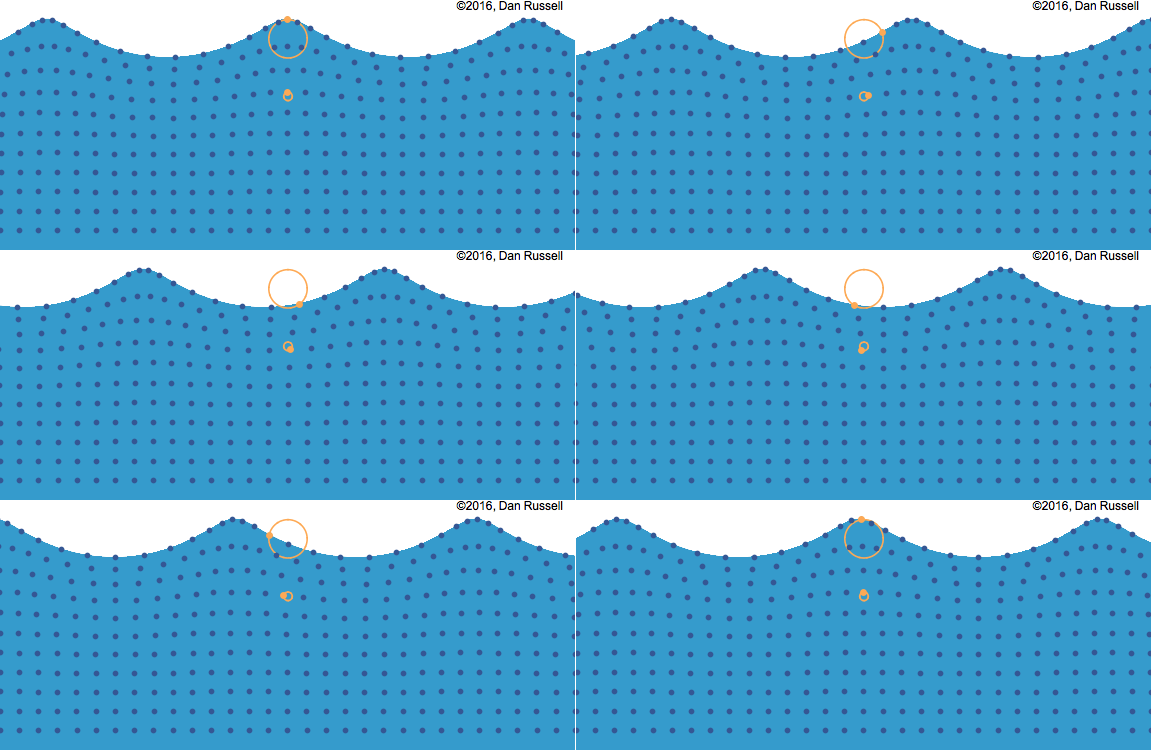 upper karma
that is also a point of discussion for me to talk about further applications of sine
thanks for that
oak horizon
yeah in the wiki page they have a whole ocean
there it is
that's done just with sine
oh, and trigonometric functions are also the base of every videogame
every time you wanna rotate a point in 3D space (or any other dimension) you have to use trig functions
which since they're just sine and cosine
oak horizon
you could also make the joke that cosine is just sine(x+PI/2)
but yeah idk what the context is
sine is just overall pretty important
upper karma
What identity this is called? On the final result? I am only aware of fundamental identity only...
acoustic jungle
2sinxcosx +cos^2x-sin^2x.
upper karma
Hmmm
double angle formula for sine and cosine
Ah yeah got it thanks.
Is there any way to memoreze trigonometric identites?
90% of the identities come from 3 formulas: fundamental, cos(x+y) and sin(x+y
paper vale
yea just rederive them from the basic ones
also the sin^2 + cos^2=1 is pretty basic to know
 little osprey
Its not basic to kindergardeners
 ashen brook
could someone help me with something related to trig
upper karma
@ashen brook just go with it
 cosmic pebbleBOT
From
Rule 1
The help channels are solely for help with math, so feel free to post your question. Asking whether you can ask a question or if anyone knows about some specific topic is unnecessary, so please try to avoid questions of that nature.
ashen brook
I need to find the point on the terminal side of the angle 45 degrees
upper karma
Send pic
ashen brook
upper karma
What are the coordinates of the arrow?
ashen brook
seems to just be y=x
ashen brook
oh thats (3,3)
upper karma
Try that
ashen brook
lmao i thought i already tried that but i guess i didnt, its right thankyou very much @upper karma
ashen brook
i can do that i just needed the point for it
 pallid edge
so ik sine, cosine, tangent, solve for side and angle,
but i just learned
IT SNOT JUST FOR RIGHT TRIANGLES?
HOW CAN U SOLVE THOSE?
 silent plank
for non-right triangles you will probably need to apply stuff like cosine rule and sine rule.
 fickle sleet
Adding onto that, there's also unique rules for unique triangles. Also some special triangles contain special correlation between its side lengths.
Those aside, you can generally make use of sine and cosine with their respective rules for a pretty large chunk of those triangles that aren't right angle ones.
silent plank
is there a better quality pic
 rich wolf
upper karma
rich wolf
upper karma
anyone got tips for success of trig?
or a good website where i can check my answers because not so sure rn
upper karma
Teacher
 versed river
i mean depends on what kinda thing you wanna check but wolfram alpha/desmos should cover a lot of your answer checking
upper karma
@silent plank Nope
@rich wolf My teacher drew it, not to scale I guess
He said they were right angled by radius-tangent theorem
 azure reef
are these lines supposed to be tangent?
upper karma
Yes
azure reef
then why amd says that angles are not right
upper karma
I should have specified tangent earlier
upper karma
Oh ok
azure reef
i mean do you know that in 4-gon sum of angles is 360?
upper karma
Yes, I just somehow managed to get a different answer
And I was confused on where I went wrong
azure reef
if you know that these are tangents you know 3 out of 4 angles
to find last one is elementary then
upper karma
Thx
Wait I still have 1 more question
I originally got a different answer but I'm not sure where I went wrong
The tangent makes an isosceles triangle
I marked 70 degs on the isoceles
azure reef
yes
you could've done that
but again you should've used that PAO where A is point where tangent and circle touch it 90
90-70=20
upper karma
Understood,
But I then used Alternate Segment theorem to get 70 deg rather than 140 deg on the central angle
Not sure where I went wrong
 rose tulip
Is the hypotonuse always going to be the longest side?
Just so I can note not always.
runic beacon
Is the hypotonuse always going to be the longest side?
Yes
 earnest echo
What is isos?
earnest echo
How is a dotted line supposed to be "isos"
earnest echo
Still the triangle would be "isos" not the line
earnest echo
Yeah, the triangle is "isos"
earnest echo
I didn't say anything
rose tulip
Then dont quote isos
earnest echo
It seems like I have struck a nerve
earnest echo
Since I asked what is "isos"
It clearly means I don't use the word
 alpine wadi
What would be the best way to learn trig and geometry? I am starting college(CS) in october and need to learn the basics so I can follow classes
I know almost nothing about trig and geometry
earnest echo
Maybe Khan Academy
alpine wadi
Any recommended ones?
earnest echo
Just read any standard book you have in your country
 sullen lantern
Why do we divide opposite by hypotenuse to get sine? What is the sine function used for? Why is this ratio so important? How did it come about?
 umbral snow
@sullen lantern
"Why do we divide opposite by hypotenuse to get sine?"
Because that's what sine is! The sine of an angle is the opposite/hypotenuse.
"What is the sine function used for?"
Basically above, it's used to notate opposite/hypotenuse of a right triangle. However, sin(x) obeys some nice algebraic properties, which can be used to describe properties of triangles.
"Why is this ratio important?"
It ends up being a conversion method from side lengths to angles and vice versa. Plus similar triangles will have the same ratios, so you can use trig to describe geometry.
sullen lantern
I see. Who invented the sine function? When did it first come into use?
paper vale
you could just google it tbh
 boreal adder
This is on my math warmup and im having trouble understanding it
upper karma
Do you know what the term coplanar means? @boreal adder
upper karma
Points are considered coplanar if they all lie on the same plane @boreal adder
What do you think now? Are they coplanar or not
boreal adder
Bruh I just wanted and answer smh
upper karma
hi
Bruh I just wanted and answer smh
@boreal adder that's not what we do here smh
@upper karma hi, need help on something?
hi! thank you my teacher was mistaken on sth, and now she corrected herself
I was just making sure that my answer is correct
ty tho
versed river
Use Pythagorean theorem ig
earnest echo
Have you tried something?
 fathom root
I write the equation out as this
earnest echo
The editor got lazy
fathom root
1 sec
the boxed off top portion
thats how i setup my equation
but i got 40, and obviously that doesnt work when i try to solv.e
so frustrating 😦
earnest echo
What do you mean it doesn't work
fathom root
if i plug it into the pythag theorem, it would be 40^2+9^2=41^2
how does that make sense
am i dumb or something
silent plank
,w 40^2+9^2=41^2
somber coyoteBOT


 Requested by ramonov#0921
versed river
Requested by ramonov#0921
versed river
Lol
fathom root
.
earnest echo
That's true
fathom root
im so disappointed in myself
silent plank
you found r
fathom root
oh my goodness
Im so dumb it just didnt look right in my brain
Ugh
Thanks yall.
I think the scale threw me off a lot too
like wot how is r 40 and the LONGER AB is 1
guess you can never trust the actual diagram
earnest echo
That diagram is really bad
silent plank
usually you shouldn't assume diagrams are to scale
 keen goblet
hey guys so im new to trigonometry
im not sure about sin, cos and tan
what do they achieve?
dark sparrow
they allow you to find side lengths using angles
dark sparrow
what do you mean what unit
keen goblet
wait nvm that depends on the question
dark sparrow
it doesn't matter what unit you use for your side lengths.
the formulas work all the same
keen goblet
ye ok, but so i read this
dark sparrow
so long as you use the same unit for all lengths in a single problem of course
keen goblet
ok so basically sin will get you the adjacent length?
dark sparrow
that's vague and also kinda wrong
in a right triangle, sin(θ) = opposite/hypotenuse
dark sparrow
sin(θ) = opposite/hypotenuse
nowhere does it say "adjacent" here
 coarse kayak
dark sparrow
coarse kayak
dark sparrow
unlike most people, i mean exactly what i say, no more no less
dark sparrow
no i didn't
keen goblet
so in this case it would be
dark sparrow
no i didn't
keen goblet
wait i need to read it again
dark sparrow
i didn't say you were "supposed to" do anything
dark sparrow
ok i am looking at it
keen goblet
Sin theta = 4/5
keen goblet
but what "IS" that value
dark sparrow
sin(θ) is the opp/hyp ratio in a right triangle with angle θ
that's all there is to it
maybe you'd benefit from a problem that demonstrates the "usefulness" of these things better
i can make one for you rn
keen goblet
yes PLS
dark sparrow
(but you will need a calculator for it)
keen goblet
ok, np
coarse kayak
@keen goblet You can use it to find theta though, if you have the inverse sine function
dark sparrow
ie the length of the ? side
calculator allowed and in fact required
so if you want to throw an answer at me, i'm gonna say round to the nearest 10cm
if you want, i can put it into a more "real world" scenario
dark sparrow
call the question-mark side x
cos(71°) = x/75
therefore x = 75 cos(71°)
does that make sense to you? @keen goblet
dark sparrow
...yes and that shouldn't really be news to you
which part of what i did were you unable to do yourself?
 dire sand

keen goblet
idk i guess the cos(71) was where my focus was at
keen goblet
ye i just realised that
keen goblet
ye?
dark sparrow
don't worry about how your calculator works out the values of sin and cos for any angle you throw at it
you'll learn it in due time but for now it will not help you
keen goblet
ok i see
ok i understood the point of it sin, cos and tan, but only one thing got me confused
dark sparrow
mhm?
keen goblet
one sec lemme think about this question before i ask lol
dire sand
i think ann just got ghosted 👻
keen goblet
no
dire sand
oh epic
how are you going with the question?
or is everything resolved?
if you're fine with it
try this
and let us know how you go with it
dark sparrow
theres nothing wrong so far
keen goblet
ah np :d
dire sand
xD
keen goblet
thx xD
 elder oracle
What would be the most efficient way to solve this problem?
elder oracle
Haha
upper karma
Are you supposed to use a calculator
elder oracle
Nope
upper karma
You can spot a rectangular
elder oracle
Yes that one in the middle
elder oracle
tan(B)?
upper karma
Np
upper karma
Hey

Is the answer here C? I keep getting E but in the answer key it's C
Anyone knows how?
silent plank
might be a typo
dark sparrow
,w 38.1/sin(6.5°)
somber coyoteBOT

 silent plank
x = 65 would get option c
 junior light
Ummm could you zoom in on the highlighted question, I'm having trouble reading the dimensions of the sides.
fathom root
sure, sorry.


 junior light
Okay. The question is fairly straightforward. You know the longest side of a right triangle is the hypotenuse, right?
junior light
You're going in the right direction, just a technical adjustment. The remaining two sides are both 7 units long.
fathom root
sorry, i don't get what you mean i apologize, math isnt my strongsuit
junior light
Are you aware of Pythagoras Theorem?
junior light
You know that the remaining two sides are equal
Notice that the triangle is also isosceles(two of the angles are equal, which implies two of the sides must also be equal)
junior light
Let each of these side measure x
somber coyoteBOT
Manan:
fathom root
ah yes i get that!
junior light
Great!
fathom root
so then let me ask im sorry
from that, it looks kinda weird to solve, im bad at solving stuff with radicals in it
err
i think thats the name for it
the square root thing
somber coyoteBOT
Manan:
junior light
Does that simplify things?
fathom root
ah, okay is it ok if i write it down rq how i thought i was supposed to? and then maybe you can see where i go wrong?
junior light
Sure 🙂
junior light
I'm sorry, I'm not aware about the FOIL method explicitly.
fathom root
no problem, do you know how i can tell that it = 7 * 7 * sqrt2 * sqrt2?
this is what i use.
junior light
You multiply the rational part with rational part, the irrational part with irrational part and multiply what is left
fathom root
how do i know what is rational and irrational?
junior light
Anything under a square root which is not a perfect square is irrational.
fathom root
ahhh okay
somber coyoteBOT
Manan:
junior light
Correct!
fathom root
then do you add those or multiply?
junior light
Then multiply these two to get 98
Keep multiplying, addition is not something we're doing atm
fathom root
got it.
fathom root
so x^2+x^2=98
junior light
Correct.
fathom root
so bc its a 45 45
cant i just instantly say, well its 98/2
therefore each side is 49?
somber coyoteBOT
Manan:
fathom root
hmm im confused there
junior light
What you have here is $x^2=49$
somber coyoteBOT
Manan:
junior light
Take the square root on both sides.
fathom root
sqrt49 = 7
junior light
Anytime 🙂
 keen plaza
simp
upper karma
Here is an interesting question for you guys!
Give an example of a 3-D object having 6 vertices such that there
are only two possible values for the distance between any two
vertices.
upper karma
What about an ||equilateral triangular prism||?
cosmic pebbleBOT
From
Rule 4
If your question has not been answered for a minimum of 15 minutes, you may use the Helpers tag once. Please do not try to bump your question using this ping unnecessarily. Do not abuse this ping. Do not individually ping users with the Helpers tag without their express permission.
 idle bloom
didn't even ask a question 
 next jackal
solve the question? and what question?
@upper karma Don't take this the wrong way, but this site is about helping you learn maths. Not volunteering on solving problems which is basically like us working out so you gain abs.
there's a lot of resources online for learning maths. We got a small list in #resources channel.
 wheat swan
Hello
I recently started my trig class and we were assigned a problem
The problem is as follows: Let t be an angle measure in degrees. Adding together t’s complement, t’s supplement, and a certain one of t’s coterminal angles yields a total of 2020 degrees. Determine t. Remember to describe your problem solving process.
I do not even know where to start, can anyone help me?
umbral snow
What's a complement angle?
What's a supplement angle?
What's a coterminal angle?
Make sure you know these definitions
wheat swan
Wait
 minor field
Yaya. So if your angle is x, the complement is
x - 90
@umbral snow i think it should be 90-x i think
wheat swan
Oh ok
umbral snow
Oh haha yeah mb
wheat swan
So then since its a single angle would it be like that angle - supp, complement??
Or am I wrong
umbral snow
That doesn't mean anything to me oop
You can keep subtracting 360 off 2020 to get rid of the coterminal angles
wheat swan
Keep subtracting 360?
minor field
yea
minor field
until u cant anymore
wheat swan
That would leave me with 220
The problem asks me to "determine t"
Im not sure what exactly that means
Since it is already given that T totals to 2020
minor field
t + tcomplement + tsupplement + t coterminal = 2020
 verbal void
Hello, I'm taking geometry and one of the equations we have to solve is (2x+1°)+(x-10°)=90° The symbol ° means degrees The problem is that I don't understand what the order of operations I am supposed to follow.
wheat swan
Ohhhh thank you @minor field I think I get it, let me try and solve it out now
minor field
hi @verbal void so what's the confusion?
verbal void
My confusion is how to start to solve the problem
idk if im supposed to distribute or combine like terms
minor field
since it's addition
u just need to add everything together
combine them
distribution only happens when u have multiplied isnt it
somber coyoteBOT
L'Âne 🍐:
minor field
Yep
verbal void
something like that right
verbal void
Would I pretend that the parentheses aren't there if another problem similar shows up in the future that is additon
verbal void
Oh ok thanks. I'm going to try it out
minor field
O.K. good luck to you
wheat swan
Hey @minor field
minor field
hi aka randrew
wheat swan
So would t = 310?
silent plank
no
for t to have a complement, it would need to be between 0 and 90° (inclusinve)
what was the initial equation you set up?
wheat swan
t + tcomplement + tsupplement + t coterminal = 2020
but i thought you could just set comp as 90 and supp 180
umbral snow
First nice choice is to subtract "t coterminal"
See above, we didn't say comp is 90, ect
silent plank
looks like you have an extra t in there
wheat swan
So supplementary is when you have two angles add to 180 correct
silent plank
yes
silent plank
you could just represent the supplement of t as 180° - t
wheat swan
ohh
silent plank
similar idea for the complement
wheat swan
Would i do all of them into one equation?
silent plank
write the whole thing
silent plank
yes
wheat swan
So that is my equation
silent plank
and then isolate t
silent plank
at this point its still basic algebra
I'm guiding you through relevant steps
t on one side, everything else on the other
wheat swan
Yeah I know its basic algebra but I havent been in a math course in 2 years and I cant seem to remember
silent plank
for basic manipulation of equations, apply the same operations to both sides of the equation
combine like terms etc
wheat swan
So for example the beginning of the equation 180 - t would i subtract 180
silent plank
you could subtract 180 from both sides of the equation