#geometry-and-trigonometry
1 messages · Page 275 of 1
 gentle bear
 soft dagger
okay
it has a magnitude of 98
and forms an angle with the x axis of 331
can you try and draw that
 pulsar merlin
@upper karma my teacher just told me to skip the assignment after i just did 10 questions....
 dim gyro
gentle bear
dim gyro
gentle bear
 upper karma
@pulsar merlin damn
soft dagger
@gentle bear the angle is supposed to 331°
upper karma
@dim gyro what do you want
gentle bear
soft dagger
331 is the angle not the magnitude @gentle bear
dim gyro
yes
upper karma
I gtg to eat so quick, use the complementary angles in 70° to get the inner angle of the triangle. Use the cosine law using 2 side lengths and one angle (the one you get by doing what its on the beginning of the message).
Ill be back in one hour to confirm your results, good luck.
 noble token
Hey, I'm having trouble visualizing this problem and I was wondering if somebody could help me work through it.
upper karma
Can someone help me in #help-4
@noble token well, you could google "right prism"
and see what it looks like
you could also google "what is the slant height from a right prism"
from that drawing, you need "s"
you already know "h"
and you know "r" (which is half of "a")
the perimeter of the square base is 24
that means "a" = ... ?
then once you have "r" and "h", Pythagoras' theorem
and you get "s"
noble token
ah
upper karma
3, yes
 silent plank
uh. prism and pyramid are different.
noble token
ah
upper karma
slant height?
silent plank
a square prism doesn't have a "slant height".
noble token
so the question is flawed
silent plank
it is unclear what the question bwants
noble token
that's what i suspected
i'm gonna assume pyramid for the sake of the question
then it's just a 3 4 5 triangle
so the slant height would be 5, yes?
 acoustic jungle
your end faces are not equal
nor parallel
and the sides are not parallelograms
 dusky surge
,w frustum
 somber coyoteBOT
Requested by Biscuit#5208
dusky surge
Opps
dim gyro
@upper karma i think i did it correctly
silent plank
not quite. how are you getting 21.6?
dim gyro
i put16.66−14.7×cos(110) in the calculator
silent plank
which gets you:
dim gyro
21.6
upper karma
that's not the law of cosines
edit: it is
dim gyro
21.6876961069
silent plank
which doesn't round to 21.6
also you should not be rounding yet
the stored value above is what you should be square rooting
it is also a good idea to write out the full equation instead of just one side of the cos law
upper karma
it rounds off to 4.7, not 4.6
Hey im back
I told @dim gyro what he had to do
It worked good?
heh, I was off a bit
fricken' rounding off
but it still gets you to 4.657, which is still closer to 4.7
Good it worked
 rapid siren
upper karma
rapid siren
upper karma
SSS
upper karma
AAA
silent plank
do you know the theorems related to similarity and congruency?
upper karma
@upper karma stop giving the answers, its totally what you aren't suppose to do in this server
You might give him a clue, method or anything to help but an straight solution
ight then
Good
 humble pebble
rent free i need answers too
 humble pebble
oh ok thanks for the answer
upper karma
But if you could read my previous messages and rules, which is what you have to do in a server, you'll understand the matter
humble pebble
oops wrong dm
upper karma

if you're only given sides... what did you think the answer was gonna be?
and if you're only given angles...
lmao ikr
I mean, come on
Yeah lol
silent plank
however if you're only given angles it doesn't mean that the triangles are ||necessarily ... ||
 devout kraken
what’s the equation to find opposite from a hyp and angle? Is there one?
upper karma
sin(theta) * hyp
 versed river
$\sin(\theta)=\frac{O}{H}$
somber coyoteBOT
Sneaky:
versed river
$H\sin(\theta)=O$
somber coyoteBOT
Sneaky:
silent plank
refer to you trig ratios and which do you think would be appropriate
devout kraken
cos(theta)=adj/hyp ?
devout kraken
$\cos(\theta)=\frac{A}{H}$
somber coyoteBOT
leaf:
devout kraken
okayokay thank you
acoustic jungle
Just a thought, proving triangle congruency all comes down to SSS and the fact only 1 triangle can be constructed with 3 given side lengths
devout kraken
There’s also SAS , ASA, and AAS?
acoustic jungle
SAS - SSS congruence by cosine law
ASA - SSS congruence by sign law
AAS is literally the same thing as ASA
upper karma
I mean, doesnt cosine and sine's rule/laws have more uses than those
upper karma
Yes
 devout harbor
@oak pawn There's a property, the tangent to a circle always forms a 90 degree angle with the radius at that point
upper karma
isn't it a right angle?
devout harbor
yes
upper karma
ok
 oak pawn
Oh I wasn’t sure usually they put the right angle sign then in this book, thanks
 vague berry
i got a trig test tomorrow 😮
 tight tide
heya is anyone else here doing High School Khan Academy Geometry ?
 quick schooner
does anybody know how to do number 3
 vague pagoda
yeah
upper karma
@quick schooner do you even SOH CAH TOA, bro?
vague pagoda
what have u tried
upper karma
what does sin(36) evaluate to?
(set your calculator to degrees first, not radians)
,w sin(36)
somber coyoteBOT
Requested by DSpider#6917
quick schooner
our teacher said not to use a calculator
upper karma
ok, then just keep it as "sin(36)"
quick schooner
sorry if i sound dumb here but i have no idea how to find b
all i know is that b is the hypothenuse
upper karma
and move the "2" over to the other side
(so that the equation evaluates to true)
"b" is the "2" in that example
 rich wolf
Omg
Do you really need that many steps to solve a division problem
That is painful to look at
Lol mb actually i scrolled up and saw
 woeful nova
can someone help me on this? how would I solve it?
 dark sparrow
let me reproduce your diagram in a more easily readable format
woeful nova
alright
dark sparrow
woeful nova
so would a ratio solve since similar?
3 X
_ _
-
-
4 5
and then cross multipliy?
x=15/4
dark sparrow
15/4 is the correct answer yes
woeful nova
thanks!!!!!!!
woeful nova
when you add radicals, is it just like how you'd think you add them 7 |2| + 7|2| = 16 ?
woeful nova
yeah
dark sparrow
do not
that's not what | ... | means
$|x|$ and $\sqrt{x}$ are two entirely different things
somber coyoteBOT
Ann:
woeful nova
`|----
woeful nova
okay
dark sparrow
anyway, no, $7\sqrt{2} + 7\sqrt{2} \neq 16$.
somber coyoteBOT
Ann:
 hollow tiger
I think he means to ask if you can add radicals
in which case yeah you can
7 * sqrt(2) + 7 * sqrt(2) = 14*sqrt(2)
dark sparrow
but that isn't what he said.
he asked if 7sqrt(2) + 7sqrt(2) was equal to 16
and the answer to that is an unambiguous no
hollow tiger
ok I guess I'm just confused now lmao
hollow tiger
yes
dark sparrow
see that's actually correct this time
woeful nova
okay thanks
gentle bear

this is the graph I came up with
here is the work I did
Maybe I don’t understand I should be doing fully but I was under the impression I take the middle values and multiply it against 2
silent plank
consider x^4 = (x^2)^2 and 16 = 4^2
 vale nimbus
sin(x) + sin(3x) = 2cos(x)
i combined sin(x) and sin(3x) and then divided both sides by 2cos(x) so im left with sin(2x) = 1
but then i only get 1 of the 2 solution sets
i guess the other way to solve is to move 2cos(x) over to the left, combine sin(x) and sin(3x) again and then factor out 2cos(x)
but i dont see why what i did doesnt give me the full solution
silent plank
dividing both sides by cos(x) erases the solution you would get from cos(x) = 0
vale nimbus

thanks man
wait what even when i factor that stuff out i still only get 1 of the sets
silent plank
can you write out your work?
upper karma
What type of factoring will be used for 20x^2 - 4x?
vale nimbus
sin(x) + sin(3x) = 2cos(x)
sin(x) + sin(3x) - 2cos(x) = 0
2sin(2x)cos(x) - 2cos(x) = 0
2cos(x)[sin(2x) - 1] = 0
silent plank
did the give a restriction on x?
vale nimbus
nope
silent plank
can you show me the rest of your work? that looks ok so far.
vale nimbus
im stupid 
my handwriting is so ugly i wrote my 1/4 so poorly it looked like a 1/2
i got it now dw
vale nimbus

should i try to avoid dividing by stuff when solving these sorts of equations?
so i dont eliminate possible sets
silent plank
try not to don't divide by stuff that could be 0
upper karma
@silent plank Do you know bout my question?
upper karma
But what type of factoring?
silent plank
common factors?
silent plank
(also not geo/trig)
 night summit
where did cos come from?
the video has nothing to do with it
thats just an exampe
example*
night summit
i substitute x for sinx and y for tanx and solved
then found reference angle because when solving for y or tanx you get a reference angle of 9.6
i added that to 180 and subtracted from 180
vale nimbus
cant u factor out tan(x)
silent plank
how you use your reference angle depends on the sign and the trig function
where is sin positive?
silent plank
9.6° is already in quadrant 1
night summit
yea
silent plank
subtracting that from 180 gets you 170.4° (the solution in quadrant 2)
night summit
yea
silent plank
and that's it
silent plank
well your 0° and 180° for tan(x)=0 are fine
night summit
how do i know
if its 0 and 180
is it always 0 and 180?
or does it depend on the sign?
silent plank
if what's 0 and 180?
silent plank
what sign?
0 is neither positive nor negative.
and x= 0, 180° are the only solutions to tan(x)=0 in the given interval
night summit
yea i get that
but if cos was 0
what would the first 2 options be
and if sin was 0
silent plank
refer to the unit circle if you are unfamiliar with these
silent plank
if what's a whole number?
upper karma
how did u solve it
silent plank
you shouldn't need to resort to subtitutions for these questions
vale nimbus
uh i have a question can i ask now or should i post it in one of the question channels
upper karma
question channels
silent plank
anyway sin(x) =7 has no real solutions
so ig leave 2 boxes blank
and only input the solutions you get from tan
night summit
tan is 0
so
i only put
0 and 180?
yes i got it ty
@silent plank sry but if a function comes out with a whole number like 1 and increasing, does that mean it has no solution?
silent plank
can you be more specific?
night summit
so if sin(x) = 1
it has no real solution?
so sin(x) cos(x) and tan(x). if any of these 3 functions equal to a whole number
they have no solution?
silent plank
sin(x) = 1 definitely has real solutions
so does cos(x) = 1
sin(x) = c and
cos(x) = c have no real solutions if
|c| > 1
vale nimbus
tan(x) + 4sin²(x) + 2 = 4sin²[(pi/4) + x]
how to solve
asked in #help-1 but we couldnt figure it out and now the channel's been robbed
silent plank
and tan(x)=c has solutions for all real c
vale nimbus
after 5 hours i still cant solve trigonometric equations

and im supposed to be able to do inequalities and inverse trigonometry by monday
vague berry
Yo
vale nimbus
i just cant do equations
im hoping inequalities are similar to equations
but i cant even do those so it aint looking too good
vague berry
hey guys how would you write the domain of 2sec(x)?
like what is the correct notation?
given that cos58˚ = a/c and sin 58˚ = b/c, calculate the expression tan302˚ + csc212˚ + sec 122˚. Answer as a fraction in simplest form
please help me
ping me maybe
 novel mango
what have you tried het
evaluate tan(2pi-x)
tell hows it related to tan(x)
Hint here :||360-58=302||
novel mango
just try to get these in terms of the standard angles
vague berry
wait can you give me an example
novel mango
also like 212=270-58=3*90-58
vague berry
like tan(2π-x) like how do you evaluate that
novel mango
there
vague berry
oh
novel mango
do you know how to evaluate the trigonometric ratios of compound of angles
i.e like a sum of angles
vague berry
no we haven't learned it such a lazy teacher
hollow tiger
I have a sheet of formulas if yall need one
novel mango
its useful and helps you relate
tan(A+B) with tan(A) and tan(B) individullaly
novel mango
have you learnt complex numbers?
vague berry
Yes I have
novel mango
ok then you know it now
its known as eulers identity
so observe how i use this
to get the trig ratios for sin(A+B)
e^(i(A+B))=e^(iA+iB)=e^(iA)*e^(iB)=(cos(A)+isin(A))(cos(B)+isin(B))
read this take time
rich wolf
let x=a+b
novel mango
do you underatand the line?
vague berry
im trying to
novel mango
yea sure
vague berry
but its kinda challenging for me since we have never once gone over it
novel mango
its very useful and you can skip all work
its just algebra
see i used the fact that a^(b+c)=a^b.a^c
you can multiply it out for getting the formula
vague berry
Ok I think I got it
how would one attempt
Īt is known that k is an x-intercept for the function f(x) = sin (x-m), where m is a positive integer. Find ONE of the x-intercepts fro the function g(x) = cos (x-m) in terms of k.
novel mango
Ok you can see that later anyways
$\tan{(A+B)}=\frac{\tan(A)+\tan(B)}{1-\tan(A)\tan(B)}$
is the formula You would need
it would follow after some work with the e^ix thig
somber coyoteBOT
God V2:
 digital gulch
Can someone help me with this?
upper karma
well if K is perpendicular to L, then its slope it the negative inverse of L's slope
upper karma
yah
digital gulch
Yeah i got that part
upper karma
divide the number in the point that passes L with the slope of L
digital gulch
Why
upper karma
cuz thats how u find r in the first point
upper karma
yes
digital gulch
R/-2,3/2
upper karma
now do the same thing with your second point and the slope of K
digital gulch
12,2r
upper karma
yes
digital gulch
What do i do with that?
upper karma
oh hang on
6 was the x-coordinate, not the y-coordinate. my bad
what you should do is multiply 6 with the slope of K, not divide
my apologizes
digital gulch
Oh ok
upper karma
so your 2nd r should be 3
digital gulch
3,r/2
upper karma
so your points should be (3/2 , 3) and (6 , 3)
digital gulch
Oh
upper karma
you know what? the 2nd r should also be 1.5 actually. i read the question incorrectly
and ignore what i said about the slope of K.
so your first point on line L should be (1.5 , -3) and your second point on K should be (6, 1.5)
digital gulch
Oh
upper karma
yah i fucked up again. my bad i don't mean to confuse you
digital gulch
Its ok
upper karma
alright
digital gulch
Yeah the rest was easy
digital gulch
Yeah
digital gulch
-1.2?
upper karma
yah
 inland bluff
 plush burrow
Given that the terminal arm passes through the point (-3, -4), find the exact values of all trigonometric ratios
can someone help me on this please
i need 3
 merry abyss
plot on Cartesian plane
and find hypotenuse
which is also radius
then find the trig ratios and use CAST
not a full answer sry
plush burrow
thanks dude
 crimson olive
can someone help me with this please?
upper karma
What's 36 degrees
crimson olive
i'm not even sure lmao thats what was so confusing
maybe the arc but im not really sure?
rich wolf
This is simple
Angle DCA is half of arc DA
And opposite angles of a cyclic quadrilateral add up to 180
upper karma
@crimson olive
what is the number of degrees of arc AB?
remember, the whole thing is 360 deg
arc AD + arc AB = ?
maybe this will help:
Enjoy the videos and music you love, upload original content, and share it all with friends, family, and the world on YouTube.
I guess you could also think of it like this:
crimson olive
i got it thank you so much!
digital gulch
Im bad at coordinate geometry
upper karma
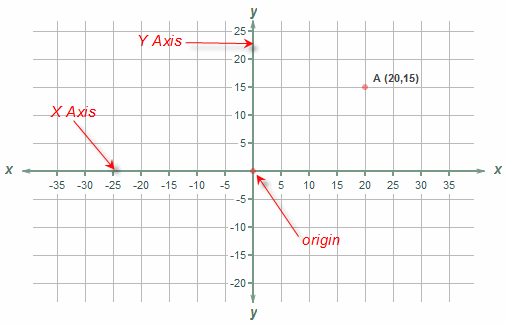
plot it and see what you get
or rather, if you didn't have to plot it, what would AC be?
hint: ||law of cosines||
this also sounds like it could be a 30-60-90 triangle
digital gulch
How do i plot it?
digital gulch
It cant be a 30-60-90 triangle
BC would be 6
But that would make AB 6 times sqrt(3)
And 8 is not 6 times sqrt(3)
So it cant be a 30-60-90 triangle
We also dont know if its a right triangle
digital gulch
Im just gonna use law of cosines
silent plank
it doesn't really make sense to use coordinate geo to do this question
upper karma
it would look something like this:
maybe if you used a ruler
and measured it "manually"
and a protractor for measuring the angle
 potent crane
Anyone know if I need to label something for the -1 on f(x) axis?
since x != pi/2
upper karma
@digital gulch @silent plank I think there's a way:
30-60-90 triangles have a certain property
that the hypotenuse is equal to ||twice the length of the shorter leg||
so the dotted line (i.e. the shorter leg) would be...?
then you can find the side with the question mark
and subsequently this side:
you can Pythagoras' theorem your way through this without any protractors and stuff
@digital gulch you understand what I'm saying?
using the law of cosines is a shortcut, but that's not what the question asked you to do 🙂
they chose 30 degrees for precisely this reason
@digital gulch
@potent crane what is the midline of that graph?
@potent crane
don't forget the ">" arrows on your axis
the vertical line is the y axis
and it doesn't have anything with "pi" on it
what is the amplitude of that function?
the midline?
and the period
upper karma
@potent crane
UPDATE: this is wrong. Should be cos(x)(1/(x-(pi/2)))
how about now? do you know what the amplitude and midline are now?
from "cos(x)(something)"
hint: ||1cos(x)(something) + 0||
aaaand you're offline
nice
dark sparrow
they're not just offline, they straight up left
 old holly
hello can i ask something
upper karma
if it's related to trig, sure
old holly
this is really dumb
but
since when is the volume of this not $\frac{1}{3} \cdot 100\pi \cdot 13cm^3$
somber coyoteBOT
Im confused; get over it:
old holly
it's kinda geometry
upper karma
True i was gonna say that
dark sparrow
f r e s h m a n s d r e a m
vale nimbus
could i have some help with goniometric inequalities?
dont really have a specific problem in mind but i think a good place to start is with tan(3x) <= sqrt(3)/3
we luckly only have to do basic inequalities but they're still too hard for my pea-sized brain
acoustic jungle
Well, if you let 3x = u then tan (u) = 1/sqrt3 and u=30 or 180+30
so 0<u<=30 and you will have to do it for the third quadrant as well
 vale nimbus
<@&286206848099549185> where did i go wrong?
dusky surge
,w graph tan(x/3)
somber coyoteBOT
Requested by Biscuit#5208
 hallow rose
The general solution for $ \tan(x)= \tan(y)$ is $x= n\cdot \pi +y$
somber coyoteBOT
FinalBoss:
dusky surge
vale nimbus
but i dont even understand how to solve these inequalities
in the book they draw a circle which is an understandable thing to do, but then they get pi/2 involved too
which i can see why but not how
they do that cuz tan isnt defined when the angle is pi/2
but idk how you're supposed to take that into account in your answer set
dusky surge
As you can see from the graph, for tangent(x/3)≤√3/3
The values are clear
vale nimbus
bro im not supposed to do it graphically lol
dusky surge
We can do it with the help of reading graph and understand the pattern
For the 'first'curve , that inequality holds for -3π/2 <x ≤π/2
So you can see for these questions about tan(x) smaller than a number, it will have a pause on every π/2+nπ
Like the second' curve, the inequality holds for 3π/2<x≤7π/2
Do you see the pattern?
vale nimbus
no
dusky surge
Ah... Okay, lemme use a question for example
vale nimbus
in class we always did these using the unit circle
but its been so long that ive forgotten
dusky surge
Okay... But using unit circle on tangent values is harder than sine and cosine
vale nimbus
i mean like i understand the drawing now but i dont see how they got their part with π/2 from it
vale nimbus
the solution should be (-3π/2)+3nx < x < π/2 + 3nx
dusky surge
$\tan{(\frac{x}3)}\leq\frac{\sqrt3}3$
somber coyoteBOT
Biscuit:
dusky surge
I'm handicapped with Latex...
vale nimbus
if you feel more comfortable writing it down on paper go ahead :p
dusky surge
Okay, gimme some moment
For this first range I picked, everything under the line y=√3/3 and on the tan(x/3), it will suits the inequality
And since it happens for every repeated copies of this first range, we can easily generalize the inequality
vale nimbus
i can understnad that
but on the drawing in my notes there's some weird stuff
holdon let me send a picture
the top part is also marked
dusky surge
Hmm... You mean the pi/2 part?
vale nimbus
yeah
dusky surge
But tan(pi/2) is undefined...
dusky surge
Yea?
dusky surge
Let's see
vale nimbus
the order of my stuff isnt right
i just realised
just imagine the 3pi/4 part being on the left
dusky surge
I think it's the other way round lol
vale nimbus
what do you mean?
dusky surge
just imagine the 3pi/4 part being on the left
@vale nimbus
This
vale nimbus
i was told to put the smallest angle to the left of x
im dumb nvm
yeah it should be the way it is
vale nimbus
is the solution correct?
dusky surge
The right side should be pi/4 +2pi+2kpi
vale nimbus
why?
vale nimbus
is there a reason for that?
dusky surge
It should be below this straight line
If it's you're solution, you are describing the things above the straight line
vale nimbus
huuuuh
dusky surge
I'm sorry for the ambiguity, I am just not used to using unit circles to solve these kinds of problems
vale nimbus
i understand the drawing just not what you mean by mine is above the straight line
nor do i see how adding 2pi to the right side would fix that
dusky surge
From what I understand from your last question, the 2nd line is describig something like this
dusky surge
But when we actually need this
Since the angle is moving anti clockwise, we add 2pi to make the inequality easier to be written out
vale nimbus
i'm sorry but i still dont see how that solves the problem
is that just to make it easier? or does that fix the issue of the shaded area being in the wrong place
dusky surge
Yea, I fix the issue of the shaded area being in the wrong place, it's about angle moving anti clockwise
Because we cannot describe clockwise from π/4 to 3π/4 the angles between them
So we add 2pi to fix the problem
dusky surge
By adding 2pi, turning it back to an anticlockwise situation
Piece, you have given me a new insight in solving problems using unit circles, thank you!
vale nimbus
dusky surge
So does that make sense now?
dusky surge
Sure!
vale nimbus
you dont have to add 2pi here since you can describe clockwise from -2pi/3 to -pi/3
i think
vale nimbus
so the angles have to be positive?
dusky surge
Nah, you are already describing anticlockwise direction😀
Try to draw the 2 angles on a unit circle and you'll see it
vale nimbus
dusky surge
Ahhh, it's the other way round XD
I kinda know what you don't understand
You know sine it's the y in the unit circle right?
vale nimbus
yes
dusky surge
So, for sin(something) < N for some constant N
On the graph, it's just everything that is under the line y=N and on the unit circle
So in this case, it's anticlockwise from -2π/3 to -π/3
vale nimbus
dusky surge
Sorry....
vale nimbus
no problem man its not your fault
dusky surge
Don't mean to make your mind explode
dusky surge
Yea, -2pi/3 is on the left, what you wrote was right.
vale nimbus
oh ok
sorry lol
so how do i know in which direction i should be going
like counter-clockwise or just clockwise
dusky surge
For me, I just read the graph...
vale nimbus
can you give me another problem?
dusky surge
This is what I read which range should it be.
can you give me another problem?
@vale nimbus
Wanna try cosine?
dusky surge
Okay
vale nimbus
brb 2minutes
dusky surge
$\sin{(x)}\leq\frac12$
somber coyoteBOT
Biscuit:
dusky surge
Okay
dusky surge
Yea
vale nimbus
i cant say why again tho fuck sake
dusky surge
vale nimbus
mhm
so when it has to be below i have to describe counter clockwise and when i have to say when its above i have to describe clockwise?
or is that a bad generlisation
dusky surge
Nah, it's a bit more complicated than that
vale nimbus
dusky surge
when it's below,
Value negative, then it's cool
Value is positive, need to add 2pi
And the situation is different for 'above' case
 dusky surge
This is correct
vale nimbus
omg i think
i really get it now
i dont do it with a graph but i try to interpert the (something)<x<(something)
and i think i get it now
dusky surge
Oh okay
vale nimbus
the smallest my angle can be is the thing on the left and the biggest my angle can be is the thing on the right
idk i cant really explain it
can you give me another problem with sin?
somber coyoteBOT
Biscuit:
vale nimbus
dusky surge
Hmmm...-5pi/6 is smaller than -pi/6
dusky surge
Yea, I know it'll be real tried for ya
vale nimbus
if u switch the left and right around tho, is it correct?
dusky surge
Anyway, if those two interchange, it's correct
vale nimbus
YES
dusky surge
Yea
dusky surge
Let's try the 'above' case
rich wolf
Bro its only 1:30
dusky surge
We're from different timezones XD
rich wolf
Lmao
dusky surge
01:30 for me
vale nimbus
AM?
dusky surge
Yep
rich wolf
Japan?
vale nimbus
that doesnt sound very healthy
dusky surge
Hong Kong
dusky surge
Indeed... It's unhealthy, staying up doing maths
vale nimbus
could u give me 1 last problem? then its bedtime for you 😤
dusky surge
Doubt that> Im pretty sure thats the same time zone though
@rich wolf
Oooo
Sure
Lemme type
$\sin(x+\frac{π}4)>\frac{\sqrt2}2$
somber coyoteBOT
Biscuit:
vale nimbus
kk
dusky surge
dusky surge
Correct!
vale nimbus
 thanks so much dude
dusky surge
You're welcome!
dusky surge
Graphically it's similar XD
vale nimbus
xD
dusky surge
But I'm really not sure about it
vale nimbus
could you give me a cos problem? or are you going to sleep now
somber coyoteBOT
Biscuit:
dusky surge
vale nimbus
dusky surge
Correct!
vale nimbus
and if it was < instead of >
would the thing above be correct?
the one that i kidna scribbled out
dusky surge
Yea!
dusky surge
You're good!
vale nimbus
thanks so much man
dusky surge
No problem man
vale nimbus
have a good nights rest now
dusky surge
Have a good dinner XD
vale nimbus
anyone else willing to help me get the hang of this?
think ive got sin and cos down
tan and cot are next
devout harbor
@vale nimbus https://www.math-exercises.com/equations-and-inequalities/trigonometric-equations-and-inequalities
Practice your math skills. Trigonometric equations and inequalities. Solve the trigonometric equations and trigonometric inequalities on Math-Exercises.com.
good luck
acoustic jungle
Ok
I'm getting an impossible triangle
A triangle that doest obey the sin law
Could you guys check if the base triangle is not possible
acoustic jungle
I'm just verifying whether or not the bottom triangle is impossible, I did the angles of depression correctly
Also don't refer to my drawing, I had to include it to fit the question in
acoustic jungle
also that 0 looks like a 2, it is 70 not 72 although this doesn't matter since it's not given in the question anyways.
upper karma
Lmao how is that a 0
then write 0 over it
so it's clear
yah how is that a 0
if it's an obtuse angle, you need 180-angle
acoustic jungle
I said before the drawing is in the picture because I had to fit it in
You know I'm going to crop it then
Actually doesn't even matter
The bottom triangle is impossible. The question has an error
 white dew
can someone explain to me how we get from the second part to the third?
i tried multiplying but I believe I did it wrong because im getting something different
acoustic jungle
cross multiplying
QS * sin 2 = 100 * sin 31
wait.
something doesn't seem right...

are you sure that answer is right
white dew

my professor sent this problem as an example
so I am just going of the example so I can do the problem he gave
acoustic jungle
alright the answer 1475 is correct
white dew
he just did not breakdown his steps completely
acoustic jungle
but that third step is wrong
white dew
wrong how? the process?
 surreal flume
How do I find the length of an arc in a circle when I am given the diameter and the measure of the angle of the arc
upper karma
do u have a diagram u can show us
upper karma
what question
 glacial haven
arc length is given by the equation r theta
surreal flume
2 and 4
upper karma
what does the degrees outside the circle represent
surreal flume
the angle measure inside
upper karma
ok
Angle over 360
Multiply by circumference
Easy
for question 2) you have to find the area of the circle then multiply it by 47 then divide it by 180
and for question 4) u have to find the circumference then multiply it by 160 then divide by 360
acoustic jungle

 lofty dust
Thank you so much
 rigid pawn
-3cos(t)/-5sin(t)
glacial haven
what about it
rigid pawn
is that csc^2 or cot
glacial haven
3/5 cot(t)
glacial haven
its not
versed river
,w -3cosx/(-5sinx)
somber coyoteBOT
 Requested by Sneaky#0928
versed river
Requested by Sneaky#0928
versed river
See, its cotangent
versed river
Yes. I was confirming it to the person who doubted you
glacial haven
how do you find the integral of cot(x) @versed river
wait nvm
you just use u sub
 desert pond
dunno if this belongs here
but not quite understanding how they get the circle equation in part b
i understand the dot product, the vector on the right of the dot product is just the vector a
but how is the vector equation of the circle (r-a) ?
upper karma
UwU
 tired dagger
glacial haven
tired dagger
glacial haven
70
humble pebble
 winged hill
can someone help me with this? i figured out the others but im still stuck on this
(sorry for the low quality pic my teacher uploaded it that way)
dark sparrow
inscribed angle theorem
dark sparrow
you don't give a shit about lengths here at all
 sly grove
@trail whale for the first one if you work out the length of all the sides of the triangle ACG then you could use the cosine rule
 trail whale
Is the answer 29
sly grove
no idea lol, i havnt put it in a calculator
although looking at the diagram that seems about right
for the record the diagram isnt to scale but its close enough that you know that you are looking for an acute angle probably below 60 degree
trail whale
Ok thanks
sly grove
reckon you can handle the other one?
trail whale
No lol my teacher set me this and we haven't studied it once so it's hard
sly grove
ok so i just put the first one in the calculator and i also got 29
trail whale
Yep
sly grove
for the next part the process is exactly but the slightly harder part is choosing the triangle
trail whale
Ok
sly grove
well what triangle would you pick?
trail whale
Idk lol
sly grove
the first thing is do you get what the mean by the angle between the planes
sly grove
not for this one
trail whale
So what angles
sly grove
AVB is the triangle and ABCD is the square
so its asking for the angle at where the two shapes meet
now a reasonable guess might then be to find the angle VAD, but that triangle is at angle so it would be larger than the real value so it wont work
so youll want to find a triangle that is "upright"
trail whale
Ok
sly grove
i dont want to fully give it away so ill let you know that two of the points have letters and the other one is the midpoint of a line
does everything i said make sense?
sly grove
VE are two of the points but you need one more for a triangle
the last one doesnt have a letter on it
trail whale
Ok
sly grove
figured it out?
trail whale
I think the answer is 67
sly grove
what did you take as the third point?
trail whale
That thing that don't have a ketter
sly grove
just ran it through my calculator and got 67 aswell, nice job
 lime storm
I’m having difficulty with this problem. Originally i got 54 but the multiple choice only has. 32, 44, 52, and 76
the last parts says what’s m<jkm
silent plank
there's a theorem for it. i forgot the name but you can derive it from inscribed angles and external angle theorem (by constructing PJ or LM)
upper karma
@lime storm what is the value of angle JPM?
hint: ||inscribed angle theorem||
well... it's been 5 hours, and you're offline, so I'll just go ahead and post it
rich wolf
@upper karma bro dont just give out the answer
upper karma
yeah, you're right
he's not gonna learn anything like that
but I am gonna leave this here as a hint:
and this: ||remember that all angles from a triangle add up to 180 degrees. And once you have angle PKL, JKM is what's known as a vertical angle (look it up)||
hopefully it's enough to get him on the right path
 pallid cloud
I couldn't find what they asked for in 3)
In 1) I showed that using Chasles
In 2) I showed the law of sines using 1)
In 4) I showed the law of cosines using the law of sines already shown in 2)
In 3) I showed that 2R=a/sinA=b/sinB=c/sinC using the law of sines and some geometry in the triangle and its circumcircle
But I couldn't express R in terms of 2 sides and the angle between them
Any help please?
Ping me when you answer please
pallid cloud
<@&286206848099549185>
 ancient axle


 acoustic jungle
@pallid cloud deleted message
wait..
You have the answer don't you?
In 3) I showed that 2R=a/sinA=b/sinB=c/sinC using the law of sines and some geometry in the triangle and its circumcircle
c is just sqrt(a^2+b^2-2abcosC)
maybe I am misunderstanding the question?
pallid cloud
Fishraider I'm not allowed to use the law of cosines