#geometry-and-trigonometry
1 messages · Page 179 of 1
 white harness
 white harness
No.
 upper karma

yes
actually, x < 0 && y >= 0 is bad (bot left)
the discontinuos lane should be changed with the continous
white harness
The rendering is reversed. Yes.
 white harness
Rounding mistake (don't panic, you are using float 32bits).
upper karma

asjkvgfasljdbvhsdobv
im
so
fckin
happy
tomorrow i will try to do on the correct order
but basically
is to reverse the sorted list (?)
yes XD
it is reversing XD
white harness
Reverse the rendering with (x, -y).
white harness
@upper karma .
upper karma
im resting :P
white harness
Don't forget (x, -y).
 hard gale
Dem DAT ordering (it's kinda logical in a computer tho, kek me)
 outer ginkgo
Please, help me. I think I've been staring at my paper for so long. TIA 🙆🏻🙏🏻
 elder vale
Whats graphing a boundary line mean again?
 glossy dawn
pretty sure it means the > < >= <= thing
so y >= 3x + 2
you draw a thicc line on the line 3x +2
the line itself being the boundary
 bright elbow
 wraith solstice
 keen aspen
Does the v represent velocity?
 twin prawn
The angles are equal because the tangent velocity vector is always perpendicular to the position vector
 wild hamlet
each arrow is rotated by 90 degrees so their adjoining angle would be the same
 echo star
can anyone here help me with my homework?
upper karma
Considering it's a math server, probably
echo star
sooooo number 39.)
just confusing af
i asked a previous server and it doesnt make sense how the answer book says its 16
how did the book get 16
if its the answer key, it has to be correct right? unless its wrong.... then ive been scammed like 2 hours
of mai lyfe
<@&286206848099549185> i need Help~~
 drowsy heron
@echo star The solution is correct. Let me explain.
echo star
ok
drowsy heron
From the picture, ABE = EBF
Therefore, ABF = ABE+ABF = ABF + ABF = 2 * ABE
But ABF =7b-24, and ABE=2b
So, (7b-24) = 2 * (2b)
Did you arrive at this equation?
@echo star
drowsy heron
What is the value of b?
echo star
ok so which equation should i be doing
drowsy heron
Why would we need a not-equals? Sounds more like a miscommunication than a mistake.
(7b-24) = 2 * (2b)
Note the “2 *”
echo star
so is it 7b-24=4b?
echo star
then whered u get 2*
drowsy heron
See what I wrote above.
From the picture, ABE = EBF
Therefore, ABF = ABE+ABF = ABF + ABF = 2 * ABE
But ABF =7b-24, and ABE=2b
So, (7b-24) = 2 * (2b)
Copied down here.
drowsy heron
There’s a single solution for b.
drowsy heron
So... you’re saying the solutions to the equation are b=-8 and b=8, right?
echo star
one of them
drowsy heron
Well... have you figured out which?
echo star
-8? right
drowsy heron
Just try plugging the numbers in 😅
drowsy heron
Ok. Do you understand how I got the equations?
echo star
yeah i get it
echo star
wat is it
drowsy heron
From the picture, ABE = EBF
Therefore, ABF = ABE+EBF = ABE + ABE = 2 * ABE
But ABF =7b-24, and ABE=2b
So, (7b-24) = 2 * (2b)
Edited the second line.
That must have been confusing 😅😑
 rose reef
help anyone thanks im a freshman and I’m taking high honors geometry
drowsy heron
@echo star So, now we have the value of b. We want to to find EBF. But we know EBF=ABE. Do you know how to find ABE?
@rose reef I’d suggest asking in one of the question rooms 😅 sorry.
@echo star Do you understand?
echo star
trynna comprehend hold up
rose reef
oky
echo star
@drowsy heron wait one more thing
with 41 how do u set it up
i just need that
nvm nvm
got it
 desert quail
Can someone help me with analytic geometry?
keen aspen
Sure
 cold plaza
if you have a circle in the xy plane of the 3 dimensional space. (including z axis)
and plot a height point projecting upward from the midpoint of all pairs of points in the circle. and the height is equal to the distance between the points on the circle.
how would the resultant shape/curve/surface look like?
 torn goblet
cold plaza
torn goblet
cold plaza
shit I thought it was a cone
cold plaza
daaaamn im smart
im not 100% sure tho is if any PhDs wanna authoritatively answer, that'd be great
cold plaza
man i thought of a technique to show its a cone
cold plaza
yeah. i wanna go inside one
cold plaza
here's a related problem... if you take a fixed point on a circle, and draw lines out to all other points on the circle... and then you connect all the midpoints of all lines... do you get a circle?
sometimes I wish I was good at art
white harness
Image please.
cold plaza
white harness
Yes, the result is a circle.
cold plaza
why
white harness
Homothety.
cold plaza
whoa thats advanced
could you please verify my question posted at like 40 min ago? the one with xyz
more like 48 min ago
white harness
It will have a volume.
cold plaza
but the volume of a cone?
white harness
Sorry, it can't have one.
cold plaza
so its just a surface then right. Its the surface of a cone right?
 errant ether
I don't think it can be a cone. Consider the curve drawn out by taking the midpoints of a set of parallel chords down the circle. The midpoints form a straight line in the xy plane and I believe a semicircle in 3d space, which doesn't lie entirely on a cone. In fact I'd guess the surface is a hemisphere but I'm not really sure
cold plaza
hmm maybe come up with a function of the distance between the end points of the parallel chords... then we apply calculus to see if its changing linearly or not
that would help
for a unit circle centered in the origin (polar coordinates) the height of each parallel chord that's parallel to the y axis is 2 sin(theta)
so yeah... i guess this shows it cant be a cone? because the slant of the cone increases linearly right?
errant ether
yeah the gradient of a function describing a cone is linear
cold plaza
knew there was something wrong with my cone hypothesis
wait acutally
shouldn't I be finding the function in rectangular coordinates instead?
because varying theta isn't like, uh, smoothly going across the x axis
and what I want to analyse is how the height changes as I smoothly go across the x axis
fuck I have like boring math homework but this shit is just pulling me in
errant ether
I went about it by considering displacement from the diameter
A chord parallel to and at a displacement x from a diameter forms a right triangle with the radius from its end on the circle to the center of the circle, the line from its center to the center of the circle, and half its own length. Half its own length is also the length to its midpoint from its end, we'll call it h. Then h^2 + x^2 = r^2, where h = z is the height, so we have a circle in the xz plane (or semicircle over the bounds of x). Consider the set of all sets of parallel chords as the rotation of a set of parallel chords. A set of parallel chords draws out a semicircle and a rotation of semicircles forms a hemisphere.
Now this could be complete nonsense, not sure lol
where blue is some random chord and red is a diameter
cold plaza
yeah no im still processing the " hence we have a semicircle in the xz plane" part
my visualization skills are pathetic
errant ether
gotcha, it's difficult to wrap your head around this a lot of the time lol
assuming again of course I'm not making it more difficult by being nonsensical
cold plaza
yeah this is kinda what I was saying (about a function with rectangluar coordinates)
ok so correct me if I'm wrong
but x^2 + h^2 = r^2
dh/dx = - (x/h) = - (x/ sqrt(r^2 - x^2))
so since h changes non-linearly with respect to x
its not a cone
errant ether
yep
cold plaza
yeah I like your proof
makes sense to me
honestly I was inspired of asking all this due to a 3Blue1Brown video
O_O
errant ether
not a bad place to be inspired lol I should watch more of his vids myself
cold plaza
yeah I was searching for like some meaning/purpose behind all these advanced mathematical definitions and their implications.. I seem to have gotten it back now. MAYBE TOPOLOGY ISN'T A COMPLETE WASE OF TIME
just maybe
errant ether
lol
 charred spearBOT
 umbral snow
@unique tulip
What's the x and y intercept of 2x + 3y - 13 = 0?
 crystal edge
Hello!
I have this and know it works
So I want to a point along a vector. I have (x0,y0) to (x1,y1)
Distance is SQRT( SQ(x0-x1)+SQ(y0-y1))
Basic Trig.
So if I want to find a point distance Q along this line I get
Ratio = Q/d
Then I use that to find point using
xn = (1-ratio)x0 + x1*ratio
Same for y.
How does this work? I did take vector geometry so I should know, just need a refresher ie. Don't go too much in detail.
 cunning mist
Hi, is there a way to know that a face of a polygon is pointing in the wrong direction? (inward a surface)
I have some polygons displaying correctly and some flipped
I need to matematically invert the flipped faces
white harness
Cross product.
white harness
Let A, B, C be your points. Then $$\overrightarrow{AB}\wedge\overrightarrow{AC}$$ is a vector.
charred spearBOT
white harness
OpenGL ?
cunning mist
Unity, but the problem is that my mesh is converted from step (catia) to polygon using open cascade~
I can't fix it manually
white harness
Is it only the blue part ?
white harness
You can choose a point inside the object. Compute the cross product then compute the dot product if the sign is positive then change points otherwise leave it unchanged.
cunning mist
a point inside the object? like the center of the bounding box?
white harness
Yes.
cunning mist
would that work for a non convex mesh?
cunning mist
yes
that's the problem hehe
I could also convert a non convex mesh to a sequence of convex meshes
and then do what you suggested before
white harness
Another way to fix it is to have one good vector toward the outside and then by recursion check the neighbours. But the non-convexity problem remains.
cunning mist
thanks anyway
white harness
You are welcome.
cunning mist
do you have any idea how physX checks for collisions of non convex meshes?
white harness
No idea.
cunning mist
that could do the trick hehe
wild hamlet
That moment when the teacher says abs(sin(x))<=1 for all x
:)
you woulda thout srub
 zenith cobalt
Pretty simple question, but I was never taught ellipses in hs :/
need the y coords of intersections of these two intersecting ellipses: https://www.desmos.com/calculator/xpuzpxcdzs
after some manipulation I get y^2+8y+8 = 0
which gives x = -1.172 and x = -6.828
I can clearly see how the -1.172 fits in, but what does the -6.828 represent?
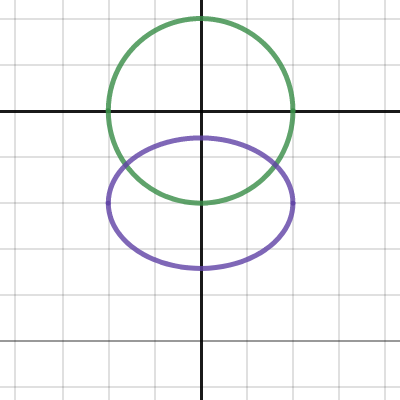
Desmos Graphing Calculator
wild hamlet
would that 6.828 be 4+2sqrt(2)?
zenith cobalt
the quadratic equals -4+2sqrt(2) and -4-2sqrt(2). I'm kinda just wondering how the single x = -1.172 translates to the y of both intersections, and the -6.828 equals nothing 🤔
 unique tulip
@umbral snow y intercept = to when x is O so put that in and then x intercept = to when y is o so put that in, and then u get x and y intercept, the question is tricky n idk how to do it. Isosceles triangle has to have 2 sides that r the same
Thank you 👍💚 @Mr. L#3864
 lone sundial
Hi
echo star
can i get help with number 3
im so confused
i get the terms and all but im confused
the squares means angle (the computer made it like that idk why) and on number 3, the angle is FGC, its cut off
Adjacent- 2 angles that share the same vertex
Complementary- equal to 90 degrees
Plz helppppp
ok nvm
got it
errant ether
It's March on March 2nd but it's not st patrick's, is the statement true or false there?
why?
to be clear I'm asking about the statement "If it is March, it is St. Patrick's Day."
not the statement I made
 amber raven
That's false
upper karma
quick basic geometry question: arent all postulates/axioms considered to have a 100% truth value?
 tribal wind
ye
upper karma
"If it is March, it is St. Patrick's Day." Truth Value: False | Statement Type: Converse
oops
amber raven
@upper karma if it's an axiom you have chosen to work with
And also does not lead to contradictions which the other axioms you have chosen to work with
upper karma
"If it is March, it is St. Patrick's Day." Truth Value: True | Statement Type: Converse
If it is St. Patrick's Day, "It is March" Truth Value: True | Statement Type: Conditional
If it is not St. Patricks Day, it is not March" Truth Value: True | statement type: Inverse
If it is not March, then it is not St. Patricks Day" Truth Value: True | statement type: Contrapositive
wouldnt it be this @upper karma
?
but make sure it is true for all
becuz if conditional is true than converse must be too
oh yea my bad
im a little stumped on that too
i understand your logic but the converse statement is a bit tedious
it should be false for all i think
but then the contrapositive is true tho...hmmmmm
yea that conditional is weird
well if contrapositive is true, then the conditional statement must also be true
yes, same goes with converse and inverse
you cannot have 1 or 3 true statements
you can only have 0, 2 or 4
np
upper karma
Is topology ever discussed here
upper karma
Hm
 silver wolf
Im looking for help on how to do angles like vertical congruent supplementary and complementary
<@&286206848099549185>
amber raven
@silver wolf vertical angles idk.
Congruent angles are a pair of angles that can be moved or rotated on to each other so that they cover the exact same space. Congruent means the same. Congruent angles are equal. The only difference between two congruent angles is where they are located and oriented in the plane.
Summplementary angles add up to 180
Complimentary angles add up to 90
What I mean by add up is but the sides of the angles together to you will get a new angle formed by the opposite of sides
upper karma
similar triangles?
 pulsar merlin
Prove triangle are similar AAA test in first one
He needs to state by which test the triangles are similar before solving them
 mild cargo
Similar triangles have equal correspondong angles and equal ratio of corresponding sides
But you can't use it until you show they are similar
pulsar merlin
Prove these are similar triangles
upper karma
how do i prove it??
twin prawn
I can assure you most people on here would Google if they could
pulsar merlin
I can teach him how to apply test of similarity, but if he doesn't know the test, how can I proceed ?
upper karma
I gave up
My maths teacher teaches 3 topics a day in an hour. How am i supposed to catch up?
 elfin mica
does anyone know how to find the volume of a truncated sqaure pyramid using similar triangles?
elfin mica
<@&286206848099549185>
wild hamlet
truncated square pyramid...
im guessing the volume of the full pyramid minus the volume of the cut off pyramid
 quiet bolt
I have a very important question
keen aspen
ya'
 plain wigeon
upper karma
plain wigeon
upper karma
👍
 little osprey
In the acute triangle ABC, D is on AB, E is on AC, and the points F and G are on BC (F is closer to B).
If : DB = DF = DE = AE = EC = CG = FG
Find the angles of ABC.
 solid orchid
I'm no math expert, but you should be able to conclude that if DF and DB are equal in length, the angle of B and F needs to be the same right?
little osprey
Which angle of F.
solid orchid
the left
little osprey
Yes.
solid orchid
AC = 2a
BC = 2a + ?
AB = a + ?
might be useful to solve for the unknown
you might be able to with the Pythagorean theorem
solid orchid
if you know the lengths of the three sides, shouldn't you be able to determine the angles?
solid orchid
is DE parallel to BC?
solid orchid
DF should be parallel to EC though right
 shadow anvil
no
solid orchid
or actually maybe not
solid orchid
is that even possible?
little osprey
Use similar triangles
afc and egc are similar
then you can prove parallel lines by corresponding angles being the same.
You understand what I did?
solid orchid
doesn't that just mean AF is parallel to EG
I don't have any expertise in geometry, mind you
little osprey
Oh yes.
My apologies.
Not DF
My mind isn't at it's best state.
I'm not an expert either.
But I do what I can.
solid orchid
does geogebra allow unknown lengths or something? Seems like a computer aided tool would be perfect for problems like this
solid orchid
I should probably make one if there are none already
seems like it would be super handy
solid orchid
the computer would give a reason lol
little osprey
Geogebra doesn't give reasoning?
solid orchid
but yea, solving by hand can be more satisfying
but when you're stuck, computer aid can be nice
it can help expand knowledge as well
little osprey
true.
solid orchid
from playing around with http://geometryexpressions.com/gxweb/
it looks like F might be equal to B

not sure if that's possible by the definition given
this might be how it looks
where F and B are on the same location
which would make the triangle equilateral
I'm pretty sure it follows the same rules you gave
 chilly notch
chilly notch
chilly notch
yeah
chilly notch
area of those are 25pi each
 waxen gorge
yes
waxen gorge
lemme think
Well we know the height from the bottom to the top intersection is 5sqrt3
waxen gorge
@chilly notch what class r u taking
chilly notch
year 9
waxen gorge
Like is this only with geometry or can u use calculus
chilly notch
this is only with geometry
i have one of those teachers who doesn't like using advanced methods for simple questions
waxen gorge
I feel like there's a super easy way to do it but I'm dumb
chilly notch
same
argh
i'm sure nobody else in my class will get it though
only that one guy who is a genius
and took a-levels when he was 5
waxen gorge
What are a-levels
upper karma
t!wiki a-levels
 loud cedarBOT
📖 | ** https://en.wikipedia.org/wiki/Level **
Level or levels or may refer to:
chilly notch
yes i'm a british pleb
waxen gorge
owo
chilly notch
how do you know though
 clear haven
it was equilateral
then he split it in half
so 306099
306090*
thus 10 for hypotenuse
idk how that helps tho but ye
clear haven
o ok
tribal wind
36
waxen gorge
@tribal wind how owo
clear haven

waxen gorge
ya but how does that prove all the sides are 6 like
tribal wind
like one of those circle curves has the equation y=sqrt(100-x^2)
and for a square you want the height y to equal the width 2|x-1/2|
waxen gorge
like
tribal wind
ur face is elegant
 timber hinge
❤
tribal wind
gl finding the secret hidden line and the rotation
timber hinge
You can prove those points lie on it exactly if you wanna be pedantic but like they do lmao
clear haven
yeah
 waxen gorge
Lol
clear haven
nice proof lol
clear haven
mhm
timber hinge
❤
tribal wind
another proof is that since you could draw a right triangle there, it has to be 3-4-5
clear haven
🖤
tribal wind
and it looks too big to have side length 8
timber hinge
Or you can use a ruler 
waxen gorge
why r the numbers so nice ;-;
tribal wind
oh I found the right geometry way to do it
timber hinge
Its more about the method than the actual rote calculations
tribal wind
use the right triangle at the corner of the green square
tribal wind
corner of green, corner of 10x10
 ty
waxen gorge
ty
waxen gorge
I'm still confused I cri
tribal wind
so for every geometry problem you have to find the hidden line
clear haven
OH SHIT
tribal wind
fight me
waxen gorge
wat about the line
tribal wind
make a bunch of variables and solve the same equation you get from using the circle equation xd
red line is 10, bottom side is (10-x)/2
height is x
waxen gorge
But how do u find the part of the line not on the square knowing the lines length is 10
Oh
tribal wind
oh
clear haven
shouldnt we add x to that to make it include the green part?
tribal wind
10-(10-x)/2
clear haven
???
 torn linden
how do you prove this?
 high pelican
"D bisects angle BDF"
high pelican
what does it mean for DH to bisect BDF
torn linden
the angle is cut in half
high pelican
or, in other words...
high pelican
"bisects" means that two things are equal
torn linden
Oh
So it would be something like:
Given:
Angle 1 = Angle 2
DH bisects angle BDF
Therefore BDH = FDH
is that right?
do I need more? Am I missing something?
torn linden
I feel like there's more lol
high pelican
and they wanted DBH = DFH
torn linden
Oh sorry
high pelican
that would be the more natural problem to ask
torn linden
Maybe I have to use one of the postulates or something
high pelican
given what is printed, it really is a one step proof
torn linden
Oh ok
I got 2 more questions lol
How would I start?
I really struggle with starting
high pelican
so, what tools do you have for proving triangles congruent?
torn linden
Ok so I got a bunch of postulates and theorems I can use
Side-Side-Side Postulate
Side-Angle-Side Postulate
Angle-Side-Angle Postulate
Angle-Angle-Side Theorem
I can use those
high pelican
which ones?
torn linden
M is midpoint of AB
high pelican
yes
torn linden
uh..
high pelican
that tells you that two things are equal
torn linden
Which two?
high pelican
If M is in the middle of AB, then...
torn linden
Then AM and MB are equal
high pelican
exactly
torn linden
Ooooh
ok
Lemme get this
Wow thanks @high pelican you are great lol
Or I just have bad logik
high pelican
no problem 😄
torn linden
I got one more one sec thi
tho
Ok last one
So the question here is:
Can you prove the pairs of triangles are congruent? Justify your answer. If there is not enough information, list what else you would need to know in order to prove they are congruent.
high pelican
so, it looks like we have two sides that we know are equal, and one angle
torn linden
right
high pelican
has there been any discussion about SSA?
torn linden
No...
high pelican
right
torn linden
Yeah we talked about how SSA isn't a thing in class
high pelican
hmm
high pelican
so that picture makes it look like those two triangles are congruent
can you maybe redraw the picture so that the angles and sides are still the same, but the triangles are clearly not congruent?
torn linden
Wait one second
high pelican
okay
high pelican
nah
torn linden
Ok
high pelican
so here's the thing
torn linden
Ok
high pelican
we have the length of AD fixed, but not the angle DAC
so imagine AD as a swinging rod that we can move back and forth
torn linden
Ok
high pelican
if we swing AD clockwise, we will eventually reach a point where we touch the bottom line again
high pelican
so we would still have those two sides and two angles equal, but now the two triangles are clearly not equal
because one is obtuse and one is acute
torn linden
Ok
high pelican
so to answer this question, it would help to draw a picture showing the two possibilities for AD
torn linden
How would I explain it then?
Oh another thing
The Image is not to scale
Or accurate
It's just there for help
high pelican
so if you have two different placements for D, that gives you two noncongruent possibilities for the lower left triangle, and only one of those is congruent to the upper right triangle
so we can't say that they are congruent
torn linden
Remember the question is
Can you prove the pairs of triangles are congruent? Justify your answer. If there is not enough information, list what else you would need to know in order to prove they are congruent.
high pelican
right, and the answer is no
torn linden
So we can't say they are congruent
What would we need to prove that they are congruent
high pelican
there are a lot of things
torn linden
Such as?
high pelican
another equality of sides, another equality of angles
high pelican
or even just them both being acute
torn linden
Again not to scale lol
But ok
No, because we don't have enough information. To prove they are congruent, we would need to know if angle D and angle B are congruent
Or if DC and AB are congruent or not
Would that be correct?
high pelican
looks good, although I would also include a diagram showing how you can make more than one triangle with the same SSA
high pelican
I don't really know the procedures 😄
 normal vault
upper karma
normal vault
upper karma
Non Euclidean geom3 also here?
twin prawn
 tiny grail
any hints anyone ? <@&286206848099549185>
 halcyon sierra
is this amc
upper karma
this question is gross
tiny grail
No lol it’s from a tst
 rustic cairn
Are D and C collinear?
upper karma
any 2 points are collinear
upper karma
yeah
upper karma
tiny grail
assuming caf and bae are collinear
just use adjacent angles on st line add up to 180ºc
upper karma
My first answer is <CAD and <EAD are adjacent because they share line AD.
tiny grail
sorry i didn't really understand the question
upper karma
Oh, well I kind of understand it but not well, its asking to make three conclusions, that you know to be true about the figure from looking at it, then support your conclusions with postulates or definitions.
<@&286206848099549185>
tiny grail
i think it simply means that if two angles share a common line, then they are next to each other, ie adjacent
upper karma
Well, everything not bold was my answer to the bolded question.
 eager burrow
hi
Did the helper come to
anyone here
I just need someone point me in a direction
 fair wigeon
Ok I'll help lol
eager burrow
fair wigeon
What's the question?
eager burrow
open in orginal
in like a browser
and you should be able to zoom it
when you click it, in the bottom left corner
fair wigeon
You use the distance formula to set both those distances equal to each other
fair wigeon
That's all it wants I guess
eager burrow
For (1) and (2) remember that if a point lies on the Unit Circle it must satisfy x
2 + y
2 = 1. Also, simplify the result as
much as possible.
thats in fine print
i think i have to solve the entire thing
but i dont understand how to do it
fair wigeon
Huh
Ok so
Just that expression you got
Can be simplified further
Like, you can cross out the c^2
On both sides
Try and simplify it and see what happens
@eager burrow
eager burrow
but this has 4 different variables
fair wigeon
Move the d and the C to other side
fair wigeon
And then the left side becomes (a+b)^2+2ac
eager burrow
and -2db
fair wigeon
the last 2 terms of the left side
eager burrow
-2db and -2c
fair wigeon
Move those over
fair wigeon
-2ac-2=2db-2c+1
eager burrow
ohh nooo
<@&286206848099549185>
I still need help
anyonee out there
<@&286206848099549185>
i waited the 15 minutes
geez
anyone
 steady sleet
it's probably late for most people
upper karma
It's not late for me but I'm too lazy to help
elfin mica
damn
twin prawn
You're right about the last part, but that's not the same statement you proposed at the beginning
Of course linear pair implies supplementary angles, but NOT linear pair doesn't necessarily imply NOT supplementary
Think of two diagonally opposite angles in a square
They don't form a linear pair yet their angles add up to 180 degrees, making them supplementary
@upper karma
 loud tiger
Yo can i ask a simple geometry question
its really stupid but here idk
i know how to answer it
but the illustration messed me up
So do i answer it like i would using hl congruence theorem
or answer it with "outside of the box" stuff
tiny grail
@loud tiger realise that th common radii are equal length. They share a hypotenuse and a certain corresponding angle is a right angle
Then by RHS they are congruenr
This congruence means their corresponding angles are the same
 opal blaze
If a line is tangent to a circle you know that the angle between radius and line segment is always 90 degrees. Then you can use angle sum of triangle to find the last angle XYO @loud tiger
loud tiger
uh. I still dont get it
 loud tiger
sorry but can you just tell me what i should do
And i'll try to understand what you said
opal blaze
YXO is 90 degrees. Because the line segment is tangent to the circle. Therefore can we say that 58 + 90 + XYO = 180
Then you just solve for XYO
Lol

opal blaze
Np
keen aspen
Sure
If you work better with tangent, just flip the tangent function about the x acis and move it over pi/2
hard gale
go for it
tiny grail
=pup barycentric coordinates
tiny grail
=pup legendre’s symbol
 gritty flare
If we have equlateral triangle with side k and then we draw circle around it, what is circles radius.
hard gale
think before saying something that misses a step
By Pythagoras, heights (which happen to be the perpendicular bisectors also) in equilateral triangles are sqrt(3)*k/2
Then indeed those heights/perp bisectors intersect at their 2/3rds
So the center of the circumcircle is 2/3 * sqrt(3)*k/2 units away from each point
ie the radius of the circumcircle is k/sqrt(3)
tiny grail
Just do sin rule lol
 astral hornet
the question asks for the angle measure right?
upper karma
yeah
astral hornet
if sides are given: use inverse tangent to find angle. if angle is given, use tangent to find side ratios. .097 means you used just tangent
upper karma
kk thanks, i might call you on help later tho xd
astral hornet
ok
going from step 2 to 4, RS + ST was substituted into RT. since 2RS = RS + ST, and 2RS = RS + RS, ST must = RS in order to = RS + RS. since both RS and ST share S and are equal, S will be their midpoints, when R S T are collinear
upper karma
@astral hornet I have an angle of elevation that the top is 53 degrees and it's 50 feet
How would I plug that in a calculator
I remember it that elevation is not inverse
but this sin cos and tan got me confused
astral hornet
@upper karma draw the triangle first, and fill in what you know; this may help
astral hornet
@upper karma since tan(θ) = opp/adj, and you know adj = 50, let x = opp
then isolate x
upper karma
adj is 50
i don't have a calculator to plug this into so this will be slightly difficult
I got 30
@astral hornet for opposite
upper karma
the heck did you get 35
astral hornet
53
upper karma
imma need a bot for this
upper karma
65
astral hornet
thats ur opp
astral hornet
what calc do you have?
in the meanwhile, you can just type ur sin cos tan stuff in search engine and a calc should show up
astral hornet
you can download wabbit as ti84 emu
 covert idol
== tan(53) * 50
charred spearBOT
50×tan(53) = -21.5579098359782
covert idol
Ah thats probably in radians
upper karma
root 3 over 2
astral hornet
30 60 90 sp tri
upper karma
45 45 90 triangle
ok im actually stuck @astral hornet
i thought i knew the rule, but i don't
I know like the angles are 45 and 45
I remember you have to divide by 2
but im so lost
astral hornet
given a triangle with legs x, x^2+x^2=sqrt(2x^2)=xsqrt2 via pythag. therefor the ratio is x : x : xsqrt2
substitute what you know into the ratio
upper karma
x = 5 sqrt 2
astral hornet
@upper karma x is legs
and you dont know the lengh yet
you do know the hyp is 5, 5 = xsqrt2
in 5 = xsqrt2, isolate x
astral hornet
5 = xsqrt2, x = 5/sqrt2; rationalize it
upper karma
ohhhhhhh
shit
this is making me look bad
i have like 20 more questions to go but these look relatively easy
I basically had 2/4.47
nevermind
Wait how do I write cos16 into terms of sine?
astral hornet
cos(θ) = sin (90-θ)
upper karma
how do you know this
astral hornet
they're complementary functions
upper karma
thanks for ya help bro @astral hornet
i needed help on this review
I missed 2 days of class, 👍
astral hornet
cos(θ) = sin (90-θ) means cos of a number = sine of 90 minus that number btw
and np
 late robin
Hi
Can anyone help me with this question
Thank you @upper karma
At first I thought it 45 since ACB is 90
 winged arch
Hello guys can anyone help me with this question
in triangle ABC, B-M-C and BM = MC =6, if A-D-B and <BDM = < ACB AD=14 Find DB Edited :wrong problem I am stupid
This is how my prof drew it and how he solved it
I don't understand how he did this problem
winged arch
<@&286206848099549185>
little osprey
How would you draw it.
winged arch
my prof drew it on the top left of this picture
wait
wrong picture
my bad
Yes this is his drawing
tiny grail
@slim gorge yes
Look at miquelbpoint and spiral centres
And complete quadrilaterals
 slim gorge
nah, i was just stupid :P
upper karma
 heavy crag
I need some vectors help if anyone is able to
It is fairly simple, but it's been a long while since I've done it
hard gale
post your thing so that someone can help
heavy crag
I got part a) as: r = (3i + 5j +2k) + t (i + j + k)
But I can't recall how to do part b)
heavy crag
nvm I got it
 wild mirage
Moved this question over to this channel, as it seem more suited for it, I'm just curious if I could use cosine law with this question, as it doesn't give enough information for the law for SSS and SAS
hard gale
the two rafters have equal lengths, that's what you're forgetting I believe
wild mirage
As you can get all the angles and just the one side
But what I find strange is the rafters are the unknowns
cutting out SAS and SSS
or am I just being blind
hard gale
yeah, just solve for them
wild mirage
How would I tho, as I don't have the information for the two requirements for the law
the main that the question is confusing me about
c^2 = 15.6^2 + b^2 - 2(15.6)(b)cos52
just can't wrap me around it
hard gale
the fact that you know the rafters are equal shortcuts that SAS/SSS yup
the 2 rafters meet at an 52°
ie c is 15.6 here
and a=b
wild mirage
So the question can't be solved with cosine but with sine law?
is that the point of the question lol
because the next one asks me to solve it using sine law
I'm sorry if I'm being really blunt about this
hard gale
what you get from drawing the situation
wild mirage
wait
if a = b
that would shorten the equation
a^2 = 15.6^2 - 2(15.6)cos52
something like that right?
hard gale
hard gale
c^2 = a^2 + b^2 - 2ab*cos(52)
(ie cosine rule)
now since a=b,
2a^2 - 2a^2*cos(52) = 15.6^2
 dire lily
AC:BC=4:3, hc=24, ACB=90° <- any idea how to solve this triangle?
wild mirage
As I'm getting the value of both a + b together
hard gale
ahhh lel yea
wild mirage
would make sense to me to divide
hard gale
🍻
wild mirage
So goow, i just wanna confirm I have it all good
15.6^2 = 2x^2 - 2x^2cos52
x^2 = 15.6^2 / (2- 2cos52)
x^2 = 15.6^2 / cos52 = 395.26
rad395.26
x = 19.88