#geometry-and-trigonometry
1 messages · Page 114 of 1
 exotic yarrow
 somber coyoteBOT


 Requested by civil_service_pigeon
exotic yarrow
Requested by civil_service_pigeon
exotic yarrow

 dark sparrow

 long geyser
Exactly!
i really love geometry, i just proved to myself what the missing side length of a rectangle has to be to fit a rectangle with a perimeter of 16 units based off of the information that one of its sides is 3 units wide.

That same logic can be applied to anything and everything, an angle for two lines can't exceed 180 degrees because of the underlying definitions. You can deduce things and induce things using knowledge that you know and don't know.
Maybe I'm just late to the party but does everyone see it like that? That picture applies to many other aspects outside of math/just-drawing-stuff on graphs
long geyser
long geyser
i really love geometry, i just proved to myself what the missing side length of ...
i feel like i got reincarnated as aristotle by learning what i know so far in school
 wanton yacht
long geyser
That same logic can be applied to anything and everything, an angle for two line...
wanton yacht
long geyser
That same logic can be applied to anything and everything, an angle for two line...
Some people can do it better than others
long geyser
wanton yacht
Some people can do it better than others
mhm
long geyser
wanton yacht
Some people can do it better than others
this is so much fun!!! this is just like a puzzle

I don't understand why the long line in a triangle for example has a decimal/fraction for it's length, intuitively wouldn't it be a whole positive integer?
wanton yacht
long geyser
I don't understand why the long line in a triangle for example has a decimal/fra...
Would it have a whole length?
long geyser
wanton yacht
Would it have a whole length?
i mean whole integer
wanton yacht
Yeah, would it?
long geyser
Hm
wanton yacht
What if you rotated it to be in line with one of the other sides?
long geyser
well take a wall for example and a ground, if you want to calculate the length of something leaning on it then it would be like duplicating the wall or the ground and rotating it in a direction
long geyser
wanton yacht
What if you rotated it to be in line with one of the other sides?
it has to be longer than both individual sides
because otherwise it won't connect both points
wanton yacht
Right. Who's to say its length should be an integer though?
This is the idea of the pythagorean theorem
$a^2+b^2=c^2$
somber coyoteBOT
pebble
 long geyser
wanton yacht
Right. Who's to say its length should be an integer though?
long geyser
wanton yacht
Right. Who's to say its length should be an integer though?
nobody i just mean intuitively it's a bit odd if you don't think about it and randomly see it and then you ask (Why is it a fraction/etc?)
wanton yacht
Yeah, I get that.
long geyser
wanton yacht
This is the idea of the pythagorean theorem
Well the pythagorean theorem only matters so long as we can use it right? so long as we have constructions such as lines and coorinate planes right? i mean not necessarily the latter but maybe you get what i mean?
wanton yacht
I mean, you can calculate the distance between any two points using it as well
long geyser
i suppose my relevance to that is that you're bringing the Pythagorean theorem into discussion but what if you didn't already know it?
wanton yacht
Mhm
long geyser
wanton yacht
I mean, you can calculate the distance between any two points using it as well
Yea! but i think that's a property of math rather than um
wanton yacht
I can see how it would be a little confusing, in which case, it's time to learn it!
long geyser
long geyser
Yea! but i think that's a property of math rather than um
im not sure
long geyser
wanton yacht
I can see how it would be a little confusing, in which case, it's time to learn ...
I've learned it before and i know it and i've used it but, i think as with many other formulas it's better to get an idea or grasp on the whats and whys first
before you generalize something
right?
wanton yacht
I generally agree with that. That's what I always try to do with physics. Getting an intuitive understanding of what you're doing and why you're doing it and why it works helps you better understand and solve new problems.
In that way, it's less formulaic and more logical
long geyser
i suppose an analogy to this is that you're telling me what f(10) in a formula is, but generally you start with the first integers of a function and expand from that/generalize
long geyser
wanton yacht
In that way, it's less formulaic and more logical
Absolutely
i watched a video of a math teacher explaining that if you think calculus is just formulas then you don't know calculus
as in calculus is the study of something specific
rather than just a bunch of operations abstractly
wanton yacht
Yeah, I think calculus is a good example. You can understand the definition of a derivative, you can learn the formulas for differentiation, and then you can learn integration, but if you don't understand what those operations represent, it's no good, you can't apply it to anything. That's another thing I like about physics, it takes these ideas and applies them directly to the real world in ways that make it clear what calculus is useful for.
long geyser
long geyser
this is so much fun!!! this is just like a puzzle
If we label these coordinates as A, B, and C respectively, then we can devise properties about these vertices and the whole shape through the tools that we've built before
wanton yacht
Yep
long geyser
wanton yacht
Yeah, I think calculus is a good example. You can understand the definition of a...
Yea
wanton yacht
That triangle specifically is special though because it's a right triangle.
long geyser
wanton yacht
That triangle specifically is special though because it's a right triangle.
I suppose any triangle is special then, because the angles stay the same no matter what in math, i mean 90 degrees isn't the same as 110 for example of course but a triangle with a certain degree still has properties such as adding up to a certain degree right?
wanton yacht
I mean, in Euclidean geometry with shapes that have straight lines, all triangles will have angles that add up to 180 degrees, sure. You can have a right triangle with one of those angles being 90 degrees, you can also have other triangles where that's not the case, in which you can always break the triangle that's not a right triangle into two smaller right triangles by constructing a line perpendicular to one of the bases and having it intersect the opposite vertex.
long geyser
i'm feeling way more comfortable with the coordinate plane and points on the plane and what happens to them now that i'm learning geometry, because before it was scary and i didn't know a ton of these properties that i'm learning in geometry such as rules of lines maybe
wanton yacht
long geyser
i'm feeling way more comfortable with the coordinate plane and points on the pla...
Lol ,yea
Just wait until you get to trig, that's fun
But anyway, what makes a right triangle special is that the basic trigonometric functions apply to them nicely
long geyser
wanton yacht
Just wait until you get to trig, that's fun
Yesss, but i suppose that in the same vain trigonometry is just geometry but one that deals with "tri" or triangles, so 3 angles.
wanton yacht
Yeah
long geyser
wanton yacht
I mean, in Euclidean geometry with shapes that have straight lines, all triangle...
i think i understand a bit
wanton yacht
Yeah... in situations like this it doesn't hurt to have a white board, lol
long geyser
wanton yacht
But anyway, what makes a right triangle special is that the basic trigonometric ...
Yea that's what i meant, so i think "anything" can be special because yes it would be "nicer" for trigonometry and stuff, instead of having to make like 14000 different stuff that you have to memorize
so it's definitely special in the case of studying trig and implementing it
but in general, angles probably don't care about what you call the shape right?
long geyser
wanton yacht
Yeah... in situations like this it doesn't hurt to have a white board, lol
Yea it's just i haven't seen lots of those words in action before
long geyser
wanton yacht
Right. An angle is only between two lines
i suppose that the study of geometry is the properties that this has when we for example add another line etc or close an object
because we start with certain premises or axioms, in euclidean geometry. Correct?
wanton yacht
Yup
long geyser
yea
wanton yacht
And then if you do spherical or hyperbolic geometry you change those a bit to get different behaviors
Veritasium makes a good video on that
long geyser
ooo
wanton yacht

Discover strange new universes that turn up at the core of Einstein’s General Relativity. Head to https://brilliant.org/veritasium to start your free 30-day trial, and the first 200 people get 20% off an annual premium subscription.
Special thanks to our Patreon supporters! Join the community to help us keep our videos free, forever:
https:...
wanton yacht
Yup
long geyser
omg i remember i didn't understand a lot of geometry, but now i'm doing some geometry in general
wanton yacht
I mean, you probably should get through a bit more euclidean geometry before you worry about noneuclidean geometry, lol
long geyser
wanton yacht
I mean, you probably should get through a bit more euclidean geometry before you...
Yea
in higher level math euclid's axioms are replaced right?
with high level math logic?
ZF and ZFC
wanton yacht
I'm not entirely sure. From what I gather, the axiom that says that lines can only have parallel line is changed to where lines can either have no parallel lines, or multiple parallel lines.
long geyser
no i mean as a whole
in mathematical analysis
In set theory, Zermelo–Fraenkel set theory, named after mathematicians Ernst Zermelo and Abraham Fraenkel, is an axiomatic system that was proposed in the early twentieth century in order to formulate a theory of sets free of paradoxes such as Russell's paradox. Today, Zermelo–Fraenkel set theory, with the historically controversial axiom o...
maybe this?
wanton yacht
Maybe?
I haven't learned any of that yet, lol
Mathematical analysis from what I understand is more deriving formulas rather than just memorizing
long geyser
wanton yacht
I haven't learned any of that yet, lol
my friend told me it's like useless to for anyone other than someone like specifically studying this or something that needs it
long geyser
wanton yacht
Mathematical analysis from what I understand is more deriving formulas rather th...
i can't wait to reinvent the wheel for so many formulas!
it's like a puzzle
no, it is a puzzle!
wanton yacht
Lol. It's fun to do
long geyser
wanton yacht
I've mostly just done more applied math for my physics courses
Fair enough
long geyser
wanton yacht
Lol. It's fun to do
Yes! it stimulates my brain so much!
wanton yacht
I will say, it's even funner to do when you're finding formulas that nobody has found before on the front lines of math and physics
long geyser
wanton yacht
I will say, it's even funner to do when you're finding formulas that nobody has ...
That can take a while
and what if you reach dead ends
I mean, you're bound to realistically, even way before your journey to discover something new
But road blocks haven't stopped society as a whole from developing new things, new ideas
i sometimes forget formulas for algebra and i'm at a bit of a dead end, but then i can just remember them or find a new path
in algebra, multiple paths lead to the same solution, and one answer has multiple paths that can be taken to achieve it
or i can ask those more knowledgable than me for help, etc
wanton yacht
Yeah. There's always dead ends that you will come across, but that's what makes it a challenge. I imagine what people like Einstein and Shrodinger had to go through when they made breakthroughs in their field. Up until them, our standard physical model of the universe only described some things with good accuracy, not all things with perfect accuracy. Will we ever get to that point? I don't know
long geyser
wanton yacht
Yeah. There's always dead ends that you will come across, but that's what makes ...
People like these spend years studying something specific, sure they did this over 80 years ago, but they spent each day thinking about the same thing rather than in 1 second simply find and formulate a solution because they wished to
wanton yacht
yep
long geyser
it doesn't matter whether i wish to find a solution to a simple quadratic equation, it exists whether or not i like it, and i have to respect its properties to find it, so i have to actually do work and thinking
i suppose this could maybe be generalized even further, such as if i'm a mathematician and i want to discover something new
wanton yacht
Yeah, I mean, geometry, algebra, calculus, linear algebra, these are just tools for these problems. That's how I like to imagine it
long geyser
Precisely
i was talking with my brother today, and he told me about how in his time when he was learning geometry and trig it wasn't as easy as now because he's revisited them and seen why for example the identities work and why they were created
i believe that's the only way to master something, it's to essentially discover it for yourself
seeing why it works
knowing what happens when you change something, etc
wanton yacht
Yeah, that's a good way to look at it. That's why I said desmos would be really good to learn from because it forces you to just play around and see how things work yourself
long geyser
wanton yacht
Yeah, that's a good way to look at it. That's why I said desmos would be really ...
Precisely!
wanton yacht
See how different variables change things
long geyser
Yes
wanton yacht
I mean, I think that if you can teach yourself things, you'll probably know them better than if you only learned from someone else. I'm not saying you shouldn't learn from other people, in fact, people are a great resource! I think you should find ways to do both. That's what I do in physics. If in class we learn something from our teacher that I don't fully get, I take it upon myself to figure it out. That's what works for me, and I think I probably have a better intuition for things than most kids in my class, which shows on my test scores, yada yada.
long geyser
wanton yacht
I mean, I think that if you can teach yourself things, you'll probably know them...
It's doing both that gets you to heights that people back then with no resources and were pioneers could only dream of
 severe crypt
long geyser
in higher level math euclid's axioms are replaced right?
severe crypt
long geyser
in higher level math euclid's axioms are replaced right?
not replaced, Euclid's axioms are for geometry and geometric consructions. ZF axioms are for set theory
long geyser
severe crypt
not replaced, Euclid's axioms are for geometry and geometric consructions. ZF ax...
Ahhhh
Thank you, i see
That's mind blowing to me
long geyser
long geyser
It's doing both that gets you to heights that people back then with no resources...
it's so hard for me to reinvent the wheel, but if i get tools from teachers and tutors then i can have a better understanding of formulas etc
i'm not a genius in every subject, nor was someone like Euclid
wanton yacht
Yeah, it's definitely more difficult to discover things yourself, but when you think about it, that's all that matters. Soo, yea
I mean
I guess discovering new things and applying what we already know to things like engineering, what not
long geyser
Yea
i want to cry so bad, because geometry is the most beautiful thing ever to me. it doesn't simply just exist in pen and paper, but it's all around us if you think about it
and i don't just mean houses and cities, but trees too, and stars
it's really symmetric
wanton yacht
Math is all around us, always
long geyser
wanton yacht
Math is all around us, always
Yea!
wanton yacht
...
long geyser
im sorry
wanton yacht
Sometimes I feel that way too, lol.
long geyser
i've spent all of my aware life (since i started thinking) viewing objects and symmetries
the neurons in my brain abstracted and quantized things around me into variables and sets
There are so many types of trees for example, but they're all under the set "tree"
long geyser
wanton yacht
Yup
i feel like i'm a reincarnate of philosophers of the past. i feel like when i'm not in the earth anymore that my legacy will still persist, that people will still try to figure out things
wanton yacht
Yep
long geyser
wanton yacht
That's good
is this essentially math
wanton yacht
There will always be that human curiosity
wanton yacht
long geyser
is this essentially math
I think the reasoning you need to do math is very structured like how you're describing. I think reasoning like that helps with things other than math too, like programming, engineering, etc, which aren't all just math subjects, but, they're related
long geyser
wanton yacht
I think the reasoning you need to do math is very structured like how you're des...
Yes
long geyser
wanton yacht
I think the reasoning you need to do math is very structured like how you're des...
I really advise this article that i recently found, it's like a metapsychologist wrote it https://www.britannica.com/topic/thought/Creative-thinking
i dont agree with everything in it personally, but it's so interesting to think (wow) that my thoughts (ironically) are in some way supressed actions/behavior
when you think in your head, you suppress your tongue a bit from talking because you don't want to verbally talk
wanton yacht
I'll check it out
long geyser
wanton yacht
I'll check it out
i think this is a bit relevant to geometry in that we think a ton, and so we problem solve, we try to figure out new approaches based on stuff that we've already seen
does that ring any bells /genq
wanton yacht
Yeah, that about summarizes things. At least in my own experiences, I find that my solutions seem inspired by what I already know, which is sometimes good, sometimes it worries me because sometimes solutions demand completely different perspectives, and those take time to come up with.
long geyser
wanton yacht
Yeah, that about summarizes things. At least in my own experiences, I find that ...
Someone like me doesn't always mind that though. Although some people prefer not to think, I despise those kinds of people (even though i'm usually very lazy) those people are not lazy but just refuse to think
wanton yacht
Lol, I know what you mean
long geyser
Yea, do you think geometry has a ton to do with problem solving in general?
wanton yacht
I think it depends on the kinds of problems you're doing and the type of experience you have in geometry
long geyser
i see, so then would you say something like just applying a formula that you already know be less problem solving and more just time?
But if you're trying to invent something from scratch logically, then that's as problem solving as it gets?
Maybe?
wanton yacht
If you know little to no geometry and you're doing geometry, even simple problems, there's lots of problem solving to be done. If you know lots of geometry and you're doing simple problems, there's probably not as much problem solving being done. If you know lots of geometry and you're doing difficult problems, then there's plenty of problem solving to be done. As for whether I think applying a formula that you already know, I think that depends as well on the complexities of the specific problem you're trying to solve.
wanton yacht
long geyser
But if you're trying to invent something from scratch logically, then that's as ...
Yes
long geyser
wanton yacht
If you know little to no geometry and you're doing geometry, even simple problem...
Yea!!!!
Honestly yea, it just depends.
Some formulas are just plug and play while others still require like doing a lot of algebra for example, right?
wanton yacht
Yeah. But sometimes it is good to practice and play around with formulas you already know, especially if you have ideas you want to try with them
wanton yacht
Well, I don't know if I would describe it like that. It's not like math is discovered, it's created
long geyser
Even on an individual level, probably nobody knows everything about math right?
wanton yacht
Yea
long geyser
wanton yacht
Well, I don't know if I would describe it like that. It's not like math is disco...
i believe it's both. in some really vague sense 🤷♀️
wanton yacht
Maybe. In the context of physics, I think it's a better perspective to have that mathematics is a tool used for modeling the universe. Our models aren't perfect, they're just theories that experiments seem to align with, and they can be improved. Whether it's discovered or created, well in this context, I would say it's more accurate to say that math is created for the purpose of creating better and better models.
I mean
however you want to look at it I suppose
long geyser
wanton yacht
Well, I don't know if I would describe it like that. It's not like math is disco...
But either way, with our axioms there's still a lot of properties that we don't know the solutions to right? maybe like complicated things that we only have approximations for possibly?
long geyser
wanton yacht
Maybe. In the context of physics, I think it's a better perspective to have that...
Sure
wanton yacht
Yeah, like the Riemann hypothesis, lol
long geyser
wanton yacht
Yeah, like the Riemann hypothesis, lol
Interesting
wanton yacht
Nobody has proven the Riemann hypothesis, in a sense we don't know 'the solution' to it
long geyser
Right
This is the most interesting stuff ever though

do you love geometry
since you practiced in desmos too
wanton yacht
I would say I love geometry, yea
long geyser
Nice!
wanton yacht
long geyser
This is the most interesting stuff ever though
It is very interesting, lol
long geyser
idk why but i used to draw random shapes in my art notebook, i don't mean random shapes but like for example a pentagon with circle tiling's inside of it, and a circle with pentagon tiling's inside of it etc, and colored them
Since i was really young i was interested in shapes!
i suppose because it's easier than just randomly being able to draw whatever you want perfectly
Like if you want to draw a tree as perfect as possible from one angle
But a tree can be seen from multiple vantage points
wanton yacht
long geyser
idk why but i used to draw random shapes in my art notebook, i don't mean random...
Sounds like fractals
long geyser
wanton yacht
Sounds like fractals
When i was a bit older, i started drawing those
Like infinite triangles, infinite pentagons stacked inside of each other, etc etc
long geyser
it's the coolest thing ever to me!
long geyser
wanton yacht
Or like the Mandelbrot fractal
that one is terrifying to me, the black areas
i'm scared of darkness and voids, that's my biggest fear
long geyser
wanton yacht
Or like the Mandelbrot fractal
But the colorful areas that show amazing geometry is the coolest thing ever!
wanton yacht
long geyser
i'm scared of darkness and voids, that's my biggest fear
Hm, well unlucky for you most of the universe is just a dark void full of ionizing radiation
long geyser
The mandelbrot fractal is in the complex plane correct?
long geyser
long geyser
The mandelbrot fractal is in the complex plane correct?
Does that mean it's in 4d?
long geyser
wanton yacht
Hm, well unlucky for you most of the universe is just a dark void full of ionizi...
Yeah but the thing is that's only because it's dark to our eyes, in reality it's the most beautiful thing ever, minus black holes
black holes are the scariest things ever
light doesn't enter them from our perspective
wanton yacht
long geyser
Does that mean it's in 4d?
No
long geyser
Can you render the mandelbrot set in 3d and travel in it with a 3d camera?
long geyser
wanton yacht
No
oo
wanton yacht
long geyser
light doesn't enter them from our perspective
Yep, that's relativity
wanton yacht
long geyser
Can you render the mandelbrot set in 3d and travel in it with a 3d camera?
Maybe, I haven't looked into it
long geyser
wanton yacht
Yep, that's relativity
What do you think is at the other end?
long geyser
wanton yacht
Maybe, I haven't looked into it
that'd be so cool!!!!! it'd be so nice to the eyes!
wanton yacht
long geyser
What do you think is at the other end?
It's probably just a super dense ball of neutrons to be honest
long geyser
wanton yacht
It's probably just a super dense ball of neutrons to be honest
Makes sense!
wanton yacht
I'm not really sure what would happen to matter if it's that dense
long geyser
wanton yacht
I'm not really sure what would happen to matter if it's that dense
Another universe?
big bang?
wanton yacht
No idea
long geyser
black holes have a really long lifespan right?
wanton yacht
I mean, relative to what?
long geyser
wanton yacht
I mean, relative to what?
to the time axis?
wanton yacht
I think if you compare relative to other types of stars, yea
long geyser
when values explode in the complex plane, is that like a big bang?
wanton yacht
What do you mean by explode in the complex plane?
The complex plane is just one that is perpendicular to the positive and negative number line
 wicked peak
help 💔
 long geyser
wanton yacht
The complex plane is just one that is perpendicular to the positive and negative...
long geyser
wanton yacht
The complex plane is just one that is perpendicular to the positive and negative...
how is this not just 3d
wanton yacht
 wicked peak
wanton yacht
Nobody has proven the Riemann hypothesis, in a sense we don't know 'the solution...
wicked peak
wanton yacht
Nobody has proven the Riemann hypothesis, in a sense we don't know 'the solution...
i did
long geyser
there's a million dollar check to the person who solves it
wanton yacht
long geyser
how is this not just 3d
I think they define like 3 different imaginary numbers that are all kind of perpendicular to each other
wicked peak
bro answer my question so i can leave you
wanton yacht
In that regard, you can make it as many dimensions as you want
wicked peak
hurry
wanton yacht
What is this for the SAT? lol
wanton yacht
ughh I haven't solved a problem like that since I was in geometry
Let me sketch it out
long geyser
wanton yacht
In that regard, you can make it as many dimensions as you want
That's insane!!!! 🤯
wanton yacht
wicked peak
good
Come on it's not that hard, GM and GN are of length that's equal to the radius
wanton yacht
long geyser
That's insane!!!! 🤯
I could be wrong, I haven't really looked into it much
I just know things like Quaternions use multiple imaginary numbers
long geyser
wanton yacht
I could be wrong, I haven't really looked into it much
But it's still probably something like that even if that's not correct
wanton yacht
yeah
wicked peak
on gang you're no help
long geyser
wicked peak
on gang you're no help
the help channels are really good!
you can try one too
wicked peak
this is the geometry and trig channel and you guys are over here talking abt your love for geometry i dont get it
long geyser
i get help there all the time
wanton yacht
wicked peak
on gang you're no help
I'm thinking, lmao
wicked peak
forget i even asked someone my age got it in 2 seconds
long geyser
wicked peak
this is the geometry and trig channel and you guys are over here talking abt you...
i LOVE geometry
wicked peak
with all due respect
long geyser
You're really mean
long geyser
wicked peak
whats the answer then genius
So rude
long geyser
wanton yacht
I'm thinking, lmao
you're really nice!
wicked peak
long geyser
So rude
im not i said with all due respect
wanton yacht
long geyser
you're really nice!
Meh
wicked peak
see im respectful
long geyser
wicked peak
see im respectful
mhm mhm...
wicked peak
bro take this to the dms
wanton yacht
wicked peak
help 💔
You have the radius, you have the perimeter, you can solve for the distance between M and H, and since angle GMH is 90 degrees, you can just use pythagoreans theorem, right?
long geyser
wicked peak
bro take this to the dms
I haven't done geometry before and I can probably solve this if i tried. are you too stupid to solve this yourself?
What use is bickering with your fingertips if you can't even solve a simple SAT question
wanton yacht
Haha
long geyser
You have access to the internet yet you can't solve this.
and on top of that you are rude to others
You're pathetic
long geyser
my heart rate is really high
wicked peak
wanton yacht
You have the radius, you have the perimeter, you can solve for the distance betw...
degrees has nothing to do with this
wicked peak
long geyser
I haven't done geometry before and I can probably solve this if i tried. are you...
bro what
long geyser
wicked peak
bro what
How old are you?
wanton yacht
wicked peak
degrees has nothing to do with this
What are you talking about?
wicked peak
why are you talking look at your bio 💔 chronically online ahh
wicked peak
long geyser
How old are you?
67
wicked peak
wanton yacht
What are you talking about?
90 degrees has nothing to do with this because the rectangle is inscribed into the circle
long geyser
wicked peak
why are you talking look at your bio 💔 chronically online ahh
So insolent
wicked peak
you would do patheogrean theorm and do 168+168 which is 336 i forgot the whole number subtract that from 3368 (something like that) and you would square both (adding them of course) and then square root then the answer is 1768
wicked peak
long geyser
So insolent
took bro a while to google the word
long geyser
wicked peak
took bro a while to google the word
you couldn't google this?
wicked peak
what
wanton yacht
wicked peak
you would do patheogrean theorm and do 168+168 which is 336 i forgot the whole n...
That's what I did
lol
Anyway
wicked peak
you just used keywords "distance" "radius" 90 degrees which you said it was which it is
nt
wanton yacht
What?
wicked peak
saying its 90 degrees would make it an isolesce triangle and its not
long geyser
the next time you look at a mirror, remember what you are, okay?
wicked peak
even if u cut the rectangle
wicked peak
wanton yacht
You have the radius, you have the perimeter, you can solve for the distance betw...
.
wanton yacht
First of all, draw a picture of the situation and lets see if we agree
wicked peak
long geyser
the next time you look at a mirror, remember what you are, okay?
im quite fond of myself
wanton yacht
Because you said the quad is inside the circle, I'm saying it's not entirely inside
wicked peak
wanton yacht
First of all, draw a picture of the situation and lets see if we agree
i gave u the steps to my own question bros cooked 😭😭
long geyser
wicked peak
im quite fond of myself
i wouldn't have guessed, now do that alone.
wicked peak
its A RECTANGLE
wanton yacht
I already got the right answer, what?
long geyser
You are a disgrace
wanton yacht
No it's not LOL
wanton yacht
???
long geyser
wicked peak
bros stupid
Please ignore them @wanton yacht
wanton yacht
Are we real?
wanton yacht
Clearly
Anyways
I was going to say, yeah, I think we just define i, j, and k as all between positive and negative 1, they're just all perpendicular to each other
wicked peak
its ok continue talking to an underage girl
wanton yacht
That's how quaternions work
long geyser
you can't insult someone and expect them to help you
long geyser
wicked peak
its ok continue talking to an underage girl
you have eyesight but for how long?
how long can you have pupils for?
long geyser
ok
long geyser
bye
wanton yacht
wicked peak
bye
👋
wanton yacht
You get used to it
long geyser
i hope i wnt have to interact with someone like that agian
thats insane
so disrespectful at the start
insane
wanton yacht
long geyser
i hope i wnt have to interact with someone like that agian
Yeah, I mean, this world's full of people like that soo
Good luck
wanton yacht
But that was a fun little math problem
long geyser
Yea!
wanton yacht
I remember struggling with problems like that when I took geometry, but I solved it really easily
long geyser
outside of their bickering, it was nice
long geyser
wanton yacht
I remember struggling with problems like that when I took geometry, but I solved...
it's so beautiful the symmetry of problem solving
long geyser
Nice!!
wanton yacht
In physics you have to do a lot of vectors and lines and trigonometry
wanton yacht
Technically yes, but I'm not sure if you would learn them in a geometry class.
long geyser
i see
wanton yacht
You more learn them in a physics class, or like a linear algebra class
long geyser
mhm
wanton yacht
A vector is just a coordinate though
long geyser
from the origin?
wanton yacht
Well, it could be, but usually we write them as being relative to another point
wanton yacht
Yea
long geyser
thats insane
wanton yacht
I mean, think about it, they have a position, that's clearly a coordinate in space. Then they might have a velocity which a vector representing how their position might change over a given unit in time, which is also a vector, then you have acceleration which represents how velocity changes over time, (how much they speed up or slow down.)
wanton yacht
Yep, you can describe all of that with that sort of stuff
long geyser
trajectories too?
long geyser
whats the relation between physics and geometry
wanton yacht
It's hard to explain, it's kind of something you have to see for your self through examples. Most physics problems involve trigonometry because you have to consider like, just the x coordinate of a vector or something, and if you only have a magnitude and an angle, you need trigonometery for that
long geyser
i see!
wanton yacht
But then there's geometry in calculating things like moment of inertia, you need sometimes the areas or volumes or different objects, things like that
wanton yacht
long geyser
how about the movement of the sun and earth and other planets
But I mean, there's multiple different ways to write the same problem. For example, this COULD be explained using vectors, forces, velocities, etc, but it could also be explained using relativity and curved spacetime.
And it could also be explained using energy and lagrangian mechanics which is completely different than newtonian mechanics
I mean, it solves the same thing, but it does it using energy instead of forces
long geyser
and how about just a 2d graph and an ellipse?
wanton yacht
Yeah,
long geyser
ooo
wanton yacht
If I recall correctly, showing that the trajectory for a planet around its orbit to be elliptical is actually pretty difficult though
long geyser
did euclid have a z axis back then? for pyramids and cubes?
wanton yacht
He probably considered it
long geyser
wanton yacht
If I recall correctly, showing that the trajectory for a planet around its orbit...
i see
long geyser
wanton yacht
He probably considered it
did he know that pyramids existed?
the 3d pyramid
wanton yacht
Are you talking about like a geometric pyramid?
wanton yacht
I mean, I suppose he might have considered them
wanton yacht
Maybe. I'm not sure
wanton yacht
Uhh, I mean we've talked about how to do like vector calculations for vectors that have higher dimensions than 2d, and it comes up when you're doing things like cross product in physics, but it mostly shows up in Calculus 3 and beyond
Lots of applied math in AI and what not involves many more dimensions than just 3 though
long geyser
wanton yacht
Lots of applied math in AI and what not involves many more dimensions than just ...
Wow
is that harder
wanton yacht
No
The jump from 2d to 3d just adds one more coordinate component. The jump from 3d to 1000d just adds more and more components, but all the math is the same.
wanton yacht
Yep
long geyser
 long geyser
wanton yacht
Not sure how fractional dimensions really work
long geyser
wanton yacht
Not sure how fractional dimensions really work
this is so insane
wanton yacht
long geyser
Yep
long geyser
does gravity work like this
wanton yacht
Shoot for the moon land among the stars
long geyser
exactly
wanton yacht
I had that same thought when I learned that quote
long geyser
Tysm for talking with me!!!!!!
long geyser
wanton yacht
I had that same thought when I learned that quote
shoot for aristotle become better than him in reality
long geyser
wanton yacht
Yep. Good luck with geometry
Ty!
wanton yacht
😅
wanton yacht
long geyser
shoot for aristotle become better than him in reality
Good luck
wanton yacht
Yep, maybe that's part of the plan
long geyser
im gonna try to master this, this is the foundations of geometry right?
 wanton yacht
It's definitely an important part of it, yea
long geyser
wanton yacht
It's definitely an important part of it, yea
cool!
i'll be sure to pay attention
wanton yacht
Probably a good idea, lol
 frosty trench
heblooo
long geyser
hii
 green gyro
Can I ask for help with this task here
 exotic yarrow
green gyro
Can I ask for help with this task here
exotic yarrow
green gyro
Can I ask for help with this task here
In the future, please show what you've done so far when asking for help. It gives us more context and saves time. \ \
As a hint, think of the ntersecting chords theorem. If you extend $OE$ to meet the circle at $P$ and $Q$ (where $P$ is closer to $E$ than $Q$), then what are the lengths of $EP$ and $EQ$ in terms of the radius?
somber coyoteBOT
Civil Service Pigeon

 edgy seal
If you continue to be unhelpful/obstinate I will just 
 vapid tide
RIP. 🙏
edgy seal
I try to be nice and just warn the troll instead of banning them smh
vapid tide
edgy seal
I try to be nice and just warn the troll instead of banning them smh
It's aight man you're just doing your job...
 grave pond
No, you cannot in fact ping 300,000 people.
wanton yacht
For part a, I think we can both agree that if we had the point that the cable was going to attach to, specifically on the sloped ground, it would be a simple distance formula calculation to get the total cable length, right?
Yes, but does what I've said make sense to you though?
grave pond
That still won't let you ping everyone ...
wanton yacht
Alright, so the question now is, how do we find that point?

Do you agree this is what we've got?
And then like, you've got the point where the cable attaches which is at the top of the tower

So if I was just like, alright, lets say that T = (0,650 ft) for simplicity, and I said that the point at the base of the tower was (0,0), if we can find P, we can use distance formula between P and T to get the length of the cable.
So how do we find P? Any ideas?
What did you get for a final answer?
I got a different answer for part a
What exactly did you do?
Well, that triangle isn't a right triangle though
I mean
You wrote it had a 90 degree angle in your diagram
What am I looking at?
That's right, sure, but how does that help you find the point where the cable attaches?
wanton yacht
wanton yacht
And then like, you've got the point where the cable attaches which is at the top...
I like my diagram better
That's not possible
Or actually
I mean, that's not the answer I got
Does it say that's the right or wrong answer when you type it in?
Is this a test?
So am I helping you cheat right now?
Alright
Is it an assignment you can ask for help with?
wanton yacht
wanton yacht
Is it an assignment you can ask for help with?
.
wanton yacht
wanton yacht
And then like, you've got the point where the cable attaches which is at the top...
I mean, I'll just say that from my diagram, tan(10deg) = y/100ft, so the y coordinate for p is 100*tan(10deg), and if you then do the distance formula between (0,650ft) and (100,100tan(10deg)), you get a different answer than what you said
frosty trench
hello
frosty trench
Vrochacho just search it up 🥹
 tiny geode

 languid talon
tiny geode
languid talon
tiny geode
divide this man by 0
 peak turtle
tiny geode
peak turtle
tiny geode
Alr
languid talon
multiply him by i 😔✌️
peak turtle
I think I could do better but this is what I have rn ✌️

 rustic girder
peak turtle
I think I could do better but this is what I have rn ✌️
rustic girder
peak turtle
I think I could do better but this is what I have rn ✌️
btw
 lime crownBOT
The purpose of this server is to help you learn, not to hand out answers. Do not ask someone to give you the answer directly.
peak turtle
My bad
 hazy aspen
need help
 worthy folio
Question and its solution
Now how I'm supposed to do questions like this which require simple but not very obvious trickery.
||I'll certainly not even get to the first step of writing 1 = sin^2 A + cos^2 A||


 obsidian harness
I agree that method is a bit artificial
let $u = \sin^2 \alpha$ (cause we can find $\csc^6, \sec^6$ in terms of $u$)
we have $10u^2 + 15(1 - u)^2 = 6 \implies u =\frac{3}{5}$
so we just need the value of $\frac{27}{u^3} + \frac{8}{(1 - u)^3}$
somber coyoteBOT
south
 obsidian harness
worthy folio
Question and its solution
Now how I'm supposed to do questions like this which ...
obsidian harness
worthy folio
Question and its solution
Now how I'm supposed to do questions like this which ...
ping
 loud geyser
So there is a circle radius 6, inside contain 4 quarters of a circle also radius 6 spaced evenly. Center of the outside circle lies upon all 4 circumferences of those circles. Find the shaded area
 lime crownBOT
What step are you on?
1. I don't know where to begin.
2. I have begun but got stuck midway.
3. I got an answer but I was told that it's wrong.
4. I got an answer and would like my work checked.
5. I have a question about someone else's work/solution.
6. I have completed the problem and don't need help anymore. Thank you.
7. None of the above
If you have no other ideas, a very natural place to start would be to define an appropriate coordinate system and start figuring out coordinates for some of the relevant points.
While you do that, you can also start thinking about which tools you have that could be used to calculate the areas on one of the shaded regions.
(My first instinct would be integration, but you probably don't have that available when you're asking here. Perhaps you have some formulas for the area of circular segments, so you can divide each of the red "fan blades" into a triangle and two segments?)
loud geyser
grave pond
(My first instinct would be integration, but you probably don't have that availa...
I do have access to integration actually, but I kinda hate making all the equations
I think a found a way

oh wait, that isn't 3
Okay ig I would just use integration atp, it seems more complicated using only geo
Yippe
 grave pond
I think my first approach would be that ABC, AEG, DFG are all half-segments which I could derive a formula for; then
ABD = ABC + AEG - CDEF - DFG.

(Whoops, sorry for using different letters).
loud geyser
grave pond
I think my first approach would be that ABC, AEG, DFG are all half-segments whic...
Oh I was doing that then it seem to be required finding a lot of others areas to derive to those 4
grave pond
Well, whatever works for you -- I'm not claiming any particular superiority of my dissection.
loud geyser
Thanks for the help 🩵
 warm shuttle
Notably, red area is necessarily equal to the white area
warm shuttle
Seems like a nasty problem either way tbh
green gyro
exotic yarrow
In the future, please show what you've done so far when asking for help. It give...
Okay thanks. It’s just that my way of solving was totally wrong since I mixed up some theorems
obsidian harness
green gyro
Can I ask for help with this task here
https://www.youtube.com/watch?v=-Gmw_DjgyYw
if anyone wants to try (or watch)

Check out Brilliant and get a 30 day free trial + 20% off their annual premium subscription! =D https://brilliant.org/FlammableMaths
Support my channel and become a Patron! Please help keep the videos going!!! =) https://www.patreon.com/mathable
Become a Member of the channel today to support what I do! :) https://www.youtube.com/channel/UCtAIs1...
 odd edge
could anyone help me w/ trigonometry, I don't really get it, even the basics
 upper karma
odd edge
could anyone help me w/ trigonometry, I don't really get it, even the basics
upper karma
odd edge
could anyone help me w/ trigonometry, I don't really get it, even the basics
which concept?
do you know about circles and right triangles?
each one builds on one another, so you can take the last lesson and think in terms of its relevance in the next one
 silk socket
Hi guys got a quick question
Which topic should I start when I'm relearning analytic geometry
 vapid jay
In the triangle ABC where AB=4, AC=5, and cos(∠BAC)=1, as shown in the figure, point D divides segment BC in the ratio 1:2. Let E be the point other than A where the line AD meets the circumcircle of triangle ABC. When the foot of the perpendicular from point D to segment CE is F, the length of segment FC is p/q√11. Find the value of p+q. (Here, p and q are coprime natural numbers.) PLS HELP
long geyser
obsidian harness
https://www.youtube.com/watch?v=-Gmw_DjgyYw
if anyone wants to try (or watch)
Tysm! I haven’t learned trigonometry but this was a really fun video!
obsidian harness
long geyser
Tysm! I haven’t learned trigonometry but this was a really fun video!
no worries!
most of it is actually just coordinate geometry though
long geyser
obsidian harness
most of it is actually just coordinate geometry though
I see! Thanks
obsidian harness
idea behind the approach (spoilers!):
||take the intersection point to be the origin; you have three points that lie on the circumference of a circle, so the standard approach is that the two perpendicular bisectors intersect at the centre, then the radius is just the distance formula||
long geyser
I thought maybe you could transpose the angle and line somehow by like shifting it until it’s equivalent to the center, and then doing calculations
long geyser
obsidian harness
idea behind the approach (*spoilers!*):
||take the intersection point to be the ...
||But how can you know if the circle still has the same radius?||
obsidian harness
long geyser
||But how can you know if the circle still has the same radius?||
there's a unique circle that passes through any 3 points (that don't lie on the same line)
by taking the intersection point as the origin, you're only translating the circle, not enlarging it or anything else
obsidian harness
long geyser
I thought maybe you could transpose the angle and line somehow by like shifting ...
that doesn't work without finding the new lengths
long geyser
I see, so it has to specifically have 3 points on the radius of the original circle for this to work?
obsidian harness
long geyser
I see, so it has to specifically have 3 points on the radius of the original cir...
3 points make a circle passing through them
there's no "original circle"
long geyser
Interesting, what prerequisites would I need to solve similar questions? I’m only beginning in geometry right now
obsidian harness
long geyser
Interesting, what prerequisites would I need to solve similar questions? I’m onl...
you need to go through algebra 1 material
do you know how to plot points on the coordinate plane?
long geyser
Yep I’ve finished algebra 1
Is that enough?
I just don’t know like the theorems and stuff like that, I believe
obsidian harness
long geyser
I just don’t know like the theorems and stuff like that, I believe
cool, then I think it's about developing the geometric intuition to connect algebra and geometry
long geyser
obsidian harness
cool, then I think it's about developing the geometric intuition to connect alge...
Okay thanks! I recently figured that a rectangle with missing bottom coordinates with a given area can be figured out algebraically, it’s so beautiful to implement what I learned so far in math into geometry
obsidian harness
https://www.youtube.com/watch?v=G6C0lbELl2Y&list=PLg2tfDG3Ww4s6Bjp17m9xjv4AIDX0xK3b
this might be new to you, but the algebra should be straightforward
long geyser
Ty! I’ll definitely watch it
obsidian harness
there's a whole part of coordinate geometry just on circles
long geyser
I see
obsidian harness
the tangent is always perpendicular to the radius
what else, the perpendicular bisector of any chord always passes through the origin
these are results from geometry
long geyser
obsidian harness
the tangent is always perpendicular to the radius
Does that deal with infitisimals? Or is that just logic
obsidian harness
but how you find those lines is through algebra, of course
long geyser
long geyser
Does that deal with infitisimals? Or is that just logic
Nevermind I see it in my head right now, that makes sense
obsidian harness
long geyser
Does that deal with infitisimals? Or is that just logic
you're splitting this vertical line into two equal halves, so each angle is 180/2 = 90
 long geyser
A ray that points in a direction from the origin of a circle has a perpendicular line to it at the vertice of the thing
long geyser
obsidian harness
you're splitting this vertical line into two equal halves, so each angle is 180/...
Yep!
I was trying to see it from the 45 degree angle
So I was wondering how would you know that
obsidian harness
lol
long geyser
Haha
long geyser
obsidian harness
what else, the perpendicular bisector of any chord always passes through the ori...
What’s a bisector and chord?
long geyser
obsidian harness
but how you find those lines is through algebra, of course
Makes sense
 simple vigil
@long geyser which class ?
obsidian harness
long geyser
What’s a bisector and chord?
bisector - a line that cuts an angle / another line into two equal halves
long geyser
simple vigil
<@692042192566353931> which class ?
I just finished 9th grade algebra 1
obsidian harness
chord - a line that connects two points on a circle
obsidian harness
long geyser
I just finished 9th grade algebra 1
yeah so you'd be doing geometry next semester or what?
long geyser
obsidian harness
bisector - a line that cuts an angle / another line into two equal halves
I see!
long geyser
obsidian harness
chord - a line that connects two points on a circle
Isn’t that just the diameter or would that be any 2 points on the circle at all?
long geyser
obsidian harness
yeah so you'd be doing geometry next semester or what?
Yep!
simple vigil
long geyser
I see!
You have whole circles or just basic
 hoary totem
long geyser
Isn’t that just the diameter or would that be any 2 points on the circle at all?
hoary totem
long geyser
Isn’t that just the diameter or would that be any 2 points on the circle at all?
any 2 points
long geyser
hoary totem
any 2 points
Okay
hoary totem
a chord is the line segment
long geyser
hoary totem
a chord is the line segment
What’s a line segment
hoary totem
the infinite line is called a secant
long geyser
simple vigil
You have whole circles or just basic
I’m not sure
hoary totem
long geyser
What’s a line segment
a segment of a line
basically a line that starts from point A to point B and stops
long geyser
hoary totem
the infinite line is called a secant
The one that points towards the x axis?
hoary totem
no
simple vigil
long geyser
I’m not sure
You have tangents in syllabus?
hoary totem
 long geyser
simple vigil
You have tangents in syllabus?
long geyser
simple vigil
You have tangents in syllabus?
No I haven’t taken geometry in school yet
long geyser
hoary totem
a segment of a line
basically a line that starts from point A to point B and sto...
Ah
simple vigil
long geyser
No I haven’t taken geometry in school yet
This is a weird system for me
💔
long geyser
hoary totem
For the notation of the ray do you have to always point the arrow to the right?
hoary totem
mhm
simple vigil
long geyser
For the notation of the ray do you have to always point the arrow to the right?
Two rays form and angle
You must be knowing this
simple vigil
long geyser
This is so easy!
💀💀💀
Beware when you will have to use triangles and circle together
long geyser
simple vigil
Two rays form and angle
You must be knowing this
I believe you mean two connected rays, because it is not necessary that they make an angle right?
simple vigil
long geyser
I believe you mean two connected rays, because it is not necessary that they mak...
Yes my mistake
long geyser
simple vigil
💀💀💀
I’m just referring to the notation like for example writing AB and then a line over it because I’ve seen that before but I wasn’t sure when to use it etc
long geyser
simple vigil
Yes my mistake
How about disconnected rays? Can you still trace an angle between them?
And for example parallel lines?
simple vigil
long geyser
I’m just referring to the notation like for example writing AB and then a line o...
It's used
But most of the times in question you need not to mention
long geyser
simple vigil
It's used
But most of the times in question you need not to mention
I see, so you can just write AB and it’s okay?
simple vigil
long geyser
How about disconnected rays? Can you still trace an angle between them?
You can measure
But you will have to extend the original
simple vigil
long geyser
I see, so you can just write AB and it’s okay?
Yes but it depends ask your teacher first
long geyser
simple vigil
You can measure
But you will have to extend the original
Ah I understand
long geyser
simple vigil
Yes but it depends ask your teacher first
Okay thanks so much!
I’m new to this
simple vigil
long geyser
And for example parallel lines?
In between parallel lines
Angle is always 180°
long geyser
simple vigil
In between parallel lines
Angle is always 180°
How about when they are placed on top of each other
0?
simple vigil
I think you should first look at
Postulates and axioms of Euclid they will be used everywhere
simple vigil
long geyser
0?
Yes
And they are called
Co-incident lines
long geyser
simple vigil
I think you should first look at
Postulates and axioms of Euclid they will be u...
I saw them on Veritasiums channel if you know him
simple vigil
long geyser
I saw them on Veritasiums channel if you know him
Yes it was in my syllabus in 9th 😂
long geyser
simple vigil
Yes
And they are called
Co-incident lines
I see
long geyser
simple vigil
Yes it was in my syllabus in 9th 😂
Your teacher made you watch him?
Or the axioms?
simple vigil
long geyser
Your teacher made you watch him?
No it was part of a chapter
long geyser
Ah
long geyser
simple vigil
Which chapter you have studied till now
Transformations of points on Khan Academy, definitions of a circle line etc and how to find the coordinates
I’m going to learn the axioms soon
simple vigil
long geyser
Transformations of points on Khan Academy, definitions of a circle line etc and ...
🤯
Are you in 9th for sure?
I think I studied these in 6-7th 😭
long geyser
simple vigil
I think I studied these in 6-7th 😭
Yeah they’re prerequisites for geometry but I’m not good with them
So I need to learn them again
simple vigil
long geyser
Yeah they’re prerequisites for geometry but I’m not good with them
I m in 10th
Just send me the question if you want help
I m good in geometry 😂
long geyser
simple vigil
I m in 10th
Just send me the question if you want help
I m good in geometry 😂
Thank you! 🙏
That’s really nice of you
simple vigil
No problem
long geyser
obsidian harness
https://www.youtube.com/watch?v=G6C0lbELl2Y&list=PLg2tfDG3Ww4s6Bjp17m9xjv4AIDX0x...
That’s really intuitive, I was wondering why in the other video the person used the x-x0 and all of that and it makes sense now!
 dusk wharf
is this a good place to talk about graphs
obsidian harness
dusk wharf
is this a good place to talk about graphs
try #precalculus
 wild wolf
obsidian harness
try <#363224154469826562>
wild wolf
obsidian harness
try <#363224154469826562>
how can I start precalculus or What do I need to know to start studying precalculus ??
 opaque dock

 flat fox
Aren't quadeladeralls the same on both sides
odd edge
flat fox
Aren't quadeladeralls the same on both sides
parallel on both sides, doesn't have to be the same side size
flat fox
oh
obsidian harness
wild wolf
how can I start precalculus or What do I need to know to start studying precalcu...
- practice on Khan Academy
- https://www.hood.edu/sites/default/files/A Quick Algebra Review.pdf
you should be familiar with all of the material in this document to proceed
I know there are harder concepts in geometry / alg 1 / alg 2 so that document really has the barebone essentials
oh yeah, IXL is pretty decent too: https://www.ixl.com/math/precalculus
long geyser
obsidian harness
1) practice on Khan Academy
Khan Academy is brilliant, i'm going through geometry and it's all very digestible
 long geyser
obsidian harness
2) https://www.hood.edu/sites/default/files/A%20Quick%20Algebra%20Review.pdf
you...
long geyser
obsidian harness
2) https://www.hood.edu/sites/default/files/A%20Quick%20Algebra%20Review.pdf
you...
is this in algebra 2?
 obsidian harness
long geyser
is this in algebra 2?
obsidian harness
long geyser
is this in algebra 2?
yes
long geyser
obsidian harness
yes
omg i think i took this in iraq, it wasn't easy
i took that in 9th grade, i think the curriculum in the middle east is advanced
odd edge
upper karma
which concept?
uh what do you mean by concept?
 spice axle
Somebody plz check my answer.

 viscid gorge
how can i find the eccentricity of this ellipse (F is the focal point) based on the given parameters ? (aka like a formula for e)
 obsidian harness
viscid gorge
how can i find the eccentricity of this ellipse (F is the focal point) based on ...
obsidian harness
viscid gorge
how can i find the eccentricity of this ellipse (F is the focal point) based on ...
https://www.desmos.com/calculator/ektc6odc06
I've used technology to do all this algebra and you have $n = \frac{e \cos t - 1}{e \cos t + 1}$

Desmos
somber coyoteBOT
south
 obsidian harness
rearrange this to solve for e
well my t is not the same as your theta (t = pi - theta), but you should be able to work it out
obsidian harness
viscid gorge
how would a geometric approach be like ?
I doubt this is possible synthetically
viscid gorge
obsidian harness
I doubt this is possible synthetically
alright thanks!
obsidian harness
no worries!
 somber badge
Can yall explain to me why cos(-θ)=cosθ, and sin(-θ)=-sinθ I still can't understand
 short obsidian
somber badge
Can yall explain to me why cos(-θ)=cosθ, and sin(-θ)=-sinθ I still can't underst...
short obsidian
somber badge
Can yall explain to me why cos(-θ)=cosθ, and sin(-θ)=-sinθ I still can't underst...
u know that cosine is an even function and sine is an odd one right
with respect to the y-axis
short obsidian
so cosine of a negative angle is the same as cosine of a positive angle
due to it being symmetric (even)
but sine is not symmetric and we cannot say the sin(-x) looks the same as sin(x)
somber badge
Wait, but on the Unit circle, lets say the triangle is 30° and the other triangle 210°, we see that the triangles are opposite of each other and flipped over the x and y axis, sine would be (1/2) in the 30° triangle and sine in the 210° triangle would be (-1/2) they are not equal as due to the identity sin(-θ)=-sin(θ)
short obsidian
yes
if u want an explanation using the unit circle i think thatll be more understandable
so theta moves anticlockwise if its positive, and clockwise when its negative, right?
somber badge
Yeah
short obsidian
right and we know cosine correlates to the x-axis, and sine for the y-axis right?
so imagine terminal going clockwise (-x)
cosines value is still positive here (positive x)
but sine changes since its dipping down (y axis)
somber badge
Ohh, wait so we are talking about the 4th quadrant, the cosine is going in the negative direction, but still is positive, and sine goes down, so its negative
short obsidian
yes we are in the 4th quadrant
but if we dip into the 3rd quadrant as in the terminal keeps going, we hit the negative x-axis, so both our cosine and sine values will be negative
and when you continue in this clockwise direction, youll end up in 2nd quadrant where our cosine and sine values will be..?
somber badge
Cosine is negative and sine is positive
short obsidian
yup
somber badge
And so this why the cosine function starts at one and descends in both sides until negative in the y-axis when it goes down
somber badge
By that i mean y-relative on the both sides of the x-axis, so -x and x, y descends equally until it reached its point where it becomes negative and keeps going down until it reaches its point where it can go back up
short obsidian
🤔 i think i am just not understanding this
could u perhaps do a small drawing of what u mean
somber badge
Yeah, I have the paper right in front of me
short obsidian
or if someone else whose understood could verify what u said lol
somber badge
Alr, so we have the cosine function, at 1 on both side of "x" which is negative and positive, y dipps down equally until it reaches zero there, because as you said before when the focus line goes down x is still positive and y is negative.

Wait, but how can we represent "-x" or positive x now? Its always negative
And on the positive side, y is getting bigger and x is getting smaller because its going counterclockwise, how is y getting smaller on the function?
short obsidian
if i try explain further i might mess up what you have understood, i think its best i leave someone else to explain this
trig is not my forte either sorry bro 😔
 somber badge
short obsidian
trig is not my forte either sorry bro 😔
somber badge
short obsidian
trig is not my forte either sorry bro 😔
Its really hard to actually understand, I can feel the toughness
short obsidian
when you have the graphical intuition it all clicks
its tough but it all is tied together and there isnt anything that cannot be explained
warm shuttle
 limber atlas
Can't you just mark all the intersections and use series/ parallel resistance formulae to solve for equivalent resistances between them?
somber badge
short obsidian
its tough but it all is tied together and there isnt anything that cannot be exp...
Yeah, that's what I find all the time, going from basics to creating your own things, you have to think of like every single possibility that the functions can be used for
warm shuttle
I don't think I learned how to do this
short obsidian
somber badge
Yeah, that's what I find all the time, going from basics to creating your own th...
https://youtu.be/R6JCwzA8xX4?si=DirCkdQo7JEekx5B check this video out if you have the time to do so
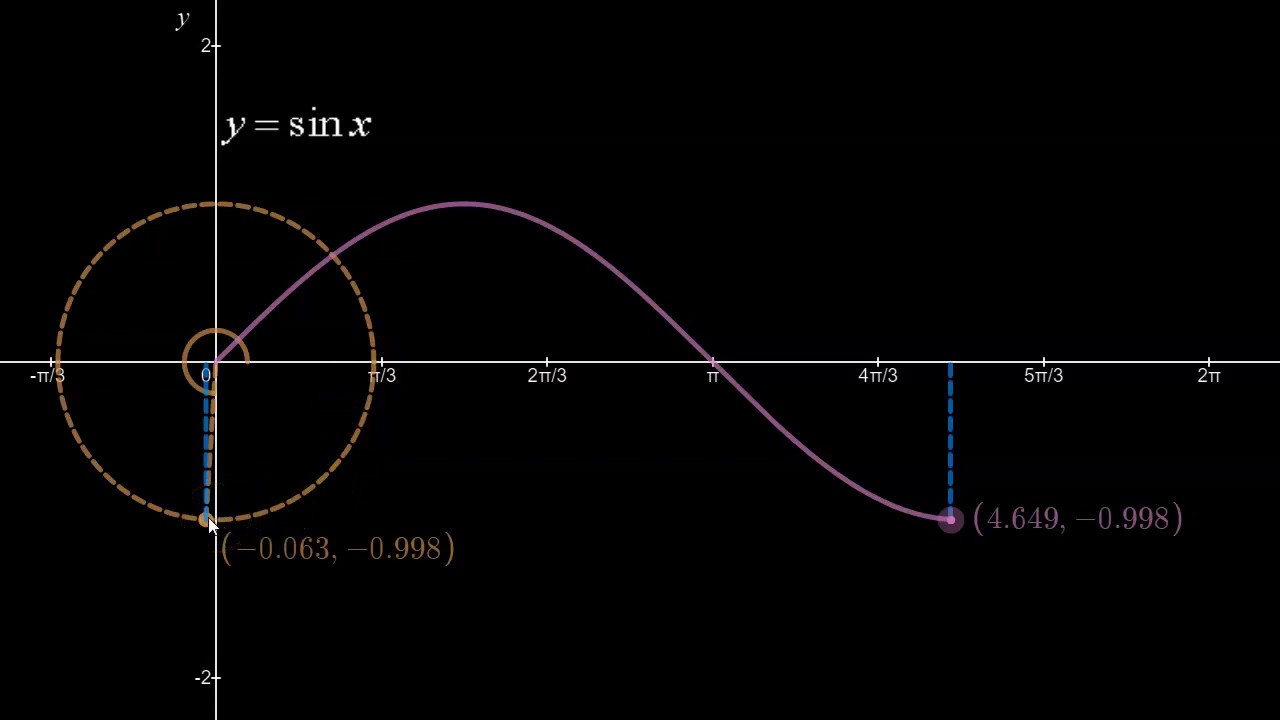
The unit circle and the graphs of the sine and cosine functions are totally related. Check out this video to find out how one relates to the other.
i think ur confusion stems from the difference between the unit circle and the graphs of cos and sin as functions
warm shuttle
limber atlas
I think this is correct
 somber badge
short obsidian
i think ur confusion stems from the difference between the unit circle and the g...
somber badge
short obsidian
i think ur confusion stems from the difference between the unit circle and the g...
You are right, I figured it out, lets say you go back, cosine is not negative, because its still positive in the fourth quadrant, but the y goes down because its negative, and then it keeps going down because it's still negative, however cosine is cosine, its just a measure at this point, you can only have a negative cosine when you go back, but when you go back you go counterclockwise which means that cosine will be technically negative here but now instead of cos(-θ)=cosθ, its cosθ=cos(-θ) which is still the same thing and says that cosine is actually positive but you are going the negative direction, by the symmetric property of equality, and then everything also has to be the same, so in the y-axis, the y value would drop, which also makes the line go up back to zero and to its starting point because we are still in the fourth quadrant.
 somber badge
Im copying this, its literally my greatest prove ever

 flat fox
this might be wrong but it seems right
 grave pond
What is "ICT"?
In particular, is it a name for particular trigonometric identities that should be avoided?
 autumn star
grave pond
What is "ICT"?
autumn star
grave pond
What is "ICT"?
calculator
grave pond
So the double-angle indentity is fair game?
autumn star
grave pond
So the double-angle indentity is fair game?
yes
i found it
what it need to be
thxcx for responding tho
 elder ice
Hey guys any suggestions on how to get better or master geometry
 real sentinel
elder ice
Hey guys any suggestions on how to get better or master geometry
real sentinel
elder ice
Hey guys any suggestions on how to get better or master geometry
practice as many questions you can
And ur pfp is super nostalgic
 wispy urchin
autumn star
calculator
wispy urchin
autumn star
calculator
ICT means Information & Communication Technology
warm shuttle
sin(2x) = 2 cos(x) sin(x) => sin(x)cos(x) = sin(2x) / 2
 hearty kite
1+sin2x = (sinx + cosx)²
 slim plinth
somber badge
slim plinth
somber badge
Can someone explain to me how in the world sin(x+y)+sin(x-y)= 2sin x cos y how it should be, but sin(x+y)-sin(x-y)≠2cos x sin y, my book tells me that, to prove the Sum-to-Product identities, but this is impossible, because in reality it equals 0💀
grave pond
Do you claim that sin(x+y)-sin(x-y) does not equal 2cos x sin y? Do you have examples of x and y that make them different?
somber badge
Well the book then says "Let x+y=a and x-y=b"
grave pond
Huh. That's not a counterexample.
But it's not clear to me whether you're actually claiming that sin(x+y)-sin(x-y) differs from 2cos x sin y. Could you clarify, please?
somber badge
I will try my best
grave pond
I'm not (at this point) asking for an explanation, just for a yes or no.
somber badge
Yes
grave pond
Okay, then do you have an example of a particular set of values for x and y that makes the two expressions have different values?
somber badge
Well, in one equation you subtract the two equations and in the other one you add both. I can conclude that the signs make the two different values different: sin(x+y)+sin(x-y)=sin(x)cos(y)+cos(x)sin(y)+sin(x)cos(y)-cos(x)sin(y)=2sin x cos y, ok
Then sin(x+y)-sin(x-y)=sin(x)cos(y)+sin(x)cos(y)-sin(x)cos(y)-sin(x)cos(y)= 0 somehow
grave pond
I'm asking which particular numbers for x and y make the two expressions have different values?
somber badge
Oh, there is no number, its a proof
grave pond
If it's a proof then it should not be a problem for you to find some numbers that one can plug in to see a difference?
Wait, are you claiming that sin(x+y)-sin(x-y) is 0, no matter what x and y are?
somber badge
Let me check
 minor zealot
Can someone help me with this. The question is find w out calculator the exact value of cos(13pie/4)
Pls
somber badge
Aha, I found something interesting, I was able to confirm that if the degrees are equal in the the x and y for both of the equations in sin(x+y)-sin(x-y), then it will of course equal 0, but if the question is like sin(x+π/3)-sin(x-π/6) there is a solution, however I was not able to calculate it, because you can't with this identity, you need to use the sum-to product identity, I figured this out by using math solver for the last question, checking for any mistakes that I may have made.
I can't prove the identity with the identity though, makes no sense
 glass robin
do any of you know any course books on fractals?
 river wigeon
glass robin
do any of you know any course books on fractals?
river wigeon
glass robin
do any of you know any course books on fractals?
Finishing a book on chaos theory rn
warm shuttle
grave pond
If it's a proof then it should not be a problem for you to find some numbers tha...
Technically, that's false
Just because you can prove something, doesn't mean you can construct an example
 gentle drift
can any one prove why (x-h)^2 +(y-k)^2= r^2
gentle drift
minor zealot
Can someone help me with this. The question is find w out calculator the exact v...
dud see let the pie be x cos (13x/4) which can be written as cos(x+9x/4) since x is 180 so according to the cast rule it is -cos 9x/4 then you can write this as -cos(x+5x/4) same as we did in the before it will be -(-cos 5x/4) which is cos 5x/4 again you can write is as cos(x+x/4) which is -cosx/4 since x is 180 degree we can write -cos 180/4 which is -cos 45 we know it is 1/root 2 so -1/root 2 is ans
obsidian harness
gentle drift
can any one prove why (x-h)^2 +(y-k)^2= r^2
it comes from Pythagoras
hearty kite
I once calculated tanx=i/root(8)
I don't even know how i did thay but it was funny
wanton yacht
gentle drift
can any one prove why (x-h)^2 +(y-k)^2= r^2
What?
Prove what about it? It's just an expression
grave pond
warm shuttle
Just because you can prove something, doesn't mean you can construct an example
Right. In this case I was trying to get them to plug in any numbers at all.
 coral gulch
My geometry teacher gave me this do any of yall know how to shade it in
 flat fox
Some of that is logic
short obsidian
coral gulch
My geometry teacher gave me this do any of yall know how to shade it in
something like this could help you solve these, perhaps?

thats borderline giving you the answers but theres not much other than knowing what these mean and how to shade in venn diagrams
 meager flax
Yo guys is there any books like Stewart's calculus book for geometry?
 humble fable
A(ABE)=9.A(EDC) ==> A(ABE)-A(EDC) = ?
 lime crownBOT
humble fable
A(ABE)=9.A(EDC) ==> A(ABE)-A(EDC) = ?
lime crownBOT
humble fable
A(ABE)=9.A(EDC) ==> A(ABE)-A(EDC) = ?
What step are you on?
1. I don't know where to begin.
2. I have begun but got stuck midway.
3. I got an answer but I was told that it's wrong.
4. I got an answer and would like my work checked.
5. I have a question about someone else's work/solution.
6. I have completed the problem and don't need help anymore. Thank you.
7. None of the above
 upper echo
humble fable
A(ABE)=9.A(EDC) ==> A(ABE)-A(EDC) = ?
upper echo
humble fable
A(ABE)=9.A(EDC) ==> A(ABE)-A(EDC) = ?
use similarity of ABE and DCE

 pallid arrow
Guys what's 1+1 (Boolean)
 slender dragon
1
slender dragon
tru tru
gentle drift
hey is infinite by infinite can be written as 1
warm shuttle
No, usually not
obsidian harness
gentle drift
hey is infinite by infinite can be written as 1
under normal definitions of (cardinal) infinity, infinity * 2 = infinity, infinity * 3 = infinity, and so on
that's why infinity/infinity is undefined
 tender arch
humble fable
tender arch
humble fable
are you turkish?
obsidian harness
nice problem btw
humble fable
tender arch
are you turkish?
perhaps
meager flax
meager flax
Yo guys is there any books like Stewart's calculus book for geometry?
Would be happy if someone answers
 vast iron
How do you calculate the area of this semicircle R1 with two fillets R2?
 warm shuttle
Well, It's kind of difficult to get an exact answer, but possible.
Important thing to note is that the line from the radius of the big circle and through the center of a small circle also passes through the point where the curve of the big circle stops, and curve of the fillet starts
To simplify set R1 = 1, set center of the big circle at origin, and only seek to find area of the right side
then solve for the center of small circle in terms of R2
Then divide the whole area into a triangle and two circle sectors
This should work
 eternal rivet
this had to be graphed I imagine (just asking)
 dire ridge
vast iron
How do you calculate the area of this semicircle R1 with two fillets R2?
dire ridge
vast iron
How do you calculate the area of this semicircle R1 with two fillets R2?
integrals
simple vigil
vast iron
How do you calculate the area of this semicircle R1 with two fillets R2?
Is this possible with geometry?
dire ridge
simple vigil
Is this possible with geometry?
no
simple vigil
dire ridge
no
Then ?
dire ridge
simple vigil
Then ?
you need to find a function that describes these
and integrate at correct bounds
simple vigil
🤯
dire ridge
the substract excess area
simple vigil
This means it is above from what I have studied
dire ridge
simple vigil
This means it is above from what I have studied
look at my account creation and server join dates
simple vigil
dire ridge
look at my account creation and server join dates
Oct 3 2025 I m older than you in this server 😂
simple vigil
dire ridge
look at my account creation and server join dates
But what you want to show me from this ?
dire ridge
same day
tender arch
dire ridge
ARE YOU?
yeah
 jovial creek
simple vigil
But what you want to show me from this ?
jovial creek
simple vigil
But what you want to show me from this ?
F1???
simple vigil
jovial creek
F1???
Yes a bit
simple vigil
dire ridge
same day
Dedication for maths 🗿
jovial creek
simple vigil
Yes a bit
What do you think of yesterdays Qualifying ?
I also stole that tag its clean
simple vigil
jovial creek
What do you think of yesterdays Qualifying ?
Not able to watch
Because of the time
simple vigil
jovial creek
Will u watch todays gp?
Maybe
Because it will be 9:30 pm for me
I have to study also
I think I will manage somehow
jovial creek
simple vigil
Maybe
Because it will be 9:30 pm for me
I have to study also
Don’t study studying won’t entertain you like max winning the title
Hope he does
I hate egoistic norris
When is his car gonna explode already
simple vigil
Come in chill channel
 warm shuttle
dire ridge
no
warm shuttle
dire ridge
no
That's just not true. In fact it's harder with calculus
 queen venture
oh everyone is sleeping
 obsidian harness
upper karma
obsidian harness
upper karma
you should recognise the expression inside the product as being one of the compound angle formulas
 dusk wren
Yes
And use the trig formula for that product series:
tan( θ- ϕ) = (tan θ-tan ϕ)/(1+ tan θ × tan ϕ)
vast iron
How do I calculate R2 segment?
 vast iron
warm shuttle
Well, It's kind of difficult to get an exact answer, but possible.
vast iron
warm shuttle
Well, It's kind of difficult to get an exact answer, but possible.
I think I'm on it, but I'm stuck again.
Anyone know how to do it?
obsidian harness
vast iron
How do I calculate R2 segment?
like this


in this case you have $(r_2 - r_1)^2 = r_1^2 + BO^2$, so that's the length of the base of the triangle
somber coyoteBOT
south

south
Compile Error! Click the  reaction for more information.
(You may edit your message to recompile.)
 vast iron
obsidian harness
woops, the area of the triangle is 1/2 * *BO* * ...
vast iron
obsidian harness
woops, the area of the triangle is 1/2 * *BO* * ...
Thanks for the working out. Did you fix the mistakes in your original text?
vast iron
obsidian harness
woops, the area of the triangle is 1/2 * *BO* * ...
I'll need some time to work through it, so I can understand it. But I'm not sure where this goes " 1/2 * BO * ...
= 1/2 * r2 * BO * sin(AOB)"
vast iron
obsidian harness
woops, the area of the triangle is 1/2 * *BO* * ...
Also where did you get the number 3 and 4 from in the diagram.
obsidian harness
vast iron
Also where did you get the number 3 and 4 from in the diagram.
they're not part of the diagram
obsidian harness
vast iron
I'll need some time to work through it, so I can understand it. But I'm not sure...
do you know A = 1/2 ab sin C? I just used that on triangle COB
vast iron
okay. So to get segment 2 would I do Sector(COD)-AOB-ABC?
obsidian harness
vast iron
okay. So to get segment 2 would I do Sector(COD)-AOB-ABC?
just sector COD - triangle COB
vast iron
obsidian harness
just sector COD - triangle COB
I see, I'll give it a go, thank you.
obsidian harness
no worries!
vast iron
obsidian harness
no worries!
I think we got it. Does this look right. Sorry for the mad scribblings.


It's a big one.
meager flax
meager flax
Yo guys is there any books like Stewart's calculus book for geometry?
Does anybody have any idea??
eternal rivet
thx
flat fox
meager flax
Does anybody have any idea??
Discover the best books in Amazon Best Sellers. Find the top 100 most popular Amazon books.
viscid gorge
ABCD and EFBG are Squares.
If the area of triangle BNF is 9 and area of trapezoid BNEG is 27, What's the colored area
Anyone got a clue ? i suck at geometry very much
i had a idea of drawing a line from G parallel to ED

 viscid gorge
 river dirge
well BG = EG = sqrt(36) = 6
river dirge
well BG = EG = sqrt(36) = 6
ok makes sense
river dirge
we also know that FN = 1,5
cause 9 = FB * FN/2 and FB = 6
so the value of BN is going to be sqrt(38,25)
viscid gorge
river dirge
cause 9 = FB * FN/2 and FB = 6
wouldn't that be FN = 3 ?
viscid gorge
BN sqrt(45)
viscid gorge
river dirge
so like (AB^2 + AE^2) = 72 right
yea makes sens
river dirge
and EN = FE - FN = 3
so AE^2 + (AB - sqrt(45))^2 = 9
so AB = 18sqrt(5) / 5
now that we have AB, we can get AE and AN, so we have the area of the triangle ANE, and value of the area of ABCD
so value of the pink area is going to be [ABCD] - 27 - [ANE]
([ABCD] is the area of ABCD)
river dirge
river dirge
so AB = 18sqrt(5) / 5
i made a little jump there
river dirge
nice 👍
viscid gorge
AN = 3 * sqrt(5) / 5
river dirge
yep
viscid gorge
so AE = 6 * sqrt(5) / 5
river dirge
viscid gorge
so AE = 6 * sqrt(5) / 5
r u sure?
viscid gorge
river dirge
r u sure?
AN^2 + AE^2 = 9
9/5 + AE^2 = 45/5
AE^2 = 45/5 - 9/5 = 36/5
AE = sqrt(36/5) = sqrt(36)/sqrt(5) = 6/sqrt(5) = 6 * sqrt(5)/5
river dirge
then we have a mistake somewhere
viscid gorge
i got area 0 lol
river dirge
river dirge
so like (AB^2 + AE^2) = 72 right
there AE = 6 * sqrt(2)/5
viscid gorge
river dirge
there AE = 6 * sqrt(2)/5
AB = 18 * sqrt(5) / 5 is correct right ?
river dirge
viscid gorge
AB = 18 * sqrt(5) / 5 is correct right ?
i am 99% sure
ill double check
let AB be x
we have x^2 + (x- sqrt(45))^2 = 63
yeah its my mistake
AB isnt 18 sqrt(5)/5
viscid gorge
wait let me check
river dirge
ive got that AB is (3sqrt(5) + 9)/2
upper echo
viscid gorge
ABCD and EFBG are Squares.
If the area of triangle BNF is 9 and area of trapezoi...
square roots are not needed

 solid gate
hey all
Im trying to solve the attached problem and im a bit confused. a cube is put in a sphere with a volume of 1.
now i understand their explanation on how they got the relationship between the length of the cube and the diameter of the sphere. however i assumed that from the center of the sphere (and cube) to the two vertices shown would be right angles and as such i can calculate the length of the side of the cube with pythagoras but that is not correct.
Can someone please explain why that is not correct as i cant see why
 upper echo
solid gate
hey all
Im trying to solve the attached problem and im a bit confused. a cube i...
upper echo
solid gate
hey all
Im trying to solve the attached problem and im a bit confused. a cube i...
That's because the diagonal section of the cube is not a square but a rectangle (with the ratio of the sides sqrt(2)). So, that angle in the center is not 90
solid gate
upper echo
That's because the diagonal section of the cube is not a square but a rectangle ...
makes sense ! thank you !
 hybrid frost
Can anyone please explain to me and make a few or just one example of Midline Theorem/square?
viscid gorge
upper echo
square roots are not needed
the key says the purple area is 36
upper echo
viscid gorge
the key says the purple area is 36
oh, yes, There is a mistake in my drawing.
 leaden chasm
Hey guys
upper echo
viscid gorge
the key says the purple area is 36
here is a correct version

 obsidian harness
 naive bay
yall my teachers doing it on purpose at ts point😭
naive bay
yall my teachers doing it on purpose at ts point😭
doing what on purpose?
naive bay
obsidian harness
doing what on purpose?
solve for z ull see
obsidian harness
naive bay
solve for z ull see
oh LMAO
I thought you were talking about there being an issue with the question
 keen marsh
Can someone help me with this problem, I feel so confused: vertex in (4,-3) axis parallel to the x-axis passing through (0,3)
thx!

I need to find the equation
Of the parable
grave pond
Could you show the entire problem you're solving, including all instructions, please?
 jade sierra
anyone know what is hsa? my text book uses hsa but my teacher say like hl
 finite drum
what would i do for 12√3??? i want to know the steps
 jade sierra
finite drum
what would i do for 12√3??? i want to know the steps
jade sierra
finite drum
what would i do for 12√3??? i want to know the steps
you want to simplify 12 sqrt 3?
finite drum
jade sierra
you want to simplify 12 sqrt 3?
yes
jade sierra
you can think of it was 12 * sqrt 3
you can rewrite sqrt3 as 1.73
so 12sqrt3 is 20.78
finite drum
ohh that's it ???
jade sierra
yea lol
finite drum
jade sierra
you can think of it was 12 * sqrt 3
you can rewrite sqrt3 as 1.73
so 12sqrt3 is ...
but tysm 😭
obsidian harness
jade sierra
anyone know what is hsa? my text book uses hsa but my teacher say like hl
ask your teacher
is it something about surface areas?
 desert gust
@everyone hi