#geometry-and-trigonometry
1 messages · Page 98 of 1
 fading crater
 zealous pike
Yes, anything halved is multiplied by 1/2. If the base was 2 before and was halved, we have 2(1/2) = 1
Let's say that this is an equilateral triangle that was halved (don't mind the ugly drawing)
 fading crater
Okay, i understand that.
zealous pike
We define the opposite side of an angle as the side to where it is "looking at". Let's say an angle of 60°, its opposite side is sqrt(3). The opposite side of 90° is the hypotenuse itself, 2.
Now. When we have Sin(x) where x is any angle, we say that sin(x) is the ratio of the opposite side of the angle x by the hypotenuse. Do you follow?
 fading crater
zealous pike
We define the opposite side of an angle as the side to where it is "looking at"....
fading crater
zealous pike
We define the opposite side of an angle as the side to where it is "looking at"....
Yes.
zealous pike
fading crater
Yes.
Can you tell what is the value for sin 60°?
 topaz turtle
uhh i don’t know the correct channel for this but can someone help me with my ixl
🥹
zealous pike
Pi/3 is the same as 60°, but it isn't the value for sin 60°
zealous pike
That's right
You got this
Now you know how the value for sin(30°) comes to be, right?
zealous pike
That's right
Summarizing.
A bit unrelated first, just for a clear of mind. We define a function as f(x) where x is the input for that function. Therefore, if we have f(x) = x and choose 5 for input value ak f(5), we have that f(5) = 5
Sine, cosine, cotangent, etc, falls into the same category: they are all functions (just aren't noted as f(x)). We can say that if we have sin(30°), sin(60°)… sin(x), , we are inputting values so that it will calculate the ratio of the opposite side of those angles by the hypotenuse of a certain triangle.
Most of the time, we don't know which triangles we are dealing with when we input let's say sin(2°)
But very good people have already computed some of those values for us today, which we recall by the trigonometric table

, we see that the sin(45°) = sqrt(2)/2. We can say that there is a triangle whose opposite side of 45° is sqrt(2) and the hypotenuse of that triangle is 2
Are you following?
fading crater
Yes.
zealous pike
An important thing to note is that we not always write the angles between the parentheses. It is common to let them without it
Sin(30°) = sin 30° = sin π/6
Coming back to your question. You got to the point where
Sin(3x) = 1/2
And you need to solve for x. Let's not do this for now and just call 3x by z. We have that 3x = z
This gives us
Sin(z) = 1/2
Ops
Can you tell what angle in radians or degrees, z needs to be so that sin(z) = 1/2?
You can forget that z = 3x here. Just think of z as any angle
zealous pike
That's right
You have that z = pi/6 = 30°
We said that z = 3x. Therefore, we have z = 30° = pi/6 = 3x.
There is a real number x that if it is multiplied by 3, it becomes pi/6.
in mathematical words, it is the same as saying:
3x = pi/6
If we divide both sides by 3, to what result we arrive?
And what happens if we substitute that result into x and multiply it by 3?
fading crater
x = pi/18?
fading crater
Both sides?
zealous pike
Just pi/18
fading crater
Pi/6
zealous pike
Do you understand now how sin(3x) = 1/2?
fading crater
Sorry, registered it just now.
fading crater
It's because of sin 30°?
zealous pike
Yes
3x becomes 30° somehow
We discovered that how
We discovered what value is x, so we have… sin(3x) = 1/2
What value do we substitute for x?
fading crater
Pi/18?
zealous pike
No
zealous pike
fading crater
Pi/18?
Yes
That's right
Pi/18!
You have come to the conclusion that sin(3x) = sin(3[π/18]) = sin(π/6) = 1/2
You may be confused in some bits for now, but it may become rather clear as you think about all this explanation.
As an exercise to understand better, try:
Cos(6x) = sqrt(2)/2
Cos(πx) = sqrt(3)/2
Solve for x
zealous pike
zealous pike
Remember of these values
fading crater
zealous pike
You may be confused in some bits for now, but it may become rather clear as you ...
- x=pi/4
- x=pi/6
fading crater
- 3*pi/2
- 2*pi/6
?
zealous pike
Not yet but you are getting the heat
zealous pike
That's right
fading crater
So, sqrt(2)/12?
zealous pike
No
You want to divide both sides by 6 in another equation, one of which you just sent here
fading crater
I don't know.
zealous pike
zealous pike
You may be confused in some bits for now, but it may become rather clear as you ...
Why do we want to find x? What's the purpose in that here?
What is the value for x called if we input it into cosine?
The answer for the last question is a word that starts with "a" and ends with "e"
zealous pike
YOU GOT THAT BRO
fading crater
Is that a yes?
zealous pike
Yes
fading crater
Ok, so the other one is pi/6*pi?
zealous pike
Yes
fading crater
Ok, got it.
zealous pike

fading crater


 arctic hatch
May I know will my teacher made the exam so hard? Anyone know?
fading crater
It's due to having to type out messages.
zealous pike
Indeed
fading crater

zealous pike
Type out, wait for a reply, wait for a reply of the reply, wait for a reply of the reply of the reply…
zealous pike
Nooo
No be sorry
Be happy actually
I'd be pissed off only if I was unable to explain this
It's my job as someone who wants to share the understanding of what I understand, to understand the understanding of my listeners and work around that
 shrewd valley
Can somebody please explain to me basic triangles
SAT on Saturday and I have no idea how to find lengths of sides or angles
Please just explain the gist of it. Math is not my strong suit whatsoever
 paper spear
for modelling sinusoidal functions why do u divide 2π for the period
if it's getting bigger dont u multiply it
or atleast put it the other way
maybe idkk
fading crater
zealous pike
It's my job as someone who wants to share the understanding of what I understand...
Thank you regardless!
 pliant bane
I need help, i don't understand how to solve this
define line shadow of 2x-b=3y which is reflected on the line y=-5 with y=k
(x',y')=(x,2k-y) formula
 empty yew
shrewd valley
SAT on Saturday and I have no idea how to find lengths of sides or angles
empty yew
shrewd valley
SAT on Saturday and I have no idea how to find lengths of sides or angles
SAT is a good exam compared to JEE(sedly)
 spiral plover
shrewd valley
SAT on Saturday and I have no idea how to find lengths of sides or angles
spiral plover
shrewd valley
SAT on Saturday and I have no idea how to find lengths of sides or angles
Wdym?
U don't need to know how to do that for the SAT
Just special right triangles should mostly do the work
 obsidian harness
pliant bane
I need help, i don't understand how to solve this
define line shadow of 2x-b=3y ...
obsidian harness
pliant bane
I need help, i don't understand how to solve this
define line shadow of 2x-b=3y ...
send the image of your problem
obsidian harness
spiral plover
Just special right triangles should mostly do the work
you're forgetting that the SAT exam has been digital for a while now
before you could use your graphing display calculator
spiral plover
obsidian harness
you're forgetting that the SAT exam has been digital for a while now
Yeah i know
😭
obsidian harness
yes then right triangles with any angles and sides can come up
obsidian harness
paper spear
for modelling sinusoidal functions why do u divide 2π for the period
the period of sin(x) and cos(x) is 2π
now, you should think of sin(2x) and cos(2x) like the functions are playing on 2.0x speed
in other words, sin(2x) is a compression, 2 > 1
sin(x/2) is a horizontal stretch, 1/2 < 1
spiral plover
obsidian harness
yes then right triangles with any angles and sides can come up
No
That's not something they test
obsidian harness
spiral plover
That's not something they test
source?
https://www.reddit.com/r/Sat/comments/vjkgks/khan_academy_right_triangle_trigonometry_problem/
there's something as devilish as this for example
Reddit
Explore this post and more from the Sat community
spiral plover
obsidian harness
https://www.reddit.com/r/Sat/comments/vjkgks/khan_academy_right_triangle_trigono...
That's khan
Not an official sat question
spiral plover
obsidian harness
https://www.reddit.com/r/Sat/comments/hz7q03/right_triangle_trig_on_sat/
Nothing here contradicts what i said though
(3,4,5) and (5,12,13) is just pythag things
obsidian harness
spiral plover
Just special right triangles should mostly do the work
okay you should have clarified
spiral plover
obsidian harness
source?
I've not seen a single question that directly tests you on something like that
obsidian harness
cause 'special right triangles' means only the 30-60-90 and the 45-45-90 angle ones
obsidian harness
spiral plover
I've not seen a single question that directly tests you on something like that
doesn't mean it couldn't come up
I know that SAT doesn't have a predefined syllabus which complicates things
spiral plover
obsidian harness
cause 'special right triangles' means only the 30-60-90 and the 45-45-90 angle o...
I assumed that the "focus" was more on the angles
spiral plover
obsidian harness
doesn't mean it couldn't come up
No they reuse questions
obsidian harness
spiral plover
No they reuse questions
they could also make new ones
spiral plover
By that logic, a comp math question could also potentially come up because it's theoretically well within their syllabus
spiral plover
obsidian harness
they could also make new ones
They're all reiterations of the same concept they're trying to reinforce
I've yet to see a novel question
obsidian harness
spiral plover
By that logic, a comp math question could also potentially come up because it's...
no, because they already test right-angled trig with respect to
- special right triangles
- integer side lengths right triangles
making the angle or a side 'not-neat' and expecting you to use Desmos to calculate the answer isn't novel
will these common styles be more likely to come up? absolutely
spiral plover
You're operating from a theoretical pov
😭
I would focus more on all the official questions
one has access to
A certain style of question is unlikely to show up
If it does then it's experimental
Look at the march sat
or the may one
actually look at the entire last year for reference
obsidian harness
spiral plover
actually look at the entire last year for reference
where?
 shy grotto
spiral plover
Not an official sat question
shy grotto
spiral plover
Not an official sat question
I doubt you're going to find one within the past few SATs to be honest
But iirc, I took november 2024 (quite old) and there isn't much "bad" triangles
obsidian harness
but yeah it does make more sense to test with a variable instead of random numbers
 obsidian harness
yes then right triangles with any angles and sides can come up
obsidian harness
obsidian harness
yes then right triangles with any angles and sides can come up
which is what I was getting at earlier
topaz turtle
could i get some homework help?
 grave pond
topaz turtle
could i get some homework help?
grave pond
topaz turtle
could i get some homework help?
If you actually ask a question, there's a chance someond will answer it.
topaz turtle
grave pond
If you actually ask a question, there's a chance someond will answer it.
Oh sorry
this is what i need help on

i’m not sure if this is the right channel for this though.
 buoyant island
hey, is there someone who can teach me geometry, i am joining my highschool math team next year as a freshman and the paper they gave me has geometry on is. can someone help me learn geometry over the summer
 worn scroll
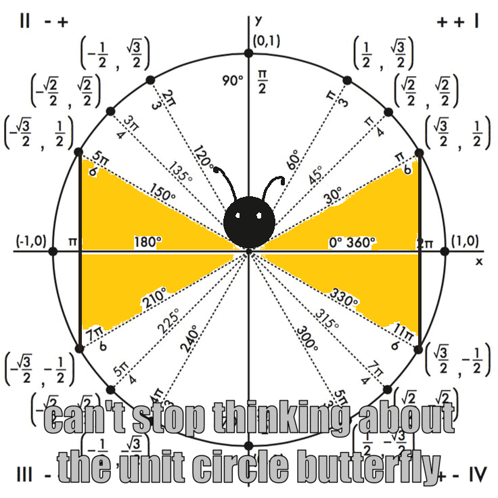 obsidian harness
worn scroll
https://tenor.com/view/unit-circle-butterfly-math-mathematics-can%27t-stop-think...
obsidian harness
worn scroll
https://tenor.com/view/unit-circle-butterfly-math-mathematics-can%27t-stop-think...
if you haven't stared at the unit circle long enough to make you hallucinate, you're not a real mathematician
 edgy spoke
buoyant island
hey, is there someone who can teach me geometry, i am joining my highschool math...
edgy spoke
buoyant island
hey, is there someone who can teach me geometry, i am joining my highschool math...
I don't know for sure if I can help, but you can dm me if you have a question or a problem, I'll try to help if I can.
empty yew
edgy spoke
I don't know for sure if I can help, but you can dm me if you have a question or...
Help here so that we can see that solution too
lol
edgy spoke
Sure, I will if I can and have time
edgy spoke
empty yew
lol
I thought they wanted a tutor or something
empty yew
edgy spoke
I thought they wanted a tutor or something
But that's against server policy lol
edgy spoke
empty yew
But that's against server policy lol
Oh, i must've missed it. I'm sorry, I was in a hurry
grave pond
It's not against server policy to help people in DMs. It is mildly discouraged to use the server to arrange paid tutoring, in DMs or elsewhere. (And strongly forbidden to advertise paid tutoring services out of nowhere).
edgy spoke
grave pond
It's not against server policy to help people in DMs. It is mildly discouraged t...
Thanks for clarification
 severe grove
how many times do you think about the unit circle daily?
grave pond
Weird question. Who keeps count?
 trail tendon
the more I think to count the more I think about it which makes the data corrupt 😔

 lime crownBOT
What step are you on?
1. I don't know where to begin.
2. I have begun but got stuck midway.
3. I got an answer but I was told that it's wrong.
4. I got an answer and would like my work checked.
5. I have a question about someone else's work/solution.
6. I have completed the problem and don't need help anymore. Thank you.
7. None of the above
 visual flume
1
obsidian harness
visual flume
help pls
use barycentric coordinates
also this belongs in #competition-math
use this, and then the centroid must lie on this line

 hoary totem
obsidian harness
use this, and then the centroid must lie on this line
hoary totem
obsidian harness
use this, and then the centroid must lie on this line
u think theres a way to solve this without coordinate geometry?
obsidian harness
hoary totem
u think theres a way to solve this without coordinate geometry?
barycentric coordinates aren't coord geo
garlic said to make the line an axis and use the fact that centroid is the average
idk what they mean
hoary totem
obsidian harness
garlic said to make the line an axis and use the fact that centroid is the avera...
oh
wait that makes this question super easy
||make the line through G the x axis and G the origin||
||A is (-a, x)||
||B is (-b, -2)||
||C is (c, -5)||
||then because the centroid is the average of A, B, and C and is at the origin||
||(-a - b + c)/3 = 0 and (x - 2 - 5)/3 = 0||
||from the second equation we have x = 7||
it is coordinate geometry
obsidian harness
hoary totem
||make the line through G the x axis and G the origin||
||A is (-a, x)||
||B is ...
I mean that gives you the answer but doesn't show why it works regardless of the triangle or the line
but you figured it out yeah, I didn't expect that
hoary totem
obsidian harness
I mean that gives you the answer but doesn't show why it works regardless of the...
how is it regardless of the triangle or the line
obsidian harness
hoary totem
how is it regardless of the triangle or the line
that's my point exactly
hoary totem
if the line or the triangle changes the coordinates of A B C change
thus the length x also change
obsidian harness
hoary totem
if the line or the triangle changes the coordinates of A B C change
yeah but you're stating the value of x doesn't change
hoary totem
it does what
obsidian harness
the question implies that x doesn't change
hoary totem
it doesnt at all
it gives the lengths 2 and 5 which lock the triangle and line to this specific configuration

a different line through G obviously gives different cooridnates for A B and C
obsidian harness
hoary totem
a different line through G obviously gives different cooridnates for A B and C
okay now I agree with you
my point was the coordinates change but the value of x remains the same
obsidian harness
obsidian harness
my point was the coordinates change but the value of x remains the same
but then you didn't show this fact
you just tested with one possible set of coordinates
hoary totem
my point was that x is the coordinate
hoary totem
x is the y coordinate of A under those specific axes
if the line changes the axes change
so the value of x changes
obsidian harness
ahhh okay so you did cover every possible setup up to rotation and translation so yeah
hoary totem
hoary totem
as seen here
obsidian harness
sorry
hoary totem
no need to be sorry lol
obsidian harness
visual flume
help pls
damn that's a clever problem
hoary totem
idk why the equation of the line was needed
obsidian harness
yeah you could just do "mean vertical displacement from line = 0, so x - 2 - 5 = 0" directly
hoary totem
obsidian harness
damn that's a clever problem
true i was like what the hell but then as soon as u mentioned "the centroid is the average" i was like
o m g
hoary totem
yar
obsidian harness
hoary totem
true i was like what the hell but then as soon as u mentioned "the centroid is t...
thank garlic
I didn't actually say that
if I understood I would have figured it all out and told you earlier
hoary totem
-# whos garlic
hoary totem
i see!
 left mauve
hoary totem
-# whos garlic
left mauve
hoary totem
-# whos garlic
How did you make your text like that
empty yew
-# Hi shiru and executor
 regal kraken
I belive this belongs here

tried to calculate k by converting cot in terms of tan
and tried to create a telescopic series
empty yew
Don't multipost clone!
 upper echo
regal kraken
I belive this belongs here
upper echo
regal kraken
I belive this belongs here
That's easy. First show that tan(pi/3+x)tan(pi/3-x)=tan(3x)/tan(x). Then it is just a telescoping product.
regal kraken
upper echo
That's easy. First show that tan(pi/3+x)tan(pi/3-x)=tan(3x)/tan(x). Then it is ...
got it thanks cuh
regal kraken
upper echo
That's easy. First show that tan(pi/3+x)tan(pi/3-x)=tan(3x)/tan(x). Then it is ...
ayy bro
you were the one who replied me in the help section right?
I am still stuck at that problem
upper echo
regal kraken
I am still stuck at that problem
so what's the problem? cot=1/tan Bring it to the left side. You get products of tan(pi/3-x)tan(pi/3+x) which is tan(3x)/tan(x)
regal kraken
upper echo
so what's the problem? cot=1/tan Bring it to the left side. You get products of ...
not this one
the other one you helped me with
upper echo
regal kraken
the other one you helped me with
which one?
 livid quiver
who can solve general formula for theta_? with given variables?

 crude quiver
oh
 worthy eagle
livid quiver
who can solve general formula for theta_? with given variables?
worthy eagle
livid quiver
who can solve general formula for theta_? with given variables?
bro its not clear
crude quiver
yeah agree
upper echo
livid quiver
who can solve general formula for theta_? with given variables?
you can find theta_? by this formula, where all angles are in radians (d is just the ratio of radiuses, not that segment marked d in the figure). By the way, only 4 parameters are enough to find all others.

 exotic cloud
livid quiver
who can solve general formula for theta_? with given variables?
exotic cloud
livid quiver
who can solve general formula for theta_? with given variables?
theta _ out?
 wild nebula
anyone kno whats gon be on the regents
grave pond
I'm not sure what "the regents" is, but that sounds a lot like you're asking for cheating help with something?
left mauve
grave pond
I'm not sure what "the regents" is, but that sounds a lot like you're asking for...
Yeah prolly, regents is high school exams in new york
 serene hedge
grave pond
I'm not sure what "the regents" is, but that sounds a lot like you're asking for...
serene hedge
grave pond
I'm not sure what "the regents" is, but that sounds a lot like you're asking for...
new york state high school exam
oh
he said that already
my fault
trail tendon
serene hedge
new york state high school exam
bro is visually deaf 👍
serene hedge
trail tendon
bro is visually deaf 👍
usually they just call that blind
trail tendon
serene hedge
usually they just call that blind
thats what AVERAGE people call it
 swift gorge
hi 😔 i'm super super super behind on school work and i need urgent help

i understand some things but lately i don't
obsidian harness
do you know what an angle bisector is?
swift gorge
ummm
is it the grey line?
sorry if i sound stupid im very bad at math it;s hard for me to pay attention to it
obsidian harness
swift gorge
is it the grey line?
yes
but what does that tell you about angles ACE and ECB, if CE is an angle bisector
obsidian harness
swift gorge
theyre the same just flipped
yep! they're equal angles
yeah so now comes the algebra part, well set up the equation first
swift gorge
is it 2x-15=x+5?
it is
it gave me 20 and that was the answer
umm hold on im gonna see how far i can get until i need help on stuff thank you south
ahh im not sure if this was the right channel either sorry 😭
 opaque radish
Im having to relearn trig to take a math placement test and am a bit confused. I understand how to find the angle but im just not sure how they want me to estimate the number of revolutions? Should i just assume that in figure T2 Theta is 4/12?

 maiden brook
opaque radish
Im having to relearn trig to take a math placement test and am a bit confused. I...
maiden brook
opaque radish
Im having to relearn trig to take a math placement test and am a bit confused. I...
This isn’t explained very well here
But no, it’s **-**1/3 * 360
opaque radish
isnt it based on the unit circle which is split up into 24ths?
opaque radish
nevermind i was thinking of something completely different
I thought the unit circle was something else
visual flume
help pls
 obsidian harness
visual flume
help pls
obsidian harness
visual flume
help pls
have you tried drawing it out?
also do you know what concave means? it's not just any pentagon where all 5 sides are equal
empty yew
,, \arccot(x)=\begin{cases}\arctan(\frac 1x) &x>0 \ \pi+\arctan(\frac 1x) &x<0\end{cases}
 somber coyoteBOT
Monkey•D•Luffy
 empty yew
What is it for arctan(x)?
empty yew
,, \arctan(x)=\begin{cases}\arccot(\frac 1x) &x>0 \ -\pi+\arccot(\frac 1x) &x<0\end{cases}
somber coyoteBOT
Monkey•D•Luffy
 empty yew
Is this correct?
left mauve
empty yew
Is this correct?
Ye

 vague dome
 summer cradle
 wispy void
since JL is a diameter which means it divides the circle into 2 equal halves
arc NJ = arc MJ
I think the question assumes that JL is perpendicular to MN
so JL bisects MN
then form triangle PKN
KN is radius
and so is KL
obsidian harness
summer cradle
so JL bisects MN
or alternatively, angle MKN = 98
then angle LKN = angle MKN / 2 and then m(NJ) is easy
then as noted already, KL = KN (both radii) so you could:
- split triangle LKN into two congruent right triangles, and then use right-angled trig
don't forget to double the opposite side to the central angle to get LN - cosine rule also works too
summer cradle
obsidian harness
or alternatively, angle MKN = 98
then angle LKN = angle MKN / 2 and then m(NJ) i...
98 is the arc length not the angle
obsidian harness
summer cradle
98 is the arc length not the angle
ah right, so angle MKN = 98
 sick zenith
Omg is anybody online 😂 the geometry regeants is tmmr 
obsidian harness
sick zenith
Omg is anybody online 😂 the geometry regeants is tmmr <:joia:13760706671742812...
new yawker
sick zenith
obsidian harness
new yawker
How do y know- ou wait.. YEAHH 
obsidian harness
only one state calls their exam the Regents
sick zenith

sick zenith
obsidian harness
only one state calls their exam the Regents
Eyyyy New York is just something

left mauve
There was a guy here just yesterday asking for what questions would be on the regents 
obsidian harness
.......
obsidian harness
left mauve
There was a guy here just yesterday asking for what questions would be on the re...
your bio screams chronically online.
left mauve
obsidian harness
your bio screams *chronically online.*
How so 
obsidian harness
it just does
left mauve
Hm maybe because it has 3 different things on it idk lol
But yeah rn i am chronically online since I'm on holiday 
empty yew
What does ask on server b4 DM means? lol
left mauve
empty yew
What does ask on server b4 DM means? lol
Don't dm without asking on the server first? It's pretty clear 
empty yew
left mauve
Don't dm without asking on the server first? It's pretty clear <:holothink:59599...
before
i see
 south storm
Hey anyone down later to help me to study for my final? Need to be locked in
 late fern
hey guys idk which channel is appropriate for this but i'm trying to study for my A levels and struggle with understanding geometry, does anyone have any tips on how to get myself to understand the concepts of geometry? i'm solving questions regularly with help but can't do it on my own for some reason
 maiden brook
 real willow
do u understand how to do any of them?
obsidian harness
maiden brook
do u understand how to do any of them?
they did q17 already btw
obsidian harness
real willow
for q18 you want to create another reflection (technically you need calculus to see why the shortest path is a reflection, but)
maiden brook
obsidian harness
for q18 you want to create another reflection (technically you need calculus to ...
no u don’t, there’s a slick way to see it
obsidian harness
maiden brook
no u don’t, there’s a slick way to see it
what's wrong with 'you want to create another reflection' ?
maiden brook
obsidian harness
what's wrong with 'you want to create another reflection' ?
No I mean that u don’t need calculus to justify it’s the best
obsidian harness
real willow
and for q19, 20, recall that the shortest distance from a point to a line is the perpendicular distance
that should tell you what the special relationship between the two lines is
obsidian harness
maiden brook
No I mean that u don’t need calculus to justify it’s the best
oh really?
ah I know
yeah you just extend the line past y = 1
obsidian harness
obsidian harness
yeah you just extend the line past y = 1
that's how they figured out q17 btw, so props to them
 real willow
real willow
real willow
I already got the rest of the questions btw :D
thanks for the help either way 🙏
obsidian harness
np!!
 edgy bone
Hi. Can someone explain to me how cos(x) and sin(x) can be negative? arent they defined as follows:
cos: cos(alfa) = adj length / hyp length
sin: sin(alfa) = adj length / hyp length
Lengths cant be negative, so how can cos(alfa) < 0?
When I google I just see people mentioning the thing with the unit circle and how cos(alfa) goes between -1 and 1. but I still dont understand how it becomes negative and can only see it going between 0 and 1.
I feel like I'm missing something extremely basic here lol.
 exotic yarrow
edgy bone
Hi. Can someone explain to me how cos(x) and sin(x) can be negative? arent they ...
exotic yarrow
edgy bone
Hi. Can someone explain to me how cos(x) and sin(x) can be negative? arent they ...
We're considering what I like to call "signed length"
,w graph x^2+y^2=1
somber coyoteBOT


 Requested by civil_service_pigeon
exotic yarrow
Requested by civil_service_pigeon
exotic yarrow
Ex. For this triangle, both legs "follow" the positive x and y axes, respectively, so we consider them to have positive length


but let's consider a triangle like this
edgy bone
Oh, is the definition taking direction into account and changing the sign?
exotic yarrow
exotic yarrow
but let's consider a triangle like this
again, the vertical leg "follows" the positive y axis, so we say that has positive length
but the horizontal leg "follows" the negative x axis, so we say that it has negative length
also note that the hypotenuse is always taken to have positive length
regardless of the quadrant
edgy bone
So the definitions i mentioned take the direction in the coord system into account for the opp and adj lengths?
exotic yarrow
edgy bone
So the definitions i mentioned take the direction in the coord system into accou...
sure
edgy bone
ah, then it makes sense. i just thought it was defined as a length, and a length can never be negative, right?
exotic yarrow
you can take lengths to be negative when convenient (where sign is based on direction)
edgy bone
aha okay. i didnt know that. thank you. now the definitions make sense
oh, signed distance exists. ive heard of signed distance fields, i shouldve figured
maiden brook
 fallen burrow
I'm looking for videos or resources to *really* comprehend trigonometry
fallen burrow
I'm looking for videos or resources to *really* comprehend trigonometry
On what level
real willow
does this look right 😓

 indigo nexus
real willow
does this look right 😓
indigo nexus
real willow
does this look right 😓
Which one ?
 glacial ember
real willow
does this look right 😓
glacial ember
real willow
does this look right 😓
i think it does
but id prob change your reasoning for 21
real willow
indigo nexus
Which one ?
the whole page in general
fallen burrow
maiden brook
On what level
I'm in high school, but I feel I'm just following orders. Why does knowing one side and one angle give all the other information about a triangle?
 dark sparrow
fallen burrow
I'm in high school, but I feel I'm just following orders. *Why* does knowing one...
dark sparrow
fallen burrow
I'm in high school, but I feel I'm just following orders. *Why* does knowing one...
one side and one angle?
are you sure about this?
it takes three elements to fully determine a triangle, not two.
maiden brook
dark sparrow
it takes *three* elements to fully determine a triangle, not two.
And this isn’t so true even
dark sparrow
maiden brook
And this isn’t so true even
are you about to bring up the ambiguous case in SSA
or what
maiden brook
yeah
fallen burrow
dark sparrow
one side and one angle?
it was an example
I think it is two angles (because the third is always 90 degrees) or one angle and one side
 spiral lodge
Well, you're talking about right triangles then 😅
 signal vapor
???
zealous pike
Aren't points 3 and 4 saying the same thing but in a different way? I can't note a difference in meaning
point 3 says that three points A, B and C not in the same straight line always completely determine a plane.
point 4 says that any three points A, B and C ofa plane, which do not lie in the same line, completely determine a plane.
Key differences: there is the word "any" in point 4. There is not the word "always" in point 4.
Here, does the word "any" denotes a set of three different points not in the same line or a set of points where one or more of the points A, B and C aren't in the same line, but two points can be in the same line? I came to the conclusion that his would be the difference, but I feel it is a wrong reasoning. Would someone give me a light?
 dark sparrow
Aren't points 3 and 4 saying the same thing but in a different way?
nope
1.3 says that for any three non-collinear points A, B, C there exists a plane alpha that contains them all
1.4 says that this plane is unique i.e. there's one and only one
zealous pike
I see. Thank you
 mellow pollen
i have a question from my a level exam today
for sin(nx)=k (0<|k|<1) (0<x<2pi) to have six solution, what is the value of n
n=3 right?
spiral lodge
Yep
mellow pollen
alr thanks
obsidian harness
mellow pollen
alr thanks
can check using Desmos
 obsidian harness
visual flume
help pls
obsidian harness
visual flume
help pls
call the intersection of DA and FB point P
then use the sine rule on triangle GPB
obsidian harness
indigo nexus
Ed is the same
what?
indigo nexus
Ed is the same as ha
obsidian harness
ok
obsidian harness
obsidian harness
call the intersection of DA and FB point P
then use the sine rule on triangle G...
ah actually, might be better to use triangle GHP
signal vapor
This is one of those questions where coordinate geometry looks to be faster
 restive sphinx
Why equation of the line in normal form is given by x cos θ + y sin θ = p?
 echo beacon
visual flume
help pls
echo beacon
visual flume
help pls
is it root3
visual flume
yeah
echo beacon
visual flume
yeah
||pba is an isosceles triangle||
||an octagon is 135 degrees per angle||
after that its js spamming angles
no sine rule or anytying needed
visual flume
yeah
echo beacon
 visual flume
i smh keep getting x = 120

but that doesnt look correct
wait it works when i plug it in with other shapes
bruh
idt its correct tho
echo beacon
visual flume
i smh keep getting x = 120
what exactly are you trying to do
 blissful storm
"A vertex of a triangle lies on the circle passing through the midpoints of the adjacent sides and the barry center. Compute the median drawn from this vertex if the opposite side has length a"
How do i approach solving this problem?
echo beacon
visual flume
i smh keep getting x = 120
hint: ||start by proving that PBA is isosceles||
if u can do that i'm sure the problem's gonna be really easy for u
but if you're trying something urself and getting it wrong, i personally encourage u to keep going until u find out whatever it is that you're doing wrong because that's (IMO) much more important
visual flume
ohhhh wait i changed symbols wrong
visual flume
echo beacon
hint: ||start by proving that PBA is isosceles||
if u can do that i'm sure the ...
pba?
echo beacon
visual flume
pba?
yes, where P is the intersection of DA and FB as south said. sorry for not clarifying
 onyx marlin
do you learn about topology/manifolds in pre-uni geometry?
 hoary prism
no usually it is about like euclidean plane geometry
 lofty spear


 sage radish
you can use circles
 upper karma
?
 white cloud
upper karma
white cloud
upper karma
Is it not just angle chasing
Let measure of angle A be x
AED is then x

 rancid dragon
Hello Humans, I want to deepen my understandings of trigonometry while making sure that I am covering enoug htopics from the standard 11th 12th Trigonometry syllabus (well, you can compare it with the Indian syllabus for intuition).
I am currently thinking of beginning "Plane Trigonometry" by S.L. Loney. I am kind of confused, because the book is from 1893. Should I continue with the book? I know Trigonometry doesn't get yearly updates like iOS. But still, is it compatible with modern trigonometry practices and similar?
grave pond
Old mathematics does not suddenly become false. The largest risk with an old book is that it will have a focus that's not all that relevant anymore. In particular, a book from that timeframe may place a lot of importance on clever tricks that would have been practically necessary to compute numerical results for problems where today we would just chuck everything into a coordinate system and throw a computer at it.
Of course, clever tricks will never entirely go out of fashion -- it's more a matter of weight and focus than a matter of "this is now completely obsolete".
 ember scroll
I have a question, it is possible to know if two squares of different sizes, ranging from point A to point B at a certain constant speed, collide at some point, and know the position where the squares would be when colliding?

 unkempt topaz
ember scroll
I have a question, it is possible to know if two squares of different sizes, ran...
unkempt topaz
ember scroll
I have a question, it is possible to know if two squares of different sizes, ran...
do the lines represent trails, or where the boxes are about to go?
ember scroll
Lines represent the Start and the End of the Box movement.
unkempt topaz
so are the boxes at the start right now?
ember scroll
unkempt topaz
so are the boxes at the start right now?
yes sir
unkempt topaz
so the first thing im thinking of is, pick one box and view its perspective
so like, instead of the green box going left by 50, you keep the green box still and make the blue box also go right by 50 as well as its current motion
but then im afraid its probably not going to be a fun solution, just a lot of line formulas
and seeing the trajectory of the lines
ember scroll
I forgot to mention something, Speed means how many squares each frame moves, Speed = 20 means that you move 20 squares in 1fps, so 1fps would be like 1 second.
ember scroll
unkempt topaz
so like, instead of the green box going left by 50, you keep the green box still...
Sorry, I didn't get the idea.
unkempt topaz
ember scroll
Sorry, I didn't get the idea.
if youre in a car going 20mph, and theres a car going the other way at 20mph, then from your perspective the car is passing you at 40mph
does that make sense
ember scroll
unkempt topaz
does that make sense
Hmm, but that's only true if, for example, I'm going from bottom left to top right. And the other car is going from top right to bottom left.
In this case, one car is going from bottom left to top right, and another is going from top right to left. So the speed wouldn't be the sum of both. In any case, I'm not sure how that would help determine if when both squares moving at different speeds they collide in some point.
unkempt topaz
ember scroll
Hmm, but that's only true if, for example, I'm going from bottom left to top rig...
correct, i deliberately used a simplified example
i am assuming, you know how fast the box is moving upwards, and also how fast its moving horizontally?
so then you can just modify the horizontal speed
ember scroll
unkempt topaz
i am assuming, you know how fast the box is moving upwards, and also how fast it...
The blue is 20 upwards and 20 horizontally. Although I still don't know how to tell if the two collide. 😅
unkempt topaz
ember scroll
The blue is 20 upwards and 20 horizontally. Although I still don't know how to t...
so we can make that 20 upwards and 70 horizontally, and keep the blue one still
but then its going to be a lot of checking points, I'd recommend finding formulas of where the corners are going to travel first
but I can't imagine a neat formula
(becuase it would also depend on the size of the squares)
maiden brook
grave pond
Old mathematics does not suddenly become _false_. The largest risk with an old b...
for geometry in particular, older books might be better cause geometry was more heavily emphasized in the past?
grave pond
That's a possible consideration, if you're reading out of interest rather than being strictly focused on useful knowledge. :-)
upper karma
i need help

 tardy vector
you know that abc and cde are equilateral triangles
so from there you can work out ||angle ace and angle acd||
and using that info you can think about ||similar triangles||
upper karma
hmm i tried that but still did not get it
 dense karma
upper karma
hmm i tried that but still did not get it
dense karma
upper karma
hmm i tried that but still did not get it
Equilateral triangles are also equiangular, and all triangles must add up to 180 degrees, if that helps
upper karma
dense karma
Equilateral triangles are also equiangular, and all triangles must add up to 180...
how>
grave pond
upper karma
how>
They're trying to tell you that, for example ∠ECD = 60°.
Is that what you're having trouble with, or is it later in the instructions?
dense karma
upper karma
how>
Because
A.) all equilateral triangles are equiangular and
B.) all equilateral triangles are similar, and
C.) all triangles add up to 180 degrees, and
D.) all similar triangles have congruent corresponding angles
Then each angle from the triangle must be sixty degrees, because 180/3 is 60.
From there, you can work out that angle ACB is 60, like all the angles in triangle ABC.
60-41=19, so angle ACE is 19.
From there, as @tardy vector said, you can use similar triangles to solve.
 jovial tangle
upper karma
i need help
jovial tangle
upper karma
i need help
I noticed the angles of bce are same as the angles acd and since d is equal to 60 degrees then x = 32 degrees and take a closer look of acd and bce triangles slide lengths.
 final frost
I literally solved everything angle and I was looking for congruence or isosceles triangle but then I gave up and then I saw the answer response, I was literally so close. In geometry you always gotta pay attention to the lil details
Bc using SAS congruence you can prove those trinagles are congruent and since it overlaps with an equilateral trinagle you subtract 60 from 92 and you get 32
obsidian harness
<@&268886789983436800>
zealous pike
Why does it say "almost identical" if the proof is fairly identical?
If L1 and L2 are supplements of L3, then L1 + L3 = 180deg and L2 + L3 = 180°, therefore, L1 = L2
L1 + L3 = 180deg
L2 + L3 = 180°
L1 + L3 = L2 + L3
By subtraction,
L1 = L2
The only thing that changes is the size of the angle
 dark sparrow
zealous pike
Why does it say "almost identical" if the proof is fairly identical?
If L1 and...
dark sparrow
zealous pike
Why does it say "almost identical" if the proof is fairly identical?
If L1 and...
yeah that's why it says almost
there is only one difference
180 instead of 90
zealous pike
So mathematics is that strict with differences
empty yew
zealous pike
So mathematics is that strict with differences<:holothink:595992719633940482>
Mathematics is always strict! We are the ones who take it rigorous or not for our cases!
maiden brook
zealous pike
So mathematics is that strict with differences<:holothink:595992719633940482>
?
empty yew
most importantly You can't say mathematics isn't mathematizing lol
We are the ones who don't understand it clearly if it seems to be wrong!
zealous pike
 that's an interesting philosophy
So, if the steps for proving two theorems are the same but the value of something in one theorem is different from the other, we say that the proof is almost identical?
empty yew
zealous pike
So, if the steps for proving two theorems are the same but the value of somethin...
The book that mentions conveying that
zealous pike
Can we say that the proofs are similar?
empty yew
Why are you this much obssessed with "almost" intsead of the theorem? lol
empty yew
zealous pike
Can we say that the proofs are similar?
sure!
zealous pike
empty yew
Why are you this much _obssessed_ with "almost" intsead of the theorem? lol
I just have nothing to do
Im bored so Im brainrotting
empty yew
zealous pike
<:sully:651816820122189834>
This should be used by me to you lmao
empty yew
zealous pike
Can we say that the proofs are similar?
Also proofs are important in higher level of math
Good Insight to look at the proofs detail lmao
zealous pike
I like trying to prove or demonstrate something
empty yew

A mathematical proof is a deductive argument for a mathematical statement, showing that the stated assumptions logically guarantee the conclusion. The argument may use other previously established statements, such as theorems; but every proof can, in principle, be constructed using only certain basic or original assumptions known as axioms, alon...
empty yew
zealous pike
I like trying to prove or demonstrate something
Prove something useful! Good Luck! 
zealous pike
Although I have almost no basis in the methods of proving. So far, I've only skimmed through direct proof, contradiction/absurd and that one for natural numbers
empty yew
I am eager to look at your proof If I can understand lol
empty yew
zealous pike
Although I have almost no basis in the methods of proving. So far, I've only ski...
Me too
zealous pike
zealous pike
Although I have almost no basis in the methods of proving. So far, I've only ski...
Induction
zealous pike
empty yew
Me too
Direct proof is basically reaching a conclusion through already accepted ideas. Can we say that mathematical demonstrations (like reaching the quadratic formula) are a form of direct proof?
empty yew
zealous pike
Direct proof is basically reaching a conclusion through already accepted ideas. ...
I think so
Also I admit that I am no more than high schooler
zealous pike
empty yew
Also I admit that I am no more than high schooler
Me too. Despite the fsct that I'm 22yo already
zealous pike
 wet pivot
Any good book of geometry
wet pivot
Any good book of geometry
This one I'm reading is good. "Geometry: seeing, doing and understanding"
signal vapor
wet pivot
Any good book of geometry
you can try Euclid's elements
||ignore the statement above any new geometry book works||
final frost
zealous pike
Why does it say "almost identical" if the proof is fairly identical?
If L1 and...
What does that mean angle one plus angle 2 =90 and angle 3 is 90
final frost
zealous pike
Why does it say "almost identical" if the proof is fairly identical?
If L1 and...
O nvm I get it
zealous pike
final frost
What does that mean angle one plus angle 2 =90 and angle 3 is 90
Not necessarily. Let's say that we have an angle of L1 = 30°. There is only one value that is complement of L1, namely 60°
If we have the information that L1 = 30° and L2 and L3 are complementary angles of L1, then L2 = L3 = 60°, because no two different values sum up with 30° to become 90°
Same goes for supplementary angles
maiden brook
zealous pike
Not necessarily. Let's say that we have an angle of L1 = 30°. There is only one ...
bro this isn’t that deep

 cunning lion
$\implies$ means ``implies''
somber coyoteBOT
cloud
 cunning lion
a shape being a square implies it is a rectangle
final frost
Like if both p and q are false then the thing is true but other than that mostly the “then” part is the answer
cunning lion
for "P implies Q" to be true, we have either:
- P is true and Q is true, or
- P is false (it doesn't matter what Q is then, because the statement doesn't say anything about Q then)
if P is true and Q is false, that's the only situation where "P implies Q" is false
 elfin dove
ooh
final frost
Wait what
cunning lion
well you apply the same logic just bearing in mind that not p and not q have the opposite truth values than p and q
 cunning lion
elfin dove
cunning lion
elfin dove
seems fine
elfin dove
yes thank youuuu
empty yew
Is logic a part of geometry?
 cunning lion
empty yew
Is logic a part of geometry?
cunning lion
empty yew
Is logic a part of geometry?
not really, but geometry classes often double as introductory proof-writing classes
empty yew
cunning lion
not really, but geometry classes often double as introductory proof-writing clas...
I see
How the derivative of volume of sphere equal to surface area of sphere?
Is this even make sense?
Is this a coincidence or has some intuitive meaning?
cunning lion
you can imagine. making a riemann sum of thin spherical shells of radius r and thickness Δr. then the volume of each thin shell is approximately surface area * thickness (this becomes precise in the limit)
so
[ V = \lim_{n \to \infty} \sum_{i = 1}^n S(r_i) \adif r_i = \int_0^R S(r) \odif r ]
where $S(r)$ gives the surface area of a sphere of radius $r$
somber coyoteBOT
cloud
 empty yew
Whoaaaaaa
I see
That's why the derivative gives us the infinitesimal change or something
Is this applicable to any geometrical or even non-geometrical shapes? @cunning lion
 dreamy ferry
Y'all uhm how do you prove a line is a median? Theres a chance I've forgotten
dark sparrow
median like in a triangle?
it needs to pass through (or start at) one vertex, and pass through the midpoint of the side opposite said vertex.
or to say it more snarkily: to prove something is a median, you have to prove it satisfies the definition of a median
dreamy ferry
dark sparrow
median like in a triangle?
Yeah, thanks
but if the vertex is right angled, then its equal to half of the opposing side, right?
dark sparrow
if your triangle is right and you're drawing a median to the hypotenuse it'll be equal to half the hypotenuse yes
zealous pike
dark sparrow
if your triangle is right and you're drawing a median to the hypotenuse it'll be...
If we are given a right triangle and draw a line bisecting the 90° angle, does it always intersect the midpoint of the hypotenuse?
left mauve
zealous pike
If we are given a right triangle and draw a line bisecting the 90° angle, does i...
 zealous pike

zealous pike
Does anyone have any tips on how to find which quadrant they are in? So far, I've been comparing them with pi/2 and 3pi/2, but it is too slow
 left mauve
zealous pike
Does anyone have any tips on how to find which quadrant they are in? So far, I'v...
left mauve
zealous pike
Does anyone have any tips on how to find which quadrant they are in? So far, I'v...
Well that is the only way lol, if you want it to be faster you can convert them to decimal and see where they lie wrt 0.5pi,pi,1.5pi,2pi
 main spindle
How do I find the coordinates of the vertices in this 3-dimensional figure?
 zealous pike
left mauve
Well that is the only way lol, if you want it to be faster you can convert them ...
zealous pike
left mauve
Well that is the only way lol, if you want it to be faster you can convert them ...
to be faaster then it is only through repetition and experience then
zealous pike
main spindle
How do I find the coordinates of the vertices in this 3-dimensional figure?
you can think about the length of the sides as the terminal points i,e the values of the coordinates
for example, A would be (0, 0, 0). B would be (0, 3, 0)
main spindle
zealous pike
you can think about the length of the sides as the terminal points i,e the value...
Understood, thanks
To clarify, D would be (5, 0, 0)?
 zealous pike
what's the purpose of this one?
 cunning lion
you put the point on the circle like you would a number line
zealous pike
But
there is no real application for that right? Like, the point of y for x = 0,5 in the unit circle is sqrt(0,75) not 0,8?
cunning lion
what?
zealous pike
The answer for 61 is (0.5, 0.8)
cunning lion
,calc cos(1)
somber coyoteBOT
Result:
0.54030230586814
,calc sin(1)
somber coyoteBOT
Result:
0.8414709848079
those are the actual coordinates. so it's an approximation good to 1 decimal place
zealous pike
zealous pike
there is no real application for that right? Like, the point of y for x = 0,5 in...
I also got a very good approximation here for y? 😭
zealous pike
cunning lion
those are the actual coordinates. so it's an approximation good to 1 decimal pla...
(x, y) is on the unit circle iff x² + y² = 1.
If x = 0.5 then y = sqrt(1 - 0.5²),
y = sqrt(0.75)
Isn't this correct also?
cunning lion
no, because the x-coordinate isn't exactly 0.5, so you can't claim to have the exact answer for the y coordinate
zealous pike
But it didn't even showed about cos or sin thus far, so I'm considering the exact numbers 😭
cunning lion
yes sure
but the point of the exercise is just to get approximate numbers based on the graph, and both numbers you get are necessary approximate with that method
zealous pike
And the book gave as the answer (0.5, 0.8) which we know they aren't exact numbers thoughh?
Y would I be wrong 😭
cunning lion
the only reason to give y in the form sqrt(0.75) is if that's the "exact answer". if it's an approximation then it would be more appropriate just to give it as a decimal
zealous pike
Oke
But
Not considering that exercise. It is right to say that (0.5, sqrt(0.75)) is on the unit circle right?
cunning lion
that is correct
 golden sigil
can one or two sided polygons exist in geometry?
cunning lion
not in euclidean (flat) geometry, but yes in other geometry systems, for example in spherical geometry
obsidian harness
golden sigil
can one or two sided polygons exist in geometry?
for example, in spherical geometry, the definition of a "line" (shortest path between two points) is a segment of a great circle
if you take the full great circle that splits the sphere in half, that's a polygon with only one side
golden sigil
oh okay
 wet python
hi
zealous pike
The question asks me to rearrange sint_1, sint_2 and sint_3 in increasing order. That would be sint_3, sin_t1 and sint_2?
The reasoning is that any negative number is always smaller than a positive number. Sin(t) is negative if it is "under" the x axis, therefore, sint_3 is the smallest value. Sint_1 is the value most close to the x axis than sint_2, therefore, sint_3 < sint_1 < sint_3
Is the reasoning right?

I wish my keyboard had subscript letters
zealous pike
I agree
 blissful mason
just finished my OCR additional maths qualification and this was the final question. could someone smart attempt it and see what they get? 🫡

also the circle hits the x axis at 0,0 ignore my slightly off diagram
or should i post this in help forum
i didnt see that lol
grave pond
So the center lies on the y-axis, and also on the perpendicular bisector of the line from (0,0) to (8,16).
blissful mason
it hits the x axis but the centres of the circle and squares are different
grave pond
The center of the circle definitely doesn't lie on the x-axis.
blissful mason
no the centre is unknown
the circle hits the x axis
but the centre is on the y axis
cunning lion
the brute force way to do it is to set it up as a system of equations in two unknowns (center and radius) and two equations (two known points on the circle)
blissful mason
i managed to get an answer
but i did a ton of steps so idk if i did it the right way
it was only 4 marks lol
grave pond
Instead of my suggestion above with "perpendicular bisector" you can also just say that the center is at (0,r) and then set up the equation r² = 8² + (16-r)².
Multiply out, cancel the r² terms on both sides, and you get a linear equation that you can solve for r.
(which ought to eventually give ||r=10||).
blissful mason
ah yea thats a much easier way than i did 😭
i used Pythagoras to find the top left corner to the point where it hits the x axis and then tan to find the angle it creates. then i could find the internal angle and use the reverse cosine rule to find the radius
i ended up getting 10 but it took me like 20 mins lol
thanks anyway
 serene umbra
blissful mason
just finished my OCR additional maths qualification and this was the final quest...
serene umbra
blissful mason
just finished my OCR additional maths qualification and this was the final quest...
what is an OCR?
blissful mason
It’s an exam board
serene umbra
thank you
serene umbra
blissful mason
just finished my OCR additional maths qualification and this was the final quest...
which grade are this exercices for?
blissful mason
Free standing qualification
Basically half an A level
it’s taken the same time as GCSEs
serene umbra
blissful mason
it’s taken the same time as GCSEs
thank you
 urban surge
Can someone pleasee help me with this Geo problem:
 lime crownBOT
urban surge
Can someone pleasee help me with this Geo problem:
lime crownBOT
urban surge
Can someone pleasee help me with this Geo problem:
What step are you on?
1. I don't know where to begin.
2. I have begun but got stuck midway.
3. I got an answer but I was told that it's wrong.
4. I got an answer and would like my work checked.
5. I have a question about someone else's work/solution.
6. I have completed the problem and don't need help anymore. Thank you.
7. None of the above
1
 sacred haven
bot ghosting u💀 🙏 🔥
serene umbra
you can use the theorem of thales
urban surge
serene umbra
you can use the theorem of thales
Can you help me use it idk what it is
sacred haven
serene umbra
you can use the theorem of thales
how yall got so smart tho fr
serene umbra
urban surge
Can you help me use it idk what it is
ok
do you want me to give you some hint
hints
urban surge
serene umbra
ok
yes please
serene umbra
so
urban surge
I asked my sister the same problem, can you also tell me the solution you got so that I can compare the answers
serene umbra
EC/ FG = FG / AB
serene umbra
urban surge
I asked my sister the same problem, can you also tell me the solution you got so...
OK
I found 10
serene umbra
urban surge
I asked my sister the same problem, can you also tell me the solution you got so...
FG = 10
urban surge
the system is telling me that the answer is a fraction
serene umbra
urban surge
I asked my sister the same problem, can you also tell me the solution you got so...
thenk i probably made a mistake 😕
urban surge
Can you please try this one :
 serene umbra
urban surge
Can you please try this one :
serene umbra
urban surge
Can you please try this one :
what was the answer : - (
serene umbra
urban surge
Can you please try this one :
ok
urban surge
serene umbra
what was the answer : - (
it was 80/7
urban surge
Have you found the answer
urban surge
I found that the side of the equilateral triangles is 2/sqrt3 i think
serene umbra
same
i found ( 28-3sqrt(3) )/24
which is 0.95016
@urban surge what did you find
 fast bronze
maiden brook
urban surge
Can you please try this one :
fast bronze
maiden brook
urban surge
Can you please try this one :
honestly coord geo isn’t too bad
urban surge
maiden brook
honestly coord geo isn’t too bad
can you solve it
maiden brook
yes
 cloud oak
hai, may i ask for help with geometry and measurement?
 glad dagger
Is it wise to take geometry over the summer? A lot of people tell me yes, and a lot of people tell me not to, so idk, I'm not sure
obsidian harness
glad dagger
Is it wise to take geometry over the summer? A lot of people tell me yes, and a ...
You'll have taken algebra 1 right? Before summer
obsidian harness
cloud oak
hai, may i ask for help with geometry and measurement?
!da2a
lime crownBOT
cloud oak
hai, may i ask for help with geometry and measurement?
No need to ask “Can I ask…?” or “Does anyone know about…?”—it’s faster for everyone if you just ask your question! See https://dontasktoask.com/
glad dagger
obsidian harness
You'll have taken algebra 1 right? Before summer
yes, I will have
 neon raven
urban surge
Can you please try this one :
neon raven
urban surge
Can you please try this one :
That looks like Thales
neon raven
urban surge
Can you please try this one :
Yeah Thales is enough to find the side length ratios, we don't even need to find the side lengths of the triangle
 thick talon
guys i need help please
idk if i can post it here but i would like to ask how do i solve SPL = lateral surface area and Sp = area of the base for a prism cuz idk how does it work
if someone have a time to explain
 last bane
I love trig etc idk if im going to rember al the rules and if I will do good in the exam
 short lynx
i honestly havent seen anything else in trig other than sin cos and tan, does it even exceed beyond that
grave pond
I think that depends a lot on country. America appears to have a tradtion of presenting also sec, cosec, cotan.
spiral lodge
spiral lodge
sec and cosec
(but not in all countries, such as Italy)
spiral lodge
grave pond
I think that depends a lot on country. America appears to have a tradtion of pre...
Yeah you anticipated me 👍
grave pond
I'm not sure there's anywhere weirder combinations like versines or exsecants are routinely taught today.
left mauve
short lynx
i got 100% on my quiz
 viscid nimbus
grave pond
I'm not sure there's anywhere weirder combinations like versines or exsecants ar...
viscid nimbus
grave pond
I'm not sure there's anywhere weirder combinations like versines or exsecants ar...
wtf
 burnt grail
Hi I am taking Geometry when school starts, is it hard?
left mauve
No
left mauve
upper karma
I am new to this server
Nice, welcome! 
left mauve
upper karma
Or am I only the youngest one 😦
Lots of young learners here
dense karma
burnt grail
Hi I am taking Geometry when school starts, is it hard?
In my opinion, it’s not too bad! It’s easier than algebra if you’re a visual learner
 jovial bloom
I had a hard time in trig and I ended up dropping the class for summer 2. I really need help to pass precac
The identities and forming them give me problems. I want to educate myself and be prepared for this time
burnt grail
dense karma
In my opinion, it’s not too bad! It’s easier than algebra if you’re a visual lea...
Yay
burnt grail
upper karma
Or am I only the youngest one 😦
I just finish freshman year
neon raven
upper karma
Or am I only the youngest one 😦
👁️

 civic rock
 ruby oasis
Hints?
ruby oasis
Hints?
draw out the radiuses of the blue circle and segments from the center to A,B,C and D
you should be able to find similar triangles that can help you solve the problem
 twin depot
upper karma
Is anyone here in class 11th? With maths?
twin depot
upper karma
Is anyone here in class 11th? With maths?
Incoming freshman doing algebra 2 rn
upper karma
Oh
 teal zephyr
guys how would u refute the staircase paradox?
 mystic umbra
ruby oasis
mystic umbra
ruby oasis
you could make right angle triangles given that the sides are tangential
might not be that useful... on contemplation
 lunar hull
teal zephyr
guys how would u refute the staircase paradox?
lunar hull
teal zephyr
guys how would u refute the staircase paradox?
We have two things going on here. We have the sequence of curves, each of which has an associated length, and we have the limiting curve which has its own length. The limit of the sequence of lengths is not the length of the limit of the curves. These two things do not need to be equal and are not in the pathological examples in the staircase paradox.
neon raven
ruby oasis
Yep, connect some lines and there are similar triangles.
summer cradle
ruby oasis
what are you asked to do?
neon raven
summer cradle
what are you asked to do?
it's likely to find something related to the incircle, probably the radius
hoary totem
how would i remove the parameter from this
 left mauve
mystic umbra
explain please
left mauve
mystic umbra
explain please
Gotta eliminate t
neon raven
hoary totem
how would i remove the parameter from this
maybe try to find sin(t) and cos(t) individually because it's a system of linear equations? tbh I'm not really sure if the other stuff affects it
urban surge
 viscid nimbus
find fb noting that it is congruent to ef (pythagorean theorem) and solve for cf using the pythagorean theorem (bc is given)
neon raven
That looks like it can be dealt with using coordinates. But otherwise drop an altitude from F to CD and it should be the same.
neon raven
viscid nimbus
find fb noting that it is congruent to ef (pythagorean theorem) and solve for cf...
Oh yeah this works too
urban surge
ok thank you
visual flume
i swear ive done it in my aops hw before lemme check
urban surge
yeah i got this from aops
maiden brook
urban surge
u can find FB and BC and then use law of cosines
visual flume
idt ur supposed to use any trig for this
gah i cant find it
imma js do it again
fbc is a triangle. draw an altitude from b to fc, and do some angle chasing and see if you have any special triangles from fbc
also help pls
 civic rock
PQRS is a rectangle?
neon raven
visual flume
also help pls
I would love to abuse symmetry on this one
Edit: doesn't really work.
neon raven
visual flume
also help pls
Oh, there's some similar triangles
Try triangles ||APF and FSD||
civic rock
neon raven
Oh, there's some similar triangles
oh nice find
I should've played around more with the angles
that just solves the whole thing completely
viscid nimbus
visual flume
also help pls
it would be so awesome if you could say af and cd are parallel to each other
viscid nimbus
visual flume
also help pls
looks like a pythagorean theorem proof with extra steps
upper echo
neon raven
Try triangles ||APF and FSD||
yep, you get the answer from this in one line.
bc their scale factor is just tan(30)
so, if x is 1/6 of the hexagon then (25+x)/20=3. Thus, [ABCDEF]=6x=6*35=210
 upper echo
exotic cloud
upper echo
exotic cloud
nope, that's not correct. FP≠PA, so, the first line is false.
exotic cloud
How do you know FP≠ PA it looks like they are the same
neon raven
exotic cloud
How do you know FP≠ PA it looks like they are the same
why are they the same :)
left mauve
"They look equal" is hardly an argument.
civic rock
the probability of two random segments equal to each other is practically 0
you just can't assume that
summer cradle
visual flume
also help pls

FD = ½x•sqrt(3) * 2 = x•sqrt(3)
APF ~ FSD
Sides ratio = FD / x = x•sqrt(3) / x = sqrt(3)
Area ratio = (sqrt(3))² = 3
Area of FSD = 20 * 3 = 60
Area of FED = Area of FSD - 25
Area FED = 60 - 25 = 35
½ * x•sqrt(3) * ½x = 35
x² = 140 / sqrt(3)
Area of hexagon = 3x²sqrt(3)/2
Area of hexagon = 210
civic rock
you don't need area of hexagon formula for this
just note that the triangles created by the hexagon's center and its sides are equilateral
summer cradle
civic rock
just note that the triangles created by the hexagon's center and its sides are e...
yes Ik
civic rock
anyways can anyone help me with this problem:
S.ABC is a tetraheron. D, E and F lies on the medians SM, SN and SP of triangle SBC, SAC, SAB so that SD/SM=1/2, SE/SN=2/3, SF/SP=3/5. The plane (DEF) cuts the tetrahedron into 2 parts. Find the ratio of the volume of the big part/small part.
summer cradle
civic rock
you don't need area of hexagon formula for this
oh you can just directly do 35 * 6 = 210
summer cradle
civic rock
anyways can anyone help me with this problem:
S.ABC is a tetraheron. D, E and F ...

which 2 parts?
civic rock
DEF forms a plane
that cuts through the tetrahedron
you have to draw the intersection of the plane and the tetrahedron
summer cradle
civic rock
you have to draw the intersection of the plane and the tetrahedron
like this?
 civic rock
yep
neon raven
civic rock
anyways can anyone help me with this problem:
S.ABC is a tetraheron. D, E and F ...
These kinds of problems scare me
civic rock
yet it appears on my TSA training
civic rock
neon raven
I barely know anything about 3d geometry 😭
oh what grade are you in
neon raven
9 :<
civic rock
high school this year?
neon raven
ye
civic rock
accidentally saw you're vietnamese as well so
neon raven
ok
exotic cloud
summer cradle
oh you can just directly do 35 * 6 = 210
OHHHHH yeah right right , nice
exotic cloud
summer cradle
How is even possible that BM = MC, and those others ,if , for example, SD/SM=1/2 and SF/SP= 3/5
i don't understand
neon raven
It's just placing a bunch of points, I don't see anything weird lol
civic rock
true...
exotic cloud
neon raven
It's just placing a bunch of points, I don't see anything weird lol
oh fk
yeah sorry
but it isn't a regular tetraheron
visual flume
summer cradle
tysm
summer cradle
visual flume
tysm
np
civic rock
civic rock
anyways can anyone help me with this problem:
S.ABC is a tetraheron. D, E and F ...
oh my god I solved it
that took me so long
I'm so tired

you have to use this fact
and then the rest is easy
 reef void
civic rock
reef void
civic rock
what theorem is that?
civic rock
idk what it is called
 north lynx
probably a consequence of the "middle theorem" (that's what it's called in French)
civic rock
north lynx
probably a consequence of the "middle theorem" (that's what it's called in Frenc...
no
 wispy whale
reef void
what theorem is that?
wispy whale
reef void
what theorem is that?
i'd like to say its appolonius theorem but it looks way too different
its probably just some random proportionality theorem
civic rock
I think I've seen it only once when I was reading about Apollonius' circle problem
wispy whale
actually now that you mention it
it does look like apollonius theorem
you just simplified it
civic rock
civic rock
I think this has like nearly 0 practicality in problems that require proofs
I might be dead wrong
wispy whale
lmao, the only reason i recognized it was cause i studied alot of theorems for olympiads
civic rock
wispy whale
it does look like apollonius theorem
how do you even analyze those ratios then
without intercept theorem
wispy whale
hmm
civic rock
you can probably go a bit furthur and apply Stewart's theorem but the proof would be inelegant
wispy whale
yea no it would be really taxing to prove
ive had my fair share of problems like these
and would not like to go back
 wispy whale
that is thales 3 parallel line theorem
civic rock
yea
wispy whale
where are you getting these problems?
civic rock
you form a parallelogram with that
civic rock
wispy whale
where are you getting these problems?
my TSA training
civic rock
"Thinking Skills Acessment"
civic rock
wispy whale
wait you're in uni?
about to
civic rock
nah gaokao here is not as crazy as in china
civic rock
wispy whale
sounds like a rough week for you
my TSA score is already high so gaokao score won't matter much
wispy whale
i wouldnt say its pleasant in the least
wispy whale
civic rock
my TSA score is already high so gaokao score won't matter much
damn, nice
i dont even know what uni i should pick
i should decide soon
 left mauve
empty yew
How sending big?
left mauve
empty yew
How sending big?
It's a sticker bro 
wispy whale
empty yew
How sending big?
civic rock
wispy whale
left mauve
worthy eagle
idk if I should continue this catacy


 left mauve
visual flume
absoutley do not use herons formula btw
left mauve
visual flume
absoutley do not use herons formula btw
Is this a challenge?
visual flume
yeah
civic rock
left mauve
Challenges aren't allowed
can I post my solution to that here
lime crownBOT
civic rock
can I post my solution to that here
As a helper, please do not give out answers that could be copied as a homework solution. Have the student work through the problem themselves and guide them along the way.
civic rock
or at least some hint
neon raven
civic rock
yeah I thought about this too, but if this is the only way then I'm so done 🙏
civic rock
ye it involves addition of fractions which is not that practical in asian geometry exercises
proofs cough cough
neon raven
...well ig it's not so bad when you can find the side length ratios easily lmao
upper echo
visual flume
absoutley do not use herons formula btw
You can rotate the triangle DCB around D so that C->E. Then the whole area is just two equal triangles with area 5*5/2 each.
obsidian harness
upper echo
You can rotate the triangle DCB around D so that C->E. Then the whole area is ju...
You sure you didn't misread AE = 3?
neon raven
I checked, it's not wrong
civic rock
when you rotate you make a segment that is also equal to 5
upper echo
obsidian harness
You sure you didn't misread AE = 3?
I'm sure. 3+2=5 so, everything is fine
civic rock
so the two triangles are congruent
obsidian harness
Wait how do you know that the height of D above AB is 5?
civic rock
civic rock
so the two triangles are congruent
this
upper echo
obsidian harness
Wait how do you know that the height of D above AB is 5?
Because the new figure is a deltoid
maiden brook
visual flume
absoutley do not use herons formula btw
bruh a simple approach is just to find AD and BD why is that not allowed?
obsidian harness
Everyone's saying there's a cleverer way than that
civic rock
maiden brook
bruh a simple approach is just to find AD and BD why is that not allowed?
heron's not allowed
that's the challenge
maiden brook
civic rock
heron's not allowed
why would it not be? but ok
maiden brook
civic rock
that's the challenge
ok
obsidian harness
I mean, I see by congruence after the rotation that AD = EC
Oh wait no it isn't
Ah I think I'm getting it
That's quite subtle
civic rock
maiden brook
wait so why is the height 5..
can you see the congruent triangles?
maiden brook
civic rock
can you see the congruent triangles?
why would they be congruent though
civic rock
hmm if I draw it out it'd spoil everything
but since many here has already figured the solution I think I would draw it out anyway

@maiden brook can you see why now?
maiden brook
oh yeah that’s pretty nice
upper karma
How to solve?
 grave pond
Note that DG must be parallel to AC.
upper karma
grave pond
Note that DG must be parallel to AC.
Why?
civic rock
love how off-scale this is lol
grave pond
upper karma
Why?
Each of them intersects CD at the same angle.
civic rock
civic rock
love how off-scale this is lol
looks like they just drew three equilateral triangles
upper karma
grave pond
Each of them intersects CD at the same angle.
Okay so you're saying cd is transversal? And rest I can solve through angles property in transversal
grave pond
I'm not completely sure what you mean by "is transversal", but CD is certainly a line that intersects both AC and DG.
upper karma
grave pond
I'm not completely sure what you mean by "is transversal", but CD is certainly a...
So how to move forward then? After knowing it's parallel?
civic rock
you look at AF and its intersections
grave pond
Further hint: If I'm right that AC and DG are parallel, ||what does that tell you about ∠FEG?||
upper karma
civic rock
you look at AF and its intersections
Ok
upper karma
grave pond
Further hint: If I'm right that AC and DG are parallel, ||what does that tell yo...
Angle Deb will be 2z then angle gef will also be 2z ( vertically opposite). Then I'll apply triangle sum property
civic rock
yep you got it