#geometry-and-trigonometry
1 messages · Page 93 of 1
 lost lotus
 dark sparrow
how much linalg do you know
dark sparrow
would you be able to find the eigenvalues and eigenvectors of a matrix if asked
lost lotus
no
i changed subjects and stoped tensors at grade 7
started tesnor at last 3 months of grade 6
dark sparrow
lost lotus
no
ok then maybe tensors are not yet in the cards for you
maybe learn linear algebra properly if you are so inclined
lost lotus
ok
 lapis moon
@lethal zephyr continued from closed question #help-28 message
,tikz
\pgfmathsetmacro\myR{sqrt(0.5)}
\draw (0,0) circle (1);
\draw (1,0) circle (\myR);
\foreach \t in {90,180,270} {
\draw[dashed, gray] (\t:1) circle (\myR);
}
\path[pattern color=red!60, pattern=north east lines] (0.75,{-sqrt(7)/4}) arc ({-atan(sqrt(7)/3)}:{atan(sqrt(7)/3)}:1) -- cycle;
\path[pattern color=blue!60, pattern=north west lines] (0.75,{sqrt(7)/4}) arc ({180-atan(sqrt(7))}:{180+atan(sqrt(7))}:{sqrt(0.5)}) -- cycle;
 somber coyoteBOT
vin100
 lapis moon
those shaded areas can now be calculated (in terns of one unknown)
the rest is just algebra
 cursive bolt
Doing school project on end-users insights sort of like an interview where. https://docs.google.com/forms/d/e/1FAIpQLScGqyZVUqd6ohqK1bVYawpHwb1nddQU9krMmMakseYh6PyekA/viewform?usp=header

Google Docs
Survey to gather insight on end-users opinions on gaming conventions.
lapis moon
@uneven scarab for your question in #help-49 message, you have to show your work
you can start with letting some quantity with a variable, then use it to find it's relation between other quantities
\begin{tikzpicture}
\foreach[count=\j from 0] \i in {1,...,6}{
  \tkzDefPoint(\j*60:3){A_\i}
  \tkzDrawPoint(A_\i)
}
\tkzDrawPolygon(A_1,A_...,A_6)
\tkzDrawSegments[blue, dim={\(s\), 20pt,}](A_1,A_6 A_6,A_5 A_5,A_4 A_4,A_3 A_3,A_2 A_2,A_1)
% mid point of base
\tkzDefMidPoint(A_5,A_6) \tkzGetPoint{M}
\tkzDrawPoint(M)
% draw triangle
\tkzDrawPolygon[thick, blue](A_2,A_3,M)
% draw given circle
\tkzDefCircle[circum](A_2,A_3,M) \tkzGetPoint{O}
\tkzDrawPoint(O)
\tkzDrawCircle[radius, purple, thick](O,M)
\tkzDrawSegments[red, dim={\(R\), 10pt,}](A_2,O O,M O,A_3)
\tkzLabelPoints(A_1,A_...,A_6,M,O)
\end{tikzpicture}
vin100
 lapis moon
@obsidian harness i think you can actually "do cogeom" while "pretending to do geom"
by drawing auxiliary vertical and horizontal lines
 empty yew
can we tell xy=0 the coordinate axes?
 sudden solstice
Can someone help me understand it please I think I got them all wrong and I am using this as my “rule” sheet

 cold pumice
sudden solstice
Can someone help me understand it please I think I got them all wrong and I am u...
cold pumice
sudden solstice
Can someone help me understand it please I think I got them all wrong and I am u...
you want to find the area ?
empty yew
cold pumice
you want to find the area ?
finding similiar triangles i suppose
sudden solstice
empty yew
finding similiar triangles i suppose
I think yea
 sullen maple
sudden solstice
Can someone help me understand it please I think I got them all wrong and I am u...
sullen maple
sudden solstice
Can someone help me understand it please I think I got them all wrong and I am u...
do u have to prove congruency here?
sudden solstice
Yes by either AA SSS SAS
empty yew
sudden solstice
Yes by either AA SSS SAS
Do you need to prove or just find the similiar triangle?
sudden solstice
empty yew
Do you need to prove or just find the similiar triangle?
Prove
empty yew
sudden solstice
Prove
watch first five minutes if you're new to congruency in triangles:https://youtu.be/VXlFEilh-cw?si=NGiXUEEg3qGM6d7g

This geometry video tutorial provides a basic introduction into triangle similarity. it explains how to use two column proofs in order to prove if two triangles are similar using the mostly the AA postulates. Other triangle similarity postulates mentioned are the AAA, SSS, and SAS postulates. Theorems used in this video include the base angle...
 wanton sinew
Hi, absolute beginner here, could someone explain this to me pleasee.

 empty yew
wanton sinew
Hi, absolute beginner here, could someone explain this to me pleasee.
empty yew
wanton sinew
Hi, absolute beginner here, could someone explain this to me pleasee.
what doubt do you have about this?
wanton sinew
empty yew
what doubt do you have about this?
I don't understand why the fractions consist of the values they have, like why AE/AC = DE/BC
empty yew
it is based on similarity of triangles
Since triangle ACB is similar to triangle AED we have that ratio
wanton sinew
I see, so a fraction with two corresponding sides as the numerator and denominator is equal to an other fraction with different corresponding sides?
empty yew
when two triangles are similar like triangle PQR is similar to triangle EDF we have the above ratio
 empty yew
wanton sinew
I see, so a fraction with two corresponding sides as the numerator and denominat...
empty yew
wanton sinew
I see, so a fraction with two corresponding sides as the numerator and denominat...
yes the ratio of the corresponding sides of the similar triangle are equal
wanton sinew
understood! thanks a ton!
one more thing, is there perhaps a name for this concept so I can refer to online resources?
empty yew
wanton sinew
one more thing, is there perhaps a name for this concept so I can refer to onlin...
similarity and congruency of triangles
dark sparrow
an angle where you care about if it's clockwise or counterclockwise?
@echo sigil are you stuck on a specific question here
 rapid hearth

 silent plank
show your work
 echo sigil
dark sparrow
<@1238557241599332424> are you stuck on a specific question here
echo sigil
dark sparrow
<@1238557241599332424> are you stuck on a specific question here
I can’t understand why BHS = PHS + BHP
 lapis moon
echo sigil
I can’t understand why BHS = PHS + BHP
lapis moon
echo sigil
I can’t understand why BHS = PHS + BHP
that's directed angle
it's like
,tikz
\draw[->, blue] (0,0) -- (-5, 0) node [midway, below] {$\vec{a}$};
\draw[->, red] (-5, 0.5) -- (3, 0.5) node [midway, above] {$\vec{b}$};
\draw[->, thick, green!50!black] (0,0) -- (3, 0) node [midway, below] {$\vec{a} + \vec{b}$};
somber coyoteBOT
vin100
 lapis moon
∡BHS = ∡(B̅H̅, H̅S̅) = ∡(B̅H̅, P̅H̅) + ∡(P̅H̅, H̅S̅)
= ∡BHP + ∡PHS
just like
,,\overrightarrow{AC} = \overrightarrow{AB} + \overrightarrow{BC}
somber coyoteBOT
vin100
 lapis moon
the "element" surrounding the '+' is the same
echo sigil
So as I understand BHS = PHS + BHP since BHP has a different direction than other two so basically it is BHS = PHS -BHP?
lapis moon
echo sigil
So as I understand BHS = PHS + BHP since BHP has a different direction than othe...
try linking up what you've said with my vector analogy above
lapis moon
somber coyote
**vin100**
left (blue) vector has a different "sense" than the other two vectors, but
green (thick) vector is still the vector sum of the other two vectors
https://math.stackexchange.com/q/339142/290189

Mathematics Stack Exchange
I'm trying to understand the difference between the sense, orientation, and direction of a vector. According to
this,
sense is specified by two points on a line parallel to a vector. Orientation is
echo sigil
lapis moon
try linking up what you've said with my vector analogy above
So,denote PHS =AC vector since it is the greatest angle ,BHS = AB ,BHP =BC,hence,AB=AC + BC ,however since BC has opposite direction it becomes AB=AC-BC which is correct
lapis moon
echo sigil
So,denote PHS =AC vector since it is the greatest angle ,BHS = AB ,BHP =BC,hence...
Note that a good notation is to have two same "element" around the letter '+'
Your choice of notation isn't goid
good*
hindering you to see the truth
echo sigil
lapis moon
Note that a good notation is to have two same "element" around the letter '+'
Like AC + CB?
 timber copper
help me (number 4, not I've already solved it)

 chrome token
can someone tell me if its a nice qn
Prove or disprove
Given that r satisfies
Pr - pi r^2 = A
and we have a convex polygon of perimeter P and area A, we can inscribe a circle of radius atleast r.
empty yew
timber copper
help me (number 4, not I've already solved it)
What is radio length?
 uneven scarab
lapis moon
<@1043358195449610300> for your question in https://discord.com/channels/2688823...
uneven scarab
lapis moon
<@1043358195449610300> for your question in https://discord.com/channels/2688823...
my friend said power of points can be used to solve it, which is pretty neat
 spark yacht
chrome token
can someone tell me if its a nice qn
Prove or disprove
Given that r satisfies
P...
spark yacht
chrome token
can someone tell me if its a nice qn
Prove or disprove
Given that r satisfies
P...
Try mods
 twin robin
evett :DDDD
 tepid oyster
why can’t i turn the two negs into pos ?

 trail tendon
tepid oyster
why can’t i turn the two negs into pos ?
trail tendon
tepid oyster
why can’t i turn the two negs into pos ?
because 1 - (-24/25)^2 actually means 1 - (-24/25) (-24/25) so there are actually three negatives
tepid oyster
ok that makes sense
empty yew
tepid oyster
ok that makes sense
Hi or-ee-too.
 left wren
Yall im failing geom i just got a 67 out 200 on my quarter test. Im so screwed pls i rly need someone to tutor or help me broo
 maiden brook
left wren
Yall im failing geom i just got a 67 out 200 on my quarter test. Im so screwed p...
maiden brook
left wren
Yall im failing geom i just got a 67 out 200 on my quarter test. Im so screwed p...
what was your test on?
like specifically
left wren
It was on like sine cosin basic geom stuff, similarity figures and special right triangles
It was 134 out of 200
My teacher graded it wrong 😭💀
But now we are learning circumference, area of circles, sectors, test in a few days and i have no idea how to do it
silent plank
might be hard to find a dedicated tutor, but you're free to post questions you're struggling with
ideally in a personal channel #❓how-to-get-help
 real vine
$$cosA-sinA=\sqrt[2]{2}*cos(A+pi/4)$$.How can you get this result using sin A-sinB ?
somber coyoteBOT
wolly5114
 dark sparrow
ok just to fix your LaTeX
$\cos(A) - \sin(A) = \sqrt{2} \cdot \cos \left( A + \frac{\pi}{4} \right)$
somber coyoteBOT
Ann
 dark sparrow
but anyway, $\cos(A) = \sin\paren{\frac{\pi}{2} - A}$.
somber coyoteBOT
Ann
 silent plank
that isn't always true
its only true for x in [-pi/2, pi/2]
because that's how the inverse is defined
 cerulean axle
ahh, okay
real vine
@dark sparrow but how does $$\frac{\sqrt[2]{2}}{2}*cos(\frac{x}{2})-\frac{\sqrt[2]{2}}{2}sin(\frac{x}{2}$$ = $$cos((\frac{x}{2})+pi/4))$$
dark sparrow
badtex
you should not put the equals sign outside of dollars
also your equality is incorrect anyway
also is there a reason why you insist on explicitly writing $\sqrt[2]{2}$ instead of $\sqrt{2}$?

 dark sparrow
ok your tex is still bad in many ways but now at least your equality is correct
and it follows from the angle sum formula for cos(x+y).
$$\frac{\sqrt{2}}{2} \cos \left(\frac{x}{2}\right) - \frac{\sqrt{2}}{2} \sin \left(\frac{x}{2}\right) = \cos \left(\frac{x}{2} + \frac{\pi}{4}\right)$$
Ann
 dark sparrow
this is what you meant to write, yes?
real vine
where does cos(x+y) come from in my equation?
real vine
dark sparrow
this is what you meant to write, yes?
yes
dark sparrow
cos(x/2 + pi/4)
apply cos(x+y) = cos(x)cos(y) - sin(x)sin(y) with x/2 for your x and pi/4 for your y
real vine
you can't use the terms from the left to prove the right cos angle?
I've used ChatGPT but it doesn't explain how all that left equals the right side
dark sparrow
!nogpt
 lime crownBOT
Please do not trust ChatGPT or similar AI tools for mathematical tasks, as they often generate output which "sounds correct" but has numerous factual or logical errors. Use of these AI tools to answer other people's help questions is strictly against server rules (see #rules).
dark sparrow
real vine
you can't use the terms from the left to prove the right cos angle?
not sure what you mean by this
are you asking like... is it possible to somehow go specifically from the left to the right somehow, rather than the reverse?
real vine
 dark sparrow
ok hold on
maybe we are getting off track somehow.
can we reset all the way to your original problem?
what do you really want to prove, and by what means?
 somber coyoteBOT
wolly5114
 dark sparrow
real vine
Did it used arcsine?
dark sparrow
real vine
Did it used arcsine?
this is wrong as written.
real vine
$\cos \left(\frac{x}{2} + \frac{\pi}{4}\right)$ Do you just expand this cos expression? That's what I'm asking How did that cos appeared from
somber coyoteBOT
wolly5114
 dark sparrow
ugh.
ok
wait
please
can you send the ORIGINAL problem EXACTLY as you encountered it. PLEASE.
im not going to ask for this a second time.


 dark sparrow
so your original question is $\lim_{x \to \pi/4} \frac{\cos(x/2) - \sin(x/2)}{4x^2 - \pi^2}$
somber coyoteBOT
Ann
 dark sparrow
yes?
real vine
well it was a difference of sines and ChatGPT showed me that answer
dark sparrow
ok sorry i have to go now i cannot continue this.
 stuck nest
can someone help me too
empty yew
stuck nest
can someone help me too
!da2a
lime crownBOT
stuck nest
can someone help me too
No need to ask “Can I ask…?” or “Does anyone know about…?”—it’s faster for everyone if you just ask your question! See https://dontasktoask.com/
stuck nest
empty yew
!da2a
cold pumice
somber coyote
**Ann**
there is a mistake its "x to pi/2"
 craggy orbit
Prove that sin^2 a + cos^2 a = 1.
 austere silo
craggy orbit
Prove that sin^2 a + cos^2 a = 1.
austere silo
craggy orbit
Prove that sin^2 a + cos^2 a = 1.
Pythagorean theorem: o^2 +a^2 = h^2
Divide both sides by h^2 and apply sohcahtoa
empty yew
 upper karma
prove sin (120) =-1/2
upper karma
prove sin (120) =-1/2
120 degree?
 obsidian harness
upper karma
prove sin (120) =-1/2
obsidian harness
upper karma
prove sin (120) =-1/2
draw it out on the unit circle
and that's actually incorrect; the corresponding principal angle will be 180 - 120 = 60 deg
empty yew
,w sin(120 deg)
somber coyoteBOT


 Requested by kingdanger6266
somber coyoteBOT
Requested by kingdanger6266
somber coyoteBOT

 empty yew
is he asking for radian?
silent plank
equation is false regardless
obsidian harness
yeah in the off chance it was suspiciously close to -1/2
upper karma
empty yew
120 degree?
Wait i mean cos
craggy orbit
,w sin(120 deg)
silent plank
what are you allowed to use?
 grand path
hello , i'm here cuz i have a math problem that i don't really know how to resolve. her's the question:
on a board made of 9 by 2 squares , we put coins on the square such that all squares either have a coin on them or share a side with square that has a coin on it. what is the minimum number of coins needed?
so i have an idea of the solution, which is five

but i just don't really know if that's the best solution , and i wanna know if it's possible to prove that this is the best solution
i thought of using some kind of graph but i also don't know how to use them
so if anybody got any idea on how to prove this is the best configuration of coins or on how to start , i would gladly appreciate it;
grand path
Did i post on the wrong channel?
trail tendon
probably not, i agree with you that it looks correct but i don't know how to prove it either lol
grand path
My teacher has the correction, i'll ask her for it tomorrow
maiden brook
grand path
on a board made of 9 by 2 squares , we put coins on the square such that all squ...
what’s the source of this question
maiden brook
how does that have to do with a calendar
but yes 5 is the minimum
there are multiple ways of seeing this just think about it for a minute
grand path
maiden brook
how does that have to do with a calendar
The source of this question is a french math calender for 2023
grand path
maiden brook
there are multiple ways of seeing this just think about it for a minute
How do i prove it though?
maiden brook
grand path
How do i prove it though?
any ideas?
grand path
Well that's the thing, i don't have ideas.
I thought about a graph where the vertex would be the suares and the edges woukd link which square share a side with which, but that doesn't give me any ideas on how to continue
maiden brook
I definitely don’t think u need a graph (there could be a solution involving that), I am not very well versed with graphs
did your teacher say u needed a solution involving a graph?
 wet pond
 grand path
maiden brook
did your teacher say u needed a solution involving a graph?
grand path
maiden brook
did your teacher say u needed a solution involving a graph?
I didn't ask her yet, i can ask her tomorrow. Do you have an idea?
maiden brook
grand path
I didn't ask her yet, i can ask her tomorrow. Do you have an idea?
why did u think to use a graph
grand path
Cuz that's what i'm currently learning in my free time and thought that it could work
maiden brook
grand path
That the solution of five is the most optimal solutiob
so what would that be showing
grand path
That the solution found is the most optimal?
maiden brook
yeah
I mean to start off your solution does work
can u use just 1 coin?
do u know the equation for a circle?
!nosols
lime crownBOT
As a helper, please do not give out answers that could be copied as a homework solution. Have the student work through the problem themselves and guide them along the way.
maiden brook
what just happened to that guy
grand path
maiden brook
what just happened to that guy
I went to sleep
grand path
maiden brook
do u know the equation for a circle?
X^2+y^2 =r^2?
maiden brook
grand path
X^2+y^2 =r^2?
I was talking to someone else, I think they deleted their messages
grand path
Oh okay
grand path
maiden brook
can u use just 1 coin?
Oh, i have an idea
maiden brook
grand path
Oh, i have an idea
yes?
grand path
For a proof, it could be something about counting the number of squares between coins, and since to maximize the effect of one coin, you need to have no overlap. So you have to have 2 spaces between coins
(At least horizobtally, vertically is smth else)
Wait no
That doesn't work
Wait ik
I can show that to minimize the number of coins, k need the maximize the effect of a coin so that a square only shares one side with a coined square.
Then i can start at the extremities and show that the best way to put another coin is to put it the way the drawing show
Since there really is two solution with no overlap(the drawing and the drawing ritated 180 drawings. But both have 5 coins)
grand path
I can have 6 cases.
The cases are:
the coin is on a upper extremity ,
the coin is on a lower extremity.
The coin is an uneven number of square from the side of the board and is on a upper square.
The coin is an uneven number of square from the side of the board and is on a upper square.
The coin is an even number of square from the side of the board and is on a upper square.
The coin is an even number of square from the side of the board and is on a upper square.
grand path
 granite marsh
what's happening guyzzz?
granite marsh
what's happening guyzzz?
Me trying to think but i'm using this as notes. Sorry, i'll write this somewhere else
granite marsh
oh
maiden brook
grand path
I can show that to minimize the number of coins, k need the maximize the effect ...
this is way too complicated
grand path
maiden brook
this is way too complicated
Then what's your idea? Personnaly i have no other ones
maiden brook
grand path
Then what's your idea? Personnaly i have no other ones
how many squares can each coin cover
grand path
Well on the current board, 3 if on an extremity and 4 on the rest?
maiden brook
yeah
grand path
I'm sorry but i don't understand
maiden brook
think about it
grand path
grand path
Well on the current board, 3 if on an extremity and 4 on the rest?
I already did. And i do not understand how this helps
maiden brook
what other information do u know about the number of squares
grand path
There are 18 of them
Oh
Yeah i understand
The ony way to divide 18 into addition of 4 and 3 is 3×4+2×3
And 3+2 = 5
Well technically there's 3× 6 but the number of coins is bigger so the answer is the previous one
 chrome token
given a unit circle, consider a convex polygon which contains the unit circle, given the area of the polygon is A, what is the maximum perimeter of said polygon?
 wise shoal
empty yew
granite marsh
oh
wise shoal
empty yew
granite marsh
oh
I am the one who's gonna be the next ramanujan you know
 paper spear
trangle😻😻😻📐📐📐📐📐
 high vault
paper spear
trangle😻😻😻📐📐📐📐📐
high vault
paper spear
trangle😻😻😻📐📐📐📐📐
fr
stuck nest
Geometry>calculus
granite marsh
empty yew
I am the one who's gonna be the next ramanujan you know
Great @empty yew ! I think I'l have a good competition
stuck nest
stuck nest
Geometry>calculus
Bro no one have same idea w me?
 frozen ocean
noone likes geometry
 graceful talon
i like geometry
it's my first math love
doesn't mean I'm good at it tho
u can see calculus in the lens of geometry
so saying geometry > calculus is …
shows a narrow view of both subjects . i just have to say something u can safely ignore this part
 signal vapor
frozen ocean
noone likes geometry
signal vapor
frozen ocean
noone likes geometry
I like geometry
 thorny pawn
I like it
signal vapor
||coordinate geometry||
thorny pawn
Just a lot of content
 gleaming pebble
do you know any angles of triangle ABC
gleaming pebble
yeah so which angle does that give you
 frozen helm
Product of gradients of l1 and l2 will be -1
If they are perpendicular
Using the point intercept for of the gradient find k
gleaming pebble
you're overcomplicating it
frozen helm
Make the equations of lines and equate them for the intersection point
frozen helm
Well have you done the solution can you show ?
 floral flare
hi is this the channel for asking questions?
gleaming pebble
so if they're perpendicular
which angle would be 90 degrees
yeah lines L1 and L2 are perpendicular
do you have a diagram?
gleaming pebble
i can make a diagram if that would help
frozen helm
Please I
gleaming pebble
hm, this is not quite right

does this make sense?
uh i don't know what you mean by y coordinate of a line
let's go back to trying to find the angles of triangle ABC
frozen helm
You can’t
gleaming pebble
we're given that L1 and L2 are perpendicular, so which angle is 90 degrees
yes
and what else are we given about triangle ABC
frozen helm
Only one angle is given
gleaming pebble
 frozen helm
Wait then the other two angles would be 45 each .
gleaming pebble
yes
gleaming pebble
part (b) just asks for the slope of L1
so if L1 forms a 45 degree angle with a vertical line
what is its slope?
frozen helm
gleaming pebble
so if L1 forms a 45 degree angle with a vertical line
You need the angle with the horizontal line I guess 🙂
Slope of any line is tan ( a) where a is smallest angle the line makes with the horizontal
But in our case it’s 45 🙌
No
AC perpendicular to BC
frozen helm
frozen helm
But in our case it’s 45 🙌
But this can’t be true as gradient is less than zero ( given )
But this can’t be true as the gradient for AC is less than zero but with this it is one
Try to use distance formula on both the sides of triangle
gleaming pebble
no don't use distance formula

if you have a vertical line
and another line at a 45 degree angle
what is the slope of the red line
stuck nest
frozen ocean
noone likes geometry
💗geo
frozen ocean
stuck nest
💗geo
geometry dash 

 cunning lion
upper karma
cunning lion
upper karma

blue angle a is equal to 43 degrees due to opposite angles, which means purple angle B is equal to 90 - 43, which means the bottom left angle is equal to 90 - (90 - 43) = 43
upper karma
yes as shown by cloud i was able to make sense of that
well i don't really have to do the proof of it
its part of physics problems
and u just use it
xd
but proving it is pretty trivial too ngl
 terse skiff
Im talking about another geometry unit
terse skiff
It’s where they give you a statement, which is the angle size and stuff like that and you have to find the proof which either given or bisector or reflexive property
Sometimes they let you find the statement, but they give you the proof
If you know what I’m talking about
For example: if AD = AD that’s the statement and the reason of it is reflexive property
 vernal valley
hello

this one
it doesnt have to be trig function
just whatever u think is easiest
vernal valley
it touches 16,0 and 20,3
 thorny cobalt
Or it’s a very restricted
vernal valley
vernal valley
it touches 16,0 and 20,3
can u create a function with this information
thorny cobalt
Trig function
vernal valley
thorny cobalt
Or it’s a very restricted
yea thats how i went about it
vernal valley
thorny cobalt
Trig function
any
thorny cobalt
That’s what your assignment is to do here?
vernal valley
that touches those two and looks similar to that
vernal valley
thorny cobalt
That’s what your assignment is to do here?
yes the test will be like this
we have to model stuff
and show how we did it and why we did it
then translate/transform it bla bla bla units to the right
or reflect it
and they say theres many possible answers so the thing they looking for is what our thinking and assumptions was
thorny cobalt
Well it looks like an inflection point, so it would likely have to be a trig function that is being multiplied by like 6 or something if 3 is the half way
vernal valley
dang bruh
😭
i thought of it as a parabola
and just used 16,0 as a vertex
then used a domain to restrict it a bunch
vernal valley
vernal valley
and just used 16,0 as a vertex
plugged in 20,3 to solve for the complete equation
that is one correct answer
thorny cobalt
I mean I guess it could be, it’s just not really a lot of information haha, you can make many functions look the exact same if you restrict its domain
vernal valley
thorny cobalt
I mean I guess it could be, it’s just not really a lot of information haha, you ...
yes thats the whole point of the test lmao
for us to show that we can use any function
because they just threw like 6 at us in like 3 weeks
thorny cobalt
Very odd test
vernal valley
thorny cobalt
Very odd test
yeah its lowk weird
and then for like higher mark we have to generalise the equation
like put in values like m and n which make the function move up/down left/right
well atleast after this ill learn something ive never learnt but only heard of before
calculusss
vernal valley
thorny cobalt
This is not calculus lol
after this i mean lol
after the whole unit
of this
we will learn it next term/semester whatever u call it
vernal valley
thorny cobalt
Im trying to think of other ones
ok
 vernal valley
thorny cobalt
No matter how I’ve deformed it thus far it is not really similar
vernal valley
thorny cobalt
No matter how I’ve deformed it thus far it is not really similar
o ok
😭
yea ion think its possible with a trig function
my teacher used a cubic
everyone in my class just did parabola or cubic tbh
 thorny cobalt
Yeah I’d just stick to simpler ones parabola is good, maybe try hyperbola or something
x^2 - y^2
vernal valley
oh
i never heard of one
ig imma learn that one too
well i heard of it once somewhere but idk what it is
thorny cobalt
Yeah good luck man that’s a rly weird assignment I’ve never done anything like that, sounds confusing especially at your math level
Like if I were you I’d be so confused lol
I had it easy and I was confused
thorny cobalt
You too !
Oh yeah one last thing
Don’t ask it for the answers I never advise doing so
But the AI chat bots are pretty decent at explaining complicated topics very simply
Again, seriously don’t have it do your work, but great tutor
dark sparrow
thorny cobalt
But the AI chat bots are pretty decent at explaining complicated topics very sim...
gotta exercise GREAT caution even then.
vernal valley
thorny cobalt
Again, seriously don’t have it do your work, but great tutor
ok tyty
 topaz sluice
Guys pls help me part c) of this problem


This is an illustration of this problem.
 restive flare
You can easily solve part a)
by using simple circle theorems
oops ill try and do part c
topaz sluice
restive flare
You can easily solve part a)
I did part a and b
topaz sluice
restive flare
oops ill try and do part c
Im trying to solve it
restive flare
yeah, i can have a look at part c in a bit
but on the surface, at first i was thinking of pascals theorem?
but thats only a guess
ill get pen and paper and try it later
topaz sluice
restive flare
but on the surface, at first i was thinking of pascals theorem?
I dont think so
restive flare
yeah i couldnt think of a use of that either
topaz sluice
Can you see F is orthocenter of APQ ?
topaz sluice
restive flare
Can you prove it?
If i can prove it , i will solve this part
restive flare
but it does look like it tho
topaz sluice
restive flare
I only see one right angle
AI and PT
restive flare
how do you know PT is an altitude tho
topaz sluice
AI is perpendicular to PQ
restive flare
but how about PT?
topaz sluice
restive flare
how do you know PT is an altitude tho
Wait
restive flare
Oh wait
triangle PTQ is an enclosed trianlge in a semicircle
so angle PTQ has to be 90
topaz sluice
PTQ is an inscribed angle that intercepts a semicircle (O) so PTQ = 90', can you see that PQ is the diameter of circle (O)?
restive flare
yeah then we make sense
yeah then it shows the altitudes, orthocenter so triangle PAQ is in fact a triangle so PTA are on a straight line
blah blah blah
restive flare
why?
topaz sluice
topaz sluice
We just prove that PT is perpendicular to QT
This does not prove that PT is the height of triangle APQ.
@restive flare
restive flare
yeah im working on it
topaz sluice
It is harder than what we were talking about
restive flare
my eyes are tired from looking at the diagram 😭
topaz sluice
restive flare
my eyes are tired from looking at the diagram 😭
Draw it by yourself , it may be easier
topaz sluice
restive flare
my eyes are tired from looking at the diagram 😭
This is just a normal level in my highschool
restive flare
im in year 10
topaz sluice
restive flare
im in year 10
Im in year 9
restive flare
omg how are you guys doing so much 😭
topaz sluice
Ill ask my friends tommorow to solve it
topaz sluice
restive flare
omg how are you guys doing so much 😭
Because we are asian
topaz sluice
restive flare
I am asian too 😭
What is your country ?
restive flare
Malaysia
topaz sluice
restive flare
Malaysia
VietNam
restive flare
But I go to a private school so ig its different
restive flare
topaz sluice
VietNam
ooh nice
topaz sluice
restive flare
maybe yall are in some elite school or smth
No , we study in a public school
restive flare
wow
topaz sluice
restive flare
omg how are you guys doing so much 😭
This is normal level
For some good student in my school , this problem is ass
restive flare
wow im from a private school and we're still doing algebra 😅
topaz sluice
restive flare
wow im from a private school and we're still doing algebra 😅
Did you learn about AM-GM ?
restive flare
arithmetic to geometric mean
topaz sluice
restive flare
wow im from a private school and we're still doing algebra 😅
What part are you doing in algebra ?
topaz sluice
restive flare
and turning points
Damm bro , i absolutely give up rn , bye bro 🫡
restive flare
have fun
 wintry kiln
I have a trig test on Friday
and I think I’m gonna fail
💔
(I’m a fool for taking AP precalc)
My main problem is applications, graphing, and memorizing the unit circle.
 unborn crest
wintry kiln
I have a trig test on Friday
unborn crest
wintry kiln
I have a trig test on Friday
WAAHHHH YOU GOT IT 💪💪
wintry kiln
unborn crest
WAAHHHH YOU GOT IT 💪💪
TYYY 😭😭😭
unborn crest
wintry kiln
TYYY 😭😭😭
YWWWW!!! 😭😭 i can link a vid to help memorize the unit circle
wintry kiln
TY PLS SEND
unborn crest
HELP MY BAD
wintry kiln
Microsoft teams go crazy
unborn crest

► My Precalculus course: https://www.kristakingmath.com/precalculus-course
Learn how to build the unit circle, including its coordinates, the angles in radians, and the angles in degrees. Then see how to use the unit circle to simplify trigonometric expressions, including positive and negative angles.
● ● ● GET EXTRA HELP ● ● ●
...
HAHAHAHHAHAHAH 😭😭
in trig we just did unit circle quiz
unborn crest
wintry kiln
Microsoft teams go crazy
FOR REALL
wintry kiln
TYSMMM
unborn crest
YWWWWW!!! 🤍 🤍
thorny cobalt
dark sparrow
gotta exercise GREAT caution even then.
It has helped me understand so much I am in calc 2 now, I used to struggle with intermediate algebra even. It has not led me astray in its explanations, I just feed the lecture material I am given and have it reexplain it in a way that I can understand.
 narrow drift
Can someone explain how to solve "Beginning with the graph of f(x) = x2, what transformations are needed to form g(x) = –(x – 6)2 + 3?"
 past rivet


i already did part 1 & 2
someone helped me with part 3 in a different server and i did that but i’d like it to be checked just in case
 strange solstice
narrow drift
Can someone explain how to solve "Beginning with the graph of f(x) = x2, what t...
strange solstice
narrow drift
Can someone explain how to solve "Beginning with the graph of f(x) = x2, what t...
is f(x) = x^2 or f(x) = 2x?
 sweet spruce
Im having problems with polygon formulas can any1 help me
narrow drift
strange solstice
is f(x) = x^2 or f(x) = 2x?
X^2
strange solstice
narrow drift
X^2
ok
strange solstice
narrow drift
X^2
what parts are u having trouble w/
narrow drift
I wasn’t understanding what they meant by the question but I get it now
Thanks though
 lucid panther
hello
i'm having a bit of a trouble with factoring and completing the square method
can some one pls help me
thorny cobalt
past rivet
Did you try a Taylor series expansion?
obsidian harness
lucid panther
can some one pls help me

This algebra 2 video tutorial shows you how to complete the square to solve quadratic equations. This is for high school students taking algebra and university students taking college algebra.
Algebra Final Exam Review: https://www.youtube.com/watch?v=U0Y8nSmEpNM
Quadratic Equations - Free Formula Sheet:
https://www.video-tutor.net/...
try watching org chem tutor
you didn't say which level you were so this has some harder examples
also try Khan Academy for practice
you also wasted a lot of time by not posting a specific question that you're having trouble with
past rivet
thorny cobalt
Did you try a Taylor series expansion?
no clue what that is, turned it in already
 worn lagoon
past rivet
no clue what that is, turned it in already
worn lagoon
past rivet
no clue what that is, turned it in already
ignore that
mentioning taylor series in a hs level geometry channel 😭
trail tendon
worn lagoon
mentioning taylor series in a hs level geometry channel 😭
doesn't even seem to help or remotely be relevant to the problem 💀
worn lagoon
trail tendon
doesn't even seem to help or remotely be relevant to the problem 💀
yeah exactly


 olive raven
can i pay someone to help me right now PLEASE PLEASE
 half bone
isnt there a help channel?
 timid fulcrum
I saw this one r/math
u/lucasvb claimed that you can extend to 3d trig functions, especially with steradians
but i have a feeling sine and cosine are sort of dimension-independent, so are functions like trig3d_x(ω,Ω) not quite right?
the user's comment was the highest, but idk if it's correct
upper karma
timid fulcrum
u/lucasvb claimed that you can extend to 3d trig functions, especially with ster...
one way to extend to a 3d trig function is through mapping the x as independent real, z as independent imaginary, and y as absolute value of the equation
it turns the function to sqrt(sin(x)cosh(z)²+cos(x)sinh(z)²)
also the 3d parametric (sin(t),cos(t),t)
 knotty jacinth
help
 obsidian harness
knotty jacinth
help
obsidian harness
knotty jacinth
help
sum of angles on a straight line is... ?
obsidian harness
knotty jacinth
so we solve for 180
yep!
so what would the left hand side be then?
obsidian harness
yep!
knotty jacinth
ok thanks
obsidian harness
,calc 31 + 9 * 14 + 23
somber coyoteBOT
Result:
180
you can check yourself also, but yes
obsidian harness
knotty jacinth
ok thanks
np!
 dark sparrow
no, CG isn't x.
you're told CH bisects arc DHG.
do you know what the word "bisect" means here?
knotty jacinth
oh ok thanks
 terse sphinx
can someone explain what's the difference between the sine rule and cosine rule? im having some difficulties understanding those
 sweet basin
the sine is lenght of opp site side from the angle over the length of the hypotunuse
and the cosine is the lenght of the adjcent side to the given angle over the length of hypotunuse
sine is opposite/hyp and cos is adj/hyp
tan is opsitte / adj
sweet basin
terse sphinx
can someone explain what's the difference between the sine rule and cosine rule?...
thats sine and cosine
sweet basin
terse sphinx
can someone explain what's the difference between the sine rule and cosine rule?...
use SOH- CAH-TOA to rember
Sine Oppisite Hypotnuse
and etc
terse sphinx
alrighty
sweet basin
get it
bro i got a trig test tmmmrw i just learned all this stuff now
im so cooked
terse sphinx
sweet basin
get it
i know those soh cah toa stuffs
it's just im having difficulties finding the edges or angles of those triangles where there's no right angle
they use some kind of Sine Rule and Cosine rules
like sine rules
a/Sin A= b/Sin B=c/Sin C
type stuffs
obsidian harness
terse sphinx
like sine rules
a/Sin A= b/Sin B=c/Sin C
yeah so if you recall your geometry, specifically triangle congruence types
for SSS, SAS you use the cosine rule
for ASA, AAS you use the sine rule
obsidian harness
terse sphinx
like sine rules
a/Sin A= b/Sin B=c/Sin C
also look into the ambiguous case of the sine rule
there will be two possible triangles, with angles x and 180 - x
for example
 terse sphinx
go on
obsidian harness
terse sphinx
go on
no I'm done for now
is there an example problem you'd like me to look over?
terse sphinx
my bad
terse sphinx
obsidian harness
is there an example problem you'd like me to look over?
lemme try to solve the one above first
obsidian harness
terse sphinx
lemme try to solve the one above first
ah good idea, so try solving for angle B and B'
obsidian harness
,w arcsin(10 * sin(33 deg)/6)
somber coyoteBOT
 terse sphinx
obsidian harness
but do you get around 65.2 and hence 180 - 65.2 = 114.8?
terse sphinx
obsidian harness
but do you get around 65.2 and hence 180 - 65.2 = 114.8?
i think so
obsidian harness
yeah then a good exercise would be to figure out the third angle
and then hence use the cosine rule to find B'C
or BC
 high wadi
Can someone tell me why this equals 28ft^2, I got 32ft^2 by using the Surface Area formula to find it but it’s wrong somehow, is it 28ft^2 because it says that there is no lid?
 signal vapor
It is an open box so the area of 1 side won't be counted
dark sparrow
high wadi
Can someone tell me why this equals 28ft^2, I got 32ft^2 by using the Surface Ar...
consider: the box has no lid.
that's why the area of the top face shouldn't be counted.
 median whale
silent plank
median whale
silent plank
that's calculus, not geo/trig,
post under the appropriate channel topic or claim your own personal channel #❓how-to-get-help
 solid needle
high wadi
Can someone tell me why this equals 28ft^2, I got 32ft^2 by using the Surface Ar...
solid needle
high wadi
Can someone tell me why this equals 28ft^2, I got 32ft^2 by using the Surface Ar...
i would also argue that 56 sq ft is also acceptable because the interior of the box could be considered the surface area too
 wanton ember
5
yeah because each time it accelerates it ignores x^9 so that can cause the number to concept to the power
trail tendon
where in Norway
more like a geology question 
4.91300
why does he ping so weirdly
why not bro
do you not agree that norway is a big rock?
😂
 rotund arch
Hello everyone, my name is Alan and I'm from Brazil, I passed the math exam at Unesp here in the state of São Paulo and I need to study for a trigonometry test in about 4 days. What do you recommend?
For me to study for this
I started finishing the semester and I'm asking
upper karma
I recommend studying trigonometry
rotund arch
upper karma
I recommend studying trigonometry
But is there any platform to study trigonometry or some app, I don't know?
rotund arch
I don't know
upper karma
Nah man homie changed name for answer is crazy
☠️
I can’t stop laughing this is crazy
Lmfaooooo
Why u both got same sentence lmfao


upper karma
rotund arch
But is there any platform to study trigonometry or some app, I don't know?
Khan academy
Is free
With no ads
I suggest that
What happened here
U three back
 topaz lava
What’s the hardest thing it geometry and how do I prepare for it next year
 bleak blade
topaz lava
What’s the hardest thing it geometry and how do I prepare for it next year
bleak blade
topaz lava
What’s the hardest thing it geometry and how do I prepare for it next year
Read egmo book by evan chen
signal vapor
How should I study from Euclid's elements
It is way too complicated
Is there a similar book slightly easier to understand
cunning lion
there are plenty of proof-based high school geometry books which present most of the same content in a more digestible format
signal vapor
Any particular one which I can refer
half bone
idkk
but i heard of uhhh
wait lemme gg it
theres a series of books by j. e. thompson called "mathematics for self study", tho it covers multiple branches. you might wanna check it out.
half bone
signal vapor
It is way too complicated
hehe i always thought it'd be funny to read the elements for absolutely no reason and in spite of my ignorance
 uncut crest
Help

 stiff yoke
So
Scale factor = 15/12
=5/4
1056pi • (5/4)^2 = 1650pi as your surface area.
For C-B
Volume: 4608pi • (5/4)^3 = 9000 pi
May be confusing since it’s a mix of 2 different concepts.
@uncut crest
uncut crest
K thx
I was told by my teacher to square for SA and cube for V but I didn’t know what to square and cube
lapis moon
stiff yoke
Volume: 4608pi • (5/4)^3 = 9000 pi
!noans
lime crownBOT
stiff yoke
Volume: 4608pi • (5/4)^3 = 9000 pi
The purpose of this server is to help you learn, not to hand out answers. Do not ask someone to give you the answer directly.
lime crownBOT
The purpose of this server is to help you learn, not to hand out answers. Do not ask someone to give you the answer directly.
stiff yoke
@lapis moon
stiff yoke
lime crown
The purpose of this server is to help you learn, not to hand out answers. Do not...
Oh alr
I’ll explain in depth next time
 meager sinew
just use wolfram alpha
lapis moon
stiff yoke
?
Instead of a complete solution, give the question asker hints/guide, so as to leave a room for them to solve their own question themselves
That would allow them to learn by doing instead of passive learning
obsidian harness
<@&268886789983436800>
stiff yoke
lapis moon
Instead of a complete solution, give the question asker hints/guide, so as to le...
Ok
 stiff yoke
!nosols
lime crownBOT
As a helper, please do not give out answers that could be copied as a homework solution. Have the student work through the problem themselves and guide them along the way.
 deft peak
What so you guys think?
stiff yoke
deft peak
What so you guys think?
Amazing
Do you have any more of these for different concepts by any chance
Or where did you find these?
deft peak
stiff yoke
Amazing
Made these
deft peak
stiff yoke
Do you have any more of these for different concepts by any chance
Yes but why?
Do u need by any chance?
I have got kepler and dual nature of light
My youtube channel

YouTube
Three videos have been uploaded
stiff yoke
deft peak
Yes but why?
The videos are just intriguing.
 dreamy ferry
Can I find the area of a triangle knowing three sides, but no height
 exotic yarrow
dreamy ferry
Can I find the area of a triangle knowing three sides, but no height
exotic yarrow
dreamy ferry
Can I find the area of a triangle knowing three sides, but no height
Yes
Look up Heron's formula
dreamy ferry
awww man I can't use that, this means I have an entirely different problem
exotic yarrow
You could always find the height yourself 
Find one angle using trig and then do trig area
dreamy ferry
Yeah just wondering how to do it
exotic yarrow
Put it in coordinate space and shoelace or draw a rectangle around the triangle
Use extended sine rule to find the circumradius and do A=abc/4R
etc
 pure steppe
is this accurate or not

 runic pasture
yes
 tropic karma
GUYS can anyone please explain?

 pallid smelt

 kindred onyx
tropic karma
GUYS can anyone please explain?
kindred onyx
tropic karma
GUYS can anyone please explain?
I think i can help: i think the answer is 135° and 225°
For the first one
This is how I solved it. First, i tried finding the reference angle. We are given that $$\cos \theta = -\frac{1}{\sqrt{2}}$$. The reference angle is the angle whose cosine is $$\frac{1}{\sqrt{2}}$$. This is a special triangle value, and the reference angle is $$45^\circ$$
somber coyoteBOT
Jesuslover123
 kindred onyx
Next, determine the quadrants.
Since $$\cos \theta$$ is negative, $$\theta$$ must lie in the second or third quadrants.
somber coyoteBOT
Jesuslover123
 kindred onyx
Thirdly, find the angles in the second and third quadrants.
In the second quadrant, the angle is $$180^\circ - 45^\circ = 135^\circ$$In the third quadrant, the angle is $$180^\circ + 45^\circ = 225^\circ$$
somber coyoteBOT
Jesuslover123
 kindred onyx
And lastly, consider the range 0⁰ to 360⁰.
The angles that satisfy the equation $$\cos \theta = -\frac{1}{\sqrt{2}}$$ in the range $$0^\circ$$ to $$360^\circ$$ are $$135^\circ$$ and $$225^\circ$$
somber coyoteBOT
Jesuslover123
 kindred onyx
Hope this helps!!! I tried my best
tropic karma
kindred onyx
Hope this helps!!! I tried my best
THANK YOU :))
deft peak
Eh
dark sparrow
kindred onyx
The angles that satisfy the equation $$\cos \theta = -\frac{1}{\sqrt{2}}$$ in th...
you can use single dollars to have your LaTeX stuff be inline
compare: this is an inline formula $x^n+y^n=z^n$ while below is a displayed formula: $$e^x = \sum_{n=0}^{\infty} \frac{x^n}{n!}$$
somber coyoteBOT
Ann
 kindred onyx
dark sparrow
compare: this is an inline formula $x^n+y^n=z^n$ while below is a displayed form...
kindred onyx
dark sparrow
compare: this is an inline formula $x^n+y^n=z^n$ while below is a displayed form...
Thanks, good to know.
kindred onyx
tropic karma
THANK YOU :))
No problem😁
 summer cradle
tropic karma
GUYS can anyone please explain?
summer cradle
tropic karma
GUYS can anyone please explain?
Hints:
-
if cos x = 1/sqrt(2) then x = 45°
cos is negative in the 2nd and
3rd quadrant -
sin(210°) = sin(180°+30°)
cos(300°) = cos(360°-60°)
summer cradle
pallid smelt
Hint:
Sum of angles in a triangle is 180°
stiff yoke
@somber coyote
stiff yoke
tropic karma
GUYS can anyone please explain?
Here’s how I solved it
- Initially, My goal was to use inverse cosine. So,
$$ cos^{-1 } (-1/sqrt{2}) $$
The answer would be 135 degrees
Now you take 135 and subtract by 360, since you need cosine to be negative. X= -cosine
Answer would be 225
somber coyoteBOT
Immanuel-TP
 stiff yoke
This works because Inverse Cosine gives us our main output as the unknown angle since we know 2 sides of the triangle.
lapis moon
somber coyote
**Immanuel\-TP**
!noans
lime crownBOT
somber coyote
**Immanuel\-TP**
The purpose of this server is to help you learn, not to hand out answers. Do not ask someone to give you the answer directly.
stiff yoke
lapis moon
!noans
I just explained it?
stiff yoke
stiff yoke
This works because Inverse Cosine gives us our main output as the unknown angle ...
@lapis moon
lapis moon
stiff yoke
I just explained it?
OP doesn't give the numerical answer, that's why I put "no answer"
when explaining, give hints/guide, which is a global description of the detailed steps
and leave OP a chance to work them out
lapis moon
kindred onyx
I think i can help: i think the answer is 135° and 225°
!nosols
lime crownBOT
kindred onyx
I think i can help: i think the answer is 135° and 225°
As a helper, please do not give out answers that could be copied as a homework solution. Have the student work through the problem themselves and guide them along the way.
lapis moon
please let the question asker to do their HW honestly
instead of giving the answer directly
 blazing bolt
does anyone wanna do some trig? i wanna learn but it's hard to focus alone (ADHD)
 spare nova
how do you solve for the red area ive been trying to do this for a while but i cant crack it
 stiff yoke
Wow
 brisk abyss
spare nova
how do you solve for the red area ive been trying to do this for a while but i c...
brisk abyss
spare nova
how do you solve for the red area ive been trying to do this for a while but i c...
hmmm
lapis moon
blazing bolt
does anyone wanna do some trig? i wanna learn but it's hard to focus alone (ADHD...
here's a youtuber and a former math phd student having adhd
https://youtu.be/-wf1M9oABX8?si=Dx4ECCwXpidEuoxy

I overcame my ADHD with THIS study method! How do Harvard and MIT students study? How to effectively memorize without forgetting? The most effective evidence-based memorization method. Why memorization is key for studying, even if you're a STEM student. How to use Anki?
▬ In this video ▬▬▬▬▬▬▬▬▬▬▬▬▬▬▬▬▬▬▬...
brisk abyss
the area of the semicircle is 25 pi upon 2
Sooo
the red area is about half of the semi circle
i think it could be 25 pi upon 2 into 1 upon 2
Thats 25 pi upon 4
@spare nova
Thats a really cool quesiton tho
 sage radish
spare nova
how do you solve for the red area ive been trying to do this for a while but i c...
sage radish
spare nova
how do you solve for the red area ive been trying to do this for a while but i c...
strange i got 9599683 / 655800
sage radish
brisk abyss
i think it could be 25 pi upon 2 into 1 upon 2
how did you get your answer?
sage radish
Nevermind i was wrong
its 25*arcsin(1/4 root(14)) -100arcsin(sqrt(14)/8)+25/2 *sqrt(7)
graceful talon
its 25*arcsin(1/4 *root(14)) -100*arcsin(sqrt(14)/8)+25/2 *sqrt(7)
thanks i cant format for my life
 covert pewter

 weary bough
Hello guys u clean wondering if anyone could help not sure which 2 i got wrong
 summer cradle
covert pewter
summer cradle
covert pewter
why is the top and bottom measure different?
the bottom one should be 3.5sqrt(3)
unless the solid is not a prism
summer cradle
spare nova
how do you solve for the red area ive been trying to do this for a while but i c...
Hint:
Try to draw sectors in the full circle and quarter circle
 grizzled hull
I have a question everyone
is similarity of triangles an equivalence relation?
actually no im stupid thats not what i meant to ask
is it transitive?
dark sparrow
grizzled hull
is it transitive?
do you think that it is or that it isn't
dark sparrow
try to sit down, write out properly what it would mean for the similarity relation on triangles to be transitive, and attempt to prove it
grizzled hull
alright gonna do it
grand path
Hello, i am stuck on a problem, and well, i don't even know where to start...
Here's the problem: we have a triangle ABC that is equilateral whose side is a (a strictly positive) . is the symmetric of C by the point symmetry of B. We draw the line (delta) which passes through P, M which is on [AB] and N which is on [AC] . We say that BM = x.
What is x for CN= 2a/3.
Here's a drawing of the problem:

And well.... i don't even know how to express the relation between x and CN so here i am
Does anybody have a way to start on this problem?
brisk abyss
sage radish
how did you get your answer?
Pretty easy , js find the semi circles area and divide it by half
lapis moon
grand path
,rccw
somber coyoteBOT
 lapis moon
Please rotate your picture, so that PC users can view it More easily
grand path
Sorry
lapis moon
grand path
Sorry
Hint: ||use Menalaus' Theorem||
grand path
Seems like something new to learn, thank you
sage radish
brisk abyss
Pretty easy , js find the semi circles area and divide it by half
what exactly made you think it was half its quite clearly not
brisk abyss
sage radish
what exactly made you think it was half its quite clearly not
If create a circle outside with a radius 10 then the circle ( red area ) could be divided into four quadrants as by the area of the bigger circle
Pi r square
25 pi
oh im wrong!
sage radish
brisk abyss
If create a circle outside with a radius 10 then the circle ( red area ) could b...
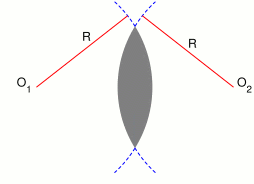
In 2-dimensional geometry, a lens is a convex region bounded by two circular arcs joined to each other at their endpoints. In order for this shape to be convex, both arcs must bow outwards (convex-convex). This shape can be formed as the intersection of two circular disks. It can also be formed as the union of two circular segments (regions betw...
crazy formula: area of circle - lens = area in problem
cunning lion
yes, any triangle
 rain jolt
thnx
timid fulcrum
has anyone came up with a geometric interpretation of say the derivative of surface area? I'm not talking about seeing things as rates of change
for a sphere that is
im just curious because since SA is V', then what does SA' mean?
and the reverse: what does ∫Vdr mean?
cunning lion
well $\odv Sr = 8\pi r$ which is four times the circumference of a great circle, i'm not aware of any further significance. a more natural connection is that the derivative of a circle's area with respect to the radius ends up being the circumference
somber coyoteBOT
cloud
 cunning lion
the integral of the volume with respect to radius would be some sort of 4-dimensional hypervolume quantity
timid fulcrum
yeah, just not the actual hypervolume. aka $\frac{1}{3}\pi r^4 \not = \frac{1}{2}\pi^2r^4$
idk if there's really any analog for this quantity
timid fulcrum
cunning lion
well $\odv Sr = 8\pi r$ which is four times the circumference of a great circle,...
wdym by great circle?
cunning lion
on the earth an example would be the equator
basically any circle which divides the sphere into two equal hemispheres
so it shares the same radius and center as the sphere itself
somber coyoteBOT
TooMuchofEverything
 cunning lion
well you wouldn't necessarily expect that integrating the volume of a sphere to give the hypervolume of a hypersphere, just like how integrating the area of a circle doesn't give the volume of a sphere
timid fulcrum
yeah
 balmy furnace
hey...im new to discord ...wont mind having friends here 🙂
 slender bronze
Do you guys think i'm good ?

 upper echo
grand path
Does anybody have a way to start on this problem?
upper echo
grand path
Does anybody have a way to start on this problem?
One of the ways is to draw a line NK parallel to BC with K on AB.
empty yew
How to find the principal solution from 0 to pi for tan(x)+sec^2(x)=1 ?
ping me if anyone know how to find this.
summer cradle
empty yew
How to find the principal solution from 0 to pi for tan(x)+sec^2(x)=1 ?
use trigonometric identities
 spiral lodge
empty yew
How to find the principal solution from 0 to pi for tan(x)+sec^2(x)=1 ?
spiral lodge
empty yew
How to find the principal solution from 0 to pi for tan(x)+sec^2(x)=1 ?
I would suggest you use the relation tan²x + 1 = sec²x
empty yew
tan(x)(1+tan(x))=0 then x=0 and sin(x)+cos(x)=0 what to do here?
summer cradle
empty yew
tan(x)(1+tan(x))=0 then x=0 and sin(x)+cos(x)=0 what to do here?
for tan(x) = 0 there are more than 1 solutions
and also you don't need to convert to sin and cos for the 2nd
just simply 1+tan(x) = 0
so tan(x) = -1
empty yew
summer cradle
so tan(x) = -1
how to get that multiple x here?
summer cradle
empty yew
how to get that multiple x here?
if tan(a) = 1, then what is a?
empty yew
pi/4
summer cradle
yes
now cuz this is -1 instead of 1
and x ranges from 0 to pi
in which quadrant is tan negative?
empty yew
second and fourth
empty yew
tan(pi-pi/2)?
summer cradle
no
empty yew
summer cradle
right?
yes
empty yew
@summer cradle isn't tan(x)=0 at two x's?
x=o,pi
then x=0,pi,3pi/4
is this correct?
summer cradle
empty yew
<@985005820708278296> isn't tan(x)=0 at two x's?
yes that's what I am saying previously
summer cradle
summer cradle
for tan(x) = 0 there are more than 1 solutions
^
summer cradle
empty yew
is this correct?
yes
empty yew
ok thank you so much @summer cradle
@summer cradle do you know about conditional trig and determinants?
summer cradle
empty yew
<@985005820708278296> do you know about conditional trig and determinants?
determinants I think you mean in matrix?
and what's conditional trigonometry?
never heard of that term
maybe give an example
I may know it but only didn't knew the term
empty yew
A+B+C=pi and some equation to prove using this condition
summer cradle
empty yew
A+B+C=pi and some equation to prove using this condition
ohh yes I know
empty yew
I want to solve this
 summer cradle
empty yew
I want to solve this
summer cradle
empty yew
I want to solve this
I don't really remember the determinant formula for 3x3 matrix
empty yew
np
 patent juniper
empty yew
I want to solve this
patent juniper
empty yew
I want to solve this
Here is the formula

 empty yew
that's too tedious using formula I want to find the determinant using properties and conditional trig directly
obsidian harness
$\sin^2 B \cot C - \sin^2 C \cot B - \sin^2 A \cot C + \sin^2 C \cot A + \sin^2 A \cot B - \sin^2 B \cot A$
somber coyoteBOT
south
 obsidian harness
empty yew
I want to solve this
obsidian harness
empty yew
I want to solve this
https://www.doubtnut.com/qna/643224187
anyways found it
Doubtnut
If A+B+C = pi, prove that [[sin^2A,cotA,1],[sin^2B,cotB,1],[sin^2C,cotC,1]]=0
tedious no matter what you do
solid needle
empty yew
that's too tedious using formula I want to find the determinant using properties...

it turns out the coordinates here are real so they form a degenerate triangle, but there does exist a transformation to get from one to the other
hint: ||you need a reflection and a dilation||
(matrix is sideways but reorienting it is trivial)
this what you're looking for?
empty yew
I can't understand what you're trying to say.
solid needle
empty yew
I can't understand what you're trying to say.
did you want a solution for this problem without manually computing the determinant?
or is your confusion about how to apply this idea
am i misunderstanding you?
 vapid gust
according to skibidi of the tangent, the sin of 40 degrees is hawk tuah gyatt
timid fulcrum
https://www.desmos.com/calculator/3r1lfj2g9c
I got sucked into the volume formula for n-spheres. Knowing that the SA of a sphere is V' and the C of a circle is A', I wondered if there's a pattern. Since the SA of a 3-sphere is 4 circles, I wondered what's the pattern for all other n-spheres of that nature.
 timid fulcrum
vapid gust
according to skibidi of the tangent, the sin of 40 degrees is hawk tuah gyatt
timid fulcrum
vapid gust
according to skibidi of the tangent, the sin of 40 degrees is hawk tuah gyatt
gyatt(pi/2) = 1/sqrt(skibidi)

 summer cradle
 glacial ember
chat this triangle is impossible right
glacial ember
chat this triangle is impossible right
impossible for the 5,5,10
cunning lion
not strictly impossible but it would be a degenerate triangle (overlapping line segments)
 fallow prism
is gpt wrong here?

the number atthe end of the sinus equation or function i dont know im not english is +1 (vertical movement) so from what ive learned in the last 4 hours shouldnt the line start from 1 rather than 0?
pls someone help me its 4am i wanna learn this and go sleep 🙏
@cunning lion do you know?
cunning lion
if you want to plot a function and get an accurate plot i would recommend desmos
chatgpt doesn't inherently "know" what a function looks like so it just plotted y = 2sin(x) because it has the more classic "sine shape"
fallow prism
cunning lion
if you want to plot a function and get an accurate plot i would recommend desmos
used this and apparently it starts in -1?

i haveno clue how this happens becuase apparently the +1 at the end i think that would mean it starts from 1 not 0 or -1
cunning lion
if you plug in x = 0 you get 2sin(0 - pi/2) + 1 = 2*sin(pi/2) + 1 = 2(-1) + 1 = -2 + 1 = -1
cunning lion
the +1 determines the midpoint line that the sin oscillates around
so the midpoint line is y = 1 in this case
fallow prism
whast the midpoint line im sorry i learned math terms in croatian
oh the average
OHHHHHHHHHHHHHHHHH
I GET IT
I LOVE U @cunning lion
❤️
so it does start in Y=1 but just x is moved 1 to the right im so stupid
 errant hedge
hey does anyone know how you can get angles BAD and CAO are equal right off the bat for this problem?
 dark sparrow
errant hedge
hey does anyone know how you can get angles BAD and CAO are equal right off the ...
dark sparrow
errant hedge
hey does anyone know how you can get angles BAD and CAO are equal right off the ...
got a diagram?
 nocturne wren
empty yew
I want to solve this
nocturne wren
empty yew
I want to solve this
it's so easy
empty yew
solid needle
did you want a solution for this problem without manually computing the determin...
yes!
empty yew
solid needle
or is your confusion about how to apply this idea
tell that too
solid needle
solid needle
https://media.discordapp.net/attachments/1063577283811610695/1120045110537764955...
do you know how to plot complex numbers on the complex plane?
empty yew
yes
solid needle
ok then so
i posted an answer already and all you said was "i dont get it"
can you be more specific about what you dont get
empty yew
solid needle
https://media.discordapp.net/attachments/1063577283811610695/1120045110537764955...
I can understand this
solid needle
ok....?
empty yew
I didn't understand the sentence you said there
solid needle
this is really tiring, i dont know which sentence youre referring to, please be more specific
 hexed sand
i'm not sure if this is the right place to ask but why are trig functions the way they are? i understand that sin(x)=o/h etc. but i don't understand why they are defined like that
obsidian harness
hexed sand
i'm not sure if this is the right place to ask but why are trig functions the wa...
didn't you ask the exact same question before?
hexed sand
this is my first message on this server
dark sparrow
are you asking where their names come from?
or are you asking why we care about side ratios at all in the first place
obsidian harness
dark sparrow
or are you asking why we care about side ratios at all in the first place
deja vu
hexed sand
i guess what i'm asking is what actually is sin cos tan and where did they come from??? (i'm not that experienced in maths so i only know sohcahtoa and a bit of sin rule and cos rule)
sorry if im not being specific, idk exactly how to articulate what im asking
dark sparrow
A) "Why are sine, cosine and tangent named this way? Who came up with those words?"
B) "So... why do these functions matter exactly? Why would we care about the ratio of some sides in a right triangle?"
is your quandary more like A or more like B
hexed sand
mostly A, a bit of B???
dark sparrow
ok right
hexed sand
sorry i realise im being not very specific
dark sparrow
no actually i have just the thing.

essentially, sine is kind of the result of a centuries-long game of broken telephone involving Sanskrit, Arabic and Latin
but at its roots the idea is that of a right triangle inscribed into a circle, and mirrored across one of its legs, so that the doubled opposite leg and the circle arc kind of form something that looks like a bow
the co in cosine stands for complement, in the sense of 90° - x
(so like, the identity cos(x) = sin(90°-x) is kind of what gives cosine its name)
hexed sand
fair fair
dark sparrow
tangent is more directly from the latin word for "touching" (in fact we still use this word for a straight line that touches a circle)
it and secant are best understood in the context of the unit circle
hexed sand
thank you very much!
dark sparrow

like this
secant means "cutting", and etymologically is related to words like section
 manic ridge
if have the adjacent how do i find the opposite it is adjacent x tan (angle) or adjacent / tan (angle) or smth else
cuz i lowkey kinda forgot
nvm got it
 river viper
what would this triangle look like
Given triangle ABC, we find the median AM and the distances BD and CE of the vertices B,C from AM to be
i mean where would you place points D and E?
 lime dune
extend AM and drop perpendiculars from B and C
their intersections with AM are D and E
when we say “distance from a point to a line” we mean the perpendicular distance
 tepid otter
Can someone explain to me how to solve trigonometry i mean how to use the formulas of trigonometry