#geometry-and-trigonometry
1 messages · Page 88 of 1
 rapid valley
 kind bronze
3.37 is correct but it is only the value for the left half of the isosceles triangle
You need to multiply it by 2 if you want to get x
 mellow merlin
finding tan in quadrant 3 is confusing, i tried finding tan(2/5) but i was actually supposed to find tan(5/2)

like that what ppl probably intuitively do since tan(2/5) is next to the origin
well me atleast
maybe im supposed to find the purple triangle instead of the yellow one?

purple one makes sense
thats where i probably went wrong
 haughty dragon
i mean i always think of tan y/x
since in q3 both are negative
becomes positive
if you think of it the angle of q3 is the same as the tan + pi
same as q1 angle
rotated 180 degrees
 carmine swift
Anyone here to help on proofs 😭
 tulip pulsar
What kind of proofs


 neat wigeon
carmine swift
neat wigeon
carmine swift
the amount of lines means that the angle or side is congruent to another angle or side that has the same amount of lines
so angles D and N are congruent cuz they both have 2 lines
angles C and O are congruent cuz they both have 1 line
line segment BD and PN are congruent cuz they both have 1 line (and obviously a line segment can't be equal to an angle so line segment BD isn't congruent to angle O, etc)
so we have 2 congruent angles and 1 congruent side so the triangles are congruent, proven by angle-angle-side (AAS)
neat wigeon
 median plaza
someone help me please
median plaza
someone help me please
it says the triangle is equilateral, which means all it's angle is 60°,
but the line segment with 11 splits the triangle in half, so now there's 2 triangles with 30-60-90 degree angles
the side opposite to the 30° angle, in this case x, is half of the hypotenuse (but we don't know the hypotenuse so it doesn't matter)
while the side opposite to 60° angle is x multiplied by sqrt(3)
so 11 = x•sqrt(3)
so in order to find x we just divide sqrt(3) on both sides
so x = 11/sqrt(3)
but it asks us to put the denominator as rational
so we just multiply sqrt(3) on the denomination and numerator
(11•sqrt(3))/sqrt(3)^2 = (11 • sqrt(3))/3
so (11 • sqrt(3))/3 is the final answer
median plaza
neat wigeon
it says the triangle is equilateral, which means all it's angle is 60°,
but the ...
this?
 neat wigeon
yes
median plaza
yessssssssssss

 neat wigeon
AC ≈ OM
CB ≈ MN
BA ≈ NO
side-side-side (SSS) congruence theorem
carmine swift
omg ur such a life saver 😭
Now these two ixls i need to do
And got to get them at a 80% :/
and they are hard too
Well 1 of them is cause i wasnt here for it
The other 1 I forgot how to do
carmine swift
yes
 royal charm
Hi! I need help with trigonometry

 spiral lodge
royal charm
Hi! I need help with trigonometry
spiral lodge
royal charm
Hi! I need help with trigonometry
!status
 lime crownBOT
royal charm
Hi! I need help with trigonometry
lime crownBOT
royal charm
Hi! I need help with trigonometry
What step are you on?
1. I don't know where to begin.
2. I have begun but got stuck midway.
3. I got an answer but I was told that it's wrong.
4. I got an answer and would like my work checked.
5. I have a question about someone else's work/solution.
6. I have completed the problem and don't need help anymore. Thank you.
7. None of the above
;cos(45)
 tame barn
...
 obsidian harness
royal charm
Hi! I need help with trigonometry
obsidian harness
royal charm
Hi! I need help with trigonometry
what's the third angle? (angle C)
great, now use the sine rule with sin(C)/15 = sin( ) / ( ) ....
the sine rule can find both side lengths
obsidian harness
mellow merlin
;cos(45)
how is that relevant lol
obsidian harness
obsidian harness
what's the third angle? (angle C)
great, now use the sine rule with sin(C)/15 =...
the key is you need an angle and the side opposite to it
there are 3 such angle-side pairs in a triangle
 vivid silo
The third angle should be 65°
We can find the measure of side BC by using the value of cos60
obsidian harness
vivid silo
We can find the measure of side BC by using the value of cos60
you mean AC
also it's the sine rule........
you don't have all three sides, or two sides and the angle in between
so it's not the cosine rule
vivid silo
Yes
obsidian harness
I just had to correct all of that, nothing personal against you btw
vivid silo
Ayoo no worries
obsidian harness
ah I mean I see now
instead of doing sine rule twice you could do sine then cosine
I feel applying sine rule twice is easier though
vivid silo
 woeful moon
use cosine for 60
woeful moon
use cosine for 60
Thanks for making everyone understand
woeful moon
vivid silo
Thanks for making everyone understand
ur welcome
woeful moon
obsidian harness
I feel applying sine rule twice is easier though
yeah it can be
vivid silo
woeful moon
ur welcome
Which grade btw?
 split river
How does one find x
 lime crownBOT
split river
How does one find x
lime crownBOT
split river
How does one find x
What step are you on?
1. I don't know where to begin.
2. I have begun but got stuck midway.
3. I got an answer but I was told that it's wrong.
4. I got an answer and would like my work checked.
5. I have a question about someone else's work/solution.
6. I have completed the problem and don't need help anymore. Thank you.
7. None of the above
Why hello bot, I don't know where to begin
 exotic yarrow
What are some properties about rectangles that you know of?
split river
exotic yarrow
What are some properties about rectangles that you know of?
Hmm....
Well all four angles are 90 degrees and they have parallel sides
exotic yarrow
Anything else?
split river
Nope
exotic yarrow
Alright then you may just not have the content required
You need to know that opposite sides are equal
the diagonals are equal to each other
And that the diagonals bisect each other
See where you can get with that
As a check, the sum of the digits of x^2 is ||18||
split river
Hmm
neat wigeon
split river
How does one find x
every rectangle has congruent diagonals
if u don't know what a diagonal is, it's the sides inside the triangle that go through the opposite angles, line CA and BD
the 2 diagonals meet each other in the middle, which makes 4 sides inside the triangle, each of all these sides are also congruent
all u need to do now is to pay attention to the angles
look at the 60° angle at the top of the center, with this one angle u can figure out all the angle measures
the angle at the bottom of the center is also 60° cuz it's a vertical angle
which means the angles to the right and left are 120°
then all u have to do is pay attention to special triangle rules (30-60-90 and 60-60-60/equilateral)
 fickle thorn
split river
How does one find x
fickle thorn
split river
How does one find x
ABCD is a rectangle => A = 90 degress, B = 90 degrees, C = 90 degrees, D = 90 degrees
Name the center O
BOA has all of its side equal, meaning all of its sides are 15 (because all of the corners of a equal-side triangle are 60 degrees)
COD has all of its sides equal to 15 for the same reason
CO + OA = CA
15 + 15 = CA
CA = 30
And then use pythagoreum theorum on the CAD right triangle to find x
also if u wanna prove that BOA has all its sides equal
The diagonals of a rectangle are cut equally in half at the center(BO = OD) (CO = OA) but only in a rectangle or a square the diagonals are the same (CA = BD) => (BO = OD = CO =OA)
fickle thorn
exotic yarrow
You need to know that opposite sides are equal
since its a rectangle that is proven by the "theoreums" of parallelogramms
basically they state that the parallel sides are equal
and the diagonals are cut in half in the center (bo = od) (co = oa)
and since its a rectangle the diagonals are equal
sorry for my poor english...
 neat wigeon
vivid silo
neat wigeon
vivid silo
angle abd is 60° cuz triangle BAO (O is center) is an equilateral
also diagonals BD and CA are 30 cm, not x
vivid silo
But we can use the value of sine to find out 'x'
neat wigeon
vivid silo
But we can use the value of sine to find out 'x'
not necessarily, we can just use 30-60-90 triangle rules(which i guess is just very simple trigonometry)
the answer for x should be || 15 • sqrt(3) either way ||
vivid silo
vivid silo
But we can use the value of sine to find out 'x'
Just an alternative method
 dense carbon
split river
How does one find x
dense carbon
split river
How does one find x
That’s an equilateral triangle so you if I label the point in the center as y, then AY, BY, CY, and DY are all 15. Multiply 60 by two and subtract from 360 means mDYA and mCYB is 120. Bisect that to turn it into 4 right triangles on both sides.
The right triangle has the internal degrees of 30 60 90, which makes a special ratio to not need trigonometry to solve.
AY is equal to 15, so the hypotenuse of all the triangles is 15. Divide by 2 to get the base of 7.5, then multiply by the square root of 3 to get the adjacent side to be 14 times the square root of 3 over 2. Multiply by two to get the whole side length as 14 times the square root of 3
Sorry I did a typo
It’s 15 not 14
Fun little problem
I miss when math was simpler


 gritty topaz
and this
gritty topaz
gritty topaz
and this
by this, we can know this is true for every rectangle
 dense carbon
Kewl
 sharp marsh
Okay so i got a question, im just curious about. I was doing chemistry and saw this shape and I was wondering if there was an alternative shape where all 5 "vectors" would be an equal angle between them all

bc like the tetrahedral has 120degrees between all of them and the octahedral has 90degrees
my hypothetical OCD doesnt like that some are 90 and some are 120 lol
I think the problem would be the dimesnsions... like in 2d, itd be possible, and in 5d, i think itd be possible, maybe... am i trippin?
 boreal tundra
honestly a great question
sharp marsh
but is there a great answer 🥲
boreal tundra
sharp marsh
but is there a great answer 🥲
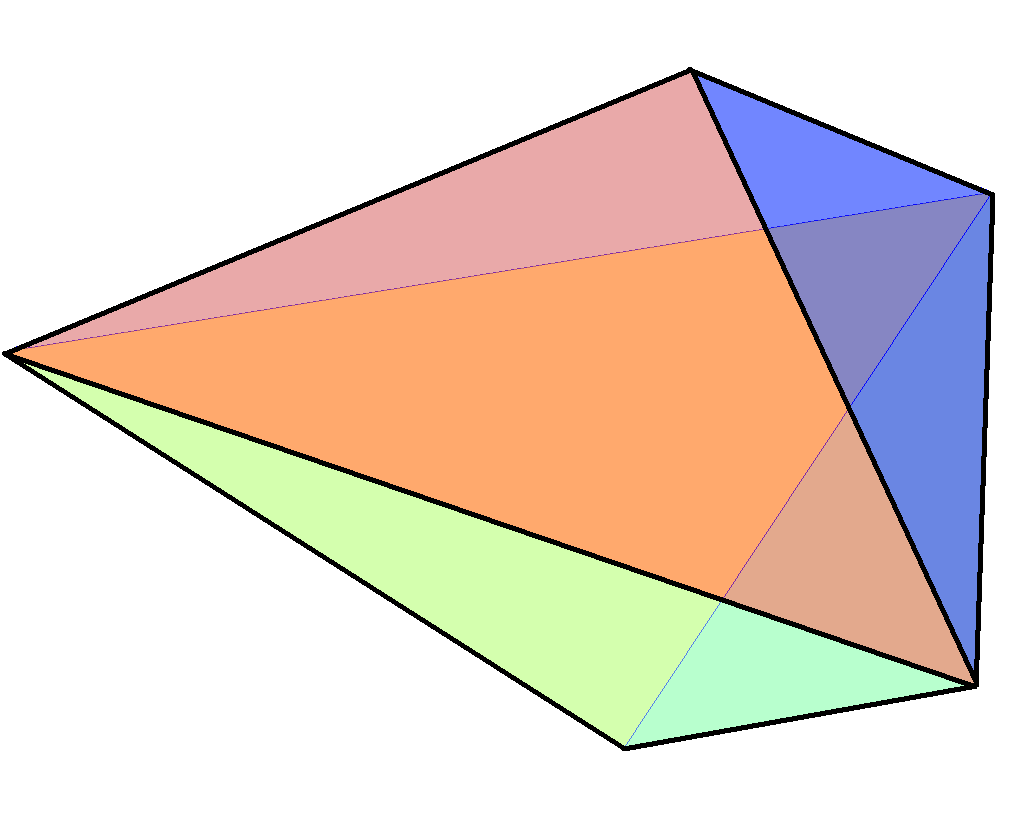
A triangular bipyramid is a hexahedron with six triangular faces constructed by attaching two tetrahedra face-to-face. The same shape is also known as a triangular dipyramid or trigonal bipyramid. If these tetrahedra are regular, all faces of a triangular bipyramid are equilateral. It is an example of a deltahedron, composite polyhedron, and Joh...
not sure
sharp marsh
huh
sharp marsh
thats better than im doin, i was using a white board
boreal tundra
So just trying to think about it, this shape would need to be two "trigonal planar" shapes orthogonal to each other. So all angles are 120 degrees. Since the "trigonal planar" shape is symmetrical we just pick any one hydrogen then add another trigonal planar essentially on top of it, but orthogonal to the existing one.
Or another way, we just take the existing trigonal bipyramidal then try to expand the 90 degrees to 120. As we increase the angle of the top hydrogen with regard to the left hydrogen, this must decrease the angle with regard to the front hydrogen, as the front hydrogen is not orthogonal to the top-left hydrogens. Due to symmetry this also applies if we do it to any other combination of hydrogens. Since any increase in the angles in one place decreases the angles elsewhere, we cannot change it into a shape with all equal angles.
Not quite a full proof
sharp marsh
I seee..... kinda 🥸
what if you made like... 5 equal pyramids connected to a center point?
i think thats how itd work
boreal tundra
I mean isn't that just exactly what this is already
boreal tundra
Another thing I'm thinking is that you can essentially draw tetrahedrons around the center atom and 3 vertices. Then it's a matter of showing you cannot create 6 equal tetrahedrons around this central atom.
sharp marsh
my intial thought, was taking a more of a "physics" approach, and solving for theta
just have to have the magnitudes of the vectors equal
boreal tundra
oh yeah that could work
boreal tundra
suppose 5 vectors where the dot product is equal between all pairs of vectors
sharp marsh
hmmm wouldnt you be solving for a WHOLE lot of variables?
bc its the i j and k of each
so 15 unknowns
well i guess you would be solving for their relation to each other, rather than their value
boreal tundra
I just asked ChatGPT and it said it's impossible
boreal tundra
it involves linear algebra which I need to take a moment to understand
sharp marsh
mannnn im a freshman in college
we havnt done that yet
ive taken phys I and im taking statics and MATLAB
and thats all my relevent knowledge
boreal tundra
it's just talking about the gram matrix and saying that you cannot have more than 3 linearly independent vectors in R3
but this cannot be right since in an octahedron this works fine
hmmm, but this formulation that I tried doesn't work though
because it's not quite that every pair of dot products has to be the same
opposite atoms don't need to have a 90 degree angle, because there's an atom in the middle between them that's at 90 degrees
 trail tendon
boreal tundra
but this cannot be right since in an octahedron this works fine
trail tendon
boreal tundra
but this cannot be right since in an octahedron this works fine
stemming from a single point? thats four...
right?
does that count tho
it doesn't work for an octahedron because the vectors "opposite" each other make a greater angle than the "adjacent" ones
sharp marsh
another way of interpreting it is to have 6 dots. 1 dot in the center and the other 5 have a radius away from the center and nearby dots. so all dots have to be a r radius away
i think thatd also work... maybe
i just cant do the math for any of this 😔
trail tendon
sharp marsh
another way of interpreting it is to have 6 dots. 1 dot in the center and the ot...
those dots could be anywhere on the sphere, that doesn't tell you anything about the angle
unless those dots represent vectors at the origin that all have dot product 0 with each other 
or at least the same dot product
they dont hvae to be perpendicular
sharp marsh
have you used a compass before? if you make two points, and draw two circles, there is only two points where a third dot can go (so that they are evenly spaced)
so i think itd be the same concept but with spheres
and where they intersect, you put dots
maybe?
when you draw two spheres, their intersection is a circle
maybe lol dunno
the sphere thing makes the trigonal bipyramid
vivid silo
This is all very intresting but a bit confusing can you guys please tell me about this in an easy way I'm a 10th grader though
sharp marsh
whats your highest level of math education?
sharp marsh
i think the general gist is like... dividing a circle into equal slices
but with a sphere
vivid silo
sharp marsh
whats your highest level of math education?
I'm a 10th grader still completing my school
sharp marsh
i think bro wants to talk to everyon
neat wigeon
huh
 cunning lion
<@&268886789983436800> spam
 silent plank
my 👀
woeful moon
vivid silo
Which grade btw?
grade 9
split river
neat wigeon
every rectangle has congruent diagonals
if u don't know what a diagonal is, it's...
I understand the angle part, but what are the special triangle rules? 30-60-90 and 60-60-60? So does that mean the triangle at the bottom is an equilateral?
AFAIK that basically means all sides are also equal then
obsidian harness
split river
I understand the angle part, but what are the special triangle rules? 30-60-90 a...
Yes you can break any equilateral triangle into two congruent right triangles
60-60-60 into two 30-60-90s
obsidian harness
split river
I understand the angle part, but what are the special triangle rules? 30-60-90 a...
That's correct, you find the base angle is 90 - 30 = 60 and hence all sides are equal
split river
obsidian harness
That's correct, you find the base angle is 90 - 30 = 60 and hence all sides are ...
South
What if instead of 60º, it's 50º?
obsidian harness
split river
What if instead of 60º, it's 50º?
Would be harder
It's still right angled trig if you break any isosceles triangle into two tho
obsidian harness
 deep wadi
podeis xplicarme las ecuaciones trighonometricas
deep wadi
podeis xplicarme las ecuaciones trighonometricas
si tienes un ejercicio puedes subirlo aquí
si no, hay tantos videos que las explican en YouTube
deep wadi
no es un ejercicio es si alguien puede darme ejercicos y yo los hago pero lo que no entiendo es cuando hay dobles soluciones o cuadruples como las pongo
obsidian harness
deep wadi
no es un ejercicio es si alguien puede darme ejercicos y yo los hago pero lo que...
sin x = 1 por 0 <= x <= 360, por ejemplo
la única solución será x = 90
deep wadi
vale y estos ejercicoos sen(2x+45)= 0,5 por ejemplo
obsidian harness
ah, un momento
deep wadi
que haya una ecuacion en el seno o coseno
obsidian harness
básicamente debes recordar que sin(30) = 0,5, además sin(150) = 0,5
deep wadi
si eso si pero es hacerla
obsidian harness
los dos están relacionados por 30 + 150 = 180
2x + 45 = 30, 2x + 45 = 150
la próxima sería 2x + 45 = 30 + 360
deep wadi
vale osea tengo que poner la sol q sea igual en dos cuadrantes
claro 360k por el n vueltas
obsidian harness
ah sí, la solución general es 2x + 45 = 30 + 360k, o 2x + 45 = 150 + 360k
deep wadi
voy a hacerlas mejor ç
obsidian harness
sen(x) = sen(180 - x)
la identidad correspondiente por cos es cos(x) = cos(-x) = cos(-x + 360)
y por tan, solo tienes una solución cada 180 grados
las equaciones con tan son más sencillas
obsidian harness
deep wadi
voy a hacerlas mejor ç
espero que mejores, qué tengas un buen día
split river
Hey guys
obsidian harness
split river
Hey guys
hey
split river
obsidian harness
hey
I sketched the position of the terminal side in a unit circle when theta = 50º and phi =130º
obsidian harness
btw my native language is English!
I really got a good work out trying to talk to this guy in Spanish
split river
And they seem to have the same sine value
obsidian harness
split river
And they seem to have the same sine value
omg we were literally talking about that
split river
And the cosine is the same but negative
obsidian harness
 split river
obsidian harness
omg we were literally talking about that
split river
obsidian harness
omg we were literally talking about that
Dang
obsidian harness
split river
And the cosine is the same but negative
have you seen the unit circle before?
split river
obsidian harness
have you seen the unit circle before?
Yes
obsidian harness
great, so you should be familiar with the concept
that cos theta = x-coord
sin theta = y-coord
split river
obsidian harness
great, so you should be familiar with the concept
But my teacher did an ass job at explaining it
split river
obsidian harness
that cos theta = x-coord
sin theta = y-coord
Well I know that, but I had to figure out why myself
obsidian harness
split river
Well I know that, but I had to figure out why myself
it's a definition; don't overthink it basically
it's how we extend cos and sin to all 4 quadrants
obsidian harness
obsidian harness
then I think this diagram should explain itself
if you think about it for long enough
split river
obsidian harness
then I think this diagram should explain itself
Ok let me se
obsidian harness
the important thing is that left of x = 0 means negative
yes the purple lines have the same length, but one is negative and the other is positive
for the cos identity
split river
So, simply put, they have the same y, but since the other triangle is in quadrant 2 and the cosine is negative?
 graceful talon
exactly
split river
Interesting...
graceful talon
they mirror along the y-axis
split river
But how do I put into words that sin(130)=sin(50)
obsidian harness
split river
So, simply put, they have the same y, but since the other triangle is in quadran...
they have the same height, so they must have the same y-coordinate
by the unit circle, the sines of both angles (alpha, pi - alpha) must be the same
graceful talon
does he know radians?
split river
graceful talon
does he know radians?
No, no I do not
My teacher did not teach that
Nor did she give any resource to learn that
graceful talon
it's just another units for angle nothing complicated
π radians is 180° in degree units
graceful talon
split river
No, no I do not
there's a reference in the pins, 2nd pin
split river
This one?
graceful talon
yeah
split river
Well it doesn't matter anymore
obsidian harness
please don't memorise all of that
split river
I have only 2 hours left of studying time and tomorrow is summative
Good luck to me ig
obsidian harness
just keep drawing triangles on the unit circle so you can relate any angle back to the 1st quadrant
obsidian harness
obsidian harness
if you flip these 2 triangles down
you get triangles in all 4 quadrants
obsidian harness
split river
Good luck to me ig
good luck!
obsidian harness
split river
Now I have to explain why sine theta is = to cos(90-theta)

another identity, another picture
split river
obsidian harness
I'm officially cooked

 somber coyoteBOT
 obsidian harness
obsidian harness
obsidian harness
yeah the point is the sides reflected across the line y = x are equal
y = x is the line of symmetry through the 1st quadrant
graceful talon
somber coyote
i made a mistake: right side should be sin theta = cos a, not sin a
but it should be the same as the left side
graceful talon
i think it's pretty intuitive
split river
graceful talon
i think it's pretty intuitive
Yh but I'm not a math guy
graceful talon
like i think it's all visual
graceful talon
split river
Now I have to explain why sine theta is = to cos(90-theta)
maybe u could rephrase this as: why the y-side of the triangle of a given angle is equal to the x-side of the triangle of its complementary angle
it's because the angle's x and y sides are switched for the complementary angle
split river
graceful talon
maybe u could rephrase this as: why the y-side of the triangle of a given angle ...
Does me changing the equal sign in the bracket change anything
Typo'd it
graceful talon
i think we knew it was a typo
split river
graceful talon
you can pass it
...
graceful talon
so it was assumed to be a minus sign
graceful talon
bc it just doesn't make sense to have an equal sign there lol
split river
Every single online source uses radians and surds
graceful talon
split river
Every single online source uses radians and surds
just reimagine π as 180° and it won't be hard
ok
graceful talon
most of the time the triangles used in problems are 30-60-90 and 45-45-90 triangles anyway
graceful talon
yeah. i mean it's not the end. after it, you can see where you missed
mellow merlin
why is when x = 0, y = -1/2?


wait nvm i think i know
cos0 = 1
i thought it equals 0
 undone vigil
Hi guys, does anybody have resources for basic trigonometry please?
silent plank
khan academy
vivid silo
undone vigil
Hi guys, does anybody have resources for basic trigonometry please?
You can also go for pw's lecture on trigonometry by ritik sir
 upper karma
That would only be useful if she's from India since the lectures are in Hindi.
 timber trout
2023: SOH CAH TOA
2024: SOH CAH TUAH
 solar python
mellow merlin
i thought it equals 0
solar python
mellow merlin
i thought it equals 0
that's sin
For any integer n:
cos(2n*pi) = 1
cos((2n+1)*pi) = -1
cos((n+1/2)*pi) = 0
sin(n*pi) = 0
sin((2n+1/2)*pi) = -1
sin((2n+3/2)*pi = 1
And for any x in R: sin(x) = cos(x+1/2*pi)
upper karma
what is the formula to find the measure of each interior angle of a regular polygon
 left plover
Is khan academies geometry and trig course good?
vivid silo
upper karma
That would only be useful if she's from India since the lectures are in Hindi.
Ah yeah I forgot UwU
upper karma
left plover
Is khan academies geometry and trig course good?
Yes.
left plover
upper karma
Yes.
Thanks I’m trying to refresh my knowledge before I take ap precalc
upper karma
Nice! Gotta keep those basics up. 
 viscid lance
(Context: D&D and other such tabletop tile-maps consisting of squares that are 5 feet in length)
How would I determine the total size of a square that consists of 3000 5-foot squares?
Supposedly, the new D&D 5e Tarrasque can be killed by 3 thousand commoners in a single round of combat. So I wanna know how far away the furthest commoner is from the tarrasque in the center (to see if it's even possible for 3000 people to make an attack every round with regular weapon ranges)
It's been a long time since I did basic geometry so the solution seems like it's fairly simple, but I can't easily think of one.
Margin of error here is pretty generous, this is napkin math.
Not when the difference between a longbow's short range is 150 feet and its long range is 300 feet.
I think maybe the solution looks something like this?
- 3000 people, 5 ft length per person, so side-length is 15,000 ft
- sqrt(15000) = 122.47 ft
So it doesn't fill a perfect square, there'd be empty spaces, which is fine.
 dark sparrow
uhh no
if you wanna arrange 3k people into a square and look at how big it is you would be interested in AREA not length
so 25 ft^2 per person, 75000 ft^2 for the whole horde if you wanna think of it that way
but also you can just work directly in tiles and find the approximate number of tiles on each side of the square as sqrt(3000)
,calc sqrt(3000)
somber coyoteBOT
Result:
54.772255750517
so they would all fit into a square 55 tiles wide
surrounding the bad guy in the center means the people at the edges are 28 tiles out, which seems well in range for your ranged weapons
viscid lance
dark sparrow
if you wanna arrange 3k people into a square and look at how big it is you would...
I understand that I was wrong, but I'll at least explain how I came to the wrong answer: I was thinking that if it were just a 5-foot-wide line like for a tile map, it'd be the area of 1x(3000x5ft). Which is 15000. So what's the square whose area is 15000.
viscid lance
If I had started out properly with base formulae, I could have worked it out better instead of the number of shortcuts I made which introduced error.


 dark sparrow
viscid lance
I understand that I was wrong, but I'll at least explain how I came to the wrong...
dark sparrow
viscid lance
I understand that I was wrong, but I'll at least explain how I came to the wrong...
wait
so im confused
mellow merlin
mellow merlin
sin(2(x-1.5π)) is kinda weird, i need an explaination on why it works
also if i have something like sin(3x + 15π) do i do sin(3(x+5π))? does that mean it shifts it -5 units? why tho and why does it work
dark sparrow
do you want your 3k people to go single file or do you want them in a square shaped crowd
viscid lance
dark sparrow
do you want your 3k people to go *single file* or do you want them in a *square*...
A square shaped crowd. I'm just explaining that when I was thinking of the area of the line, I wasn't converting it into a proper dimension of 5-by-5 squares. Basically only one term of the LxW area (1x3000) line was multiplied by 5.
dark sparrow
oh you were explaining where you went wrong w your thought process ok
viscid lance
Yeah yeah
graceful talon
mellow merlin
sin(2(x-1.5π)) is kinda weird, i need an explaination on why it works
you could do it to any kind of graph
- addition to x: translation to left
- subtraction to x: translation to right
and same with y. addition moves it downward and subtraction moves it upward
then for scaling, same thing. Same analogy
multiplying contracts it or zooms out, dividing zooms in
graceful talon
mellow merlin
also if i have something like sin(3x + 15π) do i do sin(3(x+5π))? does that mean...
-5π units
 sturdy sand
how would i go about proving that BC^2 = CE *CA?

 ruby lichen
sturdy sand
how would i go about proving that BC^2 = CE *CA?
ruby lichen
sturdy sand
how would i go about proving that BC^2 = CE *CA?
Tangent secant theorem.
ruby lichen
ruby lichen
https://proofwiki.org/wiki/Tangent_Secant_Theorem
Read this for more information.
sturdy sand
you are a life saver thank you
ruby lichen
Welcome.
graceful talon
BC²=CA²-AB²
BC²=CA(CA-AB²/CA)
then CE must be equal to CA-AB²/CA or (CA²-AB²)/CA
obsidian harness
sturdy sand
how would i go about proving that BC^2 = CE *CA?
triangles ABE and BCE are similar
sturdy sand
obsidian harness
triangles ABE and BCE are similar
can you explain?
 graceful talon
side view, front view, top view, …
trail tendon
ugly
graceful talon
needs more shading (?)
sturdy sand
sturdy sand
can you explain?
nvm i got a vision that proved it
 worn stag
 late shoal
How do I solve this?
late shoal
How do I solve this?
Heron's hyperpigmentation formula?

 harsh ginkgo
does anyone know the point of Simplified Radical form
the book i'm using is asking me to put it into simplified radical form, and i've done it before but i don't really understand it fully
a problem for example would to use the Pythagorean Theorem to find the hypotenuse (ok, not hard at all) but then it says "Leave answers in simplified radical form"
obsidian harness
harsh ginkgo
a problem for example would to use the Pythagorean Theorem to find the hypotenus...
ah, it's based on prime factorisation
harsh ginkgo
why not just leave it in decimal form!?
obsidian harness
harsh ginkgo
why not just leave it in decimal form!?
exact form is nicer and easier to recognise
somber coyoteBOT
south
 obsidian harness
somber coyote
**south**
obsidian harness
somber coyote
**south**
I mean the advantage of doing this is questionable
harsh ginkgo
but i would think that the average person wouldn't know what that means just by looking at it
obsidian harness
a simplest form is something that is inherently subjective
obsidian harness
harsh ginkgo
but i would think that the average person wouldn't know what that means just by ...
what are you referring to?
harsh ginkgo
i'd think that a number rounded to the nearest hundreth would be fine
obsidian harness
well given we have calculators everywhere it doesn't matter too much I guess
what the actual value in decimal is
harsh ginkgo
obsidian harness
what are you referring to?
i'd think that an average person wouldn't know what number radical number means
obsidian harness
harsh ginkgo
i'd think that an average person wouldn't know what number radical number means
that's just a "you haven't seen the half of maths" issue
harsh ginkgo
neither has the average person, right?
obsidian harness
harsh ginkgo
neither has the average person, right?
what do you gain by comparing yourself to the average person
harsh ginkgo
i don't know
obsidian harness
you're in school to learn and of course you'll forget most of it when you leave school
harsh ginkgo
i feel like maybe i'm treating this like a document and not like a math problem
obsidian harness
hmm
harsh ginkgo
like a paper you would do in english class or whatever
that people would be reading
obsidian harness
 azure helm
do you know how to find the inradius?
harsh ginkgo
what did i do to deserve the 😭
obsidian harness
azure helm
if so then simply use the fact that tangents to the circle must have equal length
you can find AF this way by adding all 3 equations, say (a + b = 5, b + c = 6, c + a = 7, and find a), then it's easy cause you have two congruent right-angled triangles
obsidian harness
harsh ginkgo
does anyone know the point of Simplified Radical form
I mean it's just a convention that everyone who uses mathematics uses
I don't think there's much point overthinking why we write answers in this form
harsh ginkgo
obsidian harness
I mean it's just a convention that everyone who uses mathematics uses
it confuses me
obsidian harness
harsh ginkgo
it confuses me
okay, what about it confuses you?
harsh ginkgo
i have trouble doing it because i'm used to doing something like 13.53
if 13.53 was the answer, i'd be ok with that
obsidian harness
harsh ginkgo
i have trouble doing it because i'm used to doing something like 13.53
might I suggest a video on this topic then
harsh ginkgo
finding simplified radical form instead feels like too much of a hassle
harsh ginkgo
obsidian harness
might I suggest a video on this topic then
get this
i do have one
but i can't find the one where the guy explains why simplified radical form exists
obsidian harness
harsh ginkgo
but i can't find the one where the guy explains why simplified radical form exis...
I guess it's useful when dealing with similar triangles
it's easier to see that 2 sqrt(7) and 6 sqrt(7) are related
than
,calc 2 sqrt(7)
somber coyoteBOT
Result:
5.2915026221292
Result:
15.874507866388
ohh so like if the decimal is different after the hundreth but the same before?
obsidian harness
I mean it's subjective, but in the heat of the moment you probably wouldn't think they are multiples of each other
obsidian harness
harsh ginkgo
ohh so like if the decimal is different after the hundreth but the same before?
that's something unrelated
azure helm
obsidian harness
do you know how to find the inradius?
how
I think there is a formula
obsidian harness
azure helm
I think there is a formula
indeed
if you can find the area of triangle ABC first
azure helm
obsidian harness
if you can find the area of triangle ABC first
maybe herons
obsidian harness
then consider the three triangles ABI, BIC, CIA
obsidian harness
azure helm
maybe herons
yep!
obsidian harness
obsidian harness
then consider the three triangles ABI, BIC, CIA
and the heights of all these triangles is the inradius
azure helm
can you help
obsidian harness
azure helm
can you help
how so
azure helm
Iam stuck
obsidian harness
on Heron's?
obsidian harness
the semiperimeter is just half the perimeter
azure helm
True
harsh ginkgo
how do i find the simplified radical form
am i supposed to use the largest number that can divide into the radical or does it not matter or what
obsidian harness
harsh ginkgo
am i supposed to use the largest number that can divide into the radical or does...
it doesn't matter if you keep simplifying the radical
harsh ginkgo
so then how do i do it?!
silent plank
you want to try identifying larger perfect square factor(s)
 hasty latch
 hasty latch
Okay
 lyric halo
Estimate the angle
graceful talon
don't get cooked, chicken
 loud rock
how do I find trig ratios using a coordinate?
 tired quartz
yo wtf is this

 opaque meteor
math
tired quartz
help me

 stray gulch
Fish.
 proven lantern
opaque meteor
proven lantern
opaque meteor
It's not that hard
Just google
@tired pine i needs ze help
Can u help me figure out why the values of the trig ratios are what they are.
Like the reasoning behind forumulas
dark sparrow
proven lantern
Can u help me figure out why the values of the trig ratios are what they are.
L...
you are kind of setting yourself up to get hit with the very same "it's not that hard, Google it" line that you just said yourself :P
which angles are you interested in tho?
vivid silo
opaque meteor
We can find the value of AB by using the sine ratio and then by using the pythagoras theorem we can find the length of BC
We can also find BC by using the cosine ratio
proven lantern
dark sparrow
you are kind of setting yourself up to get hit with the very same "it's not that...
Not really
He's missing a formula I'm missing an explanation
And I specifically asked a person as I trust their judgement
proven lantern
dark sparrow
which angles are you interested in tho?
Like the reasoning for values of the ratios
dark sparrow
ok but which angles?
proven lantern
Any
dark sparrow
even ones like cos(69°) which have very ugly exact forms?
proven lantern
Like why is sin 30° 1/2
proven lantern
dark sparrow
even ones like cos(69°) which have very ugly exact forms?
No
Standard ones
dark sparrow
so like what. 30, 45, 60 degrees?
proven lantern
Yeah
dark sparrow
that's why i asked. maybe you wanted something more exotic.
dark sparrow
you can get 45° by looking at a square with a diagonal drawn inside it, and 30° and 60° by looking at an equilateral triangle with one altitude drawn
dark sparrow
sin(45°) is not 1/2
proven lantern
Typo
dark sparrow
 dark sparrow
if something is not clear in the diagram you can ask me
proven lantern
dark sparrow
if something is not clear in the diagram you can ask me
Yeah, can you explain the 1st diagram
dark sparrow
i am looking at a square with side length 1
which of the measurements are not clear to you?
proven lantern
dark sparrow
which of the measurements are not clear to you?
Ok i get it, you have to know the exact value beforehand to draw this out right?
dark sparrow
wdym
proven lantern
Could you maybe show me how you calculate the exact values
dark sparrow
im just taking the side length of the square as 1
proven lantern
Like how are the values calculated
proven lantern
dark sparrow
are you asking why the diagonal is sqrt(2)?
Sure
But just values in general
dark sparrow
...
graceful talon
formula?
dark sparrow
from my perspective it appears as if you are flip-flopping between asking me about generality vs specifics
i cannot possibly tell you in full generality how to find any length or angle on any diagram
graceful talon
zooming in, zooming out
proven lantern
graceful talon
formula?
No I'm asking how you get the formula
dark sparrow
what formula
proven lantern
Well the values of the trig ratios
proven lantern
Yes
dark sparrow
for the definitions of trig functions as ratios of sides
yeah so
you use that
with the angle you want and the relevant sides
which you read from my diagrams
dark sparrow
sorry i am once again confused as to what you are asking
proven lantern
Like can you solve it
graceful talon
does he mean deriving the trig formulas from Pythagorean ?
dark sparrow
are you asking
"So how did that sqrt(2) happen?"
or
"So how do we get sin(45°)=1/sqrt(2) from this?"
dark sparrow
graceful talon
does he mean deriving the trig formulas from Pythagorean ?
she*
proven lantern
"you can get it via pyth"
graceful talon
sorry, the pfp
dark sparrow
ok so, do you know Pythagoras' theorem
graceful talon
sorry again. didn't see it well. it's a woman
proven lantern
dark sparrow
are you asking
"So how did that sqrt(2) happen?"
or
"So how do we get sin(45°)...
Both, but you can explain any you like.
I asked for the latter before
proven lantern
dark sparrow
ok so, do you know Pythagoras' theorem
Yes
proven lantern
graceful talon
does he mean deriving the trig formulas from Pythagorean ?
Yes
dark sparrow
proven lantern
Yes
ok right so
if you look at the right triangle that makes up the bottom right half of the square
its legs are 1 and 1
hyp^2 = 1^2+1^2
hyp^2 = 2
graceful talon
proven lantern
Yes
maybe you don't
proven lantern
Yes but, why are the sides 1 & 1
graceful talon
in many examples tho, they choose the hypotenuse to have the length 1. By doing so, the trig ratios become more simplified
proven lantern
So are the sides & adjacents always assumed to be 1
dark sparrow
proven lantern
So are the sides & adjacents always assumed to be 1
no not always
i do it that way because it makes things simpler
graceful talon
maybe just use variables lol
dark sparrow
it is a matter of convenience
proven lantern
Could you explain the 2nd diagram
dark sparrow
in the second diagram i start with an equilateral triangle whose sides are all equal to 2
graceful talon
well there are like 2 commonly used right triangles: the 30-60-90 and the 45-45-90 (those are angles)
dark sparrow
(i chose 2 again for convenience)
in an equilateral triangle all interior angles are 60° as marked in the bottom left
do you follow so far?
i am not done with the explanation but i want to make sure we are on the same page
proven lantern
dark sparrow
i am not done with the explanation but i want to make sure we are on the same pa...
Yeah, I'm curious is this the actual way the values are derived ?
If you chose a random number say, 57, would you still get similar results?
dark sparrow
you can start with 57 if you want yes
proven lantern
Wait what
dark sparrow
you would eventually end up seeing those 57s cancel out
proven lantern
Wait can u solve that
dark sparrow
it would create like twenty times more work than necessary
proven lantern
Umm, maybe a smaller number
dark sparrow
you want me to write down the same things for a triangle of side 57?
proven lantern
I'm not sure, i just want to see a random prime number be used in place of 2
dark sparrow
proven lantern
Yeah, I'm curious is this the actual way the values are derived ?
If you chose a...
i am not sure what you mean by "the actual way" also. do you think that every single math result has One And Only One Correct Derivation™️ and that all others are Just Wrong Before The Math Gods Say So™️?
dark sparrow
proven lantern
I'm not sure, i just want to see a random prime number be used in place of 2
57 isn't prime
proven lantern
Shiet
dark sparrow
do you specifically want a prime number just for the sake of signing me up for tons of extra work
proven lantern
dark sparrow
i am not sure what you mean by "the actual way" also. do you think that every si...
I don't know I'm just confused and want to know how the actual values came about
dark sparrow
yeah so i am telling you...
no matter how you go about it there's gonna be one point where you have to pin down one specific length in a diagram and you can do it arbitrarily
i am presenting to you the choice that i think is most convenient for me personally
proven lantern
dark sparrow
do you specifically want a prime number just for the sake of signing me up for t...
No LOL, it just seems weird for a prime number to give similar results in place of an even number.
dark sparrow
you are now trying to nitpick your way about it
graceful talon
we be always understand examples more
proven lantern
You can pick 7 idk
dark sparrow
proven lantern
No LOL, it just seems weird for a prime number to give similar results in place ...
look, swapping out the 2 for 7 will only have the effect of scaling the diagram up by some factor
the angles will not change
and the ratios won't change either
proven lantern
Yeah but
I just want to see how it's done
dark sparrow
ugh ok fine one moment
proven lantern
Thankssss
 proven lantern
dark sparrow
is this what you wanted to see?
proven lantern
dark sparrow
is this what you wanted to see?
I think so. What's the result change to now?
dark sparrow
what result?
proven lantern
dark sparrow
what result?
Like, the change of the values by replacing 2 for 7
dark sparrow
...
sorry, i really do not understand what you are asking
WHICH values?
i have put all lengths on the diagram.
you have to be more specific in what exactly you're asking me for
 light fable
in a 45-45-90 triangle, the legs are always equal because the two 45 degree angles are equal. It's a basic fact of isosceles triangles
proven lantern
dark sparrow
WHICH values?
Like the sin/cos/tan values, when you took it as 2 the values were identical to what's used but 7 alters that
spiral lodge
It doesn't alter the ratios
light fable
and in a 30-60-90 triangle, the hypotenuse is always twice as long as the short leg
proven lantern
I mean not technically but the result isn't the same now is ir
dark sparrow
proven lantern
Like the sin/cos/tan values, when you took it as 2 the values were identical to ...
no. sin(30°) = (7/2)/7 which still simplifies to 1/2.
light fable
7 ÷ 7/2 = 1/2
proven lantern
dark sparrow
no. sin(30°) = (7/2)/7 which still simplifies to 1/2.
Yeah that's what i was asking
dark sparrow
proven lantern
I mean not technically but the result isn't the same now is ir
no, the result still is the same. we just get there by a different, more circuitous route.
dark sparrow
proven lantern
Yeah that's what i was asking
ok so even just saying "the trig values" would have clued me in.
dark sparrow
light fable
7 ÷ 7/2 = 1/2
(7/2)÷7
proven lantern
I mean it's obviously a different number before simplification
light fable
oops  right, of course
dark sparrow
proven lantern
I mean it's obviously a different number before simplification
it looks different but it is the same number
proven lantern
Yeah i know
spiral lodge
Then why did you ask? 😅
light fable
I wonder if they were asking about like sin(57 deg)
dark sparrow
if you want to say that numbers which differ in form are different themselves, then you have to say that English "five", Spanish "cinco", Russian "pjat' ", Japanese "go" etc. all refer to different numbers
dark sparrow
light fable
I wonder if they were asking about like sin(57 deg)
no
light fable
yeah you're right
proven lantern
proven lantern
I mean it's obviously a different number before simplification
? What i asked was different, I obviously know it simplifies to the same thing but wanted to know what the non-simplified result was
Oops
@spiral lodge
Anyway, thanks y'all
spiral lodge
👍
 smoky halo
I'm wondering how is sin of 120 degrees equal to √3/2?
 wise pawn
I'd draw a picture
 mystic crest
Same
It’s according to the root3,1 and 2 right angle triangle, with 30 and 60 degrees
Sin60 = sin120 = root3/2
Cba to draw a diagram rn
 maiden brook
Something I thought of:
If A, B and C are three angles in a triangle, what is the maximum value of sin^2(A) + sin^2(B) + sin^2(C)?
light fable
I imagine it's when A = B = C = pi/3
maiden brook
light fable
I imagine it's when A = B = C = pi/3
Yeah but why
light fable
feels like a good guess. It's probably provable with something like Lagrange multipliers. I don't expect there's a very elementary proof
it feels like a good guess because we want to make all three angles as large as possible at the same time
and the form of the function is symmetric
so the triangle that does it is probably symmetric too
maiden brook
light fable
feels like a good guess. It's probably provable with something like Lagrange mul...
rlly?
for the last part
light fable
yeah, you're dealing with a smooth function of three variables, looking for a max
with a constraint of A + B + C - pi = 0
A,B,C all in (0,pi)
this is the kind of setup Lagrange multipliers are good for
uh did one of my sentences not go through somehow?
I was saying you're looking for a max of a smooth three variable function
opaque meteor
vivid silo
We can also find BC by using the cosine ratio
Thabks
 sacred nimbus
I need help with number 30 please
 mystic crest

 daring bronze

can someone help me out with this one please
last question i need to be done with the assignment
upper karma
sacred nimbus
I need help with number 30 please
It's fairly simple... Since you know de and cd ...using tan alpha' ... You can figure out alpha ... And then alpha = alpha'... So using tan alpha ' and AC is given ...so you can find the height of tree
mystic crest
daring bronze
can someone help me out with this one please
Use sin rule?
obsidian harness
mystic crest
Use sin rule?
that is possible but then you know, sin(90 deg) = 1
mystic crest
That’s very true, but also sin 50 from 180-(40+90)?
obsidian harness
mystic crest
That’s very true, but also sin 50 from 180-(40+90)?
yeah so you only needed to use right-angled trig
the other angle is 50 correct
mystic crest
🙏
 outer hazel
equation to find radius of red circle? (centre is intersection)
 outer hazel
equation to find radius of red circle? (centre is intersection)
outer hazel
outer hazel
equation to find radius of red circle? (centre is intersection)
only points are given no extra knowledge
 pastel berry
how do you find the equation for a circle given 3 points on the circle?
outer hazel
(x2 + y2)A + xB + yC + D = 0
 fading dove
outer hazel
equation to find radius of red circle? (centre is intersection)
fading dove
outer hazel
equation to find radius of red circle? (centre is intersection)
The given coordinates are the center of the 3 circles
Let the blue circle be s1, black one be s2, and the green one be s3
Circle red should be assumed s4
S2 might be useless in the question
S1 and s3 are having two common tangents
fading dove
outer hazel
(x2 + y2)A + xB + yC + D = 0
Isn't the equation of a general circle x^2 +y^2 + 2gx + 2fy + c = 0
outer hazel
Nice!
outer hazel
fading dove
Isn't the equation of a general circle x^2 +y^2 + 2gx + 2fy + c = 0
Tbh I just copied off google idk much yet
fading dove
outer hazel
Tbh I just copied off google idk much yet
Ohh
outer hazel
I’m in the middle of the circle topic rn
fading dove
Since it's two common tangents c1c3 = |r1-r3|
fading dove
outer hazel
I’m in the middle of the circle topic rn
Oh i see
outer hazel
Do you mind drawing this? I think I get it, cause the two tangents will meet at centre s4?
fading dove
outer hazel
Do you mind drawing this? I think I get it, cause the two tangents will meet at ...
Nope, the two tangents will be at the top, the midpoint of c1c3 will be the centre
Neglect the tangents and s2 as of now
outer hazel
Oh ok I think I might need to see it drawn 😆
fading dove
outer hazel
Oh ok I think I might need to see it drawn 😆
Draw it but without s2 aka the black circle you have drawn, i bet you added that to traumatize people
outer hazel
Ha, I honestly drew it to show that the two points of intersection of each circle, intersect at the centre of the red circle
Aka the unique circle that connects the three points
fading dove
Ohh i see
Since the two centres are extremities and forming the largest chord aka the diameter
Their midpoint will be centre of the 4th circle
Once you get the mid point aka the centre
For radius we use the formula root(g^2 + f^2 - c)
Since it's general circle
outer hazel
fading dove
For radius we use the formula root(g^2 + f^2 - c)
Good! Also fun little fact, if we use this radius for the other 3 circles, all 3 circles will meet at the centre of Red
fading dove
outer hazel
Good! Also fun little fact, if we use this radius for the other 3 circles, all 3...
Yes
Asper c1c3 = |r1-r2|
outer hazel
How did you find the value in terms of x and y of the other point on the diameter?
fading dove
outer hazel
How did you find the value in terms of x and y of the other point on the diamete...
There are certain formulas
In circles chapter
With that we manage to do it
They must have told you about the equation of standard and general circles
outer hazel
Great! I’ll try and find the algebraic equation for the entire process
fading dove
These formulas were derived from their equations
fading dove
outer hazel
Great! I’ll try and find the algebraic equation for the entire process
Cool
outer hazel
Yeah (x+x1)^2 + (y+y1)^2 = r^2
fading dove
outer hazel
Yeah (x+x1)^2 + (y+y1)^2 = r^2
And there are more such forms
For standard centre is (0,0)
So x^2 + y^2 = r^2
I have mentioned for general circle above
outer hazel
How do you find where two circles intersect?
fading dove
outer hazel
How do you find where two circles intersect?
Intersecting circles means they aren't just touching so we know that 2 poi is there
outer hazel
Do you use simultaneous equations to find their co-ordinates or something like that?
fading dove
outer hazel
Do you use simultaneous equations to find their co-ordinates or something like t...
You can do that but it will be extremely lengthy if you directly substitute the circle equation
So there will be 2 common tangents
Assume those tangents as y=mx+c
You can find the equation of the tangents by substitution
Then you have to find the perpendicular lines that intersect them both
This distance of perpendicular lines might vary depending on the scenario of the circle
The line will intersect both of the poi
From that you can find the coordinates by using simultaneous equations
 meager glacier
Should i be concerned if i think my trig class is too easy
 cloud yarrow
no
meager glacier
Theres a new lesson every class but then an entire week for just reviewing and each lesson has like only 5 homework questions
I gotta take all the calculus i just hope im gonna be prepared next few semesters
 cold sun
is there a reason why 23 degrees is explicitly crossed?

this is my teacher's work, i wasn't at school so i missed his explanation
trail tendon
cold sun
is there a reason why 23 degrees is explicitly crossed?
can you see that the angle theta is obtuse?
dense carbon
Someone please check my work my 8th grader friends don’t understand any part of it
 cold sun
trail tendon
can you see that the angle theta is obtuse?
cold sun
trail tendon
can you see that the angle theta is obtuse?
omfg  u right
dense carbon
cold sun
is there a reason why 23 degrees is explicitly crossed?
Oh this makes sense
It imagines a bigger triangle where the one shown is one part of it
You find the side opposite of 15 degrees by doing sin(15) then multiply by 30 to find the length
You divide that length by 20 because you can imagine a smaller right triangle there, then do arc sin to it to find the supplementary angle to theta. However since it is not equal to theta, you subtract it from 180 to get theta
I’m going to sleep now
cold sun
Alright

 lunar jackal
 left cosmos
Are you aware of the geometric mean
 sudden harbor
left cosmos
sudden harbor
left cosmos
u could use pythagorus theorem and make diff equations
 worn scroll
 manic belfry
meager glacier
manic belfry
meager glacier
Yes write down SOH CAH TOA
 light fable
 remote dune
so confused
remote dune
so confused
what do those little curvy things on angles X and Y indicate?
 terse stirrup
light fable
what do those little curvy things on angles X and Y indicate?
terse stirrup
light fable
what do those little curvy things on angles X and Y indicate?
It’s supposed to represent an angle
terse stirrup
remote dune
What have you done so far?
(Wanna try #❓how-to-get-help )
light fable
terse stirrup
It’s supposed to represent an angle
yes but that's not all they indicate when they're both a single arc like that
as opposed to one being a single arc and another having two arcs
upper karma
dense carbon
Oh this makes sense
It imagines a bigger triangle where the one shown is one par...
why u write in green
 astral wadi
dense carbon
upper karma
why u write in green
astral wadi
dense carbon
upper karma
why u write in green
Idk
left cosmos
remote dune
Pretty sure c = 16 because the angles show it's an isosceles triangle.
 forest hemlock
anyone knows how this works
 upper karma
Im confused with the 90°

 queen dragon
 upper karma
Do you guys know how to prove cos(a + b) = cos(a)cos(b) - sin(a)sin(b)
mystic crest
Could try by induction maybe
 solid needle
upper karma
Do you guys know how to prove cos(a + b) = cos(a)cos(b) - sin(a)sin(b)
solid needle
upper karma
Do you guys know how to prove cos(a + b) = cos(a)cos(b) - sin(a)sin(b)
if you knew complex numbers, you could prove this plus sin(a+b) simultaneously
do you accept that when complex numbers are written in polar form, their arguments are added?
this is imo the most important, most intuitive derivation for these formulas but does require a bit of prerequisite here
solid needle
solid needle
do you accept that when complex numbers are written in polar form, their argumen...
if you accept this, or are happy to give this approach a try (watch https://www.youtube.com/watch?v=-dhHrg-KbJ0 starting 9:20 ish to understand why this is true) ping me and ill fill in the rest of the details

NEW (Christmas 2019). Two ways to support Mathologer
Mathologer Patreon: https://www.patreon.com/mathologer
Mathologer PayPal: paypal.me/mathologer
(see the Patreon page for details)
For this Christmas video the Mathologer sets out to explain Euler's identity e to the pi i = -1, the most beautiful identity in math to our clueless friend Homer...
upper karma
Thanks
maiden brook
upper karma
Do you guys know how to prove cos(a + b) = cos(a)cos(b) - sin(a)sin(b)
first prove cos(a - b) = cos(a) * cos(b) + sin(a) * sin(b)
 lost lotus
....
maiden brook
Hint: Draw angles a and b on the unit circle and think of another, more convenient way of expressing the angles
maiden brook
lost lotus
wait bye i gotta sleep its 11pm in my time
gn
maiden brook
lost lotus
im in asia
what country just curious
obsidian harness
upper karma
Do you guys know how to prove cos(a + b) = cos(a)cos(b) - sin(a)sin(b)
picture proof

ah you can get the identity for cos(a + b) from cos(a - b)
just replace $b \mapsto -b$ in the formula
somber coyoteBOT
south
 maiden brook
obsidian harness
picture proof
maiden brook
obsidian harness
picture proof
but that doesn’t work for non-acute angles so u have to do some more work
upper karma
maiden brook
Hint: Draw angles a and b on the unit circle and think of another, more convenie...
I think I need an algebraic proof rather than a visual one
But sure, Ill try your method
upper karma
solid needle
if you accept this, or are happy to give this approach a try (watch https://www....
Also, I understand now
solid needle
upper karma
Also, I understand now
to be clear, are you saying that you know the full derivation now or do you mean you're ready for me to explain the next steps?
upper karma
I didnt understand the derivation but I understood the concept
solid needle
ok, would you like me to finish the derivation?
solid needle
fyi i have an appointment in 5 min
so if i leave ill be back later
so we know complex numbers can be written either in rectangular form (a+bi) or polar form (there are standard ways of writing this but i will write it as r cis t, where r is the magnitude and t is the argument)
you may also write it as $r \angle \theta$ in your notes to make it more intuitive
somber coyoteBOT
Cozmogrgdfschkipkhrshtensi
 solid needle
so for now lets set r to 1, we dont need it
do you at least understand from just definitions of sin and cos
that:
upper karma
Yes
solid needle
cis t = cos t + i sin t
solid needle
solid needle
so we know complex numbers can be written either in rectangular form (a+bi) or p...
i defined it as this
polar form of a complex number
where t is the argument, or angle
the direction of the vector when you plot the complex number
solid needle

ok so
we also just learned that
cis t * cis s = cis (t+s)
because when you multiply complex numbers, the angles are added
that was the key insight from the video i linked
so far so good?
solid needle
np
upper karma
Sorry about that
solid needle
take your time
solid needle
solid needle
we also just learned that
one additional comment before you read past this
this is also why we call this function cis
upper karma
I really froze around what cis is representing
solid needle
cis x = cos x + i sin x
maiden brook
upper karma
I think I need an algebraic proof rather than a visual one
It’s not a visual proof
solid needle
Cos I Sin -> CIS
solid needle
brb half hour
upper karma
Cool
upper karma
maiden brook
It’s not a visual proof
More like a proof where I dont need to draw anything
Just jumbling around variables
solid needle
solid needle
yeah
 summer ferry
solid needle
cis t * cis s = cis (t+s)
summer ferry
solid needle
cis t * cis s = cis (t+s)
Is this how De moivres theorem was proved, Or was it the other way round?
solid needle
imagine r was the hypotenuse of the triangle
can you see that x is cos and y is sin
solid needle
summer ferry
Is this how De moivres theorem was proved, Or was it the other way round?
basically yes
upper karma
solid needle
imagine r was the hypotenuse of the triangle
I got this one
upper karma
solid needle
can you see that x is cos and y is sin
This one, eh idk
Wait actually yeah I understand now
Im sort of piecing out the puzzle pieces
Im gonna try to solo understand this if I can
Nah I couldn't really do it
Ill try youtube vids
Sorry ill be sleeping now
If you ever want to explain it to me, just continuously chat it and ill read tomorrow
Again, thank you very much for discussing this to me
solid needle
np, this kind of stuff always takes time
ill try to explain in more detail, a bit slower this time
so complex numbers can be represented as a+bi, where a and b are real numbers
they can also be plotted on the complex plane as (a,b)
so for instance, the number 2+3i could be represented as the point (2,3) on the complex plane
dont worry too much for now about why this plotting is useful or makes sense, itll click later
the question now is, is there a different way to represent a complex value?
well if we can say a+bi can be represented as a point (a,b), then the opposite is also true
any point (x,y) in the plane can then be x+yi
so if we have another way to represent the point (x,y), then that would be another way to represent the complex value x+yi
instead of giving x and y
we can say, starting from the origin, move a distance of r in the direction t
this also gives us the exact position of the point
for example, move sqrt2 units in the 45 deg direction (up-right)
you land on the point (1,1)
so this distance r and direction t can therefore also be used to represent a complex value
we call this polar form
lets write this "distance r direction t" as r cis t
solid needle
solid needle
and thats what this is
where i use t instead of theta
now the question is just
how do you convert from a polar form to a rectangular form?
this is easy if you know the definition of sin and cos
look at that same picture
use t as the reference angle
sin = opp/hyp = y/r
so if sin t = y/r, then r sin t = y
the same steps can get you that r cos t = x
so we can now substitute x and y in x+yi
x+yi = r cos t + i r sin t
factor out the r, and this gives us that
r cis t = r (cos t + i sin t)
where, once again, r is the distance to the point representing the complex number
t is the direction
(note: this next comment about the orientation of direction will only be relevant once you start plugging in values for sin and cos, you can ignore for now)
this direction is oriented such that positive x direction (right) is 0 degrees, clockwise is negative, counterclockwise is positive
so straight up is 90 deg counterclockwise from 0, so it is 90 deg
straight down would be -90 deg, or 270 deg
once you understand polar form, we can proceed with the next steps
take your time, and have a ping for bookmark reference @upper karma
upper karma
solid needle
once you understand polar form, we can proceed with the next steps
No, I reallt understood what you meant
upper karma
upper karma
Wait actually yeah I understand now
I understood the polar form from here
Im sorry if I made you say a lot
I mean, I could go for a faster one
 sturdy gyro
Hey, so I took Geometry around 10th grade but I forgot pretty much everything lmao, does anyone have any textbooks or YT courses or something like that they could recommend? Or just specific topics I should focus on?
solid needle
upper karma
I understood the polar form from here
good, no worries
do you get why cis a * cis b = cis (a+b)
 torn ridge
sturdy gyro
Hey, so I took Geometry around 10th grade but I forgot pretty much everything lm...
torn ridge
sturdy gyro
Hey, so I took Geometry around 10th grade but I forgot pretty much everything lm...
EGMO OF EVAN CHEN
 glass bronze
guys ive done trig at highchool level and pre calc level but not further anyway you got any help regrading my concept of trig?? its a bit rusty
upper karma
solid needle
do you get why cis a * cis b = cis (a+b)
Not really. Actually that was I was trying to prove
Also, I understand why e^iπ = cosπ + isinπ
e^iπ is -1
cosπ is just -1
isinπ is 0
I still dont know the algebraic proof though
How its derived
upper karma
solid needle
do you get why cis a * cis b = cis (a+b)
Clarification
(cos a + isin a)*(cos b + isin b) = cos(a + b) + isin(a + b)
Is this the correct expanded form?
obsidian harness
upper karma
Clarification
(cos a + isin a)*(cos b + isin b) = cos(a + b) + isin(a + b)
yes, and if you accept this fact, here are the next steps:
you're using cos a cos b - sin a sin b = cos(a + b), because i^2 = -1
and sin a cos b + cos a sin b = sin(a + b) for the imaginary parts
obsidian harness
upper karma
Clarification
(cos a + isin a)*(cos b + isin b) = cos(a + b) + isin(a + b)
the idea behind this is that angles add and magnitudes multiply
upper karma
obsidian harness
you're using cos a cos b - sin a sin b = cos(a + b), because i^2 = -1
Cool
obsidian harness
yeah compare real and imaginary parts
upper karma
Is it actually possible to prove cos(a + b) = cos(a)cos(b) - sin(a)sin(b) without any triangle or drawing anything?
Purely by using trigo definitions
obsidian harness
upper karma
Purely by using trigo definitions
you could use the exponential forms for cos and sin and do it algebraically
$\cos x = \frac{e^{ix} + e^{-ix}}{2}$ for example
somber coyoteBOT
south
 upper karma
Woah
upper karma
e^(ix) = cos(x) + isin(x)
e^(-ix) = cos(-x) + isin(-x)
e^(-ix) = cos(x) - isin(x)
(e^ix) + (e^-ix) = cos(x) + isin(x) + cos(x) - isin(x)
(e^ix) + (e^-ix) = 2cos(x)
[(e^ix) + (e^-ix)]/2 = cos(x)

I'll try it on cos(a + b) identity now
e^(ix) = cos(x) + isin(x)
e^(ix) - {[(e^ix) + (e^-ix)]/2} = isin(x)
[2e^(ix) - e^ix - e^-ix]/2 = isinx
(e^ix - e^-ix)/2 = isinx
(e^ix - e^-ix)/2i = sinx
-i(e^ix - e^-ix)/2 = sinx
???
Is this right
Also, if its like, lacking or still needs more simplification, how?
maiden brook
upper karma
More like a proof where I dont need to draw anything
alr. this is probably my favorite proof

(of only the two ones i have seen..)
upper karma
maiden brook
alr. this is probably my favorite proof
Amazing
solid needle
upper karma
Clarification
(cos a + isin a)*(cos b + isin b) = cos(a + b) + isin(a + b)
so this is what i was saying in the beginning
solid needle
upper karma
I still dont know the algebraic proof though
oops i meant this
solid needle
solid needle
if you accept this, or are happy to give this approach a try (watch https://www....
this video and the timestamp I gave
gives a visual intuition of why when you multiply complex numbers, you add the arguments
if you can accept this very important core idea of complex numbers, you get
cis (a+b) = cis a * cis b
for free
this prerequisite might not be entirely algebraic, but like south said, you can derive the e^it form using calculus and stuff
that is a little bit more advanced, the geometric way is, at least imo, by far the easiest way to intuit it
the rest can be totally algebraic if you want
an extra comment that is totally not necessary but for fun:
so we have
$\cos x = \frac{e^{ix} + e^{-ix}}{2}$ as south mentioned
somber coyoteBOT
Cozmogrgdfschkipkhrshtensi
 solid needle
there are these uncommonly used variants of the trig functions, called the hyperbolic trig functions
$\cosh x = \cos (ix) = \frac{e^{-x} + e^{x}}{2}$
somber coyoteBOT
Cozmogrgdfschkipkhrshtensi
 solid needle
similarly, any hyperbolic trig function can be defined in a similar way:
sinh x = -i sin ix (thanks ann)
so if you ever see those in the wild, even if you dont yet understand anything about them, at least you rigorously know what they are
dark sparrow
sinh(x) = -i sin(ix)*
 lucid thicket
how to prove this?
 solid needle
dark sparrow
sinh(x) = -i sin(ix)*
solid needle
dark sparrow
sinh(x) = -i sin(ix)*
oops hehe
how did i mess that up
i think i need to review
dark sparrow
lucid thicket
how to prove this?
do you know the definition of "odd function"?
lucid thicket
dark sparrow
do you know the definition of "odd function"?
f(-x)=-f(x) right?
dark sparrow
yes
solid needle
easiest thing to do is ||plug in both sides and show both sides are equal||
alternatively, ||show that the base function is odd and the transformations applied turn an odd function into an odd function||
oh i see what i got wrong
cosh x + sinh x = e^x
no i in front of the sin term here
upper karma
@solid needle I figured it out now
prove cos(a-b) = cos(a)cos(b) + sin(a)sin(b)
cos(a-b):
cos(a-b) = e^[i(a-b)] + e^[-i(a-b)]/2
[e^(ia-ib) + e^(ib-ia)]/2
cos(a)cos(b):
[e^(ia) + e^(-ia)][e^(ib) + e^(-ib)]/4
[e^(ia + ib) + e^(ia - ib) + e^(-ia + ib) + e^(-ia - ib)]/4
{e^[i(a+b)] + e^[i(a-b)] + e^[-i(a - b)] + e^[-i(a+b)]}/4
e^(ix) = cos(x) + isin(x)
e^(ix) - cos(x) = isin(x)
e^(ix) - {[e^(ix) + e^(-ix)]/2} = isinx
[2e^(ix) - e^(ix) - e^(-ix)]/2 = isinx
e^(ix) - e^(-ix)/2 = isinx
-i[e^(ix) - e^(-ix)]/2 = sinx
sin(a)sin(b):
{-i[e^(ia) - e^(-ia)]/2}{-i[e^(ib) - e^(-ib)]/2}
[e^(ia) - e^(-ia)][e^(ib) - e^(-ib)]/4
[e^(ia + ib) - e^(ia - ib) - e^(-ia + ib) + e^(-ia - ib)]/4
cos(a)cos(b) + sin(a)sin(b):
e^[i(a+b)] + e^[i(a-b)] + e^[-i(a - b)] + e^[-i(a+b)] + e^(ia + ib) - e^(ia - ib) - e^(-ia + ib) + e^(-ia - ib)/4
e^[i(a+b)] + e^[i(a-b)] + e^[-i(a - b)] + e^[-i(a+b)] + e^[i(a + b)] - e^[i(a - b)] - e^[-i(a - b)] + e^[-i(a + b)]/4
2{e^[i(a+b)] + e^[-i(a+b)]}/4
{e^[i(a+b)] + e^[-i(a-b)]}/2
{e^[i(a+b)] + e^[-i(a-b)]}/2 = cos(a + b)
cos(a + b) = cos[-(a - b)] = cos(a - b)
This took so much time just to prove
solid needle
upper karma
prove cos(a-b) = cos(a)cos(b) + sin(a)sin(b)
cos(a-b):
cos(a-b) = e^[i(a-b)] +...
uhhhhhhh
cos(a+b) cannot equal cos(a-b)
unfortunately you made an error somewhere
think about it
jf they were equal
upper karma
Aww man
solid needle
and you would be telling me that cos 46 = cos 44
yeah so
heres the thing
pause
the e^it stuff is good
this is important eventually
but for now you are just making this way harder than it needs to be
lemme walk you through where you need help
first of all, did you read my response
do you get why:
upper karma
I havent, let me one sec
solid needle
ok good
now
we know two things now
cis (a+b) = cis a * cis b
cis x = cos x + i sin x
for convenience let's set some variables:
ax = cos a
ay = sin a
bx = cos b
by = sin b
so far so good?
@upper karma
cis a = ax + i ay
cis b = bx + i by
 frosty kraken
Helpp
 upper karma
solid needle
so far so good?
upper karma
solid needle
so far so good?
Mhm
solid needle
solid needle
cis (a+b) = cis a * cis b
ok now sub everything into this
and expand
let me know what you get
frosty kraken
frosty kraken
Helpp
I got a≈35
upper karma
(ax + iay)*(bx + iby)