#geometry-and-trigonometry
1 messages · Page 61 of 1
 upper karma
 obsidian harness
Oh nice
 gentle ibex
The volume of a cube is 216 in squared find the length of an edge of the cube and the surface area of the cube
 trail tendon
gentle ibex
The volume of a cube is 216 in squared find the length of an edge of the cube an...
trail tendon
gentle ibex
The volume of a cube is 216 in squared find the length of an edge of the cube an...
you need help or ?
gentle ibex
trail tendon
you need help or ?
Some guy answered it in chat
Idk how he did it so fast though
trail tendon
the formula for a volume of a cube is x^3, where x is the length of the edge
so x^3 = 216, x = cbrt(216), which is the length of the edge
and then you just square the length and multiply by 6 to get the surface area
gentle ibex
@trail tendon


 zealous olive
 astral shadow
What is the Sa
astral shadow
What is the Sa
should be 2 times the SA of all the visible sides as well as the SA of the bottom rectangle
you must've counted the bottom rectangle twice
zealous olive
also you calculated the area of the triangle wrong
 coral needle
I need assistance with geometry

 exotic yarrow
 drowsy glade
Someone who can help me with a free time for study for my exam?
 lime dune
!da2a
 lime crownBOT
No need to ask “Can I ask…?” or “Does anyone know about…?”—it’s faster for everyone if you just ask your question! See https://dontasktoask.com/
 maiden brook
drowsy glade
Someone who can help me with a free time for study for my exam?
maiden brook
drowsy glade
Someone who can help me with a free time for study for my exam?
what’s it on?
 graceful maple
Hey yo
obsidian harness
 echo beacon
4am someone sauce a question
echo beacon
4am someone sauce a question
Let $ABC$ be an acute triangle with altitude $AD, BE, CF$, orthocenter $H$. Let $P$ be the orthogonal projection of $D$ on $EF$. Prove that $PD$ is the internal bisector of $\widehat{BPC}$.

 somber coyoteBOT
south
 obsidian harness
if you haven't learned this yet you should ask for a more specific kind of question
 faint pasture
obsidian harness
Let $ABC$ be an acute triangle with altitude $AD, BE, CF$, orthocenter $H$. Let ...
faint pasture
obsidian harness
Let $ABC$ be an acute triangle with altitude $AD, BE, CF$, orthocenter $H$. Let ...
Is the last line to the solution "hence proved"?
obsidian harness
faint pasture
Is the last line to the solution "hence proved"?
no
echo beacon
obsidian harness
Let $ABC$ be an acute triangle with altitude $AD, BE, CF$, orthocenter $H$. Let ...
what the flip
give a
gr 10 problem

i’m on no sleep
obsidian harness

Mathematics Stack Exchange
I think this is a well-known result in plane geometry but I don't remember how to solve it. So I decided to post it here, hoping that I would get a hint or a solution if possible.
Let $ABC$ be an ...
 strong seal
Hey does anyone now to find an angle (0, 360) between 2 vectors?
obsidian harness
echo beacon
😭
here you go
 echo beacon
 that’s just something from a test i get
gimme sometjignharder
like
lemme give an example
obsidian harness
strong seal
Hey does anyone now to find an angle (0, 360) between 2 vectors?
yes, try using the cosine rule
echo beacon
question 26
 strong seal
obsidian harness
yes, try using the cosine rule
strong seal
obsidian harness
yes, try using the cosine rule
it does give anything over 180 tho
echo beacon
gimme something along that difficulty 
obsidian harness
strong seal
it does give anything over 180 tho
If you want the reflex angle, just do 360 - your angle
obsidian harness
echo beacon
gimme something along that difficulty <:violet_approves:1226692950634004532> <:v...
The CEMC has become Canada's largest and most recognized outreach organization for promoting and creating activities and materials in mathematics and computer science.
you can try looking for a geometry question in there
echo beacon
obsidian harness
https://cemc.uwaterloo.ca/contests/past_contests.html
NOOOO CANCERRRR
I ALWAYS
SCREW UP
ON THE CONTESTS

Kvkejdjcjjdnfhfhff
i’m gonna jump bye guys
strong seal
obsidian harness
If you want the reflex angle, just do 360 - your angle
but like in this example how can i differentiate between AC and AD?

it'll just give me the same angle no for AC and AD
obsidian harness
strong seal
but like in this example how can i differentiate between AC and AD?
45 degrees is the angle between AB and AC
45 degrees is also the angle between AD and AB
So if you want the reflex angle, you need to do 360 - 45 = 315
strong seal
obsidian harness
So if you want the reflex angle, you need to do 360 - 45 = 315
but i what if i always want the clockwise angle no matter if it's reflex or not
obsidian harness
strong seal
but i what if i always want the clockwise angle no matter if it's reflex or not
you should draw it out like you did on Geogebra but you could also try on paper
so that you can figure whether you need to do 360 - x or not
strong seal
obsidian harness
you should draw it out like you did on Geogebra but you could also try on paper
it's okay i found the solution
thank you tho
obsidian harness
no worries
 sand patrol
Can anyone help me how to find the area in colored part
 lime dune
is that supposed to be a circular arc
if not then i don't think there's enough information
sand patrol
Rly
lime dune
bc the answer is gonna be
[area of trapezoid] minus [area of that circular/elliptical/??? region]
for both of those you need to know the height of the trapezoid
sand patrol
Idk the question just says find the area In the colored part
sand patrol
Yea
lime dune
so maybe we can just assume it's a circle hmm
ok so in that case
what's the height of the trapezoid?
sand patrol
It’s not given
lime dune
if we assume the non shaded region is a semicircle
then we know what the height is
what is it equal to?
(don't overthink it)
||the radius of the semicircle, 7||
sand patrol
So the radius is the height
lime dune
that should be enough info to solve the problem
sand patrol
K Tnx
lime dune
lime dune
[area of trapezoid] minus [area of that circular/elliptical/??? region]
^
np

 grave pond
Can you find the area one of the two parts?
obsidian harness
!nosols
lime crownBOT
As a helper, please do not give out answers that could be copied as a homework solution. Have the student work through the problem themselves and guide them along the way.
obsidian harness
oh fair
sand patrol
Isn’t area of the full circle is pi*r^2
obsidian harness
sand patrol
Isn’t area of the full circle is pi*r^2
exactly
 hoary totem
sand patrol
Can anyone help me how to find the area in colored part
hoary totem
sand patrol
Can anyone help me how to find the area in colored part
if the height of the trapezoid is h, the area is
trapezoid area - half-ellipse area
((20 + 7) * h)/2 - 7 * h * pi / 2
(27 h - 7 h pi)/2
 fast rose
 lofty spear
fast rose
lofty spear
fast rose
what might this be? 
certainly, it doesn't belong to this channel 
is this just a list of topics in math?
what do you want to do with that?
 fleet aspen
i have the EVAU test on wednesday next week and im struggling to understand analytical geometry on space anyone who can give me a hand ?
 stuck sleet
It cannot be negative?

 visual bison
stuck sleet
visual bison
stuck sleet
ok thanks
 sinful heath
having trouble with compass bearings trigonometry is starting to get to me 😭
 grave pond
Have you drawn a diagram?
You're not supposed to keep that kind of situation in your head.
 sacred nimbus
is the distance formula needed to solve for this question?
 grave pond
No.
You can wither write down equations for each of the diagonals, and solve to find their intersections.
Or: since you're being promised that it's a parallelogram, you can use that the diagonals in a parallelogram cross each other exactly halfway through each diagonal.
 formal geyser

Can anyone help me to find the blue area
I already found the blue area plus the small circle inside of it
I don't know how to find the area of the small circle
grave pond
Figure out its radius first.
grave pond
Yes.
formal geyser
Can you give me a hint
 formal geyser
To be honest i dont know what to do next
Moreover, i dont understand why this triangle is 45°-45°-90°
grave pond
I hoped it would be obvious that the line that connects the centers of the two circles points towards the corner of the square and must therefore be at an angle of 45°.
formal geyser
grave pond
I hoped it would be obvious that the line that connects the centers of the two c...
I understand it now
grave pond
So the next step is to write down an equation that the radius of the small circle must satisfy.
The step after that will be solving that equation.
grave pond
I've no idea.
That equation looks reasonable. If it gives you 0.86, then go with that.
formal geyser
Okay, thanks
Thank you a lot
I solved the whole question correctly and found blue area
 past solstice
For my test I gotta know these graphs, do I have to learn them or is there a way during the test I can make these?

Do I just have to learn what a cot,cosec and sec graph look like
faint pasture
<@&268886789983436800>
trail tendon
past solstice
Do I just have to learn what a cot,cosec and sec graph look like
pretty much u just gotta know what thye look like...
past solstice
My bad i didn’t know it was gonna be so big it was an emoji on my keyboard
past solstice
trail tendon
pretty much u just gotta know what thye look like...
Damn the cot,cosec and sec ones so complicated:(
 cunning lion
if you know what the sin, cos graphs look like then it follows from that
trail tendon
a.k.a it flips, but also since a function cannot have multiple y values for one x value it has a range restriction
depending on which graph
past solstice
🧐
trail tendon
ignore what i said i was thinking of inverse trig functions
💀
these dont flip nvm
 jagged wyvern
Can someone help me with this?

Am I suppose to find each midpoint of each of the lines that can be formed
Because I end up getting decimals which i cant graph
They only let me graph whole numbers
jagged wyvern
lime dune
ie the vertices of the midsegment triangle
I gotta graph 2 triangles
lime dune
hint: using the midpoints, you can find the vertices of the original triangle - set up some equations to solve for their coordinates
 valid gull
what should I learn of Algebra, so I can move on to trig?
lime dune
don’t see it as a means to an end, learn it thoroughly
at a bare bare minimum, you should be comfortable with solving linear and quadratic equations in one variable, and working with exponents and stuff
trail tendon
cuz after trig and maybe even during trig theres still algebra ._.
especially after ._.
 gentle haven
valid gull
what should I learn of Algebra, so I can move on to trig?
gentle haven
valid gull
what should I learn of Algebra, so I can move on to trig?
One thing I can think of is the coordinate plane maybe. I think the unit circle relies on that.
valid gull
lime dune
don’t see it as a means to an end, learn it thoroughly
I am so sorry. I mean what can I learn of Geometry not Algebra LOL.
Basically I know nothing about geometry other than the basic shapes. Absolutely nothing. Right now I'm re(learning) basic arithmetic, then I'll move on to Algebra 1 and 2, and will have to move on to Trigonometry. However, geometry is missing along the way and I don't know what can I teach myself
valid gull
valid gull
I am so sorry. I mean what can I learn of Geometry not Algebra LOL.
Basically ...
@trail tendon @gentle haven
valid gull
gentle haven
One thing I can think of is the coordinate plane maybe. I think the unit circle ...
Coordinate plane is mega important. I definitely do not remember if X and Y is up horizontal or vertical so thats a must
Anything else?
trail tendon
valid gull
Coordinate plane is mega important. I definitely do not remember if X and Y is u...
x is horizontal, y is vertical
trail tendon
valid gull
I am so sorry. I mean what can I learn of Geometry not Algebra LOL.
Basically ...
uhh
valid gull
trail tendon
x is horizontal, y is vertical
right i know that but i gotta remember that
but ill prob remember after your reply
trail tendon
for geometry i would learn angle manipulations and maybe areas of 2d shapes
gentle haven
valid gull
I am so sorry. I mean what can I learn of Geometry not Algebra LOL.
Basically ...
Things related to triangles maybe
trail tendon
gentle haven
Things related to triangles maybe
oh yeh definitely
valid gull
Right thats super important
trail tendon
gentle haven
Lots of theorems
what other theorems?
valid gull
trail tendon
for geometry i would learn angle manipulations and maybe areas of 2d shapes
angles, areas of 2d shapes including triangles
gentle haven
Sas, asa, aas
trail tendon
gentle haven
Sas, asa, aas
what else?
valid gull
gentle haven
Sas, asa, aas
what
valid gull
how strong does ur geometry have to be to learn trig, and to learn calc?
trail tendon
valid gull
how strong does ur geometry have to be to learn trig, and to learn calc?
well im learning calc, and i know trig, and my geometry is mid
lol
gentle haven
valid gull
what
Congruence theorems
valid gull
i mean i've seen all of that throughout my schooling but unfortunately i never studied :/
valid gull
trail tendon
well im learning calc, and i know trig, and my geometry is mid
so having outstanding algebra skills is better than having outstanding geometry skills?
idk
trail tendon
valid gull
so having outstanding algebra skills is better than having outstanding geometry ...
definitely
valid gull
got it
valid gull
gentle haven
Congruence theorems
right
trail tendon
i would know like formulas to calculate circle, triangle, trapezoid
gentle haven
I think there's more alg than geometry in trig
trail tendon
rectangles ofc
gentle haven
Apart from triangles and circles
trail tendon
gentle haven
I think there's more alg than geometry in trig
i would actually argue the opposite?
gentle haven
How so
valid gull
trail tendon
i would know like formulas to calculate circle, triangle, trapezoid
those r the shapes u see the most in calc?
or calc has no specific shape
trail tendon
i mean at least the trig functions are based on triangles from the unit circle
valid gull
trail tendon
i mean at least the trig functions are based on triangles from the unit circle
😭
gentle haven
trail tendon
i mean at least the trig functions are based on triangles from the unit circle
Yeah but apart from that what else geometry is there
trail tendon
valid gull
or calc has no specific shape
in calc, you might use these to calculate harder shapes, more or less. also, you get to derive the formula for area of circle 💀
kind of 💀
trail tendon
gentle haven
Yeah but apart from that what else geometry is there
what algebra is there?
valid gull
interesting
trail tendon
i mean
i guess the trig identities technically
but the basic ideas of trig functions are more graphs and unit circle
and angles
valid gull
so
Area perimeter and volume of 2D shape
Area perimeter and volume of triangles
Pytagorean theorem
SAS, ASA, AAS (Congruence theorems)
formulas to calculate circle, triangle, trapezoid, rectangles
all of those r part of geometry?
or trig
trail tendon
valid gull
so
Area perimeter and volume of 2D shape
Area perimeter and volume of triangles
...
you can't have volume of 2d shape, but yea
trail tendon
gentle haven
Ratios, linear equations
in trig? where?
gentle haven
Variables
trail tendon
gentle haven
Variables
i guess 💀
valid gull
r 3d shapes trig or geometry?
gentle haven
trail tendon
in trig? where?
Sin cos, etc. those are ratios right
trail tendon
valid gull
r 3d shapes trig or geometry?
geometry
gentle haven
Tangent gives a slope
valid gull
gentle haven
Sin cos, etc. those are ratios right
tan
gentle haven
trail tendon
i guess 💀
Shocking
trail tendon
gentle haven
Sin cos, etc. those are ratios right
thats not algebra, thats...division...
trail tendon
gentle haven
Shocking
i mean idk if variables are only algebra, and everything with a variable is algebra
lol
i dont know how its classified
gentle haven
trail tendon
i mean idk if variables are only algebra, and everything with a variable is alge...
Algebra deals primarily with variables right
valid gull
gentle haven
Algebra deals primarily with variables right
yess
gentle haven
trail tendon
thats not algebra, thats...division...
Sinx=o/h
I feel like that would be algebra
gentle haven
trail tendon
i guess practically every math subject is algebra then, to an extent 💀
Yeah
valid gull
trail tendon
i guess practically every math subject is algebra then, to an extent 💀
sort of yea
you're so right
gentle haven
It's always been algebra
trail tendon
calc 1 is just algebra 3, lets be honest
gentle haven
Fr
trail tendon
calc 2 is algebra 4 🗿
gentle haven
valid gull
so circles, triangles and rectangles r the most commonly used shapes?
I suppose so
valid gull
trail tendon
calc 2 is algebra 4 🗿
and so on and so forth
trail tendon
calc 3 is maybe geometry 2 😂
valid gull
HAHAHAHA
gentle haven
Geometry is algebra 1.5
valid gull
@trail tendon which calc r u learning rn
trail tendon
valid gull
<@764342735732867072> which calc r u learning rn
2
trail tendon
i havent gotten that far, but i wouldnt say its too much harder 💀
yet, at least
💀
valid gull
lets say i take calc 1 in the fall of some random semester, and then i have a 1 month break to spring semester
and spring semester is calc 2
can i self study a bit
of calc 2
so i get an A
?
or is it super hard and barely anyone gets an A
trail tendon
oh u probably could get an A
its not that much harder than calc 1
if you got an A in calc 1, u can prolly get an A in calc 2
trail tendon
at least, i hope 💀
trail tendon
valid gull
everyone says it so hard for no reason
its hard if you look at it without context and have no idea whats going on, i guess 💀
trail tendon
it may depend on the teacher, the teacher could give really hard problems
mine didnt
valid gull
trail tendon
it may depend on the teacher, the teacher could give really hard problems
i hope not
trail tendon
valid gull
i hope not
💀
valid gull
@trail tendon if i study a lot these 2 chapters before my fall semester where i'll learn precalc 1 do u think ill be prepared

although they wont use this book, they'll cover chapters 1-4
so ideally i'd learn the first 2 chapters
trail tendon
those are really important, it may not be all you need to know but i can't really think of anything else off the top of my head so that would be great to study that, you'd be in a good place at least 😂
valid gull
ye def not all they cover more
valid gull
trail tendon
those are really important, it may not be *all* you need to know but i can't rea...
exactly thats my goal thanks
 brisk adder
Converting polar coord. to rect. coord.
Hi, can anyone help me out here? Idk what did i do wrong, i already make sure i use in radian, but still getting the slightly different answer from the video.(-4.75,-3.67) Did i miss anything, or did the lecturer make a mistake there?
(sry i sent wrong pic)

,calc 6cos(3.8 rad)
somber coyoteBOT
Result:
-4.7458062714865
,calc 6sin(3.8 rad)
somber coyoteBOT
Result:
-3.6711473456563
@trail tendon @gentle haven thank you so much you guys are awesome. Lots of love from Mars
trail tendon
valid gull
<@764342735732867072> <@717112503095525397> thank you so much you guys are aweso...
dude you live on mars???
trail tendon
brisk adder
**Converting polar coord. to rect. coord.**
Hi, can anyone help me out here? Idk...
i got the same thing he got, idk how u got that
did you use degrees but put the answer in radians?
brisk adder
brisk adder
,calc 6cos(3.8 rad)
^ i use radian mode then typed 6cos(3.8)
brisk adder
somber coyote
Result:
```
-4.7458062714865
```
hence this answer
brisk adder
can you show me how u doen it with teXit
trail tendon
i dont know texit
also uh
6cos(3.8 rad)?
it should be -3.1cos(182 deg) or -3.1cos(3.17 rad) if you really want to round
brisk adder
thats werid, i converted it to degree and it does give the correct answer
but idk where i did wrong with rad
somber coyoteBOT
Result:
2.4519999069347
they're converting polar to rectangular... for teaching purposes 😂
trail tendon
brisk adder
,calc -3.1cos(3.8 rad)
it should be more like 3.17 rad, not 3.8 rad
brisk adder
cant we just plug them in the formula, x=r* scos theta and y=r* sin theta
trail tendon
brisk adder
cant we just plug them in the formula, x=r* scos theta and y=r* sin theta
thats from rectangular to polar
actually no
its from polar to rectangular
mb
lol
brisk adder
trail tendon
it should be more like 3.17 rad, not 3.8 rad
i think my problem here is understand why cant i just plug in 3.8 rad, and where did 3.17rad come from.. From previous example, ive only been plugging in only, i dont really need to worry about converting..
somber coyoteBOT
Result:
3.1764992386297
Mhm
obsidian harness
brisk adder
i think my problem here is understand why cant i just plug in 3.8 rad, and where...
You need to convert to radians first
Then you can just plug in
brisk adder
obsidian harness
You need to convert to radians first
but isnt 3.8 rad. in radian already?
grave pond
Where do you get 3.8 from in the first place?
It's not anywhere in the picture you posted.
 obsidian harness
Ah 2 different questions got it
grave pond
Huh, that looks completely different from what you posted first.
brisk adder
brisk adder
**Converting polar coord. to rect. coord.**
Hi, can anyone help me out here? Idk...
oh lol, mb i think i sent the wrong pic

should be this
grave pond
My calculator agrees with yours.
Any particular reason not to think the person in the image made a mistake?
brisk adder
hmm, i guess they made an error? I did see comment about people getting the different answer, but no one is knowledgable enoough to be able to confirm it
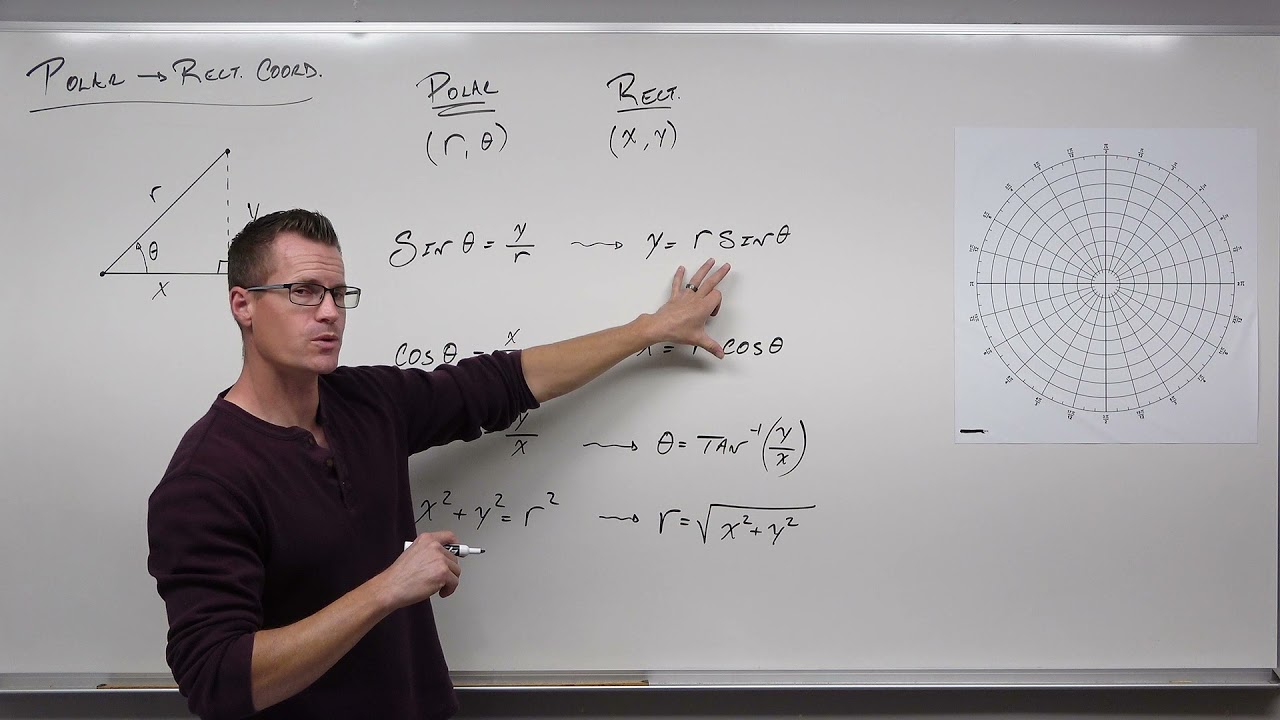
How to use trigonometric relationships to change Polar Coordinate represented points into Rectangular Coordinate represented points
Support: https://www.patreon.com/ProfessorLeonard
here is timestamp
grave pond
Their angle seems to be right, but srqt(4.98²+3.85²) is 6.29 rather than 6.
brisk adder
 grave pond
The video simply jump-cuts to having wrong numbers on the whiteboard, no hint of how they came about.
trail tendon
grave pond
The video simply jump-cuts to having wrong numbers on the whiteboard, no hint of...
prolly cuz he put it in a calculator, remembered the wrong number or smthn 💀
brisk adder
brisk adder
^
brisk adder
grave pond
My calculator agrees with yours.
welp, so can we agree (-4.75,-3.67) is the correct answer?
grave pond
Yes.
brisk adder
trail tendon
prolly cuz he put it in a calculator, remembered the wrong number or smthn 💀
sorry about the confusion earlier btw, do you get the same answer like this?
trail tendon
brisk adder
sorry about the confusion earlier btw, do you get the same answer like this?
yes
brisk adder
case close then. Thanks guys
 icy loom
don't know if this is the right place to ask but
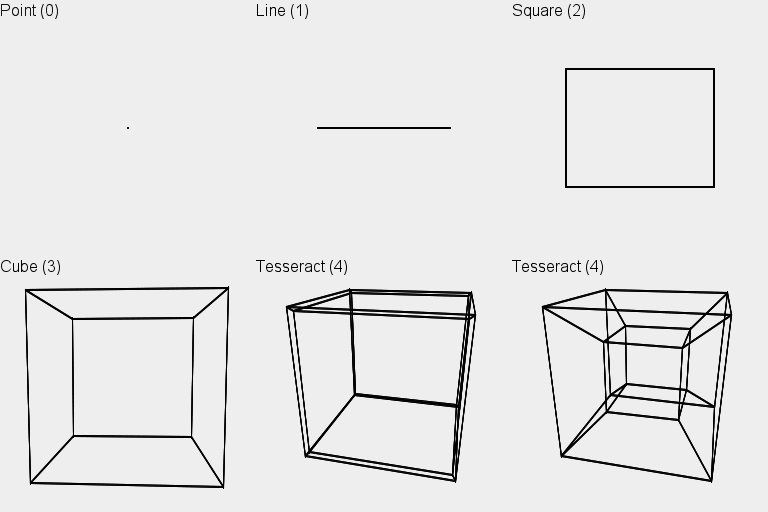
i know you can project from $\mathbb{R}^n$ to $\mathbb{R}^m$ such that m < n (usually), but i want to know if there's a term for a specific kind of action from $\mathbb{R}^n$ to $\mathbb{R}^{n+1}$ where you have some shape and you "lift it up" to form a shape of the dimension one above
somber coyoteBOT
haru~
 icy loom
https://upload.wikimedia.org/wikipedia/commons/d/d9/From_Point_to_Tesseract_(Looped_Version).gif
as in this

or less generally the action of taking a 2d shape and making a prism with it
stuck sleet
My answer is 9 pegs, but the right one is 10 pegs
My solution is that the 4ft board = 48 inches
minus the ends which is 2*6 = 12 ; therefore 48 - 12 = 36
then 4 inch spacing per peg so 36/4 = 9
What did I do wrong is my picture wrong?

 stuck sleet
48
lime dune
so we can add in one more peg
be careful of these “off by one” errors
they’re quite easy to make on questions like this
lime dune
npnp
 upbeat charm
Hey. I was wondering if anybody could give me some suggestions for online resources that I could use to get started learning geometry
lime dune
anything pre university is generally covered passably by khan academy
it’s not great, it just .. gets the job done
upbeat charm
alr thx
stuck sleet
try the book by moise and downs (Geometry, Metric Edition)
or
You can also try what am I reading now by Alexander (Elementary Geometry for College Students)
upbeat charm
those look pretty interesting. thx!
 brazen cloak
https://youtu.be/qW6Ua50fTw8?t=399
over here how is he breaking the tangent into two diff angles??

Subscribe! http://www.freemathvideos.com Want more math video lessons? Visit my website to view all of my math videos organized by course, chapter and section. The purpose of posting my free video tutorials is to not only help students learn math but allow teachers the resources to flip their classrooms and allow more time for teaching within th...
hoary totem
brazen cloak
https://youtu.be/qW6Ua50fTw8?t=399
over here how is he breaking the tangent into...
observe that 15pi/6 is 12pi/6 + 3pi/6
and 12pi/6 has no effect on the angle because its just 2 pi, its just a full revolution around the circle
so 15pi/6 is the same angle as 3pi/6
which simplifies to pi/2
 worldly rivet
brazen cloak
hoary totem
observe that 15pi/6 is 12pi/6 + 3pi/6
and 12pi/6 has no effect on the angle beca...
worldly rivet
brazen cloak
hoary totem
observe that 15pi/6 is 12pi/6 + 3pi/6
and 12pi/6 has no effect on the angle beca...
so he broke it up into 2pi and the remaining angle??
right?
 wise nest
can anyone help? im rly struggling i need all the help i can get and i havent found any
plz i REALLY need help i will fail if i dont get help
nothing has helped
this is my last hope and no one has answered my forum'
gentle haven
What do you need though
faint pasture
wise nest
can anyone help? im rly struggling i need all the help i can get and i havent fo...
 wise nest
gentle haven
What do you need though
wise nest
gentle haven
What do you need though
like theres various topics beause my teacher doesnt know how to teach
gentle haven
Like what
wise nest
area of a regualr polygon thats one
trail tendon
 kindred granite
can anyone help with proof of area of circle?
kindred granite
can anyone help with proof of area of circle?
which proof?
integral proof?
kindred granite
ya
trail tendon
can't you just do trig sub?
like uh
the equation of a line is y^2 + x^2 = r^2
obviously you can't integrate that with respect to x or y
kindred granite
k
trail tendon
but y = +- sqrt(r^2-x^2), right?
kindred granite
yeah
 kind cloak
Oh damn, I’m taking this shit next year
trail tendon
and since the area of +sqrt(r^2-x^2) is the same as -sqrt(r^2-x^2), you can just integrate +sqrt(r^2-x^2) and multiply by 2?
trail tendon
kind cloak
Oh damn, I’m taking this shit next year
this aint really geometry either lol
this is more calculus 💀
but it kind of
geometry relateed
kindred granite
trail tendon
and since the area of +sqrt(r^2-x^2) is the same as -sqrt(r^2-x^2), you can just...
yeah so far so good
trail tendon
kindred granite
yeah so far so good
alr and the bounds are -pi to pi, right?
because those are the ends of the circle?
kindred granite
yup it is
trail tendon
so now you have sqrt(r^2-x^2)
just realized
mb
i was taking unit circle
im gonna change the 1 to r^2 lol
kindred granite
kk
trail tendon
oh alr nice
hoary totem
wise nest
area of a regualr polygon thats one
here is the derivation of the formula for the area of a regular polygon
observe that any regular n-gon can be split up into n congruent isosceles triangles (5 triangles shown for the pentagon)
so we just need to find the area of 1 triangle and multiply by the number of sides
also, the sum of all exterior angles is 360 degrees
since this polygon is regular, one exterior angle (red angle) is 360/n degrees
that means 1 interior angle is 180 - 360/n degrees (blue angle)
so the angle of one of those triangles (green angle) is half of blue so (180 - 360/n)/2 = 90 - 180/n degrees
now, say the side length of this polygon is s
now we have that the purple length is s/2
and also, since tan(x) = opposite/adjacent, we have red length = tan(green angle) * purple length
or red length = tan(90 - 180/n) * s/2
red length is the height of one of those triangles, and the area of a triangle is bh/2
so the area of one of those triangles is (s * tan(90 - 180/n) * s/2) / 2
or s^2 tan(90 - 180/n) / 4
or s^2 cot(180/n) / 4
now we just multiply by the number of sides because there is 1 triangle per side
so we end up with:
area of whole regular polygon = n s^2 cot(180/n) / 4

 north kindle
I’m having some trouble with this problem, the books hint says to try and find the area of PXQ divided by the area of ABC, but since I don’t know anything about the altitude I’m trying to prove PXQ and UAR congruent but I’m finding myself unable to do so.

I’m not sure I’m going down the right path but I’m not sure how else to go about this
Wait no they can’t be congruent
 nocturne remnant
they are similar, but (generally) not congruent
north kindle
Hmmmm
I’m not sure how to find [PXQ]/[ABC] in terms of PQ and BC without knowing anything about the altitude
nocturne remnant
honestly idk what the hinted approach is, seems like you can do it without using any areas
north kindle
My idea is to use area to find the scaling factor between triangles and then doing something with that
And that seems to be what the books hinted approach is
But I do not know how to actually do that
nocturne remnant
north kindle
My idea is to use area to find the scaling factor between triangles and then doi...
can you relate, say, RS/CA to some other ratios using similar triangles?
nocturne remnant
if you use RX/BC
and convert the other one to .../BC as well
all three denominators become BC
north kindle
What other one
nocturne remnant
north kindle
What other one
TU/AB
nocturne remnant
PQ/BC + RS/CA + TU/AB = PQ/BC + RX/BC + UX/BC
after that youre pretty close to the solution
north kindle
So we need to show PQ+RX+UX = BC
Which I think we can do fairly easily
By just showing RX = QC and UX = BP
I’m not sure if that’s trivial or not
 balmy skiff
 nocturne remnant
north kindle
I’m not sure if that’s trivial or not
nocturne remnant
north kindle
I’m not sure if that’s trivial or not
it is quite trivial
 lethal peak
dont spam
 glass sparrow
!help
lime crownBOT
To ask for mathematics help on this server, please open your own help channel or help thread. See #❓how-to-get-help for instructions.
nocturne remnant
@tropic flame please post your question before tagging/asking for help

 tropic flame
nocturne remnant
<@1019626818535424030> please post your question before tagging/asking for help
tropic flame
nocturne remnant
<@1019626818535424030> please post your question before tagging/asking for help
Alr mb I'm new here
nocturne remnant
!status
lime crownBOT
What step are you on?
1. I don't know where to begin.
2. I have begun but got stuck midway.
3. I got an answer but I was told that it's wrong.
4. I got an answer and would like my work checked.
5. I have a question about someone else's work/solution.
6. I have completed the problem and don't need help anymore. Thank you.
7. None of the above
and do you need help on both 10 and 13
tropic flame
Yh
nocturne remnant
!status
lime crownBOT
What step are you on?
1. I don't know where to begin.
2. I have begun but got stuck midway.
3. I got an answer but I was told that it's wrong.
4. I got an answer and would like my work checked.
5. I have a question about someone else's work/solution.
6. I have completed the problem and don't need help anymore. Thank you.
7. None of the above
1 buddy
nocturne remnant
for question 10, you first need to find the (horizontal) distance between lines AB and CD
which is equal to distance AD
tropic flame
Alr
nocturne remnant
do you know how to do it?
tropic flame
No
nocturne remnant
hmm
tropic flame
👨🏿🦲
tropic flame
Alr
 tropic flame
nocturne remnant
tropic flame
nocturne remnant
Ooooooooooooooooooh yh I knew it
nocturne remnant
notice that BADE is a rectangle
tropic flame
Yep
nocturne remnant
so can you find the length of CE?
tropic flame
4
tropic flame
What
nocturne remnant
how did you get 4 💀
tropic flame
Bro I'm trash at geometry
nocturne remnant
answer my question how tf u got 4
tropic flame
I halfed 8
nocturne remnant
bruh
it's not given (and in this case not true) that E is the midpoint of CD
so dont assume that
💀
anyway
nocturne remnant
since ED = BA = 3cm, CE will be 8 - 3 = 5 cm
tropic flame
Oooh yep
nocturne remnant
ok so now apply pythag thm to find BE
tropic flame
Show me how u solve it in a pic and I'll get ikt
nocturne remnant
tropic flame
Show me how u solve it in a pic and I'll get ikt
i dont think it makes any difference
nocturne remnant
do you actually know pythag thm
nocturne remnant
can you just state the theorem rn
tropic flame
No
nocturne remnant
if you know it you should at least be able to do that
tropic flame
Gimme a question and I'll do it
nocturne remnant
the question is right in front of you
BC = 13 cm, CE = 5 cm, and BEC is right angle, and you need to find BE
tropic flame
Ok
nocturne remnant
can you do that?
nocturne remnant
??
tropic flame
Is it wrong
nocturne remnant
yeah
tropic flame
👨🏿🦲👨🏿🦲
nocturne remnant
BC = 13 is the longest side, how you gonna have BE = 13 too
 stray elbow
can I post my question here?
nocturne remnant
stray elbow
can I post my question here?
if its related to geometry or trigonometry then yes
tropic flame
U asked for BE
nocturne remnant
yes
tropic flame
BE=13
nocturne remnant
can you show your working
tropic flame
Nvm
nocturne remnant
?
nocturne remnant
what's your answer
tropic flame
Idk
nocturne remnant
so do you still need help
tropic flame
nocturne remnant
so do you still need help
Nah its ok
Imma move on to trigonometry
Alr
Thankk
Thanks
nocturne remnant
💀 ok
nocturne remnant
@stray elbow did you have a question?
grave pond
(If he does, he can't post it).
grave pond
Evidence suggests it would probably have been 2+2.
 autumn pelican
How does theta equal that? THe formula I was given was tan0 = y/x, 0 = arctan y/x which equals -45
 cunning lion
they ask for 0 < theta < 2pi
so it needs to be in radians, and in that particular range
autumn pelican
Oh.. you're right, thank you
Actually I seemed to only be able to get that to work for one question
This is in radians, and within the range

Oh, nevermind it was +2pi'd

 long trout
i think the opposite
trail tendon
the opposite what?
trail tendon
BD intersects AC at D i think its saying
long trout
trail tendon
i don't know what {D} or {A} means lol
point a or point d
trail tendon
long trout
did u take these before in ur life
take what?
long trout
trail tendon
take what?
projection lesson
long trout
its choose
trail tendon
how did you get it though
trail tendon
oh i thought you meant choice d
long trout
nahh
trail tendon
how did you get {D}
long trout
is it wrong?
trail tendon
i don't think so
I don't know exactly how you got it though
were you just guessing because its the point of intersection? 💀
oh wait
long trout
trail tendon
were you just guessing because its the point of intersection? 💀
i dont know how to explain it
trail tendon
im dumb
long trout
since i take it in arabic
trail tendon
ahh
long trout
i also have another one but its about the same damn lesson but i dont know the answer
trail tendon
no actually i think it is {D} because both BD and AC intersect the point, so technically the line is just...rotated about the point {D}
i don't know for sure though
 trail tendon
how did you get those?
long trout
in my book theres a rule that when they are parallel the projection equals the origin (bd) so bd =8 and so does its projection but when its a normal not parallel the origin is always bigger than the projection
unless they typed the question wrong cuz im losing my mind
if they mean its still parallel for the rest of the question it equals 8
trail tendon
what does // mean 💀
long trout
parallel
long trout
yeah thats what i said
trail tendon
im reading ur reasoning again hold on
i mean if projection means you map BD on AC

i would think the length of the "projection" would be 8
the same length as BD
unless im trippin
long trout
trail tendon
i mean if projection means you map BD on AC
yeah u map it draw two points from both ends of bd so b and d on ac which is the straight line
so they r called b dash and d dash
trail tendon
B' and D'?
 hexed tusk
long trout
hexed tusk
long trout
pretty sure its 8
long trout
trail tendon
B' and D'?
yes
trail tendon
long trout
yes
did ur teacher call them dash?
or r u self studying, or are they really called dash
lol
usually id think they were called prime
B prime -> B'
mebe not tho idk
trail tendon
weird
 empty quartz
i need hella help
trail tendon
empty quartz
i need hella help
nice
empty quartz

shit should be easy but im secon guessing
geometry has been so easy til now for me
its just so weird
i need som1 ina call to help me stgggg
trail tendon
you know how to calculate the surface area?
empty quartz
and the whole pythagoran therom i think idk bruh
so would i do the box technique
lemme show
trail tendon
alr


 trail tendon
yeah
so in order to calculate the area of the rectangle, you need that last side of the triangle
since it tells you its a right triangle, you can use the pythagorean theorem
trail tendon
empty quartz
so how do you apply that here
trail tendon
empty quartz
24^2+b^2=25^2
yes
empty quartz
and that the 25 appears to be from the right traingle being the hypotenuse
trail tendon
so whats b
empty quartz
7
trail tendon
yes
are you able to get the area of each side and add em all up for the surface area?
empty quartz
maybe
like total surface area
thats LSA + 2B
b is b x h
so 7 x 24 to find the b and then divide it by 2
so 168 would take 2b and then i would have to add the LSA

this is an example i found that uses pyth
trail tendon
empty quartz
so 7 x 24 to find the b and then divide it by 2
but there are two bases with the same area, no?
trail tendon
aren't we talking about the triangles lol
empty quartz
so if 25 is the edge, would that be the constant number used for hte box
like the boxes for finding the surface area
im so confusing stg
empty quartz
3?
trail tendon
in total?
empty quartz
if we including those triangles then 5?
trail tendon
yeah
empty quartz
ok so 5
trail tendon
its so strange to me that you think of lateral surface area before total surface area 😂
trail tendon
empty quartz
its LSA +2B = TSA
this isn't always true
but whatever
good enough lol
empty quartz
lmao
can u possibly walk me throughon how to get the answer
cause tmrw on the quiz, theres one question for each shape, so if i know hat to do with these mfs, ill do fine on it
lime dune
“lateral surface area” is just any part of the surface area that isn’t a base
trail tendon
lime dune
“lateral surface area” is just any part of the surface area that isn’t a base
yeah
empty quartz
huh
lime dune
above, you have a right triangular prism - that is, the right triangle faces are the bases
empty quartz
ok so there are 3 LSA
trail tendon
lime dune
“lateral surface area” is just any part of the surface area that isn’t a base
by the way, i never really completely understood, how do you know if something is a "base"?
lime dune
if it’s a prism
then that’s like taking a 2D shape and “stretching”/“extruding” it out into 3d
a cylinder for example
trail tendon
lime dune
if it’s a prism
what if its not?
empty quartz
so could u walk em thru on how to get that
lime dune
if I take a circle
and stretch it out
the other relevant case is pyramids/cones
where it should be quite obvious which face is the base
trail tendon
empty quartz
so could u walk em thru on how to get that
what's the area of the front side
trail tendon
lime dune
where it should be quite obvious which face is the base
yea
lime dune
lime dune
where it should be quite obvious which face is the base
the one that doesn’t have the apex as one of its vertices
empty quartz
so 168?
trail tendon
yes
empty quartz
cause 2b is 2(84)=168
ok
so
what do i do to find teh LSA
or heres a better one, how should i do it in forms of those god damn boxes
trail tendon
empty quartz
what do i do to find teh LSA
find the area of all the sides and add them up
empty quartz
or multiplication
empty quartz
trail tendon
find the area of all the sides and add them up
huh
trail tendon
empty quartz
or heres a better one, how should i do it in forms of those god damn boxes
the area of a rectangle is bh
trail tendon
oh 1 sec
empty quartz
is it because of the 8
like what does the 8 need to look like to do it
and connect to all 3
like wtfffff
and this vocab has me braindead

 empty quartz
but why is the 8 the main # involved into the boxes
trail tendon
you may be having hard time the 3D
trail tendon
empty quartz
but why is the 8 the main # involved into the boxes
don't worry about that
its the height
trail tendon
you see the rectangle that has area 8 * 24?
empty quartz
thx for that pic
trail tendon
yeh 💀
trail tendon
you forgot to add the triangles i think
empty quartz
Nah that’s adding the utraingles
 hollow moth
how should I learn geometry better? I can't wrap my head around it ngl
 subtle zenith
Me too
lime dune
without a more specific question there's not much i can say without it being meaningless generality
faint pasture
sometimes alll someone wants is the meaningless generality tho fr
hoary totem
Here is a lovely geometric proof that sqrt(2) is irrational.
The proof begins by looking at an isosceles right triangle whose legs have length 1. By the Pythagorean theorem, this triangle's hypotenuse will have length sqrt(2).

 Twitter
·
Twitter
·
cool proof
nocturne remnant
my immature ass will laugh at the account name
 grand sail
What is trigonometry
faint pasture
well at the most basic level it relates the sides of a triangle
grave pond
Generally functions that relate angle measures to ratios between lengths.
grand sail
So, why do we need a raios of sides
faint pasture
grave pond
Generally functions that relate _angle measures_ to _ratios between lengths_.
and then whatever mess it becomes when you reach non euclidean shit
grave pond
grand sail
So, why do we need a raios of sides
For example if you know one of the sides and want to know the other.
faint pasture
grand sail
So, why do we need a raios of sides
for this triangle if you are given QK = 2, how would you find PK? the answer is with trigonometry
 grave pond
(That's a somewhat bad example because for those particular angles you could also say "reflect the triangle across PQ, and that will give you an equilateral triangle").
grand sail
Im confused, trigonometry represents a ratios of sides (i have there only angles)
grave pond
grand sail
Im confused, trigonometry represents a ratios of sides (i have there only angles...
You were also told the length of QK.
faint pasture
grave pond
(That's a somewhat bad example because for those particular angles you could als...
i mean it is the simplest one, for a 45-45-90 triangle it is easier cuz isoceless, then we reach 18-72 or 37-53 but those are just weird xD
obsidian harness
grand sail
Im confused, trigonometry represents a ratios of sides (i have there only angles...
yes
if your triangle has side lengths x, y, z for example
you can make each side k times larger, and it will still be similar (look the same but bigger/smaller)
So our new side lengths are kx, ky, kz
Check that (kx)/(ky) = x/y and so on, so the ratios between sides are the same
faint pasture
(isnt similarity taught before trig?)
obsidian harness
it should be
faint pasture
hm yea
obsidian harness
Hopefully this will be revising old stuff rather than teaching them new info
faint pasture
true
grand sail
I do not understand what role play angles in that (are they sin,cos,tag
faint pasture
grand sail
I do not understand what role play angles in that (are they sin,cos,tag
they just relate a particular ratio
for eg if your triangle has the angles 30-60-90
and you take one such triangle and measure the ratios
you can use all those ratios for all triangles with same angles
this is applicable to all other angle pairs too (must contain a right angle though)
faint pasture
obsidian harness
Hopefully this will be revising old stuff rather than teaching them new info
(btw is helpful role only for those who help in the help channels or everywhere?)
 tame helm
grand sail
I do not understand what role play angles in that (are they sin,cos,tag
tame helm
grand sail
I do not understand what role play angles in that (are they sin,cos,tag
try watching this vid https://youtu.be/PUB0TaZ7bhA?si=aKzdEz6_IYYQ1VZT

This math video tutorial provides a basic introduction into trigonometry. It covers trigonometric ratios such as sine, cosine, and tangent. It explains how to evaluate it using right triangle trigonometry and SOHCAHTOA. In addition, it explains how to solve the missing sides of triangles and how to find the missing angles using inverse trig f...
 willow arrow
Hi guys I have a question that I will get from proofs and logic to here, which is if circle has zero sides or infinite sides?
obsidian harness
faint pasture
(btw is helpful role only for those who help in the help channels or everywhere?...
can be in other places
like pre-uni, early uni, advanced doesn't give helping activity though
obsidian harness
willow arrow
Hi guys I have a question that I will get from proofs and logic to here, which i...
depends on what you mean by 'side'
it's an interesting question
faint pasture
willow arrow
Hi guys I have a question that I will get from proofs and logic to here, which i...
depends
faint pasture
obsidian harness
like pre-uni, early uni, advanced doesn't give helping activity though
if not there then whats the other places 💀
obsidian harness
faint pasture
if not there then whats the other places 💀
don't think there are any other places
maybe help forum? ask the mods
faint pasture
hmm i guess ill wait for when one comes active
faint pasture
willow arrow
Hi guys I have a question that I will get from proofs and logic to here, which i...
reminds me of the whole klein bottle thing, does that thing have zero volume orr infinite volume
obsidian harness
faint pasture
hmm i guess ill wait for when one comes active
I've asked in #『meta-discussion』
willow arrow
obsidian harness
depends on what you mean by 'side'
it's an interesting question
Ya so I got a grand disagreement from someone, I kept telling them it is based off how you define sides, but they kinda just went forth wall and defined circle as something that doesn't have Exterior angle...
They presented a proof for that as here ->
 Intuitively let's define circular shapes like circles, ovals and such as an object with 0 external angles. Then :
Ea = 2pi/n
n -> inf
Therefore, Ea -> 0
I'm doing unecessary extra work here; either show what is wrong with my statement above or there's no problem with my assertion.
Now I got no clue how this answers or helps up with idea related to "sides" but
i do gladly define "side" as a line segment with 2 of its endpoints on 2 vertices.
Different compositions of these "sides" can make up different shapes Ig.
But I think I am going off the track pretty quickly..
So is that proof even right approach?
obsidian harness
faint pasture
reminds me of the whole klein bottle thing, does that thing have zero volume orr...
answered
willow arrow
I suppose this is the correct channel to ask the question.
grave pond
willow arrow
Ya so I got a grand disagreement from someone, I kept telling them it is based o...
Why are you hiding your definition behind spoiler markup?
With that definition it should be fairly obvious that there are no "sides" in a circle.
obsidian harness
grave pond
Why are you hiding your definition behind spoiler markup?
With that definition i...
that really sucks that the goddamn help forum counts but these channels don't count
faint pasture
obsidian harness
that really sucks that the goddamn help forum counts but these channels don't co...
but the thing is normal discussion regarding the subject also happens here
soo there is no way to really differentiate is there
obsidian harness
faint pasture
but the thing is normal discussion regarding the subject also happens here
shit
fair enough but I think we should loosen the definition of helping a bit
like giving info about a subject also should count as helping
faint pasture
i mean maybe but like if you look at #calculus half of the times its just people ranting about how leibniz notation sucks soo i mean you wouldnt wanna give them the "help points" xD
willow arrow
grave pond
Why are you hiding your definition behind spoiler markup?
With that definition i...
Sorry mb marked it behind spoilers.
I actually had the definition which was pretty vague was accepted by the other end anyways.. which was "line segment == side." But I retracted that one back.
And yes, I definitely agree it should just make it zero sides by definition, so even if someone asks me to "prove it has zero sides" I could just say circle is by definition having zero sides / no sides, unless they want a different definition.
With that out of the way, I was confused if the later approach with external angles is conceivable. Cause it doesn't really talk about sides anymore.
Fixed the spoilers part, it's italics now.
willow arrow
willow arrow
Sorry mb marked it behind spoilers.
I actually had the definition which was pre...
Guys tell me if I am getting trolled or smth... the suspense is haunting.
 dry scaffold
]
 cold stream
how does it equal this?
 grave pond
willow arrow
Guys tell me if I am getting trolled or smth... the suspense is haunting.
grave pond
willow arrow
Guys tell me if I am getting trolled or smth... the suspense is haunting.
It's not really a mathematical question.
In the commonly understood usage of the words, the word "side" only has a clear meaning for polygons, and a circle is not a polygon. Anyone who wants to even use it about a circle will need to provide a definition of what they mean; depending on which definition they pick they may end up with something that the circle has none of, or one of, or infinitely many of, or perhaps something in between. Choosing between the possible definitions is not something that mathematics as such has an answer for; it is up to whoever picks a definition to convince their listener that "side" is a reasonable word to use for whatever they're talking about.
trail tendon
willow arrow
Sorry mb marked it behind spoilers.
I actually had the definition which was pre...
a circle is just one curved line segment :>
💀
willow arrow
grave pond
It's not really a mathematical question.
In the commonly understood usage of the...
Alright man, glad to hear it's all about picking definitions and basically agreeing with specific definitions.
I appreciate your assessment.
willow arrow
trail tendon
a circle is just one curved line segment :>
Definition moment.
trail tendon
willow arrow
Definition moment.
😂
lime dune
wdym by "curved" ☝️🤓
obsidian harness
Wittgenstein.....
grave pond
Darüber muss man schweigen?
 atomic tulip
,calc 900/2
somber coyoteBOT
Result:
450
 devout breach
HELP-
atomic tulip
devout breach
HELP-
Is 900/2 not being 300 not enough help?
devout breach
atomic tulip
Is 900/2 not being 300 not enough help?
i said help as in lol
trail tendon
devout breach
i said help as in lol
help
tropic flame
<@&286206848099549185>
tropic flame
R u helper
 rapid shore
What is the problem?
 golden whale
yep
tropic flame
Can u help me with hatd question perimeter
rapid shore
Sure. Where is it?
golden whale
send it to what is it
tropic flame
No help me understand it
rapid shore
What do you need to understand?
golden whale
can you say the topic in academic form
lime dune
what is the problem
tropic flame
golden whale
can you say the topic in academic form
No
lime dune
!original
lime crownBOT
Please show the original problem, exactly as it was stated to you, with the entire original context. A picture or screenshot is best. If the original problem is not in English, then post it anyway! The additional context might still be helpful. Do your best to provide a translation.
tropic flame
golden whale
so which topic you wanna know
Area and volume
golden whale
yeah for sure shall we have it in voice ?
tropic flame
Yh
golden whale
it would be easier
tropic flame
Alr
faint pasture
rapid shore
What do you need to understand?
dont steal my name
rapid shore
This is a math channel.
grave pond
Sure.
The results look right, at least.
With a bit of experience you can do the angle conversion faster than the step-by-step arithmetic you used here, by viewing the fraction of pi as a combination of pi/1 (=180°), pi/2 (=90°), pi/3 (=60°) and pi/4 (=45°).
devout breach
thanks
i’ll prob just leave it like that because that’s how we did it in class
i have two more problems i might ask about after i just need to do them first
faint pasture
It is possible but not really doable by hand
Some computers graph it sure, others use what is called a "taylors series" to approximate the value
Well it is kind of complex to explain if you dont know the basics of calculus
But it is basically an infinite termed polynomial which is equal to a function
Well yea thats when you need calculus knowledge to understand the working
Im not aware of that tbh
Well do you know basic differentiation too?
Um the actual definition for the taylors series is based on differentiation so yea
He probably just approximated it by drawing the triangle but im not sure
I guess graphs werent a thing back then eithee
So triangle is the only real way
Or maybe just approximations
Like sin45 = 1/sqrt(2) we can write sin 45 solely in terms of sin1
Soo we can approximate sin 1 from there
And then calculate all other values
But it is gonna be tedious if not impossible to solve a 45 degree polynomial xD
trail tendon
faint pasture
But it is gonna be tedious if not impossible to solve a 45 degree polynomial xD
dude i thought you meant 45 degrees 😂
i was like "bro its sqrt(2)/2, already calculated" 💀
faint pasture
trail tendon
dude i thought you meant 45 degrees 😂
Lmfaooooo
faint pasture
trail tendon
dude i thought you meant 45 degrees 😂
No wait
I did mean 45 degrees in there?
faint pasture
I am saying you can calcullate sin 1 degree from there
And calculate all other shit after that
trail tendon
using series decomposition?
faint pasture
trail tendon
using series decomposition?
What even is that 💀 like taylor's series right?
It is
trail tendon
faint pasture
What even is that 💀 like taylor's series right?
yeah