#geometry-and-trigonometry
1 messages · Page 58 of 1
 heavy solstice
help i dont know what to do im freaking out 😿

 hard moon
it doesn’t appear to have exactly one solution
 north kindle
I’m having trouble with this problem, Im trying something with a line from A to the perpendicular bisector of CB but it doesn’t seem to be working

I think I have that EFA + BAC = 180
north kindle
Why exactly
 grave pond
It you draw a horizontal line through F, then its angle with FE and FC are both the same as angle BAC.
north kindle
How do you know that
grave pond
Because it's parallel to BEDA.
north kindle
How do you know that
grave pond
Because that's what I deined my line to be.
Angle FEA = angle BAC because isosceles triangle.
Angle KFE = angle FEA because parallel lines
Angle KFC = angle BAC becaluse parallel lines.

So angle EFC is two times angle BAC.
grave pond
And then angle ECF = angle EFC, again because isosceles triangle ...
 upper karma
I thought tangent lines were all the same lenght at intersections

but it has coome to my attention i am critically wrong
I am off about 2 when I multiply 23.2 (One whole triangle side lenght) by 3
grave pond
You're probably assuming that the three points of tangency are 120° apart on the circle, but that cannot be true.
upper karma
how do i approach this then
I have 3 points, they are all tangent (Questions states: "If line appears tangent, then they are tangent"
Im going to label the image for easier explanation'

i forgor the C 💀
grave pond
I don't know what it is you're computing, but you can find all the side lengths using this:
 hard moon
north kindle
I must’ve gotten something wrong in my algebra somewhere
hard moon
north kindle
I must’ve gotten something wrong in my algebra somewhere
instead of perpendiculars, label the measure of any angle “x” then start finding all the other angles in terms of x
 maiden brook
north kindle
I’m having trouble with this problem, Im trying something with a line from A to ...
maiden brook
north kindle
I’m having trouble with this problem, Im trying something with a line from A to ...
this is a great problem
i love aops
maiden brook
north kindle
I got it btw
good job!
north kindle
Why is it necessarily true that they share an altitude?

 dark sparrow
from B onto AC
dark sparrow
i mean we are considering AX and CX as their bases arent we
north kindle
Yes
dark sparrow
so like
those two come from the same straight line
so of course the altitude dropped from B will be geometrically the same in both cases
not merely equal length but like the segment is one and the same for both
north kindle
Ok but like, why is that segment the altitude
dark sparrow
what's your defn of an altitude of a triangle
it ought to be something equivalent to "a segment from one of the vertices to a point on the straight line containing its opposite side, and perpendicular to said line"
north kindle
Yeah
dark sparrow
yeah os
so*
i think you're overthinking it
we are literally just dropping a perpendicular from the same point (B) onto the same straight line (AC) in both cases
 north kindle
Looks about right
What about the other one though, how have we shown they are the same
north kindle
How?
dark sparrow
 north kindle
Oh wait I see I think
dark sparrow
if you drop a perp from B onto the line containing XC, to construct the altitude of triangle BXC, you get BH
if you drop a perp from B onto the line containing AX, to construct the altitude of triangle BAX, you still get BH
it's literally the same one
 dark sparrow
holy shit they missed some important punctuation in there
- ABCD is a tetrahedron.
- Face BCD is equilateral, with side length 12 units.
- H is the foot of the perpendicular from A onto BCD, and it lies inside the face.
- The area of CDH is 3 times that of BCH.
- The area of DBH is 2 times that of BCH.
- M is the midpoint of side BD.
dark sparrow
well i needed to write it out like this to make any sense of it.
cause the run-on sentence going on there is insane
anyway... do you have a diagram of this thing?
dark sparrow
i'm not asking if they give one
i am asking whether you have even thought to make one
upper karma
Oh yes yes
dark sparrow
"do you have [thing]" is not, in general, the same question as "does the problem give you [thing]".
grave pond
I think Ann wants to see your diagram.
dark sparrow
^
 upper karma
I do remember that,but drawing it this way make me to visualize it in a easy way
dark sparrow
it's actually way easier if you do it my way
that way you actually get a sense of the picture being 3D lol
upper karma
Okay I will do it from now on
dark sparrow
also i don't see H anywhere
upper karma
H won't be usefully for options C AND D
dark sparrow
i would not be so sure
the position of H relative to B, C and D seems relevant!
especially given A is directly above it
 dark sparrow
i also recommend you make a subdiagram showing only face BCD
upper karma
Okay
dark sparrow
cause the area ratios between CDH, BCH and BDH should be more easily shown on that
 dark sparrow
æ is an interesting choice of letter for area
anyway i am pretty sure the distances of H to each side can just be computed directly.
knowing BC=CD=DB=12 and these area ratios
upper karma
Yes
dark sparrow
do that
dark sparrow
drop the perpendiculars from H onto each side of the triangle
give names to each of the three points that are their bases
and send a photo of the resulting diagram here
mark their lengths as well
 dark sparrow
ok
upper karma
CHF are not collinear
dark sparrow
ok so you want the distance from A to CM...
and the logical first step to that is to find the distance from H to CM
upper karma
Okay i will try to
Yay
Got it
The perpendicular distance is 2
2
So now we can use pythogorean theorem
Thanks
 obtuse quiver
solve $cos(3x-15^{\circ}) = \frac{\sqrt{3}}{2} for, 0 \leq x < 180$
dark sparrow
did you mean \leq?
 somber coyoteBOT
uh
 obtuse quiver
I got the reference angle and everything
dark sparrow
solve $\cos(3x-15^{\circ})=\frac{\sqrt{3}}{2}$ for $0\leq x\leq 180^{\circ}$
somber coyoteBOT
|Ann⟩
 obtuse quiver
but normally the quadrants are like 90 180 270 and 360 right in a range of 0 to 360
i can't wrap my head around the changed ranges
 west radish
15
 obsidian harness
west radish
15
obsidian harness
west radish
15
you should explain if you want to answer
cause wolfram can do it for them ofc
dark sparrow
obtuse quiver
i can't wrap my head around the changed ranges
maybe you should try solving for all real values of x first
west radish
As do cosinverse on the other side it will equal 30 then add 15 which will equal 45 and then divide by 3
Which equals 15
obtuse quiver
west radish
As do cosinverse on the other side it will equal 30 then add 15 which will equal...
yeah i know that
but i'm trying to know what to do when the range is changed
west radish
obtuse quiver
yeah i know that
K
obsidian harness
obtuse quiver
i can't wrap my head around the changed ranges
But the way to think of it is:
0 <= 3x <= 540
-15 <= 3x - 15 <= 525
There you go, that's the domain you need to serach for
And x = 15 is only one solution ofc
dark sparrow
west radish
Which equals 15
this gives you only one solution and loses all the rest.
obtuse quiver
i got x=15, 115, and 135
obsidian harness
,calc 3*135-15
somber coyoteBOT
Result:
390
keep searching
you're not at the upper limit yet
Let me doublecheck
obsidian harness
Ah yes you are
Yeah see what happens when you try to find the next highest solution
obsidian harness
obtuse quiver
i got x=15, 115, and 135
Correct btw
obtuse quiver
all i wanna know is what to do when the range is changed, at school they drew something on the quadrants
obsidian harness
obsidian harness
But the way to think of it is:
0 <= 3x <= 540
-15 <= 3x - 15 <= 525
There you g...
@obtuse quiver
dark sparrow
imo the best way to do this is to solve for x in R and then filter to your range
instead of trying to memorize a thousand procedures for what to do when the range is in this or that form
obtuse quiver
dark sparrow
imo the best way to do this is to solve for x in R and then filter to your range
how'd i do that
west radish
If the range is changed like to 360 then minus the ansr with 360 or with 270 or with 180
According to what the range is
dark sparrow
cos(t) = sqrt(3)/2 <=> t = ±pi/3 + 2pi*n, where n ranges over all integers
or in degrees ±60 + 360n
3x - 15 = ±60 + 360n and solve for x as normal
obsidian harness
np
obtuse quiver
all good, thanks ann
btw is this correct $cos\theta = \frac{2}{3} , -180\leq x <180 \newline reference angle=48.1^{\circ} \newline \theta=-131.9,131.9$
somber coyoteBOT
uh
 dark sparrow
,calc cos(48.1 deg)
somber coyoteBOT
Result:
0.66783255547105
 though.
obtuse quiver
dark sparrow
<:wordbadtex:924222207251582996> though.
though.
obtuse quiver
dark sparrow
<:wordbadtex:924222207251582996> though.
still getting used to it lol
obtuse quiver
one sec let me show you this

i drew this quadrant to do that problem
instead of 0 and 360 i put in -180 and 180
because the range was changed
and then -180+48.1 and 180-48.1
obtuse quiver
dark sparrow
why ±131.9 and not ±48.1?
idk cos^-1(2/3) comes out as 48.1
obtuse quiver
dark sparrow
these should both be on the **left**.
wait what
dark sparrow
obtuse quiver
idk cos^-1(2/3) comes out as 48.1
yes but you should have used those values as is, not taken their supplements.
angles are always measured from the positive x axis. the positive x axis is always 0, or an integer multiple of 360.
-180 to 180 still sweeps out a full circle exactly once but it doesn't start on the positive x axis
obtuse quiver
ah
dark sparrow
it starts a half turn across from that
obtuse quiver
so i should've done this
 dark sparrow
upside down
obtuse quiver
is this good
 dark sparrow
worse
obtuse quiver
shit
dark sparrow
the ±180 are in the right places but the 0 and 90 are both misplaced and unnecessary.
obtuse quiver
alright so ignoring the 0 and 90
how would i proceed
i have the reference as 48.1
dark sparrow
... you would get x = ±48.1 but the whole construction of your diagram makes it nigh impossible to justify that cleanly.
obtuse quiver
could you tell me how to do it from scratch
if it doesn't take up too much of ur time
dark sparrow
afraid it will
obtuse quiver
ah no problem then
 rapid rivet
I was following a video online on how to graph cos and sin equations. I was a bit confused why they replaced the 2 in the formula solving for period 2pie/b as 3pie/(1/3) i was thinking because the amplitude is three that’s why but i’m still a bit confused if there is like a rule for it
 somber coyoteBOT
|Ann⟩
 rapid rivet
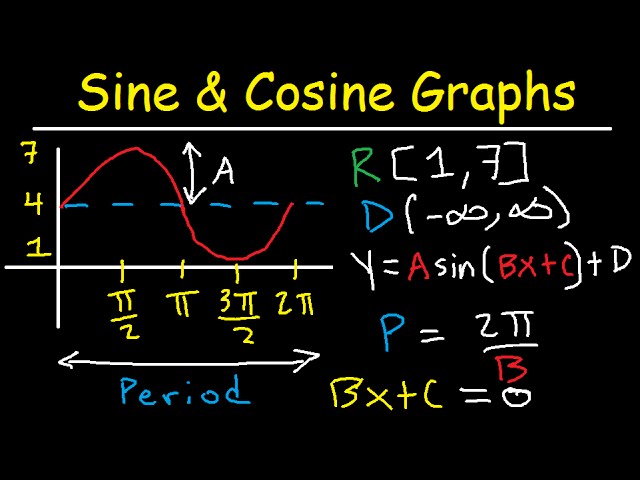
This trigonometry and precalculus video tutorial shows you how to graph trigonometric functions such as sine and cosine functions using transformations, phase shifts, period, and amplitude.
Trigonometry - Basic Introduction: https://www.youtube.com/watch?v=g8VCHoSk5_o
Angle of Elevation Problems:
h...
rapid rivet
oh dang
 rapid rivet
watching on my school account so the comments were turned off
okay thats what i thought thank you!
 steady mason
is the range and domain of a cubic function always infinity unless said otherwise
dark sparrow
it's not "infinity"
it's all real numbers.
or (-∞, +∞),
or just R.
but yes.
and the same goes for any polynomial function of odd degree.
 static hearth
if sin(alpha) is equal to -4/5 in quad 4, does this mean that sin(theta) also has the same ratio of -4/5? what is the difference between them, exactly?
dark sparrow
static hearth
if sin(alpha) is equal to -4/5 in quad 4, does this mean that sin(theta) also ha...
... alpha and theta are two different letters which probably denote different angles
thats the difference
you cannot tell anything about sin(θ) from only the info you wrote here
 somber coyoteBOT
 obtuse quiver
Any help on the trig question
static hearth
dark sparrow
... alpha and theta are two different letters which probably denote different an...

 amber hollow
any advice? i did P = 2 so B = pi, and midpoint = 7+1/2 = 4, and amplitude = 7-1/2 = 2, and since it starts at 0 im assuming its a flipped cos function
 dark sparrow
static hearth
dark sparrow
static hearth
!nogpt
 lime crownBOT
static hearth
lime crownBOT
static hearth
Please do not trust ChatGPT or similar AI tools for mathematical tasks, as they often generate output which "sounds correct" but has numerous factual or logical errors. Use of these AI tools to answer other people's help questions is strictly against server rules (see #rules).
dark sparrow
@static hearth sin, cos and tan still denote the same trig functions no matter which letter you write for their input. but if a problem involves two different angles, one of them called α and the other θ, then you obviously have to distinguish between values of trig functions at alpha and those at theta
like idk how to explain it except to repeat the same shit 17000 times
only to have you fire off this fucking GPT shit
static hearth
 static hearth
dark sparrow
<@1209732811783929877> sin, cos and tan still denote the same trig functions no ...
static hearth
dark sparrow
<@1209732811783929877> sin, cos and tan still denote the same trig functions no ...
this diagram^ is what was confusing me. but now I know that beta, theta, and potentially gamma just represent angles in the context of any given problem.
dark sparrow
the problem will tell you all the letters it uses.
they are greek but they are just letters
so yeah
static hearth

for instance, here I believed that on A) I had to calculate the Beta value in the context of sina = -4/5
but you just go over on the right side and find beta in the context of tanB = 4/1 right?
ew wtf. <@&268886789983436800>
good. it’s gone
dark sparrow
static hearth
but you just go over on the right side and find beta in the context of tanB = 4/...
yes obviously
to find shit for alpha you work with alpha
to find shit for beta you work with beta
static hearth
dark sparrow
to find shit for beta you work with beta

so for this, which is just a reference I put on my wall, why would sin(a) = sin(a)cos(B) ?
why wouldn’t sin(a) just equal sin(a)
bahhh nevermind.
 elder anchor
I do not see sin(a) = sin(a)cos(B) in your notes
amber hollow
amber hollow
any advice? i did P = 2 so B = pi, and midpoint = 7+1/2 = 4, and amplitude = 7-1...
also stuck on this one
 obtuse quiver
somber coyote
**uh**
obtuse quiver
somber coyote
**uh**
Yeah this was wrong it will be just 48.2
 west tundra
can i get an answer and explanation for this problem, I know to take inverse and use inverse of tan but I get -0.174 and 2.967 but mathaway says its wrong

 zealous olive
west tundra
can i get an answer and explanation for this problem, I know to take inverse and...
zealous olive
west tundra
can i get an answer and explanation for this problem, I know to take inverse and...
to plug it into your calculator turn cot into 1/tan and solve for tan then use inverse tan on your calculator
and this problem has infinite solutions
 clear owl
Why can’t I understand this? I’m stupid that’s what

Idiot here trying to actually be good at trig, what a fool I am
clear owl
Well, I check and yeah, it’s 5
My apologies, it’s just that my math anxiety tends to get the best of me
Grade 11 math hasn’t been that kind to me
Anyway to find another method to get the same result as in ink? (52.23)

Yeah
I tend to worry a lot because I sometimes feel like my teacher does not get that I AM trying to understand, but everything feels so cramped and doesn’t have enough space to breath, I do well in all my other classes, but math annoys me the most
Like the problem above as I do not know HOW anybody could find a second method to the question without the use of a second side for the pythagorean theorem
 trail tendon
you can use sin of one angle or cos of the other angle
and you can find the other angle because all the angles add up to 180
oh wait
it probably wants you to do pythagorean theorem
oh
i forgot you just said without pythagorean theorem
lol
theres actually a lot of ways you could do it
also it doesn't say not to use pythagorean theorem...?
clear owl
The paper was made weirdly
trail tendon
yeah
trail tendon
i bet it wanted you to use pythagorean theorem
clear owl
Yup and that was supposed to be the Correct Answer BUT, the side didn’t have any other values
But it’s okay
I am focusing on other stuff
trail tendon
clear owl
Yup and that was supposed to be the Correct Answer BUT, the side didn’t have any...
wdym?
clear owl

All the stuff from the previous quizzes
I dk why this was graded weirdly
I’m sure I showed all my steps
Isn’t cot literally cos/sin? Therefore making if x/r / y/r
clear owl
And this is weirder

I tried to solve it as best as I could using the Pythagorean identity
trail tendon
ngl i have no idea what you did
 ruby flame
use difference of squares
trail tendon
ruby flame
use difference of squares
i think hes supposed to prove it better than that...
maybe not 💀
i guess they might have just wanted him to multiply it out like (1-sinx)(1+sinx) = 1 - sin^2(x)
but thats not really a proof
i thought it wants him to prove cos^2(x) = 1-sin^2(x) after distributing
but maybe not
 trail tendon
yeah, if you can assume that then thats the way
but i don't think you distributed correctly
that might be the problem
clear owl
But I now know
clear owl
How to do it
trail tendon
yeh
clear owl
I just had to times them together
trail tendon
yeah
clear owl
And then use that identity
trail tendon
yeah
clear owl
And cross the sinses? Out
ruby flame
but why is difference of squares not a good proof
clear owl
For the cos^2x
ruby flame
you would use the pythagorean identity
trail tendon
ruby flame
but why is difference of squares not a good proof
because cos^2(x) = 1 - sin^2(x) is a trig identity, it says "prove the trig identity"
if it wants you to prove cos^2(x) = (1-sin(x))(1+sin(x)) simply because it equals another identity, thats not really a good proof :l
 jagged wyvern
Could someone help me with this? At first I tried using surface area of a sphere using 4pi(r)^2, but it marked it wrong, then i found out if it was half a sphere it would be 2pi(r)^2
Both are wrong?
 ruby flame
you need to account for the circle base
trail tendon
jagged wyvern
Could someone help me with this? At first I tried using surface area of a sphere...
is that exactly half a circle?
sphere*
trail tendon
i dont know exactly what a hemisphere is
ruby flame
hemisphere is half a sphere
clear owl
ruby flame
you need to account for the circle base
Did you use the radius or the diameter
?
jagged wyvern
radius
jagged wyvern
ruby flame
the problem is you didn't account for the base
What do i do with the base?
ruby flame
add an extra pi r^2
trail tendon
huh?
jagged wyvern
So what should the formula look like
ruby flame
$$3\pi r^2$$
jagged wyvern
If sphere is 4pi(r)^2
somber coyoteBOT
jasoney
 trail tendon
what??
ruby flame
because when you cut it in half there is a circle at the bottom
ruby flame
surface area
clear owl
Then it should be 226.19 2pi (6) ^ 2, 2pi x 36 or 6.283 x 36 = 226.188 or 266.189
Make use of bed as
Bedmas
jagged wyvern
339.29
Uh could someone confirm? It doesnt let me check no more
If im rounding to nearest hundreths
trail tendon
uh
ruby flame
i got 339.29
trail tendon
how?
ruby flame
3pi(6^2) = (3)(36)pi = 108pi = 339.29
trail tendon
4pir^2 is the surface area of entire circle tho
so 2pir^2 should be half circle...
i missing sum?
jagged wyvern
I tried using 2pir^2 it was wrong
jagged wyvern
Can someone explain how i got this wrong? I solved for the radius using the given circumference. I kept the radius in fraction form for better approximation
29.5/(2pi)
V = 4/3pi(29.5/2pi)^3
= 433.53 if rounded to nearest hundreth
 jagged wyvern
Can someone explain how i got this wrong? I solved for the radius using the give...
jagged wyvern
jagged wyvern
Can someone explain how i got this wrong? I solved for the radius using the give...
@trail tendon
hard moon
it may be displaying the correct answer after all tries have been attempted
dark sparrow
,calc 4/3 * pi * (29.5/(2 * pi))^3
somber coyoteBOT
Result:
433.52590365166
Bruh
jagged wyvern
jagged wyvern
Can someone explain how i got this wrong? I solved for the radius using the give...
Apparently volume is 434.19
hard moon
oh we got it wrong, then
jagged wyvern
🤷♂️
somber coyoteBOT
Result:
433.96579644881
 faint pasture
dark sparrow
no, can't be that
faint pasture
dark sparrow
no, can't be that
They might have done pi = 22/7 instead of 3.14 maybe?
dark sparrow
,calc 4/3 * 22/7 * (29.5/(44/7))^3
somber coyoteBOT
Result:
433.17712637741
Oh lmao
 slate frost
can someone please help me with this?

its permutation
but idk how to find the favorable outcomes
faint pasture
slate frost
but idk how to find the favorable outcomes
Well you set aside the two books as said by the question, then you just have to choose 2 out of the 3 books remaining
dark sparrow
#discrete-math is a better place for this
faint pasture
dark sparrow
<#496785905474994186> is a better place for this
Id guess #competition-math would be better but okay
slate frost
faint pasture
Well you set aside the two books as said by the question, then you just have to ...
if i set two books aside wont i have 4 left?
faint pasture
slate frost
if i set two books aside wont i have 4 left?
Nvm yea
Choose two out of the 4
slate frost
i used permutation to find total outcomes (360)
prbability = fav outcomes/total outcomes
faint pasture
,calc 654*3
somber coyoteBOT
Result:
360
Yea
How many ways can you select 2 from 4?
slate frost
my teacher said the fav outcomes was 12 in his notes but idk how he got 12 for fav outcomes
faint pasture
Yep
faint pasture
Yep
slate frost
thanks
 hard moon
Try showing it’s a parallelogram; you’re almost there, then use the fact that opposite angles of a parallelogram are congruent
Alternatively, prove two triangles containing those angles are congruent
 foggy gust
In a parallelogram, the acute angle is 45 . Find the area of a parallelogram
if its diagonals are 6 cm and 8 cm.
can someone help me with this task please
i dont quite understand it
obsidian harness
foggy gust
i dont quite understand it
Do you know the formula A = 1/2 ab sin C for a triangle?
foggy gust
yes
obsidian harness
foggy gust
yes
Right then from the picture above, there are 4 smaller triangles
And the centre bisects both diagonals
So we have 2 * (1/2 * 3 * 4 sin 45) + 2 * (1/2 * 3 * 4 sin(180 - 45))
foggy gust
but that gives us approximately 11.27
but the correct answer is 7 as i was told but how do we get 7
obsidian harness
foggy gust
but that gives us approximately 11.27
Oh wait I misinterpreted the question

So the question must mean that n = 45 right
foggy gust
yes
obsidian harness
foggy gust
yes
You could try using coordinate geometry
Then we must have (a + h)^2 + h^2 = 8^2, (a - h)^2 + h^2 = 6^2 if a is the base and h is the height
So (a + h)^2 - (a - h)^2 = 4ah = 28
 obsidian harness
upper karma
Correct channel,right?
obsidian harness
upper karma
Correct channel,right?
yes but JEE questions are hell so
Btw, use Approach0 to search for answers to competition problems
Approach Zero: A math-aware search engine.
upper karma
I will be back after the problem is precalc is done
obsidian harness
ok
The first link in Approach0 tells you that tan y = sqrt(2)/2
So options A and C are incorrect
in fact it's B
upper karma
Yes,the correct answer is B
upper karma
obsidian harness
yes but JEE questions are hell so
These are just the mock test questions
The original one's are of a different level
obsidian harness
upper karma
The original one's are of a different level
don't bring me more hell lmao
upper karma
obsidian harness
Btw, use Approach0 to search for answers to competition problems
Thr paper comes with solutions but , in most cases they dont make any sense
That is why I ask them here
obsidian harness
np
 rotund stump
can someone explain how this works and how this is able to rotate a absolute value function
 faint pasture
Are you sure that is all the context?
upper karma

If area of the triangular region AQP is 50
What is the area of square ABCD
5(PB)=12(PQ)
 proud nest

 round gale
a and b was easy but for c I tried setting 2sin2x=root2 which gave pi/8 for quadrant 1 (which was correct) I did the same for quad 2 I got 7pi/8 and that wasn't correct The answer key said the answer is x=-pi/8,x=9pi/8, x=3pi/8, and 11pi/8. Can someone explain?
 faint pasture
Do you know the formula for 2cos(a)cos(b)?
upper karma
help

i forgot to study so uh help
i remember first do some triangle?
Then get midpoint of each line?
hard moon
upper karma
if you construct a perpendicular bisector of segment AB, then every point on that perpendicular bisector will be same distance from A as is to B
Likewise, if you construct a perpendicular bisector of BC, then every point on that perpendicular bisector will be the same distance from B as is to C
How can you use that to find a point (the boat) which is the same distance away from all three points A, B, and C?
upper karma
hard moon
How can you use that to find a point (the boat) which is the same distance away ...

😭
clear owl
Any clues on how to find the measurement of D to G?

Would I have to find the “height” of the second triangle?
 wicked island
how can I prove that a>b?
 trail tendon
maybe you could do it using law of cosines?
wicked island
good idea, but I'm not sure I can use it already, considering the book didn't prove it yet
hard moon
hinge theorem
trail tendon
😔
wicked island
hard moon
hinge theorem
I'll search about it, thanks
grave pond
If you don't have any trigonometry: Drop a perpendicular from A towards BC, meeting it in P, such that the triangles ABP and ACP are right. Then use the fact that BP > PC and Pythagoras.
 daring compass
do i ask geometry questions here instead of in the help section?
grave pond
Each is accepted, just please don't do both.
 sudden shell
I don't know how to do both of the problems


 buoyant kraken
I believe that for the first one it is angles KIR and KER because they are both opposite of the diameter.
for the second one I believe it is FHG and FYG for the same reasons
rotund stump
is it possible to rotate this or no

 haughty tangle
Somebody help please

 primal jasper
haughty tangle
Somebody help please
primal jasper
haughty tangle
Somebody help please
What part do you need help with?
haughty tangle
Like on how to start. I'm so stuck
primal jasper
Alright so lets do the simple parts first, so when you have a line interesting a line?
haughty tangle
They meet at a single point right?
primal jasper
Yes but it’s also split into four parts right?
 haughty tangle
Oh yeah
primal jasper
haughty tangle
They meet at a single point right?
If you’re thinking of all of those parts as the angles surrounding that one point, they’d all add up to 360
static hearth
I just failed my trig class. anyone have an online resource/mega test that I can study so that next semester I pass for sure?
haughty tangle
primal jasper
If you’re thinking of all of those parts as the angles surrounding that one poin...
Right because of the full rotation
primal jasper
haughty tangle
Right because of the full rotation
Yup! You can also see it as two half circles
 haughty tangle
If not sure if I’m correct but the half circle isn’t it 180 degrees
primal jasper
Exactly
haughty tangle
:0
primal jasper
haughty tangle
:0
If you have one part of that 180, you can subtract that part from 180 to find the other part.
 haughty tangle
primal jasper
If you have one part of that 180, you can subtract that part from 180 to find th...
haughty tangle
primal jasper
If you have one part of that 180, you can subtract that part from 180 to find th...
Nice 👍
primal jasper
haughty tangle
Nice 👍
Then we also see that the next angle is the same as the one opposite of it. This is always the case

Ones right next to the angle are ones that will “complete” the angle making it 180. And the ones opposite of it are just the same as the angle
primal jasper
Yup!
haughty tangle
phew
quick question on the 25 degress its called a vertical angle right
so is 40
and 155?
primal jasper
Vertical angles is the rule that says opposite angles are always congruent (the-same)
haughty tangle
oh yeah their congruent
haughty tangle
in ab?
haughty tangle
oh
In geometry its a notation where for example a is parallel to line b just like c||d
so its just saying the parallele line are in the same plane that never intersect
trail tendon
| |
primal jasper
Mhm!
haughty tangle
yeah
that why they put it in these line ||
so i tried one on my own and idk if its correct so lemme send it

cause 130+50=180
primal jasper
Yup perfect!
haughty tangle
Yay 😭

I’ve only done these two so far

This one Cuase it’s the same thing like the first one
So I have measures 1 and 3
and 2 because I noticed 1 and 2 are the same degree 130
primal jasper
haughty tangle
Mhm and why is that?
primal jasper
Yes, but not quite. It’s because the two lines intersecting that line are parallel
haughty tangle
ooh
primal jasper
If they weren’t parallel or if not stated they are, you can’t assume that.
haughty tangle
primal jasper
If they weren’t parallel or if not stated they are, you can’t assume that.
i see
primal jasper
haughty tangle
is it corresponding?
Yup!
haughty tangle
oh so thats what i saw
primal jasper
The 130 to the 130 & 50 to the 50 are corresponding angles
haughty tangle
thats pretty simples
primal jasper
So what would be the relationship between 1 & 5
 haughty tangle
Corresponding?
primal jasper
Exactly
haughty tangle
o
primal jasper
What about 1 to 8
zealous olive
supplementary
haughty tangle
yeah ss exterior is supplementary aswell
primal jasper
Exactly, which means they are supplementy
haughty tangle
lets go
primal jasper
What about 4 to 5
primal jasper
Which means the angles are?
haughty tangle
congruent
primal jasper
Nice
haughty tangle
thank god i thought it was supplementary for a second
primal jasper
You should be able to complete your assignment pretty easily with that
primal jasper
Mhm
haughty tangle
👍
haughty tangle
primal jasper
Mhm
This was actually easy 😨

Now I just hope I didn’t mess up
sorry for bad lighting and quality and messy hand writing 😭
primal jasper
haughty tangle
This was actually easy 😨
You got it good job!
haughty tangle
Yessss Thank you for you help!!! I just needed a refresher ❤️
primal jasper
Ofc ofc!
 autumn pelican
I really feel stupid right now
I can't figure out how to do (sin(x)+cos(x)) ^2
In my brain I think it'll be sin^2(x) + 2sin(x)cos(x) + cos^2(x) but then a math app tells me the answer is sin(2x) + 1
zealous olive
autumn pelican
I really feel stupid right now
I can't figure out how to do (sin(x)+cos(x)) ^2
...
those are the same things
sin^2(x) + cos^2(x) = 1
and
2sinxcosx = sin2x
autumn pelican
I think I am lost, why are those the same
autumn pelican
I'm in the process of learning them but this is my first day so far
Oohh.. so for Pythagorean identities I can add the sin^2 + cos^2 to equal 1, but 2sin(x)cos(x) still confuses me
Nevermind I found it, I forgot about double angle identities
 surreal escarp
How would I get x without cancelling it both
 surreal escarp
dark sparrow
(x+8)^2 is not equal to x^2 + 64.
surreal escarp
dark sparrow
(x+8)^2 is not equal to x^2 + 64.
how so?
dark sparrow
dumb example: if x were equal to 2, then
(x+8)^2 would be (2+8)^2 = 10^2 = 100
but x^2 + 64 would be 2^2 + 64 = 4 + 64 = 68
either recall how to expand (a+b)^2, or expand (x+8)(x+8) the long way.
dark sparrow
yes of course
in general (a+b)^n is not equal to a^n+b^n. powers don't distribute over addition like that.
surreal escarp
so what should i do now
dark sparrow
how would you solve the equation
x^2 + 256 = x^2 + 16x + 64
if it was given to you like that to begin with?
what first step would you take
 shrewd haven
Get the X’s by themselves?
surreal escarp
square root the x
dark sparrow
shrewd haven
Get the X’s by themselves?
the question was not addressed to you.
surreal escarp
or minus the 256 on both sides
shrewd haven
dark sparrow
the question was not addressed to you.
Sorry
dark sparrow
surreal escarp
square root the x
if you mean to square root both sides, that's supremely unhelpful.
why not just subtract x^2 from both sides?
 surreal escarp
i got x=12
surreal escarp
surreal escarp
i got x=12
that seems right when i plug it in in the reg pythagoreon theorem equation, tysm
dark sparrow
yup there you have it
 gaunt iron
@dark sparrow do yk how to do my problem ive been stuck on it for a while plz
dark sparrow
i am not going to even touch it
 dark sparrow
there are people on this server who know how to do this, yes.
@upper karma what is troubling you here?
upper karma
I don't know where to start
dark sparrow
ok so you have a circular sheet of metal and you are cutting a hexagon out of it.
everything inside the circle but outside the hexagon is the scraps that they ask you about.
do you understand this? y/n
(i am not done yet, but i am bringing you up to the same page as myself)
@upper karma
upper karma
dark sparrow
do you understand this? y/n
(i am not done yet, but i am bringing you up to the ...
yes
dark sparrow
ok
so the scrap area equals the area of the circle minus the area of the hexagon.
do you see how to continue?
autumn pelican
If I am prompted cot = 2/3 and sinx > 0 and then asked
sin2x
Would my answer using the double angle identity be
sin2x = ~1.2569
or
sin2x = 12/13
I can't remember if I replace sin(x)cos(x) with that or if I compute it. Forgive me I have been working for 15 hrs straight and I am tired
dark sparrow
how did you get 1.2569
also go take a fucking nap for gods sake
15 hours straight is like a million times longer than you should be working
autumn pelican
dark sparrow
also go take a fucking nap for gods sake
I have a quiz due in 2 hours that I haven't had time to study for 😭
autumn pelican
dark sparrow
how did you get 1.2569
2sin(3/sqrt13)cos(2/sqrt13)
trail tendon
dark sparrow
15 hours straight is like a million times longer than you should be working
people should only be working like 5 seconds per work time 👍
dark sparrow
you got yourself royally confused.
autumn pelican
I have lost the barrier between knowing what tf radians and degree mode does atm
dark sparrow
trail tendon
people should only be working like 5 seconds per work time 👍
in this instance my use of "million" is not to be taken literally, but also 1/1,000,000 of 15 hours is less than that.
trail tendon
oh yeah its less than one second
autumn pelican
Was I right to still compute the sin and cos but meant to do this in degree mode?
dark sparrow
autumn pelican
Was I right to still compute the sin and cos but meant to do this in degree mode...
it actually doesn't matter what mode you use bc this is a non calculator question
autumn pelican
I.. am even more cdonfused now, let me just take a picture of the question

From my fading mental capacity only thing I could deduce is to use double angle identity
dark sparrow
give me a couple minutes to clock in to work
autumn pelican
Sure, I'll just write what I did rq
What I did was
find hypot = sqrt13

sin2x = 2sin(3/sqrt13)cos(2/sqrt13) = ~1.2569
or
sin2x = 2(3/sqrt13)(2/sqrt13) = 12/13
I finally discovered I was dumb and not meant to compute it, the 2nd option was right (Dear God I hope)
dark sparrow
autumn pelican
I finally discovered I was dumb and not meant to compute it, the 2nd option was ...
yes, it is.
it's sin(x) = 3/sqrt(13), not the sine of 3/sqrt(13)
autumn pelican
It only gets worse from here 
dark sparrow
95% of it getting worse is because you have overworked yourself
autumn pelican
Oh 100% but if I don't I get a lovely zero
All I have left is another of these but with half angle and then a power reduction and something I don't even know
Could someone quickly confirm for me if the U in half angle identities for.. say sin(u/2) is equal to y/c?
 spiral lodge
What are y and c?
autumn pelican
opposite = y and hypotenuse = c
 spiral lodge
autumn pelican
T
spiral lodge
autumn pelican
T
Yes, this is correct
autumn pelican
Oh okay great, ty
spiral lodge
U is just a name for the angle, you can use whatever letter you like
autumn pelican
ah okay
Ok I am swinging back full circle, if I don't have radians to easily get cosu do I replace cosu with -4/5 if my opposite is -4 and hypot is 5?
to make it
+- sqrt( 1-(-4/5) / 2 )
Coincidentally my teachers lecture has the exact same problem on the quiz, so nvm I can figure this out
 dark sparrow
cos ec typesetting fail 
upper karma
?
dark sparrow
they tried to type cosec as in cosecant, but whatever software they used for typesetting took the first three letters as meaning cos
upper karma
Oh
dark sparrow
it is an inconsequential but noticeable typesetting defect
csc anyway...
(i don't know how to do this problem without headache)
upper karma
This is what the solution says(Screen shot was not allowed so I had to write it down)
 dark sparrow
you mean 2^(r-1) and not 2^(n-1) in the sum?
upper karma
Something to remember or can it be derived in a easy way ?
upper karma
dark sparrow
you mean 2^(r-1) and not 2^(n-1) in the sum?
mb
upper karma
Okay
 nocturne remnant
upper karma
This is what the solution says(Screen shot was not allowed so I had to write it ...
nocturne remnant
upper karma
This is what the solution says(Screen shot was not allowed so I had to write it ...
Surely you just induct or sth

 upper karma
,rotate
somber coyoteBOT
 autumn pelican
That works, ty
dark sparrow
autumn pelican
Is this all the question is asking me to do?
keep going
expand this
you will get a cos^2(2x)
apply that identity again
upper karma
upper karma
Guessed it

autumn pelican
dark sparrow
keep going
Is the answer
3 + 3cos(2x)
/
4
never write fractions like this again.
but also definitely not.
dark sparrow
show your work so i can tell you where you screwed up.


 somber coyoteBOT
 autumn pelican
oh okay so the 2 * goes inside the cos not on the outside of the parenthesis
dark sparrow
..... yes obviously since you are working with cos^2(2x) and not with 2cos^2(x)...
autumn pelican
So right after I convert cos^2(2x) it should look like
( 1 + 2cos(2x) + ((1 + cos(4x)/2) ) / 4
```? upper karma
Guessed it
upper karma
upper karma
Guessed it
Any idea, Ann ?
dark sparrow
autumn pelican
So right after I convert cos^2(2x) it should look like
```
( 1 + 2cos(2x) + ((1 ...
yes, and now clean that up
dark sparrow
upper karma
Any idea, Ann ?
no
upper karma
For the first time
dark sparrow
it's more like i don't want to touch that problem.
upper karma
Oh
autumn pelican
It's all for naught, I can't finish all these questions in time 😦
obsidian harness
somber coyote
Wait I don't get what the question wants you to do
You can write cos^4 x in terms of a constant, cos 2x, and cos 4x
faint pasture
obsidian harness
You can write cos^4 x in terms of a constant, cos 2x, and cos 4x
that is exactly what it wants you do i guess
upper karma
upper karma
Guessed it
@obsidian harness
obsidian harness
upper karma
<@1151031274413228043>
which one?
upper karma
Both
autumn pelican
I CAN SLEEEPPP I submitted it a whopping 4 minutes before I would have gotten 0 points. Fuck college
upper karma
South?
obsidian harness
upper karma
South?
cba
upper karma
Cba?
 fiery summit
 obsidian harness
upper karma
Cba?
obsidian harness
upper karma
Cba?
can't be assed
obsidian harness
fiery summit
pls ask in #calculus
or in one of the help channels, see #❓how-to-get-help to know where to find them
dark sparrow
#precalculus but honestly just go wherever in pre-uni.
upper karma
Okay thank you
 lime dune
!da2a
lime crownBOT
No need to ask “Can I ask…?” or “Does anyone know about…?”—it’s faster for everyone if you just ask your question! See https://dontasktoask.com/
zealous olive
 gilded egret
any1 good at like cosine proofs?
gilded egret
any1 good at like cosine proofs?
what’s the question
gilded egret
so uh
triangle with A 38degrees, B 55degrees, C 87degrees and a 14m, c and b are unknown and they want me to find out what c is
gilded egret

oh i already got proofs down i meant like
well i would love some help understanding it
but
this
sorry for crude drawings
gilded egret
zealous olive
what’s the question
this one 🙏
lime dune
there is nothing particularly deep going on here
just plug into law of sines and solve for c
a/sin(A)=b/sin(B)=c/sin(C)
upper karma
Nvm sorry oops
 bronze wind
can someone give me the step by step process of solving for the surface area of this figure? Im stumped and I have gotten like 5 different answers
(I just need the process, I know that this answer here is correct because I checked the answer key to the assignment)

 silent plank
can you show your most recent attempt
bronze wind
I erased it
I just need to know how to use the formula
because I currently have no idea how to plug the numbers in
silent plank
area of each face (there are 5)
doable with basic area of rectangles and triangles
then add them all up
the 30in side length you calculated is correct btw
bronze wind
do you have like the actual formula im supposed to use for a polyhedron
and do you know how I would plug it in for this particular scenario
silent plank
general formula would be
add up area of each face/surface
bronze wind
ok
silent plank
there are formulae for certain solids,
but that's where they come from, so better off remembering that instead
instead of a different formula for each one
bronze wind
yeah its weird because our instructor had us remember a specific formula for a polyhedron and it makes little sense
silent plank
priority is to remember where stuff comes from
if you rely fully on memorising formula and don't know where they come from
and you for some reason forget or misremember, you're screwed
bronze wind
silent plank
if you rely fully on memorising formula and don't know where they come from
and ...
I wish this is how we did it
unfortunately public education thinks that everything is needed to be memorized
 sharp ruin
Heyy
Can somebody help me derive the formula for the excenter of a triangle?
I know it would require me to use external angle bisector theorem but I can't figure out how can I do that?
 ebon swallow
can someone help me with geometry and solving for volume
 pale spire
Given the positions of the Moon, Alice, and Bob, find the length of the shortest path that starts at one of the players, touches (or crosses) the edge or the interior of the Moon, and ends at the position of the other player.
sudden shell
Can someone explain this to me someone told me the answer was 80 but I need to understand how it’s 80
 trail tendon
sudden shell
Can someone explain this to me someone told me the answer was 80 but I need to u...
trail tendon
sudden shell
Can someone explain this to me someone told me the answer was 80 but I need to u...
assuming that dot is the center...
 sudden shell
trail tendon
assuming that dot is the center...
sudden shell
trail tendon
assuming that dot is the center...
oh Thank you for the help know I understand it
 quick stump
sudden shell
Can someone explain this to me someone told me the answer was 80 but I need to u...
quick stump
sudden shell
Can someone explain this to me someone told me the answer was 80 but I need to u...
ok so basically angle F is a right angle because the diameter is the hypotenuse, and the measure of the arc is twice the measure angle GFP, which means it is 80 degrees
 halcyon sand
Let MA and MB be tangents to (O). MCD is the secant line. Draw BK and BL perpendicular to AC and AD at K and L respectively. KL intersects CD at I. Prove that: IK = IL

can someone help me?
sharp ruin
sharp ruin
Heyy
Can somebody help me derive the formula for the excenter of a triangle?
I k...
Can somebody help?
I'm really stuck on this for 2 days.
 dusky roost
for the 4 square root of 2, is it just asking for the square root of 2 multiplied by 4?
 halcyon sand
dusky roost
for the 4 square root of 2, is it just asking for the square root of 2 multiplie...
halcyon sand
dusky roost
for the 4 square root of 2, is it just asking for the square root of 2 multiplie...
wdym by that
dusky roost
the top left thing
halcyon sand
wut abt it
halcyon sand
it means 4 multiply wit sqrt2
dark sparrow
dusky roost
for the 4 square root of 2, is it just asking for the square root of 2 multiplie...
it's not asking for that as such.
but $4\sqrt{2}$ does \textit{mean} $4 \times \sqrt{2}$, yes.
somber coyoteBOT
|Ann⟩

 ripe prairie
wait
so
2 legs on a 45 45 triangle are 4 root 2
and A^2 + B^2 = C^2
so 4 root 2 squared+ 4 root 2 squared would equal c^2
but the ^2 cancels out the root
so its 4X2+4X2= C^2
which means c^2 equals 16
but its not
the hypontenuse is 8
so why is it 8
north kindle
ripe prairie
so its 4X2+4X2= C^2
This is not correct
Also don’t use x as a multiplication symbol
dark sparrow
use *
ripe prairie
alr
dark sparrow
or \* to stop discord eating it as italics
ripe prairie
*
dark sparrow
also use sqrt() for square root
ripe prairie
k
dark sparrow
also $(4 \sqrt{2})^2 \neq 4 \cdot 2$.
somber coyoteBOT
|Ann⟩
 ripe prairie
somber coyote
**\|Ann⟩**
ripe prairie
somber coyote
**\|Ann⟩**
how come
dark sparrow
$(a \cdot b)^2 \neq a \cdot (b^2)$.
somber coyoteBOT
|Ann⟩
 sharp ruin
Is somebody here actually available now?
Please refer to my question above
sharp ruin
sharp ruin
Heyy
Can somebody help me derive the formula for the excenter of a triangle?
I k...
This one
ripe prairie
someone help my boy
sharp ruin
Not gonna lie
I thought I'd get help here
But I have been ignored for more than 24 hrs straight
north kindle
No one owes you their time
sharp ruin
north kindle
No one owes you their time
Yeah they don't of course
I just said I thought someone would help me
Sorry if it sounded rude
north kindle
Also that’s a fairly non trivial question so the number of people willing and able to help is lower than some other questions
I’d recommend going to a dedicated help channel, those are normally easier to get help in from my experience
sharp ruin
north kindle
I’d recommend going to a dedicated help channel, those are normally easier to ge...
Can you send some links?
I don't really know any
Even this channel was recommended to me by a friend of mine
north kindle
dark sparrow
not only is it a nontrivial question
it's also very unclear as stated
you didn't tell us what data you are given about your triangle and what output you expect (coordinates of the excenter, maybe?)
sharp ruin
dark sparrow
you didn't tell us what data you are _given_ about your triangle and what output...
Yes I need the coordinates of the excenter

The given can be summed up in this figure
I've posted the same in the help section though
Do you have any idea though? @dark sparrow
dark sparrow
i don't really care about this enough to work anything out, so no.
trail tendon
sharp ruin
Yes I need the coordinates of the excenter
ppl on here either aren't that good at that kind of geometry or don't care, apparently lol
sharp ruin
trail tendon
ppl on here either aren't that good at that kind of geometry or don't care, appa...
Whatever man
If I get something on the help section, well nice
If I get something here, well that's nice too
If I don't, I'll eventually figure out by myself after sometime
trail tendon
for the record im more of the first one 😂
trail tendon
sharp ruin
Well I'm also new to geometry though
that doesn't look like "new to geometry" 😭
like i aint even know what an excenter is
dark sparrow
the center of a circle tangent to one side and the extensions of the other two.
sharp ruin
trail tendon
that doesn't look like "new to geometry" 😭
Maybe man
I'm an Asian
And you know how it is here 😁
sharp ruin
dark sparrow
the center of a circle tangent to one side and the extensions of the other two.
That is kinda the consequence of what it primarily is
trail tendon
when i think of geometry i think of like basic finding degrees and arc lengths of circles n stuff
the hard part is like all the weird things liek excenter
dark sparrow
sharp ruin
That is kinda the consequence of what it primarily is
??
trail tendon
dark sparrow
the center of a circle tangent to one side and the extensions of the other two.
what is tangent, to one side of what, and the extensions of the other two what
is this a triangle?
sharp ruin
dark sparrow
??
It's the intersection point of the internal angle bisector of one of the angles and the external angle bisectors of the other 2
dark sparrow
sharp ruin
It's the intersection point of the internal angle bisector of one of the angles ...
that's your definition of it?
dark sparrow
trail tendon
what is tangent, to one side of what, and the extensions of the other two what
you don't know what the word "tangent" means? as in a line tangent to a circle?
but yes excircles and excenters are defined for a triangle
sharp ruin
dark sparrow
that's your **definition** of it?
That's the definition on wiki, that's what I was told by my teacher
trail tendon
dark sparrow
you don't know what the word "tangent" means? as in a line tangent to a circle?
i thought you were saying the center was tangent to the circle, i don't understand english 💀
dark sparrow
what is your native language
dark sparrow
... what other languages do you speak
trail tendon
i would say the only language im fluent at is english
i speak a little spanish ig
the center of a circle, tangent to one side
to me, another way of saying this
the center of a circle is tangent to one side
the center of a circle is a noun, tangent to one side is i guess an adjective phrase of some sort? idk grammar but the sentence doesnt make sense to me
;-;
dark sparrow
the center of [a circle which is tangent to [one side and the extensions of the other two]]
apologies for not making my sentences unmisinterpretable
sharp ruin
After thinking a lot, I've reached the result
It's really satisfying at the end. Not gonna lie
amber hollow
how am i supposed to tell when im supposed to use the angle i get and when im supposed to subtract it from 180
 dark sparrow
amber hollow
how am i supposed to tell when im supposed to use the angle i get and when im su...
dark sparrow
amber hollow
how am i supposed to tell when im supposed to use the angle i get and when im su...
how exactly did you get these angles?
amber hollow
cause the sine one is easier
amber hollow
easier to make mistakes with the cosine one
dark sparrow
with the sine law you run into the issue that sin(180°-x) = sin(x),
so you have to know if the angle you're calculating is acute or obtuse
since sin^-1 will only ever give you the acute ones
amber hollow
oh
dark sparrow
and that, if you so desire, can be accomplished by comparing a^2 + b^2 with c^2 (where a and b are the sides adjacent to the angle in question and c is the 3rd side)
if a^2+b^2 were equal to c^2 the angle would obviously be right, bc pythagoras
if a^2 + b^2 < c^2 the angle is obtuse, and if a^2 + b^2 > c^2 the angle is acute.
dark sparrow
very wrong photo.
dusky roost
what the skibidi
dark sparrow
dark sparrow
if a^2 + b^2 < c^2 the angle is obtuse, and if a^2 + b^2 > c^2 the angle is acut...
but then again, this is about as difficult as just applying the cosine law to begin with.
since cosine law would have you calculate (a^2 + b^2 - c^2)/(2ab) anyway.
amber hollow
so long story short, use the cosine rule if i have 3 sides unless i can clearly tell if the angles are obtuse or acute at least
dark sparrow
nothing wrong with just always using the cosine rule if you have 3 sides.