#geometry-and-trigonometry
1 messages · Page 31 of 1
 candid peak
 heavy oar
My teacher literally has to look up formulas on her computer 💀
heavy oar
I mean, she is in her 80s
heavy oar
Even my grandma didn't even live that long 😭
She said she won't get properly paid unless she works certain amount of years and she's gonna meet the "requirement" after this year
candid peak
 slow moon
you guys have bad teachers
slow moon
you guys have bad teachers
my teacher is a 42 year old man who wears exoskeleton shoes and hes gay he was great first now i have a 15 he refuses to turn in my assignments theres petitions to get him fired ive walked out of his class
candid peak
heavy oar
She said she won't get properly paid unless she works certain amount of years an...
oof
 knotty magnet
by defintion
 crude gull
Oooke so im doing fairly well in my math class, but theres one thing that feels super obvious but i dont quite get it


What if theres a triangle behind a right triangle?
 gentle haven
How many combinations of nothing are there
gentle haven
crude gull
What if theres a triangle behind a right triangle?
Wdym
crude gull
Sorta like the example, do i treat the other one like another right triangle and then solve that with the pythagorean theorum or something?
crude gull
Im not super sure about finding the area when you have two triangles connected i guess?
crude gull
Yeah width times height
crude gull
Or divided by two for a triangle?
 upper karma
1/2 * 6 * 6 * 5
upper karma
crude gull
Yeah width times height
Only works if the triangle is 90 degrees yk I don't know how it's called in english
 crude gull
Yeah ill have try this for a couple problems and see if it makes sense
upper karma
Now second image
Pythagoras
Theorem
15^2 + 15^2 = x^2
x = 15sqrt(2)
Sqrt is root btw
Idk if you learn this
Idk what grade you in
Everything understood? This is like 5th grade right? @crude gull
crude gull
Yeah it could be, i forgot it though
upper karma
upper karma
15^2 + 15^2 = x^2
x = 15sqrt(2)
no.
that is not precise.
$c=\sqrt{a^2+b^2}$
 somber coyoteBOT
Mr. Macro
 upper karma
this gives the precise answer
it depends on how much digits your calculator gives you
also it does not solve area
for this problem we use
somber coyoteBOT
Mr. Macro
 upper karma
or to make it easier
 opal veldt
i need help 😭
really really bad
i’m probably over complicating this so hard

but i have no clue how to solve for both variables

 raven prism
opal veldt
i’m probably over complicating this so hard
raven prism
opal veldt
i’m probably over complicating this so hard
96 is supplementary to the third angle in the triangle
They are on a line
And 46 and x are alternate interior angles since there are parallel lines
upper karma
opal veldt
i’m probably over complicating this so hard
remember that opp angles are equal and the sum of the angles in a triangle should add to 180 degrees

x=46
as a hint
upper karma
Find the locus of midpoints of all chords of the fixed circle O such that these chords subtend right angle at a fixed point A which lies inside the circle and is not the center.
 upper karma
 fast pasture
no. 10 - 17
fast pasture
no. 10 - 17
- 180-75=105°
upper karma
fast pasture
no. 10 - 17
- 75°
- °105°
13.180°
- 360°-75°-118°-45°=122°
- 122°
- 118°+45° = 163°
- 75°+ 122°= 197°
@fast pasture
fast pasture
thanks for your help bro aprreciate it
upper karma
upper karma
that is not precise.
how not
upper karma
fast pasture
thanks for your help bro aprreciate it
np
upper karma
upper karma
that is not precise.
i gave precise answer? 15sqrt(2)
i didint approximate please discuss this if im wrong i want to learn
upper karma
upper karma
also it does not solve area
also the second image didint ask for area did it?
ofc your helper you know better but i dont see the problem in my work
fast pasture
upper karma
14. 360°-75°-118°-45°=122°
btw, would u mind explaining why i need to subtract?
upper karma
well whole circle is 360°
upper karma
fast pasture
btw, would u mind explaining why i need to subtract?
idk if it makes sense to you?
fast pasture
oh, well i thought angle COF would measure 118° cuz it's a verticle angle
upper karma
Prove that the distance between the midpoints of opposite sides of a cyclic quadrilateral whose diagonals intersect at right angles(and at a fixed point) is fixed
 frosty rose
can anyone send me a pic of the range of the arc if the arc E ] π/2 ; π [
 neon folio
Drink water
Stay Hydrated
frosty rose
neon folio
Drink water
Stay Hydrated
eat food
stay full
 ripe loom

 granite hollow
i have no clue how to make ABC and DEF similar
 upper karma
how not
upper karma
upper karma
how not
ok so depending on how much digits your calculator gives you rounding it to a certain decimal is not precise or inaccurate, it also depends on if you have the ans function but still could go wrong due to previous calculations on the calculator.
hence why we use 👇

 upper karma
and for this question

we do not have the base of the triangle to be eligible to find the area
so we use Pythagoras theorem and rearrange it to find one of the smaller side
like so 👇
somber coyoteBOT
Mr. Macro
 upper karma
so to find the area of that triangle we construct our own formula
somber coyoteBOT
Mr. Macro
 upper karma
and we substitute into the formula 🎉
somber coyoteBOT
Mr. Macro
 upper karma
Andddd we have our answer
somber coyoteBOT
Mr. Macro
 upper karma
wooooooo 🎉
somber coyoteBOT
Mr. Macro
 upper karma
granite hollow
i have no clue how to make ABC and DEF similar
upper karma
granite hollow
i have no clue how to make ABC and DEF similar
use the rule of were opposite angles are equal on the parallel
also the bad printer makes it hard to see
upper karma
upper karma
ok so depending on how much digits your calculator gives you rounding it to a ce...
a yeh right some people might have issue pretty common
 scarlet siren
yo can someone help me with my math homework its pretty basic but im just dumb
nvm i got it
 foggy violet
I have this statement to prove

(ABC is the triangle, and a, b and c are the opposite sides of the angles A, B and C respectively)
Can I say that this expression is the same as the LHS, WLOG?

I think that way I can add the two up, show that their some is 0, and since they are equal, each of them are 0. But I'm not sure if this is a valid method.
upper karma
foggy violet
Can I say that this expression is the same as the LHS, WLOG?
try writing cos square as 1 - sin
then multiply a^2 and all
then see what terms cancel out
upper karma
yes
upper karma
foggy violet
I have this statement to prove
have you tried expading
somber coyoteBOT
Mr. Macro
 foggy violet
upper karma
have you tried expading
foggy violet
upper karma
have you tried expading
I did solve it, like this, but it took a lot of steps, and I felt like the above was more elegant.
upper karma
Hello everyone, one question, the side faces are perpendicular to the bases in a regular prism, right?
 red flax
does anyone understand how too solve this?

I'm having trouble but I dont know how too find the interior angles
this ones a little more puzzling for me

 sterile widget
red flax
does anyone understand how too solve this?
sterile widget
red flax
does anyone understand how too solve this?
Assume that angle BAC is x
We know that all angles of a triangle add up to 180 degrees
X + (4m +3) + (3m -3) = 180 degrees
While (6m+22) + x = 180 degrees
We can rewrite the equations as x + (4m + 3) + (3m-3) = (6m+22) + x
Remove x from both sides
(4m +3) + (3m-3) = (6m+22)
7m = 6m +22
subtract 6m from both sides
m = 22
sorry if my explanation is a bit confusing
red flax
no I understand it
red flax
thank you 😁
red flax
sterile widget
for the second image
yes for the second one
sterile widget
We know that all angles of a triangle add up to 180 degrees
(5x-7) + (x+16) + (8x+3) = 180
14x - 7 + 16 + 3 =180
14x + 12 = 180
14x + 12 - 12 = 180 -12
14x = 168
x = 12
red flax
and I just plug those in for the equations right
sterile widget
yep
sterile widget
you're welcome

 royal willow
what is m here
royal willow
so it is saying that angle x is 5 times as great as angle y
red flax
yes
and I think angle z is 60
I am not confident in the answer I am getting for this question which is why I need help
red flax
yeah
royal willow
ok and we also know that x is 5 times as big as y right
red flax
yes
royal willow
royal willow
so x + y + 60 = 180 right
so lets put x = 5y into this
and solve for y
now we have 1 variable so we can solve
5y + y + 60 = 180
so 6y = 120
so y = 20
so far u with me?
red flax
yes I am
royal willow
then using that information we know x is 5 times as big as y
so if y is 20 then x is 5x20
so x = 100
royal willow
all good
red flax
thank you for the help I appreciate it
royal willow
np
red flax
sterile widget
Assume that angle BAC is x
wait so why would you assume angle BAC as X instead of assuming angle A is X? 😔
because I am rereading and looking at it wondering why A isnt assumed as X since BAC = 180
or am I wrong 😭
sterile widget
red flax
wait so why would you assume angle BAC as X instead of assuming angle A is X? 😔
I mean that you could assume that angle a is X
red flax
sterile widget
I mean that you could assume that angle a is X
ohhh okay thank you because I am taking these for notes
since I missed class today
red flax
😁
sterile widget
np
 red flax
its fine I figured it out
sterile widget
ok
royal willow
red flax
wait so why would you assume angle BAC as X instead of assuming angle A is X? 😔
Those are two ways to write the same thing. Angles in the form of ABC correspond to angle B between A and C
red flax
royal willow
Those are two ways to write the same thing. Angles in the form of ABC correspond...
ahh okay okay
 solemn lion
Do I cancel out the 9/4 sec^2theta. Or do I simplify the radicand first?

 thick fable
solemn lion
Do I cancel out the 9/4 sec^2theta. Or do I simplify the radicand first?
thick fable
solemn lion
Do I cancel out the 9/4 sec^2theta. Or do I simplify the radicand first?
no u can't
 ebon pier
solemn lion
Do I cancel out the 9/4 sec^2theta. Or do I simplify the radicand first?
ebon pier
solemn lion
Do I cancel out the 9/4 sec^2theta. Or do I simplify the radicand first?
bro see
dude*
see
if you check the radicand you can multiply 4 and then you can take the 9 common and you get sec^2theta -1 which becomes the sqrt(tan^2 theta) hence it becomes
9/4(sec^2 theta/tantheta)
upper karma
red flax
how would I find MN?
4d+3 = 6d - 13
solemn lion
ebon pier
if you check the radicand you can multiply 4 and then you can take the 9 common ...
I did that after some help and realization
Thanks
 twin crag
how do i solve this
 thick fable
!nosols
 lime crownBOT
As a helper, please do not give out answers that could be copied as a homework solution. Have the student work through the problem themselves and guide them along the way.
 stark hinge
Solved it (atleast one answer)
stark hinge
stark hinge
Solved it (atleast one answer)
So, tip cot a = 1/ tan a
stark hinge
thick fable
!nosols
Mb
 opal salmon
Help, I don’t get this
 royal willow
hint: common factoring
opal salmon
royal willow
hint: common factoring
How should I continue
 royal willow
well (x^2 + x - 6) doesn't equal x(x-6)
as for the (2x^2 + 4x) u can factor out an x yes, but u can also factor out a 2
opal salmon
royal willow
well (x^2 + x - 6) doesn't equal x(x-6)
What should I do when I am baout to factor x out of x
kinda confused here
royal willow
do u know how to factor simple trinomials?
opal salmon
yes
royal willow
ok so what do u do when u are trying to factor (x^2 + x - 6)
find two numbers that multiply to (-6) and add to 1 right?
opal salmon
yes
royal willow
so what are the numbers
opal salmon
-2,3
royal willow
okay so then it factors to what
opal salmon
(x-2)(x+3)
royal willow
opal salmon
Help, I don’t get this
continue from this using what u just solved
(x-2)(x+3)(2x^2+4x)
u can still factor out using common factoring
on the (2x^2+4x)
opal salmon
I found that the greatest common factor is x
opal salmon
(x+2)
royal willow
yeah
so put it all together
|| 2x(x-2)(x+3)(x +2) || is what u should get
and that is completely factored
opal salmon
Thanks bro
royal willow
np
opal salmon
rlly helped me there
royal willow
u knew how to do it I just guided u 

 pulsar garden
when it says "arc AT" it asks for the lenght of the arc AT?
or it asks for the angle to the center?
that faces AT?
 sick kraken
pulsar garden
when it says "arc AT" it asks for the lenght of the arc AT?
sick kraken
pulsar garden
when it says "arc AT" it asks for the lenght of the arc AT?
Length
pulsar garden
Oooh so to find the lenght u can just get the angle in the center and then do the conversion with Pi
pulsar garden
sick kraken
Length
U can divide the circumference with 360 triangles, each triangle with the angle on the origin of the circumference has 1 degree
Every triangle is congruent to each other because of SAS axiom
So u know that you have an angle of 41 degrees on AOT(O is the center of the circumference)
And the angle insists on AT
So the formula should be (41/360)*2π
Wait are u sure ur looking for the lenght of the arc?
Oh nvm now i saw better what is given
My bad
About FG just do the conversion from degrees to radiants, same thing to AC
And if ur asking if FC is correct it is, you can check that by taking the chord CG and knowing that u get two congruent angles
Not sure about AC
Im taking my time
So i dont have anything in mind other than difference to check on AC, if FG is correct then it is AC
And same thing otherwise
Oh now i saw ur solution to the left, that's not correct
Because it is an intersection point, not a vertex of the circumference
sick kraken
Hi im back
pulsar garden
Also u can't really say that arc FA is insists of an angle of 148 degrees because FA is secant to the circumference but the other line isn't secant or tangent
So u can't use the theorem ur looking for
sick kraken
Hmmm
pulsar garden
sick kraken
Hmmm
Where did u take that 2*148?
By which vertex of the circumference?
sick kraken
The 2*148=x+(23+x) is a formula for when an angle is inside the circle but not at the center
2a=Arc+arc
pulsar garden
sick kraken
The 2*148=x+(23+x) is a formula for when an angle is inside the circle but not a...
Where did u take 24?
 halcyon vector
i think this question is wrong and if it isnt pls help me with the ans

 pulsar garden
sick kraken
pulsar garden
sick kraken
Its an intersection point inside the circumference, you can'use that theorem
It has to be a point of the circumference
sick kraken
 pulsar garden
halcyon vector
i think this question is wrong and if it isnt pls help me with the ans<:blobcry:...
pulsar garden
halcyon vector
i think this question is wrong and if it isnt pls help me with the ans<:blobcry:...
When a quadrilateral is cyclic?
sick kraken
This is the theorem i used
pulsar garden
sick kraken
What the, do u have the proof?
sick kraken
So i used the 148 degrees and used 23+x cause that's the arc of it
 halcyon vector
pulsar garden
When a quadrilateral is cyclic?
halcyon vector
pulsar garden
When a quadrilateral is cyclic?
like a cyclic quadrilateral is a quadrilateral whose opposite angles are supplementary
pulsar garden
sick kraken
So i used the 148 degrees and used 23+x cause that's the arc of it
If its a theorem and it works, everything is perfect, never saw that theorem
Its weird that u get the theorems but not the proof
sick kraken
pulsar garden
What the, do u have the proof?
Not really but my advanced geometry just gave me the formulas
Lemme show u
 pulsar garden
sick kraken
pulsar garden
sick kraken
I agree about the first two, never done ther two
I should see the proof
Also the last one seems useful to optics
pulsar garden
halcyon vector
i think this question is wrong and if it isnt pls help me with the ans<:blobcry:...
If ACD is hysoscele then its easy lol
But u dont know if it is
sick kraken
pulsar garden
I should see the proof
Same
But if it's true did I do anything wrong?
Because I'm not sure if
pulsar garden
pulsar garden
But u dont know if it is
But we know it is because of the SAS
pulsar garden
sick kraken
But if it's true did I do anything wrong?
If its true then its ok
pulsar garden
Yeah it works if the formula given is correct
sick kraken
 halcyon vector
pulsar garden
If ACD is hysoscele then its easy lol
halcyon vector
pulsar garden
If ACD is hysoscele then its easy lol
umm what is hysoscele
sick kraken
Idk if I can consider both the Arcs X tho
That's my only doubt
Cause maybe I could've done
pulsar garden
halcyon vector
umm what is hysoscele
A triangle with the two obliquous side congruent
sick kraken
2 x 148 = X + ( 23 + Y ) ?
pulsar garden
Wait lemme write
pulsar garden
halcyon vector
i think this question is wrong and if it isnt pls help me with the ans<:blobcry:...
Hold on, it doesnt say if BD is the bisector
It isnt a parallelogram so we can't say that the two diagonals has the intersection point on the medium segments
I have an idea
Wait
ACB is 30 degrees because AB = BC;
180 - 70 - 2*30 = 50
halcyon vector
pulsar garden
ACB is 30 degrees because AB = BC;
180 - 70 - 2*30 = 50
yeah that much is easy
pulsar garden
It means that E isnt the medium point
halcyon vector
u can even find AEB and BEC but that will also be pointless
halcyon vector
pulsar garden
ADC = 60 degrees
yeah got it
pulsar garden
Very weird, we have infinite solutions about the angles
Seems impossible but idk, im taking more time
halcyon vector
pulsar garden
Very weird, we have infinite solutions about the angles
😂😂😂
pulsar garden
Because we have that (30 + x) + (30 + y) = 180
halcyon vector
pulsar garden
Seems impossible but idk, im taking more time
i got this in my test for 3 marks and if this is wrong im definitely getting full marks
pulsar garden
pulsar garden
Because we have that (30 + x) + (30 + y) = 180
It means that x + y = 120
halcyon vector
pulsar garden
Because we have that (30 + x) + (30 + y) = 180
yeah i thought of that too but it just leads to mmore pointlessness
 pulsar garden
sick kraken
I don't think it's right 😭
pulsar garden
sick kraken
I don't think it's right 😭
It isnt in fact
sick kraken
😔
pulsar garden
30 + 30 + 140 > 180
sick kraken
But are the bottom triangles irght
halcyon vector
pulsar garden
It isnt in fact
yeah cause like we dont know if EAD = DCE
sick kraken
pulsar garden
30 + 30 + 140 > 180
Wait
Then it isn't a triangle
Is the question itself wrong?
pulsar garden
halcyon vector
yeah i thought of that too but it just leads to mmore pointlessness
If x = y then that triangle is equilateral but we have to understand more, there are infinite solution, maybe we need more time
halcyon vector
sick kraken
Is the question itself wrong?
THATS WAT IM SAYING
halcyon vector
sick kraken
But are the bottom triangles irght
no
sick kraken
halcyon vector
no
Yeah now I see not
halcyon vector
pulsar garden
Actually it seems impossible to me
thank god
halcyon vector
i got so scared when i was not able to do this
pulsar garden
halcyon vector
i got so scared when i was not able to do this
Ur going to fail a lot, no worries
sick kraken
pulsar garden
Infinite solutions...
I feel like it has 0 solutions as you said 30+30+140>180 meaning a triangle doesn't exist
pulsar garden
That's how you learn i guess
pulsar garden
sick kraken
I feel like it has 0 solutions as you said 30+30+140>180 meaning a triangle does...
Yeah but that's because u taken the diagonal as a bisector when it isnt
halcyon vector
pulsar garden
Ur going to fail a lot, no worries
yeah but like i was so overconfident that todays paper is gonna be a piece of cake
pulsar garden
That angle next to the 70 degrees is 50
halcyon vector
and then i wasted atleast 5 to 10 mins on this
pulsar garden
halcyon vector
yeah but like i was so overconfident that todays paper is gonna be a piece of ca...
Ur in highschool, wait for pure mathematics
halcyon vector
pulsar garden
Ur in highschool, wait for pure mathematics
🥲
sick kraken
Scary
I'm probably only gonna do calculus in uni
Because I wanna be a Vet
I don't think that deepdives in to a lot of Math
halcyon vector
Thank you for your time pochineko and holi
sick kraken
Yup
pulsar garden
halcyon vector
i think this question is wrong and if it isnt pls help me with the ans<:blobcry:...
Im sure that its wrong

 pulsar garden
Im sure that its wrong
pulsar garden
pulsar garden
Im sure that its wrong
And we can prove it by contraddiction
pulsar garden
sick kraken
Using these formulas
Lemme say this to him and then we check
sick kraken
pulsar garden
And we can prove it by contraddiction
Why would the angle next to 70 be 50 if AB=BC
pulsar garden
sick kraken
Why would the angle next to 70 be 50 if AB=BC
It isnt bisector
Its just the image
That makes u think that
pulsar garden
180 - 30 - 30 - 70 = 50
sick kraken
In geometry you can't rely on images even tho it's kind of all visual too 😭
halcyon vector
sick kraken
Why would the angle next to 70 be 50 if AB=BC
ACB = 30, BEC = 80, BEA = 100, ABE = 50
 halcyon vector
ACB = 30, BEC = 80, BEA = 100, ABE = 50
halcyon vector
halcyon vector
ACB = 30, BEC = 80, BEA = 100, ABE = 50
BY amngle sum prop
of triangles
sick kraken
Ok wait
pulsar garden
halcyon vector
i think this question is wrong and if it isnt pls help me with the ans<:blobcry:...
So lemme try by proving that it isnt possible
Wee are gonna use contraddiction that it can't be 60 degrees
Nah i forgot
Sry
halcyon vector
pulsar garden
Nah i forgot
😂😂
sick kraken
How did you guys find 50* 😭
 halcyon vector
no worries
pulsar garden
sick kraken
The sum of every angle of a triangle is 180, there's a theorem
halcyon vector
sick kraken
How did you guys find 50* 😭
AC is a straight line
sick kraken
AB=BC
halcyon vector
means 180
pulsar garden
sick kraken
Ik
Do u see that 70 u added
halcyon vector
80+80 = 160
pulsar garden
Substitute that with an x
 halcyon vector
sick kraken
halcyon vector
sick kraken
yesh
pulsar garden
sick kraken
And we even know that ADC is 60 degrees
sick kraken
How can we even find other angles
 halcyon vector
pulsar garden
And we even know that ADC is 60 degrees
halcyon vector
pulsar garden
And we even know that ADC is 60 degrees
how?
pulsar garden
Because it is cyclic
Lool we have even more variables
Because we dont know how it divides
So we have x, y, z and w
Because we dont know which angle is ADE and CDE
And the not all the triangles with x angles are congruent with each other
halcyon vector
pulsar garden
Because we dont know which angle is ADE and CDE
yeah and we cant make another eq to solve for z and w
pulsar garden
Alr i know how to prove that it is possible
 pulsar garden
Dont let me forget
halcyon vector
pulsar garden
Alr i know how to prove that it is possible
YAYYY
pulsar garden
Since it is cyclic it means that x = y
halcyon vector
sick kraken
ADC IS 60
pulsar garden
Yep
halcyon vector
50 +40 is 90
pulsar garden
But there is a problem
halcyon vector
pulsar garden
Since it is cyclic it means that x = y
which angle are u taking x and which y
sick kraken
We’d need to solve everything via equations right
pulsar garden
Nah it isnt
pulsar garden
halcyon vector
which angle are u taking x and which y
Lemme get to my computer
sick kraken
We can't just interchange numbers visually using the angle triangle theorem
 halcyon vector
pulsar garden
it means that x is 60 and y is 60 degrees
halcyon vector
pulsar garden
it means that x is 60 and y is 60 degrees
yeah got it
pulsar garden
we were only thinking a way about congruence theorems
so we were thinking that it was impossible
and thinking that a problem is impossible makes us impossible to solve it lol
sick kraken
Guys
halcyon vector
pulsar garden
we were only thinking a way about congruence theorems
bruh u dont need to correct ur grammer we understand u😂😂
 halcyon vector
sick kraken
Sorry to bother but would the arc that idk be X or Y
halcyon vector
sick kraken
Sorry to bother but would the arc that idk be X or Y
sorry i am not at that level yet😭😭😭
halcyon vector
sick kraken
Sorry to bother but would the arc that idk be X or Y
i dont understand anything in this fig
 pulsar garden
halcyon vector
i dont understand anything in this fig
pulsar garden
halcyon vector
i dont understand anything in this fig
we trusted too much the draw
 pulsar garden
sick kraken
pulsar garden
sick kraken
using the formulas works, the problem is that i hate to use something that isn't mine
that's because i always look for proofs before using them
halcyon vector
sick kraken
Sorry to bother but would the arc that idk be X or Y
wat do we have to find in this?
pulsar garden
sick kraken
So this is correct? <@688032319235293196>
the formula works, and also u can use the difference of angle to see if even AC is correct, so it works
pulsar garden
sick kraken
Sorry to bother but would the arc that idk be X or Y
dont use variables name that are points
u might get confused
halcyon vector
oki guys i have to go bye
sick kraken
pulsar garden
dont use variables name that are points
I did
pulsar garden
halcyon vector
oki guys i have to go bye
cya
sick kraken
2x=80+(Y+76)
There's no proof that the Angle(X) = The Missing Arc (Y)
Also if I use x a the only variable it gives me 156
And as you can see there's a diameter so that whole arc should equal 180 and 158+76>180

Using Y gave me 78 as a value
sick kraken
pulsar garden
dont use variables name that are points
Ok
sick kraken
halcyon vector
wat do we have to find in this?
 pulsar garden
akr
alr
the first angle u find it easily
well u already wrote everything
ur just looking for x?
y = 80 + x;
x = (360 - 2y)/2
x = (360 - 160 - 2x)/2 => x = (200 - 2x)/2
2x = 200 - 2x => 4x = 200 => x = 50
@sick kraken
damn, this is a 26, not an x

sorry
x = (360 - (2*106))/2
x = 74
 pulsar garden
u can use geogebra for euclidean geometry
sick kraken
What's geogebra
pulsar garden
sick kraken
What's geogebra
a tool
sick kraken
Ohh ok
 versed mulch
Im learning geometry😓
 wide oyster
I need a hexagon with a width of 18in what would the side lengths be?
 misty tusk
so you've got your hexagon right

and its composed of 6 equilateral triangles and you have a width of 18 inches
so if we split that into 2 and break out one equilateral triangle we get this
here

now we know that since these are all equilateral triangles (and we're splitting this one in half) we can use similar triangles because this will be a 30-60-90 right triangle
so we're able to see that these two triangles are similar by angles and now we can find the side length using ratios

so since our side length is b we should be able to solve for it
$\frac{9}{\sqrt{3}} = \frac{b}{2}$
somber coyoteBOT
architecture2
 misty tusk
and that's how you'd find the side length
wide oyster
misty tusk
and that's how you'd find the side length
thanks
 wicked arrow
if A,B two physicial or geometrical objetcs defined as a set of points,atoms ,proove that :d(A,B)=inf({T(x,y) | for all (x,y) belongs to A ,B respectively }) and T(x,y) is the set of standarts of trajectories beetween x and y .
the space is R^3
and the distance is usuale
 heavy crow
,w simplify sin^3(x)
somber coyoteBOT


 Requested by taylornix
heavy crow
Requested by taylornix
heavy crow
I can do this with eulers formula but what's the intended way to do it
like... power reducing + product to sum?
I know it's quick with the triple angle formula but who knows that off the top of their head?
(this came up in an ODEs class, solving y''+4y=sin^3(x))
idek anyone who remembers the product to sum formula
upper karma
④ A circle with a diameter of 24 cm is cut in half. A cone-shaped cap is made from one part. Calculate the height of this hat.
 royal lotus
heavy crow
like... power reducing + product to sum?
I know it's quick with the triple angle...
royal lotus
heavy crow
like... power reducing + product to sum?
I know it's quick with the triple angle...
Sum-of-angles formula. The power reduction will bump down the coefficient of the angles by powers of 2, so 3x in the argument won't help, yet.
I never remember product-to-sum / sum-to-product. I don't find them worthwhile, yet.
royal lotus
upper karma
④ A circle with a diameter of 24 cm is cut in half. A cone-shaped cap is made fr...
What measurements from the semi-circle are preserved, and which change (and into what)?
Where does the angle of the chunk cut out / chunk remaining go?
upper karma
royal lotus
What measurements from the semi-circle are preserved, and which change (and into...
idk
upper karma
royal lotus
What measurements from the semi-circle are preserved, and which change (and into...
doesnt say, maybe just thrown out
 subtle girder
Are all u guys mathematicians?
royal lotus
Picture the cone you make (or literally make one). There is a triangle you can create between the vertex, drawing an altitude to your table, and going out to the edge.
So if you have an almost-circle (like 359-degrees), the angle of the "triangle" made with the vertical under the cone is almost 90-degrees (it's almost flat), and at only 1-degree, it's super tall, and the top angle is practically zero.
We can conclude the cut of the central angle is probably going to have a linear relationship with the angle of the triangle. We can check to make sure, as we go through.
@subtle girder I teach math at a 2-year college
subtle girder
Wow
royal lotus
The arclength of the remaining parts of your circle become what?
And where does the radius of the original circle go?
 outer marsh
so are you turning a semi-circle into a cone?
royal lotus
Yes
I would suggest actually making a cap to explore the situation.
Label the parts, and see what they become.
 floral cairn
Are angles JLK and LJM congruent alternate interior angles?
 royal lotus
floral cairn
Are angles JLK and LJM congruent alternate interior angles?
royal lotus
floral cairn
Are angles JLK and LJM congruent alternate interior angles?
Since JK & LM are parallel, yes, LJM & JLK are alternate interior angles, and congruent.
floral cairn
royal lotus
Since JK & LM are parallel, yes, LJM & JLK are alternate interior angles, and co...
Ty bro
 river abyss
geometric proofs are making me crazy 
im acrually about to fail geometry because of it
thick fable

royal lotus
@river abyss How comfortable are you with some of the more basic proofs?
river abyss
royal lotus
<@950065379902890074> How comfortable are you with some of the more basic proofs...
I don’t understand any of it
royal lotus
and/or have you worked in or read any of Euclid's Elements?
Most of the time, you look for "what can I guarantee to be true" at every step in the proof. Look at your options, and then choose something that gets you a step closer to your target statement.
floral cairn
river abyss
I don’t understand any of it
Review the thereoms,postulates, and properties
river abyss
Okay 👍
floral cairn
If u have any questions and what the properties mean you can ask me
knotty magnet
subtle girder
Are all u guys mathematicians?
lol u here
 smoky jetty
knotty magnet
lol u here
smoky jetty
knotty magnet
lol u here
u olympiad nerds lol
knotty magnet
smoky jetty
u olympiad nerds lol
xd
river abyss
Do you use proofs in any other math y besides geometry
thick fable
river abyss
Do you use proofs in any other math y besides geometry
yea
river abyss
Bro
 gritty mural
river abyss
Do you use proofs in any other math y besides geometry
gritty mural
river abyss
Do you use proofs in any other math y besides geometry
delta epsilon proof my beloved
river abyss
This is making me sad
gritty mural
its ok delta epsilon proofs are fun
u do them in calc
theyre way more satisfying
geometry proofs are 🤮
floral cairn
river abyss
This is making me sad
Geo proofs aren’t that hard
What do you need help with
floral cairn
gritty mural
geometry proofs are 🤮
Geo proofs are satisfying
floral cairn
Highschool Freshie
heavy crow
river abyss
Do you use proofs in any other math y besides geometry
the majority of math is proofs after a certain point.
you generally forget about proofs until lower div linear algebra, and then upper division maths is mostly proofs.
grad math is almost all proofs. many classes have absolutely no computation at all. it's just all theory.
upper levle math proofs a lot more interesting than geometry proofs though.
floral cairn
I’m gonna. Take linear algebra in my senior year
heavy crow
linear algebra is a lot more interesting than geometry in my very biased opinion
upper karma
heavy crow
linear algebra is a lot more interesting than geometry in my very biased opinion
Well geometry is fun because it has a lot of intuition unlike linear algebra, where things get abstract
heavy crow
linear algebra is far more intuitive to me than geometry lol
upper karma
heavy crow
linear algebra is far more intuitive to me than geometry lol
Are you sure about that?
heavy crow
yeah, actually.
upper karma
You think vector spaces are more intuitive than for example Thales theorem
heavy crow
oh 100%
upper karma
Hmm
heavy crow
people have different inclinations in math. there is no one subject that's ultimately more intuitive or easier than another.
upper karma
Not ultimately, but you can see a big difference between geometry and linear algebra, especially the proofs
heavy crow
vector spaces are intuitive for me because it's just generalizing the concept of adding and scaling. and the whole point of linear algebra imo is showing that scary abstract vector spaces are really just adding and scaling vectors in F^n under the hood.
linear algebra proofs are way more intuitive for me than geometry/trig proofs. that's why i just use euler's formula for all my trig proofs 
upper karma
heavy crow
vector spaces are intuitive for me because it's just generalizing the concept of...
But that’s not intuitive at all it you‘re defining sine and cosine with complex numbers instead of understand it’s geometrical meaning
It’s very good for proofs
heavy crow
eulers formula has a very strong geometric meaning
and the analysis definitions of sine and cosine involve plenty of geometry
upper karma
True but I still think it’s better to begin easy and then go abstract
heavy crow
indeed. but once i did that, then i found that starting abstract made everything easier
my point is not that my way is better. it's that your way isn't. people will find different approaches/subjects easier for them.
upper karma
Yes abstract makes a lot of things easier but one can’t ignore the history before, because absactness was build from that
upper karma
heavy crow
my point is not that my way is better. it's that your way isn't. people will fin...
Sure
Everyone has different approaches
Maybe my university is just bad, idk, it’s just not fun to get thrown by abstract definitions and theorems without showing some good applications or intuition
heavy crow
upper karma
Maybe my university is just bad, idk, it’s just not fun to get thrown by abstrac...
most people don't like abstraction of the sake of abstraction, you aren't alone. that's why i'm getting a phd in math and most people don't. but intuition is really important, yes. that said, i generally want the more abstract version of something before i care about using it to solve problems.
upper karma
heavy crow
most people don't like abstraction of the sake of abstraction, you aren't alone....
I see
royal lotus
upper karma
Maybe my university is just bad, idk, it’s just not fun to get thrown by abstrac...
Not necessarily, but your teachers may be less interested in teaching than their own research.
This is fairly common.
I teach at a two-year college, and we are expected to become better teachers, trying out new approaches every semester or every couple of years, depending on how it's going with the other one(s).
Personally, I prefer learning via abstraction, like ET, but prefer teaching through historical context and highlighting motivation via the problems that existed, then focus on the solutions with the math I'm teaching that day.
 graceful torrent
For -cos^2(x)can we use identity to make it into -(1-sin^2(x))
 silent plank
yes
misty tusk
my personal ranking of proof difficulty (easiest to hardest) is probably geometry, epsilon-delta, trigonometry, and linear algebra
they all have a lot of similarities but its NOT worth it at all to call them the same
 runic mica
who here is taking the sat on dec 2
 fathom beacon
hello, how do i find the area of this trapezium

 round lagoon
fathom beacon
hello, how do i find the area of this trapezium
round lagoon
fathom beacon
hello, how do i find the area of this trapezium
Find the hyp then find angle BDC , hence find angle BDA and BAD then solve the second triangle with sine rule.
 tiny citrus
Hello, could somebody pleaase help me find the value of Xg and Yg? I have no idea how to find them

G is at the center point of the rectangle
One last thing, the height of the rectangle is given, even if i didnt write it
 proper otter
for some reason i pretty dislike geometry, especially 3d geometry
with calculus theres actually stuff going on and going through step by step solving stuff is engaging and fun
on the other hand staring at a bagua for hours isnt as fun, this is somewhat more tolerable with 2d geometry, but for 3d i just die
 worthy latch
can somebody help me simplify this equation using double angle identities:
\frac{sin2\theta \left(6tan\theta \right)}{\left(2-2tan^2\theta \right)\left(2cos^2\theta -1\right)}
if the bot doesnt automatically just simplify the problem so it is easier to see, enter this in symbolab and it will give you the equation
i used chatgpt and all the other math solvers online but couldnt get the same answer as the one i had on my answer key, which was (3/2)(tan^2(2(theta)))
 grave pond
You need to surround the TeX with dollar signs to get the bot to render it.
thick fable
,, \frac{sin2\theta \left(6tan\theta \right)}{\left(2-2tan^2\theta \right)\left(2cos^2\theta -1\right)}
somber coyoteBOT
यजतलमाओ
 thick fable
!status
lime crownBOT
What step are you on?
1. I don't know where to begin.
2. I have begun but got stuck midway.
3. I got an answer but I was told that it's wrong.
4. I got an answer and would like my work checked.
5. I have a question about someone else's work/solution.
6. I have completed the problem and don't need help anymore. Thank you.
7. None of the above
@worthy latch
worthy latch
no 2
thick fable
show ur work
 frozen ocean
worthy latch
\frac{sin2\theta \left(6tan\theta \right)}{\left(2-2tan^2\theta \right)\left(2co...
frozen ocean
worthy latch
\frac{sin2\theta \left(6tan\theta \right)}{\left(2-2tan^2\theta \right)\left(2co...
do you know how does double angle work in general?
worthy latch
frozen ocean
do you know how does double angle work in general?
yes
i got the answer nvm
grave pond
Please don't crosspost a question to several channels. #math-discussion is probably the better one here.
smoky jetty
fathom beacon
hello, how do i find the area of this trapezium
a more geometry-inclined approach
 upper karma
fathom beacon
hello, how do i find the area of this trapezium
upper karma
fathom beacon
hello, how do i find the area of this trapezium
$A=\frac{h}{2} \times (a+b)$
somber coyoteBOT
Mr. Macro
 upper karma
h is the Hight
a is BC
b is AD
but first you are required to find the missing values using pythag
 hard coral
Is there a way to find the angle between two vectors without the angle being incorrect? I say this because the way many people say to do, keep getting me the wrong answer. I am trying to find the angle from the x-axis to the red vector which is anchored at the origin but no matter what I do, it says the angle is less than 180 when its actually greater

the angle should be 360-θxy but that isn't possible when θxz is less than 180 which makes it difficult
this is why

 junior flame
help

 sullen quiver
junior flame
help
sullen quiver
junior flame
help
Okay so you need to interpret the slope
A slope of -2 means for every x your y decreases by 2
So you find your difference between -9 and 3
And then multiply that by -2 to get the amount your line goes down
And then since you start at 7 you then do 7-amount line goes down
junior flame
ohh
 vocal bison
idk 🤷♀️

 pastel kite
 upper karma
vocal bison
i think F is the midpt of DB but 🤷♀️
upper karma
vocal bison
i think F is the midpt of DB but 🤷♀️
it wouldnt be since its logical
wait you might be right
ABCDEF only point left is in the middle
forming GF and cf
upper karma
vocal bison
i think F is the midpt of DB but 🤷♀️
Yes the mid point is F
hard coral
Can I get some help? I have a vector that starts at the origin and goes to some randomg point. How can I find the angle between this vector and say the X-axis defined as the vector <1,0,0>. Before you Google the answer, Google's answer doesn't work. I need to get the angle that gets the correct angle in all quadrants. For example, arctan cannot tell the difference between quadrant 1 and 3 which other trig functions have similar issues but this is very important that I get the exact angle
Hell I even tried law of cosines
I need this angle because I can then use it in two functions that came up the x and y components of a vector. However when x or y is 0 using the law of cosines method, the angle is entirely wrong when I alter the x or y that isn't 0. Which then throws out the law of cosines method. Is there anything I can do? I feel like I'm at a loss but then again, there is no way this is impossible I know this for sure
 vernal pilot
hard coral
Is there a way to find the angle between two vectors without the angle being inc...
vernal pilot
hard coral
Is there a way to find the angle between two vectors without the angle being inc...
Have you learnt about the scalar product? $|a|\cdot|b|\cos(\theta)=a_{1}b_{1}+a_{2}b_{2}$?
somber coyoteBOT
TheLord26
 vernal pilot
Is this what you are after?https://www.desmos.com/calculator/amaqkz4gj0

Desmos
upper karma
ABC ia a triangle that has the side lengths of a, b and c.
a, b and c have an equation like this: a^2 + b^2 + c^2 -6a -10b - 14c + 83 = 0
What is tan(ACB)?
hard coral
vernal pilot
Is this what you are after?https://www.desmos.com/calculator/amaqkz4gj0
That's essentially what I did and it gave lesser results
I did that and the law of cosines
Law of cosines showed potential though I have two inputs and it all falls apart when one input is zero and I try to move around another input. That is, the law of cosines is good but it is applied to two functions which have different inputs for each. Those two functions make up two components of a vector and when one input is zero, the other one just isn't on the right side of the graph when I move around it's input
 lament tree
anyone knows where this formula for a conic section comes from?

I suppose I could derive it with patience, but I'm kinda lazy rn
 mint nexus
can anyone help me do the statement and reasonings for proofs? im extremely confused on how to do it and i failed my test because of it. feel free to dm me if you can help me :)
 obsidian harness
lament tree
anyone knows where this formula for a conic section comes from?
obsidian harness
lament tree
anyone knows where this formula for a conic section comes from?
you can show that this quadratic form is invariant under translation, rotation, reflection, and dilation
it's just some algebra
lament tree
obsidian harness
you can show that this quadratic form is invariant under translation, rotation, ...
what does this have to do with it being a conic section
obsidian harness
the main reason why we need the cross term xy is cause of rotation
a circle already has a, b, d, e, and f
so does an ellipse
obsidian harness
lament tree
what does this have to do with it being a conic section
that you don't need any more terms to represent all conic sections
you're not missing a term somehow
lament tree
ok but like
what does this have to do with a cone
and a section
of such cone
knowing the formulas it's easy to know this represents all conic sections I want to know if you can go from cone and plane to this formula
obsidian harness
oh right, I assumed you were working from the standard forms of a circle, ellipse, parabola and so on
lament tree
no
obsidian harness
mb
lament tree
well I already know proofs for the ellipse and circle conic sections, which would lead to the formulas, but I'm curious on the others, if the formula pops out or something
I suppose I could just set the formula of a plane equal to the formula of a cone
I mean, the equation
formula is weird in this context
lament tree
I can also find a formula for a rotated cone and set z = 0
lament tree
I think I got this actually
I made the equation of an inclined cone and after setting y = 0, it's giving me all the conics
lament tree
apparently at least
 stuck sleet
Hello I cannot understand the third property of the pyramid:
How did they derived it???

The ratio said:


base on this figure:
 lament tree
basically, the area grows linearly as it goes down and down
stuck sleet
how this is derived? Thanks!
lament tree
I'm not sure how to prove that without unecesseraly fancy stuff
lament tree
lament tree
basically, the area grows linearly as it goes down and down
actually, it grows quadratically
just realised I read the thing wrong
the perimeter of the section grows linearly and as a consequence the area grows quadratically with the altitude
lament tree
stuck sleet
how this is derived? Thanks!
but basically, if you focus on each side of the slice, you can spot pairs of similar triangles, and you can also construct other similar triangles by drawing both altitudes from the tip to the bottom
stuck sleet
yeah
lament tree
that's the idea that makes the segment grows linearly, and as a consequence, the area quadratically
(just a property of areas)
omg I gained the ative role 🥹
stuck sleet
does this property have a proper name so I can search how is the derivation?
I was learning solid geometry
lament tree
uhh idk, and the only common derivation I've seen of it is kinda handwavey, it's a not very rigorous limiting process, there's probably something better tho
the idea I've seen is that if you divide the area in a bunch of very small squares to aproximate it well, if the ration between two similar figures is k, than after multiplying "the figure" by k, in all directions, the little squares will have multiplied by k both the height and the base, so the new area of each square is the previous one * k * k or * k²
I think that's a good intuition tho
oh actually, I think if you prove that for triangles, you can prove that for any polygon since they can be divided by triangles
stuck sleet
thanks!
lament tree
np
 stuck sleet
lament tree
np
stuck sleet
lament tree
np
 smoky jetty
anyone wanna give it a try?
 stuck sleet
lament tree
nice
stuck sleet
lament tree
nice
for two similar triangles
So if I said all the triangle faces of the two pyramids are similar, the bases are also similar?
 minor arch
I'm having trouble with this proof:
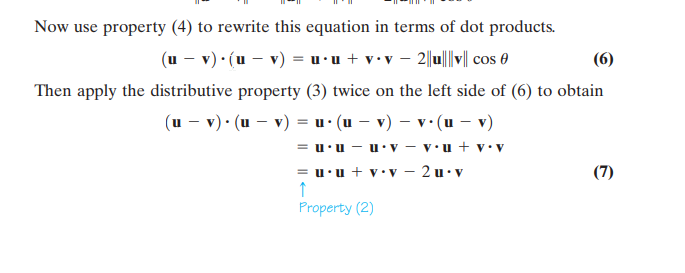
I get lost at the "Then apply the distributive property twice on the left side of (6):
minor arch
So Khan Academy explained the proof more clearly. But it seemed to have arrived at the proof through other means. Anyone knows wtf this book is saying?
Rofl no, I'm dumb. I got it now fr. The way they phrased it, I didn't realize that step 7 was only working on the left side and foiling it out. STUPID. I should be sleeping.
 weary torrent
minor arch
I get lost at the "Then apply the distributive property twice on the left side o...
weary torrent
minor arch
I get lost at the "Then apply the distributive property twice on the left side o...
They factored out the u-v twice
minor arch
weary torrent
They factored out the u-v twice
Yeah, TY. It makes sense. I was thinking about it too hard.
For that step, I thought that the righthand side was a simplification of the right handside for the version at (6). When they were just focusing on the leftside.
it says so plainly as well, but my mind didn't register that.
 lucid jasper
Find m,k in R s.t.
(y+mx)²=ky(3x+4y-9) is a circle.
 wide field

Why does the axial section of a cylinder, which is parallel to the cylinder axis, look like this?
Why is it parallel to the radius?
 bronze wind
Can someone tell me how to solve for X?
 wide field
I think I understand, I can move the virtual line to the radius as much as I like. And obviously, no matter how I draw the section, I can move the virtual line to the radius as much as I like. And it will always be parallel 😅
upper karma
bronze wind
Can someone tell me how to solve for X?
hellow their
so using the cosine rule
we can solve the angle of tirangle HLJ
and since angle H is equal to angle F
once we find the angle
we can use it to solve x by substitution into the sinerule
e is opp to andgle E
g is opp to x+2
$\frac{e}{sin(E)} = \frac{g}{sin(G)}$
somber coyoteBOT
Mr. Macro
 smoky jetty
bronze wind
Can someone tell me how to solve for X?
smoky jetty
bronze wind
Can someone tell me how to solve for X?
see if they're similar. If so, set ratios of corresponding sides in proportion
 shrewd prawn
Someone help please

 quiet sand
 fickle rose
shrewd prawn
Someone help please
fickle rose
shrewd prawn
Someone help please
honestly just use pythagorean theorem to find the height. normally u should use geometric mean especially if u have ugly numbers like that on the bottom but you don’t have enough lengths to do it
shrewd prawn
fickle rose
honestly just use pythagorean theorem to find the height. normally u should use ...
Can u tell me the answer at least?
 heady scaffold
shrewd prawn
Can u tell me the answer at least?
heady scaffold
shrewd prawn
Can u tell me the answer at least?
no
we arent allowed to
we have to have you work through it
shrewd prawn
Oh
 misty tusk
 cosmic ferry
not sure of the exact notation they want you to use but essentially its asking how you would map the points of one onto the other
so for an example lets take a point in Figure W and see where it is in Figure X
these two points here for example

we've got one at (-1, 5) and another at (4, -5)
now if we take a look at what's actually happening to the shape we can see that its reflected a few times across the x and the y axes
so in order to get (-1,5) to (4,-5) we can do a few transformations right
so the first thing I would do is flip it along the y axis and move it over

you can show that as
$$(x,y) \rightarrow (-x+3, y)$$
and if we apply this to (-1, 5) we can get the points (4, 5) which matches up with the blue outline shown above
somber coyoteBOT
architecture2
 misty tusk
now our next step is flipping the blue shape along the x axis, which can be done with a transformation of $$(x, -y)$$
somber coyoteBOT
architecture2
 misty tusk
and if we put these together we get a transformation of
$$(x,y) \rightarrow (-x+3, -y)$$
somber coyoteBOT
architecture2
 cosmic ferry
So reflect once over the y and once over the x?
misty tusk
really? thats. strange
cosmic ferry
It’s some practice website and that’s how they want us to do it
And the teacher wasn’t even here today to explain
So I’m lost
misty tusk
i don't see a faster way to do it than that ngl
 ornate lava
hey i need a confirmation for me answer:
find arc length of the sector where central angle is 3pi/8 and the radius is 18.2 cm
would the answer be 67.5/360 * 36.4pi
misty tusk
ornate lava
hey i need a confirmation for me answer:
find arc length of the sector where cen...
isnt arc length just the radius times the angle
so wouldn't it be 18.2*3(180)/8 cm
ornate lava
but that results in a number higher than 36.4pi
the circumference
i thought the formula was angle * circumference (2pi r)
so i tried doing the 3pi/8 which was 67.5
so is 67.6/360 x 36.4pi correct? or am i missing something here
misty tusk
ohhh i see what the problem is
its the conversion between degrees and radians
what unit does it want the answer in
ornate lava
uh my friend sent me the problem it doesnt really say
misty tusk
hmmm okay
ornate lava
but the idea is right correct?
find the angle measure and multiply it to the circumference
misty tusk
yeah that's right
just make sure the angle is a fraction out of 360
yeah sorry my mistake
you were right the first time
i just didn't really read it all that clearly
misty tusk
your answer above is in degrees but there's another answer in radians which is in terms of pi
ornate lava
6.825 pi cm is an answer right ?
misty tusk
yep
ornate lava
thank you
 gritty mulch
Why bother… when u can use this?


 vernal pilot
cosmic ferry
It’s some practice website and that’s how they want us to do it
vernal pilot
cosmic ferry
It’s some practice website and that’s how they want us to do it
have you by chance learnt about rotations?
bronze wind
smoky jetty
see if they're similar. If so, set ratios of corresponding sides in proportion
How would I solve it out if there is those 3 corresponding sides
fickle rose
bronze wind
Can someone tell me how to solve for X?
setup a proportion
set 2 fractions equivilant to each other
simplify each fraction as much as possbile to make it easier
then cross multiply and isolate for x
bronze wind
fickle rose
set 2 fractions equivilant to each other
what if its 3
fickle rose
bronze wind
what if its 3
what if what is 3
based on the congruent angle u can use that to figure out which sides should be proportional to each other
u may have to do a bit of testing i guess
 mint pebble
- (a) Using Euler's Graph Theory theorem, state why the following graph contains an Euler circuit. [5 marks]
(b) Use Fleury's algorithm to find an Euler circuit in the following graph. Note that full marks will only be given if the steps for Fleury's algorithm are given. Clearly list the order of the vertices visited in your circuit - e.g., abcdef.
marks]
 bronze wind
fickle rose
what if what is 3
bronze wind
fickle rose
what if what is 3
theres 3 sides with numbers
upper karma
Can Somebody roughly list Main topics/Things to know in vectors pre College
upper karma
Can someone help me in these problems?

 sinful junco

 toxic scarab
could you help me
 upper karma
toxic scarab
could you help me
upper karma
toxic scarab
could you help me
The first one you can to pythagoras to get OP first then use it again to solve for PN
OP^2+MP^2 = MO^2
Rearrange to find OP then use it to PN
toxic scarab
thx
toxic scarab
so its 25^2+7^2=25^2?

 upper karma
 midnight current
tangent is opposite over adjacent
toxic scarab
oh
 stiff otter
midnight current
stiff otter
midnight current
Tangent = Opposite/Addjacent
You're referencing from the perspective of angle A

So your triangle would be labeled like this.
Opposite is the opposite of angle A
Hypotenuse is always your longest side or the angle across from the right angle formed
And adjacent is whatever is left
Therefore tan(a) = 24/7
 tawdry pike
Who can help me

 fickle rose
tawdry pike
Who can help me
fickle rose
tawdry pike
Who can help me
find the length of the diagnosis of the parallelogram
ur able to easily find them
and Part B’s answer is already on the diagram
 grave nova
Is the largest angle of a triangle always opposite the largest side?
sick kraken
Im lost on this

 atomic merlin
how do i find the radius of a circle that touches the sides of the triangle (the one i just drew in)
 hard coral
I need some help regarding angles in 3 Dimensions. I have the correct angle for everything though the issue now is that, the x-component of the reflected vector is seemingly dependent on two angles for its correct x-component. The reflected vector is in Red and as you can see, the angle is nearly 270 yet the reflected vector looks as though its 225. This is because the x-component is following the angle of the normal vector in green, along the xy plane as shown in the second image of the top down view.


Though the x-component is in along the 180 line or the negative side of the x-axis which is correct, the angle from the x-axis on the XZ plane, should be around 630 degrees. How do I incorporate that into Rx so that way the reflection vector looks like its at 270 and not 225? I feel like I need two cos for one function but that obviously isn't correct at all. Could I get some help?

here is the paper work I did
 hard coral
nvm I solved it
upper karma
The detail consists of a cone and a hemisphere. The surface area of this part is 320 cm². The volume of the hemisphere is 2000pi/3 cm³. Calculate: a) the length of the radius of the hemisphere; b) the area of the lateral surface of the cone: c) the height of the cone to the nearest 0.1 cm.

I am a little stuck I get R = 10
b) 120pi
And then c) H = 0
I am doing something wrong I need help
 rugged hearth
atomic merlin
how do i find the radius of a circle that touches the sides of the triangle (the...
rugged hearth
atomic merlin
how do i find the radius of a circle that touches the sides of the triangle (the...
theres a lil soemthing called the incenter i think
and the incenter of a triangle is the midpoint of the largest circle that can fit in the triangle
and the diameter of the circle is 2/3 the length of the line from the incenter or 1/3
u gotta google it
 median vapor
hey so do we represent coordinate-plane curvature with a Capital Omega?
fickle rose
grave nova
Is the largest angle of a triangle always opposite the largest side?
yes
that’s a theorem
 maiden brook
toxic scarab
could you help me
maiden brook
toxic scarab
could you help me
for b, erect an altitude from C to AB. Does this necessarily have the same length as AD? What can u say about this quadrilateral, and use this to find BC. then find square simply
bruh "complex problem" smh
 coarse lance
is this a troll geometry problem?

 urban ivy
Yeah
 vagrant schooner
Do you think anyone can solve this?
 fast pasture
 obsidian harness
fast pasture
obsidian harness
fast pasture
in that circle, there are two right angles (CD is the diameter)
one 45 degree angle
and the other two angles are equal
the two angles sum to 360 - 180 - 45 degrees
fast pasture
obsidian harness
the two angles sum to 360 - 180 - 45 degrees
so the two angles measure 67.5?
@obsidian harness
obsidian harness
yes
fast pasture
aight thx
 ornate igloo
two concentric circles their radii is 12 , 7 respectively, AD is a chord of the bigger circle, A and D are points on the bigger cirlce, AD intersecting the smaller circle at point B, C respectively , prove that AB*BD = 95
Couldnt solve this in exam im in Grade 10
obsidian harness
ornate igloo
two concentric circles their radii is 12 , 7 respectively, AD is a chord of the ...
let the midpoint of AD (and of BC) be point M
then AM^2 + MO^2 = AO^2 = 12^2
and BM^2 + MO^2 = BO^2 = 7^2
the way to see this is that 12^2 - 7^2 = 95
so......
ornate igloo
obsidian harness
so......
isnt there any forced way to find AB or BD to prove AB*BD equals 95
because i dont understand how your solving proved it
obsidian harness
ornate igloo
isnt there any forced way to find AB or BD to prove AB*BD equals 95
because i do...
use my hint that 12^2 - 7^2 = 95 to see that
this is pretty close already
ornate igloo
obsidian harness
this is pretty close already
thank you from your hint i knew it after i factorize i conclude that AB*BD = 95
👍
obsidian harness
no worries!
hard coral
I need some help here. I have need the x-component of the red vector, to be at around 0. Or rather, the angle should be almost 90 as the Tau_r says it should. But is there any way I can rewrite R_x such that R_x is nearly 0 when θ_xz is nearly 90? I found that the way I have it, works but it requires me to manually switch sin(θ_xz) to cos(θ_xz) at certain angles that I don't know of. That disqualifies me using a piecewise function and that isn't the goal. I need some way to get the R_x function to be correct with two angles it seems. Any advice?


The Tau_r is just a way to display the θ_xz angle dw about it
Here are my x and y inputs. For context, this is for computing the reflection angle on a surface

This is the surface

thanks if anyone could help
gentle haven
I made a rotation function in which it gives you the point after rotating any point any angle around any coordinate.
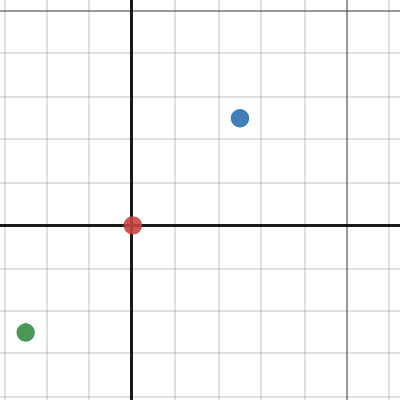
Desmos
 slow spruce
Is vertical angle congruence axiomatic and if not how do you prove it from axioms?
upper karma
slow spruce
Is vertical angle congruence axiomatic and if not how do you prove it from axiom...
It is not axiomatic and provable
slow spruce
@upper karma thanks for the reply
I'll see if I can do it from Euclid's when I feel up to it
upper karma

 opaque sluice
Hello
Can someone explain me how to know the projection of the cos in the sun according to the circle ?
For example, I'll take the equation : cos(x) = 1/2
What is the projection of 1/2 in the sinus axis according to the circle of trigonometry?
vernal pilot
opaque sluice
What is the projection of 1/2 in the sinus axis according to the circle of trigo...
are you just asking what $\cos(x)=\frac{1}{2}$ means?
somber coyoteBOT
TheLord26
 vernal pilot
or in general, what each of the trig functions are actually doing?
opaque sluice
No, like $\cos(x) =\frac{1}{2}\ = cos(x) = cos(\frac{π}{3}$
somber coyoteBOT
Meyland
Compile Error! Click the  reaction for more information.
(You may edit your message to recompile.)
 vernal pilot
$\cos(x) =\frac{1}{2}\ = cos(x) = cos(\frac{\pi}{3})$
somber coyoteBOT
TheLord26
 vernal pilot
Uhh, this is just trigonometry.
Basically think of x as the angle (usually its represented as theta). and the "1/2" as the adjacent side of a triangle divided by the hypotenouse.
then you solve using trig
what that pi/3 means is just 60 degrees.
but in radians.
$cos(\frac{\pi}{3})=\frac{1}{2}$
somber coyoteBOT
TheLord26
Compile Error! Click the reaction for more information.
(You may edit your message to recompile.)
 opaque sluice
 vernal pilot
yes.
opaque sluice
Wanna know how project the cos point into the sun axis
For example the square root of 3 divided by 2 is pi/6
vernal pilot
think of it as the xy plane. where any point is can pe represented with (sin(y),cos(x)).
and, in fact, if you graph $(\sin(\theta),\cos(\theta))$, you can find any point on the unit circle.
somber coyoteBOT
TheLord26

 worldly scroll
How can I deduce $\cos2a = 1 - \sin^2a using other identities?
,, \cos2a = 1 - \sin^2a
somber coyoteBOT
sb
 worldly scroll
By using the trigonometric identity cos2x=cos^2(x)−sin^2(x) , and other identities, find the positive expression for sin(A/2) in terms of cos(A) .
try putting theta for both x and y in the cosine double angle formula, and see whta you get
twin crag
OH SORRY @worldly scroll i meant angle addition formula for cosine cos(x+y)
 supple abyss
you don't because it isn't true 
twin crag
supple abyss
you don't because it isn't true <:swag:993176868750635138>
its cos^2x right
 limber kraken
Here I gota very cool trick for you guys: cos((180-a+b)/2) = sqrt( (sin(a)-sin(b))^2 + (cos(b) - cos(a))^2)/2 for all positive values of cos


the order is from l;eft to right like how you read english
limber kraken
twin crag
OH SORRY <@199347376874323968> i meant angle addition formula for cosine cos(x+y...
Oh yeah the fromula that I rediscovered... haha... anyway its cos(a)cos(b)-sin(a)sin(b)
limber kraken
somber coyote
**sb**
Ignoring compex values and using the formula for cos we we cos(a)*cos(a)-sin(a)*sin(a)=1-sin^2(a) we can calccel out the sin^2(a) and we get cos^2(a) = 1 which means a is 0,180 any anything after that added y 360 such as 360,540,etc.
 plain marten
somber coyote
**sb**
plain marten
somber coyote
**sb**
Thats not true. Its $\cos 2a = 1 - 2\sin ^{2} a$
somber coyoteBOT
Cherry Man

Cherry Man
Compile Error! Click the reaction for more information.
(You may edit your message to recompile.)

 bold sandal
isnt this a trig theorem for the 30 60 90 triangle?
limber kraken
somber coyote
**Cherry Man**
Its nota formula but a equation that is supposed to be solve if I am correct? its just find the value of a
obsidian harness
bold sandal
isnt this a trig theorem for the 30 60 90 triangle?
it's much more general than that
it works for any value of a
twin crag
bold sandal
isnt this a trig theorem for the 30 60 90 triangle?
i don'tt hink so
unless you're talking about the side ratios
 worthy python
Just aced my trig test guys
 lethal moss
nice
 celest wave
hi
someone help me please
i already got a few answers but i still need help plz i dont get it

 lean tartan
celest wave
i already got a few answers but i still need help plz i dont get it
lean tartan
celest wave
i already got a few answers but i still need help plz i dont get it
Boolean algebra
lethal moss
celest wave
i already got a few answers but i still need help plz i dont get it
Hi exloria.
From what I see you have found out that the triangle is equilateral. The thing you are missing is that every angle in such triangle has the exact same measure. Try to find it then.
celest wave
how
 vocal mauve
Equilateral triangles have 60 degrees for all angles
lethal moss
vocal mauve
Equilateral triangles have 60 degrees for all angles
... and bare in mind that BAC and ACB are both inner angles of this triangle (the 60 deg rule applies)
celest wave
so how do i find BAC? Do I have to add everything?
lethal moss
refer to what Salaam said earlier.
lethal moss
celest wave
so how do i find BAC? Do I have to add everything?
Is there something to clarify?
vocal mauve
What?
celest wave
because 60 + 60 +60 is 180