#geometry-and-trigonometry
1 messages · Page 21 of 1
 snow crystal
snow crystal
snow crystal
Right now I'm preparing for one, yeah
snow crystal
I have like 3 months left
snow crystal
 smoky jetty
national?
smoky jetty
national?
Yes
snow crystal
Also that exercise got my kind of confused cuz back when I was doing geometry in my school we would solve such problems doing the exact same thing I did (without giving the approximate result but the actual number even if it wasn't rational)
 pseudo viper
lol i definetly had no chance at solving that
 silk dove
@snow crystal i thiiink i see the mistake?
if there is
kinda forgot trig rules but one sec
snow crystal
huh
 silk dove
but consider this for any right triangle. if a = 30 deg, then that would mean AD = 8 which is not true
 snow crystal
wait I think I see the mistake
triangle DEF is not inscribed in any circle
So I cannot use law of sines like that
that makes sense now
silk dove
also
snow crystal
so I get that tan alpha = 1/2
silk dove
law of sine is kinda weird when not all of the sides are acute
snow crystal
you mean angles
silk dove
angles yeah my bad
snow crystal
I mean in this case it doesn't make any difference
silk dove
snow crystal
so I get that tan alpha = 1/2
we love that 26.57 degree angle 😭
silk dove
ill try tio like approximate some the solution bc thas just what we do
silk dove
snow crystal
naaah 💀
i got 1.252 which is like same thing that the other guy got, GGGYeah
snow crystal
cool
silk dove
would love to show you my solution if you like reading messy, sloppy, bad-pencil, cumbled-paper, incoherent, non-standard writing
snow crystal
I like challenges
you can post it here
yeah I did all the calculations and got ~ 1,25 as well
silk dove
snow crystal
you can post it here
Too embarassing may I dm you
snow crystal
sure
smoky jetty
thats nice of yall
smoky jetty
silk dove
i got 1.252 which is like same thing that the other guy got, GGGYeah
how long did it took u get?
i realized earlier than u could straight up go to SSS law of sine case to ease the calculation a bit
pseudo viper
what's there to learn trig wise after learning the core trig functions & how to use them to find sides / angles + law of sine / cosine?
 weary hound
silk dove
law of sine is kinda weird when not all of the sides are acute
weary hound
silk dove
law of sine is kinda weird when not all of the sides are acute
I guess this is because of the property that sin(x)= sin(π-x) so you have to find if the angles are acute or not
snow crystal
pseudo viper
what's there to learn trig wise after learning the core trig functions & how to ...
sketching graphs of trig functions, solving trig equations and inequalities
(for example)
smoky jetty
yeah, or maybe if u have a trig book, dig into those lessons
silk dove
weary hound
I guess this is because of the property that sin(x)= sin(π-x) so you have to fin...
yea
pseudo viper
snow crystal
sketching graphs of trig functions, solving trig equations and inequalities
hmmmm
I will look into that
trig book might be useful
only rly learning trig rn for game dev stuff
smoky jetty
ooh interesting
snow crystal
pseudo viper
only rly learning trig rn for game dev stuff
wow I'd never think that would actually come inhandy in life
smoky jetty
snow crystal
wow I'd never think that would actually come inhandy in life
Joe casted a shadow extending 2 met-
 tardy plover
is that a homework question?
snow crystal
smoky jetty
~~Joe casted a shadow extending 2 met-~~
LMAOO
weary hound
Avg homework question stereotype where you have to find how close Joe is to the lämp and stuffs
Honestly I wish they could provide an example of how math is used irl
But yeah that's why universities exist probably
tardy plover
people use it to calculate the height of buildings by looking at the building's shadow
no one does that, but that's what its used for apparently
 vivid plinth
pseudo viper
only rly learning trig rn for game dev stuff
vivid plinth
pseudo viper
only rly learning trig rn for game dev stuff
what game are u making?
pseudo viper
vivid plinth
what game are u making?
not making any game rn at this time
but realised i need to scratch up on my math skills
pseudo viper
weary hound
Honestly I wish they could provide an example of how math is used irl
this is why i struggled a lot in school
- they just sucked at teaching people that have any sort of different thought process
weary hound
pseudo viper
this is why i struggled a lot in school
+ they just sucked at teaching people th...
What do you expect, school is standardized, also has to differentiate student with grades, and it's very slow to change the legislation or something
pseudo viper
i understand why it is the way it is
doesn't change the fact that it sets up a lot of students for failure
smoky jetty
what grade are u in rn?
weary hound
smoky jetty
what grade are u in rn?
University freshman
I'm here because I'm mostly bored
smoky jetty
oh lol
 cyan crow
What are euclids postulates
 grave pond
That's something Google is good at answering.
 fiery oriole
is sin^2 x the same as (sin x)^2 or sin(x^2)?
snow crystal
sin^2 x = (sinx)^2
 velvet lark
This question came up in my precalc course (not on a quiz or anything graded, but as a practice question), and im completely at a loss when it comes to solving it. can someone help?
 smoky jetty
the tan function gives u the ratio of opposite side and adjacent side. Now, it asks for the value of the ratio of secant function in the third quadrant. What do u know about the sides in the third quadrant?
 topaz panther
A frame in the shape of an equilateral triangle encloses three circular discs of radius length 5 cm so that the discs touch each other. Find:
a. the perimeter of the smallest frame which can enclose the discs
b. the area enclosed between the discs.

I got the perimeter but I am completely lost on what to do for area
smoky jetty
topaz panther
A frame in the shape of an equilateral triangle encloses three circular discs of...
what does it mean by the smallest frame?
(for b) If the area asks for this area, then I think u can find the area of the equilateral triangle such that adding the area of those sectors with degree measure of 60 each, and that area x is equal to the area of the scaled-down triangle

u could refer to the radii as lengths of the triangle
topaz panther
thank youu
velvet lark
smoky jetty
the tan function gives u the ratio of opposite side and adjacent side. Now, it a...
Would this be how you would solve it? Or did I make a mistake

 warm warren
i think i found the mistake, the theorem says that the sin formula can be used for triangle which belongs to circle but the one you did that for(4/sin(a)=8) is wrong bc its half of it
snow crystal
yeah I already found that yesterday
warm warren
ooh then sorry i just saw it
isn't tho? i think its a simple question which requires trained eye to these kind of problems so you can pave your way and draw extra lines
ooh i love these questions, my favourite one is this
 smoky jetty
velvet lark
Would this be how you would solve it? Or did I make a mistake
smoky jetty
velvet lark
Would this be how you would solve it? Or did I make a mistake
seems about right
velvet lark
ok thank you!
 sharp lodge
<@&286206848099549185>

 novel scaffold
if (sinx)^n = sin^n(x) then why isn't (sinx)^-n = sin^-n(x)
snow crystal
because (sinx)^-n = (1/sinx)^n
snow crystal
because if you raise a number to a negative power you get its reciprocal
novel scaffold
hmm
but then technically (sinx)^-n = sin^-n(x) is correct too
you could just evaluate sinx first and then reciprocal
snow crystal
novel scaffold
but then technically `(sinx)^-n = sin^-n(x)` is correct too
but sinx is a single term
you can't break it into pieces like that
snow crystal
novel scaffold
but then technically `(sinx)^-n = sin^-n(x)` is correct too
wait , you mean this? $\sin^{-n}\left(x\right)$
 somber coyoteBOT
iammax420
 snow crystal
but sin^-n (x) means the same as 1/sin^n (x)
they may look different but it's exactly the same thing
novel scaffold
someone said u can't write it like that
novel scaffold
a friend
he asked teacher, teacher said it's some binomial stuff
idk
welp thanks
snow crystal
take arcsin for example
this is the inverse function to y = sin x
and arcsin is basically sin^-1 x
which is (sin x)^-1
novel scaffold
hm yeah
novel scaffold
snow crystal
which is (sin x)^-1
wait how
that's 1/sinx
which is different than arcsin
snow crystal
yep
novel scaffold
snow crystal
yep
and 1/sinx isn't the same as arcsinx
snow crystal
oh wait lol
snow crystal
turns out 1/sin x=csc x
novel scaffold
eeee
snow crystal
ok my bad apparently
so turns out sin^-1(x) is not equal to (sin x)^-1
interesting
snow crystal
ohhh wait that makes sense

so basically sinx=b/a
(sinx)^-1 = 1/sinx = a/b
which is csc x
same thing with other trig functions
novel scaffold
yeah ik that
novel scaffold
novel scaffold
why isn't (sinx)^-n equal to that
but what's the explanation behind this
snow crystal
ok I think I know now
sin^-1 x is the inverse of the result of sin x
whereas (sin x)^-1 is the inverse of sinx
novel scaffold
u said opposite
(sinx)^-1 is inverse of result of sinx which is basically 1/sinx
that's all sorted out
what I'm asking is
why isn't (sinx)^-n = sin^-n(x) just like (sinx)^n = sin^n(x)
(sinx)² = sin²x but this doesn't work when u replace 2 with -2
why is that
what's the reason
snow crystal
hmm
 royal scarab
novel scaffold
what's the reason
royal scarab
novel scaffold
what's the reason
actually the formula has a condition that says n must be a Natural Number. That's why (sin x)^n = sin^n(x) is only applicable for n = 1, 2, 3, 4.........
Hope it helped your doubt
royal scarab
Idk the exact reason of this rule. But (sinx)^-2 is just simply written (cosec x)^2 or cosec^2(x) and not sin^-2(x)
the reciprocal of sine function has a separate denotion "cosec". That's why we don't need to write sin^-2(x) separately
royal scarab
actually it has nothing to do with arcsin x or sin inverse. cosec and sin are inter-related but arcsin is not related like that
arcsin is the inverse of the sine function. The -1 on sin in arcsin or sin inverse denotes the inverse the function. For example f^-1(x) is the inverse of f(x) not reciprocal
snow crystal
ok but it is related to the question that they asked
because sin^-1 x = arcsin x
and that got him confused
royal scarab
snow crystal
and that got him confused
haha the confusion is too common. I also had the same two years ago
snow crystal
tbf I haven't even studied this "inverse trig functions" thing so I shouldn't have said anything lol
snow crystal
royal scarab
Idk the exact reason of this rule. But (sinx)^-2 is just simply written (cosec x...
also I'll ask my teacher about it
royal scarab
snow crystal
tbf I haven't even studied this "inverse trig functions" thing so I shouldn't ha...
i see. inverse trig function is not that hard by the concept tho. Questions can be
royal scarab
snow crystal
also I'll ask my teacher about it
good! if possible let me know too what he thinks about it
snow crystal
I will
novel scaffold
snow crystal
because sin^-1 x = arcsin x
nah not that
arcsin is fine
its inverse of sin
novel scaffold
novel scaffold
why is that
i want the reasoning behind this
novel scaffold
royal scarab
Idk the exact reason of this rule. But (sinx)^-2 is just simply written (cosec x...
but why
whats the reason that (sinx)² = sin²x is only valid for natural numbers
why cant u do the same with negative integers
royal scarab
novel scaffold
why cant u do the same with negative integers
i can't provide exact mathematical or logical answer to this question. you can take it like a tradition/manner/rule to write or denote like this
snow crystal
snow crystal
also I'll ask my teacher about it
As I mentioned before
I will let you guys know as soon as I find out
novel scaffold
okie
snow crystal
Funny thing is that there is plenty of "honorable people" or sum other graduates on this server that can easily answer this question but for whatever reason they won't
That would save us some time
snow crystal
Neither can I
silk dove
royal scarab
actually the formula has a condition that says n must be a Natural Number. That'...
where did u even hear that
this is the first time im hearing that
actually kinda makes sense cause of sin^-1(x)
if i had to guess i would say that its just a convention
damn not even desmos lets me try

 wind coral
silk dove
damn not even desmos lets me try
wind coral
silk dove
damn not even desmos lets me try
If you want sin^a(x) in desmos try sqrt(sin(x))^2a. They are similar except for the fact desmos won't show an accurate graph.
 pseudo nebula
Notation for sin makes no sense
silk dove
wind coral
If you want sin^a(x) in desmos try sqrt(sin(x))^2a. They are similar except for ...
I was just playing around with the notation but thank you nevertheless
pseudo nebula
silk dove
if i had to guess i would say that its just a convention
I assumed so too
the notation is just weird
vivid plinth
I always just read sin²x as (sin x)²
I don't encounter cases with the notation sin^a(x) other than sin²(x) often, so I never rly thought abt it
In the case of $\sin^{-1}(x)$ I just naturally assume arcsin
somber coyoteBOT
utopian_vision

 south helm
novel scaffold
why isn't (sinx)^-n = sin^-n(x) just like (sinx)^n = sin^n(x)
south helm
novel scaffold
why isn't (sinx)^-n = sin^-n(x) just like (sinx)^n = sin^n(x)
There is no reason. This is a question of notation, not on the properties of the sine function. You can do this, and nobody is going to scold you, as long as it is clear from context what you mean. The problem with this method of notation is that sin^(-1)(x) is already used for something: arcsin, the inverse function. And, in general, f^(-1)(x) is usually used for the inverse function, while f(x)^(-1) is the reciprocal. But arcsin(x) is already an alternate notation, so you are free to use sin^(-1)(x) as notation for 1/sin(x) all you want, as long as it is clear to the reader that is the notation you are going with. But, at the end of the day, you can avoid all of this by simply using sin(x)^a. That is absolutely unambiguous. Yes, it means you have to use parentheses, because sin x^a is also ambiguous (it could be sin(x^a) or sin(x)^a), but it avoids all of these issues, nonetheless.
south helm
royal scarab
actually the formula has a condition that says n must be a Natural Number. That'...
Who told you this, or where did you read that? How is that even a "formula"?
novel scaffold
south helm
There is no reason. This is a question of notation, not on the properties of the...
hmm
royal scarab
south helm
Who told you this, or where did you read that? How is that even a "formula"?
My maths teacher told me this 3 years ago that n must be a Natural number. But I read your explanation too. Your's is more clear. It's just a matter of convenience as long as the reader can understand what I am trying to convey
novel scaffold
makes sense
novel scaffold
royal scarab
My maths teacher told me this 3 years ago that n must be a Natural number. But I...
they probably told that as a convention
cuz you dont usually do (sinx)^-n = sin^-n(x)
royal scarab
novel scaffold
cuz you dont usually do (sinx)^-n = sin^-n(x)
yeah, you are right. It's all just convention
 hollow dust
wind coral
If you want sin^a(x) in desmos try sqrt(sin(x))^2a. They are similar except for ...
hollow dust
wind coral
If you want sin^a(x) in desmos try sqrt(sin(x))^2a. They are similar except for ...
or sin(x)^a
 deft drum
If we have 3 position vector points on the plane, we can find two displacement vectors. Then we find normal vector $\vec N$, and to find equation of plane $\vec N \cdot (\vec r - \vec r_1) =0$ is done. I have problem understanding why we have to find the normal vector to plane.
somber coyoteBOT
tbhaxor
 deft drum
If we have two vectors $\vec S_1$ and $\vec S_2$ we can consider them as basis vector and span the whole plane. Why do we need normal vector, this part is bugging me.
somber coyoteBOT
tbhaxor
 deft drum
What I think is that, its related to how the plane lies in the space. In 2D we describe line by two points specficially touching the x and y axis. Similarity here in 3D, when we have plane there are infinite ways of its orientianation which also changes with perpendicular vector (aka normal vector).
If this is wrong, please correct me
south helm
deft drum
If we have two vectors $\vec S_1$ and $\vec S_2$ we can consider them as basis v...
You do not have to find the normal vector. A parameterization works just fine. But it is a natural choice for a single equation form. The short answer is because the equation is defined by N dot R = 0. The presence of a dot product equaling zero should clue you in that there is some sort of orthogonality relationship at play.
The long answer is as follows: We desire that $\vec{N}\cdot \vec{r}=\vec{N}\cdot \vec{r}_1$. Thus, a particular solution for $\vec{r}$ is going to be $\vec{r}=\vec{r}_1$, and the rest can be obtained from a linear combination of vectors in the kernel of the linear transformation $\vfunc{f}{\bR^3}{\bR}{\vec{x}}{\vec{N}\cdot\vec{x}}$. That is, vectors orthogonal to $\vec{N}$. Since we defined $\vec{N}$ as being orthogonal to the $\vec{S}$ vectors, then this equation describes exactly the plane spanned by the $\vec{S}$ vectors, which passes through $\vec{r}_1$.
somber coyoteBOT
st.jamie.

 upper karma
can someone help me with these

 grizzled breach
upper karma
can someone help me with these
grizzled breach
upper karma
can someone help me with these
- Then OP is congruent with PN.
Oh wait. It is asking for angles haha.
upper karma
grizzled breach
Oh wait. It is asking for angles haha.
yea i think sso
grizzled breach
upper karma
yea i think sso
Do you see that in 7, segment LM and segment MN, both are congruent and related and both have the M? So using that, then we can also say that the answer for 7 is then : angle LMN is congruent to angle NML.
upper karma
grizzled breach
Do you see that in 7, segment LM and segment MN, both are congruent and related...
ohhh
grizzled breach
Do you see it?
grizzled breach
upper karma
NPO is congruent to OPN?
I wouldn't say you are wrong, but I don't think they are asking for the angle (you are giving angles as answer). The are givving you the angles for you to give them the segments (the inverse of number 7)
Give them the segment of line that are congruent. The connecting point is P which I think you notice already.
upper karma
grizzled breach
I wouldn't say you are wrong, but I don't think they are asking for the angle (y...
oh so what should i give as an asnwer then?
grizzled breach
What is the opposite segment of the angle PNO?
upper karma
grizzled breach
What is the opposite segment of the angle PNO?
ONP?
grizzled breach
upper karma
ONP?
ONP is an angle, not a segment (segment are described by 2 points, angles are described by 3 points)
What is the opposite segment of the angle PNO?
What is the opposite segment of the angle PON?
upper karma
grizzled breach
What is the opposite segment of the angle PNO?
PON?
upper karma
grizzled breach
What is the opposite segment of the angle PON?
PNO?
grizzled breach
upper karma
PON?
PON is an angle. I am not askin for the angle but for the segment of line opposite to the angle PON.
upper karma
grizzled breach
PON is an angle. I am not askin for the angle but for the segment of line opposi...
ohhh
wait I don't understand
I'm very bad at this topic
upper karma
grizzled breach
What you dont understand?
the oppsite segement stuff
grizzled breach
Ok, in the picture, if you see ccarefully, look at the angle MNL. What is the opposite segment of line of that angle?
The answer is LM
Or ML.
LM is a segment of line.
upper karma
grizzled breach
What is the opposite segment of the angle PNO?
so this is PO?
upper karma
ahhh
grizzled breach
You have to be careful and be very strict with the definitions.
upper karma
grizzled breach
You have to be careful and be very strict with the definitions.
yea i see that now
upper karma
upper karma
can someone help me with these
so for 8 It's PO congeuent to segment OP?
grizzled breach
upper karma
so for 8 It's PO congeuent to segment OP?
No. But PO or OP is correct inthe first blank space if they are asking for line segments.
grizzled breach
upper karma
so for 8 It's PO congeuent to segment OP?
PO or OP is the segment opposite tot the first angle, What is the opposite segment of the angle PON?
upper karma
oh
upper karma
grizzled breach
PO or OP is the segment opposite tot the first angle, What is the opposite segme...
PN?
upper karma
PO is congruent to PN
grizzled breach
upper karma
PO is congruent to PN
Yes, that should be fine but a cleaner answer (a little detail in the order) would be: OP is congruent to PN
upper karma
grizzled breach
Yes, that should be fine but a cleaner answer (a little detail in the order) wou...
ohhh okay
Thank you.
 shadow plover
In 11 look at the sides how do you go from 16 to 12
upper karma
shadow plover
In 11 look at the sides how do you go from 16 to 12
what do you mean
snow crystal
upper karma
it's 16:12
I mean there not corresponding
you have 8:4
but you also have 16:12
the ratio is not the same
snow crystal
snow crystal
the ratio is not the same
what does this mean to you?
upper karma
snow crystal
what does this mean to you?
the ratio's are unequal
snow crystal
so are the triangles similar?
upper karma
snow crystal
so are the triangles similar?
no
snow crystal
there ya go
upper karma
ohhh
so
for the answer
i just write the ratios aren't the same, therefore the triangles aren't similar
what about 12
snow crystal
what can you say about 12
upper karma
one triangle is smaller than the other
snow crystal
what about the angles
upper karma
they arent the same either
upper karma
right angle?
snow crystal
nope
 upper karma
um wait lemmie check
shadow plover
snow crystal
what do you call these angles in english?
vertical angles
upper karma
snow crystal
what do you call these angles in english?
vertical?
upper karma
yeah
snow crystal
and also the ratios of corresponding sides are the same
10/24 = 15/36
which means ...
upper karma
there similar
snow crystal
yep
snow crystal
np
 gaunt lotus
snow crystal
what do you call these angles in english?
gaunt lotus
snow crystal
what do you call these angles in english?
Opposite
 night idol
How would I solve for x and y without using trig like without SOHCAHTOA

 silent plank
pythag
shadow plover
night idol
How would I solve for x and y without using trig like without SOHCAHTOA
Use 9^2 + b^2= 15^2 then use that information to solve bc
 gaunt orbit
 wanton shell
<@1072150835565428826>
wanton shell
<@1072150835565428826>
see what
smoky jetty
night idol
How would I solve for x and y without using trig like without SOHCAHTOA
might have done a more rigorous approach but, you can find the side of DC using pytha, then find length of DB using pytha again and subtract it to DB from DC. Then, find area of triangle DBA and subtract it from the area of triangle DAC. Finally, the area of triangle ABC is equal to (x*AC)/2
 night idol
smoky jetty
might have done a more rigorous approach but, you can find the side of DC using ...
night idol
smoky jetty
might have done a more rigorous approach but, you can find the side of DC using ...
Woahhhhh
That actually makes sense, THANK YOU
smoky jetty
np!
upper karma
snow crystal
what do you call these angles in english?
vertically opposite angles
 hardy night
smoky jetty
might have done a more rigorous approach but, you can find the side of DC using ...
hardy night
smoky jetty
might have done a more rigorous approach but, you can find the side of DC using ...
u can find BC by use 2 similar triangles DBA and FBC. It's faster
smoky jetty
hardy night
u can find BC by use 2 similar triangles DBA and FBC. It's faster
thought of that as well, but how could we prove that they are similar?
silent plank
AA
smoky jetty
but wouldnt it require to do the sohcahtoa thing?
silent plank
no
smoky jetty
how come
hardy night
smoky jetty
thought of that as well, but how could we prove that they are similar?
it's too easy. You cann't prove it ??
hardy night
silent plank
vert angles + right angles
yeah, that's right
smoky jetty
silent plank
vert angles + right angles
oh right, lol my bad for not seeing it
yeah that's surely a better way
 tardy swift
trig is hard
pseudo viper
would cross product fall under geometry?
weary hound
Perhaps but isn't that more of vectors
pseudo viper
hm true
 west lintel
does anyone know where I can get a ti 84+ for the cheapest price possible or a ti inspire for the lowest price
upper karma
how would i do these

 gilded hatch
upper karma
how would i do these
gilded hatch
upper karma
how would i do these
Which one?
Use for the tasks 14 and 15 the intercept theorem 🙂
upper karma
gilded hatch
Use for the tasks 14 and 15 the intercept theorem 🙂
idk that
gilded hatch
Hmm I see
For 13 you can use the pythagorean theorem
Do you know that?
$a^2+b^2=c^2$
somber coyoteBOT
gilgamesh5000

 gilded hatch
ye
gilded hatch
Yes
gilded hatch
You have the value for h 😁 it's 12
upper karma
gilded hatch
You have the value for h 😁 it's 12
ohhh
gilded hatch
You can only solve for x😁
gilded hatch
$20^2 = 12^2 + x^2$ solve it
somber coyoteBOT
gilgamesh5000
 upper karma
how
gilded hatch
$20^2 = 12^2 + x^2 \mid -12^2 \ 20^2 - 12^ 2 = x^2 \
400 - 144 = x^2$
somber coyoteBOT
gilgamesh5000
 gilded hatch
Now you can calculate
upper karma
somber coyote
**gilgamesh5000**
yea so 400-144=256
and the 256=x^2, so u square root 256 to remove the ^2 from the x
and you get 16
gilded hatch
Yes
upper karma
ahhh
gilded hatch
x=16 is your final answer
upper karma
yes
upper karma
upper karma
how would i do these
do i do the same with 14 and 15?
gilded hatch
upper karma
do i do the same with 14 and 15?
With intercept theorem
upper karma
gilded hatch
With intercept theorem
what's that
upper karma
upper karma
what's that
do you still need help?
smoky jetty
gilded hatch
For 13 you can use the pythagorean theorem
it'd only work if they're right triangles right? tho not indicated that theyare
 lapis torrent
Someone please suggest me some good geometry problems.
smoky jetty
look up AOPs problems
upper karma
upper karma
do you still need help?
no i finally understood it lol

 last quiver
you can use thales theorem for part a
sharp lodge
thalas..?
 languid pawn
If three points A, B, and C lie on the circumference of a circle, whereby the line AC is the diameter of the circle, then the angle ∠ABC is a right angle (90°).
last quiver
it can be done with Pythagoras theorem as well
last quiver
Considering O as origin , can you figure out the angle BOC ?
BC = 3cm
Radius = 3cm
OB = 3cm
What triangle is this ?
sharp lodge
last quiver
What triangle is this ?
a right angled.. according to part a
NOO its not right angled
idk whut it is
this is why i hate math
last quiver
Ahh sorry I didn't specify properly, what triangle is BOC
sharp lodge
but isnt the question asking for abc..?
 cerulean robin
sharp lodge
<@&286206848099549185>
cerulean robin
sharp lodge
<@&286206848099549185>
I know you are asking for help, but don't spam @ Helpers (sorry helpers discord automatically joined the mention).
Spam in this server is usually defined as more than once per 15 minutes, refer to #info - rules
sharp lodge
cerulean robin
I know you are asking for help, but don't spam @ Helpers (sorry helpers discord ...
oh srry i didnt knw that
last quiver
sharp lodge
but isnt the question asking for abc..?
Yes but it's a step to reach the answer
sharp lodge
last quiver
Yes but it's a step to reach the answer
ohh
cerulean robin
sharp lodge
oh srry i didnt knw that
no problem
 magic otter
it can be done using straight lines
sharp lodge
this is so confusing 😭
last quiver
We need to figure out the coordinates of point C and in order to do that first we try to figure out that the triangle BOC is equilateral triangle (and argue that the x coordinate of C lies midway on x-axis) and then apply Pythagoras theorem to figure out the y-coordinate of point C
sharp lodge
last quiver
We need to figure out the coordinates of point C and in order to do that first w...
ohh
last quiver
Although I'm not sure if there's a shorter (and easier) way to do this.
last quiver
sharp lodge
ohh
So can you figure out what (type of) triangle BOC is (given that BC = BO = OC = 3cm) ?
sharp lodge
but the problem is we dont knw what type of triangle it is
magic otter
sending solution in 5 min . please wait .
last quiver
sharp lodge
but the problem is we dont knw what type of triangle it is
hmm it's a equilateral triangle since all sides are equal
sharp lodge
last quiver
hmm it's a equilateral triangle since all sides are equal
how do uk all sides are equal tho..?
last quiver
sharp lodge
how do uk all sides are equal tho..?
It's given BC = BO = OC = 3cm
sharp lodge
theey only gave bc
last quiver
sharp lodge
theey only gave bc
Yes and the radius is 3cm which gives the length of other two sides (which are radii themselves)
sharp lodge
OHH
last quiver
So can you now figure out what's the x-coordinate of point C ?
sharp lodge
is it 1.5?
last quiver
Yes
sharp lodge
so AB= 6 and bc = 3
we can use phytogoras theroem ..?
oh nvm we dont need to find AC

 lusty acorn
lapis torrent
sharp lodge
lusty acorn
lapis torrent
sharp lodge
If c is not point a or b , then acb = 90
cerulean robin
sharp lodge
<@&286206848099549185>
This is closer to correct usage, but we request that you wait 15 minutes after posting your question at least before you DM someone.
sharp lodge
cerulean robin
This is closer to correct usage, but we request that you wait 15 minutes *after ...
it already was 15 mins bro
lapis torrent
Bro the bot is cracked
 runic crag
sharp lodge
it already was 15 mins bro
runic crag
sharp lodge
it already was 15 mins bro
15 minutes after posting your question.
runic crag
sharp lodge
What part do you not understand?
sharp lodge
runic crag
15 minutes *after posting your question*.
OH
sharp lodge
runic crag
What part do you not understand?
c
runic crag
Oh. Just convert m/s to km/h and calculate both of their distances, then find the distance between them.
Since they've been moving from 12:00 to 12:30, time elapsed is 1/2 hour.
If you've still got doubts, ping me.
sharp lodge
runic crag
If you've still got doubts, ping me.
okay
runic crag
Have you got doubts?
sharp lodge
how to convert into km/h ....i forgot..
runic crag
,tex $\frac{xm}{1s}=\frac{\frac{x}{1000}km}{\frac{1}{3600}h}=3.6\cdot\frac{xkm}{1h}$
@sharp lodge
sharp lodge
okayy
somber coyoteBOT
rageiplier

 marsh pagoda
gilded hatch
marsh pagoda
gilded hatch
The angle between h and x is not said to be 90°
upper karma
Gang what do l have to do here to find the diameter
 silent plank
<@&268886789983436800>
wind coral
<@&268886789983436800>
grave pond
Oh, they spammed in multiple channels and then left.
smoky jetty
a fun geometry problem I found online

solved it in 15 mins, actually easier than I expected. I bet yall could get it faster
smoky jetty
upper karma
Gang what do l have to do here to find the diameter
are 1,6 and 0,6 the midpoints?
 foggy parcel
smoky jetty
a fun geometry problem I found online
foggy parcel
smoky jetty
a fun geometry problem I found online
oo the shit's crazy af
goin to grab some papers
 carmine crag
GH is of 1 unit
draw a line parallel to gh from b it will be of same length
consider the point where the line from b cuts GC E
wait whats the length of GC and HB
 flat kelp
 floral shale
How much you wanna bet it's just 48


 fluid stream
What do you know about the angles of a parallelogram
 rustic yew
fluid stream
Anything else?
rustic yew
fluid stream
Anything else?
uh angle a + angle b = 180 degrees
fluid stream
Yes that's what you get from one, now you can solve for x
And then you can write the other one and solve for y
 keen gorge
confused
smoky jetty
foggy parcel
nah basically that's the one lol
which one?
 timber cargo
smoky jetty
a fun geometry problem I found online
timber cargo
smoky jetty
a fun geometry problem I found online
I got 37.12594146315
upper karma
smoky jetty
are 1,6 and 0,6 the midpoints?
GC length is 1,6 and BH length is 0,6
 clear remnant
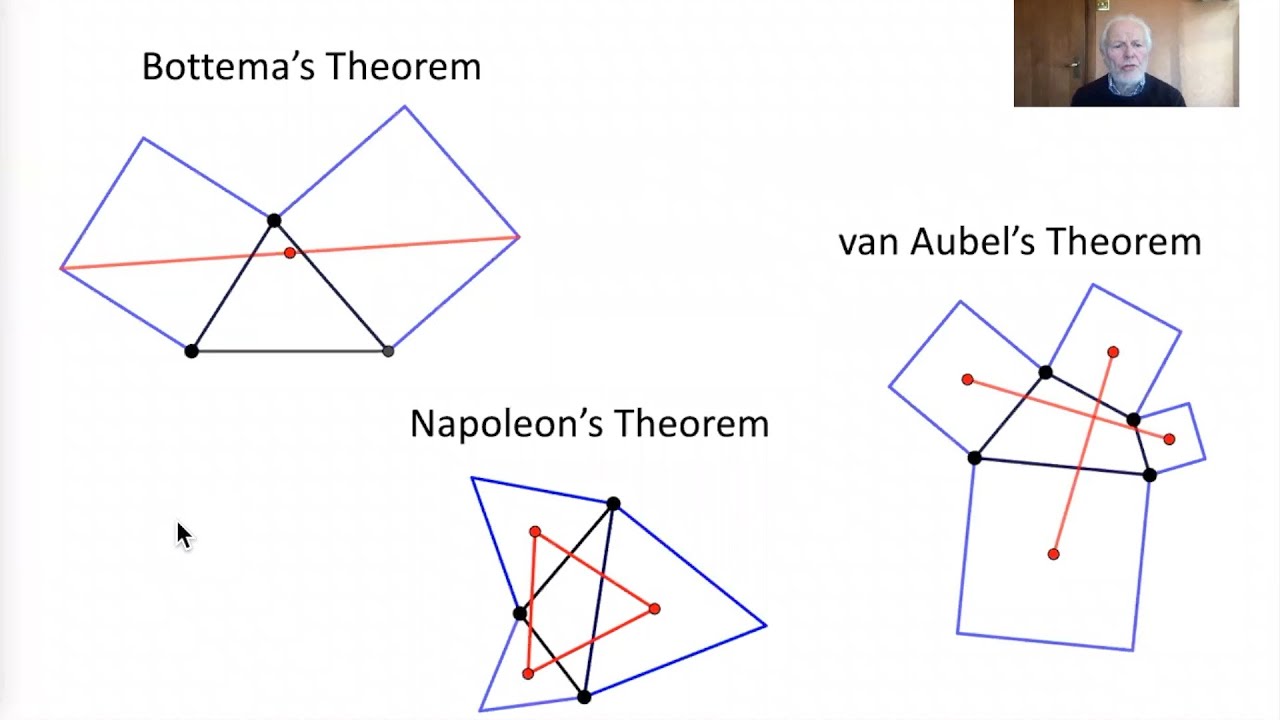
Bottema'a theorem, van Aubel's theorem and Napoleon's theorem, are all brilliant. If you have never seen them before, you will be amazed! I prove then all by working in the complex plan, as van Aubel did in 1878.
upper karma
rustic yew
how do u do this?
Adjacent Angles Of Parallelogram Is Always 180 Degrees
 sturdy dawn
 errant lake
cant u just Google it

I Need help with this problem
this is what I’ve done so far

And btw there’s no trig involved cuz the lesson is geometrical transformations like rotation translation dilation and stuff like that
grave pond
I don't see how you can hope to end up with degrees without doing some trig along the way.
upper karma
errant lake
💀
 spring oxide
errant lake
spring oxide
errant lake
First thing what number is larger ET or TF?
smoky jetty
timber cargo
I got 37.12594146315
not quite, but can you show your sol?
timber cargo
smoky jetty
not quite, but can you show your sol?
Yesterday, I realized that I made a mistake on that problem
Quite early into it
but I'll redo it
smoky jetty
ight gl!
 upper karma
 dull light
uh look at the side ratio
dull light
uh look at the side ratio
i am
 smoky jetty
what do u know about similar figures' properties?
specifically, what is the relationship between fig 1's angles and sides to fig 2's?
upper karma
smoky jetty
what do u know about similar figures' properties?
all the angles are congruent
like all corresponding angles
smoky jetty
how about the sides?
smoky jetty
the corresponding sides are proportional
u can think of it like this, the figures are like the images u scale up or down in MS Word
upper karma
smoky jetty
u can think of it like this, the figures are like the images u scale up or down ...
yeah okay
so i make an equation
smoky jetty
yeah
smoky jetty
smoky jetty
the corresponding sides are proportional
.
smoky jetty
now u could set ratios that would make them in proportion
and frmo the given figure, u can have more than one approach, as long as they are in proportion
upper karma
so like x=16, 38=19 right?
smoky jetty
clearly, 38 is not 19 isnt it?
upper karma
smoky jetty
clearly, 38 is not 19 isnt it?
yea
smoky jetty
right, so what ratios of corresponding sides do u think could u set in proportion?
meaning the value of their ratios would give the same answer/quotient
upper karma
smoky jetty
meaning the value of their ratios would give the same answer/quotient
um idk
im lost
smoky jetty
i.e what sides from the larger figure is comparable to the smaller figure?
upper karma
x and 16?
upper karma
38 and 19
upper karma
smoky jetty
and a way we could compare things is by setting a ratio
yea
smoky jetty
and when ratios are in proportion, it means that the two set of things that we compare are equal. Simply an equation of ratios
upper karma
upper karma
how do i do this
the answer is B
upper karma
smoky jetty
and when ratios are in proportion, it means that the two set of things that we c...
yea
smoky jetty
upper karma
the answer is B
yup, and could u explain how u were able to get it?
upper karma
smoky jetty
yup, and could u explain how u were able to get it?
I guessed cuz the time was gonna end
smoky jetty
ohh, lmao i didnt expect that
upper karma
smoky jetty
ohh, lmao i didnt expect that
hahaha I was lucky
I'm gonna study my mistakes tho
smoky jetty
but i'd suggest at least reading more about it on the internet or wherever u could, coz u seem to be confused on similar triangles
yeah that'd help surely
upper karma
smoky jetty
but i'd suggest at least reading more about it on the internet or wherever u cou...
yea i don't understand them at all
i got all the similar triangle questions wrong
smoky jetty
u can look up khan academy and browse videos all about similar triangles, they're free online
smoky jetty
upper karma
i got all the similar triangle questions wrong
did u listen in class? or there was some trouble u encountered while it was being discussed
upper karma
smoky jetty
did u listen in class? or there was some trouble u encountered while it was bein...
it's an online course
so there is no class
just work
smoky jetty
oh
upper karma
but the hw she gave us was so easy
and this assinment was sm diff than the hw's she gave
smoky jetty

Khan Academy
Learn for free about math, art, computer programming, economics, physics, chemistry, biology, medicine, finance, history, and more. Khan Academy is a nonprofit with the mission of providing a free, world-class education for anyone, anywhere.
smoky jetty
upper karma
and this assinment was sm diff than the hw's she gave
welp, might be a call to look into it deeper
upper karma
smoky jetty
welp, might be a call to look into it deeper
yea i will


 trail trellis
 elfin osprey
I struggled with these too lol
elfin osprey
what should i do lmao theyre so hard
elfin osprey
yeah
trail trellis
Did you learn theorems for it
elfin osprey
a few but not enough for me to do this problem correctly
i'd know how to put the theorems down once i heard them but i dont know what to look for yk?
idk the first step
and i dont know theorems well enough to do it in reverse
elfin osprey
yeah side angle side, you can tell if two triangles are congruent if they share a side, an angle, and another side. right?
trail trellis
Yes
I think you would use these so first say that Angle RYM and Angle TYN are vertical angles i guess
And Angle MYT and RYN are vertical too
I would start from that
elfin osprey
ok let me write that down
trail trellis
Oh wait sry im wrong i think
elfin osprey
yeah im trying to figure this out it doenst sound right lol
i need to prove that rym and ryn are congruent
trail trellis
yes
elfin osprey
and then triangle rny and rmy share TWO SIDES because ry!
trail trellis
yes
elfin osprey
lemme write this down un momento
elfin osprey
wait i think thats it
trail trellis
Angle MYT plus Angle RYM would be 180 degrees right
trail trellis
Oh?
elfin osprey
yeah i meant triangle
trail trellis
trail trellis
Angle MYT plus Angle RYM would be 180 degrees right
i think we had a way to prove from this

 peak siren
da fuq is an angle
elfin osprey
which means
angle rym and ryn are congruent
and thats
two sides and an angle?
my=ny, ry, and rym/ryn
SAS?
trail trellis
elfin osprey
which means
Yeah i think how to solve this is right
trail trellis
Yay
elfin osprey
 trail trellis
elfin osprey
tysm
trail trellis
elfin osprey
tysm
Np!
elfin osprey
and if bmi and kmt are congruent,
then thats
ok so ipk and tpb share ip and tp
tpb contains tp
and ipk contains ip
and theyre congruent
so thats a side
trail trellis
Wait Angle B and Angle K is
elfin osprey
oh yeah cuz those are congruenbt
elfin osprey
i can figure those out with google those arent the issue lol
trail trellis
Oh okok lol
We can't do ASS so we would need one more angle
so that we could do AAS
elfin osprey
side pk and bt are congruent
right
couldnt it be sas? side 1: ip and tp, angle b and k and side pk and bt
trail trellis
Why pk and bt?
elfin osprey
bmi and kmt are congruent
and ip and pt are
so adding the same length to the same lenght
wqait
i said the wrong thing
pk and bP
trail trellis
Yes that would be right, but i think that would be ASS
elfin osprey
i dont get the difference lol? if you have two sides and an angle cant that just be sas? like what determines that
anyway
heres the next one

yo.
this is easy
wait
triangle must add up to 180
trail trellis
elfin osprey
i dont get the difference lol? if you have two sides and an angle cant that just...
If the side is next to the side it would be ss if there is an angle next to the side it is sa
trail trellis
elfin osprey
triangle must add up to 180
yes
elfin osprey
trail trellis
If the side is next to the side it would be ss if there is an angle next to the ...
ok lets do this easy one and go back to that
trail trellis
elfin osprey
ok lets do this easy one and go back to that
okkk
elfin osprey
that should be fine
trail trellis
am i allowed to ask what grade u do geometry
elfin osprey
yeah so normally it would be 10th or 11th at my school, but im in a faster and higher course so for me im taking it my freshman year, but for most else they take it 10th or 11th
trail trellis
wow
elfin osprey
a lot of people will be doing algebra in freshman yeaer
while i did that this past year
trail trellis
so u in 9th?
elfin osprey
yeah
trail trellis
ME TOO
elfin osprey
YO
trail trellis
but im in algebra2 lol
elfin osprey
yeah im taking that 10th lol
elfin osprey
makes sense lmao
everyone in my grade is either algebra which i took last year or algebra 2 which i take next year
cuz im doing honors geometry freshman year
elfin osprey
in the middle
elfin osprey
wdym
trail trellis
cuz im the only one in algebra2 in my grade
trail trellis
YES
trail trellis
ohhh
trail trellis
thats nice
elfin osprey
but i did algebra t/a eight grade, which means i go to geometry, not algebra two. so basicallty the seventh graders who were in my class this year are a year ahead of all of us
and two years ahead than the normal math people
elfin osprey
yeah im rlly scared tho. only because of these damn proofs theyre so hard
trail trellis
IKR PROOFS ARE SO HARD
trail trellis
okkk
 trail trellis
lol
elfin osprey
xjk and xjk triangles and angles are congrent
lamo
jesus
wait
xjk
and
xjf
there
elfin osprey
lmao
trail trellis
so J is the midpoint?
trail trellis
yay
elfin osprey
let me see if i have more tho
trail trellis
okkkk
elfin osprey
idt i have more proofs but i def got more work
trail trellis
okk
elfin osprey
heres the thing my tutor
assigned me those proofs
and then gave me some other pdf but he never said what to do in it
trail trellis
elfin osprey
and then gave me some other pdf but he never said what to do in it
What lol
elfin osprey
lemme text him
trail trellis
okk
 atomic osprey
If I have a circle lying on a larger sphere say on the southern hemisphere and I know that the circle has circumference 10, how can I figure out the distance from the south pole to a point on the circle? From the circumference I can find that the radius of the circle is 5/pi, but I think I would also need something else to find the distance.
 lilac cave
Hello
timber cargo
smoky jetty
not quite, but can you show your sol?
This is what I got, approximately: 36.53096278
I found the equations for the quater circles and integrated with respect to each of the functions and bounds
errant lake
grave pond
I don't see how you can hope to end up with degrees without doing _some_ trig al...
how bout u actually think and try before u say such statements
u can use 30,60,90 triangles to solve this problem by rotating the figure 90 degrees counter clockwise
which is what I partially did before u said what I was doing what hopeless

 errant lake
upper karma
💀
errant lake
upper karma
💀
what r u laughing about
 upper glen

my solution
I'll use Google Translate to explain but I don't know if it will translate correctly
first I used marlen's theorem to find the other segment that also contains 2V3, such a theorem says that the sum of the squares of these segments generated by the opposite vertices are equal, in this case for example I said that V6 for the square plus 3V2 for the square was equal to 2V3 for the square plus x for the square such x that gave 2V3 as well, This theorem holds only for when we have a quadrilateral with all its internal angles worth 90 degrees, a rectangle
after that I noticed several congruences of triangles but the one that will serve me is the one that says that the EFT triangle is congruent to the EHT triangle, because it will tell me that those angles described will be worth 45 degrees each
congruence by SSS
I connected a segment of the vertex T next to the square doing 90 degrees
after that I noticed an isosceles triangle 90,45,45 and calculated its sides, I found that they were worth V3 and then in the other right triangle I used Pythagoras and found that the other side that was missing was 3, and this way we discovered a triangle 90,60,30 and solved the problem
 balmy dragon
 smoky jetty
errant lake
smoky jetty
errant lake
seems pretty cool
smoky jetty
timber cargo
This is what I got, approximately: 36.53096278
yep! thats correct
timber cargo
smoky jetty
yep! thats correct
Yeah, how did you approach it? Did you do what I did as well
smoky jetty
My approach was this: Get the area of the segment of the quarter circle with radius=8 and subtract the area of segment of the quarter circle with radius=4 from it. Next, get the area of the segment of the quarter circle with radius=12, and subtract the area of the quarter circle with radius = 8 from it. Finally, add the 2 areas we've got, i.e 22.84 unit^2 + 13.69 unit^2. Hence, the shaded area = 36.53 unit^2.
 frozen ocean
 indigo escarp
I need help pls
indigo escarp
I need help pls

 rustic yew
elfin osprey
yeah so normally it would be 10th or 11th at my school, but im in a faster and h...
rustic yew
elfin osprey
yeah so normally it would be 10th or 11th at my school, but im in a faster and h...
im taking geometry in 7th grade, is that normal?
timber cargo
smoky jetty
My approach was this: Get the area of the segment of the quarter circle with rad...
Yeah, it was a fun problem

 onyx basin
do you know the sum of angles inside a triangle?
 hoary dove
yes 180
onyx basin
ye
hoary dove
x is 90
onyx basin
yep
hoary dove
what are the others lol
onyx basin
this forms a triangle in of itself

you know x is 90
and you also know that another angle is 70
and that x + y + 70 = 180
so what would y be?
onyx basin
yes and yes
elfin osprey
rustic yew
im taking geometry in 7th grade, is that normal?
in my school thats not even possible
rustic yew
elfin osprey
in my school thats not even possible
lol
my county allows u to go 2 years ahead in math after 6th grade and I am taking extra summer school to get another yr ahead
elfin osprey
what country might that be lol
rustic yew
if ur wondering why im doing this, its because im indian this is very normal
rustic yew
elfin osprey
what country might that be lol
this is america
rustic yew
elfin osprey
i am too
then u must be a doctor or IT employee eh?
elfin osprey
yeah no i get it im doing the entire honors geometry course right now before school even starts so i can stay ahead
nah nah im a hs
rustic yew
elfin osprey
nah nah im a hs
ok
rustic yew
elfin osprey
yeah no i get it im doing the entire honors geometry course right now before sch...
good luck having headaces
elfin osprey
yeah :/ this sucks ass im literally sitting here right now doing points of concurrency
rustic yew
elfin osprey
yeah :/ this sucks ass im literally sitting here right now doing points of concu...
very simple, I learnt this in kindergarden
elfin osprey
aint no way
rustic yew
elfin osprey
aint no way
did u forget, im indian
elfin osprey
damn im not that indian
rustic yew
I would have been slapped my parents and grandparents if I refused
and my great grandparents would have rised from the grave
elfin osprey
jesus
 tribal rover
Can someone explain this please
 upper karma
tribal rover
Can someone explain this please
upper karma
tribal rover
Can someone explain this please
Cos of an angle is always equal to the adjascent side/hypotenuse..
Therefore cos 60°=Adjascent side to the angle 60°(1 unit)/Hypotenuse(2 units)
Which is equal to ½
 ember stratus
P, Q, R and S lie on the circle O ( r ) and are the points of tangency of O 3 ( r 2 ), O 4 ( r 2 ), O 5 ( r 3 ) and O 6 ( r 3 ), as shown.
O 1 ( r 1 ) and O 2 ( r 1 ) are tangent to each other and are tangent to O 3 ( r 2 ), O 4 ( r2 ), O 5 ( r 3 ) and O 6 ( r 3 ), as shown.
Find r 1 as a function of l and L .
 upper karma
oh wow im doing geometry over the summer to get ahead too lol
i guess it is a pretty common idea
 median vapor
Hey so I know that you have the standard trig functions and then hyperbolic trig functions (represented by slapping an h to the end of normal trig functions). Are there any other trig functions that follow the naming convention of slightly modifying the spelling of the base trig ratios?
upper karma
this question is the hardest question of this year's hong kong diploma of secondary education exam, involving coordinate geometry and trigonometry
the marking scheme is still classified and therefore hk students cannot get them
how will you answer this question if you were the students sitting in that exam?

 languid olive
math
 exotic yarrow
upper karma
this question is the hardest question of this year's hong kong diploma of second...
exotic yarrow
upper karma
this question is the hardest question of this year's hong kong diploma of second...
Here’s my first impressions:
(a) Straightforward, observe that Q is the midpoint of PR
(b) (i) Angle between two lines formula
(b) (ii) Straightforward
(b) (iii) Angle bisector theorem then find the incentre. Then, do shoelace formula.
Maybe there’s a better way, but that’s my first thoughts
Ok I just did it, turns out that O, Q, G, I, H are collinear
Heights are the same because Q is a midpoint, so 11/12 (compare horizontal distance)
upper karma
I hate this class
frozen ocean
it's my favourite class 💜
 raw cobalt
could someone help me doe this
 upper karma
raw cobalt
could someone help me doe this
upper karma
raw cobalt
could someone help me doe this
m<GME intercepts the big arc GE which is 164 + 62 = 226. Since m<GME is an inscribed angle, it means that it is half the angle it intercepts. 226 / 2 = 113
 heavy crow
upper karma
m<GME intercepts the big arc GE which is 164 + 62 = 226. Since m<GME is an inscr...
heavy crow
upper karma
m<GME intercepts the big arc GE which is 164 + 62 = 226. Since m<GME is an inscr...
!nosols
 lime crownBOT
upper karma
m<GME intercepts the big arc GE which is 164 + 62 = 226. Since m<GME is an inscr...
lime crownBOT
upper karma
m<GME intercepts the big arc GE which is 164 + 62 = 226. Since m<GME is an inscr...
As a helper, please do not give out answers that could be copied as a homework solution. Have the student work through the problem themselves and guide them along the way.
upper karma
Oops, sorry about that
 tame dove
 sleek inlet
HOW DO I DO 17 AND 20

 dark sparrow
@sleek inlet DO YOU STILL NEED HELP WITH THESE
AND WHY ARE YOU YELLING
IN ANY CASE, THE SOLID IN #17 IS A BOX WITH A PYRAMID STUCK ON TOP OF IT, WHILE THE ONE IN #20 IS A BOX FROM WHICH THE PYRAMID HAS BEEN CUT OUT!
IN THE SECOND CASE THE BASE OF THE PYRAMID IS A SQUARE, AND ITS APEX IS PRESUMED TO LIE ON THE BOTTOM FACE OF THE CUBE!
 thin locust
ive heard that the reason why you cant prove the pythagorean theorem with a lot of trigonometric stuff is because a lot of trigonometric formulas are based om the pythagorean identity (sin²x + cos²x = 1) which is based on the pythagorean theorem (-> cyclic proof)
but cant you avoid this by proving the pythagorean identity using eulers formula which you can prove with a derivative
or is the proof for the derivative of sin and cos also based on the pythagorean thworem which would make it cyclic again
?
like
sin²x + cos²x = (cosx +isinx)(cosx - isinx) = e^ix * e^-ix = 1
 nocturne remnant
What if:
Define e^x using power series
Define sin and cos using e^ix
Then everything should be good
heavy crow
nocturne remnant
What if:
Define e^x using power series
Define sin and cos using e^ix
Then every...
yeah this works. I did it a few years ago, it's interesting. you can define cos and sin as the real and imaginary parts of e^ix and prove that they describe trigonometry. weirdly, you can also define pi in terms of e as making α the first positive zero of cos. then you can prove that the radius of a circle is 4αr=2pi r which means α=pi/2. something like that I may have the exact details wrong
I actually started by defining $L(x) \defeq\int_0^x\frac{\dd t}{t}$, showing it's inverse $E(x)$ is exponential in nature, defining $e\defeq E(x)\implies E(x)=e^x$ and going from there.
somber coyoteBOT
nixxy nilpotent (raving lunatic)
 heavy crow
etc. I did it because I thought it was weird that the Taylor series definitions for sin and cos would describe trigonometry, and i wanted to know why.
 warped bone
sleek inlet
HOW DO I DO 17 AND 20
warped bone
sleek inlet
HOW DO I DO 17 AND 20
 frozen ocean
warped bone
frozen ocean
warped bone
!nosols
lime crownBOT
warped bone
As a helper, please do not give out answers that could be copied as a homework solution. Have the student work through the problem themselves and guide them along the way.
 violet kiln

How can this question have 2 answers
I found that x=30
But in the ms it's written 30 AND 210
So how come 210 is an answer???

This is the ms for the question
How is x=30 and x=210 ???
 lost marlin
30° is a notable angle and you can see the 210° on a trigonometric circle
Btw, you also could have thought what angle that it sin divided by it cosine is equal to 1/sqrt3. You would find the exact same answer
Draw a line that tangent the 0°. The tangent of each angle will be where its extension touches. For example. Take the 210° and draw a straight line all the way to the right. You’ll see that it will pass right over the 30°, so its tangents are equal
 snow crystal
violet kiln
So how come 210 is an answer???
snow crystal
violet kiln
So how come 210 is an answer???
because tangent has a period of pi, so it has the same value every 180 degrees
smoky jetty
violet kiln
This is the ms for the question
How is x=30 and x=210 ???
afaik tan of 210 and 30 degrees are equal?
30 degrees is the reference angle of 210 in the 3rd quadrant, right?
 warm bramble
violet kiln
So how come 210 is an answer???
warm bramble
violet kiln
So how come 210 is an answer???
Basically you have tanx=tan(π/6) so x=kπ+(π/6) with k being an integer but now you need to find k
It also gives you that x is between 0 and 360 or in other words 0 and 2π
With that in mind you have 0<=kπ+(π/6)<=2π
If you keep going to solve for k you get -1/6<=k<=11/6
Now combining that with the fact that k is an integer the only options are k=0 and k=1 so you go to x=kπ+(π/6) and replace k with 0 and 1 to find the 2 results
(εφx is tanx, εφθ is tan(any number) and θ is well, any number)

As a simpler answer you can say that tanx=tan(π/6) and keeping in mind that tanx=tan(x) or tanx(π+x)
The answer kinda depends on the material you've covered as well
warped bone
violet kiln
So how come 210 is an answer???
 upper karma
 lost marlin
yes, that's correct
upper karma
Thx
 whole venture
Is there any derivation of the trig functions which doesn't require analysis to understand
 prisma wolf
i need help
whole venture
Don't we all
frozen ocean
prisma wolf
i need help
!help
lime crownBOT
prisma wolf
i need help
Please read #❓how-to-get-help

 sacred aspen
 sullen isle
Hello all! I'm having trouble seeing why this construction works

Any help would be appreciated!
 polar current
i’m confused on how to solve for the lowest part of the roof and idk if i did it right
 somber coyoteBOT
jahobinthehomeless

 sweet linden
 somber coyoteBOT
jahobinthehomeless

 untold crypt
We know that the number of degrees of an n sided object is 180*(n-2)
But we also know that a circle has 360 degrees
And a circle has infinitely many sides
As n approaches infinity, [180(n-2)] approaches infinity, so how can a circle have 360 degrees?
Like this is a hectogon, a 100 sided object

It has 17640 degrees
 somber dome
isnt that a circle?
lost marlin
untold crypt
We know that the number of degrees of an n sided object is 180*(n-2)
when we talk about 180(n-2), we are talking about the sum of the intern angles, that are formed by the vertices of a convex polygon. The 360° degrees in a circle corresponds to the central angle. they just have different natures
if you divide a circle in 4 identical parts, and take those lines you used to divide and put them all together, you’ll be able to form a square
i’ll try to illustrate
see those lines? the ones that forms 4 90° degree angles?

imagine they’re 4 lines, not 2. they’re all the exact same size. if you rearrange them, you’ll have a perfect square
warm bramble
prisma wolf
CD is an altitude, that's given
Since it's an altitude on a line, it cuts the 180 degrees in 2, so D (of triangle ADC) = D (of triangle BDC) = 180/2 = 90 degrees so DACD and ACBD are right triangles
We know that sinA=opposite/hypotenuse. The opposite of A is CD or in other words h while the hypotenuse of the triangle ADC is b so sinA=h/b
With the same logic for the triangle BDC sinB=h/a
Using that sinB=h/a you can get a(sinB)=h if you just multiply both sides by a and the same goes for sinA=h/b which, if multiplied by b gets b(sinA)=h
You have that both a(sinB) and b(sinA) are equal to h so a(sinB)=h=b(sinA) so a(sinB)=b(sinA)
For the last one you use what we just proven above [a(sinB)=b(sinA)] and you just devide both sides by a*b which gets
a(sinB)/ab=b(sinA)/ab
On the first part the a is simplified and on the second one b
so sinB/a=sinA/a