#geometry-and-trigonometry
1 messages · Page 19 of 1
 tribal sequoia
 frail ridge
Hello geometry
I have a pretty difficult problem
So I have a figure that shows three parallel lines cut by a traversal

All the angles have linear binomial measures
To get the value of the variable, I need to find a way to make angle 3 equal to angle 2
Since angle 4 has y as its variable unlike angle 2 and 3 where its x
 smoky jetty
the only way I could think of is if angle 3, 2, and 4 and their respective supplementary angles (summing up to 180 degrees) is bisected by the transversal of the 3 parallel lines
giving you x=y=180/2 ??
 upper karma
Help

 exotic yarrow
upper karma
Help
exotic yarrow
upper karma
Help
Adjacent angles in a parallelogram are supplementary, so ||x+(x+30)=180||
upper karma
exotic yarrow
Adjacent angles in a parallelogram are supplementary, so ||x+(x+30)=180||
So the answer would be 150.-.
exotic yarrow
upper karma
So the answer would be 150.-.
That's the value of 2x, not x.
exotic yarrow
👍
 fiery oriole
upper karma
Help
fiery oriole
upper karma
Help
a = c and d = b based on it being a parallelogram
oh hold on it was answered nvm
upper karma
fiery oriole
a = c and d = b based on it being a parallelogram
Thx for the other hint though
 fiery summit
 trim dirge
for this problem would I have to divide 630 by tan(50) or multiply 630 by tan(50)

 floral shale
trim dirge
for this problem would I have to divide 630 by tan(50) or multiply 630 by tan(50...
floral shale
trim dirge
for this problem would I have to divide 630 by tan(50) or multiply 630 by tan(50...
Drawing the scenario will help
upper karma
 upper karma
Hi guys!! I need some help with my geometry review packet, right now we are on a unit about area, volume, and surface area! If someone could take a look at these problems and show me how to do it step by step that would be super helpful! No worries if your not up to doing the entire packet, anything would be great! Some of the problems have some of my work but I don't think I did any of it right. Thank you!


 storm portal
upper karma
Hi guys!! I need some help with my geometry review packet, right now we are on a...
storm portal
upper karma
Hi guys!! I need some help with my geometry review packet, right now we are on a...
I’d start by asking and sending 1 Q at a time
upper karma

 upper karma
storm portal
I’d start by asking and sending 1 Q at a time
upper karma
storm portal
I’d start by asking and sending 1 Q at a time
Sorry about that! These are the two questions I’m having the most difficulty with
upper karma
-5, -3
- is negative points, - is positive points
Second one, use 180 and subtract whatever arcs you need to find
KJL is major arc
Find angle G
360- angle G = KJL
180 - 72 - 30 = JK
upper karma
tribal sequoia
which question
27 and 29
tribal sequoia
upper karma
27 and 29
Use trig ratios to solve
 tender urchin
uhm
 pliant nest
Hey, how does one calculate the Volume of a Triangular Prism when the base has no defined height?
How’d I be able to calculate the area of the base (triangle) without knowing the height, only the length of the three sides and that it has a 90 degree angle?
Like in this example below.

Like damn, I know I shouldn’t be struggling since calculating Volume is so easy and I have 0 problems whatsoever with the other problems
 dark sparrow
the base is a right triangle tho
so you can take its legs as the base and height...
or yknow
see the right triangle as half (in the literal sense) of a rectangle @pliant nest

 plain burrow
upper karma
plain burrow
upper karma
two add up to 180
 upper karma
test
 blazing basalt
does anyone know a website i can use to plot a bunch of circles of different sizes?
i have the x, y and radius values
upper karma
blazing basalt
i have the x, y and radius values
No 💀💀
blazing basalt
😭
pliant nest
dark sparrow
so you can take its legs as the base and height...
Okay, so basically:
B = 4 x 3
B = 12 mi squared
V = 12 x 5
V = 60 mi cubed
or half of that which would be 30 mi cubed?
But uh…the answer is somehow supposed to be 10 mi cubed.
upper karma
pliant nest
Okay, so basically:
B = 4 x 3
B = 12 mi squared
V = 12 x 5
V = 60 mi cubed
or...
Thx
dark sparrow
pliant nest
Okay, so basically:
B = 4 x 3
B = 12 mi squared
V = 12 x 5
V = 60 mi cubed
or...
the volume of a pyramid is one-third of the product of its base area and height.
 stuck oak
Why is the restriction for arctan or any inverse trig function based around the origin or 0
For example, arctan domain is from -pi/2 to pi/2
Why don’t we go from 0 to pi instead
 silent plank
For example, arctan domain is from -pi/2 to pi/2
did you mean range?
stuck oak
I do realize that the the horizontal line y=0 would pass 2 points but still
stuck oak
silent plank
> For example, arctan domain is from -pi/2 to pi/2
did you mean range?
Umm
I thought it’s now domain
Ok nvm
I meant range
I mistyped that
silent plank
convenience, continuity
stuck oak
silent plank
convenience, continuity
I sorta understand convenience but continuity would still work in my case no? 0<y<pi

 tardy yacht
i dont understand solving for trigonometric equations, especially in the negative domain. like why is there a billion different ways to figure out different questions. how am i supposed to get it right each time. it just doesnt feel like theres a single process and when i figure out a process for one question its all stuffed up for another question
silent plank
show specific examples
there's no one size fits all formula/process
understand the basic principles and apply those to your problems
tardy yacht
 silent plank
show your attempt
tardy yacht
My working is very messy and all over the place and some incompleted, I apologise for the inconsistency. Many attempts have been put in the bin. The last one is a successful attempt. I’ve been focusing on tantheta=-1


 silent plank
which question are you focusing on atm
tardy yacht
g) tantheta=-1
silent plank
can you post the attempt for that only separately
tardy yacht
the attempt has been posted in the first picture for tanx=-1.
silent plank
not sure what you're doing with neg domain
tardy yacht
putting negatives in front of it
silent plank
the angles for every quadrant you set up should pretty much be the same
tardy yacht
I don't understand
 tardy yacht
tan is negative in the second and fourth quad
silent plank
yes
tardy yacht
and then when you want to find a negative angle you put a negative in front of each thingy and reverse the
i dont even understand what im saying
places where tan is negative
silent plank
theta = arctan(-1) = -arctan(1) = -45°
 silent plank
well arctan(-1) gets you -45° directly already
tardy yacht
wait i remember my teacher said to just change it to positive because negatives are too difficult or annoying to deal with
silent plank
and to get other solutions you can add integer multiples of 180°
tardy yacht
I get that
But how will I know that's all the possible answers?
and I tried that on another question with a negative angle and it was wrong. I think it was 4e, tant=-1/sqrt3 which is -30
and that's not true I just contradicted myself.

I'm not even sure what I'm doing wrong
silent plank
-30
yeh, that's one of the solutions,
and +180° to get the other
tardy yacht
The pieces seem to be coming together but I'm sure it will come crashing down.
Like for example this, it was provided by my teacher in an example but I don't understand it
 silent plank
what about that don't you understand
tardy yacht
the negative angles
silent plank
think of it more as the rotation from the positive x-axis
i'll make some adjusments
tardy yacht
the 4th quadrant is initially 360-t but I would think to put a negative in front to make it -(360-t) = -360+t?
tardy yacht
silent plank
i'll make some adjusments
Thank you
silent plank
 pliant nest
dark sparrow
the volume of a pyramid is **one-third** of the product of its base area and hei...
pliant nest
dark sparrow
the volume of a pyramid is **one-third** of the product of its base area and hei...
Huh? Oh shit, it’s a Triangular Pyramid 😹, I forgot the fact it’s 1/3rd of a Triangular Prism
Like how a Cone is 1/3rd of a Cylinder
My bad, thanks G
silent plank
the 4th quadrant is initially 360-t
all the signs are already accounted for
pliant nest
upper karma
Thx
Wdym? I fked it up lol
silent plank
if you're using a reference/related acute angle,
you apply the - to that to get a position in Q4
e.g. with
tan(t) = -1
the reference angle would be arctan|-1| = arctan(1) = 45°
and you apply the - to the 45°, to get the result of -45° for Q4
alternatively you could subtract 45° from 360° to get 315°
which is co-terminal with -45°
however 315° isn't in the desired interval
upper karma
how do i remember all trig functions behaviours?
tardy yacht
silent plank
e.g. with
tan(t) = -1
the reference angle would be arctan|-1| = arctan(1) = 45°
...
wait back up on the absolute value with arctan why are you doing that
silent plank
for the reference angle / related acute angle you take the magnitude to work with positive values as per your teacher's recommendation
and then apply signs and/or quadrant shift afterwards
depending on what you started with
tardy yacht
but wouldn't that get confusing
silent plank
not really
pliant nest
pliant nest
Hey, how does one calculate the Volume of a Triangular Prism when the base has n...
So essentially this is:
B = (4)(3)/2
B = 12/2
B = 6 mi squared.
V = (6)(5)/3
V = 30/3
V = 10 mi cubed.
Got it, thank’s Ann. 💗
I can’t believe how I didn’t realize that it’s a Triangular Pyramid and not Triangular Prism 😅
tardy yacht
silent plank
not really
i follow a little bit but not enough to put it into practice
silent plank
do you have any issue for non-negative values?
 urban raft
can i get a function to plot a spring like structure in three dimensional space ,
tardy yacht
silent plank
do you have any issue for non-negative values?
no
silent plank

the k above is the reference / related acute angle,
i.e. the acute angle between the terminal side and the x-axis
inverse-trig-function |your value|
gives you that angle
and getting the angles in your desired quadrant is pretty much
applying angle addition/subtract
and 360° in a full revolution

 grave pond
You will continue to be lost unless you actually explain what you're lost with.
 junior pine
OH SORRY
HAHA
ok so basically
I think I understand trig but thing is
How Dyu know what t label it
Yk how ders sin cos tan

Like da frik is dis wan
Cus icl all of them look disame
Da only topics I don’t get is trig n geo🥲
 vocal cloud
junior pine
vocal cloud
junior pine
do you need to find theta?
 vocal cloud
junior pine
Theta?
vocal cloud
junior pine
Theta?
its the angle you have marked witha 0 with a dash through it
junior pine
Oh hahyah
vocal cloud
its called theta
vocal cloud
you need to find that correct?
junior pine
Like u can’t tell me dis looks all disame
 vocal cloud
junior pine
Like u can’t tell me dis looks all disame
vocal cloud
junior pine
Like u can’t tell me dis looks all disame
it does but you get used to it
junior pine
🥲
vocal cloud
Do you have the length of the 3 sides?
vocal cloud
the hypotenuse, opposite and adjacent
vocal cloud
ok good
Now
lets use
trigonometry to find out angle
(il call theta x cos idk how to put it on keyboard)
junior pine
Oki
vocal cloud
We have all 3 so we can use any of the sin,cos or tan
I will use tan
TAN(X)= Opposite/adjacent
correct?
junior pine
How Dyu even know t use tan
vocal cloud
You can use any of them in this case
vocal cloud
junior pine
How Dyu even know t use tan
Look at the information theyve given you
vocal cloud
Do you have the length of the sides of the hypotenuse, opposite or adjacent
junior pine
Idk do I💀
vocal cloud
do you have a number labeled next to them? or in the book does it?
junior pine
I do
vocal cloud
Then you do
vocal cloud
 junior pine
Wait
vocal cloud
just reposting
vocal cloud
and lets say you are under a building
and its the same shape as that triangle the area you are standing in
What are you seeing is opposite or facing you
vocal cloud
i am horribel at explaining lol
vocal cloud
ah i see
junior pine
see I’m in foundation level for a reason💀
Foundation level is baby maths
Idk why they have trig in der
vocal cloud
foundation level?
junior pine
Yeah
vocal cloud
what country are you in
junior pine
Ireland
vocal cloud
yeah ikr
vocal cloud
i got jc in a5 days
vocal cloud
MY GUY
junior pine
😭😭
vocal cloud
TRIG IS SO EASY
vocal cloud
alr
junior pine
MATHS IS HARD FOR MY NON EXISTENT BRAIN
vocal cloud
fair enough i understand that
grave pond
Indoor voices, please.
vocal cloud
idk how to explain this
junior pine
See dis is why I wud never graduate as a maths degree
 vocal cloud
yes
junior pine
Now what am I gonna look at here💀
vocal cloud
what side are you looking at
junior pine
Like where I’m standing at x or?
vocal cloud
junior pine
Now what am I gonna look at here💀
imagine ur under a building
at x
what do you see
junior pine
 junior pine
Ehm
vocal cloud
Is it opposite yours eye or is it next to it?
junior pine
Yes…no?…idk🥲
vocal cloud
oh dear
junior pine
Allow man
vocal cloud
i am
 gaunt lotus
Hint it starts with o
vocal cloud
yep for jc
junior pine
Ffs higher level ppl
junior pine
gaunt lotus
Hint it starts with o
Huh
vocal cloud
meet my lord and saviour

This math video tutorial provides a basic introduction into trigonometry. It covers trigonometric ratios such as sine, cosine, and tangent. It explains how to evaluate it using right triangle trigonometry and SOHCAHTOA. In addition, it explains how to solve the missing sides of triangles and how to find the missing angles using inverse trig f...
junior pine
LMAO
vocal cloud
the organic chemistry tutor
junior pine
😭😭
vocal cloud
he saved me
junior pine
Imagine I’d die laughing if we’re neighbours
vocal cloud
from going to ordinary
vocal cloud
junior pine
Imagine I’d die laughing if we’re neighbours
hehe
junior pine
Yeah sure
vocal cloud
try understand the video i sent
junior pine
Okie
vocal cloud
good luck for LC mate
 vocal cloud
do you do geo or history for lc
junior pine
History
vocal cloud
is it hard?
junior pine
Yes💀
vocal cloud
ok
junior pine
A lot of ppl regret choosing it
vocal cloud
i gotta do my irish but cya
junior pine
LMAO
vocal cloud
the video imo explains it really well btw
its helped alot of my friends get 90s in their trig test
watch it .5 speed and stuff
smoky jetty
junior pine
Like u can’t tell me dis looks all disame
just so u know, size does not matter for trig ratios of right triangle as the scaled-down or up version would mean that u could simplify the terms in the ratio by their gcf and giving u the same result compared to the original size.
smoky jetty
upper karma
how do I be doing these ones?
get the ratio equal to whatever function that has the segment NO in it
could be the ratio of secant 75 deg
junior pine
Who I talking
upper karma
what you guys think of these flyers here for my trig article?


 light aurora
<@&268886789983436800>
 slow spruce
upper karma
what you guys think of these flyers here for my trig article?
slow spruce
upper karma
what you guys think of these flyers here for my trig article?
What are you trying to show? Formatting needs work; text overlapping your images, tl;dr, font too small to read, etc.
upper karma
then read this
upper karma
slow spruce
What are you trying to show? Formatting needs work; text overlapping your images...
this is a better way to do trigonometry in every case basically and it simplifies the effort needed
im not much of a programmer but this is my preemptive benchmark results on a CPU by google bard in multistep vectors and gfx

 slow spruce
Do you know about latex/ beamer? The ^-1 everywhere are an eyesore
upper karma
ya sorry bud its done in word with latex but i didnt realize i coulda superscripted that. i will fix it next time i update it i hope it doesn't make it impossible to understand lmao
slow spruce
No it doesn't
upper karma
i swear after you study it all a while it makes yr mind feel more efficient like you just took a selenium pills or smth; like youll look like my pfp lmao
slow spruce
Is there a reason you don't use radians?
upper karma
ehhhmm... well actually the calculation comes in radians, did i neglect to put theta in deg = to the radians? i should thx
right yea i did... well i figured it doesn't quite hurt since deg is a radians alternative and the formula to convert units is elsewhere. like to say 3kg != about 6lb is kinda wrong anyways, will fix next edition im savin this chat
ive been working on this for over two years basically, since 2019 and only started with publishable material like 2 years ago and overdosed from frustration once or twice even flunked a semester; but it turns out this is probably 6x better for a physics or geo student or computer for trig and is probably the best way as ive explored other theorems for a long time
but i found the formula myself without knowing arcsin and while the proof to derive it is only a few major steps and not common knowledge to most undergrads; or even obvious to my other profs it is about as diff as the diff series for pi credited to diff mathematicians like the binomial pair series by ramanujan or leibnitz
so figuratively plus the benefits its publicationworthy
 flint steeple

question about this
i have issues with estimating angles based on images
how do i do this? (self-learning because im bored)
exotic yarrow
flint steeple
how do i do this? (self-learning because im bored)
It might to help to convert to degrees
1/2 of a radian is quite a lot of wiggle room
You can ||assume it's a straight angle and still be within the margin of error||
flint steeple
oh interesting, ive been using a method where estimate using radians but i keep getting the answer wrong
exotic yarrow
tbf radians is probably new to you, it takes time to get used to thinking in radians intuitively
but once you do, you never voluntarily turn back to degrees lol
 lethal jackal
 upper karma
smoky jetty
get the ratio equal to whatever function that has the segment NO in it
upper karma
smoky jetty
get the ratio equal to whatever function that has the segment NO in it
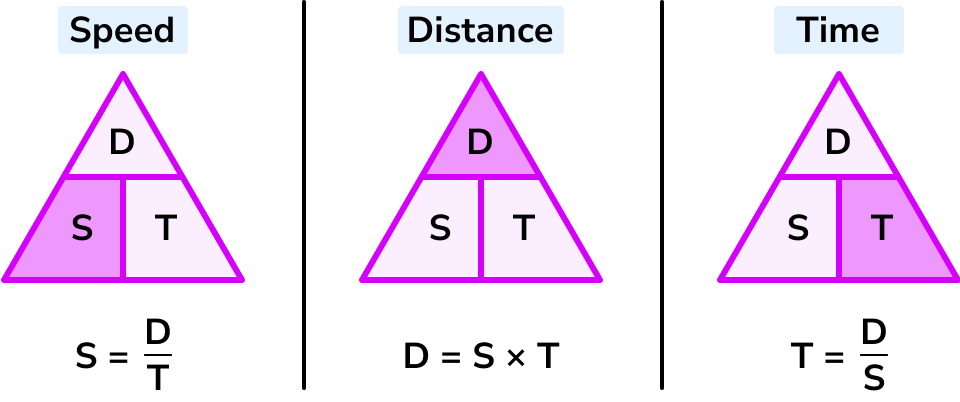
I found the trick to all these kinda questions, it's all about equivalent equations via multplication basically. https://thirdspacelearning.com/wp-content/uploads/2022/04/speed-distance-time-image-2.png (example of what i mean from basic physics)
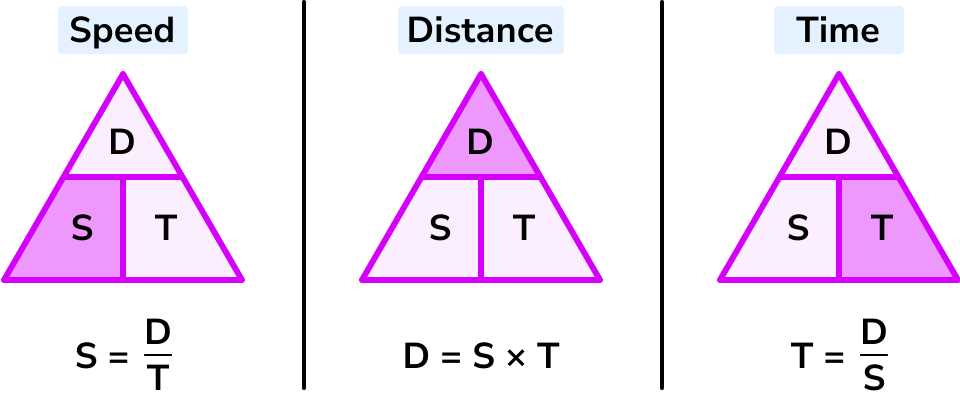
just remember these concepts and it's free lol
Like this:
AB=Hyp
Opp/Hyp=0.82 (at 55 degrees)
Opp=5
5/Hyp=0.82 (at 55 degrees)
5/0.82=Hyp (at 55 degrees)
5/0.82≈6.1
Hyp≈6.1
AB≈6.1

this should hopefully be the right answer
tardy yacht
how can you get the calculator to give things in terms of pi
like if a value is given as 1.5707.... which is pi/2, how do i make the calculator show its pi/2 without having to figure it out myself
or is that not possible
silent plank
depends on the calculator
if your question involves special angles / ratios, you shouldn't really need the calc for it anyway
tardy yacht
its asking for answers in terms of radians. its more of a little hiccup to deal with it but i found you can just divide it by pi, then whatever number you get you multiply it by pi and thats the exact answer
like 1.047195.... /pi=0.3333 therefore 1.047195......=0.333pi=pi/3
silent plank
if your question involves special angles / ratios, you shouldn't really need the calc for it anyway
 wind sedge
vocal cloud
https://www.youtube.com/watch?v=PUB0TaZ7bhA&ab_channel=TheOrganicChemistryTutor
wind sedge
vocal cloud
https://www.youtube.com/watch?v=PUB0TaZ7bhA&ab_channel=TheOrganicChemistryTutor
Ayeee
vocal cloud
wat
wind sedge
Nothin
 wild rivet
upper karma
this should hopefully be the right answer
wild rivet
upper karma
this should hopefully be the right answer
it is
 odd geyser
Hi! Given 17 cubes, the sides of which are 1 centimeter long, how would one find the smallest possible hollow cube that can fit those 17 cubes within it? Thanks!
(Please ping me if you think of anything!)
grave pond
That sounds hard. The analogous problem of finding the smallest square that will fit 17 identical squares is open, for example. On the other hand, with cubes there's an easy upper bound of 3 (since 3³>17), which doesn't leave a lot of room for being creative with tilting some of the cubes...
odd geyser
it does sound quite hard!
i was out of ideas so i decided to consult a math space (this one)
grave pond
Do you have a hydraulic press available? (Cf https://xkcd.com/2740/)
odd geyser
cant not bring up this one while were talking xkcd and unsolved math problems https://xkcd.com/2529/
smoky jetty
upper karma
Like this:
AB=Hyp
Opp/Hyp=0.82 (at 55 degrees)
Opp=5
5/Hyp=0.82 (at 55 degrees)...
yeah seems about right

 somber coyoteBOT

 dire hull
So I did infact do the cosine law
However I’m troubled by making the triangle itself

Here is my work in part B
But I’m still getting the triangle drawing wrong
Like my drawing makes no sense
exotic yarrow
Because you need to redraw it with angle A being obtuse
dire hull
Oh, okay wait lemme try doing that rn

That’s the way i drew that
But in order for me to do my cosine law I need to get my letters to certain places
My work in part B doesn’t match my drawing in part a
dire hull
OH
Omg I’m acc so stupid 🤦🏽♀️
Sorry and thank you 😭
I was stuck on this for a solid 30 mins and then did some other questions 💀
But 21.3 seems odd because all the other two numbers are whole numbers that aren’t decimals
 steady estuary
For b, wouldn't it be because it lies in the 3rd quadrant where its x and ys would be negative?

 thorny fossil
steady estuary
For b, wouldn't it be because it lies in the 3rd quadrant where its x and ys wou...
thorny fossil
steady estuary
For b, wouldn't it be because it lies in the 3rd quadrant where its x and ys wou...
Yes, or alternatively one can use tan to show it
 tawny grove
what are the uses of sine cosine and tanget ratios that are greater than 180
the sine cosine an tanget are just ratios of the sides of triangles
but how can the ratio be negative
 feral canyon
HELP

 grave pond
tawny grove
but how can the ratio be negative
grave pond
tawny grove
but how can the ratio be negative
What the cosine and sine really are is coordinates of points on the unit circle, and the circle has points on both sides of the coordinate axes.
The interpretation as rations of sides lengths in a right triangle works only for angles between 0° and 90°.
grave pond
There's no special formula that you use for prisms specifically. The base of a prism is (by definition) some plane polygon, and you compute it area in the same way as you would compute the area of the same polygon if there wasn't a prism built on it.
 surreal plover
How do you find the area of the base of a prism
grave pond
surreal plover
How do you find the area of the base of a prism
That's what I answered in the post immediately above yours.
surreal plover
grave pond
That's what I answered in the post immediately above yours.
Well I mean more like for surface area
grave pond
You find the area of a polygon in the same way no matter what you're going to use that area for after you've found it.
grave pond
If you have a particular polygon you need to find an area of, we can discuss that, but simply saying that it's the base of a prism is not going to help us narrow in on an area calculation that works for it.
surreal plover
Oh ok
Let me find the problem
I’m supposed to find the surface area

But I can’t figure it out
steady estuary
Wouldn't it be 90?
 grave pond
surreal plover
I’m supposed to find the surface area
grave pond
surreal plover
I’m supposed to find the surface area
Okay. So the base here is presumably a regular hexagon with side length 2, and you want to find its area.
(This is a pyramid, not a prism, but fortunately the area of the base doesn't depend on what we're building on top of it).
The simplest way to find the area of a regular polygon is to draw lines from each corner to the center, dividing it into congruent triangles, one for each side.
You may alreay know that in case of a hexagon, these triangles end up being equilateral.
Can you find the areal of an equilateral triangle with side length 2?
grave pond
steady estuary
Wouldn't it be 90?
90° is one of them, yes.
surreal plover
grave pond
Can you find the areal of an equilateral triangle with side length 2?

Maybe
I’m completely lost
grave pond
The case for an equilateral triangle can be done with just Pythagoras, but is perhaps more instructive to use some trigonometry -- do you have trig available?
surreal plover
I do
grave pond
Then we should perhaps look at the general case of a regular n-gon with known side length.
Draw lines from each corner to the center, dividing it into n isosceles triangles. Then more lines from the center to the midpoint of each side splits those into 2n right triangles that you can do trigonometry on. (And once you have the side lengths of a right triangle, its area should be easy).
 maiden brook
grave pond
(This is a pyramid, not a prism, but fortunately the area of the base doesn't de...
maiden brook
grave pond
(This is a pyramid, not a prism, but fortunately the area of the base doesn't de...
technically it does but in this case we are assuming that perpendicular intersects the "center" of the hexagon
grave pond
It doesn't even technically. The area of a given polygon is the same no matter whether you're building a prism on top of it, or a pyramid, or nothing at all.
(The area of the other sides of the pyramid will depend on where we put its apex, sure).
maiden brook
grave pond
(The area of the _other_ sides of the pyramid will depend on where we put its ap...
yeah and for the purposes of the problem u have to assume it’s at the “center” (is there a better word for this?) of the hexagon?
maiden brook
grave pond
It doesn't even technically. The area of a given polygon is the same no matter w...
sorry I misinterpreted what u had said
 inland grove
What's a pythagoream triple?
 weak pawn
inland grove
What's a pythagoream triple?
weak pawn
inland grove
What's a pythagoream triple?
just a set of integers that fits into the pythagorean theorem; e.g., 3, 4 and 5 or 5, 12 and 13.
 quasi perch
Can anyone please explain why point B is
x = $q_3\cdot sin(q_2) + L\cdot cos(q_2) \\
z = q_1 + q3\cdot cos(q_2) - L\cdot sin(q_2)$
 somber coyoteBOT
jordinho
 grave pond
It isn't, as far as I can see -- you need to add L to the expression for x.
upper karma
 upper karma

 last ocean
 short dagger
Sorry for the language of the question. In short, the radius of the pizzas is 10 cm and it asks for the area of the KLMN square.
 smoky jetty
steady estuary
Wouldn't it be 90?
smoky jetty
steady estuary
Wouldn't it be 90?
could be referring to the special triangles
upper karma
is this true or false for all right triangles
 grave pond
Multiply by c on both sides and compute the area of the triangle in two different ways.
upper karma
short dagger
Sorry for the language of the question. In short, the radius of the pizzas is 10...
20*20=400cm^2
tray must be 90 degree
so it is either rectangle
or square
so it's l*b or a^2
and the sides got diameter of pizza
so square
20^2
upper karma
grave pond
Multiply by c on both sides and compute the area of the triangle in two differen...
oh so it's gotta be true
cus hc/2 = ab/2
and that's just two different ways of showing the area of the triangle
pretty cool then
grave pond
Eyup.
upper karma
thanx
grave pond
You can also do it with similar triangles, but it's easier to get lost in the algebra that way.
short dagger
upper karma
20*20=400cm^2
answer key says 800
upper karma
grave pond
You can also do it with similar triangles, but it's easier to get lost in the al...
yeah i agree
grave pond
upper karma
and the sides got diameter of pizza
One easily sees on the diagram that the sides are longer than the diameter of the pizza. If they had the same length, the two half-pizzas that meet in a corner would overlap.
dire hull
I wanted to know if what I was doing was right and whether the answer to this was reasonable or not

And whether we cancel out the squared and the square root for 30k^2 under sqrt
 timber cargo
Don't we all
 fair vapor
timber cargo
Don't we all
fair vapor
timber cargo
Don't we all
indeed


 lethal nacelle
can someone solve
lethal nacelle
lethal nacelle
can someone solve
find ab
 versed glacier

 ember stratus
in this video https://www.youtube.com/watch?v=yRhYsq0qOWw
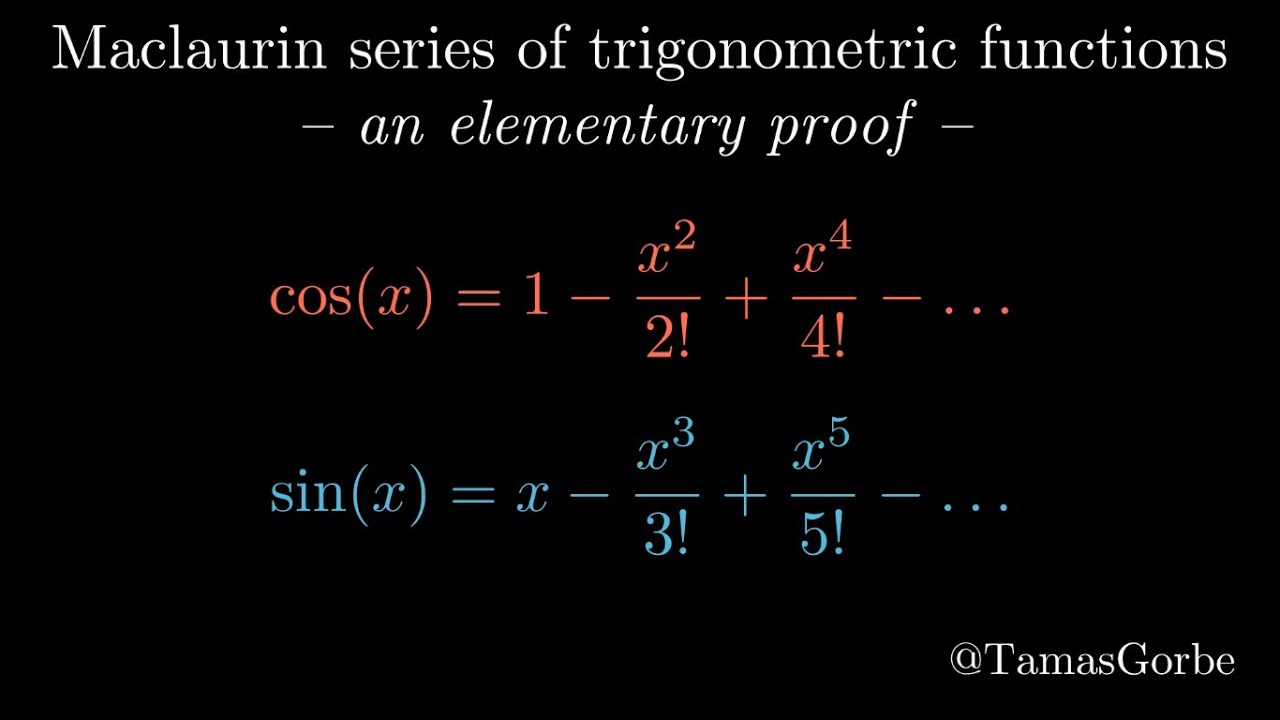
The terms in the Maclaurin series
cos(x) = 1 – x²/2! + x⁴/4! – ...
sin(x) = x – x³/3! + x⁵/5! – ...
are the (signed) lengths of involutes. This video sketches an elementary proof of this fact.
how did they find 0:26 2 sin x/2
smoky jetty
lethal nacelle
can someone solve
tbf that triangle is hella inaccurate in regards to angle B
 prime musk
 zealous pike
Have someone read this book? I want to know what background in math I need to read it
 upper karma
can someone show me how to solve these?
 upper karma
 exotic yarrow
upper karma
can someone show me how to solve these?
exotic yarrow
upper karma
can someone show me how to solve these?
Г) Convert the argument to a power of 10
д) Rewrite the exponent as a single log with a coefficient of 1, then apply the definition of a log (as the inverse of the exponential)
In the future, questions like this belong better in the #prealg-and-algebra channel than here.
exotic yarrow
upper karma
Direct formula substitution
 upper karma
exotic yarrow
Direct formula substitution
upper karma
exotic yarrow
Direct formula substitution
🙏🙏
upper karma

 silver stream
upper karma
silver stream
upper karma
You are given a leg of value 10, specifically adjacent to the angle of 52°, which trigonometric function deals with adjacent sides? Cosine. To solve for the hypotenuse we can think back to the different definitions for trigonometric functions, cosine is defined as cos(θ) = adjacent/hypotenuse. Using this information you can create the equation cos(52°) = 10/x (let's set the hypotenuse equal to x), from here just solve for x: (x) cos(52°) = 10/x (x) **--> **xcos(52°) = 10 (divide by cos(52°) --> x = 10/cos(52°) (you are given a approximate value of cos(52°), let's use that) --> x = 10/0.616 **--> ** x ≈ 16.23. This means that AB ≈ 16.23
Note that the question gave you an approximate value of cos(52°) that is rounded so hopefully that is the decimal they are looking for.
Hopefully I did that right 💀
upper karma
silver stream
You are given a leg of value 10, specifically adjacent to the angle of 52°, whic...
Thx
silver stream
np
weak pawn
How would you do 2a?
 weak pawn
Someone please 😭😭🙏🙏
upper karma
is the amplitude pi/6? @weak pawn
weak pawn
upper karma
is the amplitude pi/6? <@691070898807111740>
No clue 💀
I'm trying to relearn trig and someone sent this question, I have no clue how to do it 😭😭
upper karma
might try to take advantage of the fact that (1+irt(3) is just (rt(3)-i) rotated 90 degrees in the positive
finding the modulus might be a pain but amplitude can by obtained by mere observation if you identify this fact
or hey even better
use the euler form
the modulus is 4 (?)
please confirm the answers
@weak pawn
weak pawn
I don't know the answers
upper karma
hmm
upper karma
weak pawn
I'm trying to relearn trig and someone sent this question, I have no clue how to...
ask the person who sent you this question ey?
 meager citrus
Anyone know how to do 7E)

 lucid vale
Did i do this right and how do i calculate the alpha values its like midnight and i have a test tomorrow plz help
 exotic yarrow
meager citrus
Anyone know how to do 7E)
exotic yarrow
meager citrus
Anyone know how to do 7E)
Factor the numerator and denominator
weak pawn
upper karma
ask the person who sent you this question ey?
they still havent responded with the answers 😭
meager citrus
exotic yarrow
Factor the numerator and denominator
Which side?
exotic yarrow
Which side can be factored into linear factors that cancel?
 torn heath
weak pawn
How would you do 2a?
torn heath
weak pawn
How would you do 2a?
You could rewrite 1 + i sqrt(3) = i (sqrt(3) - i) and then divide numerator and denominator by (sqrt(3) - i)^15
meager citrus
exotic yarrow
Which side can be factored into linear factors that cancel?
Right?
weak pawn
torn heath
You could rewrite 1 + i sqrt(3) = i (sqrt(3) - i) and then divide numerator and ...
Wouldnt that mean it would have to be -1 in the numerator originally?
torn heath
weak pawn
Wouldnt that mean it would have to be -1 in the numerator originally?
Do you mean that the numerator should have been (-1 + i sqrt(3))^17?
weak pawn
torn heath
Do you mean that the numerator should have been (-1 + i sqrt(3))^17?
yeah
ive forgotten all imaginary number rules so 💀 that might be it
torn heath
weak pawn
Wouldnt that mean it would have to be -1 in the numerator originally?
Well, no, because sqrt(3) - i times i equals 1 + i sqrt(3). Remember that i^2 = -1, so
(sqrt(3) - i)i = i sqrt(3) - i^2 = i sqrt(3) + 1
weak pawn
OHH okay yes
thank you 🙏🙏
other than that, wouldnt that interfere with the exponents too?
like ((i)(sqrt(3)-i))^17
torn heath
Yes
weak pawn
so then how could you divide it
weak pawn
torn heath
You can divide
okay i just wanna make sure i did it right, i got
2sqrt(3) + 10i
meager citrus
exotic yarrow
Factor the numerator and denominator
Ohhhhhhhh would the top be (sinx-3)(sinx-3x) and bottom (sinx-3)(sinx+3)
Been a while since I did perfect and difference of squares
Is that right?
exotic yarrow
meager citrus
Ohhhhhhhh would the top be (sinx-3)(sinx-3x) and bottom (sinx-3)(sinx+3)
I think you meant (sin x-3)(sin x-3) for the numerator
but yes
meager citrus
exotic yarrow
I think you meant (sin x-3)(sin x-3) for the numerator
Ye that’s what I said
exotic yarrow
Ohhhhhhhh would the top be (sinx-3)(sinx-3__x__) and bottom (sinx-3)(sinx+3)
meager citrus
Typing is a pain
 exotic yarrow
Send what you did so far with it
meager citrus
exotic yarrow
Send what you did so far with it
Nothing. I’m not sure how to start
torn heath
weak pawn
okay i just wanna make sure i did it right, i got
2sqrt(3) + 10i
Could you show how you obtained that in detail? I think the correct result is 2sqrt(3) + 4
meager citrus
exotic yarrow
🤷♂️
I can rearrange from here right?
 exotic yarrow
I can't rlly make out what you're doing because of all the scribbles, but the logic seems fine
meager citrus
exotic yarrow
I can't rlly make out what you're doing because of all the scribbles, but the lo...
Sorry, I converted sin^2x to its equivalent, same with tanx, then I found an LCD of cosx between all 3 and got the final line
weak pawn
torn heath
Could you show how you obtained that in detail? I think the correct result is 2s...
(i^17)(sqrt(3) - i)^2
(i)(sqrt(3) - i)^2
(i)(9 - isqrt(3) - isqrt(3) + 1)
(i)(9 - 2isqrt(3) + 1)
10i + 2sqrt(3)
 lament moon
i need 2 solutions for doing this, help pls
 meager citrus
Anyone know what to do from here?
 torn heath
weak pawn
(i^17)(sqrt(3) - i)^2
(i)(sqrt(3) - i)^2
(i)(9 - isqrt(3) - isqrt(3) + 1)
(i)(9...
torn heath
weak pawn
(i^17)(sqrt(3) - i)^2
(i)(sqrt(3) - i)^2
(i)(9 - isqrt(3) - isqrt(3) + 1)
(i)(9...
The third line should be (i)(3 - isqrt(3) - isqrt(3) + 1) because sqrt(3)^2 equals 3, not 9
weak pawn
torn heath
The third line should be (i)(3 - isqrt(3) - isqrt(3) + 1) because sqrt(3)^2 equa...
oh yes, dont know how i missed that 🤦 thank you
 abstract kettle

 grizzled ridge
I am in Geometry Honors and was wondering what the forumla for this is? I remember something about calculating chords using a tangent line but I can't find the formula on google. Thanks!

 royal cedar

 twilit plover
meager citrus
Anyone know what to do from here?
twilit plover
meager citrus
Anyone know what to do from here?
whats the question exactly?

this is what I got on simplification
 pliant pumice
Hello! If sum of each pair of opposite angles in quadrilateral is equal 180 degrees, does it mean that the quadrilateral is cyclic? If yes, how can I prove it?
upper karma
 weak pawn
upper karma
weak pawn
upper karma
To find the height you'd use tangent
Since you already know the value of tan(35), youd set it equal to x/100
Then youd multiply 100 to the other side to isolate the X
Getting .7002*100, which equals 70.02. Then you'd add 5 to get the height of 75.02ft
upper karma
weak pawn
Getting .7002*100, which equals 70.02. Then you'd add 5 to get the height of 75....
Thx
junior pine
Where’s that Irish guy
Who lives in
Yeah
I wanna ask for notes off him lol
Cus I need trig n geo notes 😔
upper karma
junior pine
Cus I need trig n geo notes 😔
Same
junior pine
upper karma
Same
U got some?
upper karma
junior pine
U got some?
I have sin = opposite over hypotenuse and cos = adjacent over hypotenuse and tan = opposite over adjacent
That’s it though💀💀
junior pine
Oh wait that’s good cus idk how t use dat lel
upper karma
I need help with this
 junior pine
Send it thru my tingy uh dms ting
upper karma
junior pine
Oh wait that’s good cus idk how t use dat lel
Well your welcome lmao
upper karma
upper karma
I need help with this
alternate int., corresponding, transitive
in that order
Thx

 proven tusk
anyone know how to solve this?
 maiden brook
hint: find the interior angle measures and extend each side
 empty edge
yes
 cursive sluice
whats a good resource for geometry like pauls online notes, I want to learn these topics

 upper karma
I think there are no solutions between -pi to 0 ( as sin is negative in those regions)
you do have 2 solutions in 0 to 2pi, one in the first and the other in the second quadrant
which can simply be found by satisfying sin(x)=1/sqrt(2)
 buoyant nest
upper karma
I think there are no solutions between -pi to 0 ( as sin is negative in those re...
buoyant nest
upper karma
I think there are no solutions between -pi to 0 ( as sin is negative in those re...
Apparently you’re ment to use the negative trig identities for this question
 buoyant nest
Maybe? It might change the -square root 2 to a positive
upper karma
you mean convert it into 2sin(-x) + sqrt(2) =0?
buoyant nest
Yeah that
upper karma
still doesn't change the solutions as you'll ultimately be solving for x
buoyant nest
I see that now
The negative x would just be x because of the negative sin rule
I did the working out and got root 2 / 2 is this correct?
upper karma
yes
buoyant nest
Thanks
 snow sedge
Hello, how can i find all triangle data only with Ma, Sa, Sb?
I need at least to get example for this one, bc i have 9 more like that 😅 (and no, it's not for exam, more like homework)
snow sedge
My bad
snow sedge
silent plank
what are
Ma, Sa, Sb
M = median
S = middle line
Idk if they're called like that in english
Smth like this

Thanks in advance
 wind shard
Rectangles of the same color are equal in area, angles of the same color are equal in size.

Why are these triangle similiar?

 earnest pewter
 dark sparrow
earnest pewter
dark sparrow
earnest pewter
wrong server
 ancient ether
Whos online
I have some questions about cos, tan and sin
just one
So is the first letter for the trig ratio always the side that goes clock wise first? Or does it also need to have an X on that side of the angle or for example 15 degrees that or x on that side for you to start the first letter of your ratio for SOHCAHTOA
Is this the right trig ratio?

The adjacent is on X
Today js my last night to work on this so please I cant wait 4 to 5 hours for a response 😒
 median vapor
wind shard
Rectangles of the same color are equal in area, angles of the same color are equ...
median vapor
wind shard
Rectangles of the same color are equal in area, angles of the same color are equ...
Givens: All rectangles (assuming you meant a^2 and r by (r+s) were equal and that c by x and b^2 were equal) are equal in area, same colored angles are the same size.
line r - line AF = line FE
line s - line EB = line FE
b^2 = cs
b^2/s = c
c = line r + line s - line FE
rc = a^2
c = a^2/r
a^2/r = b^2/s
r(b^2) = s(a^2)
just some info i got...
ancient ether
median vapor
Givens: All rectangles (assuming you meant a^2 and r by (r+s) were equal and tha...
Hi
Is the trig ratio in the picture right
median vapor
i was replying to someone else, one moment
 ancient ether
Rob?
median vapor
ancient ether
Is the trig ratio in the picture right
the trig ratio is correct if A/H = Adjacent over Hypotenuse. if the little angle you drew is the angle you are taking the cosine of though, you might have messed up where you put the adjacent side for this specific angle.
ancient ether
hmmm
Oh no that angle was me being dumb
I realized it has to be opposite of where the number degrees is
median vapor
ancient ether
I realized it has to be opposite of where the number degrees is
alr, but you did get the ratio for cosine right
ancient ether
I do the stuff on the calculator to solve now right?
median vapor
sure
median vapor
 rain steeple
How do I start?
rain steeple
How do I start?
probably the double angle formula (to deal with 1-cos2x, there are also good visuals for this on yt)(en.wikipedia.org/wiki/List_of_trigonometric_identities#Double-angle_formulae).
 median vapor
ancient ether
Ok so how do I know if it is multiplication or divi
median vapor
ancient ether
Ok so how do I know if it is multiplication or divi
if you're talking about trig ratios, cos = adj/hyp, sin = opp/hyp, tan = opp/adj, so on so forth.
the / or fraction is division, though you could rewrite O/A as O * 1/A
ancient ether
Sometimes ive seen people do tan and multiplication and also tan and division so now idk what to use when I get tan
For this im solve for the indicated missing side
median vapor
alr
ancient ether
i got 6.7
median vapor
wait a sec
ancient ether
oki
median vapor
ok
ancient ether
I just now seeing my teacher put x down low divide and x up high to mutiply
median vapor
so yea
do that
basically, if the sides are >1 or x>1, then multiply by the appropriate sine or cosine
then the opposite, if x<1, divide the known side by the sine or cosine of a known angle other than the 90 degree one that is inside the same triangle.
ancient ether
I was looking for the vid that showed me the equation cus my laptop reset 😅
ancient ether
median vapor
basically, if the sides are >1 or x>1, then multiply by the appropriate sine or ...
gotcha
7.24
Tan46 times 7
ancient ether
ancient ether
Tan46 times 7
Oh wait im a dumbass I was supposed to divide
81.86
Do I round up to 82 degrees?
@median vapor
median vapor
um
ancient ether
…
median vapor
ancient ether
…
honestly, i'd probably wait for a better explainer from another server member, i'm not rly explaining this that well I think.
median vapor
i think so
personally, i wouldn't use tangent to find the adjacent side of a right triangle
ancient ether
Sin is probably the way to go
 sand tusk
ancient ether
sand tusk
ancient ether
tan46 = opp/adj = 7/x
x = 7/tan46
tan46 should be a little bigger than 1 since tan45 is 1 so x is approximately 7 id say
x is around 6.7
ancient ether
Ah
ancient ether
ancient ether
7.24
Well I did get this
sand tusk
ancient ether
Sin is probably the way to go
you dont have the hypotenuse length so using sin wouldnt do much cus sin46 = 7/hypotenuse and you need to find X not hypotenuse
sand tusk
ancient ether
Well I did get this
Yeah did you multiply tan46 with 7?
sand tusk
nah you need to divide in this case
tan46 = 7/x
x * tan46 = (7/x) * x [x cancels on out on the RHS]
x * tan46 = 7
(x*tan46)/tan46 = 7/tan46 [tan46 cancels out on the LHS]
x = 7/tan46
ancient ether
This was my other problem and I got 7 degrees
 sand tusk
ancient ether
This was my other problem and I got 7 degrees
sand tusk
ancient ether
This was my other problem and I got 7 degrees
is that angle 84 or 94 i cant see it clearly
ancient ether
Cos54x12
ancient ether
sand tusk
is that angle 84 or 94 i cant see it clearly
54
sand tusk
ancient ether
Cos54x12
oh wait u need to find the side length?
ancient ether
It says solve for missing side
sand tusk
oh my bad, A = cos54*12 and O = sin54*12
ancient ether
7 degrees?
ancient ether
wait does that mean that the other problem isnt actually 6.7
sand tusk
the other problem is 6.7 units
sand tusk
ancient ether
This was my other problem and I got 7 degrees
like if in this question the hypotenuse was 12 cm, the side would be 7 cm
and if it was 12 feet, side would be 7 feet
An angle is always measured in degrees and radians but in sides if there is no unit mentions its best if you just write(sidelength) units
sand tusk
if ou find any difficulty just write out the trig ratios in front of you
if they give you the value of an angle, just write down the sin cos and tan of that angle with respect to the triangle like how you did in the previous questions just now
and see which one can be best applied, slowly you can mentally figure out which one you should apply without having to write it all down repeatedly
 ancient violet
i have been looking at this 360 degree image and im wondering how could i recreate this distortion with other images. is this related to how earth maps are flattened? the mercator proyection and those things?
 upper karma
heyo guys
 nocturne marten
 tame gull
How to find the perimeter of this triangle?

 viscid gull
What are the assumptions of the problem?
fiery oriole
tame gull
How to find the perimeter of this triangle?
i’m a dumbass but wouldn’t AC be 7x and same with BC?
 warm plume
ancient violet
i have been looking at this 360 degree image and im wondering how could i recrea...
warm plume
ancient violet
i have been looking at this 360 degree image and im wondering how could i recrea...
im not sure if i understood correctly, but if you want to recreate this exact distortion maybe look up „fish eye prespective” and something might come up?
 hushed urchin
im confused about the sides, AB is adjacent, AC is hypotenuse, and BC is opposite so my answer is cos = 12/13 but the correct answer is 5/13 can someone explain
 dark sparrow
no, AB is not adjacent to theta
look at the triangle, look where AB is, look where theta is
they're across from each other!
dark sparrow
no
none of this is a matter of "consideration"
the hypotenuse is the side across from the right angle.
the hypotenuse is also the longest side.
hushed urchin
yes
fiery oriole
seeing as you’re on khan academy, i think it should link a video/article where it explains which side is which
pretty sure that’s near the start of khan academy trig
hushed urchin
wut that website isnt khan academy
ancient violet
warm plume
im not sure if i understood correctly, but if you want to recreate this exact di...
Yea i actually found it. Its called equirectangular proyection
 cyan sandal
bro why did math start looking like this ☠️

 slim dragon
cyan sandal
bro why did math start looking like this ☠️
slim dragon
cyan sandal
bro why did math start looking like this ☠️
Big ideas math lol
 nocturne heath
 nocturne heath
nocturne heath
nocturne heath
let's say i have two points (0,0), (250, 50) how do i translate the coordinates to (0,0) (141, 210)
we know the slope of the red lines (0.707107, 0.707107) and (0, 1)
ember stratus
How did they derive the simultaneous equations of
𝑟3𝑐𝑜𝑠(𝜃3)−𝑟4𝑐𝑜𝑠(𝜃4)=𝑟1−𝑟2𝑐𝑜𝑠(𝜃2)
𝑟3𝑠𝑖𝑛(𝜃3)−𝑟4𝑠𝑖𝑛(𝜃4)=−𝑟2𝑠𝑖𝑛(𝜃2)
 upper karma
does anyone have a diagram of trig functions and their reciprocals interpreted on a unit circle
like this but without the extra stuff 😭

 frozen ocean
I've never heard of cvs or crd specificity, if you don't mind telling me what are those meaning
,tex .geom trig def
somber coyoteBOT
Akira
 frozen ocean
Not sure what do you meant but here
upper karma
frozen ocean
I've never heard of cvs or crd specificity, if you don't mind telling me what ar...
literally just 1-sin
i don’t know why it exists
upper karma
frozen ocean
Not sure what do you meant but here
yeah thanks this is it
crd is probably the length of the chord that subtends the angle theta
grave pond
They were somewhat useful for calculations in the days of pencil, paper and precomputed tables. If you had a computation where you had to repeatedly multiply by 1-cos(v) for various angles v, a table of log(1-cos(v)) could be a timesaver -- from there to giving them names is not far.
Of course, 1-cos(v) could also be computed as 2 sin²(v/2), but as Wikipedia says:
Prior to the advent of computers, the elimination of division and multiplication by factors of two proved convenient enough that tables of haversine values and logarithms were included in 19th- and early 20th-century navigation and trigonometric texts.
grave pond
Right, deleted and @upper karma gets a day in the penalty box.
dark sparrow
penalty box?
 past burrow
hey so im currently on the hunt for geometry courses. Any tips?
grave pond
24h mute
nocturne heath
I was wondering if someone could help me transform coordinates from the right box to the left box

in the bottom left box, we know 2 variables .. the slope of the red line (0.923077, 0.384615) and the coordinates of the start of the green line (15.3847, 222.117786)
we're trying to produce -200, 100 from the coordinates of the start of hte green line and the slope of the red line
can anyone help me?
nocturne heath
i figured it out
Vector Transform_Coordinates(Vector enemy_direction, Vector enemy_start)
{
float rotation_angle = asin(enemy_direction.x / sqrt(pow(enemy_direction.x, 2) + pow(enemy_direction.y, 2)));
return Vector(enemy_start.x * cos(rotation_angle) - enemy_start.y * sin(rotation_angle), enemy_start.x * sin(rotation_angle) + enemy_start.y * cos(rotation_angle), 0);
}
median vapor
past burrow
hey so im currently on the hunt for geometry courses. Any tips?
khan acadamy has at least a High School geometry course so long as you are ok with watching video mainly. There are also open textbooks out there if you prefer reading.
upper karma

 spiral mesa
-90degrees means 90degrees clockwise
So, don't you think the point would land on the negative y-axis after the rotation?
upper karma
spiral mesa
-90degrees means 90degrees clockwise
ohh i thought 90 was clockwise
90 degrees*
spiral mesa
Generally positive value of an angle denotes counterclockwise rotation
pliant nest
I'm stuck on something stupid again 😂
How do I figure out the Surface Area of a Cone when the given values do not include the height?

 teal flower
Pythagorean theorem
 pliant nest
I thought I was solving for the hypotenuse which I thought was the Height. Makes more sense though
thx
Okay, so now I know the height is 16cm, the radius is 8cm & the length is 17.9cm.
pliant nest
Yea, I am rounding
I am supposed to round to the nearest tenth
But I still don't know the formula to figure out the surface area of the cone.
I know how to figure out the surface area of the cylinder by unfolding, so getting 2x the area of the circles + the area of the rectangle
But I have no clue about the cone
I mean I did google it and did figure the formula out but it seems so different from how I learned the rest
Apparently I could've just done:
SA = area of circle + pi(8)(17.9)
😭
 heady berry
real
pliant nest
Stuck again, this time with a word problem 😂
"A square pyramid measuring 9 yd along the
base with a slant height of 12.8 yd."
How do I figure out the surface area? I thought I could employ the Pythagorean theorem and do:
a^2 + 9^2 = 12.8^2
a = ~9.1 yd
And I did but I am clueless where to go after that
🤦♂️
silent plank
you shouldn't be using pythag for the surface area
nor have you applied pythag properly here
pliant nest
Damn, guess I should've solved for the hypothenuse
But I am clueless
As to how to solve this square pyramid
silent plank
you have the slant height of the pyramid, which is already the height of the triangular faces
pliant nest
Idk what to do with it lol
silent plank
and add the area of the square base as well
pliant nest
Okay so:
1/2(12.8)(9)
1/2(115.2)
= 57.6^2
A = 9^2
A = 81 yd^2
SA = 81 + 7(57.6)
SA = 311.4
I'm crying rn
ty 
 marsh current
whats the best book I can get which covers significant amount of geometry and trigonometry
 safe tundra
 sullen raptor
marsh current
whats the best book I can get which covers significant amount of geometry and tr...
sullen raptor
marsh current
whats the best book I can get which covers significant amount of geometry and tr...
Algebra and Trigonometry by James Stewart
 wooden warren
Hello, I’ve been really thinking about this and I even constructed the suggestion given here, but I have really no idea how to prove this.

Heres my construction and I really do not know how to even get the area of the shape
 grave pond
Hmm, yes, that's not immediately obvious.
Try comparing the areas of triangles GDE and GAE.
wooden warren
grave pond
Try comparing the areas of triangles GDE and GAE.
Ooo they must be equal? Since they have same base and altitude
OH I GOT IT
thank u so much
AE would be a median and it would halve the triangle’s area
 sturdy jackal
$(\pi)(r)^3(\frac{4}{3})$
somber coyoteBOT
dmahonjr
 dark sparrow
that's quite a lot of unnecessary parentheses
 rugged marsh
sturdy jackal
$(\pi)(r)^3(\frac{4}{3})$
rugged marsh
sturdy jackal
$(\pi)(r)^3(\frac{4}{3})$
I would suggest $\left(\frac{4}{3}\right)$
somber coyoteBOT
ForJoke
 sturdy jackal
rugged marsh
I would suggest $\left(\frac{4}{3}\right)$
sturdy jackal
rugged marsh
I would suggest $\left(\frac{4}{3}\right)$
thank you
 strange crater
ok i'm taking a step back from analysis and reviewing some simply geometry and i suck, lol

i'm given that this is an isosceles triangle, and i am to find the white part of the area of the triangle
can i assume that what appears to be the right angle indeed is a right angle?
rugged marsh
I would hope so
strange crater
otherwise there is two possible solutions, right?
rugged marsh
wait you said the triangle is isosceles right?
strange crater
yes
oh wait no if what appears to be a right angle is not a right angle, then we can't find the are i'm pretty sure
rugged marsh
this can only be isoceles if its a 45-45-90
strange crater
why not 45-67.5-67.5 ?
rugged marsh
that is true
strange crater
ugh i'm just gonna assume whoever drew this up is not a sadist
rugged marsh
is this all the info?
strange crater
ye
rugged marsh
yeah just assume 45-45-90
strange crater
strange crater
oh wait no if what appears to be a right angle is *not* a right angle, then we *...
no it can still be solved in the other case
 last quiver
yeah it can be solved in both the cases
last quiver
strange crater
no it can still be solved in the other case
all the side lengths of the triangle are not given ?
weak pawn
I don't understand the definition of sine part😭
 last quiver
weak pawn
I don't understand the definition of sine part😭
last quiver
weak pawn
I don't understand the definition of sine part😭
yk sin α = opposite/hypotenuse ?
strange crater
last quiver
all the side lengths of the triangle are not given ?
what do you mean
last quiver
strange crater
what do you mean
I mean are all the side lenthgs given , coz in the diagram it's just given that one side length is equal to 10, rest two are not given
strange crater
yes, no other are given, but they are easily found if what appears to be so indeed is a right angle, if it's not there is just one other possibility not too hard to find either
last quiver
how can you do it in the case of 45 67.5 67.5 ?
strange crater
then the two unknown sides must be equal
last quiver
yeah
strange crater
so we split the triangle in half along the middle, and we have right angled triangle where we know an angle 45/2 = 22.5 and its opposite side 10/2 = 5, so the hypothenuse (the unknown side) is equal to 5 / tan(22.5)
last quiver
strange crater
so we split the triangle in half along the middle, and we have right angled tria...
yes , that makes sense :)
weak pawn
last quiver
yk sin α = opposite/hypotenuse ?
but why the cosB?
oh wait nvm
im literally slow asf
last quiver
weak pawn
but why the cosB?
by definition , cos (β) = adjacent / hypotenuse , in this the hypotenuse is equal to 1. So adjacent = cos (β)
last quiver
yw :-)
strange crater
can someone verify i'm not being stoopid: an alpha-degree slice out of circle of radius r, has area alpha/360 * pi r^2 right?
"alpha-degree" being an awkward way to state that the angle between the two side of the slice inside the circle is alpha
last quiver
strange crater
can someone verify i'm not being stoopid: an alpha-degree slice out of circle of...
yep
 frosty dew
Is trigonometry NYS Algebra 2 equivalent?
 upper karma
upper karma
upper karma
this is the answer btw
 vivid plinth
upper karma
i got the answer but it was the opposite like
vivid plinth
upper karma
i got the answer but it was the opposite like
What was your process
How did you get to that
upper karma
vivid plinth
What was your process
alright so i got 2401/625 because
wait
nvm i understood it
you flip the fraction so it becomes 7^2/5^2 then flip it again because its exponent is negative
correct
frozen ocean
💀
 vivid plinth
<@&268886789983436800>
 cinder oar
upper karma
cinder oar
upper karma
The eqn must be: x+y=10
Let A(c,0)=(x,y)
If y=0, then x=10
upper karma
thanks i got it
 jade forum
can you help with geometry?
so there's a triange
pqr and the pqr angle 120 degrees
how do i get the orthogonal projection of line ?
pq and qr is 4 cm
 left ridge
i hate trig...uguu....
smoky jetty
cinder oar
The eqn must be: x+y=10
Let A(c,0)=(x,y)
If y=0, then x=10
could u elaborate why that should be the equation?
frozen ocean
jade forum
can you help with geometry?
so there's a triange
pqr and the pqr angle 120 degre...
,tex .original
somber coyoteBOT
Akira

 sudden pulsar
 trim meadow
How do I do dis


 olive sluice
if 3x=cosec theta and 3/x=cot theta find the value of 3(x^2-1/x^2)
olive sluice
olive sluice
if 3x=cosec theta and 3/x=cot theta find the value of 3(x^2-1/x^2)
any help with thus
 stiff sigil
Can anyone help me with class 9 cbse ncert maths chapter 6 and 7?
frozen ocean
olive sluice
any help with thus
Do you know how to prove $cosec^2 \theta −cot ^2\theta=1$?
somber coyoteBOT
Akira

 trail sigil
$1/sin^2\theta-cos^2\theta/sin^2\theta=1$
somber coyoteBOT
delightful malody
 trail sigil
$1-cos^2\theta=sin^2\theta$
somber coyoteBOT
delightful malody
 dark sparrow

frozen ocean
Ghost ping?
upper karma
Hi. I'm having some trouble understanding this problem:
"Let ABC be a triangle with a right angle at B. Let D be any point on AB, and let E be the foot of the perpendicular from D to AC. Prove that angle DBE is equal to angle DCE." Is angle DEC a right angle?
could anyone help? 🙂
frozen ocean
Is that what the angle looks like for your question?

 young tiger
upper karma
Hi. I'm having some trouble understanding this problem:
"Let ABC be a triangle w...
young tiger
upper karma
Hi. I'm having some trouble understanding this problem:
"Let ABC be a triangle w...
First, draw the figure.

Notice how m∠DAE = m∠BAC by the reflexive property of equality.
Also notice how m∠DEA = m∠ABC since all 90° angles are congruent.
This means that △DAE ~ △CAB by AA~.

You can see that in the figure above, m would be the scale factor for △DAE and △BAC.
Now construct segments BE and DC.

Notice how m∠BAE = m∠CAD by the reflexive property of equality.
Notice how AB/AC = AD/AE.
This means that △ADC ~ △AEB by SAS~.
The corresponding angles of similar triangles are congruent.
∴ m∠DBE = m∠DCE

Also, ∠DEA and ∠DEC are supplementary angles.
So if m∠DEA = 90°, then m∠DEC = 90°.
smoky jetty
thats neat
 stark wraith

 nocturne remnant
also use the fact that sin^2 + cos^2 = 1, you get a pair of simul equations which can be solved for sin or cos
maiden brook
young tiger
**∴ m∠DBE = m∠DCE**
great diagrams!
nocturne remnant
young tiger
**This means that △DAE ~ △CAB by AA~**.
cool but you confused AD and AE with each other
Oh this was a day ago
Whatever
upper karma
young tiger
Now construct segments BE and DC.
Does that imply that BEC is 90, therefore BDEC is a cyclic quadrilateral?
upper karma
young tiger
Now construct segments BE and DC.
This is what has been torturing me. Cuz if m<DEA = 90, then m<BEC = 90 as well, which would make BDEC a cyclic quadrilateral.
m<BDE = m<BCE ---> m<BCE = 90???
 lethal pier
left ridge
i hate trig...uguu....
lethal pier
left ridge
i hate trig...uguu....
why
 atomic reef




 wind coral
<@&268886789983436800>
young tiger
nocturne remnant
cool but you confused AD and AE with each other
oh shit yeah sorry. fixed it
young tiger
upper karma
Does that imply that BEC is 90, therefore BDEC is a cyclic quadrilateral?
∠BEC cannot be 90°.
Notice how m∠DEC = 90°.
By the angle addition postulate, m∠DEC = m∠BEC + m∠DEB
This means that m∠BEC has to be less than 90°.
 young lintel
I can't find any use of the name "alternating cube" online. Has anyone seen this or did gpt make it up? And do you have a name for this cube?
 floral shale
young lintel
I can't find any use of the name "alternating cube" online. Has anyone seen this...
floral shale
young lintel
I can't find any use of the name "alternating cube" online. Has anyone seen this...
This is why you don't use ChatGPT