#geometry-and-trigonometry
1 messages · Page 8 of 1
 sly dawn
sly dawn
sly dawn
answers is 114?
 lusty girder
Anyways once the angle of A in both triangles combined is solved, you solved the question
lusty girder
sly dawn
answers is 114?
Yep
 neon trellis
Where am I going wrong? Why does the fraction change a lot? How do I know which one is denominator and which one is nominator? It’s messing up my scale factor value and that’s why I get the answer wrong. Either wrong or right, it’s just luck atp


Ahh I shouldn’t have tried to find the unknowns that way…
It changes based on which one is wanting to be found
UGH
It’s ok
 upper karma
neon trellis
Where am I going wrong? Why does the fraction change a lot? How do I know which ...
upper karma
neon trellis
Where am I going wrong? Why does the fraction change a lot? How do I know which ...
In these kinds of things, the order in which u write things is heavily heavily important
If u just want a tip to avoid such minor mistakes be extemely careful about the way u write stuff
 nocturne remnant
you still have the wrong answer...
 dark sparrow
well congratulations on spectacularly missing my point
nocturne remnant
anyone who isnt blind would realize that BAD is definitely not 90
degrees
so what did you mean to say?

 grave pond
114 sounds right.
 smoky jetty
do congruent sides must have congruent angles?
smoky jetty
lusty girder
AC=BC
ohhh bruh, this makes me disappointed how I typically miss the important details in the statement
smoky jetty
smoky jetty
do congruent sides must have congruent angles?
if so, what decent reasoning do y'all know about it? I'm quite confused with google
So far, this is how I understood it. If the measure of the adjacent sides of two angles of a polygon is congruent, then so is the angles' measure.
just combined some info from the web, and how I think of it
smoky jetty
smoky jetty
So far, this is how I understood it. If the measure of the adjacent sides of two...
does this works conversely?
neon trellis
upper karma
In these kinds of things, the order in which u write things is heavily heavily i...
thanks
 heavy adder
I'm confused is this channel basses solely on university level geometry or any level?
 silent plank
around high school level in this specific channel
though you're better off claiming your own channel
there may be more appropriate stuff under #get-advanced-access if you want uni-level help
 keen token
3sin(x) + 4cos(x) = 5 find cos and sin
nocturne remnant
use the given equation and also sin^2 + cos^2 = 1 so obtain a system of simultaneous equations
and solve them
upper karma
keen token
3sin(x) + 4cos(x) = 5 find cos and sin
U mean cos & sin of x ?
keen token
it just says, solve sinx and cosx
can someone solve it for me i wanna see the actual process
 somber coyoteBOT
Pebble

 dreamy locust
can yall give me the answer for this

 kind fjord
@dreamy locust FDE = FED
Also, FDE = EDU
FDE = EDU which completes the proof(alt. interior angle)
 sly dawn
 mossy stream
so basically, using pythagoras theorem-
720^2 + r^2 = (648 + r)^2
then you just solve the equation
smoky jetty
sly dawn
so basically, using pythagoras theorem-
720^2 + r^2 = (648 + r)^2
then you just...
can u elaborate how u found it? (i.e how you knew that it would be the equation)
sly dawn
smoky jetty
can u elaborate how u found it? (i.e how you knew that it would be the equation)
ok so, since MK is tangent to circle J, MK is perpendicular to JK (i.e. MKJ = 90 degrees). NJ = KJ as it is the radius of the circle, so we call it R. Then using the Pythagoras theorem which states that the hypotenuse squared is equal to the sum of the square or the remaining sides, we get-
720^2 + R^2 = (648 + R)^2
hope that answers your question.
I can also solve the equation if you want.
 smoky jetty
sly dawn
ok so, since MK is tangent to circle J, MK is perpendicular to JK (i.e. MKJ = 90...
smoky jetty
sly dawn
ok so, since MK is tangent to circle J, MK is perpendicular to JK (i.e. MKJ = 90...
ohh i see now. When u said pythagorean, i didnt know there would be variables included. Thx!
if I get this right, hypo as you have previously stated is = (648 + R)^2, as to complete the wholeness of the length of the hypo, the known value (i.e 648) and the other part (which is the missing value the variable R represents) would be added together, and so fort and so on
wow that's actually fun to realize, lol

 dark sparrow
that's a problem. your doubt could be "i don't know how to begin" or "i tried something but got stuck" or "i got some nonsense"
also no need to double ping

 ebon sundial
 knotty pier
3ctg [(pi / 6) + (x / 2)] > -sqrt3???
knotty pier
3ctg [(pi / 6) + (x / 2)] > -sqrt3???
Yeah ig
sly dawn
smoky jetty
ohh i see now. When u said pythagorean, i didnt know there would be variables in...
Glad you understood it. :)
sly dawn
 meager skiff
Yeah its correct.
Btw you could also check it yourself by substituting the value of x and check if both sides are equal.
silent plank
<@&268886789983436800>
 next mantle
<@&268886789983436800> 


 high sequoia
Was this helpful???
neon trellis
how to do this

 solar frigate
Sin ∅=4/10
sly dawn
neon trellis
how to do this
0.4 is also equal to 4/10. so 4 becomes the perpendicular and 10 becomes the hypotenuse. then use pythagorean theorem to find the other side
sly dawn
solar frigate
Sin ∅=4/10
Where'd you get that fancy looking theta?
sly dawn
um alright i'll try that when i am on my phone, thanks
high sequoia
Is this correct??

 eternal phoenix
high sequoia
Is this correct??
eternal phoenix
high sequoia
Is this correct??
ig yea
 timber cargo
eternal phoenix
ig yea
timber cargo
eternal phoenix
ig yea
It is right
eternal phoenix
timber cargo
It is right
yes ; that is what i said....
high sequoia
Ok thanks
silent plank
depends on what you're told about theta
high sequoia
I don't get ?@silent plank
silent plank
in additional to the dodgy notation at the end
the sign of cos(theta) will depends on what quadrant theta is in and/or whether theta is an acute angle
high sequoia
Yep!
smoky jetty
silent plank
in additional to the dodgy notation at the end
the sign of cos(theta) will depen...
meaning the ratio could be negative?
 brisk ferry
high sequoia
Is this correct??
brisk ferry
high sequoia
Is this correct??
yes
high sequoia
Ok
upper karma
 still socket
oh god
still socket
oh god
what was it?
 lusty needle
still socket
for an adult tiktok server
lusty needle
still socket
for an adult tiktok server

 late heron
Hell
high sequoia
Why hell?@late heron
upper karma
Hell o
 fiery cliff
 grave pond
The two angles at c (hmm, or is that perhaps an e?) are different in your proposal, but the problem looks like they're supposed to be equal.
And you have a triangle with angle sum 66+(58+56)+56 = 236.
And angles h and k which are clearly supplementary in the drawing, don't sum to 180° with your numbers.
 lilac wraith
guys, If i want to learn geometry or trigonometry, from where do I need to start?
 smoky jetty
What do you know about the properties of a quadrilateral rhombus?
smoky jetty
I'll give u 2 hints: Diagonals are perpendicular and bisect each other into two equal parts.

 glacial otter
lilac wraith
guys, If i want to learn geometry or trigonometry, from where do I need to start...
glacial otter
lilac wraith
guys, If i want to learn geometry or trigonometry, from where do I need to start...
Khan academy, openstax, youtube,
 bleak blade
lilac wraith
guys, If i want to learn geometry or trigonometry, from where do I need to start...
bleak blade
lilac wraith
guys, If i want to learn geometry or trigonometry, from where do I need to start...
Aops

 heavy shale
 severe orbit
plz send clear pic
severe orbit
Thats all i have man
heavy shale
also r u giving an exam?
severe orbit
i ripped the worksheet
heavy shale
oh lol
severe orbit
heavy shale
also r u giving an exam?
no its test corrections
heavy shale
severe orbit
no its test corrections
its hard to read
heavy shale
severe orbit
U can read if u zoom in
i am on pc so i cant sry
heavy shale
u gotta wait for someone else ig 😢
severe orbit

Better?
Try to take an ss and see if u can zoom in
@heavy shale i can type it all
<@&286206848099549185>
heavy shale
severe orbit
ok so u need to prove CB=CD for it to be rhombus
so try thinking of ways to prove the triangles similar
severe orbit
Can y send like the statement and reasons, this thing is due in 7 mins
Please
I promise ill stay and listencto the explanation after
But i rlly need to submit this
heavy shale
severe orbit
Can y send like the statement and reasons, this thing is due in 7 mins
ok wait
severe orbit
Ok thank you
heavy shale
Angle C = Angle C (Common)
Angle F = Angle E = 90 (Given they are perpendicular)
So, Triangle CEB ~ Triangle CFD (Angle-Angle)

BC/CD = CE/CF (Corresponding sides of a similar triangle are Proportional)
Since, CE=CF
BC/CD = 1
=>BC=CD
Since Adjacent and opposite sides are equal
ABCD is Rhombus```Sry cant send pic not on phone rn
heavy shale
they are the same
severe orbit
Oh ai
smoky jetty
heavy shale
```
Angle C = Angle C (Common)
Angle F = Angle E = 90 (Given they are perpendicu...
nicee
does two = angles in both triangles automatically concludes to them being congruent?
smoky jetty
heavy shale
Similar not Congruent
ah ok
heavy shale
severe orbit
its hard to understand the proof
yea ik phone screen small
smoky jetty
severe orbit
sorry
wdym?
heavy shale
i cant take screenshot of it
severe orbit
Ok wait i have an idea
dont give me the givens
Because i alr have it
but
just give the info
one line at a time
like
a is congruent to d
reason: (put here)
 smoky jetty
me neither, lol, i mean when using it to proof things about quadrilaterals
severe orbit
smoky jetty
me neither, lol, i mean when using it to proof things about quadrilaterals
Czn u like tell me row by row
like the statement and reason
like clearly
heavy shale
severe orbit
i feel like i havwnt learned about the proportional part
its like the reverse of SSS
similarity criterion
smoky jetty
what does sss mean here? eek me
heavy shale
smoky jetty
what does sss mean here? eek me
Side - Side - Side
smoky jetty
yeah, but are u referring to another theorem?
severe orbit
 heavy shale
its a similarity rule
heavy shale
wait have u learned similar triangles?
severe orbit
Dont think so
smoky jetty
heavy shale
its a similarity rule
oh i see, just googled it quick
heavy shale
i think then my proof is out of your syllabus 
smoky jetty
hatin' not having textbook in geo rn
severe orbit
yep..
heavy shale
sry i dont know any other way
heavy shale
severe orbit
Because im in 10th grade
i am also in 10th lol
severe orbit
smoky jetty
hatin' not having textbook in geo rn
Do you know how to do it
severe orbit
heavy shale
i am also in 10th lol
Oh wow lmaooo
smoky jetty
im in 9th, eek
severe orbit
nicee
smoky jetty
im gonna re-read this convo later, and see how much i could grasp, lol... more gaps were found

 tawny vector
Is there a purpose to specifically naming the reciprocal functions
upper karma
tawny vector
Is there a purpose to specifically naming the reciprocal functions
reciprocal functions indicate perpendicular
grave pond
At least the cotangent does.
It varies a lot from country to county how much emphasis is given to secant, cosecant, and cotangent. It appears to be common in the US to teach and drill them, whereas in many European countries you never even see those names (and seem to do quite fine without them).
tawny vector
Hmm alr
Yeah had them briefly mentioned here in canada but there wasnt much emphasis
Thanks 👍
high sequoia
grave pond
It varies a lot from country to county how much emphasis is given to secant, cos...
Really?
grave pond
To the best of my knowledge, yes.
dark sparrow
in russia you see sine, cosine, tangent and cotangent
secant and cosecant get at most a passing mention
 orchid agate
dark sparrow
in russia you see sine, cosine, tangent and cotangent
orchid agate
dark sparrow
in russia you see sine, cosine, tangent and cotangent
In Ukraine as well
dark sparrow
wouldn't be surprised if that was also true for most other ex-soviet states tbh
orchid agate
dark sparrow
wouldn't be surprised if that was also true for most other ex-soviet states tbh
Thankfully we are not post soviet now
But yeah
Geographically yes
dark sparrow
geography's all i was talking about, of course
orchid agate
dark sparrow
geography's all i was talking about, of course
Where are you from though
You also from Post Soviet country?
If you know that much stuff
About it
dark sparrow
i am from russia
 wise belfry
Any one know about isometric math concepts?
smoky jetty
heavy shale
```
Angle C = Angle C (Common)
Angle F = Angle E = 90 (Given they are perpendicu...
ight, so I re-read this again, and yeah, they all make sense to me. And I realized that we were just about to go to this topic next year in school, so I thought, what's better than learning it in advance, lmao
 verbal frigate
please help
smoky jetty
 versed vigil
Hello, how can I solve for angle a?
`k = sin(a) * cos(a)`
versed vigil
Hello, how can I solve for angle a?
`k = sin(a) * cos(a)`
not sure, how about if k = 30deg?
versed vigil
smoky jetty
not sure, how about if k = 30deg?
k cannot be measured in degrees in this case since it is not an angle
I have since found out about double angle identity
grave pond
There's a constant factor missing there which disappeared on it way from the double-angle identity.
smoky jetty
same
 neat python
How can I find trapezium area i only know MN=15 and height=10
 tawny vector
neat python
How can I find trapezium area i only know MN=15 and height=10
tawny vector
neat python
How can I find trapezium area i only know MN=15 and height=10
Idk if this is right
But cant you solve for AB?
Oh wait im dumb sorry
upper karma
i made a fun problem a while ago
ABCD is similar to CXYZ. What is the perimeter of ABCXYZD?
 tawny vector
upper karma
ABCD is similar to CXYZ. What is the perimeter of ABCXYZD?
tawny vector
upper karma
ABCD is similar to CXYZ. What is the perimeter of ABCXYZD?
Is it ||214.763|| or am i dumb
upper karma
I can check what I got
Ok so a year ago I got ||214.76|| so I think you are right. Today I tried it again and got 129.29 lol
I think I know what I did wrong this time
tawny vector
||22/11 = 2, so ABCD is increased by a factor of 2 (idk the right terminology lol). So that means that x = 18, 3x = 54. AD / AB solved by pythagorean, then divide by 2 for CX / XY||
upper karma
Yes
I think I was just lazy and used the length of 3x as the hypotenuse lol
I should have checked it but luckily it is not a big deal
 sick spindle
neat python
How can I find trapezium area i only know MN=15 and height=10
sick spindle
neat python
How can I find trapezium area i only know MN=15 and height=10
In a trapezium, the line joining the mid points of non-parallel sides is Half of the sum of the parallel sides
So the area will be 150 sq units
neat python
sick spindle
In a trapezium, the line joining the mid points of non-parallel sides is Half of...
I found area but Ty anyway
sick spindle
Alright cool
smoky jetty
sick spindle
So the area will be 150 sq units
shouldn't it be 100?
My equation was 10 = (b_1 + b_2)/2
(2)(10)= "
20 = "
Area = ((b_1 + b_2)/2)(h)
= ((20)/2)(10)
= (10)(10)
= 100?
 spiral marsh
nope.MN=(b1+b2)/2=15,so the Area will@be MN X height=15 X 10=150 cm^2
15 multiplied by 10
smoky jetty
ohh ffs, i thought the median value was 10, eek, gonna wash these eyes thoroughly, lmao
upper karma
is locus is like a path of eqn? like eqn of circle is a kind of locus?
grave pond
"Locus" is a traditional word for "the set of points that satisfy some condition".
A circle is the locus of all points whose distance from the center is such-and-such.
upper karma
😭😭😭😭😭😭😭😭
grave pond
Is that so sad? There, there.
upper karma
yes hell sad
upper karma
grave pond
"Locus" is a traditional word for "the set of points that satisfy some condition...
so isnt that kind of eqn of line?
grave pond
No, the thing called a "locus" would be the line itself, not an equation.
upper karma
find eqn of locus of a centre of circle with some conditions?, does that imply to find eqn of of line that passes through centre with some " given condition" ?
grave pond
I'm sorry, I don't understand that question well enough to suggest an answer.
 karmic forge
can anyone help me? I have a math problem; there is a triangle with two perpendicular lines on the two sides ( AB and BC ), and i need to find the equation of the two perpendicular lines of AB and BC. you can look at the way that I did to find the line equation of the perpendicular line of AC, and the answer that i found is y=-2x+-1.5, but that real answer is y=-2x+2.5. what have I done wrong?

 dry current

 storm portal
karmic forge
can anyone help me? I have a math problem; there is a triangle with two perpendi...
storm portal
karmic forge
can anyone help me? I have a math problem; there is a triangle with two perpendi...
Are e and f at certain points?
There are infinitely many lines that are perpendicular to a given line
karmic forge
storm portal
Are e and f at certain points?
whatever i solved it. i was trying to solve the perpendicular line of AB, which start at point E
it's the middle of AB
 narrow slate
How do I solve this through algebra?
 somber coyoteBOT
wintersavory

 wind compass
Can someone explain direct inverse and joint variation please
dark sparrow

Courses on Khan Academy are always 100% free. Start practicing—and saving your progress—now: https://www.khanacademy.org/math/algebra-home/alg-rational-expr-eq-func/alg-direct-and-inverse-variation/v/direct-inverse-and-joint-variation
Direct Inverse and Joint Variation
Watch the next lesson: https://www.khanacademy.org/math/algebra2/rational-...
smoky jetty
khan all the way!!
upper karma
Why does trig functions need to be defined in a unit circle? Why not in a circle with a radius of 10 or 100? If its because its more simple to do calculations, does that trig functions wont work if it is defined in a circle with a radius other than 1?
Or is it arbitrary? Just like the 360 degrees measurement system
nocturne remnant
the unit circle is most natural... otherwise many trig identities would have unnecessary clumsy coefficients attached to them.
For example, if they are defined in a circle of radius 10, then sin(x+y) = 0.1(sin(x)cos(y) + cos(x)sin(y))
 hallow ferry
Guys I have chapter this trignometry
Does anyone have any idea about Heights and Distances calculating with the help of Trignometry
Pls DM me and help me pls
upper karma
the actor or the teacher?
smoky jetty
I was tryna practice myself with geometry and found this problem which for me is ridiculously hard.. Anyone wanna give it a shot?
 grave pond
There's a lot of irrelevant data there, so your problem is most likely that you're overthinking it. It is ridiculously much simpler than it looks.
(Note that the arrows near letters K, M, Q seem to say that IK and RQ are parallel).
smoky jetty
yeah, so far I was able to solve for D, C, Z, angle PDE, angle JPK, but idk how i could get to y and x
any other hints that you can give?
grave pond
It is much simpler than you think.
All of those are irrelevant for the relation between y and x.
smoky jetty
alright, i'll try to analyze it again
grave pond
By the time you say "analyze" you're already overcomplicating it.
grave pond
Hint: There's no computation going on.
grave pond
Hint 2: Ignore CJ and LM and all angles involving one of those lines.
smoky jetty
i still cant see how, coz for me i couldnt find their values
grave pond
You're not being asked to find their values in numbers.
smoky jetty
wdym?
smoky jetty
grave pond
You're not being asked to find their values in numbers.
oh wait wha-
grave pond
"Express angle x in terms of y and z".
smoky jetty
if not, then basically x = y?
grave pond
Yes.
grave pond
Sorry.
 hearty iron
Can someone help me with 3 or 4 please
 smoky jetty
hearty iron
Can someone help me with 3 or 4 please
smoky jetty
hearty iron
Can someone help me with 3 or 4 please
not very certain, but this is how I tried (for no.3):
70 and angle DOA are supplementary, as they are linear pairs of angles. Therefore,
70+ angle DOA = 180 so on...
Now, with the value found, the sum of angle A, DOA, and angle D must be = 180 (as for any triangle)
Since alternate interior angles are congruent (in a parallelogram), then ange D is = to angle DBC
if ever this is wrong, I'll try to revise/remove it to avoid confusion
hearty iron
smoky jetty
not very certain, but this is how I tried (for no.3):
70 and angle DOA are suppl...
Ah i didnt know the last rule
Thanks
I thought that but just wanted to be sure
hearty iron
hearty iron
Can someone help me with 3 or 4 please
You have an idea for number 4? What does it mean by the angle between the bisectors of the other 2
By guess is B
 surreal obsidian
Did I gaslight myself
I swear I remember reading a theorem where if you have four lines in a circle that meet at a single point, partitioning the regions by taking every other one divides the circle into two sets that are each half the area of the original circle

but I can't find it anywhere online
nvm found it
requires the additional restriction that the angle of each sector where they meet is equal
wind compass
dark sparrow
https://m.youtube.com/watch?v=v-k5L0BPOmc&vl=en
thank you!
smoky jetty
if u were to guide a student, would u prefer them to learn triangle congruence first, before theorems on quadrilaterals? or the other way around?
 lost siren
Ig Triangles and later Circles and start quadilaterals between circles from cyclic quadilaterals
dark sparrow
smoky jetty
if u were to guide a student, would u prefer them to learn triangle congruence f...
triangles first, definitely.
smoky jetty
oh now it made sense
our teacher first discussed quads before triangle congruence, thats why when she gave us some proving problems, some of the reasons for me were unfamiliar coz they were yet to be discussed. I wouldn't know if I didn't look them up on my own
when coming up with this problem (for reference 5x is the median of a trapezoid), I often get curious why our teacher (or even the cool guy on YT, michael van bizen) transposes the denominator to the LHS. Though I tried not to (i.e diving the numerator to it), I still got the same answer. Is there a particular reason why some do it?
 dark sparrow
none in particular
this is a linear equation
there are multiple ways to solve those
there is rarely a big Reason why one solution path is chosen over another
smoky jetty
oh ok thx. hopefully when i got a pretty long free time, i could study basic algebra again
smoky jetty
I got this quiz problem before (unfortunately, at the time, I wasn't able to get the answer, and I got 0 points from it), though after reviewing kites and trapezoids (our current geometry lessons) for hours, I still don't have an idea on how to get the area, or even know what quadrilateral the said lot is. Any hints or guide would be appreciated!

 feral sedge
Hello @upper karma I have solved this problem
Rectangle ABCD ~ Rectangle CXYZ =>
CZ/BC = YZ/CD
CZ = YZ =>
BC = CD
So, similarity ratio r is equal to
CZ = CD/2, BC = CD(similarity)
r = BC /CZ = CD/YZ = 2
........
upper karma
feral sedge
Hello <@456226577798135808> I have solved this problem
Rectangle ABCD ~ Rectang...
Yes the scale ratio is 2

 sullen flame
 astral wadi
I would advice drawing a picture of the scenario first and go from there
 deft fog
Hi guys, help me solve this please, and what is the answer?

 stuck sleet
Analytic and Coordinate geometry is the same thing right????
 rain oak
deft fog
Hi guys, help me solve this please, and what is the answer?
rain oak
deft fog
Hi guys, help me solve this please, and what is the answer?
Google: congruence theorem triangle SSA
Should be around 243.516
 shut fog

 soft nest
 split galleon
arctan(2 )= angle (theta) = ---> theta = 63.43 degress
split galleon
Nope
upper karma
rain oak
Should be around 243.516
243?
split galleon
split galleon
The answer is arctan(2/11)
dark sparrow
split galleon
The answer is arctan(2/11)
do not give out answers.
soft nest
split galleon
The answer is arctan(2/11)
ohh the angle subtended is with respect to the base of the statue not the ground
rigtht?
split galleon
dark sparrow
do not give out answers.
Alright sorry I am actually new so 😅
split galleon
soft nest
ohh the angle subtended is with respect to the base of the statue not the ground
Shall I give you my diagram?
soft nest
split galleon
Shall I give you my diagram?
na na i got it ty tho
split galleon
And you even got the answer?
soft nest
split galleon
And you even got the answer?
yes just use differnce of angles formula from there
split galleon
Yup
soft nest
and u get it
split galleon
Right
The question was actually asked in JEE mains
Like one of the toughest exam in india
soft nest
split galleon
The question was actually asked in JEE mains
fr ahh , i am glad i got it 💩
soft nest
split galleon
Like one of the toughest exam in india
i am indian only
split galleon
Yo boi 😂
soft nest
i am in 10th so its pretty nice that i got it
split galleon
Great for you!
 runic beacon
soft nest
i am indian only
runic beacon
soft nest
i am indian only
That ‘only’ being another proof of that
 soft nest
split galleon
soft nest
split galleon
sin theta = 1/2.6
split galleon
No
soft nest
split galleon
No
whaa it shud be
i will show working
csc x + cotx = 5 ---- 1
1+ cot x^2 = csc^2 x
1 = (csc x + cot x ) (cscx- cotx)
csc x - cot x = 1/5 ---- 2
adding 1 and 2
2 csc x = 5 +1/5
csc x = 2.6
sinx = 1/2.6
upper karma
How did you get the second line?
upper karma
No, the line above that
soft nest
upper karma
No, the line above that
thats a trig identity very common
soft nest
\
 soft nest
split galleon
No
soft nest
split galleon
No
its the same as 5/13 , 5/13 =1/2.6
 lunar smelt
Hello there. I wish to get a head start in my high school studies and have been considering learning geometry from either Khan Academy or the AoPS Geometry textbook. If it is of any help, I also wish to pursue mathematical and computer science competitions. If there is also any other resources that may help me, I would be greatly appreciative to know about them.
 keen lintel
lunar smelt
Hello there. I wish to get a head start in my high school studies and have been ...
keen lintel
lunar smelt
Hello there. I wish to get a head start in my high school studies and have been ...
Urm for geometry, if u wish to have a good basics, then EGMO by Evan Chen would be great, and also A beautiful journey through Olympiad geometry by Stefan is a good book too. But both of these are more oriented towards math olympiad styles. If u wish to pursue geometry that is around university standards, then sadly I cant help with that.
 lost vector
Help, please!
 smoky jetty
interesting problems, though I cant help
 finite nebula
lost vector
Help, please!
finite nebula
lost vector
Help, please!
Which number specifically?
smoky jetty
I got this quiz problem a few weeks ago, and I got 0 points because I didn't know how I was going to solve it. Trying to solve it yet again (just to practice), but I still don't know. By making the illustration of the kite vertically, I couldn't find the answer. Though, I could, if I made the illustration horizontally, but, the value doesn't seem to match how it's represented by the illustration I made (i.e. the value of supposedly half of the shorter diagonal is greater than the hypotenuse of the larger isosceles triangle

assum the diagonal IT is longer, coz I suck at drawing online

is there something wrong with my diagram? Or there's a concept I must know in order to find it
finite nebula
lost vector
Help, please!
4: SY = 3 cm
grave pond
smoky jetty
is there something wrong with my diagram? Or there's a concept I must know in or...
Hmm, yes, the problem is only solvable if you assume IX=TX. It looks like the author of the problem assumed that there's a standard order to refer to vertices of a kite, such that "LIYT is a kite" would give that information, but I don't think any such convention exists.
 obtuse quiver
yeah if ix=tx use the pythagoras theorem and double it
smoky jetty
yeah thats what I thought as well
is there a way to solve an isosceles trapezoid's dimension with only the diagonals & the area given? I've searched on google, though I couldn't find any
grave pond
No, since there are more degrees of freedom than givens. For diagonal length of 1, as long as the given area is 1/2 or smaller, you can always find a rectangle solution -- but obviously not every isosceles trapezoid with a small area is a rectangle.
smoky jetty
hmm, i wonder what's up with the quiz questions given to us...
can u take a look at this, maybe my comprehension was wrong

it didn't specify what quadrilateral or even shape it was, but I just assumed that it was an isosceles trapezoid as it was our previous lesson. I did get the value of the diagonal from it
grave pond
Yeah, that looks underspecified. You can get the perpendicular distance from the length-8 diagonal to each of the two other corners, but not x itself.
 rain wharf
How do I solve for x? Knowing all 3 lengths of the triangle
 upper karma
rain wharf
How do I solve for x? Knowing all 3 lengths of the triangle
upper karma
rain wharf
How do I solve for x? Knowing all 3 lengths of the triangle
Could you add more information about those segments?
timber cargo
rain wharf
How do I solve for x? Knowing all 3 lengths of the triangle
If that's an equilateral triangle, then x would be of the same length as halve of a side length of the triangle
 real wyvern
Just a question but this is the right identity right
somber coyoteBOT
Jagteshwar(JPS838898)
 rain wharf
All sides are different
 heady cloud
hey so im not the best with geometry can someone tell me if i have done this assignentment right?
(i measured my desk and those are the actual dimensions of it... is there a part im missing or didn't add.


 potent flower
just multiply every dimension with given factor..
 dusky stratus
how do i solve this
 dusky stratus
circles
 pliant roost
maybe it's in some chapter
or wherever
maybe you should make up some right triangles, m?
ohh, wait, I think I've gotten an idea
I'll answer in #competition-math
 glad geyser
if the normal to the ellipse x^{2} + 4y^{2} = 4 at the extremities of chords ax + by = 1 and px + qy = 1 are concurrent then ap + bq = ?
grave pond
dusky stratus
how do i solve this
By the way, don't post the same question in several different channels like that. It is inconsiderate to people who reply in one channel without having seen the discussion already in the other one.
 upbeat latch
Could anyone tell of their approach to tackle this Question
 grave pond
That's not a question, just an expression.
dark sparrow
well, the question might implicitly be "evaluate this"
upbeat latch
yes, it is EVALUATE the following
grave pond
Well, the inner series at least should be simple to evaluate -- that's just a finite arithmetic sequence.
pliant roost
since it's finite, you could probably die writing out this immensely long sum of cotangents
I wonder if there's something more elegant
grave pond
The cotangent of k is the argument of k+i, so the sum of cotangents here is the argument of the product (3+i)(7+i)(13+i)···(381+i). But for that product I can't think of anything better than brute force.
Oh, wait -- the factors are 1+n(n+1)+i which happen to be (1-ni)(1+(n+1)i).
So if we're only interested in arguments, the series telescopes!
And we're left with cot(argument of (1-i)(1+20i)).
pliant roost
grave pond
The cotangent of k is the argument of k+i, so the sum of cotangents here is the ...
forgot that we can use complex numbers! then of course the problem reduces to something simpler...
is the answer 21/19, then?
since (1-i)(1+20i)=21+19i
grave pond
That's what I conclude. But I might have missed something along the way.
upbeat latch
pliant roost
is the answer 21/19, then?
yes
had not thought of Complex Numbers while solving, so was stuck
Thanks👍
 keen yoke
Is there anybody who had decent knowledge of Python and knows 3D trigonometry that can help me out with a small problem that I have in my code? I am trying to determine the vertices of a rotated cube across all axes, but something is breaking and it is telling me the y value when rotated by 90 degrees is 2, which is impossible
 noble crest
Hey can anyone give me the AOPS geometry pdf please
bleak blade
noble crest
Hey can anyone give me the AOPS geometry pdf please
It’s on libgen
 foggy ledge

 silk jacinth
if a circle is divided into subsections that are bounded by perimeter(s) of smaller concentric circle(s) and evenly spaced radii, do these subsections have names? examples of two such subsections are colored red and blue in the image

 wise pawn
I've heard the blue region referred to as a polar rectangle and the red region is a sector, but this is without the evenly spaced radii constraint
silk jacinth
wise pawn
I've heard the blue region referred to as a polar rectangle and the red region i...
the evenly spaced constraint might not be relevant here, just thought that there would be some radii bounding the sections
yeah the red would be the sector of the smaller circle, but it has a distinct relation to the larger circle
polar triangle?
wise pawn
no
I think if you want to get more descriptive and you're already using polar coordinates, people will just refer to the coordinates themselves
 errant lake


Really not sure how to solve them I tried drawing triangles and the exterior angles but I couldn’t solve anything
Any help?
 south vessel
errant lake
south vessel
errant lake
For Problem two, I think you need to find all the exterior angles using this rule x+y+z = 360. Sum of exterior angles of triangle equal 360 degree
 half cosmos
is it possible to solve a triangle given two sines?
errant lake
south vessel
For Problem two, I think you need to find all the exterior angles using this rul...
Yeah I found problem the answer to problem 2 already but I still wanna know the relationship in between exterior angles and question 1
 smoky hearth
 pine sequoia
hmm?
upper karma
geometry is so annoying dude proofs are so stupid
like why do i have to show 48 steps when i can give the` answer in 1
pine sequoia
hmm
 oak matrix
are terminal and initial sides only found in standard form angles?
also
can yall answer and break down all the possible answers of this question
if costheta > o and sintheta < 0 then theta lies in what quadrant?
my answer is quadrant 1
oak matrix
dark sparrow
so cos(θ) is positive while sin(θ) is negative?
oh shit i got it the other way around
dark sparrow
 oak matrix
dark sparrow
oak matrix
dark sparrow
okay i get it now
quadrant 1 only happens when all funtions are positive
(dont mind, im just gonna discuss so i can remember it)
quadrant 2 is when the adjacent is negative
(all standard angles)
oak matrix
oak matrix
quadrant 2 is when the adjacent is negative
wrong
when x is negative
quadrant 3 when tangent and cotangent is negative
4 when cos and secant are positive
@dark sparrow idk if i can ping u but how did he know that that was y without memorizing the unit circle?

or the question is purely based on the unit circle?
dark sparrow
the 45-45-90 triangle
or memorized trig values for special angles
er. wait.
are you asking why the letter y was chosen to denote an angle here?
oak matrix
dark sparrow
are you asking why the letter y was chosen to denote an angle here?
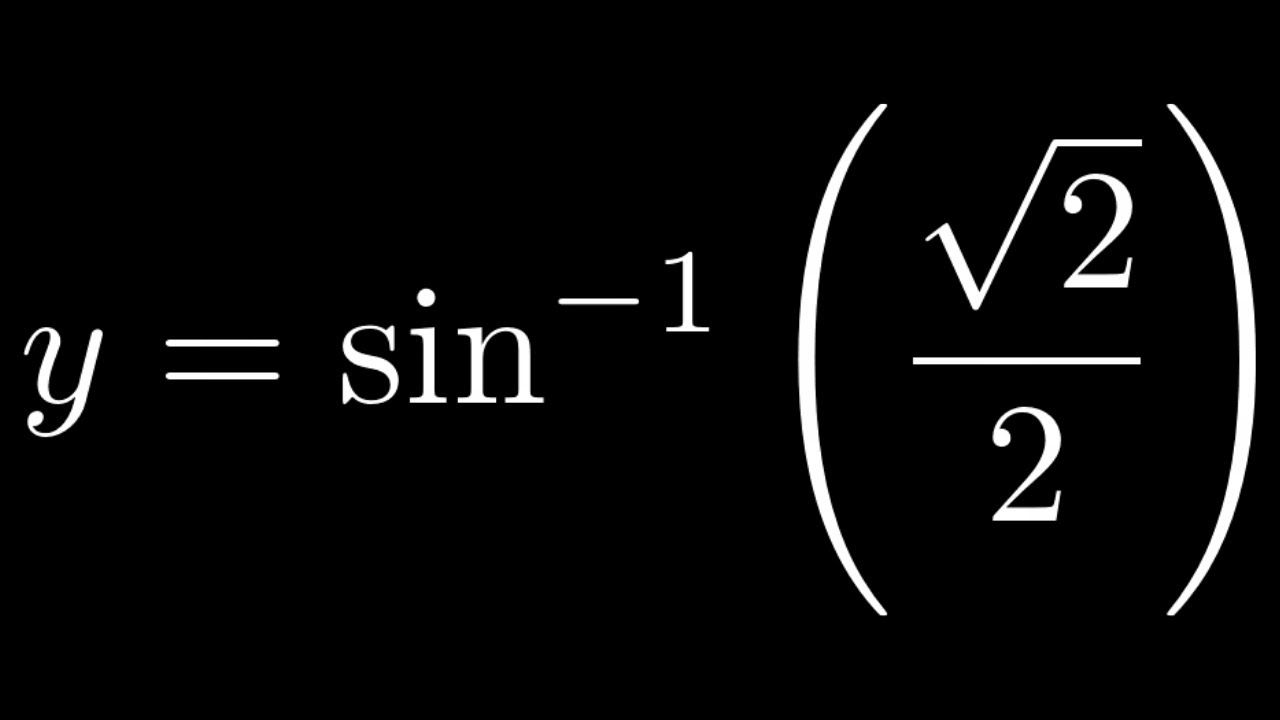
Evaluate y = sin^(-1)(sqrt(2)/2))
If you enjoyed this video please consider liking, sharing, and subscribing.
Udemy Courses Via My Website: https://mathsorcerer.com
My FaceBook Page: https://www.facebook.com/themathsorcerer
There are several ways that you can help support my channel:)
Consider becoming a member of the channel: https://www.y...
he said in the video
dark sparrow
timestamp?
oak matrix
that the range of that equation is the line i pointed
oak matrix
dark sparrow
timestamp?
:30
dark sparrow
"the range of arcsine"
he is talking about the range of the arcsine function, not "the range of the equation"
oak matrix
what is arcsine
dark sparrow
sin^-1
also denoted arcsin
it's the function that, on the input of a number between -1 and 1, returns the angle between -pi/2 and +pi/2 whose sine equals that number.
oak matrix
dark sparrow
it's the function that, on the input of a number between -1 and 1, returns the a...
ooooooooo
dark sparrow
the range of sin^-1 is [-pi/2, +pi/2], and this is part of the definition of sin^-1
oak matrix
okay now i understand the video better
oak matrix
dark sparrow
the range of sin^-1 is [-pi/2, +pi/2], and this is part of the definition of sin...
where is -pi/2 here
 oak matrix
dark sparrow
3pi/2 and -pi/2 are one full turn apart.
oak matrix
dark sparrow
3pi/2 and -pi/2 are one full turn apart.
right?
 dark sparrow
3pi/2 not 3pi/3 but yes sure
oak matrix
dark sparrow
3pi/**2** not 3pi/3 but yes sure
ah yes miswritten
@dark sparrow question again t-t
nvm
wait
sorry
why is it like this
 dark sparrow
sin^-1
also denoted arcsin
it's the function that, on the input of a number between -1 and 1, returns the angle between -pi/2 and +pi/2 whose sine equals that number.
also technically that is incorrect
it should be $y = \arcsin(x) \iff (\sin(y) = x \text{ AND } y \in [-\pi/2, +\pi/2] )$
somber coyoteBOT
Ann
 upper karma

 rustic hazel
upper karma
rustic hazel
upper karma
konse states h tu ?
upper karma
delhi
rustic hazel
is delhi a state?
upper karma
union territory
upper karma
upper karma
@main zenith
upper karma
upper karma
@upper karma
 thorny ruin
 main zenith
upper karma
<@380077808690528256>
main zenith
upper karma
<@380077808690528256>
D
 rugged dew
hey people, why does the paraxial approximation map theta, instead of 0, to sin?
I cannot figure out the reasoning that leads to that, which implies I may also be incorrectly understanding why paraxially-approximated cosine = 1.
 knotty bough
Hello and thanks for the help in advance, very cool to have a place like this for people like me that have 0 idea how geometry works 😄 I have a picture of a shape that I'd like to define and know the measurements of, since the shape grows smaller in size due to the distance of it in the picture it's hard for me to know what the actual shape is (a square, a rectangle, or whatever). Anyone free to receive a PM of a picture of it willing to help out, hit me up! Thank you.
rugged dew
knotty bough
Hello and thanks for the help in advance, very cool to have a place like this fo...
I think that if you don't know the distance between the lens (perhaps virtual) and the shape, you can't calculate this.
rugged dew
do you know the distance along the focal axis between the lens and some object a, and the distance along the focal axis between a + the shape you want to measure? Other than constructing, via geo/trig, a path along which you can figure out axial distance, you could use something super advanced. If you have a very high resolution image and you could train it (an ai) to recognize any similar textures or patterns between the object you want to measure the perceived distance of, for instance, you could train an ai to detect the level of relative downsampling, and thus get a proportionate distance to something you can estimate.
knotty bough
I hve no clue what a focal axis is 😄
I don't have any tools sadly, I'm extremely nooby.
rugged dew
probably the center of the image, If it's taken with most any camera
knotty bough
I don't know the distance sadly. 😦
It's just a picture from the middle of the room basically.
The shape does appear in multiple scenes in the movies I'm using to get the image from but I guess that doesn't help?
rugged dew
I dunno then man. I worked with ai on image analysis for a year and it's not practical to get into as anything short of a major project for a university student or a professional.
well, you don't have distances between the lenses and objects, so your frame of reference is unknown
knotty bough
Yea exactly, sigh. 😦
rugged dew
it's like seeing dots on a grid and no x or y axis. what you gonna do?
say they're a thumb apart? I load that picture on my bigass monitor, and they're two thumbs apart.
knotty bough
Is there a way to identify the shape though, instead of only the measurement.
rugged dew
yeah definitely
knotty bough
Yea that would be a start.
Any idea how?
I sent u a PM better to do it there maybe as to not clutter up the entire section here. 😄
rugged dew
I come from bioinformatics so, ImageJ or CellProfiler
is there either 1. a texture or 2. a color difference between the object you want to outline and the background?
p.s. ImageJ is a generic tool. I'd use Fiji, btw, which is just a convenient UI wrapper around ImageJ
the generic thing you're looking for is called partitioning, in imaging, btw.
if the color is distinctly different, you may be able to use thresholding alone to get your shape
upper karma
rustic hazel
is delhi a state?
lol
upper karma
upper karma
yeh hai trigonometry bhai. barabaar trigonometry hogaya. kiya aap jee ka prepare kar raha ho?
upper karma
upper karma
yeh hai trigonometry bhai. barabaar trigonometry hogaya. kiya aap jee ka prepare...
nope
why?
upper karma
upper karma
why?
just asking
 limpid onyx
Is it always possible find the exact value of $\sin(\frac{2\pi}{n})$ where $n \in \mathbb{Z}$?
somber coyoteBOT
kappa
 upper karma

 brittle lotus
somber coyote
**kappa**
brittle lotus
somber coyote
**kappa**
no
 rapid sigil
how do I make line segments with specific length like maybe 7 cm or similar in geogebra?
 floral shale
somber coyote
**kappa**
floral shale
somber coyote
**kappa**
Taylor series goes crazy
upper karma
 upper karma
upper karma
upper karma
<@&286206848099549185>
 quiet hinge
 quiet hinge
please help me with this question
also correction in the equation of the ellipse
its a^2
brittle lotus
upper karma
so let's first represent secA-tanA also in terms of x
the pythagorean identity sin^2x+cos^2x=1, divide everything by cos^2x gives you tan^2x+1=sec^2x, moving the terms make it sec^2-tan^2x=1. This is equivalent to (secx+tanx)(secx-tanx). We know from the question that the first part is equivalent to x. So it's x(secx-tanx)=1. This is 1/x=(secx-tanx).
Now we have two equations. 1)secA-tanA=x; 2)1/2=secA-tanA
we add up the two together, giving us 2secA=x+1/x
and then divide by 2 gets you the answer
brittle lotus
brittle lotus
we add up the two together, giving us 2secA=x+1/x
this is (x^2+1)/x
so it's answer D
brittle lotus
quiet hinge
dyk whats eccentric angles or parametrization of the coordinates?

 brittle lotus
 wispy lance
circumcentre
brittle lotus
wispy lance
orthocentre
learn the definitions of all first
theres also incentre, excentre, and centroid
limpid onyx
floral shale
Taylor series goes crazy
Can you elaborate?
upper karma
limpid onyx
Can you elaborate?
I think i can answer your question
upper karma
floral shale
nah dw about taylor series
Yh I know about Taylor series
Do you want the answer in closed form? Or by cases
The only form I can think of is an infinite product

@floral shale
floral shale
Product moment
 fickle leaf
Is there any reasonable way to evaluate inverse trig functions without knowing the unit circle? I didn't memorize it at first because of the 30/60/90 and 45/45/90 tricks so now I'm wondering if there's another trick or if I just need to bite the bullet
 snow kite
fickle leaf
Is there any reasonable way to evaluate inverse trig functions without knowing t...
snow kite
fickle leaf
Is there any reasonable way to evaluate inverse trig functions without knowing t...
just learn the unit circle

 mellow quiver
you can find (using properties of 45-45-90 and equilateral triangles) that the longest diagonal is length 1/4*(sqrt6+sqrt2)

i was wondering if there was any reason why it happened to be sin(75 degrees) or if that was coinkydink
snow kite
fickle leaf
ty tho appreciate it at least I know now
with trig the real value is learning demoivre's theorem. infinitely useful
fickle leaf
snow kite
with trig the real value is learning demoivre's theorem. infinitely useful
I'm still learning trig tbh. High school drop out returning to college trying to get a CS degree and learning all my HS math
snow kite
fickle leaf
I'm still learning trig tbh. High school drop out returning to college trying to...
nice man
what are the prerequisites for the CS course?
upper karma
fickle leaf
I'm still learning trig tbh. High school drop out returning to college trying to...
lmao
fickle leaf
snow kite
what are the prerequisites for the CS course?
Everything up to calculus with an actual letter grade, so I need to take remedial courses as I have no transcripts. The course I'm trying to land in is basically a trig course, but I need ot know some trig to get into it, it's lowkey kinda dumb but such is life
fickle leaf
upper karma
lmao
?
snow kite
fickle leaf
Everything up to calculus with an actual letter grade, so I need to take remedia...
yeah. i highly suggest looking at the precalculus course on khan. the trig sections are good
fickle leaf
snow kite
yeah. i highly suggest looking at the precalculus course on khan. the trig secti...
oh yeah, mr khan himself has been a huge help. That and organic chem tutor. The school uses Aleks to let people test out of courses, so I've been using that to study as well. Planning on doing a retake tonight
snow kite
fickle leaf
oh yeah, mr khan himself has been a huge help. That and organic chem tutor. The ...
what type of questions do you get on those tests?
fickle leaf
snow kite
what type of questions do you get on those tests?
With aleks it's basically 1 or 2 questions per topic. It's not looking so much for an overall score, it's looking for mastery of subjects. If you answer say a simple factoring question correctly, it'll then try and give you a harder one, if you answer that right it'll jump up a few topics and ask one that if you answer correctly proves you have mastery over several topics in factoring, so it gives you credit for all of them. It basically covers everything in US high school and middle school mathematics, everything you need to get to Calc 1
snow kite
fickle leaf
With aleks it's basically 1 or 2 questions per topic. It's not looking so much f...
oh ok. hard to prepare for that
limpid onyx
upper karma
So when is this not transcendental?
snow kite
it's all of highschool math combined?
fickle leaf
snow kite
it's all of highschool math combined?
yeap. And it can ask you any question in the set that you haven't already proved mastery over
limpid onyx
floral shale
unless you know calculus
Ik basic calc, like Taylor series and stuff
fickle leaf
Around 290 topics. I have about 50% of them done in live testing
snow kite
then i'd learn as generally as possible
maybe a bit of linear algebra?
do you get a formula booklet
fickle leaf
Nah it's all built into the website itself, it walks you through stuff and teaches each thing individually. I've run through almost all of the topics, I have less than 20 left and they're mostly trig and more difficult functions and logarithms stuff
It's been a JOURNEY to say the least, I'm on a very short timeline and had very little time to prepare
snow kite
gotcha
fickle leaf
hence why I was asking aobut the unit circle, it's more time I don't have to memorize something, but I'm sure there's some easy way to like everyting else
snow kite
yeah cramming all of HS even into 2 years can be tough
fickle leaf
I guess we're gonna find out LMAO
fickle leaf
Basically there's different modules thast you can be put in for Aleks, when I took the test initially in summer I scored so bbad they put me into a different module. About 2 weeks ago I asked why my score wasn't improving much even after months of study and they went "oh oopsies you were in the wrong one" and almost all of my progress was wiped, and I only had 30 topics left. So I've learned about 150 topics in the last 2 weeks, but I feel like it's sticking, after the retake tonightI 'll know for sure.
fickle leaf
snow kite
do you need to memorize the unit circle?
Hopefully not. I don't need to get all of trig right, only about 40% of it in addition to 70% overall with all the topics combined. After the retake tonightI 'll know for sure what I need to know trig wise for my last retake which I'll probably take on saturday or friday night
I'll have the entire sem to really cement trig, I just need to know enough to skirt by on the test
And this test doesn't go on my record, it's just placement
Technical my knowledge checks they have you take every 20 topics has me placing all the way in calculus, not just trig, so I'm hopeful
 misty forge


I can't continue from here, could someone please have a look at this and share some things I may be missing please?
grave pond
Hmm, a first observation is that the $3\sqrt2$ is a bit of a red herring, since that is the only explicitly given length. The real question is, with a configuration like in the diagram, what is $\dfrac{AE+CE}{BE}$? This ratio turns out to be independent of where on the arc ADC we put E!
somber coyoteBOT
Troposphere
 grave pond
I got through with a proof of that by choosing a coordinate where the coordinates of the points are A(1,0), B(0,-1), C(1,0).
Then what we want is the value of $$\frac{\sqrt{(x-1)^2+y^2}+\sqrt{(x+1)^2+y^2}}{\sqrt{x^2+(y+1)^2}}$$ under the assumption that $x^2+y^2=1$ and $y>0$. Took a few false starts, and it's still a bit ugly, but \emph{possible}.
somber coyoteBOT
Troposphere

 grave pond
If you draw an inscribed square (turned 45° with respect to the outer one) it is easier to see that the sum of opposite pairs of quadrilaterals must be the same.
 sonic willow
grave pond
If you draw an inscribed square (turned 45° with respect to the outer one) it is...
sonic willow
grave pond
If you draw an inscribed square (turned 45° with respect to the outer one) it is...
I don't know what to do next

Ik that there are 4 45 45 90 triangles, and they have half area of the big square, but I have no Idea what to do with that fact
grave pond
The 45-45-90 triangles are all equal, so now you only need to see that the irregular triangles on the inside have the same pairwise area sum.
(Hint: declare the red edges to be their bases).
sonic willow
kinda stupid, but I got ?=80 and I think it is correct
but it doesn't look like that on a picture, so I probably got a lot of things wrong
 austere socket
Is there a way to describe the process of finding the smallest polygon that encapsulates a list of coordinates ?
Cuz I can't seem to get good google searches for a solution
I think it's called minimum bounding geometry but I can't find much online
nocturne remnant
austere socket
Is there a way to describe the process of finding the smallest polygon that enca...
By “smallest polygon that encapsulates a list of coordinates” I think you mean https://en.wikipedia.org/wiki/Convex_hull?

In geometry, the convex hull or convex envelope or convex closure of a shape is the smallest convex set that contains it. The convex hull may be defined either as the intersection of all convex sets containing a given subset of a Euclidean space, or equivalently as the set of all convex combinations of points in the subset. For a bounded subset ...
austere socket
I should have also specified that I want only edges that go to and from points of that list
idk if that changes your answer
nocturne remnant
austere socket
I should have also specified that I want only edges that go to and from points o...
Well, that’s pretty obvious. The convex hull of a finite set of points would “tightly fit” the points if that makes sense
There are some algorithms on finding the convex hull but I haven’t looked much into it
austere socket
nocturne remnant
Well, that’s pretty obvious. The convex hull of a finite set of points would “ti...
I also forgot that they have to be straight yeah
so no weirdly fitting shapy
nocturne remnant
. yeah that’s what I was trying to say
Anyways

Given a set of points on a 2 dimensional plane, a Convex Hull is a geometric object, a polygon, that encloses all of those points. The vertices of this polygon maximize the area while minimizing the circumference.
Note that if some additional points were to be included, then the covering area is reduced while the circumference is increased. Li...
Maybe this will be useful?
austere socket
thanks
grave pond
sonic willow
kinda stupid, but I got ?=80 and I think it is correct
But 16+80 does not equal 20+28.
 lapis vigil
can someone help

U mean this?

yea cool so i thikn i got sin and cos down but ned help on the rest
ts what i got so far

 sinful remnant
What’s a good textbook for trigonometry?
 undone moat
somber coyoteBOT
undone moat
somber coyoteBOT
Professor Wumpus.
 dark sparrow

 graceful matrix
sinful remnant
What’s a good textbook for trigonometry?
graceful matrix
sinful remnant
What’s a good textbook for trigonometry?
savvas envision
 grand cargo
 timber cargo
 feral galleon
Can someone teach me trigonometry
feral galleon
Can someone teach me trigonometry
Go to Khan Academy.
feral galleon
No
 tribal rover
Can anyone solve and explain this grade 10 question to me?
 timber cargo
feral galleon
No
timber cargo
feral galleon
No
Sorry pal, but I don't think anyone here will waste their time teaching trigonometry to you when you have access to so many websites and opportunities to learn it yourself.
tribal rover
That’s sad
 golden steppe
tribal rover
Can anyone solve and explain this grade 10 question to me?
golden steppe
tribal rover
Can anyone solve and explain this grade 10 question to me?
can't you do the first question using a pythagorean triplet?
the formula m^2 + 1, m^2 -1, 2m always forms a pythagorean triplet
with m2 +1 being the hypotenuse
I'm just a silly 9th grader but I'm sure you could input into that to find the dimensions
dark sparrow
 glossy basalt
x = 3+r66
glossy basalt
x = 3+r66
don't give out answers (and especially not in this bad format)
glossy basalt
whoopsie so sorry
tribal rover
UGHHHHH

 worthy nimbus
tribal rover
UGHHHHH
worthy nimbus
tribal rover
UGHHHHH
nice geometry
dark sparrow
tribal rover
UGHHHHH
wrong server?
dark sparrow
@tribal rover this sort of stuff belongs in #discussion or #chill
upper karma
sinful remnant
What’s a good textbook for trigonometry?
https://www.examstack.in/2022/12/cengage-mathematics-g-tewani-1.html
go to trigonometry book and download it. it is free and very challenging

Exam Stack
Cengage Mathematics G. Tewani [PDF] Free Download [examstack.in]
 floral ginkgo
How do I calculate a triangle that’s inside a circle?
The distance between AB

In both circles
 solemn goblet
Or just
Ok
So
The area of the first should be 3sin 50
And the second should be 2sin angle m
solemn goblet
floral ginkgo
The distance between AB
For the sides use the laws of cosines
pliant roost
the second circle is superfluous
floral ginkgo
Yeah but i need to know Wich circle creates the least distance between A and B
And my answer book says I need to divide 50 trough 360
Then times 2pi
Times 3
solemn goblet
floral ginkgo
And my answer book says I need to divide 50 trough 360
Those are the circular measure formulas
They are another way to do then
M
floral ginkgo
pliant roost
AB = AB
Yeah but Both circles go trough em
And they wanna know Wich circle has the least distance
solemn goblet
U can just look up circular measure formulas or I can tell you
pliant roost
floral ginkgo
And they wanna know Wich circle has the least distance
the one with the lesser angle?
or you can just measure heights
floral ginkgo
The one with the lesser circle distance
Like the circle goes trough A and B
And they wanna know how long it takes for it to do so
Like the distance in the circle
floral ginkgo
@pliant roost @solemn goblet I solved it!
It was a lil confusing but I made it
Idk how it worked though
grave pond
Uhm, if you don't know how it works, the it doesn't sound like you have solved anything in a mathematical sense.
floral ginkgo
Well I got the answer
And I sort of understand how it works
But like 2 steps I don’t understand
floral ginkgo
I understand the math
But I have a lot of trouble getting to the point where I know what to use
upper karma
can someone help me please

SOMEONE HELP PLZ
@everyone ik this ping does nothing but help
Calculate the slope of each line
If the slopes are equal, the two lines are perpendicular
If $m_1=-\frac{1}{m_2}$ the two lines with slope $m_1$ and $m_2$ are perpendicular
somber coyoteBOT
HPH_Bulko
 upper karma
If $m_1=-\frac{1}{m_2}$ the two lines with slope $m_1$ and $m_2$ are perpendicul...
upper karma
upper karma
If $m_1=-\frac{1}{m_2}$ the two lines with slope $m_1$ and $m_2$ are perpendicul...
thank you so much
i rly appreciate
 potent forge
hi how can i tell if a radian is between 0 and 2 pi
 junior grove
potent forge
hi how can i tell if a radian is between 0 and 2 pi
junior grove
potent forge
hi how can i tell if a radian is between 0 and 2 pi
What do you want to say?
like 45 degree
junior grove
sure, probably 🙂
potent forge
so my question is
-7pi/3
Find an angle between
0
and
2
π
that is coterminal with the given angle.
junior grove
pi is 180 degree
potent forge
2pi is 360 yes
junior grove
hold on
potent forge
and I would add 2pi over 1
times the denominator
of 3
the first answer is -pi/3
but i noticed that is a negative so its not between 0 and 2 pi
so I did it again
potent forge
yes I got that
okay so basically I could tell if its between 0 and 2 pi of I convert the radians to degree
gotchu
makes sense
okay the next one is this
junior grove
potent forge
yes I got that
Trust me question is wrong
potent forge
77pi/2 how can I do this fast
yah I tried that and it was wrong so I found out it wasnt between that
junior grove
77/2 is = 38 right?
potent forge
38pi/2
and that seems to be out of range
so then 38/2
19pi/2
still out of range
sonic willow
I have a question
Does pythagorean theorem work in non-euclidian geometry too?
timber cargo
I believe it's Riemann Curvature Tensor that describes the bending of space
The pythagorean theorem fails at that
 bright elm
An observer (O) is located 500 feet from a school (S). The observer notices a bird (B) flying at a 39° angle of elevation from his line of sight. How high is the bird flying over the school? Please show all work.
timber cargo
bright elm
An observer (O) is located 500 feet from a school (S). The observer notices a bi...
tan(39 degrees)=x/500
But that question is impossible to answer without knowing the height of the school.
Only when you know the height of the school will you know how high the bird is flying over the school
upper karma
and the height of the line of sight of the person
timber cargo
And that too
worthy nimbus
lol
tribal rover
GUYS HELP

 frank moth
Just use the distance formula for all four segments and verify they work. Then find the slope of the two diagonals and check if they are negative reciprocals.
dark sparrow
@tribal rover do you still need help with this?
 prime musk
Guys help me with this sum…
If two internal angle bisector of a triangle to the opposite side are equal in length, then prove that the triangle is isosceles.
snow kite
prime musk
If two internal angle bisector of a triangle to the opposite side are equal in l...
do you use vectors for that?
prime musk
snow kite
do you use vectors for that?
Umm I don’t know how to solve…. Would be very grateful if anyone can show a detailed proof
snow kite
prime musk
Umm I don’t know how to solve…. Would be very grateful if anyone can show a deta...
I don't know how.
 civic folio
does anyone know what formula needed for ray casting?
tribal rover
dark sparrow
<@772968168154857472> do you still need help with this?
YES
dark sparrow
okay, have you made any progress thus far?
upper karma
so, the lowest amount of legs a polygon can have is 3, right? because you need 3 legs to close a triangle. now in 2 dimensions you need 6, because a pyramid is shaped like a polygon and has 6 legs. now does that mean that the lowest 4 dimensional polygon-like object has at least 12 legs?
upper karma
Find Missing Measures Using the Pythagorean Theorem but how
 vagrant crystal
@thorn dragon check dm
prime musk
prime musk
If two internal angle bisector of a triangle to the opposite side are equal in l...
Umm anyone who can help me…..
 neat steeple
Is this right?

 upper karma
can someone help with question 1

 royal cedar
Compute the angles CDF and FDE using the isosceles triangles
upper karma
upper karma
can someone help with question 1
and also refer to properties of kites
smoky jetty
upper karma
can someone help with question 1
diagonals of a kite are perpendicular (i.e they intersect at 90 degrees), therefore you can refer to Pythagorean theorem with that
another thing is that the longer diagonal bisects the triangle DEF which is an isosceles triangle, as part of the kite divided by the segment DF
 dark reef
kites have a pair of opposite congruent angles
also use the fact that all the interior angles add up to 360
keen lintel
prime musk
If two internal angle bisector of a triangle to the opposite side are equal in l...
Its trivial by angle bisector theorem, unless you require the proof of angle bisector theorem
keen lintel
 wanton fog
HELP
wanton fog
HELP
Consider two right angle triangles, ABC and ABD, Let angle BAD=y
,notice cos(y)=3/x=x/11 , Thus x^2=33 and just take the square root
 flat moth
How did we find the second equation

From i+1 to the ones with square root of 2 and all
I do understand that they're equal to one another but idk how they did it
dark sparrow
|1+i| = sqrt(2)
their idea was to separate the modulus and argument but without writing out exp(i*arg)
so that it's just modulus * unit
dark sparrow
i'm using it a bit informally
flat moth
1+i is the unit right?
dark sparrow
when i said "unit" i meant "complex number whose magnitude is 1"
 old nacelle
can someone help please. For the 2nd pic both 86 and 92 are wrong.


 near harness
old nacelle
can someone help please. For the 2nd pic both 86 and 92 are wrong.
near harness
old nacelle
can someone help please. For the 2nd pic both 86 and 92 are wrong.
Yea they are wrong. Angle T and angle V should add up to 180° but only add up to 178
old nacelle
near harness
Yea they are wrong. Angle T and angle V should add up to 180° but only add up to...
yeah that’s what i thought so is 88 the right answer?
near harness
Well the question asks measure of U
So U + V = 180
U = 180 - V
Which is 92 if we take V = 88
Otherwise 94 if we take V = 86
old nacelle
oh ok thanks
smoky jetty
near harness
Otherwise 94 if we take V = 86
could the value be uncertain inthe problem?
coz the only thing that I think would have a fixed value would be Angle S
upbeat latch
wanton fog
HELP
the simplest approach that I saw in the question is that, I did this sum by using Pythagoras in the three TRIANGLES-which leads to x= sqrt(33)
upbeat latch
wanton fog
HELP
Like, I first took Triangle BDA, then Triangle BDC, and then, Triangle ABC, and after applying Pythagoras to all of them, you would come up with some Commons that you could use in one of the Equations where the Equation becomes a Pure in "x" and a constant Numeric which leads to the final Answer of sqrt(33) which approximates 5.74
 shrewd idol
wanton fog
HELP
shrewd idol
wanton fog
HELP
BD^2 = AD*AC if i remember correctly
 pure cobalt
someone speaks Spanish? I need help, urgently
 wicked narwhal
old nacelle
can someone help please. For the 2nd pic both 86 and 92 are wrong.
wicked narwhal
old nacelle
can someone help please. For the 2nd pic both 86 and 92 are wrong.
hi, I would say (36+x2)/2=7x-6 but I don't know explain
It is a property of median
 novel axle
Anyone know how to solve this?
 snow kite
novel axle
Anyone know how to solve this?
snow kite
novel axle
Anyone know how to solve this?
the horizontal line is the "image"
so part A would be 1 unit
wanton fog
upbeat latch
Like, I first took Triangle BDA, then Triangle BDC, and then, Triangle ABC, and ...
thank u sm
 junior heath
old nacelle
can someone help please. For the 2nd pic both 86 and 92 are wrong.
junior heath
old nacelle
can someone help please. For the 2nd pic both 86 and 92 are wrong.
First question is a simultaneous equations problem in disguise. The two trapeziums created by the median are similar, so a*(x^2)=7x-6 and a(7x-6)=36 for some scaling factor a. You can then solve for x
 cerulean fiber
Evan and Ryan each chipped in $1000 to buy an old boat to fix it up. Then Evan spent $825 on materials and Ryan spent $1650 on parts. They worked an equal number of hours and sold it for $6800. How should they fairly divide the $6800? Round to the nearest cent.
 narrow condor
can someone help me with this?
 dark sparrow
,rccw
somber coyoteBOT
 dark sparrow
@narrow condor do you still need help with this?
narrow condor
dark sparrow
<@760689548975407145> do you still need help with this?
yea please
dark sparrow
have you made a diagram?
narrow condor
i got up to here
 dark sparrow
actually, come to think of it, the problem is somewhat ambiguous as stated if we view it in 3 dimensions...
,rccw
somber coyoteBOT
 narrow condor
but i’m confused about the ambiguous case
dark sparrow
ok, i take it that B and C are the fishing boats while A is the school of fish
narrow condor
yes
dark sparrow
narrow condor
but i’m confused about the ambiguous case
what ambiguous case? are you talking about the ambiguity i alluded to just now, or what?
narrow condor
yea that
dark sparrow
when you say "the ambiguous case", do you mean the possibility that can arise when solving a triangle that you can't tell if a particular angle is acute or obtuse despite knowing its sine?
because that's not at all what i was talking about.
narrow condor
yea i was talking about how it doesn’t state that the school is right in between them, but it could possibly be located on another side. here i’ll draw it out
dark sparrow
right
i viewed this problem from a 3-dimensional standpoint and reasoned thusly:
the set of all points at an angle of depression of 35° from the first fisherman is a cone with its apex at the fisherman's boat, extending downward. similarly for the other fisherman.
so the set of all possible locations for the school of fish is in fact the intersection between these two cones
wait hold on somethings wrong here still
ok fuck it im geogebraing this shit
ok, so the fish apparently have an entire ellipse of points in the water that they could be in lmao
 narrow condor
great😃
dark sparrow
i placed the first fisherman at (0,0,0) and the second at (18,0,0)
and then plotted the cones of angle-of-depression 35° and 51° for them
yeah we in fact don't know that the angle between the first fisherman's line-of-sight to the fish and his line-of-sight to the second fisherman is 35°.
narrow condor
this question is ridiculous
dark sparrow
it sure is!
oh also i think i misspoke - idt the curve of intersection is an ellipse at all
smoky jetty
smoky jetty
assum the diagonal IT is longer, coz I suck at drawing online
update on this, which I found unsolvable at first. Apparently, I don't know if it was my mistake for the labeling, or this just depends on how one labels a quadrilateral based on the 4 vertices which makes it solvable. Basically, if you label it as LIYT, but the letters are shifted to the right by 1 position, then you'd get the value. What do you guys think of this?
i waited for almost a month to know whats up with these problems coz i thought theres a property i didnt know
smoky jetty
smoky jetty
I got this quiz problem before (unfortunately, at the time, I wasn't able to get...
ok now with this problem, the shape was said by our teacher, and upon knowing, the answer was easily found. But what I found quite confusing is how the shape was assumed to be kite, because of what our teacher said, "the given values are the diagonals and area, to find x, thus is a hint (translated). What i found ambigious with this is I think there's no logic behind it. yes, the x can be found if it was a kite, but quadrilaterals has area and diagonals as well, so it can be other quads as well, though may not be solved. But still, do u guys agree with my teacher's reasoning here? I just wanna know if it would make sense to rely on such "hint" if it were based on the previous lesson
coz idk if I did'nt do enough analyzing the paragraph per problem, or there's something wrong with it.
near harness
smoky jetty
could the value be uncertain inthe problem?
angle T and V have to be supplementary but they are not in the question since they add up to 178 deg not 180.
smoky jetty
i think it didn't state that the given is an isosceles trapezoid, as opposite angles would be =180 if it is an isosceles trapezoid

 coarse lance
am i meant to google this or is it easy to enough to create it with the information given?

(the second problem)
$2d^2$ i made this
somber coyoteBOT
Price
 wicked narwhal
 royal dawn
No, it is C the correct answer
 royal dawn
wicked narwhal
No, it is C the correct answer
royal dawn
wicked narwhal
No, it is C the correct answer
thank you so much for this. i jus figured it out like 10 mins ago 😭
i have like 5 more questions if your free can u help?